GRE quantitative comparison questions contribute to roughly 30% of GRE’s Quantitative Reasoning and their thorough coverage is therefore must in a comprehensive GRE prep course. QC is not a separate topic or concept but a distinct question format used to test the same quantitative concepts assessed by other GRE question types. Quantitative Comparison questions on the GRE place two values side by side as Quantity A and Quantity B and guide you to judge their relationship using four fixed answer options.
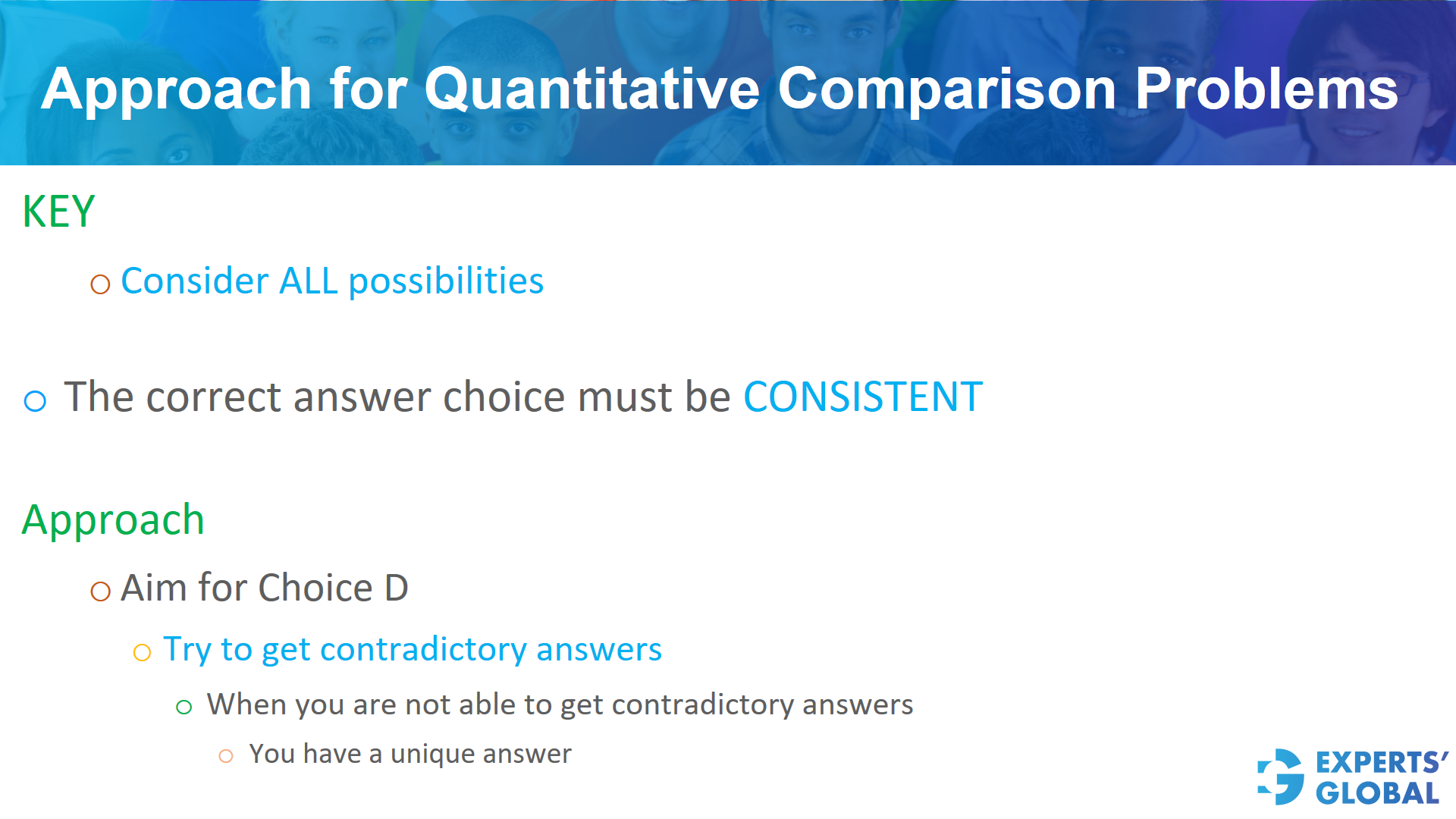
Approach for Solving GRE Quantitative Comparison Questions
In QC questions, you do not compute a final numeric value and instead compare two given quantities, which should make them more approachable. Yet many students see lower accuracy here due to the absence of a clear and organized solving approach. The following video walks you through a clear and organized approach to solving QC questions and then applies that approach across multiple GRE style examples with cleverly designed choices, helping you apply the method smoothly in your GRE drills, GRE sectional tests, and GRE full-length tests.
Key Slide Recap
GRE-Style Practice Questions | Quantitative Comparison
In the last lesson, you learnt a smart approach for solving GRE QC questions. The next step is application. The exercise below presents a focused set of GRE style Quantitative Comparison questions with clear explanations. Work through each question patiently, aim for correct reasoning, and study every explanation with care.
All the best!
Practice Question 1 | GRE QC
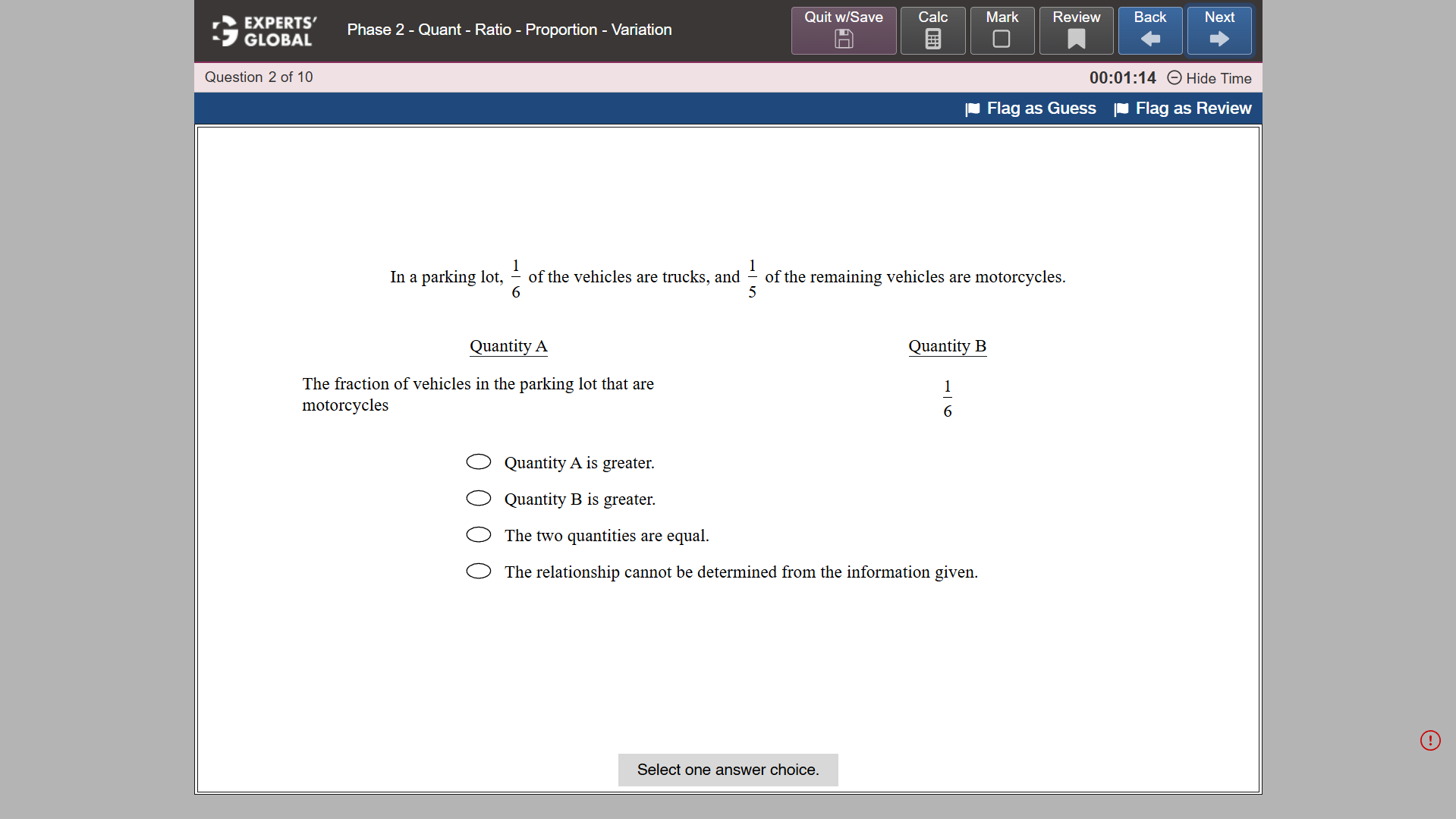
In a parking lot, 1/6 of the vehicles are trucks, and 1/5 of the remaining vehicles are motorcycles.
Quantity A: The fraction of vehicles in the parking lot that are motorcycles
Quantity B:1/6
A. Quantity A is greater.
B. Quantity B is greater.
C. The two quantities are equal.
D. The relationship cannot be determined from the information given.
Show Explanation
Written Explanation
We need to determine the relationship between the fraction of vehicles in the parking lot that are motorcycles and 1/6.
Quantity A:
The fraction of vehicles that are trucks = 1/6.
The fraction of remaining vehicles that are not trucks = 1 – The fraction of vehicles that are trucks = 1 – (1/6) = 5/6.
Since 1/5 of the remaining vehicles are motorcycles, the fraction of vehicles that are motorcycles= (1/5) of (5/6) =(1 × 5)/(5 × 6) = 1/6.
Quantity B: 1/6
Hence, the two quantities are equal.
C is the correct answer.
Practice Question 2 | GRE QC
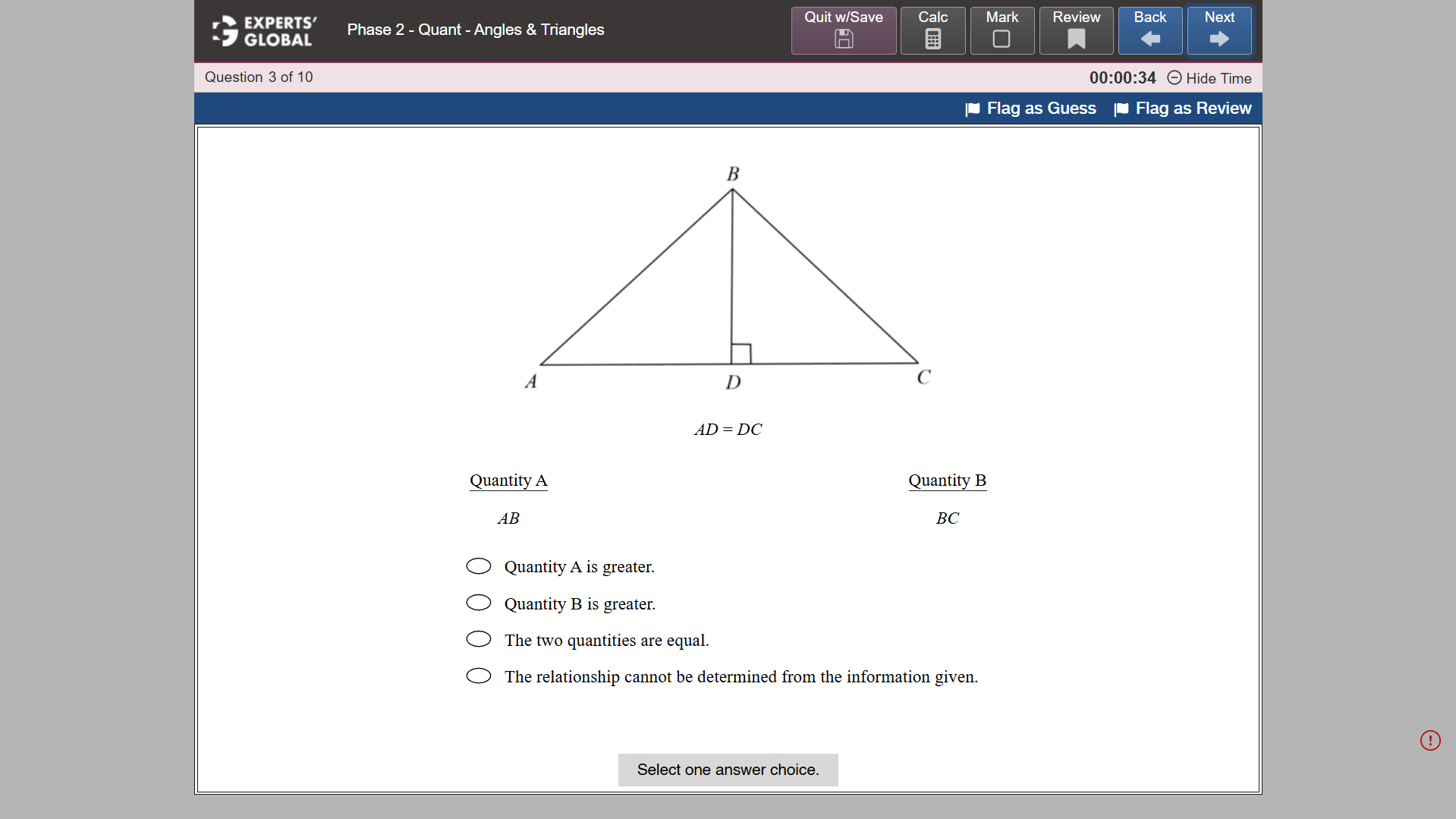
AD = DC
Quantity A:AB
Quantity B:BC
A. Quantity A is greater.
B. Quantity B is greater.
C. The two quantities are equal.
D. The relationship cannot be determined from the information given.
Show Explanation
Written Explanation
AD = DC We need to determine the relationship between AB and BC.
Since triangle BDA is a right triangle, AB2 = BD2 + AD2. (Equation I)
Similarly, since triangle BDC is a right triangle, BC2 = BD2 + DC2. (Equation II)
Since AD = DC, it follows that BD2 + AD2 = BD2 + DC2. (Equation III)
From Equations I, II, and III, AB2 = BC2.
Hence, the two quantities are equal.
C is the correct answer.
Practice Question 3 | GRE QC
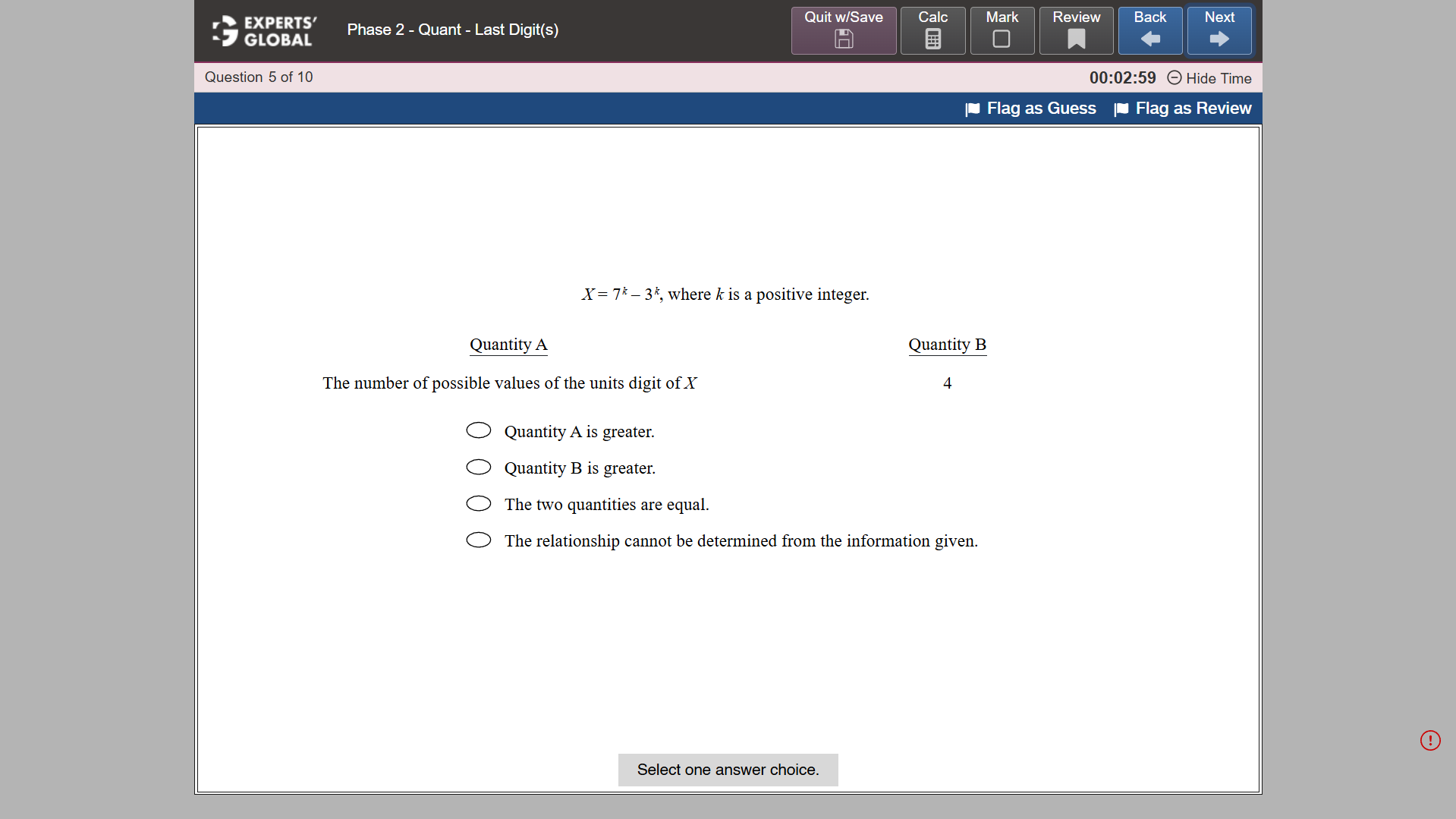
X = 7k – 3k, where k is a positive integer.
Quantity A: The number of possible values of the units digit of X
Quantity B: 4
A. Quantity A is greater.
B. Quantity B is greater.
C. The two quantities are equal.
D. The relationship cannot be determined from the information given.
Show Explanation
Written Explanation
X = 7k – 3k where k is a positive integer.
We need to determine the relationship between the number of possible values of the units digit of X and 4.
Quantity A:
There are 4 possible values for the units digit of 7k for positive integer values of k, which follow the cyclic pattern of 7, 9, 3, and 1.
Similarly, there are 4 possible values for the units digit of 3k for positive integer values of k, which follow the cyclic pattern of 3, 9, 7, and 1.
The units digit of 7k – 3k will follow the cyclic pattern of the difference of the units digit of 7k and 3k.
Possibility 1:k is of the form 4n + 1, where n is a positive integer.
The units digit of 7k – 3k = 7 – 3 = 4. Possibility 2:k is of the form 4n + 2, where n is a positive integer.
The units digit of 7k – 3k = 9 – 9 = 0. Possibility 3:k is of the form 4n + 3, where n is a positive integer.
The units digit of 7k – 3k
= units digit of 7k – 3k + 10
= 3 – 7 + 10 = 6 Possibility 4:k is of the form 4n, where n is a positive integer.
The units digit of 7k – 3k = 1 – 1 = 0.
Therefore, there are 3 possible values of the units digit of 7k – 3k, which are 0, 4, and 6.
Quantity B: 4
Hence, Quantity B is greater.
B is the correct answer.
Practice Question 4 | GRE QC
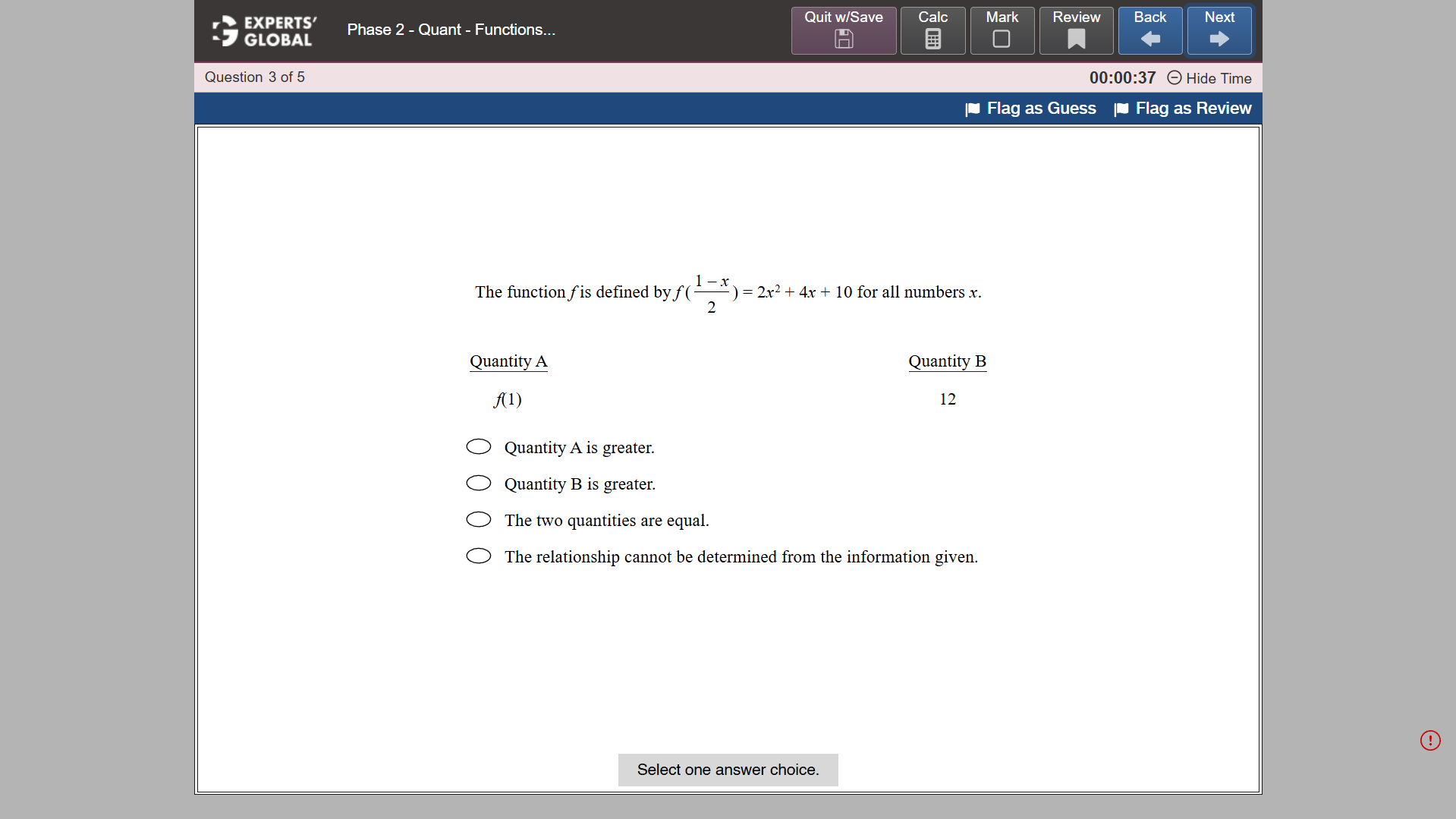
The function f is defined by f (1 – x/2) = 2x2 + 4x + 10 for all numbers x.
Quantity A:f(1)
Quantity B: 12
A. Quantity A is greater.
B. Quantity B is greater.
C. The two quantities are equal.
D. The relationship cannot be determined from the information given.
Show Explanation
Written Explanation
f (1 – x/2)= 2x2 + 4x + 10 We need to determine the relationship between f(1) and 12.
Quantity A:
Since we need to calculate f(1) and f is expressed in terms of x, we first need to calculate the corresponding value of x. (1 – x)/2 = 1
1 – x = 2
–x = 1 x = –1
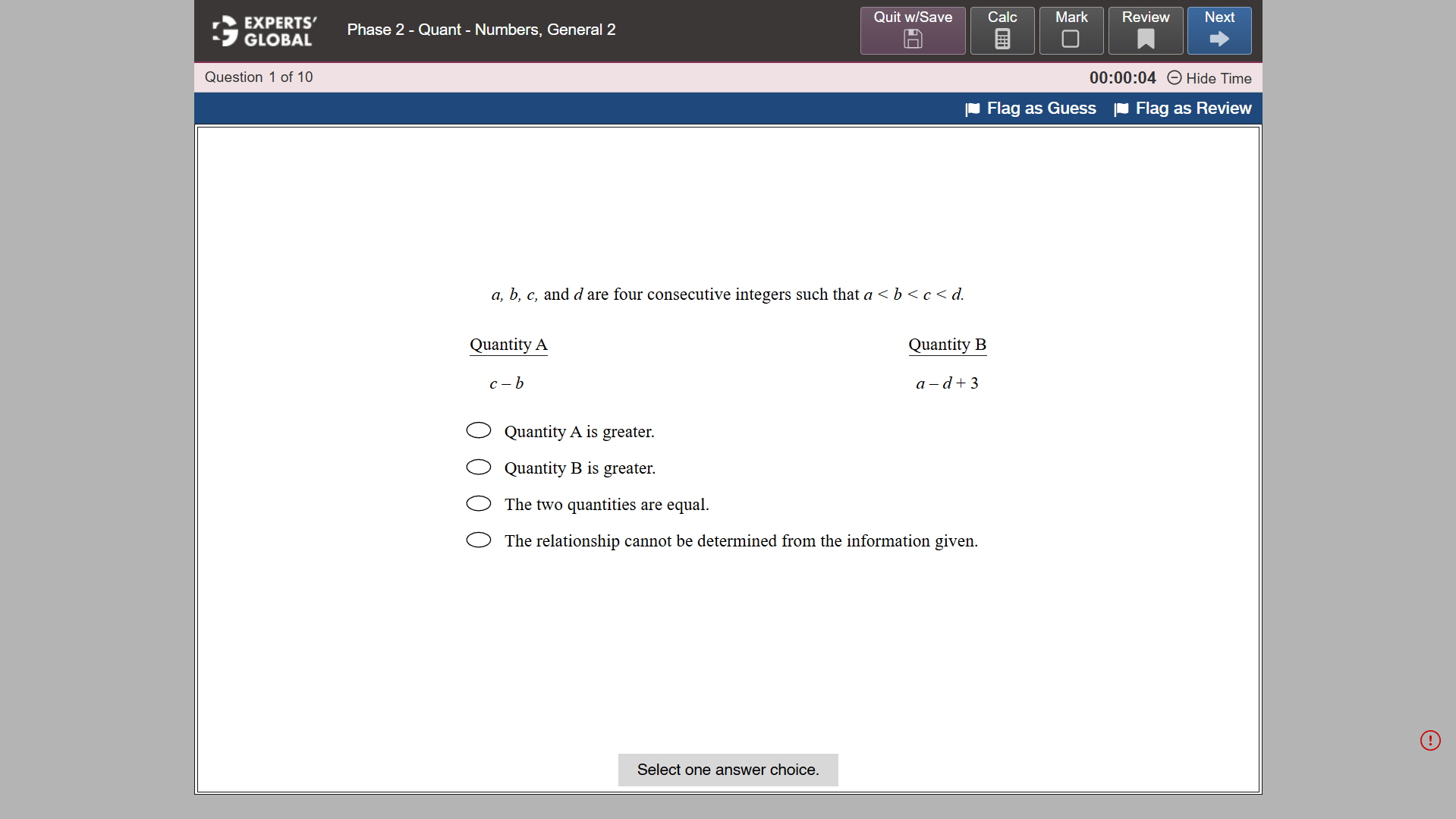
a, b, c, and d are four consecutive integers such that a < b < c < d.
Quantity A:c – b
Quantity B:a – d + 3
A. Quantity A is greater.
B. Quantity B is greater.
C. The two quantities are equal.
D. The relationship cannot be determined from the information given.
Show Explanation
Written Explanation
We need to determine the relationship between c – b and a – d + 3.
Since a, b, c, and d are four consecutive integers such that a < b < c < d; b = a + 1 c = a + 2 d = a + 3
Quantity A:c – b = (a + 2) – (a + 1) = a + 2 – a – 1 = 1. Quantity B:a – d + 3 = a – (a + 3) + 3 = a – a – 3 + 3 = 0.
Hence, Quantity A is greater.
A is the correct answer.
Practice Question 6 | GRE QC
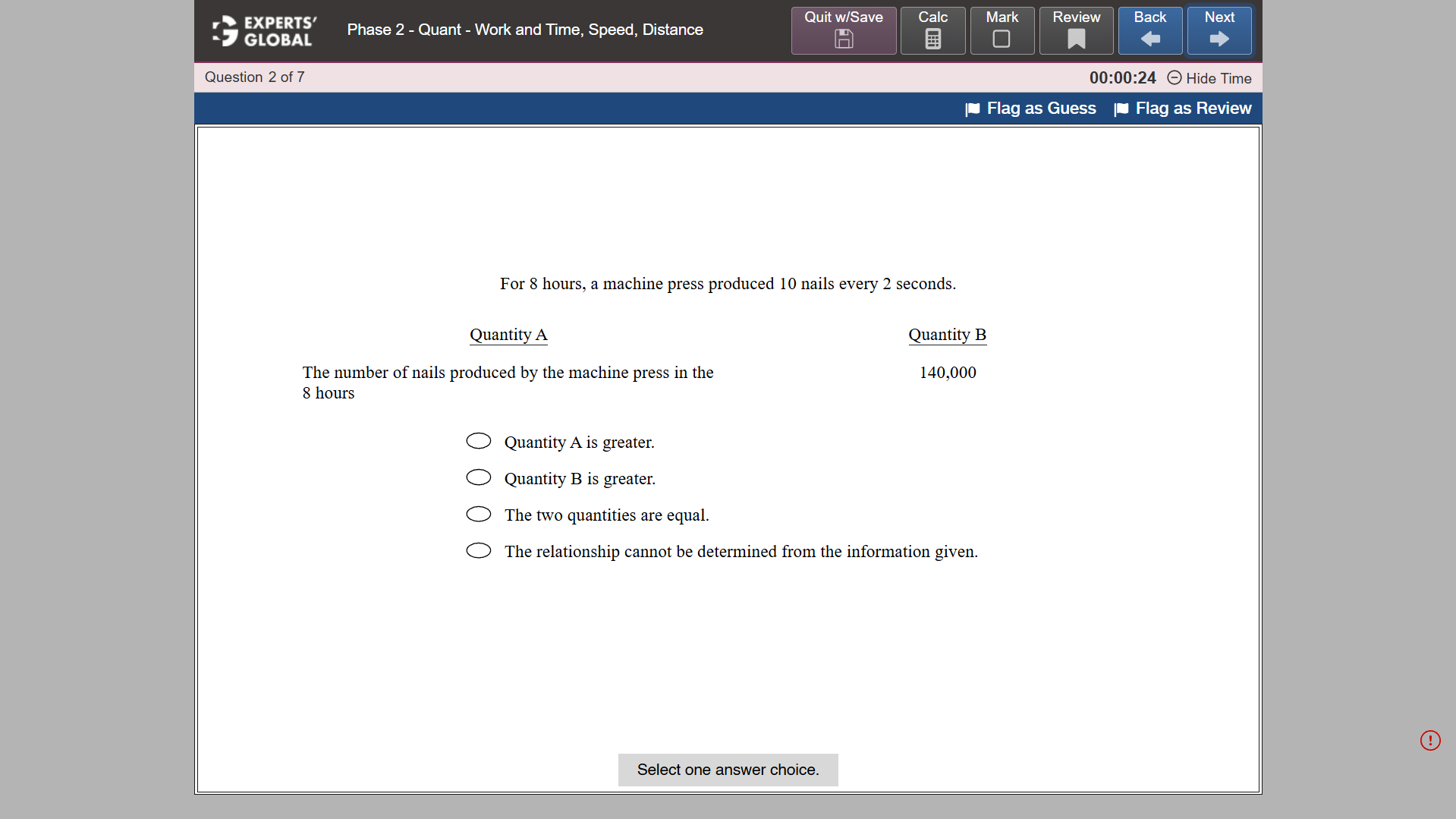
For 8 hours, a machine press produced 10 nails every 2 seconds.
Quantity A: The number of nails produced by the machine press in the 8 hours
Quantity B: 140,000
A. Quantity A is greater.
B. Quantity B is greater.
C. The two quantities are equal.
D. The relationship cannot be determined from the information given.
Show Explanation
Written Explanation
A machine press produced 10 nails every 2 seconds.
We need to determine the relationship between the number of nails produced by the machine press in 8 hours and 140,000.
Quantity A:
10 nails every 2 seconds, implies that the machine produces 5 nails per second.
The number of nails that the machine produces per hour = 5 × 60 × 60.
The number of nails that the machine produces in 8 hours = 5 × 60 × 60 × 8 = 144,000.
Quantity B: 140,000
Hence, Quantity A is greater.
A is the correct answer choice.
Practice Question 7 | GRE QC
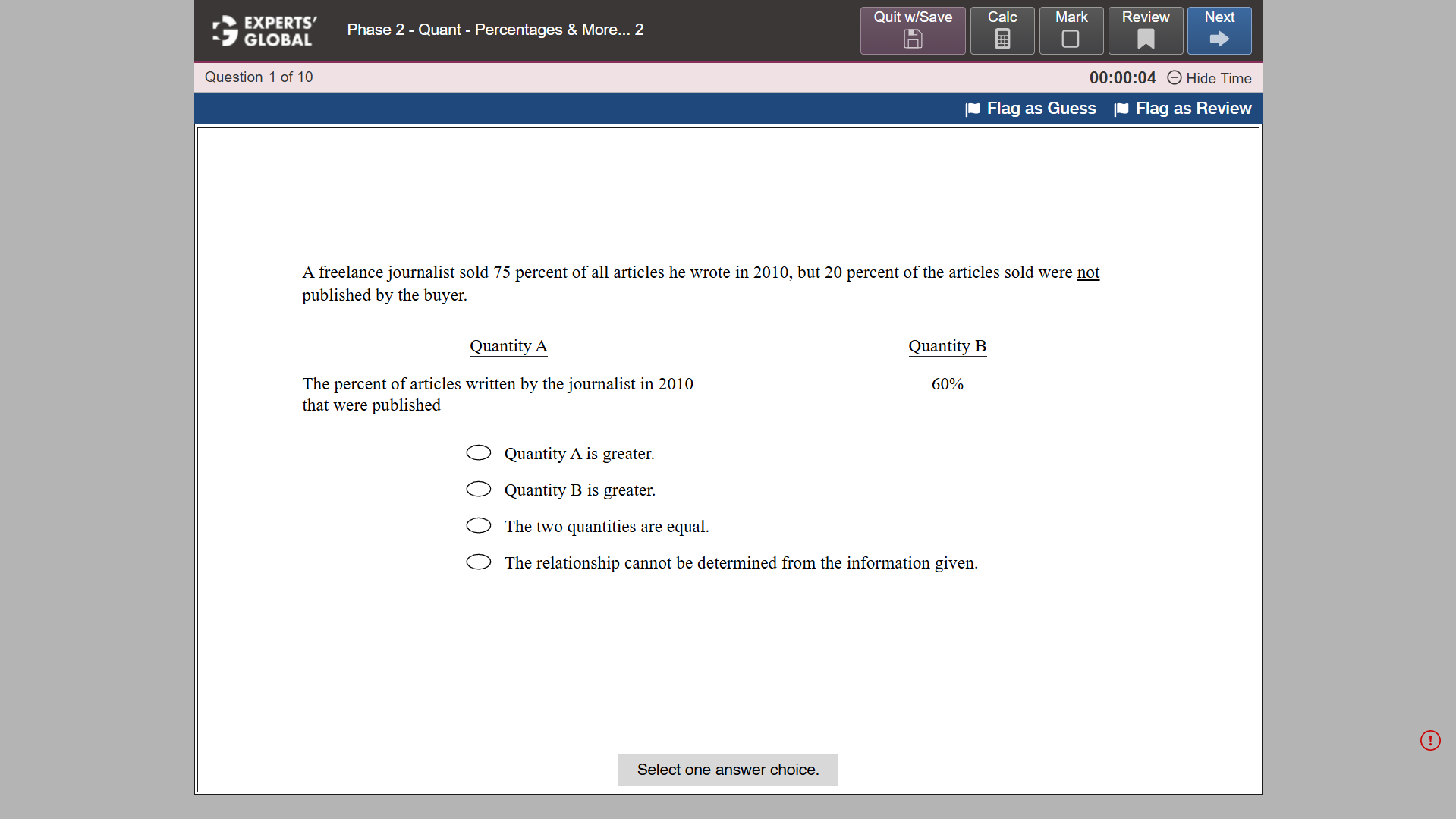
A freelance journalist sold 75 percent of all articles he wrote in 2010, but 20 percent of the articles sold were not published by the buyer.
Quantity A: The percent of articles written by the journalist in 2010 that were published
Quantity B: 60%
A. Quantity A is greater.
B. Quantity B is greater.
C. The two quantities are equal.
D. The relationship cannot be determined from the information given.
Show Explanation
Written Explanation
Let the total number of articles written by the journalist be x.
We need to determine the relationship between the percentage of articles written that were published and 60%.
Quantity A:
The journalist sold 75% of all articles written.
Therefore, the number of articles sold = 0.75x.
20% of the articles sold were not published.
Therefore, the number of articles that were published = (0.8)(0.75x) = 0.6x = 60% of x.
Thus, the percent of articles written that were published = 60%.
Quantity B: 60%
Hence, the two quantities are equal.
C is the correct answer.
Practice Question 8 | GRE QC
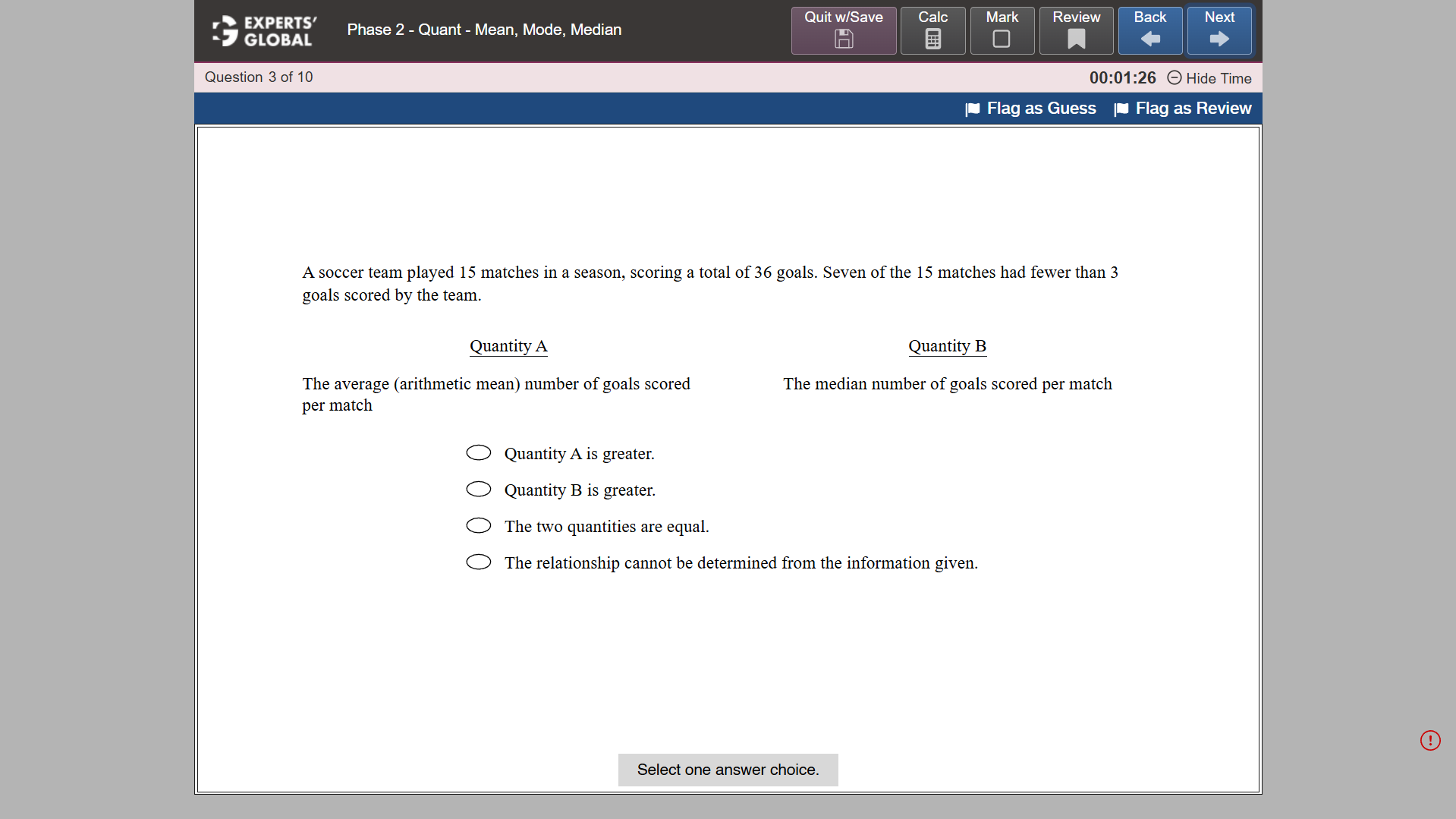
A soccer team played 15 matches in a season, scoring a total of 36 goals. Seven of the 15 matches had fewer than 3 goals scored by the team.
Quantity A: The average (arithmetic mean) number of goals scored per match
Quantity B: The median number of goals scored per match
A. Quantity A is greater.
B. Quantity B is greater.
C. The two quantities are equal.
D. The relationship cannot be determined from the information given.
Show Explanation
Written Explanation
The soccer team played 15 matches in a season, scoring a total of 36 goals.
Seven of the 15 matches had fewer than 3 goals scored by the team. We need to determine the relationship between the average and the median number of goals scored per match.
Quantity A: The average number of goals scored per match
= (Total number of goals scored)/15
= 36/15 = 2.4
Quantity B:
The median of an ordered set with an odd number of elements is the middle number. Possibility 1: If the goals scored in 15 matches are as follows: {0, 0, 0, 0, 0, 0, 0, 4, 4, 4, 4, 5, 5, 5, 5}, then the median is 4. In this case, Quantity A < Quantity B. Possibility 2: If the goals scored in 15 matches are as follows: {2, 2, 2, 2, 2, 2, 2, 2, 2, 2, 2, 2, 2, 2, 8}, then the median is 2. In this case, Quantity A > Quantity B.
Hence, the relationship cannot be determined from the information given.
D is the correct answer.
Practice Question 9 | GRE QC
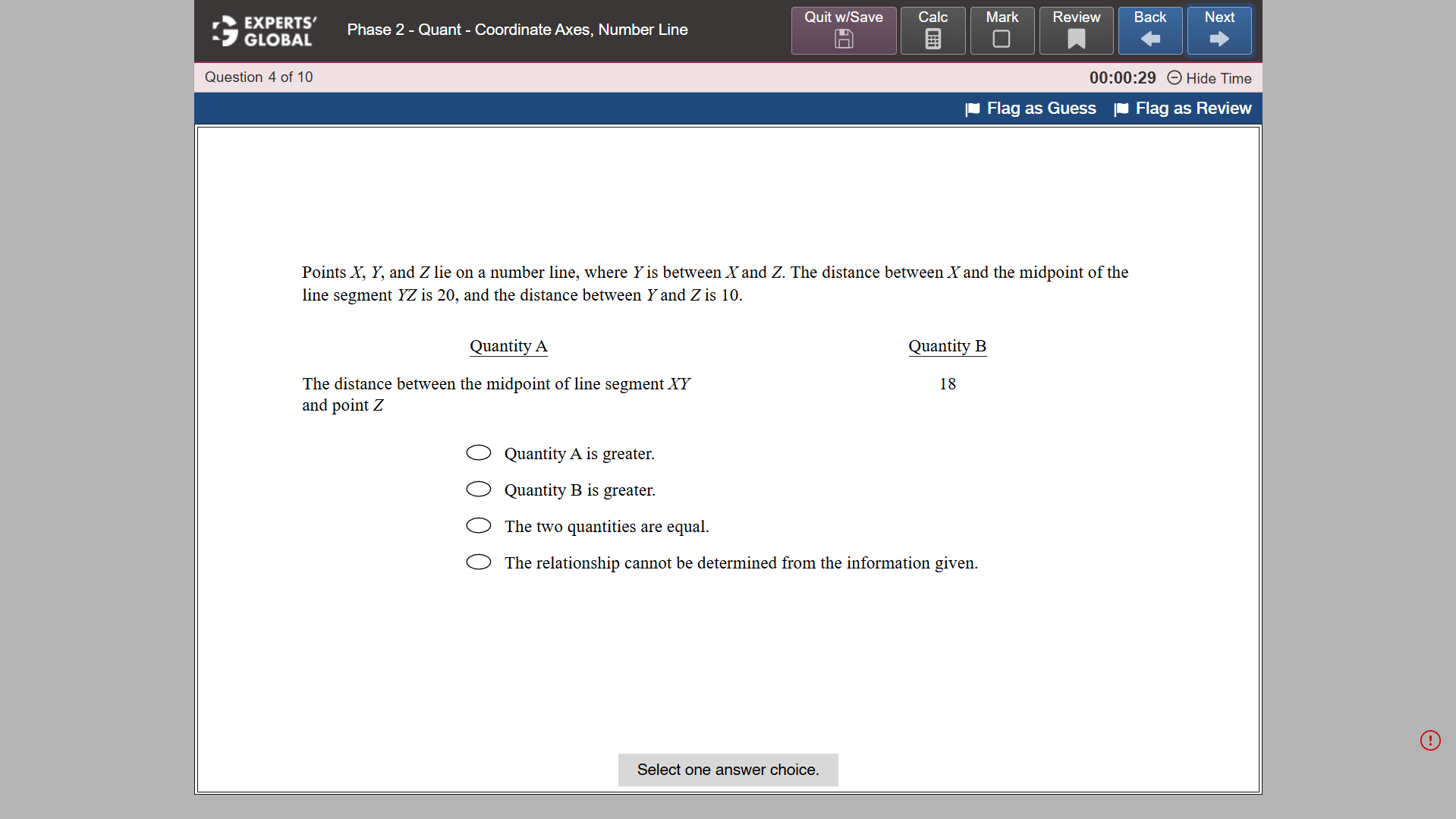
Points X, Y, and Z lie on a number line, where Y is between X and Z. The distance between X and the midpoint of the line segment YZ is 20, and the distance between Y and Z is 10.
Quantity A: The distance between the midpoint of line segment XY and point Z
Quantity B: 18
A. Quantity A is greater.
B. Quantity B is greater.
C. The two quantities are equal.
D. The relationship cannot be determined from the information given.
Show Explanation
Written Explanation
Let points M and N be the midpoints of the line segments XY and YZ, respectively. XN = 20 YZ = 10 We need to determine the relationship between the distance between the midpoint of line segment XY (point M) and point Z and 18.
Quantity A:
Since N is the midpoint of YZ, YN = (1/2) × YZ = (1/2) × 10 = 5. XY = XN – YN = 20 – 5 = 15
Since M is the midpoint of XY, MY = (1/2) × XY = (1/2) × 15 = 7.5. MZ = MY + YZ = 7.5 + 10 = 17.5
Quantity B: 18
Hence, Quantity B is greater.
B is the correct answer.
Practice Question 10 | GRE QC
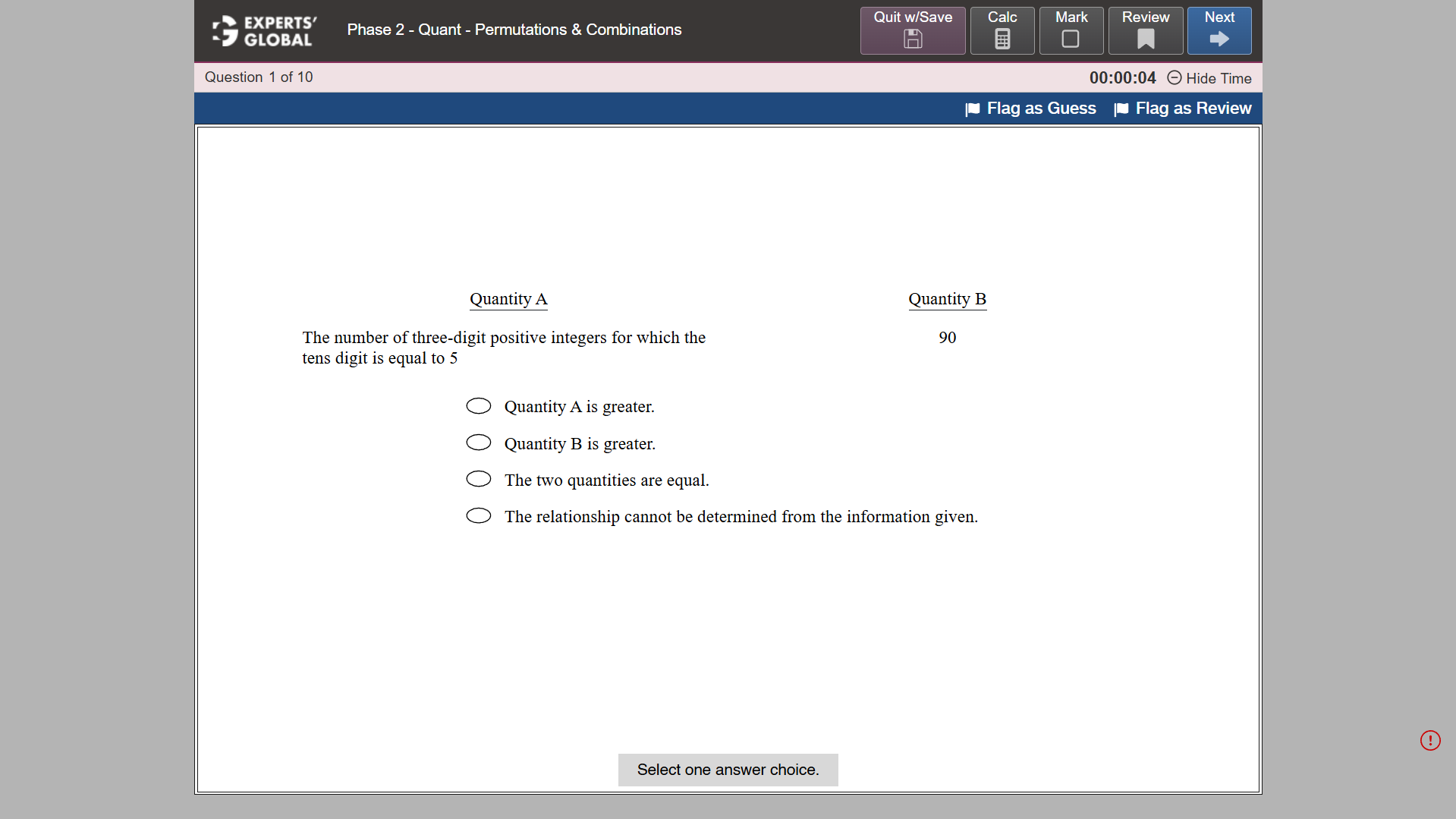
Quantity A: The number of three-digit positive integers for which the tens digit is equal to 5
Quantity B: 90
A. Quantity A is greater.
B. Quantity B is greater.
C. The two quantities are equal.
D. The relationship cannot be determined from the information given.
Show Explanation
Additional GRE-style Quantitative Comparison Questions with Explanations: