The quantitative reasoning section of the GRE is one of the three sections and appears in two parts, with the difficulty of the second part based on your performance in the first part. Stronger performance leads to a more challenging second part and improves your chance of a higher score. The question types may test all topics and concepts within the GRE quantitative reasoning curriculum. On this page, we present a rich set of GRE quant practice questions across all GRE question types, topics, concepts, and formats. Use this resource and the explanations with care, and apply the learnings in further GRE preparation and practice across GRE sectional mocks and GRE full-length mocks.
Important: If you need to undergo thorough Quant preparation, please visit Free GRE Quantitative Reasoning prep
Practice Question 1 | GRE Quant
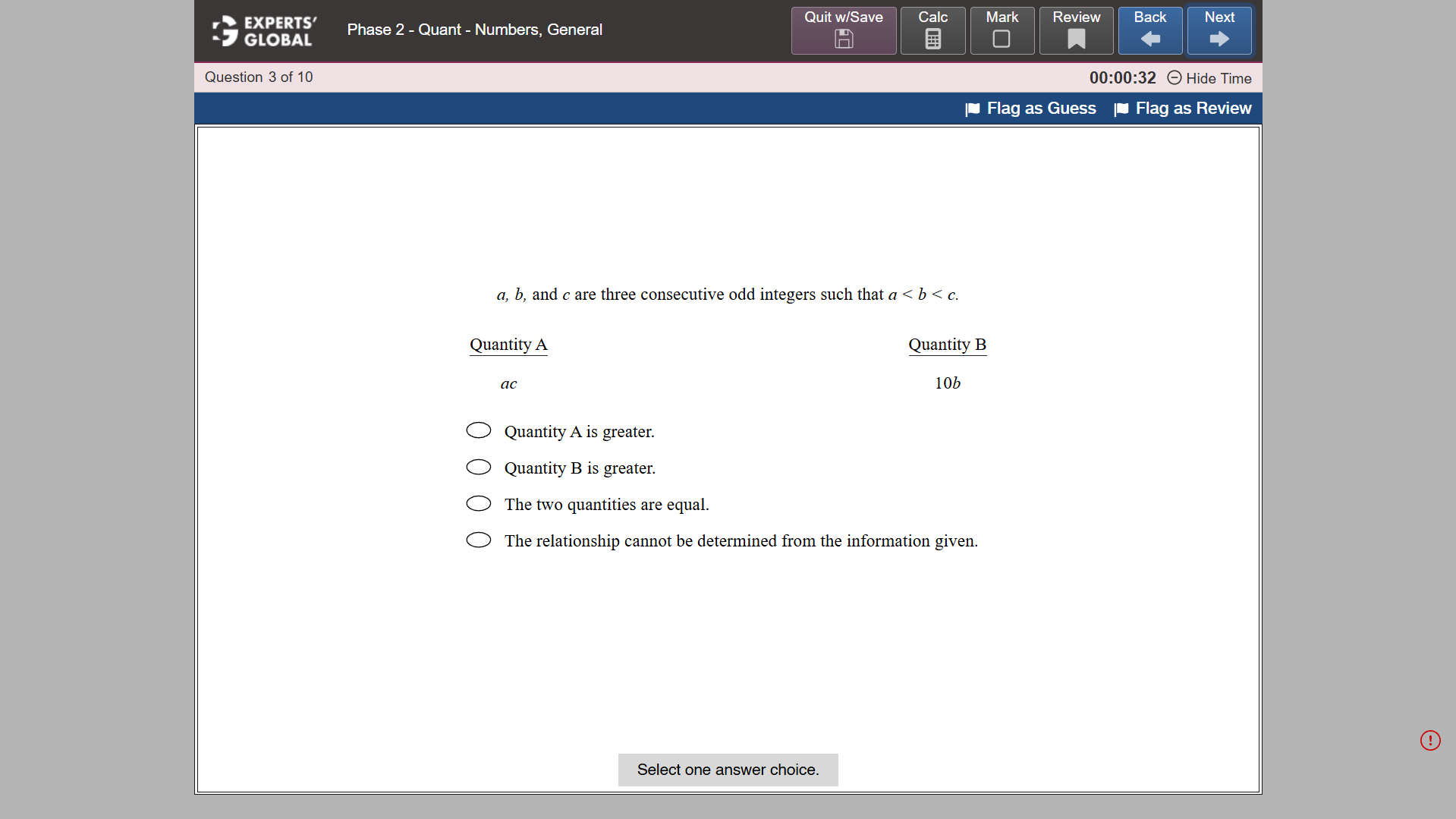
a, b, and c are three consecutive odd integers such that a < b < c.
Quantity A: ac
Quantity B:: 10b
A. Quantity A is greater.
B. Quantity B is greater.
C. The two quantities are equal.
D. The relationship cannot be determined from the information given.
Written Explanation
We need to determine the relationship between ac and 10b.
a, b, and c are three consecutive odd integers such that a < b < c;
b = a + 2
c = a + 4
Quantity A: ac = a(a + 4) = a2 + 4a.
Quantity B: 10b = 10(a + 2) = 10a + 20.
Possibility 1: a = 1
Quantity A: (1)2 + 4(1) = 5
Quantity B: 10(1) + 20 = 30
In this case, Quantity A < Quantity B.
Possibility 2: a = 25
Quantity A: (25)2 + 4(25) = 725
Quantity B: 10(25) + 20 = 270
In this case, Quantity A > Quantity B.
Hence, the relationship cannot be determined from the information given.
D is the correct answer.
Practice Question 2 | GRE Quant
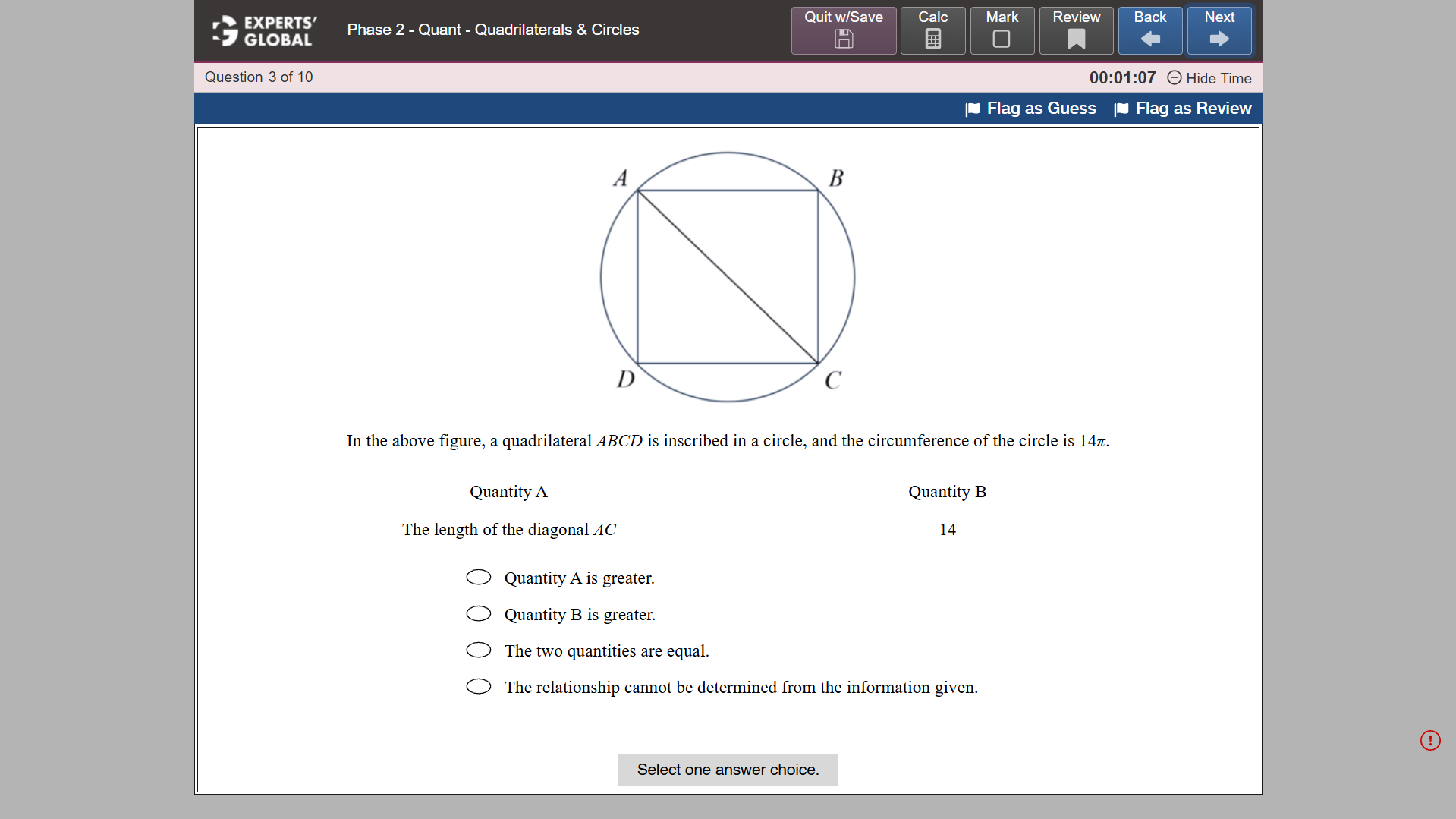
In the above figure, a quadrilateral ABCD is inscribed in a circle, and the circumference of the circle is 14π.
Quantity A: The length of the diagonal AC
Quantity B:: 14
A. Quantity A is greater.
B. Quantity B is greater.
C. The two quantities are equal.
D. The relationship cannot be determined from the information given.
Written Explanation
Quadrilateral ABCD is inscribed in a circle.
Circumference of the circle = 14π.
Let the diameter of the circle be d.
We need to determine the relationship between the length of the diagonal AC and 14.
Circumference of the circle = πd
14π = πd
Cancelling π from both sides,
d = 14
Possibility 1: If ∠ABC = ∠CDA = 90°, then triangle ABC and triangle CDA would be right triangles. In this case, diagonal AC = diameter of the circle = 14.
Possibility 2: If ∠ABC ≠ 90° or ∠CDA ≠ 90°, then diagonal AC would not be the diameter of the circle. In this case, diagonal AC < 14.
Hence, the relationship cannot be determined with the information given.
D is the correct answer.
Practice Question 3 | GRE Quant
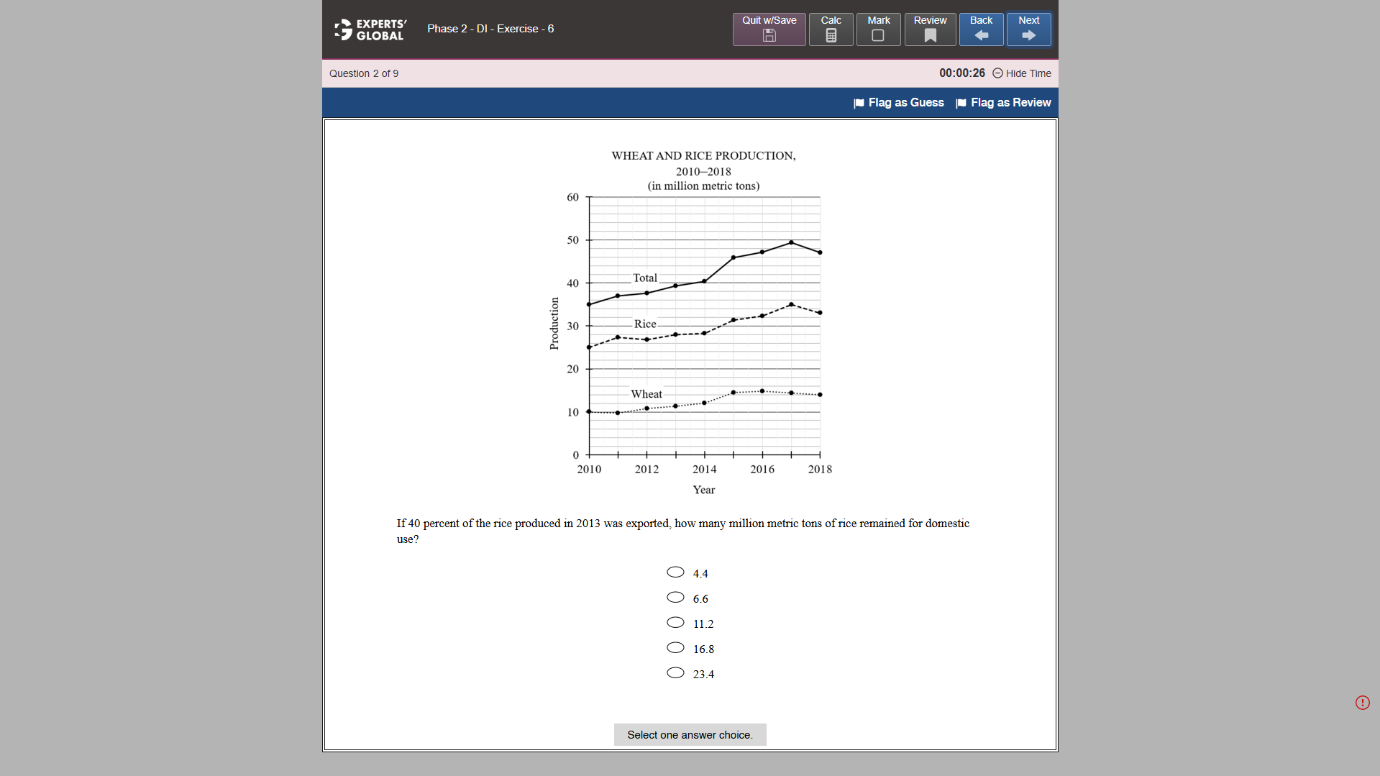
If 40 percent of the rice produced in 2013 was exported, how many million metric tons of rice remained for domestic use?
A. 4.4
B. 6.6
C. 11.2
D. 16.8
E. 23.4
Written Explanation
The production values are provided along the vertical axis in the graph.
The production of rice is indicated by the dashed line in the graph.
The graph shows that the amount of rice produced in 2013 = 28 million metric tons.
If 40 percent of the rice produced in 2013 was exported, it implies that 60 percent of rice remained for domestic use.
Thus, the amount of rice that remained for domestic use in 2013 = 60% of 28 million metric tons = 16.8 million metric tons.
D is the correct answer choice.
Practice Question 4 | GRE Quant
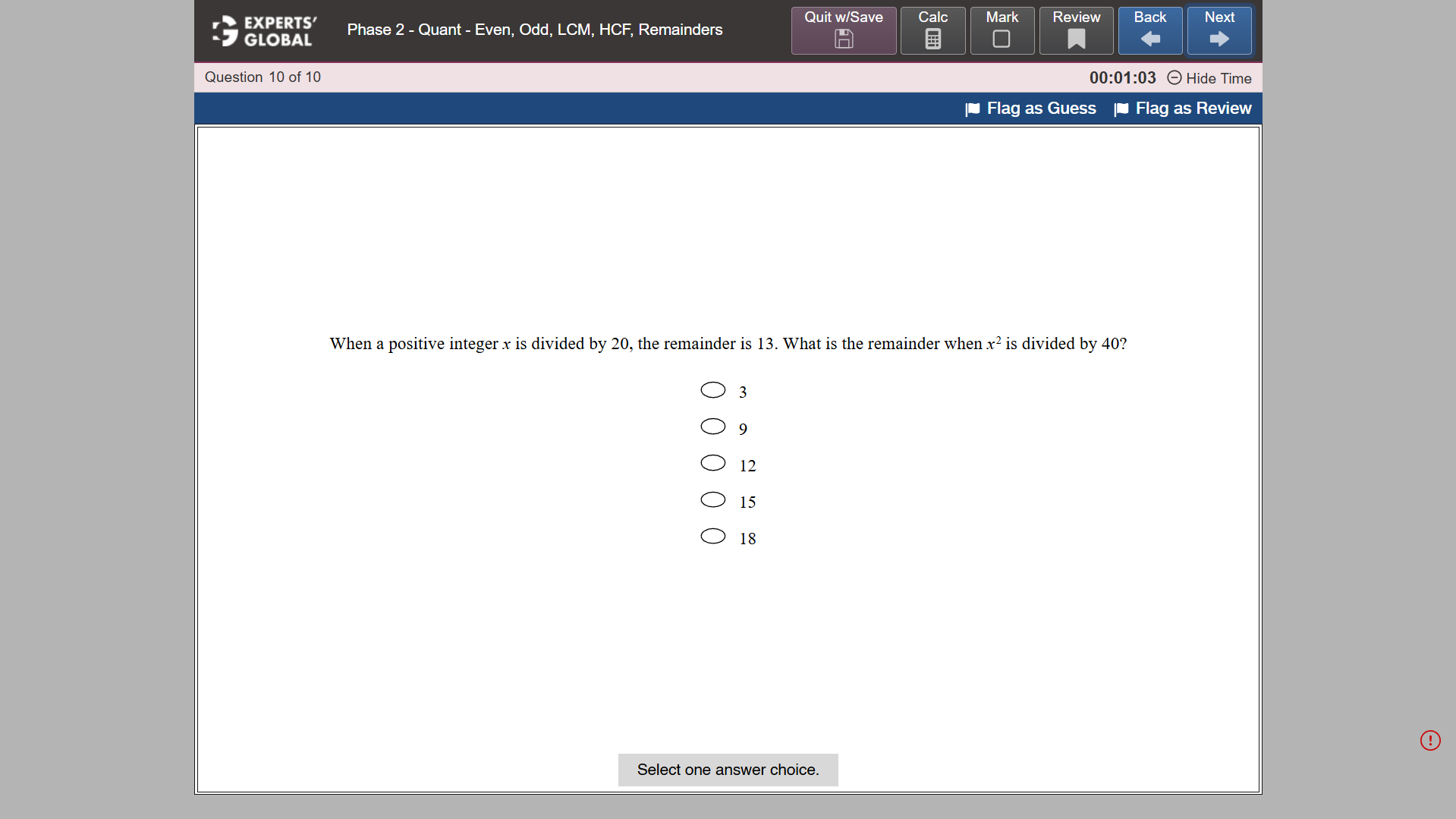
When a positive integer x is divided by 20, the remainder is 13. What is the remainder when x2 is divided by 40?
A. 3
B. 9
C. 12
D. 15
E. 18
Written Explanation
When x is divided by 20, the remainder is 13.
Therefore, x = 20k + 13, where k is some non-negative integer.
x2 = (20k + 13)2 = 400k2 + 520k + 169
Since 400 and 520 are divisible by 40, and the remainder when 169 is divided by 40 is 9, the remainder when 400k2 + 520k + 169 is divided by 40 is 9.
Hence, the remainder when x2 is divided by 40 is 9.
B is the correct answer choice.
Practice Question 5 | GRE Quant
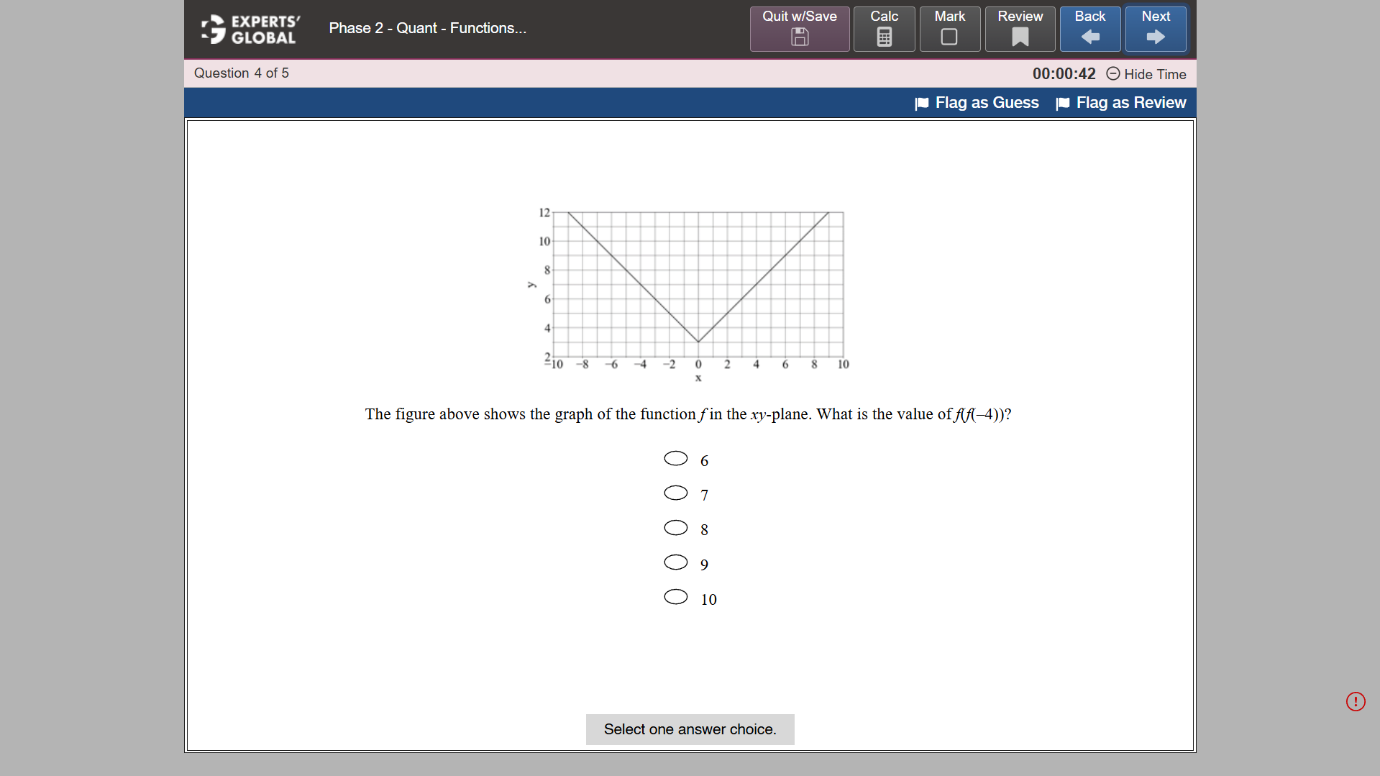
The figure above shows the graph of the function f in the xy-plane. What is the value of f(f(–4))?
A. 6
B. 7
C. 8
D. 9
E. 10
Written Explanation
The above graph shows the values of function f(x) along the vertical axis and the values of the inputs x along the horizontal axis.
At x = –4, the corresponding value of y = 7. Thus, f(–4) = 7.
At x = 7, the corresponding value of y = 10. Thus, f(f(–4)) = 10.
E is the correct answer choice.
Practice Question 6 | GRE Quant
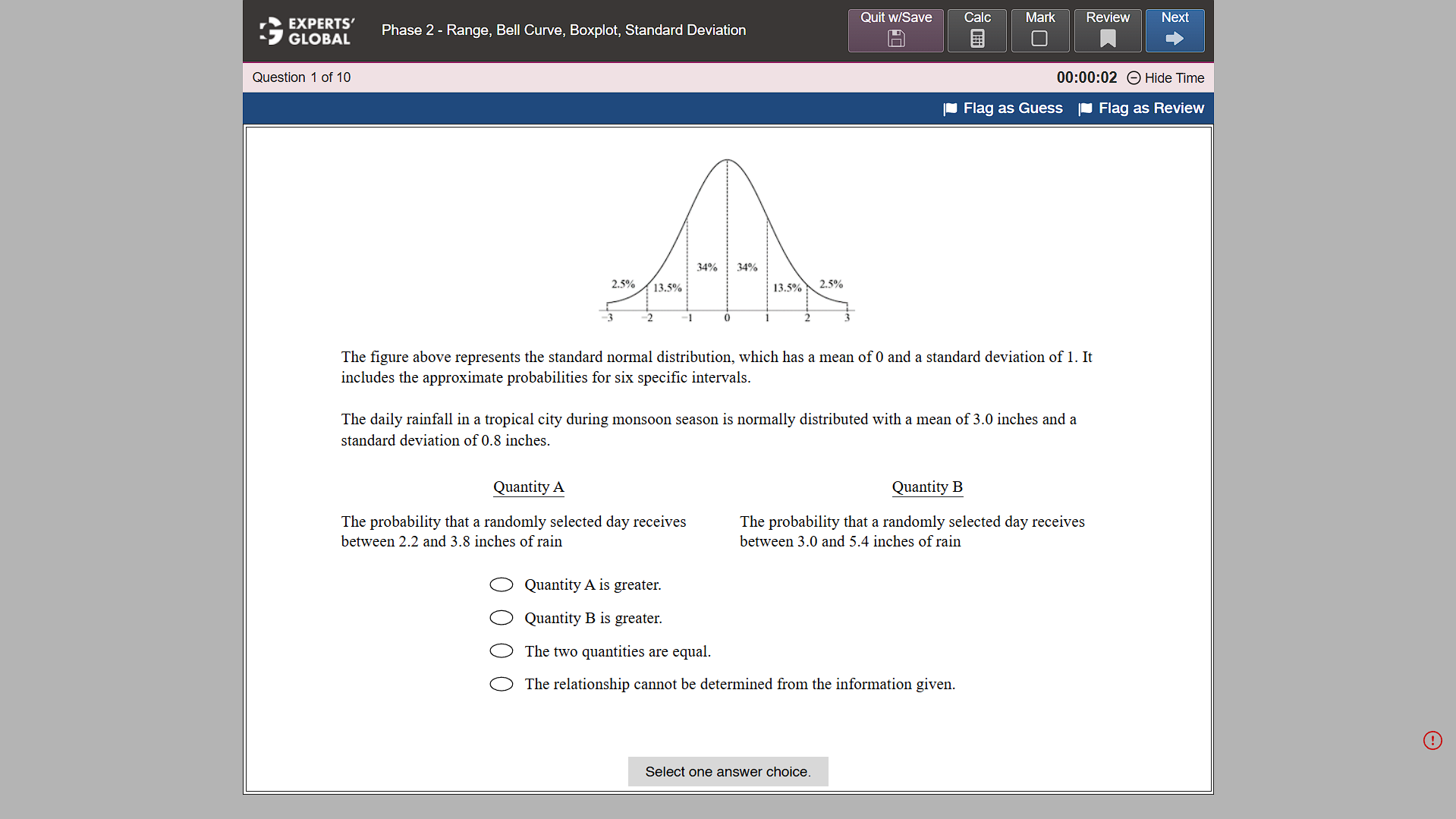
The figure above represents the standard normal distribution, which has a mean of 0 and a standard deviation of 1. It includes the approximate probabilities for six specific intervals.
The daily rainfall in a tropical city during monsoon season is normally distributed with a mean of 3.0 inches and a standard deviation of 0.8 inches.
Quantity A: The probability that a randomly selected day receives between 2.2 and 3.8 inches of rain
Quantity B:: The probability that a randomly selected day receives between 3.0 and 5.4 inches of rain
A. Quantity A is greater.
B. Quantity B is greater.
C. The two quantities are equal.
D. The relationship cannot be determined from the information given.
Written Explanation
The mean daily rainfall in the tropical city during the monsoon season = 3.0 inches.
The standard deviation of daily rainfall in the tropical city during the monsoon season = 0.8 inches.
We need to determine the relationship between the probability that a randomly selected day receives between 2.2 and 3.8 inches of rain and the probability that it receives between 3.0 and 5.4 inches of rain.
Quantity A:
2.2 inches = 3.0 inches – 1 × (0.8 inches). Thus, 2.2 inches is 1 standard deviation below the mean.
3.8 inches = 3.0 inches + 1 × (0.8 inches). Thus, 3.8 inches is 1 standard deviation above the mean.
Therefore, the required probability is given by the area between –1 and 1 in the standard normal curve.
Quantity B:
5.4 inches = 3.0 inches + 3 × (0.8 inches). Thus, 5.4 inches is 3 standard deviations above the mean.
Therefore, the required probability is given by the area between 0 and 3 in the standard normal curve.
The area between –1 and 1 is greater than the area between 0 and 3 in the standard normal curve.
Hence, Quantity A is greater.
A is the correct answer.
Practice Question 7 | GRE Quant
On a given day, a postwoman must deliver parcels to 6 locations – a hospital, the Mayor’s office, two corporate offices within the same building, and two different private residences. If the Mayor’s office must be the first delivery of the day and the corporate offices must be visited one after the other, in how many different orders could the postwoman make these 6 deliveries?
A. 72
B. 48
C. 36
D. 24
E. 18
Written Explanation
The postwoman must deliver parcels to 6 locations.
The Mayor’s office must be the first delivery of the day and the corporate offices must be visited one after the other.
We need to determine in how many different orders the postwoman could make these 6 deliveries.
Since the Mayor’s office must be the first delivery of the day, we only need to consider the order for the remaining 5 deliveries.
Since corporate offices must be visited one after the other, we will consider the corporate offices as a single corporate office block for easier calculations.
Thus, we need to count the number of ways to order a hospital, corporate office block, and two different private residences.
The number of different orders in which we can choose to make deliveries to 4 places = 4! = 24.
Additionally, since there are 2 offices in the corporate office block and the delivery to the offices can be made in either order, there are 2 possible orders in which deliveries can be made to the two corporate offices.
Thus, the total number of different orders in which the postwoman could make 6 deliveries = 24 × 2 = 48.
B is the correct answer choice.
Practice Question 8 | GRE Quant
When the decimal point of a certain positive decimal number is shifted two places to the left, the resulting number is 2 times the square of the original number. What is the original number?
Written Explanation
Let the original number be n.
We need to determine the value of n.
Shifting the decimal point two places to the left in a positive decimal number is equivalent to dividing the number by 100.
Since shifting the decimal point of n two places to the left results in a number that 2 times the square of n,
n / 100 = 2n2
n = 200n2
Dividing both sides by n,
1 = 200n
n = 0.005
0.005 is the correct answer.
Practice Question 9 | GRE Quant
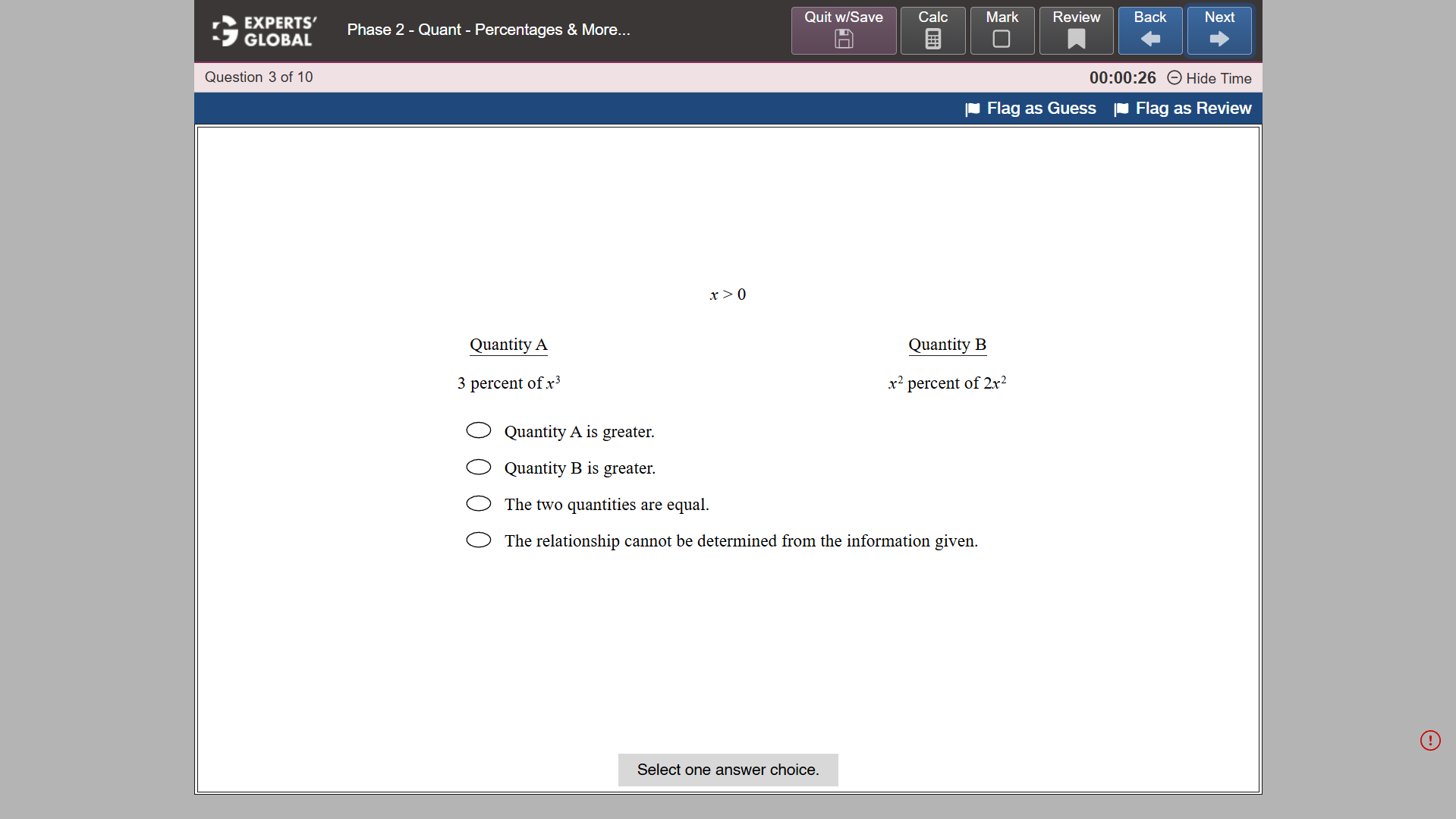
x > 0
Quantity A: 3 percent of x3
Quantity B: x2 percent of 2x2
A. Quantity A is greater.
B. Quantity B is greater.
C. The two quantities are equal.
D. The relationship cannot be determined from the information given.
Written Explanation
x > 0
We need to determine the relationship between 3 percent of x3 and x2 percent of 2x2.
Quantity A: 3 percent of x3 = ( 3 / 100 ) × (x3) = ( 3x3 / 100 ).
Quantity B: x2 percent of 2x2 = (x2 / 100) × (2x2) = (2x4 / 100).
Possibility 1: x = 1
Quantity A: ( 3x3 / 100 ) = [3(1)3 / 100] = 3 / 100
Quantity B: ( 2x4 / 100 ) = [2(1)4 / 100] = 2 / 100
In this case, Quantity A > Quantity B.
Possibility 2: x = 2
Quantity A: ( 3x3 / 100 ) = [3(2)3 / 100] = 24 / 100
Quantity B: ( 2x4 / 100 ) = [2(2)4 / 100] = 32 / 100
In this case, Quantity A < Quantity B.
Hence, the relationship cannot be determined from the information given.
D is the correct answer.
Practice Question 10 | GRE Quant
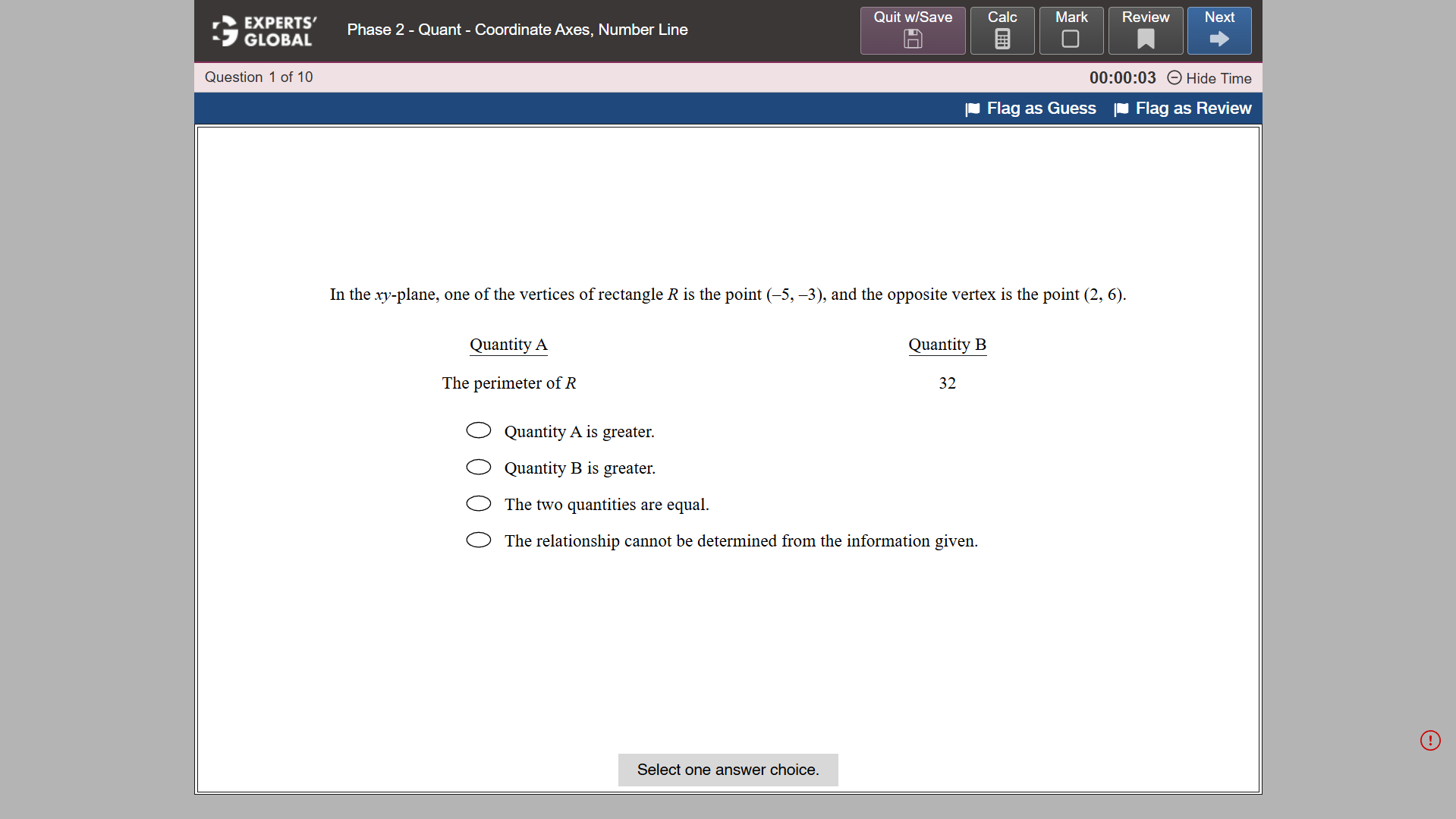
In the xy-plane, one of the vertices of rectangle R is the point (–5, –3), and the opposite vertex is the point (2, 6).
Quantity A: The perimeter of R
Quantity B:: 32
A. Quantity A is greater.
B. Quantity B is greater.
C. The two quantities are equal.
D. The relationship cannot be determined from the information given.
Written Explanation
One of the vertices of rectangle R is the point (–5, –3), and the opposite vertex is the point (2, 6).
We need to determine the relationship between the perimeter of R and 32.
Quantity A:
The rectangle ABCD shown in the explanation diagram above represents the rectangle with the given information.
The length of the rectangle = x coordinate of vertex C – x coordinate of vertex A = 2 – (–5) = 7.
The width of the rectangle = y coordinate of vertex C – y coordinate of vertex A = 6 – (–3) = 9.
The perimeter of rectangle R = 2 × (Length + Width) = 2 × (7 + 9) = 32.
Quantity B:
32
Hence, the two quantities are equal.
C is the correct answer.
Practice Question 11 | GRE Quant
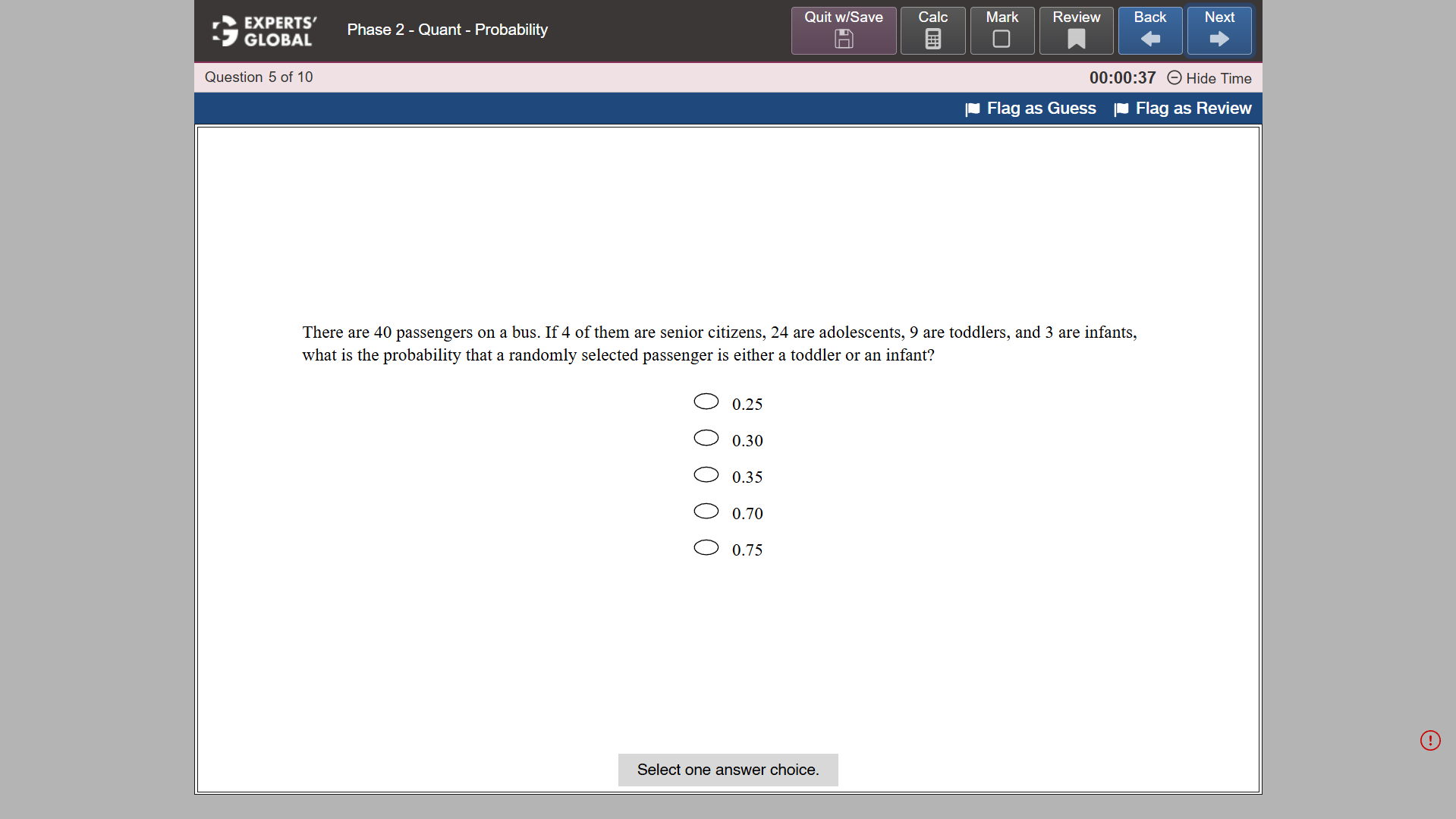
There are 40 passengers on a bus. If 4 of them are senior citizens, 24 are adolescents, 9 are toddlers, and 3 are infants, what is the probability that a randomly selected passenger is either a toddler or an infant?
A. 0.25
B. 0.30
C. 0.35
D. 0.70
E. 0.75
Written Explanation
Number of senior citizens = 4.
Number of adolescents = 24.
Number of toddlers = 9.
Number of infants = 3.
Total number of passengers = 40.
The probability that a randomly selected book is neither a short story anthology nor a collection of poetry
= (Number of passengers that are either toddlers or infants) / (Total number of passengers)
= (9 + 3) / (40)
= 0.3
B is the correct answer choice.
For Further GRE Prep and Practice…
End-to-end GRE prep course online (includes 7-day free trial)
15 full-length GRE practice tests
60 sectional GRE practice tests
Free full-length GRE diagnostic test
GRE Prep + Admission Consulting Bundle