GMAT Critical Reasoning (CR) questions challenge your ability to grasp the structure of an argument and evaluate its logic. In the Verbal section, you will face only two question types: Critical Reasoning and Reading Comprehension. Out of the 23 questions in this section, around 8 to 10 will focus on Critical Reasoning, making up roughly 40% of your total score in the Verbal section. This emphasizes just how crucial Critical Reasoning is for a top GMAT score, and therefore, its comprehensive coverage is essential in a high-quality GMAT preparation course. By honing your skills on GMAT CR questions, you will not only strengthen your performance on the GMAT but also sharpen your reasoning skills for success in business school, in your career, and beyond. This page provides you with a structured, clear approach to tackling Critical Reasoning questions, covering all the question types on the GMAT and offering worked examples to guide your GMAT CR preparation.
Approach For Solving GMAT Critical Reasoning Questions: The Missing-Link-Approach by Experts’ Global
The missing link approach helps you tackle almost all the GMAT Critical Reasoning questions efficiently. Start by reading the question stem to understand the question type. Then, carefully read the paragraph to understand its information and identify the conclusion. Create a simple mind map that connects key pieces of information leading to the conclusion. In most GMAT CR questions, a gap exists between the information presented and the conclusion, which we at Experts’ Global call the “missing link”. Identifying the missing link is crucial for solving various CR question types. Assumption and strengthening questions require you to fill this gap, while weakening questions challenge you to attack it. Similarly, each CR question type requires a different task, but the missing link is almost always at the core of the solution. The conceptual video below guides you through this method step by step, showing you how to apply it to on GMAT-style CR questions across your practice drills, sectional tests, and full-length GMAT mock tests.

Approach for Solving GMAT CR Questions – The Missing-Link-Approach
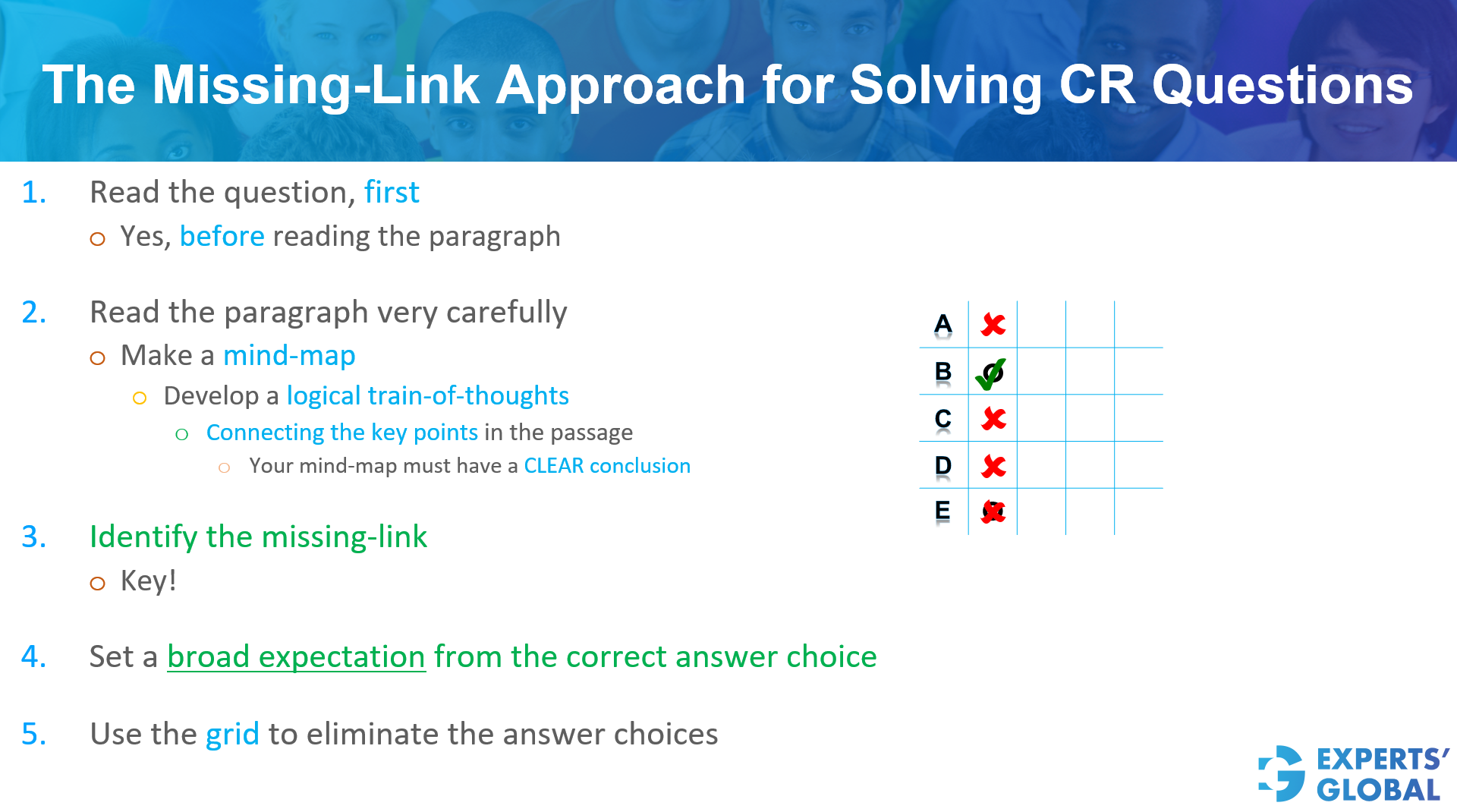
Answer Choices Generally Incorrect on GMAT Critical Reasoning Questions
Wrong answers in GMAT Critical Reasoning often share four common traits: irrelevance, jumping from here to there, contradictions, and repeating already stated facts. To boost both your accuracy and speed, quickly and consistently eliminate these distractions as you work through CR questions. The video below elucidates such choices in a simple way and shows how they appear on the GMAT CR.
GMAT CR Questions: Choices Generally Incorrect
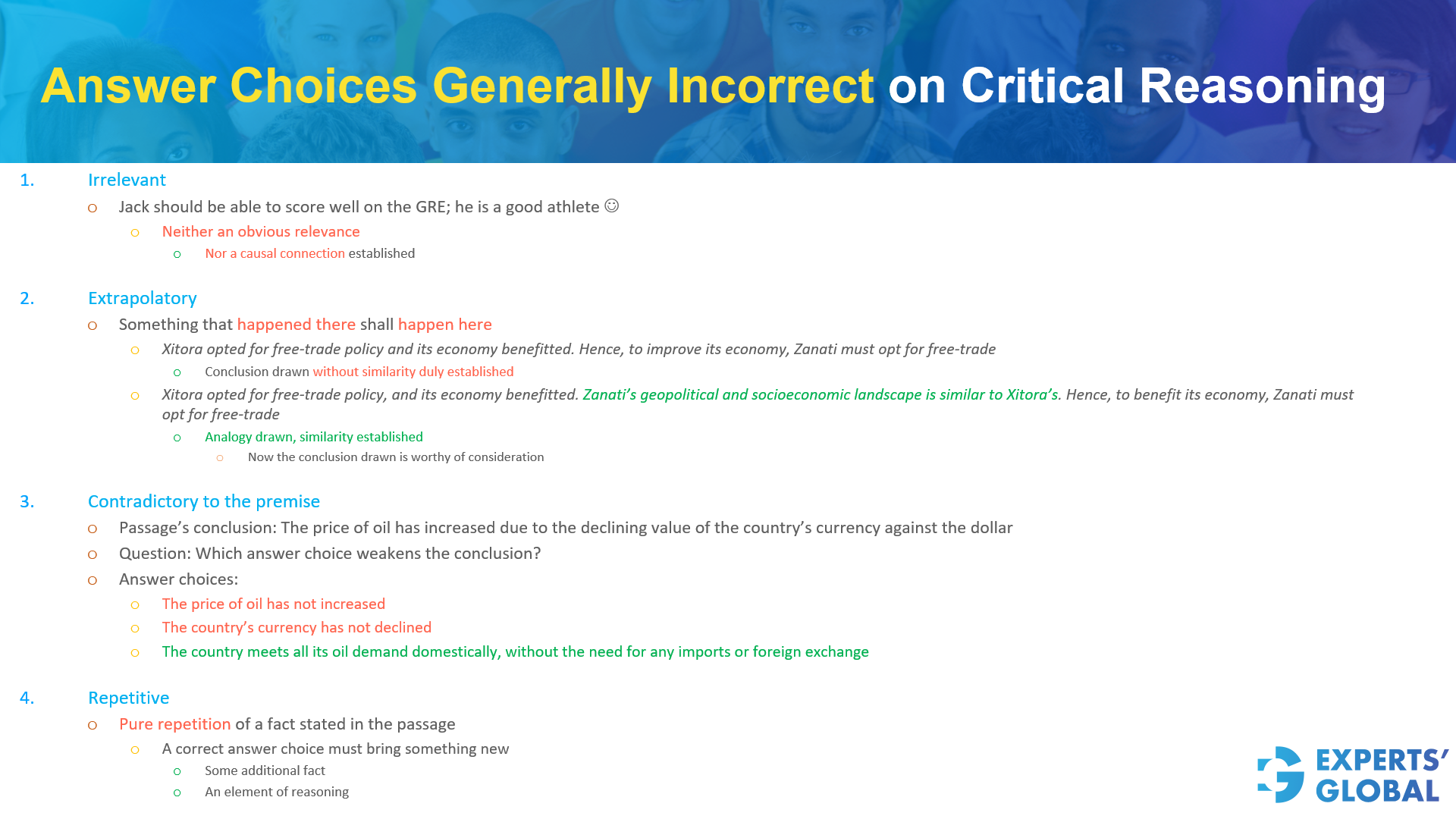
Ten Main GMAT Critical Reasoning Question Types
Familiarize yourself with the ten key GMAT Critical Reasoning question types: assumption, strengthen, weaken, explanation/paradox, evaluation, inference, main-point/conclusion, paragraph completion, dialogue, and boldface. Quick recap of the approach for CR questions: start by identifying the question type, mapping the premise and conclusion, and finding the missing link. Then, evaluate the options based on the task and focus on eliminating the wrong answers, not just selecting the right one.
Ten Main GMAT CR Question Types
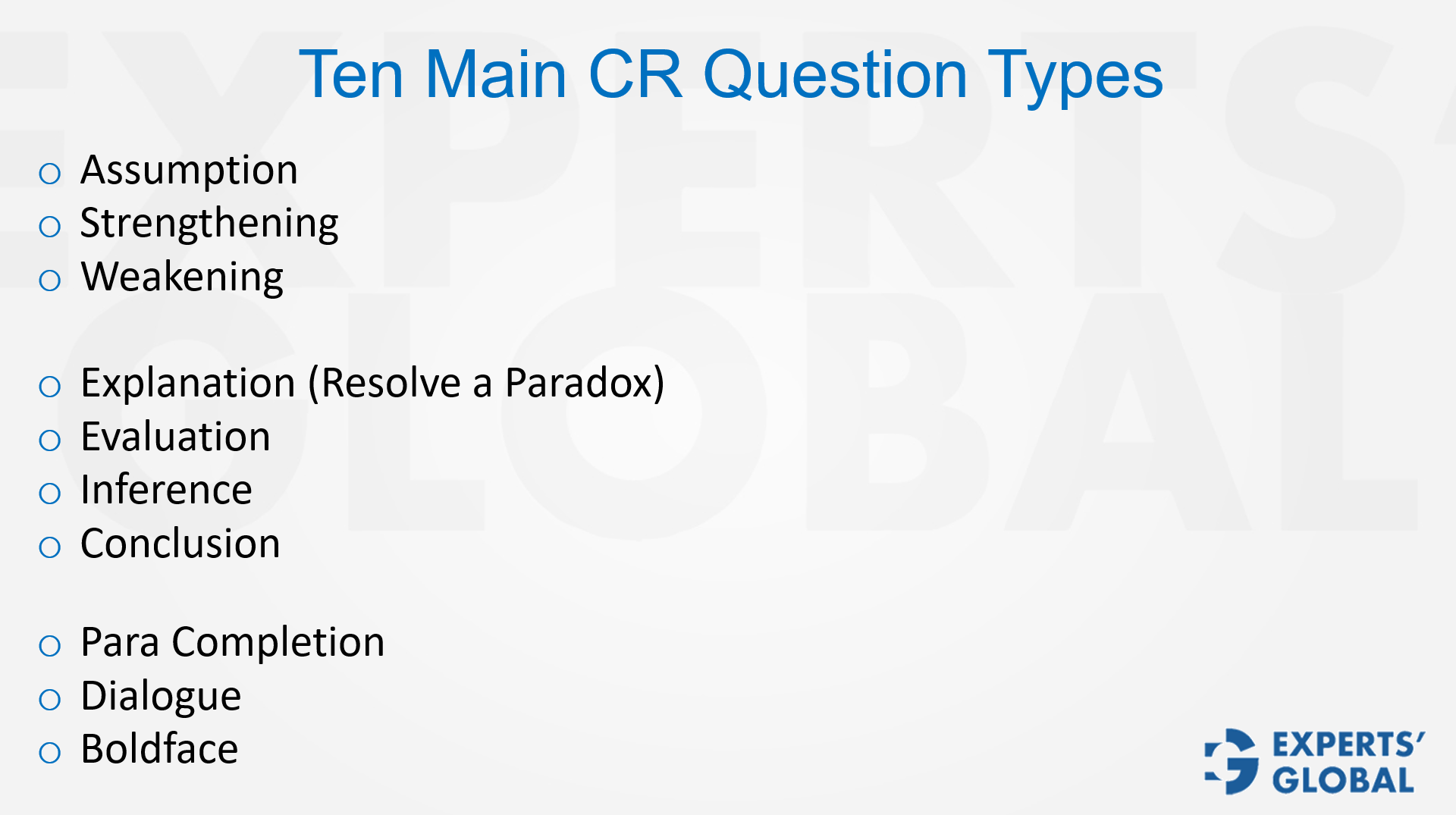
Assumption Questions | GMAT Critical Reasoning Prep
CR Assumption questions challenge you to find the hidden idea that must be true for the argument to be valid. This helps you uncover the unseen connection between the premise and conclusion. On this page, you will find a well-organized playlist of subtopics and worked examples to guide your efficient preparation for this concept.
Approach For Assumption GMAT Critical Reasoning Questions
GMAT Critical Reasoning assumption questions present a passage with a premise, a conclusion, and a noticeable gap. The correct assumption closes this gap and strengthens the argument. It is a statement that must hold true for the argument to be valid. In this overview, you will discover how to identify assumptions by testing both sufficiency and necessity: the assumption supports the argument, and removing it causes the argument to collapse. The video below walks you through this method, demonstrates it with examples, and gets you ready to apply it on the GMAT.
GMAT CR: Assumptions Question Type
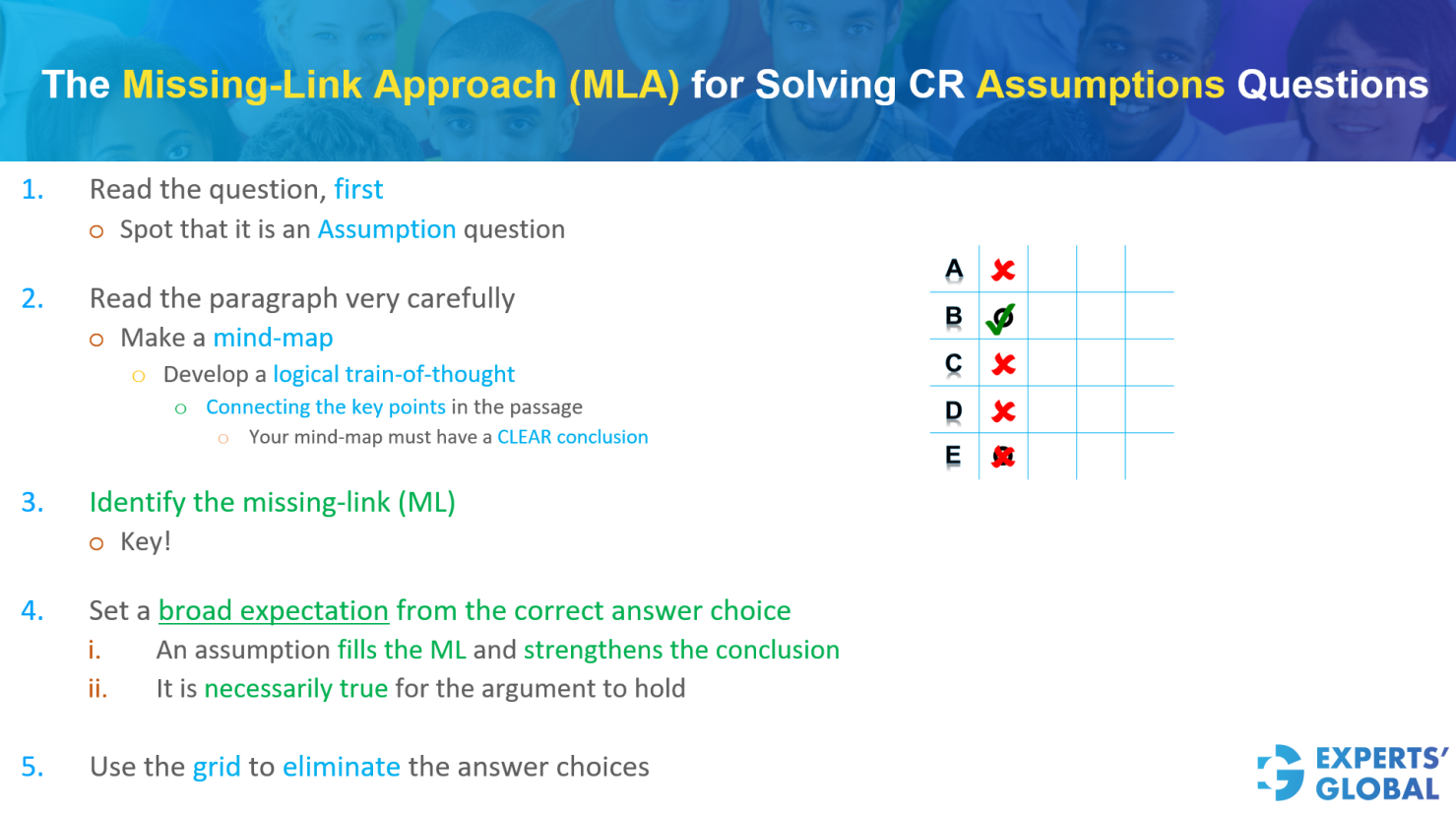
Strengthening Vs Assumption
Strengthening statements and assumptions both connect premises to conclusions, but they serve different purposes. A strengthening statement makes the argument more convincing, while an assumption is essential. Without it, the reasoning falls apart. In other words, a strengthening statement backs up an argument, but an assumption is what keeps it standing. Every assumption strengthens the argument, but not every strengthener is an assumption. The main difference lies in necessity: if an assumption is false, the argument falls apart; a strengthener adds support but isn’t essential. The video below dives deeper into this idea and demonstrates how the GMAT might test it.
Strengthening vs Assumption | GMAT CR Questions
Assumption Negation Test
When you’re stuck on a GMAT Critical Reasoning question, try the Assumption Negation Test. Start by identifying the premise and conclusion, then propose the most likely assumption. After that, negate it. If the argument falls apart, you’ve found an essential assumption. Use this technique carefully, as it can be time-consuming and is best saved for challenging questions. The video below breaks down the concept and demonstrates how to apply it on the GMAT.
GMAT CR: Assumption Negation Test
GMAT-style Worked Example: Assumption CR Question
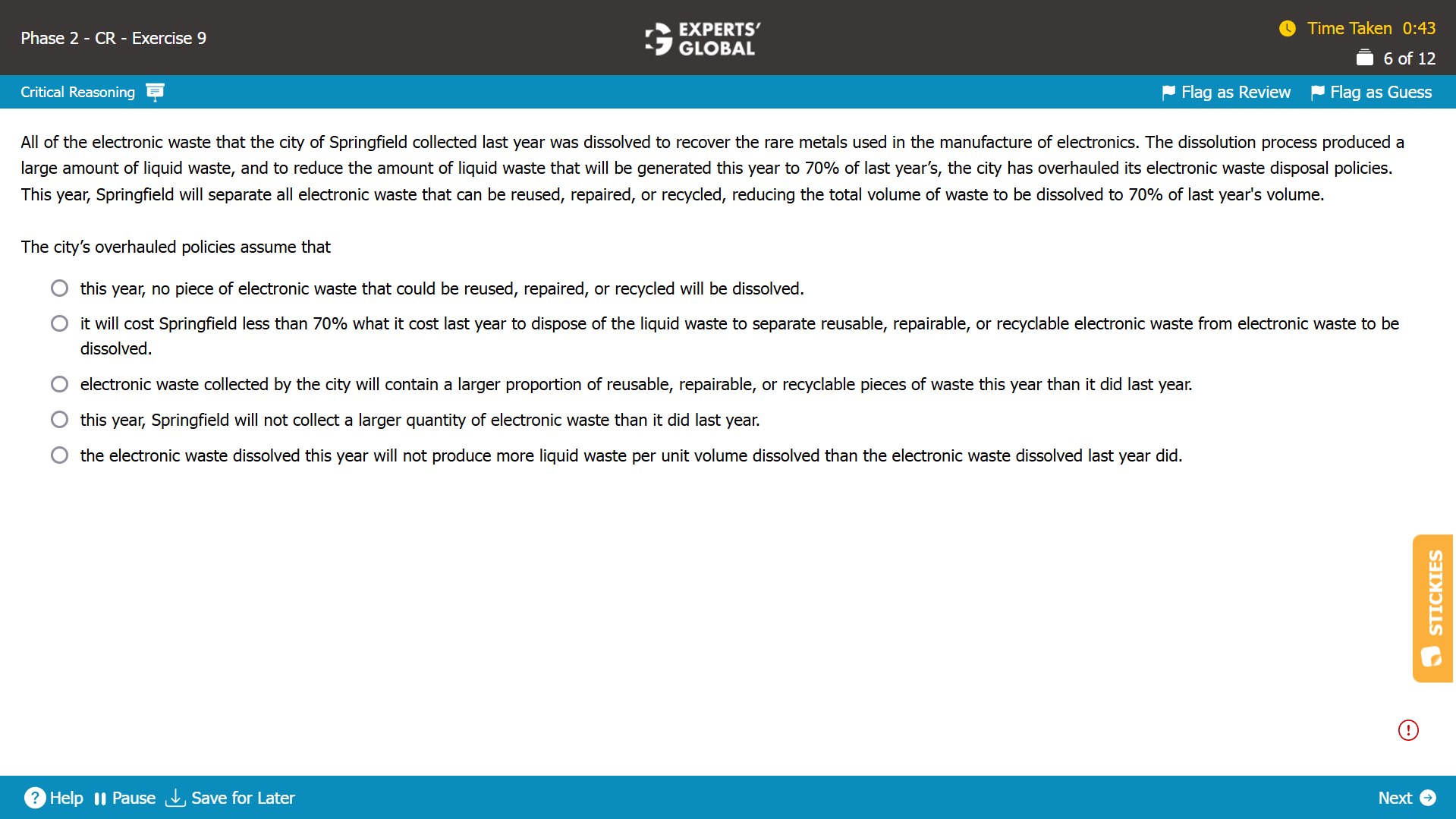
Written Explanation
Mind-map: Last year, all the city’s electronic waste was dissolved → dissolution produced liquid waste → city wants to reduce the amount of liquid waste to 70% of last year’s → city will separate electronic waste that can be reused, repaired, or recycled → separation will reduce the total volume of waste to be dissolved to 70% of last year’s → amount of liquid waste this year will be 70% of last year’s (implicit conclusion)
Missing-link: Between separation reducing the total volume of waste to be dissolved to 70% of last year’s and the conclusion that the amount of liquid waste this year will be 70% of last year’s
Expectation from the correct answer choice: To strengthen the conclusion that the amount of liquid waste this year will be 70% of last year’s, through a valid assumption
A. Trap. This answer choice, suggesting that there is no dissolution of any electronic waste that could be reused, repaired, or recycled, indicates that the only waste to be dissolved would be that left after reusable, repairable, or recyclable waste is separated; the argument already accounts for such waste to be dissolved and mentions that this year, the total volume of waste to be dissolved is 70% of last year’s; so, this answer choice adds no new information and does not strengthen the conclusion. Further, please note, a hint here is in the term “no piece”, which is too strong to be a valid assumption; one needs to be cautious of such answer choices as they are generally incorrect on the GMAT. Besides, this condition is not necessary for the argument to hold and thus, is not a valid assumption. Because this answer choice does not strengthen the conclusion through a valid assumption, this answer choice is incorrect.
B. The argument is concerned with the amount of liquid waste generated in the process of electronic waste dissolution and not with any financial factor; so, this answer choice, introducing information related to the cost of separation, is out of scope. Besides, this condition is not necessary for the argument to hold and thus, is not a valid assumption. Because this answer choice does not strengthen the conclusion through a valid assumption, this answer choice is incorrect.
C. Trap. This answer choice, suggesting that this year has a larger proportion of reusable, repairable, or recyclable waste than that last year, indicates that the waste to be dissolved this year would be a smaller proportion of the total waste as compared to that last year; however, the argument already accounts for the waste to the dissolved and mentions that this year, the total volume of waste to be dissolved is 70% of last year’s; so, this answer choice adds no new information and does not strengthen the conclusion. Besides, this condition is not necessary for the argument to hold and thus, is not a valid assumption. Because this answer choice does not strengthen the conclusion through a valid assumption, this answer choice is incorrect.
D. Trap. This answer choice, suggesting that electronic waste this year will not be larger in quantity than that last year, indicates that the waste to be dissolved this year would be smaller or equal in quantity than the waste that was dissolved last year; however, the argument already accounts for the waste to the dissolved and mentions that this year, the total volume of waste to be dissolved is 70% of last year’s; so, this answer choice adds no new information and does not strengthen the conclusion. Besides, this condition is not necessary for the argument to hold and thus, is not a valid assumption. Because this answer choice does not strengthen the conclusion through a valid assumption, this answer choice is incorrect.
E. Correct. The argument mentions that this year, the total volume of waste to be dissolved is 70% of last year’s; so, this answer choice, suggesting that the liquid waste per unit volume will not be higher this year, indicates that the total liquid waste generated this year will not be higher than 70% of the liquid waste generated last year, thus strengthening the conclusion. Additionally, this statement does have to be true for the conclusion to hold; negating this statement would mean that “liquid waste per unit volume will be higher this year”, thus casting doubt on whether the total liquid waste generated this year will be 70% of the liquid waste generated last year and negating the conclusion. Because this answer choice strengthens the conclusion through a valid assumption, this answer choice is correct.
E is the best choice.
Strengthen the Argument Questions | GMAT Critical Reasoning Prep
GMAT Critical Reasoning Strengthen the Argument questions present a brief argument with a premise, a conclusion, and a clear gap known as the missing link. You will see five answer choices, and the correct one is the statement that fills this gap and makes the conclusion stronger. This page provides an organized playlist of subtopics, along with a few worked examples, to help you prepare efficiently for this concept.
Approach for Strengthen the Argument GMAT CR Questions
A strengthening statement boosts the credibility of the conclusion by filling the gap between the premise and conclusion or by adding new, relevant details. Unlike an assumption, it doesn’t have to be essential. In the video below, you will see this approach in action, with examples tied to GMAT drills, sectional tests, and full-length practice exams.
Approach for Strengthen the Argument GMAT CR Questions
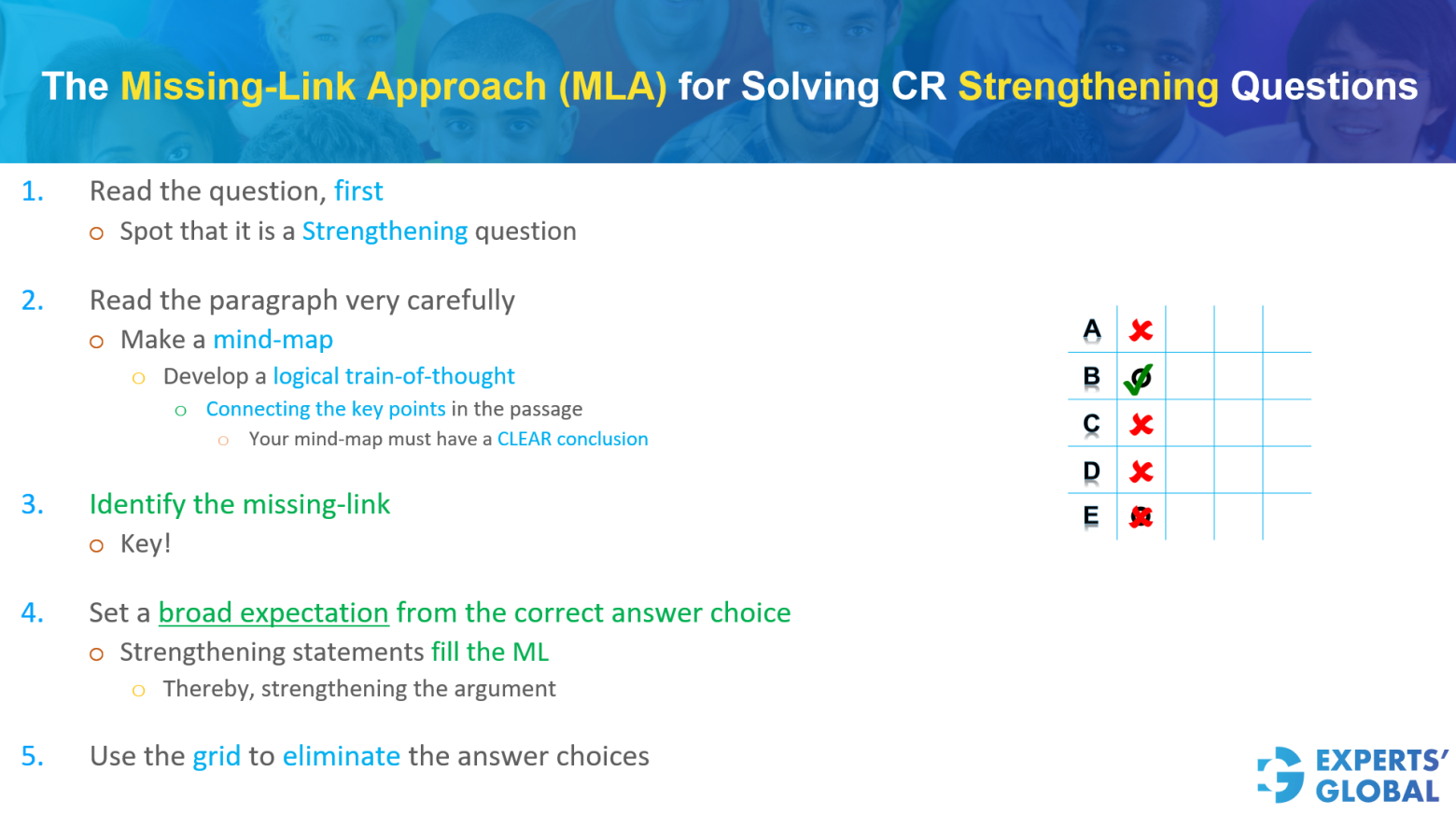
How Strengthening and Assumption Statements Differ
Strengthening statements and assumptions both connect an argument’s premises to its conclusion, but they serve different purposes. A strengthening statement boosts the argument’s persuasiveness, while an assumption is crucial; without it, the logic falls apart. Both help close the gap and support the conclusion, but an assumption must be true for the argument to be valid, while a strengthening statement does not have to be. In simple terms, assumptions are a specific type of strengthening statement. The video below dives into this concept and demonstrates how it may appear on the GMAT.
Strengthening vs Assumption | GMAT CR Questions
GMAT-style Worked Example: Strengthen the Argument CR Question
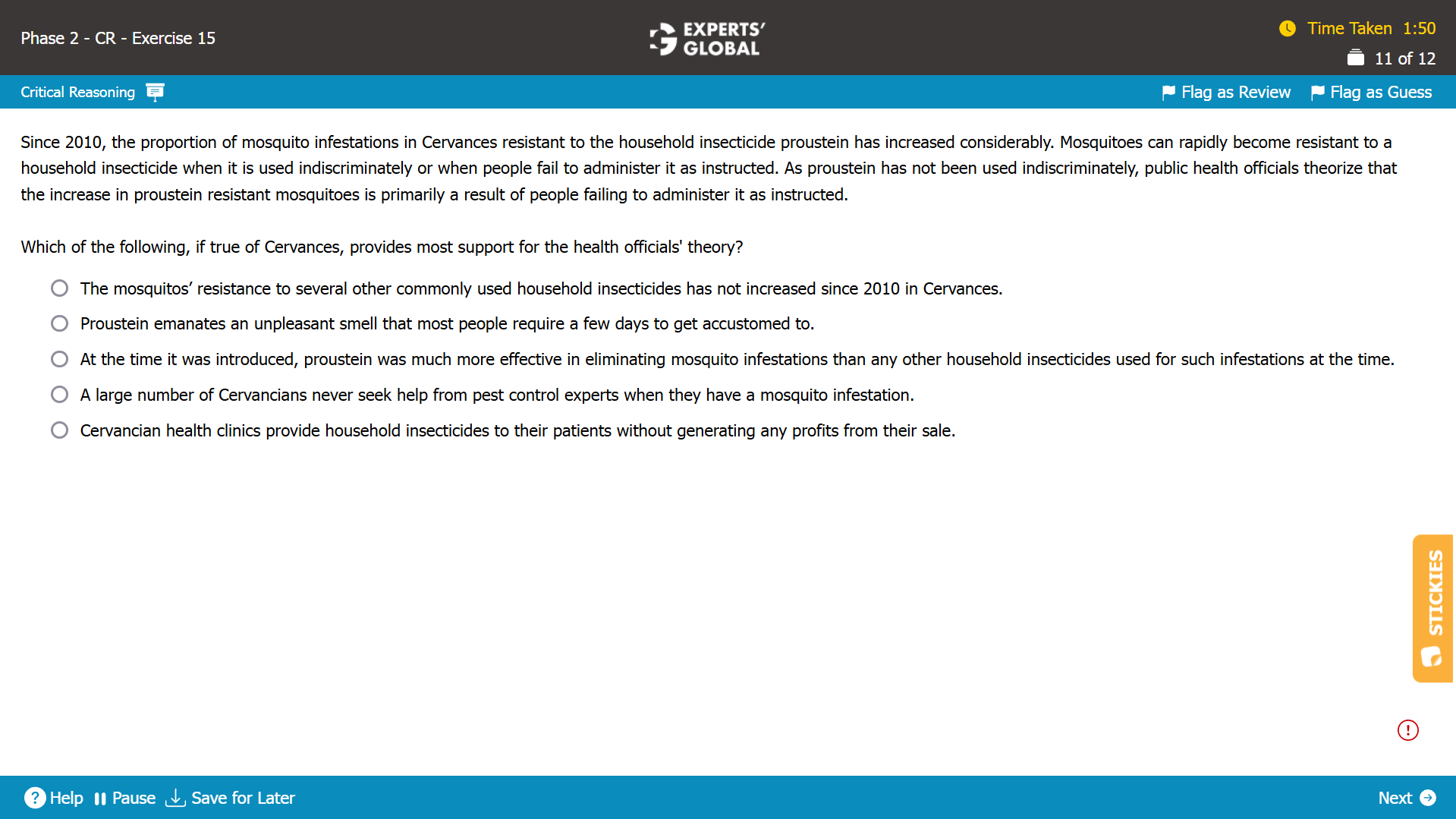
Written Explanation
Mind-map: Mosquito resistant to insecticide proustein increased substantially → resistance develops when insecticide is used indiscriminately or when people fail to administer it as instructed → proustein not used indiscriminately → increase in proustein resistant mosquito is primarily due to failure to administer proustein as instructed (conclusion)
Missing-link: Between proustein not being used indiscriminately and the conclusion that the increase in insecticide resistant mosquito is primarily due to failure to administer proustein as instructed
Expectation from the correct answer choice: To strengthen the conclusion that the increase in insecticide resistant mosquito is primarily due to failure to administer proustein as instructed
A. The argument is concerned with increase in mosquitoes’ resistance to insecticide proustein; so, the increase in mosquitoes’ resistance to other insecticides is out of scope. Because this answer choice does not strengthen the conclusion, this answer choice is incorrect.
B. Correct. This answer choice, suggesting a likely unwanted effect of proustein, indicates the possibility of people discontinuing the use of proustein within the first few days, strengthening the conclusion that the increase in insecticide resistant mosquito is primarily due to failure to administer proustein as instructed. Because this answer choice strengthens the conclusion, this answer choice is correct.
C. Trap. The argument is concerned with the reduced effectiveness of proustein “over time” and not with the effectiveness of proustein in comparison with other insecticides “when it was introduced”; so, this answer choice is just a statement of fact and does not strengthen the argument. Because this answer choice does not strengthen the conclusion, this answer choice is incorrect.
D. Trap. The argument, suggesting a lack of involvement of pest control experts in most cases, indicates a possibility of some people using insecticides on their own and likely using them indiscriminately; however, the argument mentions that insecticides have not been used indiscriminately, suggesting that such a possibility has already been accounted for; so, this answer choice, although relevant to the broad context of the argument, does not strengthen the conclusion. Because this answer choice does not strengthen the conclusion, this answer choice is incorrect.
E. The argument is concerned with the reduced effectiveness of insecticides and not with any cost factor associated with their acquisition or sale; so, this answer choice is just a statement of fact and has no bearing on the argument. Because this answer choice does not strengthen the conclusion, this answer choice is incorrect.
B is the best choice.
Weaken the Argument Questions | GMAT Critical Reasoning Prep
CR Weaken the Argument questions challenge you to select the statement that weakens an argument by breaking the link between its premise and conclusion. These questions teach you to identify missing information, alternative explanations, and overlooked factors that reduce the strength of a claim. On this page, you will find a well-structured conceptual lesson along worked examples, to help you prepare efficiently for this concept.
Approach for Weaken the Argument GMAT Critical Reasoning Questions
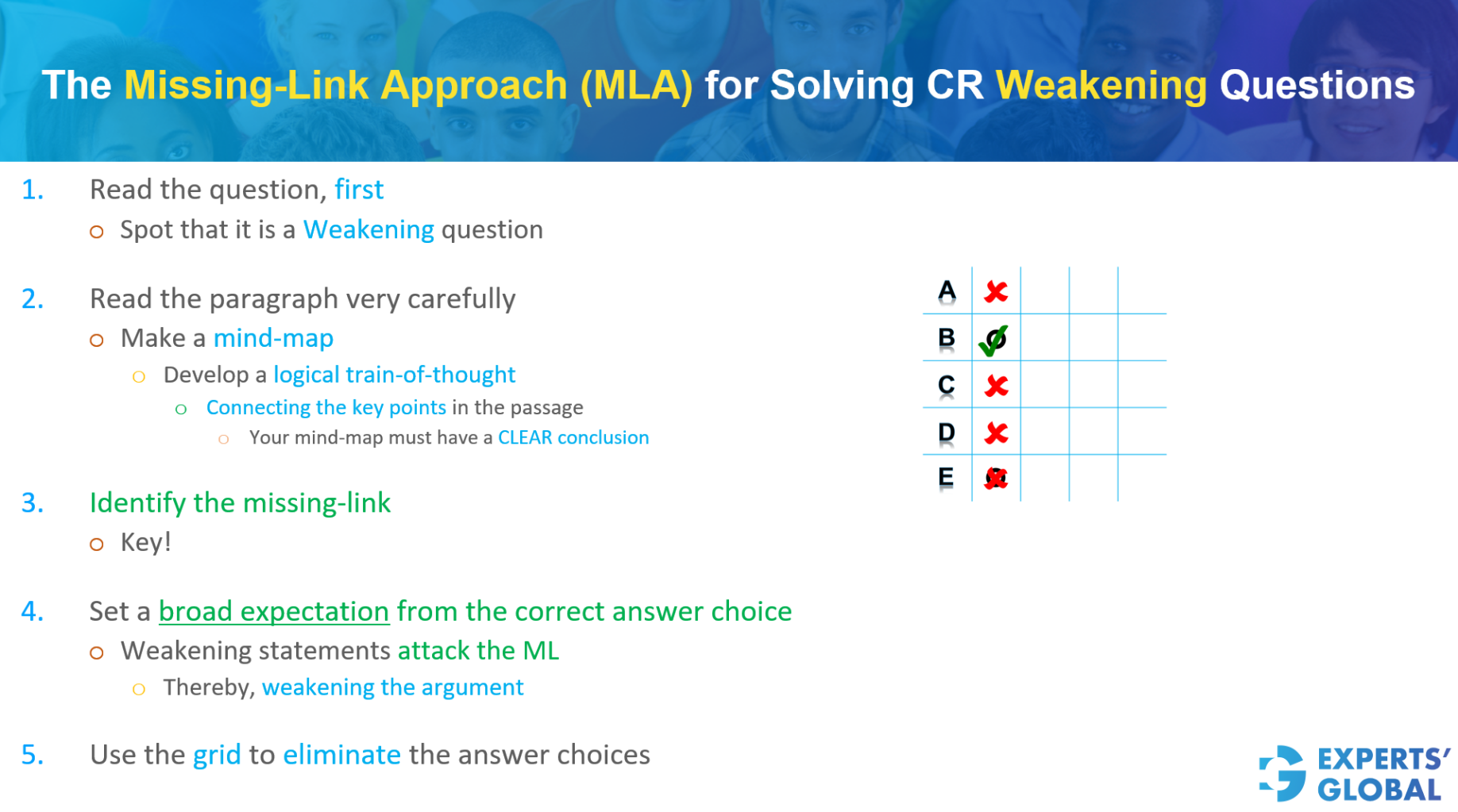
The Missing Link Approach for solving GMAT CR weakening questions involves five steps. First, read the question carefully and recognize it as a weakening question. Then, read the passage thoroughly and create a logical mind map, focusing on key points and ensuring a clear conclusion. Identify the missing link in the argument. Set broad expectations for the correct answer, knowing that weakening statements will attack this link. Finally, use a grid to eliminate incorrect answer choices. The video below explains this strategy, demonstrates it with GMAT-style questions, and helps you apply it on GMAT CR.
Approach for Weaken the Argument GMAT CR Questions
GMAT-style Worked Example: Weaken the Argument CR Question
Written Explanation
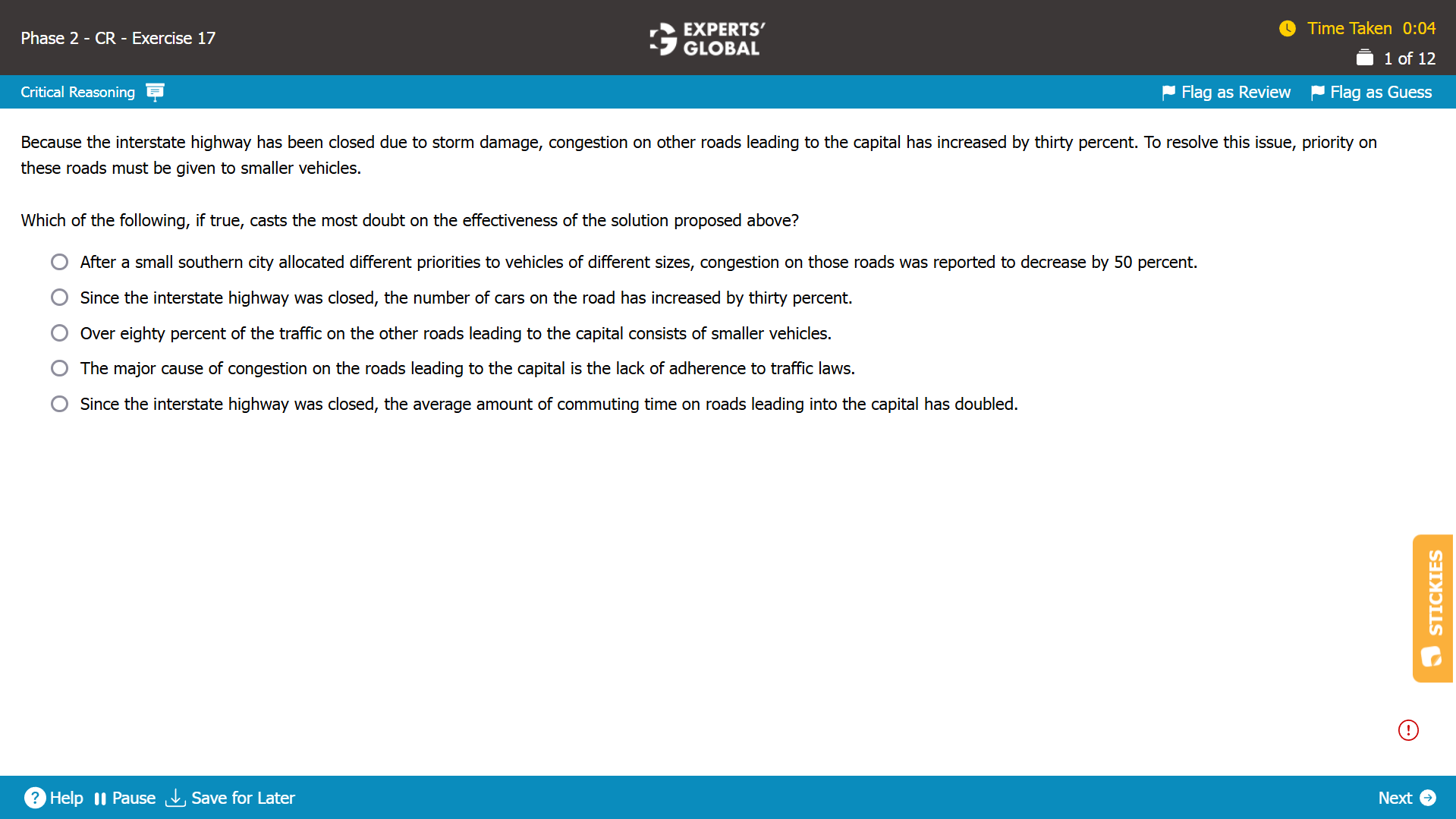
Mind-map: Interstate highway closed due to storm damage → congestion on roads leading to capital increased by thirty percent → smaller vehicles must be prioritized to reduce congestion (conclusion)
Missing-link: Between congestion on roads leading to capital increasing by thirty percent and the conclusion that smaller vehicles must be prioritized to reduce congestion
Expectation from the correct answer choice: To weaken the conclusion that smaller vehicles must be prioritized to reduce congestion
A. This answer choice, suggesting an evidence that size-based prioritizing reduced congestion in another city, indicates the possibility that prioritizing smaller vehicles may reduce congestion, thus strengthening, rather than weakening, the conclusion. Because this answer choice does not weaken the conclusion, this answer choice is incorrect.
B. This answer choice, suggesting a thirty percent increase in the number of cars after the closure of the interstate highway, likely supports the fact mentioned in the argument that congestion on roads leading to the capital increased by thirty percent; however, this answer choice fails to address whether prioritizing smaller vehicles will reduce congestion; so, this answer choice is just additional information and does not weaken the conclusion. Because this answer choice does not weaken the conclusion, this answer choice is incorrect.
C. Trap. If a high percentage of traffic is due to smaller vehicles, prioritizing such vehicles will likely lead to reduced congestion; so, this answer choice, if anything, marginally strengthens, rather than weakens, the conclusion. Because this answer choice does not weaken the conclusion, this answer choice is incorrect.
D. Correct. By suggesting that the lack of adherence to traffic laws is the major cause of congestion, this answer choice indicates that the prioritization of smaller vehicles may not be followed and may not lead to reduced congestion, thus weakening the conclusion. Because this answer choice weakens the conclusion, this answer choice is correct.
E. This answer choice, suggesting that commuting time on the roads to the capital doubled after the closure of the interstate highway, likely supports the fact mentioned in the argument that congestion on roads leading to the capital increased by thirty percent; however, this answer choice fails to address whether prioritizing smaller vehicles will reduce congestion; so, this answer choice is just additional detail and does not weaken the conclusion. Because this answer choice does not weaken the conclusion, this answer choice is incorrect.
D is the best choice.
Resolve-the-Paradox Questions | GMAT Critical Reasoning
Critical Reasoning Resolve the Paradox questions ask you to find the statement that shows how two seemingly contradictory facts can both be true. These questions help you uncover the missing piece that makes sense of the surprising pattern and restores balance to the situation. This page offers a structured playlist along with a few worked examples to guide your efficient preparation for this concept.
Approach for Resolve-the-Paradox (Explanation) GMAT Critical Reasoning Questions
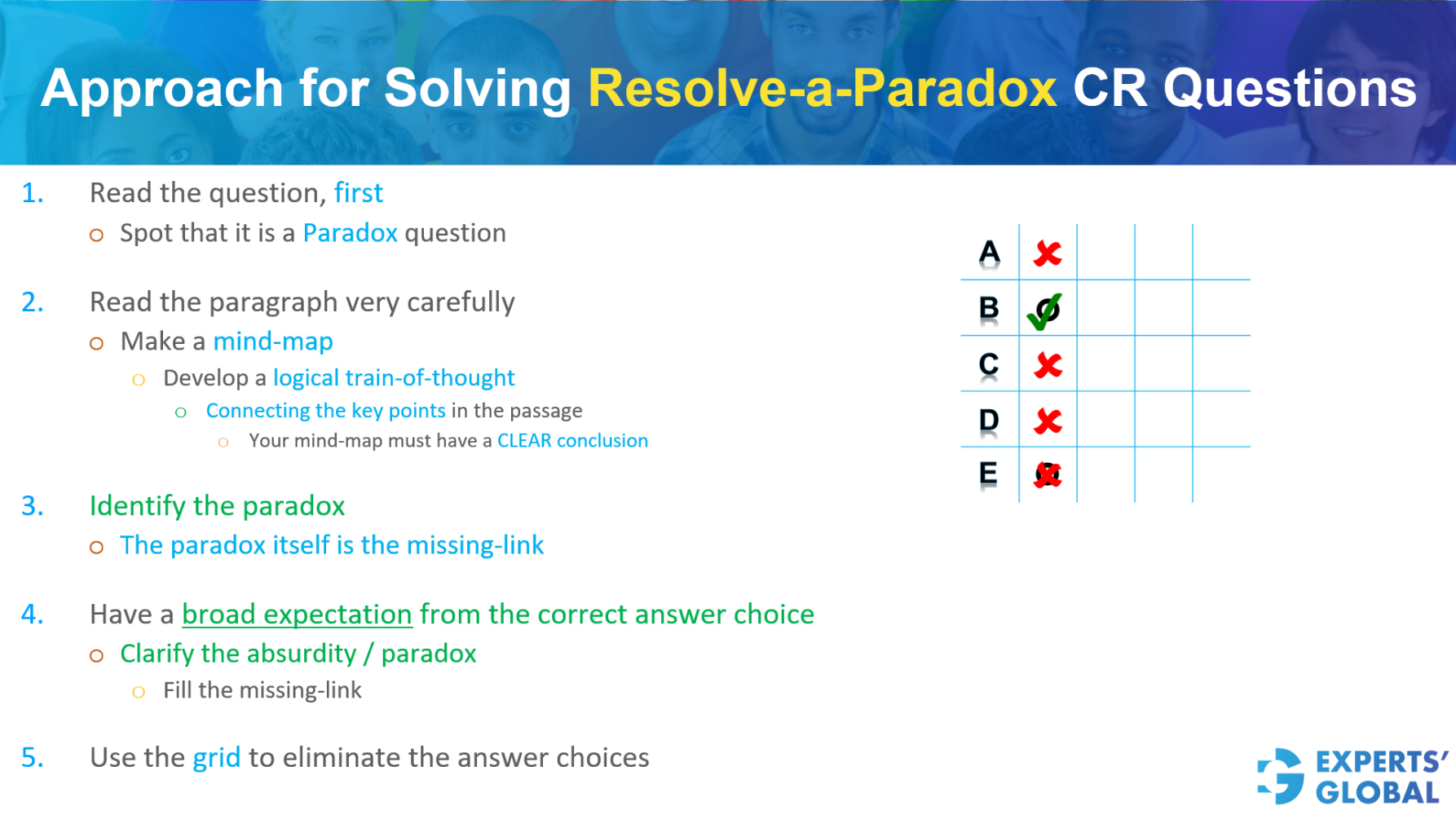
To solve GMAT Resolve-the-Paradox questions, first, read the question to recognize it as a paradox question. Then, carefully read the passage and create a mind map, connecting key points with a clear conclusion. The paradox itself is the missing link. Set a broad expectation from the correct answer choice, clarifying the paradox. Finally, use the grid to eliminate answer choices, ensuring the correct one resolves the paradox effectively. The video below explains the method, demonstrates how it works, and helps you apply it on GMAT-style CR Paradox questions.
Approach for Resolve-the-Paradox GMAT CR Questions
Beware When You See Numbers in CR
When you encounter numbers in GMAT Critical Reasoning, pay close attention, as they often hold both the trap and the key. Consider the context and scale carefully. For example, a 95% customer satisfaction rate may seem positive, but it is insufficient for industries like healthcare, where even a small margin of error can have serious consequences. The short video below brings this concept to life, showing how it might appear on the GMAT.
Beware When You See Numbers on GMAT CR
GMAT-style Worked Example: Resolve the Paradox CR Question
Written Explanation
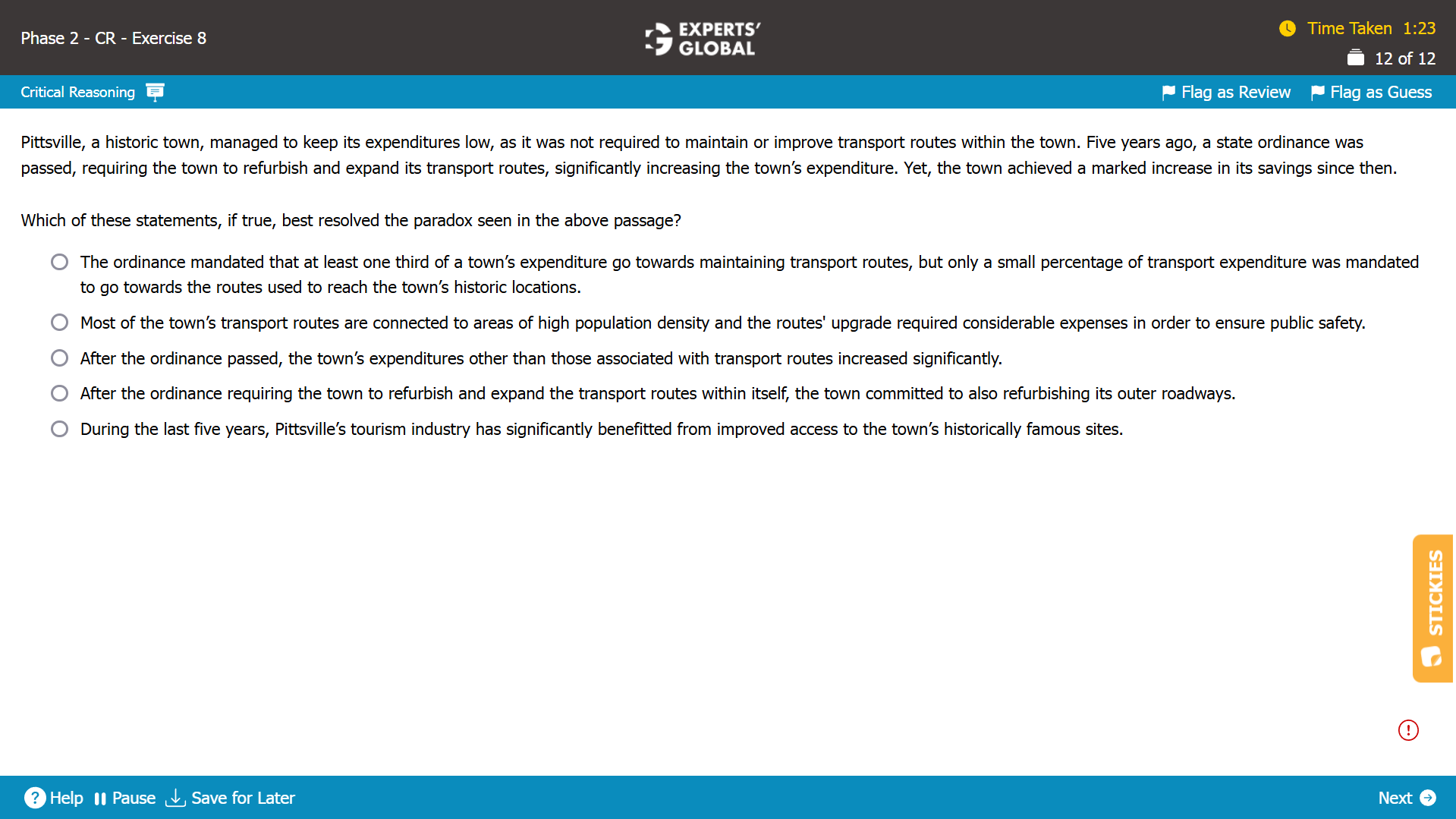
Mind-map: Town did not maintain transport routes → low expenditure → ordinance required upgrade of transport routes → town’s expenditure increased → town’s savings increased too
Missing-link: Between the town’s expenditure increasing and its savings increasing too
Expectation from the correct answer choice: To explain why the town’s savings increased despite the increase in its expenditure
A. Trap. The argument mentions that Pittsville kept low expenditure by avoiding transport expenditure; this answer choice, suggesting that transport expenditure was mandated to be at least one third of a town’s overall expenditure, simply supports the fact in the argument that the town’s transport expenditure increased and fails to explain why the town’s savings increased too. Additionally, this answer choice, suggesting that routes leading to historic locations accounted for only a small percentage of the transport expenditure, makes no suggestion about the town’s savings. Overall, this answer choice simply adds information, which, although relevant to the broad context of the argument, does not explain the discrepancy in the argument. Because this answer choice does not explain the discrepancy in the argument, this answer choice is incorrect.
B. This answer choice, suggesting that the upgrade of most of the town’s routes was expensive, simply supports the fact in the argument that the town’s transport expenditure increased and fails to explain why the town’s savings increased too. Because this answer choice does not explain the discrepancy in the argument, this answer choice is incorrect.
C. This answer choice, suggesting that expenditure other than transportation expenditure increased too, indicates greater overall expenditure, thus suggesting a likely reduction in savings and raising further concern over, rather than explaining, why the town’s savings increased. Because this answer choice does not explain the discrepancy in the argument, this answer choice is incorrect.
D. This answer choice, suggesting the town’s commitment to refurbish outer roadways in addition to its internal transportation routes, indicates greater overall expenditure, thus suggesting a likely reduction in savings and raising further concern over, rather than explaining, why the town’s savings increased. Because this answer choice does not explain the discrepancy in the argument, this answer choice is incorrect.
E. Correct. By suggesting that the improved access to historically famous sites benefitted Pittsville’s tourism industry, this answer choice indicates the possibility that improved transportation routes led to greater tourism revenue and that the tourism revenue likely increased more than the transportation expenses did, generating an increase in the town’s savings; thus, this answer choice explains the discrepancy in the argument. Because this answer choice clarifies the exact discrepancy, this answer choice is correct.
E is the best choice.
Evaluate-the-Argument Questions | GMAT Critical Reasoning
GMAT Critical Reasoning Evaluate the Argument, or “Evaluation,” questions ask you to identify the information that helps you determine whether an argument’s reasoning holds up or falls short. On this page, you’ll find a well-organized conceptual lesson and worked examples to guide your efficient preparation for this concept.

Approach for Evaluate-the-Argument GMAT Critical Reasoning Questions
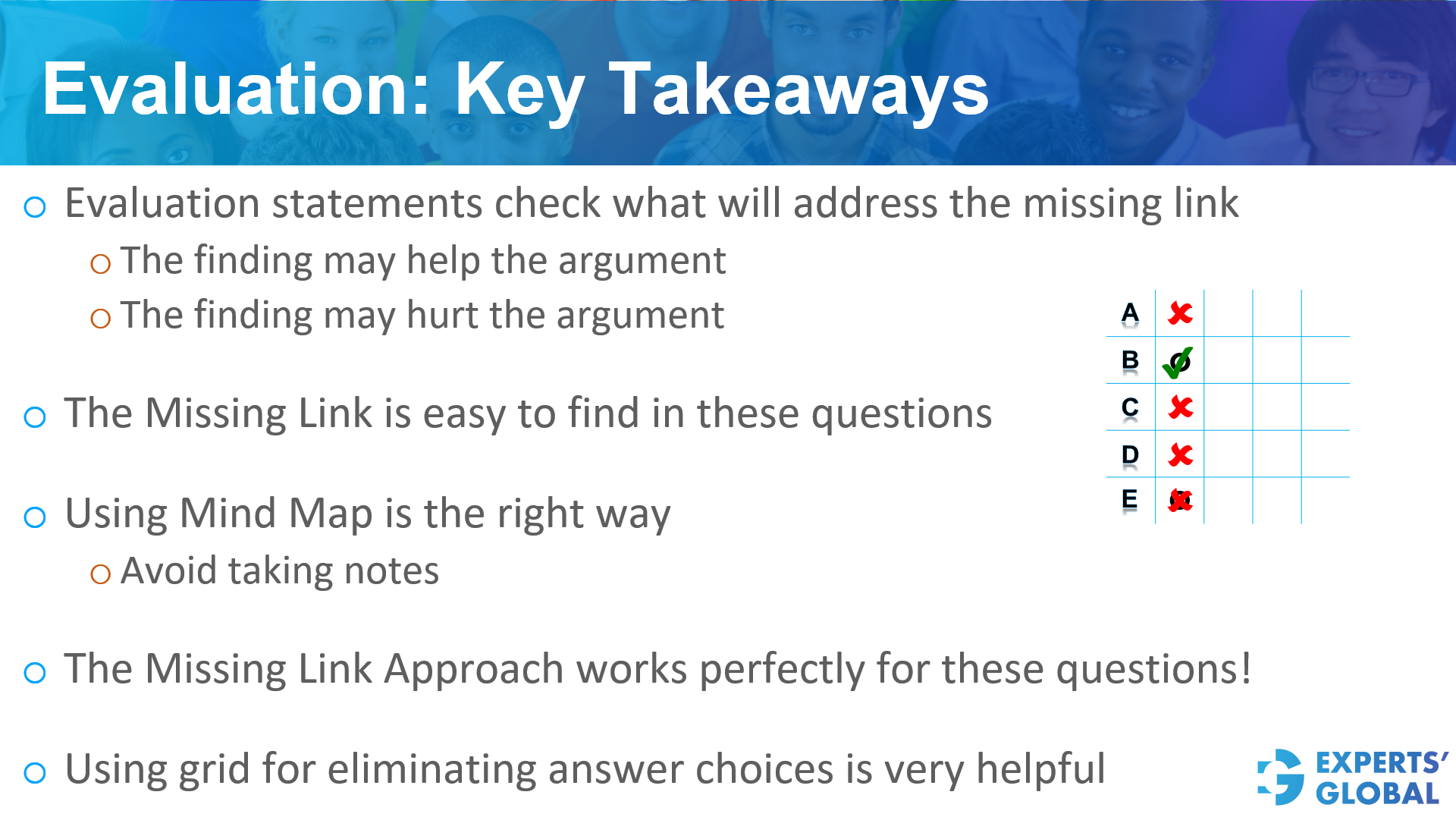
To solve GMAT Critical Reasoning Evaluation questions, first, read the question carefully to recognize that it’s an evaluation question. Then, read the paragraph carefully and create a mind map, connecting the key points with a clear conclusion. Set a broad expectation for the correct answer choice based on how it impacts the conclusion. Go by elimination (use the grid) to Identify the evaluation statement, which either strengthens or weakens the argument. The video below explains the method, demonstrates it with examples, and helps you apply it effectively on GMAT.
Approach for Evaluate-the-Argument GMAT CR Questions
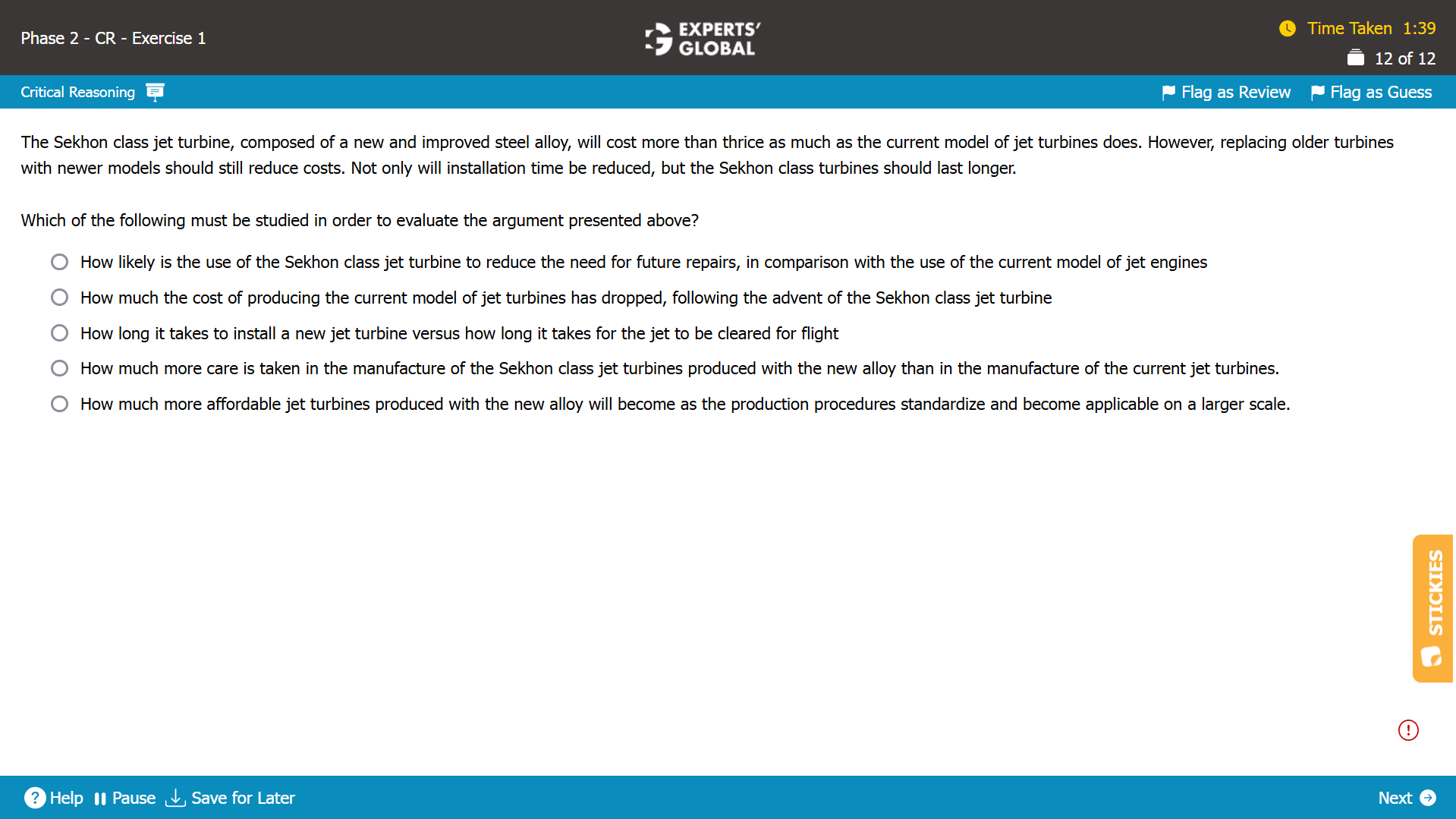
GMAT-style Worked Example: Evaluate the Argument CR Question
Written Explanation
Mind-map: New model of jet turbines costs more than thrice as much as the current model → new model reduces installation time and should last longer → replacing the current model with the new model is cost-effective (conclusion)
Missing-link: Between all the virtues of the new model and the conclusion that replacing the current model with the new model is cost-effective
Expectation from the correct answer choice: To indicate some fact or data that helps in evaluating the conclusion that replacing the current model with the new model is cost-effective
A. Correct. If the new model, in comparison to the current model, does not reduce the need for future repairs, it indicates that replacing the current model with the new model is not likely to decrease repair costs; so, this answer choice casts doubt on the conclusion that the replacement is cost-effective; so, comparing the likelihood to reduce the need for future repairs in the two models would help evaluate the conclusion. Because this answer choice would help evaluate the conclusion, this answer choice is correct.
B. The argument is concerned with comparing the cost-effectiveness in the usage of the new and the current models; so, comparing the effect of the new model on the “cost of production of the current model” would simply provide additional information but have no bearing on the argument. Because this answer choice would not help evaluate the conclusion, this answer choice is incorrect.
C. Trap. The argument is concerned with comparing the cost-effectiveness in the usage of the new and the current models; comparing the amount of “time” to install the two models would compare the efficiency of the installation and not the cost-effectiveness of the two models; so, this answer choice is just additional information and has no bearing on the argument. Because this answer choice would not help evaluate the conclusion, this answer choice is incorrect.
D. The argument is concerned with comparing the cost-effectiveness in the usage of the new and the current models; comparing the “degree of care” during manufacturing of the two models would likely compare the quality of manufacturing and not the cost-effectiveness of the two models; so, this answer choice is just additional information and has no bearing on the argument. Because this answer choice would not help evaluate the conclusion, this answer choice is incorrect.
E. The argument is concerned with comparing the cost-effectiveness in the usage of the new and the current models; so, comparing the “production cost of the new model” before and after standardization/mass production would simply provide additional information but have no bearing on the argument. Besides, affordability of the new model after standardization/mass production is a concern in the future and is out of scope of the present concern related to cost-effectiveness. Because this answer choice would not help evaluate the conclusion, this answer choice is incorrect.
A is the best choice.
Inference Questions | GMAT Critical Reasoning
Critical Reasoning Inference questions challenge you to identify the statement that must be true based on the information given, without adding assumptions, exaggerating, or misinterpreting the facts. On this page, you will find structured conceptual material along with several worked examples, to guide your efficient preparation for this concept.
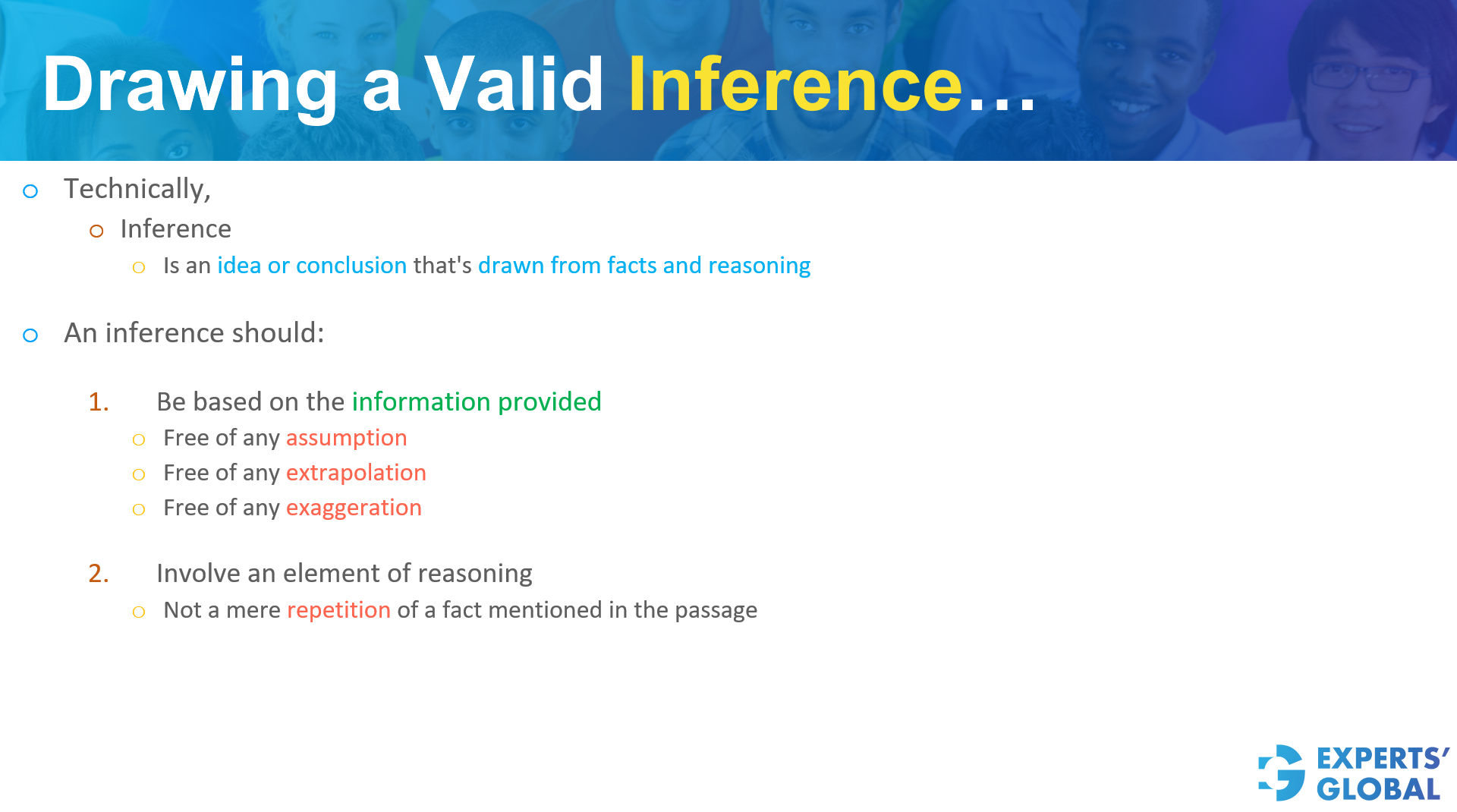
Characteristics of a Valid Inference
A valid inference is a statement that must be true based solely on the information provided, without adding any assumptions, exaggeration, or stretching of the facts. It remains firmly within the boundaries of the passage, respects important qualifiers, and directly follows from the facts as presented. It is understated yet certain, because it sticks strictly to what the details clearly support.
Approach for Inference GMAT Critical Reasoning Questions
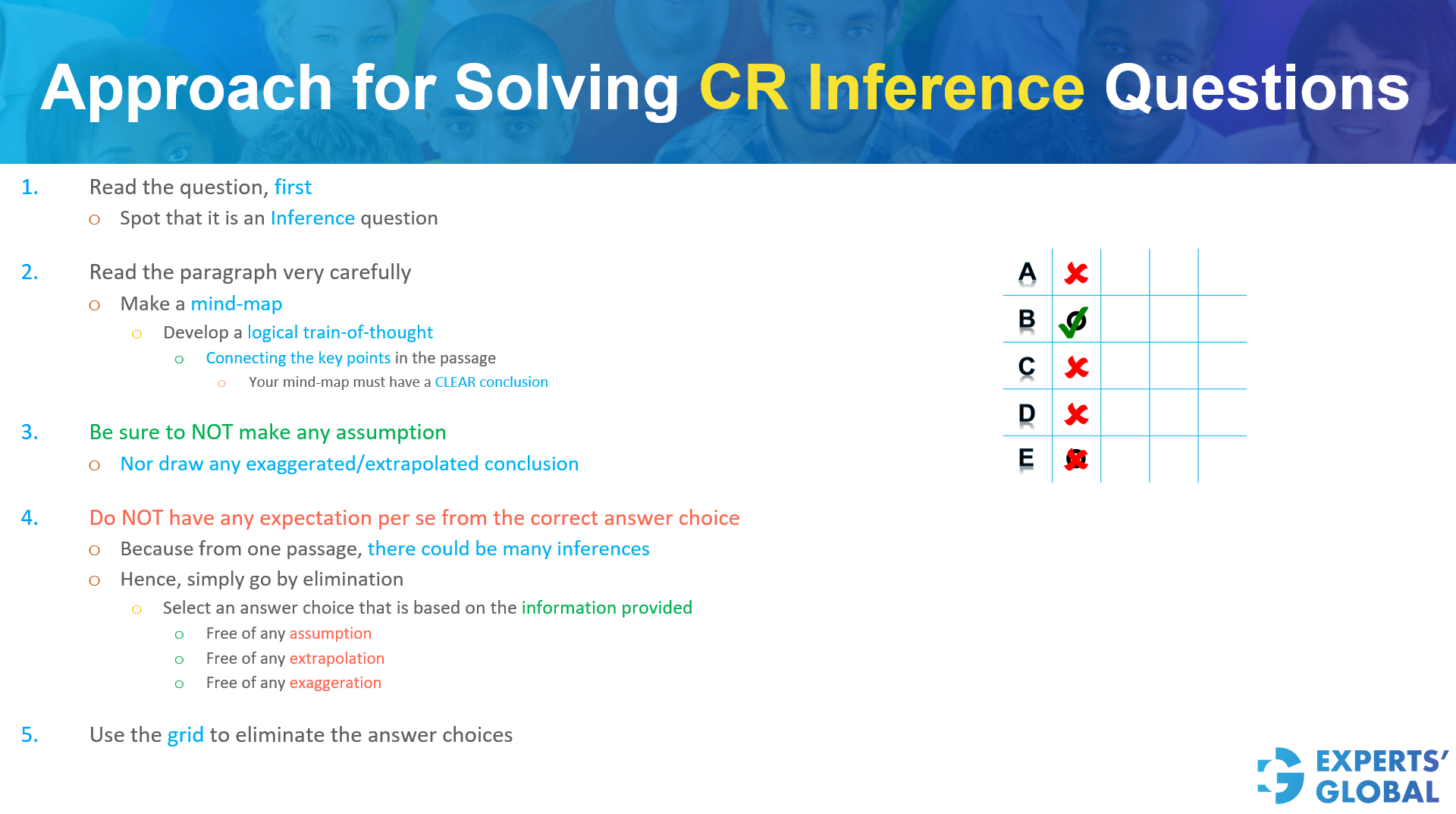
To solve GMAT Critical Reasoning inference questions, follow these steps: First, read the question stem to identify that it’s an inference question. Then, carefully read the paragraph and create a mind map to connect key points with a clear conclusion. Avoid making assumptions or drawing exaggerated conclusions. Don’t expect a specific answer; instead, use elimination based on the information provided. Select the answer that is free from assumptions, extrapolation, and exaggeration, and use the grid to eliminate incorrect choices. In the short video below, this approach is explained, demonstrated, and ready for application on GMAT.
Approach for GMAT CR Inference Questions
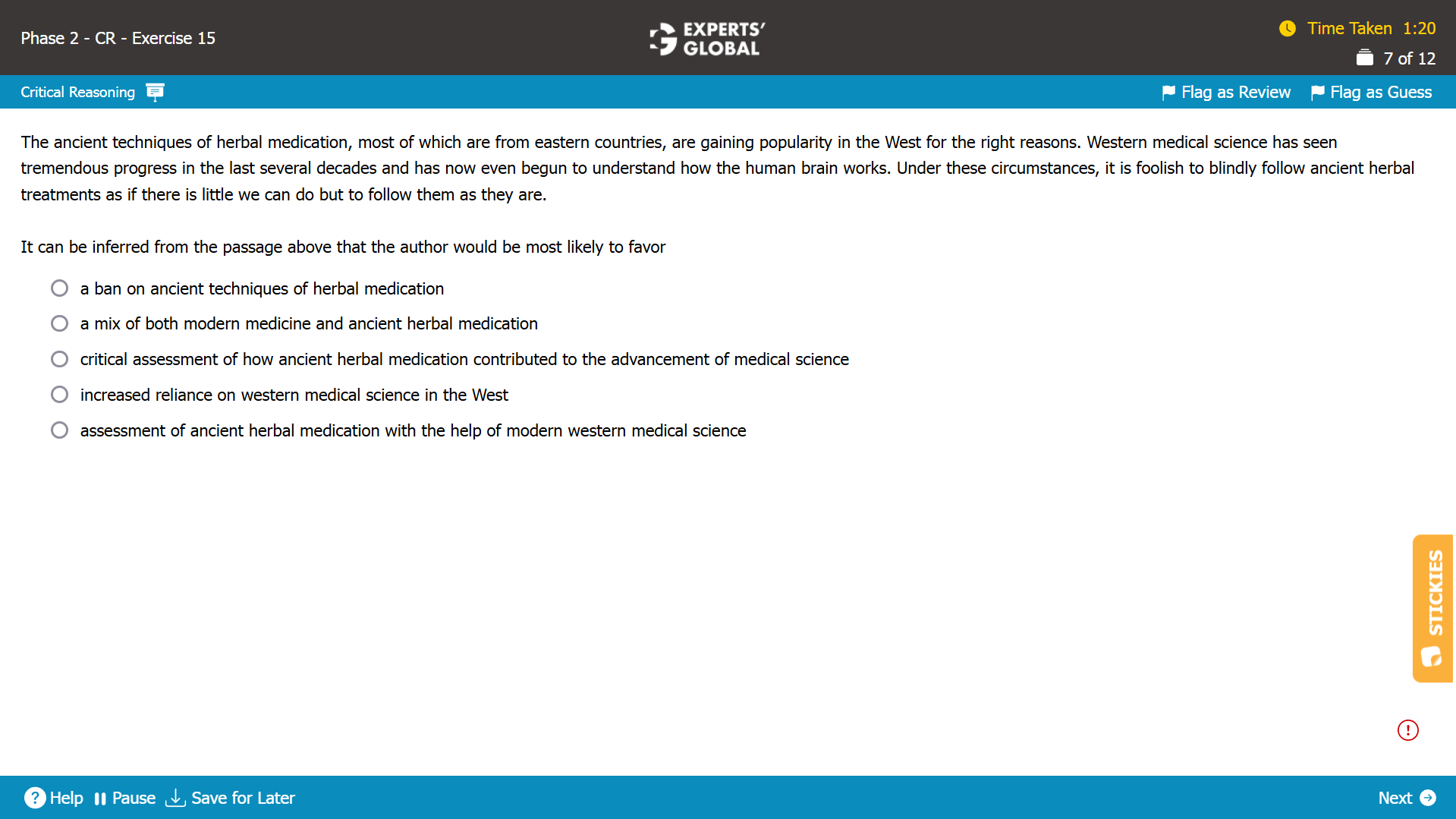
GMAT-style Worked Example: Inference CR Question
Written Explanation
Mind-map: Ancient herbal treatments from the East gaining popularity in the West → western medical science has made tremendous progress → it is foolish to blindly follow ancient herbal treatments
Missing-link: Not needed
Expectation from the correct answer choice: To be duly deducible from the information in the passage, without any assumption or extrapolation
A. Although the passage mentions that “it is foolish to blindly follow ancient herbal treatments”, it also mentions that these treatments are “gaining popularity in the West for the right reasons”; it can be inferred that the author regards these treatments as respectable and hence, is not likely to be in favor of banning them. Besides, the term “ban” is extremely strong; one needs to be cautious of such answer choices as they are generally incorrect on the GMAT. Because this answer choice is not deducible from the information in the passage without any assumption or extrapolation, this answer choice is incorrect.
B. The passage mentions that the “western medical science has seen tremendous progress” and that “it is foolish to blindly follow ancient herbal treatments”; although it can be inferred that the author suggests scrutiny of these treatments by western medical science, no suggestion regarding mixing modern medicine and ancient herbal medication can be inferred. Because this answer choice is not deducible from the information in the passage without any assumption or extrapolation, this answer choice is incorrect.
C. Trap. The passage mentions that ancient herbal treatments are “gaining popularity in the West for the right reasons”; it can be inferred that the author regards these treatments as respectable and hence, is not likely critical about their contribution to the advancement of medical science, as this answer choice mentions; the author simply objects to blindly following them. Because this answer choice is not deducible from the information in the passage without any assumption or extrapolation, this answer choice is incorrect.
D. Trap. The passage mentions that the “western medical science has seen tremendous progress” and that “it is foolish to blindly follow ancient herbal treatments as if there is little we can do but to follow them as they are”; it can be inferred that the author believes that there is significant reliance on the western medical science; further, the passage mentions that ancient herbal treatments are “gaining popularity in the West for the right reasons”, thus acknowledging the importance of the eastern ancient treatments; overall, it cannot be established that the author is in favor of “increased reliance” on western medical science, as the answer choice mentions. Because this answer choice is not deducible from the information in the passage without any assumption or extrapolation, this answer choice is incorrect.
E. Correct. The passage mentions that “western medical science has seen tremendous progress” and that “it is foolish to blindly follow ancient herbal treatments”; it can be inferred that the author suggests scrutiny of these treatments by western medical science; in other words, the author would like to favor assessment of ancient herbal medication with the help of modern western medical science, as the answer choice mentions. Because this answer choice is deducible from the information in the passage without any assumption or extrapolation, this answer choice is correct.
An interesting discussion:
A student once wrote to us seeking clarification about why answer choice E is correct but answer choice C is incorrect when both answer choices indicate an assessment of ancient herbal treatments. Can you spot the difference between the two answer choices? Please note that the passage mentions that ancient herbal treatments are “gaining popularity in the West for the right reasons” and that “it is foolish to blindly follow ancient herbal treatments”; the author regards these treatments as respectable but objects to following them without reasons; because the author mentions both positive and negative aspects about the treatments, the author’s view is likely going to be objective; answer choice E suggests an objective assessment (neutral tone) whereas answer choice C suggests a critical assessment (negative tone); so, the two answer choice differ and answer choice E, being neutral in tonality, is correct. The overall learning here is to pay attention to what the argument implies holistically.
E is the best choice.
Facing difficulty with such problems? Click here
Main Point or Conclusion Questions | GMAT Critical Reasoning
Critical Reasoning Main Point or Conclusion questions challenge you to identify the primary claim the argument seeks to prove, the central idea that all other details in the passage aim to support. These questions help you distinguish the main message from the supporting information and understand the structure of the reasoning clearly. On this page, you will find well-organized conceptual lesson along with worked examples, to guide your efficient preparation for this concept.
Characteristics of a Valid Main Point or Conclusion Statement
A valid main point or conclusion statement highlights the core claim the argument is trying to establish, rather than a supporting detail or side note. It aligns with the passage’s scope, mirrors the author’s intent, and maintains the exact level of certainty expressed. The statement clearly and accurately captures the key idea, without introducing extra information or making the claim broader or stronger than what the passage supports.
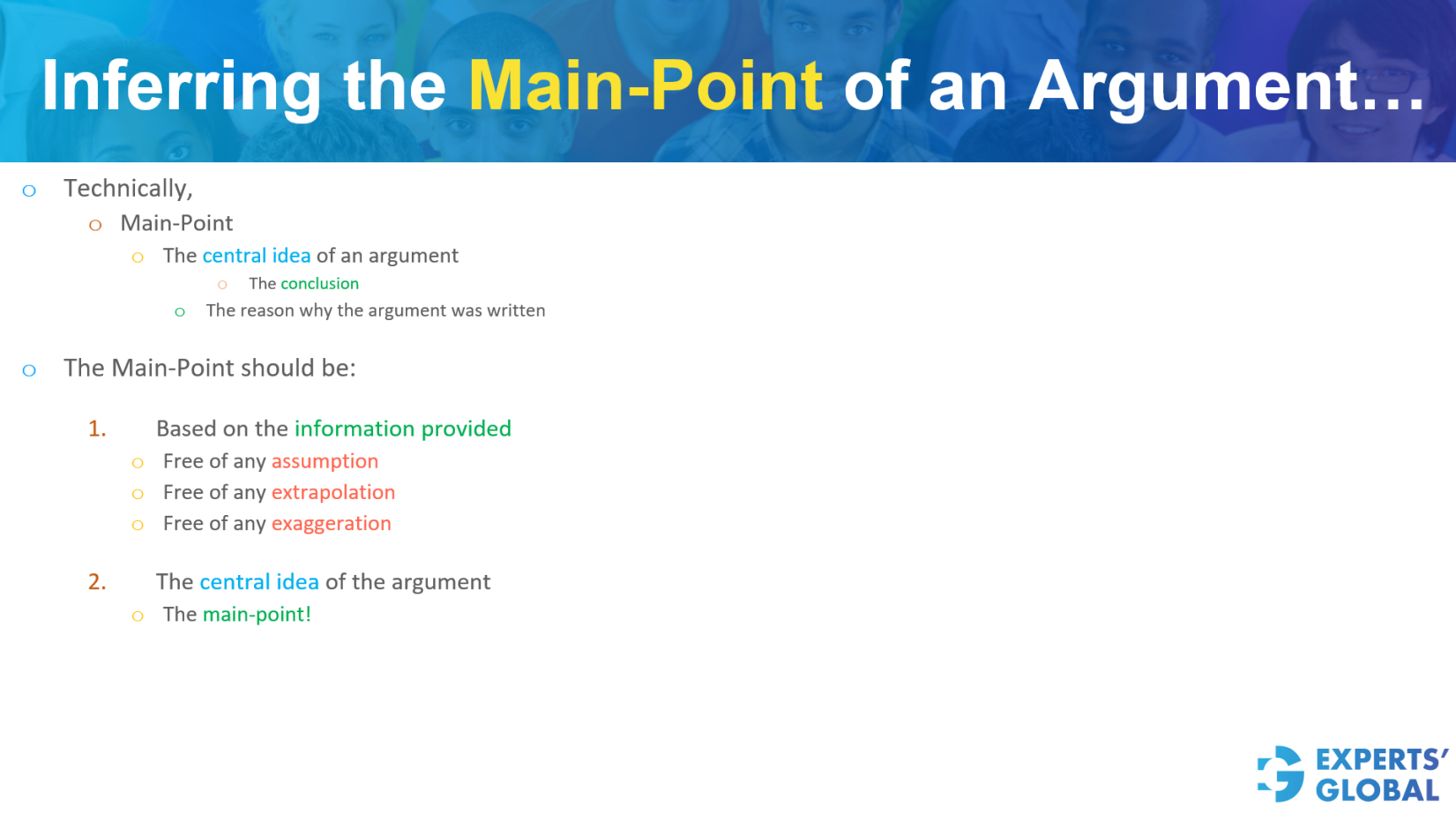
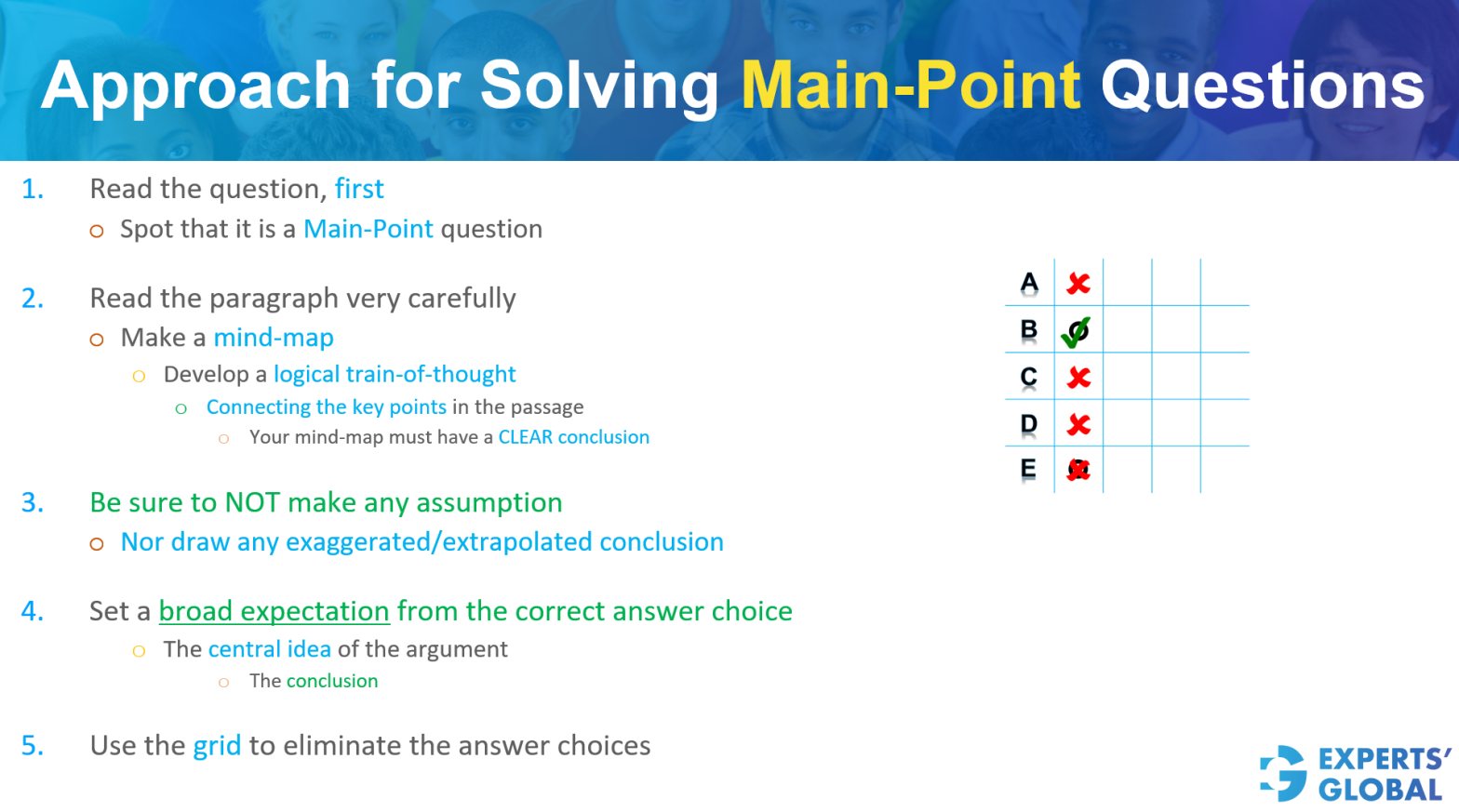
Approach for Argument’s Main Point GMAT Critical Reasoning Questions
First, read the question stem to identify the question as a main-point one. Then, read the paragraph carefully and create a mind map to logically connect the key points, ensuring your map leads to a clear conclusion. Avoid making assumptions or drawing exaggerated conclusions. Set a broad expectation for the correct answer by focusing on the central idea of the argument. Finally, use the grid to eliminate answer choices. The short video below explains the method, demonstrates it in action, and helps you apply it on GMAT CR.
Approach for GMAT CR Argument’s Main Point Questions
GMAT-style Worked Example: Main Point CR Question
Written Explanation
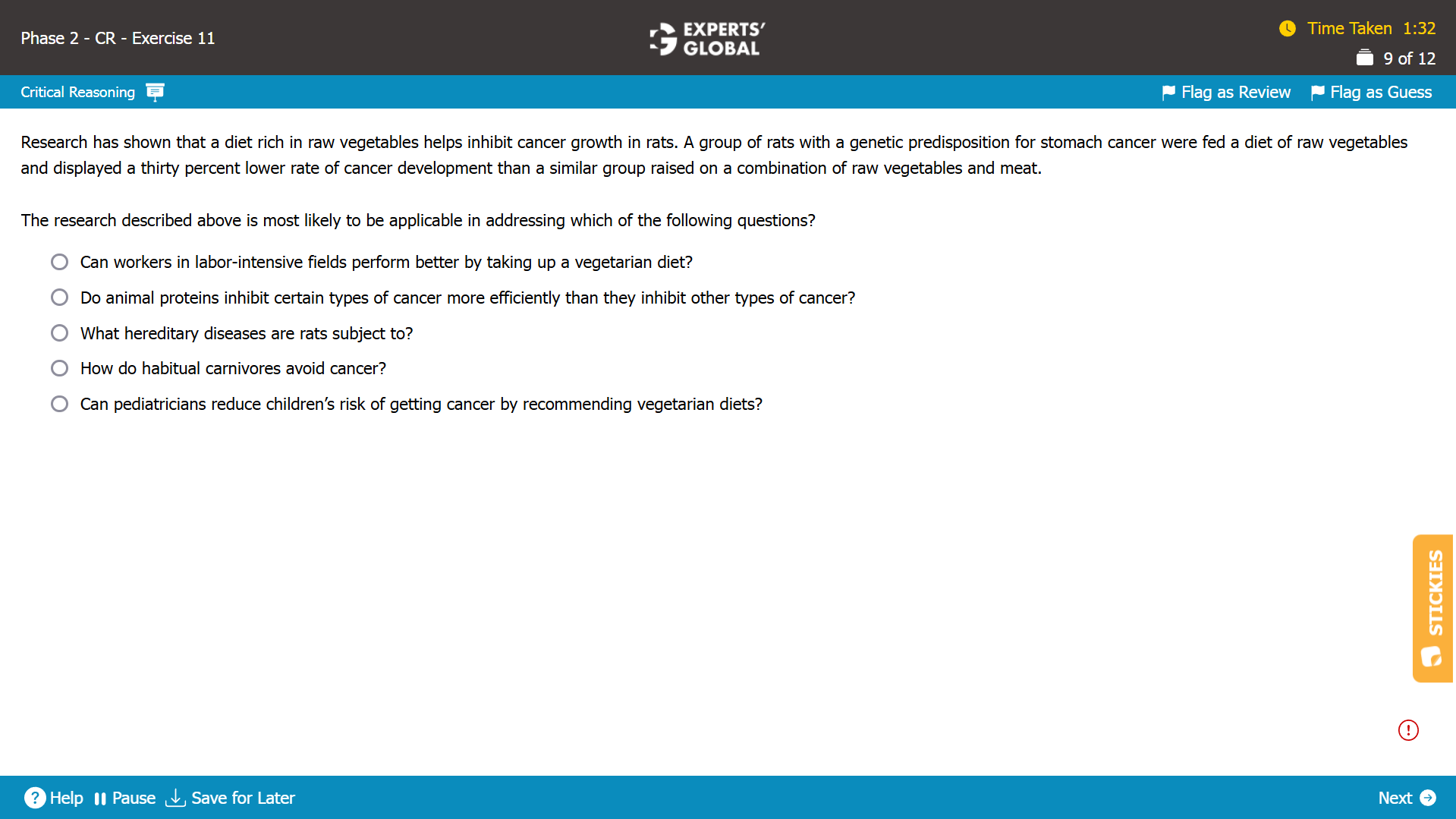
Mind-map: Raw vegetable diet helps inhibit cancer growth → rats fed on raw vegetable diet lowered development of cancer compared to similar rats fed on vegetable and meat diet
Missing-link: Not needed
Expectation from the correct answer choice: To have due applicability of the research mentioned in the passage, without any assumption or extrapolation
A. The passage is concerned with the effect of a raw vegetable diet on “cancer growth” and not on the “physical ability to labor”; so, this answer choice, questioning whether such a diet would improve the performance of workers in labor-intensive fields, does not present a scenario in which the research in the passage is applicable. Because the research in the passage is not applicable to this answer choice, this answer choice is incorrect.
B. The passage is concerned with the effect of a “vegetable” diet on cancer growth; so, this answer choice, comparing the effectiveness of a “non-vegetarian” diet in inhibiting different types of cancer, is a question unrelated to the research on the effect of a vegetable diet and so does not present a scenario in which the research in the passage is applicable. Because the research in the passage is not applicable to this answer choice, this answer choice is incorrect.
C. Trap. The passage is concerned with the effect of a vegetable diet on “cancer” growth; so, this answer choice, questioning about other hereditary diseases in rats, is a general question unrelated to the research on the effect of a vegetable diet and so does not present a scenario in which the research in the passage is applicable. Because the research in the passage is not applicable to this answer choice, this answer choice is incorrect.
D. The passage is concerned with the effect of a “vegetable” diet on cancer growth; so, this answer choice, questioning how those with a “non-vegetarian” diet avoid cancer, is a question unrelated to the research on the effect of a vegetable diet and so does not present a scenario in which the research in the passage is applicable. Because the research in the passage is not applicable to this answer choice, this answer choice is incorrect.
E. Correct. The passage establishes a cause-effect relationship between a vegetable diet and a reduced risk of cancer in rats; such a relationship holds relevance in determining whether a vegetable diet can also reduce the risk of cancer in children; so, this answer choice, questioning such a possibility, presents an apt scenario in which the research in the passage is applicable. Because the research in the passage is applicable to this answer choice, this answer choice is correct.
E is the best choice.
Complete the Paragraph Questions | GMAT Critical Reasoning
CR Complete the Paragraph questions challenge you to select the answer that best continues the author’s reasoning, ensuring the paragraph concludes with a smooth, logical flow. These questions teach you how ideas connect, how arguments unfold, and what kind of statement naturally follows from the information already given. On this page, you will find a well-structured conceptual material along with worked examples, to guide your preparation for this concept.
Characteristics of a Valid Paragraph Completion Statement
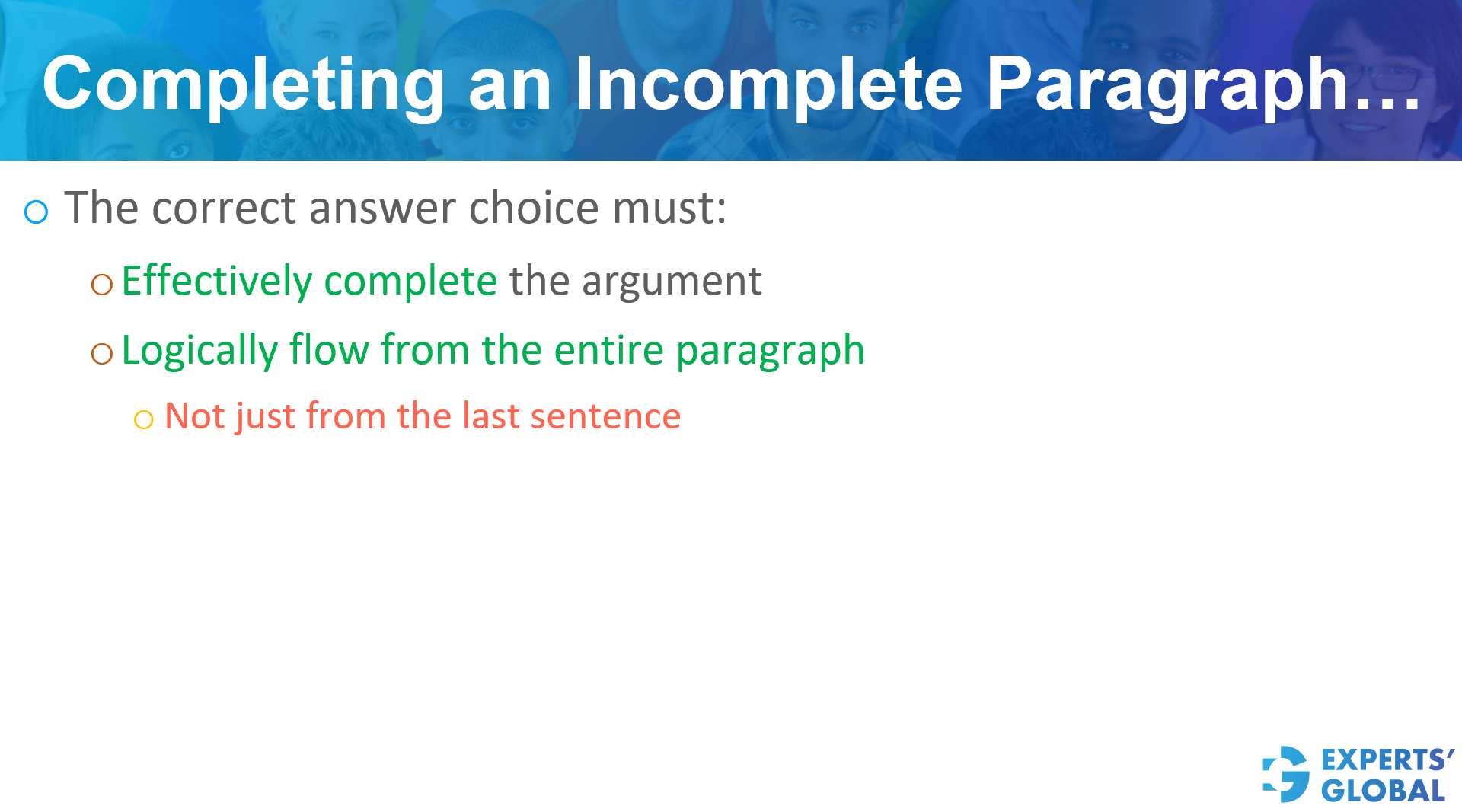
A valid paragraph completion statement seamlessly extends the author’s logic, bringing the paragraph to a clear and logical conclusion. It aligns with the tone and direction of the existing content, building directly on the provided information without introducing new assumptions or diverging from the main topic. It maintains the same level of certainty and scope as the passage and avoids making extreme or irrelevant claims that disrupt the flow.
Approach for Paragraph Completion GMAT Critical Reasoning Questions
Approach for Paragraph Completion GMAT Critical Reasoning Questions
First, identify that it is a para-completion question. Then, read the paragraph carefully and create a mind map to logically connect the key points with a clear conclusion. Process the argument’s information and estimate how it would logically conclude. Set a broad expectation from the correct answer, ensuring it logically completes the entire paragraph. Finally, use the grid to eliminate incorrect choices. The following video demonstrates this approach, applies it to sample problems, and connects it to GMAT-style CR para-completion problems.
Approach for GMAT CR Paragraph Completion Questions
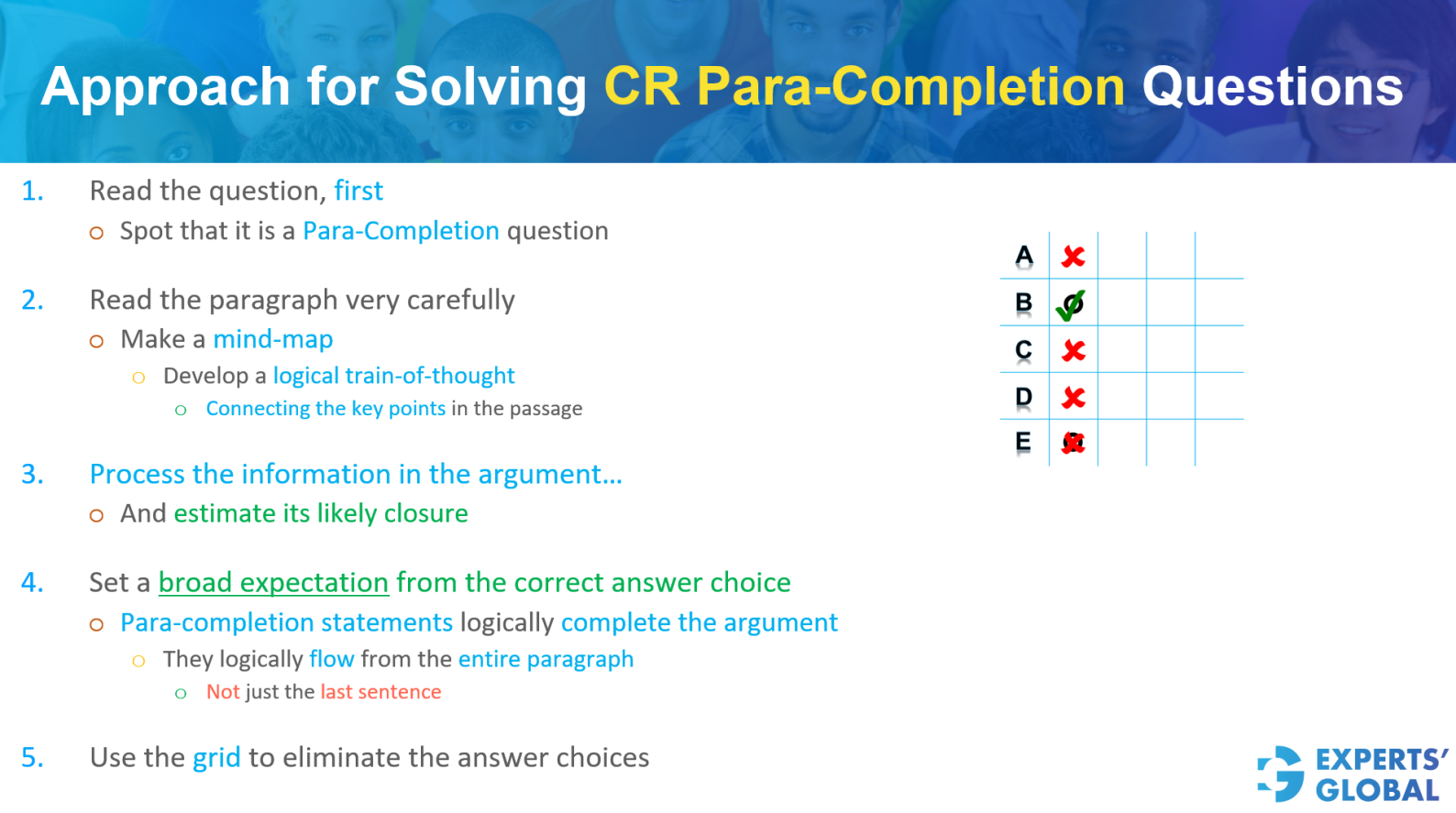
GMAT-style Worked Example: Paragraph Completion CR Question
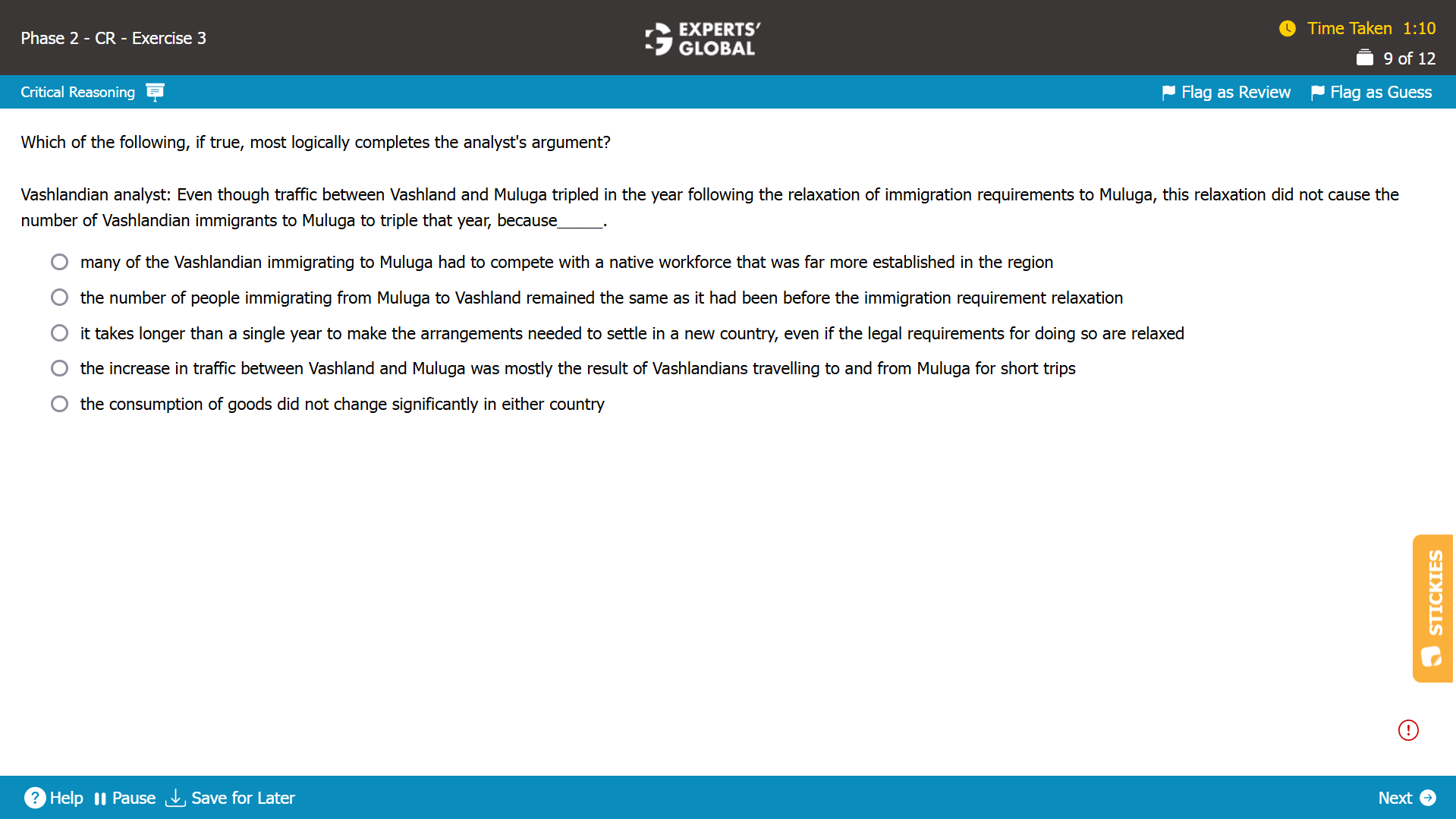
Written Explanation
Mind-map: Immigration requirements to Muluga relaxed → traffic from Vashland to Muluga tripled in a year → relaxation did not triple number of Vashlandian immigrants to Muluga because _____
Missing-link: Between traffic from Vashland to Muluga tripling in a year and the number of Vashlandian immigrants to Muluga not tripling
Expectation from the correct answer choice: Something on the lines of an explanation for why the relaxation in immigration requirements did not triple the number of Vashlandian immigrants to Muluga despite tripling the traffic from Vashland to Muluga
A. Trap. This answer choice, suggesting a workforce-related challenge Vashlandian immigrants face “after they immigrate” to Muluga, makes no suggestion regarding why the number of Vashlandian immigrants did not triple despite the traffic from Vashland to Muluga tripling after the relaxation in immigration requirements. Because this answer choice does not effectively complete the chain of thoughts developed in the passage, this answer choice is incorrect.
B. This argument is concerned with the relaxation in immigration requirements “to Muluga” and its effect on the number of Vashlandian immigrants “to Muluga”; so, immigrants “from Muluga to Vashland” are out of scope. Because this answer choice does not effectively complete the chain of thoughts developed in the passage, this answer choice is incorrect.
C. This answer choice, suggesting a settlement-related challenge Vashlandian immigrants face “after they immigrate” to Muluga, makes no suggestion regarding why the number of Vashlandian immigrants did not triple despite the traffic from Vashland to Muluga tripling after the relaxation in immigration requirements. Because this answer choice does not effectively complete the chain of thoughts developed in the passage, this answer choice is incorrect.
D. Correct. This answer choice, suggesting that the increase in traffic between the two countries was mostly because of Vashlandians travelling for “short trips” rather than “immigrating”, explains why, after the relaxation in immigration requirements, traffic tripled but the number of Vashlandian immigrants did not, thus clarifying the exact discrepancy and effectively completing the chain of thoughts developed in the passage. Because this answer choice duly completes the passage, this answer choice is correct.
E. Stable consumption of goods makes no suggestion regarding an increase in traffic or in immigration to Muluga, thus failing to effectively complete the chain of thoughts developed in the passage. Because this answer choice does not duly complete the passage, this answer choice is incorrect.
D is the best choice.
Boldface Questions | GMAT Critical Reasoning
GMAT Critical Reasoning Boldface questions challenge you to identify the role of each highlighted statement in the argument. With a structured, step-by-step method, achieving near-perfect accuracy on GMAT CR boldface questions within the time limit is well within reach. This page provides that approach in a clear, organized manner. Moreover, this page offers a structured playlist by subtopic, along with multiple worked examples, to guide your preparation effectively for this concept.
CR Boldface Questions: What These Questions Ask You to Do
In GMAT Critical Reasoning boldface questions, you will see a passage with certain parts highlighted in bold. Your task is to figure out how these bolded sections fit into the overall argument and what role they play.
How a Boldface CR Question Appears on the GMAT
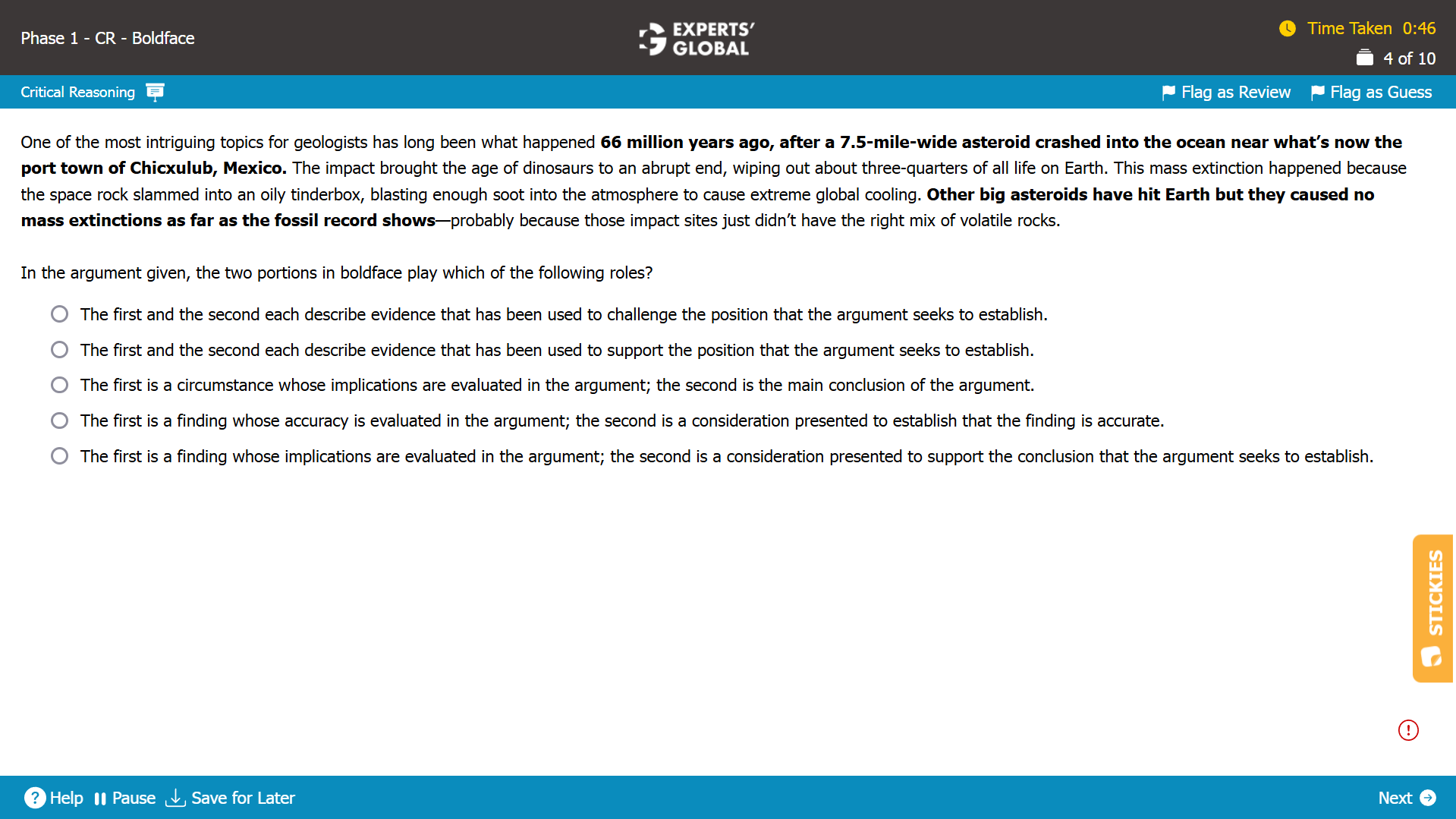
Approach for Boldface GMAT Critical Reasoning
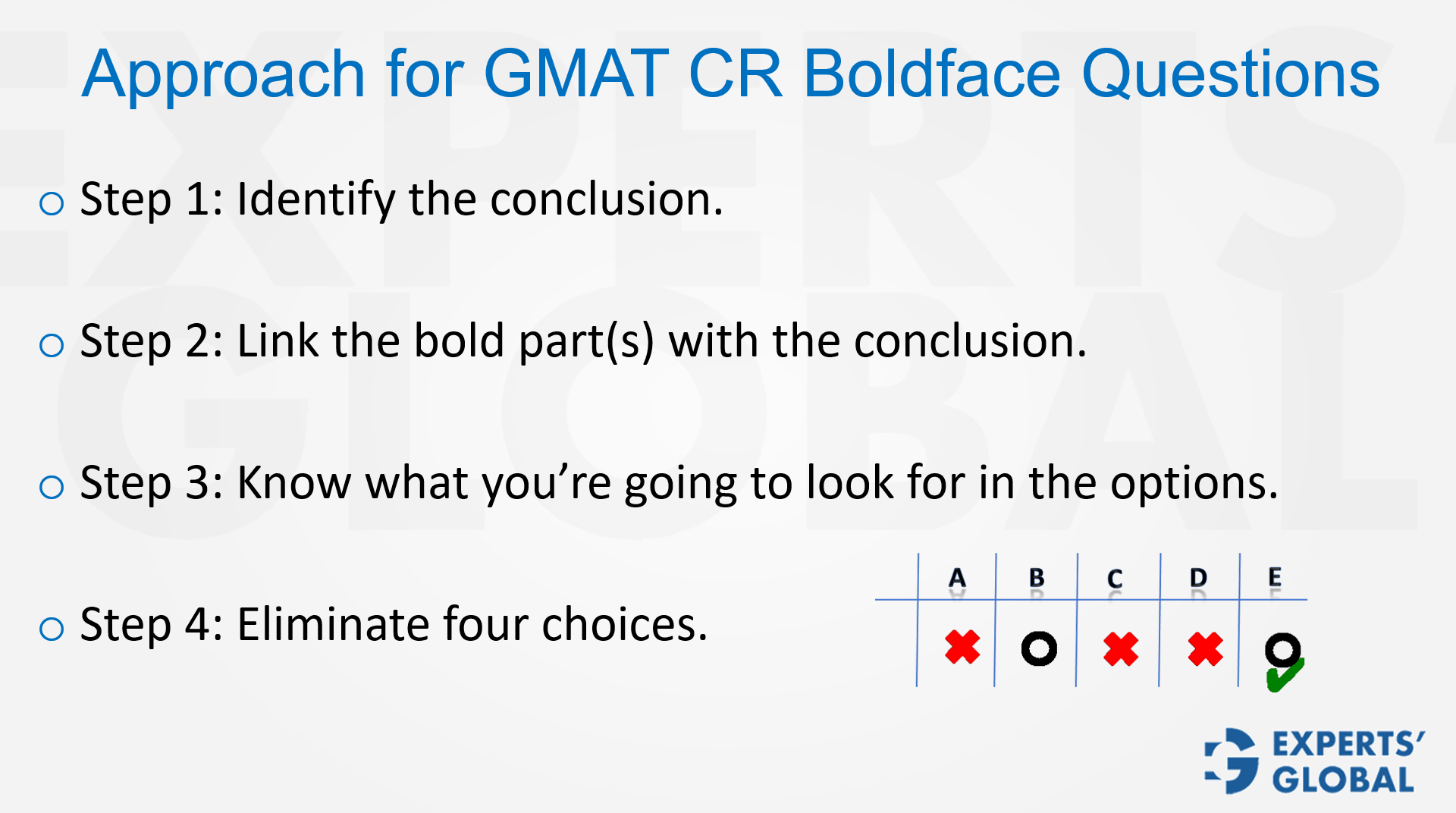
In GMAT boldface questions, you will encounter a passage with one or more sections highlighted in bold. Your job is to figure out how these bolded parts contribute to the overall argument. Here’s a simple 4-step method to tackle these questions:
Step 1: Identify the conclusion of the argument.
Step 2: Connect the bolded section(s) to that conclusion.
Step 3: Understand what to look for in the answer choices.
Step 4: Eliminate four incorrect options. The remaining choice is the correct one.
Always make sure to double-check your answer before finalizing it.
The following conceptual review walks you through this strategy and shows how to apply it to boldface questions, even when under time pressure. This brief lesson also includes worked examples to demonstrate each step and important concepts. Pause the video after each question to solve it yourself, applying the approach while seeing how the trainer uses it in real-time examples.

Approach for GMAT CR Boldface Questions
Applying the Strategy to a GMAT-like Boldface Question
Now that you know the best way to tackle GMAT CR Boldface questions, it’s time to put your skills to the test with a GMAT-style problem. Watch the video carefully and pause it to work through the question yourself. Focus on using the strategy rather than just finding the answer, and take note of how the trainer skillfully demonstrates the four-step approach.
Application of Approach for GMAT CR Boldface Questions
Mastering the Key Vocabulary in Boldface Questions
A key challenge in tackling GMAT CR Boldface questions is understanding the specific language used in both the questions and the answer choices. While the terms may not be difficult, they have very specific meanings. Grasping these meanings is essential for navigating the options, making it easier to eliminate incorrect answers, and ultimately selecting the right one.
Frequently Used Vocabulary in GMAT CR Boldface Questions
Essential Nouns in Critical Reasoning Boldface Questions
- Conclusion – The statement that the reasoning aims to prove.
- Judgment – A personal assessment or opinion about something.
- Prediction – A statement about what is expected to occur in the future.
- Evidence – Information that either supports or challenges an argument.
- Fact – A verified truth or established detail.
- Opinion – A viewpoint that may or may not be accurate.
- Main Conclusion – The central claim of the argument, separate from smaller conclusions.
- Intermediate Conclusion – A secondary claim that may or may not back the main conclusion.
- Circumstance – A relevant condition or context in the argument.
- Assumption – An unstated belief accepted as true to make the reasoning valid.
- Consideration – A point or factor taken into account during the reasoning process.
- Finding – A result discovered through research or effort.
- Explanation – A clarification that helps make something easier to understand.
- Objection – A counterpoint or disagreement with the argument.
- Claim – A statement presented without solid proof.
- Position – A firmly held stance or opinion on an issue.
Essential Verbs in Critical Reasoning Boldface Questions
- To oppose – To challenge or weaken an argument.
- To establish – To present or lay out a viewpoint.
- To evaluate – To carefully assess or judge.
- To imply – To suggest something without stating it directly.
- To introduce – To bring forward a new idea or point.
- To support – To reinforce or strengthen an argument.
- To explain – To make an idea or concept clearer.
- To undermine – To weaken or diminish the strength of an argument.
- To challenge – To question or dispute the truth of something.
- To describe – To offer a detailed account or explanation.
Vocabulary Test 1 for Boldface Questions
Now that you understand the essential vocabulary for GMAT CR Boldface questions, it’s time to put your knowledge to the test with a real argument. In the following video, you will see an argument with a boldfaced section, followed by 10 terms. Your task is to choose the term that best matches the boldfaced part. This exercise is Drill #1.
Vocabulary Test 1 for GMAT CR Boldface Questions
Vocabulary Test 2 for Boldface Questions
Let’s dive into another practice exercise. In the video ahead, you will come across an argument with a boldfaced section, followed by 10 common GMAT CR Boldface terms. Your challenge is to determine which term best fits the boldfaced part. This exercise is Drill #2.
Vocabulary Test 2 for GMAT CR Boldface Questions
Vocabulary Test 3 for Boldface Questions
In the next video, you will encounter an argument with a boldfaced section, followed by 10 frequently used GMAT CR Boldface terms. Your goal is to review the list and identify which terms apply to the boldfaced part. This is Drill #3.
Vocabulary Test 3 for GMAT CR Boldface Questions
Vocabulary Test 4 for Boldface Questions
For this next exercise, watch the video where you will see an argument with a boldfaced section, followed by 10 commonly used GMAT CR Boldface terms. Your job is to examine the boldfaced part and figure out which terms best describe it. This is Drill #4.
Vocabulary Test 4 for GMAT CR Boldface Questions
Vocabulary Test 5 for Boldface Questions
The next video presents an argument with a boldfaced section, followed by 10 typical GMAT CR Boldface terms. Go through the list and figure out which terms accurately describe the boldfaced portion. This is Drill #5.
Vocabulary Test 5 for GMAT CR Boldface Questions
Key Recap: Important Points for CR Boldface Questions
By now, you have a solid understanding of the GMAT CR boldface task, a clear strategy for tackling these questions, and a familiarity with commonly tested vocabulary, all while building your skills through focused vocabulary drills. Great job on making impressive progress! Before diving into GMAT-style CR boldface questions, let’s take a moment to quickly recap the key points of the strategy. The following short video summarizes the approach, shows how to apply it to questions, and helps you use it confidently on GMAT boldface.
Key Points for GMAT CR Boldface Questions
GMAT-style Worked Example: Boldface CR Question
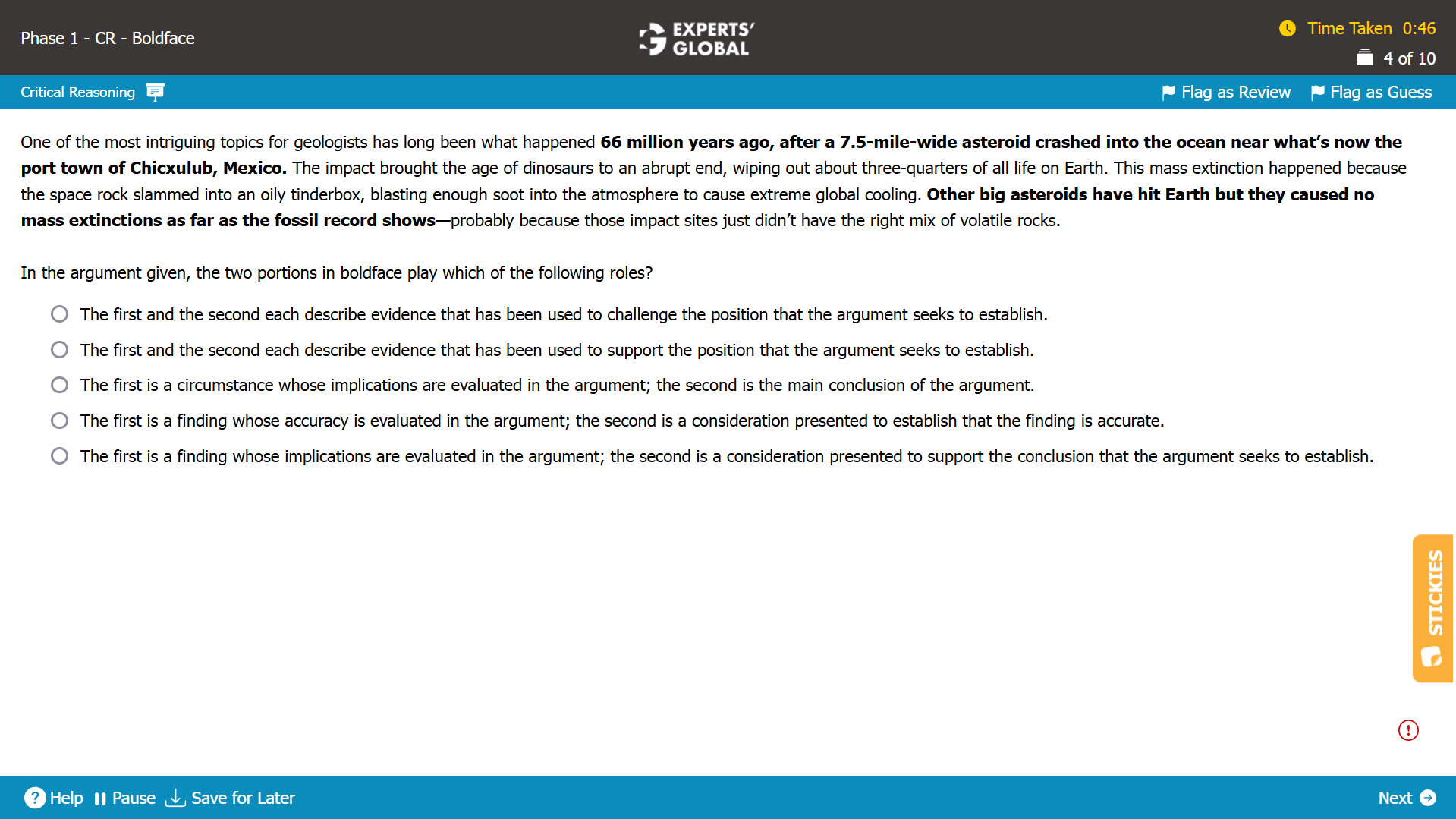
Written Explanation
Strategy: Determining the main conclusion of the argument and finding the relation of the boldfaced portions with this conclusion
Logic: The argument discusses a controversial view regarding the role of Medical Directors. The argument mentions that the champions of the view believe that Medical Directors are micromanaging and that clinical staffers are capable of understanding and implementing medical best practices, thus drawing an intermediate conclusion that, as the first boldface states, the Medical Directors’ role should be that of a communicator and mediator. The argument goes on to counter this view by stating that staffers’ understanding may not be flawless and the staffers may have blind spots. The argument further argues that, as the second boldface states, failure to study emerging best practices may make an advanced physician obsolete, thus concluding that the champions of the controversial view must reconsider their opinion. In the context of the main conclusion – the first boldface is an intermediate conclusion that the argument opposes; the second boldface is a judgment used to establish the main conclusion.
Intermediate conclusion: The Medical Directors’ role should be that of a communicator and mediator.
Main conclusion: The champions of the controversial view must reconsider their opinion.
Broad expectation from the correct answer choice:
The first boldface is an intermediate conclusion that the argument opposes.
The second boldface is a judgment used to establish the main conclusion.
A.
Merit(s):
None
Demerit(s):
The first boldface is an intermediate conclusion that the argument opposes; therefore, it is incorrect to state that the first boldface is the “argument’s primary conclusion”; please note, the term “a conclusion” is used to indicate an intermediate/parallel/separate/supporting conclusion whereas the term “the conclusion” or “conclusion” is used to indicate the main conclusion.
The second boldface is used to establish the main conclusion and thus supports the main conclusion; therefore, it is incorrect to state that the second boldface “opposes the argument’s primary conclusion”.
Because this answer choice does not correctly highlight the roles played by the two portions in boldface, this answer choice is incorrect.
B.
Merit(s):
The second boldface is a judgment that the argument gives careful thought to; therefore, it is broadly correct to state that the second boldface is a “consideration”.
The second boldface is used to establish the main conclusion and thus supports the main conclusion; therefore, it is correct to state that the second boldface is “put forward in support of the argument’s primary conclusion”.
Demerit(s):
The first boldface is an intermediate conclusion that the argument opposes; therefore, it is incorrect to state that the first boldface “supports the argument’s primary conclusion”.
Because this answer choice does not correctly highlight the roles played by the two portions in boldface, this answer choice is incorrect.
C.
Merit(s):
The first boldface is an intermediate conclusion reached by the argument; therefore, it is correct to state that the first boldface is “a conclusion”; please note, the term “a conclusion” is used to indicate an intermediate/parallel/separate/supporting conclusion whereas the term “the conclusion” or “conclusion” is used to indicate the main conclusion.
The first boldface is an intermediate conclusion that the argument opposes; therefore, it is correct to state that the “argument is in opposition to” the first boldface.
Demerit(s):
The second boldface is used to establish the main conclusion and is itself not the main conclusion; therefore, it is incorrect to state that the second is the “argument’s primary conclusion”.
Because this answer choice does not correctly highlight the roles played by the two portions in boldface, this answer choice is incorrect.
D. Trap.
Merit(s):
The first boldface is an opinion that the argument gives careful thought to; therefore, it is broadly correct to state that the first boldface is a “consideration”.
The second boldface is used to establish the main conclusion and thus supports the main conclusion; therefore, it is correct to state that the second boldface “supports the argument’s primary conclusion”.
Demerit(s):
The first boldface is an intermediate conclusion that the argument opposes; although the first boldface and the main conclusion are in opposition, it is the main conclusion that opposes the first boldface rather than the other away round; the first boldface itself provides no opposition; so, it is largely incorrect to state that the first boldface is “used to oppose the argument’s primary conclusion”.
The second boldface is a judgment and not a concrete fact; therefore, it is incorrect to state that the second boldface is an “evidence”.
Because this answer choice does not correctly highlight the roles played by the two portions in boldface, this answer choice is incorrect.
E.
Merit(s):
The first boldface is an intermediate conclusion reached by the argument; therefore, it is correct to state that the first boldface is “a conclusion”; please note, the term “a conclusion” is used to indicate an intermediate/parallel/separate/supporting conclusion whereas the term “the conclusion” or “conclusion” is used to indicate the main conclusion.
The first boldface is an intermediate conclusion that the argument opposes; therefore, it is correct to state that the “argument seeks to oppose” the first boldface.
The second boldface is a judgment that the argument gives careful thought to; therefore, it is broadly correct to state that the second boldface is a “consideration”.
The second boldface is used to establish the main conclusion and thus supports the main conclusion; therefore, it is correct to state that the second boldface “supports the argument’s primary conclusion”.
Demerit(s):
None
Because this answer choice correctly highlights the roles played by the two portions in boldface, this answer choice is correct.
E is the best answer choice.
Method-of-Reasoning Questions | GMAT Critical Reasoning Prep
GMAT CR Method-of-Reasoning questions ask you to identify the reasoning pattern behind an argument, such as how it reaches conclusions, uses evidence, tackles objections, or makes comparisons. On this page, you will find a carefully organized playlist of subtopics, along with worked examples, to help guide your preparation for this concept.
Overview and Approach for Method-of-Reasoning GMAT Critical Reasoning Questions
Method-of-reasoning CR questions on the GMAT focus on the structure of an argument. A common question will ask, “In the passage, how does the author build the argument?” Your goal is to select the option that most accurately describes how the argument is developed. In the video below, the method is explained, applied to GMAT-style questions, and set up for use on your GMAT.

Approach for Method-of-Reasoning GMAT CR Questions
Similar Reasoning GMAT Critical Reasoning Questions
In similar reasoning CR questions, you are presented with an argument and asked to select the option that mirrors its logical structure. A typical question will ask, “Which of the following most closely follows the same logical pattern as the argument above?” The short video below reinforces this concept and demonstrates how the GMAT may test it.
Similar Reasoning GMAT CR Questions
Finding the Flaw in Reasoning GMAT Critical Reasoning Questions
Finding the flaw questions challenge your ability to identify faulty logic. Read the question, create a quick mind map, and locate the inconsistency. Look for common patterns like faulty analogies, false dilemmas, assumptions, correlation mistaken for causation, circular reasoning, or overlooked alternatives. Use the process of elimination to choose the option that best describes the flaw. The short video below explains the method in a simple, accessible way, showing how it can be tested on the GMAT.
Finding the Flaw in Reasoning GMAT CR Questions
GMAT-style Worked Example: Method of Reasoning CR Question
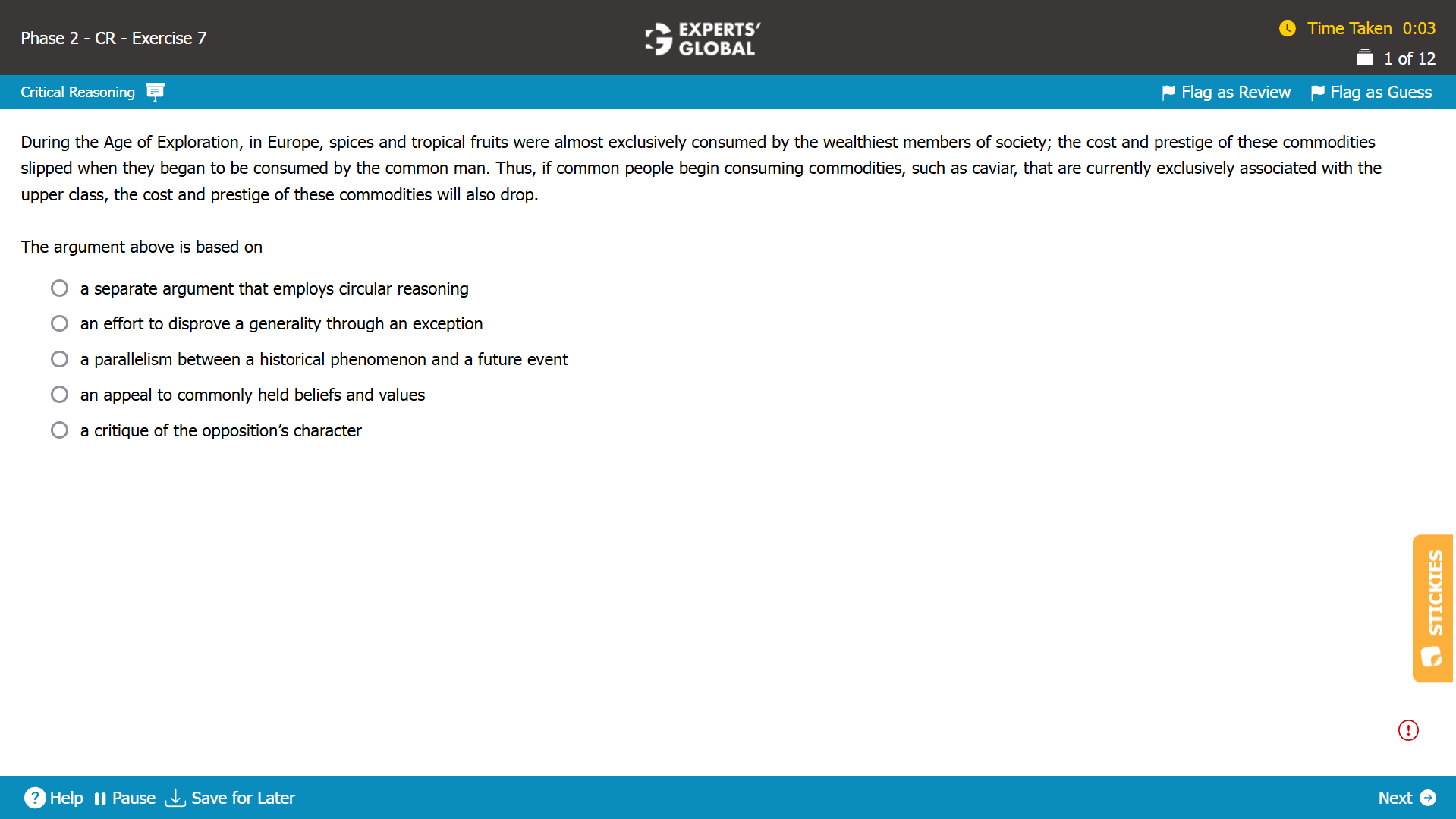
Written Explanation
Mind-map: Spices and fruits exclusively consumed by the wealthiest in past → common people began consuming commodities → cost and prestige of commodities decreased → common people begin consuming commodities exclusive to upper class today → cost and prestige of commodities will decrease (conclusion)
Missing-link: Between past decline in cost/prestige of exclusive commodities after consumption by common people and future decline in cost/prestige of exclusive commodities after consumption by common people
Expectation from the correct answer choice: Something on the lines of reasoning that an event will take place in the future because a similar event took place in the past
A. Trap. Circular reasoning is the idea of proving a conclusion by stating/assuming that it is true; the argument neither makes any reference to any other argument that is based on circular reasoning nor suggests that the two events – the cost/ prestige of commodities dropping in the past and the cost/prestige of commodities dropping in the future – have any circular reasoning between themselves; rather, the argument reasons that an event will take place in the future because a similar event took place in the past. Because this answer choice does not indicate what the argument is based on, this answer choice is incorrect.
B. The argument reasons that an event will take place in the future because a similar event took place in the past; so, the argument suggests that the two events are “in accordance” with each other and one is not an “exception” to the other. Because this answer choice does not indicate what the argument is based on, this answer choice is incorrect.
C. Correct. The argument reasons that an event will take place in the future because a similar event took place in the past; in other words, the argument is based on a parallelism between a historical phenomenon and a future event, as the answer choice mentions. Because this answer choice indicates what the argument is based on, this answer choice is correct.
D. The argument makes no mention of commonly held beliefs and values or of an appeal to such notions. Furthermore, the argument reasons that an event will take place in the future because a similar event took place in the past. Because this answer choice does not indicate what the argument is based on, this answer choice is incorrect.
E. The argument makes no suggestion regarding criticism. Furthermore, the argument reasons that an event will take place in the future because a similar event took place in the past. Because this answer choice does not indicate what the argument is based on, this answer choice is incorrect.
C is the best choice.
Logical Fallacy Questions | GMAT Critical Reasoning Prep
Logical Fallacy Critical Reasoning questions on the GMAT appear in familiar formats such as resolve the paradox, strengthen, weaken, and assumption questions. The key skill at the heart of these question types is the ability to identify the logical flaw in an argument. Mastering this skill is essential for solving these questions effectively. These questions help you understand how arguments can fail and how flawed reasoning can lead to incorrect conclusions. This page offers a well-organized playlist by subtopic, along with several worked examples, to support your preparation.
The Confusion Between Cause and Effect Fallacy
Confusing cause and effect occurs when you assume A causes B, while B is actually the cause of A. For example, if schools with more advanced technology have better student performance, it would be incorrect to assume that better performance leads to more technology. In reality, providing advanced technology enhances student performance. The following video walks you through this method step by step, showing you how to apply it on GMAT CR.
Confusing Cause with Effect Fallacy | GMAT CR
The Confusion Between Correlation and Causation Fallacy
Confusing correlation with causation occurs when two trends are observed together, and one is incorrectly assumed to cause the other. For example, if the number of people buying sunscreen and ice cream sales both rise in summer, it would be wrong to say that buying sunscreen causes people to buy ice cream. In reality, warm weather is driving both. Just because two things are related does not mean one causes the other. The short video gives you a strong understanding of this concept and shows how it can appear on the GMAT’s CR.
Confusing Correlation with Causation Fallacy | GMAT CR
The Assuming Similar Bases Fallacy
The assuming similar bases fallacy occurs when conclusions are drawn based on comparisons that assume the starting points are the same. For instance, if the salary of Person A increases by 20% and Person B’s salary rises by 15%, claiming that A now earns more overlooks their starting salaries. If Person A earned $30,000 and Person B earned $50,000, Person B would still earn more even after the raises. The short video below helps clarify this concept and shows how it can be tested on the GMAT.
Assuming Similar Bases Fallacy | GMAT CR
The False Analogy Fallacy
The false analogy occurs when you assume that two things are similar in important ways, and therefore what applies to one should apply to the other. For example, just because a bicycle and a motorcycle both have wheels and are used for transportation, it doesn’t mean that riding a motorcycle is as safe as riding a bicycle. Always be cautious of such assumptions.
False Analogy Fallacy | GMAT CR
The Hasty Generalization Fallacy
Generalization involves making broad judgments about a group based on limited evidence. In GMAT Critical Reasoning, this appears when sweeping conclusions are drawn from a single example. For instance, if a particular economic policy works in one country, it doesn’t mean it will work for all countries in the region, as socio-political contexts can vary greatly. Be cautious of making such broad assumptions and always consider the broader context. The following video offers a clear explanation and demonstrates the common way this fallacy appears in GMAT CR questions.
Hasty Generalization Fallacy | GMAT CR
The Circular Reasoning Fallacy
Circular reasoning occurs when an argument takes its conclusion as a given and uses that assumption to prove itself. For example, saying “The plan will succeed because the plan cannot fail” simply repeats the claim without providing any independent evidence. This short video lesson clearly explains the concept and shows how it appears on the GMAT.
Circular Reasoning Fallacy | GMAT CR
The Impressed by Numbers Fallacy
In GMAT Critical Reasoning, the “impressed by numbers” fallacy occurs when impressive statistics are used to persuade, without showing their true relevance or providing solid evidence. Be on the lookout for stats that distract from the actual logic. For example, “Ten thousand copies sold, so it must be the best” overlooks important factors like target audience, product quality, and user reviews. The video below offers a clear explanation of this concept and shows how it appears on the GMAT.
Impressed by Numbers Fallacy | GMAT CR
The Missing the Main Point Fallacy
In GMAT Critical Reasoning, this flaw shows up when an answer seems logical but misses the main point of the passage. First, identify the author’s key argument, then evaluate each response based on that. Remove any options that stray off-topic or bring up unrelated concerns. For example, if the passage discusses the impact of climate change on agriculture, a response focusing on pollution control would be irrelevant. The short video below explains the concept and demonstrates how it is tested on the GMAT.
Missing the Main Point Fallacy | GMAT CR
The Comparing Percentage with Absolute Numbers Fallacy
In GMAT Critical Reasoning, comparing percentages or proportions with actual numbers often mixes up relative change with actual counts. For example, Class A’s attendance increased by 40% (from 5 to 7), while Class B’s attendance rose by 15% (from 50 to 57). Saying A improved more overlooks the size of the base: smaller numbers make percentages seem bigger, while B added more students overall. In the short video below, you will see this concept explained and applied to GMAT-style questions.
The Comparing Percentage with Absolute Numbers Fallacy
The Comparing One with Oneself Fallacy
GMAT Critical Reasoning can sometimes present the self-comparison flaw, where conclusions are drawn solely from how something compares to itself, rather than to external standards or others. For example, in a 100-meter sprint, Sarah may set her personal best, but her time could still be considered slow when compared to elite athletes. The short video below explains the concept clearly and demonstrates how it is tested on the GMAT.
Comparing One with Oneself Fallacy | GMAT CR
The Confusing Necessity with Sufficiency Fallacy
GMAT Critical Reasoning frequently presents the fallacy of treating a necessary condition as if it were sufficient. For example, claiming that a high IQ guarantees academic success is flawed. While a high IQ may be important for success, it is not sufficient on its own. The video below provides a clear explanation of this concept and shows how it applies to GMAT questions.
Confusing Necessity with Sufficiency Fallacy | GMAT CR
The Confusing Sufficiency with Necessity Fallacy
GMAT Critical Reasoning can often mask the fallacy of treating a sufficient condition as necessary. For example, saying “Employees who work overtime get a bonus, so only employees who work overtime get bonuses” is flawed. While working overtime might guarantee a bonus, it is not the only way to earn one, as performance or special achievements might also be factors. This short video dives into the concept and shows how it can be tested on the GMAT.
Confusing Sufficiency with Necessity Fallacy | GMAT CR
The Confusing Possibility with Necessity Fallacy
GMAT Critical Reasoning can sometimes hide the fallacy of treating something possible as something necessary. For example, saying “This app can improve your sleep, so you must use it to sleep better” is flawed. While the app may help, sleep could also be improved with natural remedies, lifestyle changes, or other tools. Just because something is possible does not mean it is required. This short video breaks down the concept and shows how it is applied in GMAT questions.
Confusing Possibility with Necessity Fallacy | GMAT CR
The Confusing Subsets and Supersets Fallacy
GMAT Critical Reasoning can sometimes test the fallacy of confusing subsets and supersets. For instance, saying “All team leaders are managers; therefore, all managers are team leaders” is flawed. The issue is that team leaders are just a small group within the larger group of managers, and many managers are not team leaders. The short video below clarifies this concept and shows how it appears in GMAT questions.
Confusing Subsets and Supersets Fallacy | GMAT CR
GMAT-style Worked Example: Logical Fallacy CR Question
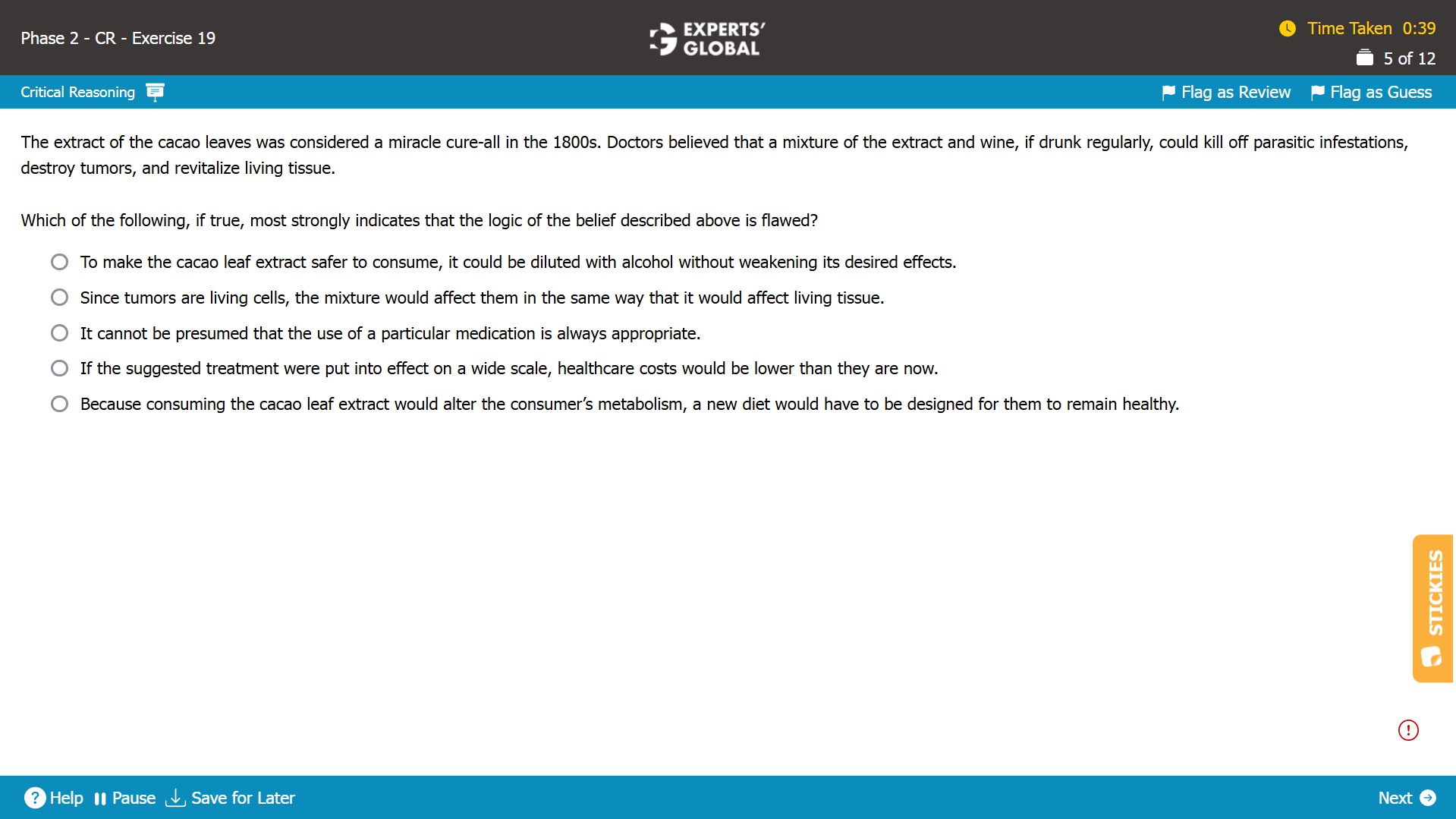
Written Explanation
Mind-map: Cacao leave extract considered cure-all mixed with wine, cacao leave extract can kill parasitic infestations, destroy tumors, and revitalize living tissue
Missing-link: Not needed
Expectation from the correct answer choice: Something on the lines of a side-effect of the mixture
A. The argument is concerned with the effects of consuming the mixture; this answer choice, suggesting that dilution with alcohol does not weaken the extract’s effect and makes the extract safer to consume, relates to how any side-effect of the mixture could be avoided; such information is just additional information and does not indicate the flaw in the argument. Because this answer choice does not indicate the flaw in the logic of the belief in the argument, this answer choice is incorrect.
B. Correct. By suggesting that the mixture would affect tumors and living tissue in the same way, this answer choice casts doubt on how the mixture can “destroy” tumors but “revitalize” living tissue, thus indicating the flaw that the argument assumes that the mixture would affect infestations, tumors, and living cells in the same fashion. Because this answer choice indicates the flaw in the logic of the belief in the argument, this answer choice is correct.
C. The argument simply mentions a belief about the medical effects of consuming the mixture and makes no suggestion that consuming the mixture is “always” appropriate; so, this answer choice is just a statement of fact and does not indicate the flaw in the argument; the flaw is that the argument assumes that the mixture would affect infestations, tumors, and living cells in the same fashion. Because this answer choice does not indicate the flaw in the logic of the belief in the argument, this answer choice is incorrect.
D. The argument is concerned with the “medical” effect of consuming the mixture and not with the “financial” effects; so, this answer choice is just additional information and does not indicate the flaw in the argument; the flaw is that the argument assumes that the mixture would affect infestations, tumors, and living cells in the same fashion. Because this answer choice does not indicate the flaw in the logic of the belief in the argument, this answer choice is incorrect.
E. The argument is concerned with the “medical” effect of consuming the mixture; this answer choice, suggesting the requirement of a new diet if the mixture is consumed, simply indicates a likely inconvenience associated with consuming the mixture; such information is just additional information and does not indicate the flaw in the argument; the flaw is that the argument assumes that the mixture would affect infestations, tumors, and living cells in the same fashion. Because this answer choice does not indicate the flaw in the logic of the belief in the argument, this answer choice is incorrect.
B is the best choice.
Dialogue Questions | GMAT Critical Reasoning Prep
Dialogue-based Critical Reasoning questions on the GMAT evaluate the same skills as other CR questions. The difference is that they present a conversation between two people rather than a paragraph. For example, you might be asked to identify an assumption made by the second person in response to the first. This page offers a structured conceptual lesson along with worked examples, to guide your preparation effectively for this concept.
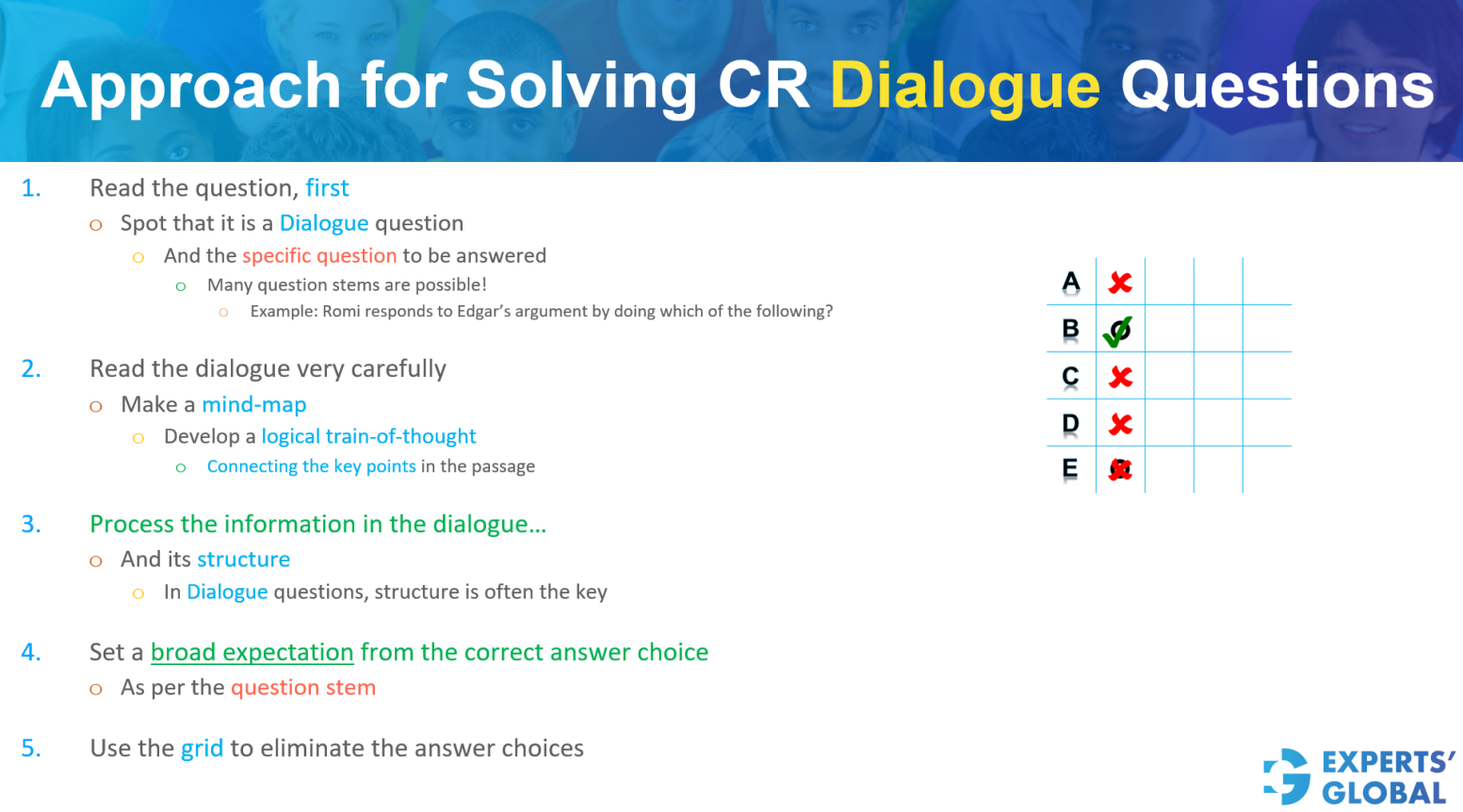
Approach for Dialogue GMAT Critical Reasoning Questions
Start by reading the question carefully to identify the specific question stem. Then, read the dialogue thoroughly, making a mind-map to connect the key points and develop a logical train of thought. Focus on the structure of the dialogue, as it is often key to understanding the response. Set a broad expectation for the correct answer based on the question stem, and finally, use the grid to eliminate incorrect options. The short video below explains this method, provides examples, and guides you on how to apply it effectively in GMAT CR.
Approach for GMAT CR Dialogue Questions
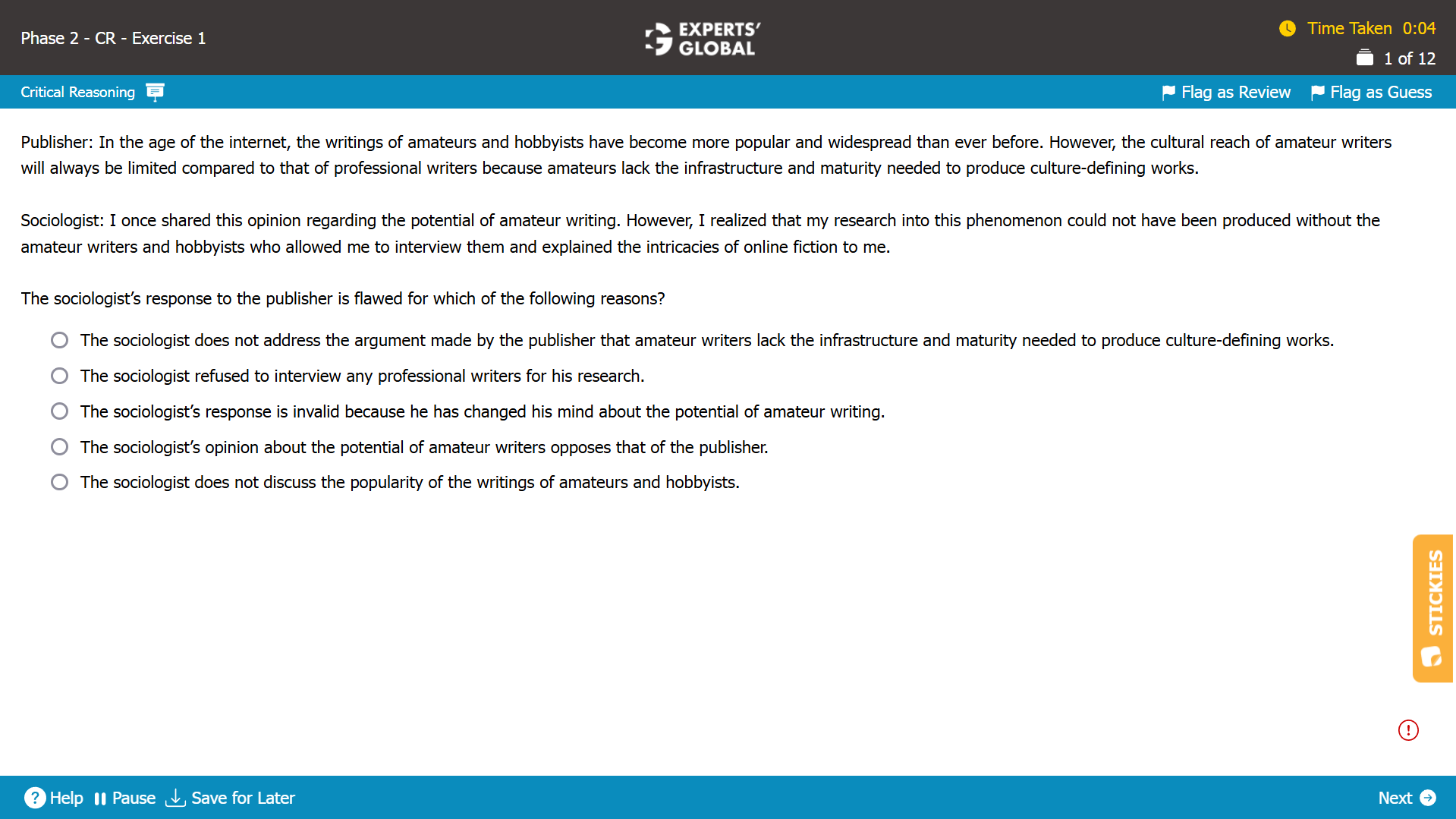
GMAT-style Worked Example: Dialogue CR Question
Written Explanation
Mind-map: Publisher: Internet has made amateur writing more popular than before → amateur writers lack infrastructure and maturity compared to professional writers → cultural reach of amateur writers will be limited → Sociologist: I once shared this opinion → amateur writers explained to me the intricacies of online fiction → my research into this phenomenon could not have been produced without this help
Missing-link: Between the publisher’s comment about the cultural reach of amateur writers and the sociologist’s response not addressing the comment
Expectation from the correct answer choice: Something on the lines of the sociologist not addressing the publisher’s comment on the amateur writers’ cultural reach
A. Correct. The passage suggests that the sociologist has changed the opinion regarding the potential of amateur writing and thus the sociologist disagrees with the publisher; however, the sociologist does not address the publisher’s comment on the amateur writers’ lack of infrastructure and maturity preventing them from producing culture-defining works; this lack of addressing the publisher’s comment is the main flaw in the sociologist’s response. Because this answer choice indicates the flaw in the sociologist’s response, this answer choice is correct.
B. The sociologist’s response makes no suggestion that the sociologist refused to interview professional writers for his research; so, such refusal is not a flaw in the sociologist’s response. Besides, the passage, as well as the sociologist’s response, is concerned with the phenomenon of online fiction for which interviewing professional writers is likely not necessary; thus, refusing to interview professional writers is not the flaw in the sociologist’s response/research; the sociologist’s response is flawed in that it does not address the publisher’s comment on the amateur writers’ cultural reach. Further, “sociologist refused to interview” indicates an emotional tone; one needs to be cautious of such answer choices as they are generally incorrect on the GMAT. Because this answer choice does not indicate the flaw in the sociologist’s response, this answer choice is incorrect.
C. Although the sociologist’s response suggests that the sociologist has changed the opinion regarding the potential of amateur writing, changing opinion is not the flaw in the sociologist’s response; the sociologist’s response is flawed in that it does not address the publisher’s comment on the amateur writers’ cultural reach. Because this answer choice does not indicate the flaw in the sociologist’s response, this answer choice is incorrect.
D. The passage mentions that the sociologist once shared the publisher’s opinion regarding the potential of amateur writers, suggesting that the sociologist’s current opinion opposes that of the publisher; although the answer choice indicates this difference, holding a different opinion is not the flaw in the sociologist’s response; the sociologist’s response is flawed in that it does not address the publisher’s comment on the amateur writers’ cultural reach. Because this answer choice does not indicate the flaw in the sociologist’s response, this answer choice is incorrect.
E. The passage mentions the publisher’s comment that the internet has made amateur writing more popular; although the sociologist does not discuss the popularity aspect, the lack of this discussion is not the flaw in the sociologist’s response; the sociologist’s response is flawed in that it does not address the publisher’s comment on the amateur writers’ cultural reach. Because this answer choice does not indicate the flaw in the sociologist’s response, this answer choice is incorrect.
A is the best choice.
Additional GMAT-style Critical Reasoning Practice Questions
For additional, rich set of GMAT-style CR practice questions, please visit: GMAT Critical Reasoning Sample Questions
For Further Prep and Practice:
15 full-length GMAT practice tests (includes a free test)
End-to-end GMAT prep course online (includes 7-day free trial)
GMAT 5-weeks crash course
GMAT Prep + Admission Consulting Bundle