Critical Reasoning, often abbreviated as CR, is one of the most thinking focused question types on the GMAT. In a typical CR question, you are presented with a short argument followed by a question stem. Your task is to carefully read the argument, understand how the ideas fit together, identify the gaps in reasoning, and select the answer choice that best addresses what the question asks. Through this format, the GMAT assesses how clearly you analyze arguments, how well you identify gaps or connections in reasoning, and how carefully you avoid choices that sound appealing but do not logically fit. Within the 23 questions that make up the Verbal section of the GMAT, 8 to 10 questions are Critical Reasoning, making thorough coverage of CR an essential part of a dependable GMAT prep course.
On this page, we present a collection of sample critical reasoning questions that give you firsthand exposure to how concepts are tested through the CR question type on the GMAT. As you work through these questions, without worrying about speed, focus on understanding the structure, requirement, and nuances of the different question types, and the reasoning approach required to select correct responses. Use this resource thoughtfully and carry the learnings into subsequent GMAT quizzes, GMAT sectional tests, and GMAT full-length mock tests. Happy practicing!
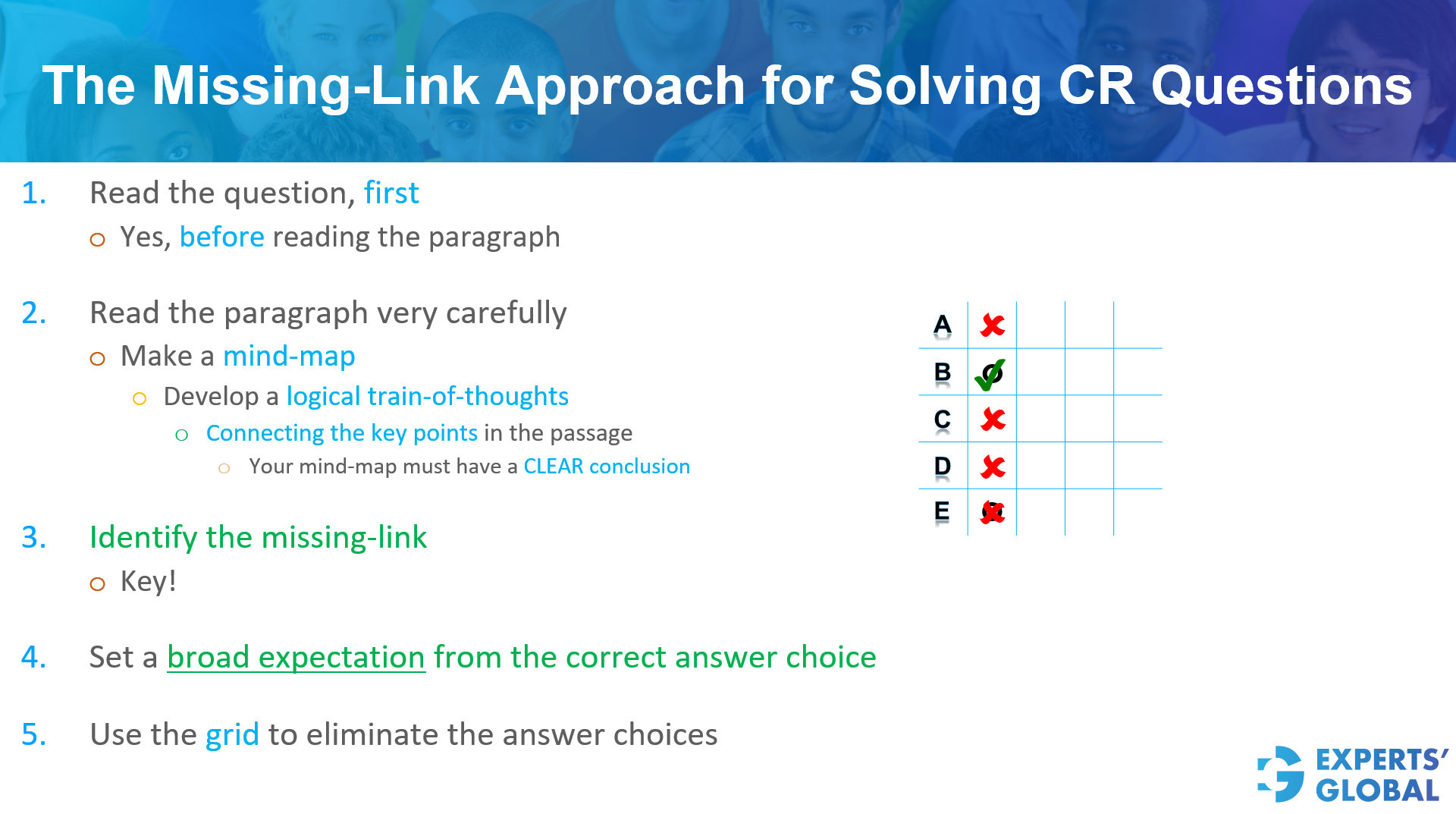
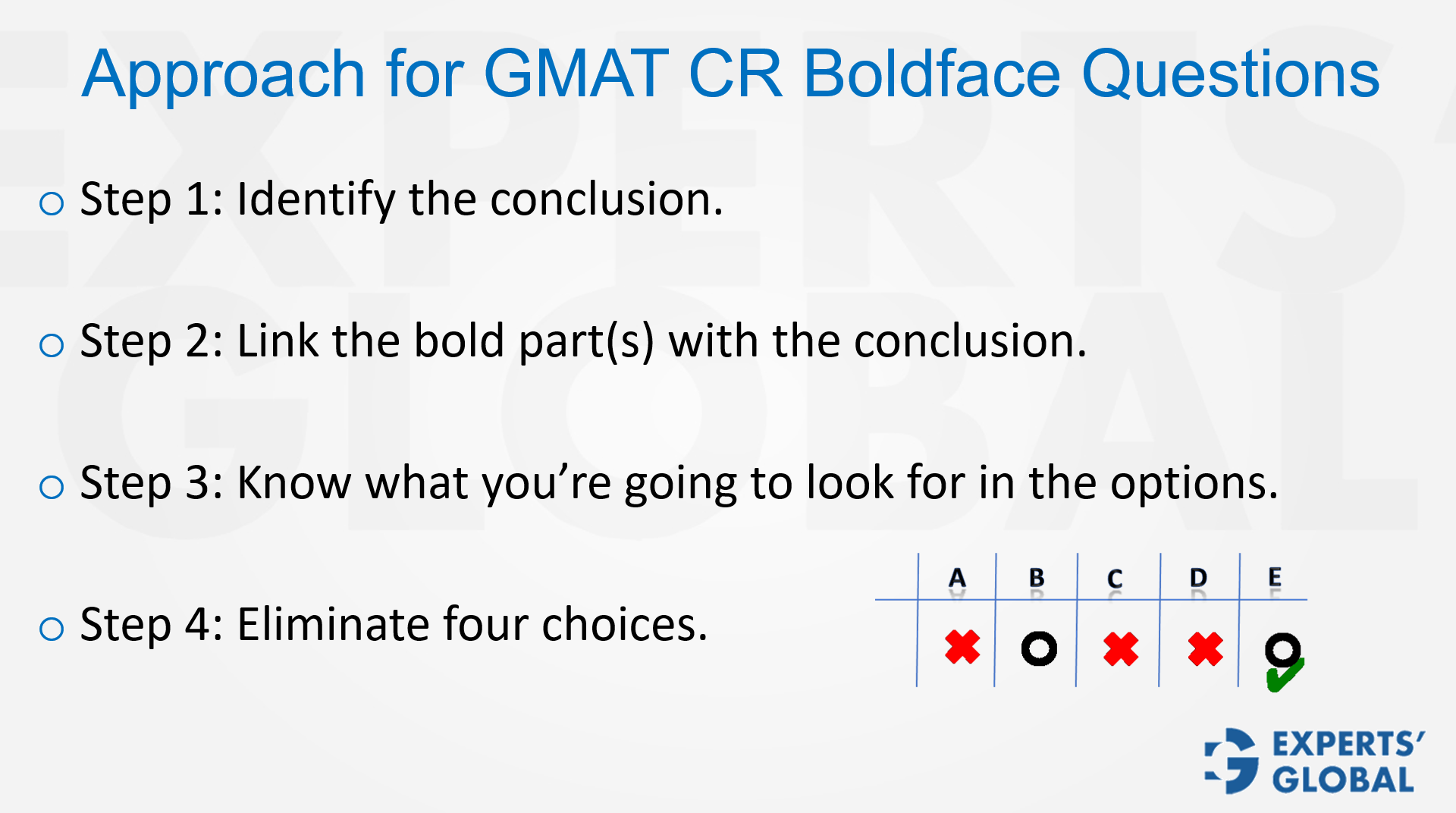
Snapshot of the Missing-Link-Approach for CRs by Experts’ Global
Q1. GMAT CR: Assumption Sample Question
CR Assumption questions ask you to spot the unstated idea that must be true for the argument to work, so you can clearly see the hidden connection between the premise and the conclusion. GMAT Critical Reasoning assumption questions give you a short passage with a premise, a conclusion, and a clear gap between them, which acts as the missing link. The correct assumption is the statement that closes this gap and supports the conclusion, and it is also something that must be true for the argument to stand.
Important: Before visiting the CR Assumption sample question, if you would like a quick brush up of the concept, you may first visit: Free GMAT CR Assumption Questions Prep
Written Explanation
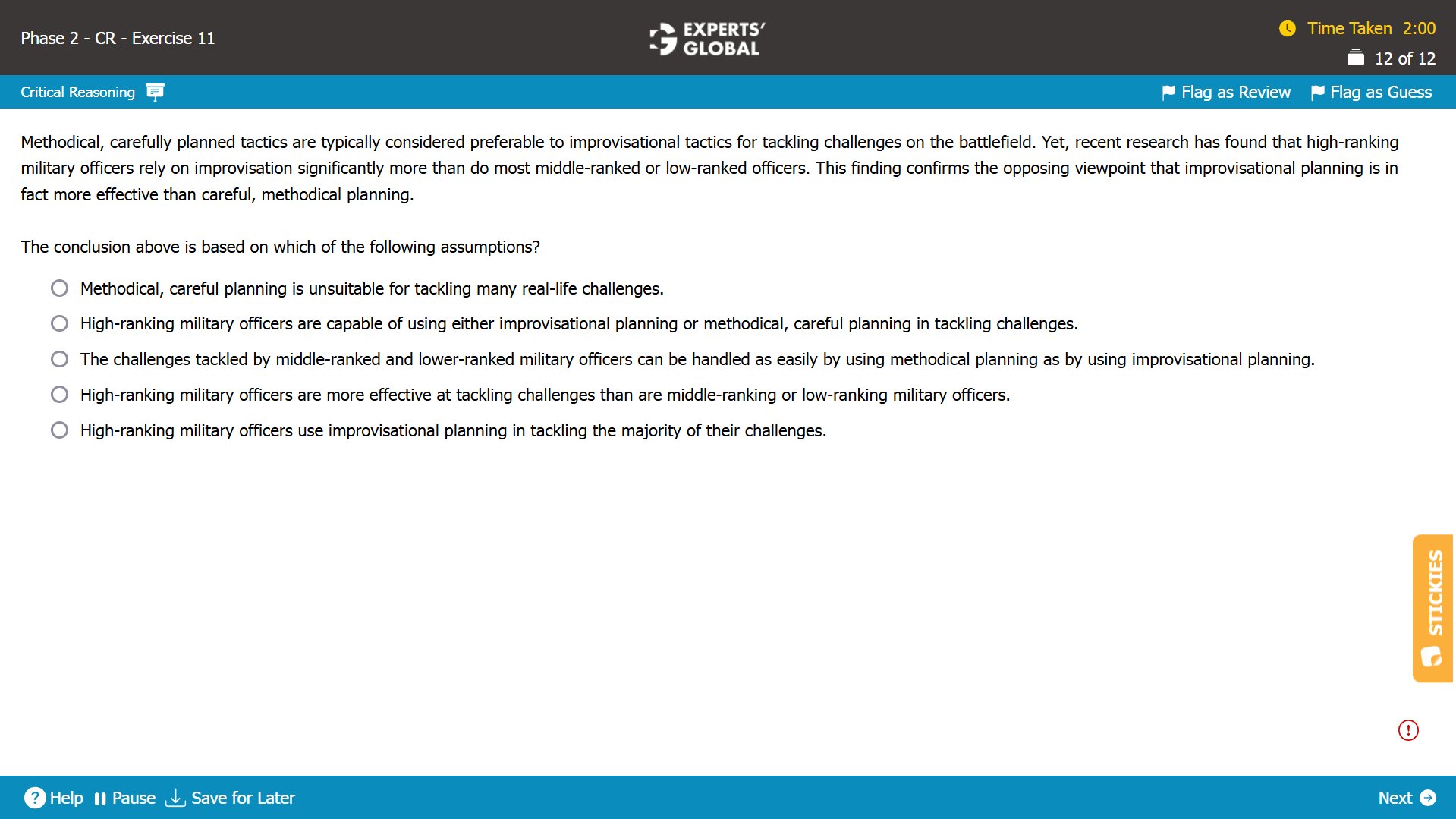
Mind-map: Methodical planning is typically considered preferable to improvisation → high-ranking officers rely on improvisation more than middle-ranked and low-ranked officers do → improvisation is more effective than methodical planning (conclusion)
Missing-link: Between high-ranking officers relying on improvisation more than middle-ranked and low-ranked officers do and the conclusion that improvisation is more effective than methodical planning
Expectation from the correct answer choice: To strengthen the conclusion that improvisation is more effective than methodical planning, through a valid assumption
A. This answer choice, suggesting the unsuitability of methodical planning, simply indicates a demerit of methodical planning but fails to address why improvisation is more effective than methodical planning; so, this answer choice, at best, only marginally strengthens the conclusion. However, despite being a mild “strengthening statement”, this answer choice doesn’t qualify as a valid “assumption” because it doesn’t have to be true for the conclusion to hold; it is possible that improvisation is more effective than methodical planning even if methodical planning is suitable for tackling real-life challenges; please remember, a valid assumption “must be necessarily true” for the argument to hold. Because this answer choice does not strengthen the conclusion through a valid assumption, this answer choice is incorrect.
B. Trap. This answer choice, suggesting high-ranking officers’ ability to use the two types of planning methods, makes no suggestion about why improvisation is more effective than methodical planning; so, this answer choice does not strengthen the conclusion. Besides, this condition is not necessary for the argument to hold and thus, is not a valid assumption. Because this answer choice does not strengthen the conclusion through a valid assumption, this answer choice is incorrect.
C. This answer choice, suggesting ease of use of the two types of planning methods, makes no suggestion about why improvisation is more effective than methodical planning; so, this answer choice does not strengthen the conclusion. Besides, this condition is not necessary for the argument to hold and thus, is not a valid assumption. Because this answer choice does not strengthen the conclusion through a valid assumption, this answer choice is incorrect.
D. Correct. By suggesting that high-ranking officers are more effective than other officers, this answer choice establishes a connection between high-ranking officers’ reliance on improvisation and their greater effectiveness, thus filling the missing link and strengthening the conclusion that improvisation is more effective than methodical planning. Additionally, this statement does have to be true for the conclusion to hold; negating this statement would mean that “high-ranking officers are not more effective than other officers”, thus suggesting that high-ranking officers’ lack of higher effectiveness may be related to the officers’ reliance on improvisation, thereby casting doubt on the conclusion. Because this answer choice strengthens the conclusion through a valid assumption, this answer choice is correct.
E. Trap. This answer choice, suggesting that high-ranking officers use improvisation more than they use methodical planning, makes no suggestion about why improvisation is more effective than methodical planning; so, this answer choice does not strengthen the conclusion. Besides, this condition is not necessary for the argument to hold and thus, is not a valid assumption. Because this answer choice does not strengthen the conclusion through a valid assumption, this answer choice is incorrect.
D is the best choice.
Q2. GMAT CR: Strengthen the Argument Sample Question
GMAT Critical Reasoning Strengthen the Argument questions give you a short passage with a premise, a conclusion, and a gap between them, which we call the missing link. You see five answer choices, and the correct strengthening statement is the one that closes this gap and makes the conclusion more convincing.
Important: Before visiting the CR Strengthening sample question, if you would like a quick brush up of the concept, you may first visit: Free GMAT CR Strengthen the Argument Questions Prep
Written Explanation
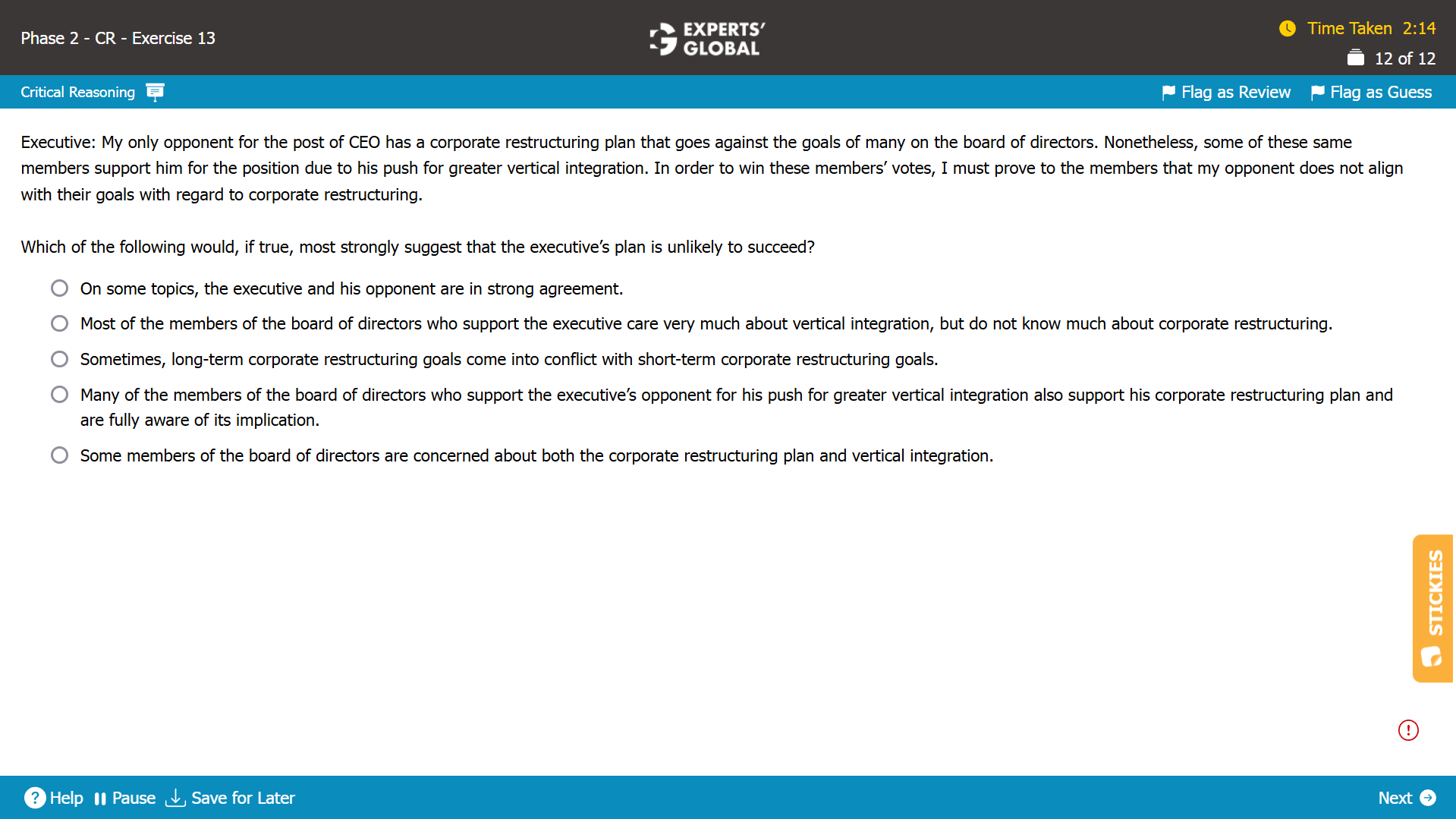
Mind-map: Executive: My opponent has a corporate restructuring plan goes against the goals of the board of directors → some members of the board support my opponent for vertical integration plan → I plan to prove to board that opponent does not align with the board’s goals
Missing-link: Not needed
Expectation from the correct answer choice: To weaken that the executive’s plan will succeed
A. This answer choice, suggesting strong agreement between the executive and the opponent on some topics, makes no suggestion regarding why the executive’s plan to prove to the board that the opponent does not align with the board’s goals will not succeed. Because this answer choice does not weaken that the executive’s plan will succeed, this answer choice is incorrect.
B. Trap. This answer choice, suggesting that the members of the board supporting the executive’s opponent know little about corporate restructuring, introduces the possibility that the executive’s effort to prove to the board that the opponent does not align with the board’s goals may lead to the board members changing their opinion and voting in favor of the executive, thus, if anything, strengthening, rather than weakening, that the executive’s plan will succeed. Because this answer choice does not weaken that the executive’s plan will succeed, this answer choice is incorrect.
C. The argument is concerned with whether the executive will win votes by proving to the board that the opponent does not align with the board’s goals; so, whether the long-term and short-term priorities related to corporate restructuring align with each other is just additional detail and has no bearing on the argument. Because this answer choice does not weaken that the executive’s plan will succeed, this answer choice is incorrect.
D. Correct. By suggesting that many members of the board supporting the executive’s opponent are fully aware of the implication of the corporate restructuring plan and support the opponent’s plan, this answer choice indicates that despite the executive’s effort to prove that the opponent does not align with the board’s goals regarding corporate restructuring, the board may not change their opinion, thus weakening that the executive’s plan will succeed. Because this answer choice weakens that the executive’s plan will succeed, this answer choice is correct.
E. If some board members are concerned about corporate restructuring as well as vertical integration, it introduces the possibility that, if the executive proves that the opponent does not represent the board’s priorities regarding corporate restructuring, these members may vote in favor of the executive, thus, if anything, strengthening, rather than weakening, that the executive’s plan will succeed. Because this answer choice does not weaken that the executive’s plan will succeed, this answer choice is incorrect.
D is the best choice.
Q3. GMAT CR: Weaken the Argument Sample Question
CR Weaken the Argument, or simply weakening, questions ask you to identify the statement that makes an argument less convincing by weakening the connection between its premise and its conclusion. The correct answer choice generally attacks the missing link between the premise and the conclusion.
Important: Before visiting the CR Weakening sample question, if you would like a quick brush up of the concept, you may first visit: Free GMAT CR Weaken the Argument Questions Prep
Written Explanation
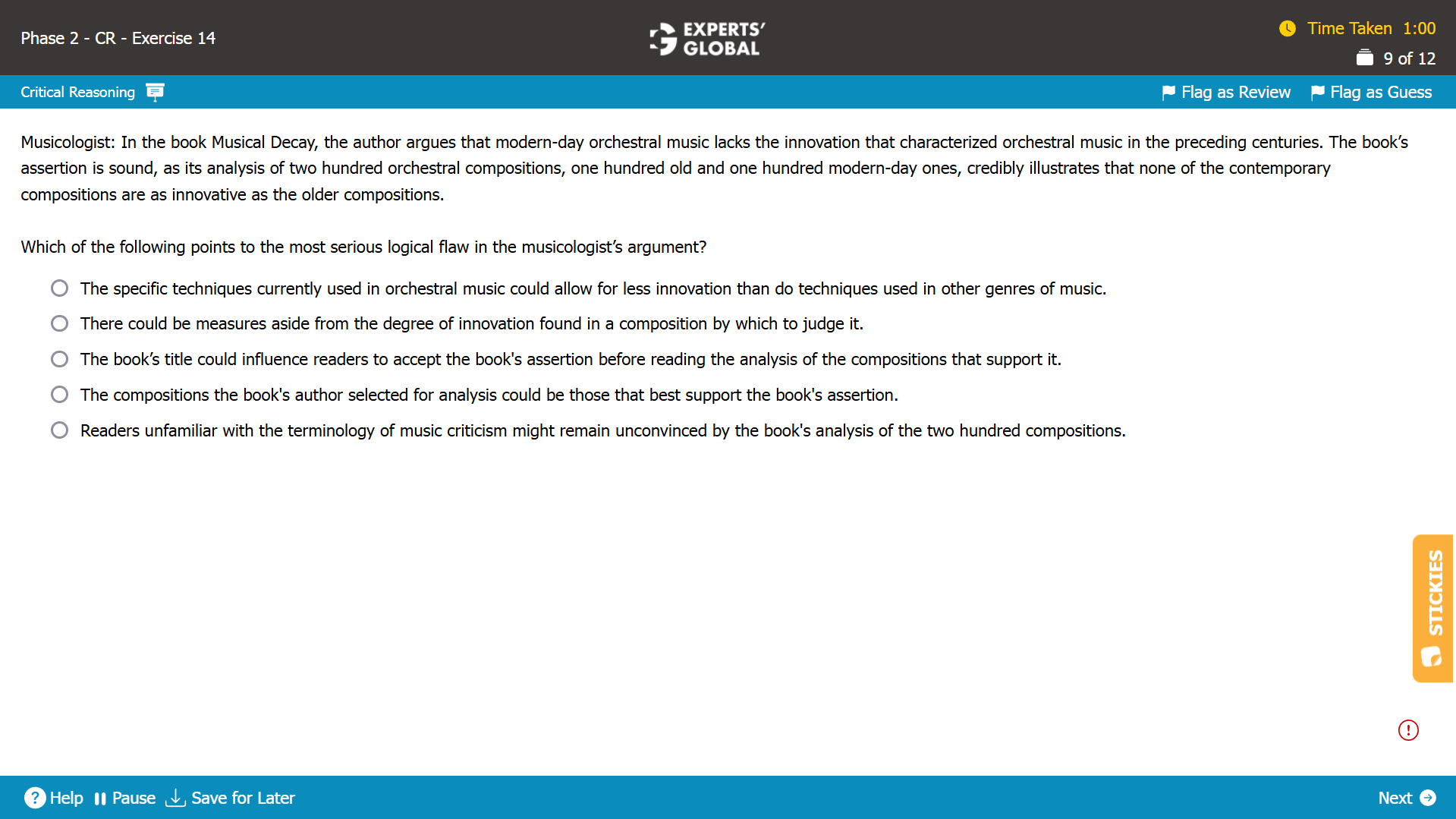
Mind-map: One hundred old and one hundred new music compositions compared → no contemporary composition studied is as innovative as the older compositions → contemporary music lacks innovation that existed in old music (conclusion)
Missing-link: Between no contemporary composition studied being as innovative as the older compositions and the conclusion that contemporary music lacks innovation that existed in old music
Expectation from the correct answer choice: Something on the lines of a flaw in the methodology of the analysis
A. Trap. This answer choice, suggesting that contemporary music techniques may not facilitate innovation, indicates the possibility that contemporary music lacks innovation, thus, if anything, strengthening, rather than pointing to a flaw in, the argument. Because this answer choice does not point to the most serious flaw in the argument, this answer choice is incorrect.
B. Trap. The argument is concerned with the “innovation” in music components; so, “other measures” to judge music compositions are out of scope. Because this answer choice does not point to the most serious flaw in the argument, this answer choice is incorrect.
C. This answer choice, suggesting that readers could accept the thesis by reading on the book’s title, simply explains the impact of the book’s title and provides no information about whether the book’s thesis is correct about contemporary music lacking innovation that existed in old music; so, this answer choice is just additional consideration and does not point to the most serious logical flaw in the reviewer’s argument. Because this answer choice does not point to the most serious flaw in the argument, this answer choice is incorrect.
D. Correct. A conclusion based on a sample set is valid only if the sample set is representative of the overall population; so, the conclusion in the argument is valid only if the two sets of one hundred compositions each are representative of contemporary and old music compositions respectively; this answer choice, suggesting the possibility that the compositions are biased to favor the book’s thesis, casts doubt on the validity of the conclusion and thus points to a serious logical flaw in the reviewer’s argument. Because this answer choice points to the most serious flaw in the argument, this answer choice is correct.
E. This answer choice, suggesting that some readers may not be convinced about the book’s thesis, simply indicates that certain readers may not appreciate the thesis and provides no information about whether the book’s thesis is correct about contemporary music lacking innovation that existed in old music; so, this answer choice is just additional consideration and does not point to the most serious logical flaw in the reviewer’s argument. Because this answer choice does not point to the most serious flaw in the argument, this answer choice is incorrect.
D is the best choice.
Q4. GMAT CR: Resolve the Paradox Sample Question
Resolve the paradox questions in GMAT Critical Reasoning set up a neat little clash. The given information seems to point toward one outcome, but the real world result goes the other way. Your task is to choose the option that bridges that gap and explains how both facts still make sense together. In the end, the “conflict” disappears, and the story fits.
Important: Before visiting the CR Paradox sample question, if you would like a quick brush up of the concept, you may first visit: Free GMAT CR Resolve the Paradox Questions Prep
Written Explanation
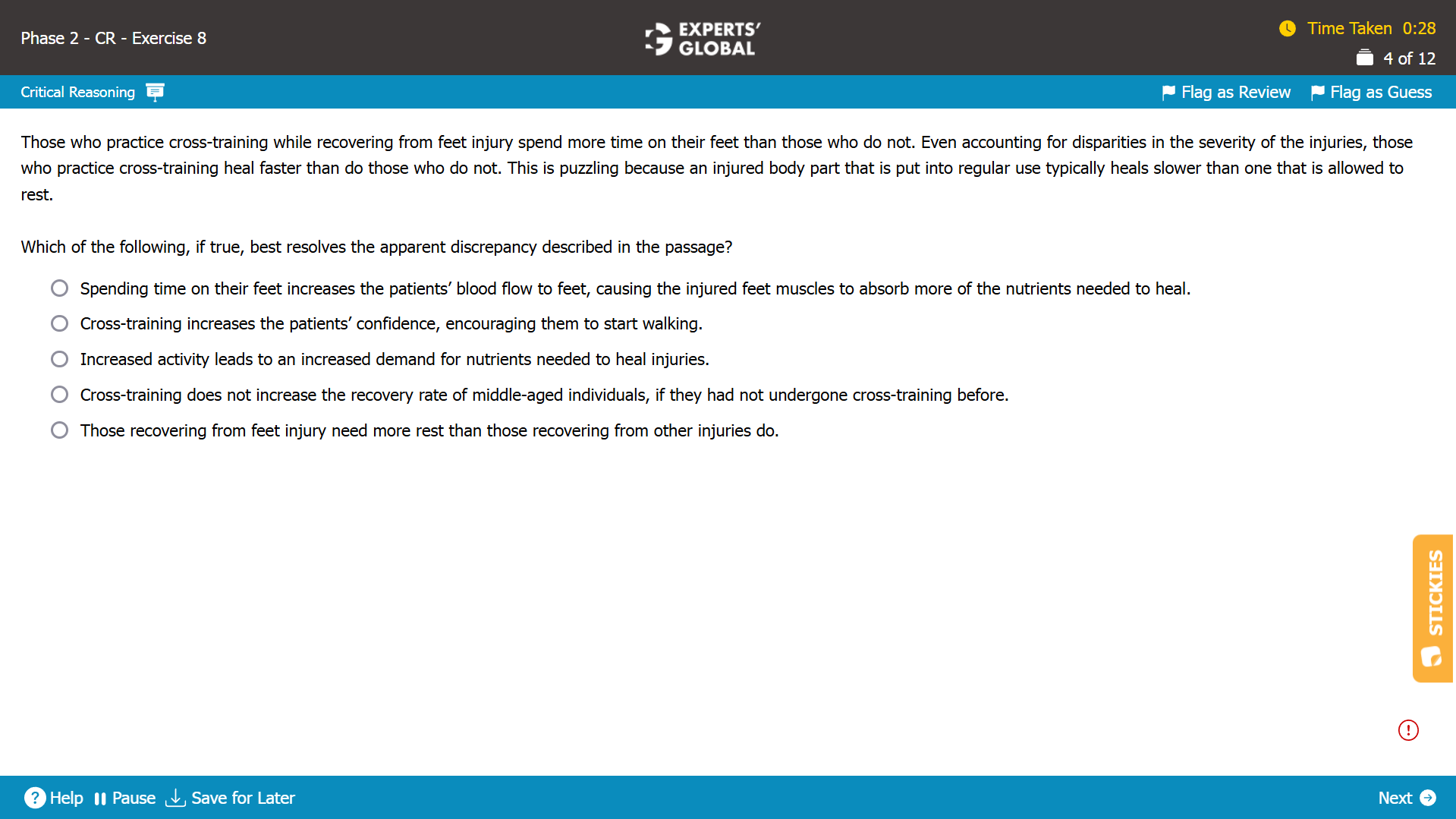
Mind-map: Those practicing cross-training while recovering from feet injury spend more time on feet → those who practice cross-training heal faster → injured body part in regular use heals slower
Missing-link: Between those who practice cross-training healing faster and injured body part in regular use healing slower
Expectation from the correct answer choice: To explain why those who practice cross-training heal faster despite the fact that injured body part in regular use heals slower
A. Correct. By suggesting that spending more time on feet leads to greater absorption of nutrients required for healing, this answer choice indicates that cross-training causes faster healing by facilitating greater nutrient absorption, thus explaining the discrepancy in the argument. Because this answer choice clarifies the exact discrepancy, this answer choice is correct.
B. This answer choice, although suggesting a psychological impact of cross-training, makes no suggestion regarding how cross-training accelerates healing from feet injury; so, this answer choice is just additional information and does not explain the discrepancy in the argument. Further, “increasing patients’ confidence” indicates an emotional tone; one needs to be cautious of such answer choices as they are generally incorrect on the GMAT. Because this answer choice does not explain the discrepancy in the argument, this answer choice is incorrect.
C. This answer choice, although suggesting that cross-training increases nutrient requirements for healing, makes no suggestion regarding how cross-training accelerates healing from feet injury; so, this answer choice is just additional information and does not explain the discrepancy in the argument. Because this answer choice does not explain the discrepancy in the argument, this answer choice is incorrect.
D. This answer choice, suggesting that cross-training may not lead to faster healing for some individuals, makes no suggestion regarding how cross-training accelerates healing from feet injury in general; so, this answer choice is just additional information and does not explain the discrepancy in the argument. Further, “middle-aged individuals with previous cross-training” refers to only a part of all those recovering from feet injury and is thus limited in scope. Because this answer choice does not explain the discrepancy in the argument, this answer choice is incorrect.
E. This answer choice, suggesting that rest is more important while recovering from feet injury than from other injuries, indicates that spending more time on feet during cross-training is likely to slow the recovery process; so, this answer choice, if anything, casts doubt on, rather than explain, how cross-training accelerates healing from feet injury. Because this answer choice does not explain the discrepancy in the argument, this answer choice is incorrect.
A is the best choice.
Q5. GMAT CR: Evaluate the Argument Sample Question
GMAT Critical Reasoning Evaluate the Argument questions ask you to identify the information that helps you assess an argument’s strength by revealing whether its reasoning holds up or falls apart. It is important to notice that a valid evaluation statement does not have to strengthen the argument, because evaluation can point in either direction. It may support the argument or it may weaken it: a valid evaluation statement may ‘help’ the argument as well as ‘hurt’ the argument.
Important: Before visiting the CR Evaluation sample question, if you would like a quick brush up of the concept, you may first visit: Free GMAT CR Evaluate the Argument Questions Prep
Written Explanation
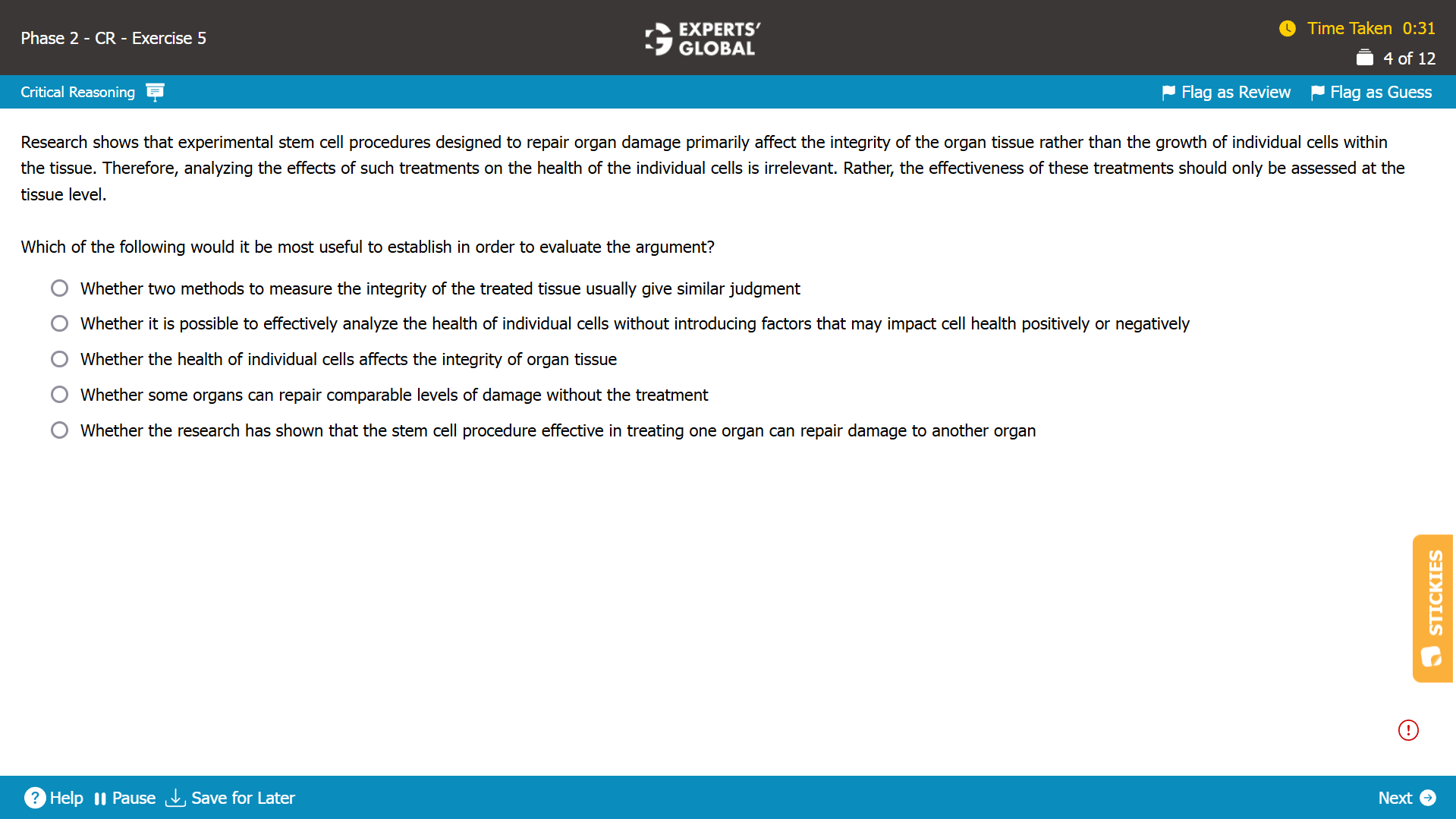
Mind-map: Stem cell procedures designed to repair damaged organs → procedure affects integrity of tissues rather than growth of individual cells → assessment of the treatment’s effectiveness should occur only at the tissue level rather than at the cell level (conclusion)
Missing-link: Between stem cell procedure affecting integrity of tissues rather than growth of individual cells and the conclusion that assessment of the treatment’s effectiveness should occur only at the tissue level rather than at the cell level
Expectation from the correct answer choice: To indicate some fact or data that helps in evaluating whether assessment of the treatment’s effectiveness should occur only at the tissue level rather than at the cell level
A. Knowing whether different methods judge the integrity of the treated tissue similarly would help evaluate the accuracy of the judgment but make no suggestion regarding whether the treatment’s effectiveness should be judged only at the tissue level rather than at the individual cell level; so, this answer choice would simply provide additional information but not help evaluate the conclusion. Because this answer choice would not help evaluate the conclusion, this answer choice is incorrect.
B. The argument is concerned with whether the treatment’s effectiveness should be judged only at the tissue level rather than at the individual cell level; so, knowing the effect the process of judgment may have on the health of individual cells would simply provide additional information but have no bearing on the argument. Because this answer choice would not help evaluate the conclusion, this answer choice is incorrect.
C. Correct. If the health of the individual cells affects the integrity of organ tissue, judging the treatment’s effectiveness at the individual cell level would be relevant and the judgment taken only at the tissue cells may not offer the complete picture of the treatment’s effectiveness; so, this answer choice would help evaluate the conclusion. Because this answer choice would help evaluate the conclusion, this answer choice is correct.
D. Trap. The argument is concerned with judging the effectiveness of the treatment; so, knowing whether the treatment is necessary would simply provide additional information but have no bearing on the argument. Because this answer choice would not help evaluate the conclusion, this answer choice is incorrect.
E. The argument is concerned with how the treatment’s effectiveness in “treating one organ” should be judged; so, knowing whether the same treatment can be useful in repairing “another damaged organ” would simply provide additional information but have no bearing on the argument. Because this answer choice would not help evaluate the conclusion, this answer choice is incorrect.
C is the best choice.
Q6. GMAT CR: Inference Sample Question
Critical Reasoning Inference questions ask you to spot the one statement that must be true based only on what you are given. You keep your thinking clean and disciplined. No extra assumptions, no stretching the facts, and no dramatic leaps. Just an inference that the information clearly indicates to be true without doubt.
Important: Before visiting the CR Inference sample question, if you would like a quick brush up of the concept, you may first visit: Free GMAT CR Inference Questions Prep
Written Explanation
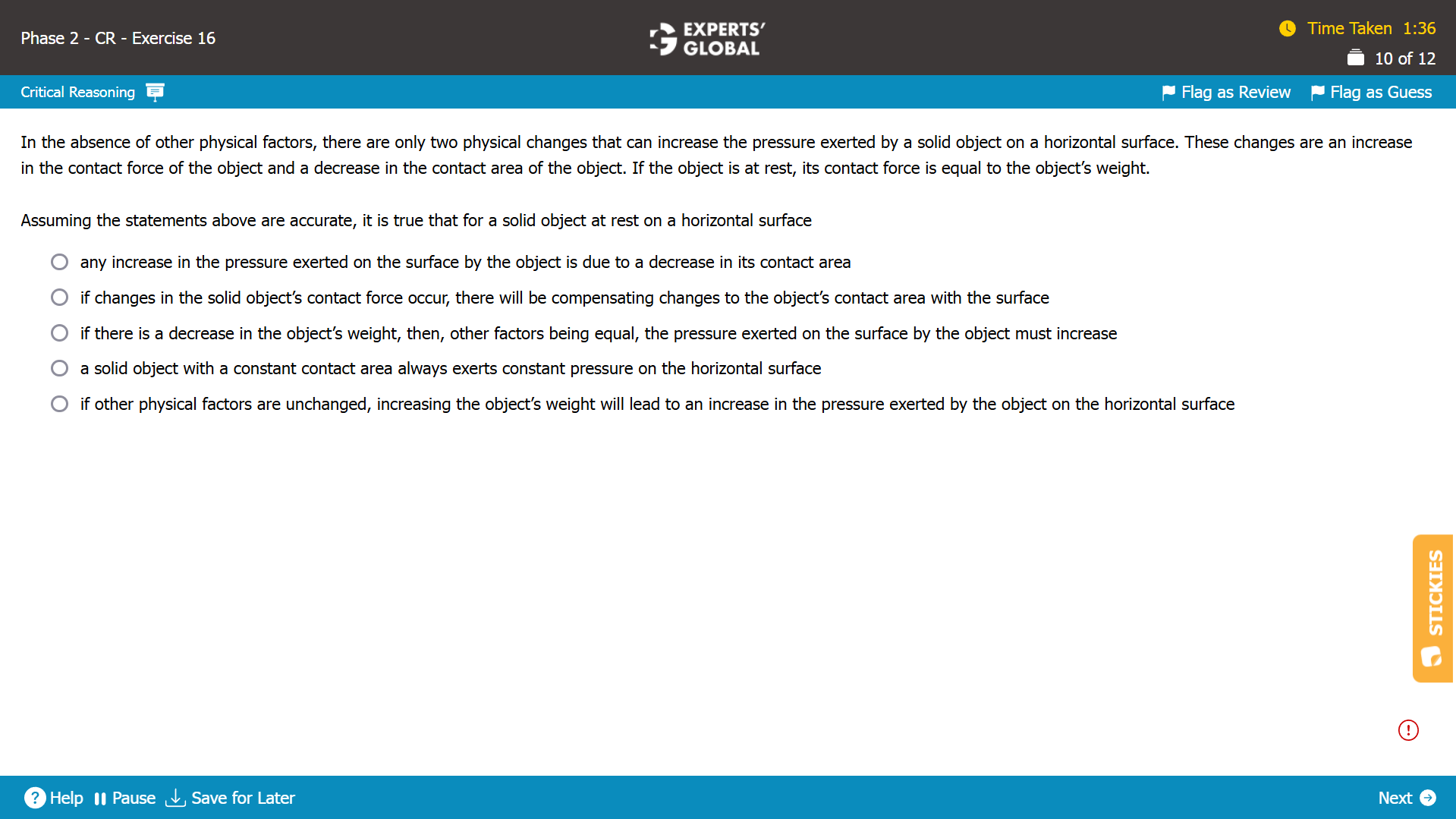
Mind-map: Two physical changes increase pressure → increase in contact force and decrease in contact area → for a stationary object, contact force is equal to the weight of the object
Missing-link: Not needed
Expectation from the correct answer choice: To be duly deducible from the information in the passage, without any assumption or extrapolation
A. The passage mentions that, in the absence of other physical factors, an increase in contact force and a decrease in contact area are the two changes that increase pressure; so, it is possible to increase pressure by increasing contact force and keeping contact area constant; hence, it is incorrect to state that “any increase” in pressure is due to a decrease in contact area, as the answer choice mentions. Because this answer choice is not deducible from the information in the passage without any assumption or extrapolation, this answer choice is incorrect.
B. The passage mentions that, in the absence of other physical factors, an increase in contact force and a decrease in contact area are the two changes that increase pressure; the passage makes no suggestion regarding a body’s tendency to compensate one physical change by initiating another physical change; so, it cannot be established that changes in contact force will lead to compensating changes in contact area, as the answer choice mentions. Because this answer choice is not deducible from the information in the passage without any assumption or extrapolation, this answer choice is incorrect.
C.The passage mentions that contact force is equal to the weight of the object; so, a decrease in weight indicates a decrease in contact force; additionally, the passage mentions that, in the absence of other physical factors, an increase in contact force increases pressure, suggesting that a decrease in contact force decreases pressure; overall, it can be established that a decrease in weight, or a decrease in contact force, decreases, rather than increase, pressure, contrary to what the answer choice mentions. Because this answer choice is not deducible from the information in the passage without any assumption or extrapolation, this answer choice is incorrect.
D. Trap.The passage mentions that, in the absence of other physical factors, an increase in contact force and a decrease in contact area are the two changes that increase pressure; so, when contact area remains constant, pressure is entirely dependent on contact force; hence, with a constant contact area, pressure will remain constant “only” if contact force remains constant too; so, is it incorrect to state that constant contact area “always” exerts constant pressure, as the answer choice mentions. Because this answer choice is not deducible from the information in the passage without any assumption or extrapolation, this answer choice is incorrect.
E. Correct. The passage mentions that contact force is equal to the weight of the object; so, an increase in weight indicates an increase in contact force; additionally, the passage mentions that, in the absence of other physical factors, an increase in contact force increases pressure; overall, it can be established that an increase in weight, or an increase in contact force thereby, increases pressure, as the answer choice mentions. Because this answer choice is deducible from the information in the passage without any assumption or extrapolation, this answer choice is correct.
E is the best choice.
Q7. GMAT CR: Main Point of the Argument Sample Question
The conclusion is the main idea of an argument, the reason the argument exists. Critical Reasoning Main Point or Conclusion questions ask you to identify the central claim the argument tries to prove, the one point that all other statements in the passage are designed to support.
Important: Before visiting the CR Main Point sample question, if you would like a quick brush up of the concept, you may first visit: Free GMAT CR Main Point Questions Prep
Written Explanation
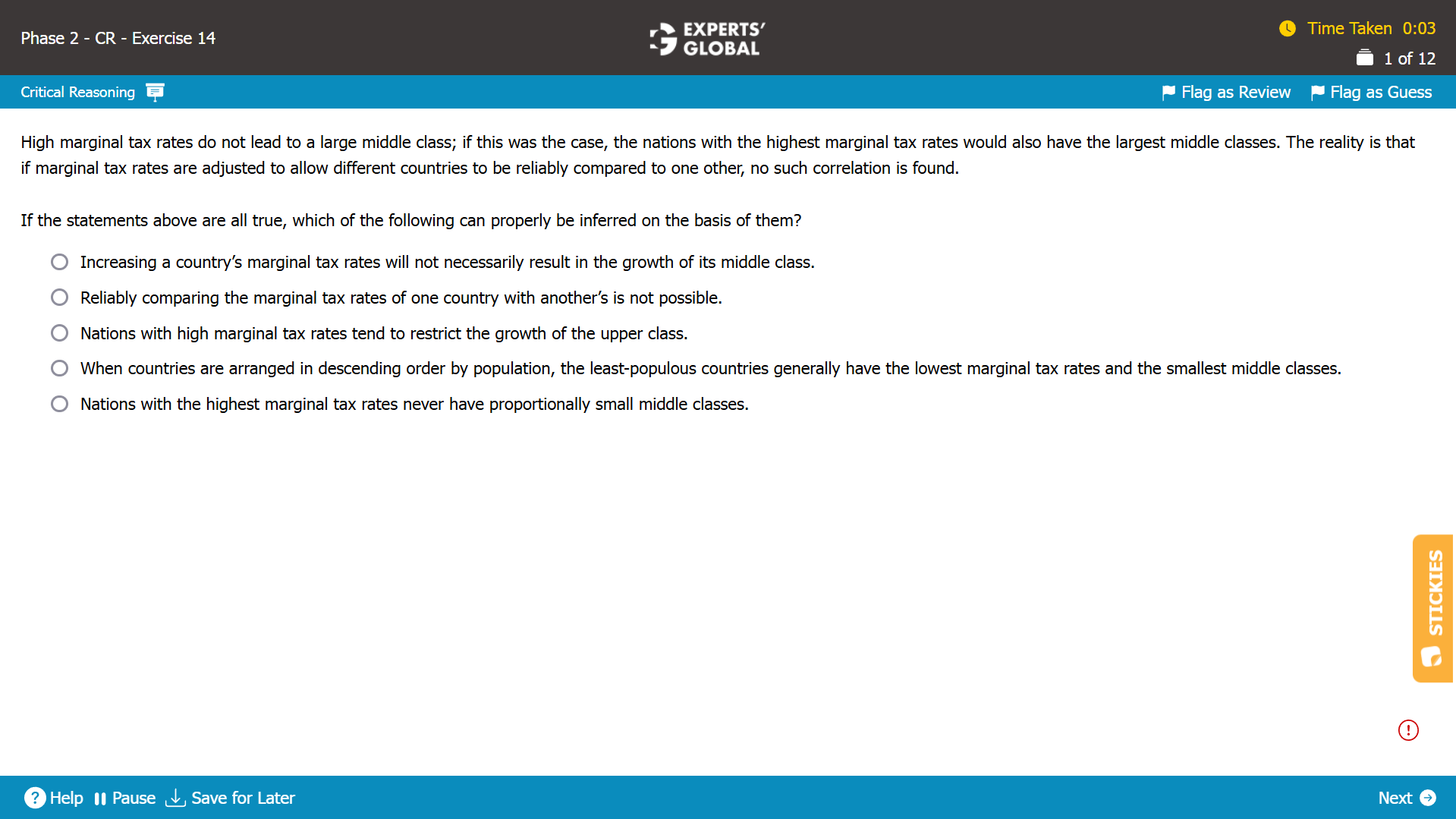
Mind-map: High tax rates do not lead to large middle class → highest tax rate countries do not have largest middle classes → when comparing countries, no correctional exists between tax rate and middle class
Missing-link: Not needed
Expectation from the correct answer choice: To be duly deducible from the information in the passage, without any assumption or extrapolation
A. Correct. The argument mentions that high marginal tax rates do not lead to a larger middle class and that no correctional exists between high marginal tax rate and the size of the middle class; thus, it can be inferred that raising a country’s marginal tax rates will not necessarily result in the growth of its middle class, as the answer choice mentions. Because this answer choice is deducible from the information in the passage without any assumption or extrapolation, this answer choice is correct.
B. The argument mentions adjustment of marginal tax rates to “reliably” compare different countries; so, this answer choice, suggesting that reliable comparison is impossible, contradicts the fact mentioned in the argument. Besides, the term “impossible” is extremely strong; one needs to be cautious of such answer choices as they are generally incorrect on the GMAT. Because this answer choice is not deducible from the information in the passage without any assumption or extrapolation, this answer choice is incorrect.
C. The argument is concerned with high marginal tax rates and the size of the middle class and makes no suggestion regarding the upper class; so, this answer choice, making a connection between high marginal tax rates and the upper class, is just a possibility and cannot be established. Because this answer choice is not deducible from the information in the passage without any assumption or extrapolation, this answer choice is incorrect.
D. The argument mentions that no correctional exists between high marginal tax rate and the size of the middle class and makes no mention of the size of the country; so, this answer choice, suggesting a correlation between marginal tax rates and the size of the middles class in small countries, cannot be established. Because this answer choice is not deducible from the information in the passage without any assumption or extrapolation, this answer choice is incorrect.
E. Trap. The argument mentions that no correctional exists between high marginal tax rate and the size of the middle class; so, it is incorrect to state that a negative correlation exists, as the answer choice mentions. Besides, the term “never” is extremely strong; one needs to be cautious of such answer choices as they are generally incorrect on the GMAT. Because this answer choice is not deducible from the information in the passage without any assumption or extrapolation, this answer choice is incorrect.
A is the best choice.
Q8. GMAT CR: Paragraph Completion Sample Question
CR Complete the Paragraph questions ask you to choose the answer choice that best carries the author’s reasoning forward and completes the paragraph with a clear, logical finish. The goal is to close the entire argument smoothly, not simply add a last sentence that sounds like a conclusion.
Important: Before visiting the CR Para Completion sample question, if you would like a quick brush up of the concept, you may first visit: Free GMAT CR Complete the Paragraph Questions Prep
Written Explanation
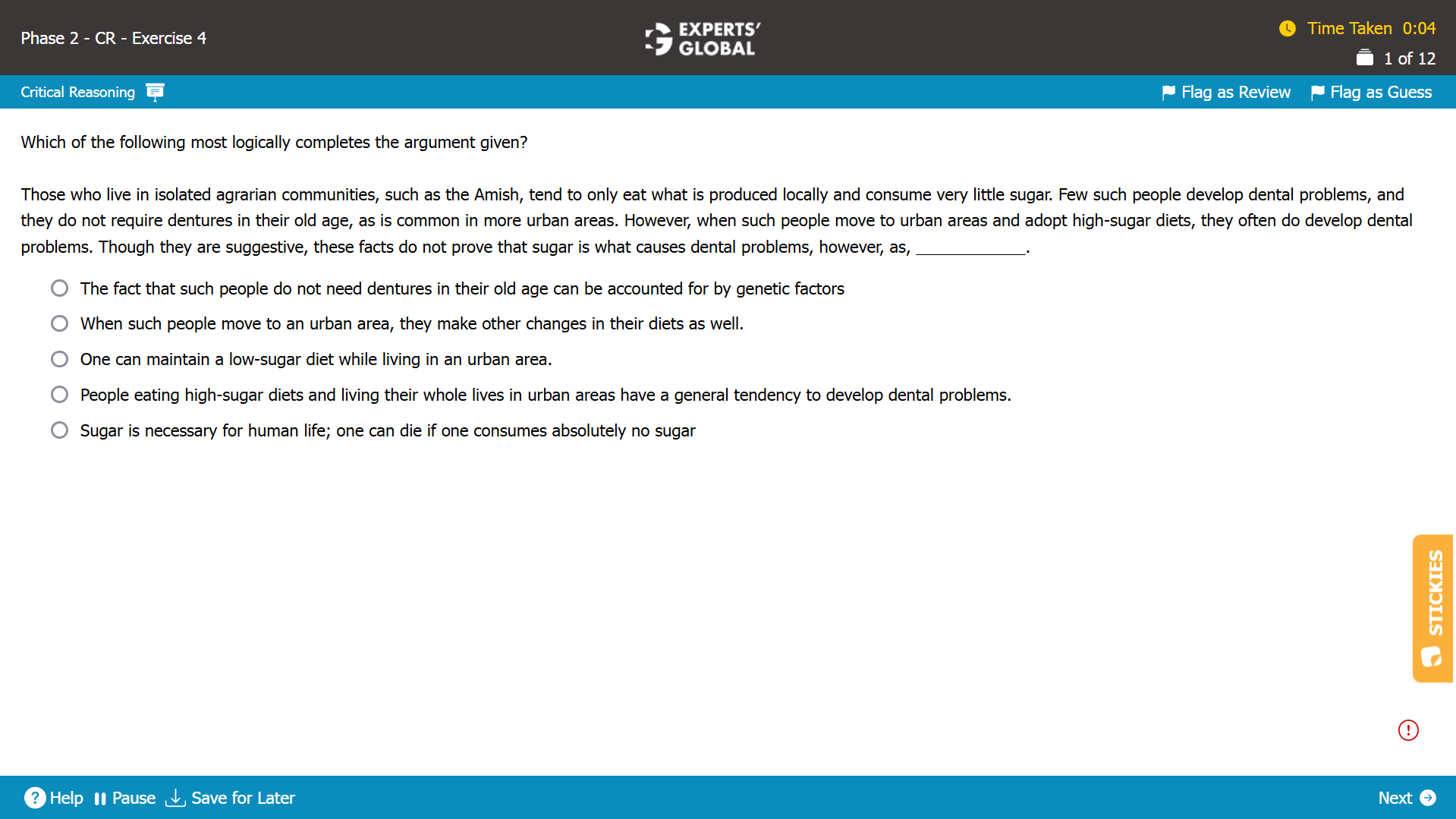
Mind-map: Those in isolated agrarian societies eat only local production and little sugar → few develop dental problems and do not require dentures when old → dentures are common in urban areas → moving from isolated societies to urban areas and adoption of high-sugar diets lead to dental problems → however, sugar is not the culprit in dental problems because _____
Missing-link: Between moving from isolated societies to urban areas leading to dental problems and sugar not being the culprit in dental problems
Expectation from the correct answer choice: Something on the lines of why sugar should not be considered the culprit in dental problems
A. Trap. This answer choice, suggesting that people in isolated agrarian societies do not need dentures in old age because of genetic factors, fails to explain why the same people, when moved to urban areas, develop dental problems. Because this answer choice does not effectively complete the chain of thoughts developed in the passage, this answer choice is incorrect.
B. Correct. By suggesting the presence of changes in other dietary habits after moving from isolated societies to urban areas, this answer choice introduces the possibility that the development of dental problems after moving to urban areas may be because of non-sugar related dietary changes and not necessarily because of the adoption of high-sugar diets, thus weakening the cause-effect relationship between sugar and dental problems and completing the chain of thoughts developed in the passage. Because this answer choice duly completes the passage, this answer choice is correct.
C. Trap. This answer choice, suggesting the possibility of maintaining a low-sugar diet when living in urban areas, provides no information about whether sugar causes dental problems and hence does not effectively complete the chain of thoughts developed in the passage. Because this answer choice does not effectively complete the chain of thoughts developed in the passage, this answer choice is incorrect.
D. This answer choice, suggesting a correlation between sugar and dental problems, indicates that sugar may be a culprit in dental problems; so, this answer choice, if anything, casts doubt on, rather than explains, why sugar should not be considered the culprit in dental problems. Because this answer choice does not effectively complete the chain of thoughts developed in the passage, this answer choice is incorrect.
E. This answer choice, suggesting the importance of sugar consumption, is a general statement of fact and provides no information about whether sugar causes dental problems, thus failing to effectively complete the chain of thoughts developed in the passage. Because this answer choice does not effectively complete the chain of thoughts developed in the passage, this answer choice is incorrect.
B is the best choice.
Q9. GMAT CR: Boldface Sample Question
In GMAT Critical Reasoning boldface questions, you see a passage that includes one or two bolded parts. Your task is to identify the role these bolded part or parts play in the argument. On the GMAT, the verbal section includes 23 questions in total. Of these, roughly 8 to 10 are Critical Reasoning questions, and typically one of those is a boldface question.
Important: Before visiting the CR Boldface sample question, if you would like a quick brush up of the concept, you may first visit: Free GMAT CR Boldface Questions Prep
Written Explanation
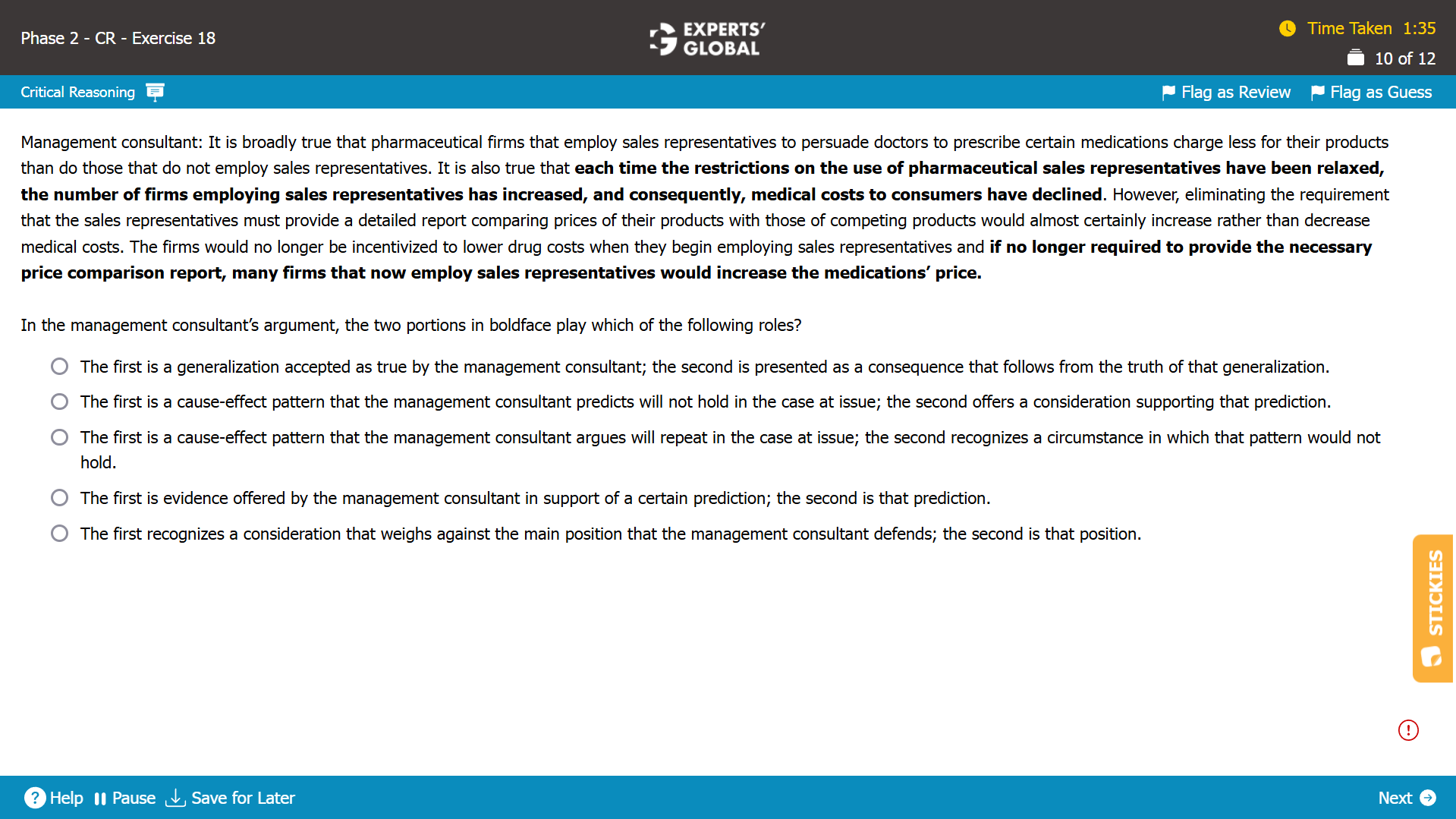
Strategy: Determining the main conclusion of the argument and finding the relation of the boldfaced portions with this conclusion
Logic: The argument is concerned with removing a particular requirement for pharmaceutical firms while employing sales representatives. The argument mentions that pharmaceutical firms employing sales representatives generally charge less for their products and that, as the first boldface states, with lower restrictions on employing sales representatives, more firms employ sales representatives, thus bringing down medical costs for consumers. The argument concludes that eliminating the requirement that mandates firms to show a detailed report comparing prices of their products with those of competing products would, however, increase medical costs. The argument reasons that when such a requirement is removed, firms would not have any incentive to sell their products at reduced prices and that, as the second boldface states, firms already employing sales representatives would increase their products’ prices. In the context of the main conclusion – the first boldface is the pattern that the argument concludes will not hold in a particular case; the second boldface is the prediction based on which the argument draws its conclusion.
Main conclusion: Eliminating the requirement that mandates firms to show a detailed report of relative prices would increase medical costs.
Broad expectation from the correct answer choice:
The first boldface is the pattern that the argument concludes will not hold in a particular case.
The second boldface is the prediction based on which the argument draws its conclusion.
A. Trap.
Merit(s):
The first boldface is the pattern that lowering restrictions generally results in reduced medical costs; therefore, it is broadly correct to state that the first boldface is “a generalization”.
The argument mentions the phrase “it is also true that” before the first boldface, suggesting that the management consultant does not doubt the first boldface; therefore, it is correct to state that the “management consultant accepts” the first boldface “as true”.
The second boldface is a prediction regarding the effect of an event; therefore, it is broadly correct to state that the second boldface is a “consequence”.
Demerit(s):
The argument, on the basis of the second boldface, concludes that the first boldface will not hold in a particular case; so, the two boldfaces relate to opposite positions; therefore, it is incorrect to state that the second boldface “follows from the truth of” the first boldface.
Because this answer choice does not correctly highlight the roles played by the two portions in boldface, this answer choice is incorrect.
B.
Merit(s):
The first boldface is the pattern that lowering restrictions generally results in reduced medical costs; therefore, it is correct to state that the first boldface is a “cause-effect pattern”.
The argument concludes that the first boldface will not remain valid in a particular case; therefore, it is correct to state that the management consultant “predicts” that the first boldface “will not hold in the case at issue”.
The second boldface is the prediction that the argument gives careful thought to and uses to draw the conclusion; therefore, it is correct to state that the second boldface is a “consideration”.
The argument, on the basis of the second boldface, concludes that the first boldface will not hold in a particular case; therefore, it is correct to state that the second boldface “supports the management consultant’s prediction”.
Demerit(s):
None
Because this answer choice correctly highlights the roles played by the two portions in boldface, this answer choice is correct.
C. Trap.
Merit(s):
The first boldface is the pattern that lowering restrictions generally results in reduced medical costs; therefore, it is correct to state that the first boldface is a “cause-effect pattern”.
The second boldface is a prediction regarding the effect of an event; in other words, the second boldface is a situation surrounding the event; therefore, it is correct to state that the second boldface is a “circumstance”.
The argument, on the basis of the second boldface, concludes that the first boldface will not remain valid in a particular case; therefore, it is correct to state that the second boldface indicates that “the cause-effect pattern in the first boldface would not hold”.
Demerit(s):
The argument concludes that the first boldface will not hold in a particular case; therefore, it is incorrect to state that the management consultant “argues” that the first boldface “will repeat in the case at issue”.
Because this answer choice does not correctly highlight the roles played by the two portions in boldface, this answer choice is incorrect.
D.
Merit(s):
The first boldface presents a concrete observation; therefore, it is correct to state that the first boldface is an “evidence”.
The second boldface is the forecast the argument makes; therefore, it is correct to state that the second boldface is the management consultant’s “prediction”.
Demerit(s):
The argument concludes that the first boldface will not hold in a particular case because, in such a case, firms already employing sales representatives would increase their products’ prices; in other words, the management consultant contradicts the first boldface on the basis of a certain prediction and does not use the first boldface to support the prediction; therefore, it is incorrect to state that the management consultant offers the first boldface “in support of a certain prediction”.
Because this answer choice does not correctly highlight the roles played by the two portions in boldface, this answer choice is incorrect.
E.
Merit(s):
The first boldface is an observation that the argument gives careful thought to; therefore, it is correct to state that the first boldface is a “consideration”.
The argument concludes that the first boldface will not hold in a particular case; therefore, it is broadly correct to state that the first boldface “weighs against the main position that the management consultant defends”.
Demerit(s):
The second boldface is the prediction based on which the management consultant draws his view and itself is not the view; therefore, it is largely incorrect to state that the second boldface is a “position”.
The second boldface is the prediction based on which the management consultant draws his view; in other words, the second boldface defends the management consultant’s position and not the other way round; therefore, it is incorrect to state that the “management consultant” defends the second boldface.
Because this answer choice does not correctly highlight the roles played by the two portions in boldface, this answer choice is incorrect.
B is the best answer choice.
Q10. GMAT CR: Method of Reasoning Sample Question
Method-of-reasoning CR questions ask you to identify how an argument is built. These questions feel a bit different and particularly interesting because they test both your logical thinking and your awareness of structure. Unlike strengthen, weaken, or inference questions, which focus on supporting or challenging a conclusion, these questions ask you to see how the author or speaker organizes ideas and connects the steps in the reasoning.
Important: Before visiting the CR Method of Reasoning sample question, if you would like a quick brush up of the concept, you may first visit: Free GMAT CR Method of Reasoning Questions Prep
Written Explanation
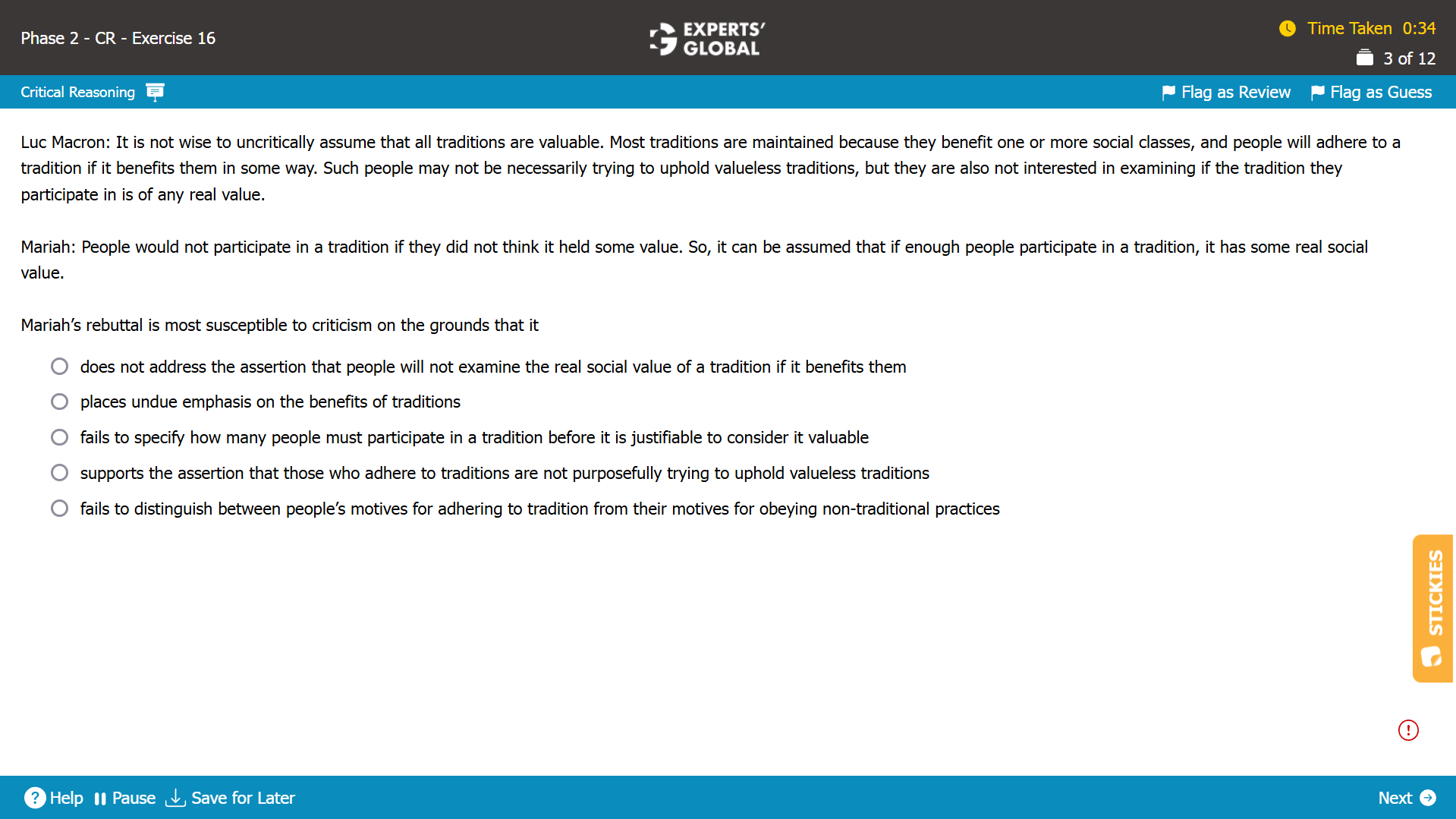
Mind-map: LM: uncritically assuming that all traditions are valuable is not wise → people follow most traditions because the traditions benefit people in some ways → people may not be necessarily upholding valueless traditions → people are also not interested in examining the real value of a tradition → M: people would follow a tradition only if they believe in its value → if enough people participate in a tradition, it has some real value (conclusion)
Missing-link: Not needed
Expectation from the correct answer choice: Something on the lines of failing to address whether people follow traditions because traditions benefit people and whether people are interested in examining the real value of a tradition
A. Correct. Luc Macron mentions that people follow most traditions because the traditions benefit people and that people are not interested in examining the real value of a tradition; Mariah simply states that a tradition that is followed by enough people has real value; it can be inferred that Mariah fails to address whether people follow traditions because the traditions benefit people and whether people are interested in examining the real value of a tradition; in other words, Mariah’s response does not address the assertion that people will not examine the real social value of a tradition if it benefits them, as the answer choice mentions. Because this answer choice indicates the criticism that Mariah’s response is most susceptible to, this answer choice is correct.
B. Mariah makes no suggestion regarding the benefits of traditions; so, it is incorrect to state that her response places undue emphasis on them, as the answer choice mentions. Furthermore, Mariah simply states that a tradition that is followed by enough people has real value and fails to address whether people follow traditions because the traditions benefit people and whether people are interested in examining the real value of a tradition; failure to address these concerns is the key flaw in Mariah’s response; we need an answer choice on similar lines. Because this answer choice does not indicate the criticism that Mariah’s response is most susceptible to, this answer choice is incorrect.
C. Although Mariah does not specify the number of people required to participate in a tradition before the tradition is considered valuable, such specification is out of the scope of the dialogue; so, the absence of such specification is not the flaw in her response. Furthermore, Mariah simply states that a tradition that is followed by enough people has real value and fails to address whether people follow traditions because the traditions benefit people and whether people are interested in examining the real value of a tradition; failure to address these concerns is the key flaw in Mariah’s response; we need an answer choice on similar lines. Because this answer choice does not indicate the criticism that Mariah’s response is most susceptible to, this answer choice is incorrect.
D. Trap. Luc Macron mentions that people may not be necessarily upholding valueless traditions and Mariah states that people would follow a tradition only if they believe in its value; so, Luc Macron and Mariah agree on the aspect stated in this answer choice; a point of agreement cannot exhibit a flaw in Mariah’s rebuttal. Furthermore, Mariah simply states that a tradition that is followed by enough people has real value and fails to address whether people follow traditions because the traditions benefit people and whether people are interested in examining the real value of a tradition; failure to address these concerns is the key flaw in Mariah’s response; we need an answer choice on similar lines. Because this answer choice does not indicate the criticism that Mariah’s response is most susceptible to, this answer choice is incorrect.
E. Luc Macron’s argument and Mariah’s response are related to people following traditions; so, non-traditional practices are out of scope. Additionally, Mariah makes no suggestion regarding people’s motives. Overall, failure to distinguish between motives for tradition and motives for non-traditional practices is not a flaw in Mariah’s response. Furthermore, Mariah simply states that a tradition that is followed by enough people has real value and fails to address whether people follow traditions because the traditions benefit people and whether people are interested in examining the real value of a tradition; failure to address these concerns is the key flaw in Mariah’s response; we need an answer choice on similar lines. Because this answer choice does not indicate the criticism that Mariah’s response is most susceptible to, this answer choice is incorrect.
A is the best choice.
Q11. GMAT CR: Logical Fallacy Sample Question
Logical fallacy Critical Reasoning questions on the GMAT show up through familiar formats such as resolve the paradox, strengthen, weaken, and assumption questions. Yet beneath these common labels sits one central skill: spotting the logical fallacy in the argument, which forms the foundation for solving these questions correctly.
Important: Before visiting the CR Logical Fallacy sample question, if you would like a quick brush up of the concept, you may first visit: Free GMAT CR Logical Fallacy Questions Prep
Written Explanation
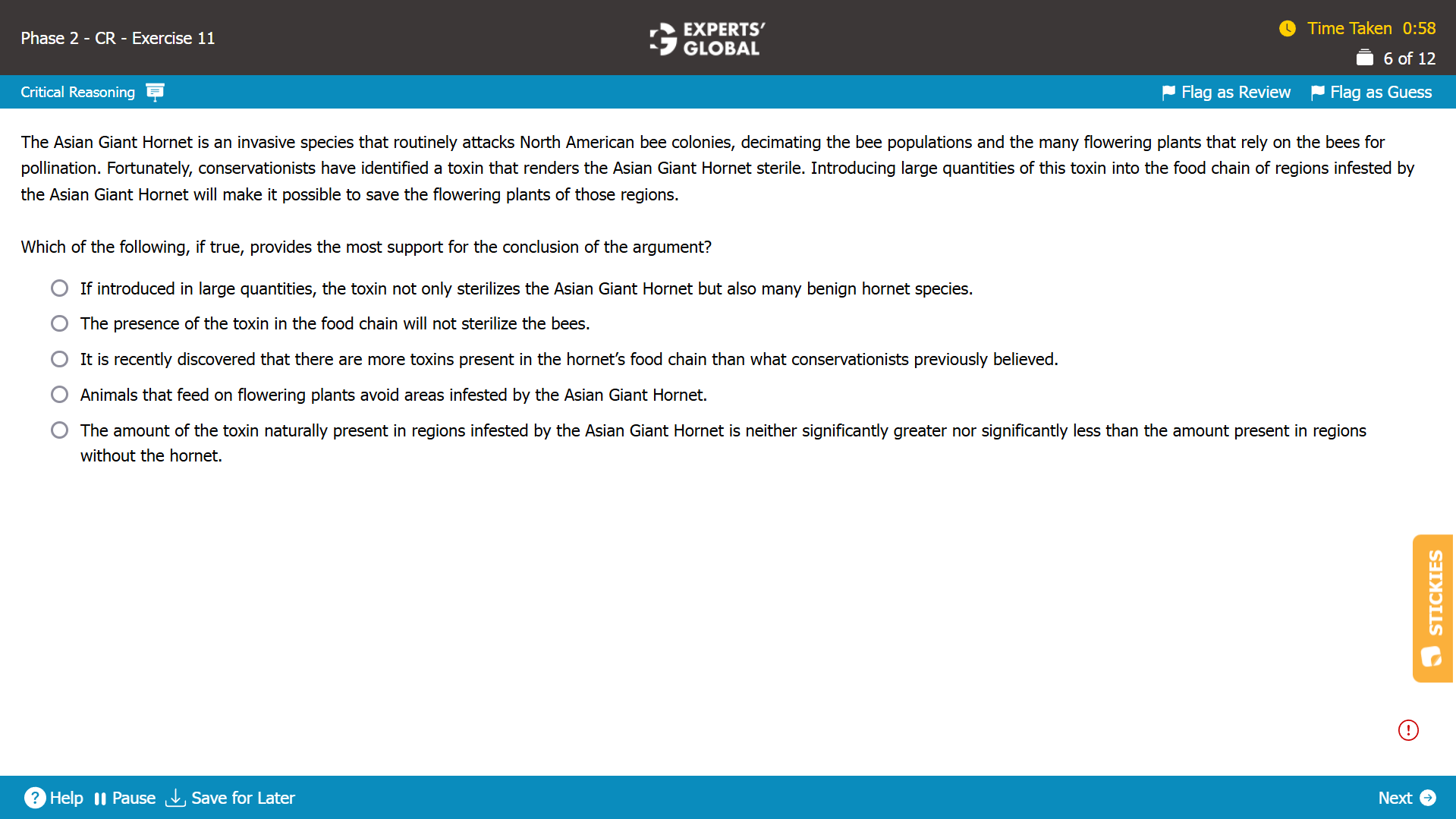
Mind-map: Hornet attacks bees colonies → bee population is reduced → flowering plants dependent on bees are also reduced → toxin makes hornet sterile → introducing large quantities of toxin in hornet’s food chain will save flowering plants (conclusion)
Missing-link: Between toxin making hornet sterile and the conclusion that introducing large quantities of the toxin in hornet’s food chain will save flowering plants
Expectation from the correct answer choice: To strengthen the conclusion that introducing large quantities of the toxin in hornet’s food chain in the affected region will save flowering plants
A. The argument makes no connection between benign hornet species and the threat to flowering plants; so, this answer choice, suggesting that other benign hornet species are sterilized by the toxin, is just additional information and does not strengthen the conclusion that introducing large quantities of toxin in the hornet’s food chain will save flowering plants. Because this answer choice does not strengthen the conclusion, this answer choice is incorrect.
B. Correct. By suggesting that bees will not be sterilized because of the toxin, this answer choice eliminates the possibility of a side-effect and indicates that the toxin will not lead to a reduction in the population of bees, thus helping grow flowering plants that rely on bees for pollination; so, this answer choice, by eliminating a negative impact of the toxin, strengthens the conclusion. Because this answer choice strengthens the conclusion, this answer choice is correct.
C. The argument is concerned with the impact of a “particular” toxin rendering the hornet sterile; so, information that there are a greater “number of toxins” in the hornet’s food chain than previously believed is just additional information and does not strengthen the conclusion. Because this answer choice does not strengthen the conclusion, this answer choice is incorrect.
D. The argument is concerned with the decreasing population of flowering plants in areas infested by the Asian Giant Hornet; this answer choice, suggesting that such areas do not have animals that feed on flowering plants, simply indicates the absence of another threat to flowering plants but makes no suggestion regarding whether flowering plants can be saved from the threat of hornets by introducing large quantities of toxin in the hornet’s food chain; so, this answer choice is just additional information and does not strengthen the conclusion. Because this answer choice does not strengthen the conclusion, this answer choice is incorrect.
E. The argument is concerned with the effect of “introducing large quantities” of the toxin in the region; so, information about the natural, current level of toxins in the region is just additional information and has no bearing on the argument. Because this answer choice does not strengthen the conclusion, this answer choice is incorrect.
B is the best choice.
Q12. GMAT CR: Dialogue Sample Question
On the GMAT, dialogue-based Critical Reasoning questions test the same core skills you use in every other CR format. The twist is the presentation. Instead of one paragraph, you see the argument unfold as a quick back and forth between two speakers. Your job is to judge the reasoning and answer the question that follows.
Important: Before visiting the CR Dialogue sample question, if you would like a quick brush up of the concept, you may first visit: Free GMAT CR Dialogue Questions Prep
Written Explanation
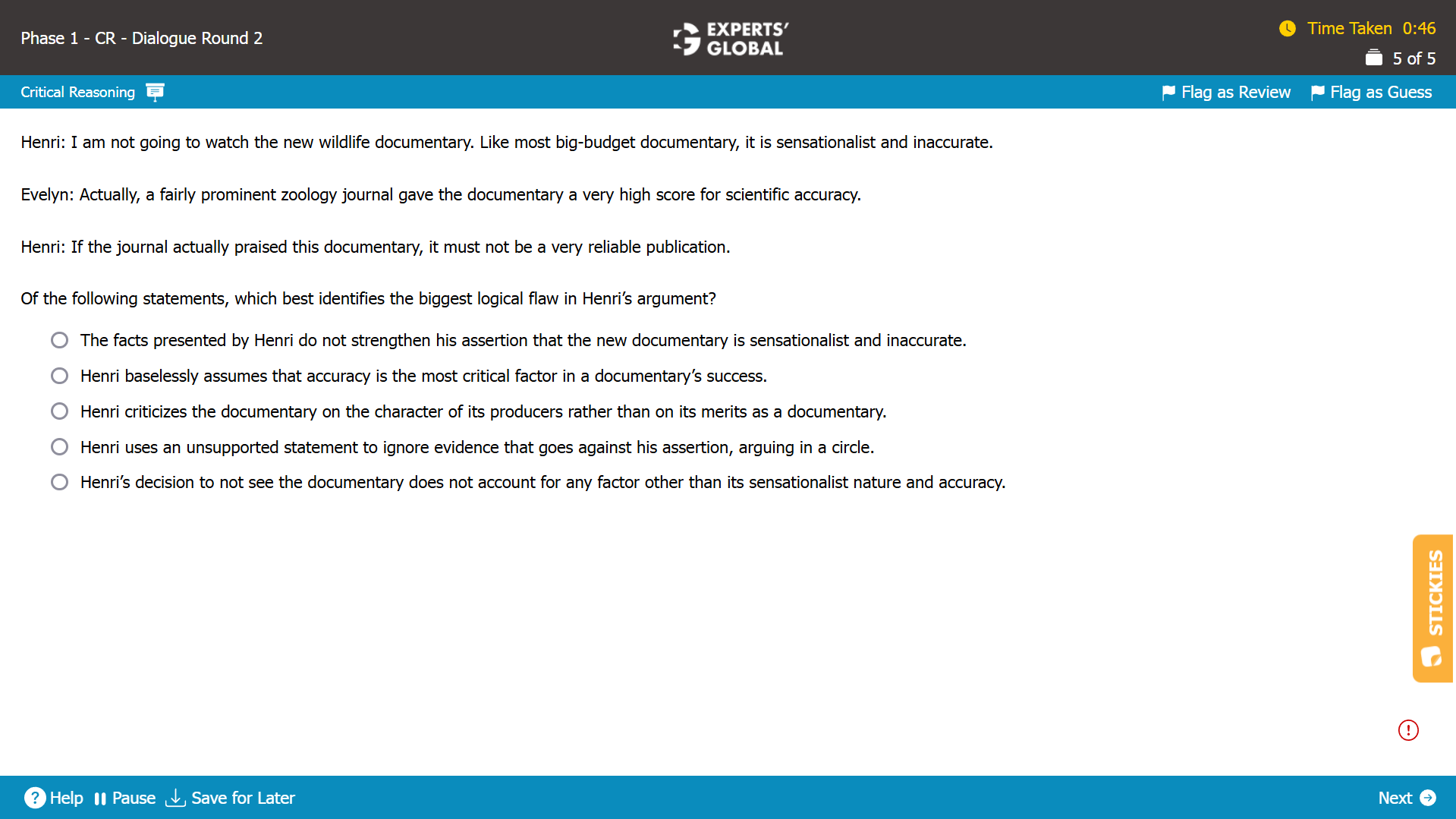
Mind-map: Henri: I will not watch documentary → documentary is sensationalist and inaccurate → Evelyn: a prominent zoology journal gave documentary high score for accuracy → Henri: if so, the journal must not be a reliable publication (conclusion)
Missing-link: Not needed
Expectation from the correct answer choice: Something on the lines of Henri ignoring Evelyn’s evidence and doubting the reliability of the journal simply because the journal’s opinion differs from his judgment
A. Henri does not present any factual information to support his judgment that the new wildlife documentary is sensationalist and inaccurate or to support his conclusion that the journal is not a reliable publication; so, it is incorrect to state that the flaw in Henri’s argument is that the facts presented by him do not strengthen his assertion, as the answer choice mentions. Furthermore, the flaw in Henri’s argument is that Henri ignores Evelyn’s evidence and doubts the reliability of the journal simply because the journal’s opinion differs from his judgment; we need an answer choice on similar lines. Because this answer choice does not identify the biggest logical flaw in Henri’s argument, this answer choice is incorrect.
B. Henri makes no suggestion regarding the factors involved in a documentary’s success or regarding whether the new wildlife documentary will be successful; so, it cannot be established that Henri assumes that accuracy is the most critical factor in a documentary’s success, as the answer choice mentions. Furthermore, the flaw in Henri’s argument is that Henri ignores Evelyn’s evidence and doubts the reliability of the journal simply because the journal’s opinion differs from his judgment; we need an answer choice on similar lines. Because this answer choice does not identify the biggest logical flaw in Henri’s argument, this answer choice is incorrect.
C. Henri makes no suggestion about the character of the documentary’s producers; so, it is incorrect to state that the flaw in Henri’s argument is that Henri criticizes the documentary on the character of its producers rather than on its merits as a documentary, as the answer choice mentions. Furthermore, the flaw in Henri’s argument is that Henri ignores Evelyn’s evidence and doubts the reliability of the journal simply because the journal’s opinion differs from his judgment; we need an answer choice on similar lines. Because this answer choice does not identify the biggest logical flaw in Henri’s argument, this answer choice is incorrect.
D. Correct. Henri questions the accuracy of the new wildlife documentary; upon Evelyn’s comment that a prominent zoology journal gave the documentary a high score for accuracy, Henri ignores this evidence and doubts the reliability of the journal simply because the journal’s opinion differs from his judgment; Henri offers no support for his judgments about the documentary’s accuracy or the journal’s reliability and thus, tries to prove a conclusion by stating/assuming that it is true; in other words, the biggest flaw in Henri’s argument is that he makes an unsupported statement, ignores factual information contrary to his statement, and draws a conclusion on the basis of his unsupported statement, thus exhibiting circular reasoning, as the answer choice mentions. Because this answer choice identifies the biggest logical flaw in Henri’s argument, this answer choice is correct.
E. Although Henri’s decision to not see the documentary is entirely based on Henri’s views about the documentary’s sensationalist nature and inaccuracy, these factors in Henri’s decision are not the flaw in Henri’s argument; the flaw in Henri’s argument is that Henri ignores Evelyn’s evidence and doubts the reliability of the journal simply because the journal’s opinion differs from his judgment; we need an answer choice on similar lines. Because this answer choice does not identify the biggest logical flaw in Henri’s argument, this answer choice is incorrect.
D is the best choice.
For Further Prep and Practice:
15 full-length GMAT practice tests (includes a free test)
End-to-end GMAT prep course online (includes 7-day free trial)
GMAT 5-weeks crash course
GMAT Prep + Admission Consulting Bundle