Comprehensive coverage across every GMAT section, every question type, and every topic, concept, and micro-concept forms the foundation of a well-designed GMAT prep course. This page brings together sample GMAT sample questions that are thoughtfully distributed by section, question type, and concept. The intent is to present at least one representative question from each GMAT micro-concept, so you gain direct exposure to the full breadth of GMAT content and see how these concepts are tested across different sections and question formats. This page serves as a structured orientation to the complete GMAT landscape, designed to help you navigate the full perimeter of what the exam covers in a clear and organized way.
While working through these sample questions, your focus should remain on experiencing the questions themselves, their formats, structures, and nuances, and on attempting to arrive at the correct answers with care. Speed should not be a priority at this stage. Instead, use this opportunity to gain strong first-hand exposure to the entire GMAT expanse and to ensure meaningful learning from the questions as well as their detailed explanations. Use this rich resource carefully to, in just a few hours, gain broad exposure to the GMAT and carry these learnings forward into subsequent GMAT quizzes, GMAT sectional tests, and GMAT full-length mock tests. Happy exploring!
Quant Sample Questions
Verbal Sample Questions
Data Insights Sample Questions
Quant Sample Questions
The quantitative section on the GMAT is one of the three sections on the exam and therefore contributes to one-third of your overall score. In addition to this direct contribution, the concepts learned during quantitative section preparation also contribute indirectly to roughly half of the questions in the Data Insights section. The GMAT quantitative section features only one question format, the problem solving question type, commonly referred to as PS. Each problem solving question presents a problem statement followed by five answer choices, out of which only one option is correct. Your task is to analyze the information provided, work through the required quantitative steps, and identify the correct answer choice.
GMAT Quant: Number Properties Sample Questions
Number properties are the backbone of the quantitative section on tests like the GMAT. Nearly half of the questions in this section, either directly or indirectly, rely on number properties. Mastering this topic will not only boost your performance in the quantitative section but also improve your ability to tackle quant-based problems in the Data Insights section. Becoming comfortable with numbers helps you think and compute faster and more accurately, making a noticeable difference in your overall GMAT performance.
Important: Before visiting the following sample question(s), if you would like a quick brush up of key Number Properties concepts, you may first visit: Free GMAT Number Properties Prep
Practice Question 1
Written Explanation
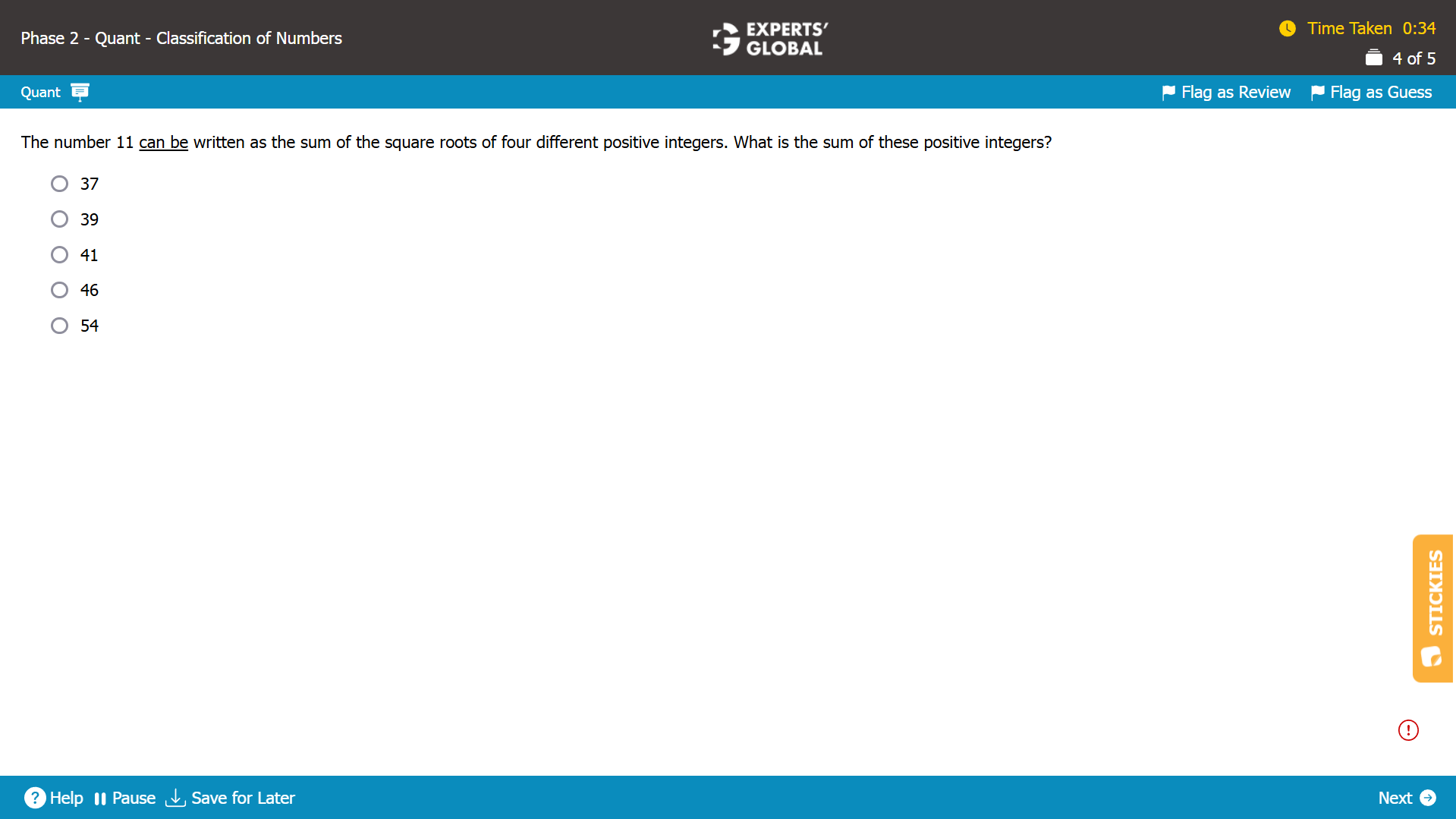
Let’s express 11 as a sum of four different positive integers.
11 = 1 + 10.
Let’s now express 10 as a sum of three different positive integers.
11 = 1 + 2 + 8.
Let’s now express 8 as a sum of two different positive integers.
11 = 1 + 2 + 3 + 5.
Now, 11 is written as the sum of 1,2,3,5, or as the sum of the square roots of four different positive integers – 1, 4, 9, 25.
The sum of these integers would be 1 + 4 + 9 + 25 = 39.
B is the correct answer choice.
Practice Question 2
Written Explanation
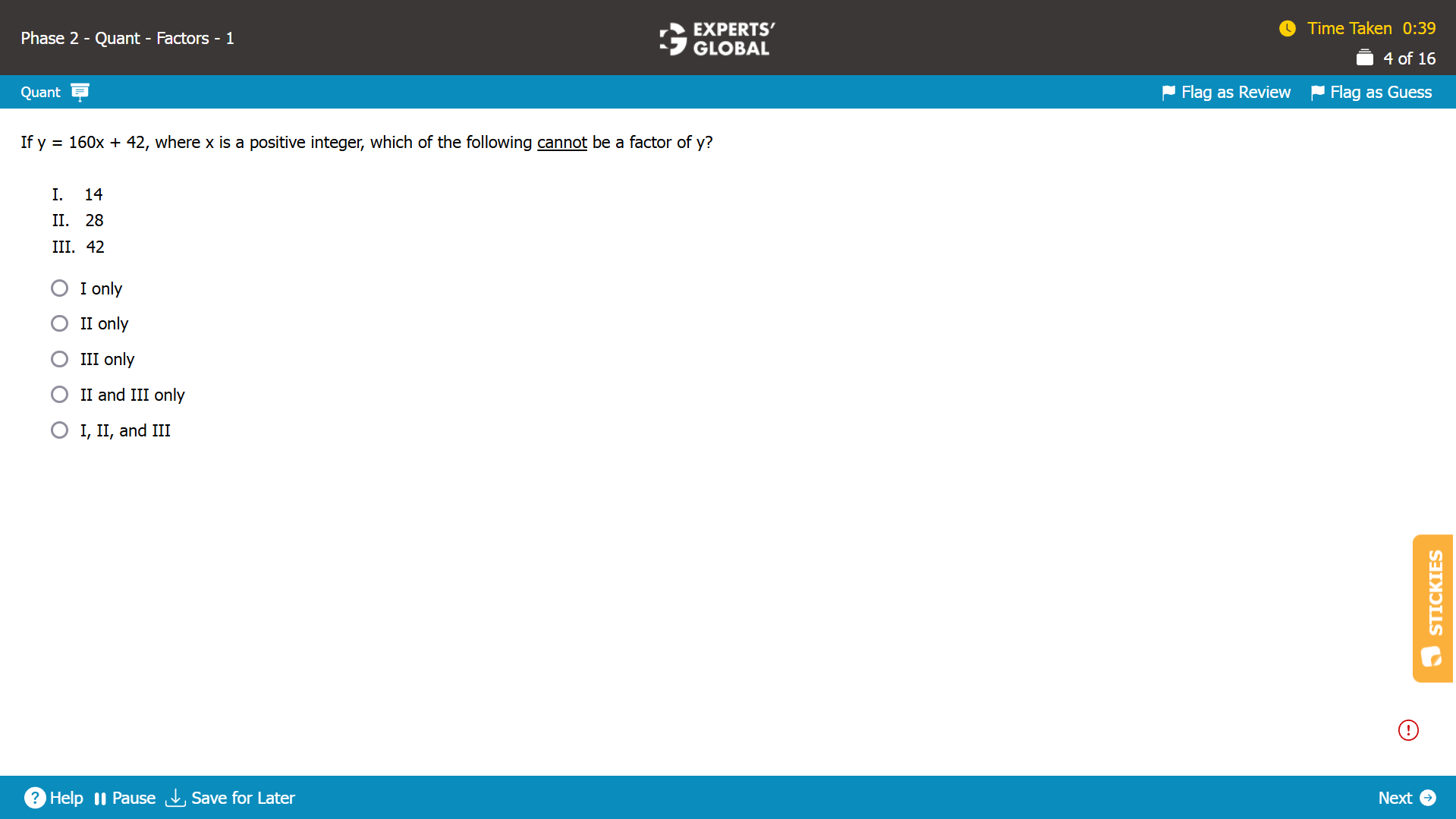
y = 160x + 42
Checking whether 14 can be a factor of y…
14 is a factor of 42.
If x is a multiple of 7, 14 will be a factor of 160x. So, 14 will be a factor of 160x + 42.
For example, if x = 7, y = 160x + 42 = 1162 = 14 X 83.
14 can be a factor of y.
Checking whether 28 can be a factor of y…
42 is 14 more than a multiple of 28.
So, for y to be a multiple of 28….
(160x + 14) will have to be a multiple of 28.
So, 160x will have to leave a remainder of 14, 14 + 28, 14 + 2(28)… when divided by 28.
The possible remainders are {14, 42, 70, 98…}
160x is a multiple of 160 and will never fall in this series.
So, (160x + 14) cannot be a multiple of 28.
Overall, y cannot be a multiple of 28, or 28 cannot be a factor of y.
Checking whether 42 can be a factor of y…
42 is a factor of 42.
If x is a multiple of 42, 42 will be a factor of 160x. So, 42 will be a factor of 160x + 42.
42 can be a factor of y.
B is the correct answer choice.
Practice Question 3
Written Explanation
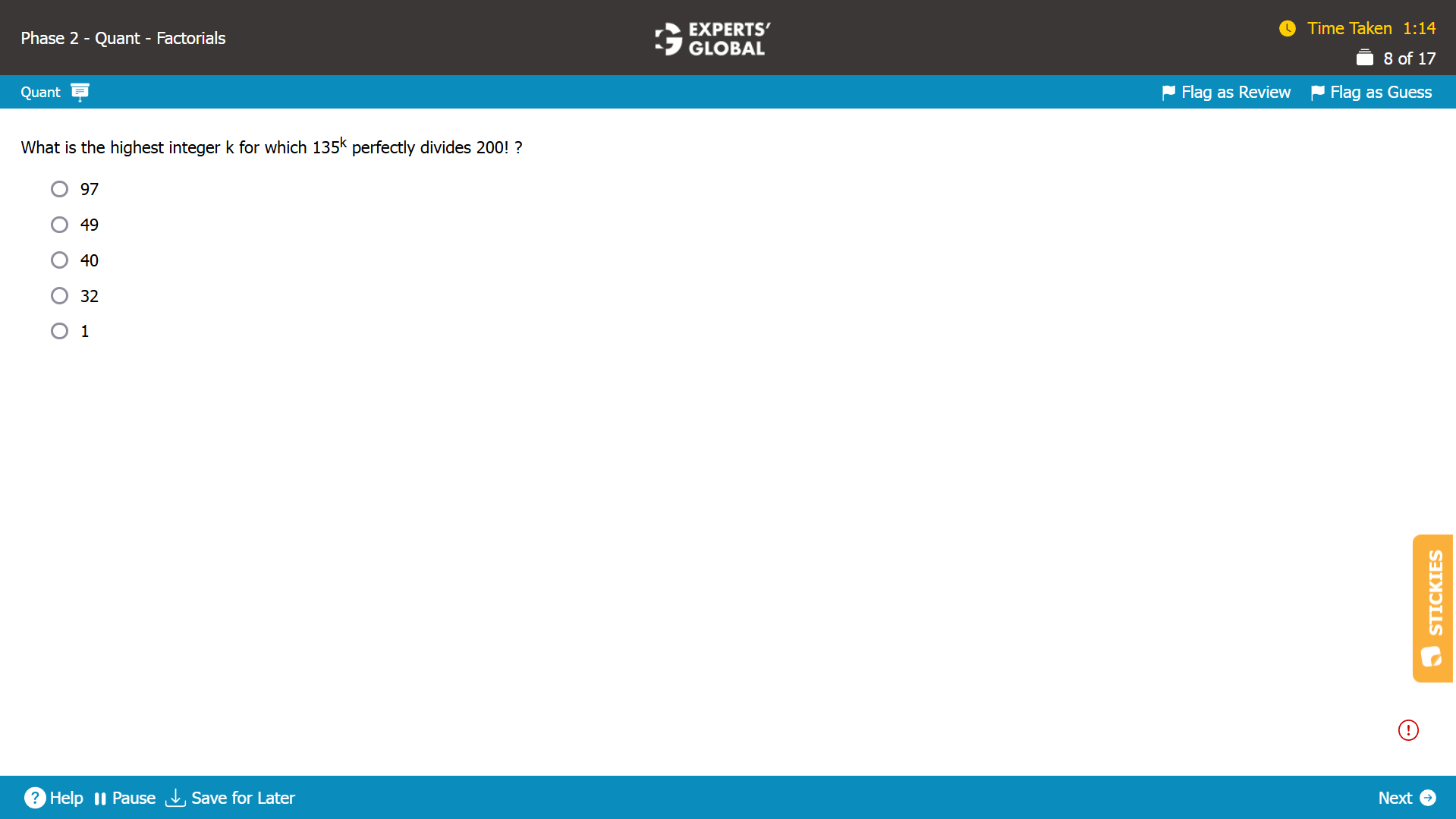
135 = 3 X 3 X 3 X 5.
135 has three 3s and one 5.
Three 3s will occur after every (3 X 3 X 3) = 27 numbers whereas one 5 will occur after every 5 numbers.
As a result, there will be more 5s in 200! than three 3s.
So, the highest power of 135 in 200! will be determined by the number of three 3s in 200!.
Multiples of 3 till 200 = 200 / 3 = 66.
Each of these multiples will have a 3 as a factor.
So far, number of 3s in 200! = 66.
Multiples of 32 = 9 till 200 = 200 / 9 = 22.
Each of these multiples will have two 3s as factors.
The first of the 3s is already counted because a multiple of 32 is also a multiple of 3.
There are 22 new 3s to be counted.
So far, number of 3s in 200! = 66 + 22 = 88.
Multiples of 33 = 27 till 200 = 200 / 27 = 7.
Each of these multiples will have three 3s as factors.
The first of the 3s is already counted because a multiple of 33 is also a multiple of 3.
The second of the 3s is already counted because a multiple of 33 is also a multiple of 32.
There are 7 new 3s to be counted.
So far, number of 3s in 200! = 88 + 7 = 95.
Multiples of 34 = 108 till 200 = 200 / 108 = 1.
Each of these multiples will have four 3s as factors.
The first of the 3s is already counted because a multiple of 34 is also a multiple of 3.
The second of the 3s is already counted because a multiple of 34 is also a multiple of 32.
The third of the 3s is already counted because a multiple of 34 is also a multiple of 33.
There is 1 new 3 to be counted.
So far, number of 3s in 200! = 95 + 1 = 96.
There are no multiples of 35 till 200.
Overall, total number of 3s in 200! = 96.
Total number of three 3s in 200! = 96 / 3 = 32.
The highest integer k such that 135k divides 200! is 32.
D is the correct answer choice.
Practice Question 4
Written Explanation
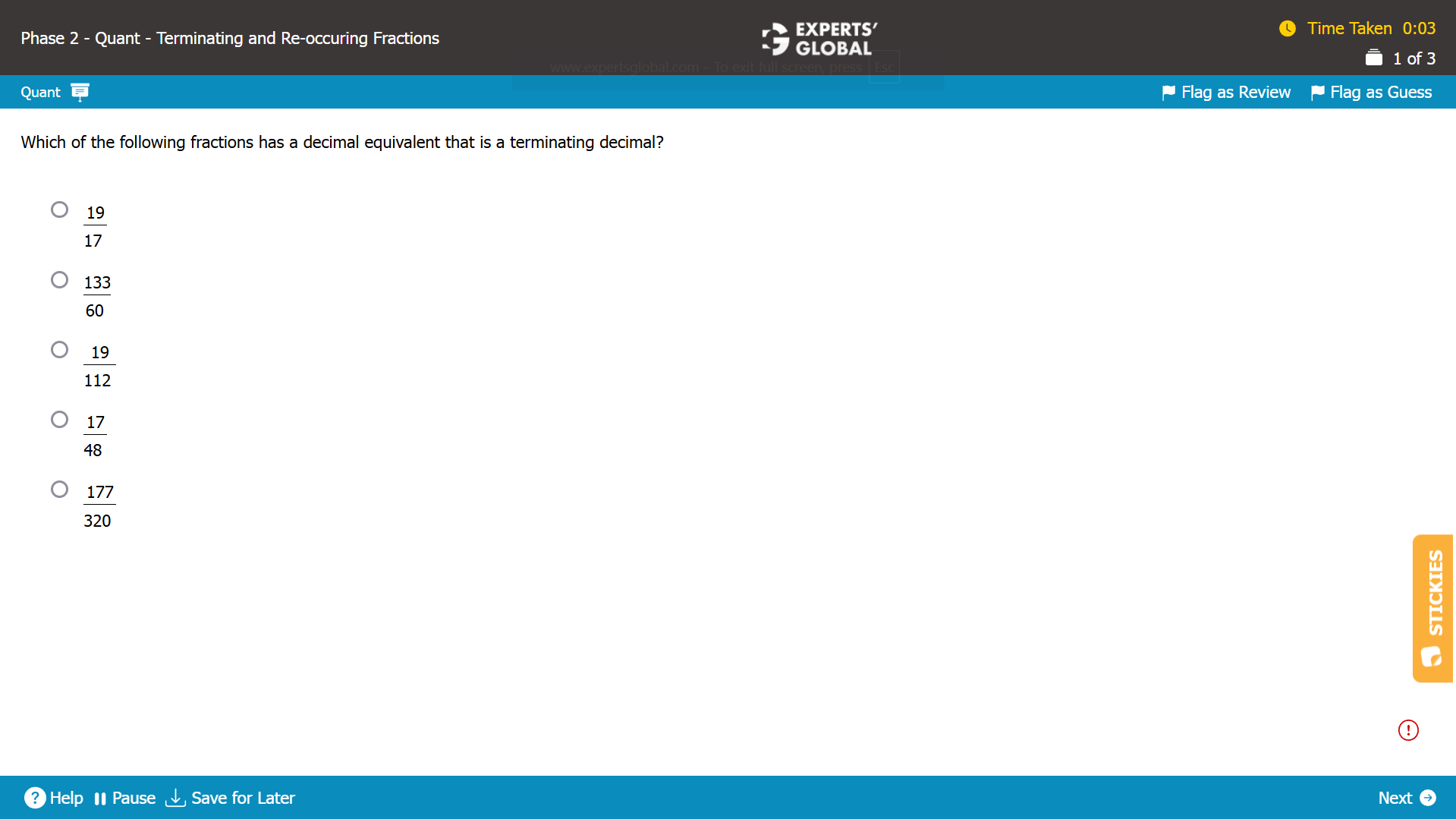
A fraction would be a terminating decimal if its denominator has 2 and 5 as the only prime factors.
A. The denominator = 17, a prime number.
There is no 17 in the factors of numerator = 19. So, the 17 in the denominator will remain.
Overall, 19 / 17 has a denominator that does not have 2 and 5 as the only prime factors. So, the fraction will not terminate.
B. The denominator = 60 = 2 X 2 X 3 X 5 = {2, 3, 5}
There is no 3 in the factors of numerator = 133 = 7 X 19. So, the 3 in the denominator will remain.
Overall, 133 / 60 has a denominator that does not have 2 and 5 as the only prime factors. So, the fraction will not terminate.
C. The denominator = 112 = 2 X 2 X 2 X 2 X 7= {2, 7}
There is no 7 in the factors of numerator = 19. So, the 7 in the denominator will remain.
Overall, 19 / 112 has a denominator that does not have 2 and 5 as the only prime factors. So, the fraction will not terminate.
D. The denominator = 48 = 2 X 2 X 2 X 2 X 3= {2, 3}
There is no 3 in the factors of numerator = 17. So, the 3 in the denominator will remain.
Overall, 17 / 48 has a denominator that does not have 2 and 5 as the only prime factors. So, the fraction will not terminate.
E. The denominator = 320 = 2 X 2 X 2 X 2 X 2 X 2 X 5 = {2,5}
The denominator has 2 and 5 as the only prime factors. The fraction will terminate.
E is the correct answer choice.
Practice Question 5
Written Explanation
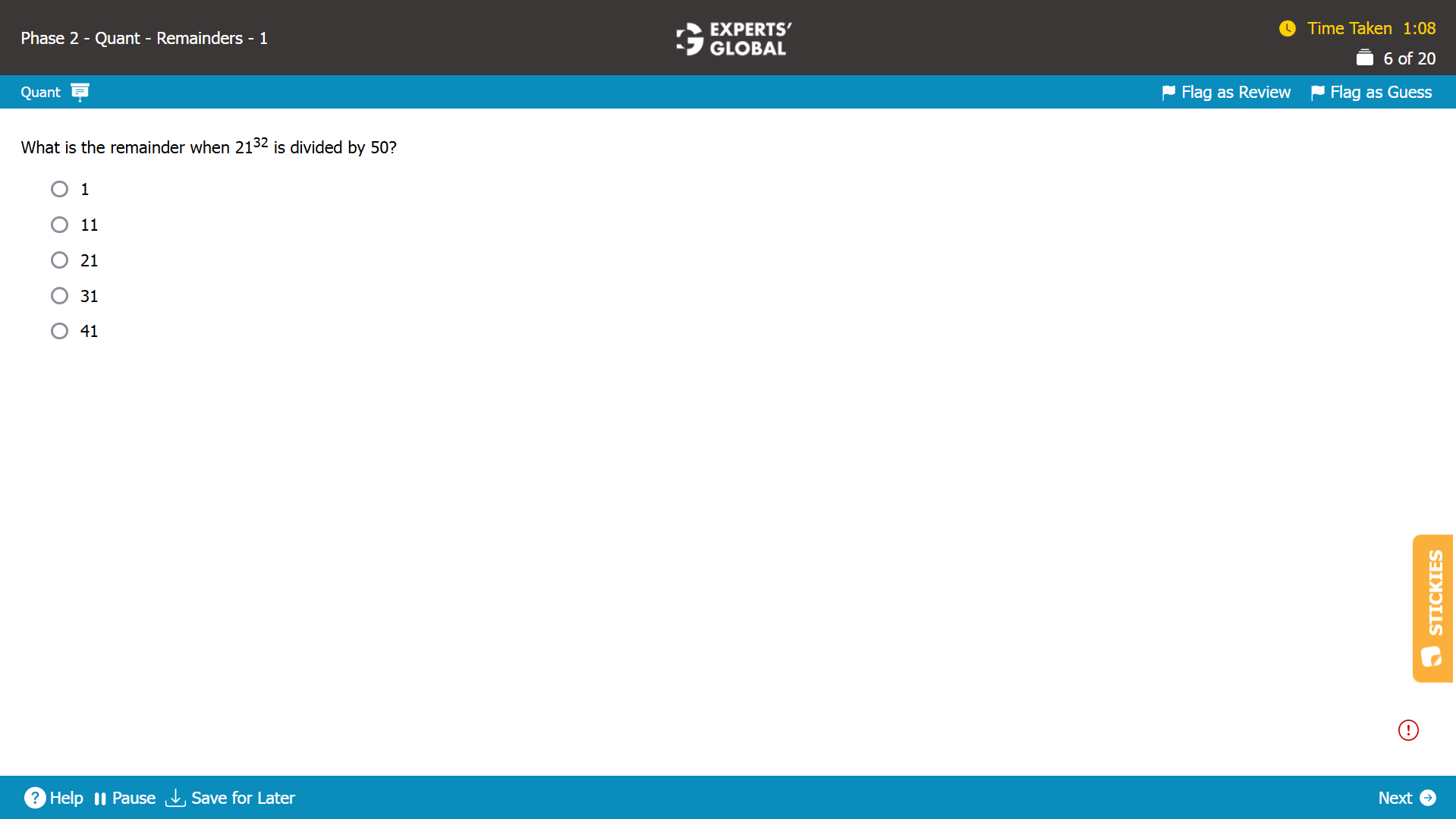
100 is a multiple of 50; so, the remainder of a number when divided by 50 depends on the last two digits of the number.
Last two digits of 211 = 21.
Last two digits of 212 = last two digits of (21 X 21) = 41.
Last two digits of 213 = last two digits of (42 X 21) = 61.
Last two digits of 214 = last two digits of (61 X 21) = 81.
Last two digits of 215 = last two digits of (81 X 21) = 01.
Last two digits of 216 = last two digits of (01 X 21) = 21.
From the 6th power onwards, the last two digits will repeat in the {21, 41, 61, 81, 01} cycle with 5 terms.
32 = 5 X 6 + 2; so, 32 leaves the remainder of 2 in the cycle of 5.
So, the 32 – 2 = 30th power will complete 6 cycles of {21, 41, 61, 81, 01} and …
The 32th power will have the last two digits of 41, the second term in the cycle.
So, the 2132 will have the last two digits of 41.
A number with the last two digits of 41 leave a remainder of 41 when divided by 50.
The remainder when 2132 is divided by 50 is 41.
E is the correct answer choice.
GMAT Quant: Overlapping Sets Sample Question
Overlapping sets problems describe situations where the same people or objects fit into two or more groups at once. Your job is to see exactly where the groups overlap, how they connect, and what that means for the totals.
Important: Before visiting the following sample question(s), if you would like a quick brush up of key Overlapping Sets concepts, you may first visit: Free GMAT Overlapping Sets Prep
Practice Question 1
Written Explanation
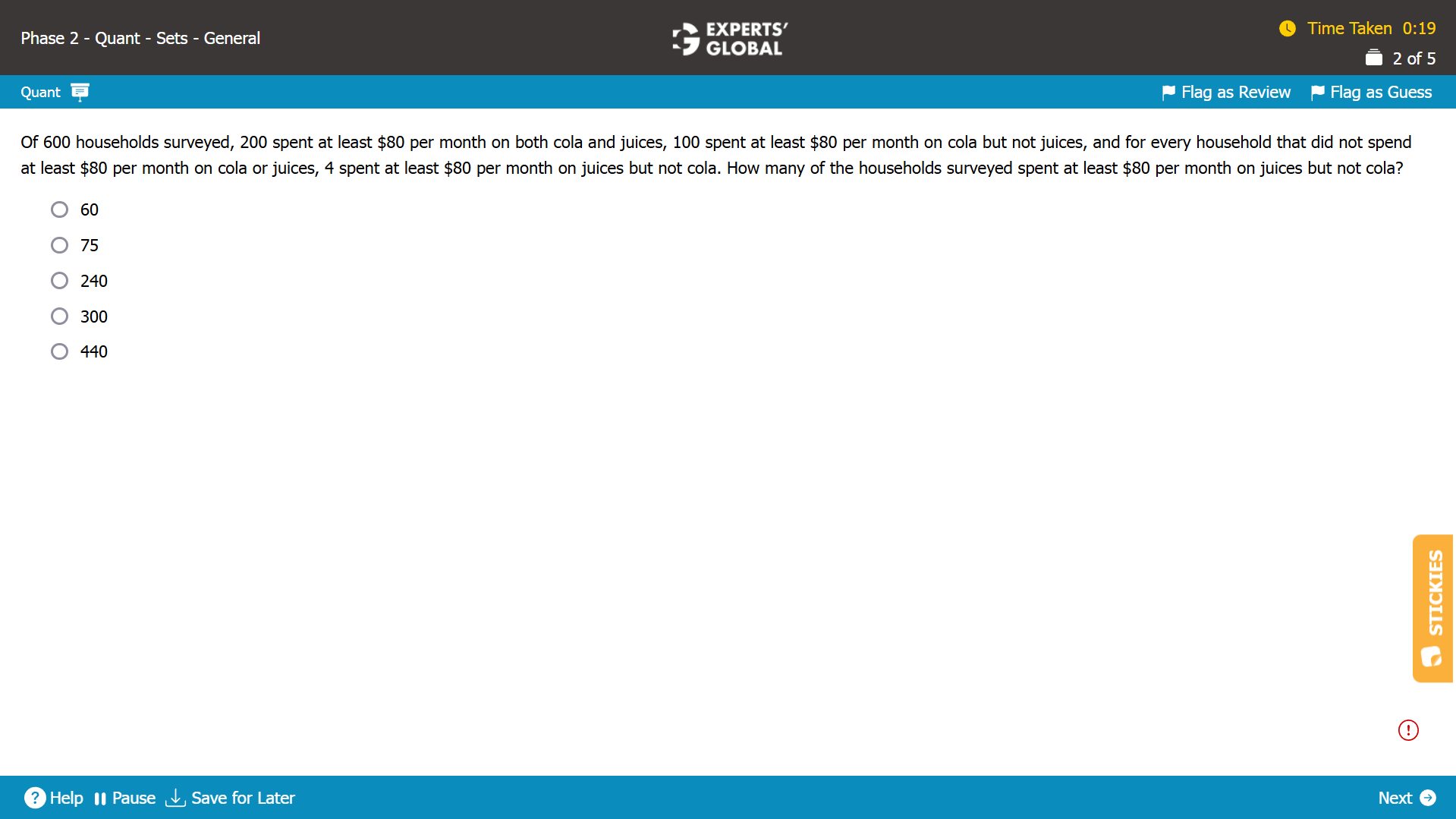
Households that did not spend at least $80 per month on cola or juices = D … (Set I)
Households that spent at least $80 per month on juices but not cola = C … (Set II)
For every household in Set I, there are 4 households in Set II.
So. C = 4 X D.
Total number of households = 600 = 100 + 200 + C + D
300 = 4 X D + D
D = 60.
C = 4 X 60 = 240.
Number of the households that spent at least $80 per month on juices but not cola = C = 240 households.
C is the correct answer choice.
Practice Question 2
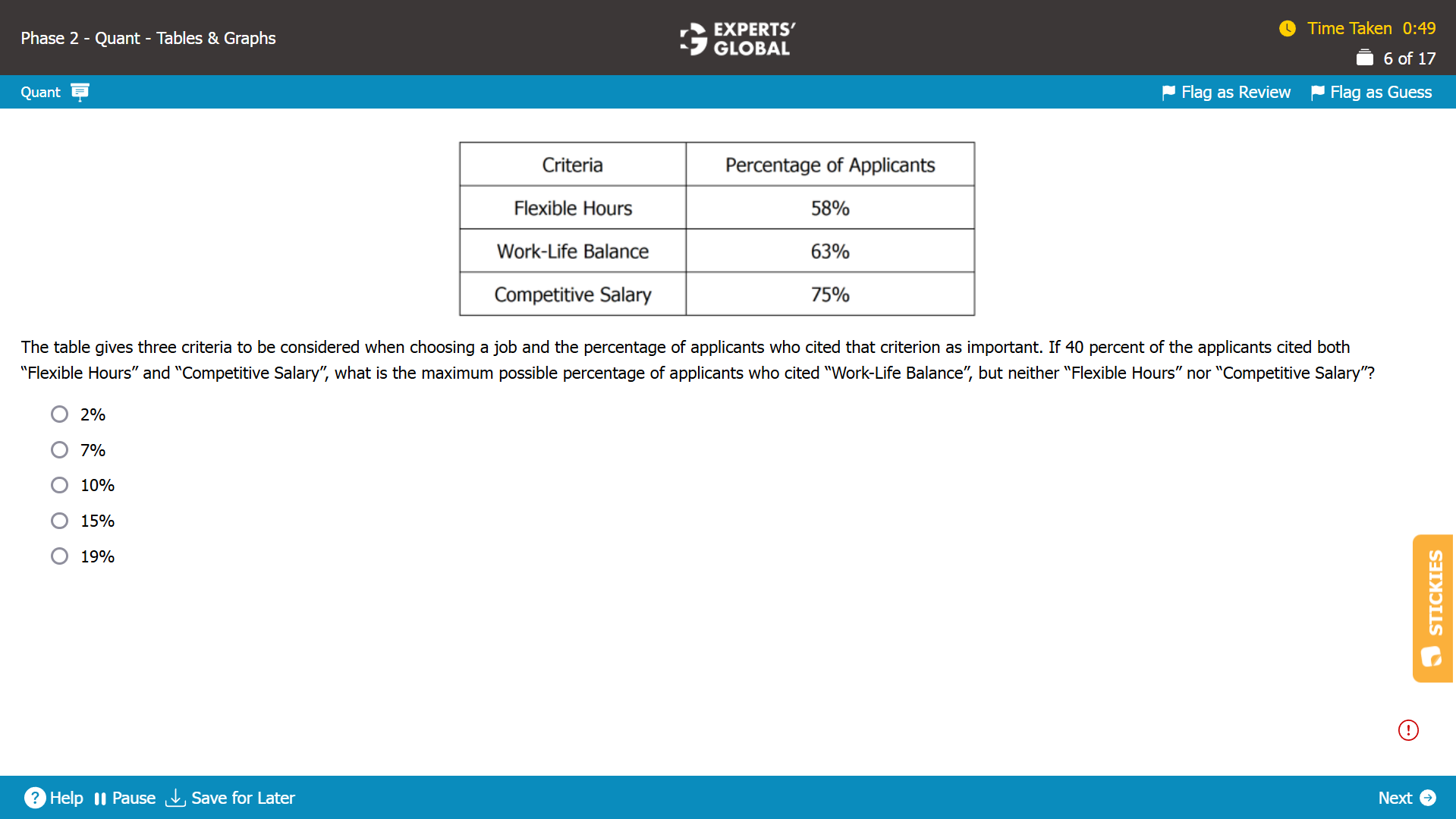
Percentage of applicants who cited both “Flexible Hours” and “Competitive Salary” = 40%
From the table, percentage of applicants who cited “Flexible Hours” = 58%
From the table, percentage of applicants who cited “Competitive Salary” = 75%
The percentage of applicants who cited either “Flexible Hours” or “Competitive Salary”
= Percentage of applicants who cited “Flexible Hours” + Percentage of applicants who cited “Competitive Salary” – Percentage of applicants who cited both “Flexible Hours” and “Competitive Salary”
= 58% + 75% – 40%
= 93%
The maximum possible percentage of applicants who cited “Work-Life Balance”, but neither “Flexible Hours” nor “Competitive Salary”
= 100% – The percentage of applicants who cited either “Flexible Hours” or “Competitive Salary”
= 100% – 93%
= 7%
The maximum possible percentage of applicants who cited “Work-Life Balance”, but neither “Flexible Hours” nor “Competitive Salary” is 7%.
B is the correct answer choice.
Practice Question 3
Written Explanation
When three sets intersect…
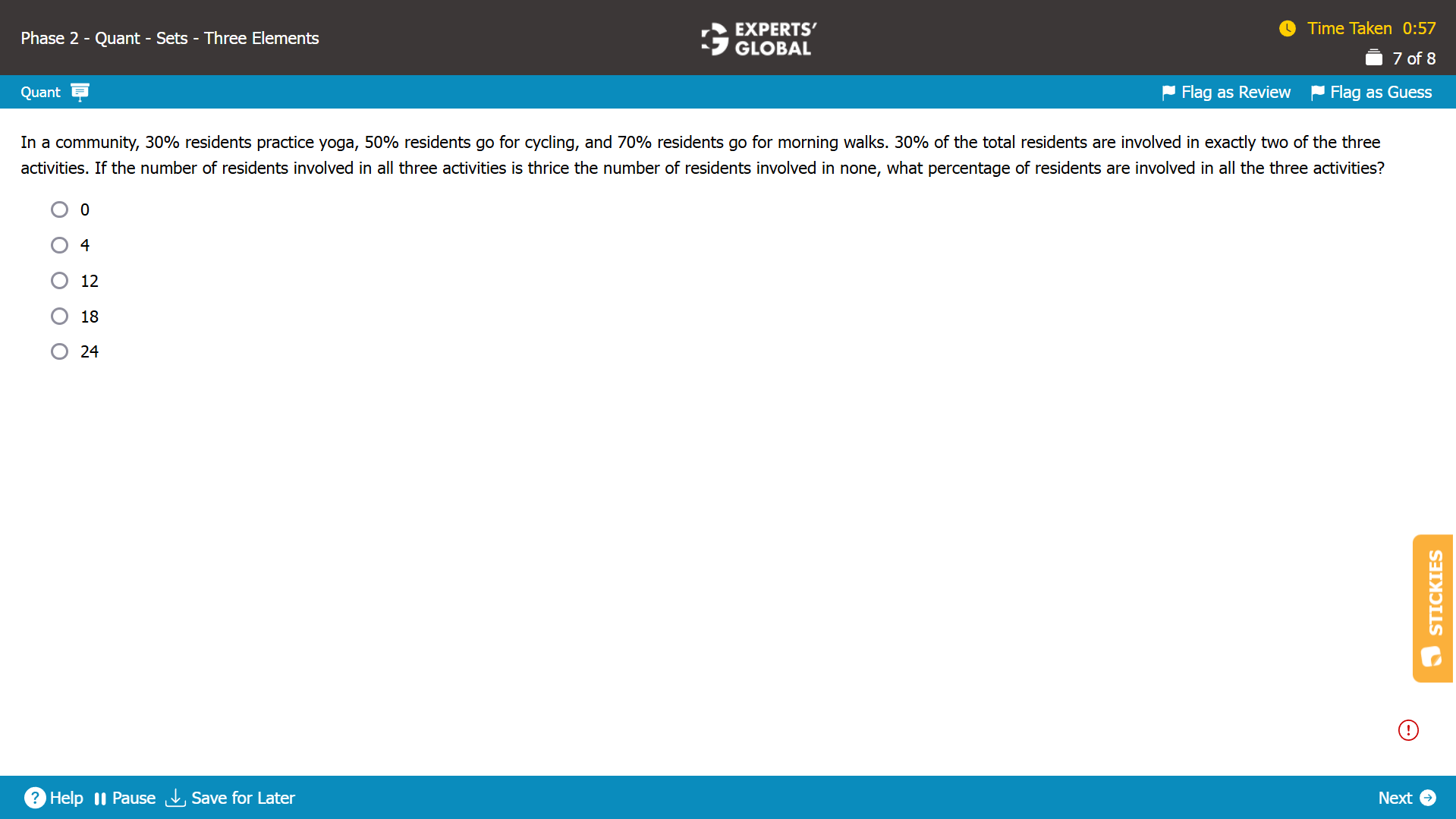
(Set 1 population + Set 2 population + Set 3 population) – (the population common in exactly two sets) – 2 X (the population common in all the three sets) + (the population in no set) = Total population
This can be verified from the above diagram as follows.
((A + E + G + D) + (B + E + F + D) + (C + G + F + D)) – (E + F + G) – 2D + H = A + B + C + E + F + G +D + H
So,
(Yoga residents + cycling residents + morning walk residents) – (residents who engage in exactly two of these activities) – 2 X (residents who engage in all three activities) + (residents who engage in none of the three activities) = Total number of residents
Residents practice yoga = 30%
Residents going for cycling = 50%
Residents going for morning walk = 70%
Residents who engage in exactly two of these activities = 30%
Let’s say that residents who engage in none of the three activities = x%
So, residents who engage in all three activities = 3x%
Overall,
(30 + 50 + 70) – (30) – 2 X (3x) + x = 100%
120 – 5x = 100
x = 4%.
So, residents who engage in all three activities = 3x% = 3 X 4 = 12%.
12% residents engage in all three activities.
C is the correct answer choice.
Practice Question 4
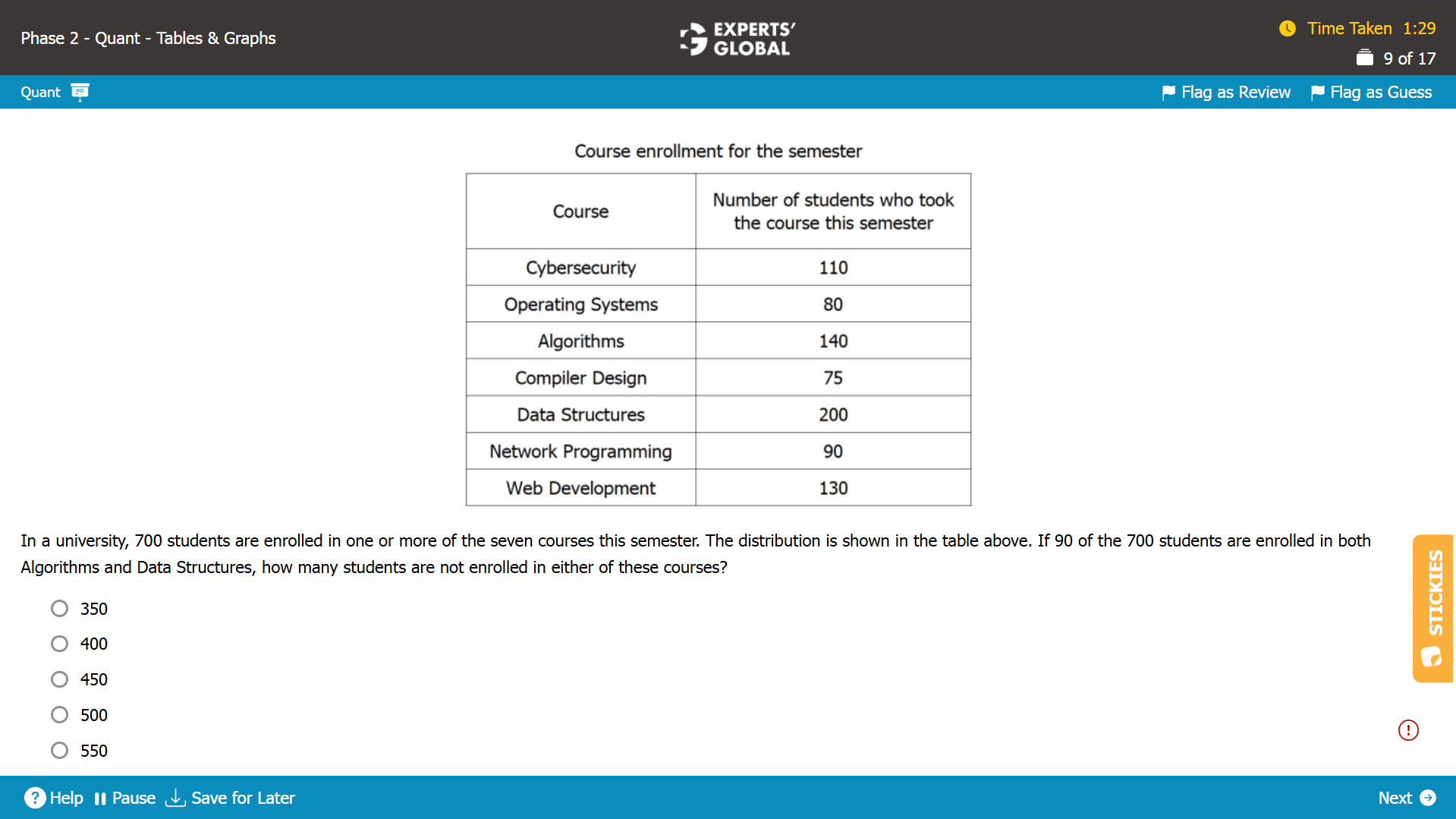
We need to determine the number of students that are not enrolled in either Algorithms or Data Structures course.
The number of students who are enrolled in both Algorithms and Data Structures = 90.
From the table, the number of students enrolled in Algorithms = 140.
From the table, the number of students enrolled in Data Structures = 200.
The number of students who are enrolled in either Algorithms or Data Structures
= Number of students enrolled in Algorithms + Number of students enrolled in Data Structures – Number of students who are enrolled in both Algorithms and Data Structures
= 140 + 200 – 90
= 250
The number of students who are NOT enrolled in either Algorithms or Data Structures
= Total number of students – Number of students who are enrolled in either Algorithms or Data Structures
= 700 – 250 = 450
Hence, the number of students not enrolled in either Algorithms or Data Structures course is 450.
C is the correct answer choice.
Practice Question 5
Written Explanation
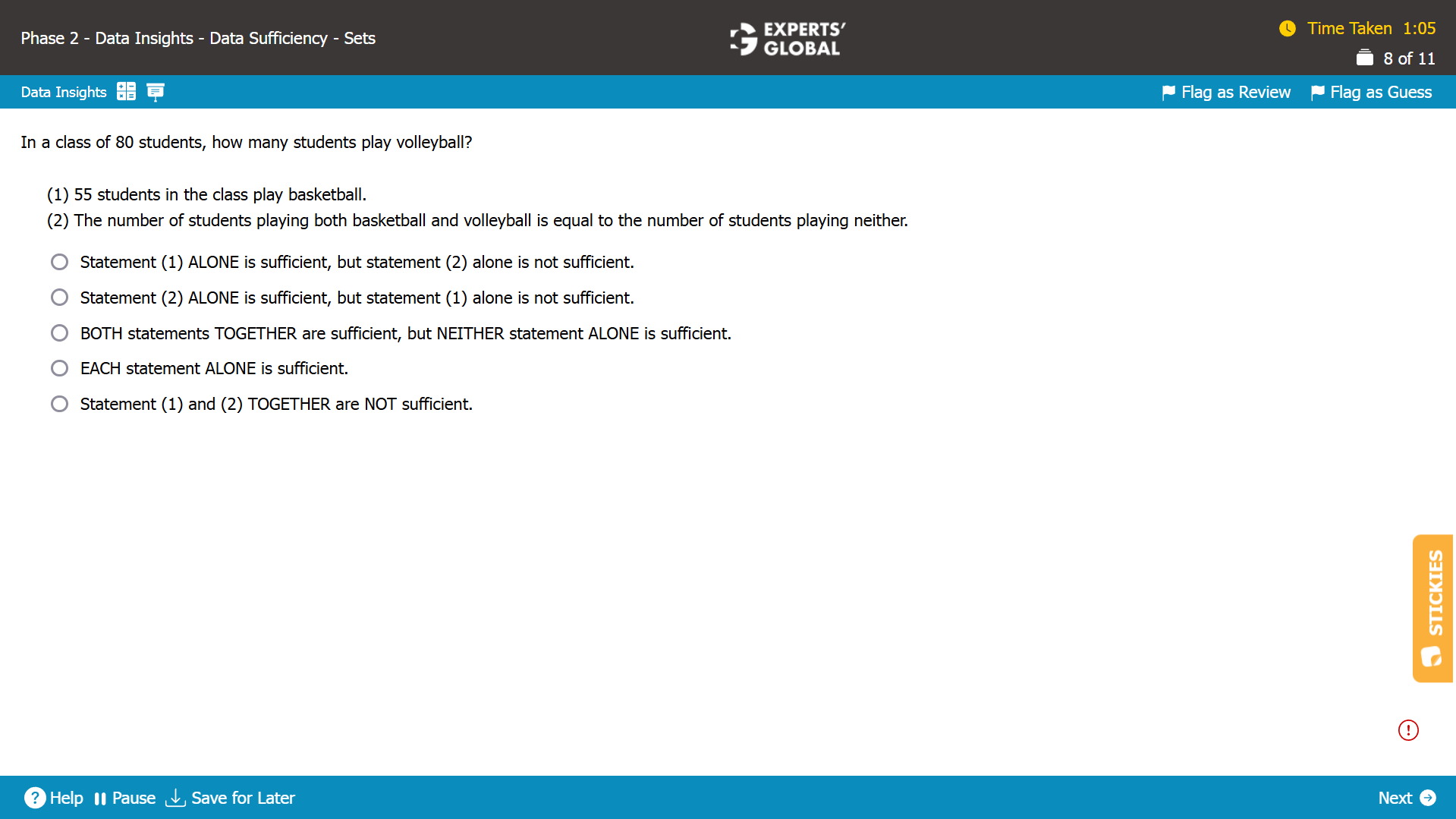
There are 80 students in the class.
Statement (1):
55 students play basketball. Number of students playing volleyball is unknown. Insufficient.
Statement (2):
The number of students playing both basketball and volleyball is equal to the number of students playing neither. Let’s say that number is x and there are y students playing volleyball but not basketball. Number of students playing volleyball is unknown. Insufficient.
Combining both,
Basketball + Volleyball – Both + None = Total
55 + (x+y) –x + x = 80
x+y = 25.
This is the number of students playing volleyball.
Hence, C is the correct answer choice.
Facing difficulty with the approach for Set Theory questions? Please Click here
Facing difficulty with the approach for data sufficiency questions? Please Click here
Need a comprehensive strategy, approach, and practice for Set Theory? Please Click here (you need to be enrolled for a course that includes the Quant section).
Need a comprehensive strategy, approach, and practice for data sufficiency questions? Please Click here (you need to be enrolled for a course that includes the Quant section).
GMAT Quant: Percentages-Mixtures-Alligation Sample Question
Percentages, mixtures, and alligation sit together as one powerful idea set on the GMAT. Percentages tell you how much of the whole you have, measured out of 100. Mixtures focus on what you get when you blend two or more parts into one combined result. Alligation gives you a fast, clever shortcut for many weighted average situations.
Important: Before visiting the following sample question(s), if you would like a quick brush up of key Percentages-Mixtures-Alligation concepts, you may first visit: Free GMAT Percentages-Mixtures-Alligation Prep
Practice Question 1
Written Explanation
On Monday…
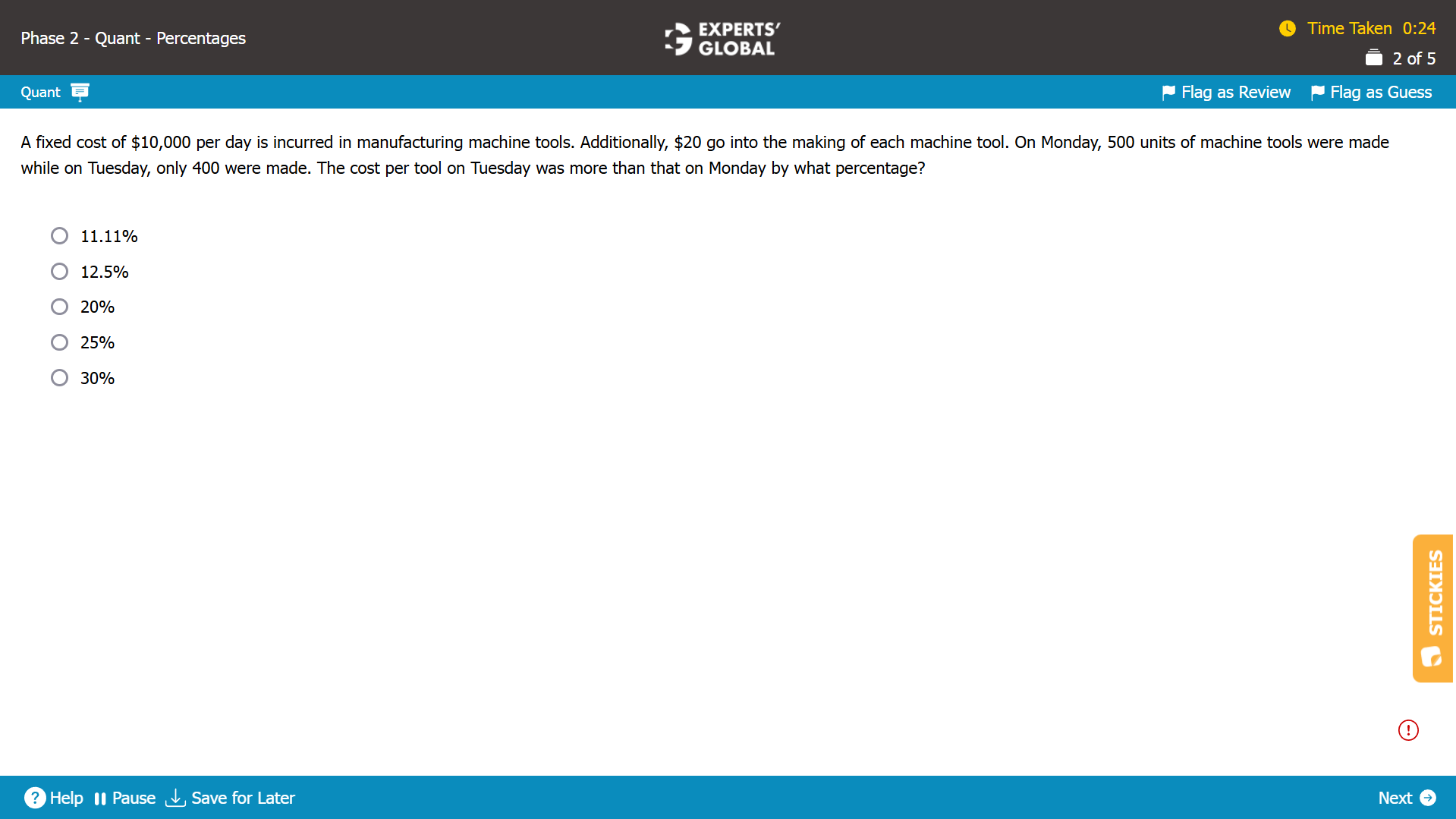
Fixed cost in manufacturing machine tools = $10,000.
Number of machine tools made = 500
Cost per machine tool made = $20
Cost for 500 machine tools made = 20 X 500 = 10,000
Total cost on Monday = 10,000 + 10,000 = $20,000.
Cost per tool on Monday = Total cost / 500 tools = 20,000 / 500 = $40.
On Tuesday…
Fixed cost in manufacturing machine tools = $10,000.
Number of machine tools made = 400
Cost per machine tool made = $20
Cost for 500 machine tools made = 20 X 400 = 8,000
Total cost on Tuesday = 10,000 + 8,000 = $18,000.
Cost per tool on Tuesday = Total cost / 400 tools = 18,000 / 400 = $45.
Overall,
Cost per tool on Monday = $40
Cost per tool on Tuesday = $45
So, cost per tool on Tuesday was ((45 – 40) / 40) X 100 = (5 / 40) X 100 = 12.5% of the cost per tool on Monday.
B is the correct answer choice.
Practice Question 2
Written Explanation
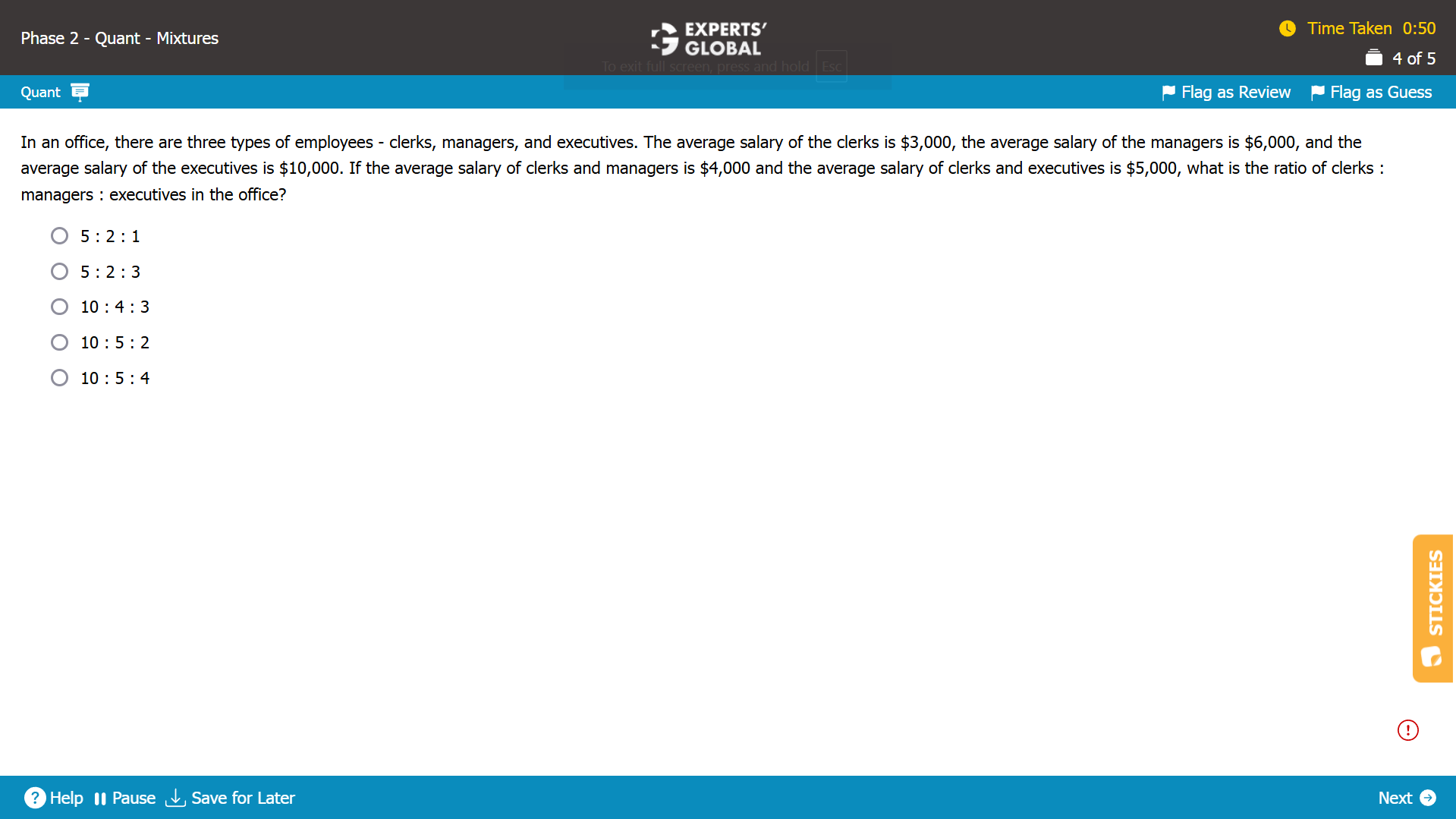
Let’s say there are C clerks, M managers, and E executives.
Average salary of clerks and managers is 4000.
So, (3000C + 6000M) = 4000 (C+M)
i.e. 2M = C
Average salary of clerks and executives is 5000.
So, (3000C + 10000E) = 5000 (C+E)
i.e. 5E = 2C
Combining both these statements,
2C = 4M = 5E = 20x, let’s say.
So, C = 10x, M = 5x, and E = 4x.
So, the required ratio is C : M : E = 10 : 5 : 4.
Hence, E is the correct answer choice.
Practice Question 3
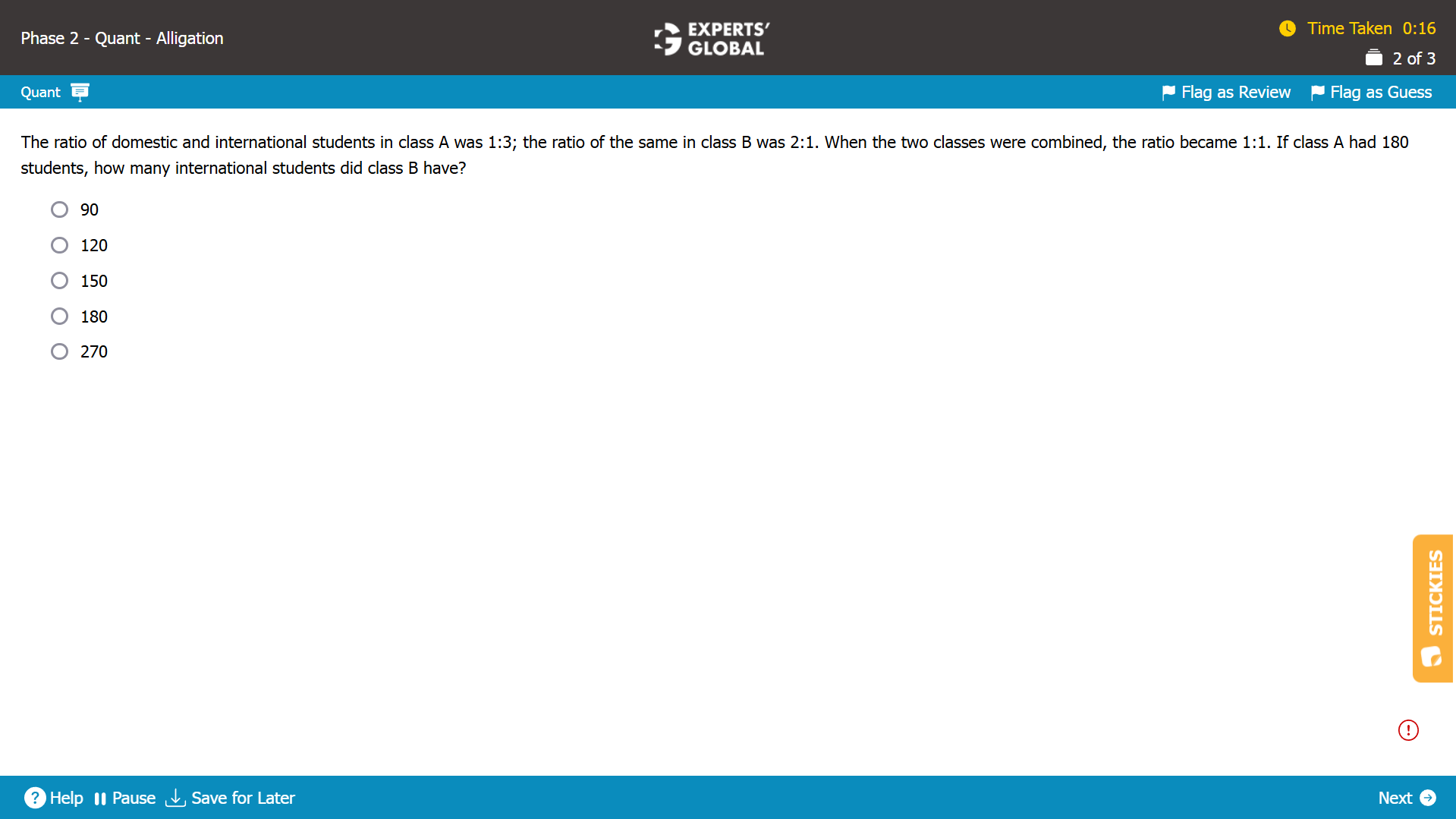
Written Explanation
Number of students in class A = 180.
Ratio of domestic and international students in class A = 1:3
So, let’s say that class A had x domestic students and 3x international students.
Total number students in class A = 180 = 4x; so, x = 45.
So, in class A, there are 45 domestic students and 45 X 3 = 135 international students.
Ratio of domestic and international students in class B = 2:1
So, let’s say that class B had 2y domestic students and y international students.
Total number students in class B = 3y student.
When the two classes are mixed…
Total number of students in the two classes = 180 + 3y
Total number of domestic students in the two classes = 45 + 2y
Total number of international students in the two classes = 135 + y
The ratio of domestic and international students is 1:1 in the mixed class.
So, 45 + 2y = 135 + y
y = 90
There are 90 international students in class B.
Please watch the video for an alternate method to solve.
A is the correct answer choice.
GMAT Quant: Ratio-Proportion-Variation Sample Question
Ratios help you compare two quantities side by side. A proportion tells you that two ratios are equal, or it shows how a part connects to the whole. Variation explains how one quantity changes when another quantity changes.
Important: Before visiting the following sample question(s), if you would like a quick brush up of key Ratio-Proportion-Variation concepts, you may first visit: Free GMAT Ratio-Proportion-Variation Prep
Practice Question 1
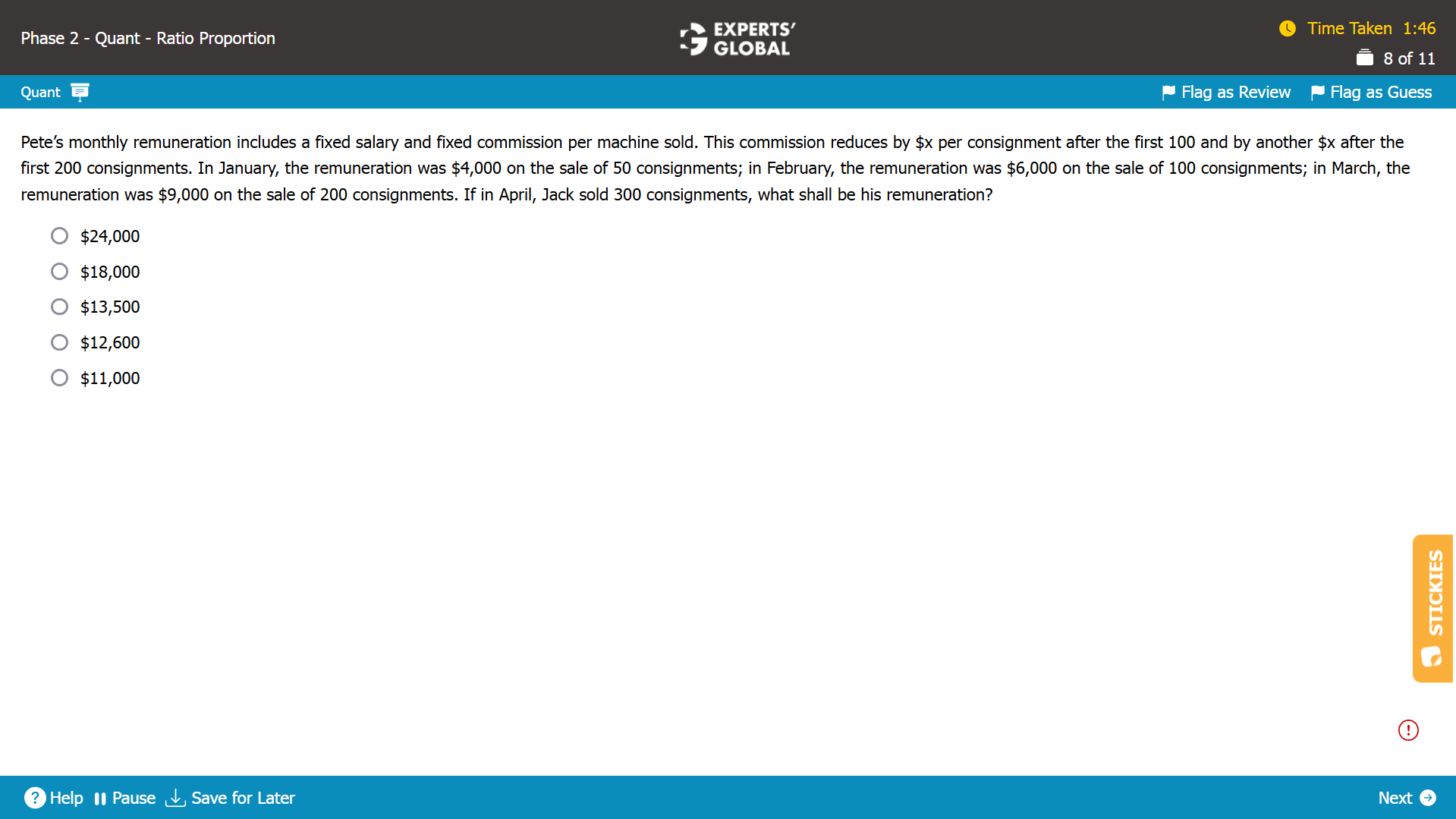
Written Explanation
In January…
Number of consignments = 50
Remuneration = Fixed salary + commission for 50 machines
So, 4000 = fixed salary + 50 X commission per machine … (Equation I)
In February…
Number of consignments = 100
Remuneration = Fixed salary + commission for 100 machines
So, 6000 = fixed salary + 100 X commission per machine… (Equation II)
Combining Equation I and Equation II…
Fixed salary = 4000 – 50 X commission per machine = 6000 – 100 X commission per machine
2000 = 50 X commission per machine
Commission per machine = 2000 / 50 = $40
Fixed salary = 4000 – 50 X commission per machine = 4000 – 2000 = $2000.
In March…
Number of consignments = 200
Remuneration = Fixed salary + commission for first 100 machines + commission for next 100 machines
9000 = 2000 + 100 X (40) + (40 – x) X 100
40 – x = 30
x = 10
So, the commission after 100 machines is reduced by $10 and the commission after 200 machines is reduced by $20.
In April…
Number of consignments = 300
Remuneration = Fixed salary + commission for first 100 machines + commission for next 100 machines + commission for the next 100 machines = 2000 + 100 X (40) + (40 – 10) X 100 + (40 – 10 – 10) X 100 = 2000 + 4000 + 3000 + 2000 = $11000.
The remuneration in April was $11,000.
E is the correct answer choice.
Practice Question 2
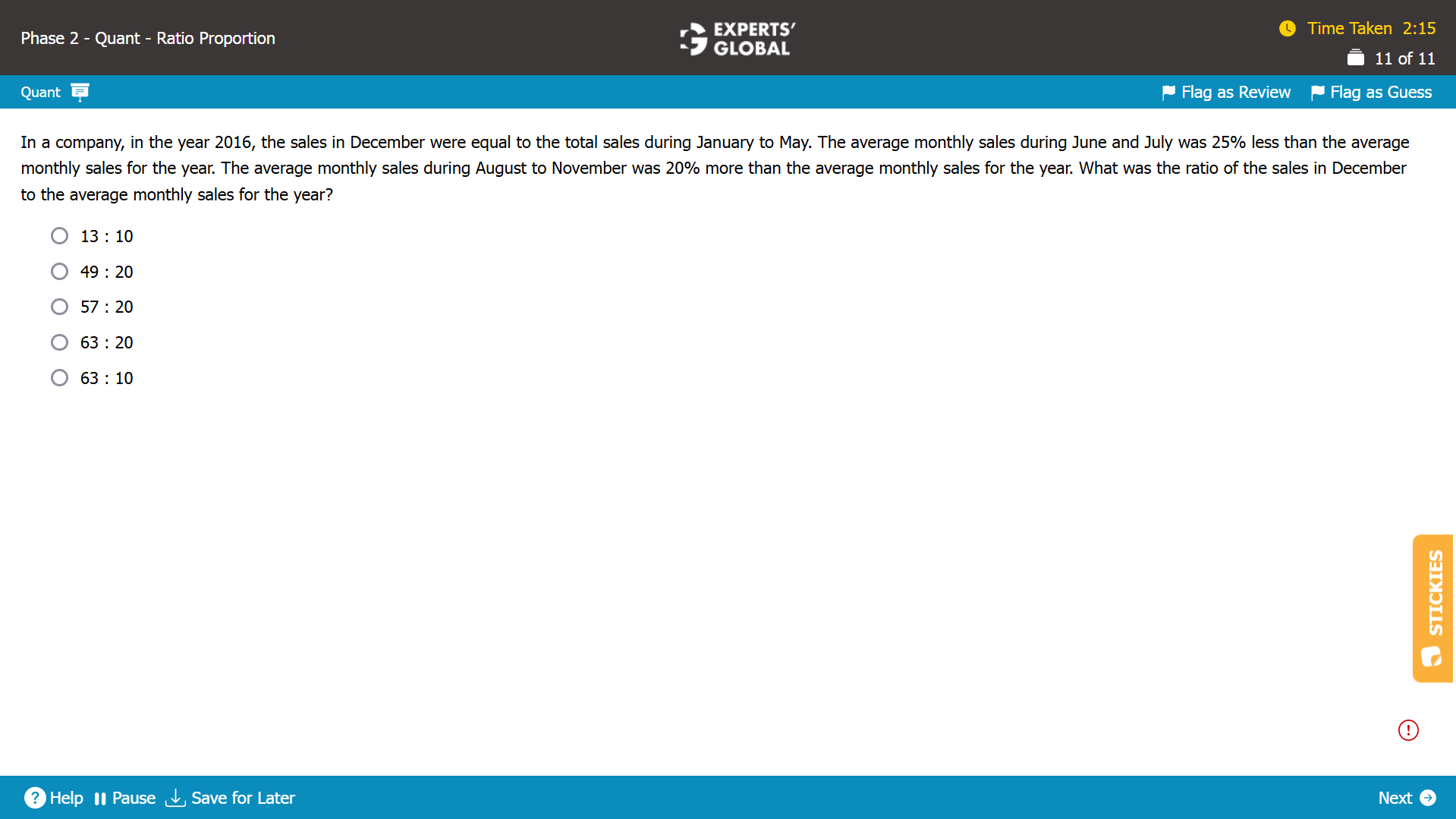
Written Explanation
Let’s say that the average monthly sales for the year was x.
So, total sales in the year = 12x.
Average monthly sales during June and July = 25% less than average monthly sales for the year = 0.75x.
Total sales during June and July = 0.75x X 2 months = 1.5x.
Average monthly sales during August and November = 20% more than average monthly sales for the year = 1.2x.
Total sales during August and November = 1.2x X 4 months = 4.8x.
Let’s say that the total sales in December was D.
So, the total sales in January to May = total sales in December = D.
Overall, the total sales in the year = Total sales in January to May + Total sales during June and July + Total sales during August and November + total sales in December
12x = D + 1.5x + 4.8x + D = 2D + 6.3x.
2D = 5.7x
D/x = 5.7 / 2 = 57 / 20
The ratio of the sales in December to the average monthly sales for the year was 57 / 20.
C is the correct answer choice.
Practice Question 3
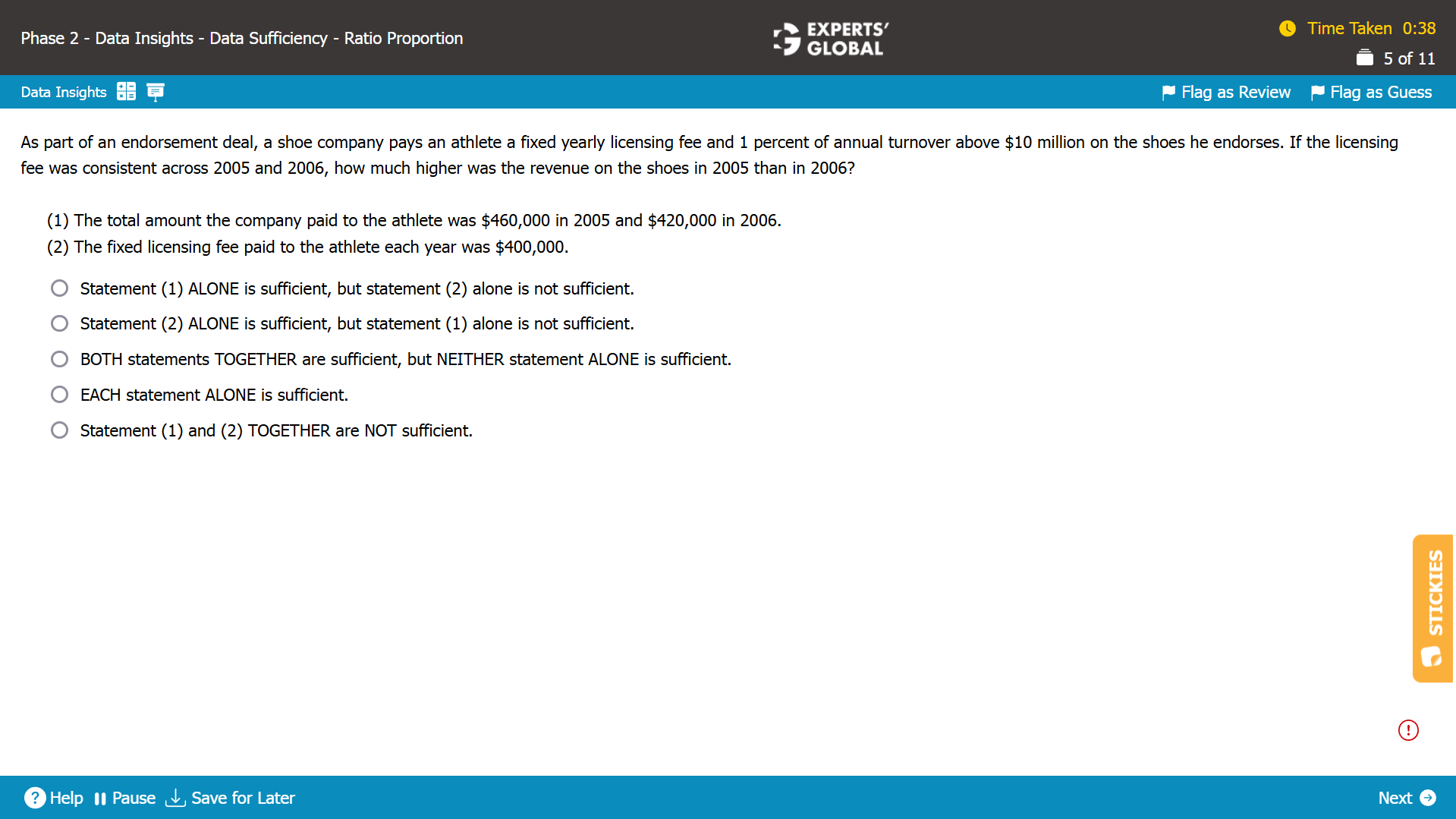
Let the fixed yearly licensing fee be L.
Let the annual turnover in the year 2005 and year 2006 be A1 and A2, respectively.
If A1 ≤ $10 million, then the total amount paid to the athlete in the year 2005 = L
If A1 > $10 million, then the total amount paid to the athlete in the year 2005 = L + 0.01(A1 – 10,000,000) (Equation I)
If A2 ≤ $10 million, then the total amount paid to the athlete in the year 2006 = L
If A2 > $10 million, then the total amount paid to the athlete in the year 2006 = L + 0.01(A2 – 10,000,000) (Equation II)
Difference between the revenue on the shoes in 2005 and in 2006 = A1 – A2
We need to find whether the value of (A1 – A2) can be determined.
Statement (1)
The total amount paid to the athlete in 2005 = $460,000 (Equation III)
The total amount paid to the athlete in 2006 = $420,000 (Equation IV)
If A2 ≤ $10 million, then L = 420,000, and then since the total amount paid to the athlete in 2005 was greater than L, it follows that A1 ≥ $10 million.
After that, using Equations I and III we can determine the value of A1, however, it is not possible to calculate the value of A2.
Since no information is provided that suggests that A2 > $10 million, it is NOT possible to determine the value of (A1 – A2). Hence, Statement (1) is insufficient.
Statement (2)
L = 400,000 (Equation V)
Since no information is provided regarding the total amount paid to the athlete, it is NOT possible to determine the value of (A1 – A2). Hence, Statement (2) is insufficient.
As Statement (1) alone as well as Statement (2) alone is insufficient to answer the question, we need to now combine the two statements.
Statement (1) and Statement (2) combined
From Equation V, we know that L = 400,000, and since Equation III and Equation IV show that the total amount paid to the athlete is greater than L for both years, it follows that A1 > $10 million and A2 > $10 million.
From Equations I and III: L + 0.01(A1 – 10,000,000) = $460,000 (Equation VI)
From Equations II and IV: L + 0.01(A2 – 10,000,000) = $420,000 (Equation VII)
From Equations V, VI, and VII we have 3 equations with 3 unknown variables that can be solved to determine the value of A1 and A2, which in turn can be used to determine the value of A1 – A2. Hence, Statement (1) and Statement (2) combined are sufficient.
C is the correct answer choice.
GMAT Quant: Profit-Loss and Interest Sample Question
Profit and loss focuses on how a deal shifts from cost price to selling price, showing whether you gain money or give some up. Interest explains the extra amount you earn or pay when money gets invested or borrowed across time. Together, these two ideas sit at the heart of commercial arithmetic.
Important: Before visiting the following sample question(s), if you would like a quick brush up of key Profit & Loss and Interest concepts, you may first visit: Free GMAT Profit & Loss and Interest Prep
Practice Question 1
Written Explanation
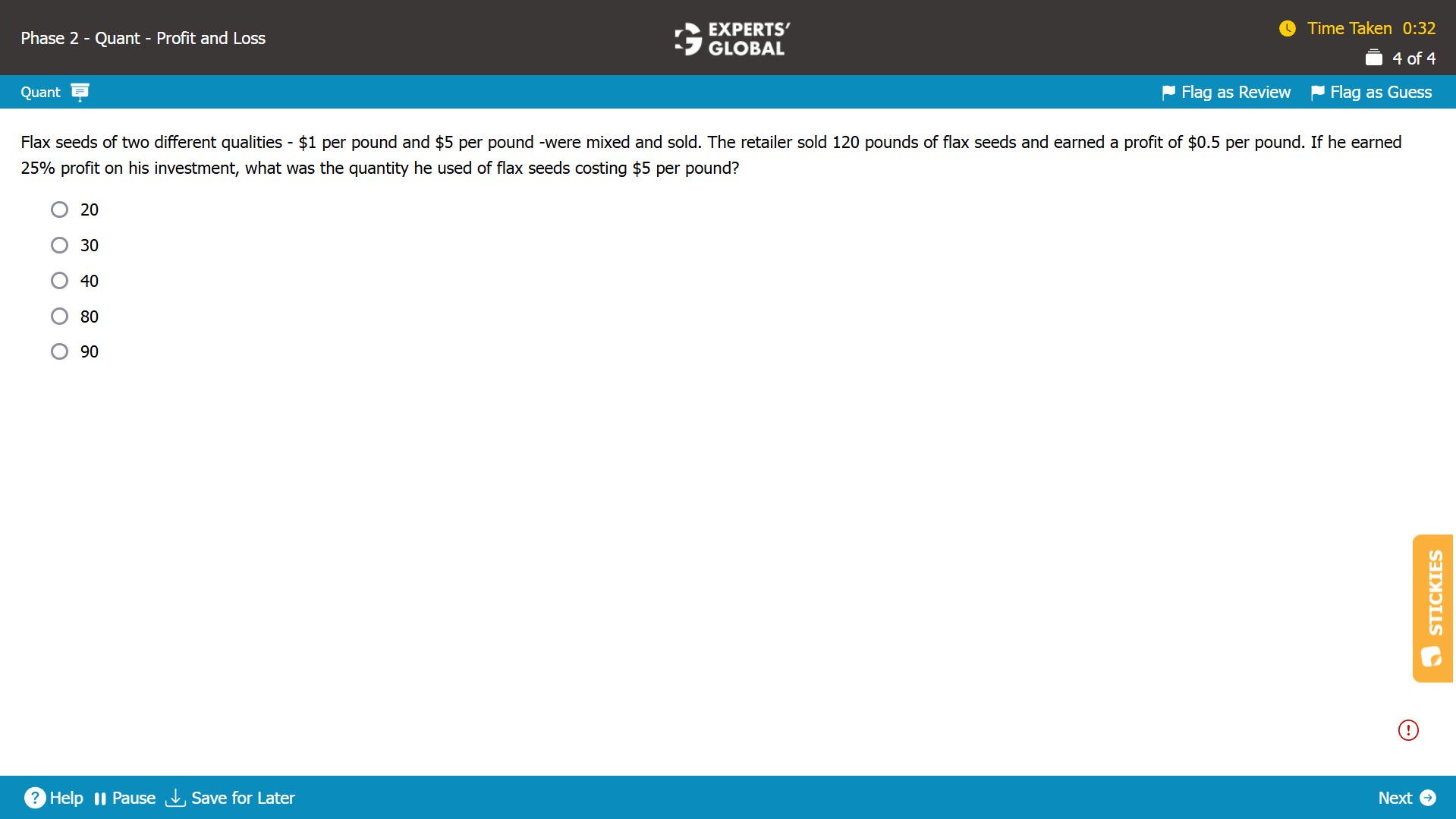
Let’s say that the retailer used x pounds of seeds of $5 per pound.
Total quantity of seeds sold = 120 pounds.
So, the quantity of seeds of $1 per pound = (120 – x) pounds.
Cost of seeds of $5 per pound = quantity of seeds of $5 per pound X 5 = x X 5 = 5x.
Cost of seeds of $1 per pound = quantity of seeds of $1 per pound X 5 = (120 – x) X 1 = 120 –x.
Total cost = cost of seeds of $5 per pound + cost of seeds of $1 per pound = 5x + (120 – x) = 120 + 4x.
Profit = 25%
So, profit in dollars = 25% X total cost = 0.25 X (120 + 4x) = 30 + x.
Total quantity = 120 pounds.
Profit per pound = $0.5 per pound = total profit in dollars / 120 = (30 + x) / 120.
0.5 = (30 + x) / 120
60 = 30 + x
x = 30
So, the retailer used 30 pounds of flax seeds costing $5 per pound.
[Alternatively…
Profit = $0.5 per pound = 25%
So, the cost per pound = 0.5 / (25 / 100) = $2
The seeds of $1 per pound and the seeds of $5 per pound were mixed in a certain ratio. The average cost per pound is $2.
So, using allegation, the ratio of seeds of $1 per pound and seeds of $5 per pound can be calculated as follows.
Quantity of seeds of $1 per pound : quantity of seeds of $5 per pound = (5–2) : (2–1) = 3 : 1
Total quantity = 120 pounds.
Quantity of seeds of $1 per pound = (3 / 4) X 120 = 90 pounds
Quantity of seeds of $5 per pound = (1 / 4) X 120 = 30 pounds.
So, the retailer used 30 pounds of flax seeds costing $5 per pound.]
B is the correct answer choice.
Practice Question 2
Written Explanation
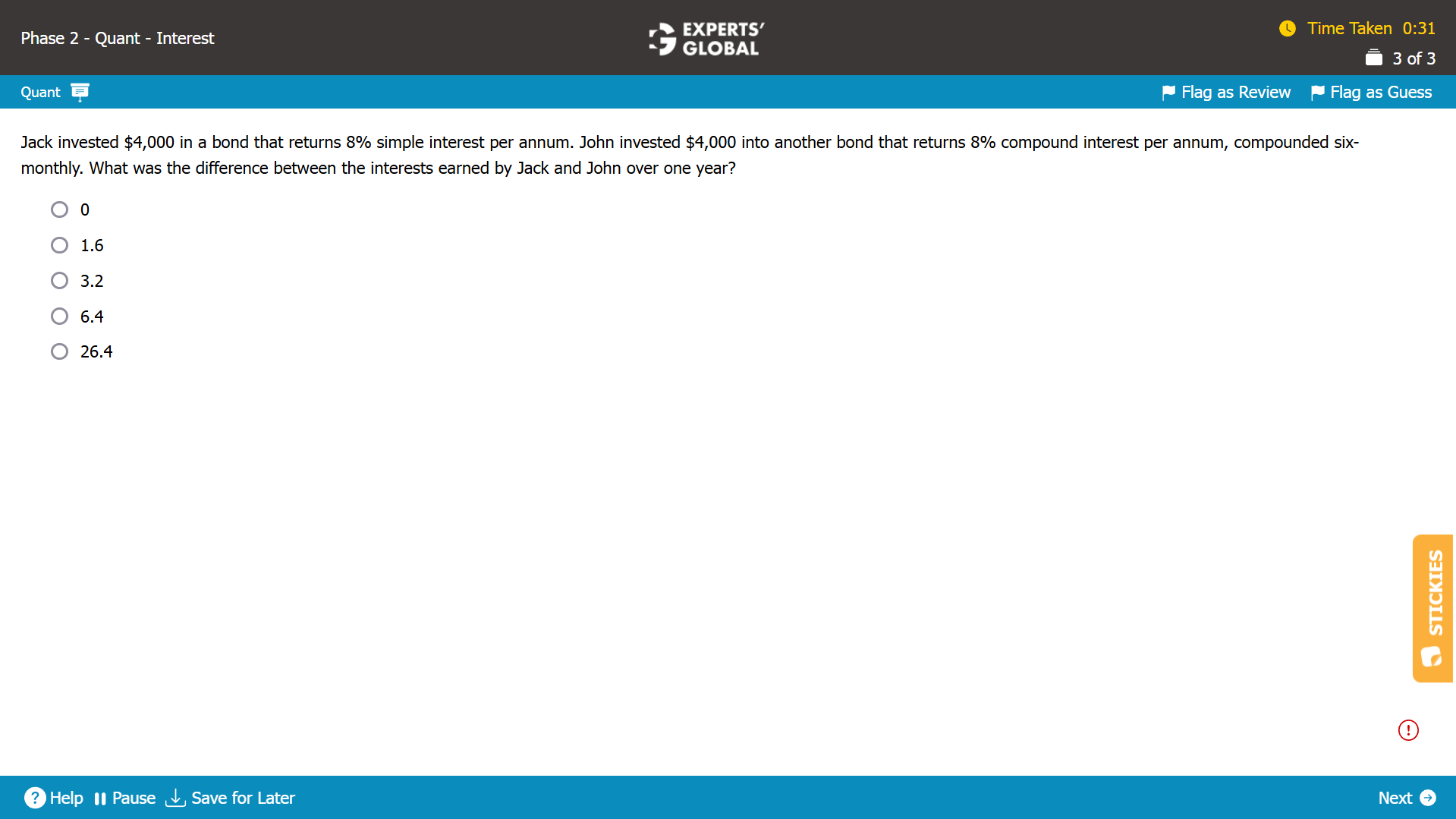
Jack’s investment….
Principal = $4000
Interest rate = 8% per annum
Period = 1 year
Simple interest earned = (P x r x n)/100 = (4000 X 8 X 1) / 100 = $320.
John’s investment….
Principal = $4000
Considering that the compounding period is six months…
Interest rate = 8% per annum = 4% per six months
Period = 1 year = 2 periods of six months
Compound interest earned = P X [(1 + r / 100)n – 1] = 4000 X [(1 + 4 /100)2 – 1] = 4000 X [1.0816 – 1] = $326.4.
Difference between the interests earned by Jack and John = 326.4 – 320 = $6.4.
D is the correct answer choice.
Practice Question 3
Written Explanation
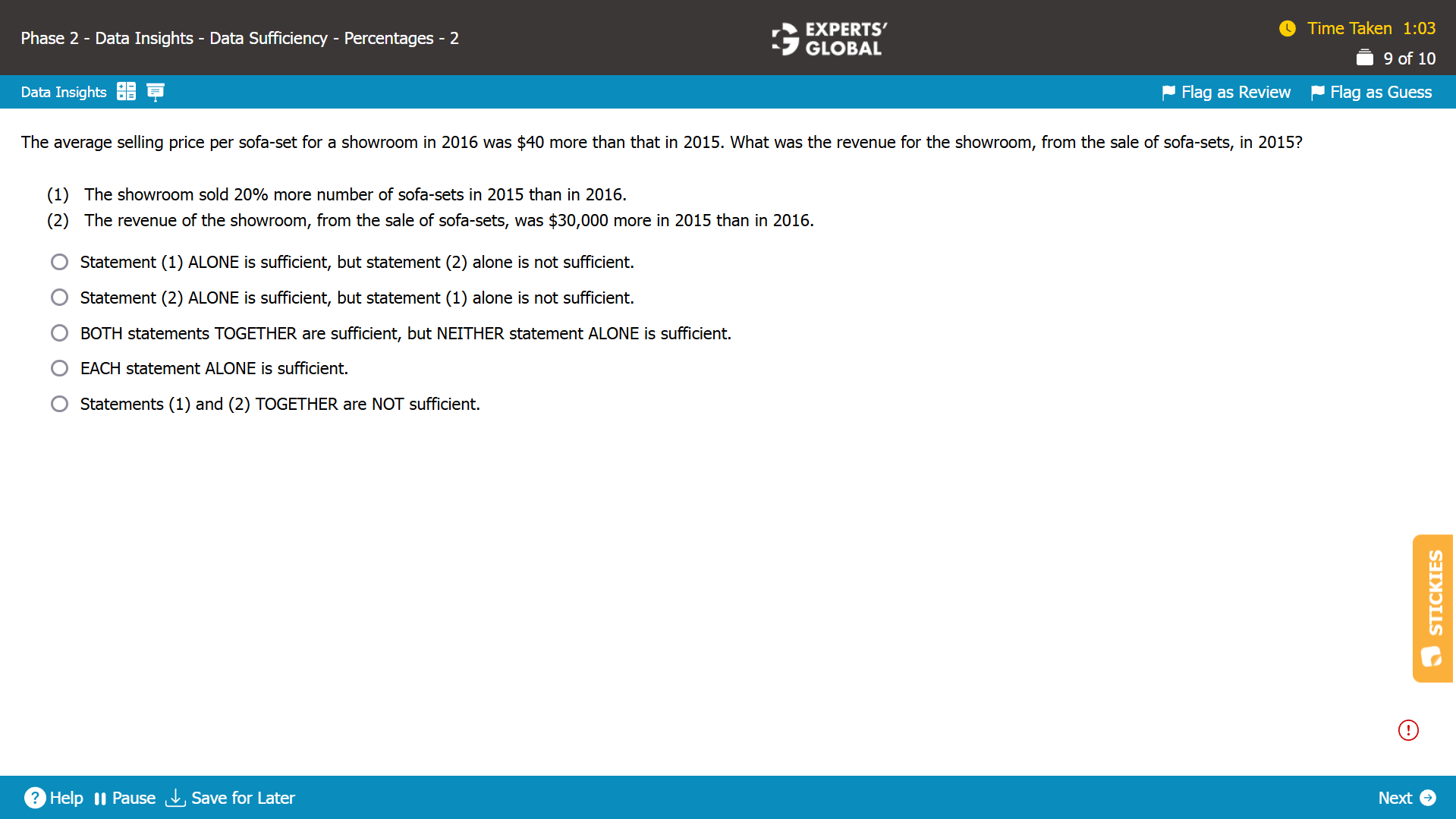
Selling price in 2016 = selling price in 2015 + $40.
Statement (1)
Number of sofa-sets sold in 2015 = 20% more than the number of sofa-sets sold in 2016.
Nothing is known about the absolute selling price in any year; so, the absolute revenue in 2015 cannot be determined. Insufficient.
Statement (2)
Revenue of sofa-sets in 2015 = revenue of sofa-sets in 2016 + $30,000.
Nothing is known about the absolute revenue in any year; so, the absolute revenue in 2015 cannot be determined. Insufficient.
Because both the statements alone are not sufficient, let’s combine the two statements.
Statement (1) and Statement (2) combined
Number of sofa-sets sold in 2015 = 20% more than the number of sofa-sets sold in 2016.
Revenue of sofa-sets in 2015 = revenue of sofa-sets in 2016 + $30,000.
Nothing is known about the absolute revenue in any year; so, the absolute revenue in 2015 cannot be determined. Insufficient.
E is the correct answer choice.
GMAT Quant: Statistics Sample Question
Mean, or average, gives you the central value of a number set. Median points to the middle number after you arrange the values in order. Mode spotlights the value that shows up most often. Range tells you how wide the data spreads by comparing the highest and lowest values. Variance shows how far the numbers sit from the average. Standard deviation translates that spread into a form that feels easier to read and use.
Important: Before visiting the following sample question(s), if you would like a quick brush up of key Statistics concepts, you may first visit: Free GMAT Statistics Prep
Practice Question 1
Written Explanation
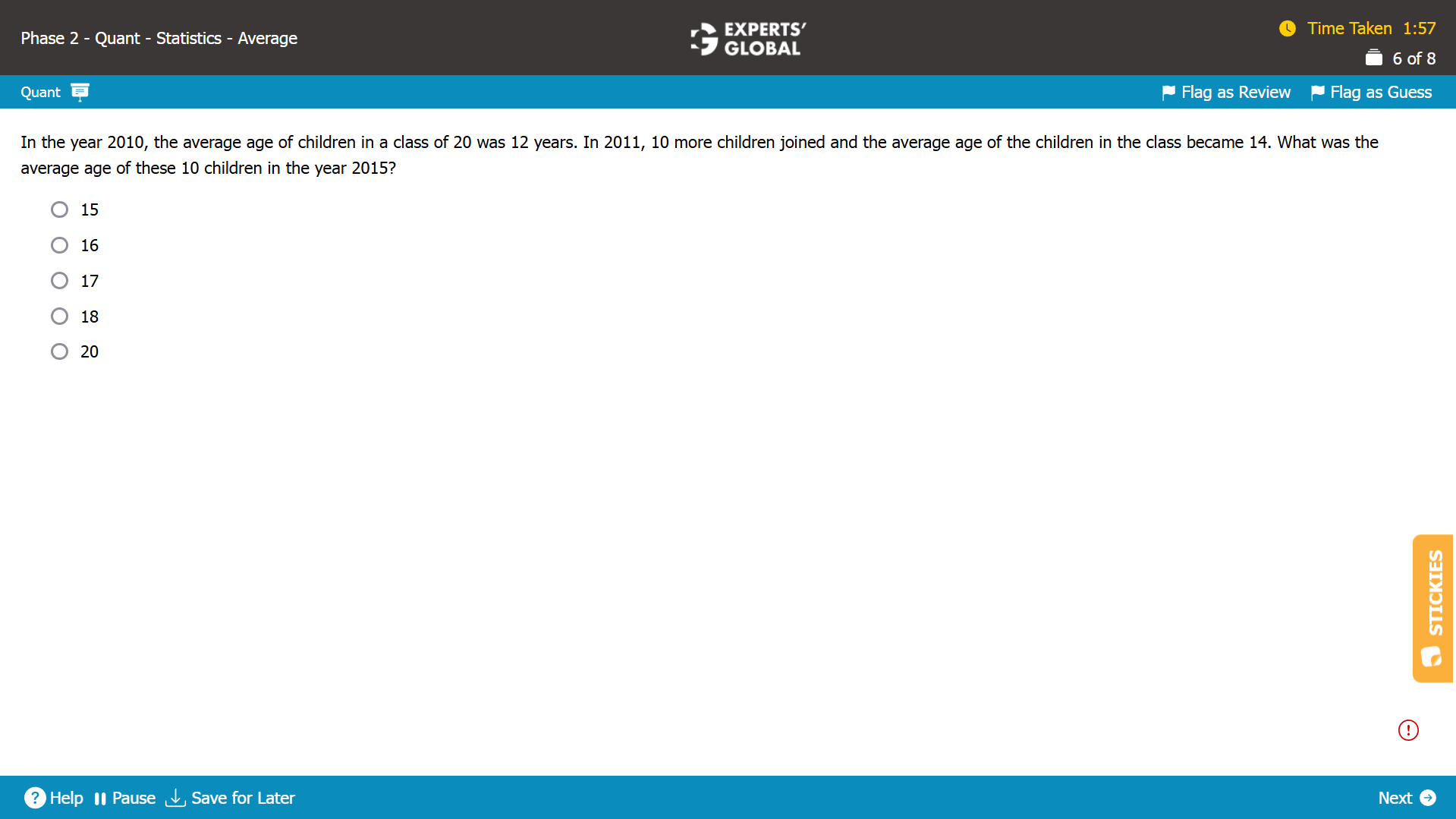
Average age of 20 children in 2010 = 12
So, average age of 20 children in 2011= 13.
Total years in 2011 = 20 * 13 = 260
After 10 children joined, total years = 30 * 14 = 420
Difference = 420 – 260 = 160
Hence, the average age of the 10 additional children in 2011 = 160/10 = 16 years
Average age of the 10 additional children in 2015 = 16 + 4 = 20 years.
Hence, E is the correct answer choice.
Practice Question 2
Written Explanation
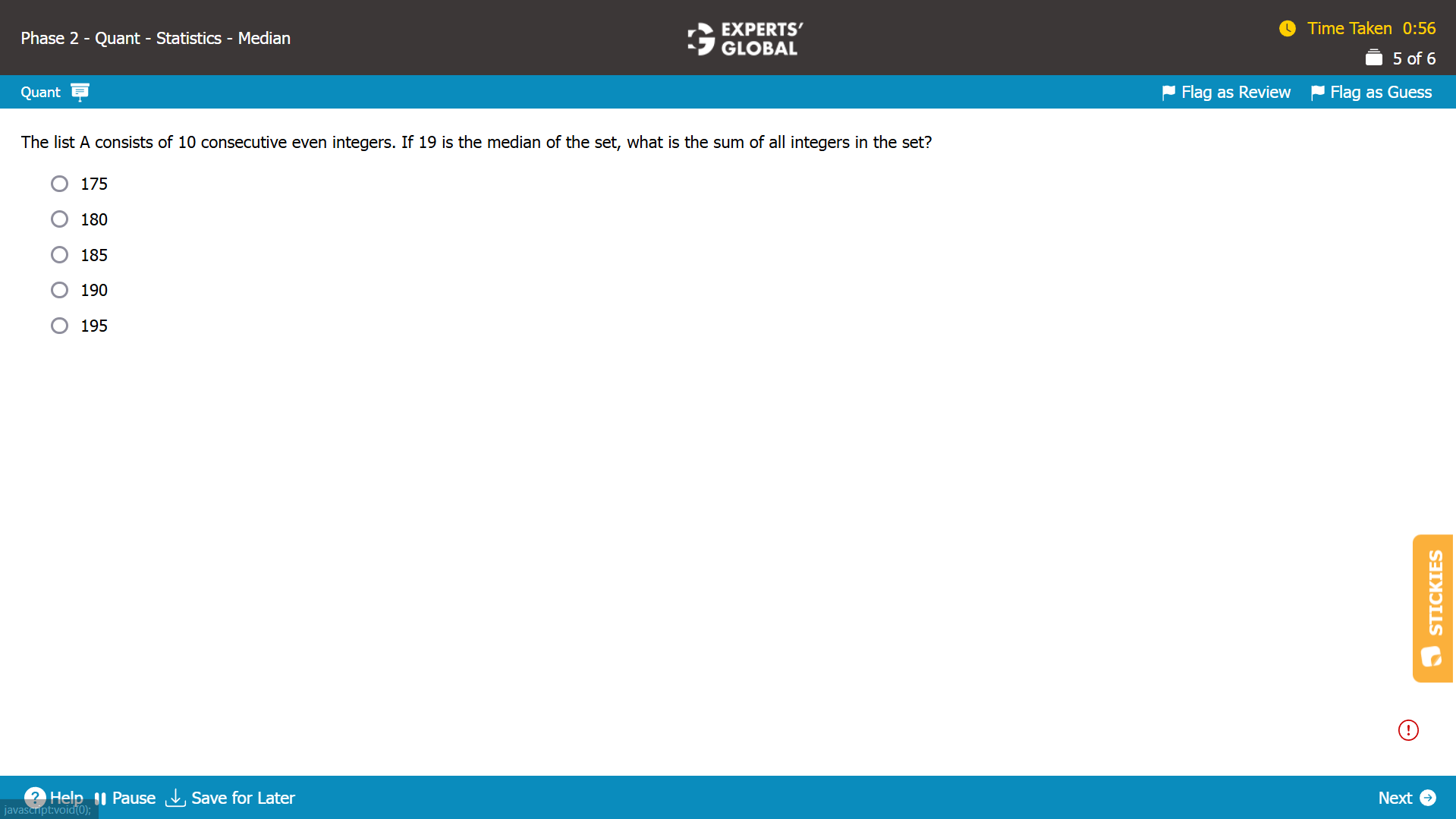
List A is a set of 10 consecutive even integers. So, there is an increase of 2 between every two consecutive integers in the set.
List A has the median of 19. The median represents the mean of the 5th and 6th integers. The 5th and the 6th integers are even, consecutive integers; so, the integers will be 18 and 20.
Overall, the set would appear as follows.
{10, 12, 14, 16, 18, 20, 22, 24, 26, 28}
The sum of all integers would be 10 + 12 + 14 + 16 + 18 + 20+ 22 + 24 + 26 +28 = 190.
[Alternatively,
List A is a set of 10 consecutive even integers; so, the set is in arithmetic progression and will have median = mean.
Sum of all integers = 10 X mean = 10 X median = 10 X 19 = 190]
D is the correct answer choice.
Practice Question 3
Written Explanation
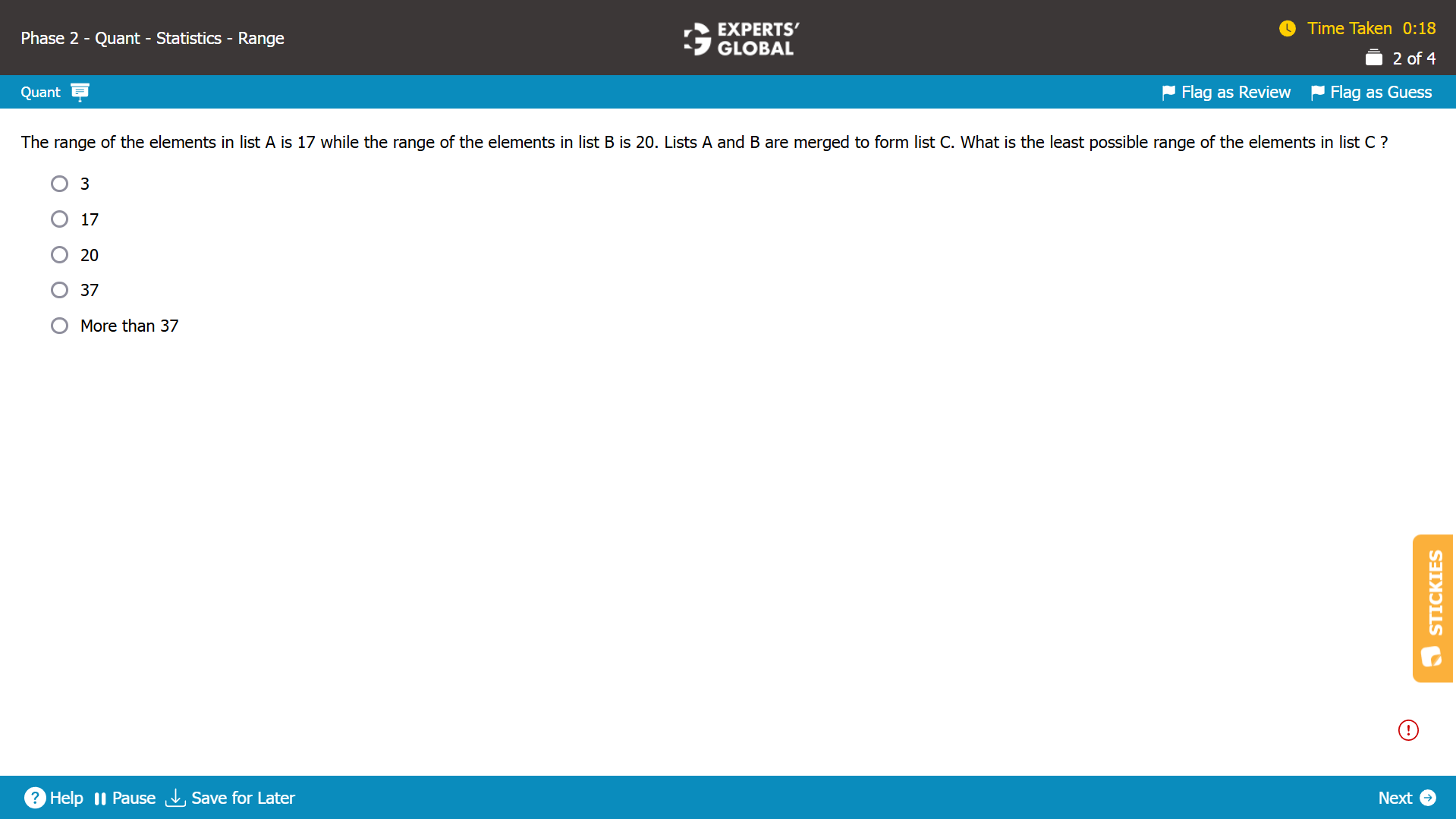
For the “least possible range”, we can assume that all elements in list A lie within the range of elements in the list B.
Example:
List A: 1, 2, 3, 4, 5….18
List B: 0, 1, 2, 3, 4…20
In such cases, the range of the two lists combined (i.e. list C) is same as the range of list B.
Hence, “the least possible range of the elements in list C” is same as the range of list B; hence, 20.
C is the correct answer choice.
Practice Question 4
Written Explanation
Statement (1):
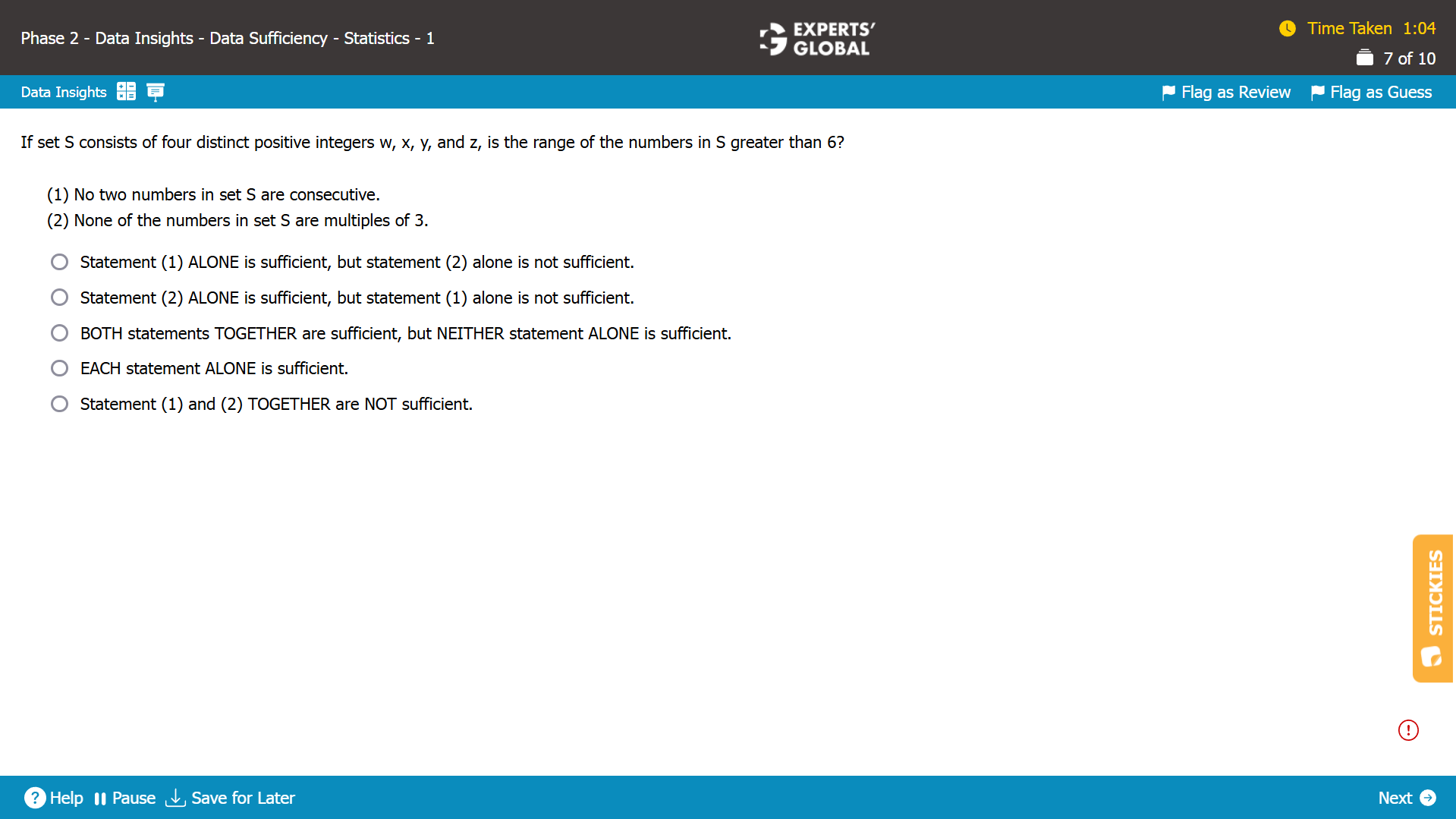
Since no two numbers are consecutive, there is a difference of at least two in all numbers. That means case of such numbers is {x, x+2, x+4, x+6}. The range is bound to be at least 3*2 = 6. Insufficient.
Statement (2):
‘No multiples of 3’ does not indicate anything about the range. Insufficient.
Combining both,
The closest case is {x, x+2, x+4, x+6} with a range of 6. In any of {x, x+2, x+4, x+6} set, there will always be a multiple of 3. Since we do not want any multiple of 3, we will have to expand the range of this selection. That means that the range is now bound to be greater than 6. Sufficient.
Hence, C is the correct answer choice.
Facing difficulty with the approach for Statistics questions? Please Click here
Facing difficulty with the approach for data sufficiency questions? Please Click here
Need a comprehensive strategy, approach, and practice for Statistics questions? Please Click here (you need to be enrolled for a course that includes the Quant section).
Need a comprehensive strategy, approach, and practice for data sufficiency questions? Please Click here (you need to be enrolled for a course that includes the Quant section).
Practice Question 5
Written Explanation
Statement (1):
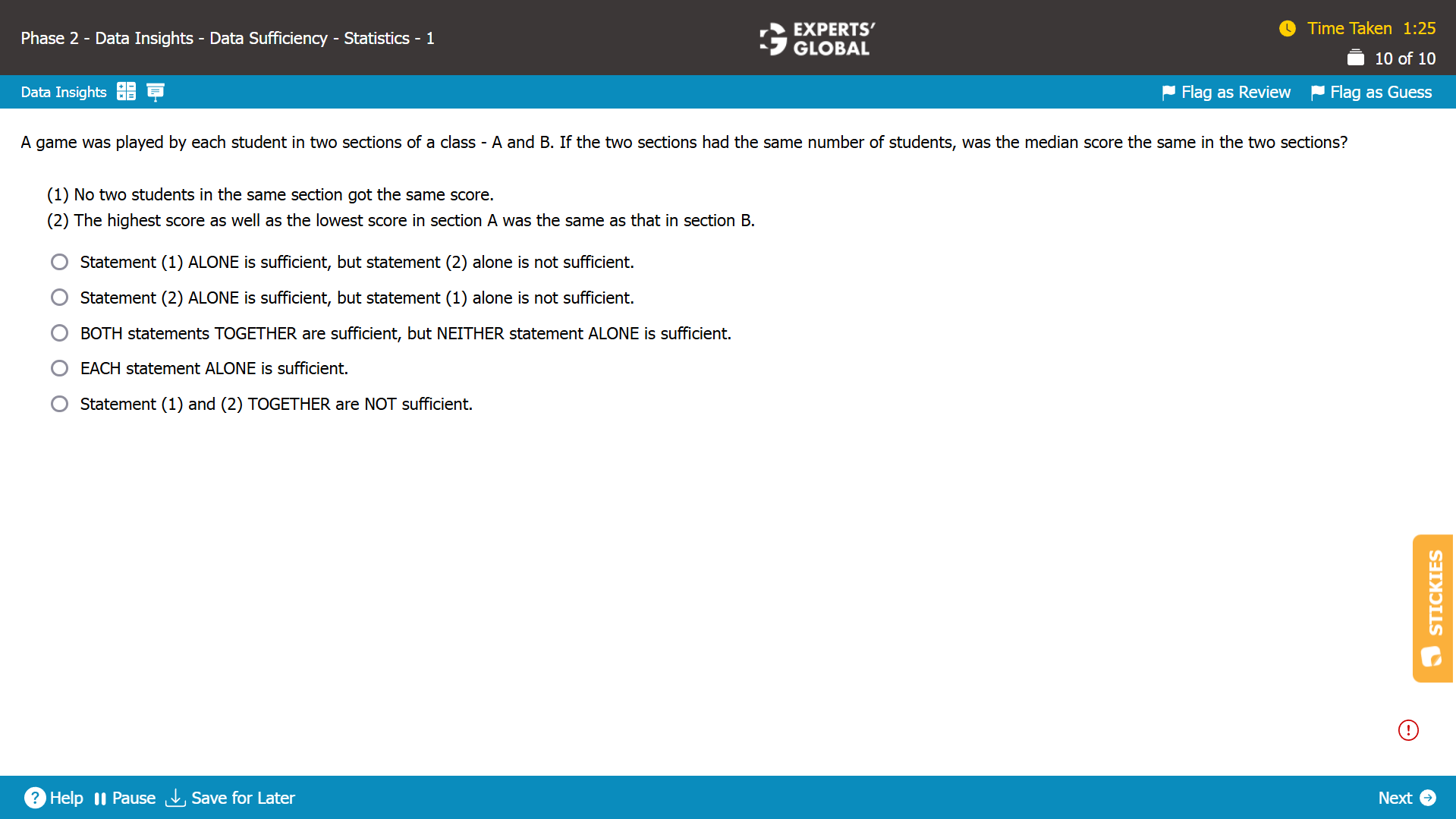
Even if all scores are distinct within each section, it does not tell us anything about the median scores. The scores across sections may not be distinct and thus, the median scores for the two sections may (or may not) be the same. Insufficient.
Statement (2):
Even if the range of scores in each section is the same, it does not tell us anything about the median scores. The median scores for the two sections may (or may not) be the same. Insufficient.
Combining both, we learn no information about the median scores. Insufficient.
Hence, E is the correct answer choice.
Facing difficulty with the approach for Statistics questions? Please Click here
Facing difficulty with the approach for data sufficiency questions? Please Click here
Need a comprehensive strategy, approach, and practice for Statistics questions? Please Click here (you need to be enrolled for a course that includes the Quant section).
Need a comprehensive strategy, approach, and practice for data sufficiency questions? Please Click here (you need to be enrolled for a course that includes the Quant section).
GMAT Quant: Linear and Quadratic Equations Sample Question
Linear equations, often called simple equations, model relationships where variables move at a steady, constant rate. Quadratic equations capture relationships where the change follows a squared pattern, creating a curve instead of a straight line. Together, they sit at the core of algebra and power many problem solving situations on the GMAT.
Important: Before visiting the following sample question(s), if you would like a quick brush up of key Linear and Quadratic Equations concepts, you may first visit: Free GMAT Linear and Quadratic Equations Prep
Practice Question 1
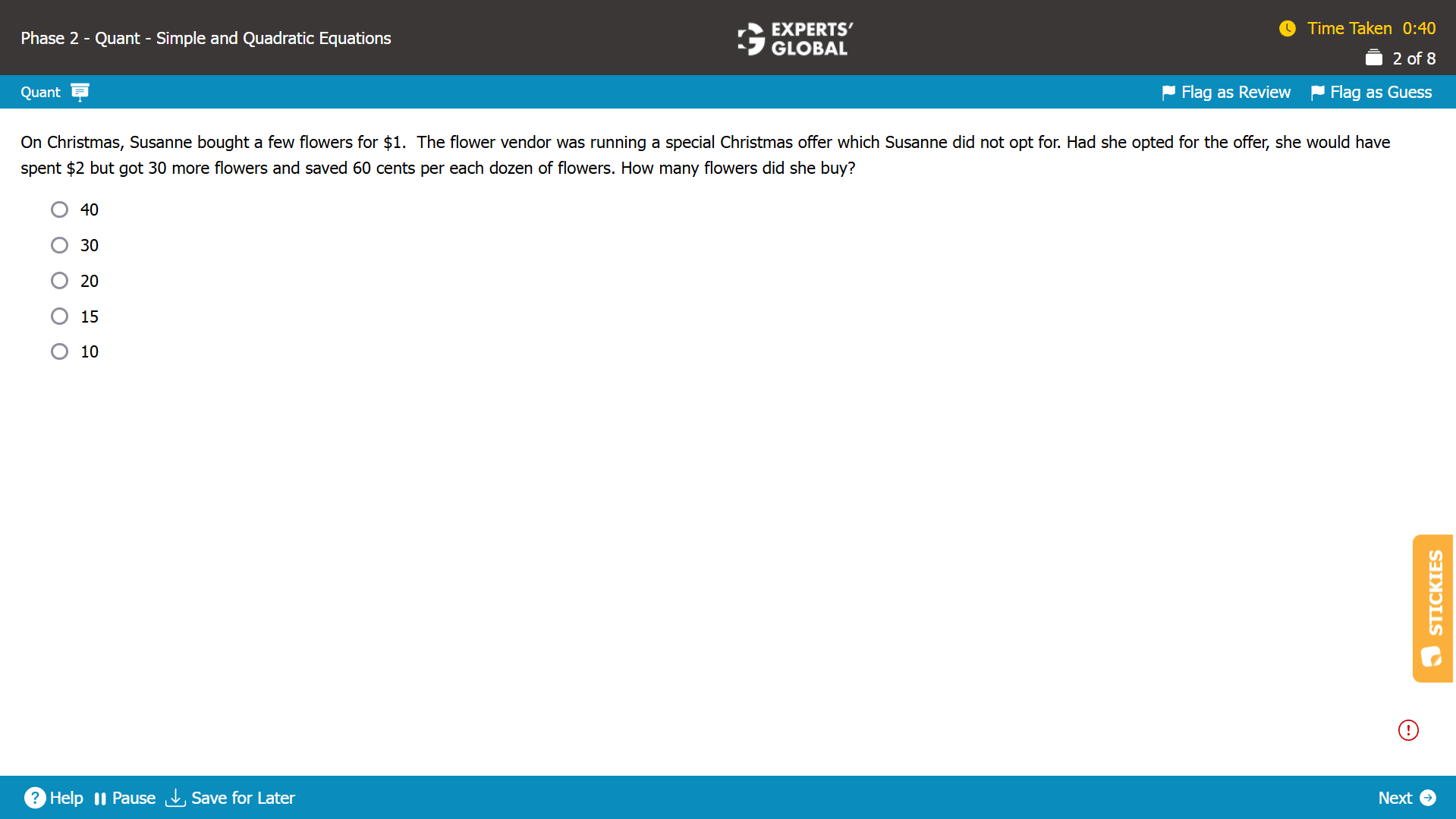
Written Explanation
Let’s say Susanne bought x flowers, without the offer.
Without the offer…
Total spending = $1 = 100 cents
Total number of flowers bought = x
Cost per flower without the offer = 100 / x in cents… (Equation I)
With the offer…
Total spending = $2 = 200 cents
Total number of flowers bought = x + 30
Cost per flower with the offer = 200 / (x + 30) in cents… (Equation II)
The offer would have also saved 60 cents per dozen of flowers; so, the cost of each flower would have been 60/12 = 5 cents lower.
Cost per flower with the offer = cost per flower without the offer – 5 cents
Substituting Equation I and Equation II…
200 / (x + 30) = (100 / x) – 5
Multiplying both sides by (x + 30) (x)…
200x = 100 (x + 30) – 5 (x + 30) (x)
200x = 100x + 3000 – 5x2 – 150x
5x2 + 250x – 3000 = 0
x2 + 50x – 600 = 0
(x + 60) X (x – 10) = 0
x = 10 or x = –60
Because x is the number of flowers, x cannot be negative. So, x = 10 flowers.
[Alternatively, after arriving at 200 / (x + 30) = (100 / x) – 5, one can plug in the numbers from answer choices and find out that x = 10]
E is the correct answer choice.
Practice Question 2
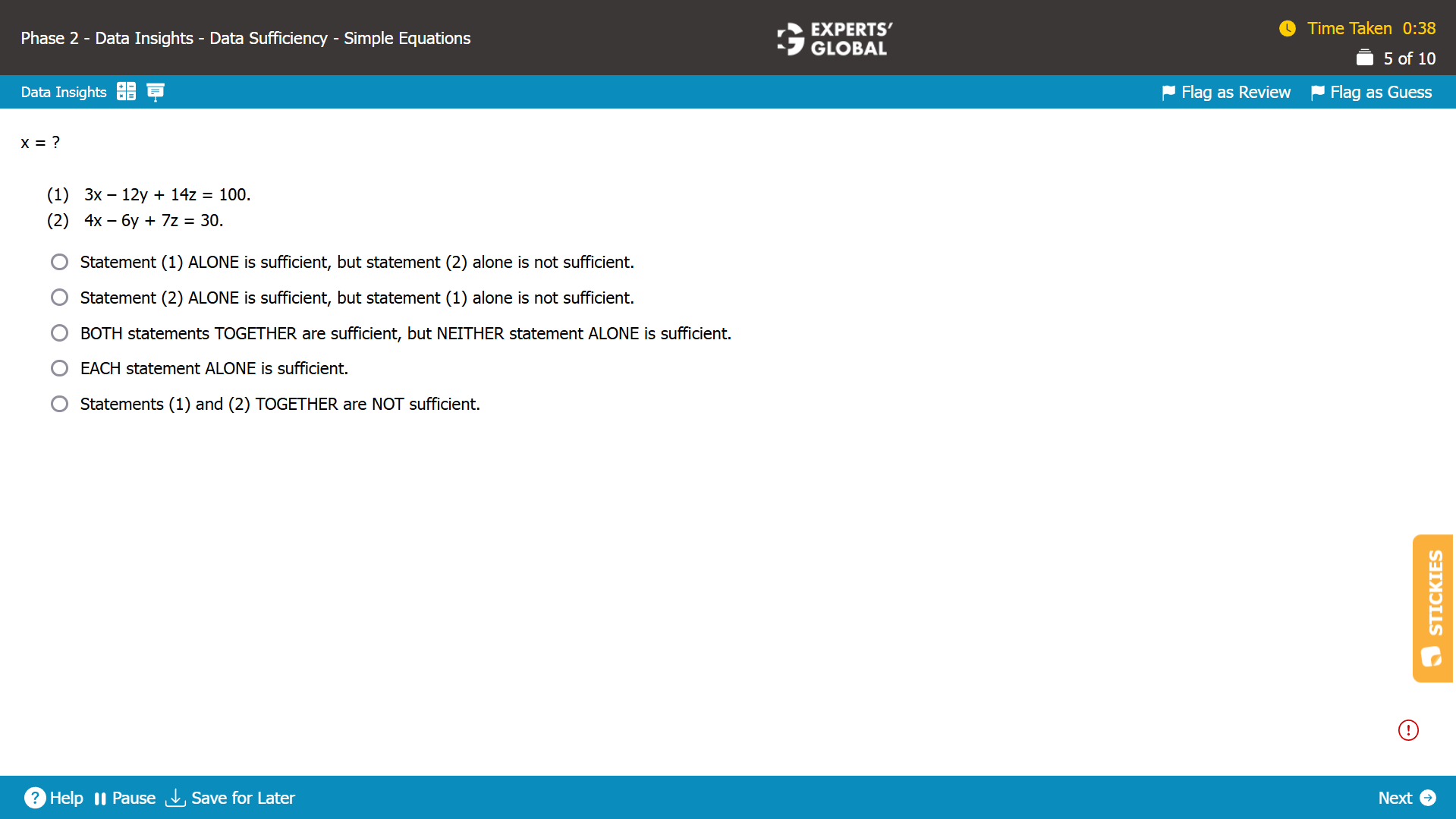
Written Explanation
Statement (1)
3x – 12y + 14z = 100.
There are three variables and only one equation. The value of x cannot be determined. Insufficient.
Statement (2)
4x – 6y + 7z = 30.
There are three variables and only one equation. The value of x cannot be determined. Insufficient.
Because both the statements alone are not sufficient, let’s combine the two statements.
Statement (1) and Statement (2) combined
3x – 12y + 14z = 100.
– 12y + 14z = 100 – 3x… (Equation I)
4x – 6y + 7z = 30
2 X (4x – 6y + 7z = 30) = 2 X 30
8x – 12y + 14z = 60
– 12y + 14z = 60 – 8x… (Equation II)
Equating Equation I and Equation II
100 – 3x = 60 – 8x.
There is one equation with one variable. The value of x can be determined. (Please note that the exact answer is not required to be calculated in a Data Sufficiency question.)
Sufficient.
C is the correct answer choice.
Practice Question 3
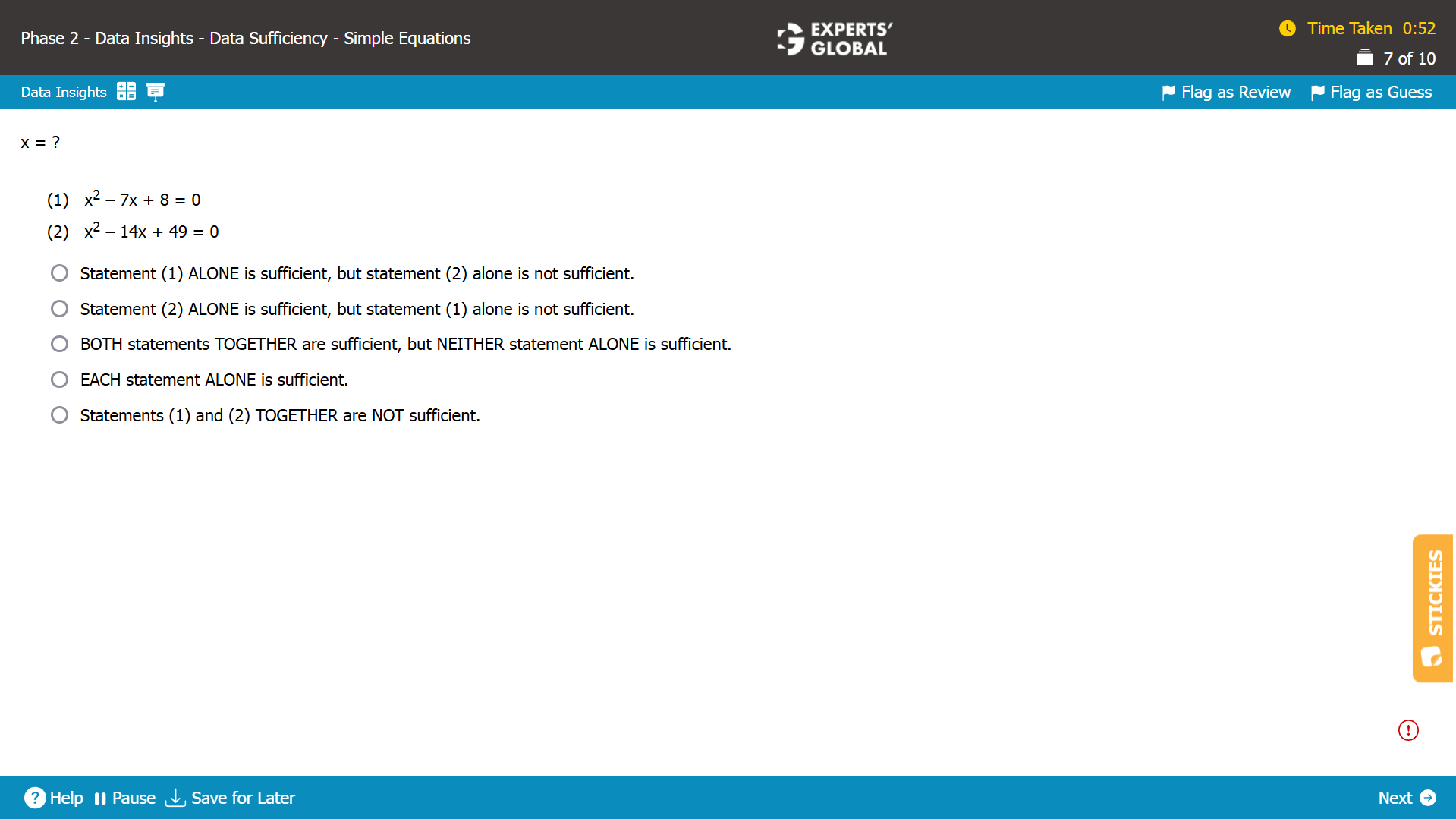
Written Explanation
Statement (1)
x2 – 7x + 8 = 0
This is a quadratic equation with 2 roots. (Please note that the exact answer is not required to be calculated in a Data Sufficiency question.)
So, there will be two values of x. Insufficient.
Statement (2)
x2 – 14x + 49 = 0
A quadratic equation has 2 roots; but (x2 – 14x + 49) is the perfect square of (x – 7). So, this equation will have only one root. Sufficient.
B is the correct answer choice.
Practice Question 4
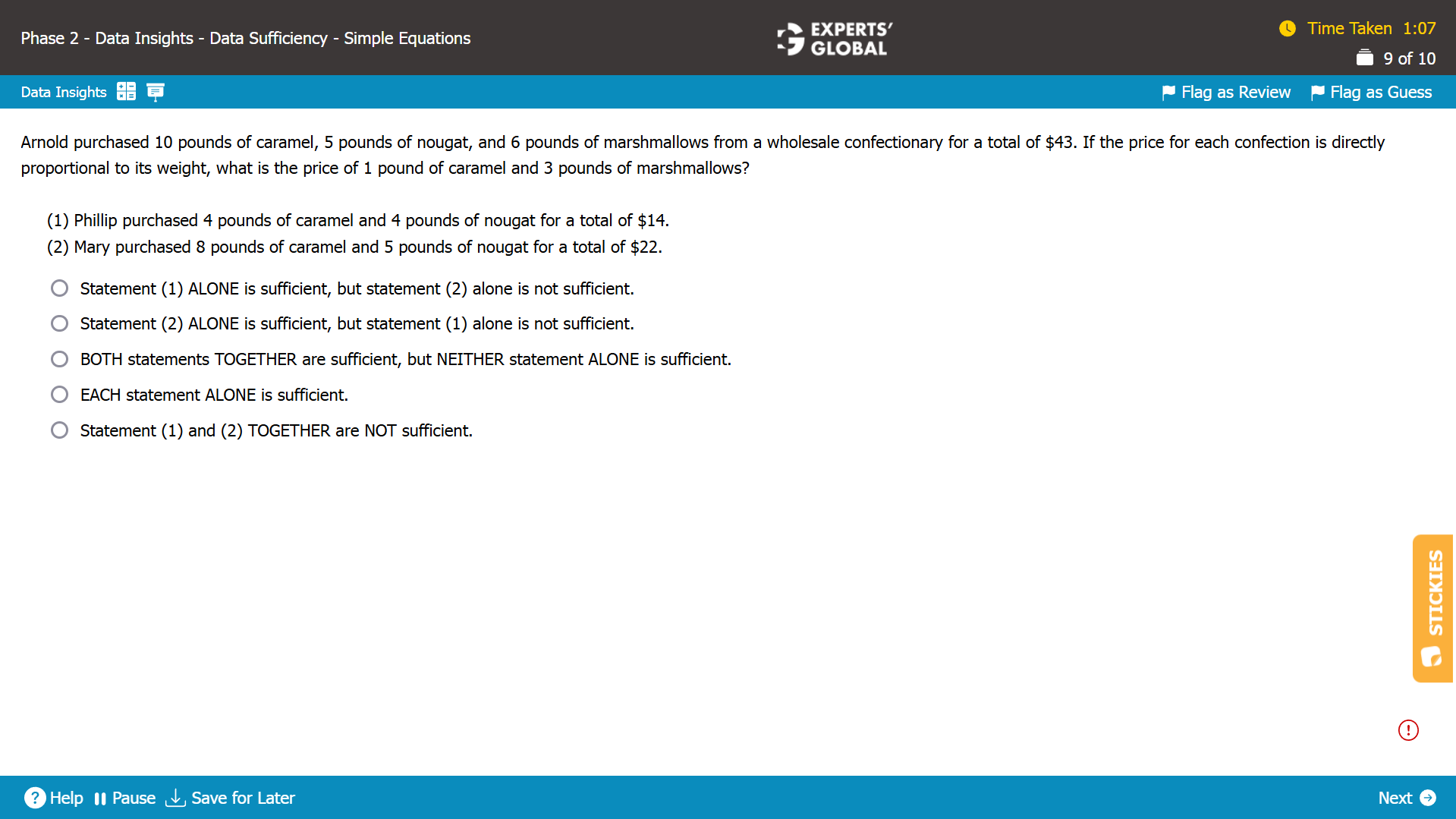
Written Explanation
Amount of caramel purchased = 10 pounds.
Amount of nougat purchased = 5 pounds.
Amount of marshmallows purchased = 6 pounds.
Since the price for each confection is directly proportional to its weight:
Price of 10 pounds of caramel = 10C, where C is the constant of proportionality.
Price of 5 pounds of nougat = 5N, where N is the constant of proportionality.
Price of 6 pounds of marshmallow = 6M, where M is the constant of proportionality.
Since the total price is given as $43: 10C + 5N + 6M = 43 (Equation I)
Price of 1 pound of caramel and 3 pounds of marshmallow = 1C + 3M = C + 3M
We need to find whether the value of C + 3M can be determined.
Statement (1)
4C + 4N = 14 (Equation II)
Substituting Equation II into Equation I does NOT help us determine the value of C + 3M. Hence, Statement (1) is insufficient.
Statement (2)
8C + 5N = 22
5N = 22 – 8C
Substituting the value of 5N into Equation I:
10C + 5N + 6M = 43
10C + 22 – 8C + 6M = 43
2C + 22 + 6M = 43
2C + 6M = 21
Dividing both sides by 2, we get:
C + 3M = 10.5
It is possible to determine the value of C + 3M. Hence, Statement (2) is sufficient.
B is the correct answer choice.
GMAT Quant: Inequalities Sample Question
Inequalities show comparisons where one quantity is larger than, smaller than, at least, or at most another. Instead of locking you into one final number, they push you to think in ranges of possible values. They matter a lot in GMAT algebra, and you see them again and again on the exam.
Important: Before visiting the following sample question(s), if you would like a quick brush up of key Inequalities concepts, you may first visit: Free GMAT Inequalities Prep
Practice Question 1
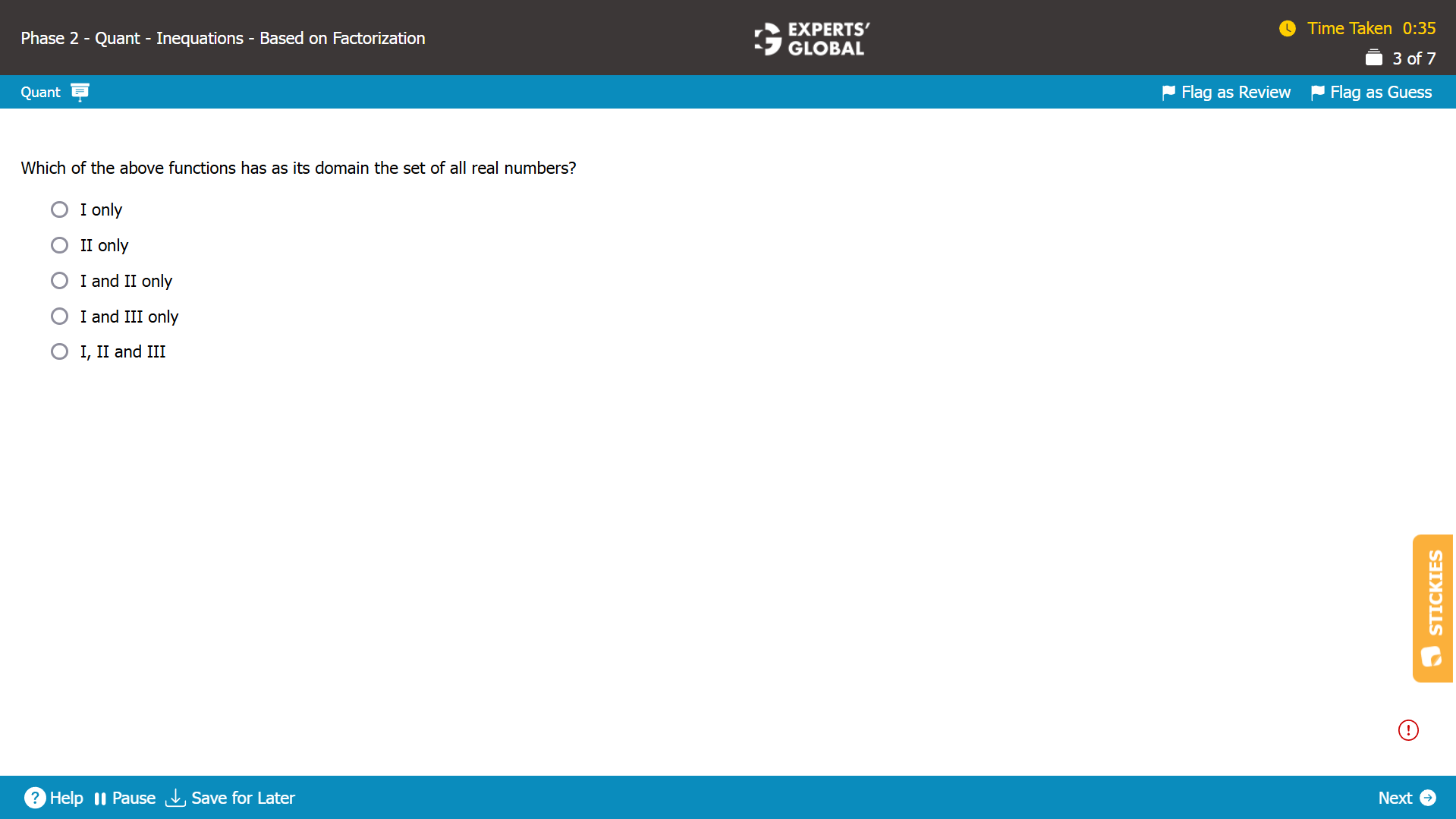
The domain of a function f(x) is all values of x for which f(x) is well-defined.
I. Since even roots are only well-defined for non-negative numbers, √( x / 100 )3 is NOT well-defined for any real value of x < 0.
II. Since all odd roots of any real number are well-defined, (x)1/5 is well-defined for all real values of x.
III. If x = 4 or x = –4, then the denominator (x – 4)(x + 4) would be 0. Thus, x2 – 23 / (x – 4)(x + 4) is NOT well-defined for all real values of x.
B is the correct answer choice.
Practice Question 2
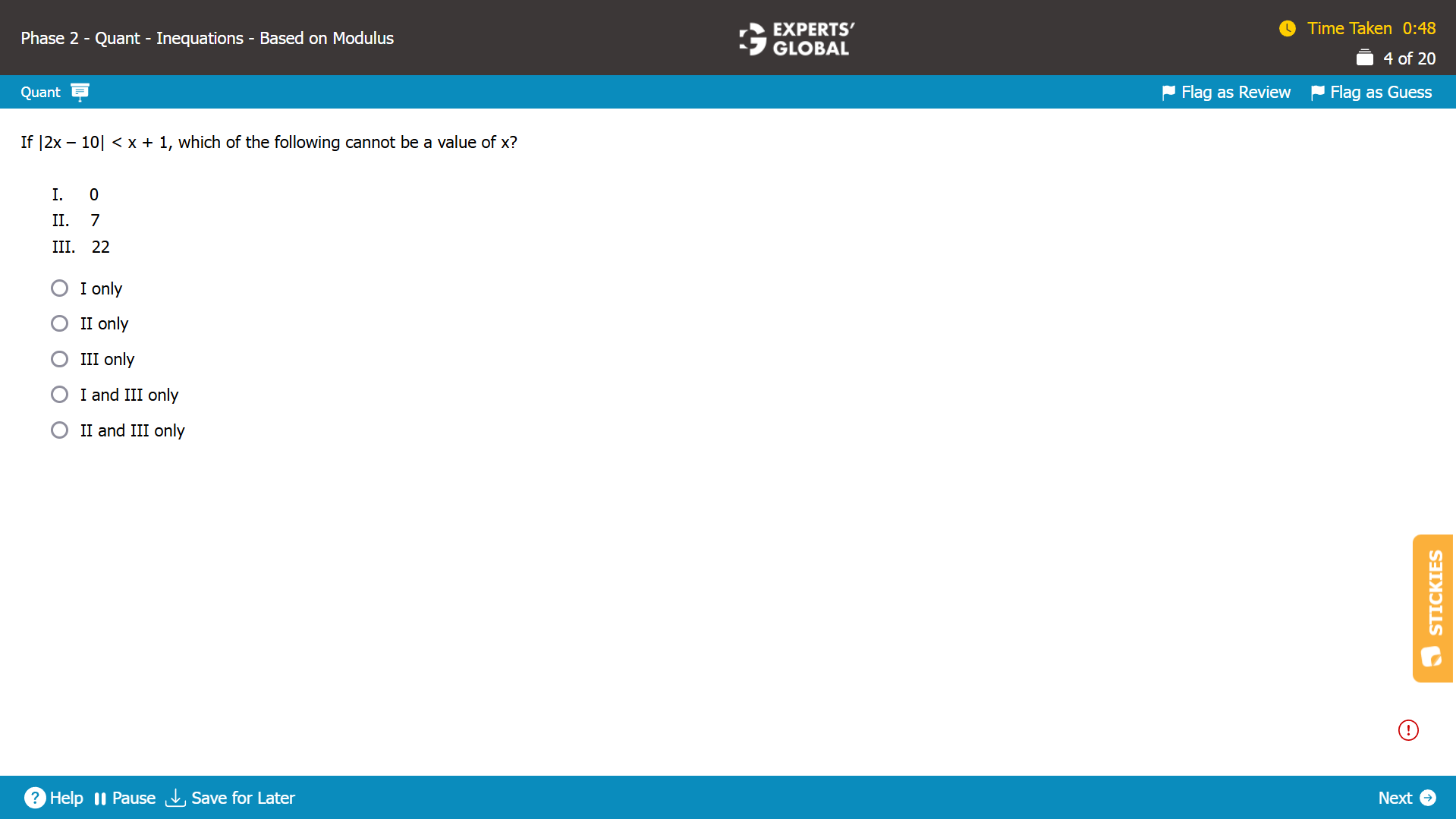
Written Explanation
|2x – 10| < x + 1
Let’s check whether x can be any of the given values.
If x = 0…
|2x – 10| = |0 – 10| = 10
x + 1 = 0 + 1 = 1
|2x – 10| < x + 1 does not hold for x = 0.
If x = 7…
|2x – 10| = |14 – 10| = 4
x + 1 = 7 + 1 = 8
|2x – 10| < x + 1 holds for x = 7.
If x = 22…
|2x – 10| = |44 – 10| = 34
x + 1 = 22 + 1 = 23
|2x – 10| < x + 1 does not hold for x = 22.
Values in I and III cannot be true for x.
D is the correct answer choice.
Practice Question 3
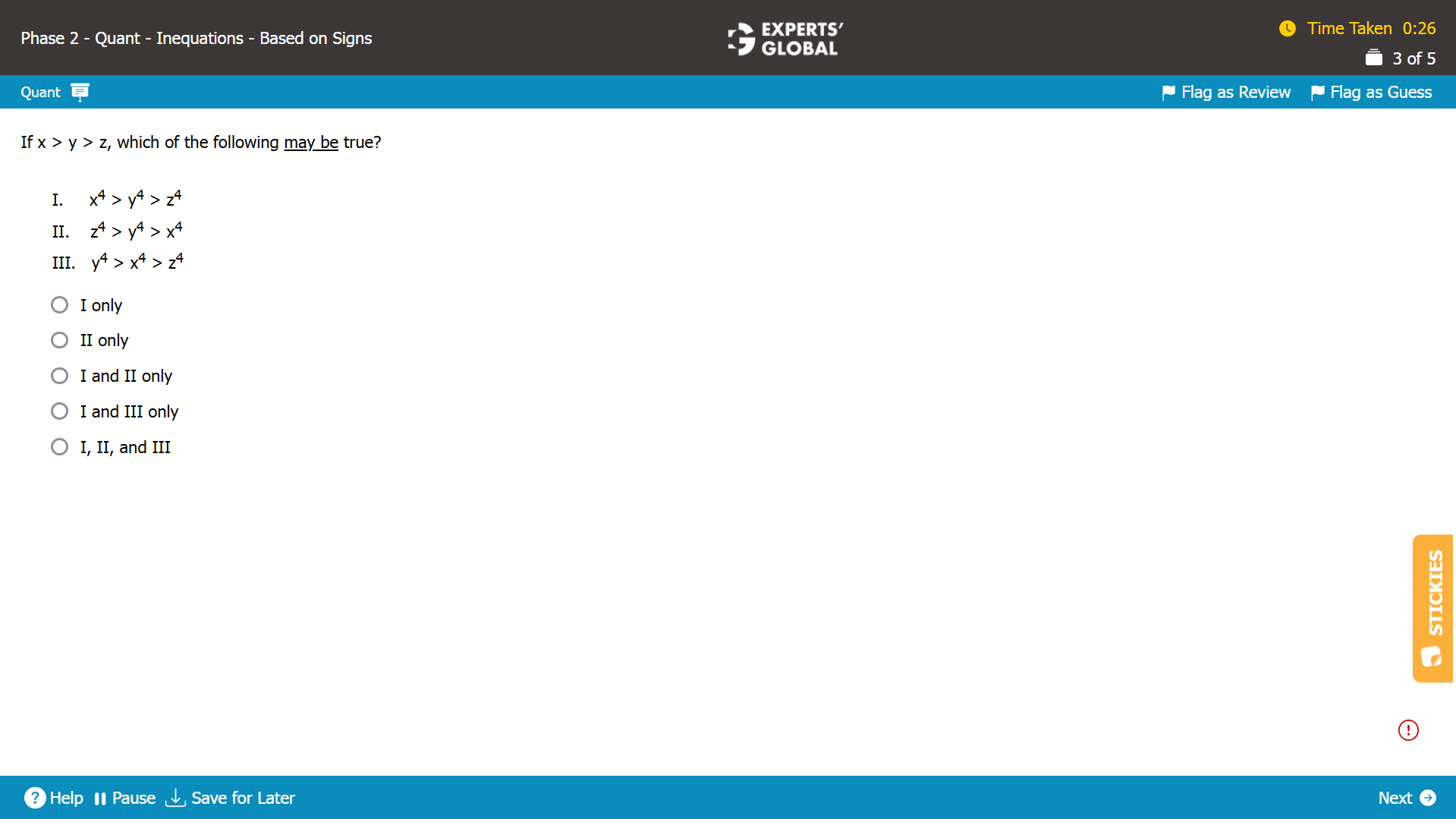
Written Explanation
Let’s evaluate each statement.
Statement I: x4 > y4 > z4.
Comparing x, y, and x, x > y > z and x4 > y4 > z4.
This may be true for large positive values such as x = 3, y = 2, and z = 1.
x4 = 81, y4 = 16, z4 = 1.
x > y > z and x4 > y4 > z4.
Statement I may be true for some values.
Statement II: z4> y4 > x4.
Comparing x, y, and x, x > y > z and z4 > y4 > x4.
This may be true for negative values such as x = –1, y = –2, and z = –3.
x4 = 1, y4 = 16, z4 = 81.
x > y > z and z4 > y4 > x4.
Statement II may be true for some values.
Statement III: y4 > x4 > z4.
Comparing x and y, x > y and y4 > x4. This is possible when x and y are negative.
Comparing y and z, y > x and y4 > z4. This is possible when y and z are positive.
So, there is a contradiction in this statement. This possibility cannot exist.
Statement III may not be true for any values.
Only Statement I and Statement II may be true.
C is the correct answer choice.
Practice Question 4
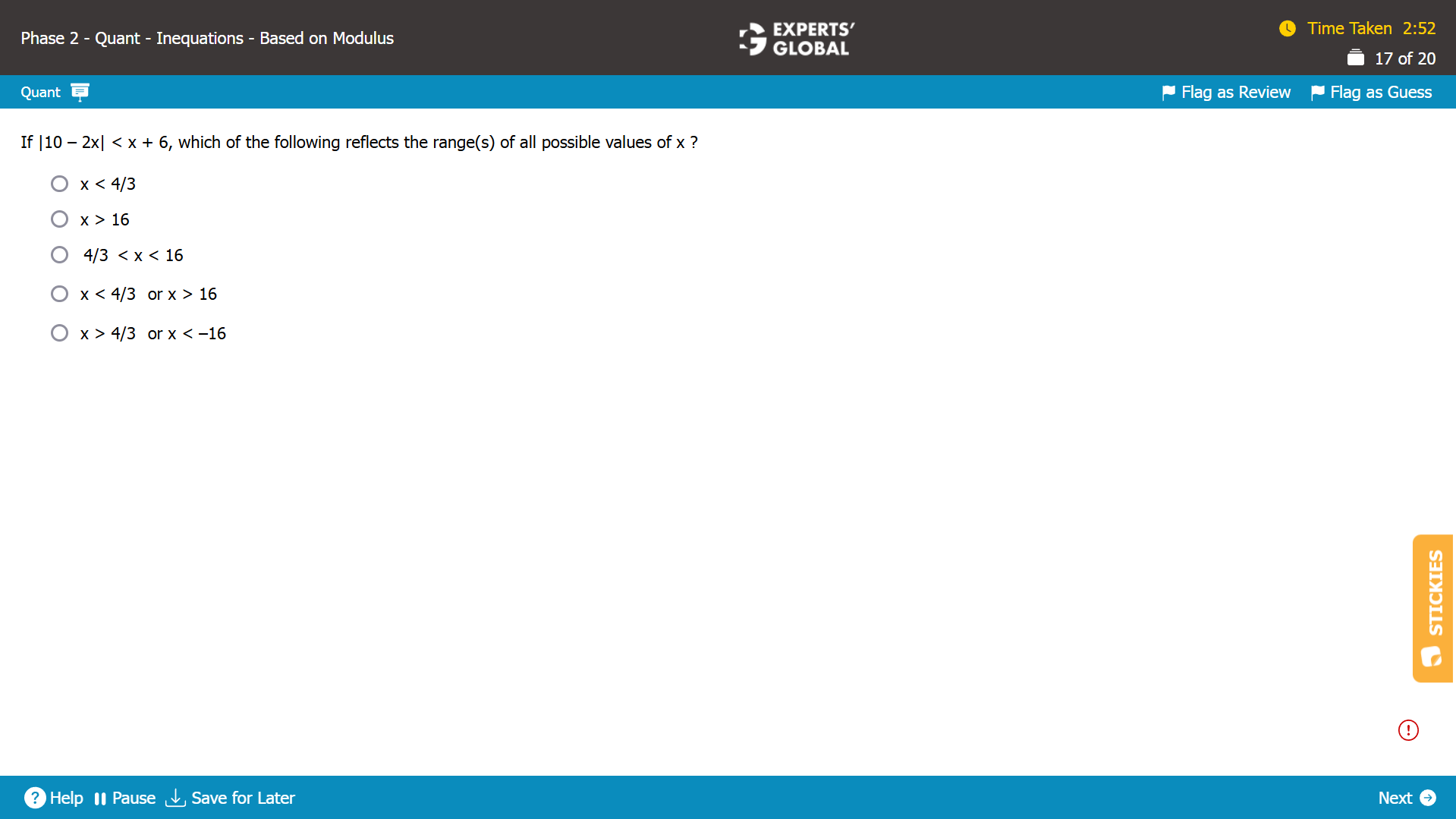
Written Explanation
Removing the modulus sign leads to two possibilities.
So, for the inequality |10 – 2x| < x + 6…
Possibility 1: (10 – 2x) is positive.
10 – 2x < x + 6
4 < 3x
x > 4 / 3
x can be any number greater than 4 / 3.
Possibility 2: (10 – 2x) is negative.
10 – 2x > (–1) X (x + 6)
10 – 2x > –x – 6
16 > x
x can be any number smaller than 16.
Combining all the possibilities, the range of x is 4 /3 < x < 16.
C is the correct answer choice.
Practice Question 5
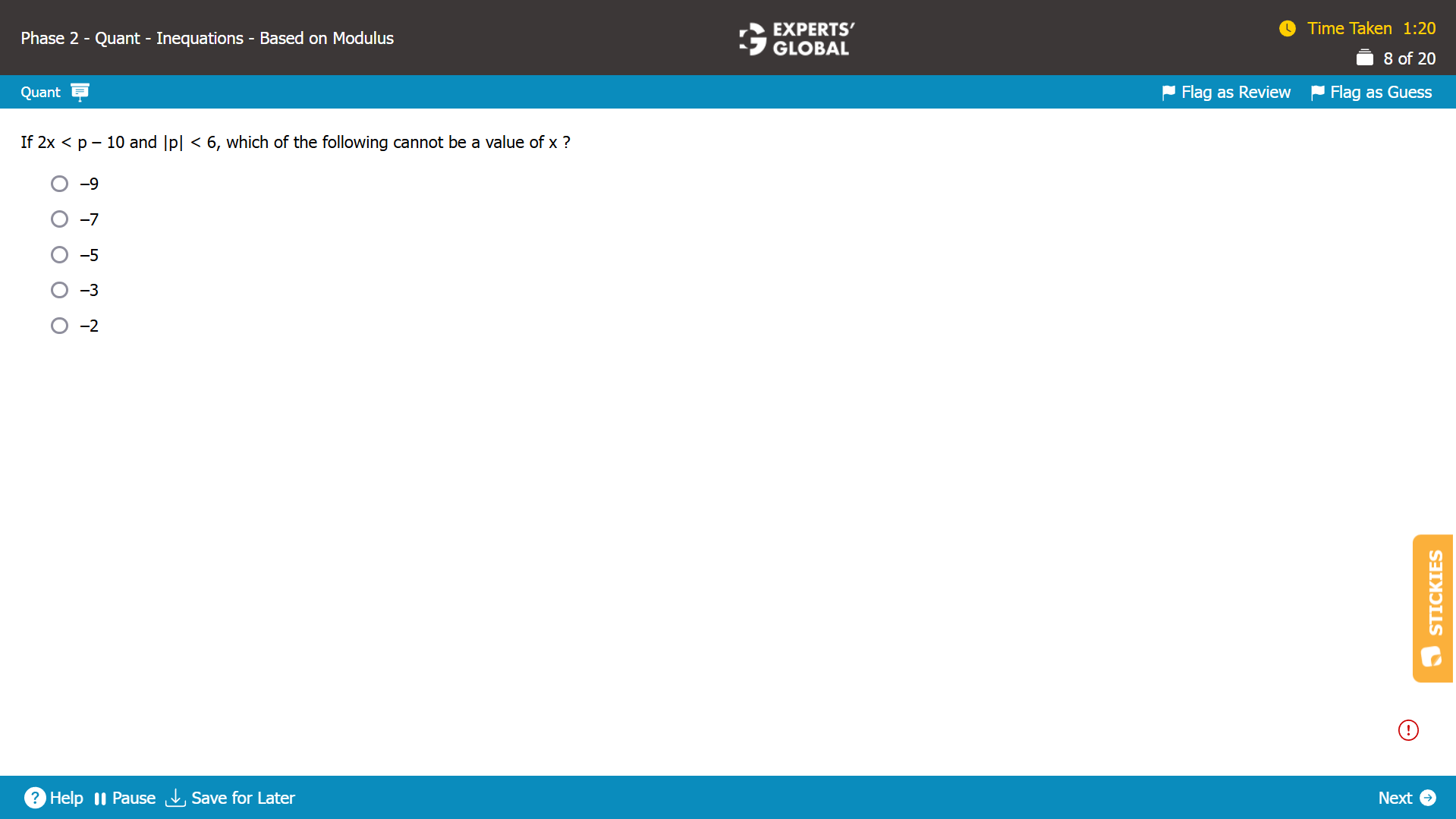
Written Explanation
|p| < 6.
So, p can range from –6 to 6, excluding both values.
Let’s find the extreme points of 2x < p – 10.
When p = –6…
2x < –6 – 10
2x < –16
x < –8
When p = 6…
2x < 6 – 10
2x < –4
x < –2
So, x can have any value less than –2.
x can be –9, –7, –5, or –3 but cannot be –2.
The value that x cannot have is –2.
E is the correct answer choice.
GMAT Quant: Algebraic Functions Sample Question
Functions show how one quantity depends on another by matching every input with one clear, well defined output. This structure helps you spot patterns, understand relationships, and track change with confidence.
Important: Before visiting the following sample question(s), if you would like a quick brush up of key Algebraic Functions concepts, you may first visit: Free GMAT Algebraic Functions Prep
Practice Question 1
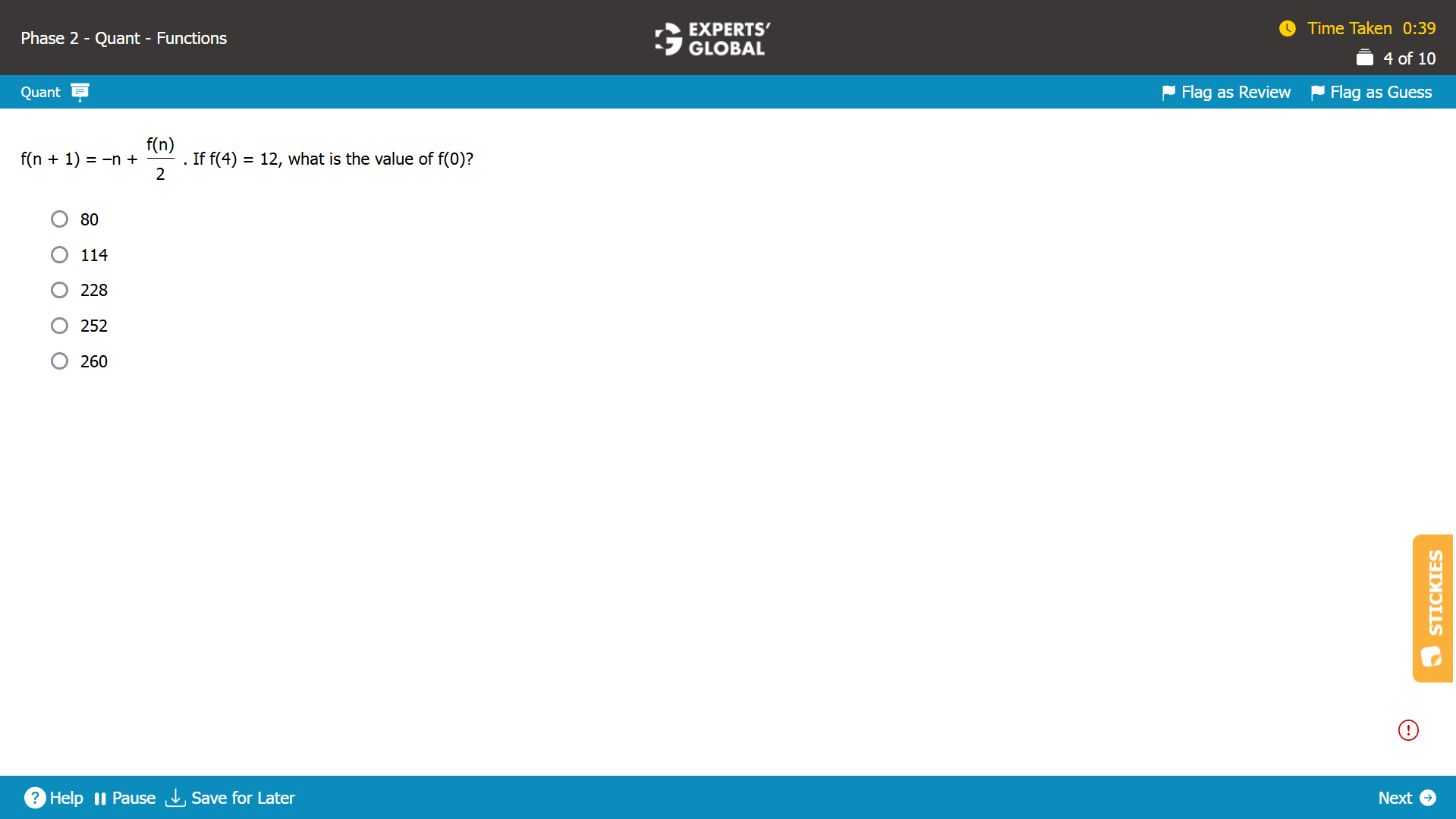
Written Explanation
f(n + 1) = –n + f(n) / 2
2 X f(n + 1) = –2n + f(n)
f(n) = 2 X f(n + 1) + 2n
f(4) = 12.
f(3) = 2 X f(4) + 2 X 3 = 2 X (12) + 6 = 30.
f(2) = 2 X f(3) + 2 X 2 = 2 X (30) + 4 = 64.
f(1) = 2 X f(2) + 2 X 1 = 2 X (64) + 2 = 130.
f(0) = 2 X f(1) + 2 X 0 = 2 X (130) + 0 = 260.
Overall, f(0) = 260.
E is the correct answer choice.
Practice Question 2
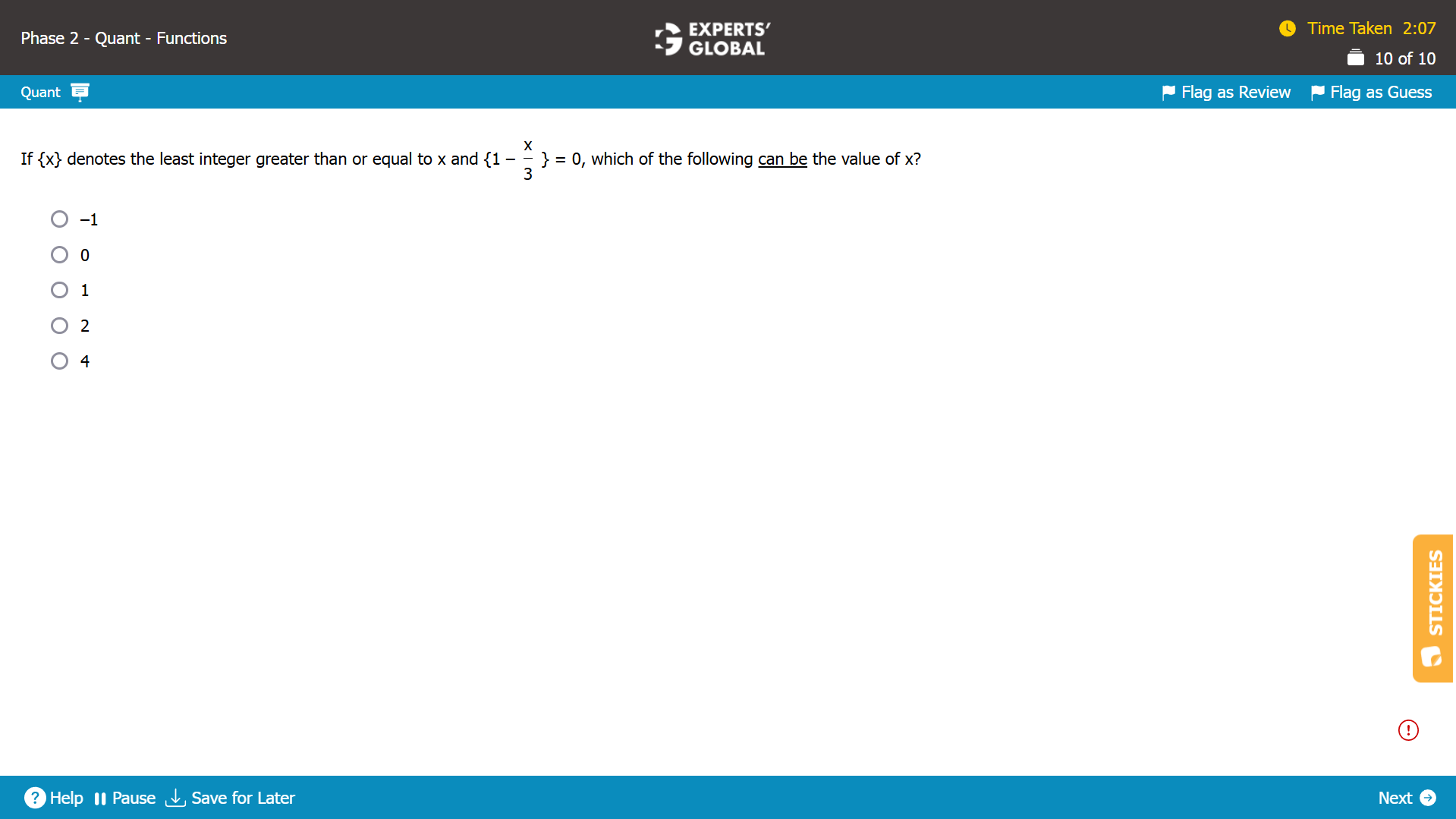
Written Explanation
{x} = the least integer greater than or equal to x.
{1 – x / 3} = the least integer greater than or equal to (1 – x / 3) = 0.
(1 – x / 3) lies between 0 and –1 and may also be 0.
In other words, –1 < (1 – x / 3) ≤ 0.
Multiplying by 3…
–3 < (3 – x) ≤ 0
On one side…
–3 < 3 – x
So, x < 6.
On the other side…
(3 – x) ≤ 0
x ≥ 3
From the given answer choices, 3 is a possible value of x.
E is the correct answer choice.
Practice Question 3
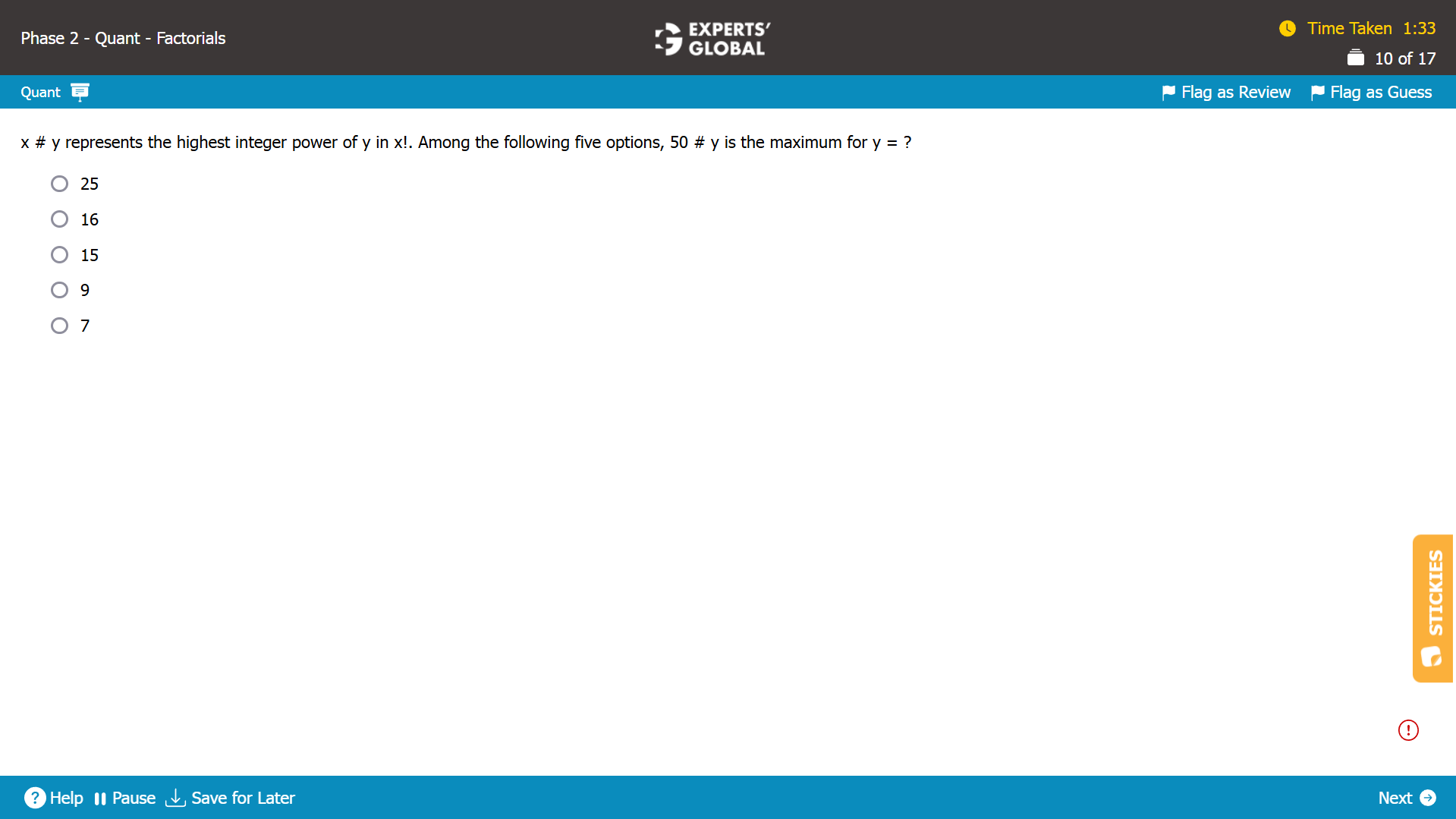
Written Explanation
50 # y represents the highest integer power of y in 50!.
25 = 5 X 5
The highest power of 25 in 50! will be determined by the number of two 5s in 50!.
Multiples of 5 till 50 = 50 / 5 = 10.
Each of these multiples will have a 5 as a factor.
So far, number of 5s in 50! = 10.
Multiples of 52 = 25 till 50 = 50 / 25 = 2.
Each of these multiples will have a 5 as a factor.
The first of the 5s is already counted because a multiple of 52 is also a multiple of 5.
There are 2 new 5s to be counted.
So far, number of 5s in 50! = 10 + 2 = 12.
There are no multiples of 53 till 50.
Overall, total number of 5s in 50! = 12.
Total number of two 5s in 50! = 12 / 2 = 6.
50 # 25 = 6.
16 = 2 X 2 X 2 X 2
The highest power of 16 in 50! will be determined by the number of four 2s in 50!.
Total number of 2s in 50! = (50 / 2) + (50 / 4) + (50 / 8) + (50 / 16) + (50 / 32), after ignoring all remainders = 25 + 12 + 6 + 3 + 1 = 47.
Total number of four 2s in 50! = 47 / 4 = 11.
50 # 16 = 11.
15 = 3 X 5.
There will be fewer 5s in 50! than 3s.
So, the highest power of 15 in 50! will be determined by the number of 5s in 50!.
Total number of 5s in 50! = (50 / 5) + (50 / 25), after ignoring all remainders = 10 + 2 = 12.
50 # 15 = 12.
9 = 3 X 3.
So, the highest power of 9 in 50! will be determined by the number of two 3s in 50!.
Total number of 3s in 50! = (50 / 3) + (50 / 9) + (50 / 27), after ignoring all remainders = 16 + 5 + 1 = 22.
Total number of two 3s in 50! = 22 / 2 = 11.
50 # 9 = 11.
So, the highest power of 7 in 50! will be determined by the number of 7s in 50!.
Total number of 7s in 50! = (50 / 7) + (50 / 49), after ignoring all remainders = 7 + 1 = 8.
50 # 7 = 8.
50 # y is maximum when y = 15.
C is the correct answer choice.
GMAT Quant: Work-Rate Sample Question
Work rate problems focus on how fast a job gets done when one person, or several people, work on it. You connect total work to time and to the speed of each contributor.
Important: Before visiting the following sample question(s), if you would like a quick brush up of key Work-Rate concepts, you may first visit: Free GMAT Work-Rate Prep
Practice Question 1
Written Explanation
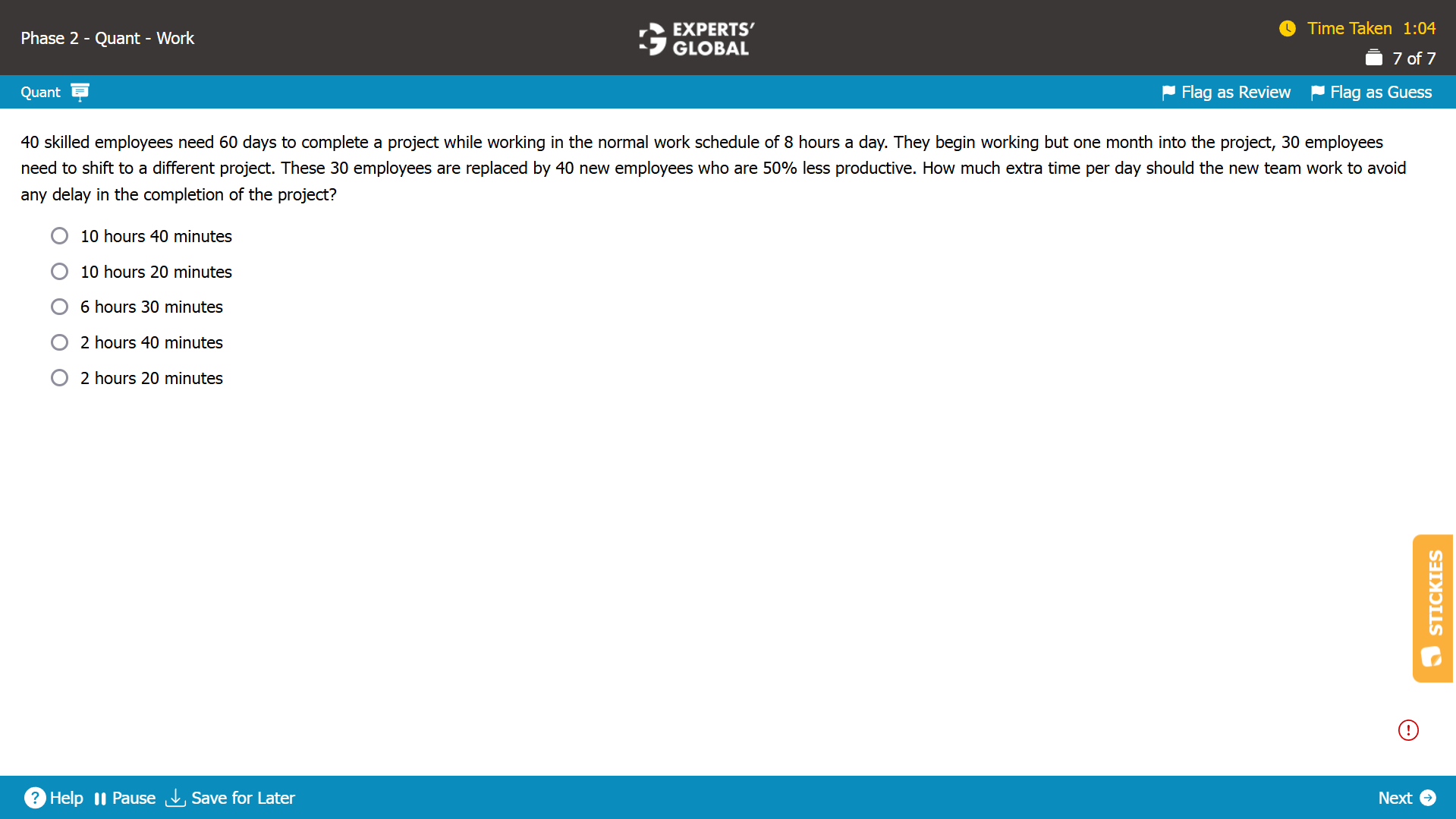
Let’s say the team has 40 employees, works 8 hours a day, and would complete the project in 60 days.
Total number of man-hours in the project = 40 * 8 * 60 = 19200 man-hours.
The team works for 30 days with all the 40 employees.
Work completed in 30 days = 40 * 8 * 30 = 9600 man-hours.
Now, 30 employees leave and are replaced by 40 new employees, who are 50% less productive; so, the new 40 employees complete the work of only 40 / 2 = 20 old, fully-efficient employees.
The new team has …
Fully-efficient employees = 40 – 30 = 10 fully-efficient employees.
Half-efficient employees = 40, equivalent of 20 fully-efficient employees.
So, effectively, the team has 10 + 20 = 30 fully-efficient employees.
Work remaining for the new team = 19200 – 9600 = 9600 man-hours.
Number of fully-efficient employees = 30.
Number of days left = 60 days – 30 days = 30 days.
Number of hours to be worked per day = 9600 / (30 X 30) = 10.66 hours = 10 hours 40 minutes.
Extra time to be worked every day = 10 hours 40 minutes – 8 hours = 2 hours 40 minutes.
D is the correct answer choice.
Practice Question 2
Written Explanation
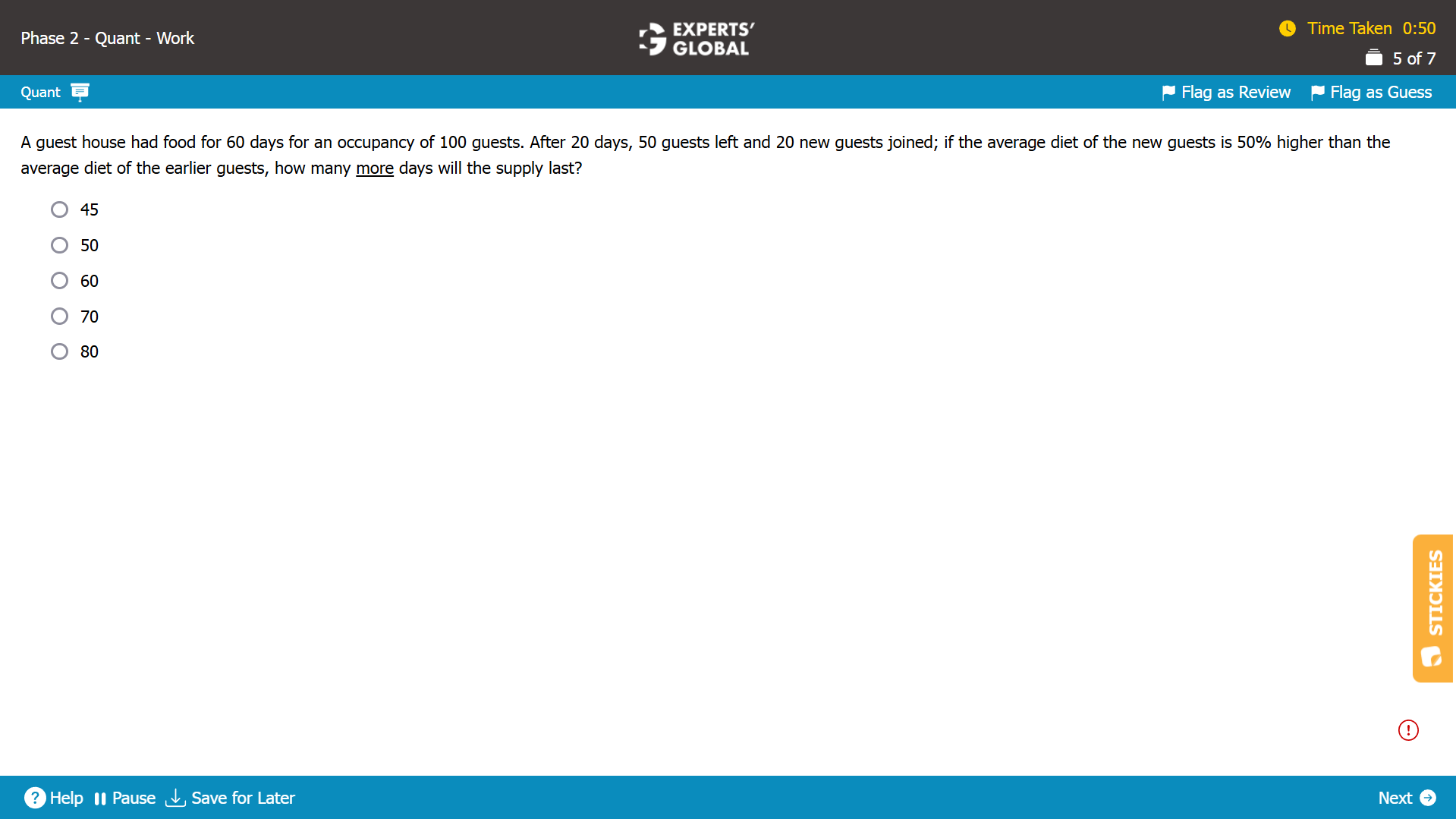
The guest house has food for 100 guests, for 60 days.
Total number of day-meals the guest house has = 100 X 60 = 6000 day-meals.
The guest house has 100 guests for 20 days.
Food consumed in 20 days = 100* 20 = 2000 day-meals.
Now, 50 guests leave and 20 new guests join; a new guest eats 50% more than what an old guest would have; so, the new 20 guests need food for 20 X (150 / 100) = 30 old guests.
The guest house now has …
Old guests = 100 – 50 = 50 old guests.
New guests = 20, equivalent of 30 old guests.
So, effectively, the team has 50 + 30 = 80 old guests.
Remaining food = 6000 – 2000 = 4000 day-meals.
Number of effective old guests = 80.
Number of extra days the food will last = 4000 / 80 = 50 days.
B is the correct answer choice.
Practice Question 3
Written Explanation
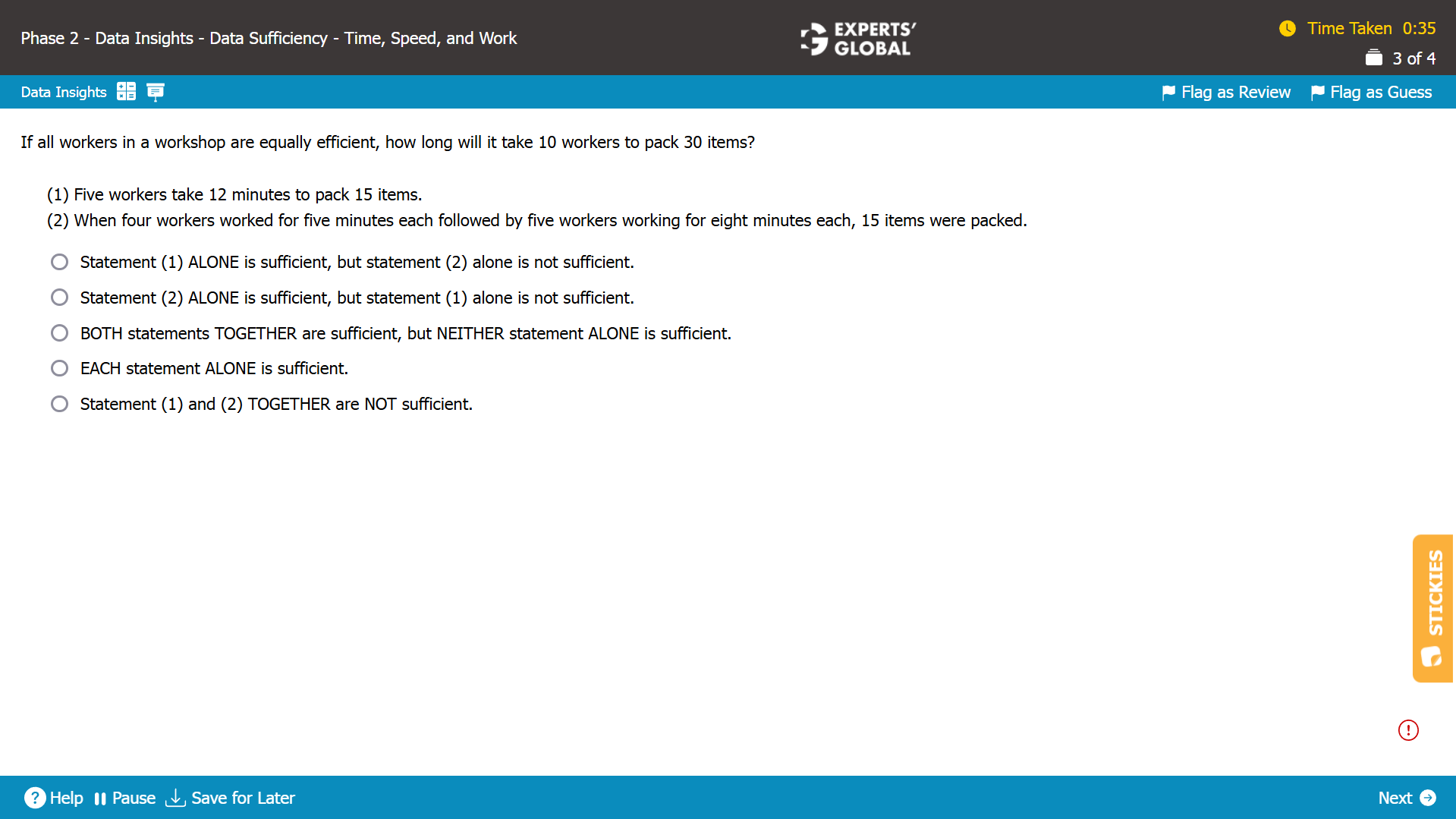
Statement (1):
5*x*12 = 15 items.
We can find x, the per minute productivity of a worker. Sufficient.
Statement (2):
4*x*5 + 5*x*8 = 15 items.
We can find x, the per minute productivity of a worker. Sufficient.
Hence, D is the correct answer choice.
Facing difficulty with the approach for Work questions? Please Click here
Facing difficulty with the approach for data sufficiency questions? Please Click here
Need a comprehensive strategy, approach, and practice for Work questions? Please Click here (you need to be enrolled for a course that includes the Quant section).
Need a comprehensive strategy, approach, and practice for data sufficiency questions? Please Click here (you need to be enrolled for a course that includes the Quant section).
GMAT Quant: Time-Speed-Distance Sample Question
Time, speed, and distance connect three simple ideas: how far something goes, how fast it moves, and how long it takes. Relative speed adds an extra layer by showing how one moving object looks from the point of view of another, whether they travel in the same direction or in opposite directions.
Important: Before visiting the following sample question(s), if you would like a quick brush up of key Time-Speed-Distance concepts, you may first visit: Free GMAT Time-Speed-Distance Prep
Practice Question
Written Explanation
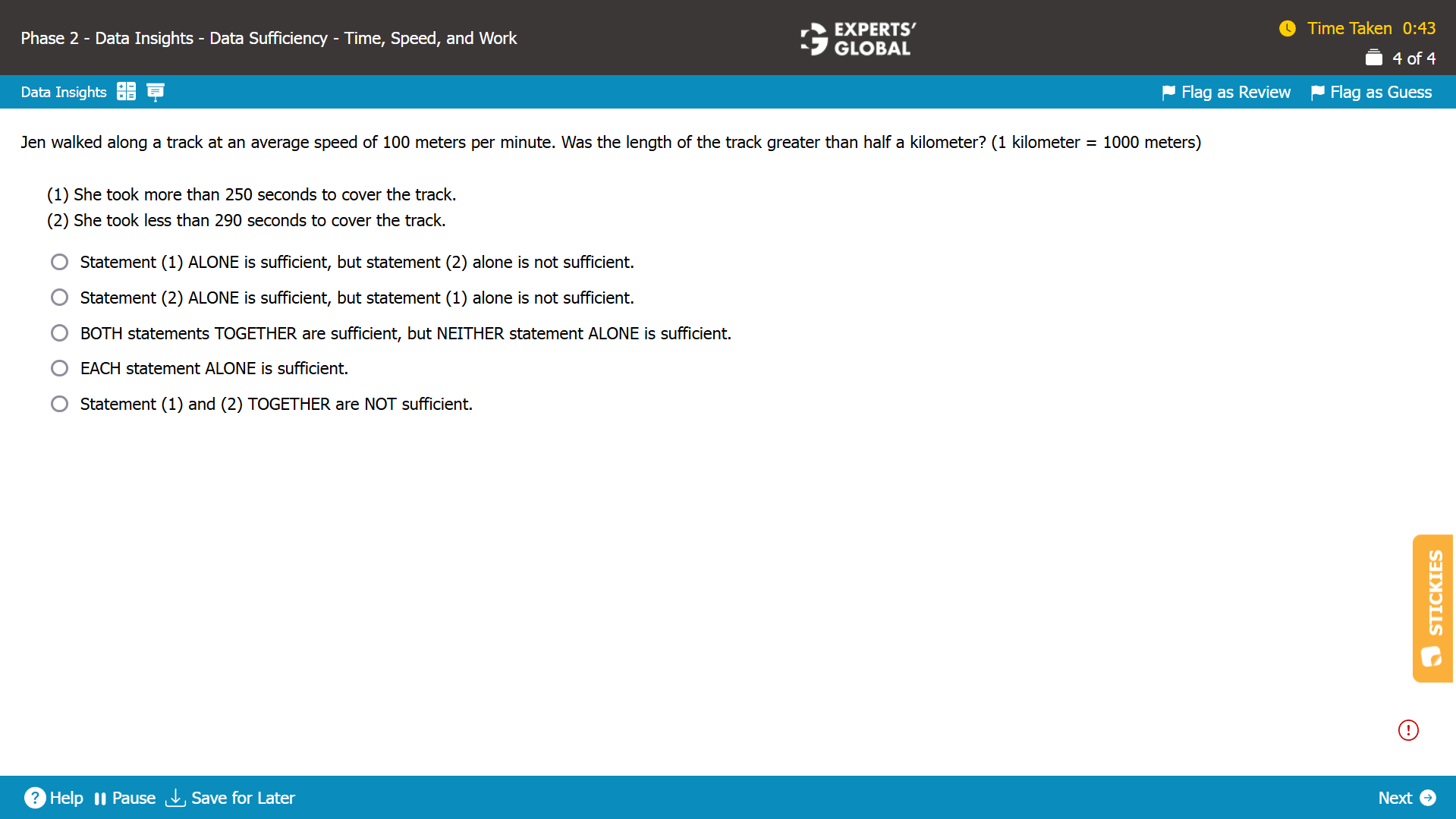
Jen walks with the rate of 100 meters per minutes = 100/60 meters per second.
Statement (1):
Jen walked for more than 250 seconds. So Jen walked more than 250*(100/60) = 416.67 meters. Insufficient.
Statement (2):
Jen walked for less than 290 seconds. So Jen walked less than 290*(100/60) = 483.33 meters. Sufficient.
Hence, B is the correct answer choice.
Facing difficulty with the approach for Time Speed Distance questions? Please Click here
Facing difficulty with the approach for data sufficiency questions? Please Click here
Need a comprehensive strategy, approach, and practice for Time Speed Distance questions? Please Click here (you need to be enrolled for a course that includes the Quant section).
Need a comprehensive strategy, approach, and practice for data sufficiency questions? Please Click here (you need to be enrolled for a course that includes the Quant section).
GMAT Quant: Coordinate Geometry Sample Question
Coordinate geometry shows you how to place points, lines, and shapes on a flat plane using ordered pairs of numbers. With that setup, you can explore location, distance, and clean geometric patterns using algebra.
Important: Before visiting the following sample question(s), if you would like a quick brush up of key Coordinate Geometry concepts, you may first visit: Free GMAT Coordinate Geometry Prep
Practice Question 1
Written Explanation
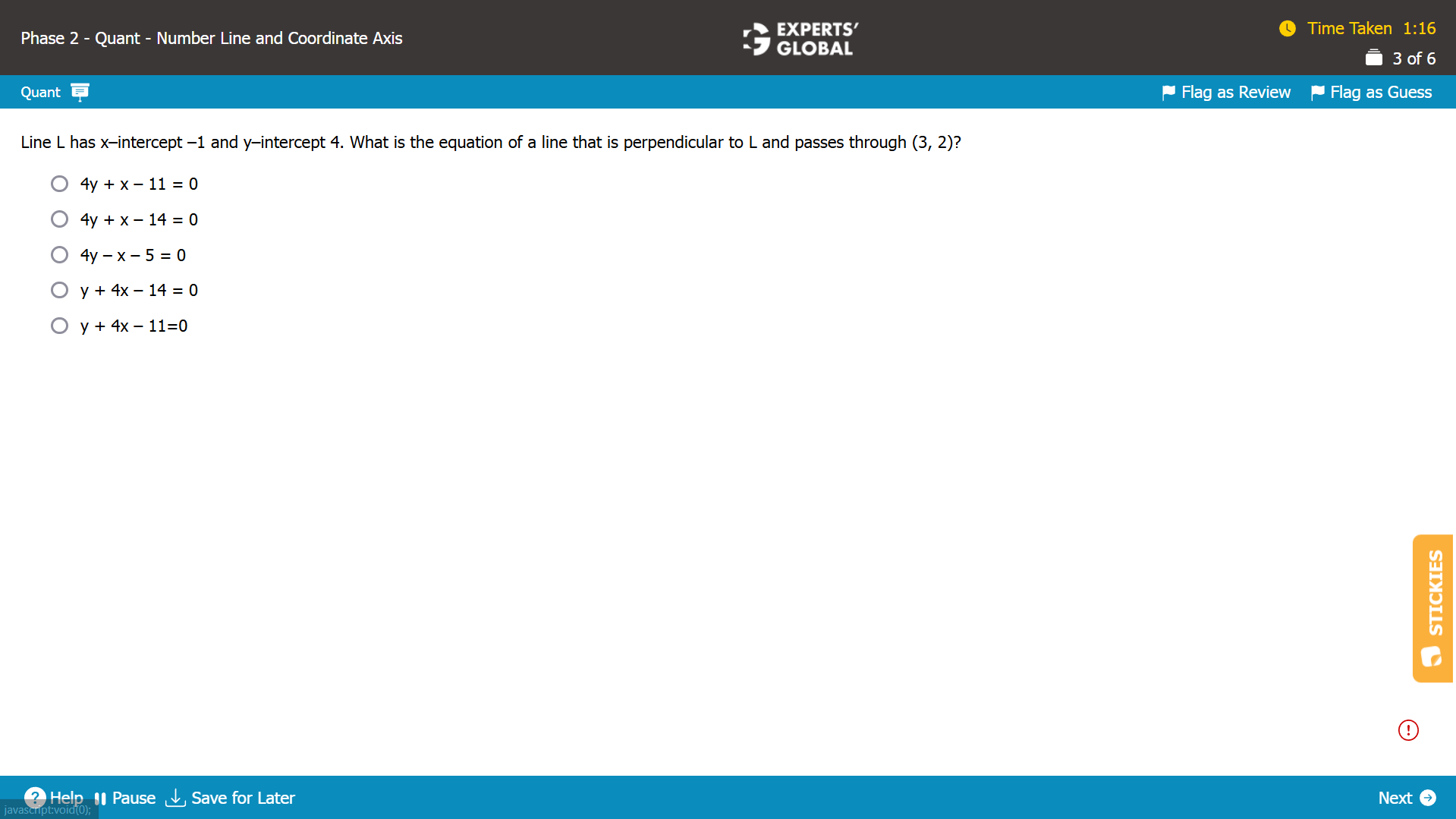
L has X–intercept –1; so, the line passes through (–1, 0).
L has Y–intercept 4; so, the line passes through (0, 4)
Slope of the line passing through (–1, 0) and (0, 4) = (4 – 0) / (0 – (–1)) = 4 / 1 = 4.
The product of the slopes of perpendicular lines is –1.
So, slope of the line perpendicular to L = –1 / (slope of line L) = –1 / 4
Equation of line with slope –1 / 4 and passing through (3, 2)…
y = mx + b where b is the Y-intercept
2 = (–1 / 4) X 3 + b
8 = –3 + 4b
b = 11 / 4
So, the equation of line perpendicular to L is…
y = (–1 / 4)x + 11 / 4
4y = –x + 11
4y + x – 11 = 0.
A is the correct answer choice.
Practice Question 2
Written Explanation
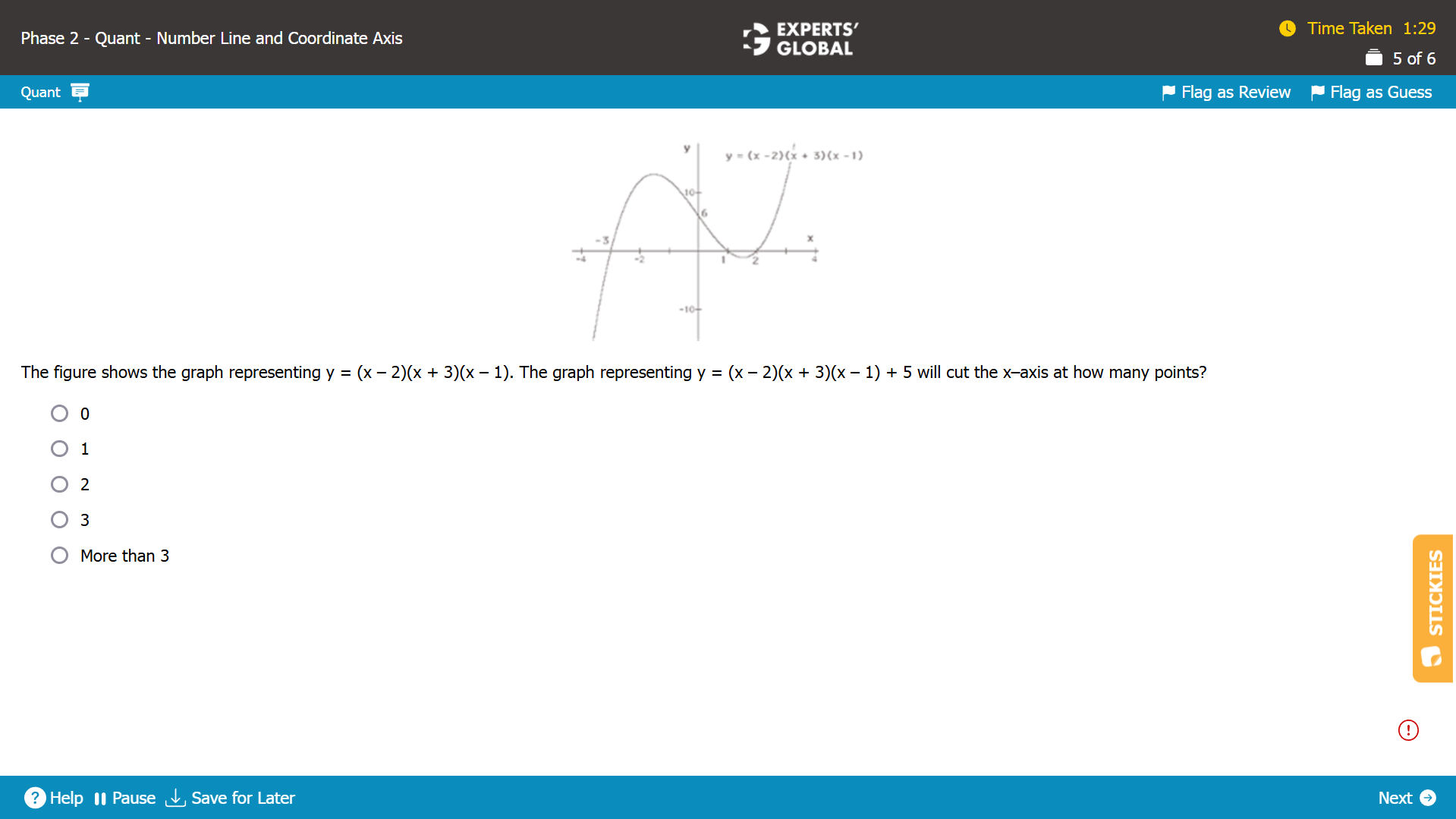
When 5 is added to the Y-coordinates in the function, the Y-coordinates of all points in the new function will be 5 more than the Y-coordinates of corresponding points in the old function. In other words, the graph will shift up by 5 points.
It can be imagined that in the new function, the X-axis will appear where the line y = –5 appears in the current graph.
The line y = –5 cuts the function at only one point. So, the new function will cut the X-axis at only one point.
B is the correct answer choice.
GMAT Quant: Permutations and Combinations Sample Question
Permutations count how many different arrangements you can make when the order of items matters. Combinations count how many different groups you can choose when the order does not matter. Together, they turn counting into a clean, structured game you can play with confidence and clarity.
Important: Before visiting the following sample question(s), if you would like a quick brush up of key Permutations and Combinations concepts, you may first visit: Free GMAT Permutations and Combinations Prep
Practice Question 1
Written Explanation
In a palindrome of 5-digit numbers…
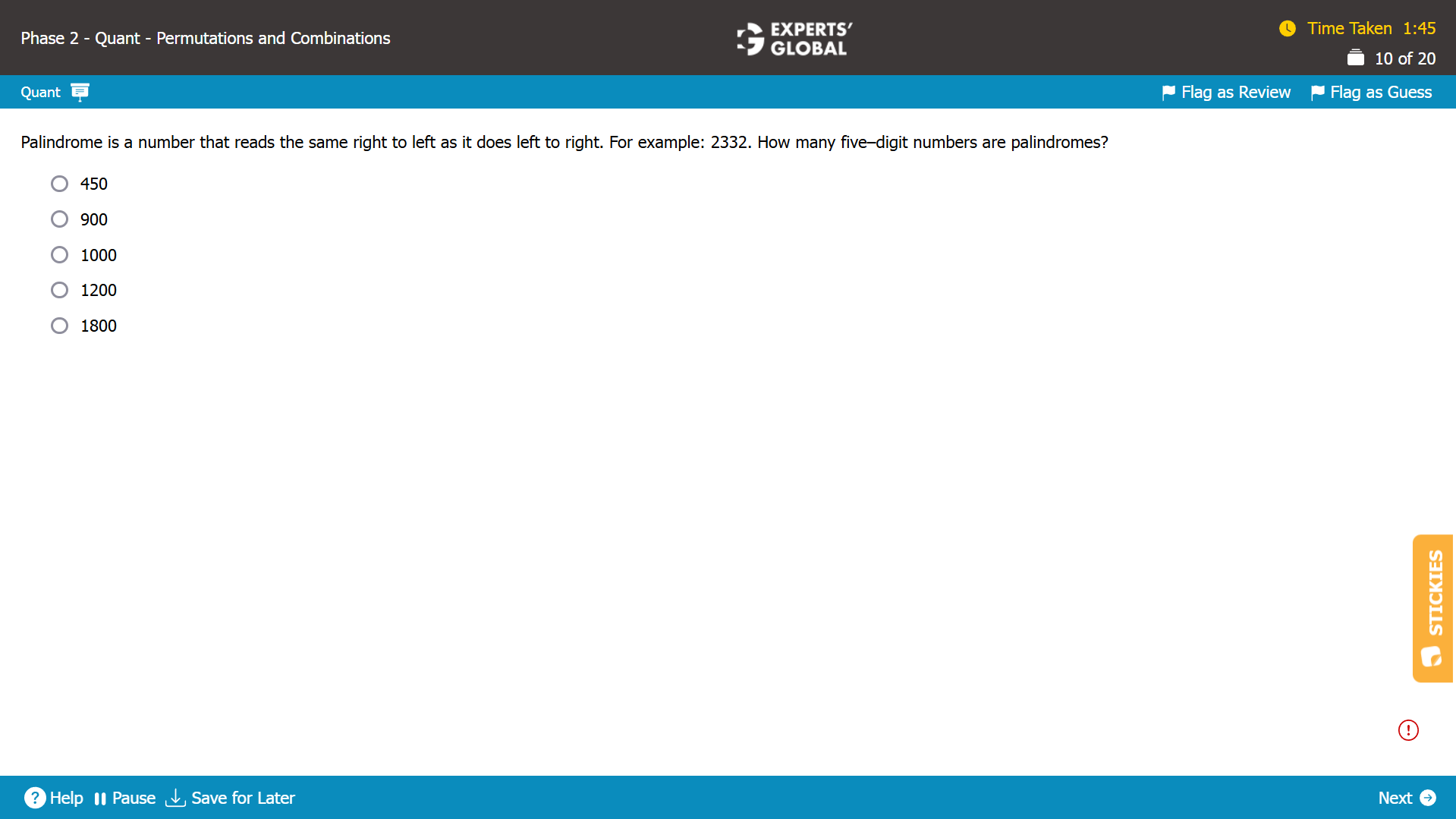
The first digit can be any digit from {1, 2, 3, 4, 5, 6, 7, 8, 9}. So, there are 9 possible values for the first digit.
The second digit can be any digit from {0, 1, 2, 3, 4, 5, 6, 7, 8, 9}. So, there are 10 possible values for the second digit.
Number of ways in which the first and the second digits can be chosen = 9 X 10 = 90.
There is no restriction on the middle digit. There are 10 digits available for the middle digit.
Number of ways in which the middle digit can be chosen = 10.
The fourth and the fifth digits are the same as the second and the first digits, respectively. So, the fourth and the fifth digits need not be chosen.
Overall, total number of five-digit palindromes = number of ways in which the first and the second digits can be chosen X number of ways in which the middle digit can be chosen X = 90 X 10 = 900.
There can be 900 five-digit palindromes.
B is the correct answer choice.
Practice Question 2
Written Explanation
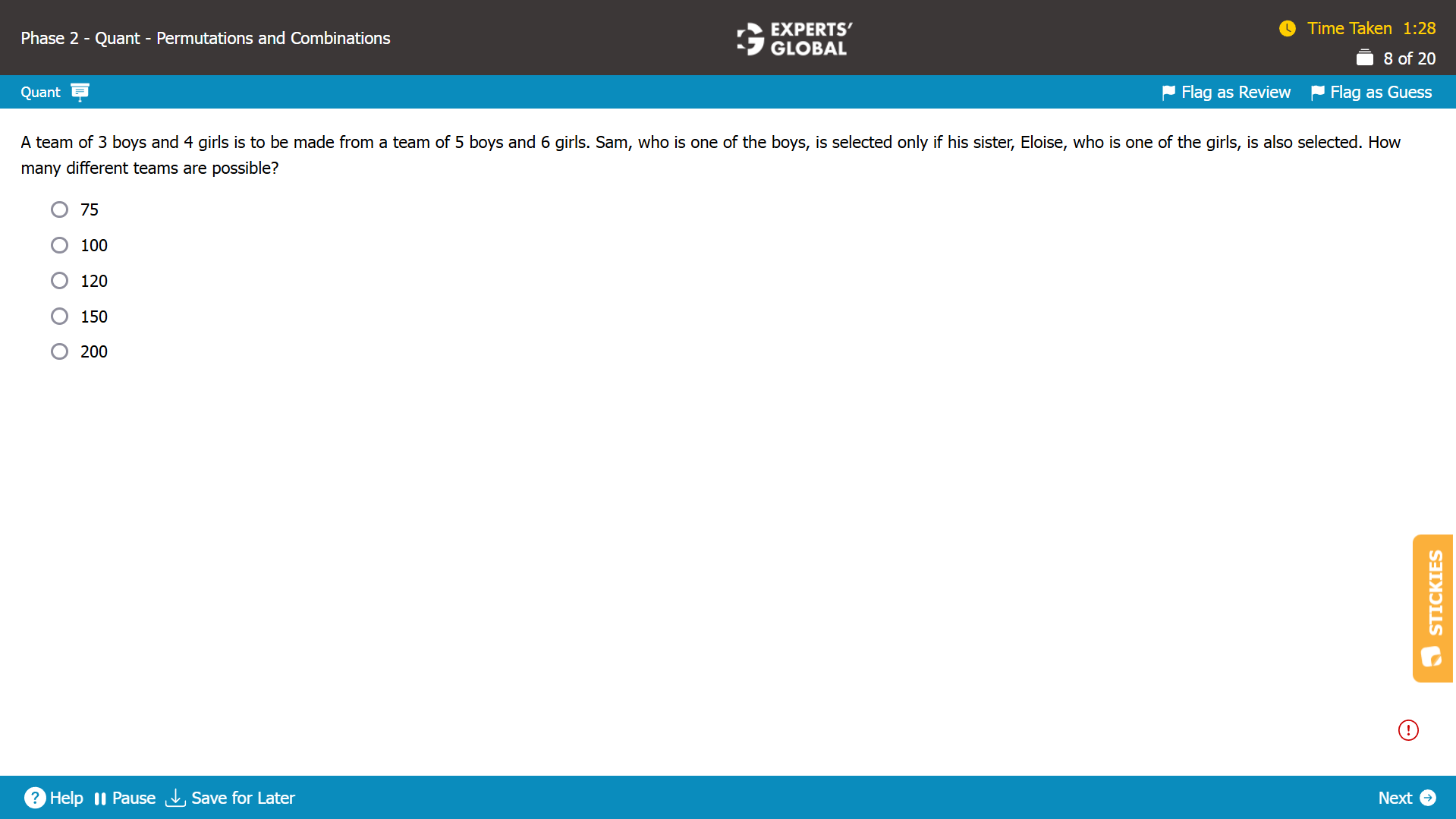
There are two possibilities to be considered, depending on whether Sam is selected.
Possibility 1: Let’s say that Sam is selected. So, Eloise must have also been selected.
In the team of 3 boys, one boy, Sam, is already selected. 2 more boys need to be selected.
In the available 5 boys, one boy, Sam, is already selected. 4 more boys are available.
Number of ways in which the team of boys can be formed = 4C2
In the team of 4 girls, one girl, Eloise, is already selected. 3 more girls need to be selected.
In the available 6 girls, one girl, Eloise, is already selected. 5 more girls are available.
Number of ways in which the team of girls can be formed = 5C3
Total number ways in the two teams can be formed, if Sam is selected = 4C2 X 5C3 = 60.
Possibility 2: Let’s say that Sam is NOT selected. Eloise may or may not have been selected.
In the team of 3 boys, one boy, Sam, is NOT selected. 3 boys need to be selected.
In the available 5 boys, one boy, Sam, is NOT selected. 4 boys are available.
Number of ways in which the team of boys can be formed = 4C3
In the team of 4 girl, one girl, Eloise, may or may not have been selected. 4 girls need to be selected.
In the available 6 girls, one girl, Eloise, may or may not have been selected. 6 girls are available.
Number of ways in which the team of girls can be formed = 6C4
Total number ways in the two teams can be formed, if Sam is NOT selected = 4C3 X 6C4 = 60.
The two possibilities are mutually exclusive; in other words, the two possibilities cannot exist together. So, their number of ways need to be added to get the total number of required ways.
So, total number of required ways = number of ways from Possibility 1 + number of ways from Possibility 2 = 60 + 60 = 120.
120 different teams are possible.
C is the correct answer choice.
Practice Question 3
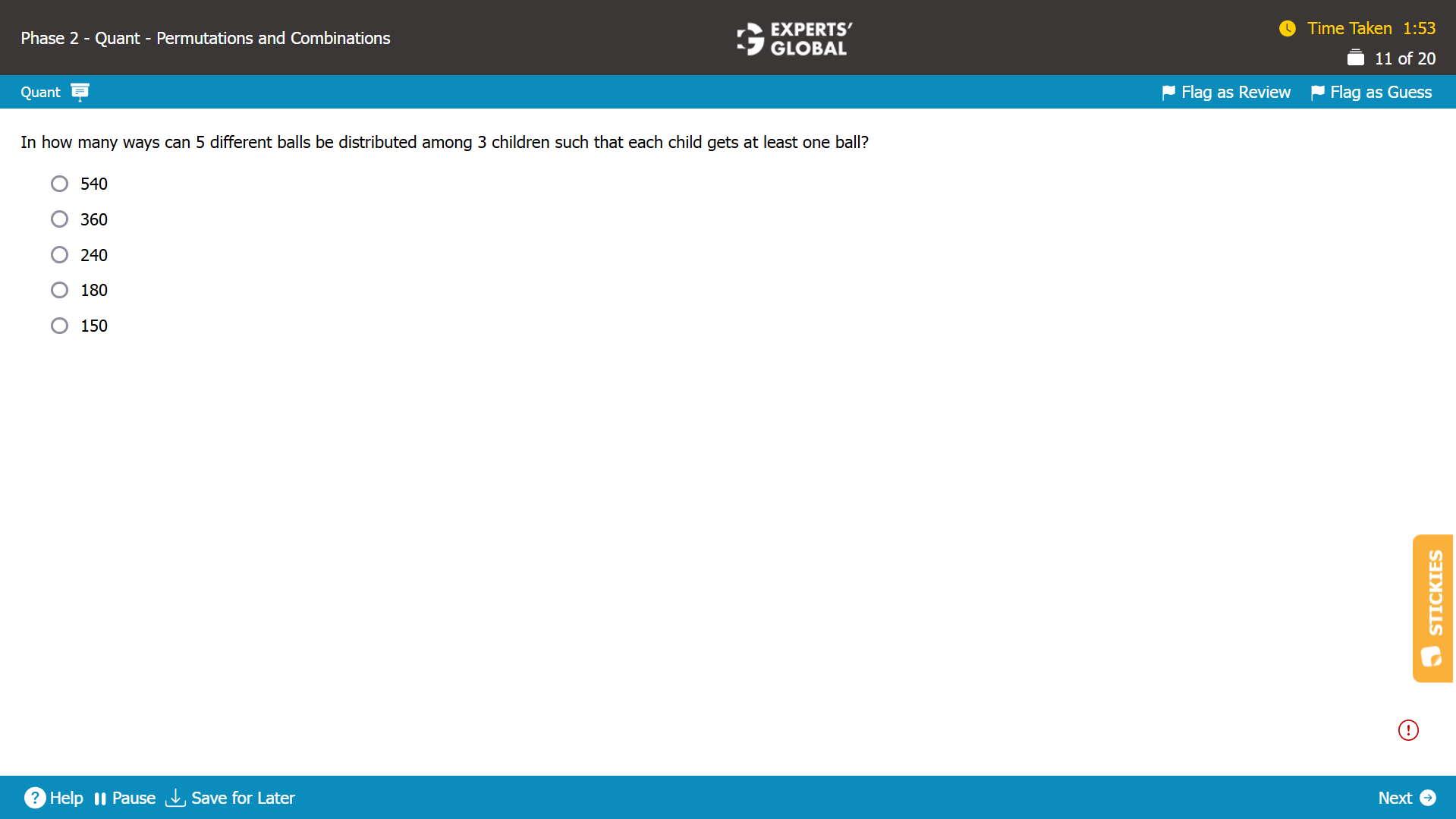
Written Explanation
There are the following 2 possibilities in which 5 different balls can be distributed among 3 children such that each child gets at least one ball.
Possibility 1: The first child gets 2 balls, the second child gets 2 balls, and the third child gets 1 ball.
Let’s first select the child that would get only 1 ball. This child can be selected from 3 children in 3 ways.
For the remaining two children…
… 2 balls from 5 balls can be given to the first child in 5C2 ways, and
… 2 balls from 3 remaining balls can be given to the second child in 3C2 ways.
For the chosen one child…
… 1 remaining ball can be given to the third child in 1 way.
Number of ways of Possibility 1 = 3 X (5C2 X 3C2 X 1) = 3 X 10 X 3 X 1 = 90.
Possibility 2: The first child gets 3 balls, the second child gets 1 ball, and the third child gets 1 ball.
Let’s first select the child that would get 3 balls. This child can be selected from 3 children in 3 ways.
For the chosen one child…
… 3 balls from 5 balls can be given to the first child in 5C3 ways, and
For the remaining two children…
… 1 ball from 2 remaining balls can be given to the second child in 2C1 ways.
… 1 remaining ball can be given to the third child in 1 way.
Number of ways of Possibility 2 = 3 X (5C3 X 2C1 X 1) = 3 X 10 X 2 X 1 = 60.
The two possibilities are mutually exclusive; so, the number of ways of each possibility need to be added to get the total number of ways.
So, total number of ways = number of ways of Possibility 1 + number of ways of Possibility 2 = 90 + 60 = 150.
The required distribution can be done in 150 ways.
E is the correct answer choice.
Practice Question 4
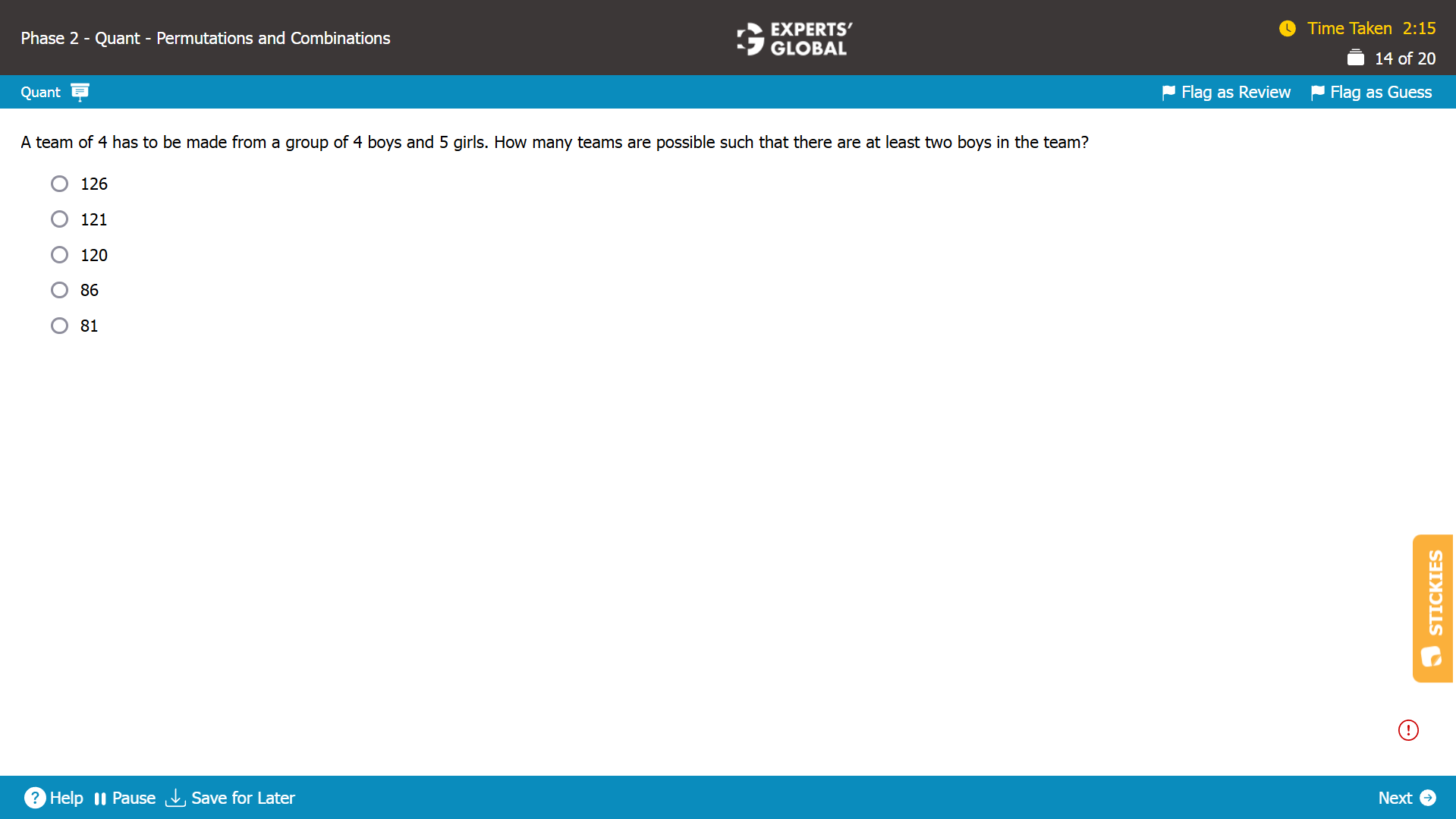
Written Explanation
There are 4 boys + 5 girls = 9 children. A team of 4 children needs to be selected.
Number of ways in which teams can be selected with no restriction = 9C4
Let’s say that there is no boy in the team.
In other words, 4 of the 5 girls are selected in the team.
Number of ways in which teams can be selected with no boy = 5C4
Let’s say that there is one boy in the team.
In other words, 3 of the 5 girls are selected, and 1 of the 4 boys is selected. Both selections are independent.
Number of ways in which teams can be selected with one boy = 5C3 X 4C1
Number of ways in which teams can be selected with at least two boys = Number of ways in which teams can be selected with no restriction – number of ways in which teams can be selected with no boy – number of ways in which teams can be selected with one boy
So, number of ways in which teams can be selected with at least two boys = 9C4 – 5C4 – (5C3 X 4C1) = 126 – 5 – (10 X 4) = 81.
81 teams are possible such that there are at least two boys in the team.
E is the correct answer choice.
GMAT Quant: Probability Sample Question
Probability tells you how likely an event is to happen, so you can put a clear number on uncertainty. It turns chance into something you can measure, compare, and understand.
Important: Before visiting the following sample question(s), if you would like a quick brush up of key Probability concepts, you may first visit: Free GMAT Probability Prep
Practice Question 1
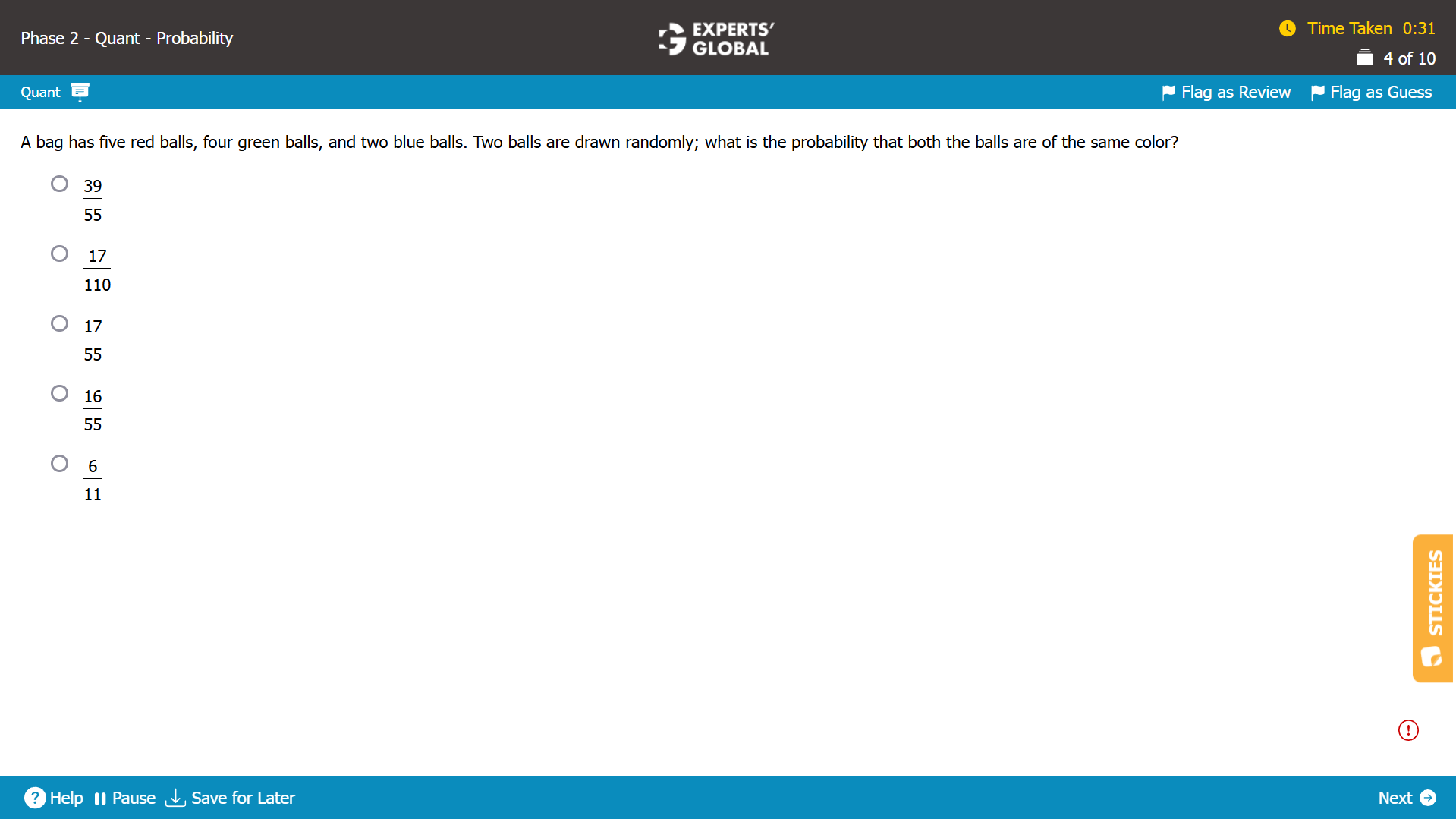
Written Explanation
There are 5 red balls.
So, number of ways in which 2 red balls can appear = 5C2 = 10.
There are 4 green balls.
So, number of ways in which 2 green balls can appear = 4C2 = 6.
There are 2 blue balls.
So, number of ways in which 2 blue balls can appear = 2C2 = 1.
When two balls of the same color appear, they can be either red, or green, or blue.
Number of ways in which 2 balls of the same color can appear = number of ways in which 2 red balls can appear + number of ways in which 2 green balls can appear + number of ways in which 2 blue balls can appear = 10 + 6 + 1 = 17.
Total number of balls = 5 red balls + 4 green balls + 2 blue balls = 11 balls.
Number of ways in which 2 calls can be drawn = 11C2 = 55.
So, the probability of drawing two balls of the same color = (number of ways in which 2 balls of the same color can appear) / (number of ways in which 2 calls can be drawn)
= 17 / 55.
The probability that both the balls are of the same color is 17 / 55.
C is the correct answer choice.
Practice Question 2
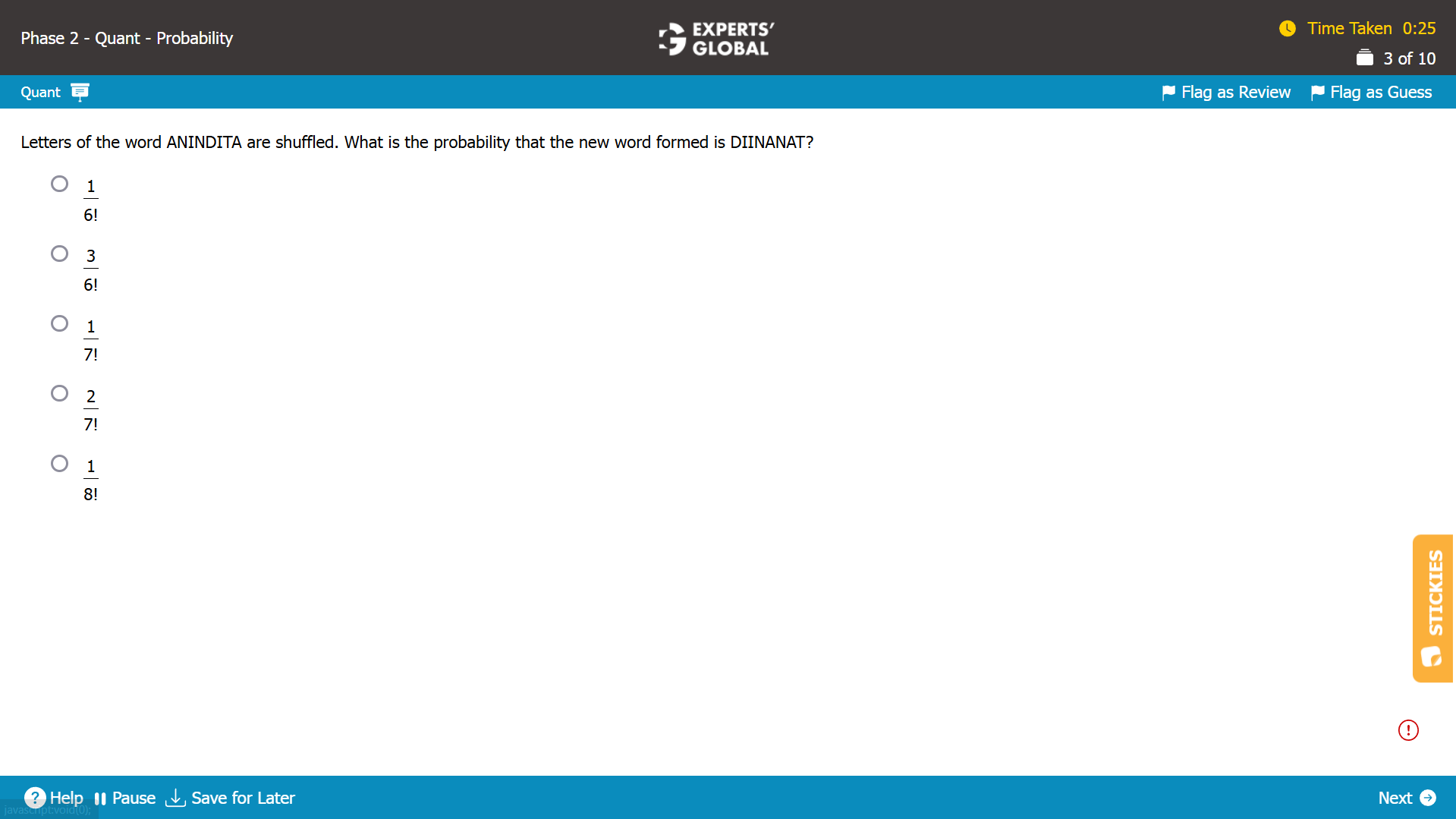
Written Explanation
Number of letters in ANINDITA = 8.
Number of ways in which 8 letters can be arranged = 8!
These 8! ways treat two individual A’s differently; the order of the individual letters is not important; so, the two A’s must be treated as the same letter. There are 2 A’s; so, there will be 2! ways of arranging the A’s.
Similarly, these 8! ways treat two individual N’s differently; the order of the individual letters is not important; so, the two N’s must be treated as the same letter. There are 2 N’s; so, there will be 2! ways of arranging the N’s.
Similarly, these 8! ways treat two individual I’s differently; the order of the individual letters is not important; so, the two I’s must be treated as the same letter. There are 2 I’s; so, there will be 2! ways of arranging the I’s.
Number of ways in which 8 letters can be arranged, without repetition = 8! / (2! X 2! X 2!) = 8! / 8 = 7!
DINANAT is a unique combination needed. Please note that the word DINANAT would appear to be DINANAT regarless of any repeated letters in it. So, number of ways in which DINANAT can occur = 1.
Overall, the probability of DINANAT = 1 / 7!.
C is the correct answer choice.
GMAT Quant: Sequences and Series Sample Question
Sequences are ordered number lists where each term follows a clear rule or pattern. A series takes those terms and adds them up to form a single total.
Important: Before visiting the following sample question(s), if you would like a quick brush up of key Sequences and Series concepts, you may first visit: Free GMAT Sequences and Series Prep
Practice Question 1
Written Explanation
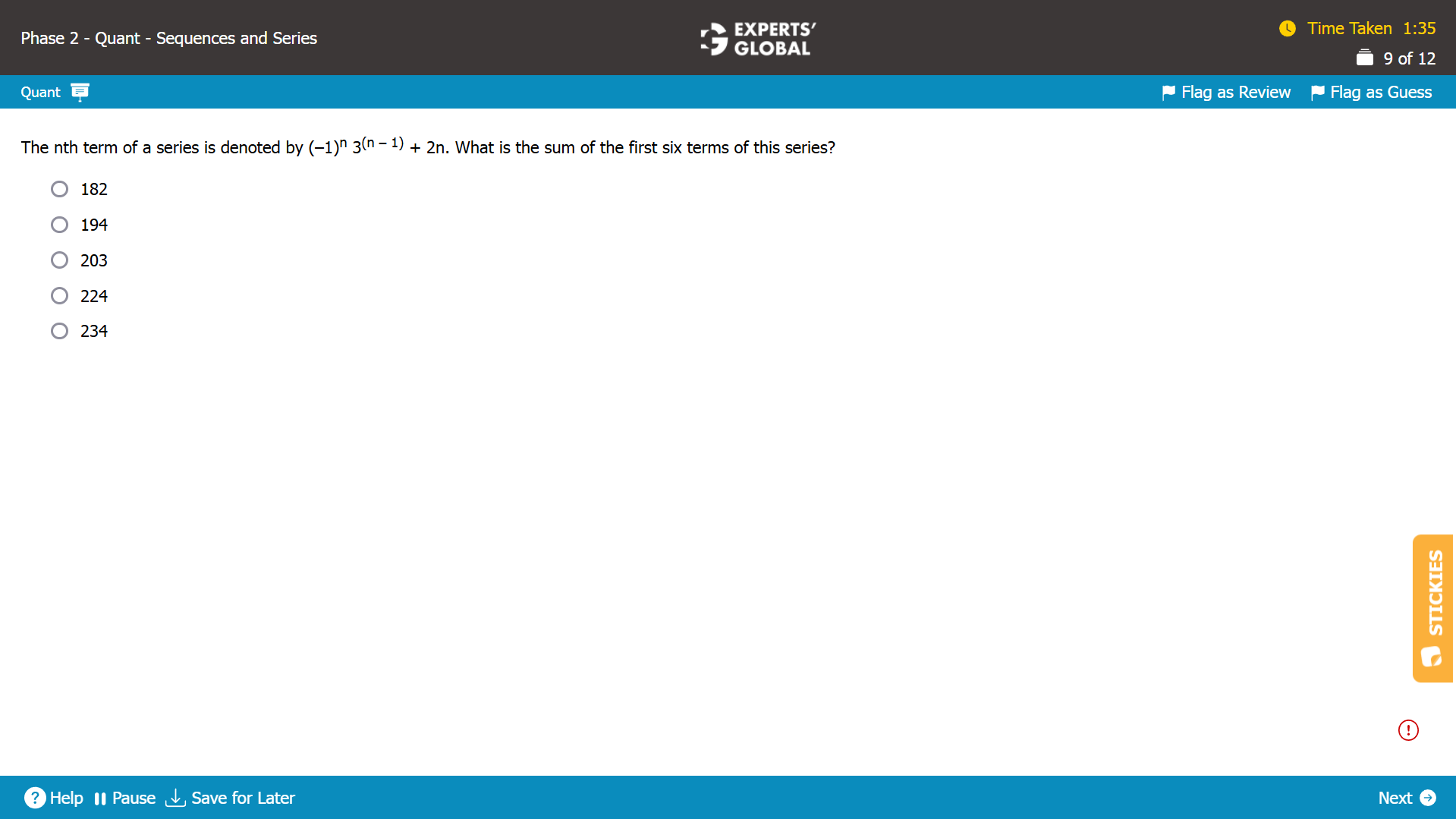
nth term = (–1)n 3(n – 1) + 2n
1st term = (–1)1 3(1 – 1) + 2 (1) = (–1 X 1) + 2 = 1
2nd term = (–1)2 3(2 – 1) + 2 (2) = (1 X 3) + 4 = 7
3rd term = (–1)3 3(3 – 1) + 2 (3) = (–1 X 9) + 6 = –3
4th term = (–1)4 3(4 – 1) + 2 (4) = (1 X 27) + 8 = 35
5th term = (–1)5 3(5 – 1) + 2 (5) = (–1 X 81) + 10 = –71
6th term = (–1)6 3(6 – 1) + 2 (6) = (1 X 243) + 12 = 255
Sum of the first six terms = 1 + 7 – 3 + 35 – 71 + 255 = 224.
D is the correct answer choice.
Practice Question 2
Written Explanation
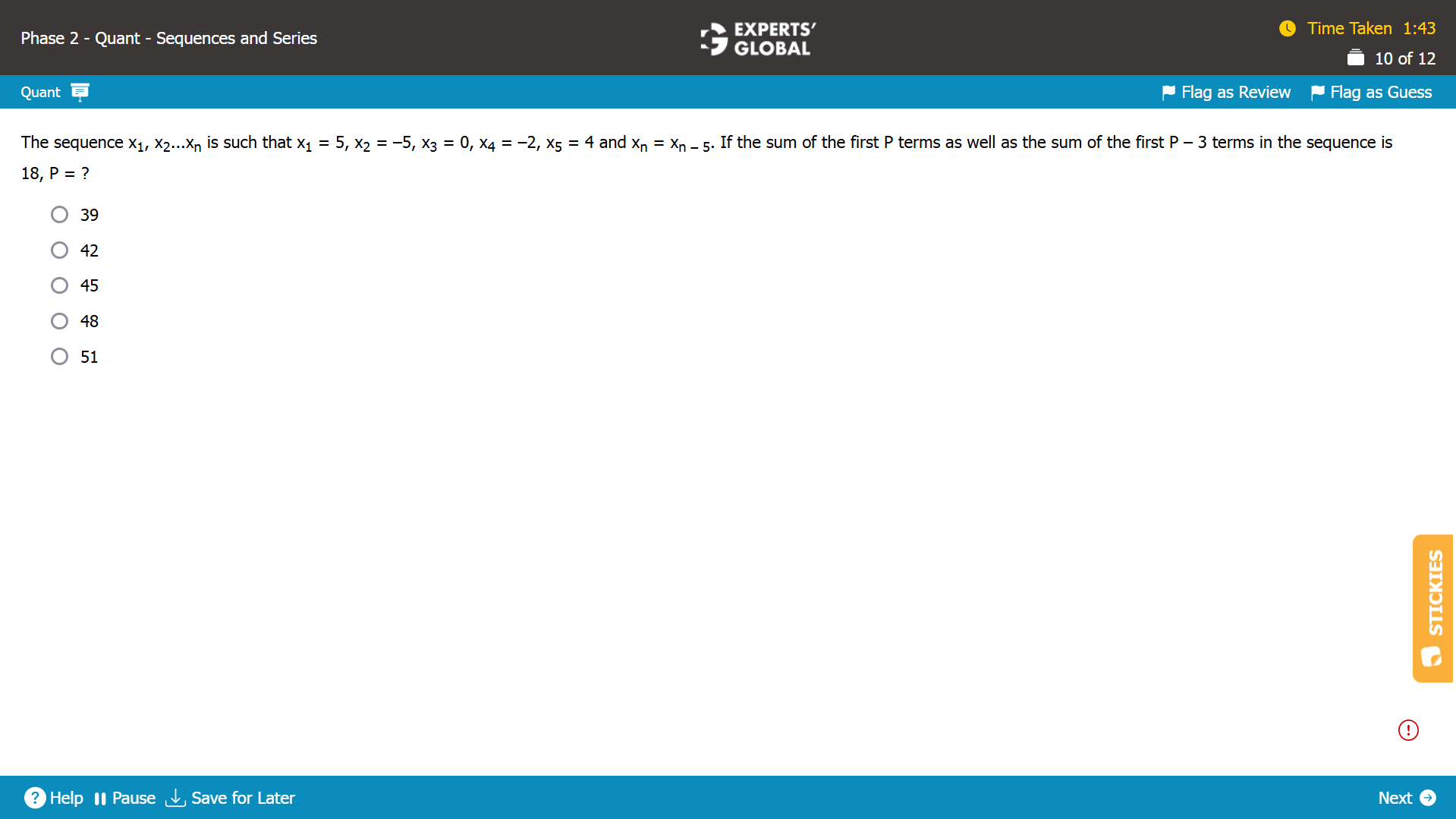
Because xn = xn – 5, the series has the first five terms repeating. These five terms are 5, –5, 0, –2, and 4. The terms repeat thereafter.
Sum of first P terms = sum of first (P – 3) terms + sum of the last 3 terms in the first P terms
18 = 18 + sum of the last 3 terms in the first P terms
Sum of the last 3 terms in the first P terms = 0
From the given 5 terms, the three consecutive terms that add up to 0 are 5, –5, 0.
So, the last 3 terms in the first P terms are 5, –5, 0 or the first, second and third terms or their repeats.
In other words…
Sum of first (P – 3) terms = some multiple of the sum of {5, –5, 0, –2, and 4}
and
Sum of first P terms = Sum of first (P – 3) terms + {5, –5, 0}
So, (P – 3) is a multiple of 5 and P is 3 more than a multiple of 5.
From the answer choices…
48 is the only number that is 3 more than a multiple of 5.
Verifying with P = 48…
Sum of first (P – 3) terms = Sum of first 45 terms = (45 / 5) X sum of {5, –5, 0, –2, and 4} = 9 X (2) = 18, as given the questions stem.
Sum of first P terms = Sum of first 48 terms = 18 + sum of {5, –5, 0} = 18, as given the questions stem.
So, P = 48.
D is the correct answer choice.
Practice Question 3
Written Explanation
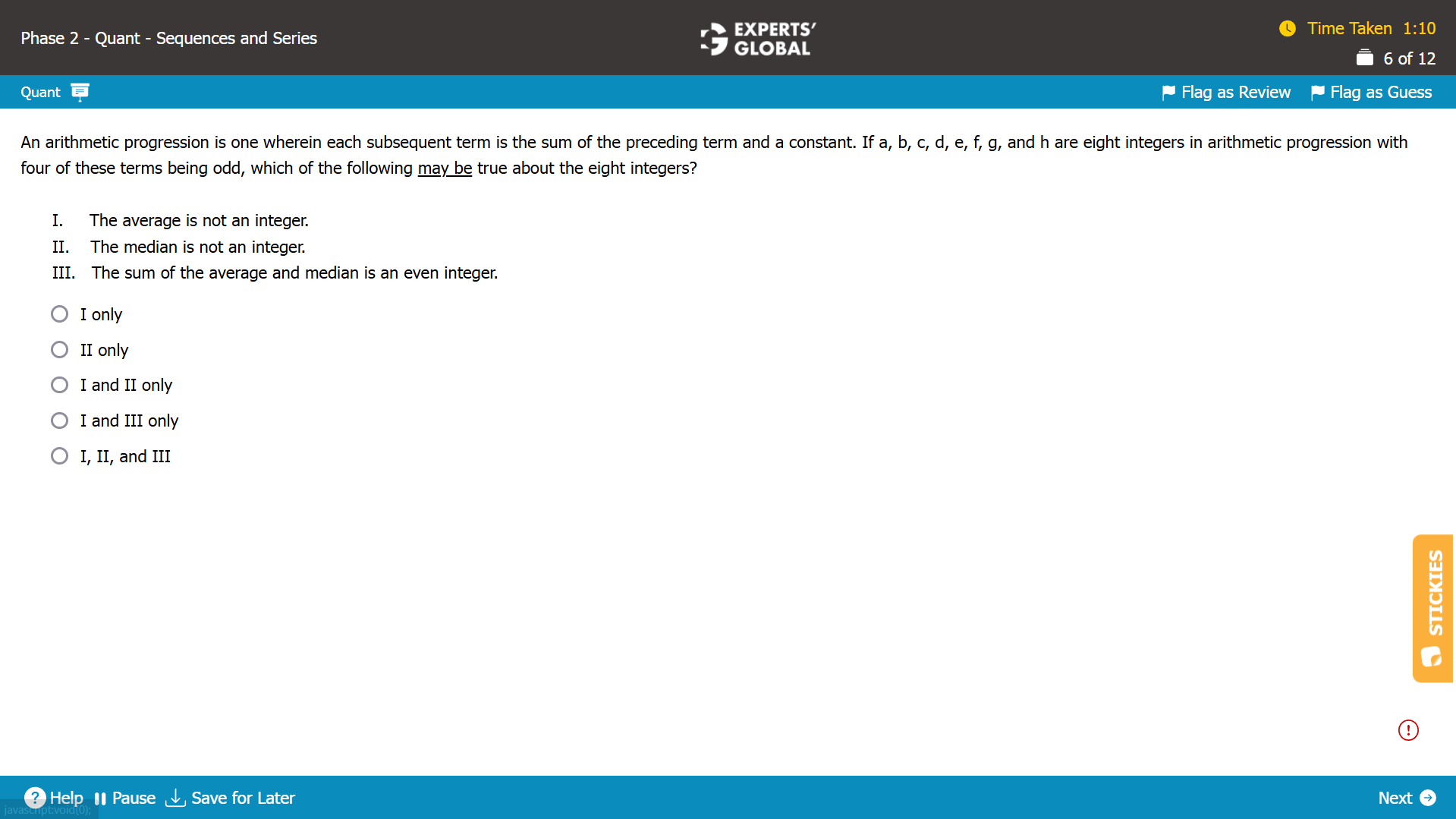
S = {a, b, c, d, e, f, g, h}
There are 8 terms in total. There are 4 odd terms; so, there are 4 even terms.
Because there are both even and odd terms, the common difference is odd and consecutive terms are even and odd, alternately.
In this arithmetic progression, mean = median = the average of the 4th and the 5th terms.
These terms are consecutive; so, one of these would be even and the other would be odd and their sum would be odd.
So, the average of these terms will NOT be an integer. So, Statement I is TRUE.
In this arithmetic progression, median = the average of the 4th and the 5th terms.
These terms are consecutive; so, one of these would be even and the other would be odd and their sum would be odd.
So, the median of these terms will NOT be an integer. So, Statement II is TRUE.
In this arithmetic progression, mean = median = the average of the 4th and the 5th terms.
These terms are consecutive; so, one of these would be even and the other would be odd and their sum would be odd.
mean = median = (sum of the 4th and the 5th terms) / 2 = odd / 2.
mean + median = 2 X (odd / 2) = odd.
So, the sum of the average and median is an odd integer. Statement III is FALSE.
C is the correct answer choice.
Verbal Sample Questions
The verbal section on the GMAT is one of the three sections on the exam and therefore contributes to one third of your overall score. Along with this direct contribution, the skills developed during verbal section preparation also support performance in roughly 50% of the Data Insights section. The GMAT verbal section includes two question types: reading comprehension (RC) and critical reasoning (CR). Each question presents a passage or an argument followed by multiple answer choices, out of which only one option is correct. Your task is to read carefully, evaluate the information and reasoning presented, and identify the answer choice that best meets the requirement of the question.
GMAT RC: Reading Comprehension Sample Questions
On the GMAT, Reading Comprehension gives you a dense passage with a few smart twists, and then three or four multiple choice questions with exactly one correct answer. You usually see about four passages, which puts roughly 13 to 15 of the 23 Verbal questions in the RC bucket. That fact alone makes RC a non-negotiable part of your Verbal plan and your overall GMAT plan. Here is the real win: strong Reading Comprehension trains you to absorb, filter, and analyze information fast. That skill shows up everywhere, across sections and question types. So when you get better at RC, you do not just raise your RC score, you raise your entire GMAT game.
Important: Before visiting the following sample question(s), if you would like a quick brush up of key Reading Comprehension concepts, you may first visit: Free GMAT Reading Comprehension Prep
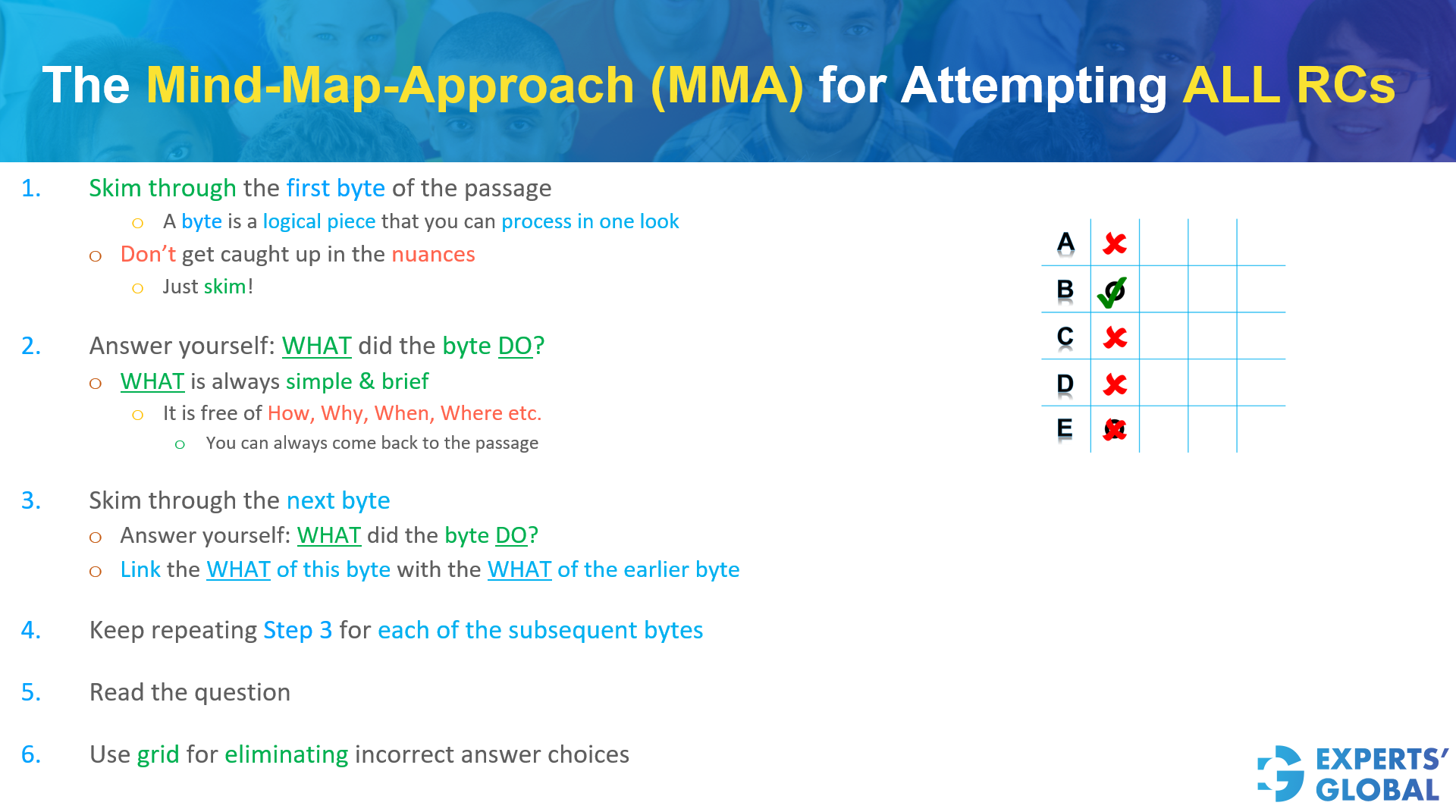
Snapshot of the Mind-Map-Approach for RCs by Experts’ Global
GMAT RC: Sample Question 1
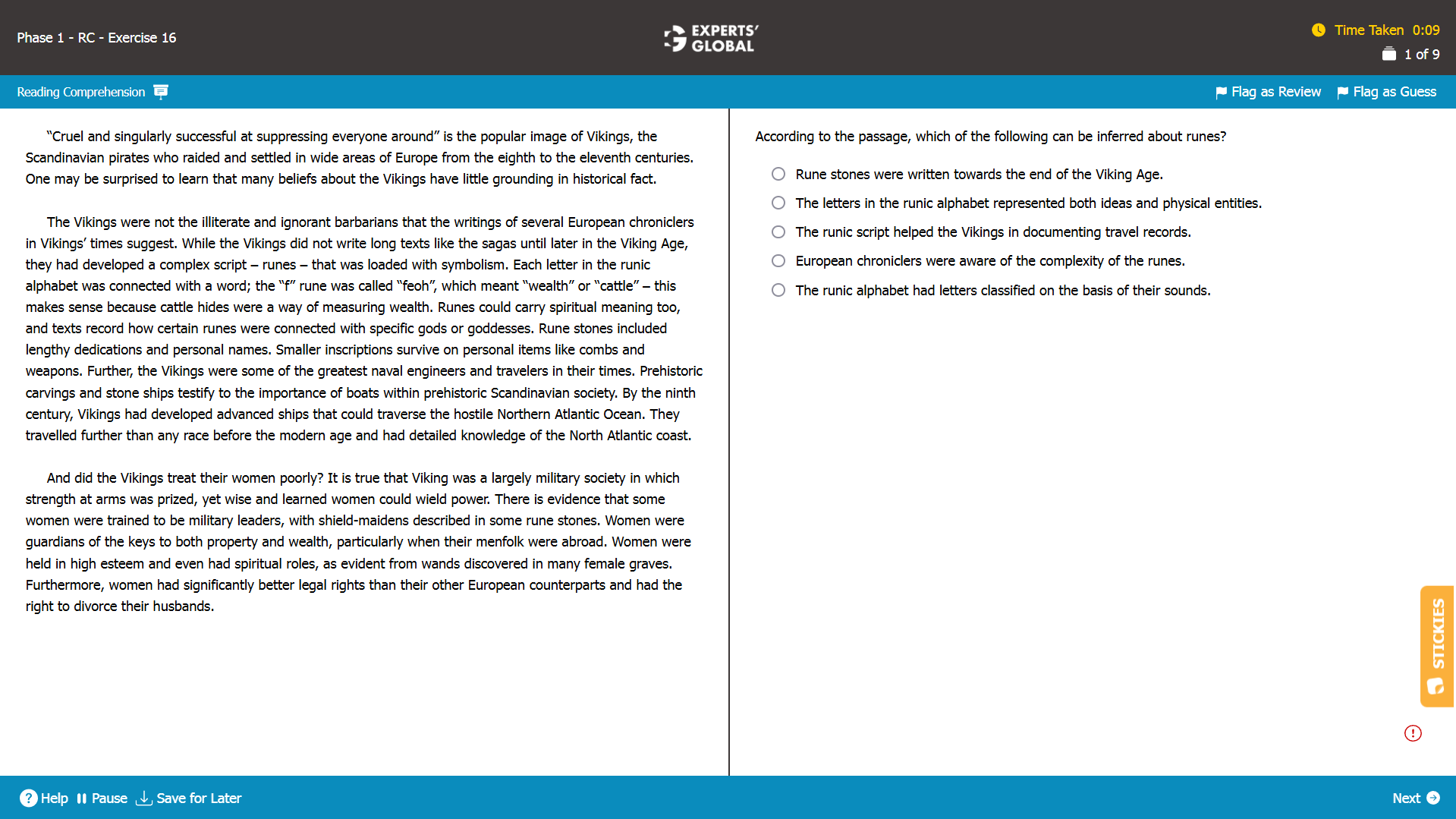
Written Explanation
Mind-map
To suggest that many beliefs about the Vikings are incorrect (Paragraph 1)
To refute that Vikings were illiterate and ignorant barbarians (Paragraph 2)
To refute that Vikings treated their women poorly (Paragraph 3)
Each answer choice needs to be carefully evaluated in light of the information presented in the passage.
A. The second paragraph mentions that “Rune stones included lengthy dedications and personal names” and the third paragraph mentions that “There is evidence that some women were trained to be military leaders, with shield-maidens described in some rune stones”; these are the only two references to “rune stones” in the passage and no reference suggests the period in which rune stones were written. There is a reference to “late Viking Age”, when the second paragraph mentions that “the Vikings did not write long texts like the sagas until later in the Viking Age”; this reference suggests that it was the long texts like the sagas, and not rune stones, that were written towards the end of the Viking Age. Overall, the passage doesn’t suggest that rune stones were written towards the end of the Viking Age, as the answer choice mentions. Incorrect.
B. Correct. The second paragraph mentions that runes were “loaded with symbolism” and that “Each letter in the runic alphabet was connected with a word; the “f” rune was called “feoh”, which meant “wealth” or “cattle” – this makes sense because cattle hides were a way of measuring wealth”; it can be inferred that the letters in the runic alphabet were symbolic and represented both ideas, such as wealth, and physical entities, such as cattle.
C. The second paragraph mentions that “the Vikings were some of the greatest naval engineers and travelers in their times” and that “They travelled further than any race before the modern age and had detailed knowledge of the north Atlantic coast”; although there are references to the travels of the Vikings, there is no mention of any “travel records” and the script of such records; the passage doesn’t suggest that the runic script helped the Vikings in documenting travel records, as the answer choice mentions. Incorrect.
D. The second paragraph states that “The Vikings were not illiterate and ignorant barbarians that the writings of several European chroniclers in Vikings’ times suggest”; to support this view, the passage subsequently mentions that the Vikings “had developed a complex script – runes”; the passage makes no connection between the complexity of runes and the European chroniclers’ awareness of it. On a logical note, because the passage states that European chroniclers in Vikings’ times considered the Vikings “illiterate and ignorant barbarians”, it is unlikely that they were aware of the complexity of the runes, the Vikings script. Incorrect.
E. The second paragraph mentions that “Each letter in the runic alphabet was connected with a word; the “f” rune was called “feoh”, which meant “wealth” or “cattle” – this makes sense because cattle hides were a way of measuring wealth”; there is no mention of the classification of the letters of the rune alphabet on the basis of their sounds. Incorrect.
B is the best answer choice.
GMAT RC: Sample Question 2
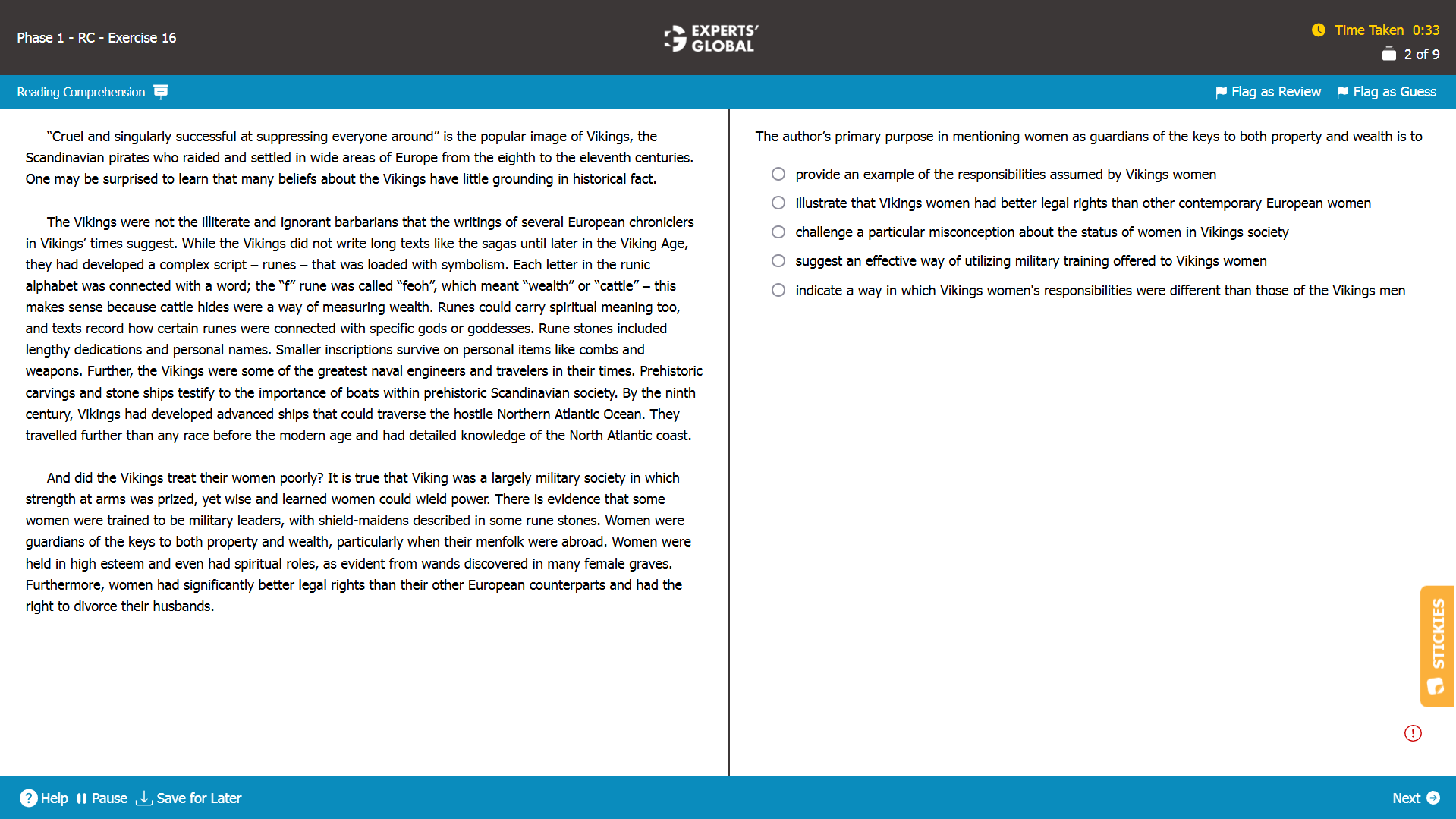
Written Explanation
Mind-map
To suggest that many beliefs about the Vikings are incorrect (Paragraph 1)
To refute that Vikings were illiterate and ignorant barbarians (Paragraph 2)
To refute that Vikings treated their women poorly (Paragraph 3)
The third paragraph states that “Women were guardians of the keys to both property and wealth, particularly when their menfolk were abroad”. The author’s purpose in mentioning women as guardians of the keys to both property and wealth is to suggest that women had high status in society, and thus refutes the perception that the Vikings treated their women poorly. Each answer choice needs to be carefully evaluated in light of the information presented in this context.
A. The third paragraph mentions that “Women were guardians of the keys to both property and wealth, particularly when their menfolk were abroad”; although this reference suggests that guarding both property and wealth were women’s “responsibilities”, as the answer choice mentions, to provide an example of women’s responsibilities is not the purpose of the mention of women as guardians. Furthermore, as the mind-map suggests, the third paragraph refutes that the Vikings treated their women poorly; in doing so, the author’s purpose in mentioning women as guardians of the keys to both property and wealth is to suggest that women had a high status in society, and thus refutes the perception that the Vikings treated their women poorly; we need an answer choice on similar lines. Incorrect.
B. The third paragraph mentions that “Women were guardians of the keys to both property and wealth, particularly when their menfolk were abroad” and that “women had significantly better legal rights than their other European counterparts and had the right to divorce their husbands”; the passage does not make any connection between the Vikings women being guardians of the keys to both property and wealth, and the women having legal rights; being guardians of keys and holding legal rights are not related. Furthermore, as the mind-map suggests, the third paragraph refutes that the Vikings treated their women poorly; in doing so, the author’s purpose in mentioning women as guardians of the keys to both property and wealth is to suggest that women had a high status in society, and thus refutes the perception that the Vikings treated their women poorly; we need an answer choice on similar lines. Incorrect.
C. Correct. As the mind-map suggests, the third paragraph refutes that the Vikings treated their women poorly; in doing so, the paragraph states that “Women were guardians of the keys to both property and wealth, particularly when their menfolk were abroad”; author’s purpose in mentioning women as guardians of the keys to both property and wealth is to suggest that women had a high status in society, and thus refutes the perception that the Vikings treated their women poorly; in other words, the passage mentions women as guardians of the keys to both property and wealth in order to challenge a particular misconception about the status of women in Vikings society, as the answer choice mentions.
D. Although the third paragraph mentions that “There is evidence that some women were trained to be military leaders, with shield-maidens described in some rune stones. Women were guardians of the keys to both property and wealth, particularly when their menfolk were abroad”, the passage doesn’t suggest that women’s task of guardians of the keys to both property and wealth is an “effective way of utilizing” the military training offered to Vikings women. Furthermore, as the mind-map suggests, the third paragraph refutes that the Vikings treated their women poorly; in doing so, the author’s purpose in mentioning women as guardians of the keys to both property and wealth is to suggest that women had a high status in society, and thus refutes the perception that the Vikings treated their women poorly; we need an answer choice on similar lines. Incorrect.
E. Although the third paragraph mentions that “Women were guardians of the keys to both property and wealth, particularly when their menfolk were abroad”, the passage doesn’t compare the responsibility of the Vikings women with those of the Vikings men. Furthermore, as the mind-map suggests, the third paragraph refutes that the Vikings treated their women poorly; in doing so, the author’s purpose in mentioning women as guardians of the keys to both property and wealth is to suggest that women had a high status in society, and thus refutes the perception that the Vikings treated their women poorly; we need an answer choice on similar lines. Incorrect.
C is the best answer choice.
GMAT RC: Sample Question 3
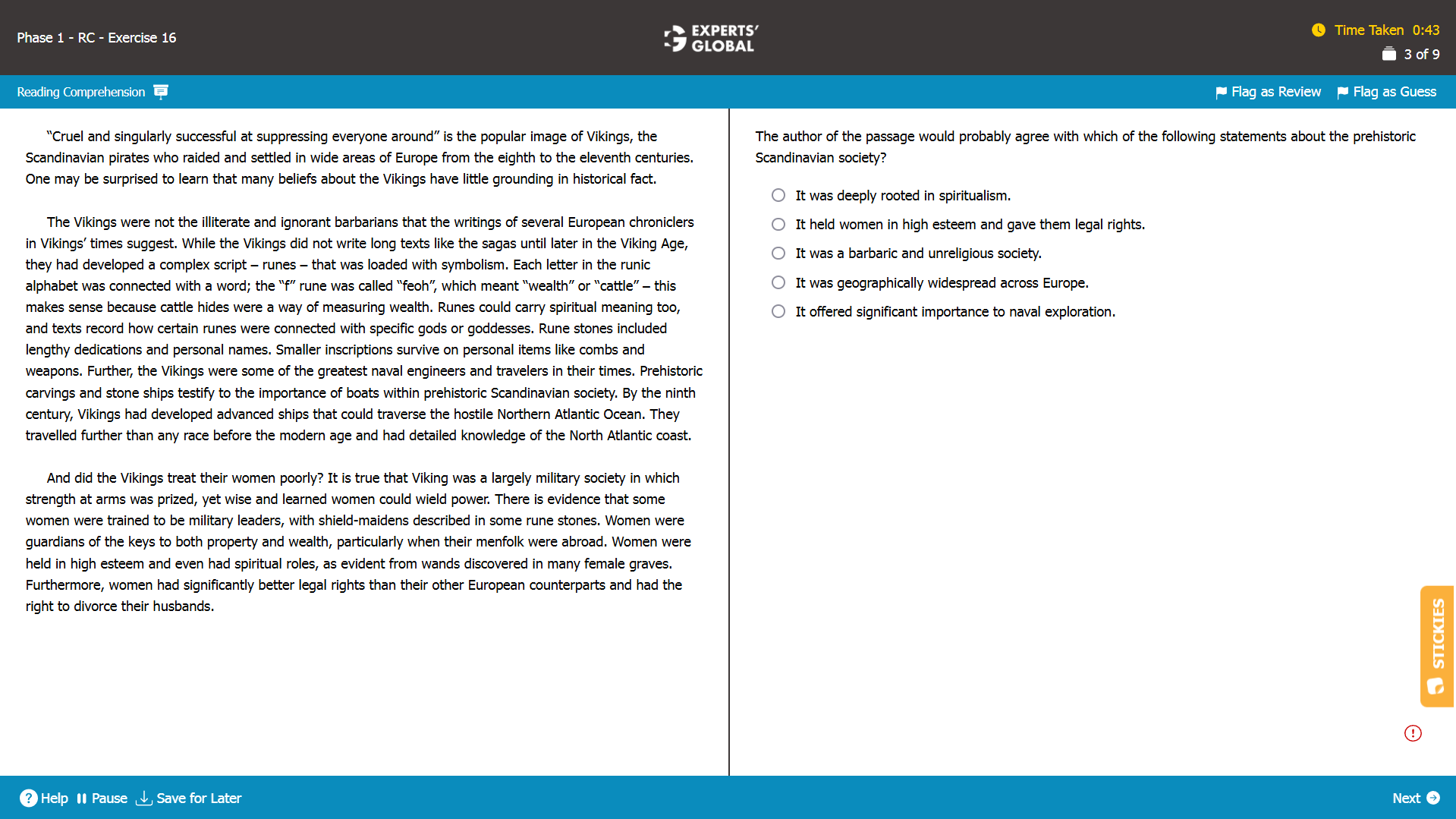
Written Explanation
Mind-map
To suggest that many beliefs about the Vikings are incorrect (Paragraph 1)
To refute that Vikings were illiterate and ignorant barbarians (Paragraph 2)
To refute that Vikings treated their women poorly (Paragraph 3)
The second paragraph mentions that “Prehistoric carvings and stone ships testify to the importance of boats within prehistoric Scandinavian society”. There is no other mention of the prehistoric Scandinavian society. Each answer choice needs to be carefully evaluated in light of the information presented in this context.
A. The second paragraph mentions that “Prehistoric carvings and stone ships testify to the importance of boats within prehistoric Scandinavian society”; there is no mention of spiritualism in the prehistoric Scandinavian society; so, it cannot be inferred from the passage that the author would agree with the statement that the prehistoric Scandinavian society was deeply rooted in spiritualism. Incorrect.
B. The second paragraph mentions that “Prehistoric carvings and stone ships testify to the importance of boats within prehistoric Scandinavian society”; there is no mention of women or their status/legal rights in the prehistoric Scandinavian society; so, it cannot be inferred from the passage that the author would agree with the statement that the prehistoric Scandinavian society held women in high esteem and gave them legal rights. Further, the third paragraph mentions that, in the Vikings society, women were “held in high esteem” and “had significantly better legal rights than their other European counterparts”; such treatment is mentioned in the context of the Vikings, and not the prehistoric Scandinavian society. Incorrect.
C. The second paragraph mentions that “Prehistoric carvings and stone ships testify to the importance of boats within prehistoric Scandinavian society”; there is no mention of the prehistoric Scandinavian society being barbaric and unreligious; so, it cannot be inferred from the passage that the author would agree with the statement that the prehistoric Scandinavian society was a barbaric and unreligious society. Further, as the mind-map suggests, the second paragraph discusses the perception that the Vikings were “illiterate and ignorant barbarians” and refutes such a belief; the perception of barbarism is mentioned in the context of the Vikings, and not the prehistoric Scandinavian society. Incorrect.
D. The second paragraph mentions that “Prehistoric carvings and stone ships testify to the importance of boats within prehistoric Scandinavian society”; there is no mention of the prehistoric Scandinavian society being geographically widespread; so, it cannot be inferred from the passage that the author would agree with the statement that the prehistoric Scandinavian society was geographically widespread across Europe. Further, the first paragraph mentions that the Vikings were “Scandinavian pirates who raided and settled in wide areas of Europe”; the widespread settlement across Europe is mentioned in the context of the Vikings, and not the prehistoric Scandinavian society. Incorrect.
E. Correct. The second paragraph mentions that “Prehistoric carvings and stone ships testify to the importance of boats within prehistoric Scandinavian society”; the author is likely to agree with the statement that the prehistoric Scandinavian society offered significant importance to naval exploration.
E is the best answer choice.
GMAT RC: Sample Question 4
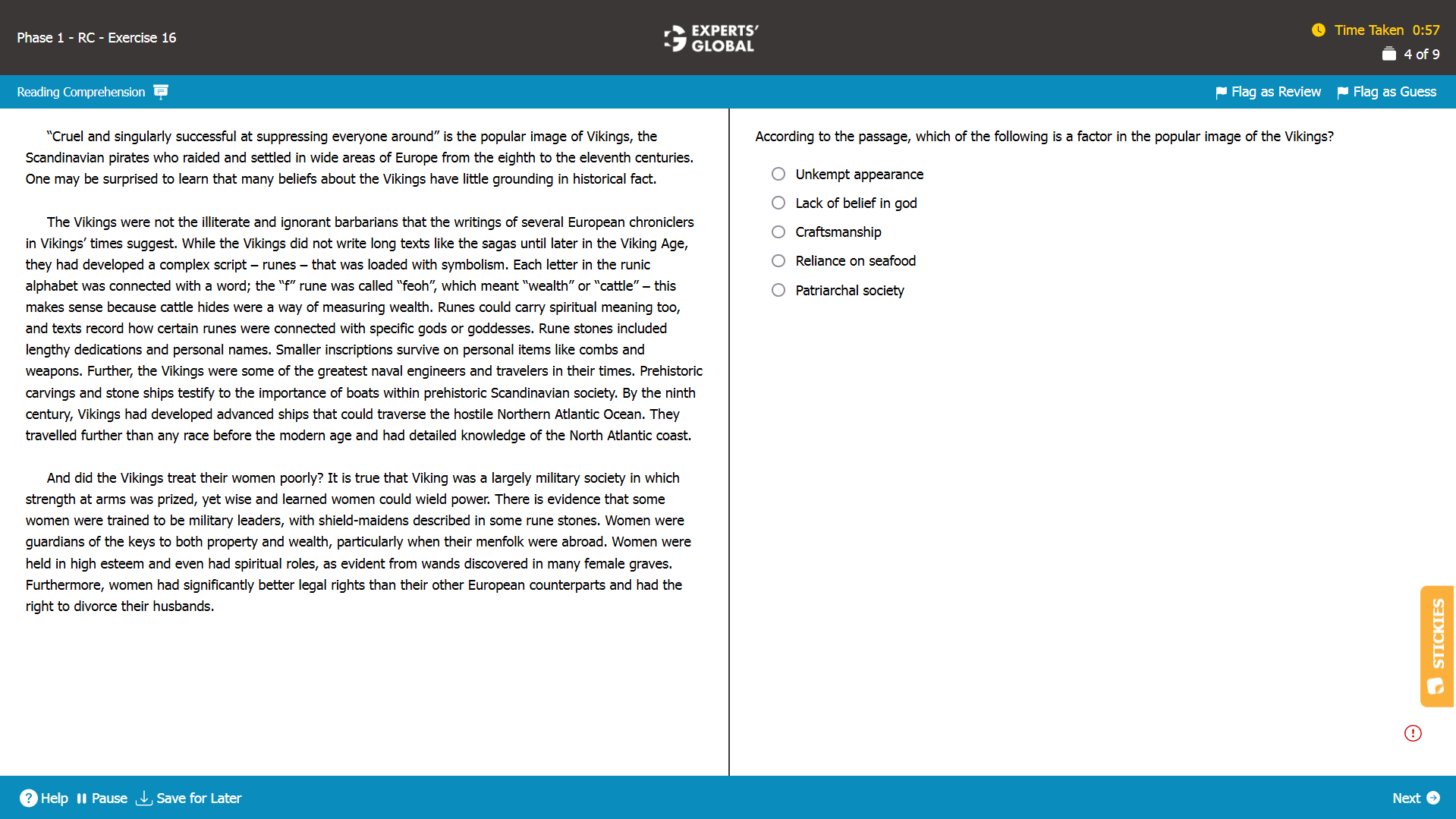
Written Explanation
Mind-map
To suggest that many beliefs about the Vikings are incorrect (Paragraph 1)
To refute that Vikings were illiterate and ignorant barbarians (Paragraph 2)
To refute that Vikings treated their women poorly (Paragraph 3)
As a whole, the passage mentions several popular perceptions of the Vikings – that the Vikings were cruel and ruthless, that they were illiterate and ignorant barbarians, and that they treated their women poorly. Each answer choice needs to be carefully evaluated in light of the information presented in this context.
A. The passage makes no mention of the unkempt appearance of the Vikings. As a whole, while the passage mentions several popular perceptions of the Vikings – that the Vikings were cruel and ruthless, that they were illiterate and ignorant barbarians, and that they treated their women poorly, there is no reference to how untidy the Vikings looked, as a factor in the popular image of the Vikings. Incorrect.
B. The second paragraph mentions that Vikings’ runes “could carry spiritual meaning too, and texts record how certain runes were connected with specific gods or goddesses”; although there is a mention of the Vikings’ gods, the reference doesn’t suggest that the popular image of Vikings portrays them as a community without belief in god. As a whole, while the passage mentions several popular perceptions of the Vikings – that the Vikings were cruel and ruthless, that they were illiterate and ignorant barbarians, and that they treated their women poorly, there is no reference to the Vikings’ belief, or lack thereof, in god, as a factor in the popular image of the Vikings. Incorrect.
C. Trap. The second paragraph mentions that the Vikings were “some of the greatest naval engineers” and “had developed advanced ships that could traverse the hostile Northern Atlantic Ocean”; although the passage indicates that the Vikings had great craftsmanship, these references are made while conveying that the popular image of Vikings is incorrect, and not made while stating a factor in the popular image of the Vikings. As a whole, while the passage mentions several popular perceptions of the Vikings – that the Vikings were cruel and ruthless, that they were illiterate and ignorant barbarians, and that they treated their women poorly, there is no reference to the Vikings’ skills or artistry, as a factor in the popular image of the Vikings. Incorrect.
D. The passage makes no mention of Vikings’ food habits. As a whole, while the passage mentions several popular perceptions of the Vikings – that the Vikings were cruel and ruthless, that they were illiterate and ignorant barbarians, and that they treated their women poorly, there is no reference to the Vikings’ reliance on seafood, as a factor in the popular image of the Vikings. Incorrect.
E. Correct. The first paragraph mentions that the popular image of Vikings portrays them as “Cruel and singularly successful at suppressing everyone around”; as the mind-map mentions, the first paragraph suggests that many beliefs about the Vikings are incorrect, the second paragraph refutes that Vikings were illiterate and ignorant barbarians, and the third paragraph refutes that the Vikings treated their women poorly; as a whole, the passage mentions several popular perceptions of the Vikings – that the Vikings were cruel and ruthless, that they were illiterate and ignorant barbarians, and that they treated their women poorly; in other words, the passage suggests that patriarchal society is a factor in the Vikings’ popular image.
Note:
Some of the answer choices in this question are very tricky; however, a closer look will suggest answer choice E is too good to be incorrect and thus, cannot be eliminated; remember, on the Verbal section of GMAT, it is not about selecting one answer choice but about eliminating four answer choices; with this approach, you will be forced to look deeper and thus find flaws that you may have missed earlier. Crux- never select one answer choice, eliminate four!
E is the best answer choice.
GMAT RC: Sample Question 5
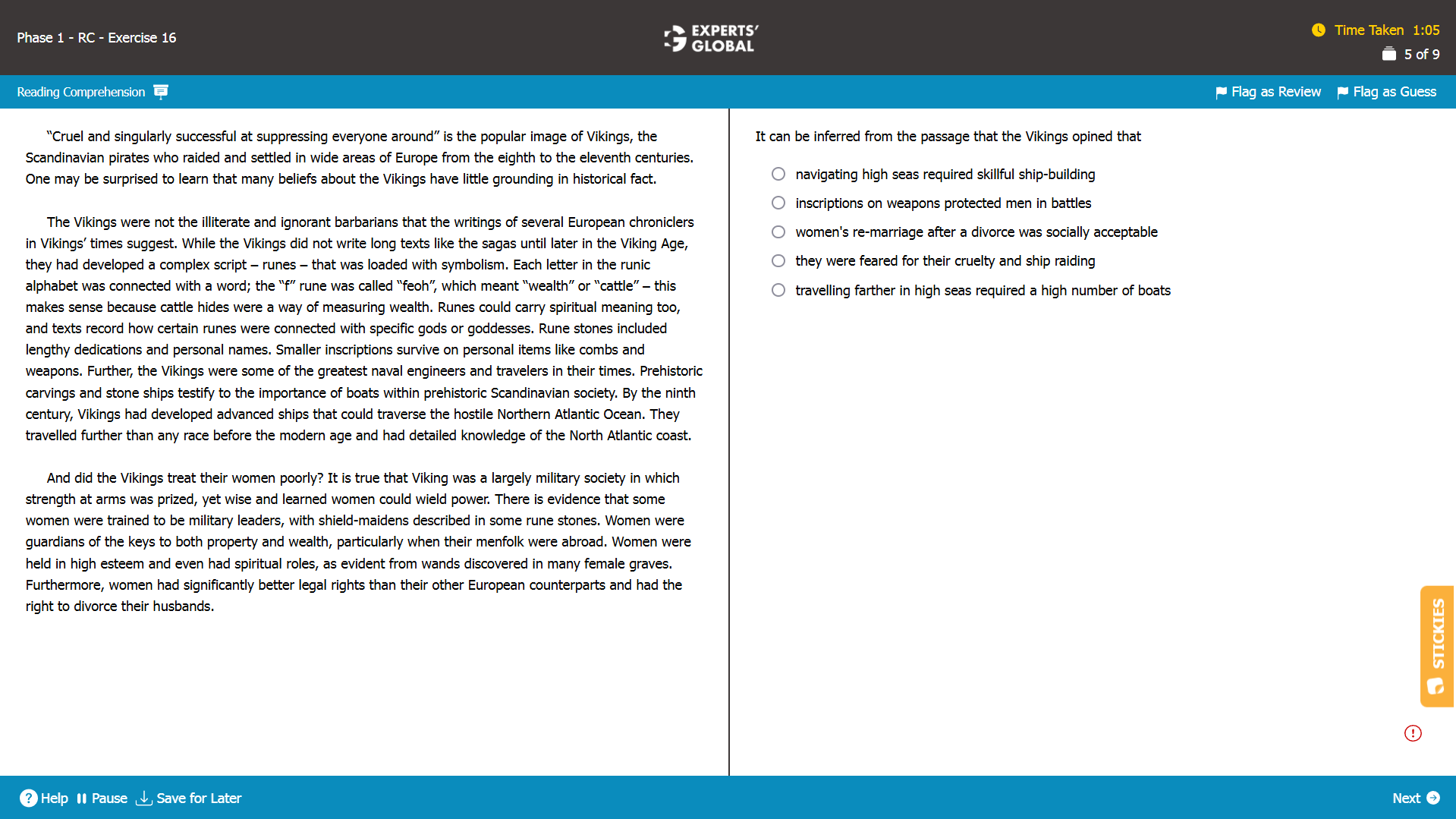
Written Explanation
Mind-map
To suggest that many beliefs about the Vikings are incorrect (Paragraph 1)
To refute that Vikings were illiterate and ignorant barbarians (Paragraph 2)
To refute that Vikings treated their women poorly (Paragraph 3)
Each answer choice needs to be carefully evaluated in light of the information presented in the passage.
A. Correct. The second paragraph mentions that the Vikings were “some of the greatest naval engineers” and “had developed advanced ships that could traverse the hostile Northern Atlantic Ocean”; it can be inferred that the Vikings knew that advanced ships were required to travel hostile waters; in other words, the Vikings opined that navigating high seas required skillful ship-building, as the answer choice suggests.
B. Although the second paragraph mentions that smaller runic “inscriptions survive on personal items like combs and weapons”, there is no mention of any belief or opinion behind making inscriptions on weapons; it cannot be inferred that the Vikings opined that inscriptions on weapons protected men in battles. Incorrect.
C. Although the third paragraph mentions that women “had the right to divorce their husbands”, there is no mention of how women’s re-marriage after a divorce is socially viewed; it cannot be inferred that the Vikings opined that women’s re-marriage after a divorce was socially acceptable. Incorrect.
D. Trap. Although the first paragraph mentions that the popular image of Vikings portrays them as “Cruel and singularly successful at suppressing everyone around”, there is no mention of whether the Vikings believed, or knew, that they were feared for their cruelty and ship raiding; in other words, it cannot be inferred that the Vikings opined that they were feared for their cruelty and ship raiding. Incorrect.
E. Trap. Although the second paragraph mentions that “Vikings had developed advanced ships that could traverse the hostile Northern Atlantic Ocean” and that “They travelled further than any race before the modern age”, the passage makes no reference to “a high number of boats” as a requirement for “travelling in high seas”; so, it cannot be inferred that the Vikings opined that travelling farther in high seas required a high number of boats. Incorrect.
A is the best answer choice.
GMAT RC: Sample Question 6
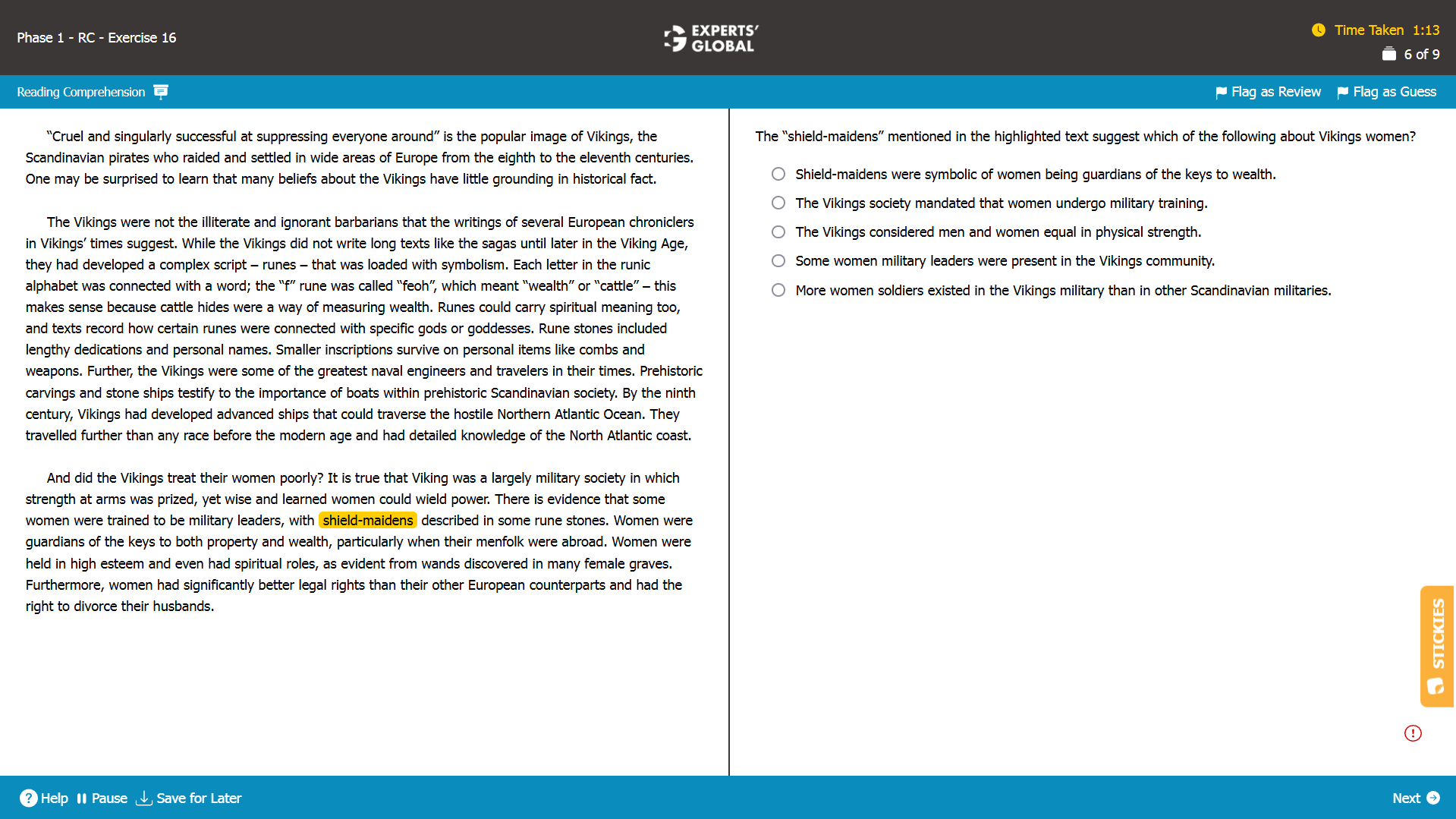
Written Explanation
: GMAT RC: Sample Question 6
Mind-map
To suggest that many beliefs about the Vikings are incorrect (Paragraph 1)
To refute that Vikings were illiterate and ignorant barbarians (Paragraph 2)
To refute that Vikings treated their women poorly (Paragraph 3)
The third paragraph states that “It is true that Viking was a largely military society in which strength at arms was prized, yet wise and learned women could wield power. There is evidence that some women were trained to be military leaders, with shield-maidens described in some rune stones”. The mention of “shield-maidens” acts as evidence that “some women were trained to be military leaders”, and thus refutes the perception that the Vikings treated their women poorly. Each answer choice needs to be carefully evaluated in light of the information presented in this context.
A. Trap. The third paragraph states that “It is true that Viking was a largely military society in which strength at arms was prized, yet wise and learned women could wield power. There is evidence that some women were trained to be military leaders, with shield-maidens described in some rune stones. Women were guardians of the keys to both property and wealth, particularly when their menfolk were abroad”; although it is mentioned that women were guardians of the keys to wealth, the shield-maidens in some rune stones are not symbolic of women being “guardians”, but symbolic of women being “trained military leaders”. Furthermore, the mention of “shield-maidens” acts as evidence that “some women were trained to be military leaders”; we need an answer choice on similar lines. Incorrect.
B. The third paragraph states that “It is true that Viking was a largely military society in which strength at arms was prized, yet wise and learned women could wield power. There is evidence that some women were trained to be military leaders, with shield-maidens described in some rune stones”; there is no suggestion that the Vikings society mandated that women undergo military training. Furthermore, the mention of “shield-maidens” acts as evidence that “some women were trained to be military leaders”; we need an answer choice on similar lines. Incorrect.
C. The third paragraph states that “It is true that Viking was a largely military society in which strength at arms was prized, yet wise and learned women could wield power. There is evidence that some women were trained to be military leaders, with shield-maidens described in some rune stones”; although it is mentioned that the Vikings trained some women to be military leaders, there is no suggestion that the Vikings considered men and women equal in physical strength. Furthermore, the mention of “shield-maidens” acts as evidence that “some women were trained to be military leaders”; we need an answer choice on similar lines. Incorrect.
D. Correct. The third paragraph states that “It is true that Viking was a largely military society in which strength at arms was prized, yet wise and learned women could wield power. There is evidence that some women were trained to be military leaders, with shield-maidens described in some rune stones”; the mention of “shield-maidens” acts as evidence that “some women were trained to be military leaders”; in other words, some women military leaders were present in the Vikings community, as the answer choice mentions.
E. Trap. The passage makes no mention of Scandinavian militaries other than that of the Vikings, and does not compare the number of women in the Vikings military with that in other Scandinavian militaries. Furthermore, the mention of “shield-maidens” acts as evidence that “some women were trained to be military leaders”; we need an answer choice on similar lines. Incorrect.
D is the best answer choice.
GMAT RC: Sample Question 7
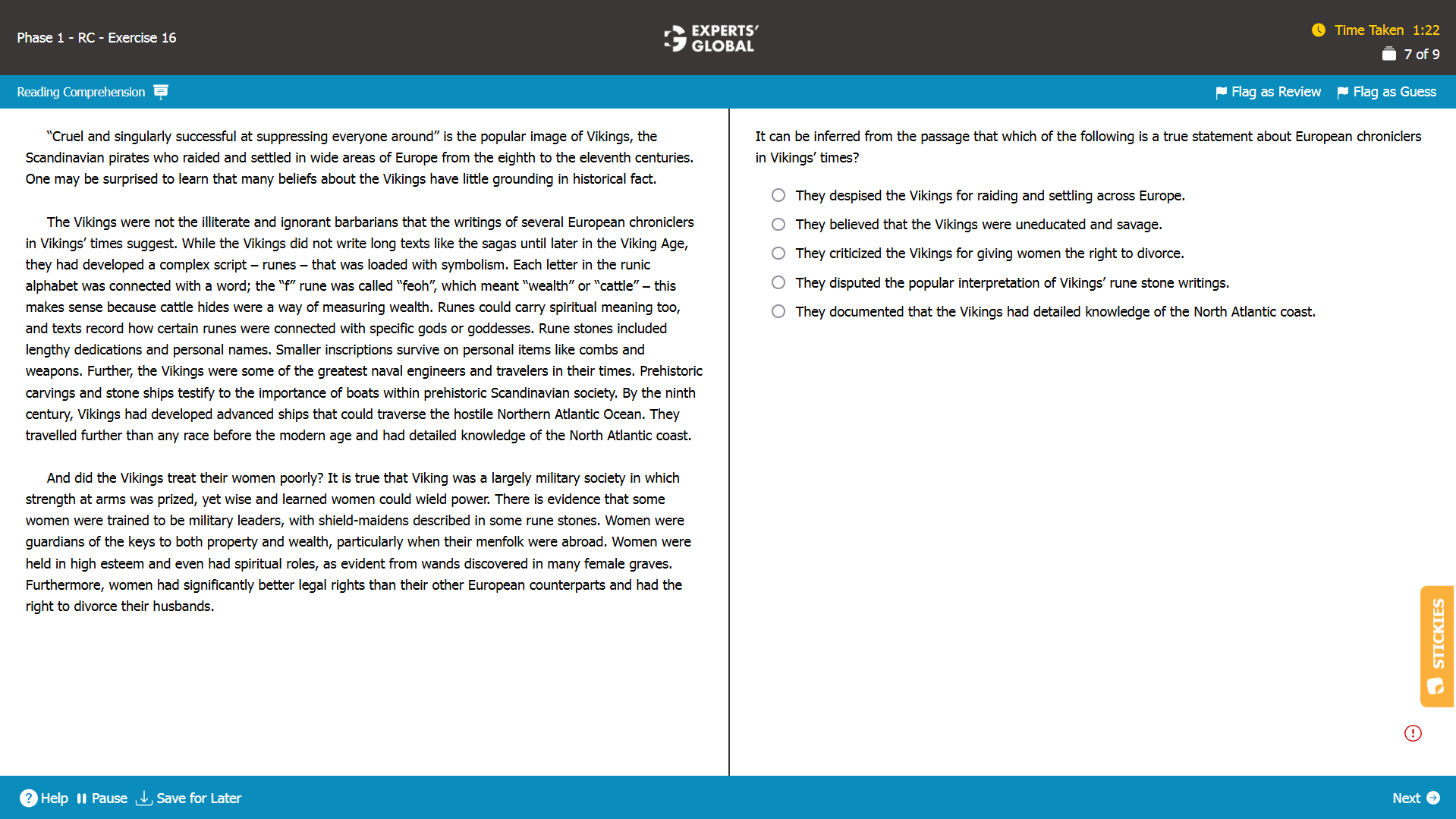
Written Explanation
Mind-map
To suggest that many beliefs about the Vikings are incorrect (Paragraph 1)
To refute that Vikings were illiterate and ignorant barbarians (Paragraph 2)
To refute that Vikings treated their women poorly (Paragraph 3)
The second paragraph mentions that “The Vikings were not the illiterate and ignorant barbarians that the writings of several European chroniclers in Vikings’ times suggest”; there is no other reference to European chroniclers. Each answer choice needs to be carefully evaluated in light of the information presented in this context.
A. The first paragraph mentions that the Vikings were “Scandinavian pirates who raided and settled in wide areas of Europe” and the second paragraph mentions that “The Vikings were not the illiterate and ignorant barbarians that the writings of several European chroniclers in Vikings’ times suggest”; there is no suggestion that the European chroniclers despised the Vikings for raiding and settling across Europe. Incorrect.
B. Correct. The second paragraph mentions that “The Vikings were not the illiterate and ignorant barbarians that the writings of several European chroniclers in Vikings’ times suggest”; the passage states that the European chroniclers described in their writings that Vikings were illiterate, ignorant, and barbaric; in other words, the European chroniclers believed that the Vikings were uneducated and savage, as the answer choice mentions.
C. The third paragraph mentions that the Vikings women “had significantly better legal rights than their other European counterparts and had the right to divorce their husbands” and the second paragraph mentions that “The Vikings were not the illiterate and ignorant barbarians that the writings of several European chroniclers in Vikings’ times suggest”; there is no suggestion that the European chroniclers criticized the Vikings for giving women the right to divorce. Incorrect.
D. The second paragraph mentions that “Rune stones included lengthy dedications and personal names” and that “The Vikings were not the illiterate and ignorant barbarians that the writings of several European chroniclers in Vikings’ times suggest”; there is no reference that the European chroniclers disputed the popular interpretation of Vikings’ rune stone writings. Incorrect.
E. The second paragraph mentions that the Vikings “travelled further than any race before the modern age and had detailed knowledge of the North Atlantic coast” and that “The Vikings were not the illiterate and ignorant barbarians that the writings of several European chroniclers in Vikings’ times suggest”; there is no suggestion that the European chroniclers documented that the Vikings had detailed knowledge of the North Atlantic coast. Incorrect.
B is the best answer choice.
GMAT RC: Sample Question 8
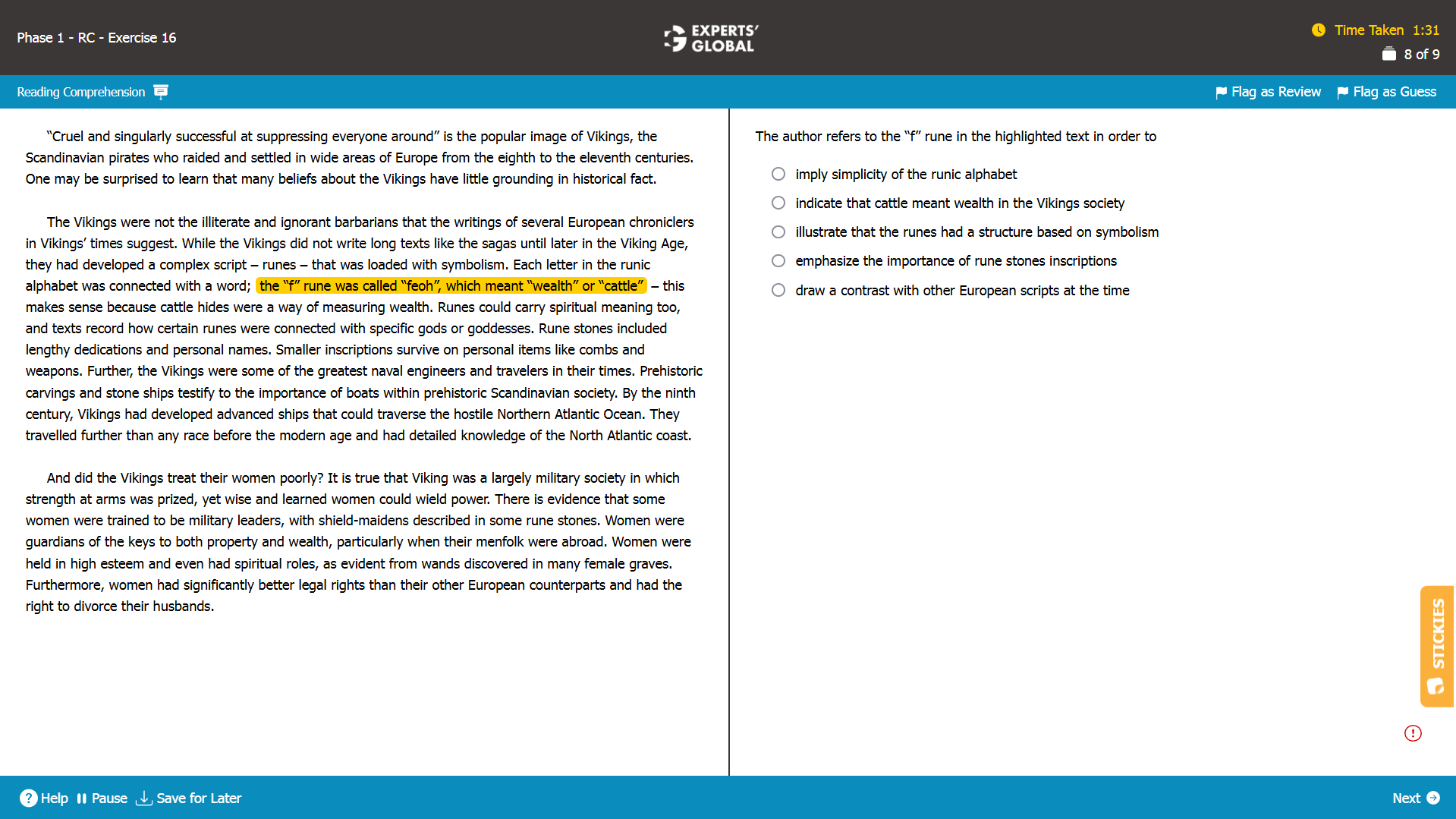
Written Explanation
Mind-map
To suggest that many beliefs about the Vikings are incorrect (Paragraph 1)
To refute that Vikings were illiterate and ignorant barbarians (Paragraph 2)
To refute that Vikings treated their women poorly (Paragraph 3)
The second paragraph mentions that the Vikings “had developed a complex script – runes – that was loaded with symbolism” and that “Each letter in the runic alphabet was connected with a word; the “f” rune was called “feoh”, which meant “wealth” or “cattle” – this makes sense because cattle hides were a way of measuring wealth”; it can be inferred that the letters in the runic alphabet were symbolic and represented relevant ideas and entities, and the “f” rune is mentioned to illustrate such nature of the runic alphabet. Each answer choice needs to be carefully evaluated in light of the information presented in this context.
A. The second paragraph mentions that the Vikings “had developed a complex script – runes”; so, it is incorrect to state that the author mentions the “f” rune to imply the simplicity of the runic alphabet. Furthermore, the passage suggests that the letters in the runic alphabet were symbolic and represented relevant ideas and entities, and the “f” rune is mentioned to illustrate such nature of the runic alphabet; we need an answer choice on similar lines. Incorrect.
B. The second paragraph mentions that the Vikings “had developed a complex script – runes” and that “Each letter in the runic alphabet was connected with a word; the “f” rune was called “feoh”, which meant “wealth” or “cattle”; although the passage mentions that cattle meant wealth in the Vikings society, to make this suggestion is not the purpose of mentioning the “f” rune. Furthermore, the passage suggests that the letters in the runic alphabet were symbolic and represented relevant ideas and entities, and the “f” rune is mentioned to illustrate such nature of the runic alphabet; we need an answer choice on similar lines. Incorrect.
C. Correct. The second paragraph mentions that the Vikings “had developed a complex script – runes – that was loaded with symbolism” and that “Each letter in the runic alphabet was connected with a word; the “f” rune was called “feoh”, which meant “wealth” or “cattle” – this makes sense because cattle hides were a way of measuring wealth”; it can be inferred that the letters in the runic alphabet were symbolic and represented relevant ideas and entities, and the “f” rune is mentioned to illustrate such nature of the runic alphabet; in other words, the author mentions the “f” rune to illustrate that the runes had a structure based on symbolism, as the answer choice mentions.
D. The second paragraph mentions that “Each letter in the runic alphabet was connected with a word; the “f” rune was called “feoh”, which meant “wealth” or “cattle” – this makes sense because cattle hides were a way of measuring wealth” and that “Rune stones included lengthy dedications and personal names”; the passage makes no connection between the “f” rune and the importance of rune stones inscriptions; it is incorrect to state that the author mentions the “f” rune to emphasize the importance of rune stones inscriptions. Furthermore, the passage suggests that the letters in the runic alphabet were symbolic and represented relevant ideas and entities, and the “f” rune is mentioned to illustrate such nature of the runic alphabet; we need an answer choice on similar lines. Incorrect.
E. The passage makes no mention of European scripts other than Vikings’ runes. Furthermore, the passage suggests that the letters in the runic alphabet were symbolic and represented relevant ideas and entities, and the “f” rune is mentioned to illustrate such nature of the runic alphabet; we need an answer choice on similar lines. Incorrect.
C is the best answer choice.
GMAT RC: Sample Question 9
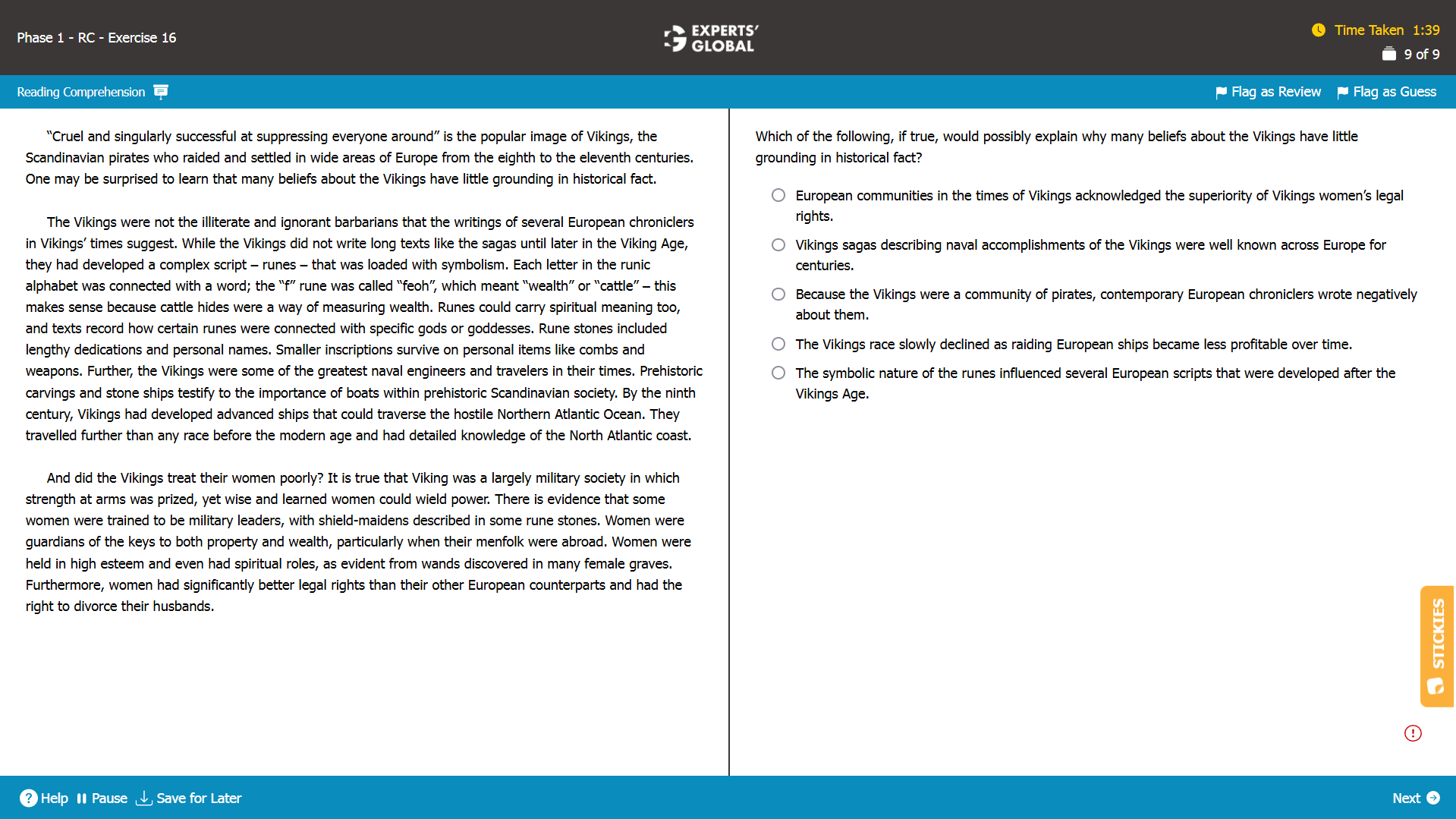
Written Explanation
Mind-map
To suggest that many beliefs about the Vikings are incorrect (Paragraph 1)
To refute that Vikings were illiterate and ignorant barbarians (Paragraph 2)
To refute that Vikings treated their women poorly (Paragraph 3)
Each answer choice needs to be carefully evaluated in light of the information presented in the passage.
A. As the mind-map mentions, the first paragraph suggests that many beliefs about the Vikings are incorrect, the second paragraph refutes that Vikings were illiterate and ignorant barbarians, and the third paragraph refutes that the Vikings treated their women poorly; if European communities in the times of Vikings acknowledged the superiority of Vikings women’s legal rights, Vikings would likely have a positive popular image, and would not foster the perception that they treated their women poorly. Because the statement in this answer choice does not explain why many beliefs about the Vikings have little grounding in historical fact, this answer choice is incorrect.
B. As the mind-map mentions, the first paragraph suggests that many beliefs about the Vikings are incorrect, and the second paragraph refutes that Vikings were illiterate and ignorant barbarians by stating that “the Vikings were some of the greatest naval engineers and travelers in their times”; if Vikings sagas describing naval accomplishments of the Vikings were well known across Europe for centuries, Vikings would likely have a popular image of having advanced skills, and would not foster the perception that they were illiterate and ignorant barbarians. Because the statement in this answer choice does not explain why many beliefs about the Vikings have little grounding in historical fact, this answer choice is incorrect.
C. Correct. The first paragraph mentions that the Vikings were “Scandinavian pirates who raided and settled in wide areas of Europe”; if the European chroniclers in the time of the Vikings wrote negatively about the Vikings because the Vikings were a community of pirates, it would explain how the negative perception towards the Vikings originated. Because the statement in this answer choice can possibly explain why many beliefs about the Vikings have little grounding in historical fact, this answer choice is correct.
D. The passage does not provide information to believe that the decline of the Vikings can affect the Vikings’ factually deficient, popular perception. Because the statement in this answer choice does not explain why many beliefs about the Vikings have little grounding in historical fact, this answer choice is incorrect.
E. As the mind-map mentions, the first paragraph suggests that many beliefs about the Vikings are incorrect, and the second paragraph refutes that Vikings were illiterate and ignorant barbarians by stating that the Vikings “had developed a complex script” called “runes”; if the symbolic nature of the runes influenced several European scripts that were developed after the Vikings Age, Vikings would likely have a popular image of having a worthy writing system, and would not foster the perception that they were illiterate and ignorant barbarians. Because the statement in this answer choice does not explain why many beliefs about the Vikings have little grounding in historical fact, this answer choice is incorrect.
C is the best answer choice.
Additional 40+ Free GMAT-style Reading Comprehension Questions with Explanations:
Please find another set of GMAT-style RC questions with explanations on: How to Solve GMAT Reading Comprehension Prep
Please find another set of GMAT-style RC questions with explanations on: Free GMAT Reading Comprehensions Prep
Please find another set of GMAT-style RC questions with explanations on: Free GMAT Verbal Prep
Please find another set of GMAT-style RC questions with explanations on: Free GMAT Reading Comprehensions Sample Questions
Please find another set of GMAT-style RC questions with explanations on: Free GMAT Verbal Sample Questions
GMAT CR: GMAT Critical Reasoning Sample Questions
GMAT Critical Reasoning checks how clearly you understand an argument and how confidently you can test its logic. In the Verbal section, you only see two question types: Reading Comprehension and Critical Reasoning. Out of 23 Verbal questions, you typically face about 8 to 10 Critical Reasoning questions. That puts close to 40 percent of Verbal in the Critical Reasoning zone, so it plays a major role in a strong GMAT score. Even better, your prep gives you a skill that travels far beyond the test. You learn to spot gaps, weigh evidence, and make decisions with clarity, which supports many other GMAT question types. It also shows up in business school, in management work, and in everyday choices. Think of Critical Reasoning prep as a powerful upgrade to the way you think, not just the way you test.
Snapshot of the Missing-Link-Approach for CRs by Experts’ Global
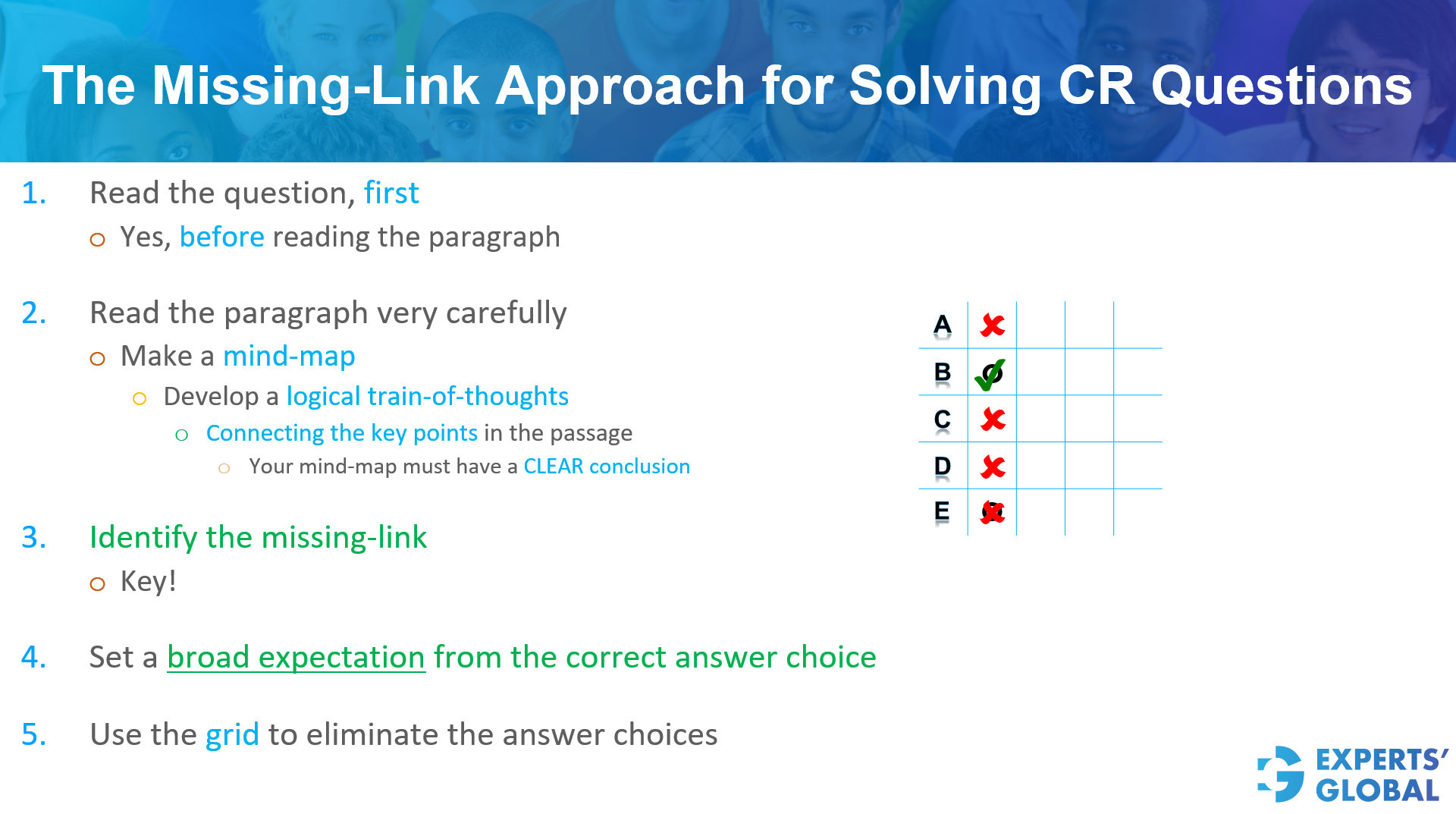
GMAT CR: Assumption Sample Question
CR Assumption questions challenge you to find the unspoken idea that must hold true for the argument to make sense. They guide you to uncover the hidden connection between the premise and the conclusion.
Important: Before visiting the following sample question(s), if you would like a quick brush up of key CR Assumption concepts, you may first visit: Free GMAT CR Assumption Prep
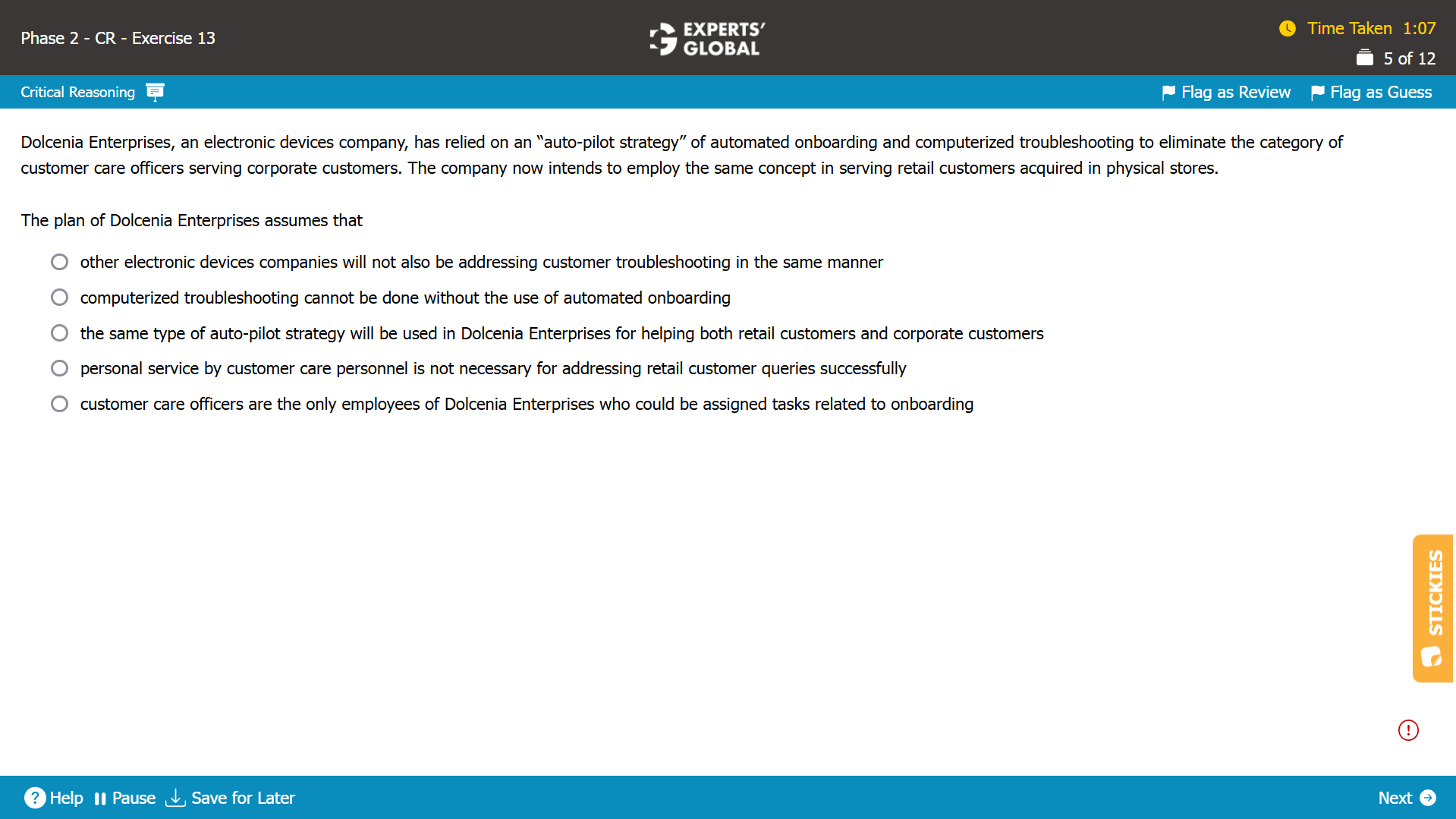
Written Explanation
Mind-map: Dolcenia Enterprises relies on automation strategy → eliminates customer care officers for corporate customers → automation strategy will work for retail customers (implicit conclusion)
Missing-link: Between eliminating customer care officers for corporate customers and the conclusion that automation strategy will work for retail customers
Expectation from the correct answer choice: To strengthen the conclusion that automation strategy will work for retail customers, through a valid assumption
A. The argument is regarding Dolcenia Enterprises and is not concerned with what other electronics companies do; so, the idea that “other companies will not follow a similar strategy” is irrelevant to the argument and its conclusion. Besides, this condition is not necessary for the argument to hold and thus, is not a valid assumption. Because this answer choice does not strengthen the conclusion through a valid assumption, this answer choice is incorrect.
B. This is just a statement of fact and how the automation strategy is deployed has no bearing on the argument. Besides, this condition is not necessary for the argument to hold and thus, is not a valid assumption. Because this answer choice does not strengthen the conclusion through a valid assumption, this answer choice is incorrect.
C. Trap. This is just additional, nuanced detail and whether the same type of automation strategy is used for both retail and corporate customers has no bearing on the argument. Besides, this condition is not necessary for the argument to hold and thus, is not a valid assumption. Because this answer choice does not strengthen the conclusion through a valid assumption, this answer choice is incorrect.
D. Correct. If the idea that “personal service by customer care personnel is not necessary for addressing retail customer queries successfully” is connected to the premise that the automation strategy has “eliminated the category of customer care officers serving corporate customers”, it suggests that the automation strategy could also be used for retail customers; this suggestion fills the missing link and strengthens the conclusion of the argument. Additionally, this statement does have to be true for the conclusion to hold; negating this statement would mean that “personal service by customer care personnel is required by retail customers” and thus, negate the conclusion that “automation strategy will work for retail customers”. Because this answer choice strengthens the conclusion through a valid assumption, this answer choice is correct.
E. The argument is concerned with whether the automation strategy will work for retail customers, and the idea that “customer care officers are the only (among all) employees who could be assigned tasks related to onboarding” is just additional detail that has no bearing on the argument. By suggesting the importance of customer care officers in onboarding tasks, the answer choice, if anything, weakens the conclusion that “automation strategy will work”. Because this answer choice does not strengthen the conclusion through a valid assumption, this answer choice is incorrect.
D is the best choice.
GMAT CR: Strengthen the Argument Sample Question
Strengthen the Argument questions in GMAT Critical Reasoning present an argument, and your task is to select the answer choice that strengthens it. You need to choose the option that fills the missing link between the information provided and the conclusion drawn.
Important: Before visiting the following sample question(s), if you would like a quick brush up of key CR Strengthen the Argument concepts, you may first visit: Free GMAT CR Strengthen the Argument Prep
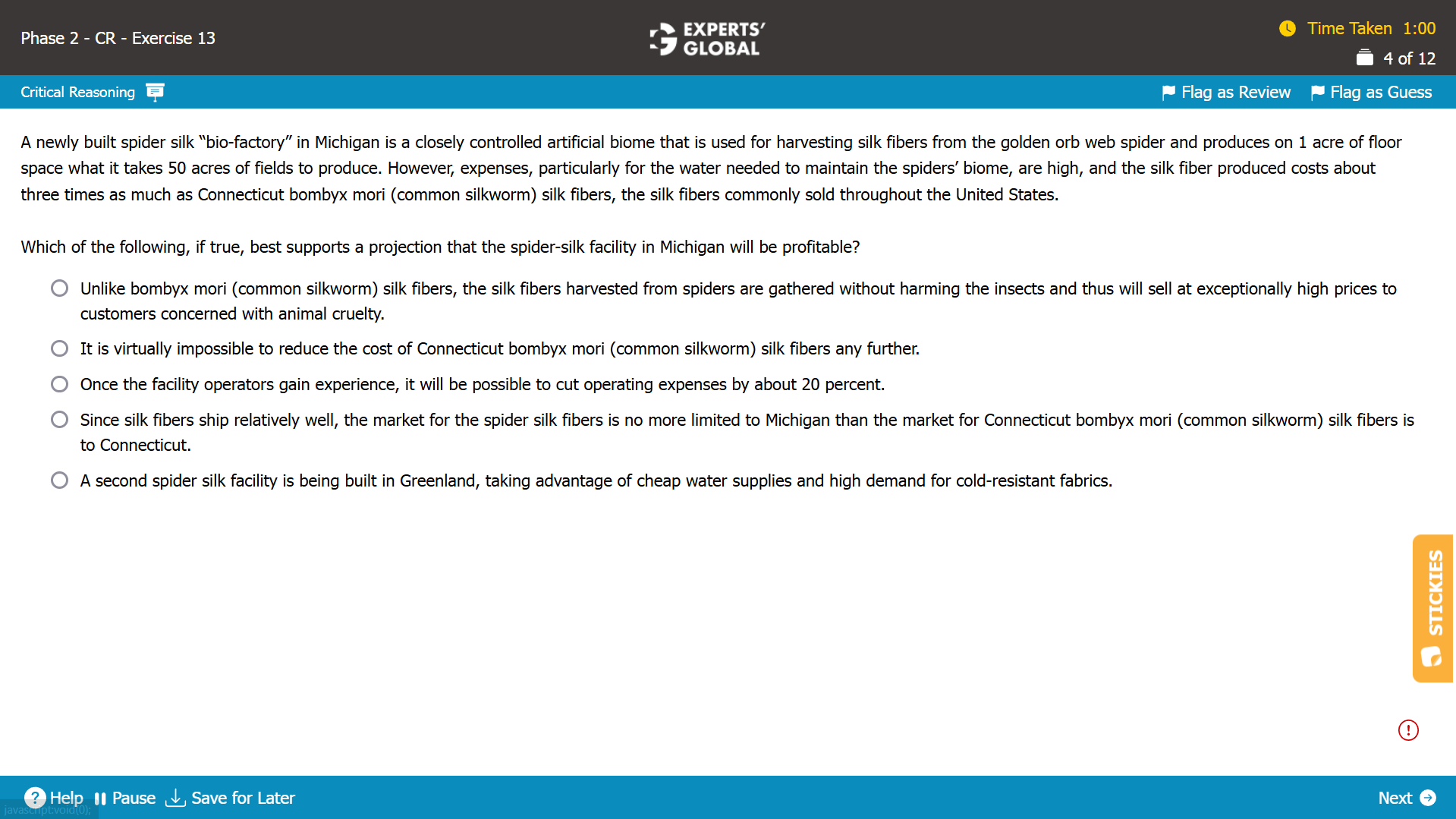
Written Explanation
Mind-map: A spider-silk facility is built in Michigan → produces as much silk fiber in 1 acre that fields produce in 50 acres → water requirements of the facility are high → spider-silk is three times as expensive as common silk → spider-silk facility will be profitable (implicit conclusion)
Missing-link: Between all the information presented and the conclusion that the spider-silk facility will be profitable
Expectation from the correct answer choice: To strengthen the conclusion that the spider-silk facility will be profitable
Note: This question seeks an answer choice that “would best support” the argument; such questions often represent a common GMAT dilemma of choosing the “best answer choice” among multiple “good answer choices”; in such a scenario, you need to analyze the options closely and proceed with one that “best” supports the argument.
A. Correct. This answer choice, suggesting that spider-silk will be likely bought at exceptionally high prices by a certain section of customers, indicates that the spider-silk factory can likely expect handsome sales and thus strengthens the conclusion that the factory can likely become profitable. Because this answer choice strengthens the conclusion, this answer choice is correct.
B. This answer choice, suggesting the lack of possibility of a reduction in the cost of “common silk”, provides no information about cost/sale/profits related to “spider-silk”; so, this answer choice is just a statement of fact and has no bearing on the argument. Because this answer choice does not strengthen the conclusion, this answer choice is incorrect.
C. Trap. The argument mentions that spider-silk is three times as expensive as common silk; so, this answer choice, suggesting a 20 percent reduction in operating expenses, is likely insignificant in bringing down the cost and making the spider-silk facility profitable; so, this answer choice, at best, only faintly strengthens the argument; this is too weak an option to be the correct answer and shall eventually make way for a better, stronger choice; we have a more convincing answer choice in A.
D. Trap. This answer choice, suggesting that neither of the two types of silk is geographically limited, provides no information about cost/sale/profits related to “spider-silk”; so, this answer choice is just a statement of fact and has no bearing on the argument. Because this answer choice does not strengthen the conclusion, this answer choice is incorrect.
E. The argument is concerned with whether the spider-silk factory in Michigan will be profitable; so, information about another factory in Greenland is out of scope. Because this answer choice does not strengthen the conclusion, this answer choice is incorrect.
A is the best choice.
GMAT CR: Weaken the Argument Sample Question
CR Weaken the Argument questions, or simply weakening questions, ask you to identify the statement that weakens an argument by challenging the missing link between the premise and the conclusion.
Important: Before visiting the following sample question(s), if you would like a quick brush up of key CR Weaken the Argument concepts, you may first visit: Free GMAT CR Weaken the Argument Prep
Written Explanation
Mind-map: SR zoo failed to detect preventable disease before they become serious → other zoos have reduced mortality rate from preventable diseases by instituting health checkups for animals → SR zoo plans to institute the same policy → SR zoo will be able to detect preventable disease before they become serious (implicit conclusion)
Missing-link: Between other zoos reducing mortality rate from preventable diseases by instituting health checkups for animals and the conclusion that SR zoo will be able to detect preventable disease before they become serious
Expectation from the correct answer choice: Some disadvantage of the health checkups of animals
A. This answer choice, suggesting that zoos without the health checkups have a higher mortality rate than the national average, indicates a risk of not instituting the health checkups, thus suggesting the necessity of the health checkups; this answer choice makes no suggestion regarding a potential drawback in the policy of instituting health checkups. Because this answer choice does not indicate a potential drawback in the policy, this answer choice is incorrect.
B. This answer choice, suggesting the owners’ preference to keep the health checkups outside of the animal display hours, simply indicates an operational restriction and makes no suggestion regarding a potential drawback in the policy of instituting health checkups. Because this answer choice does not indicate a potential drawback in the policy, this answer choice is incorrect.
C. Trap. This answer choice, suggesting that the Schwimmer-Rock Zoo has more animals than the zoos with health checkups, highlights the need to detect preventable disease before they become serious and makes no suggestion regarding a potential drawback in the policy of instituting health checkups. Because this answer choice does not indicate a potential drawback in the policy, this answer choice is incorrect.
D. Trap. This answer choice, suggesting the difficulty in conducting health checkups and the need for additional training to caretakers, simply indicates an operational challenge as well as its likely solution, and makes no suggestion regarding a potential drawback in the policy of instituting health checkups. Because this answer choice does not indicate a potential drawback in the policy, this answer choice is incorrect.
E. Correct. This answer choice, suggesting that frequent health checkups would require additional expenses and increase pressure on the zoo’s stringent budget, indicates that the checkups may affect the zoo’s financial health, thus highlighting a financial disadvantage as potential drawbacks. Because this answer choice indicates a potential drawback in the policy, this answer choice is correct.
An interesting discussion:
A student once wrote to us suggesting that answer choice E should not be correct because it does not weaken the argument’s implicit conclusion that the Schwimmer-Rock Zoo will be able to detect preventable disease before they become serious. Can you spot the error in the student’s reasoning? Please note that the question stem asks for a “drawback” in the policy of instituting health checkups for animals; a drawback does not necessarily have to weaken the conclusion; so, answer choice E, suggesting a financial disadvantage, is an apt drawback in the policy. A greater learning here is to carefully read non-standard question stems to catch such nuances.
E is the best choice.
GMAT CR: Resolve-the-Paradox Sample Question
Resolve the Paradox questions in GMAT Critical Reasoning present an argument where the conclusion appears to be in contrast with the information provided. Your task is to select the answer choice that provides a logical explanation for this discrepancy.
Important: Before visiting the following sample question(s), if you would like a quick brush up of key CR Resolve-the-Paradox concepts, you may first visit: Free GMAT CR Resolve-the-Paradox Prep
Written Explanation
Mind-map: Survey conducted to ask residents to rank four priorities of government → survey repeated on the same residents twenty years later → majority of residents now rank bringing down rent lower than they did earlier → most residents agree that rents have grown much faster than in neighboring cities
Missing-link: Between the majority of residents now giving lower priority to rent reduction than they did earlier and most residents agreeing that rents have grown much faster than in neighboring cities
Expectation from the correct answer choice: To explain why the majority of residents now give lower priority to rent reduction despite agreeing that rents are growing
A. Correct. If most residents surveyed now have become homeowners since the last survey, it indicates that, because these residents live in their own houses rather than in rented accommodation, bringing down the average rent is not as important a matter to them now as it was twenty years ago, thus explaining why they give lower priority to rent reduction despite agreeing that rents are growing much faster than in neighboring cities. Because this answer choice explains the discrepancy in the argument, this answer choice is correct.
B. Trap. The argument is concerned with the majority of residents ranking a particular priority differently in two surveys conducted over time; so, information that some priorities important to people do not appear on either survey is just additional information and has no bearing on how residents rank the available priorities in both surveys; so, this answer choice does not explain why the majority of residents surveyed now give lower priority to rent reduction despite agreeing that rents are growing much faster than in neighboring cities. Because this answer choice does not explain the discrepancy in the argument, this answer choice is incorrect.
C. The argument is concerned with why the “majority” of residents “now” give lower priority to rent reduction; this answer choice, suggesting that “some” residents paid similar rents “twenty years ago”, is limited in scope and does not explain the discrepancy in the argument. Because this answer choice does not explain the discrepancy in the argument, this answer choice is incorrect.
D. The argument is concerned with why the “majority” of residents “now” give lower priority to rent reduction; so, this answer choice, suggesting that “some” of those in the recent survey did not consider the matter a priority, is limited in scope and does not explain the discrepancy in the argument. Because this answer choice does not explain the discrepancy in the argument, this answer choice is incorrect.
E. This answer choice, suggesting that many residents surveyed now found roads much safer than they did twenty years ago, suggests that residents are likely to rank road safety lower in the order of priority and makes no suggestion regarding why they give lower priority to rent reduction; so, this answer choice does not explain the discrepancy in the argument. Because this answer choice does not explain the discrepancy in the argument, this answer choice is incorrect.
A is the best choice.
GMAT CR: Evaluate-the-Argument Sample Question
GMAT Critical Reasoning Evaluate the Argument questions ask you to find the information that lets you assess the strength of an argument by determining if its reasoning stands strong or falls apart.
Important: Before visiting the following sample question(s), if you would like a quick brush up of key CR Evaluate-the-Argument concepts, you may first visit: Free GMAT CR Evaluate-the-Argument Prep
Written Explanation
Mind-map: Hotel wants to decrease water expenditure → plans to replace old showerheads with new showerheads → new showerheads consume less water and are no more expensive → conversion costs are negligible → switching to new showerheads would help minimize hotel’s yearly maintenance costs (conclusion)
Missing-link: Between all the virtues of the new showerhead and the conclusion that switching to new showerheads would help minimize the hotel’s yearly maintenance costs
Expectation from the correct answer choice: To indicate some fact or data that helps in evaluating the conclusion that switching to new showerheads would help minimize the hotel’s yearly maintenance costs
A. The argument is concerned with switching showerheads in “all the rooms” in the hotel and not just in the “new rooms” to be built; so, knowing whether there will be more rooms would simply provide additional information but have no bearing on the argument. Because this answer choice would not help evaluate the conclusion, this answer choice is incorrect.
B. The argument is concerned with whether switching from the current showerheads to “low-flow water-efficient showerheads” minimizes maintenance costs; so, switching from the current showerheads to “any type of showerhead except the low-flow water-efficient ones” is out of scope. Further, knowing whether any other hotel switched from the current showerheads makes no suggestion regarding the change in maintenance costs; so, such knowledge would simply provide additional information but have no bearing on the argument. Because this answer choice would not help evaluate the conclusion, this answer choice is incorrect.
C. The argument is concerned with whether switching to “low-flow water-efficient showerheads” minimizes maintenance costs; so, knowing whether the new showerheads can be purchased from the same wholesaler that sells the current showerheads would simply provide additional information but have no bearing on the argument. Because this answer choice would not help evaluate the conclusion, this answer choice is incorrect.
D. Correct. If the service life of low-flow water-efficient showerheads is not as long as that of current showerheads, it indicates that the low-flow water-efficient showerheads may need more frequent replacements, thus increasing maintenance costs; so, a comparison between the predicted longevity of the two types of showerheads would help evaluate the conclusion that switching to new showerheads would help minimize the hotel’s yearly maintenance costs. Because this answer choice would help evaluate the conclusion, this answer choice is correct.
E. Trap. The argument mentions that the cost of “converting water fixtures is negligible” and is concerned with whether the switch minimizes “maintenance costs”; so, knowing whether the conversion can be done by the workmen that already know how to make the conversion or the conversion requires additional training/expertise has no bearing on the argument. Because this answer choice would not help evaluate the conclusion, this answer choice is incorrect.
D is the best choice.
GMAT CR: Inference Sample Question
Critical Reasoning Inference questions challenge you to find a statement that must be true based on the information provided, without any assumption or overstatements.
Important: Before visiting the following sample question(s), if you would like a quick brush up of key CR Inference Questions concepts, you may first visit: Free GMAT CR Inference Questions Prep
Written Explanation
Mind-map: Continuous use of painkillers has two negative effects → liver’s efficiency is reduced → brain recognizes ingredients particular to a painkiller → produces neutralizing chemicals → body develops resistance → painkiller becomes less effective
Missing-link: Not needed
Expectation from the correct answer choice: To suggest how to at least partially curb the pernicious effects of the continuous use of painkillers, via a possibility duly deducible from the information in the passage
A. The argument makes no suggestion regarding chemical stability as a factor in the reduced effectiveness of painkillers; so, this answer choice cannot be established as a means to curb the pernicious effects of the continuous use of painkillers. Because this answer choice is not deducible as a possible means, this answer choice is incorrect.
B. The argument mentions reduced efficiency of the liver as a pernicious effect of the continuous use of painkillers but makes no suggestion that improved liver function would make the liver less susceptible to the effect of painkillers; so, this answer choice, suggesting improving liver function, cannot be established as a means to curb the pernicious effects of the continuous use of painkillers. Because this answer choice is not deducible as a possible means, this answer choice is incorrect.
C. The argument mentions that as the brain recognizes the constant intake of ingredients particular to a painkiller, it responds by producing neutralizing chemicals, thus reducing the effectiveness of the painkiller; so, it can be inferred that increasing the quantity of painkillers is likely to trigger the brain to increase the quantity of neutralizing chemicals, thus continuing the body’s resistance; so, this answer choice, suggesting gradual increase in the quantity of painkillers used, cannot be established as a means to curb the pernicious effects of the continuous use of painkillers. Because this answer choice is not deducible as a possible means, this answer choice is incorrect.
D. The argument makes no suggestion regarding using more than one type of painkillers as a factor in the reduced effectiveness of painkillers; so, this answer choice, suggesting avoiding such usage, cannot be established as a means to curb the pernicious effects of the continuous use of painkillers. Because this answer choice is not deducible as a possible means, this answer choice is incorrect.
E. Correct. The argument mentions that as the brain recognizes the constant intake of ingredients particular to a painkiller, it responds by producing neutralizing chemicals, thus reducing the effectiveness of the painkiller; because these ingredients are particular to a painkiller, periodically changing the type of painkillers will likely prevent the brain from responding, thus preventing the body from developing resistance; so, this answer choice, suggesting periodic switching of the type of painkiller, can be established as a means to partially curb the pernicious effects of the continuous use of painkillers. Because this answer choice is deducible as a possible means, this answer choice is correct.
E is the best choice.
GMAT CR: Main Point Sample Question
Critical Reasoning Main Point or Conclusion questions ask you to find the key idea the argument is trying to prove, the one point that all other details in the passage are designed to support.
Important: Before visiting the following sample question(s), if you would like a quick brush up of key CR Main Point or Conclusion concepts, you may first visit: Free GMAT CR Main Point or Conclusion Prep
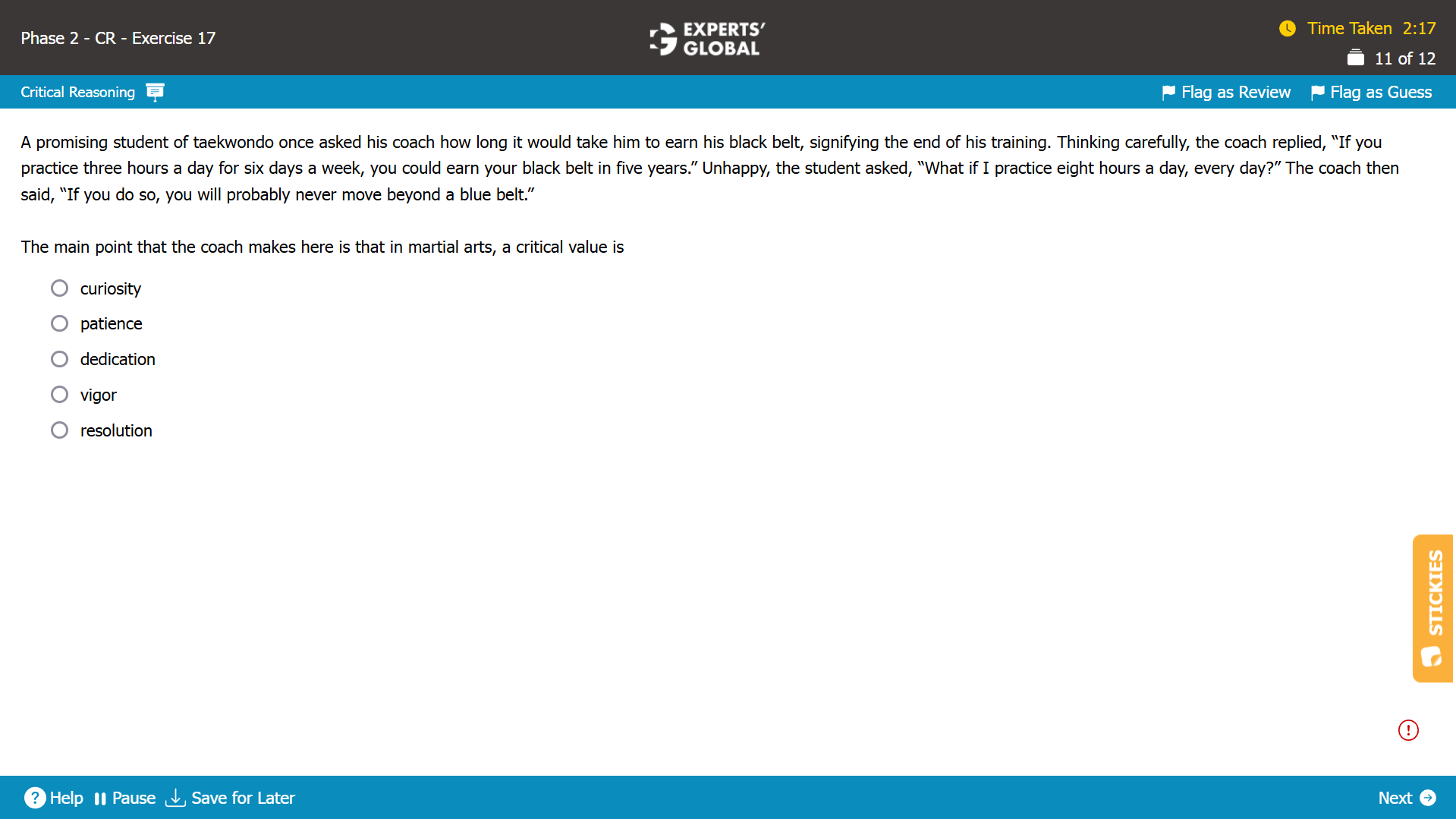
Written Explanation
Mind-map: Student: When can I finish my last training level? → coach: in five years, if you practice regularly throughout the week → student is unhappy → student: what if I practice heavily every day? coach: in that case, you will probably not reach the last training level
Missing-link: Not needed
Expectation from the correct answer choice: Something on the lines of restrained, disciplined practice rather than intense, relentless practice
Discussion: The coach’s opinion regarding the completion of the student’s last training level changes after the student queries restlessly about whether he can practice heavily every day to reduce his training period; the coach’s pessimistic response is caused by the value that the student exhibits in his second query and the coach believes that the value is a hurdle in the student’s progress.
A. The student shows a strong desire to know more about his progress, thus demonstrating curiosity; the coach is not likely to believe that the student’s curiosity would be a hurdle in the student’s progress; so, it is incorrect to state that the coach regards curiosity as a critical value in martial arts, as the answer choice mentions. Further, the coach simply states that the student may not reach the last training level if the student fails to practice regularly throughout the week and practices heavily every day; it can be inferred that the coach recommends restrained, disciplined practice rather than intense, relentless practice; we need a critical value on similar lines. Because this answer choice does not indicate the main point of the coach’s argument, this answer choice is incorrect.
B. Correct. The coach’s first response is that the student will finish the last training level in five years; the student is “unhappy” with the response and queries restlessly about whether he can practice heavily every day to reduce his training period; the coach responds that the student may not reach the last training level if the student fails to practice regularly throughout the week and practices heavily every day; it can be inferred that the coach recommends restrained, disciplined practice rather than intense, relentless practice; so, it is correct to state that the coach regards patience as a critical value in martial arts, as the answer choice mentions. Because this answer choice indicates the main point of the coach’s argument, this answer choice is correct.
C. The student shows a willingness to practice heavily every day, thus demonstrating dedication; the coach is not likely to believe that the student’s dedication would be a hurdle in the student’s progress; so, it is incorrect to state that the coach regards dedication as a critical value in martial arts, as the answer choice mentions. Further, the coach simply states that the student may not reach the last training level if the student fails to practice regularly throughout the week and practices heavily every day; it can be inferred that the coach recommends restrained, disciplined practice rather than intense, relentless practice; we need a critical value on similar lines. Because this answer choice does not indicate the main point of the coach’s argument, this answer choice is incorrect.
D. The student shows a willingness to practice heavily every day, thus demonstrating vigor; the coach is not likely to believe that the student’s vigor would be a hurdle in the student’s progress; so, it is incorrect to state that the coach regards vigor as a critical value in martial arts, as the answer choice mentions. Further, the coach simply states that the student may not reach the last training level if the student fails to practice regularly throughout the week and practices heavily every day; it can be inferred that the coach recommends restrained, disciplined practice rather than intense, relentless practice; we need a critical value on similar lines. Because this answer choice does not indicate the main point of the coach’s argument, this answer choice is incorrect.
E. The student shows a strong intention to practice heavily every day, thus demonstrating resolution; the coach is not likely to believe that the student’s resolution would be a hurdle in the student’s progress; so, it is incorrect to state that the coach regards resolution as a critical value in martial arts, as the answer choice mentions. Further, the coach simply states that the student may not reach the last training level if the student fails to practice regularly throughout the week and practices heavily every day; it can be inferred that the coach recommends restrained, disciplined practice rather than intense, relentless practice; we need a critical value on similar lines. Because this answer choice does not indicate the main point of the coach’s argument, this answer choice is incorrect.
B is the best choice.
GMAT CR: Complete the Paragraph Sample Question
CR Complete the Paragraph questions ask you to choose the answer that best follows the author’s reasoning, making sure the paragraph wraps up in a smooth and logical way.
Important: Before visiting the following sample question(s), if you would like a quick brush up of key CR Complete the Paragraph concepts, you may first visit: Free GMAT CR Complete the Paragraph Prep
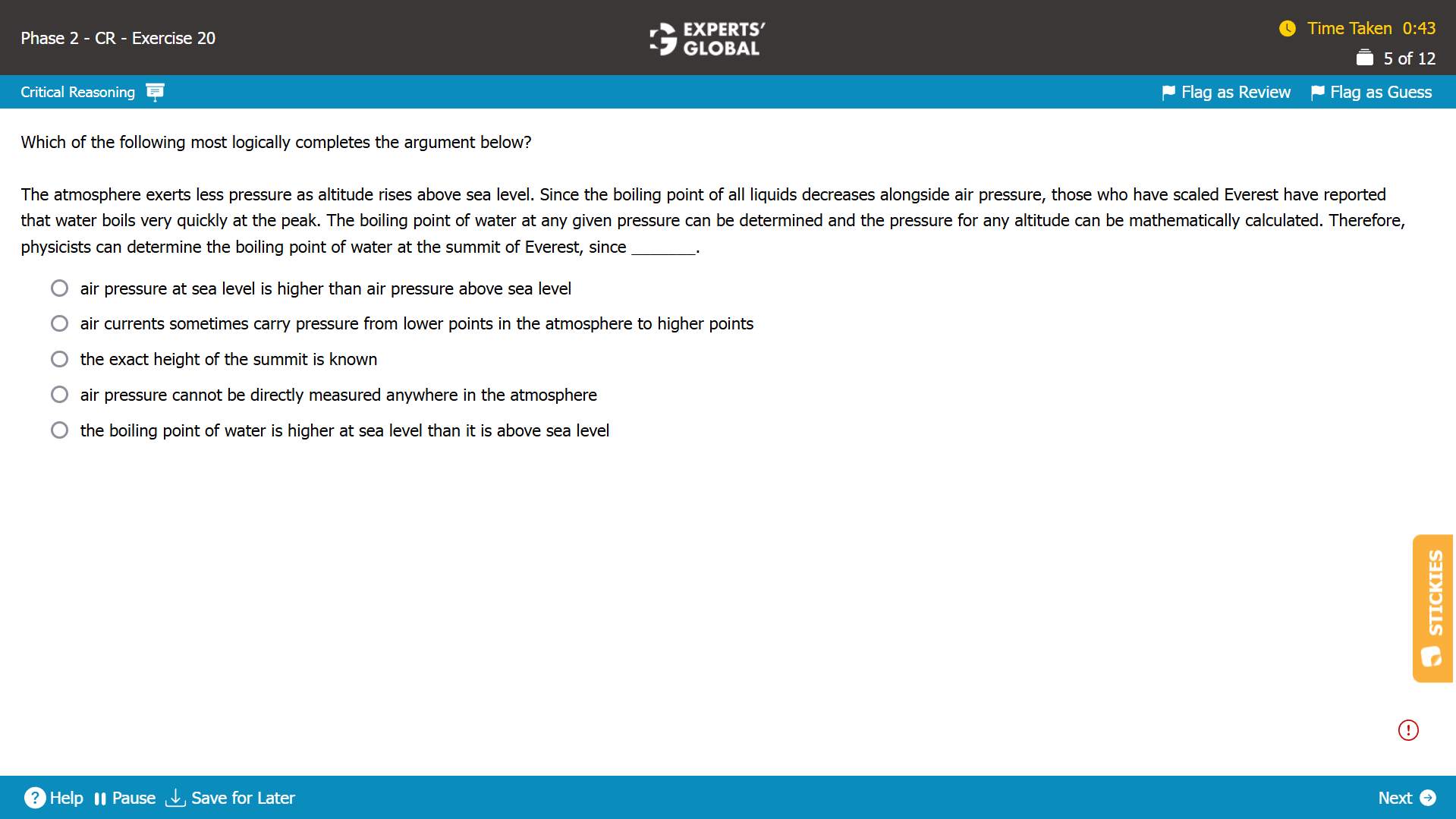
Written Explanation
Mind-map: Higher altitude, less pressure → less pressure, less boiling point for liquids → boiling point at any pressure can be determined → pressure for any altitude can be calculated → boiling point of water at the summit of Everest can be determined because _____
Missing-link: Not needed
Expectation from the correct answer choice: Something on the lines of the altitude at the summit of Everest can be determined
A. Trap. This answer choice, suggesting that the pressure at sea level is higher than that above it, reiterates the fact mentioned in the argument that the atmosphere exerts less pressure as altitude rises above sea level and provides no information about the altitude at the summit of Everest, using which the pressure and subsequently the boiling point of water at the summit can be calculated, as the argument mentions; so, this answer choice adds no new information and fails to effectively complete the chain of thoughts developed in the passage. Because this answer choice does not duly complete the passage, this answer choice is incorrect.
B. This answer choice, suggesting that higher points can occasionally have more pressure than at other times, provides no information about the altitude at the summit of Everest, using which the pressure and subsequently the boiling point of water at the summit can be calculated, as the argument mentions; so, this answer choice is just a general statement of fact and fails to effectively complete the chain of thoughts developed in the passage. Because this answer choice does not duly complete the passage, this answer choice is incorrect.
C. Correct. The argument mentions that the boiling point for any pressure can be determined and that the pressure for any altitude can be determined; so, to determine the boiling point of water at the summit of Everest, only the altitude at the summit of Everest is required; hence, this answer choice, suggesting that the exact height of the summit is known, explains how boiling point of water at the summit of Everest can be determined, as the answer choice mentions. Because this answer choice effectively completes the chain of thoughts developed in the passage, this answer choice is correct.
D. This answer choice, suggesting that directly measuring air pressure is not possible, provides no information about the altitude at the summit of Everest, using which the pressure and subsequently the boiling point of water at the summit can be calculated, as the argument mentions; so, this answer choice is just a general statement of fact and fails to effectively complete the chain of thoughts developed in the passage. Additionally, the argument mentions that “the pressure for any altitude can be mathematically calculated”; so long as the pressure can be measured, whether it can be calculated mathematically or “directly measured” has no bearing on the determination of boiling point. Because this answer choice does not duly complete the passage, this answer choice is incorrect.
E. This answer choice, comparing the boiling point of water at sea level and higher altitude, provides no information about the altitude at the summit of Everest, using which the pressure and subsequently the boiling point of water at the summit can be calculated, as the argument mentions. Further, the argument mentions that pressure lowers as altitude rises and that boiling point for liquids lowers as pressure lowers, suggesting that boiling point of water is higher at sea level than it is above sea level, as the answer choice mentions; so, this answer choice adds no new information. Overall, this answer choice simply repeats the information in the argument and fails to effectively complete the chain of thoughts developed in the passage. Because this answer choice does not duly complete the passage, this answer choice is incorrect.
C is the best choice.
GMAT CR: Boldface Sample Question
GMAT Critical Reasoning Boldface questions present a paragraph with one or two boldfaced portions. Your task is to identify the role these boldfaced sections play in the argument.
Important: Before visiting the following sample question(s), if you would like a quick brush up of key CR Boldface concepts, you may first visit: Free GMAT CR Boldface Prep
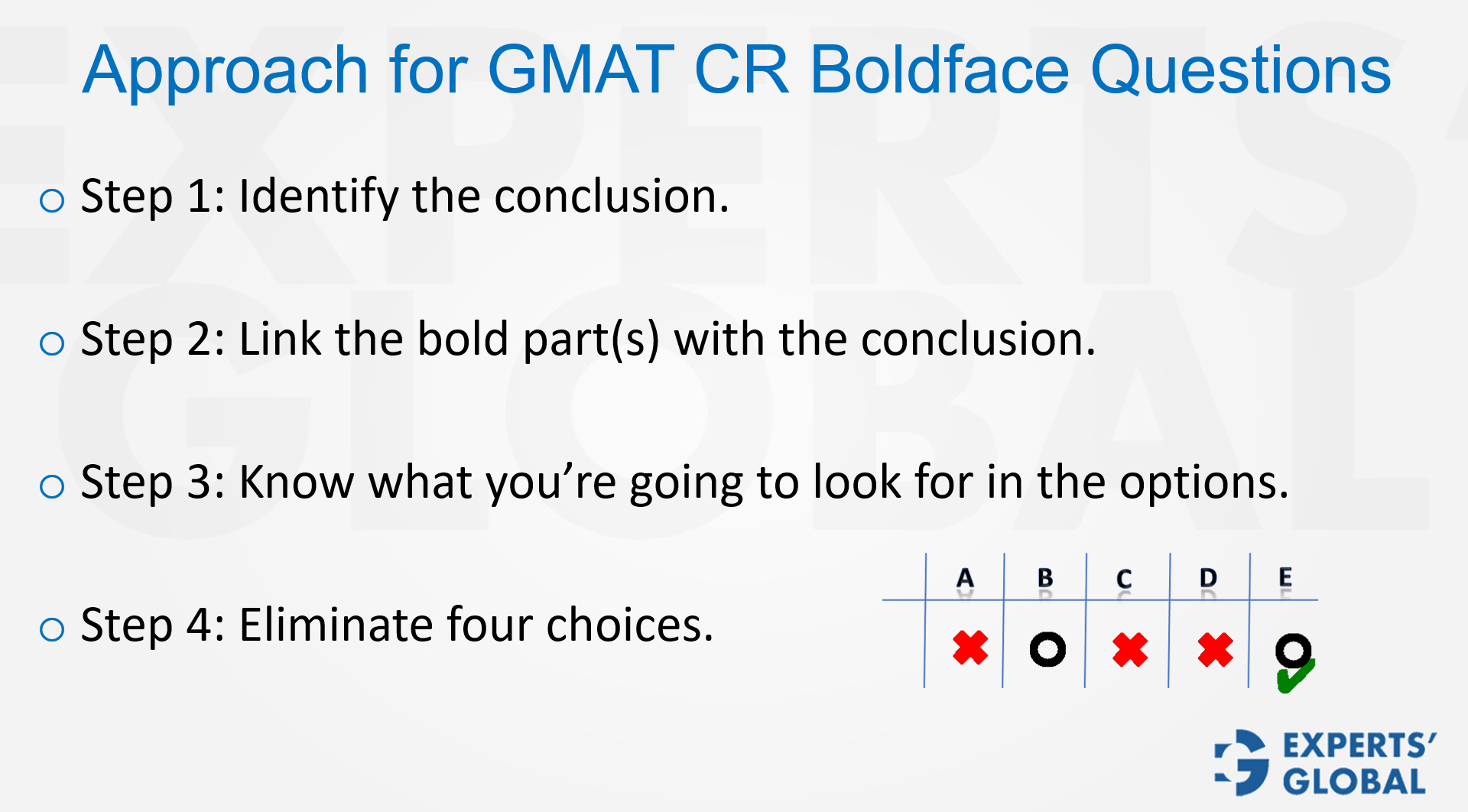
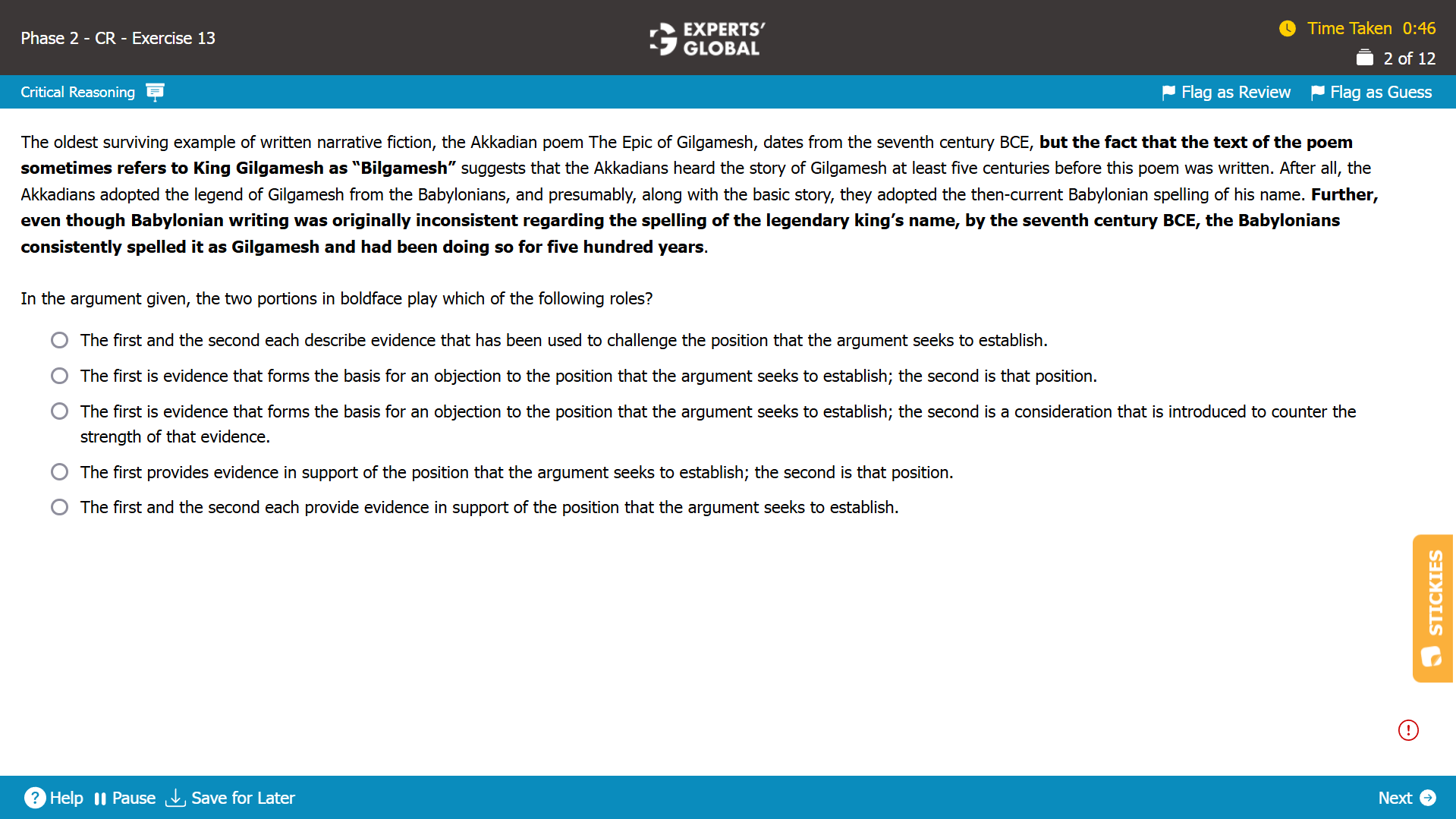
Written Explanation
Strategy: Determining the main conclusion of the argument and finding the relation of the boldfaced portions with this conclusion
Logic: The argument is concerned with the Akkadians adopting the legend of king Gilgamesh from the Babylonians. The argument mentions, as the first boldface states, that an Akkadian poem in the seventh century BCE sometimes spells the king’s name as “Bilgamesh”, thus drawing the conclusion that the Akkadians heard the story at least five centuries before the poem was written. The argument presents the observation that the Akkadian adopted the legend from the Babylonians and reasons, as the second boldface states, that the Babylonians’ usage of the spelling was inconsistent earlier but by the seventh century BCE, the spelling “Gilgamesh” was consistently used for five centuries. Overall, the main conclusion is that the Akkadians heard the story at least five centuries before the poem was written. In the context of the main conclusion – the first boldface is a fact used to establish the main conclusion; the second boldface is an observation used to establish the main conclusion.
Main conclusion: The Akkadians heard the story at least five centuries before the poem was written.
Broad expectation from the correct answer choice:
The first boldface is a fact used to establish the main conclusion.
The second boldface is an observation used to establish the main conclusion.
A.
Merit(s):
The first boldface presents a concrete fact; therefore, it is correct to state that the first boldface is an “evidence”.
The second boldface presents a concrete observation; therefore, it is correct to state that the second boldface is an “evidence”.
Demerit(s):
The argument uses the first boldface to establish the main conclusion; therefore, it is incorrect to state that the first boldface is “used to challenge the position that the argument seeks to establish”.
The argument uses the second boldface to establish the main conclusion; therefore, it is incorrect to state that the second boldface is “used to challenge the position that the argument seeks to establish”.
Because this answer choice does not correctly highlight the roles played by the two portions in boldface, this answer choice is incorrect.
B.
Merit(s):
The first boldface presents a concrete fact; therefore, it is correct to state that the first boldface is an “evidence”.
Demerit(s):
The argument uses the first boldface to establish the main conclusion; therefore, it is incorrect to state that the first boldface is the “basis for an objection to the position that the argument seeks to establish”.
The second boldface presents a concrete observation and not an opinion; therefore, it is incorrect to state that the second boldface is a “position”.
The second boldface is an observation used to establish the main conclusion but the argument does not seek to set up the observation as acceptable; therefore, it is incorrect to state that the argument “seeks to establish the second boldface”.
Because this answer choice does not correctly highlight the roles played by the two portions in boldface, this answer choice is incorrect.
C.
Merit(s):
The first boldface presents a concrete fact; therefore, it is correct to state that the first boldface is an “evidence”.
The second boldface is an observation that the argument uses to draw the main conclusion; therefore, it is correct to state that the second boldface is a “consideration”.
Demerit(s):
The argument uses the first boldface to establish the main conclusion; therefore, it is incorrect to state that the first boldface is the “basis for an objection to the position that the argument seeks to establish”.
The argument uses the two boldfaces to establish the main conclusion; so, the two boldfaces concur with each other and do not oppose each other; therefore, it is incorrect to state that the second boldface is “introduced to counter the strength of the first boldface”.
Because this answer choice does not correctly highlight the roles played by the two portions in boldface, this answer choice is incorrect.
D.
Merit(s):
The first boldface presents a concrete fact; therefore, it is correct to state that the first boldface is an “evidence”.
The argument uses the first boldface to establish the main conclusion; therefore, it is correct to state that the first boldface “supports the position that the argument seeks to establish”.
Demerit(s):
The second boldface presents a concrete observation and not an opinion; therefore, it is incorrect to state that the second boldface is a “position”.
The second boldface is an observation used to establish the main conclusion but the argument does not seek to set up the observation as acceptable; therefore, it is incorrect to state that the argument “seeks to establish the second boldface”.
Because this answer choice does not correctly highlight the roles played by the two portions in boldface, this answer choice is incorrect.
E.
Merit(s):
The first boldface presents a concrete fact; therefore, it is correct to state that the first boldface is an “evidence”.
The argument uses the first boldface to establish the main conclusion; therefore, it is correct to state that the first boldface “supports the position that the argument seeks to establish”.
The second boldface presents a concrete observation; therefore, it is correct to state that the second boldface is an “evidence”.
The argument uses the second boldface to establish the main conclusion; therefore, it is correct to state that the second boldface “supports the position that the argument seeks to establish”.
Demerit(s):
None
Because this answer choice correctly highlights the roles played by the two portions in boldface, this answer choice is correct.
E is the best answer choice.
GMAT CR: Method-of-Reasoning Sample Question
GMAT CR Method of Reasoning questions challenge you to spot the thinking pattern an argument follows, like how it makes conclusions, uses evidence, addresses counterarguments, or draws comparisons.
Important: Before visiting the following sample question(s), if you would like a quick brush up of key CR Method-of-Reasoning concepts, you may first visit: Free GMAT CR Method-of-Reasoning Prep
Written Explanation
Mind-map: Skin-whitening creams use metal compounds to lighten skin tone → Critics: metal compounds have negative health effects, including risk of skin cancer → Defender: metal compounds absorbed via such creams is less than those absorbed in a few minutes’ exposure to gasoline smoke → skin-whitening creams do not hurt anyone
Missing-link: Between metal compounds absorbed via such creams being less than those absorbed in a few minutes’ exposure to gasoline smoke and the conclusion that skin-whitening creams do not hurt anyone
Expectation from the correct answer choice: To indicate some fact or data that helps in evaluating whether the creams could have negative health effects / the creams do not hurt anyone
A. Knowing whether the creams are equally effective in all areas of the skin makes no suggestion regarding the creams’ negative health effects; so, this answer choice would simply provide additional information but not help in evaluating the dispute concerning the health effects of the skin-whitening creams. Because this answer choice would not help in evaluating the dispute, this answer choice is incorrect.
B. The argument mentions that many skin-whitening creams/cosmetics use heavy metal compounds to block the production of the skin pigment melanin, suggesting that treatments for hyperpigmentation are likely to use metal compounds to reduce melanin production; thus, this answer choice provides no additional, useful information to help in evaluating the dispute stated in the argument. Besides, this answer choice provides information about “treatments” and not about skin-whitening “creams” as such. Overall, this answer choice would not help in evaluating the dispute concerning the health effects of the skin-whitening creams. Because this answer choice would not help in evaluating the dispute, this answer choice is incorrect.
C. Correct. This answer choice, suggesting that the typical amount of metal compounds is the lifetime cumulative amount absorbed, indicates that the metal compounds absorbed via skin-whitening creams over the lifetime of a user are less than those absorbed from a few minutes of exposure to gasoline smoke, thus making the amount insignificant enough to support the defender’s view that skin-whitening creams do not hurt anyone; on the other hand, if the typical amount is a one-time amount absorbed, it indicates that, for every usage of the cream, the user is exposed to significant amount of metal compounds, thus casting doubt on the safety of the creams and strengthening the critics’ view that the creams have negative health effects; overall, this answer choice would help in evaluating the dispute concerning the health effects of the skin-whitening creams. Because this answer choice would help in evaluating the dispute, this answer choice is correct.
D. The argument is concerned with the “health” impact of skin-whitening creams and not the “cultural” impact; so, this answer choice is out of scope. Because this answer choice would not help in evaluating the dispute, this answer choice is incorrect.
E. Knowing whether the skin-whitening creams were tested on a broad cross-section of the population indicates the extent of the testing but provides no information about the findings of the tests, without which no judgment can be passed on the creams’ negative health effects; so, this answer choice would not help in evaluating the dispute concerning the health effects of the skin-whitening creams. Because this answer choice would not help in evaluating the dispute, this answer choice is incorrect.
C is the best choice.
GMAT CR: Logical Fallacy Sample Question
Logical Fallacy Critical Reasoning questions on the GMAT appear in familiar formats such as strengthen, weaken, resolve the paradox etc. The key skill in solving these questions is identifying the logical fallacy in the argument.
Important: Before visiting the following sample question(s), if you would like a quick brush up of key CR Logical Fallacy concepts, you may first visit: Free GMAT CR Logical Fallacy Prep
Written Explanation
Mind-map: Hornet attacks bees colonies → bee population is reduced → flowering plants dependent on bees are also reduced → toxin makes hornet sterile → introducing large quantities of toxin in hornet’s food chain will save flowering plants (conclusion)
Missing-link: Between toxin making hornet sterile and the conclusion that introducing large quantities of the toxin in hornet’s food chain will save flowering plants
Expectation from the correct answer choice: To strengthen the conclusion that introducing large quantities of the toxin in hornet’s food chain in the affected region will save flowering plants
A. The argument makes no connection between benign hornet species and the threat to flowering plants; so, this answer choice, suggesting that other benign hornet species are sterilized by the toxin, is just additional information and does not strengthen the conclusion that introducing large quantities of toxin in the hornet’s food chain will save flowering plants. Because this answer choice does not strengthen the conclusion, this answer choice is incorrect.
B. Correct. By suggesting that bees will not be sterilized because of the toxin, this answer choice eliminates the possibility of a side-effect and indicates that the toxin will not lead to a reduction in the population of bees, thus helping grow flowering plants that rely on bees for pollination; so, this answer choice, by eliminating a negative impact of the toxin, strengthens the conclusion. Because this answer choice strengthens the conclusion, this answer choice is correct.
C. The argument is concerned with the impact of a “particular” toxin rendering the hornet sterile; so, information that there are a greater “number of toxins” in the hornet’s food chain than previously believed is just additional information and does not strengthen the conclusion. Because this answer choice does not strengthen the conclusion, this answer choice is incorrect.
D. The argument is concerned with the decreasing population of flowering plants in areas infested by the Asian Giant Hornet; this answer choice, suggesting that such areas do not have animals that feed on flowering plants, simply indicates the absence of another threat to flowering plants but makes no suggestion regarding whether flowering plants can be saved from the threat of hornets by introducing large quantities of toxin in the hornet’s food chain; so, this answer choice is just additional information and does not strengthen the conclusion. Because this answer choice does not strengthen the conclusion, this answer choice is incorrect.
E. The argument is concerned with the effect of “introducing large quantities” of the toxin in the region; so, information about the natural, current level of toxins in the region is just additional information and has no bearing on the argument. Because this answer choice does not strengthen the conclusion, this answer choice is incorrect.
B is the best choice.
GMAT CR: Dialogue Sample Question
On the GMAT, dialogue-based Critical Reasoning questions test the same core skills as other formats. The difference lies in presentation, where the argument unfolds through a quick back-and-forth between two speakers. Your task is to judge the reasoning and answer the question.
Important: Before visiting the following sample question(s), if you would like a quick brush up of key CR Dialogue concepts, you may first visit: Free GMAT CR Dialogue Prep
Written Explanation
Mind-map: Network president: I intend to change focus from reality television programming to scripted television programming → research shows that public’s attention is shifting to scripted television programming → most studios will tailor their programming accordingly → producer: I disagree → as public becomes more interested in scripted television programming, networks will become saturated → reality television programming will be a novelty → reality television programming will increase in viewership
Missing-link: Not needed
Expectation from the correct answer choice: Something on the lines of accepting the facts cited by the network president but disagreeing with him by presenting a benefit of continuing reality television programming
A. The term “suggesting” indicates offering a recommendation or supporting a course of action; the producer makes no recommendations about what types of television programming the public should watch; the producer simply accepts the facts cited by the network president but disagrees with him by presenting the benefit of continuing reality television programming. Because this answer choice does not indicate the producer’s method of responding to the network president’s argument, this answer choice is incorrect.
B. Neither the network president nor the producer makes any suggestion regarding whether all reality television programs have lower budgets than scripted television programs do; the producer simply accepts the facts cited by the network president but disagrees with him by presenting the benefit of continuing reality television programming. Because this answer choice does not indicate the producer’s method of responding to the network president’s argument, this answer choice is incorrect.
C. The producer accepts the facts cited by the network manager by acknowledging that “As the public becomes more interested in scripted television programs, networks will become saturated with them”; so, it is incorrect to state that the producer disputes the network president’s assertion that the public’s attention is shifting towards scripted television programs with high budgets; the producer simply accepts the facts cited by the network president but disagrees with him by presenting the benefit of continuing reality television programming. Because this answer choice does not indicate the producer’s method of responding to the network president’s argument, this answer choice is incorrect.
D. Correct. The producer accepts the facts cited by the network president but disagrees with him by exploring the consequences of the strategy suggested by the network president to conclude that continuing reality television programming is beneficial; in other words, the producer responds to the network president’s proposal of shifting focus by suggesting that not changing the network’s current focus could be the better decision, as the answer choice mentions. Because this answer choice aptly indicates the producer’s method of responding to the network president’s argument, this answer choice is correct.
E. Trap. The dialogue makes no suggestion that the network president assumes that the number of high-budget scripted television shows on air will increase alongside the public’s interest in them or that the producer provides evidence that questions such an assumption; the producer simply accepts the facts cited by the network president but disagrees with him by presenting the benefit of continuing reality television programming. Because this answer choice does not indicate the producer’s method of responding to the network president’s argument, this answer choice is incorrect.
D is the best choice.
Data Insights Sample Questions
The Data Insights section on the GMAT is one of the three sections on the exam and therefore contributes to one third of your overall score. In addition to this direct contribution, the skills developed while preparing for Data Insights also draw upon concepts and abilities from both the quantitative and verbal sections. The GMAT Data Insights section includes five question formats, namely data sufficiency (DS), table analysis (TA), two-part analysis (TPA), graphics interpretation (GI), and multi-source reasoning (MSR). Each question presents information through tables, graphics, passages, or statements, followed by answer choices or response options based on the question type. Your task is to carefully analyze the information provided, connect the relevant details, and select the correct response or set of responses based on what the question requires. In data sufficiency, each question has one correct answer choice. In the other Data Insights question types, most questions require multiple responses, and the question is considered correct only when every required response is correct – there are no partial credits.
Important: Before visiting the DI sample questions, if you would like a quick brush up of key Data Insights concepts, you may first visit: Free GMAT Data Insights Prep
Data Sufficiency (DS) Sample Questions
Data Sufficiency, often referred to as DS, is one of the most interesting question types on the GMAT. Instead of asking you to calculate a final answer, a DS question asks you to judge whether the information provided is sufficient to answer the question. Out of the 20 questions in the Data Insights section of the GMAT, about 5 to 7 are DS.
Important: Before visiting the Data Sufficiency sample questions, if you would like a quick brush up of key DS concepts, you may first visit: Free GMAT Data Sufficiency Prep
DS Sample Question 1
Let the total number of babies delivered be A.
Let the total number of babies delivered in a private hospital be P.
Let the total number of cesarean births be C.
Let the number of cesarean births in private hospitals be B.
Since 25% of all babies were delivered in a private hospital: P = 0.25A (Equation I)
Since 40% of all cesarean births occurred in a private hospital: B = 0.4C (Equation II)
We have to find the percentage of all births that took place in a private hospital were cesarean births, which can be expressed as:
What percentage of P is B?
We need to find whether the value of 100 × (B/P) can be determined.
Statement (1)
A = 72,000
Using the value of A, from Equation I we can determine the value of P, however, no information is provided regarding the value of B.
It is NOT possible to determine with certainty the value of 100 × (B/P). Hence, Statement (1) is insufficient.
Statement (2)
0.2A = C
From Equation II, we get: B = 0.4C = 0.4(0.2)A (Equation III)
Dividing Equation III by Equation I, we get: B/P = 0.4(0.2)A/0.25A = (0.4)(0.2)/0.25
It is possible to determine with certainty the value of 100 × (B/P). Hence, Statement (2) is sufficient.
B is the correct answer choice.
DS Sample Question 2
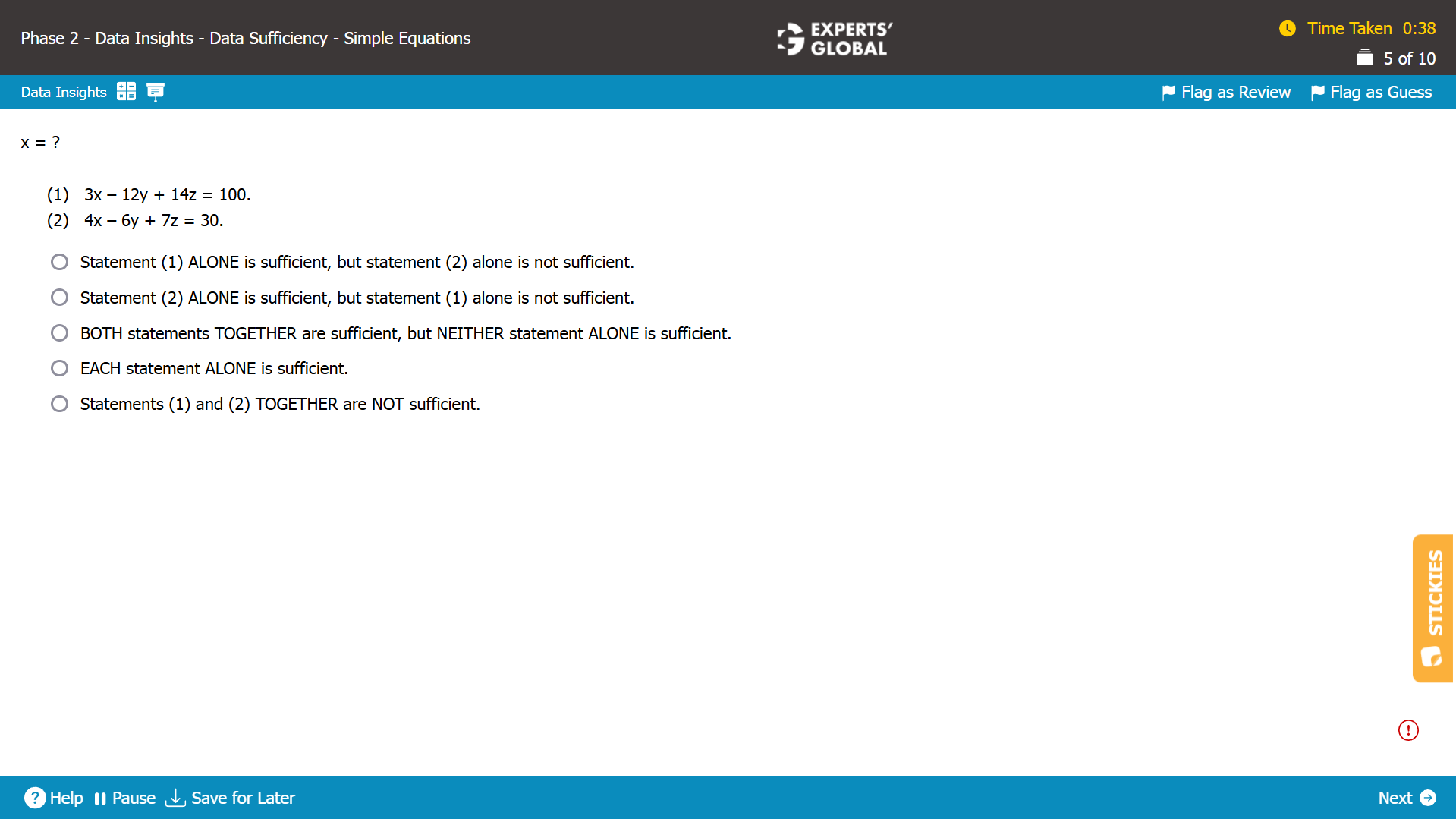
Written Explanation
Statement (1)
3x – 12y + 14z = 100.
There are three variables and only one equation. The value of x cannot be determined. Insufficient.
Statement (2)
4x – 6y + 7z = 30.
There are three variables and only one equation. The value of x cannot be determined. Insufficient.
Because both the statements alone are not sufficient, let’s combine the two statements.
Statement (1) and Statement (2) combined
3x – 12y + 14z = 100.
– 12y + 14z = 100 – 3x… (Equation I)
4x – 6y + 7z = 30
2 X (4x – 6y + 7z = 30) = 2 X 30
8x – 12y + 14z = 60
– 12y + 14z = 60 – 8x… (Equation II)
Equating Equation I and Equation II
100 – 3x = 60 – 8x.
There is one equation with one variable. The value of x can be determined. (Please note that the exact answer is not required to be calculated in a Data Sufficiency question.)
Sufficient.
C is the correct answer choice.
DS Sample Question 3
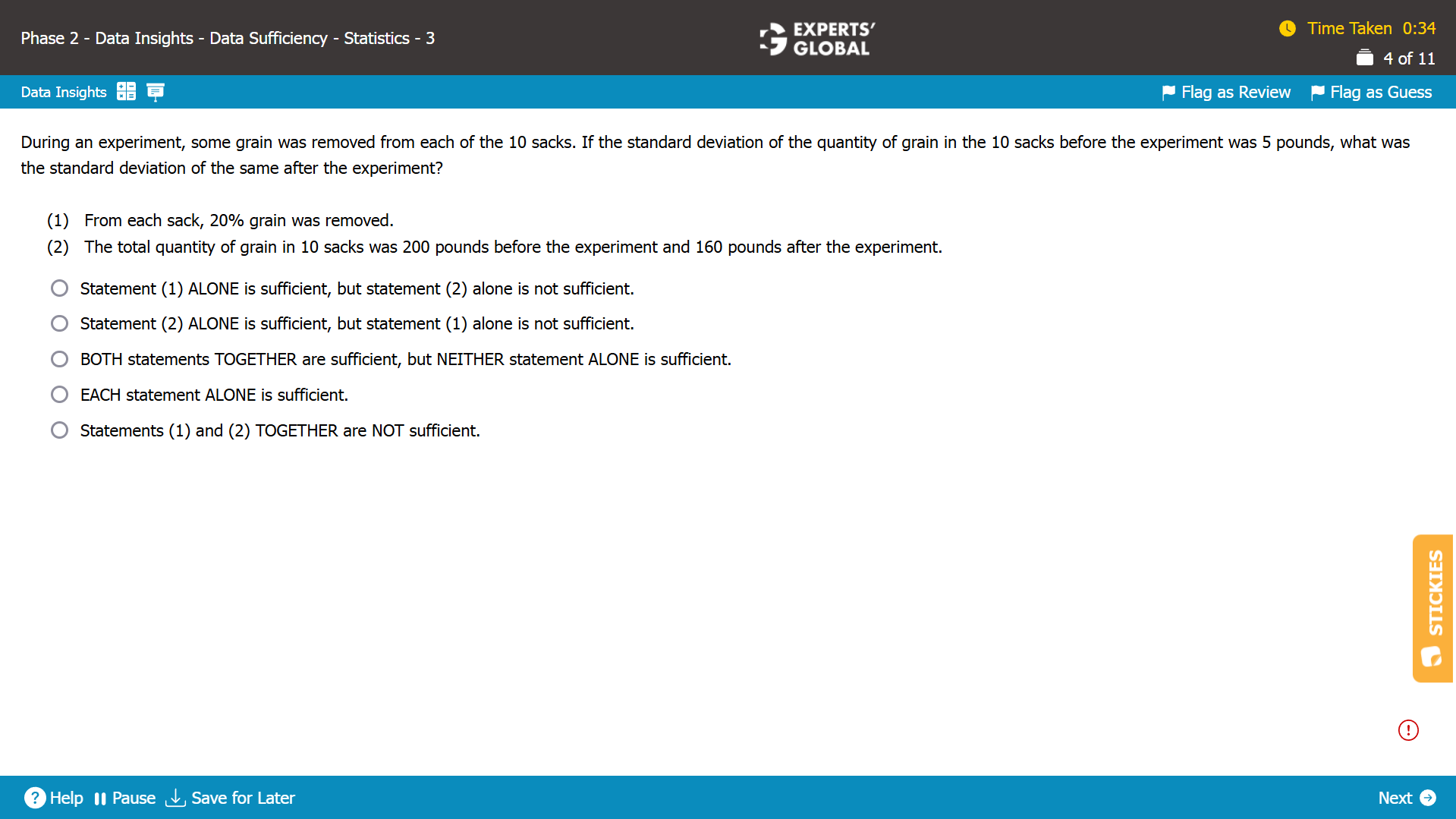
Written Explanation
Statement (1)
There are 10 sacks of grain with a standard deviation of 5 pounds in their quantity.
When each element in a set is increased by the same percentage, the standard deviation of the set changes by the same percentage.
So, if 20% grain is removed from each sack, the standard deviation will reduce by 20% and will become 5 X 0.8 = 4 pounds. Sufficient.
Statement (2)
The average quantity of 200 pounds before the experiment indicates that the total quantity in 10 sacks was 200 X 10 = 2000 pounds.
The average quantity of 160 pounds after the experiment indicates that the total quantity in 10 sacks is 160 X 10 = 1600 pounds.
However, nothing is known about how much grain was added to each sack. If an equal quantity was added to each sack, the standard deviation will remain unchanged; on the other hand, if a different quantity was added to each sack, the standard deviation will change.
Nothing can be determined about the standard deviation after the experiment. Insufficient.
A is the correct answer choice.
DS Sample Question 4
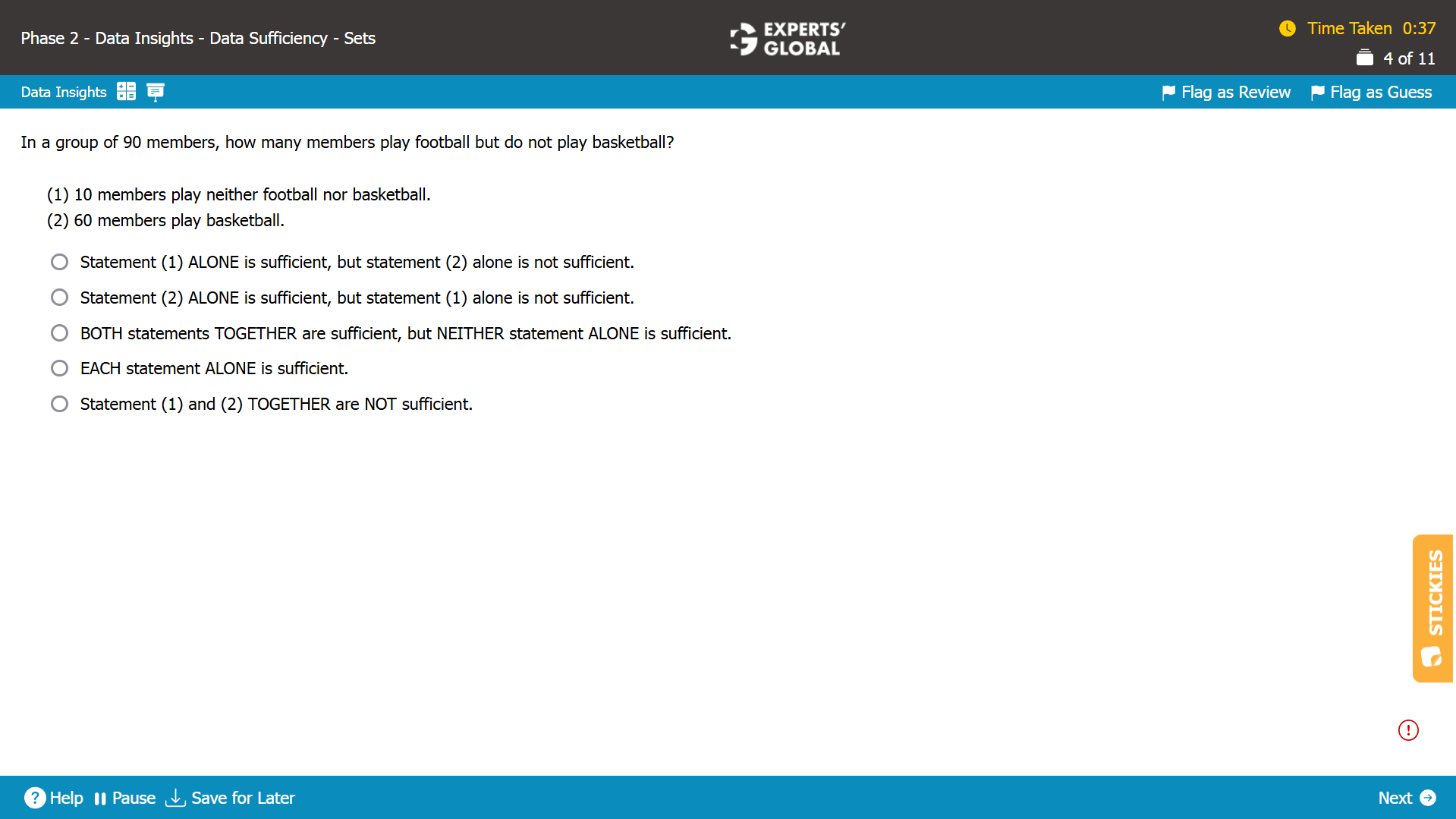
Written Explanation
Statement (1):
c = 10; Does not help in finding a. Insufficient.
Statement (2):
x + b = 60; Does not help in finding a. Insufficient.
Combining both, we know c = 10, x + b = 60; hence, a = 20. Sufficient.
Hence, C is the correct answer choice.
Facing difficulty with the approach for Set Theory questions? Please Click here
Facing difficulty with the approach for data sufficiency questions? Please Click here
Need a comprehensive strategy, approach, and practice for Set Theory? Please Click here (you need to be enrolled for a course that includes the Quant section).
Need a comprehensive strategy, approach, and practice for data sufficiency questions? Please Click here (you need to be enrolled for a course that includes the Quant section).
DS Sample Question 5
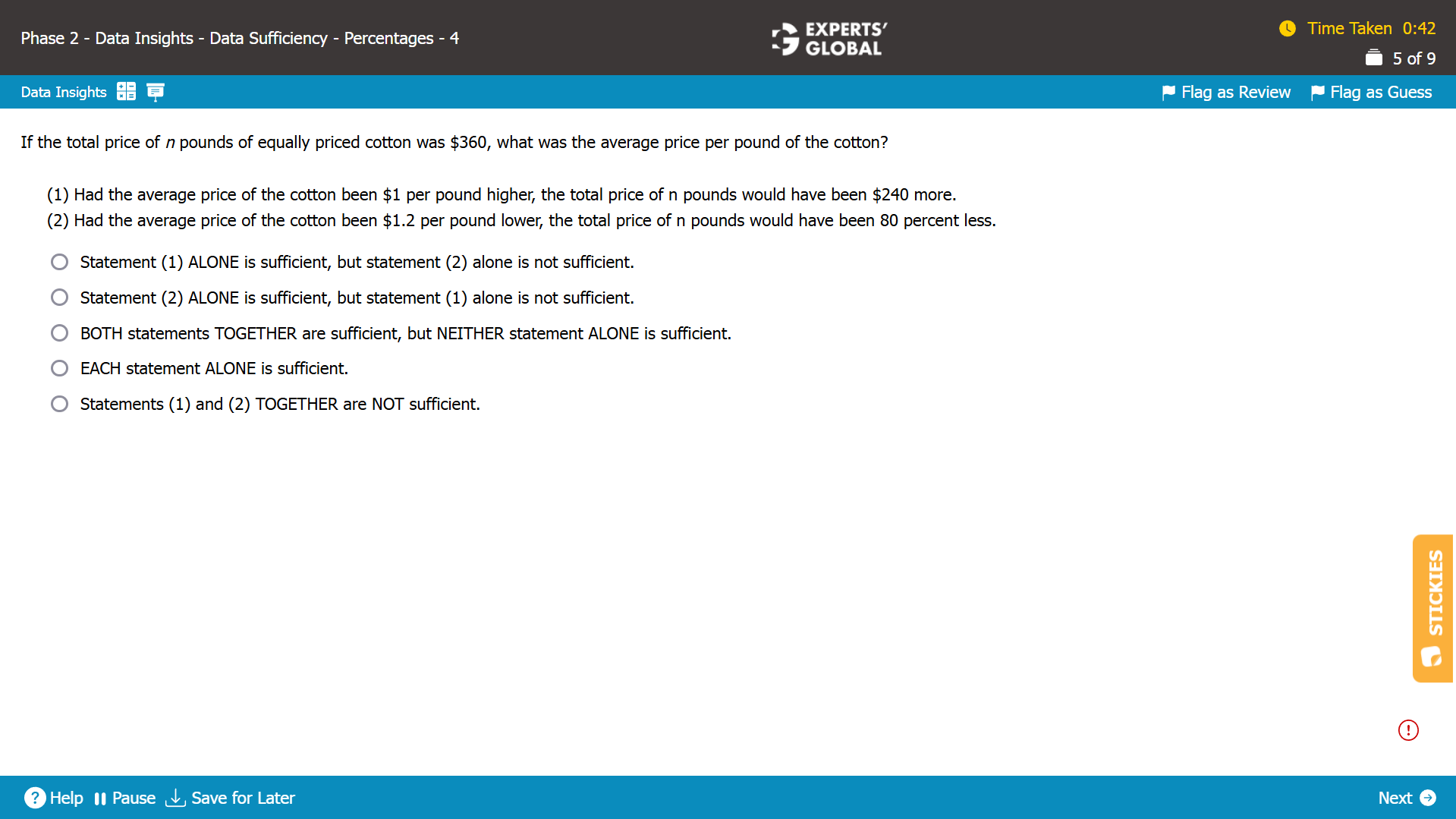
Let the average price per pound of the cotton be p.
Since the total price of n pounds of cotton was $360: np = 360 (Equation I)
We need to find whether the value of p can be determined.
Statement (1)
(p + 1)n = 240 + np (Equation II)
From Equation I and Equation II, we have 2 equations with 2 unknown variables, which can be solved to determine the exact value of p. Hence, Statement (1) is sufficient.
Statement (2)
(p – 1.2)n = np – 0.8np (Equation III)
From Equation I and Equation III, we have 2 equations with 2 unknown variables, which can be solved to determine the exact value of p. Hence, Statement (2) is sufficient.
D is the correct answer choice.
Table Analysis (TA) Sample Questions
Table Analysis, often referred to as TA, is one of the most distinctive and engaging question types on the GMAT. Instead of asking you to decide whether information is sufficient, a TA question asks you to interpret information presented in a table and judge which responses are supported by the data shown. Out of the 20 questions in the Data Insights section of the GMAT, about 3 are TA.
Important: Before visiting the Table Analysis sample questions, if you would like a quick brush up of key TA concepts, you may first visit: Free GMAT Table Analysis Prep
TA Sample Question 1
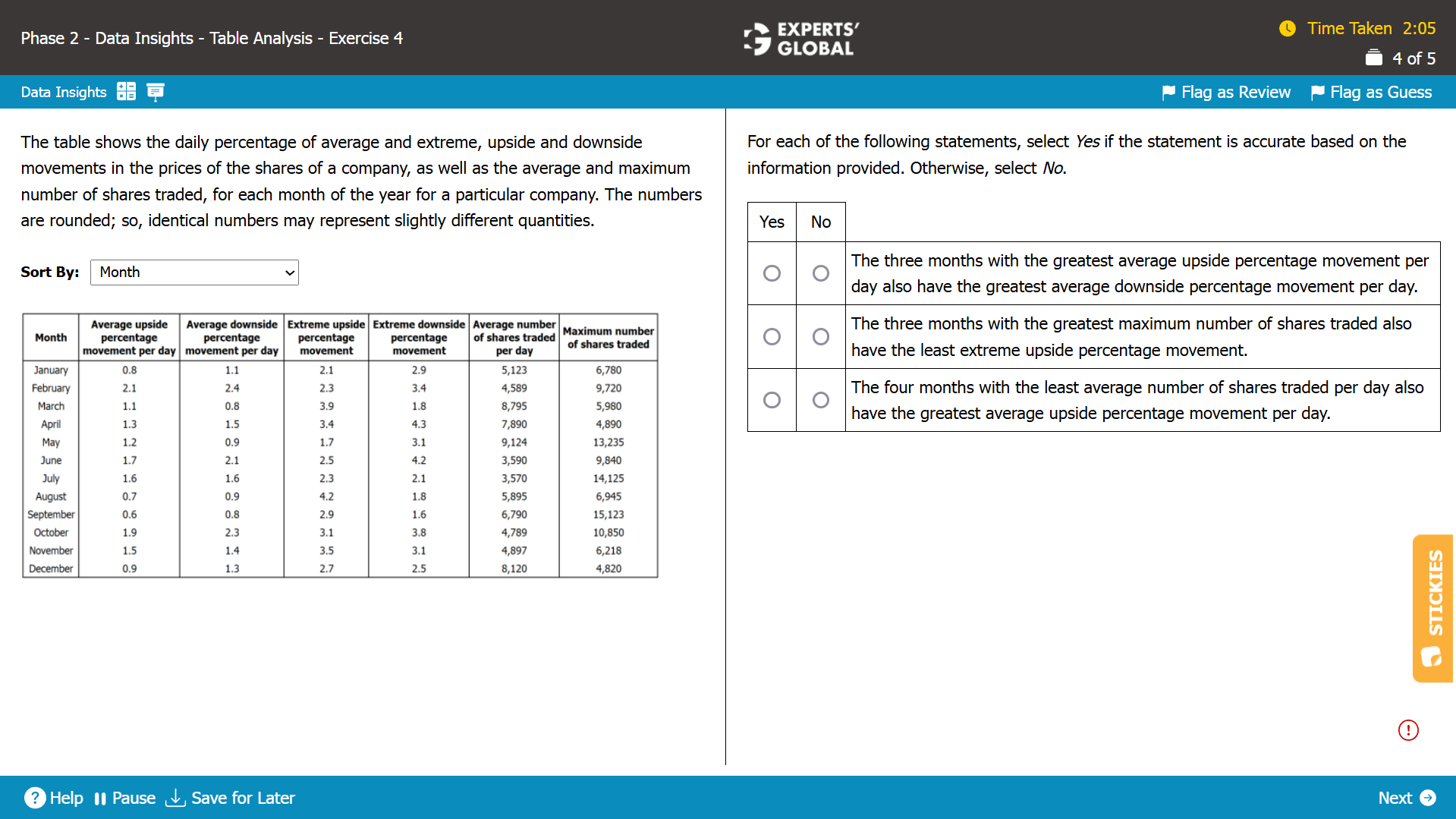
I.
The three months with the greatest average upside percentage movement per day are February, June, and October.
The three months with the greatest average downside percentage movement per day are February, June, and October.
Hence, this statement is accurate based on the information provided.
II.
The three months with the greatest maximum number of shares traded are May, July, and September.
The month of January has a lower extreme upside percentage movement than July and September.
Hence, this statement is NOT accurate based on the information provided.
III.
The four months with the least average number of shares traded per day are February, June, July, and October.
The four months with the greatest average upside percentage movement per day are February, June, July, and October.
Hence, this statement is accurate based on the information provided.
Yes, No, Yes is the correct combination of the answer choices.
TA Sample Question 2
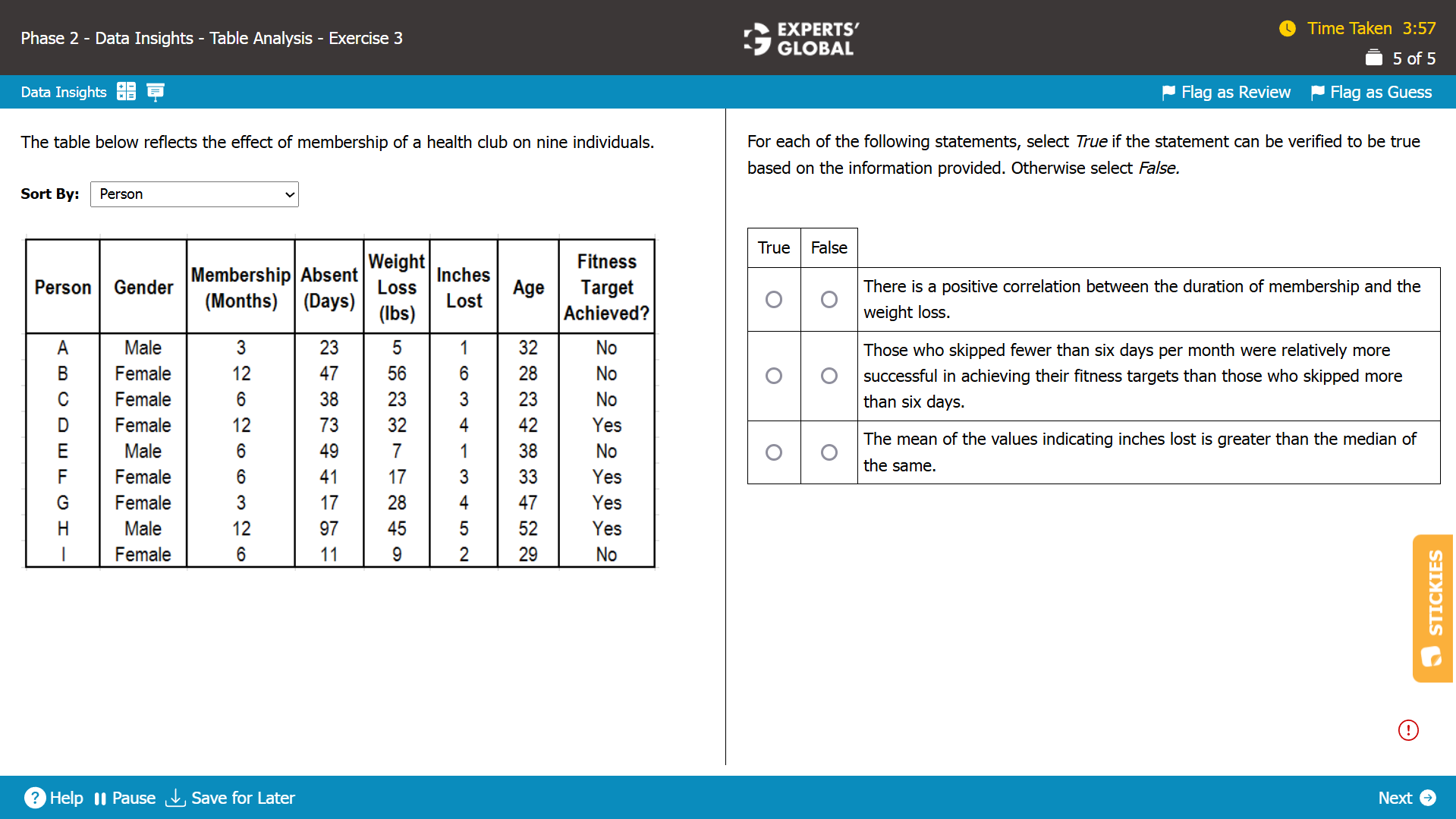
I.
This would suggest that the longer the membership, the more is the weight loss. The data does not suggest this.
The statement is false.
II.
There are three members who skipped fewer than six days per month – B, G, I. Only one of them achieved fitness target. Success rate = 1/3.
Among the other six members, three achieved fitness target. Success rate = 1/2.
The success rate is not higher in those who skipped fewer than six days per month.
The statement is false.
III.
The mean of inches Lost is 3.2, and the median is 3.
The statement is true.
Hence, False-False-True is the correct answer choice.
Need a comprehensive strategy, approach, and practice for Data Insights questions? Please
click here (you need to be enrolled for a course that includes the DI section).
Two-Part Analysis (TPA) Sample Questions
Two-Part Analysis, often referred to as TPA questions ask you to make two connected choices that work together to satisfy the question. Out of the 20 questions in the Data Insights section of the GMAT, about 4 to 5 are TPA.
Important: Before visiting the Two-Part Analysis sample questions, if you would like a quick brush up of key TPA concepts, you may first visit: Free GMAT Two-Part Analysis Prep
TPA Sample Question 1
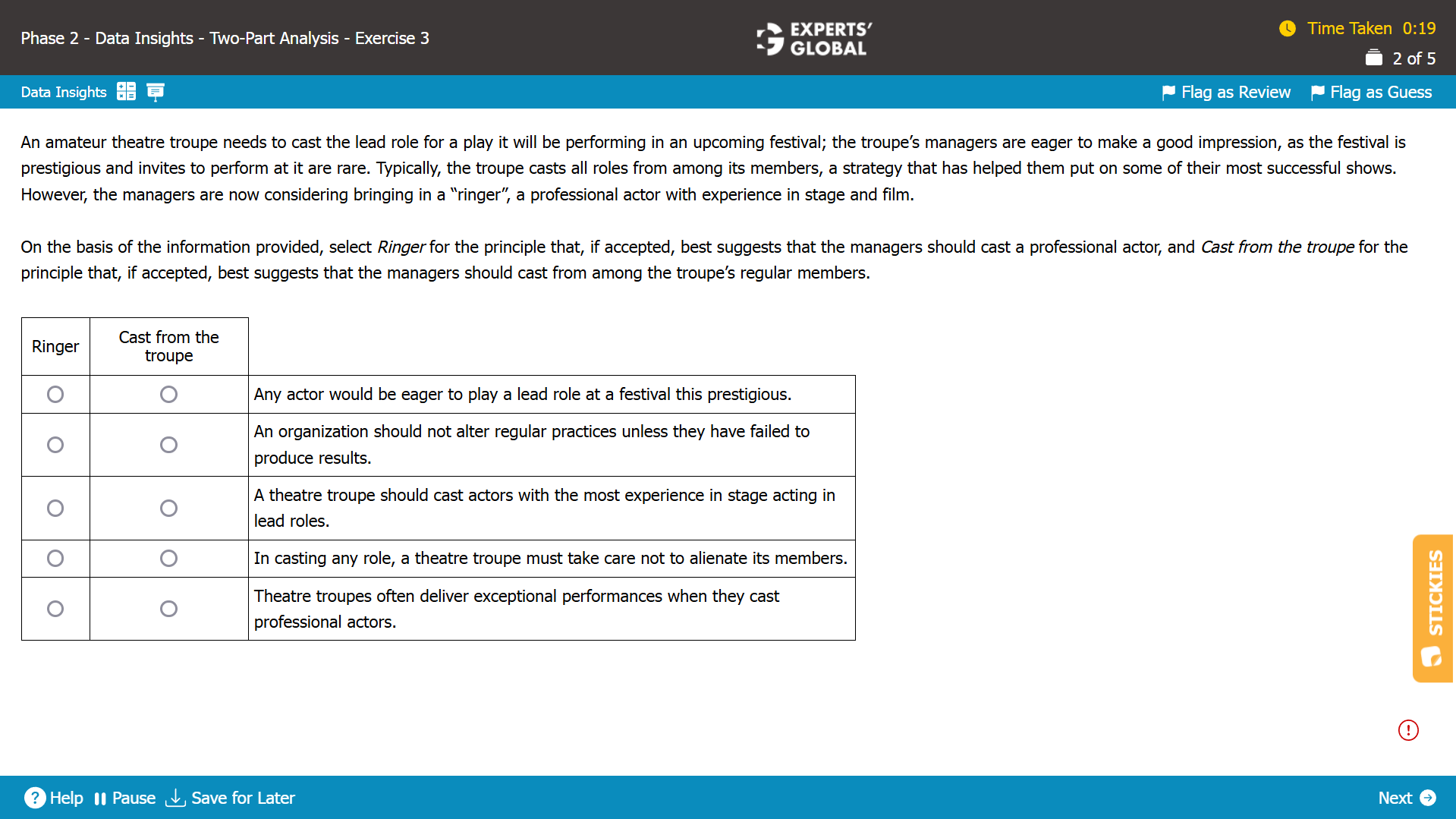
We need to select a principle that, if accepted, best suggests that the managers should cast a professional actor, and select a principle that, if accepted, best suggests that the managers should cast from among the troupe’s regular members.
A.
An actor being eager to play a lead role at a festival only indicates that it would be easy to acquire an actor. This, by itself, is not a reason for the managers to cast an actor, since no information is provided that would lead one to conclude that acquiring an actor easily would help the troupe’s managers make a good impression at the festival. Thus, the organization accepting the principle that any actor would be eager to play a lead role at such a prestigious festival would not favor either casting the current troupe members or casting a professional actor.
B.
Based on the information that the theater troupe was invited to a prestigious festival, for which invitations are rare, and the information that the troupe typically casts all roles from among its members, which has allowed them to put on successful shows, one can conclude that the theater troupe is producing good results without bringing in a professional actor. Thus, if the organization accepts the principle that an organization should not alter regular practices unless they have failed to produce results, then this would favor casting from among the troupe’s regular members.
Hence, “An organization should not alter regular practices unless they have failed to produce results” is the correct answer choice for the Cast from the troupe column.
C.
Given that the actor with the most experience in stage acting in lead roles could be either one of the current theatre troupe members or the professional actor, if the organization accepts the principle that a theatre troupe should cast actors with the most stage acting experience in lead roles, it would not favor casting either the current troupe members or the professional actor.
D.
The passage does not provide any information suggesting that casting a professional actor would alienate any of the theater troupe members. Thus, if the organization accepts the principle that a theatre troupe must avoid alienating its members when casting any role, it would not favor casting either the current troupe members or the professional actor.
E.
The information given in the passage suggests that the theater troupe is currently not using a professional actor, and the troupe’s managers are eager to make a good impression at the festival. So, if the organization accepts the principle that theater troupes often deliver exceptional performances when they cast professional actors, then this would favor casting a professional actor, as it would likely result in the theater troupe giving a better performance at the festival.
Hence, “Theatre troupes often deliver exceptional performances when they cast professional actors” is the correct answer choice for the Ringer column.
Hence, E is the correct answer choice for the “Ringer” column, and B is the correct answer choice for the “Cast from the troupe” column.
TPA Sample Question 2
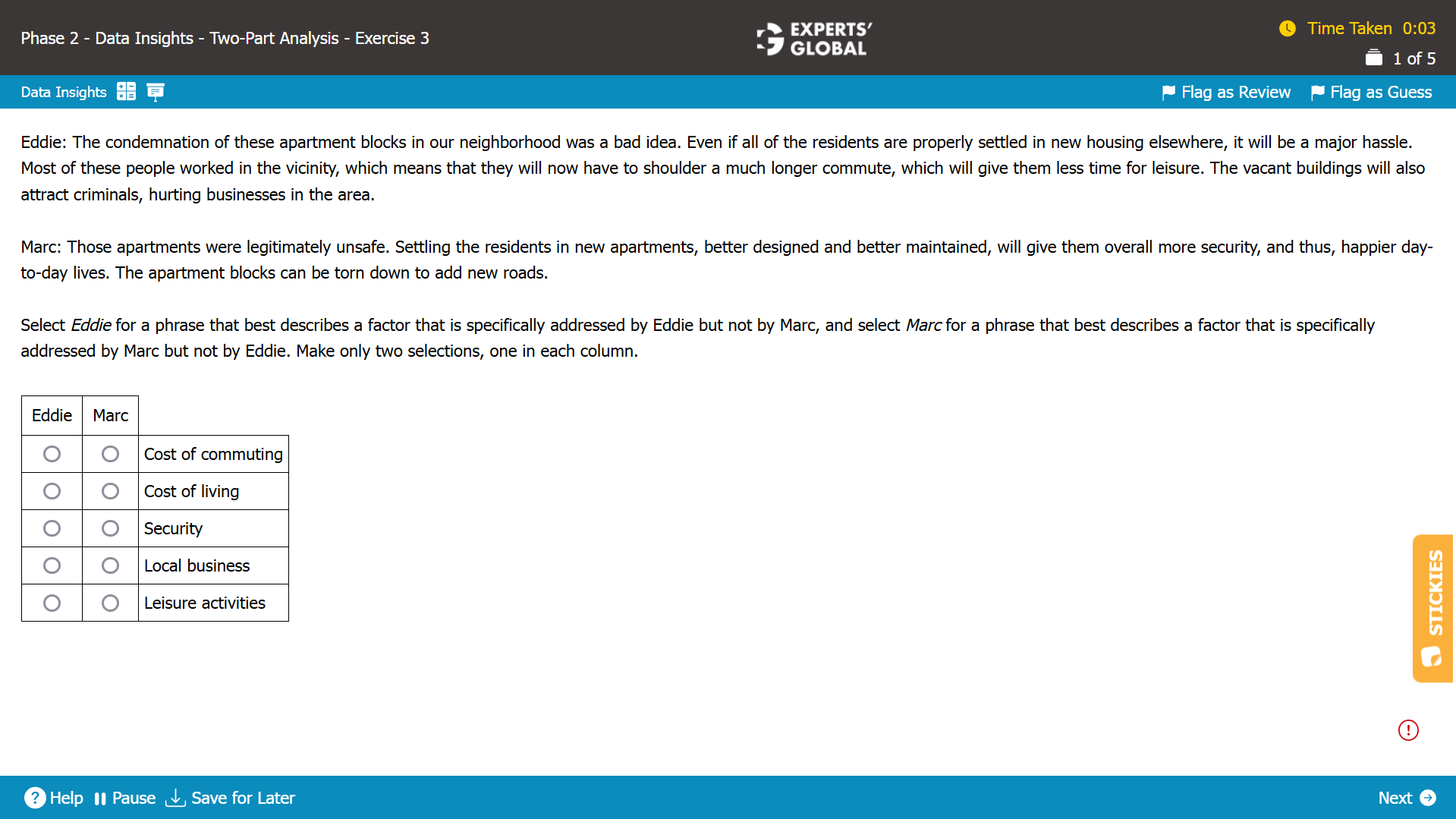
We need to select a phrase that best describes a factor that is specifically addressed by Eddie but not by Marc, and select a phrase that best describes a factor that is specifically addressed by Marc but not by Eddie.
A.
Eddie addresses the time required for the commuting, as indicated by the line “will have to shoulder a much longer commute”, but does NOT address the cost of commuting.
Marc does not address the cost of commuting.
B.
Neither Eddie nor Marc addresses the cost of living.
C.
Eddie does not address security.
Marc addresses security as indicated by the line “will give them overall more security”.
Hence, security is the correct answer choice for the Marc column.
D.
Eddie addresses the local business, as indicated by the line “The vacant buildings will also attract criminals, hurting businesses in the area”.
Marc also addresses this factor, as indicated by the line “The apartment blocks can be torn down to add new roads”.
E.
Eddie addresses leisure activities, as indicated by the line “which will give them less time for leisure”.
Marc does not address leisure activities.
Hence, leisure activities is the correct answer choice for the Eddie column.
Hence, “Leisure activities” is the correct answer choice for the “Eddie” column, and “Security” is the correct answer choice for the “Marc” column.
TPA Sample Question 3
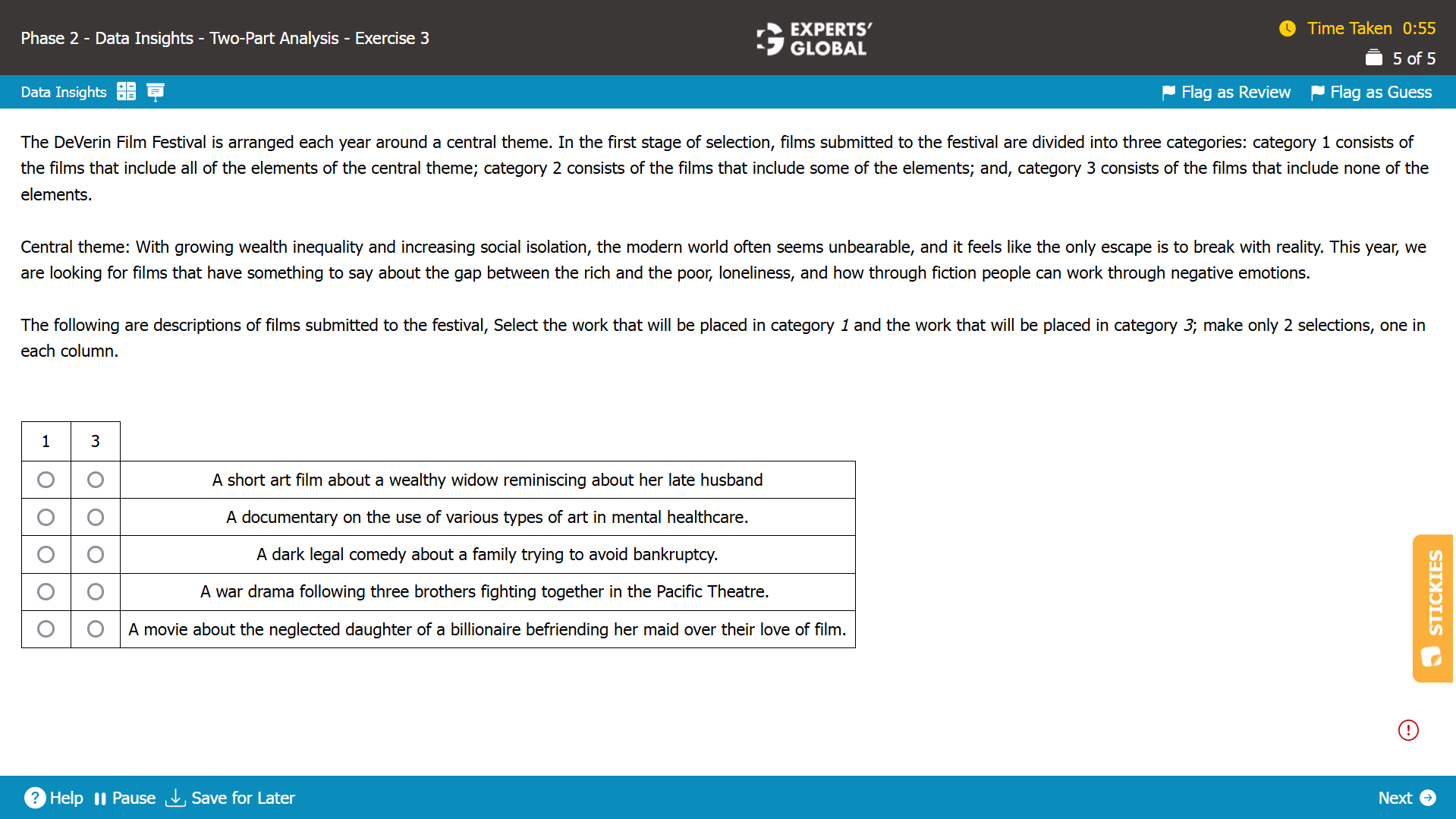
The central theme includes the following elements – wealth inequality, loneliness, and how people can work through negative emotions through fiction.
We need to select a work that includes all the elements of the central theme for category 1, and select a work that includes none of the elements of the central theme for category 3.
A. A short art film about a wealthy widow reminiscing about her late husband
This work mentions wealth but does not include the element of wealth inequality, thus this is not the correct answer choice for category 1.
This work is about a person remembering a deceased loved one, so we can reasonably conclude it includes the element of loneliness; thus, this is not the correct answer choice for category 3.
B. A documentary on gender bias in mental health science.
This work does not include the element of wealth inequality; thus, this is not the correct answer choice for category 1.
This work refers to the use of the arts in mental healthcare, so we can reasonably conclude that it includes the elements of using fiction to combat negative emotions; thus, this is not the correct answer choice for category 3.
C. A dark legal comedy about a family trying to avoid bankruptcy.
This work refers to a family working together towards a goal, so we can reasonably conclude it does not include the element of loneliness; thus, this is not the correct answer choice for category 1.
This work refers to bankruptcy, so we can reasonably conclude that it includes the element of wealth inequality; thus, this is not the correct answer choice for category 3.
D. A war drama following three brothers fighting together in the Pacific Theatre.
Since this work makes no mention of the element of wealth inequality, this is not the correct answer choice for category 1.
Since this work makes no mention of the elements of wealth inequality, loneliness, and how people can work through negative emotions through fiction, this is the correct answer choice for category 3.
Hence, “A war drama following three brothers fighting together in the Pacific Theatre” is the correct answer choice for the category 3 column.
E. A movie about the neglected daughter of a billionaire befriending her maid over their love of film.
This work includes the elements of wealth inequality, as indicated by the phrase “billionaire befriending her maid”, loneliness, as indicated by the phrase “neglected daughter”, and how people can work through negative emotions through fiction, as indicated by the phrase “over their love of film”, this is the correct answer choice for category 1.
Since this work includes the element of wealth inequality, this is not the correct answer choice for category 3.
Hence, “A movie about the neglected daughter of a billionaire befriending her maid over their love of film” is the correct answer choice for the category 1 column.
Hence, Eis the correct answer choice for the 1 column, and D is the correct answer choice for the 3 column.
Graphics Interpretation (GI) Sample Questions
Graphics Interpretation, often referred to as GI, is one of the most distinctive and engaging question types on the GMAT. Instead of asking you to interpret information in a table, a GI question asks you to read information shown visually and judge which responses are supported by what the graphic presents. The GMAT uses this question format to measure how calmly and logically you interpret visual data, rather than how quickly you react to what you see. Out of the 20 questions in the Data Insights section of the GMAT, 3 to 4 are GI.
Important: Before visiting the Graphics Interpretation sample questions, if you would like a quick brush up of key GI concepts, you may first visit: Free GMAT Graphics Interpretation Prep
GI Sample Question 1
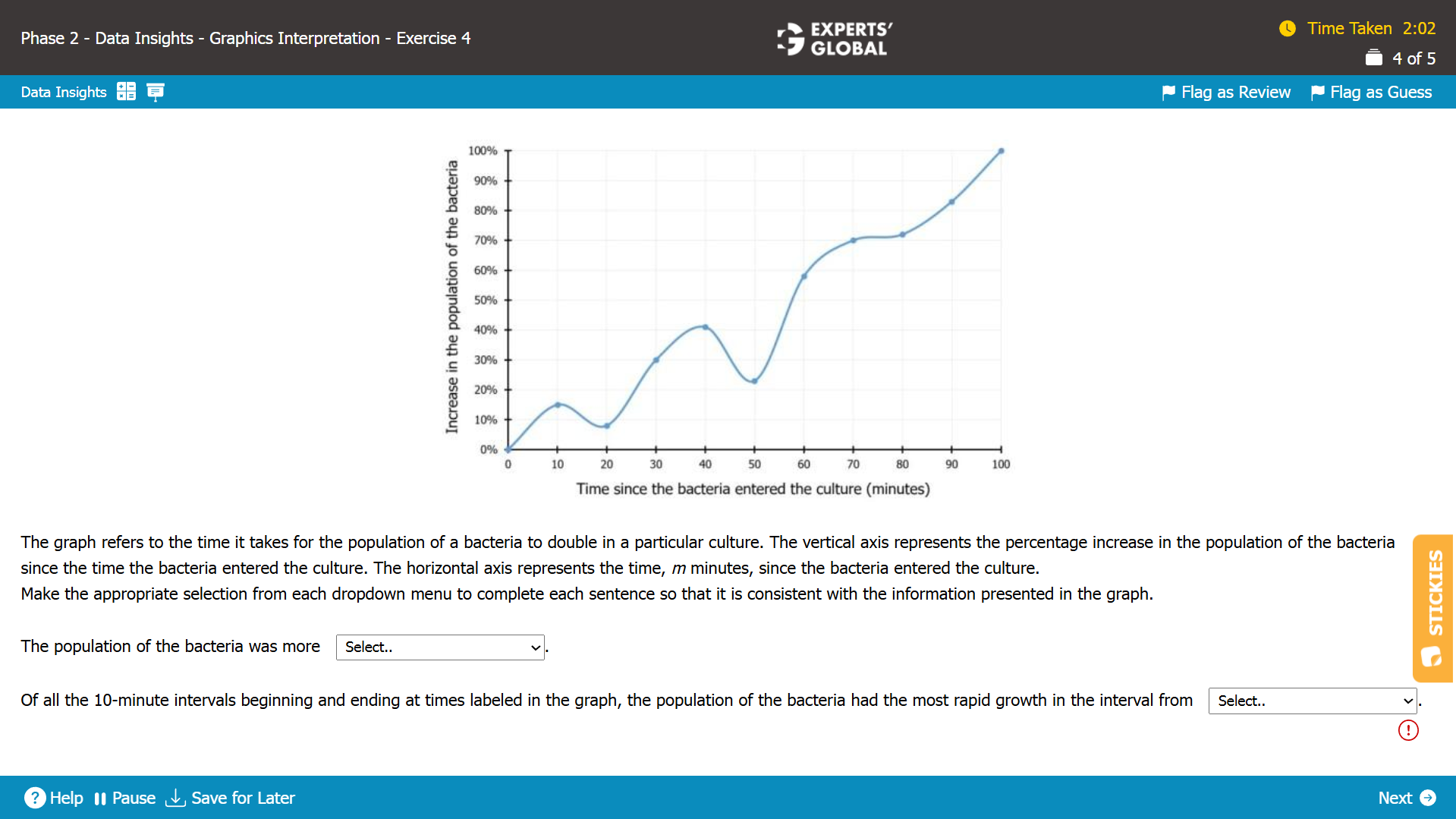
I.
The vertical axis represents the percentage increase in the population of the bacteria since the time the bacteria entered the culture.
This implies that a higher value along the vertical axis indicates a higher population of the bacteria.
From the graph, we see that the population of bacteria was higher at m = 40 minutes than at m = 50 minutes
Hence, “at m = 40 minutes than at m = 50 minutes” is the correct answer choice.
II.
To find the most rapid growth of the population of the bacteria look for the blue line that has the steepest increase.
Hence, “m = 50 minutes to m = 60 minutes” is the correct answer choice.
GI Sample Question 2
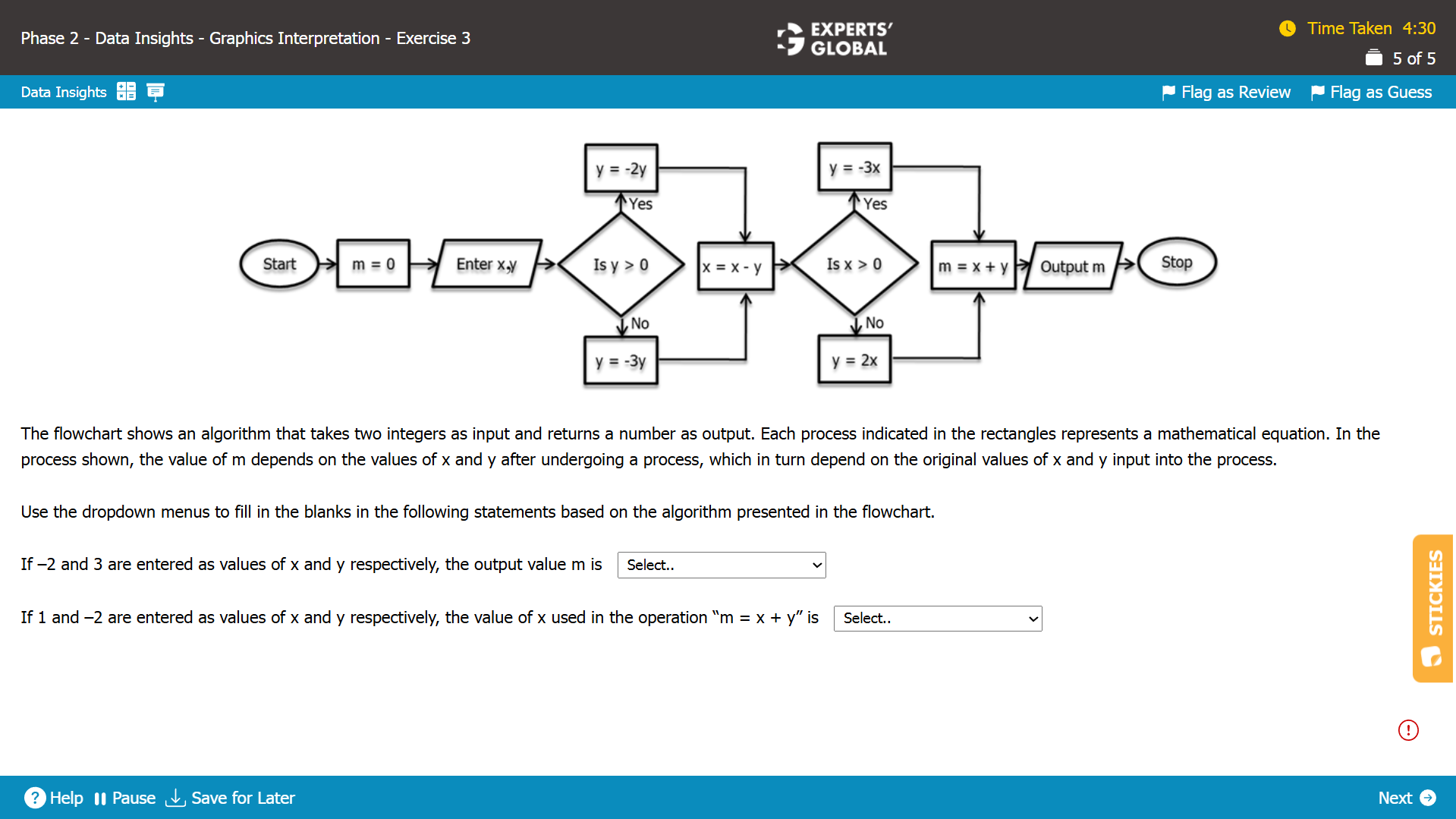
I.
m = 0, x = –2, y = 3
Is y>0? Yes. y = –2y = –6
x = x–y = 4
Is x>0? Yes. y = –3x = –12
m = x+y = –8
The output m value is –8.
Hence, –8 is the correct answer choice.
II.
m = 0, x = 1, y = –2
Is y>0? No. y = –3y = 6
x = x–y = –5
Is x>0? No. y = 2x = –10
m = x+y = –15
The value of x used in this operation is –5.
Hence, –5 is the correct answer choice.
Need a comprehensive strategy, approach, and practice for Data Insights questions? Please
click here (you need to be enrolled for a course that includes the DI section).
GI Sample Question 3
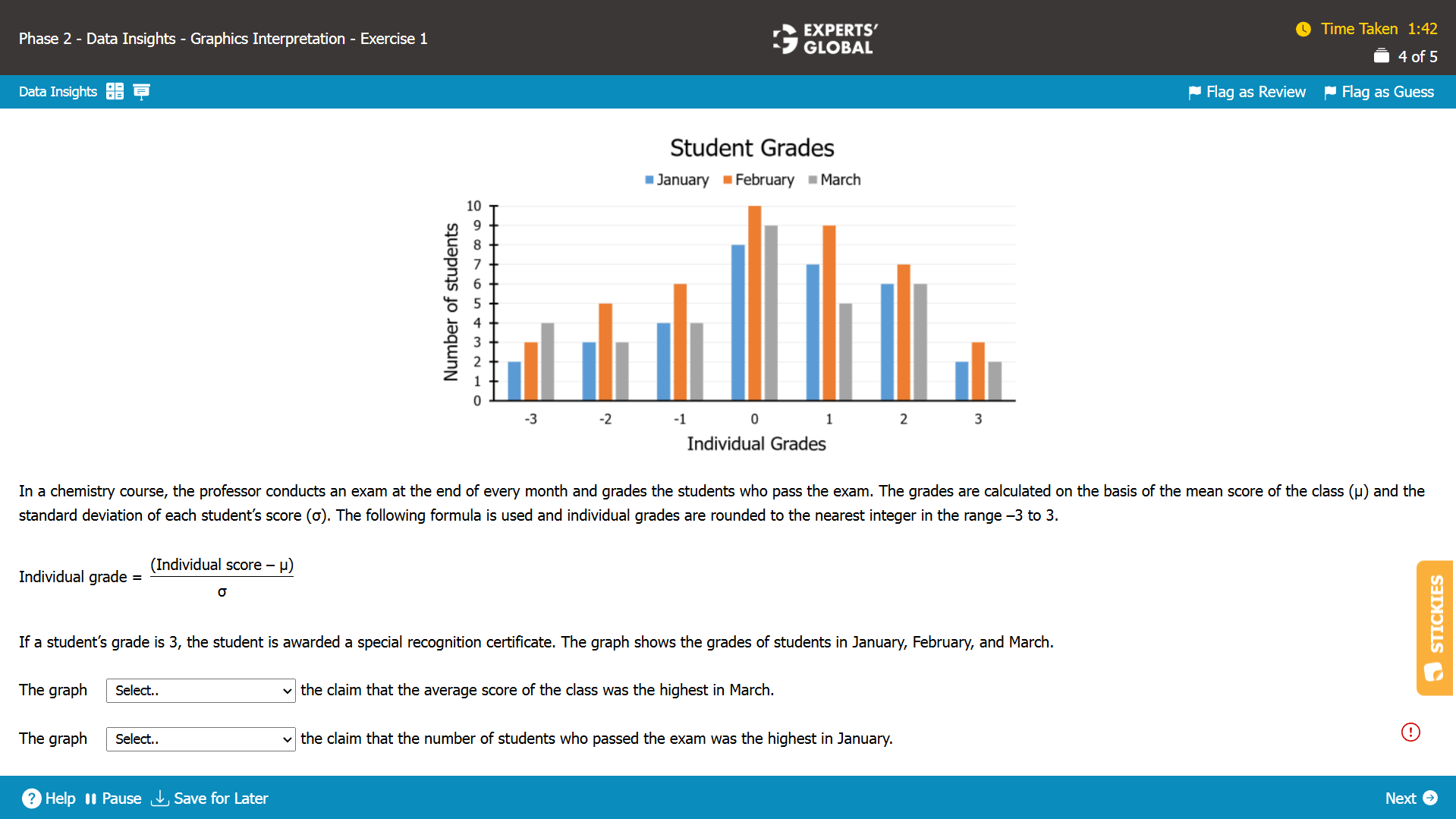
I.
To calculate the average score we would require the individual scores of the students.
Individual grade = (Individual score – µ) / σ
Rearranging the terms, we get;
Individual score = (Individual grade × σ) + µ
Since no information is provided regarding the values of µ and σ, it is NOT possible to calculate the individual scores or the average score of the students.
Hence, neither supports nor refutes is the correct answer choice.
II.
The graph displays the grades of the students who have passed the exam.
The vertical axis of the graph represents the number of students who have passed the exam and received a particular grade.
From the graph, we see that the height of the column for the February month is greater than the height of the column for the January month for each grade displayed in the graph.
Thus, the number of students who passed the exam in February was greater than in January.
Hence, refutes is the correct answer choice.
Multi-Source Reasoning (MSR) Sample Questions
Multi-Source Reasoning questions place you in front of information spread across two or three tabs, such as short passages, charts, tables, or statements, and ask you to combine these pieces to answer carefully framed questions. You switch between sources, compare details, and form clear conclusions from the information taken together. Most questions require multiple responses, and an attempt is marked correct only when every selected response is correct, with no partial credit. On the GMAT, you usually see one or two Multi-Source Reasoning sets, with three questions in each set, meaning either three or six of the twenty Data Insights questions follow this format. Below is a complete set of three sample Multi-Source Reasoning questions that give you first hand exposure to how concepts are tested through the MSR question type.
Important: Before visiting the Multi-Source Reasoning sample questions, if you would like a quick brush up of key MSR concepts, you may first visit: Free GMAT Multi-Source Reasoning Prep
Tab 1 + Question 1
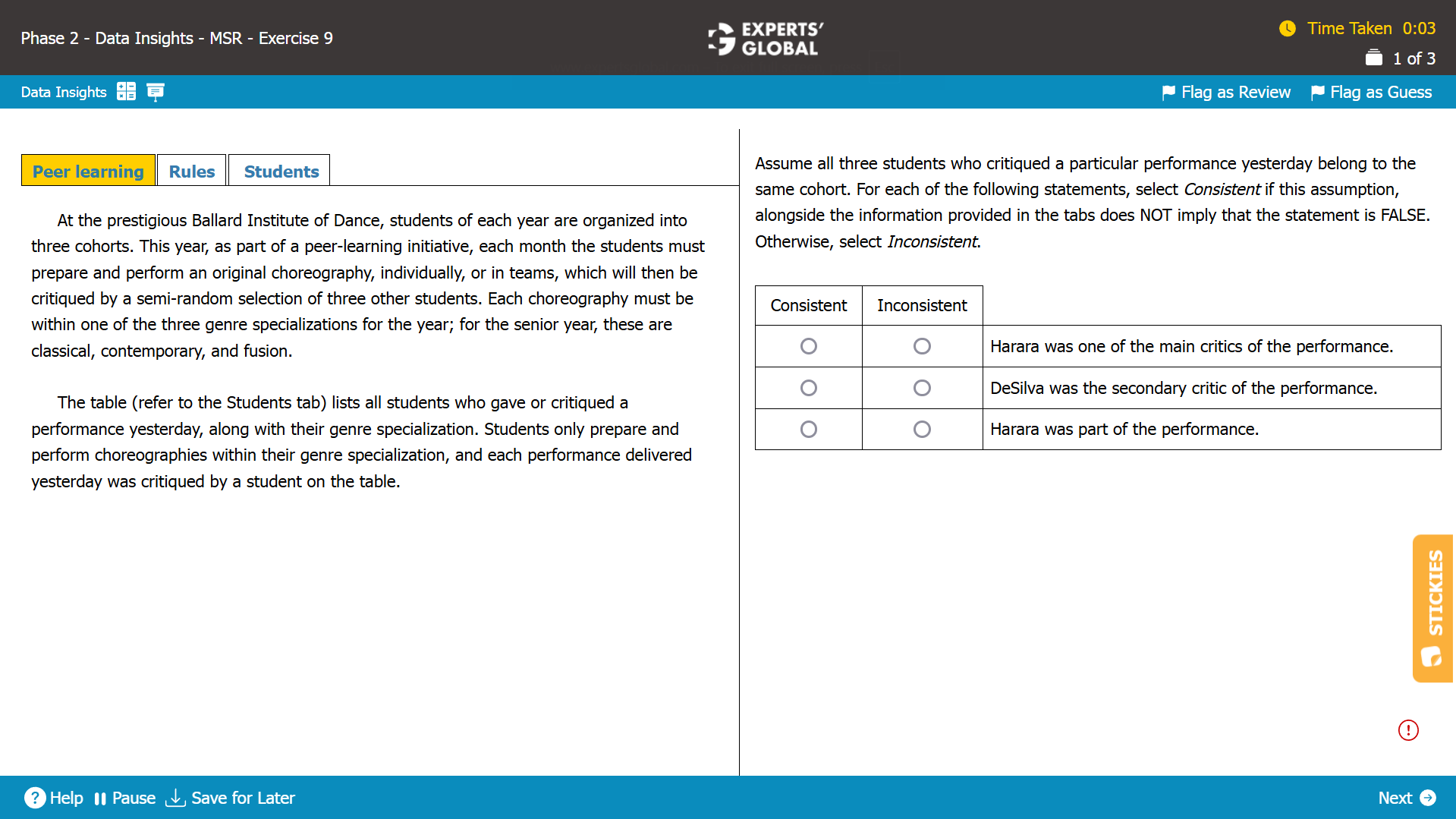
Tab 2 + Question 2
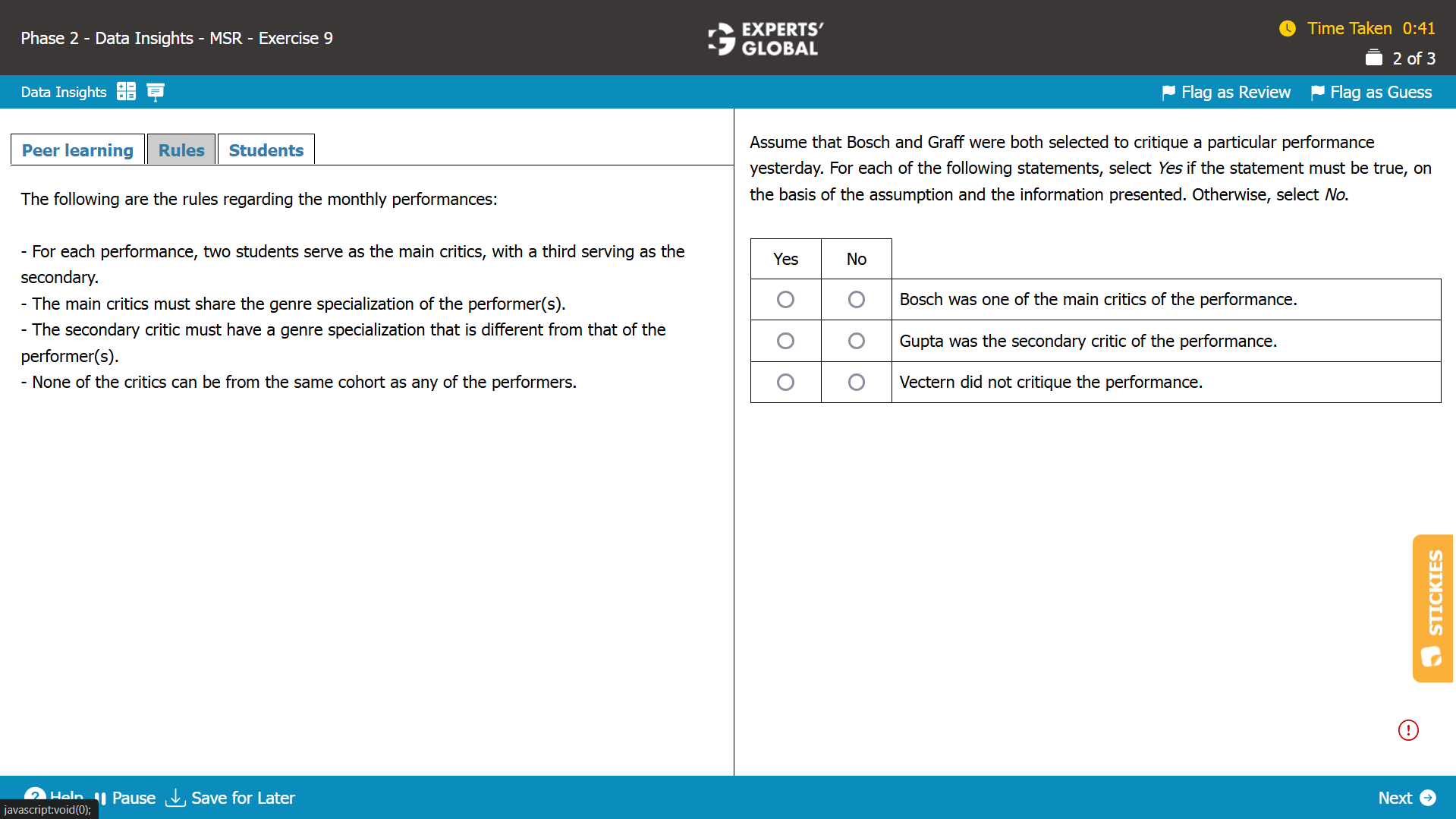
Tab 3 + Question 3
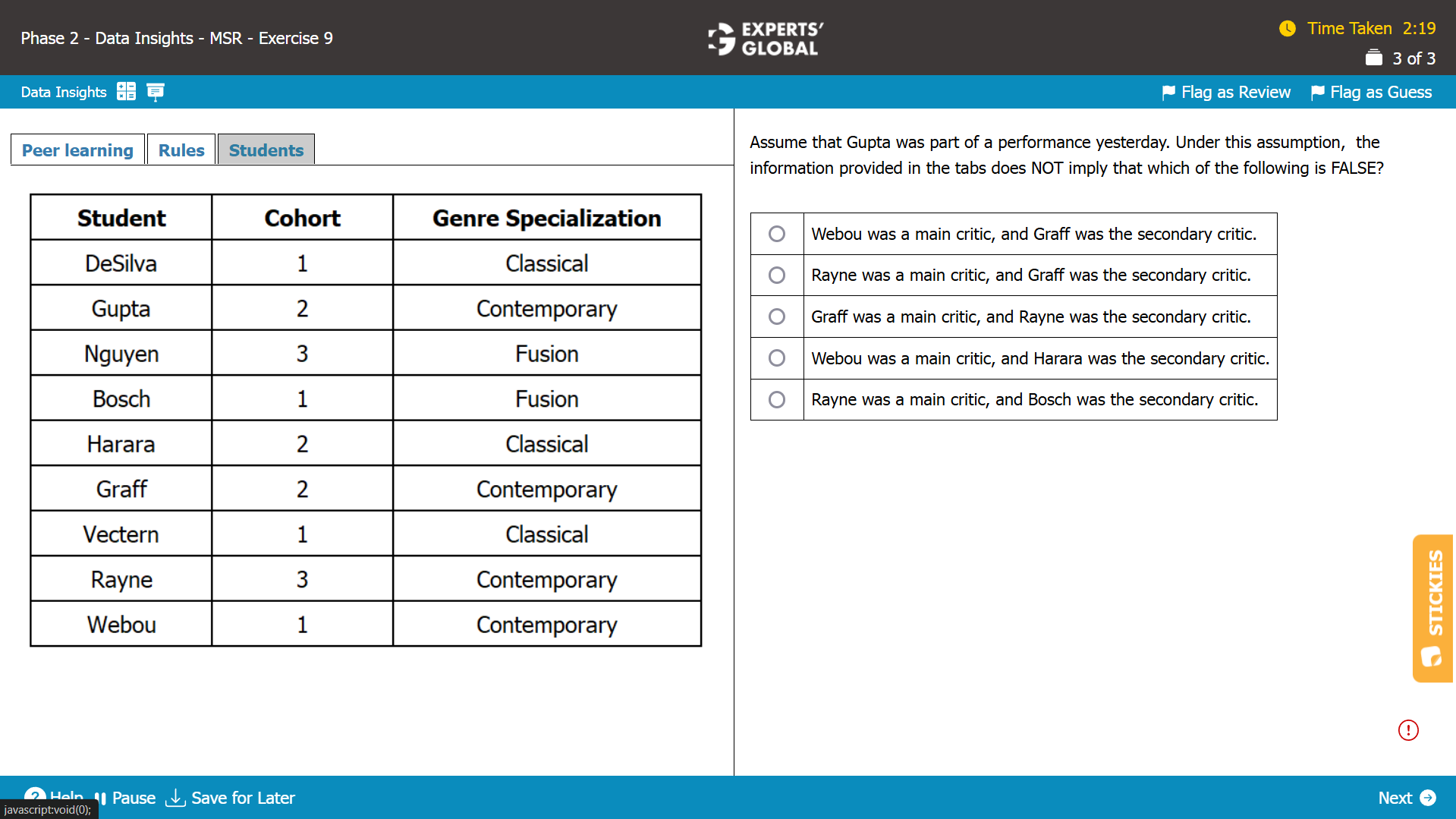
Show correct answer to Question 1
I.
From the table, we see that Harara belongs to cohort 2 and specializes in ‘Classical’.
From the table, we also see that Gupta and Graff are the only students other than Harara that belong to cohort 2 and neither of them specializes in ‘Classical’.
From the rules mentioned in the “Rules” tab, we know that two students serve as main critics and the main critics must share the genre specialization of the performer.
If Harara is one of the main critics, then it is NOT possible to have another critic who belongs to cohort 2 as well as specializes in ‘Classical’.
Thus, “Inconsistent” is the correct answer choice.
II.
From the table, we see that DeSilva belongs to cohort 1 and specializes in ‘Classical’.
Since the secondary critic must have a genre specialization that is different from that of the performer, we know that the performer must specialize in either ‘Contemporary’ or ‘Fusion’.
From the table, we also see that Bosch, Vectern, and Webou are the only students other than DeSilva that belong to cohort 2.
Among these students, only one student specializes in ‘Contemporary’ (Webou) and only one specializes in ‘Fusion’ (Bosch).
From the rules mentioned in the “Rules” tab, we know that two students serve as main critics and the main critics must share the genre specialization of the performer.
If DeSilva is the secondary critic, then it is NOT possible to have two main critics from cohort 1 who specialize in the same genre other than ‘Classical’.
Thus, “Inconsistent” is the correct answer choice.
III.
From the table, we see that Harara belongs to cohort 2 and specializes in ‘Classical’.
From the rules mentioned in the “Rules” tab, we know that two students serve as main critics and the main critics must share the genre specialization of the performer.
From the table, we see that DeSilva and Vectern belong to cohort 1 and specialize in ‘Classical’.
From the rules mentioned in the “Rules” tab, we know that the secondary critic must have a genre specialization that is different from that of the performer.
From the table, we see that Bosch and Webou belong to cohort 1 and do not specialize in ‘Classical’.
If Desilva and Vectern are the main critics and if either Bosch or Webou is the secondary critic, then Harara can be part of the performance.
Thus, “Consistent” is the correct answer choice.
Hence, Inconsistent-Inconsistent-Consistent is the correct combination of answer choices.
Show correct answer to Question 2
From the table, we see that Bosch is from cohort 1 and Graff is from cohort 2.
Since none of the critics can be of the same cohort as any of the performers we know that the performer must be from cohort 3.
From the table, we see that Nguyen and Rayne are the only two students from cohort 3.
From the rules mentioned in the “Rules” tab, we know that two students serve as main critics and the main critics must share the genre specialization of the performer.
From the table, we see that other than Nguyen there is only one student (Bosch) who specializes in ‘Fusion’.
Thus, it is not possible for Nguyen to be the performer.
Therefore, Rayne must be the performer.
I.
From the table, we see that Rayne specializes in ‘Contemporary’ whereas Bosch specializes in ‘Fusion’.
From the rules mentioned in the “Rules” tab, we know that the main critic must share the genre specialization of the performer.
Thus, Bosch cannot be the main critic of the performance.
Thus, “No” is the correct answer choice.
II.
From the table, we see that both Rayne and Gupta specialize in ‘Contemporary’.
From the rules mentioned in the “Rules” tab, we know that the secondary critic must have a genre specialization that is different from that of the performer.
Thus, Gupta cannot be the secondary critic of the performance.
Thus, “No” is the correct answer choice.
III.
From the table, we see that Rayne specializes in ‘Contemporary’, Bosch specializes in ‘Fusion’, and Vectern specializes in ‘Classical’.
From the rules mentioned in the “Rules” tab, we know that the main critic must share the genre specialization of the performer.
This implies that Vectern cannot be the main critic.
From the rules mentioned in the “Rules” tab, we know that only one student serves as the secondary critic and the student has a genre specialization that is different from that of the performer.
Since the question stem mentions that Bosch was selected to critique the performance, Bosch must be the secondary critic.
This implies that Vectern cannot be the secondary critic.
Thus, “Yes” is the correct answer choice.
Hence, No-No-Yes is the correct combination of answer choices.
Show correct answer to Question 3
A.
From the table, we see that both Gupta and Graff are from cohort 2.
From the rules mentioned in the “Rules” tab, we know that none of the critics can be of the same cohort as any of the performers.
Thus, the information provided in the passage implies that this statement is FALSE.
B.
From the table, we see that both Gupta and Graff are from cohort 2.
From the rules mentioned in the “Rules” tab, we know that none of the critics can be of the same cohort as any of the performers.
Thus, the information provided in the passage implies that this statement is FALSE.
C.
From the table, we see that both Gupta and Graff are from cohort 2.
From the rules mentioned in the “Rules” tab, we know that none of the critics can be of the same cohort as any of the performers.
Thus, the information provided in the passage implies that this statement is FALSE.
D.
From the table, we see that both Gupta and Harara are from cohort 2.
From the rules mentioned in the “Rules” tab, we know that none of the critics can be of the same cohort as any of the performers.
Thus, the information provided in the passage implies that this statement is FALSE.
E.
From the table, we see that Gupta belongs to cohort 2 and specializes in ‘Contemporary’.
From the rules mentioned in the “Rules” tab, we know that none of the critics can be of the same cohort as any of the performers.
From the table, we see that neither Rayne nor Bosch belongs to cohort 2.
From the rules mentioned in the “Rules” tab, we know that the main critic must share the genre specialization of the performer.
Since Rayne specializes in ‘Contemporary’, it is possible for Rayne to be the main critic.
From the rules mentioned in the “Rules” tab, we know that the secondary critic must have a genre specialization that is different from that of the performer.
Since Bosch specializes in ‘Fusion’, it is possible for Bosch to be the secondary critic.
Thus, the information provided in the passage does NOT imply that this statement is FALSE.
Hence, E is the correct answer choice.
Additional Free GMAT-style Multi-Source Reasoning (MSR) Questions with Explanations:
Please find another set of GMAT-style MSR questions with explanations on: How to Solve GMAT Multi-Source Reasoning Questions
Please find 2 sets of GMAT-style MSR questions with explanations on: Free GMAT Multi-Source Reasoning Prep
Please find another set of GMAT-style MSR questions with explanations on: Free GMAT Data Insights Prep
Please find 2 sets of GMAT-style MSR questions with explanations on: Free GMAT Multi-Source Reasoning Sample Questions
Please find another set of GMAT-style MSR questions with explanations on: Free GMAT Data Insights Sample Questions
For Further Prep and Practice:
15 full-length GMAT practice tests (includes a free test)
End-to-end GMAT prep course online (includes 7-day free trial)
GMAT 5-weeks crash course
GMAT Prep + Admission Consulting Bundle