The verbal section of the GMAT plays a significant role in your overall score, making up one-third of the total. Additionally, preparing for this section improves your skills for the Data Insights section, impacting around 50% of your performance there. This is why comprehensive coverage of all verbal concepts is essential in any solid GMAT prep course. In the verbal section, you will encounter two main types of questions: reading comprehension (RC) and critical reasoning (CR). Each question presents either a passage or an argument, followed by multiple answer choices. Only one choice is correct. Your task is to carefully read, assess the information and reasoning, and select the answer that best fits the question’s requirements. This page provides a well-structured playlist organized by subtopics, along with several worked examples, to help you prepare for this concept in the most effective way.
Reading Comprehension Questions on GMAT Verbal Section
On the GMAT, reading comprehension begins with a detailed passage, often with a few twists and turns, followed by three or four multiple-choice questions, each with exactly one correct answer. You typically see four such passages, so roughly 13 to 15 of the 23 Verbal questions are reading comprehension. This alone shows how central RC is to your Verbal preparation, and to your GMAT preparation overall. Even more importantly, strength in reading comprehension sharpens your ability to understand and analyze information quickly, and that skill matters across all GMAT sections and question types. In that sense, reading comprehension supports not only RC and the Verbal section, it also strengthens your performance across the entire GMAT. Therefore, thoughtful strategy and steady practice in reading comprehension are essential parts of any comprehensive GMAT preparation course. This page offers you an organized, subtopic-wise playlist, along with a few worked examples, for efficient preparation approach that you can carry into your GMAT practice drill, sectional tests, and full-length GMAT mocks.
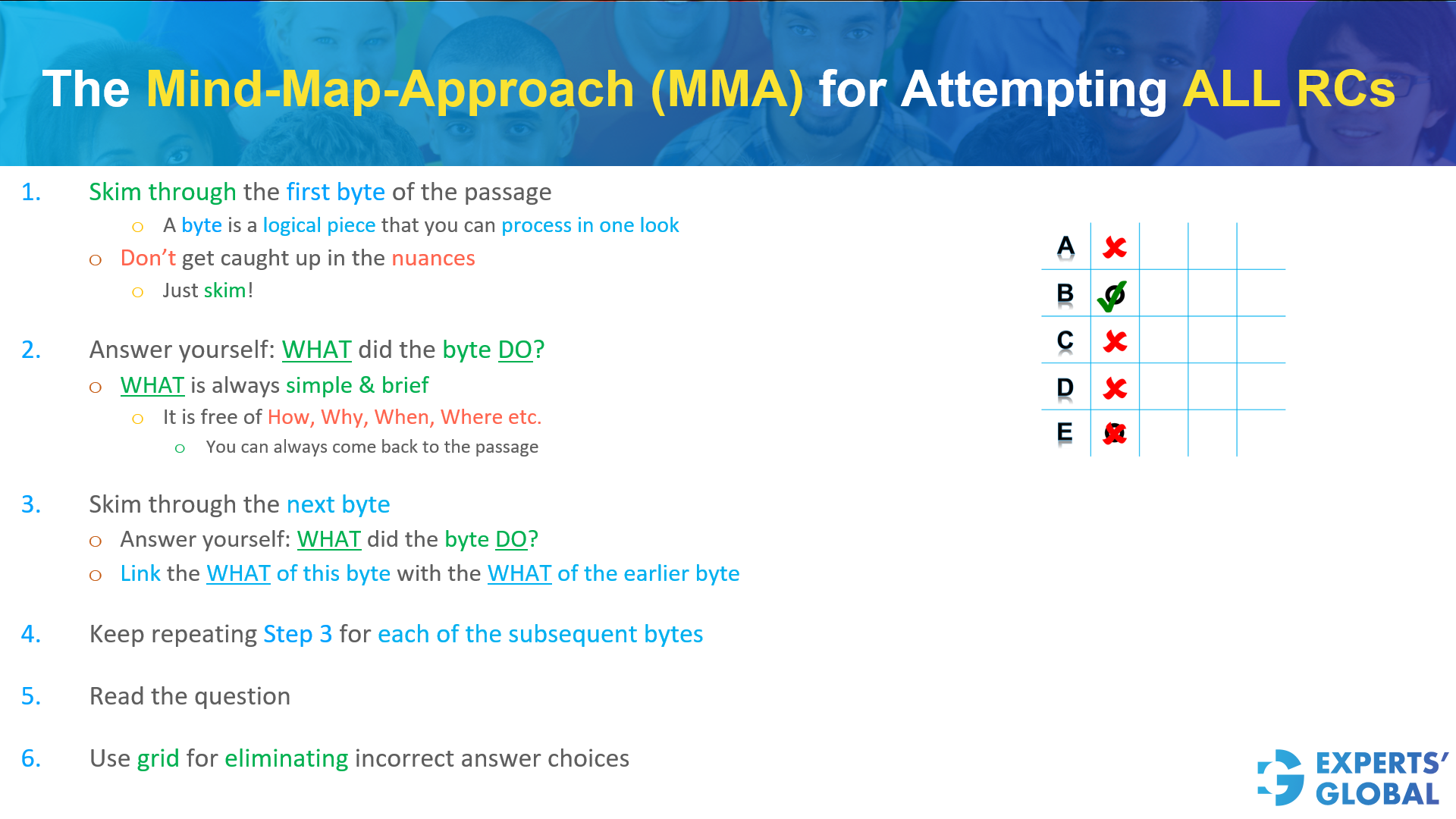
Approach for Solving Reading Comprehensions on the GMAT – The Mind-Map-Approach
The Mind-Map-Approach by Experts’ Global has supported tens of thousands of GMAT students since 2008 by giving them a simple, organized, efficient way to handle RC that saves time and improves accuracy. In the following short video, the method is presented in a step-wise manner and illustrated on GMAT-like questions.

Approach for solving GMAT Verbal RC Questions
Wish to know your current GMAT level? Take our free, full-length GMAT diagnostic test
How To Master the Mind-Map-Approach for Solving RCs
As always, Experts’ Global explains this journey in three clear stages: Understand – Practice – Master.
Stage 1: Understand
In the first few days, do not focus on speed at all. Put your full attention on learning the Mind-Map-Approach and applying it correctly. Your aim at this stage is to build a clear sense of how to spot the purpose of each paragraph and how the ideas connect. Work patiently until you reach an accuracy level of at least 80 percent before you add any time pressure.
Stage 2: Practice
Once you score above 80 percent accuracy consistently, start attempting questions under timed conditions. At this stage, your focus is learning to use the Mind-Map-Approach effectively so you maintain high accuracy while your speed improves gradually under time limits. By now, the method should begin to feel natural and should support both your accuracy and your confidence when you work under time pressure, in GMAT exercises and in GMAT mocks.
Stage 3: Master
In the final stage, refine how you apply the Mind-Map-Approach and build complete confidence in it under conditions that feel like the real test. Practice under time pressure and in longer sittings so your endurance and composure grow steadily. Review your mistakes with care and learn from them. When you solve RC questions in under 2 minutes consistently with more than 80 percent accuracy, you can say you have truly mastered the Mind-Map-Approach.
Reading Comprehension Practice Set with Explanations | GMAT Verbal RC
Please find below, a series of GMAT-style Reading Comprehension passage and questions, each with a detailed explanation. Take your time with each question, applying the reading approach and reasoning techniques you’ve learned here for tackling Reading Comprehension questions on the GMAT. Focus on mastering the steps for active reading, annotation, and analyzing options, rather than just selecting the answer that seems right. Once you finish each question, use the explanation control to see the correct answer and explore the full reasoning behind it. Happy solving!
RC Practice Question 1 | GMAT Verbal
Written Explanation
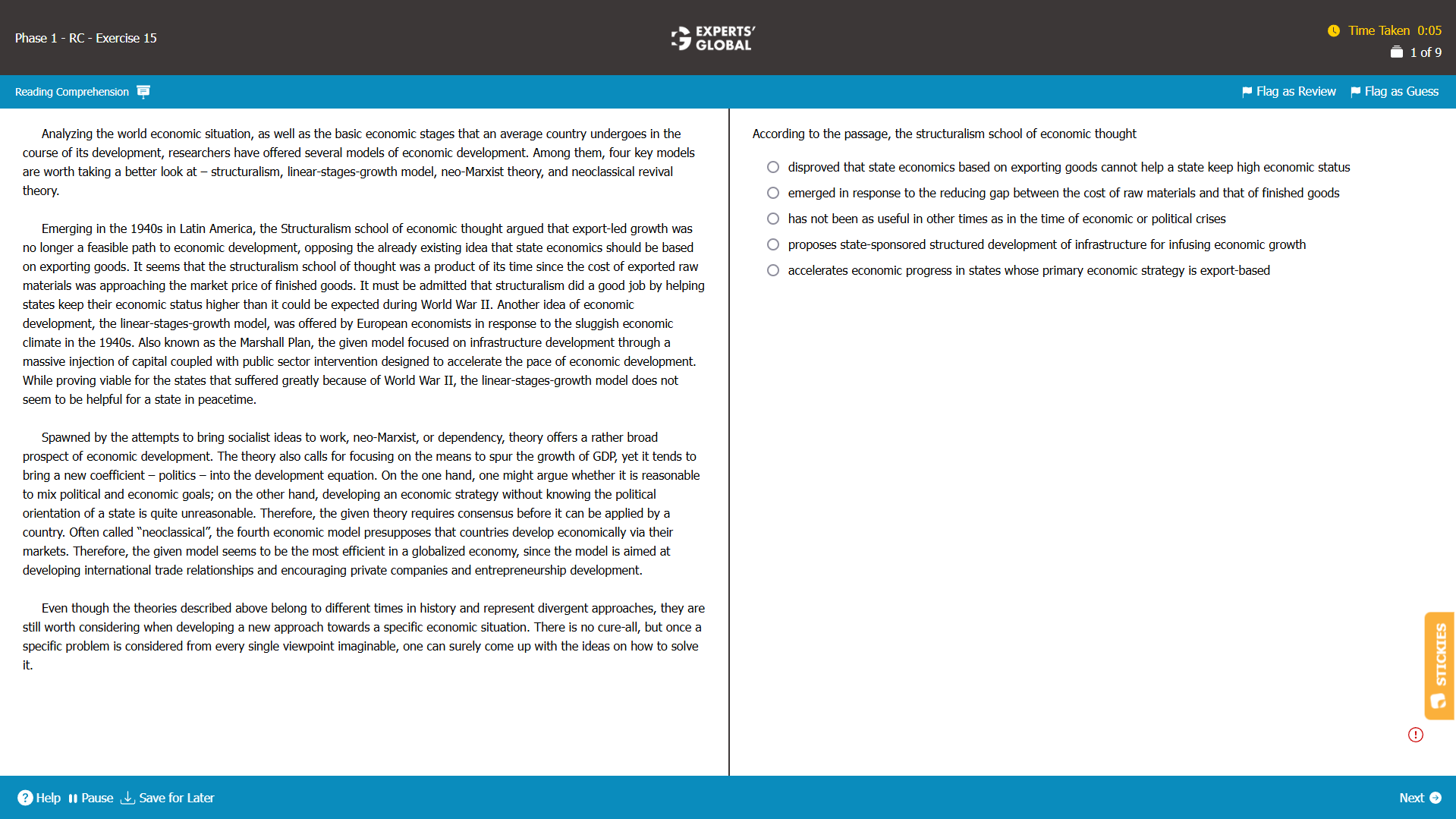
Mind-map
To indicate that there are four major models of economic development (Paragraph 1)
To discuss the first two economic models – structuralism and linear-stages-growth model (Paragraph 2)
To discuss the other two economic models – neo-Marxist theory and neoclassical revival theory (Paragraph 3)
To suggest that all theories are worth considering while solving a specific problem (Paragraph 4)
The second paragraph details the structuralism school of thought. Each answer choice needs to be carefully evaluated in light of the information presented in the passage.
A. Trap. The second paragraph mentions that “the Structuralism school of economic thought argued that export-led growth was no longer a feasible path to economic development” because “the cost of exported raw materials was approaching the market price of finished goods”; in other scenarios in which the cost of raw material has not reduced exports, export-based economic policies may still be useful; so, it is incorrect to state that the structuralism school of thought disproved that state economics based on exporting goods cannot help a state keep high economic status, as the answer choice mentions. Incorrect.
B. Correct. The second paragraph mentions that “ the Structuralism school of economic thought argued that export-led growth was no longer a feasible path to economic development” and that “the structuralism school of thought was a product of its time since the cost of exported raw materials was approaching the market price of finished goods”; in other words, according to the passage, the structuralism school of economic thought emerged in response to the reducing gap between the cost of raw materials and that of finished goods, as the answer choice mentions.
C. Although the second paragraph mentions that “It must be admitted that structuralism did a good job by helping states keep their economic status higher than it could be expected during World War II”, the passage makes no comparison between the success of structuralism in “the time of economic or political crises” and that in other times; the second paragraph mentions that “linear-stages-growth model does not seem to be helpful for a state in peacetime”, suggesting that it is the linear-stages-growth model, and not structuralism, that has not been as useful in other times as in the time of economic or political crises; so, it cannot be established that the structuralism school of economic thought has not been as useful in other times as in the time of economic or political crises, as the answer choice mentions.
D. The second paragraph mentions that the linear-stages-growth model “focused on infrastructure development through a massive injection of capital coupled with public sector intervention designed to accelerate the pace of economic development”; the passage suggests that the linear-stages-growth model, and not the structuralism school of thought, proposes state-sponsored structured development of infrastructure for infusing economic growth. Incorrect.
E. The second paragraph mentions that “the Structuralism school of economic thought argued that export-led growth was no longer a feasible path to economic development, opposing the already existing idea that state economics should be based on exporting goods”; the structuralism school of thought opposes export-based economic strategy; so, it cannot be true that it accelerates economic progress in states whose primary economic strategy is export-based. Incorrect.
B is the best answer choice.
RC Practice Question 2 | GMAT Verbal
Written Explanation
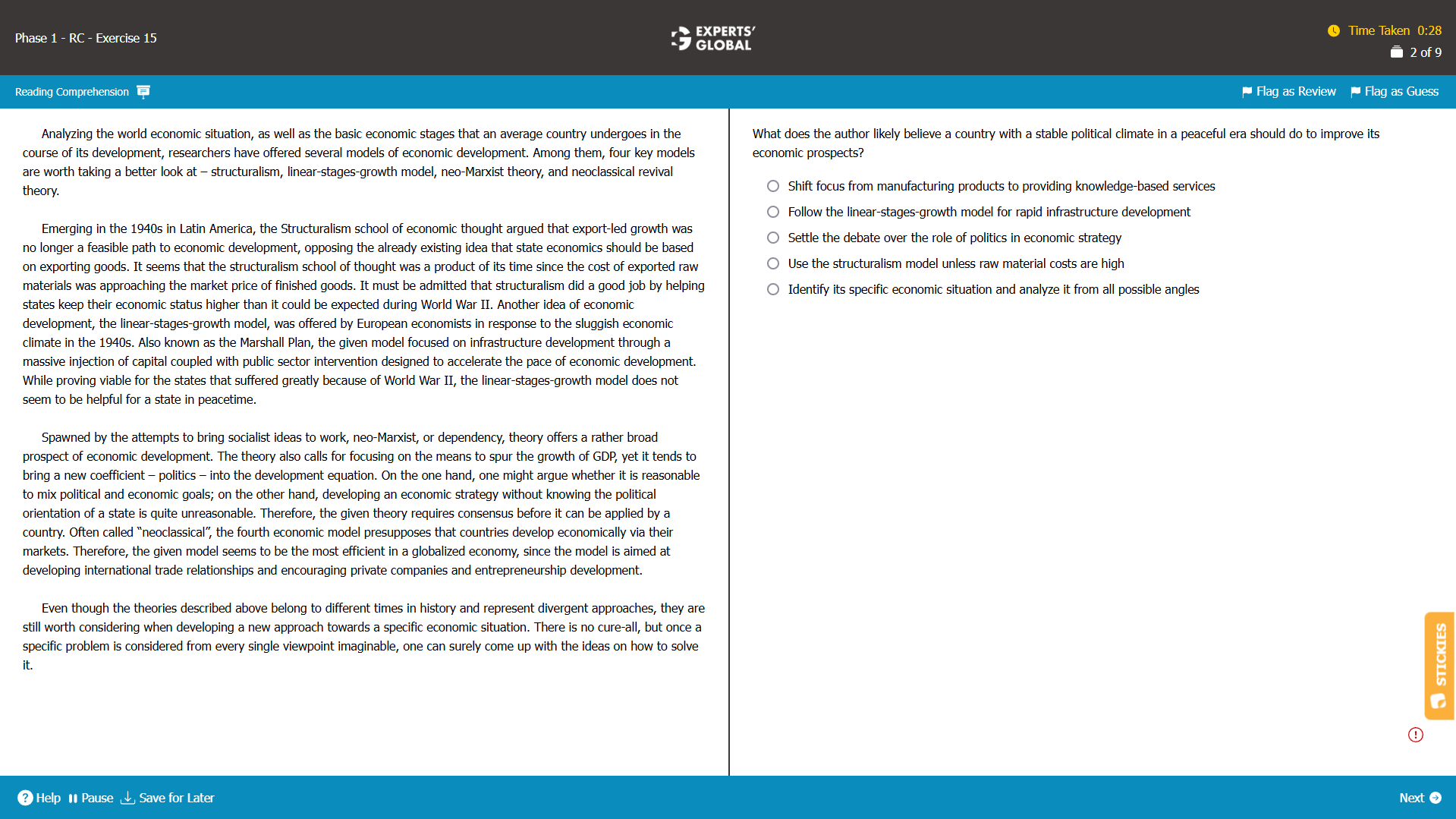
Mind-map
To indicate that there are four major models of economic development (Paragraph 1)
To discuss the first two economic models – structuralism and linear-stages-growth model (Paragraph 2)
To discuss the other two economic models – neo-Marxist theory and neoclassical revival theory (Paragraph 3)
To suggest that all theories are worth considering while solving a specific problem (Paragraph 4)
As the mind-map indicates, the second and the third paragraphs discuss four models of economic development. Subsequently, the fourth paragraph mentions that all economic models are “worth considering when developing a new approach towards a specific economic situation” and that “once a specific problem is considered from every single viewpoint imaginable, one can surely come up with the ideas on how to solve it”. Each answer choice needs to be carefully evaluated in light of the information presented in this context.
A. The passage makes no mention of shifting focus from manufacturing products to providing knowledge-based services; so, it cannot be established that the author is likely to recommend a similar approach to the country under consideration. Moreover, the fourth paragraph mentions that, generally, all the four theories are “worth considering” and “once a specific problem is considered from every single viewpoint imaginable, one can surely come up with the ideas on how to solve it”, suggesting that the author is likely to recommend a similar approach to the country under consideration; we need an answer choice on similar lines. Incorrect.
B. The second paragraph mentions that the linear-stages-growth model “does not seem to be helpful for a state in peacetime”; so, in the example of a country with a stable political climate “in a peaceful era”, the author is not likely to recommend the linear-stages-growth model for rapid infrastructure development. Moreover, the fourth paragraph mentions that, generally, all the four theories are “worth considering” and “once a specific problem is considered from every single viewpoint imaginable, one can surely come up with the ideas on how to solve it”, suggesting that the author is likely to recommend a similar approach to the country under consideration; we need an answer choice on similar lines. Incorrect.
C. Trap. The third paragraph mentions that “On the one hand, one might argue whether it is reasonable to mix political and economic goals; on the other hand, developing an economic strategy without knowing the political orientation of a state is quite unreasonable”; although settling this debate over the role of politics in economic strategy would generate clarity about neo-Marxist theory, the passage makes no suggestion regarding specific factors that would make neo-Marxist theory a suitable theory for a country with a stable political climate in a peaceful era; it cannot be inferred that the author likely believes that the neo-Marxist theory is suitable for the country under consideration. Moreover, the fourth paragraph mentions that, generally, all the four theories are “worth considering” and “once a specific problem is considered from every single viewpoint imaginable, one can surely come up with the ideas on how to solve it”, suggesting that the author is likely to recommend a similar approach to the country under consideration; we need an answer choice on similar lines. Incorrect.
D. Trap. The second paragraph suggests that the structuralism school of thought emerged when the increased cost of raw material reduced exports and export-led growth was “no longer a feasible path to economic development”; so, the author mentions that the structuralism school of thought is to be used in the time of high cost of raw materials; in other words, the passage suggests a strategy that is opposite of what the answer choice suggests – “use the structuralism model unless raw material costs are high” means that “use the structuralism model when raw material costs are not high”. Moreover, the fourth paragraph mentions that, generally, all the four theories are “worth considering” and “once a specific problem is considered from every single viewpoint imaginable, one can surely come up with the ideas on how to solve it”, suggesting that the author is likely to recommend a similar approach to the country under consideration; we need an answer choice on similar lines. Incorrect.
E. Correct. The fourth paragraph mentions that all economic models are “worth considering when developing a new approach towards a specific economic situation” and that “once a specific problem is considered from every single viewpoint imaginable, one can surely come up with the ideas on how to solve it”; so, to a country with a stable political climate in a peaceful era, the author is likely to recommend identifying its specific economic situation and analyzing it from all possible angles, as the answer choice mentions.
E is the best answer choice.
RC Practice Question 3 | GMAT Verbal
Written Explanation
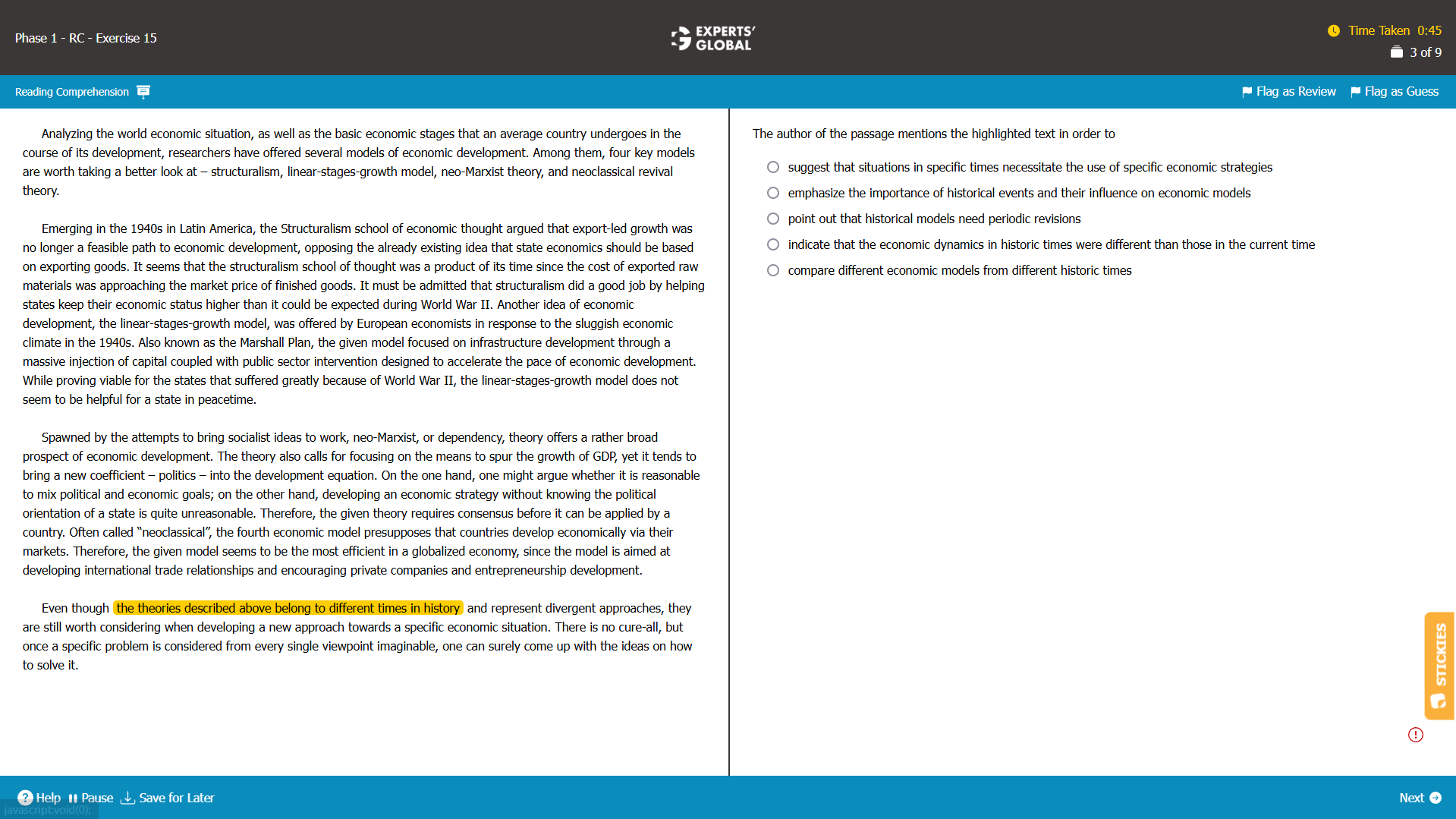
Mind-map
To indicate that there are four major models of economic development (Paragraph 1)
To discuss the first two economic models – structuralism and linear-stages-growth model (Paragraph 2)
To discuss the other two economic models – neo-Marxist theory and neoclassical revival theory (Paragraph 3)
To suggest that all theories are worth considering while solving a specific problem (Paragraph 4)
The mind-map indicates that the passage is about four major models of economic development and the passage mentions each theory under a certain situational or historic context. Subsequently, the fourth paragraph mentions that “Even though the theories described above belong to different times in history and represent divergent approaches, they are still worth considering when developing a new approach towards a specific economic situation”. The author mentions the highlighted text to suggest that different economic models were developed to address specific situations in specific times, and although all models are “divergent”, they are “worth considering” while developing economic strategies. Each answer choice needs to be carefully evaluated in light of the information presented in this context.
A. Correct. The fourth paragraph mentions that “Even though the theories described above belong to different times in history and represent divergent approaches, they are still worth considering when developing a new approach towards a specific economic situation”; it can be inferred that the author mentions the highlighted text to suggest that different economic models were developed to address specific situations in specific times, and although all models are “divergent”, they are “worth considering” while developing economic strategies; in other words, the author mentions the highlighted text to suggest that situations in specific times necessitate the use of specific economic strategies, as the answer choice mentions.
B. Trap. Although the passage mentions each theory under a certain situational or historic context, the author does not mention the highlighted text in order to emphasize the importance of historical events and their influence on economic models, as the answer choice mentions. Furthermore, our expectation from the correct answer choice is on the lines that the highlighted text suggests that different economic models were developed to address specific situations in specific times, and although all models are “divergent”, they are “worth considering” while developing economic strategies. Incorrect.
C. The passage makes no mention of “revisions” to models; so, it cannot be inferred that the author mentions the highlighted text in order to point out that historical models need periodic revisions, as the answer choice mentions. Furthermore, our expectation from the correct answer choice is on the lines that the highlighted text suggests that different economic models were developed to address specific situations in specific times, and although all models are “divergent”, they are “worth considering” while developing economic strategies. Incorrect.
D. The passage makes no reference to “the current time” and makes no comparison between the economic dynamics in historic times and those in the current time; so, it cannot be inferred that the author mentions the highlighted text in order to indicate that the economic dynamics in historic times were different than those in the current time, as the answer choice mentions. Furthermore, our expectation from the correct answer choice is on the lines that the highlighted text suggests that different economic models were developed to address specific situations in specific times, and although all models are “divergent”, they are “worth considering” while developing economic strategies. Incorrect.
E. Although the passage mentions each theory under a certain situational or historic context, the passage makes no comparison among economic models from different historic times; even if the passage did so, such a comparison is not the intended purpose behind the mention of the highlighted text; so, it cannot be inferred that the author mentions the highlighted text in order to compare different economic models from different historic times, as the answer choice mentions. Furthermore, our expectation from the correct answer choice is on the lines that the highlighted text suggests that different economic models were developed to address specific situations in specific times, and although all models are “divergent”, they are “worth considering” while developing economic strategies. Incorrect.
A is the best answer choice.
RC Practice Question 4 | GMAT Verbal
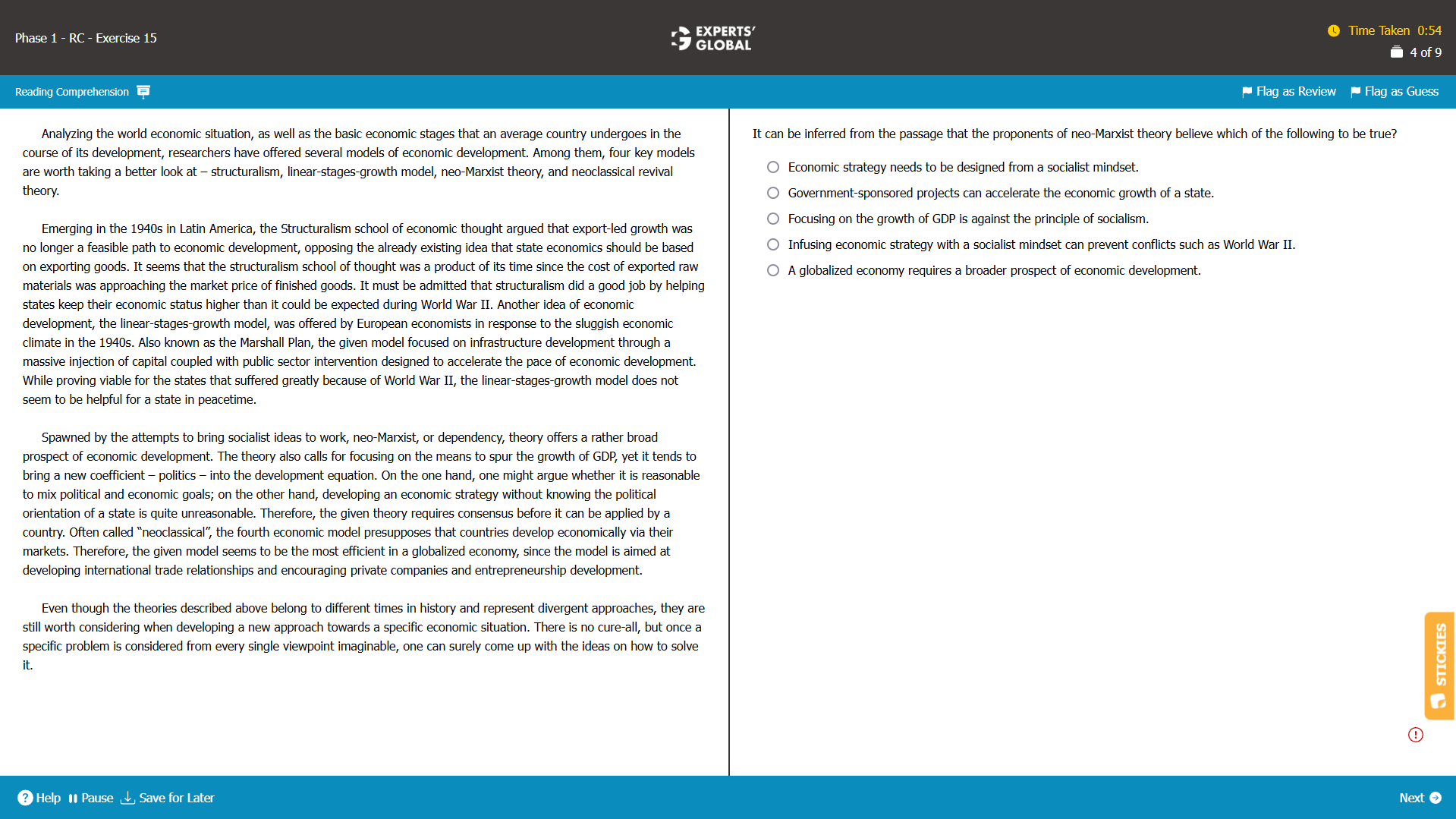
Written Explanation
Mind-map
To indicate that there are four major models of economic development (Paragraph 1)
To discuss the first two economic models – structuralism and linear-stages-growth model (Paragraph 2)
To discuss the other two economic models – neo-Marxist theory and neoclassical revival theory (Paragraph 3)
To suggest that all theories are worth considering while solving a specific problem (Paragraph 4)
Each answer choice needs to be carefully evaluated in light of the information presented in the passage.
A. Correct. The third paragraph mentions that “Spawned by the attempts to bring socialist ideas to work, neo-Marxist, or dependency, theory offers a rather broad prospect of economic development”; it can be inferred that the proponents of neo-Marxist theory believe that economic strategy needs to be designed from a socialist mindset, as the answer choice mentions.
B. The passage doesn’t mention “government-sponsored projects” in the context of the neo-Marxist theory; so, it cannot be established that the proponents of neo-Marxist theory believe that government-sponsored projects can accelerate the economic growth of a state, as the answer choice mentions. Incorrect.
C. Trap. The third paragraph mentions that “Spawned by the attempts to bring socialist ideas to work, neo-Marxist, or dependency, theory offers a rather broad prospect of economic development” and that the neo-Marxist theory “calls for focusing on the means to spur the growth of GDP”; it can be inferred that the proponents of neo-Marxist theory believe that focusing on the growth of GDP is not against the principle of socialism; in other words, the passage suggests an idea that is opposite of what the answer choice suggests. Incorrect.
D. The passage makes no connection between the neo-Marxist theory and any events of friction such as World War II; so, it cannot be established that the proponents of neo-Marxist theory believe that infusing economic strategy with a socialist mindset can prevent conflicts such as World War II, as the answer choice mentions. Incorrect.
E. The third paragraph mentions that the neoclassical model “seems to be the most efficient in a globalized economy”; the passage mentions “a globalized economy” in the context of the neoclassical model, not the neo-Marxist theory; so, it cannot be established that the proponents of neo-Marxist theory believe that a globalized economy requires a broader prospect of economic development, as the answer choice mentions. Incorrect.
A is the best answer choice.
RC Practice Question 5 | GMAT Verbal
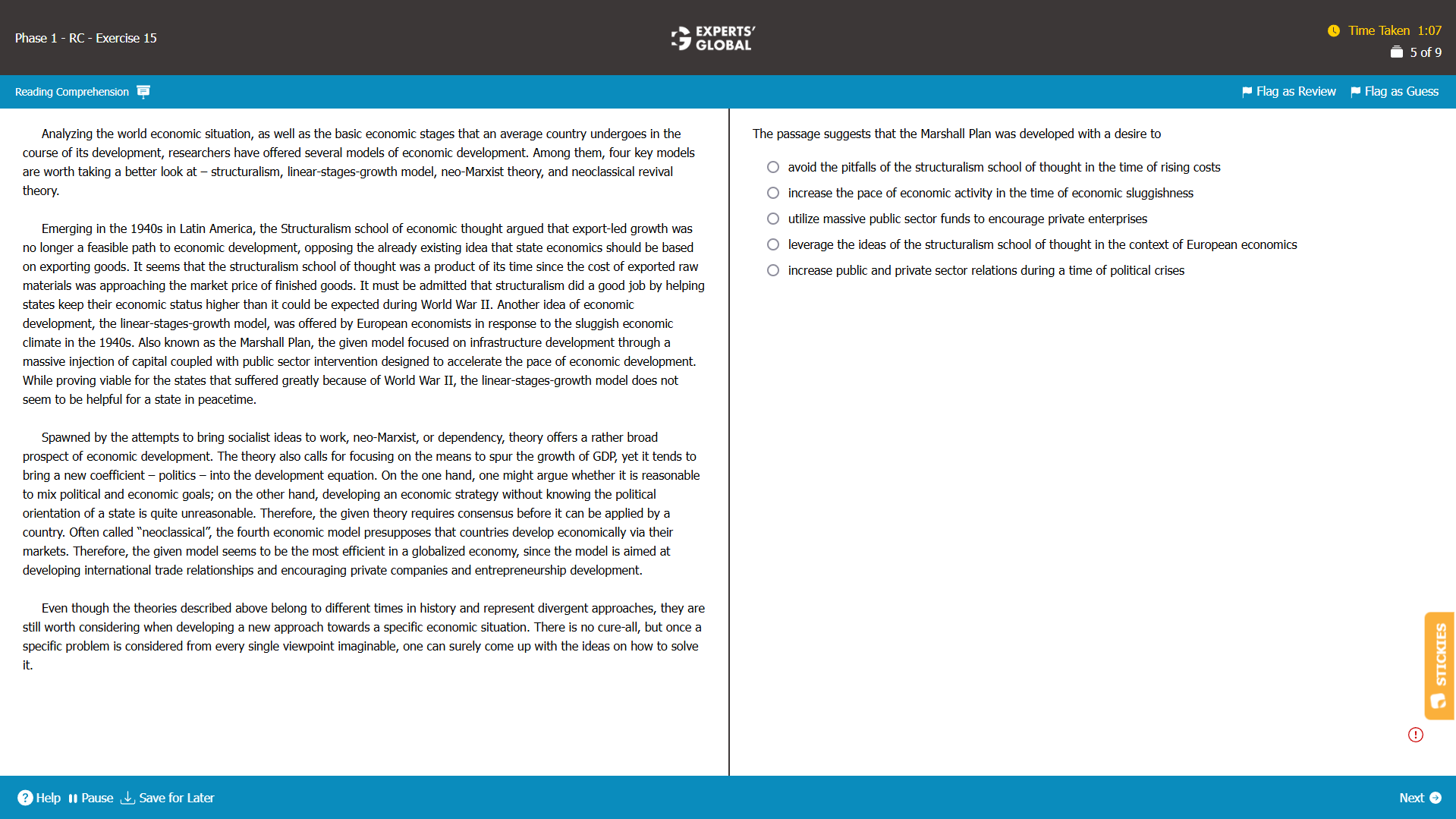
Written Explanation
Mind-map
To indicate that there are four major models of economic development (Paragraph 1)
To discuss the first two economic models – structuralism and linear-stages-growth model (Paragraph 2)
To discuss the other two economic models – neo-Marxist theory and neoclassical revival theory (Paragraph 3)
To suggest that all theories are worth considering while solving a specific problem (Paragraph 4)
The second paragraph mentions that the linear-stages-growth model, also known as the Marshall Plan, “was offered by European economists in response to the sluggish economic climate in the 1940s” and the model “focused on infrastructure development through a massive injection of capital”. Each answer choice needs to be carefully evaluated in light of the information presented in this context.
A. The passage makes no connection between the structuralism school of thought and the Marshall Plan; so, it is incorrect to state that the Marshall Plan was developed with a desire to avoid the pitfalls of the structuralism school of thought in the time of rising costs, as the answer choice mentions. Furthermore, our expectation from the correct answer choice is on the lines that it indicates that the Marshall Plan developed “in response to the sluggish economic climate in the 1940s” and “focused on infrastructure development through a massive injection of capital”. Incorrect.
B. Correct. The second paragraph mentions that the linear-stages-growth model, also known as the Marshall Plan, “was offered by European economists in response to the sluggish economic climate in the 1940s” and the model “focused on infrastructure development through a massive injection of capital coupled with public sector intervention designed to accelerate the pace of economic development”; in other words, the passage mentions that the Marshall Plan was developed with a desire to increase the pace of economic activity in the time of economic sluggishness, as the answer choice mentions.
C. Trap. Although the second paragraph mentions that the Marshall Plan focused on infrastructure development “through a massive injection of capital”, there is no suggestion that the capital injected was sourced from “surplus” government funds and that the Marshall Plan aimed to “encourage private enterprises”; so, it is incorrect to state that the Marshall Plan was developed with a desire to utilize massive public sector funds to encourage private enterprises, as the answer choice mentions. Furthermore, our expectation from the correct answer choice is on the lines that it indicates that the Marshall Plan developed “in response to the sluggish economic climate in the 1940s” and “focused on infrastructure development through a massive injection of capital”. Incorrect.
D. The passage makes no connection between the structuralism school of thought and the Marshall Plan; so, it is incorrect to state that the Marshall Plan was developed with a desire to leverage the ideas of the structuralism school of thought in the context of European economics, as the answer choice mentions. Furthermore, our expectation from the correct answer choice is on the lines that it indicates that the Marshall Plan developed “in response to the sluggish economic climate in the 1940s” and “focused on infrastructure development through a massive injection of capital”. Incorrect.
E. The passage makes no mention of “public and private sector relations” in the context of the Marshall Plan; so, it is incorrect to state that the Marshall Plan was developed with a desire to increase public and private sector relations during a time of political crises, as the answer choice mentions. Furthermore, our expectation from the correct answer choice is on the lines that it indicates that the Marshall Plan developed “in response to the sluggish economic climate in the 1940s” and “focused on infrastructure development through a massive injection of capital”. Incorrect.
B is the best answer choice.
RC Practice Question 6 | GMAT Verbal
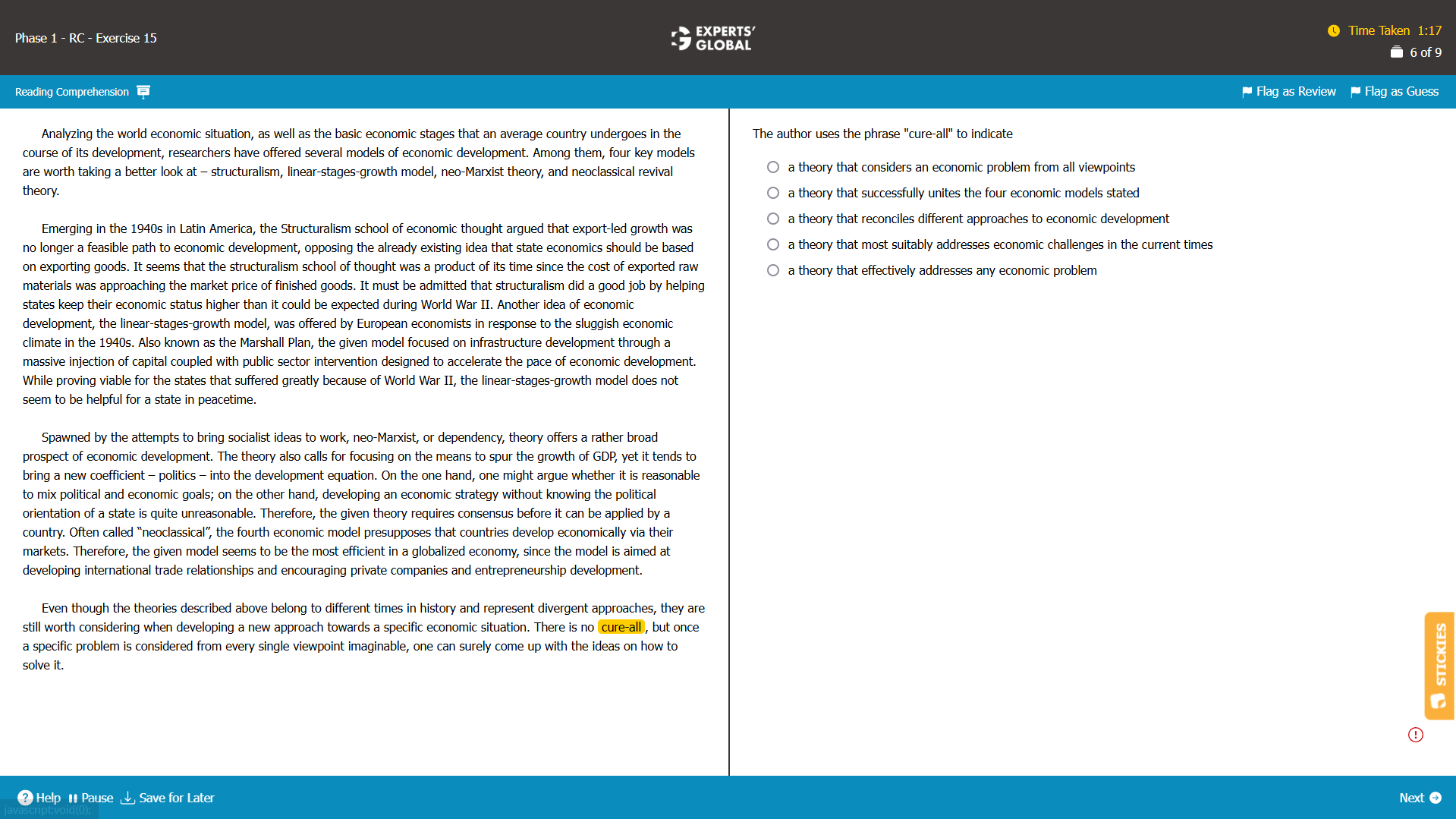
Mind-map
To indicate that there are four major models of economic development (Paragraph 1)
To discuss the first two economic models – structuralism and linear-stages-growth model (Paragraph 2)
To discuss the other two economic models – neo-Marxist theory and neoclassical revival theory (Paragraph 3)
To suggest that all theories are worth considering while solving a specific problem (Paragraph 4)
The fourth paragraph mentions that all economic models are “worth considering” and that “There is no cure-all, but once a specific problem is considered from every single viewpoint imaginable, one can surely come up with the ideas on how to solve it”. It can be inferred that the author believes that the economic theories are “viewpoints” and uses the phrase “cure-all” to suggest “a comprehensive theory for any economic situation”. Each answer choice needs to be carefully evaluated in light of the information presented in this context.
A. Trap. The fourth paragraph mentions that all economic models are “worth considering” and that “There is no cure-all, but once a specific problem is considered from every single viewpoint imaginable, one can surely come up with the ideas on how to solve it”; it can be inferred that the author believes that the economic theories are “viewpoints”; hence, the author is not likely to indicate a “theory” that considers an economic problem “from all viewpoints”; so, it is incorrect to state that the author uses the phrase “cure-all” to indicate a theory that considers an economic problem from all viewpoints. Furthermore, our expectation from the correct answer is that it indicates that the phrase “cure-all” suggests “a comprehensive theory for any economic situation”. Incorrect.
B. The fourth paragraph mentions that all economic models are “worth considering” and that “There is no cure-all, but once a specific problem is considered from every single viewpoint imaginable, one can surely come up with the ideas on how to solve it”; the author doesn’t suggest “unification” of the four economic models; so, it is incorrect to state that the author uses the phrase “cure-all” to indicate a theory that successfully unites the four economic models stated. Furthermore, our expectation from the correct answer is that it indicates that the phrase “cure-all” suggests “a comprehensive theory for any economic situation”. Incorrect.
C. The fourth paragraph mentions that all economic models are “worth considering” and that “There is no cure-all, but once a specific problem is considered from every single viewpoint imaginable, one can surely come up with the ideas on how to solve it”; the author doesn’t suggest “reconciliation” of the four economic models; so, it is incorrect to state that the author uses the phrase “cure-all” to indicate a theory that reconciles different approaches to economic development. Furthermore, our expectation from the correct answer is that it indicates that the phrase “cure-all” suggests “a comprehensive theory for any economic situation”. Incorrect.
D. The passage makes no reference to “the current time” and the “economic challenges in the current times”; so, it is incorrect to state that the author uses the phrase “cure-all” to indicate a theory that most suitably addresses economic challenges in the current times. Furthermore, our expectation from the correct answer is that it indicates that the phrase “cure-all” suggests “a comprehensive theory for any economic situation”. Incorrect.
E. Correct. The fourth paragraph mentions that all economic models are “worth considering” and that “There is no cure-all, but once a specific problem is considered from every single viewpoint imaginable, one can surely come up with the ideas on how to solve it”; it can be inferred that the author believes that the economic theories are “viewpoints” and uses the phrase “cure-all” to suggest “a comprehensive theory for any economic situation”, or a theory that effectively addresses any economic problem, as the answer choice mentions.
E is the best answer choice.
RC Practice Question 7 | GMAT Verbal
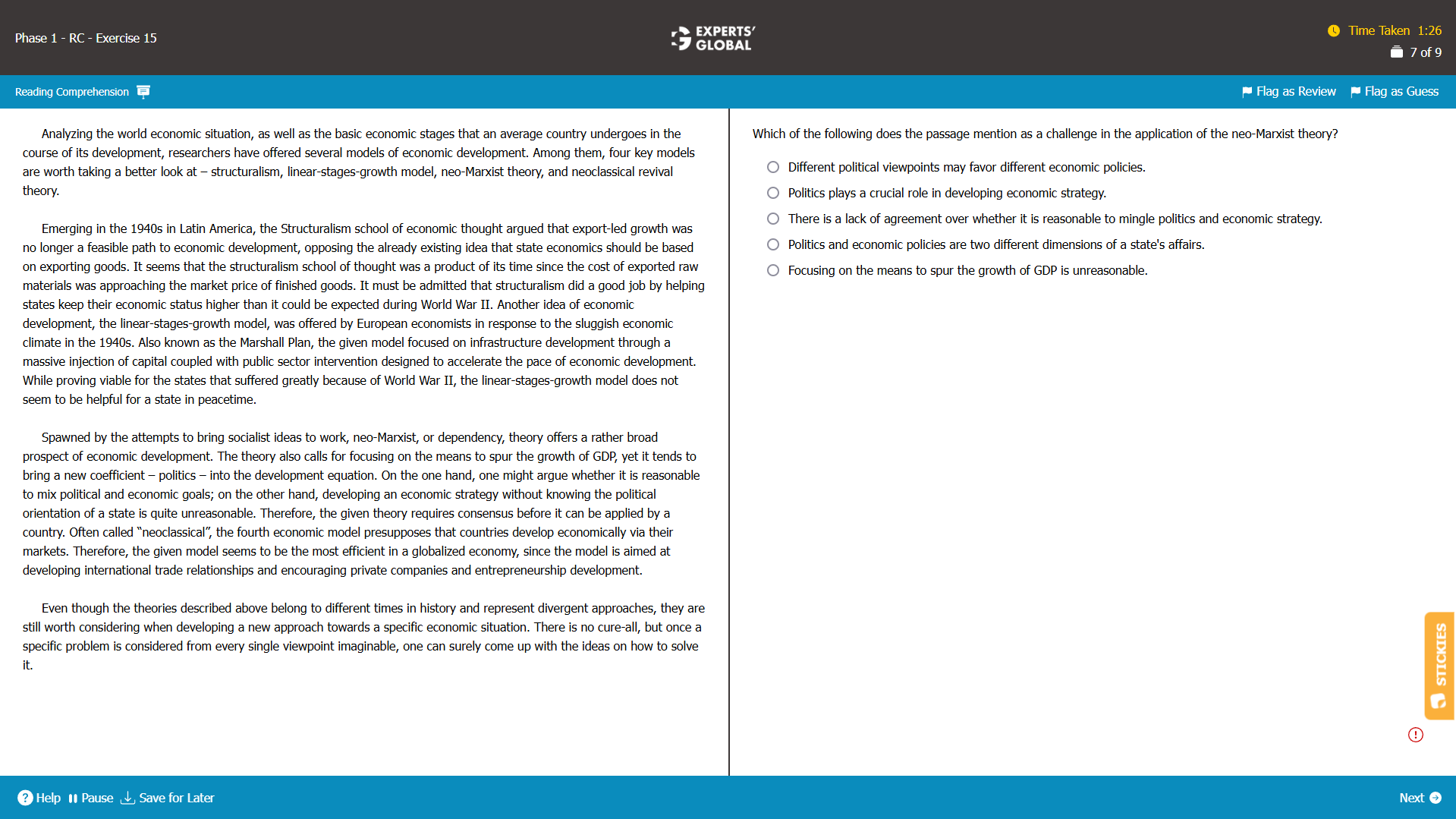
Mind-map
To indicate that there are four major models of economic development (Paragraph 1)
To discuss the first two economic models – structuralism and linear-stages-growth model (Paragraph 2)
To discuss the other two economic models – neo-Marxist theory and neoclassical revival theory (Paragraph 3)
To suggest that all theories are worth considering while solving a specific problem (Paragraph 4)
The third paragraph mentions the neo-Marxist theory and states that “On the one hand, one might argue whether it is reasonable to mix political and economic goals; on the other hand, developing economic strategy without knowing the political orientation of a state is quite unreasonable. Therefore, the given theory requires consensus before it can be applied by a country”. It can be inferred that the passage mentions that there is a challenge in the application of the neo-Marxist theory because there is a lack of agreement over whether mixing politics and economic goals/strategy is “reasonable”. Each answer choice needs to be carefully evaluated in light of the information presented in this context.
A. The passage makes no suggestion that different political viewpoints may favor different economic policies; so, it is incorrect to state that there is a challenge in the application of the neo-Marxist theory because different political viewpoints may favor different economic policies. Furthermore, our expectation from the correct answer choice is on the lines that there is a lack of agreement over whether mixing politics and economic goals/strategy is “reasonable”. Incorrect.
B. Trap. Although the third paragraph states the view that “developing economic strategy without knowing the political orientation of a state is quite unreasonable”, such a view is only one side of the debate on whether mixing politics and economic goals/strategy is reasonable, and this debate is the challenge in the application of the neo-Marxist theory; in other words, the passage mentions that there is a challenge in the application of the neo-Marxist theory because there is a lack of agreement over whether mixing politics and economic goals/strategy is “reasonable” and not because politics plays a crucial role in developing economic strategy. Incorrect.
C. Correct. The third paragraph discusses the neo-Marxist theory and mentions that “On the one hand, one might argue whether it is reasonable to mix political and economic goals; on the other hand, developing economic strategy without knowing the political orientation of a state is quite unreasonable. Therefore, the given theory requires consensus before it can be applied by a country”; in other words, the passage mentions that there is a challenge in the application of the neo-Marxist theory because there is a lack of agreement over whether it is reasonable to mingle politics and economic strategy, as the answer choice mentions.
D. Trap. Although the third paragraph states the view that “one might argue whether it is reasonable to mix political and economic goals”, such an argument is only one side of the debate on whether mixing politics and economic goals/strategy is reasonable, and this debate is the challenge in the application of the neo-Marxist theory; in other words, the passage mentions that there is a challenge in the application of the neo-Marxist theory because there is a lack of agreement over whether mixing politics and economic goals/strategy is “reasonable” and not because politics and economic policies are two different dimensions of a state’s affairs. Incorrect.
E. The third paragraph mentions that the neo-Marxist theory “calls for focusing on the means to spur the growth of GDP”; it is incorrect to state that the passage mentions that focusing on the means to spur the growth of GDP is unreasonable. Furthermore, our expectation from the correct answer choice is on the lines that there is a lack of agreement over whether mixing politics and economic goals/strategy is “reasonable”. Incorrect.
C is the best answer choice.
RC Practice Question 8 | GMAT Verbal
Written Explanation
Mind-map
To indicate that there are four major models of economic development (Paragraph 1)
To discuss the first two economic models – structuralism and linear-stages-growth model (Paragraph 2)
To discuss the other two economic models – neo-Marxist theory and neoclassical revival theory (Paragraph 3)
To suggest that all theories are worth considering while solving a specific problem (Paragraph 4)
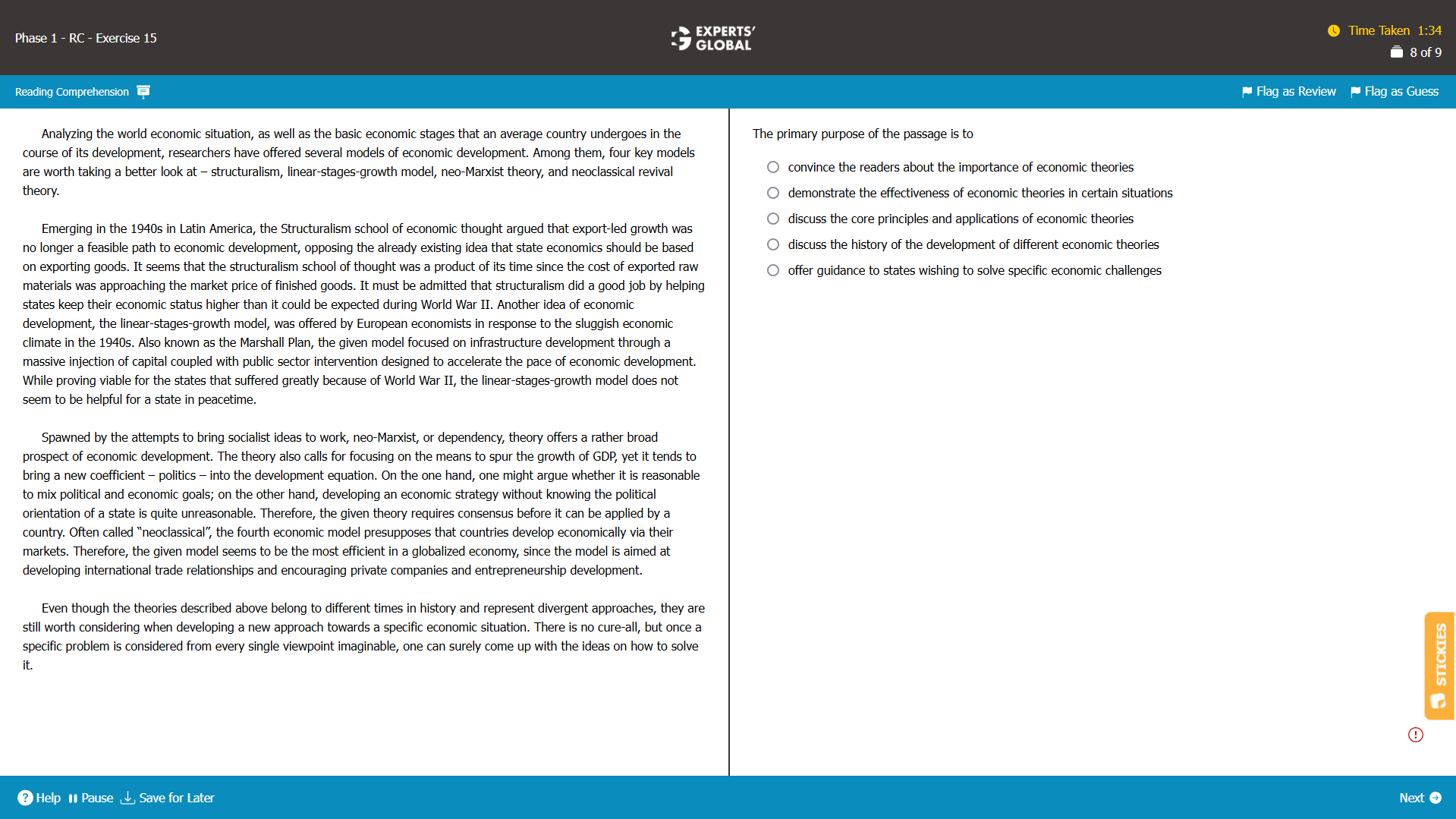
As the mind-map mentions, the first paragraph indicates that there are four major models of economic development, the second and the third paragraphs discuss the four models, and the fourth paragraph suggests that all theories are worth considering while solving a specific problem. As a whole, the passage discusses four economic theories, mentions their fundamental view, and suggests under what circumstances these models can be best utilized. The answer choice that does justice to this summary is the correct answer choice.
A. The passage doesn’t attempt to “convince the readers”. Furthermore, as a whole, the passage discusses four economic theories, mentions their fundamental view, and suggests under what circumstances these models can be best utilized; we need an answer choice that does justice to this summary. Incorrect.
B. The term “demonstrate” requires substantiation/reasoning/proof, which the passage doesn’t present. Additionally, as a whole, the passage discusses four economic theories, mentions their fundamental view, and suggests under what circumstances these models can be best utilized; although there is some discussion on “effectiveness of economic theories in certain situations”, this discussion is limited in scope and cannot be considered the primary purpose of the passage. Furthermore, we need an answer choice that does justice to the above-mentioned summary. Incorrect.
C. Correct. As the mind-map mentions, the first paragraph indicates that there are four major models of economic development, the second and the third paragraphs discuss the four models, and the fourth paragraph suggests that all theories are worth considering while solving a specific problem; as a whole, the passage discusses four economic theories, mentions their fundamental view, and suggests under what circumstances these models can be best utilized; in other words, the primary purpose of the passage is to discuss the core principles and applications of economic theories, as the answer choice mentions.
D. As a whole, the passage discusses four economic theories, mentions their fundamental view, and suggests under what circumstances these models can be best utilized; although there is some discussion on “the history of the development of different economic theories”, this discussion is limited in scope and cannot be considered the primary purpose of the passage. Furthermore, we need an answer choice that does justice to the above-mentioned summary. Incorrect.
E. The term “offer guidance” requires recommendations which the passage doesn’t present. Additionally, although the fourth paragraph mentions that the four theories mentioned are “worth considering” when developing a new approach towards a specific economic situation, this discussion cannot be construed as “guidance to states wishing to solve specific economic challenges”. Furthermore, as a whole, the passage discusses four economic theories, mentions their fundamental view, and suggests under what circumstances these models can be best utilized; we need an answer choice that does justice to this summary. Incorrect.
C is the best answer choice.
Additional 40+ Free GMAT-style Reading Comprehension Questions with Explanations:
Please find another set of GMAT-style RC questions with explanations on: How to Solve GMAT Reading Comprehension Questions
Please find another set of GMAT-style RC questions with explanations on: Free GMAT Reading Comprehensions Prep
Please find another set of GMAT-style RC questions with explanations on: Free GMAT Reading Comprehension Sample Questions
Please find another set of GMAT-style RC questions with explanations on: Free GMAT Verbal Sample Questions
Please find another set of GMAT-style RC questions with explanations on: Free GMAT Sample Questions
Critical Reasoning Questions on GMAT Verbal Section
GMAT critical reasoning questions test how clearly you understand an argument and how well you think through its logic. In the Verbal section, critical reasoning and reading comprehension are the only two question types, and you can expect 8 to 10 critical reasoning questions out of a total of 23. That means about 40 percent of the Verbal section involves critical reasoning, which makes it essential for a strong GMAT score. As you prepare, you also build solid critical reasoning skills that support you in other GMAT question types and, even more importantly, serve you well in business school, in your career in business management, and in daily life. This page offers a clear and structured approach to solving Critical Reasoning questions, covers all the question types on the GMAT, and provides worked examples to guide your GMAT Verbal preparation.
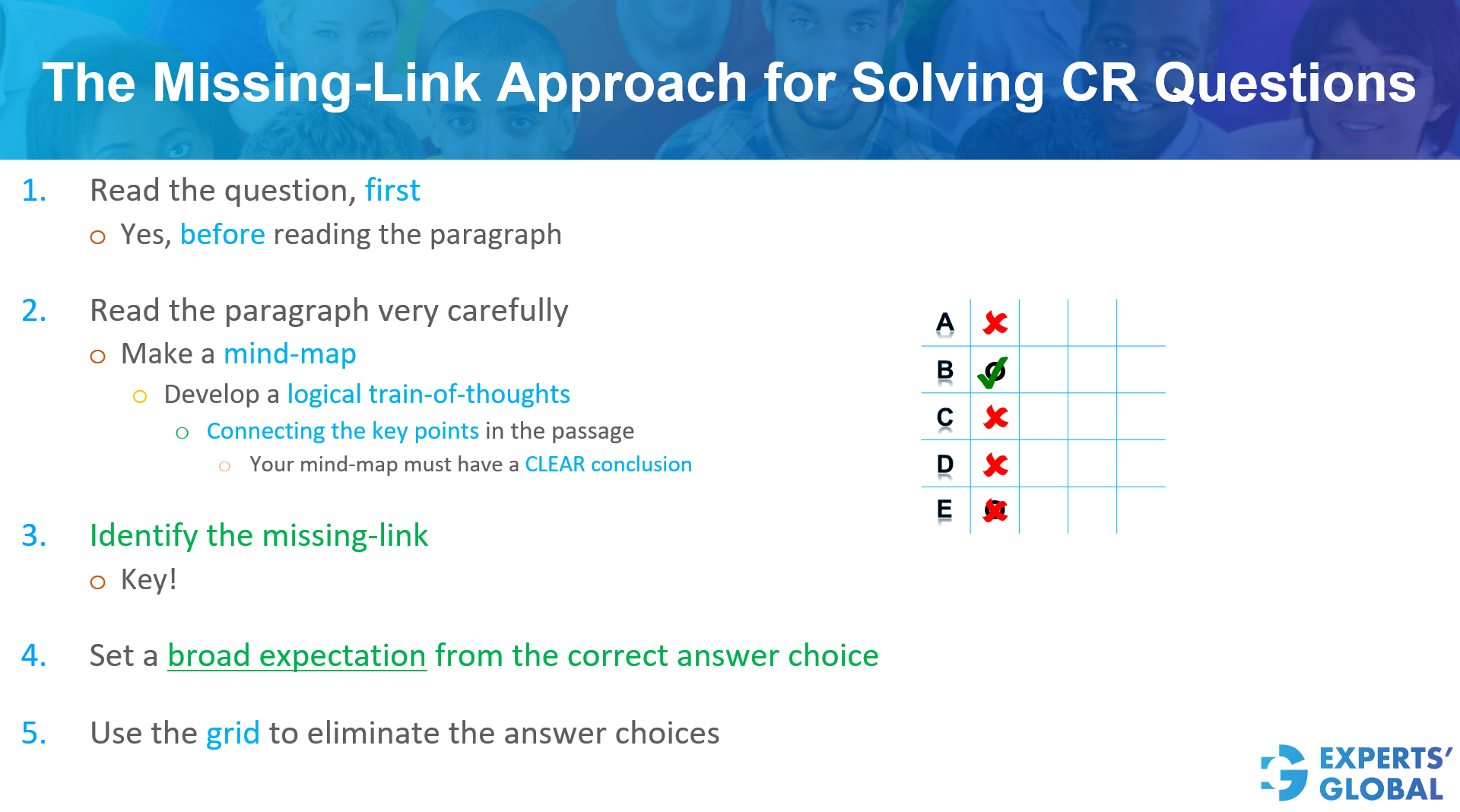
Approach For Solving GMAT CR Questions: The Missing-Link-Approach by Experts’ Global
Critical Reasoning measures how clearly and systematically you think. This overview presents the Missing-Link-Approach: first identify the premise, then define the conclusion, and then pinpoint the gap between them. Through this lens, you learn how to handle assumption, strengthened argument, and weakened argument questions, and how to anticipate strong answers even before you read the options. The explanatory video below walks you through the approach step by step, shows how it works on questions, and prepares you to use it in GMAT drills, sectional tests, and full-length GMAT mock tests.

Approach for Solving GMAT Verbal CR – The Missing-Link-Approach
Answer Choices Generally Incorrect on GMAT CR
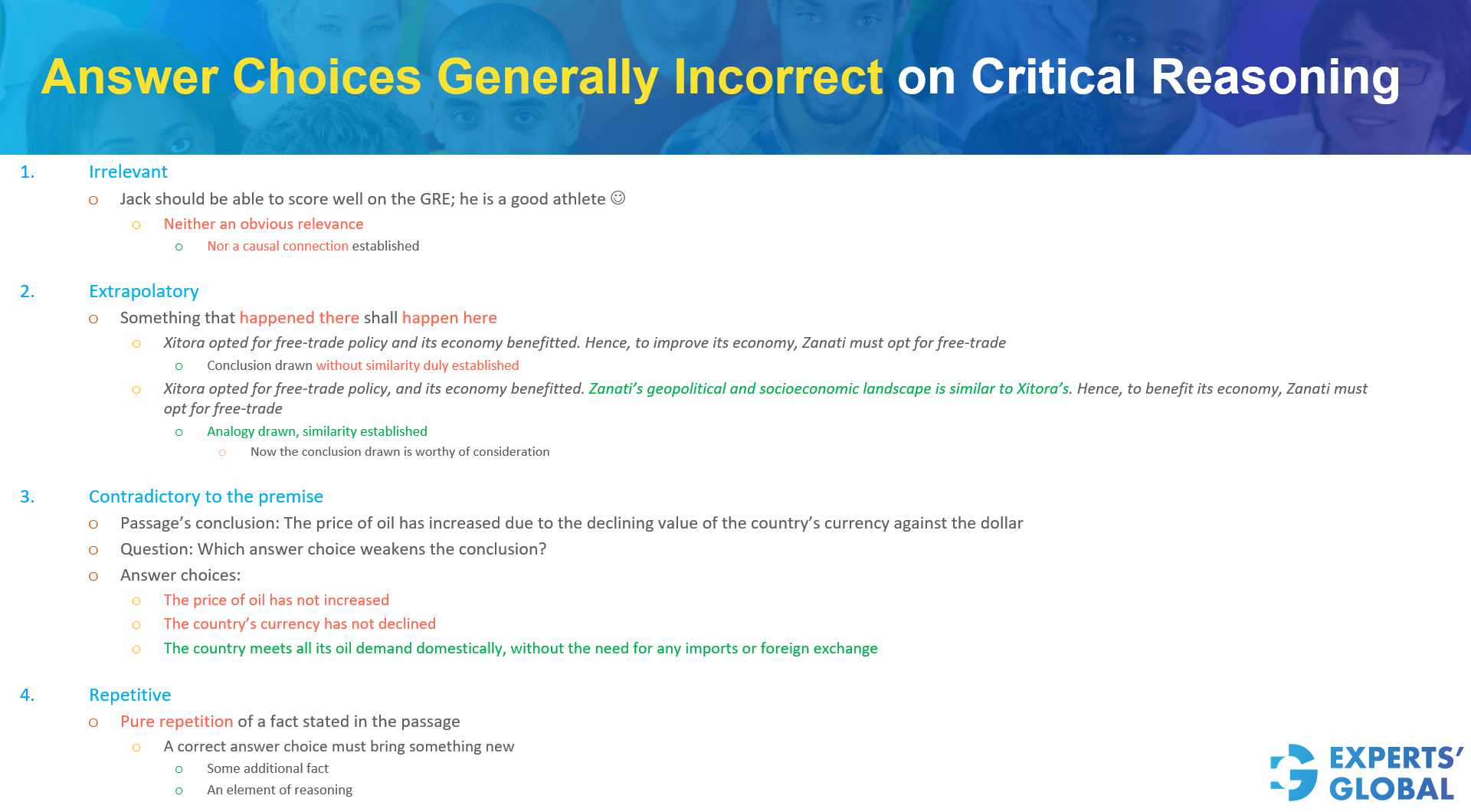
Incorrect answers in GMAT Critical Reasoning often share four key characteristics: irrelevance, faulty extrapolation, contradictions, and repeating already stated facts. To boost both accuracy and speed, quickly and consistently eliminate these types of options as you work through the CR questions. The short video below explains this idea in a simple manner and shows how the GMAT can test it.
Choices Generally Incorrect on GMAT Verbal CR
Ten Main GMAT Verbal Critical Reasoning Question Types
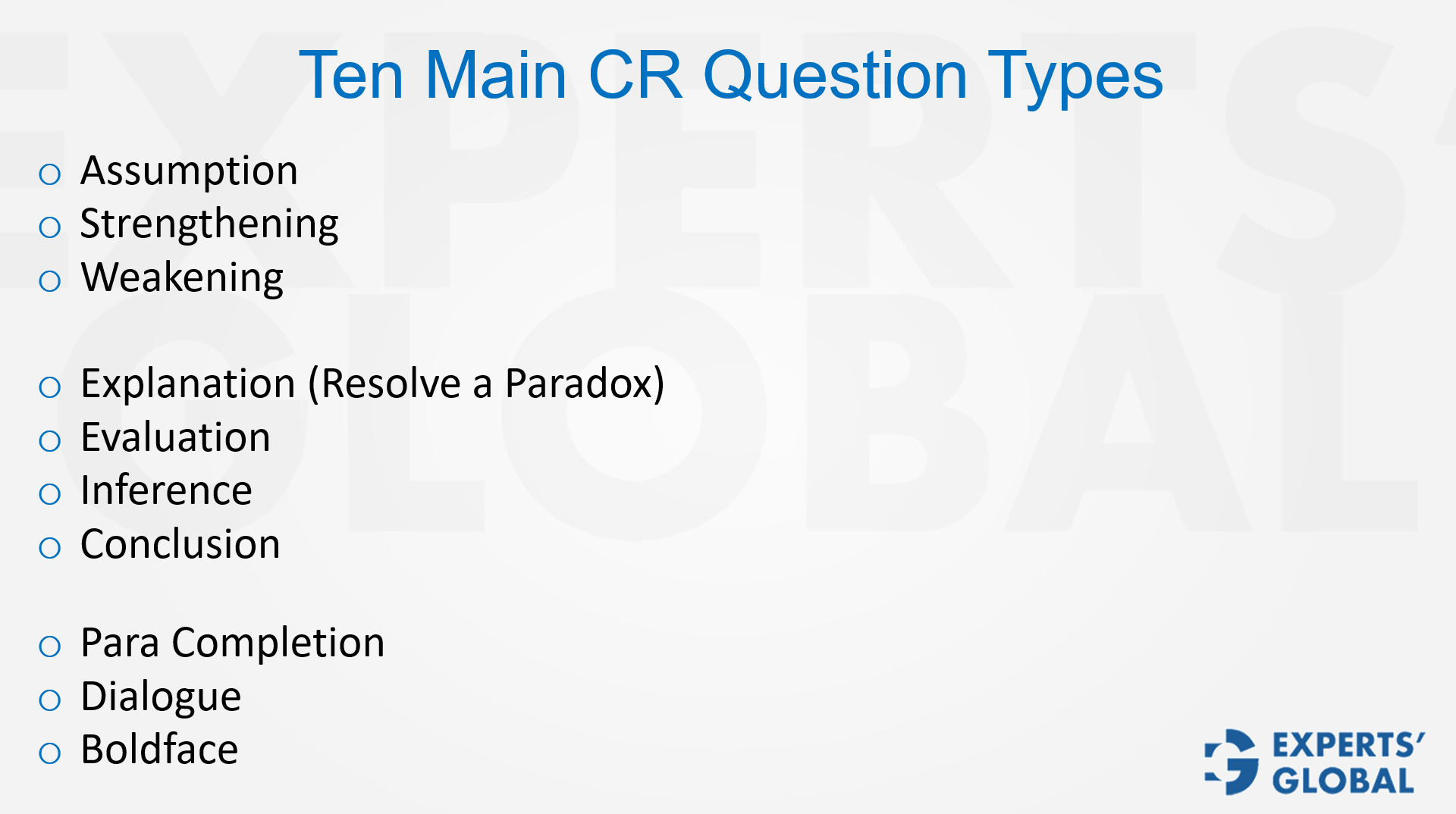
Familiarize yourself with the ten key CR question types: assumption, strengthen, weaken, paradox, evaluation, inference, conclusion, paragraph completion, dialogue, and boldface. The straightforward conceptual video below introduces each question type and the corresponding question stems used on the GMAT.
Ten Main GMAT CR Question Types
Assumption Critical Reasoning Questions | GMAT Verbal Prep
CR Assumption questions ask you to identify the unstated idea that must be true for the argument to hold, which helps you spot the hidden link between the premise and the conclusion. This page offers you an organized, subtopic-wise playlist, along with a few worked examples, for efficient preparation of this concept.
Approach For Assumption Questions | GMAT Verbal CR
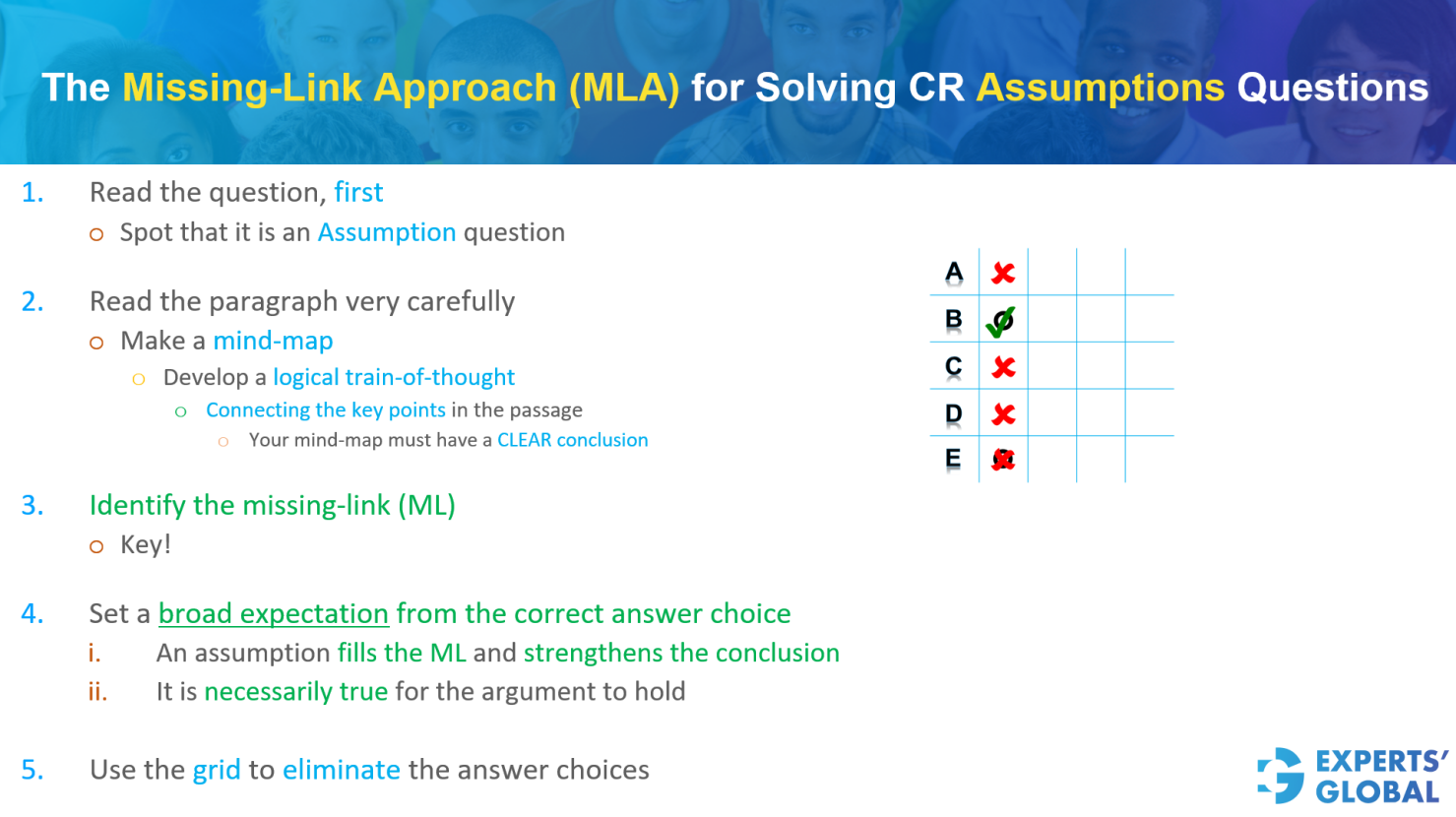
GMAT Critical Reasoning assumption questions give you a passage with a premise, a conclusion, and a clear gap, the missing link, between the two. The correct assumption is the statement that closes this missing link, which strengthens the conclusion. Also, a correct assumption is a statement that must be true for the argument to hold. This overview shows you how to identify assumptions by testing for both sufficiency and necessity: an assumption strengthens the argument, but if you deny it, the argument collapses. The short video below explains the method, applies it to examples, and prepares you to use it on GMAT.
Approach for Assumption Questions | GMAT Verbal CR
Assumption vs Strengthening | GMAT Verbal CR
Every assumption strengthens the argument, but not every strengthener is an assumption. A strengthening statement boosts an argument, but an assumption is its foundation. The key difference lies in necessity: if an assumption is false, the argument falls apart; a strengthener helps, but it is not essential. A strengthening statement adds support but does not need to be true for the argument to stand. An assumption, however, is crucial and must be true for the argument to hold. The short video below takes a focused look at this idea and shows how the GMAT may test it.
Strengthening vs Assumption | GMAT Verbal CR
Assumption Negation Test for Assumptions Questions | GMAT Verbal CR
When you’re stuck on GMAT CR, try the Assumption Negation Test. First, identify the premise and conclusion, then propose the likely assumption. Afterward, negate it. If the argument falls apart, the assumption is essential. Use this method sparingly since it can be time-consuming and should only be used for the toughest questions. The short video below makes the concept feel familiar and shows how it can be applied on the GMAT.
Assumption Negation Test for Assumption Questions | GMAT Verbal CR
GMAT-style Worked Example: CR Assumption Question | GMAT Verbal Prep
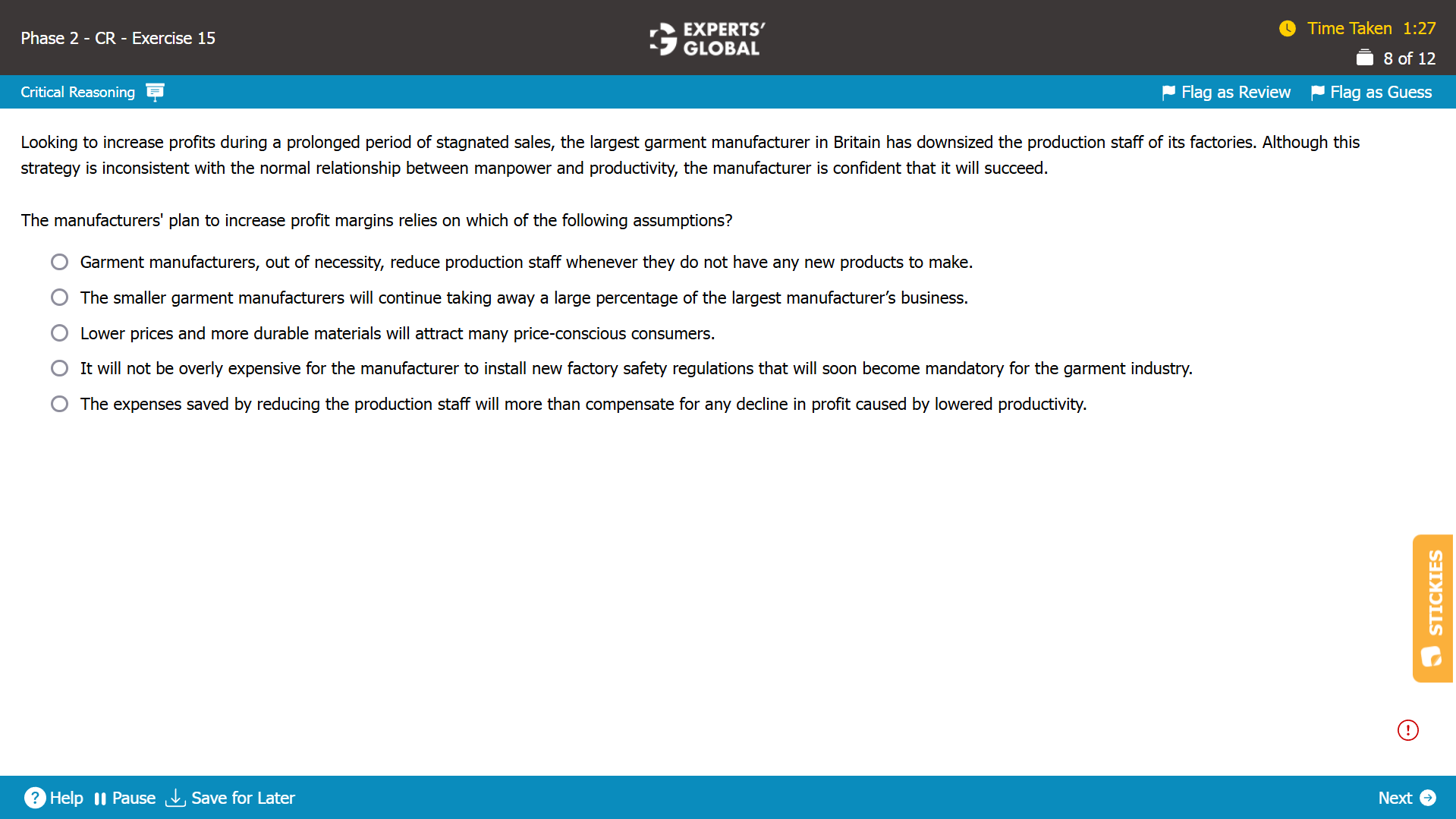
Mind-map: Stagnated sales → manufacturer downsizes production staff → lower productivity → profits are expected to increase (conclusion)
Missing-link: Between lower productivity and the conclusion that profits are expected to increase
Expectation from the correct answer choice: To strengthen the conclusion that profits are expected to increase, through a valid assumption
A. The argument is based on the premise that a manufacturer downsized “in a particular scenario” of stagnated sales, and is not concerned with other downsizing scenarios; so, the idea that downsizing occurs “whenever manufacturers do not have any new products to make” is irrelevant to the argument and its conclusion. This answer choice simply adds information, which, although relevant to the broad context of the argument, has no bearing on the reasoning or its conclusion. Besides, this condition is not necessary for the argument to hold and thus, is not a valid assumption. Because this answer choice does not strengthen the conclusion through a valid assumption, this answer choice is incorrect.
B. The idea that “the smaller garment manufacturers will take away business from the largest manufacturer” is simply additional information, which, although relevant to the broad context, has no bearing on the reasoning. Additionally, if the smaller manufacturers (continue to) take away business from the largest manufacturer, it, if anything, only weakens and not strengthens the conclusion that the largest manufacturer’s profits are expected to increase. Because this answer choice does not strengthen the conclusion through a valid assumption, this answer choice is incorrect.
C. The argument is not concerned with “lower prices and more durable materials” or “price-conscious consumers”; so, the answer choice is irrelevant to the argument and its conclusion. Besides, this condition is not necessary for the argument to hold and thus, is not a valid assumption. Because this answer choice does not strengthen the conclusion through a valid assumption, this answer choice is incorrect.
D. The argument is not concerned with “new factory safety regulations”; so, the idea that such regulations “will soon become mandatory” is irrelevant to the argument and its conclusion. Besides, this condition is not necessary for the argument to hold and thus, is not a valid assumption. Because this answer choice does not strengthen the conclusion through a valid assumption, this answer choice is incorrect.
E. Correct. If the idea that “the expenses saved by reducing the production staff will more than compensate for any decline in profit caused by lowered productivity” is connected with the premise of lower productivity, it suggests that “downsizing will likely lead to some decline in profit, but greater savings in expenses” and thus supports the conclusion that profits are expected to increase. Additionally, this statement does have to be true for the conclusion to hold; negating this statement would mean that “the expenses saved will not be more than the decline in profit” and thus, negate the conclusion that profits are expected to increase. Because this answer choice strengthens the conclusion through a valid assumption, this answer choice is correct.
E is the best choice.
Strengthen the Argument Critical Reasoning Questions | GMAT Verbal Prep
GMAT Critical Reasoning Strengthen the Argument questions give you a short argument with a premise, a conclusion, and a clear gap between them that we at Experts’ Global call the missing link. You see five answer choices, and the correct strengthening statement is the one that closes this missing link and makes the conclusion more convincing. These questions train you to recognize what kind of information adds support to a line of reasoning and makes it feel clearer and more dependable. This page provides an organized, subtopic-wise playlist, along with a few worked examples, to help you prepare efficiently for this concept for the GMAT Verbal section.
Approach for GMAT Strengthen the Argument Questions | GMAT Verbal CR
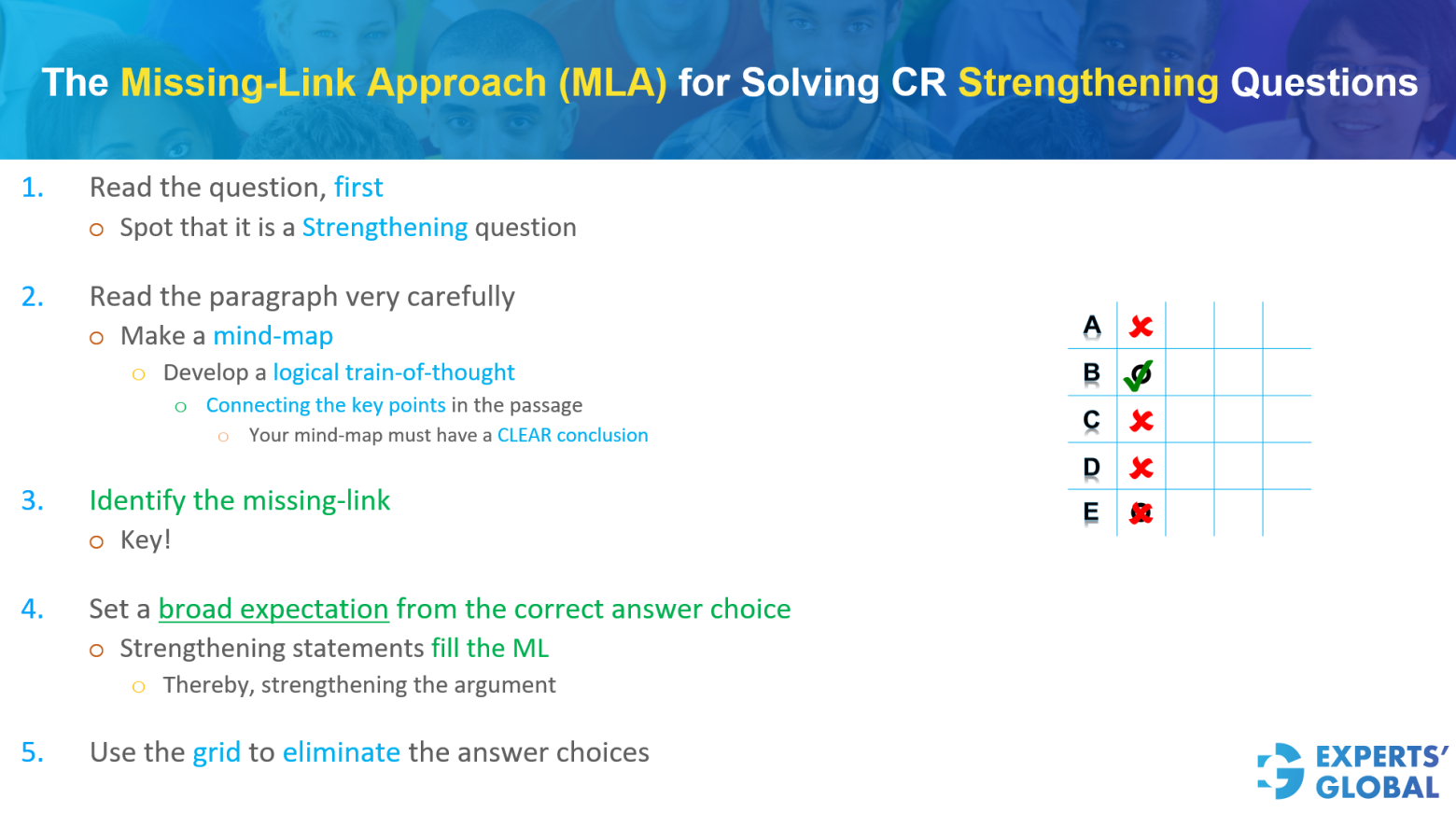
A strengthening statement enhances the argument by making the conclusion more persuasive, either by filling the gap between the premise and conclusion or introducing new, relevant details. Unlike an assumption, it is not essential. This overview explains how these statements differ from assumptions, which must be true for the argument to hold up. In the short video that follows, you see the approach explained and demonstrated, then tied to GMAT CR questions.
Approach for Strengthen the Argument Questions | GMAT Verbal CR
How Strengthening and Assumption Statements Differ | GMAT Verbal CR
Strengthening statements and assumptions both bridge an argument’s premises to its conclusion, but they differ in how necessary they are to the reasoning. A strengthening statement adds persuasive power to the argument, while an assumption is required; without it, the logic falls apart. Both assumption and strengthening statements close the missing link and support the conclusion, but an assumption must be true for the argument to stand, whereas a strengthening statement does not have to be. So, in simple terms, assumption statements sit within the broader set of strengthening statements. The short video below takes a focused look at this idea and shows how the GMAT may test it.
GMAT CR: Strengthening vs Assumption
GMAT-style Worked Example: CR Strengthen the Argument Question | GMAT Verbal Prep
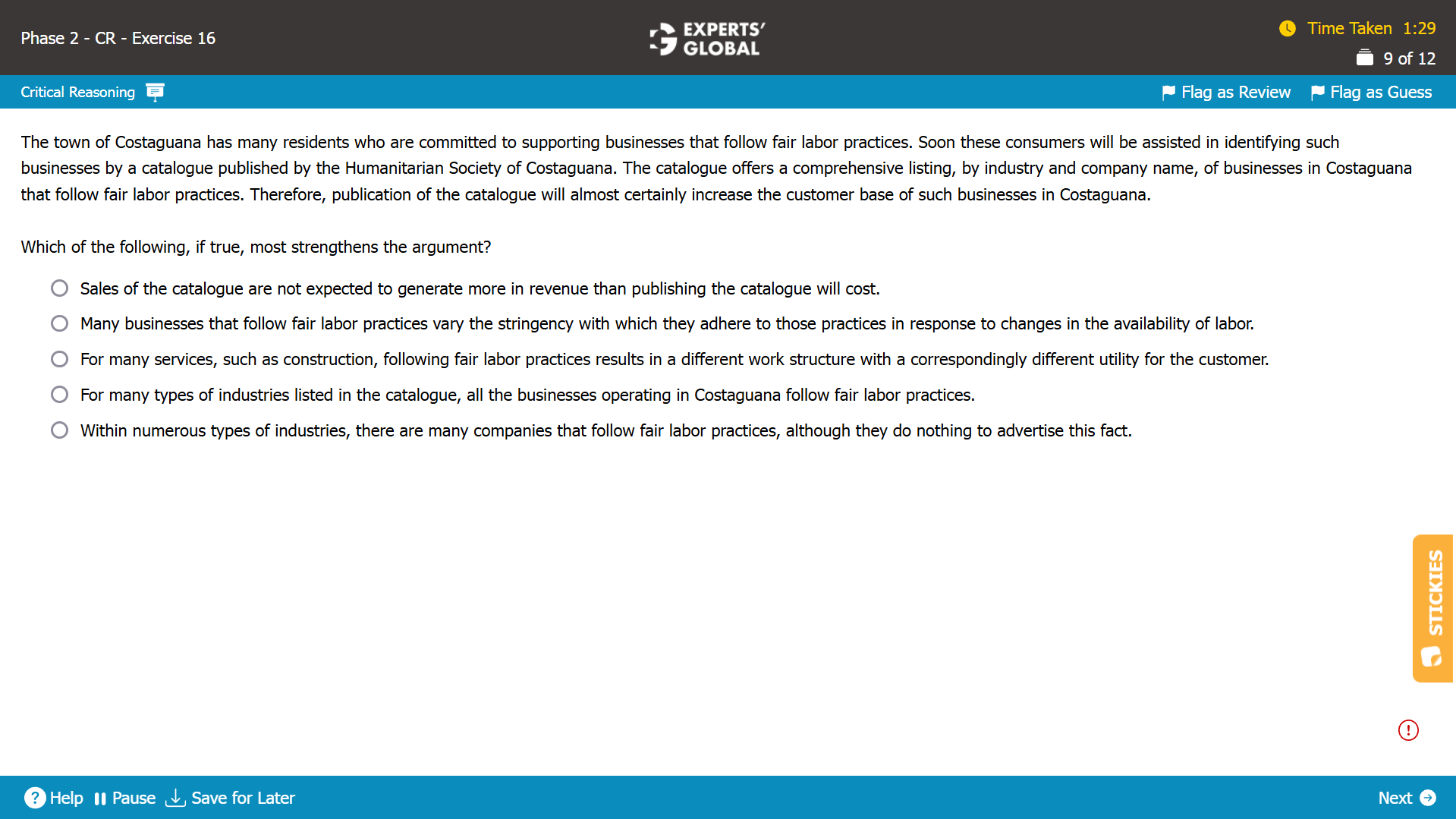
Mind-map: Town C residents support businesses that follow fair labor → a catalogue listing such businesses is published → the catalogue will increase customer base of such businesses (conclusion)
Missing-link: Between the publication of a catalogue listing businesses that follow fair labor and the conclusion that the catalogue will increase customer base of such businesses
Expectation from the correct answer choice: To strengthen the conclusion that the catalogue will increase customer base of such businesses
A. The argument is concerned with the effect of the catalogue’s publication on the customer base of businesses that follow fair labor; so, the financial factors related to the publication of the catalogue are out of scope. Because this answer choice does not strengthen the conclusion, this answer choice is incorrect.
B. The argument is concerned with the customer base of businesses that follow fair labor and not particularly with the stringency of following fair labor; so, this answer choice simply adds information, which, although relevant to the broad context of the argument, does not strengthen the conclusion. Because this answer choice does not strengthen the conclusion, this answer choice is incorrect.
C. The argument is concerned with the customer base of businesses that follow fair labor and not with work structures as a result of following fair labor; so, this answer choice is out of scope. Because this answer choice does not strengthen the conclusion, this answer choice is incorrect.
D. Trap. This answer choice, suggesting that all businesses in many industries follow fair labor, raises doubt regarding how valuable the information in the catalogue will be in educating the customer base about businesses that follow fair labor; so, this answer choice, if anything, faintly weakens, rather than strengthens, the argument. Further, “many” is subjective and refers to only a part of all industries; this answer choice is thus limited in scope. Because this answer choice does not strengthen the conclusion, this answer choice is incorrect.
E. Correct. By suggesting that the catalogue will likely inform people about many businesses that were not previously known to follow fair labor, this answer choice indicates that people will likely buy from these newly discovered businesses and thus strengthens the conclusion. Because this answer choice strengthens the conclusion, this answer choice is correct.
E is the best choice.
Weaken the Argument Critical Reasoning Questions | GMAT Verbal Prep
CR Weaken the Argument, or simply weakening, questions ask you to choose the statement that makes an argument less convincing by undermining the connection between its premise and its conclusion. They train you to spot gaps, competing explanations, and ignored factors that can lower the strength of a claim. This page provides organized conceptual lesson along with a few worked examples, for efficient preparation of this concept for GMAT’s Verbal section.
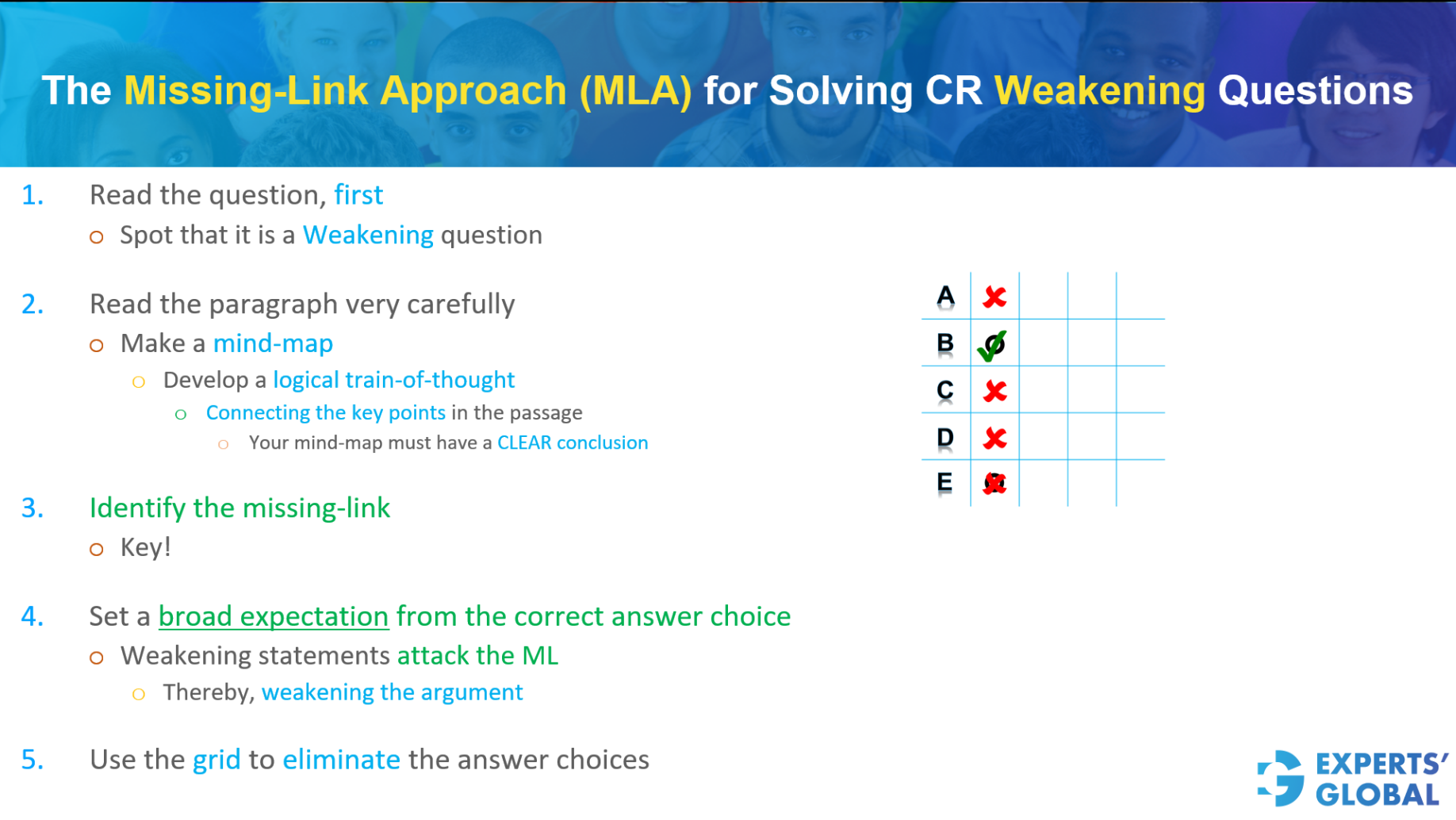
Approach for Weaken the Argument Question Type | GMAT Verbal CR
Weakening questions ask you to test how solid the connection really is between an argument’s premise and its conclusion. This overview explains what a weakening statement accomplishes: it reduces the argument’s persuasive strength by targeting the missing link, offering alternative explanations, questioning the stated cause, introducing evidence that points the other way, or changing the benchmark used for comparison. The video and article lay out a clear framework for spotting these moves and using them consistently. The short video below explains this approach, shows it in action on GMAT-style questions, and helps you apply it on the GMAT’s Verbal section.
Approach for Weaken the Argument Questions | GMAT Verbal CR
GMAT-style Worked Example: CR Weaken the Argument Question
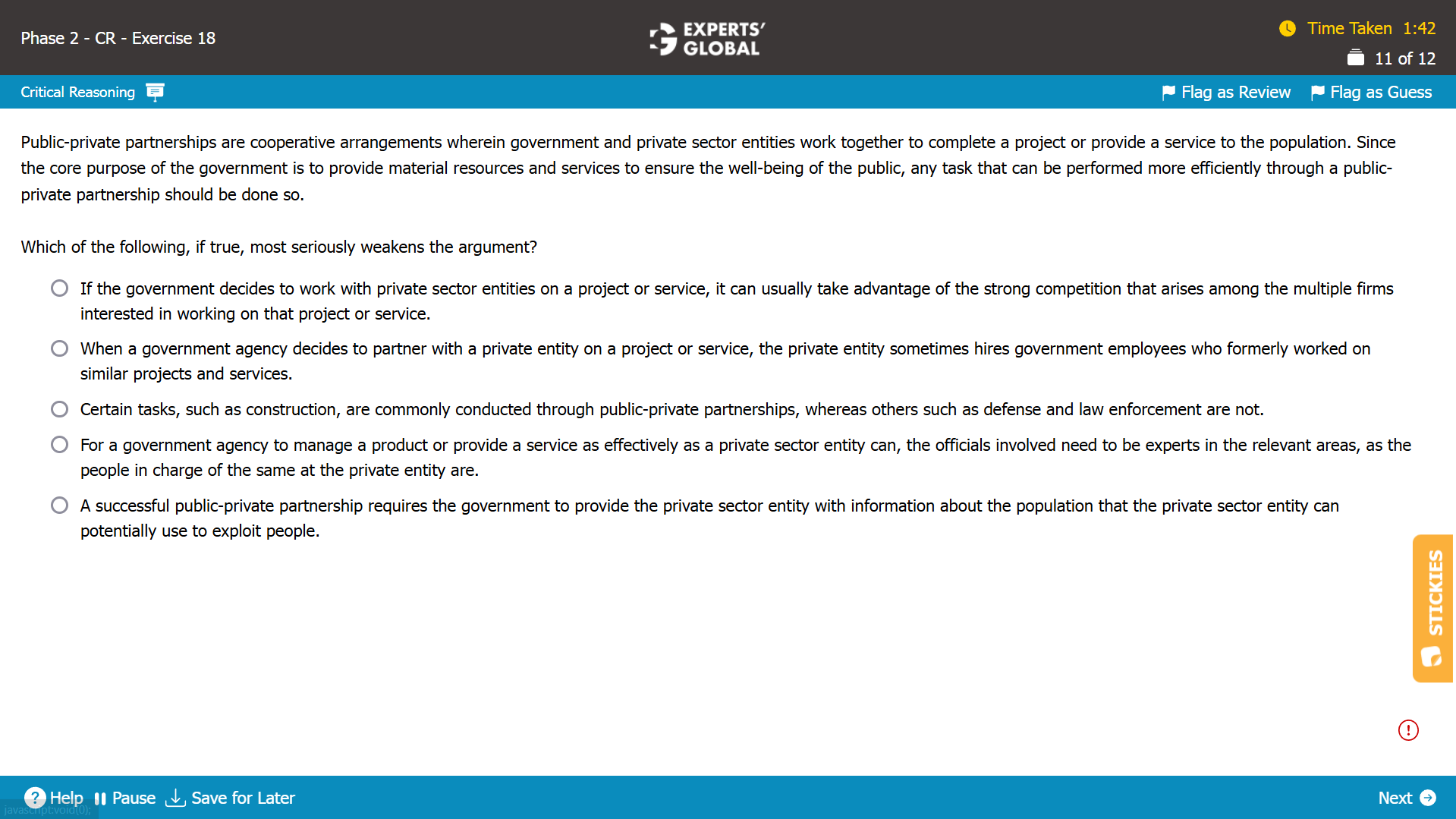
Mind-map: In public-private partnerships (PPP), governments and private entities work together to serve the population → government’s core purpose is related to ensuring well-being of the public → tasks that can be performed more efficiently through PPP should be done by private entities (conclusion)
Missing-link: Between government’s core purpose being related to ensuring well-being of the public and the conclusion that tasks that can be performed more efficiently through PPP should be done by private entities
Expectation from the correct answer choice: To weaken the conclusion that tasks that can be performed more efficiently through PPP should be done by private entities
A. This answer choice, suggesting that governments can take advantage of competition among private firms, indicates a benefit of governments selecting the best partner for public-private partnerships, thus strengthening, rather than weakening, the conclusion. Because this answer choice does not weaken the conclusion, this answer choice is incorrect.
B. This answer choice, suggesting the possibility of former government employees getting hired by private entities, makes no suggestion regarding whether governments should conduct any task through public-private partnerships; so, this answer choice is just additional information and does not weaken the argument. Because this answer choice does not weaken the conclusion, this answer choice is incorrect.
C. The argument is concerned with whether governments should conduct any task through public-private partnerships; so, information about which types of tasks are generally conducted through such partnerships is just additional detail and does not weaken the argument. Because this answer choice does not weaken the conclusion, this answer choice is incorrect.
D. This answer choice, suggesting that governments need to develop expertise in order to be as effective as private entities, indicates a potential challenge for the governments and hints at a benefit of public-private partnerships, thus strengthening, rather than weakening, the conclusion. Because this answer choice does not weaken the conclusion, this answer choice is incorrect.
E. Correct. By suggesting the possibility that private entities can potentially exploit people’s information, this answer choice indicates a risk associated with such partnerships and governments’ effort to ensure the well-being of the public, thus weakening the conclusion. Because this answer choice weakens the conclusion, this answer choice is correct.
E is the best choice.
Resolve-the-Paradox Critical Reasoning Questions | GMAT Verbal Prep
Critical Reasoning Resolve the Paradox questions ask you to choose the statement that explains how two facts that appear to conflict can both be true at the same time. They train you to make sense of surprising patterns by spotting the missing idea that brings the situation back into balance. This page provides an organized, subtopic-wise playlist, along with a few worked examples, for efficient preparation of this concept.
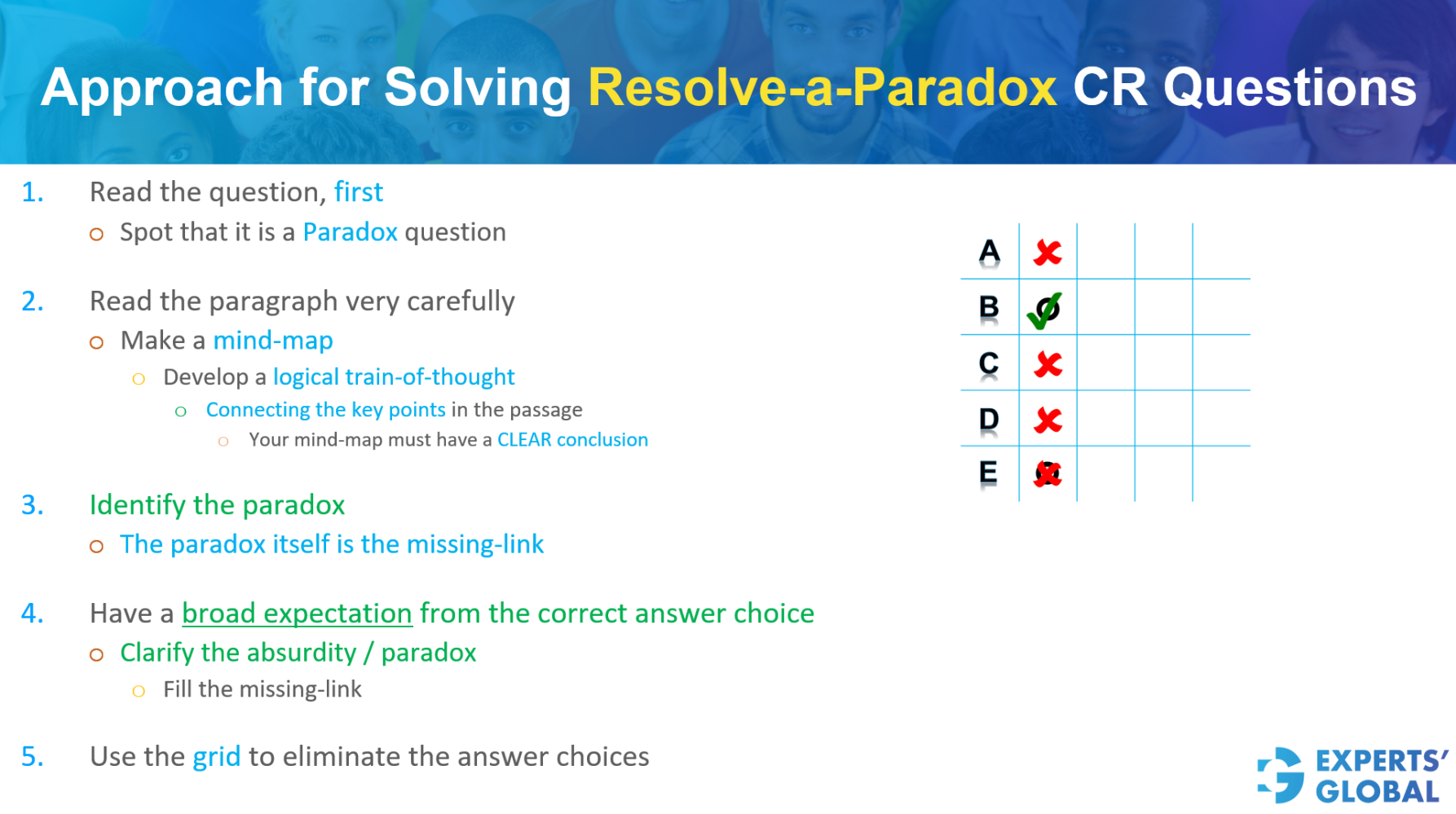
Approach for Resolve-the-Paradox (Explanation) Questions | GMAT Verbal CR
Resolve-the-paradox, or explanation, questions in GMAT Critical Reasoning present a situation that looks contradictory: the premise appears to point to one outcome, but the observed result points in a different direction. This overview explains how you handle these questions by finding a connecting reason that makes both sides fit together. The short video below explains the approach, demonstrates how it works, and helps you use it on the GMAT.
Approach for Resolve-the-Paradox Questions | GMAT Verbal CR
Beware When You See Numbers in CR
When you encounter numbers in GMAT CR, pay close attention, as they often hold both the trap and the key. Consider the context and scale carefully. For instance, a 99% success rate might seem impressive, but in situations like surgeries or airplane landings, a 1% failure is completely unacceptable. The short video that follows brings this concept from theory into practice and shows how it can show up on the GMAT.
Beware When You See Numbers in GMAT Verbal CR
GMAT-style Worked Example: CR Resolve the Paradox Question
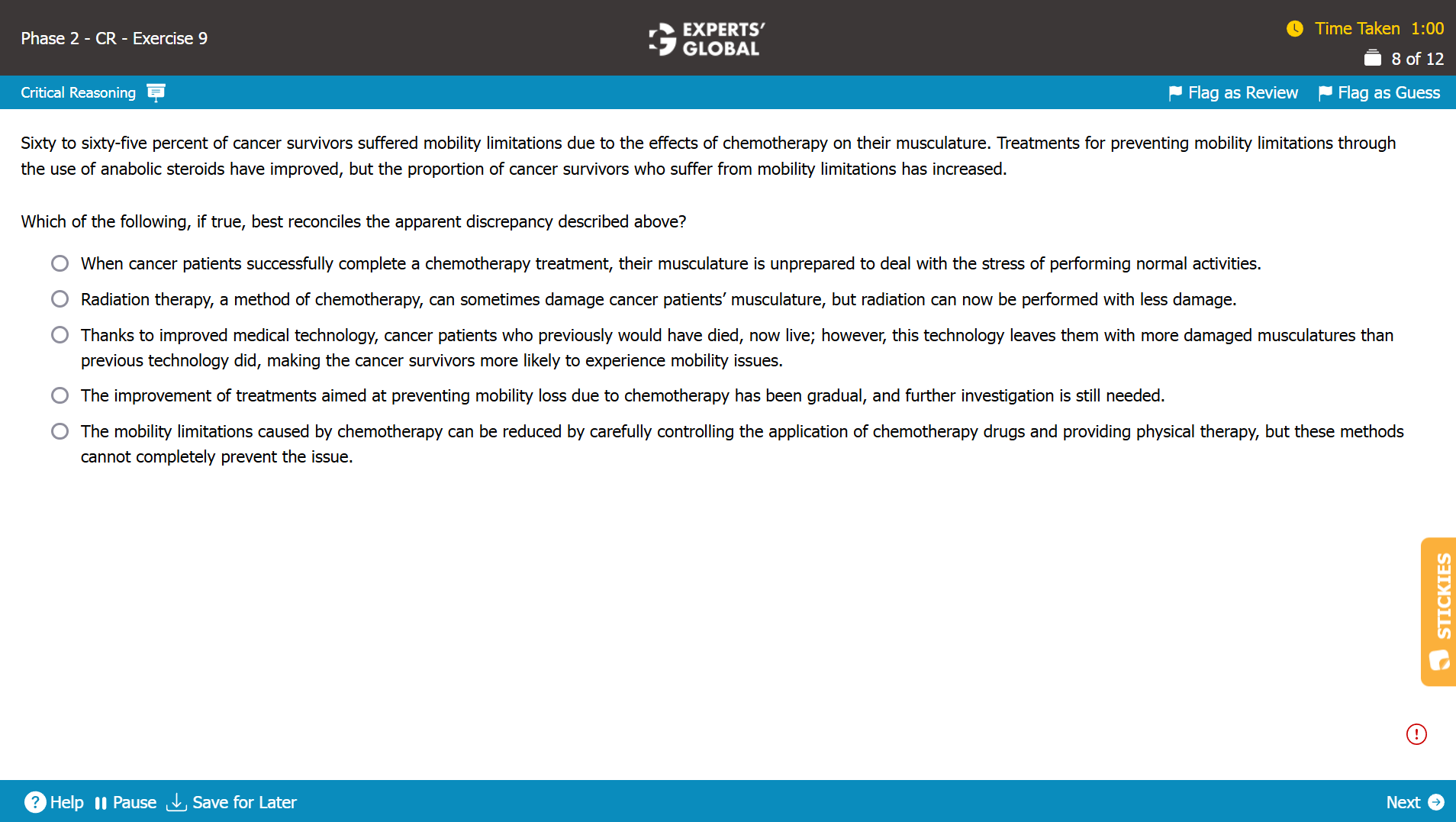
Mind-map: Cancer survivors undergo chemotherapy → large percentage of survivors suffer from mobility limitation → treatments to prevent mobility limitation have improved → proportion of cancer survivors with mobility limitations has increased
Missing-link: Between treatments to prevent mobility limitation improving and the proportion of cancer survivors with mobility limitations increasing
Expectation from the correct answer choice: To explain why the proportion of cancer survivors with mobility limitations has increased despite treatments to prevent mobility limitation improving
A. This answer choice, suggesting that successful chemotherapy leaves patients with musculature vulnerable to stress, supports the fact in the argument that a large percentage of survivors suffer from mobility limitation after successful chemotherapy; however, this answer choice does not explain why the proportion of cancer survivors with mobility limitations has increased despite treatments to prevent mobility limitation improving. Because this answer choice does not explain the discrepancy in the argument, this answer choice is incorrect.
B. This answer choice, suggesting that a method in chemotherapy now causes less musculature damage than it did before, indicates that the proportion of cancer survivors with mobility limitations should have decreased rather than increased; so, this answer choice, if anything, raises further concern over, rather than explains, why the proportion of cancer survivors with mobility limitations has increased despite treatments to prevent mobility limitation improving. Because this answer choice does not explain the discrepancy in the argument, this answer choice is incorrect.
C. Correct. By suggesting that improvement in medical technology is helpful in saving lives but leaves cancer survivors with more damaged musculatures and with greater susceptibility to mobility issues, this answer choice introduces the possibility that, even with improved treatments to prevent mobility limitation, cancer survivors now are more likely to suffer from mobility issues; such a possibility explains why the proportion of cancer survivors with mobility limitations has increased despite treatments to prevent mobility limitation improving. Because this answer choice clarifies the exact discrepancy in the premise, this answer choice is correct.
D. Trap. This answer choice, suggesting gradual “improvement” in the prevention of mobility limitation, indicates that the proportion of cancer survivors with mobility limitations should have “decreased” rather than increased; so, this answer choice, if anything, raises further concern over, rather than explains, why the proportion of cancer survivors with mobility limitations has increased despite treatments to prevent mobility limitation improving. Because this answer choice does not explain the discrepancy in the argument, this answer choice is incorrect.
E. Trap. This answer choice, suggesting that complete prevention of mobility limitations during chemotherapy is not possible, indicates that some mobility limitation is likely in all cancer survivors; however, this answer choice does not explain why the proportion of cancer survivors with mobility limitations has increased despite treatments to prevent mobility limitation improving. Because this answer choice does not explain the discrepancy in the argument, this answer choice is incorrect.
C is the best choice.
Evaluate-the-Argument Critical Reasoning Questions | GMAT Verbal Prep
GMAT Critical Reasoning Evaluate the Argument, or simply Evaluation, questions ask you to choose the information that helps you assess an argument’s strength by revealing whether its reasoning stands firm or falls apart. They train you to spot the key point the argument rests on and to see how new evidence can shift how confident you feel about its conclusion. This page provides an organized conceptual lesson along with a few worked examples, for efficient preparation of this concept.
Approach for Evaluate-the-Argument Questions | GMAT Verbal CR
Evaluation of an argument questions focus on examining the connection between evidence and conclusion. Start by identifying the gap, then determine which option helps clarify it. The right answer may either strengthen or weaken the conclusion, providing support or challenging it. The short video below explains the method, shows it in action, and prepares you to apply it consistently on the GMAT.
Approach for Evaluate-the-Argument Questions | GMAT Verbal CR

GMAT-style Worked Example: CR Evaluate the Argument Question
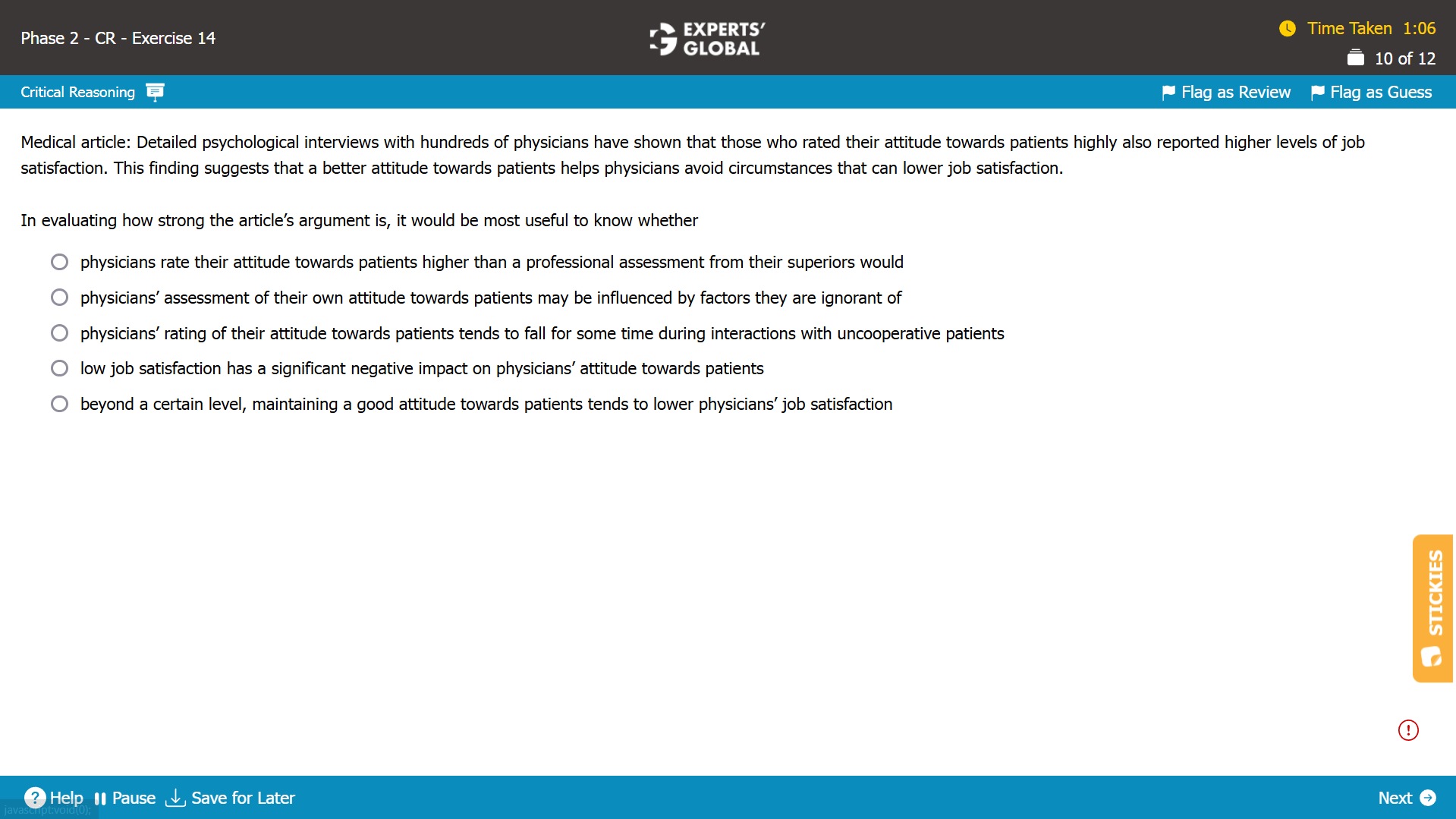
Mind-map: Interviews of physicians conducted → physicians with better attitude had higher job satisfaction → attitude helps avoid lower job satisfaction (conclusion)
Missing-link: Between physicians with a better attitude having higher job satisfaction and the conclusion that attitude helps avoid lower job satisfaction
Expectation from the correct answer choice: To indicate some fact or data that helps in evaluating the conclusion that attitude helps avoid lower job satisfaction
Discussion: This argument commits the classic GMAT error of confusing “effect” with “cause”; the argument mentions that physicians with better attitude had higher job satisfaction and concludes that attitude is the “cause” that has an “effect” on job satisfaction; the argument ignores the possibility that job satisfaction may be the cause that has an effect on attitude. In order to establish a cause-effect relationship implied in the argument, the reverse possibility needs to be evaluated.
A. Trap. This answer choice, suggesting that physicians typically rate themselves higher on the attitude towards patients than their superiors would, indicates that all physicians involved in the study are likely to have inflated the ratings of the attitude towards patients; however, this answer choice makes no suggestion regarding the relationship between the attitude towards patients and job satisfaction levels and thus would not help evaluate the conclusion. Because this answer choice would not help evaluate the conclusion, this answer choice is incorrect.
B. Trap. This answer choice, suggesting that there are other factors that affect the attitude towards patients, or the perception thereof, is applicable to all physicians regardless of their attitude towards patients and job satisfaction levels; so, this answer choice fails to make any suggestion regarding the relationship between the two; hence, this answer choice does would not help evaluate the conclusion. Because this answer choice would not help evaluate the conclusion, this answer choice is incorrect.
C. Trap. This answer choice, suggesting that interactions with uncooperative patients temporarily affect physicians’ attitude towards patients, is applicable to all physicians regardless of their attitude towards patients and job satisfaction levels; so, this answer choice fails to makes any suggestion regarding the relationship between the two; hence, this answer choice does would not help evaluate the conclusion. Because this answer choice would not help evaluate the conclusion, this answer choice is incorrect.
D. Correct. This answer choice, suggesting that low job satisfaction negatively affects the attitude towards patients, indicates that job satisfaction levels are the “cause” that have an “effect” on the attitude towards patients, thus reversing the cause-effect relationship implied in the argument and casting doubt on the conclusion that the attitude towards patients helps physicians avoid circumstances that can lower job satisfaction; so, this answer choice would help evaluate the conclusion. Because this answer choice would help evaluate the conclusion, this answer choice is correct.
E. This answer choice, suggesting that there exists a high level of the attitude towards patients that tends to lower job satisfaction, indicates that, in some cases, attitude does not help avoid lower job satisfaction, thus weakening the conclusion; however, this answer choice is applicable only “beyond a certain level” and is thus, limited in scope; hence, this answer choice makes no suggestion regarding the generally-applicable relationship between attitude towards patients and job satisfaction levels and thus would not help evaluate the conclusion. Because this answer choice would not help evaluate the conclusion, this answer choice is incorrect.
D is the best choice.
Inference Critical Reasoning Questions | GMAT Verbal Prep
Critical Reasoning Inference questions ask you to choose the statement that must be true based on the information provided, without bringing in assumptions, stretching what is said, or overplaying the facts. This page provides an organized playlist, along with a few worked examples, for efficient preparation of this concept.
Characteristics of a Valid Inference | GMAT Verbal CR
A valid inference is a statement that must be true based only on the information you are given, with no extra assumptions, stretch, or exaggeration. It stays tightly within the scope of the passage, respects key qualifiers, and follows from the facts as stated. It sounds modest but certain, because it does not go beyond what the details clearly allow.
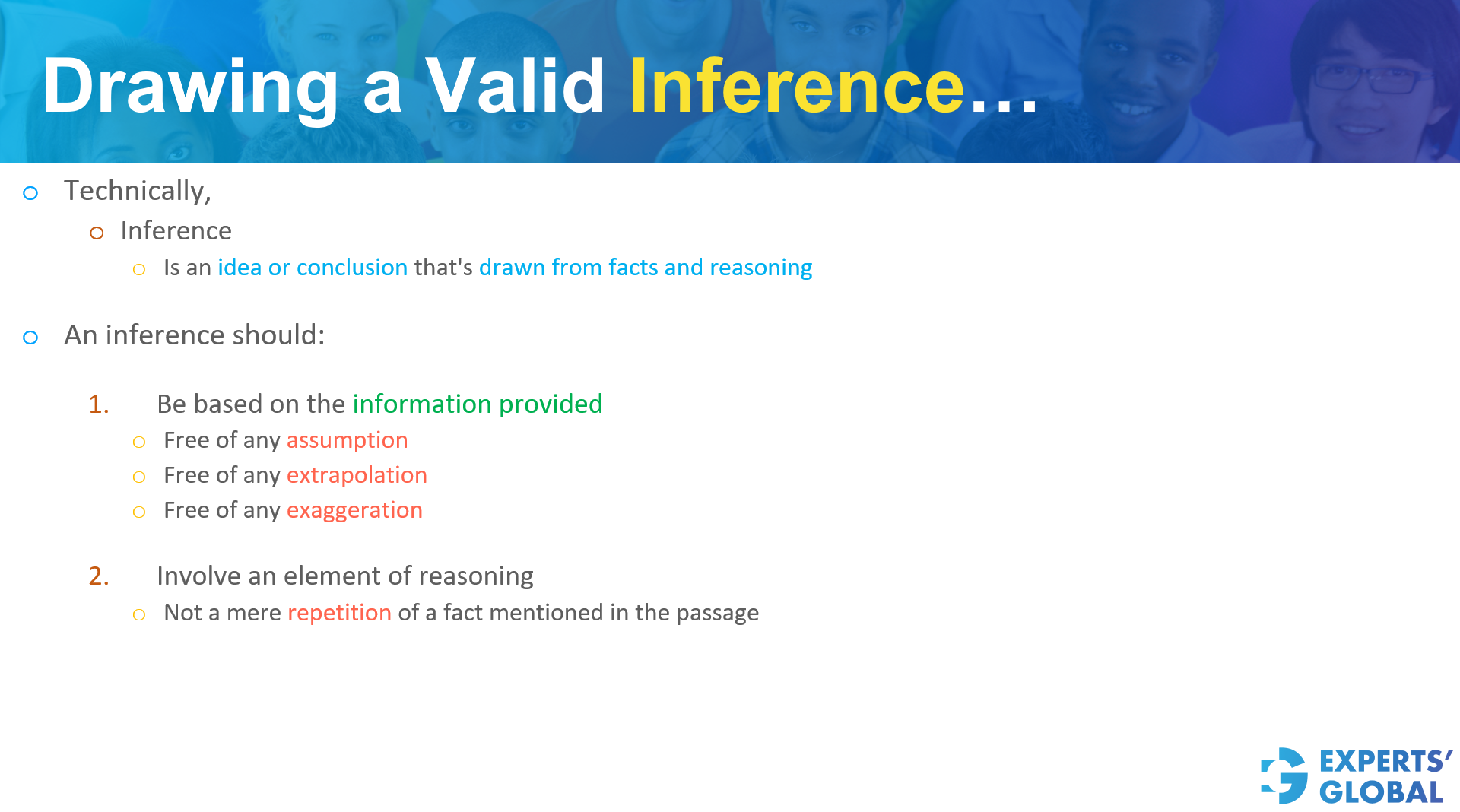
Approach for Inference Questions | GMAT Verbal CR
In GMAT CR, inference questions require you to draw conclusions that are guaranteed by the given statements. Stick strictly to the facts – avoid making assumptions, predictions, or comparisons. Analyze the details, then evaluate the options. Accept only those that are directly supported and eliminate anything that relies on additional conditions. Focus on drawing precise conclusions, not making judgments about causes or value. In the short video that follows, this approach is explained, demonstrated, and set up for use on the GMAT.
Approach for Inference Questions | GMAT Verbal CR
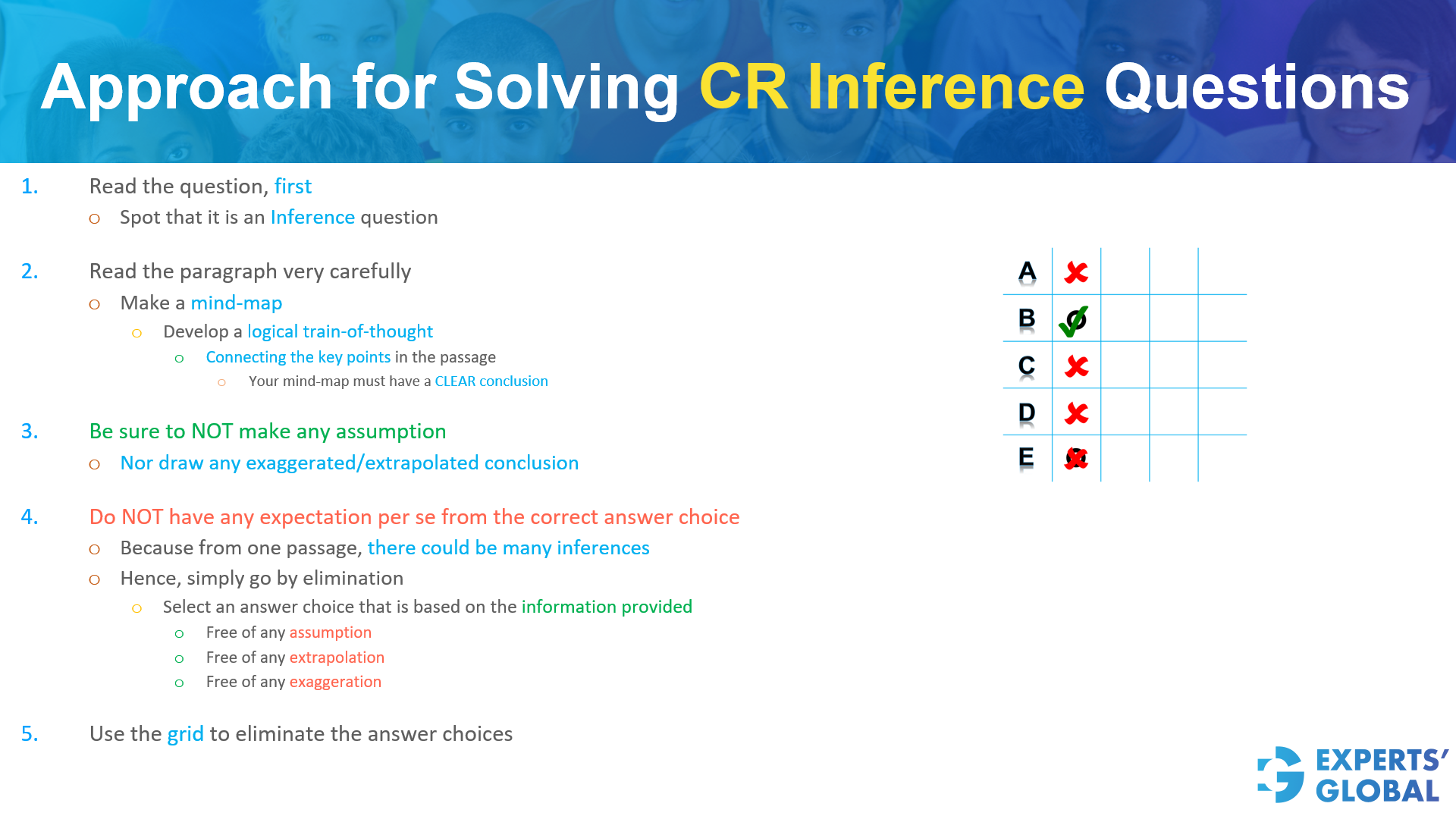
GMAT-style Worked Example: CR Inference Question
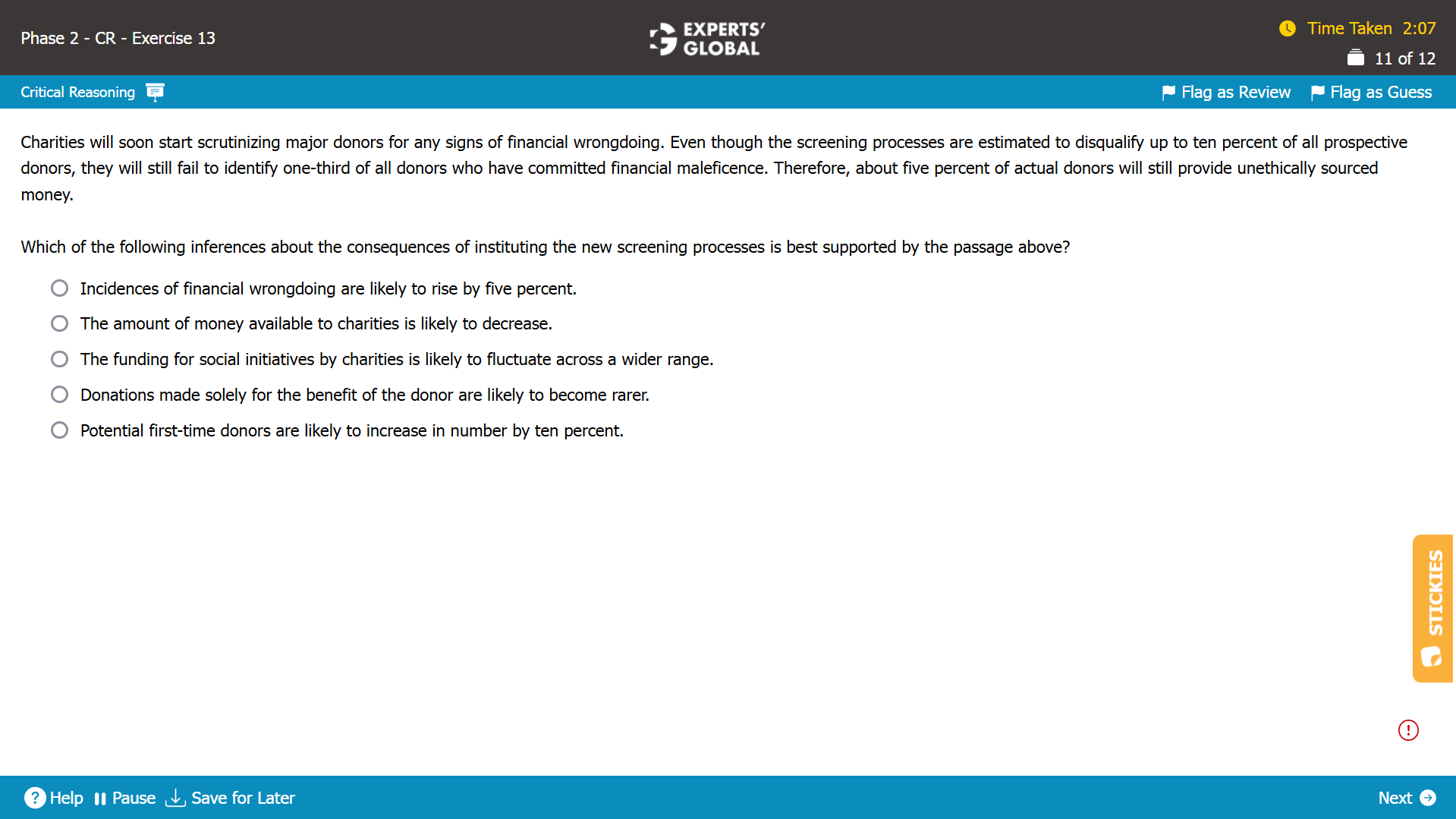
Mind-map: Charities to scrutinize donations for financial wrongdoing → ten percent donors expected to be disqualified → one-third of donors with financial malpractice will not be identified → five percent of all donors will provide unethically sourced money
Missing-link: Not needed
Expectation from the correct answer choice: To be duly deducible from the information in the passage, without any assumption or extrapolation
A. Trap. The argument is concerned with charities’ scrutiny identifying donors with financial maleficence and not with incidents of financial maleficence in general; so, this answer choice cannot be established. Because this answer choice is not deducible from the information in the passage without any assumption or extrapolation, this answer choice is incorrect.
B. Correct. The argument mentions that the scrutiny is expected to disqualify ten percent of all prospective donors, suggesting a decline in accepted donations, or, in other words, in the amount of money available to charities, as the answer choice mentions. Because this answer choice is deducible from the information in the passage without any assumption or extrapolation, this answer choice is correct.
C. The argument mentions that the scrutiny is expected to disqualify ten percent of all prospective donors, suggesting a decline in accepted donations; this answer choice, suggesting “fluctuations” in funding, indicates possible increase or decrease, and can only be partially established; this answer choice can stay after the first glance but shall eventually make way for a better, stronger answer choice; we have a more convincing answer choice in B.
D. The argument mentions that the scrutiny is expected to disqualify ten percent of all prospective donors, suggesting a decline in accepted donations; however, the argument makes no suggestions regarding the purpose of donations; so, this answer choice, suggesting that donations made with the sole purpose of benefitting the donor will become rarer, cannot be established. Because this answer choice is not deducible from the information in the passage without any assumption or extrapolation, this answer choice is incorrect.
E. Trap. The argument mentions charities’ scrutiny and its impact on “donors with financial malpractice” but makes no suggestion regarding the scrutiny’s impact on “potential first-time donors”; so, this answer choice, suggesting an impact, cannot be established. Because this answer choice is not deducible from the information in the passage without any assumption or extrapolation, this answer choice is incorrect.
B is the best choice.
Main Point (or Conclusion) Critical Reasoning Questions | GMAT Verbal Prep
Critical Reasoning Main Point or Conclusion questions ask you to identify the single central claim the argument tries to prove, the key idea that all other details in the passage are meant to support. They train you to separate the core message from supporting background and to recognize the structure of the reasoning with clarity. This page provides organized conceptual lesson along with a few worked examples, for efficient preparation of this concept.
Characteristics of a Valid Main Point or Conclusion Statement | GMAT Verbal CR
A valid main point or conclusion statement captures the one central claim the argument aims to establish, not a supporting detail or a side observation. It matches the scope of the passage, reflects the author’s intent, and stays faithful to the exact level of certainty expressed. It pulls the key idea together in a clean, accurate way, without adding new information or making the claim broader or stronger than what the passage allows.
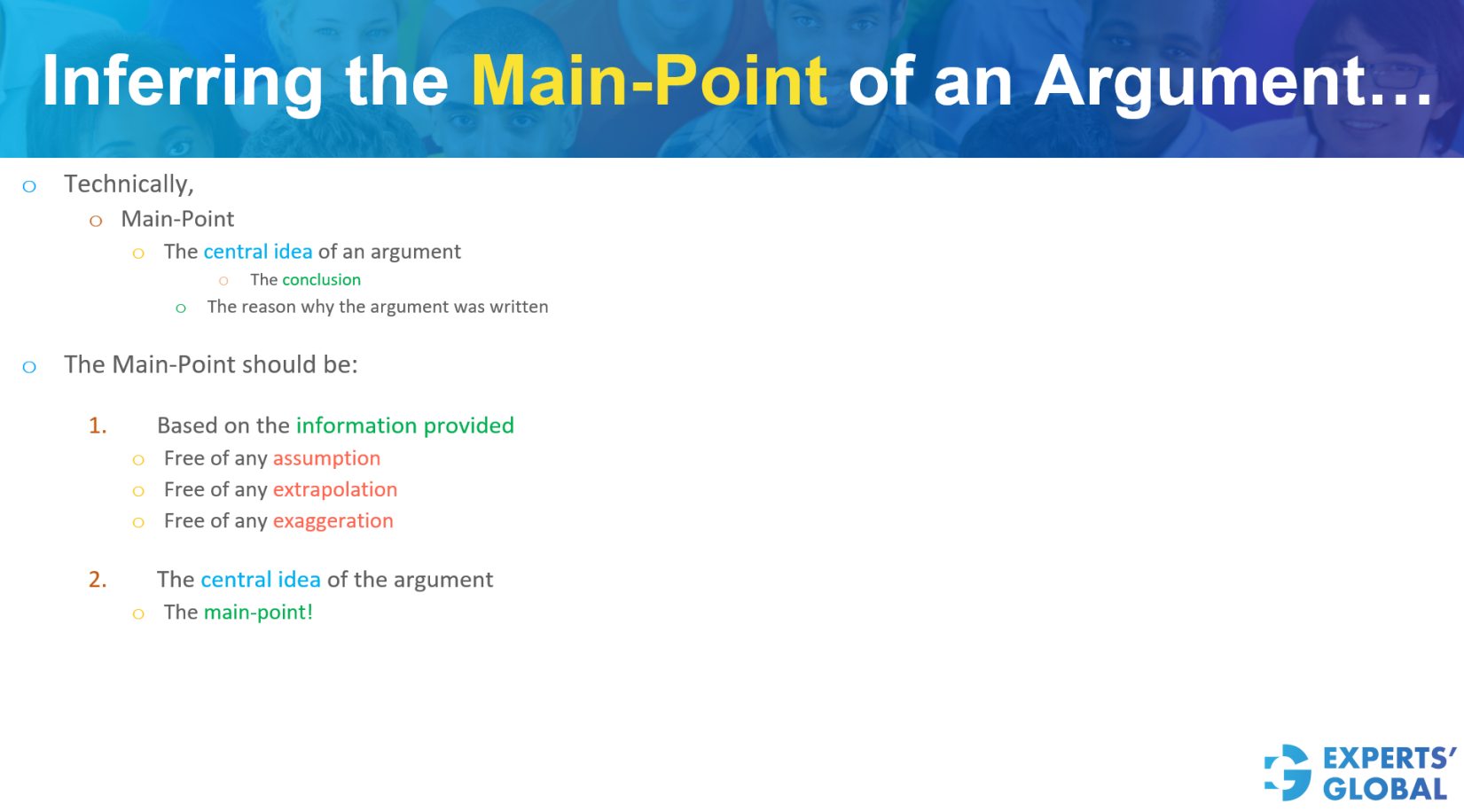
Approach for Argument’s Main Point Questions | GMAT Verbal CR
For conclusion questions in GMAT Critical Reasoning, focus on identifying the author’s main point, not just background details or simple inferences. Quickly map out the argument, figure out what it’s trying to prove, and be cautious of extreme words like “definitely.” The conclusion could be anywhere, so select the statement that the premises are trying to support. The short video below presents the method, shows it in real use, and prepares you to apply it on the GMAT Verbal section.
Approach for Argument’s Main Point Questions | GMAT Verbal CR
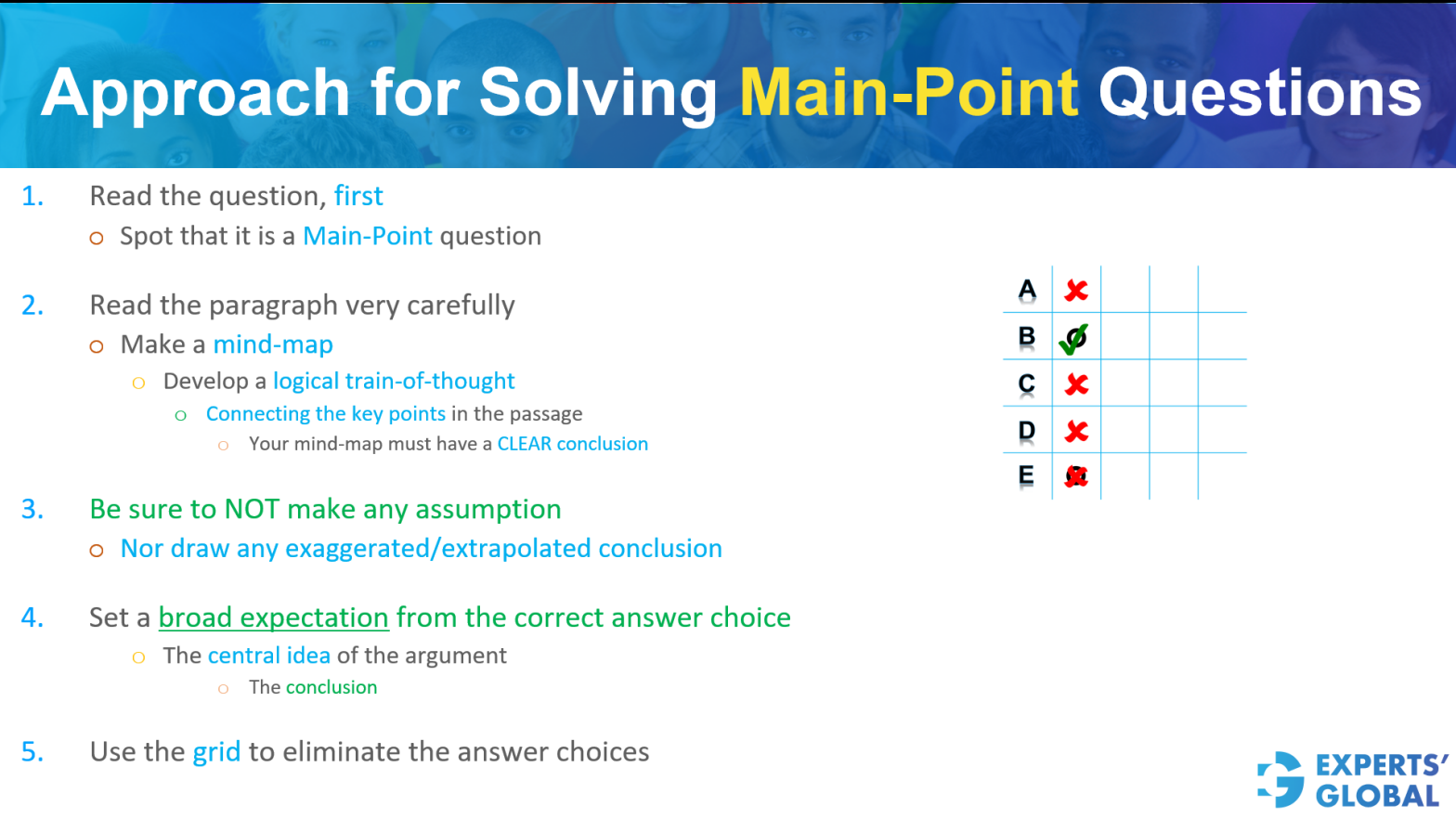
GMAT-style Worked Example: CR Main Point Question
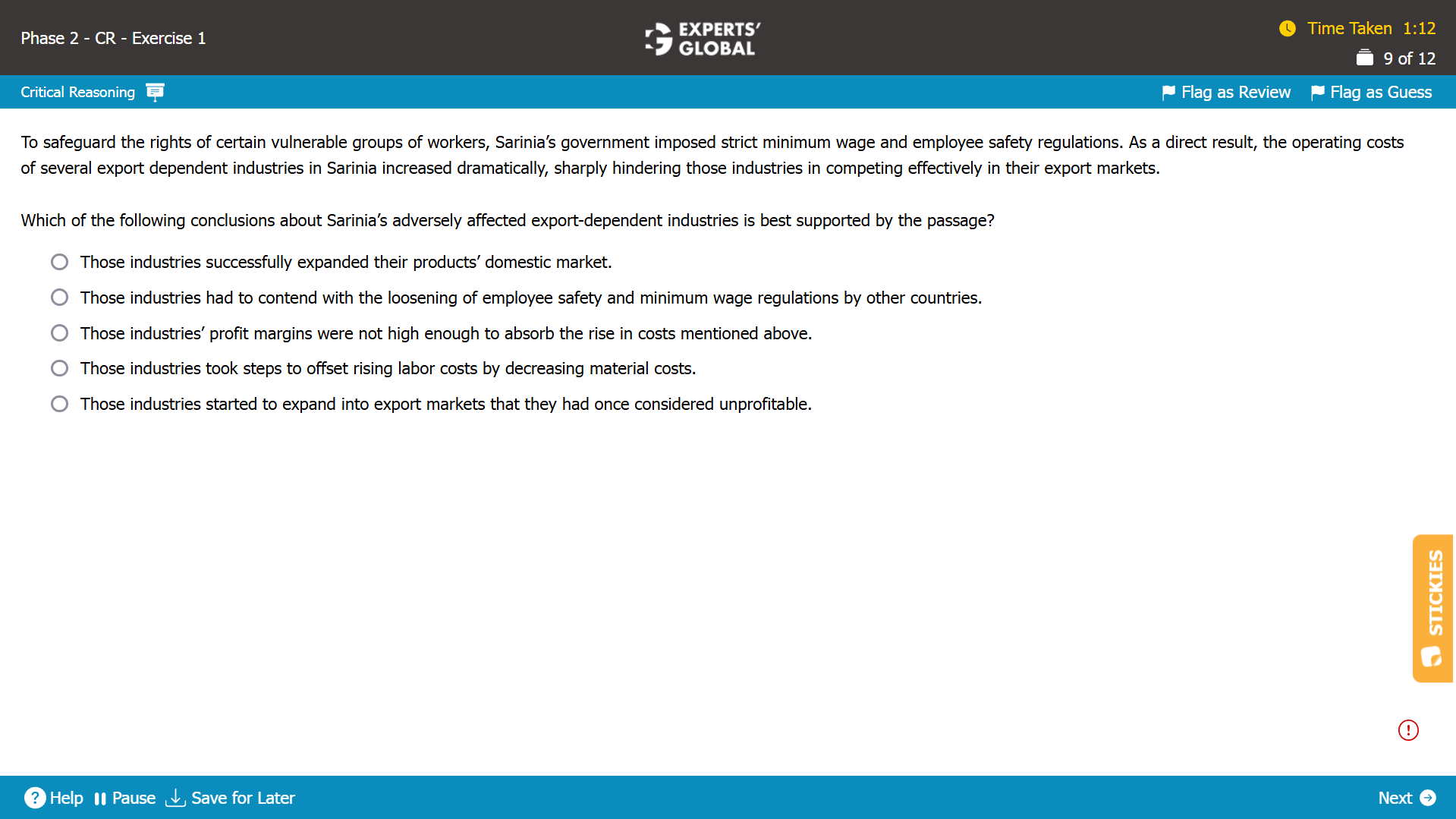
Mind-map: Government wanted to safeguard vulnerable workers → minimum wage and safety regulations imposed → cost of export dependent industries increased → industries cannot compete effectively
Missing-link: Between the cost of export dependent industries increasing and the industries not being able to compete effectively
Expectation from the correct answer choice: To be duly deducible from the information in the passage, without any assumption or extrapolation
A. Trap. The argument is concerned with the impact of regulation on “export-dependent industries” and provides no information about such industries’ operations in the “domestic market”; so, this answer choice is just a possibility, which, although relevant to the broad context of the argument, cannot be established. Because this answer choice is not deducible from the information in the passage without any assumption or extrapolation, this answer choice is incorrect.
B. Trap. This answer choice commits the classic GMAT error of extrapolation – the idea of reaching a conclusion for one set on the basis of observations on another set; the argument is concerned with Sarinia’s minimum wage and safety regulations and provides no information about the comparison/similarity between Sarinia’s and other countries’ regulations and conditions; so, this answer choice is just a possibility, which, although relevant to the broad context of the argument, cannot be established. Because this answer choice is not deducible from the information in the passage without any assumption or extrapolation, this answer choice is incorrect.
C. Correct. If the operating costs of export dependent industries increased dramatically, thus limiting their ability to compete effectively, the industries did not have enough financial leeway to absorb the increase in costs; in other words, it can be established that the industries’ profit margins were not high enough to absorb the rise in costs, as the answer choice mentions. Because this answer choice is deducible from the information in the passage without any assumption or extrapolation, this answer choice is correct.
D. The argument makes no suggestion regarding how the export-dependent industries responded to the regulation; so, this answer choice, suggesting that the industries offset rising labor costs by decreasing material costs, is just a possibility, which, although relevant to the broad context of the argument, cannot be established. Because this answer choice is not deducible from the information in the passage without any assumption or extrapolation, this answer choice is incorrect.
E. The argument makes no suggestion regarding how the export-dependent industries responded to the regulation; so, this answer choice, suggesting that the industries started expanding into unexplored markets, is just a possibility, which, although relevant to the broad context of the argument, cannot be established. Because this answer choice is not deducible from the information in the passage without any assumption or extrapolation, this answer choice is incorrect.
C is the best choice.
Complete the Paragraph Critical Reasoning Questions | GMAT Verbal Prep
CR Complete the Paragraph questions give you an incomplete paragraph and ask you to choose the answer choice that best completes it. The correct answer choice carries the author’s reasoning forward so the paragraph ends with a clear, logical flow. These questions help you see how ideas link together, how arguments develop, and what kind of statement naturally comes next from the information already presented. This page provides an organized, subtopic-wise playlist, along with a few worked examples, for efficient preparation of this concept for GMAT’s Verbal section.
Characteristics of a Valid Paragraph Completion Statement | GMAT Verbal CR
A valid paragraph completion statement continues the author’s logic in a smooth, natural way and brings the paragraph to a clear, sensible finish. It stays consistent with the tone and direction of what is already written, and it follows from the given information without adding new assumptions or introducing a new topic. It matches the scope and level of certainty in the passage, and it avoids extreme or unrelated claims that break the flow.
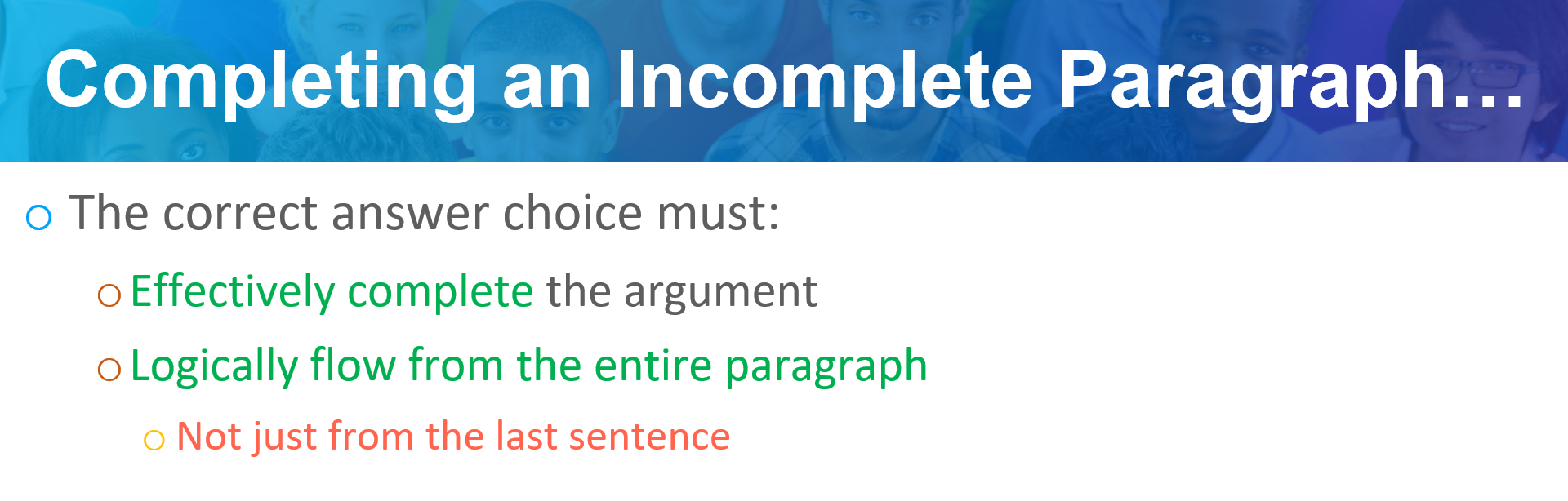
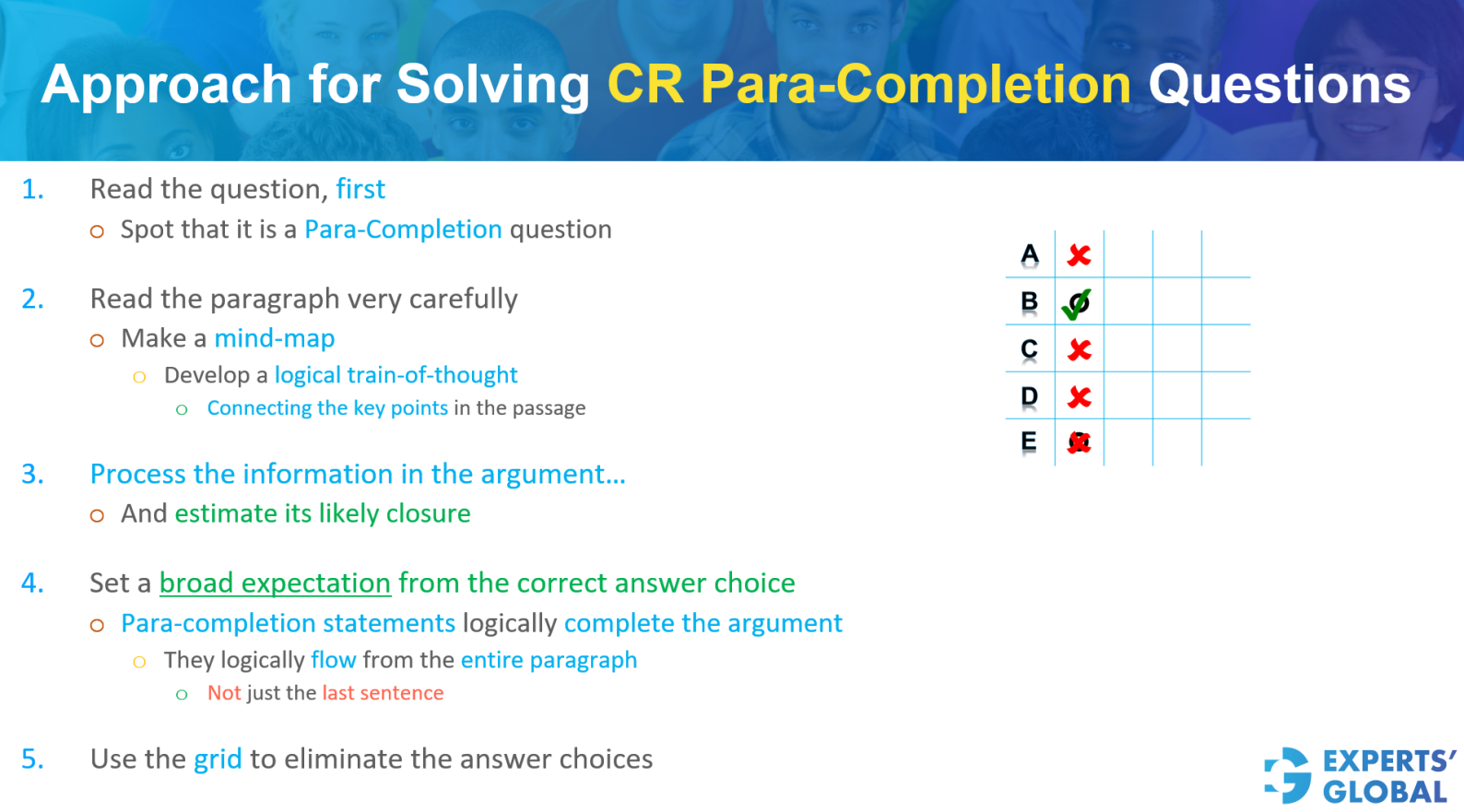
Approach for Paragraph Completion Questions | GMAT Verbal CR
Paragraph completion questions ask you to bring the full argument to a proper finish, not merely add a last sentence. This overview clarifies the goal: read the paragraph as a complete unit, sketch its structure in your mind, and choose a continuation that respects every key point while keeping the language balanced and non-prescriptive. You will see how matching tone, scope, and logical flow leads you to the most fitting endings, setting you up for the video and the detailed article that follow. In the short video below, you see the approach explained, tried on problems, and connected to GMAT CR para completion questions.
Approach for Paragraph Completion Questions | GMAT Verbal CR
GMAT-style Worked Example: CR Paragraph Completion Question
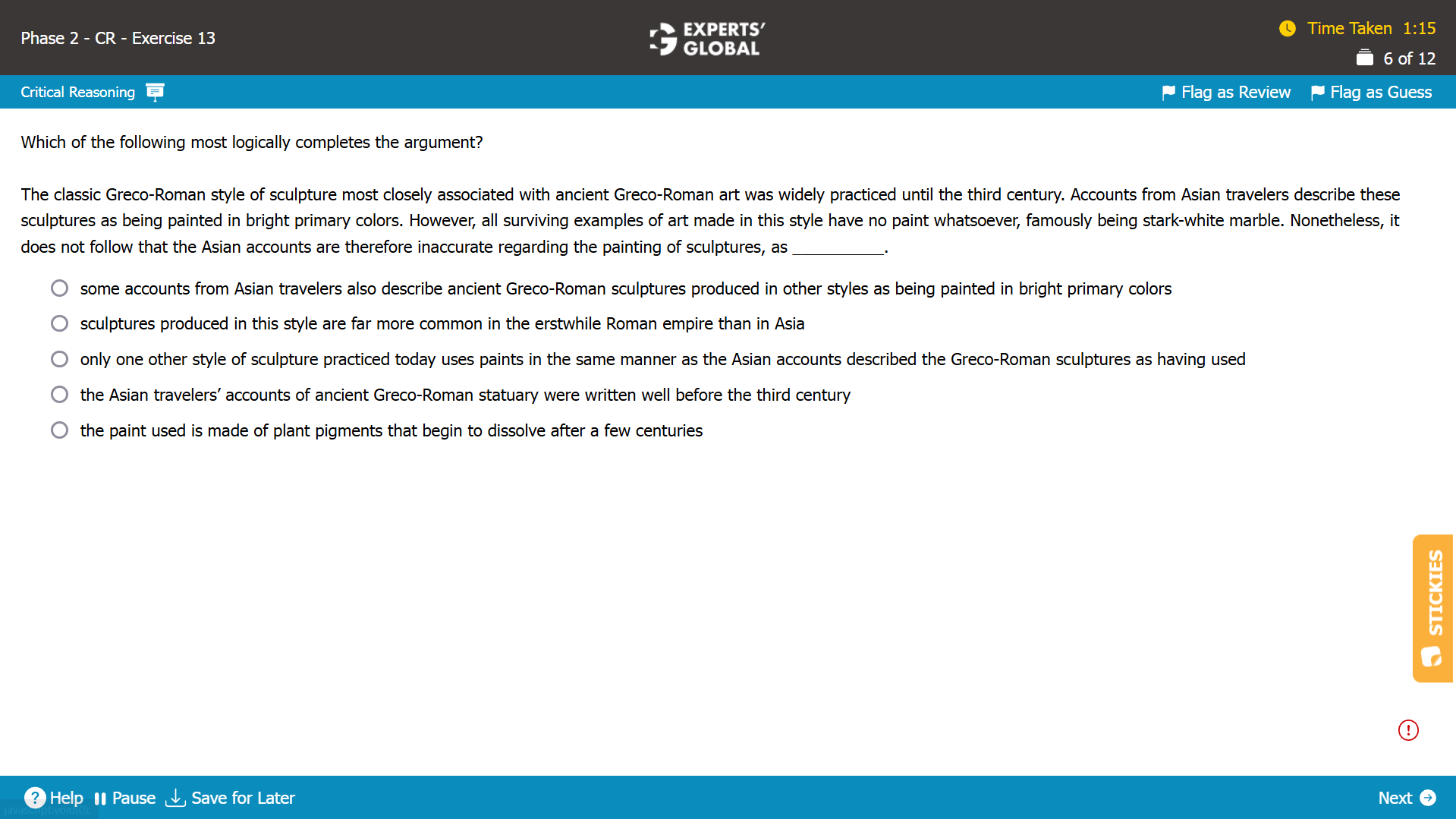
Mind-map: Sculpture style practiced until third century → travelers described that sculptures were painted in bright colors → examples of surviving sculptures have no paint → travelers’ descriptions can still be accurate because _____
Missing-link: Between examples of surviving sculptures having no paint and travelers’ descriptions still being accurate
Expectation from the correct answer choice: Something on the lines of an explanation for why the travelers’ descriptions can be accurate despite examples of surviving sculptures having no paint
A. The argument is concerned with the discrepancy between surviving sculptures of the Greco-Roman style having no paint and the Asian travelers’ descriptions suggesting that the sculptures were painted in bright primary colors; so, information about the travelers’ descriptions of “other styles of painting” is out of scope and does not clarify the discrepancy. Because this answer choice does not effectively complete the chain of thoughts developed in the passage, this answer choice is incorrect.
B. The argument is concerned with the discrepancy between surviving sculptures of the Greco-Roman style having no paint and the Asian travelers’ descriptions suggesting that the sculptures were painted in bright primary colors; so, information that sculptures were more common in the erstwhile Roman empire than in Asia is just additional information and does not clarify the discrepancy. Because this answer choice does not effectively complete the chain of thoughts developed in the passage, this answer choice is incorrect.
C. The argument is concerned with the discrepancy between surviving sculptures of the Greco-Roman style having no paint and the Asian travelers’ descriptions suggesting that the sculptures were painted in bright primary colors; so, information about another sculpture style practiced today having similar paints is just additional information and does not clarify the discrepancy. Because this answer choice does not effectively complete the chain of thoughts developed in the passage, this answer choice is incorrect.
D. If the travelers’ accounts were written well before the third century, it indicates that the Greco-Roman style sculptures, painted in bright primary colors as described in the accounts, had been in existence well before the third century; however, this answer choice makes no suggestion regarding why the surviving sculptures of the Greco-Roman style have no paint, thus failing to effectively complete the chain of thoughts developed in the passage. Because this answer choice does not duly complete the passage, this answer choice is incorrect.
E. Correct. By suggesting that the plant pigments in the paint on the sculptures fade after a few centuries, this answer choice introduces the possibility that the Greco-Roman style sculptures were painted in bright primary colors in the third century when the Asian travelers described them as such, but the sculptures’ paint faded with time and so the surviving sculptures of the style have no paint; such a possibility clarifies the exact discrepancy and effectively completes the chain of thoughts developed in the passage. Because this answer choice duly completes the passage, this answer choice is correct.
E is the best choice.
Boldface Critical Reasoning Questions | GMAT Verbal Prep
GMAT Critical Reasoning Boldface questions ask you to identify the function each highlighted statement serves within an argument. Without a solid strategy, the argument’s structure can feel complex and the subtle answer choices can seem very confusing. For that reason, any dependable GMAT preparation course needs to teach a complete strategy for boldface questions and provide enough practice with well-designed problems. With a disciplined, step-by-step approach, you can realistically aim for 100 percent accuracy on GMAT CR boldface questions within the time limit. On this page, we present that approach in an organized way and then help you apply it through guided practice and fully worked examples.
GMAT CR Boldface Questions: What These Questions Ask You to Do
In GMAT Critical Reasoning boldface questions, you will encounter a passage that highlights certain sections in bold. Your goal is to determine how these bolded sections contribute to the overall argument.
How a Boldface CR Question Appears on the GMAT
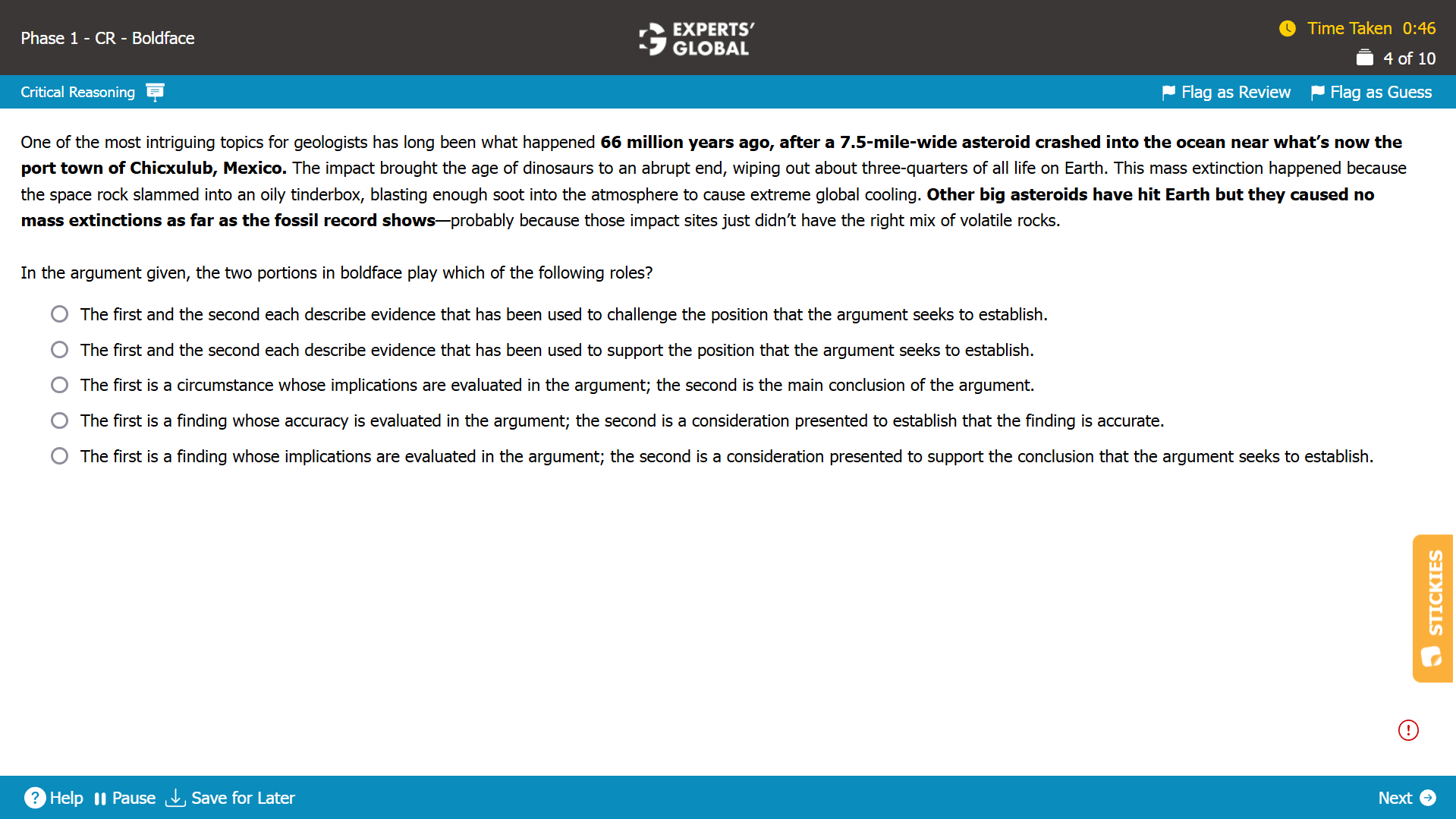
Strategy: Determining the main conclusion of the argument and finding the relation of the boldfaced portions with this conclusion
Logic: The argument explores the consequences of an event. The argument mentions, as the first boldface states, that an asteroid crashed at a particular location 66 million years ago. The argument subsequently mentions that the impact caused mass extinction because the crash resulted in extreme global cooling. The argument goes on to mention, as the second boldface states, that other similar crashes have happened but not caused mass extinction, and offers an explanation to justify the lack of mass extinction in those crashes. Overall, the main conclusion is that the impact of the asteroid crash caused mass extinction because the site of the crash had the right mix of volatile rocks, thus resulting in extreme global cooling. In the context of the main conclusion – the first boldface is the event whose consequences the argument assesses in the main conclusion; the second boldface is an observation that the argument uses to establish the main conclusion.
Main conclusion (implicit): The impact of the asteroid crash caused mass extinction because the site of the crash had the right mix of volatile rocks, thus resulting in extreme global cooling.
Broad expectation from the correct answer choice:
The first boldface is the event whose consequences the argument assesses in the implicit main conclusion.
The second boldface is an observation that the argument uses to establish the implicit main conclusion.
A.
Merit(s):
The second boldface states factual events; therefore, it is broadly correct to state that the second boldface is an “evidence”.
Demerit(s):
The first boldface is a factual event whose consequences the argument assesses; the argument does not use the first boldface for validation of an idea; therefore, it is largely incorrect to state that the first boldface is an “evidence”.
The argument assesses the consequences of the first boldface; the first boldface does not pass any judgment on the conclusion; therefore, it is incorrect to state that the first boldface “challenges the position that the argument seeks to establish”.
The argument uses the second boldface to establish the implicit main conclusion; so, the second boldface supports the argument’s position; therefore, it is incorrect to state that the second boldface “challenges the position that the argument seeks to establish”.
Because this answer choice does not correctly highlight the roles played by the two portions in boldface, this answer choice is incorrect.
B.
Merit(s):
The second boldface states factual events; therefore, it is broadly correct to state that the second boldface is an “evidence”.
The argument uses the second boldface to establish the implicit main conclusion; therefore, it is correct to state that the second boldface “supports the position that the argument seeks to establish”.
Demerit(s):
The first boldface is a factual event whose consequences the argument assesses; the argument does not use the first boldface for validation of an idea; therefore, it is largely incorrect to state that the first boldface is an “evidence”.
The argument assesses the consequences of the first boldface; the first boldface does not pass any judgment on the conclusion; therefore, it is incorrect to state that the first boldface “supports the position that the argument seeks to establish”.
Because this answer choice does not correctly highlight the roles played by the two portions in boldface, this answer choice is incorrect.
C.
Merit(s):
The first boldface is a factual event; therefore, it is correct to state that the first boldface is a “circumstance”.
The argument assesses the consequences of the first boldface to establish the implicit main conclusion; therefore, it is correct to state that the “implications of the first boldface are evaluated in the argument”.
Demerit(s):
The argument uses the second boldface to establish the implicit main conclusion and the second boldface itself is not the main conclusion; therefore, it is incorrect to state that the second boldface is the “main conclusion of the argument”.
Because this answer choice does not correctly highlight the roles played by the two portions in boldface, this answer choice is incorrect.
D.
Merit(s):
The first boldface is a factual event; therefore, it is broadly correct to state that the first boldface is a “finding”.
The second boldface is an observation that the argument uses to establish the implicit main conclusion; therefore, it is correct to state that the second boldface is a “consideration”.
Demerit(s):
The argument assesses the consequences of the first boldface and does not assess the correctness of the first boldface; therefore, it is incorrect to state that the “accuracy of the first boldface is evaluated in the argument”.
The two boldfaces are two independent events and pass no judgment on each other; therefore, it is incorrect to state that second boldface “establishes that the finding in the first boldface is accurate”.
Because this answer choice does not correctly highlight the roles played by the two portions in boldface, this answer choice is incorrect.
E.
Merit(s):
The first boldface is a factual event; therefore, it is broadly correct to state that the first boldface is a “finding”.
The argument assesses the consequences of the first boldface to establish the implicit main conclusion; therefore, it is correct to state that the “implications of the first boldface are evaluated in the argument”.
The second boldface is an observation that the argument gives careful thought to and uses to establish the implicit main conclusion; therefore, it is correct to state that the second boldface is a “consideration”.
The argument uses the second boldface to establish the implicit main conclusion; therefore, it is correct to state that the second boldface “supports the position that the argument seeks to establish”.
Demerit(s):
None
Because this answer choice correctly highlights the roles played by the two portions in boldface, this answer choice is correct.
E is the best answer choice.
How to Tackle Boldface Questions | GMAT Verbal CR
Here’s a straightforward 4-step approach to solving these questions:
Step 1: Identify the argument’s conclusion.
Step 2: Connect the bolded part(s) to the conclusion.
Step 3: Understand what you need to look for in the options.
Step 4: Eliminate four choices. The remaining option is the correct answer.
As always, double-check your choice before finalizing it.
The following conceptual review demonstrates this strategy and explains how to apply it to boldface questions on the GMAT, even under time constraints. This brief lesson also includes worked examples to help illustrate the steps and key concepts. Pause the video after each question to solve it on your own, applying the approach while observing how the trainer uses it with live arguments.

Approach for Boldface Questions | GMAT Verbal CR
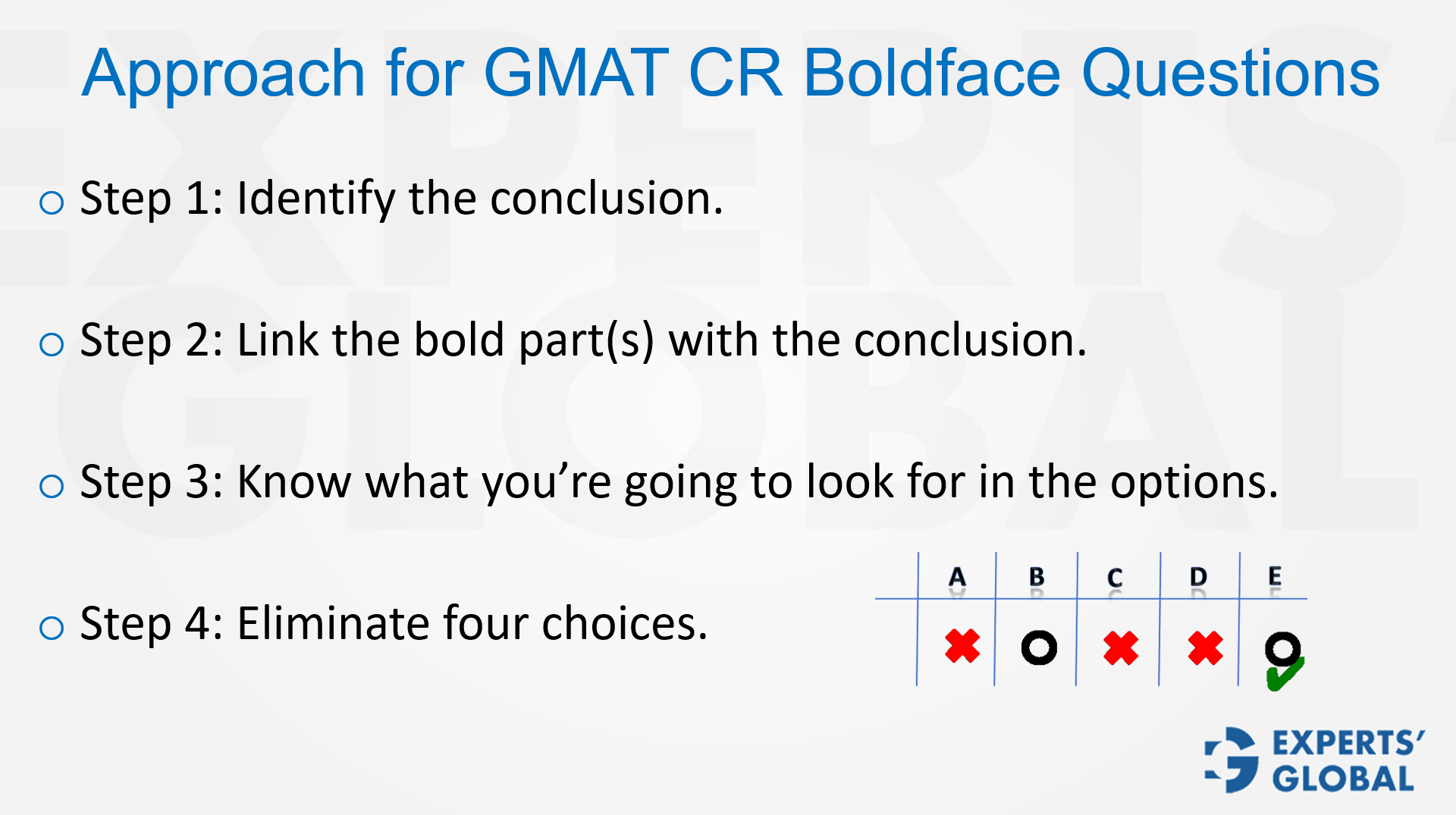
Applying the Strategy to a GMAT-like Boldface Question | GMAT Verbal CR
Now that you are familiar with the right approach for solving GMAT CR Boldface questions, let’s put it into practice with a GMAT-like problem. Watch the following video closely, pausing it to solve the question on your own. Focus on applying the strategy, not just finding the answer, and pay attention to how the trainer effectively demonstrates the four-step approach.
Application of Approach for CR Boldface Questions | GMAT Verbal CR
Mastering the Key Vocabulary in Boldface Questions | GMAT Verbal CR
A significant challenge in tackling GMAT CR Boldface questions is navigating the specific vocabulary used in both the questions and answer choices. While the terms themselves are not overly complex, they carry precise meanings. Understanding these meanings is crucial for effectively processing the options, making the elimination process smoother, and helping you select the correct answer.
Frequently Used Vocabulary in CR Boldface Questions | GMAT Verbal CR
Essential Nouns in CR Boldface Questions | GMAT Verbal CR
- Conclusion – the statement the reasoning seeks to prove.
- Judgment – a personal evaluation or view on something.
- Prediction – a statement about what is expected to happen in the future.
- Evidence – information that supports or challenges an argument.
- Fact – a verified truth or established detail.
- Opinion – a perspective that may or may not be correct.
- Main Conclusion – the primary claim of the argument, distinct from smaller conclusions.
- Intermediate Conclusion – a secondary claim that may or may not support the main conclusion.
- Circumstance – a condition or context that is relevant to the argument.
- Assumption – an unstated belief accepted as true for the reasoning to be valid.
- Consideration – a point or factor taken into account during reasoning.
- Finding – a result obtained through study or effort.
- Explanation – a clarification that makes something easier to understand.
- Objection – a counterpoint or disagreement with the argument.
- Claim – a statement presented without definitive proof.
- Position – a firmly held stance on an issue.
Key Verbs in CR Boldface Questions | GMAT Verbal CR
- To oppose – to counter or weaken an argument.
- To establish – to present or set up a viewpoint.
- To evaluate – to judge or assess carefully.
- To imply – to suggest something indirectly.
- To introduce – to bring a new idea or point into the discussion.
- To support – to back or strengthen an argument.
- To explain – to clarify an idea or concept.
- To undermine – to weaken or reduce the strength of an argument.
- To challenge – to question or dispute the validity of something.
- To describe – to provide details or a clear account.
Vocabulary Test 1 for Boldface Questions | GMAT Verbal CR
Now that you are familiar with the key vocabulary used in GMAT CR Boldface questions, let’s put it into practice with a real argument. In the video that follows, you will find an argument with a boldfaced portion, followed by 10 terms. Your job is to determine which of the 10 terms best fits the boldface. This exercise is Drill #1.
Vocabulary Test 1 for Boldface Questions | GMAT Verbal CR
Vocabulary Test 2 for Boldface Questions | GMAT Verbal CR
Let’s keep practicing with another exercise. In the video that follows, you will encounter an argument with a boldfaced section, followed by 10 commonly used GMAT CR Boldface terms. Your task is to identify which of these terms apply to the boldface. This exercise is Drill #2.
Vocabulary Test 2 for Boldface Questions | GMAT Verbal CR
Vocabulary Test 3 for Boldface Questions | GMAT Verbal CR
In the video that follows, you will come across an argument with a boldfaced section, followed by 10 commonly used GMAT CR Boldface terms. Your task is to go through the list and determine which terms relate to the boldface. This exercise is Drill #3.
Vocabulary Test 3 for Boldface Questions | GMAT Verbal CR
Vocabulary Test 4 for Boldface Questions | GMAT Verbal CR
For this next exercise, watch the video that presents an argument with a boldfaced section, followed by 10 frequently used GMAT CR Boldface terms. Your task is to analyze the boldface and determine which terms accurately describe it. This is Drill #4.
Vocabulary Test 4 for Boldface Questions | GMAT Verbal CR
Vocabulary Test 5 for Boldface Questions | GMAT Verbal CR
The upcoming video features an argument with a boldfaced section, followed by 10 common GMAT CR Boldface terms. Review the terms and identify which ones correctly describe the boldfaced part. This session is Drill #5.
Vocabulary Test 5 for Boldface Questions | GMAT Verbal CR
Key Recap: Important Points for Boldface Questions | GMAT Verbal CR
Up to this point, you have gained an understanding of the CR boldface task on the GMAT, learned a clear strategy for these questions, explored commonly tested vocabulary, and practiced through targeted vocabulary drills. Well done on making such strong progress! Before moving on to solving GMAT-style CR boldface questions, it’s important to quickly review the key points of the GMAT CR boldface strategy. The following brief video outlines this approach, demonstrates how it applies to questions, and helps you use it effectively in GMAT drills, sectional tests, and full-length GMAT practice tests.
Key Points for Boldface Questions | GMAT Verbal CR
GMAT-style Worked Example: CR Boldface Question
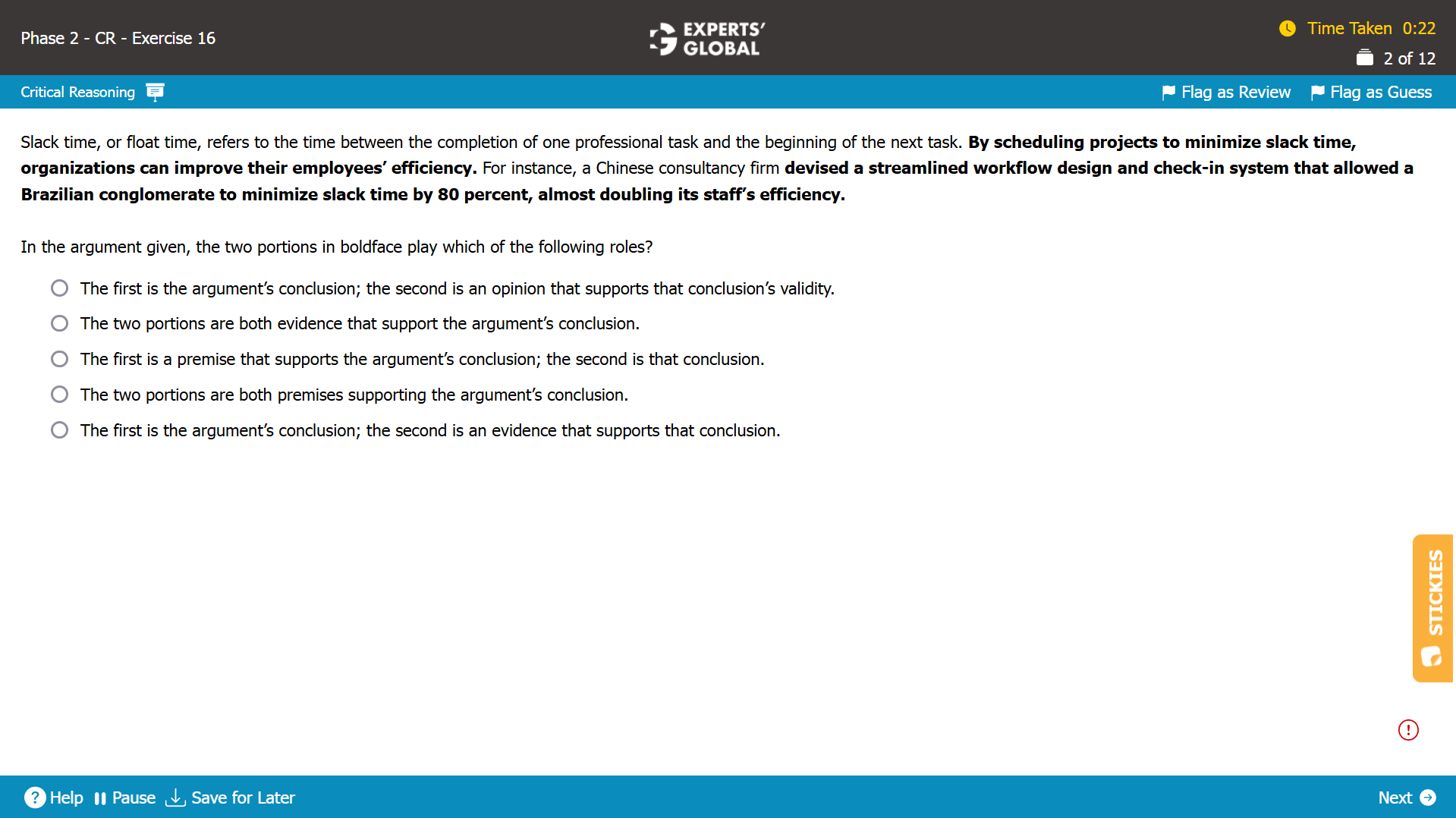
Strategy: Determining the main conclusion of the argument and finding the relation of the boldfaced portions with this conclusion
Logic: The argument discusses a way for organizations to improve employee efficiency. The argument mentions that the time between two professional tasks is termed as slack time and that, as the first boldface states, by scheduling projects to minimize slack time, employee efficiency can be improved. The argument subsequently provides an example in the second boldface, which states that a Chinese firm was able to double the employee efficiency of a Brazilian conglomerate by streamlining workflow. Overall, the main conclusion is that employee efficiency can be improved by scheduling projects to minimize slack time. In the context of the main conclusion – the first boldface is the main conclusion of the argument; the second boldface is an observation that the argument uses to establish the main conclusion.
Main conclusion: Employee efficiency can be improved by scheduling projects to minimize slack time.
Broad expectation from the correct answer choice:
The first boldface is the main conclusion of the argument.
The second boldface is an observation that the argument uses to establish the main conclusion.
A. Trap.
Merit(s):
The first boldface is the main point the argument establishes; therefore, it is correct to state that the first boldface is the “argument’s conclusion”.
The argument uses the second boldface to establish the main conclusion; therefore, it is correct to state that the second boldface “supports the conclusion’s validity”.
Demerit(s):
The second boldface is a factual observation and not a point of view; therefore, it is incorrect to state that the second boldface is an “opinion”.
Because this answer choice does not correctly highlight the roles played by the two portions in boldface, this answer choice is incorrect.
B. Trap.
Merit(s):
The second boldface is a factual observation; therefore, it is correct to state that the second boldface is an “evidence”.
The argument uses the second boldface to establish the main conclusion; therefore, it is correct to state that the second boldface “supports the argument’s conclusion”.
Demerit(s):
The first boldface is a judgment and not a concrete fact; therefore, it is incorrect to state that the first boldface is an “evidence”.
The first boldface is itself the main conclusion of the argument; therefore, it is incorrect to state that the first boldface “supports the argument’s conclusion”.
Because this answer choice does not correctly highlight the roles played by the two portions in boldface, this answer choice is incorrect.
C.
Merit(s):
None
Demerit(s):
The first boldface is the main conclusion of the argument; therefore, it is incorrect to state that the first boldface a “premise”.
The first boldface is itself the main conclusion of the argument; therefore, it is incorrect to state that the first boldface “supports the argument’s conclusion”.
The second boldface is used to establish the main conclusion and itself is not the main conclusion; therefore, it is incorrect to state that the second boldface is the “argument’s main conclusion”.
Because this answer choice does not correctly highlight the roles played by the two portions in boldface, this answer choice is incorrect.
D.
Merit(s):
The second boldface is an observation based on which the main conclusion is established; therefore, it is correct to state that the second boldface is a “premise”.
The argument uses the second boldface to establish the main conclusion; therefore, it is correct to state that the second boldface “supports the argument’s conclusion”.
Demerit(s):
The first boldface is the main conclusion of the argument; therefore, it is incorrect to state that the first boldface is a “premise”.
The first boldface is itself the main conclusion of the argument; therefore, it is incorrect to state that the first boldface “supports the argument’s conclusion”.
Because this answer choice does not correctly highlight the roles played by the two portions in boldface, this answer choice is incorrect.
E.
Merit(s):
The first boldface is the main point that the argument establishes; therefore, it is correct to state that the first boldface is the “argument’s conclusion”.
The second boldface is a factual observation; therefore, it is correct to state that the second boldface is an “evidence”.
The argument uses the second boldface to establish the main conclusion; therefore, it is correct to state that the second boldface “supports the argument’s conclusion”.
Demerit(s):
None
Because this answer choice correctly highlights the roles played by the two portions in boldface, this answer choice is correct.
E is the best answer choice.
Method-of-Reasoning Critical Reasoning Questions | GMAT Verbal Prep
GMAT CR Method-of-Reasoning questions require you to identify the reasoning pattern an argument follows, such as how it draws conclusions, uses evidence, addresses objections, or establishes comparisons. These questions help you understand not just the content of the argument, but also its structure and the logic behind it. This page provides a well-organized, subtopic-wise playlist along with a few worked examples to guide your preparation for this concept.
Overview and Approach for Method-of-Reasoning CR Questions
Method-of-reasoning CR questions on the GMAT focus on understanding how an argument is organized. A common stem might say, “In the passage, the author builds the argument by…”. Your job is to select the option that most accurately reflects how the argument is constructed. In the following short video, the approach for solving these questions is explained, demonstrated on GMAT-style questions, and prepared for use in your GMAT Verbal prep.
Approach for Method-of-Reasoning Questions | GMAT Verbal CR
Similar Reasoning CR Questions | GMAT Verbal CR
In similar reasoning CR questions, you are presented with an argument and asked to pick the option that mirrors its logical structure. A common stem might say: “Which of the following most closely follows the same logical pattern as the argument above?” The short video below reinforces this concept and shows how the GMAT may test it.
Similar Reasoning Questions | GMAT Verbal CR
Finding the Flaw in Reasoning Questions | GMAT Verbal CR
Finding the flaw questions challenge your ability to identify faulty reasoning. First, read the stem and create a mental map, then pinpoint where the logic breaks down. Familiarize yourself with common patterns such as faulty analogies, false dilemmas, assumptions, correlation mistaken for causation, circular reasoning, and ignored alternatives. Use elimination to narrow down your choices and select the one that best identifies the flaw. The following short video presents this idea in a clear and approachable manner, demonstrating how it may appear on the GMAT.
Finding the Flaw in Reasoning Questions | GMAT Verbal CR
GMAT-style Worked Example: CR Method of Reasoning Question
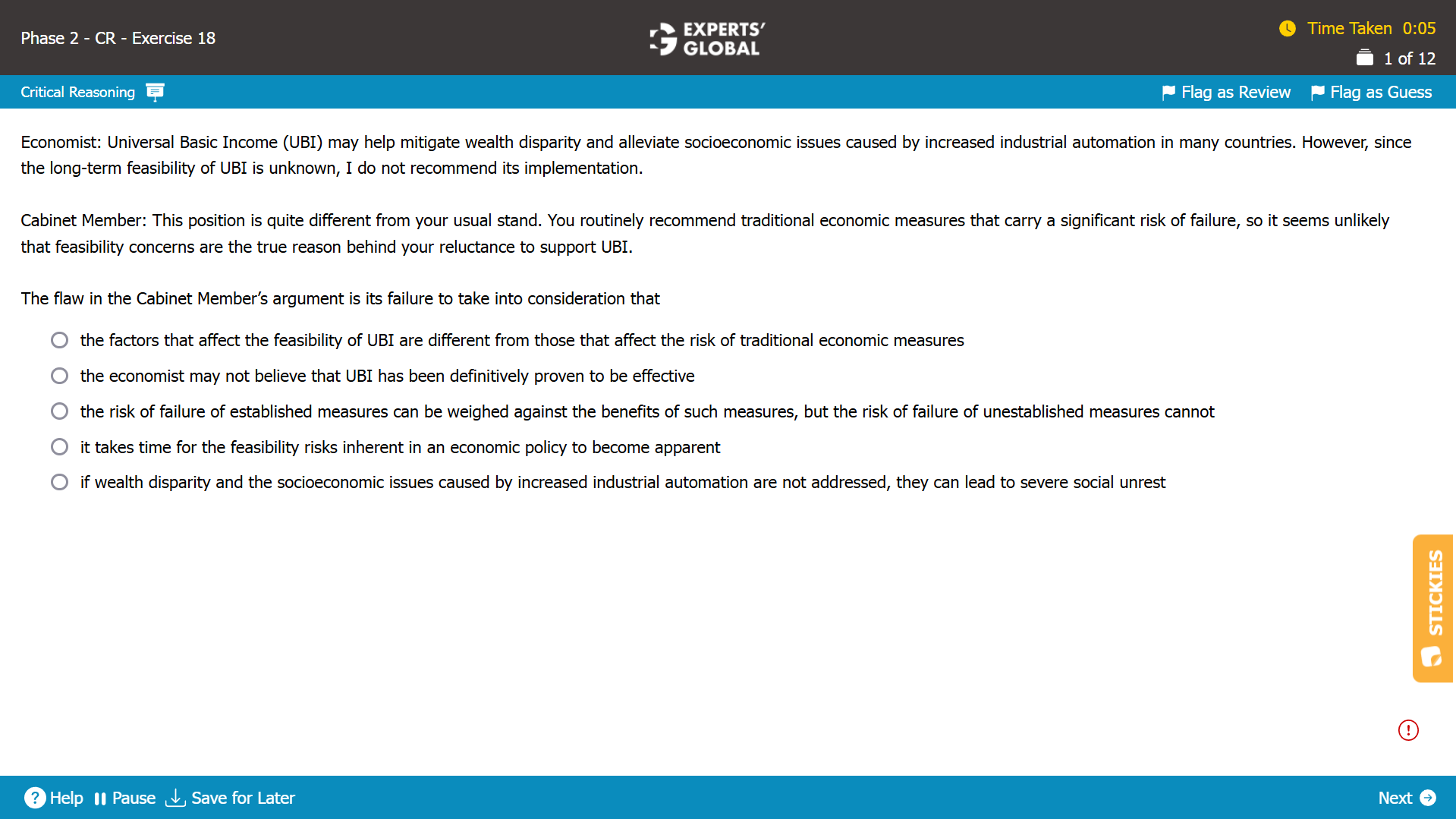
Mind-map: Economist: UBI may help in addressing issues caused by industrial automation → feasibility of UBI is unknown → I do not recommend UBI → Cabinet Member: you take a different stand usually → you often recommend traditional economic measures with risk of failure → feasibility concern is not the true reason behind your reluctance to recommend UBI (conclusion)
Missing-link: Between the economist often recommending traditional economic measures with a significant risk of failure and not recommending UBI because its feasibility is unknown
Expectation from the correct answer choice: Something on the lines of a difference between the risk of failure of traditional economic measures and the risk of failure of UBI
A. This answer choice, suggesting that different factors affect the feasibility of UBI and of traditional economic measures, makes no suggestion regarding whether the feasibility concern is the true reason behind the economist’s reluctance to recommend UBI; so, this answer choice is just additional detail and a failure to consider the reasoning in this answer choice is not a flaw in the Cabinet Member’s argument. Because this answer choice does not indicate a flaw, this answer choice is incorrect.
B. This answer choice, suggesting that the economist may not believe that the effectiveness of UBI is proven, indicates the economist’s doubt regarding UBI; such doubt may prevent the economist from recommending UBI; so, this answer choice indicates an alternate reason for the economist’s reluctance to recommend UBI, thus strengthening the Cabinet Minster’s conclusion that the feasibility concern is not the true reason behind the economist’s reluctance to recommend UBI; hence, a failure to consider the reasoning in this answer choice is not a flaw in the Cabinet Member’s argument. Because this answer choice does not indicate a flaw, this answer choice is incorrect.
C. Correct. This answer choice, suggesting a difference between the risk of unestablished economic measures and that of established economic measures, indicates that the risk of UBI cannot be compared with its benefits whereas the risk of established measures can be; this answer choice indicates the possibility that the economist recommends risky traditional economic measures because their risk is likely justified in comparison with their expected benefits and that the economist is likely not in a position to recommend UBI because the risk of UBI, being unknown, cannot be compared with its expected benefits; such a possibility indicates that the feasibility concern may be the true reason behind the economist’s reluctance to recommend UBI, thus casting doubt on the Cabinet Member’s conclusion that the feasibility concern is not the true reason behind the economist’s reluctance to recommend UBI; so, a failure to consider the reasoning in this answer choice is a flaw in the Cabinet Member’s argument. Because this answer choice indicates a flaw, this answer choice is correct.
D. This answer choice, suggesting that knowing the feasibility of an economic policy takes time, makes no suggestion regarding whether the feasibility concern is the true reason behind the economist’s reluctance to recommend UBI; so, this answer choice is just additional detail and a failure to consider the reasoning in this answer choice is not a flaw in the Cabinet Member’s argument. Because this answer choice does not indicate a flaw, this answer choice is incorrect.
E. This answer choice, suggesting the social effects of economic challenges if left unaddressed, makes no suggestion regarding whether the feasibility concern is the true reason behind the economist’s reluctance to recommend UBI; so, this answer choice is just additional information and a failure to consider the reasoning in this answer choice is not a flaw in the Cabinet Member’s argument. Because this answer choice does not indicate a flaw, this answer choice is incorrect.
C is the best choice.
Logical Fallacy Critical Reasoning Questions | GMAT Verbal Prep
Logical Fallacy CR questions on the GMAT often come in familiar forms, such as resolve the paradox, strengthen, weaken, and assumption questions. At the core of these question types is one essential skill: identifying the logical flaw in an argument. These questions help you understand why arguments fail and how flawed reasoning can lead to invalid conclusions. On this page, you will find an organized playlist by subtopic, along with a few worked examples, to guide your preparation on this concept for the GMAT’s Verbal section.
The Confusion Between Cause and Effect Fallacy | GMAT Verbal CR
Mixing up cause and effect means assuming that A causes B when, in reality, B causes A. For example, cities with more bike lanes also have more cyclists. If you assume that more cyclists lead to more bike lanes, you are flipping the cause-and-effect relationship. In truth, adding bike lanes encourages more cycling. The following video demonstrates this concept and helps you apply it on the GMAT.
Confusing Cause with Effect Fallacy | GMAT Verbal CR
The Confusion Between Correlation and Causation Fallacy | GMAT Verbal CR
In GMAT Critical Reasoning, confusing correlation with causation happens when you notice two things happening together and assume one causes the other. For example, coffee shop visits and umbrella sales increase at the same time, leading you to think coffee causes umbrella purchases. The real reason is rainy days, which drive both. Just because two things occur together doesn’t mean one causes the other. The following short video provides a solid understanding of this concept and demonstrates how it may appear on the GMAT.
Correlation and Causation Fallacy | GMAT Verbal CR
The Assuming Similar Bases Fallacy | GMAT Verbal CR
The assuming similar bases fallacy occurs when conclusions are drawn from comparisons, assuming the starting points were the same. For example, if the price of A increases by 50% and the price of B rises by 40%, claiming that A is now more expensive overlooks the original prices. If A was $50 and B was $100, B is still the higher cost. The short video below helps clarify this concept and demonstrates how it is tested on the GMAT.
Assuming Similar Bases Fallacy | GMAT Verbal CR
The False Analogy Fallacy | GMAT Verbal CR
False analogy happens when you assume two things are similar in key ways and believe that a claim for one should apply to the other. For example, just because smoothies and sodas are both cold and sweet, it does not mean that soda is as healthy as a fruit smoothie. When analogies are drawn or comparisons are made on GMAT CR, be cautious. The following short video brings this concept to life and elucidates how it may be tested on the GMAT.
False Analogy Fallacy | GMAT Verbal CR
The Hasty Generalization Fallacy | GMAT Verbal CR
The generalization fallacy occurs when a broad conclusion is drawn from limited evidence. It often shows up as a sweeping statement based on a single example. For instance, one friend’s noisy car doesn’t prove that all cars from that brand are noisy. Always look for mismatched scopes and favor more cautious, well-supported conclusions. This concise video provides a clear explanation and shows the typical way this fallacy appears in the GMAT.
Hasty Generalization Fallacy | GMAT Verbal CR
The Circular Reasoning Fallacy | GMAT Verbal CR
Circular reasoning fallacy occurs when an argument takes its conclusion as a given and uses that to prove the same point again. For example: “This plan will succeed because successful plans succeed.” This simply repeats the claim without offering any new evidence. This brief video lesson below clarifies the concept and demonstrates how it is tested on the GMAT.
Circular Reasoning Fallacy on GMAT
The Impressed by Numbers Fallacy | GMAT Verbal CR
In GMAT Critical Reasoning, the “impressed by numbers” fallacy occurs when impressive statistics are used to persuade, without providing real relevance or solid support. On CR, be alert for numbers that distract from the actual logic. For example: “Five million sold, so it must be the best,” ignoring factors like market size, returns, and customer satisfaction. The video below provides a concise explanation of this concept and demonstrates how it appears on the GMAT.
Impressed by Numbers Fallacy | GMAT Verbal CR
The Missing the Main Point Fallacy | GMAT Verbal CR
In GMAT Critical Reasoning, this flaw arises when a response seems logical but overlooks the main point of the passage. Start by identifying the author’s core argument, then evaluate each option based on that. Eliminate choices that stray into side topics or introduce new issues. The following short video explains the concept and shows how it is tested on the GMAT.
Missing the Main Point Fallacy | GMAT Verbal CR
The Comparing Percentage with Absolute Numbers Fallacy | GMAT Verbal CR
Comparing percentages or proportions with raw numbers can lead to confusion between relative change and actual counts. For example, Class A’s attendance increased by 50% (from 10 to 15), while Class B’s grew by 20% (from 100 to 120). Claiming that Class A saw a bigger improvement overlooks the size of the starting numbers: smaller bases exaggerate percentage changes, while Class B actually added more students. In the brief video below, you will see the concept explained and applied to GMAT-style questions.
Comparing Percentage with Absolute Numbers Fallacy | GMAT Verbal CR
The Comparing One with Oneself Fallacy | GMAT Verbal CR
In GMAT Critical Reasoning, the “comparing one with oneself” fallacy occurs when conclusions are based solely on how something compares to its own past performance, rather than against external standards or peers. For example, Jack may set a personal record in a 400-meter run, but his time might still be considered poor when compared to other athletes’ performances. The short video lesson below clarifies the concept and shows how it can be tested on the GMAT.
Comparing One with Oneself Fallacy | GMAT Verbal CR
The Confusing Necessity with Sufficiency Fallacy | GMAT Verbal CR
GMAT Critical Reasoning often includes the fallacy of treating a necessary condition as if it were enough on its own. For example, claiming that good leadership ensures team success is flawed. While good leadership may be necessary for success, it is not sufficient on its own. The video below offers a concise explanation of this concept and demonstrates its application in GMAT questions.
Confusing Necessity with Sufficiency Fallacy | GMAT Verbal CR
The Confusing Sufficiency with Necessity Fallacy | GMAT Verbal CR
GMAT Critical Reasoning sometimes presents the fallacy of treating a sufficient condition as if it were necessary. For example, saying “Members get free entry, so only members can enter free” is flawed. While membership may grant free entry, promotions, guest passes, or other offers could also allow entry. This following brief lesson explains the concept and demonstrates how it can appear on the GMAT.
Confusing Sufficiency with Necessity Fallacy | GMAT Verbal CR
The Confusing Possibility with Necessity Fallacy | GMAT Verbal CR
GMAT Critical Reasoning can sometimes mask the fallacy of treating something possible as if it were necessary. For example, “This medicine can reduce headaches, so you must take it to reduce headaches” is flawed. While the medicine may help, headaches can also be relieved through rest, hydration, or other remedies. Just because something is possible does not mean it is the only solution. This brief video below explanation breaks down the concept and demonstrates its application in GMAT questions.
Confusing Possibility with Necessity Fallacy | GMAT Verbal CR
The Confusing Subsets and Supersets Fallacy | GMAT Verbal CR
GMAT CR sometimes tests the fallacy of confusing subsets and supersets. Basic example: “All scholarship recipients are applicants; therefore all applicants are scholarship recipients.” Flaw: recipients are only a subset of applicants; many applicants are not recipients. The following short video clarifies this concept and demonstrates how it appears on the GMAT.
Confusing Subsets and Supersets Fallacy | GMAT Verbal CR
GMAT-style Worked Example 1: CR Logical Fallacy Question
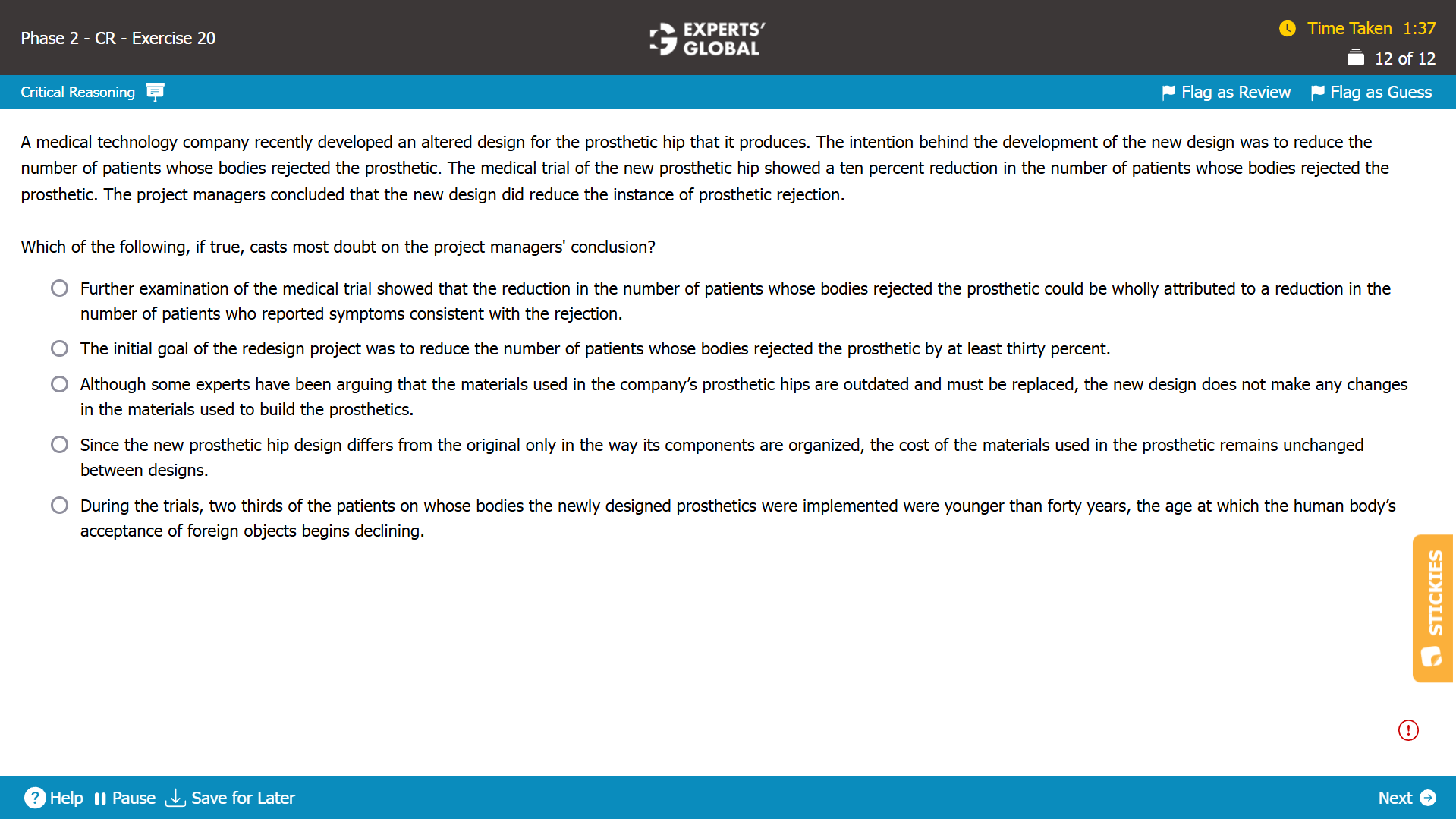
Mind-map: Medical company alters design of prosthetic hip → goal was to reduce number of patients whose bodies rejected prosthetic → trial showed ten percent reduction → new design reduced the instance of prosthetic rejection (conclusion)
Missing-link: Between the trial showing ten percent reduction and the conclusion that the new design reduced the instance of prosthetic rejection
Expectation from the correct answer choice: To weaken the conclusion that the new design reduced the instance of prosthetic rejection
A. Trap. This answer choice, suggesting that the reduction in the instance of prosthetic rejection was because of a reduction in reporting symptoms of rejection, does not rule out the possibility that the reduction in reporting symptoms of rejection could be because of the new design; so, this answer choice simply adds information, which, although relevant to the broad context of the argument, does not weaken the conclusion. Because this answer choice does not weaken the conclusion, this answer choice is incorrect.
B. This answer choice, suggesting that the initial goal was to achieve thirty percent rejection, indicates that the project’s ten percent reduction fell short of its target; however, failure to meet the target does not dispute the view that the new design reduced the instance of prosthetic rejection; so, this answer choice is just additional detail, which, although relevant to the broad context of the argument, does not weaken the conclusion. Because this answer choice does not weaken the conclusion, this answer choice is incorrect.
C. This answer choice, suggesting that the new design has no changes in the material used, indicates the possibility that the design, rather than the material, caused the reduction, thus, if anything, strengthening, rather than weakening, the conclusion. Because this answer choice does not weaken the conclusion, this answer choice is incorrect.
D. This answer choice, suggesting that the new design differs from the old design in the organization of components but not in cost, indicates the possibility that the design, owing to the new organization of components, caused the reduction, thus strengthening, rather than weakening, the conclusion. Because this answer choice does not weaken the conclusion, this answer choice is incorrect.
E. Correct. By suggesting that two thirds of patients in the trial were young enough to naturally accept prosthetics, this answer choice indicates the possibility that the reduction in prosthetic rejection may have been because of the patients’ bodies naturally accepting prosthetics and not necessarily because of the improved design of the prosthetics; such a possibility casts doubt on the cause-effect relationship between the new design and the reduction and indicates the presence of another cause for the reduction, thus weakening the conclusion. Because this answer choice weakens the claim, this answer choice is correct.
E is the best choice.
GMAT-style Worked Example 2: CR Logical Fallacy Question
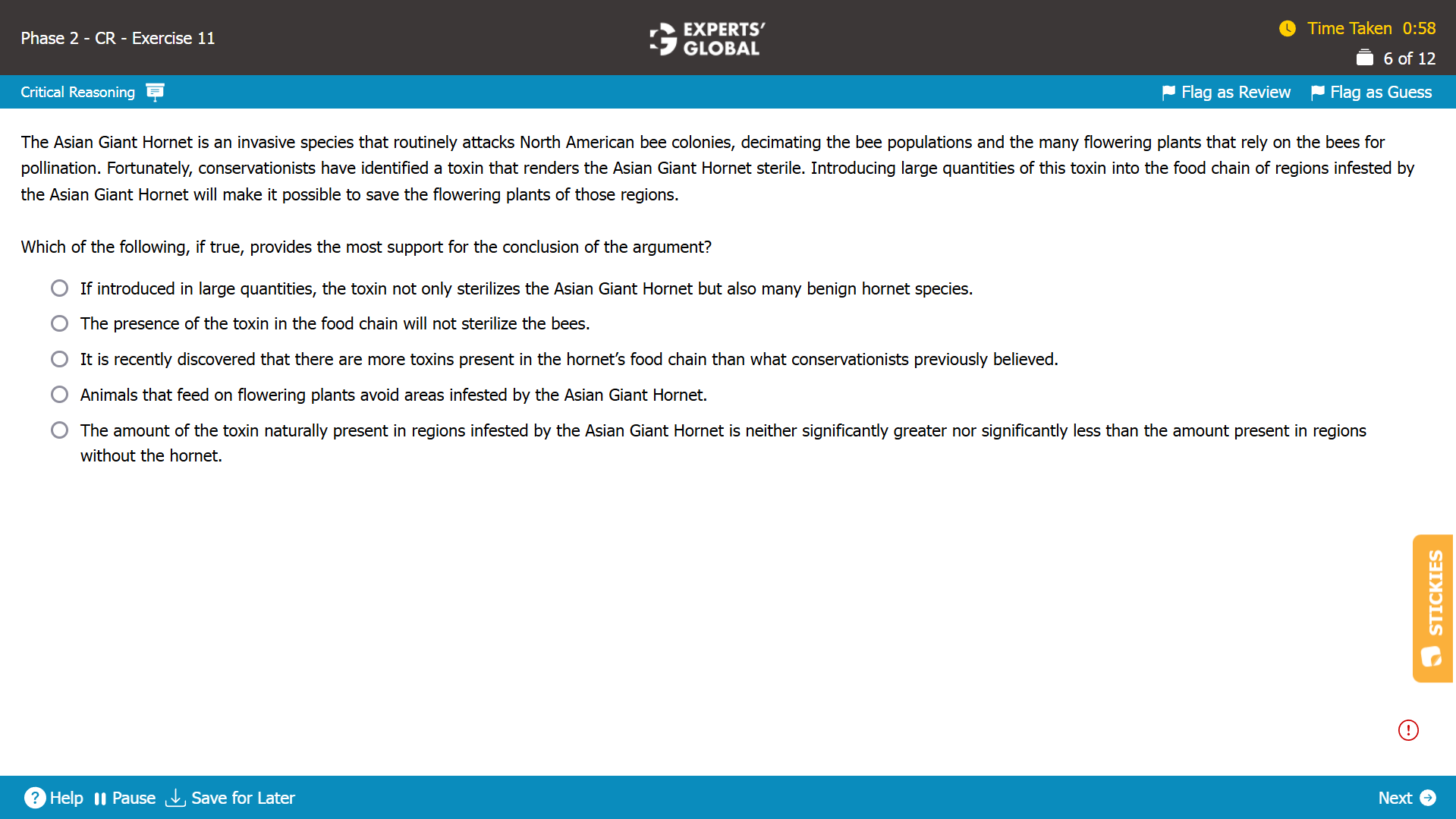
Mind-map: Hornet attacks bees colonies → bee population is reduced → flowering plants dependent on bees are also reduced → toxin makes hornet sterile → introducing large quantities of toxin in hornet’s food chain will save flowering plants (conclusion)
Missing-link: Between toxin making hornet sterile and the conclusion that introducing large quantities of the toxin in hornet’s food chain will save flowering plants
Expectation from the correct answer choice: To strengthen the conclusion that introducing large quantities of the toxin in hornet’s food chain in the affected region will save flowering plants
A. The argument makes no connection between benign hornet species and the threat to flowering plants; so, this answer choice, suggesting that other benign hornet species are sterilized by the toxin, is just additional information and does not strengthen the conclusion that introducing large quantities of toxin in the hornet’s food chain will save flowering plants. Because this answer choice does not strengthen the conclusion, this answer choice is incorrect.
B. Correct. By suggesting that bees will not be sterilized because of the toxin, this answer choice eliminates the possibility of a side-effect and indicates that the toxin will not lead to a reduction in the population of bees, thus helping grow flowering plants that rely on bees for pollination; so, this answer choice, by eliminating a negative impact of the toxin, strengthens the conclusion. Because this answer choice strengthens the conclusion, this answer choice is correct.
C. The argument is concerned with the impact of a “particular” toxin rendering the hornet sterile; so, information that there are a greater “number of toxins” in the hornet’s food chain than previously believed is just additional information and does not strengthen the conclusion. Because this answer choice does not strengthen the conclusion, this answer choice is incorrect.
D. The argument is concerned with the decreasing population of flowering plants in areas infested by the Asian Giant Hornet; this answer choice, suggesting that such areas do not have animals that feed on flowering plants, simply indicates the absence of another threat to flowering plants but makes no suggestion regarding whether flowering plants can be saved from the threat of hornets by introducing large quantities of toxin in the hornet’s food chain; so, this answer choice is just additional information and does not strengthen the conclusion. Because this answer choice does not strengthen the conclusion, this answer choice is incorrect.
E. The argument is concerned with the effect of “introducing large quantities” of the toxin in the region; so, information about the natural, current level of toxins in the region is just additional information and has no bearing on the argument. Because this answer choice does not strengthen the conclusion, this answer choice is incorrect.
B is the best choice.
GMAT-style Worked Example 3: CR Logical Fallacy Question
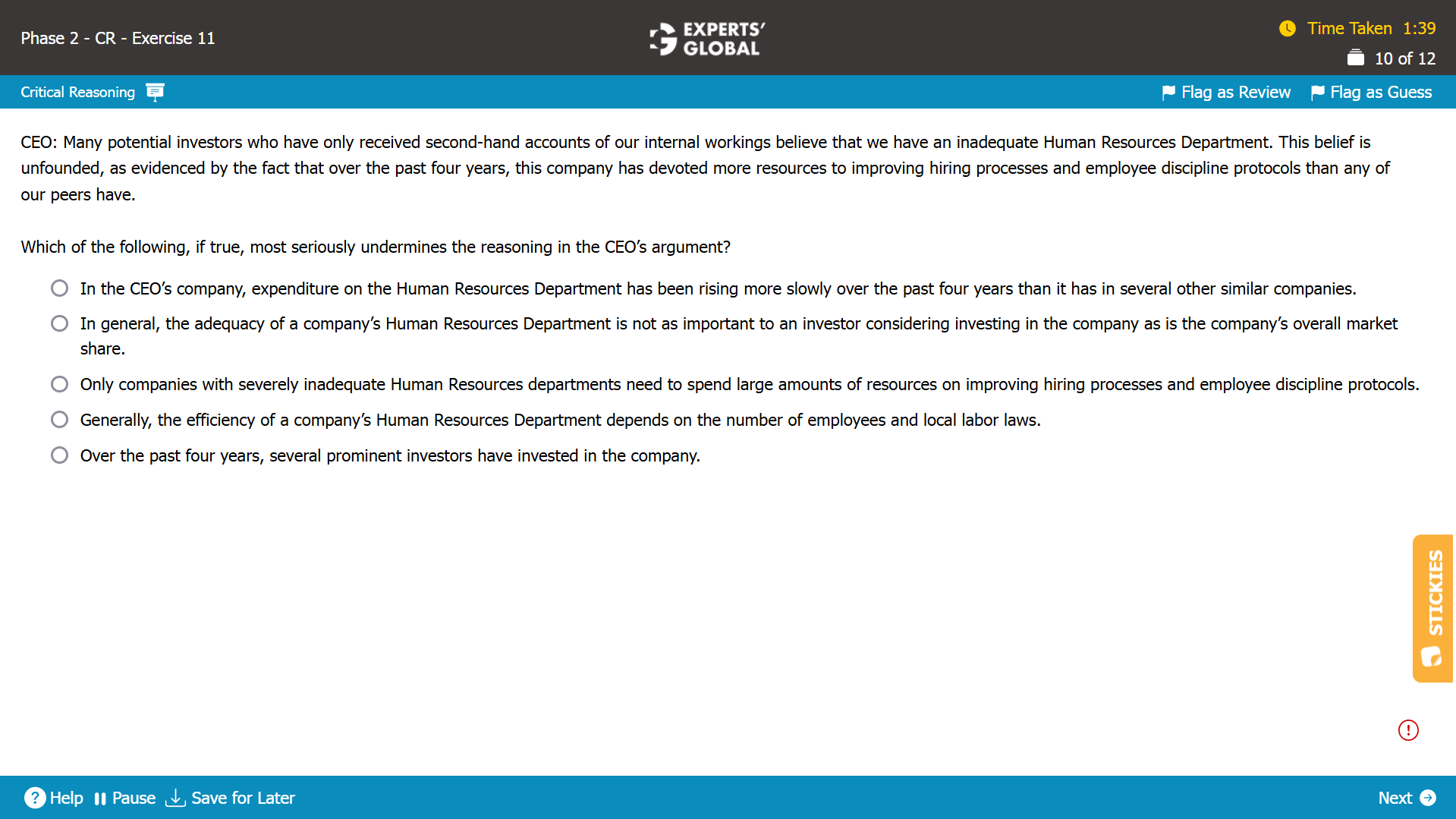
Mind-map: CEO: Many potential investors believe that we have an inadequate HR department → in last four years, company has devoted more resources to improving hiring and discipline protocols than any peer has → HR department is adequate (implicit conclusion)
Missing-link: Between the company devoting more resources to improving hiring and discipline protocols than any peer in the last four years and the conclusion that the HR department is adequate
Expectation from the correct answer choice: To weaken the conclusion that the HR department is adequate
A. Trap. Even if the company’s expenditure on the HR department is rising more slowly than that in other companies is, the argument mentions the fact that the company has devoted more resources to improving the department over the period; so, this answer choice is just additional detail and has no bearing on the argument. Because this answer choice does not weaken the conclusion, this answer choice is incorrect.
B. This answer choice, suggesting that investors find market share more important than the HR department’s adequacy, provides no information about whether the company’s HR department is adequate; so, this answer choice is just additional information and does not weaken the argument. Because this answer choice does not weaken the conclusion, this answer choice is incorrect.
C. Correct. This answer choice, suggesting that only companies with severely inadequate HR departments need to spend resources to improving hiring and discipline protocols, indicates that the company, owing to its large spending of resources to these activities, must have a severely inadequate HR department, thus weakening the conclusion. Because this answer choice weakens the conclusion, this answer choice is correct.
D. Trap. This answer choice, suggesting that the HR department’s efficiency depends on certain factors, provides no information about whether the company’s HR department is adequate; so, this answer choice is just additional information and does not weaken the argument. Because this answer choice does not weaken the conclusion, this answer choice is incorrect.
E. This answer choice, suggesting that several prominent investors find the company a worthy investment, provides no information about whether the company’s HR department is adequate; so, this answer choice is just additional information and does not weaken the argument. Because this answer choice does not weaken the conclusion, this answer choice is incorrect.
C is the best choice.
Dialogue Critical Reasoning Questions | GMAT Verbal Prep
Dialogue-based CR questions on the GMAT assess the same concepts as other critical reasoning questions. The difference is that instead of a paragraph, you’ll be presented with a conversation between two people. For instance, the question might ask you to identify an assumption the second person makes in response to the first. This page provides an organized conceptual lesson along with worked examples, to help you prepare efficiently for this concept.
Approach for Dialogue Questions | GMAT Verbal CR
In GMAT Critical Reasoning, dialogue-based questions assess the same fundamental skills as other formats. The key difference is that the argument is presented as a conversation between two speakers rather than a single paragraph. For example, you might be asked to identify the flaw in response of the second person while responding to the first person The short video below explains the approach for this question type, illustrates it with examples, and helps you apply it effectively on GMAT.
Approach for Dialogue Questions | GMAT Verbal CR
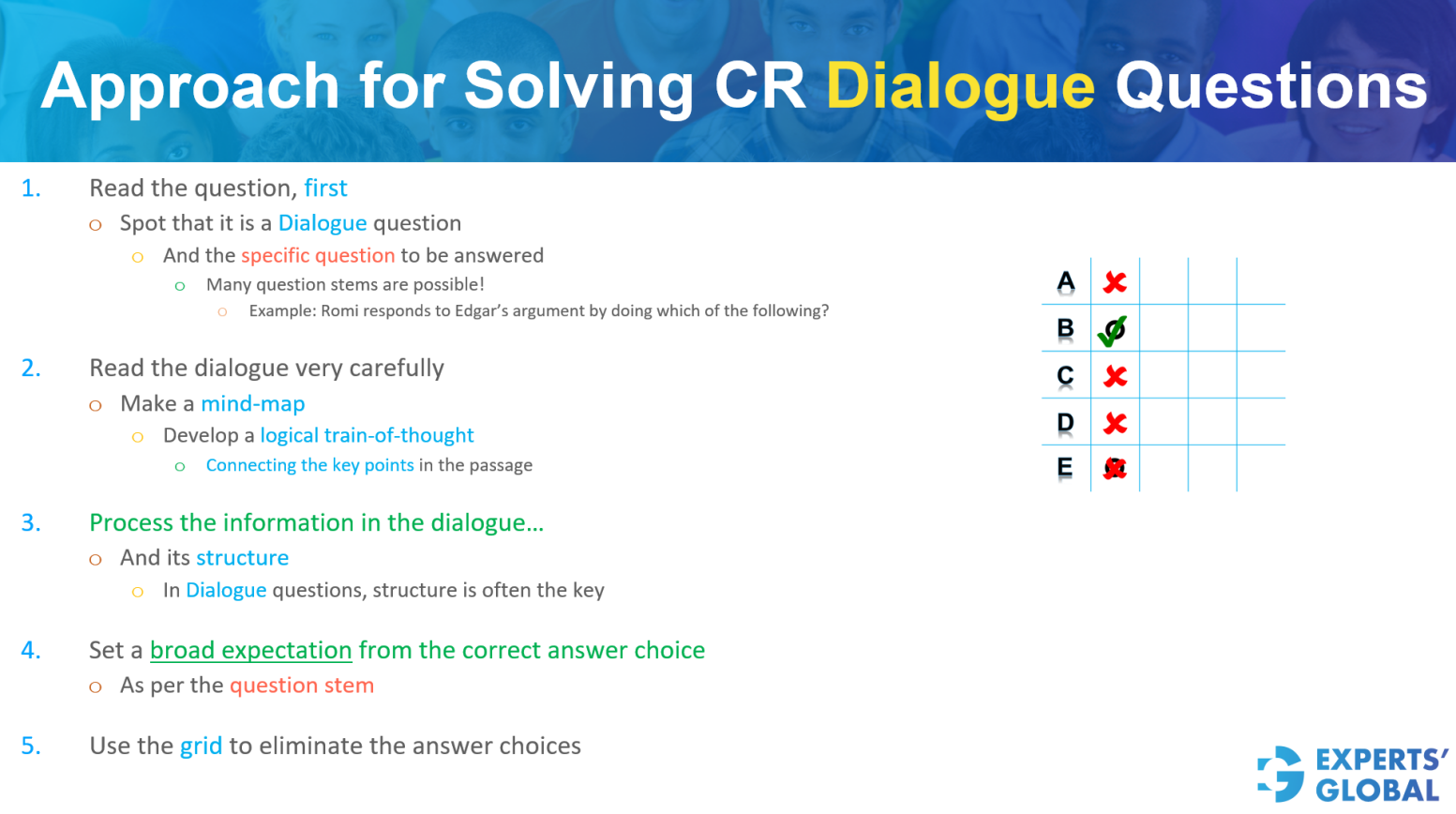
GMAT-style Worked Example: CR Dialogue Question
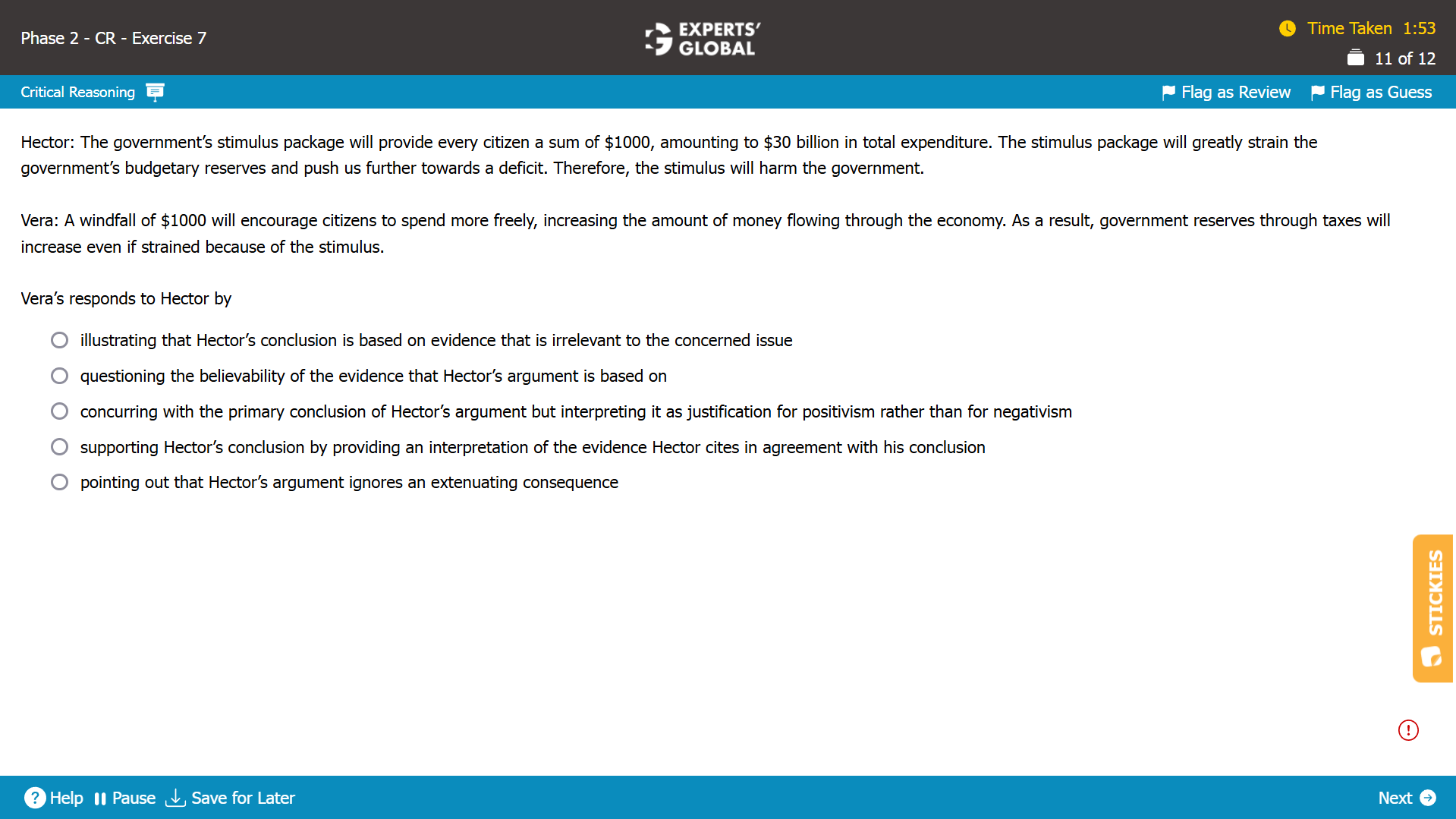
Mind-map: Hector: stimulus package will give $1000 to every citizen → government reserves will be strained and deficit is likely → stimulus will harm → Vera: with stimulus, citizens will spend more → more money will flow through economy → government reserves will increase even if strained
Missing-link: Not needed
Expectation from the correct answer choice: Something on the lines of responding by drawing attention to a positive impact of the stimulus that Hector ignored
A. Vera disagrees with Hector’s conclusion that the stimulus will harm the government but does not question the accuracy or relevance of Hector’s evidence/statement; Vera simply responds by drawing attention to the likely increase in taxes as a positive impact of the stimulus that Hector ignored. Because this answer choice does not indicate Vera’s method of responding to Hector, this answer choice is incorrect.
B. Trap. Vera responds by suggesting a likely increase in taxes “even if” the government reserves are strained because of the stimulus; so, Vera “accepts” that the stimulus will create a negative impact on the reserves; hence, it is incorrect to state that Vera responds by “questioning the believability of” Hector’s evidence/statement; Vera simply responds by drawing attention to a positive impact of the stimulus that Hector ignored. Because this answer choice does not indicate Vera’s method of responding to Hector, this answer choice is incorrect.
C. Trap. Vera responds by drawing attention to the likely increase in taxes as a positive impact of the stimulus; although it can be inferred that Vera offers “additional information that offers positivism rather than negativism”, Vera “disagrees” with Hector’s conclusion that the stimulus will harm the government; so, it is incorrect to state that Vera responds by “concurring with the primary conclusion of Hector’s argument” by interpreting “Hector’s conclusion as justification for positivism rather than for negativism”. Because this answer choice does not indicate Vera’s method of responding to Hector, this answer choice is incorrect.
D. Trap. Vera “disagrees” with Hector’s conclusion that the stimulus will harm the government; so, it is incorrect to state that Vera “supports” Hector’s conclusion. Additionally, Vera responds by drawing attention to the likely increase in taxes as a positive impact of the stimulus that Hector ignored; so, Vera provides “additional information” rather than “an interpretation of Hector’s evidence in agreement with Hector’s conclusion”. Because this answer choice does not indicate Vera’s method of responding to Hector, this answer choice is incorrect.
E. Correct. Vera disagrees with Hector’s conclusion that the stimulus will harm the government and responds by drawing attention to the likely increase in taxes as a positive impact of the stimulus that Hector ignored; in other words, Vera responds by pointing out that Hector’s argument ignores an extenuating consequence, as the answer choice mentions. Because this answer choice aptly indicates Vera’s method of responding to Hector, this answer choice is correct.
E is the best choice.
Additional GMAT-style Critical Reasoning Practice Questions
For additional, rich set of GMAT-style CR practice questions, please visit: GMAT Critical Reasoning Sample Questions
For Further Prep and Practice:
15 full-length GMAT practice tests (includes a free test)
End-to-end GMAT prep course online (includes 7-day free trial)
GMAT 5-weeks crash course
GMAT Prep + Admission Consulting Bundle