Quick Summary
To solve any Reading Comprehension question on the GMAT, use the Mind-Map-Approach devised by Experts’ Global. This powerful method helps you map structure, stay focused, and answer with confidence. Master it step by step to make Reading Comprehension your strongest section!
The Mind-Map-Approach by Experts’ Global, for Solving Any RC!
Here is an approach that will help you solve any Reading Comprehension question you ever encounter on the GMAT. Developed by Experts’ Global GMAT prep, the Mind-Map-Approach equips you with a structured method to understand and navigate even the most challenging passages. It trains you to identify the purpose of each paragraph and link ideas across the passage, helping you build a clear mental map of the structure. Whether the question asks about tone, main idea, or a specific fact, this approach enables you to answer with precision and confidence.

GMAT RC: How to Solve Reading Comprehension Questions
Step-by-Step Explanation of the Mind-Map-Approach:
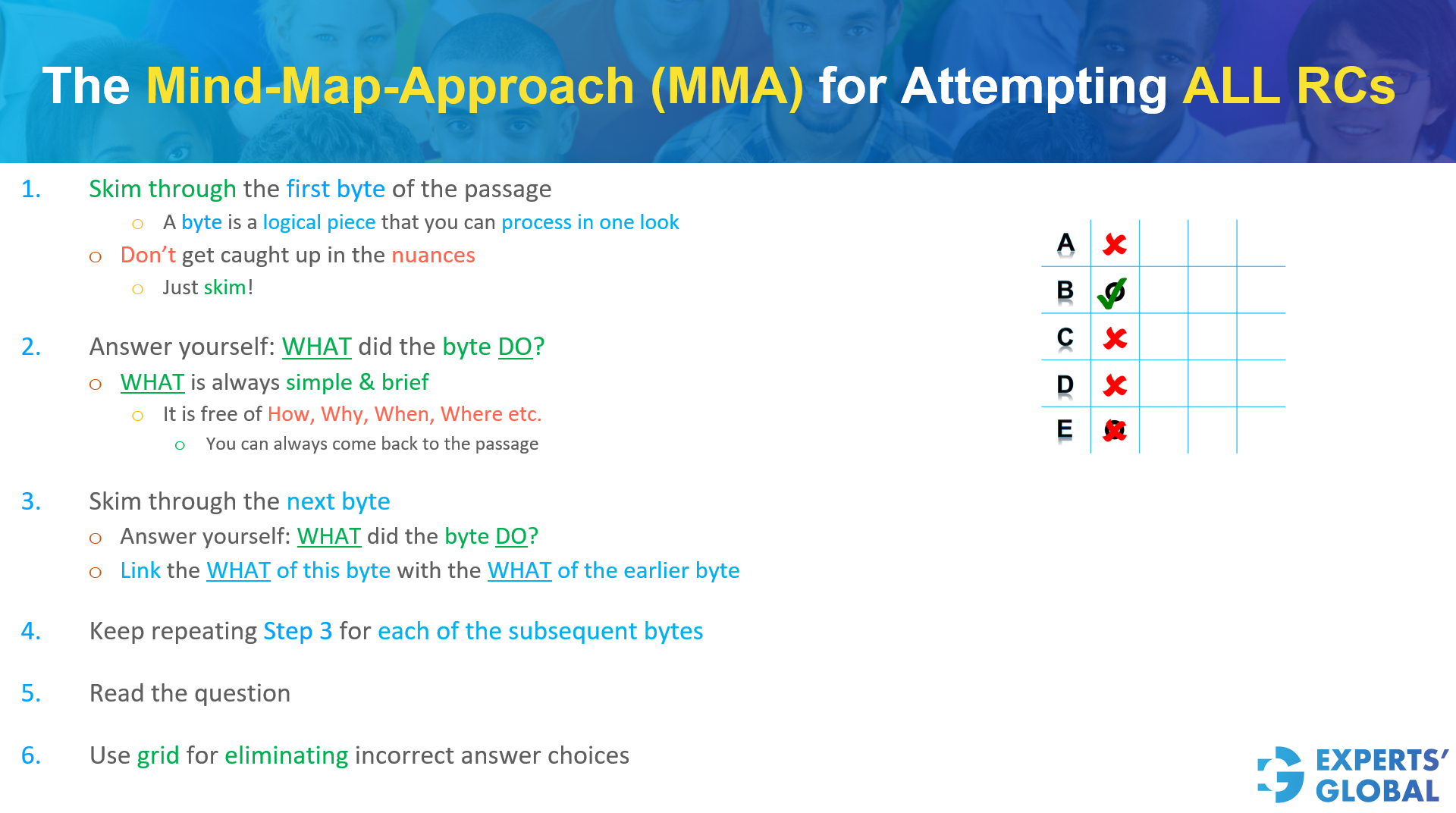
1. Skim One Paragraph at a Time
Read each paragraph quickly with the goal of identifying its purpose. After reading, look away and ask yourself, “What was the main point of this paragraph?” The answer should be brief, a simple short phrase. Avoid focusing on examples or secondary details at this stage.
2. Link Paragraphs Logically
Once you have understood two paragraph purposes, mentally connect them. Ask how the second paragraph continues or contrasts with the first. This process of connecting each paragraph builds a chain of logic that strengthens your understanding of the passage’s flow.
3. Build a Mind-Map of the Information
By the end of the passage, you will have a sequence of connected paragraph purposes in your mind. This becomes your Mind-Map. It allows you to answer structure-based questions quickly and helps you locate relevant content for detail-based questions with ease.
Next, you need to practically solve the questions presented to you. Here is how the Mind-Map-Approach would help you in solving all the RC questions that follow the passage.
4.1 Solving Structure-Based Questions
Structure-based questions include those that ask about the main idea, the purpose of a paragraph, the role of a specific sentence, or the tone of the author. These questions are best addressed through the Mind-Map you have built while reading. Since the Mind-Map captures the purpose and flow of each paragraph, you can often answer structure-based questions without revisiting the passage.
4.2 Solving Fact-Based Questions
Fact-based questions ask you to locate and interpret specific information mentioned in the passage. These may include questions that begin with “According to the passage…” or ask what the author explicitly stated. The Mind-Map helps you identify the paragraph where the fact is most likely located, allowing you to return only to the relevant section. This minimizes unnecessary rereading and leads to more accurate and faster responses.
4.3 Solving Inference-Based Questions
Inference-based questions require you to draw a logical conclusion that is not directly stated in the passage. These questions can be challenging if you do not understand the deeper intent behind a paragraph. The Mind-Map helps by reminding you of the context in which a statement appears. Once you know where to look, you can revisit that paragraph to assess whether the inferred meaning is valid.
Three Steps to Mastering the Mind-Map-Approach for Solving RCs
As always, Experts’ Global says 3 stages: Understand – Practice – Master!
1. Understand
In the first few days, do not worry about speed. Focus entirely on understanding the Mind-Map-Approach and applying it correctly. The objective is to build a clear grasp of how to identify paragraph purposes and link ideas. Aim to reach an accuracy level of at least 80 percent before introducing any time pressure.
2. Practice
Once you are regularly achieving over 80 percent accuracy, begin solving questions under timed conditions. The focus at this stage is on developing the ability to apply the Mind-Map-Approach effectively in order to maintain high accuracy while gradually gaining speed under time constraints. At this stage, the method should feel natural and support both your accuracy and confidence under time pressure, GMAT exercises as well as GMAT mocks.
3. Master
Work toward refining your application of the Mind-Map-Approach and gaining full confidence in it under test-like conditions. Practice under time pressure and in long sittings to build endurance and composure. Analyze your mistakes carefully and learn from them. When you are consistently solving RC questions in under 2 minutes with over 80% accuracy, you have mastered the Mind-Map-Approach!
Key Benefits of the Mind-Map-Approach
Efficiency and Effectiveness Advantages
- Helps reduce dependency on memory by building a live structure during reading
- Saves time by minimizing rereading and improving content recall
- Improves accuracy by sharpening focus on the author’s purpose and argument flow
- Builds confidence by turning Reading Comprehension into a logical and repeatable process
Emotional and Strategic Advantages
The Mind-Map-Approach brings clarity and calm. It transforms reading from a passive task into an active reasoning process. Long or abstract passages become manageable because you are never lost. You feel in control and well-equipped, which lifts your performance and confidence throughout the Verbal section.
Did you know?
10,000+ GMAT candidates confirmed that our 15 GMAT practice tests are in great sync with the real GMAT!
Avoid This Common Misconception: That There Is Not Much To Prepare For Reading Comprehension
Many GMAT students carry a common misconception that there is not much to be studied for reading comprehension on the GMAT. This belief is not true. While it is correct that there may not be a large amount of formal theory to be memorized, there is a clear need for an efficient, well thought out approach for solving the reading comprehension questions on the GMAT.
Reading comprehension forms a good sixty percent of the GMAT verbal section. It is not realistic to go into the GMAT and hope to do very well without having done an organized preparation for the reading comprehension questions. You need to have a solid approach for solving these questions, and you need to familiarize yourself with the common reading comprehension question types that the GMAT tends to ask. You also need to apply the approach you have developed across several reading comprehension sets so that your efficiency and accuracy steadily improve. In other words, underestimating reading comprehension during your preparation is a serious and avoidable mistake.
Reading comprehension does not only account for the majority of the verbal section. Being good at reading comprehension generally lifts your ability to read and comprehend fast, which is a skill at the core of virtually all GMAT question types. Therefore, becoming strong at reading comprehension helps you not only with the reading comprehension questions themselves or only with the verbal section on the GMAT. It supports your performance across all the sections and virtually all the question types on the exam.
GMAT Reading Comprehension Practice Set with Explanations
Below, you will find a series of GMAT-style Reading Comprehension passages and questions, each paired with a detailed explanation. Take your time with each question and use the reading strategies and reasoning methods you’ve learned for approaching RC on the GMAT. Focus on mastering the key steps: active reading, annotation, and careful analysis of the answer choices, not just picking what feels right. After each question, click on the explanation control to view the correct answer and dive deep into the full reasoning. Enjoy the process and keep pushing forward!
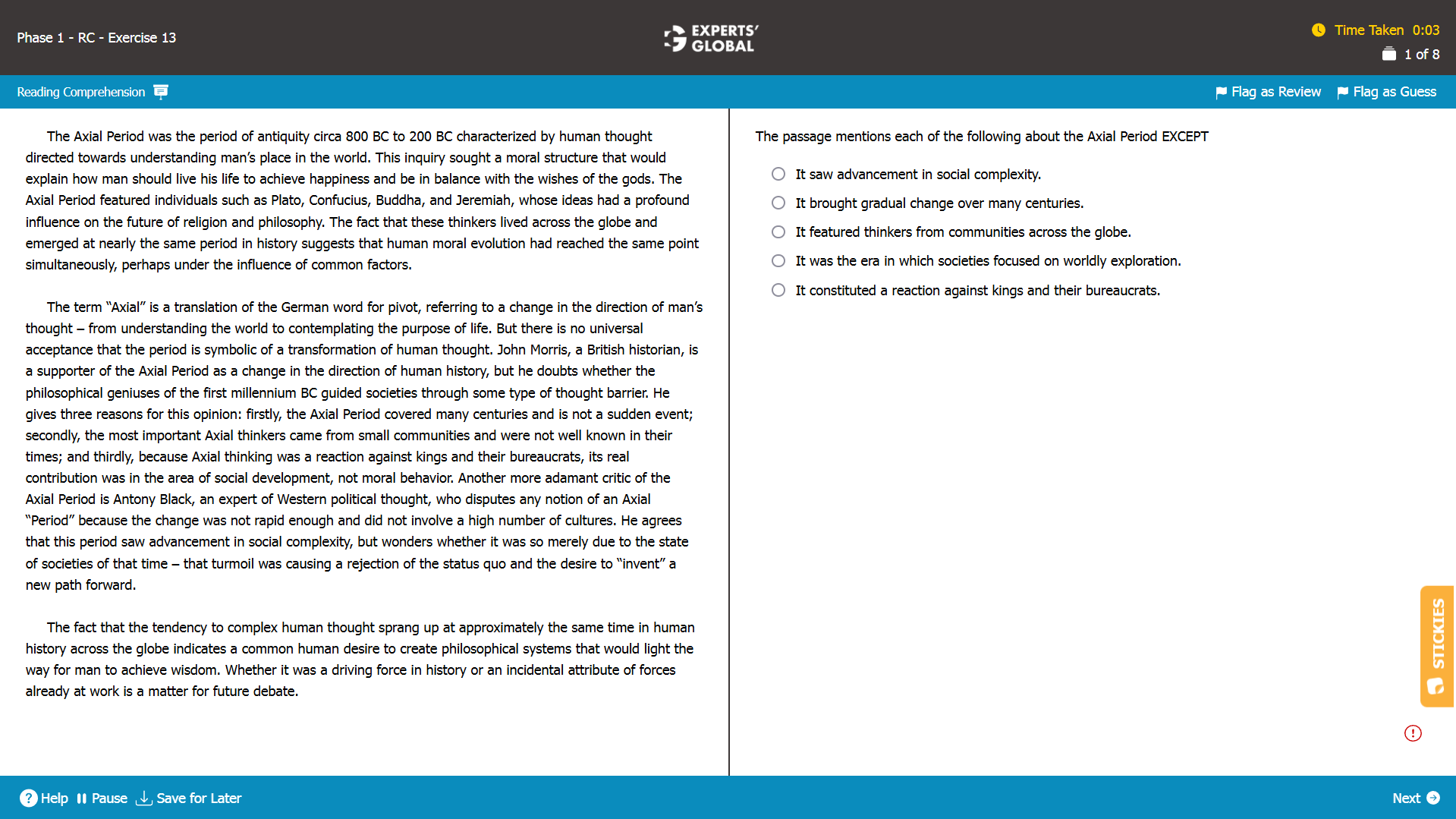
RC Practice Question 1 | GMAT Verbal
Written Explanation
Mind-map
To introduce the Axial Period which represents development of human thought (Paragraph 1)
To discuss concerns about considering Axial Period a transformation (Paragraph 2)
To suggest that no definitive understanding of Axial Period’s role in human thought currently exists (Paragraph 3)
Each answer choice needs to be carefully evaluated in light of the information presented in the passage.
A. The second paragraph mentions that Antony Black agrees that “this period saw an advancement in social complexity”; because the passage mentions that the statement in the answer choice is true about the Axial Period, this answer choice is incorrect.
B. The first paragraph mentions that “The Axial Period was the period of antiquity circa 800 BC to 200 BC”; the second paragraph mentions that John Morris believes that “the Axial Period covered many centuries and is not a sudden event” and that Antony Black believes that “the change was not rapid enough”; all these references suggest that the Axial Period brought gradual change over many centuries, as the answer choice mentions. Because the passage mentions that the statement in the answer choice is true about the Axial Period, this answer choice is incorrect.
C. The first paragraph mentions that “The Axial Period featured individuals such as Plato, Confucius, Buddha, and Jeremiah” and “these thinkers lived across the globe and emerged at nearly the same period in history”; the passage makes the reference that the Axial Period featured thinkers from communities across the globe, as the answer choice mentions. Because the passage mentions that the statement in the answer choice is true about the Axial Period, this answer choice is incorrect.
D. Correct. The second paragraph mentions that Axial thinking refers “to a change in the direction of man’s thought” from understanding the “world” to contemplating the purpose of life; this reference is directly the opposite of what the answer choice mentions – that the Axial Period societies focused on “worldly” exploration. Because the passage doesn’t mention that the statement in the answer choice is true about the Axial Period, this answer choice is correct.
E. The second paragraph mentions that John Morris believes that “because Axial thinking was a reaction against kings and their bureaucrats, its real contribution was in the area of social development, not moral behavior”; the passage makes the reference that the Axial Period constituted a reaction against kings and their bureaucrats, as the answer choice mentions. Because the passage mentions that the statement in the answer choice is true about the Axial Period, this answer choice is incorrect.
D is the best answer choice.
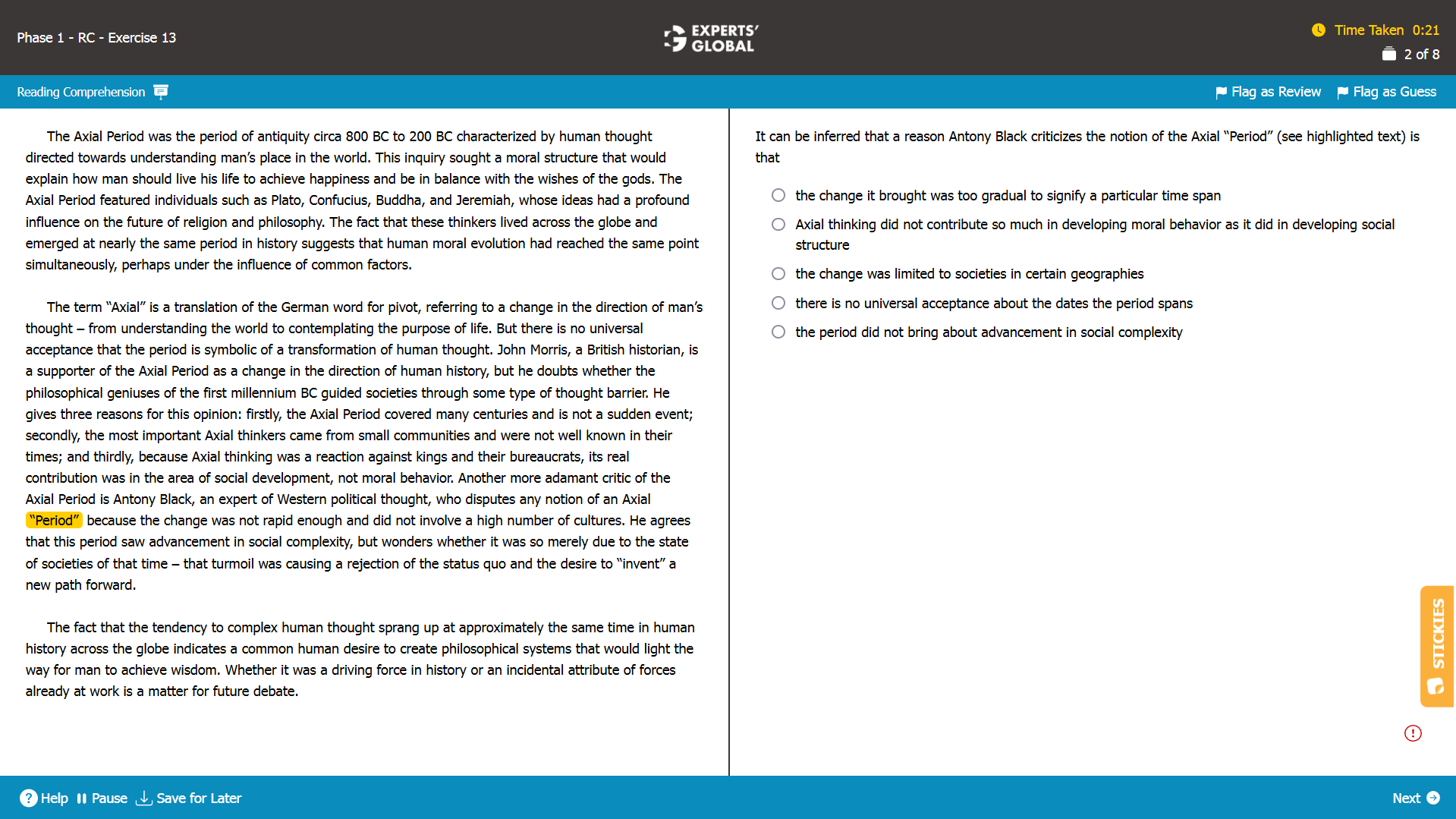
RC Practice Question 2 | GMAT Verbal
Written Explanation
Mind-map
To introduce the Axial Period which represents development of human thought (Paragraph 1)
To discuss concerns about considering Axial Period a transformation (Paragraph 2)
To suggest that no definitive understanding of Axial Period’s role in human thought currently exists (Paragraph 3)
The second paragraph mentions that Antony Black “disputes any notion of an Axial “Period” because the change was not rapid enough and did not involve a high number of cultures”. It can be inferred that the emphasis on the word “Period” suggests that Black objects to the use of the term “Period”; it can also be inferred that Black makes such an objection because “the change was not rapid enough”. In other words, Black believes that the change was so slow that one cannot define a time period on the basis of this change. Each answer choice needs to be carefully evaluated in light of the information presented in this context.
A. Correct. The second paragraph mentions that Antony Black “disputes any notion of an Axial “Period” because the change was not rapid enough and did not involve a high number of cultures”; it can be inferred that the emphasis on the word “Period” suggests that Black objects to the use of the term “Period”; it can also be inferred that Black makes such an objection because “the change was not rapid enough”; so, Black believes that the change was so slow that one cannot define a time period on the basis of this change; in other words, Black believes that the change the Axial Period brought was too gradual to signify a particular time span, as the answer choice mentions.
B. The second paragraph mentions that John Morris believes that Axial thinking’s “real contribution was in the area of social development, not moral behavior”; so, the idea that Axial thinking did not contribute so much in developing moral behavior as it did in developing social structure is an objection raised by Morris, not by Black. Furthermore, our expectation from the correct answer choice is on the lines that Black believes that the change was so slow that one cannot define a time period on the basis of this change. Incorrect.
C. Trap. The second paragraph mentions that Antony Black “disputes any notion of an Axial “Period” because the change was not rapid enough and did not involve a high number of cultures”; although there is a reference to “the limitation of the number of cultures”, the objection to the term “Period” is not made in that regard; so, it is incorrect to state that Black criticizes the notion of the Axial “Period” because the change was limited to societies in certain geographies, as the answer choice mentions. Furthermore, our expectation from the correct answer choice is on the lines that Black believes that the change was so slow that one cannot define a time period on the basis of this change. Incorrect.
D. The first paragraph mentions that “The Axial Period was the period of antiquity circa 800 BC to 200 BC”; the passage makes no suggestion that there is a disagreement about the dates of the period; so, it is incorrect to state that Black criticizes the notion of the Axial “Period” because there is no universal acceptance about the dates the period spans, as the answer choice mentions. Furthermore, our expectation from the correct answer choice is on the lines that Black believes that the change was so slow that one cannot define a time period on the basis of this change. Incorrect.
E. The second paragraph mentions that Antony Black “agrees that this period saw an advancement in social complexity; so, it is incorrect to state that Black criticizes the notion of the Axial “Period” because the period did not bring advancement in social complexity, as the answer choice mentions. Furthermore, our expectation from the correct answer choice is on the lines that Black believes that the change was so slow that one cannot define a time period on the basis of this change. Incorrect.
A is the best answer choice.
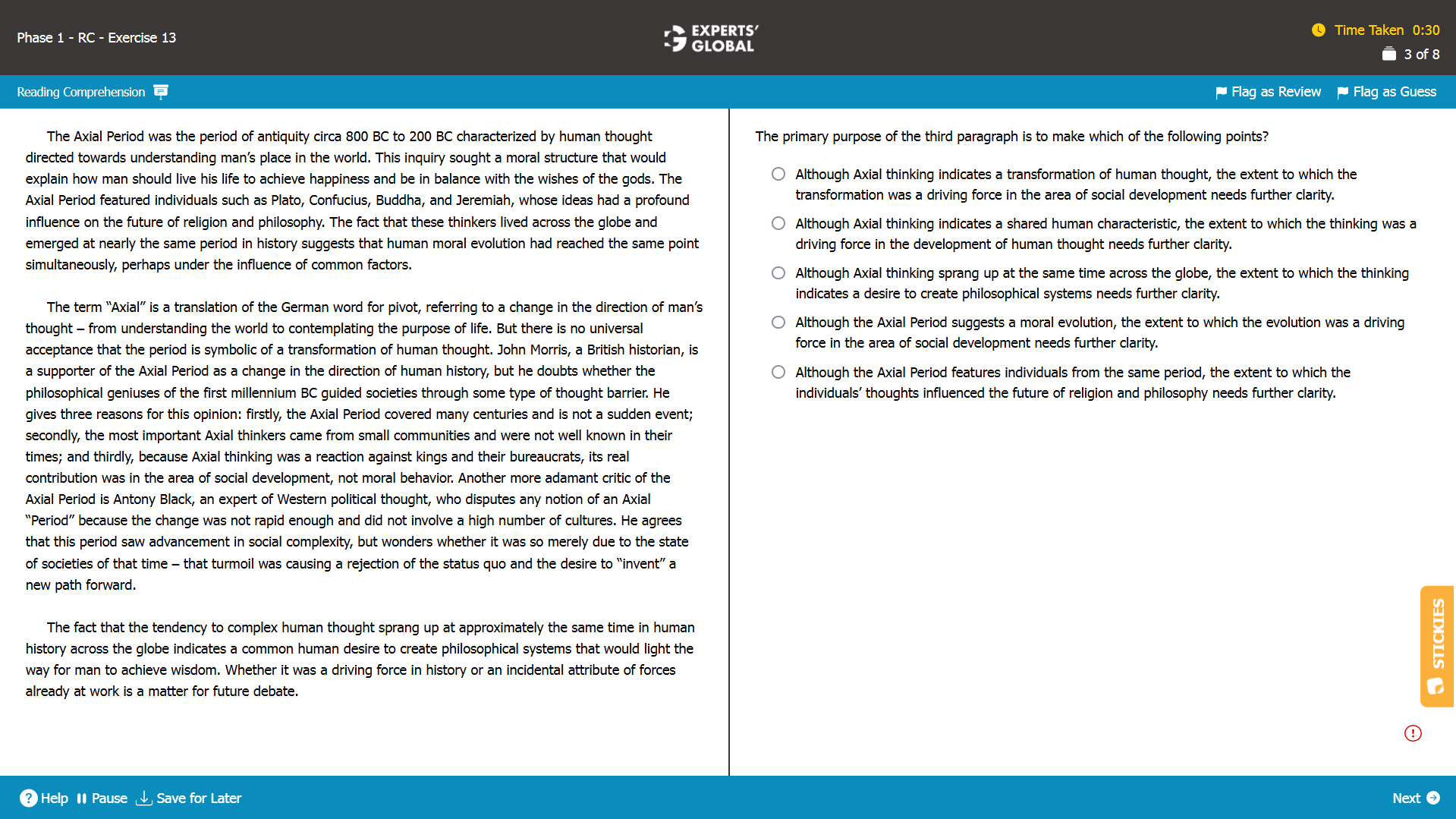
RC Practice Question 3 | GMAT Verbal
Written Explanation
Mind-map
To introduce the Axial Period which represents development of human thought (Paragraph 1)
To discuss concerns about considering Axial Period a transformation (Paragraph 2)
To suggest that no definitive understanding of Axial Period’s role in human thought currently exists (Paragraph 3)
The third paragraph states that Axial thinking shows a common human desire, but whether this thinking was a driving force in history is not yet clear. The answer choice that does justice to this summary is the correct answer choice.
A. The third paragraph doesn’t mention the idea that “Axial thinking indicates a transformation of human thought” and makes no reference to “social development”; it is incorrect to state that the primary point in the third paragraph is that although Axial thinking indicates a transformation of human thought, the extent to which the transformation was a driving force in the area of social development needs further clarity, as the answer choice mentions. Furthermore, the paragraph suggests that Axial thinking shows a common human desire to create philosophical systems, but whether this thinking was a driving force in history is not yet clear; we need an answer choice on similar lines. Incorrect.
B. Correct. The third paragraph states that Axial thinking shows “a common human desire to create philosophical systems”, but whether this thinking was a “driving force in history” is not yet clear; in other words, the primary purpose of the third paragraph is to make the point that although Axial thinking indicates a shared human characteristic, the extent to which the thinking was a driving force in the development of human thought needs further clarity, as the answer choice mentions.
C. Trap. The third paragraph mentions that “The fact that the tendency to complex human thought sprang up at approximately the same time in human history across the globe indicates a common human desire to create philosophical systems that would light the way for man to achieve wisdom”; the paragraph mentions that Axial thinking indicates “a common human desire to create philosophical systems”, and doesn’t suggest that “the extent to which the thinking indicates a desire to create philosophical systems needs further clarity”, as the answer choice mentions. Furthermore, the paragraph suggests that Axial thinking shows a common human desire to create philosophical systems, but whether this thinking was a driving force in history is not yet clear; we need an answer choice on similar lines. Incorrect.
D. The third paragraph doesn’t mention “moral evolution” or “social development”; it is incorrect to state that the primary point in the third paragraph is what the answer choice mentions – that, although the Axial Period suggests a moral evolution, the extent to which the evolution was a driving force in the area of social development needs further clarity. Furthermore, the paragraph suggests that Axial thinking shows a common human desire to create philosophical systems, but whether this thinking was a driving force in history is not yet clear; we need an answer choice on similar lines. Incorrect.
E. The third paragraph doesn’t mention “specific individuals” or their influence on “the future of religion and philosophy”; it is incorrect to state that the primary point in the third paragraph is what the answer choice mentions – that, although the Axial Period features certain individuals from the same period, the extent to which the individuals’ thoughts influenced the future of religion and philosophy needs further clarity. Furthermore, the paragraph suggests that Axial thinking shows a common human desire to create philosophical systems, but whether this thinking was a driving force in history is not yet clear; we need an answer choice on similar lines. Incorrect.
B is the best answer choice.
RC Practice Question 4 | GMAT Verbal
Mind-map
To introduce the Axial Period which represents development of human thought (Paragraph 1)
To discuss concerns about considering Axial Period a transformation (Paragraph 2)
To suggest that no definitive understanding of Axial Period’s role in human thought currently exists (Paragraph 3)
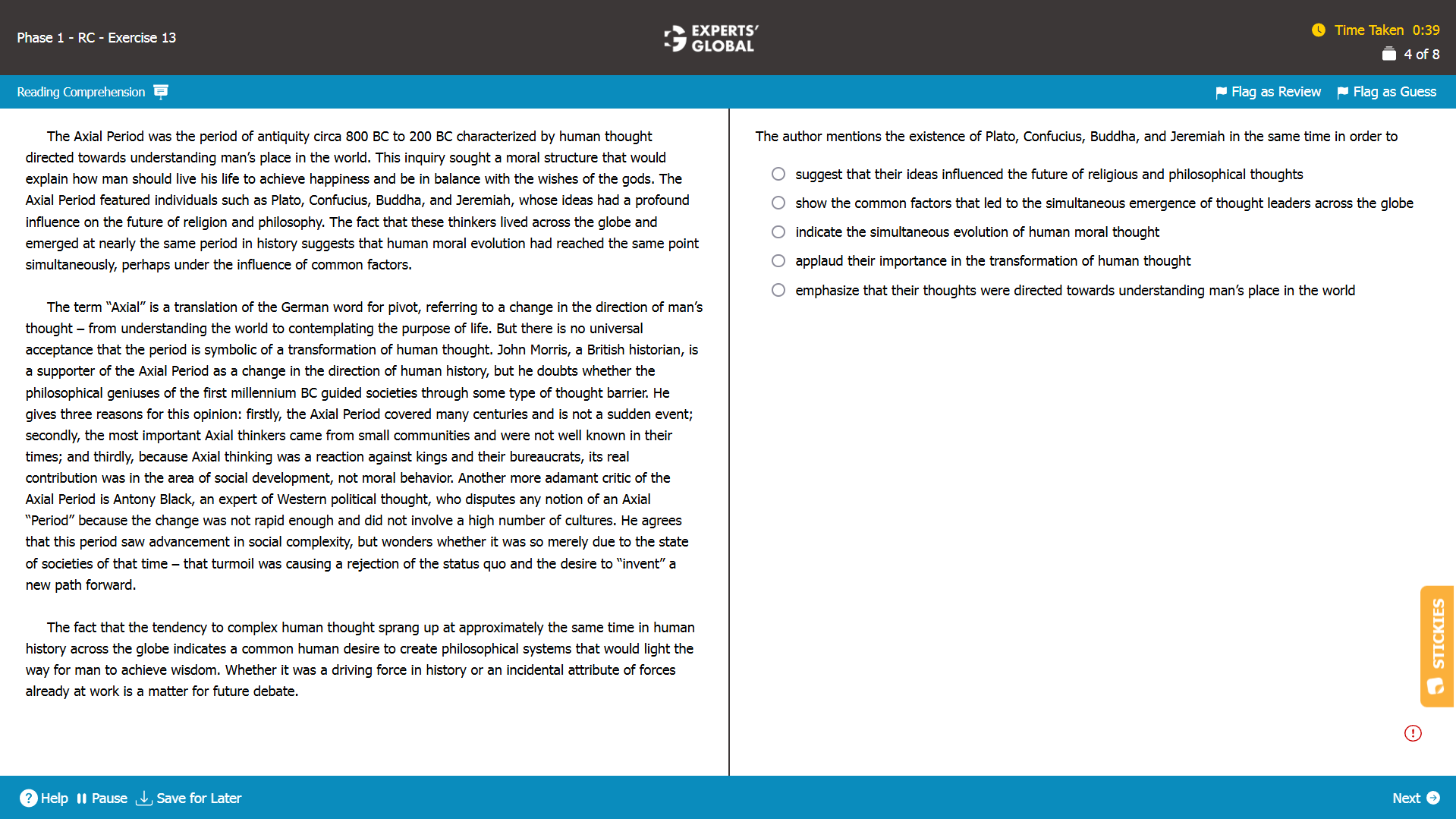
The first paragraph mentions that “The fact that these thinkers lived across the globe and emerged at nearly the same period in history suggests that human moral evolution had reached the same point simultaneously, perhaps under the influence of common factors”. It can be inferred that the author mentions the existence of Plato, Confucius, Buddha, and Jeremiah in the same time in order to suggests that human moral evolution had reached the same point simultaneously. Each answer choice needs to be carefully evaluated in light of the information presented in the passage.
A. Although the passage suggests that the ideas of Plato, Confucius, Buddha, and Jeremiah influenced the future of religious and philosophical thoughts, to make this suggestion is not the reason the author mentions the existence of Plato, Confucius, Buddha, and Jeremiah in the same time. Furthermore, our expectation from the correct answer choice is on the lines that the existence of Plato, Confucius, Buddha, and Jeremiah in the same time suggests that human moral evolution had reached the same point simultaneously. Incorrect.
B. Trap. Although the first paragraph refers to the possibility that some “common factors” influenced human moral evolution, the passage doesn’t indicate what these common factors are. Furthermore, our expectation from the correct answer choice is on the lines that the existence of Plato, Confucius, Buddha, and Jeremiah in the same time suggests that human moral evolution had reached the same point simultaneously. Incorrect.
C. Correct. The first paragraph mentions that “The fact that these thinkers lived across the globe and emerged at nearly the same period in history suggests that human moral evolution had reached the same point simultaneously, perhaps under the influence of common factors”; in other words, the author mentions the existence of Plato, Confucius, Buddha, and Jeremiah in the same time in order to indicate the simultaneous evolution of human moral thought, as the answer choice mentions.
D. Although the first paragraph suggests that the ideas of Plato, Confucius, Buddha, and Jeremiah are related to “understanding man’s place in the world” and influenced “the future of religious and philosophical thoughts”, the author’s tone is objective and it cannot be inferred that the author “applauds” the importance of these thinkers in the transformation of human thought. Furthermore, our expectation from the correct answer choice is on the lines that the existence of Plato, Confucius, Buddha, and Jeremiah in the same time suggests that human moral evolution had reached the same point simultaneously. Incorrect.
E. Although the first paragraph suggests that the ideas of Plato, Confucius, Buddha, and Jeremiah are related to understanding man’s place in the world, to make this emphasis is not the reason the author mentions the existence of Plato, Confucius, Buddha, and Jeremiah in the same “time. Furthermore, our expectation from the correct answer choice is on the lines that the existence of Plato, Confucius, Buddha, and Jeremiah in the same time suggests that human moral evolution had reached the same point simultaneously. Incorrect.
C is the best answer choice.
RC Practice Question 5 | GMAT Verbal
Written Explanation
Mind-map
To introduce the Axial Period which represents development of human thought (Paragraph 1)
To discuss concerns about considering Axial Period a transformation (Paragraph 2)
To suggest that no definitive understanding of Axial Period’s role in human thought currently exists (Paragraph 3)
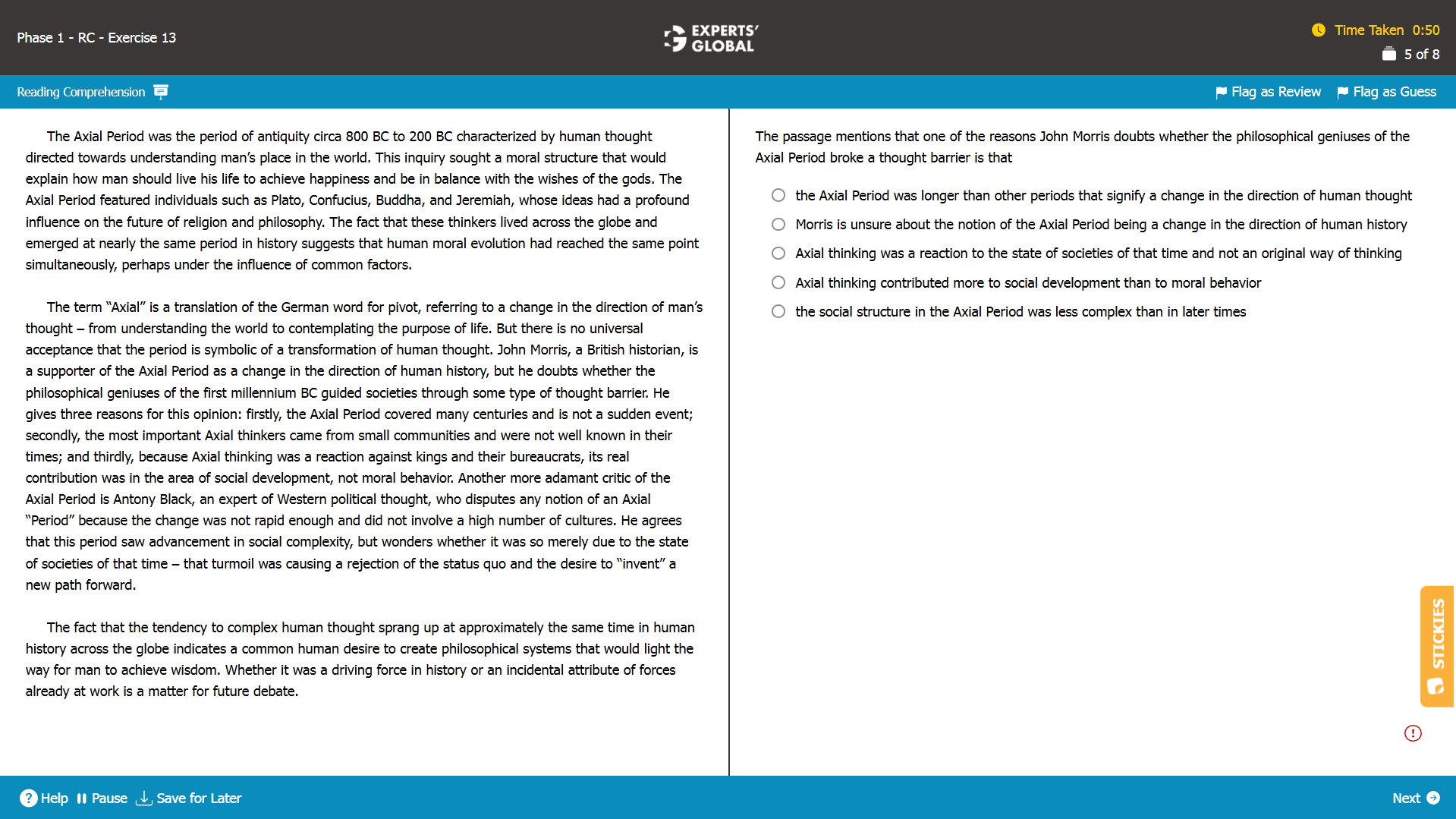
The second paragraph mentions that John Morris is concerned about three specific reasons: firstly, Axial Period was not a sudden event; secondly, the most important Axial thinkers came from small communities and were not well known in their times; thirdly, Axial Period’s real contribution was in the area of social development, not moral behavior. Each answer choice needs to be carefully evaluated in light of the information presented in the passage.
A. The passage makes no comparison between Axial Period and “other periods that signify a change in the direction of human thought”; so, it cannot be established that one of the reasons for Morris’s doubt is related to the length of the Axial Period, as the answer choice mentions. Furthermore, our expectation from the correct answer choice is on the lines that it indicates one of the three concerns John Morris cites: firstly, Axial Period was not a sudden event; secondly, the most important Axial thinkers came from small communities and were not well known in their times; thirdly, Axial Period’s real contribution was in the area of social development, not moral behavior. Incorrect.
B. The second paragraph mentions that Morris “is a supporter of the Axial Period as a change in the direction of human history”; so, it is incorrect to state that Morris is unsure about the notion of the Axial Period being a change, as the answer choice mentions. Furthermore, our expectation from the correct answer choice is on the lines that it indicates one of the three concerns John Morris cites: firstly, Axial Period was not a sudden event; secondly, the most important Axial thinkers came from small communities and were not well known in their times; thirdly, Axial Period’s real contribution was in the area of social development, not moral behavior. Incorrect.
C. Trap. Although the second paragraph mentions that John Morris cites that “Axial thinking was a reaction against kings and their bureaucrats”, it cannot be inferred that Axial thinking was “not an original way of thinking”, or that Morris objected to Axial thinking because it was not original; so, it cannot be established that one of the reasons for Morris’s doubt is the lack of originality of thinking, as the answer choice suggests. Furthermore, our expectation from the correct answer choice is on the lines that it indicates one of the three concerns John Morris cites: firstly, Axial Period was not a sudden event; secondly, the most important Axial thinkers came from small communities and were not well known in their times; thirdly, Axial Period’s real contribution was in the area of social development, not moral behavior. Incorrect.
D. Correct. The second paragraph mentions that John Morris “doubts whether the philosophical geniuses of the first millennium BC guided societies through some type of thought barrier” because of three specific reasons, one of which is that “because Axial thinking was a reaction against kings and their bureaucrats, its real contribution was in the area of social development, not moral behavior”; in other words, the passage mentions that one of the reasons John Morris doubts whether the philosophical geniuses of the Axial Period broke a thought barrier is that Axial thinking contributed more to social development than to moral behavior, as the answer choice mentions.
E. Although the second paragraph mentions that Antony Black agrees that the Axial Period “saw an advancement in social complexity”, this reference has no connection with Morris’s thoughts; so, it cannot be established that one of the reasons for Morris’s doubt is related to the social structure in the Axial Period, as the answer choice suggests. Furthermore, our expectation from the correct answer choice is on the lines that it indicates one of the three concerns John Morris cites: firstly, Axial Period was not a sudden event; secondly, the most important Axial thinkers came from small communities and were not well known in their times; thirdly, Axial Period’s real contribution was in the area of social development, not moral behavior. Incorrect.
D is the best answer choice.
RC Practice Question 6 | GMAT Verbal
Written Explanation
Mind-map
To introduce the Axial Period which represents development of human thought (Paragraph 1)
To discuss concerns about considering Axial Period a transformation (Paragraph 2)
To suggest that no definitive understanding of Axial Period’s role in human thought currently exists (Paragraph 3)
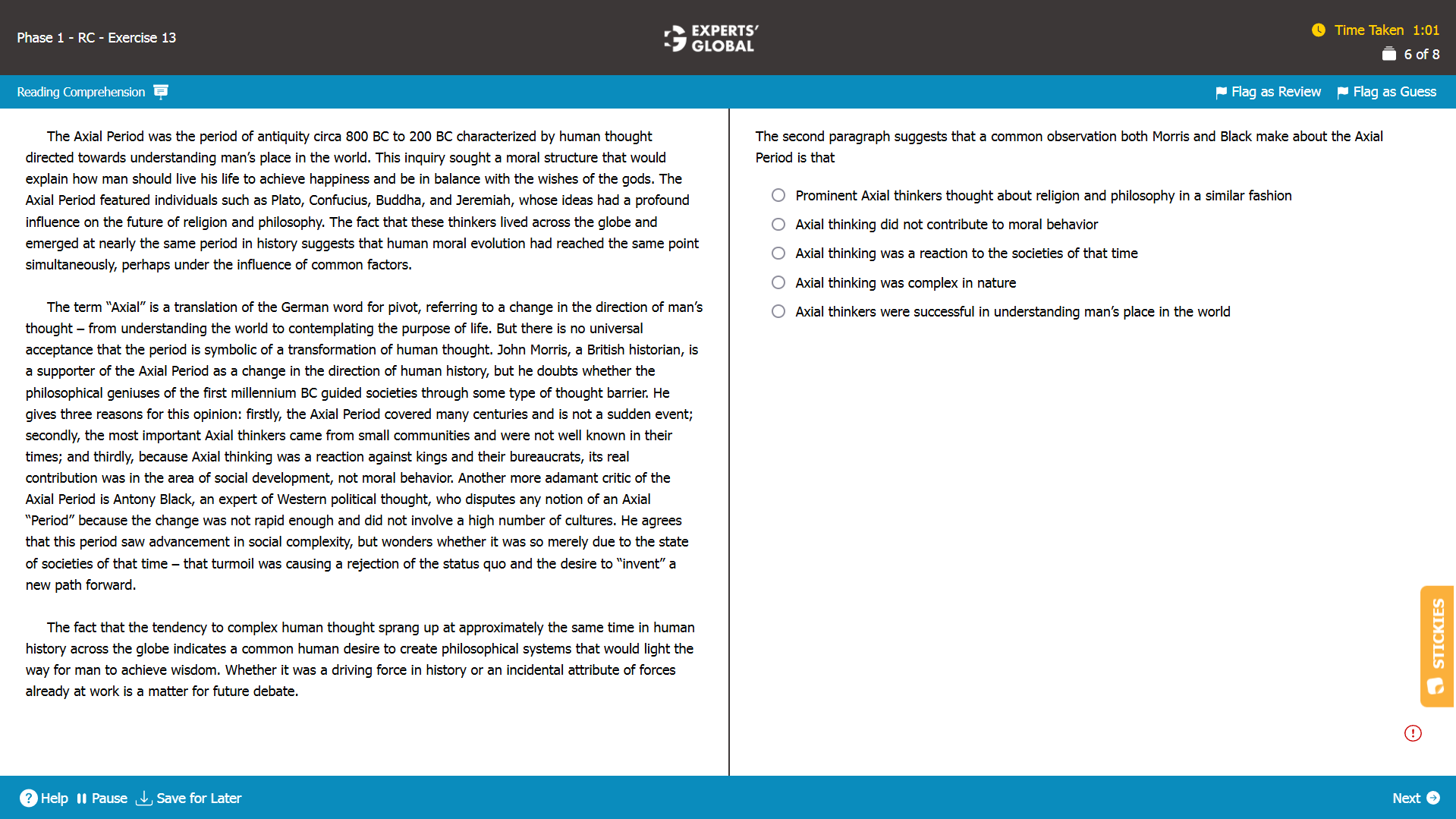
The second paragraph mentions that Morris observes that “because Axial thinking was a reaction against kings and their bureaucrats, its real contribution was in the area of social development, not moral behavior”. The paragraph also mentions that Black observes that the “societies of that time” were in “turmoil” and such a social state caused “a rejection of the status quo and the desire to “invent” a new path forward”. It can be inferred that two common observations both Morris and Black make about Axial thinking are that it was a slow/gradual event over a long time and that it was a reaction to social structures/events of the time. Each answer choice needs to be carefully evaluated in light of the information presented in this context.
A. Although the first paragraph mentions “individuals such as Plato, Confucius, Buddha, and Jeremiah,”, the passage makes no reference to the “similarity” of thoughts of these prominent Axial thinkers on matters related to religion and philosophy; so, it is incorrect to state that a common observation both Morris and Black make about the Axial Period is that Prominent Axial thinkers thought about religion and philosophy in a similar fashion. Furthermore, our expectation from the correct answer choice is on the lines that it indicates one of the two common observations both Morris and Black make about Axial thinking – that it was a slow/gradual event over a long time and that it was a reaction to social structures/events of the time. Incorrect.
B. Although the second paragraph mentions that Morris observes that Axial thinking’s “real contribution was in the area of social development, not moral behavior”, the passage makes no suggestion regarding Black’s views on how Axial thinking related to moral behavior; so, it cannot be stated that a common observation both Morris and Black make about Axial thinking is that Axial thinking did not contribute to moral behavior, as the answer choice suggests. Furthermore, our expectation from the correct answer choice is on the lines that it indicates one of the two common observations both Morris and Black make about Axial thinking – that it was a slow/gradual event over a long time and that it was a reaction to social structures/events of the time. Incorrect.
C. Correct. The second paragraph mentions that Morris observes that “because Axial thinking was a reaction against kings and their bureaucrats, its real contribution was in the area of social development, not moral behavior”; the paragraph also mentions that Black observes that the “societies of that time” were in “turmoil” and such a social state caused “a rejection of the status quo and the desire to “invent” a new path forward”; it can be inferred that a common observation both Morris and Black make about Axial thinking is that it was a reaction to social structures/events of the time, or to the societies of that time, as the answer choice mentions.
D. The passage makes no reference to the “complexity” of Axial thinking; so, it is incorrect to state that a common observation both Morris and Black make about the Axial Period is that Axial thinking was complex in nature. Furthermore, our expectation from the correct answer choice is on the lines that it indicates one of the two common observations both Morris and Black make about Axial thinking – that it was a slow/gradual event over a long time and that it was a reaction to social structures/events of the time. Incorrect.
E. Although the first paragraph mentions that Axial Period is “characterized by human thought directed towards understanding man’s place in the world”, the passage makes no reference to Morris’s and Black’s views on the success of Axial thinkers; so, it is incorrect to state that such success is a common observation both Morris and Black make. Furthermore, our expectation from the correct answer choice is on the lines that it indicates one of the two common observations both Morris and Black make about Axial thinking – that it was a slow/gradual event over a long time and that it was a reaction to social structures/events of the time. Incorrect.
C is the best answer choice.
RC Practice Question 7 | GMAT Verbal
Written Explanation
Mind-map
To introduce the Axial Period which represents development of human thought (Paragraph 1)
To discuss concerns about considering Axial Period a transformation (Paragraph 2)
To suggest that no definitive understanding of Axial Period’s role in human thought currently exists (Paragraph 3)
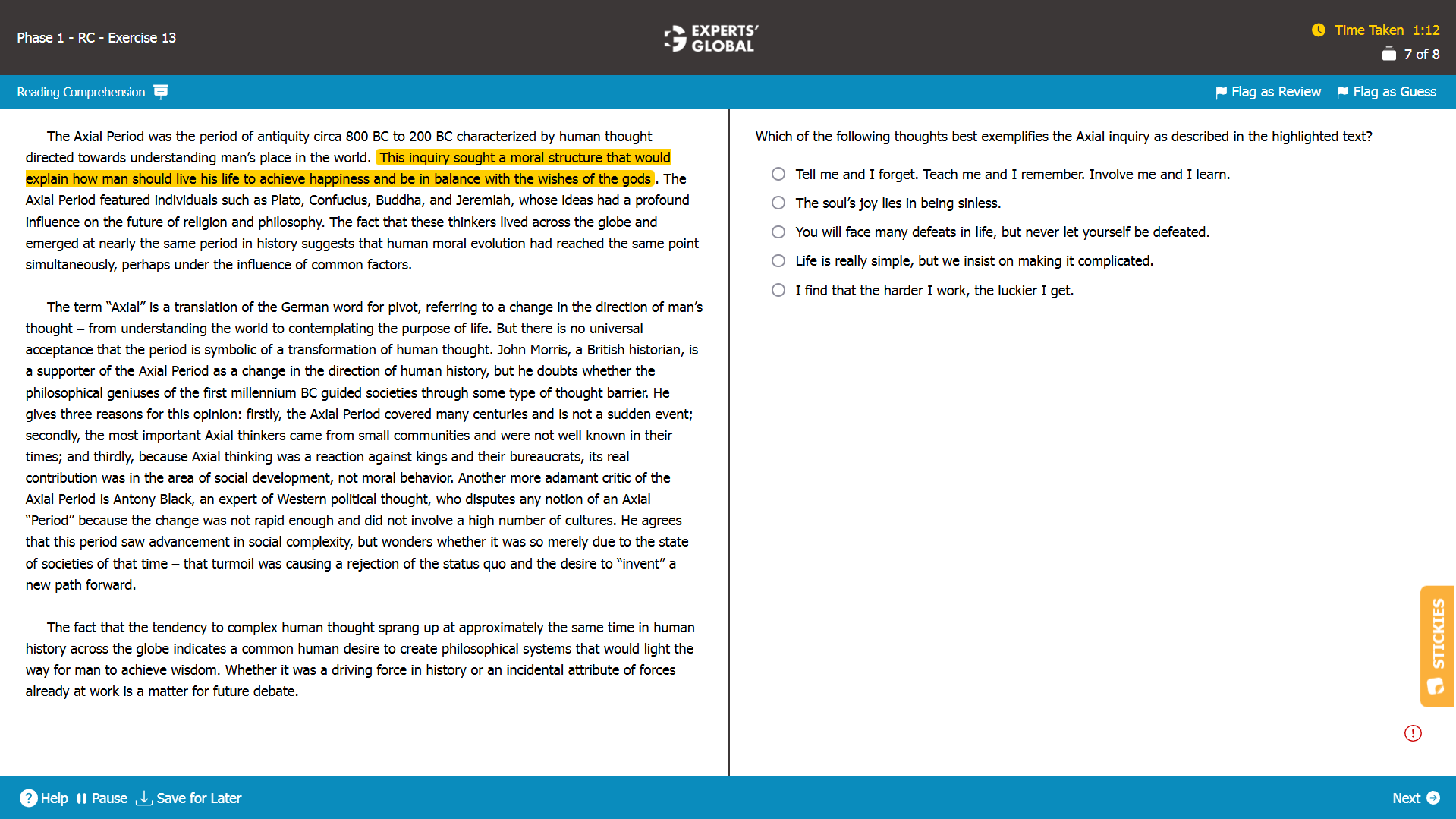
The highlighted text from the first paragraph mentions that “This inquiry sought a moral structure that would explain how man should live his life to achieve happiness and be in balance with the wishes of the gods”. It can be inferred that the Axial “inquiry” implied here means “a moral thought that explains how to be happy and in alignment with the gods’ will”. The answer choice that does justice to this idea is the correct answer choice.
A. The Axial “inquiry” implied in the highlighted text means “a moral thought that explains how to be happy and in alignment with the gods’ will”; the thought in this answer choice “Tell me and I forget. Teach me and I remember. Involve me and I learn.” relates to learning, and not to happiness, morality, or gods’ will. Because this answer choice doesn’t exemplify the Axial thought implied in the highlighted text, this answer choice is incorrect.
B. Correct. The Axial “inquiry” implied in the highlighted text means “a moral thought that explains how to be happy and in alignment with the gods’ will”; the thought in this answer choice “The soul’s joy lies in being sinless” relates to happiness (“joy”), morality (“being sinless”), and gods’ will (“soul” and “being sinless”). Because this answer choice exemplifies the Axial thought implied in the highlighted text, this answer choice is correct.
C. The Axial “inquiry” implied in the highlighted text means “a moral thought that explains how to be happy and in alignment with the gods’ will”; the thought in this answer choice “You will face many defeats in life, but never let yourself be defeated.” relates to success and failure, and not to happiness, morality, or gods’ will. Because this answer choice doesn’t exemplify the Axial thought implied in the highlighted text, this answer choice is incorrect.
D. The Axial “inquiry” implied in the highlighted text means “a moral thought that explains how to be happy and in alignment with the gods’ will”; the thought in this answer choice “Life is really simple, but we insist on making it complicated” relates to simplicity/complexity of life, and not to happiness, morality, or gods’ will. Because this answer choice doesn’t exemplify the Axial thought implied in the highlighted text, this answer choice is incorrect.
E. The Axial “inquiry” implied in the highlighted text means “a moral thought that explains how to be happy and in alignment with the gods’ will”; the thought in this answer choice “I find that the harder I work, the luckier I get.” relates to hard work and luck, and not to happiness, morality, or gods’ will. Because this answer choice doesn’t exemplify the Axial thought implied in the highlighted text, this answer choice is incorrect.
B is the best answer choice.
RC Practice Question 8 | GMAT Verbal
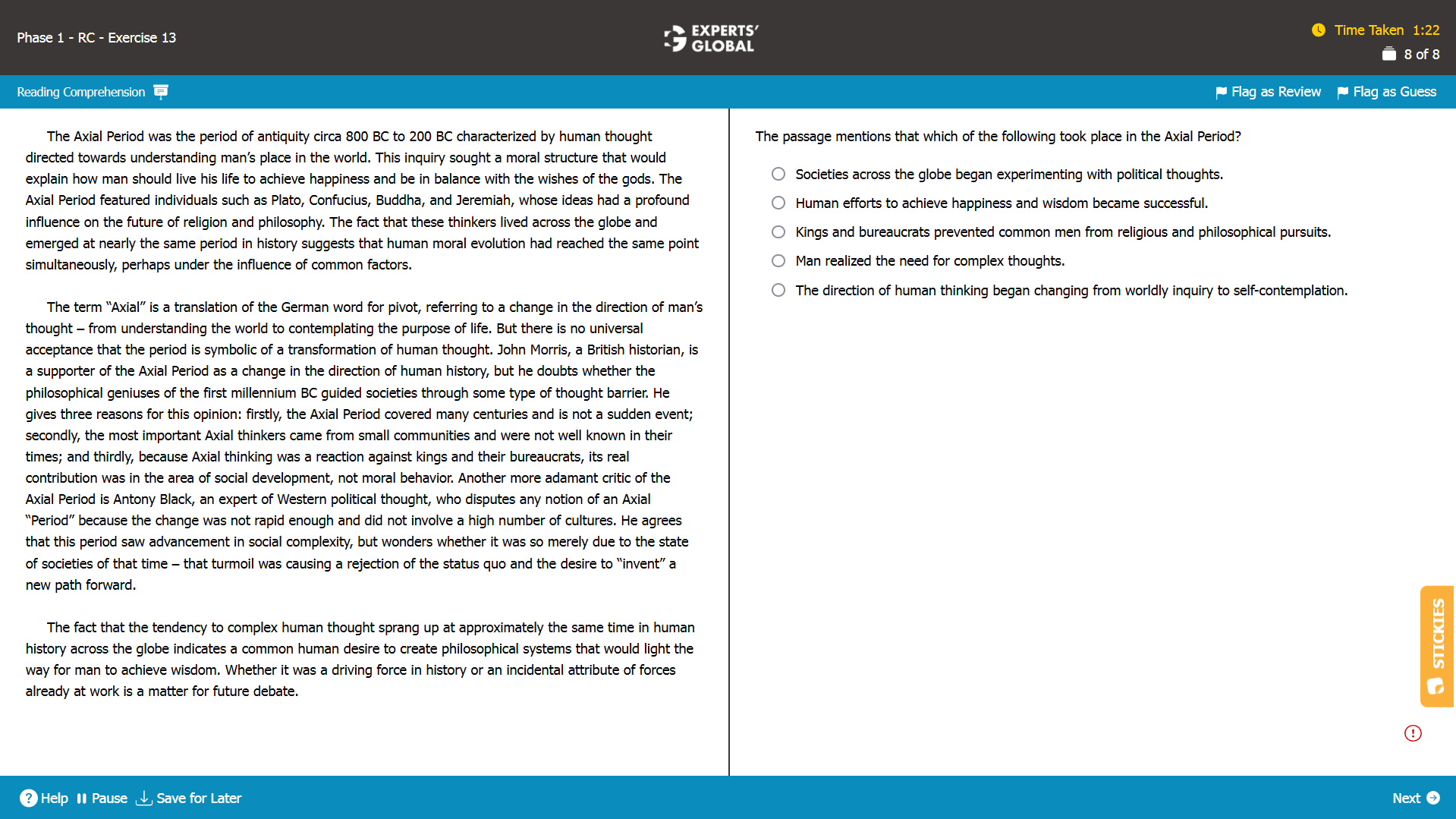
Written Explanation
Mind-map
To introduce the Axial Period which represents development of human thought (Paragraph 1)
To discuss concerns about considering Axial Period a transformation (Paragraph 2)
To suggest that no definitive understanding of Axial Period’s role in human thought currently exists (Paragraph 3)
Each answer choice needs to be carefully evaluated in light of the information presented in the passage.
A. The passage makes no reference to “political thought” in the Axial Period; so, it is incorrect to state that in the Axial Period, societies across the globe began experimenting with political thoughts, as the answer choice mentions. Because the passage does not mention that the statement in the answer choice is true about the Axial Period, this answer choice is incorrect.
B. The first paragraph mentions that the Axial “inquiry sought a moral structure that would explain how man should live his life to achieve happiness” and the third paragraph mentions that Axial thinking “indicates a common human desire to create philosophical systems that would light the way for man to achieve wisdom”; although the passage makes references to human efforts to achieve happiness and wisdom, the passage makes no suggestion that such efforts became successful, as the answer choice mentions. Because the passage does not mention that the statement in the answer choice is true about the Axial Period, this answer choice is incorrect.
C. Although the second paragraph mentions that Morris believes that “Axial thinking was a reaction against kings and their bureaucrats”, the passage doesn’t suggest that Kings and bureaucrats prevented common men from religious and philosophical pursuits, as the answer choice mentions. Because the passage does not mention that the statement in the answer choice is true about the Axial Period, this answer choice is incorrect.
D. The passage makes no reference to “complex thoughts” and to man’s realization about them; so, it is incorrect to state that in the Axial Period, man realized the need for complex thoughts, as the answer choice mentions. Because the passage does not mention that the statement in the answer choice is true about the Axial Period, this answer choice is incorrect.
E. Correct. The second paragraph mentions that Axial thinking refers “to a change in the direction of man’s thought – from understanding the world to contemplating the purpose of life”; in other words, the passage suggests that in the Axial Period, the direction of human thinking began changing from worldly inquiry to self-contemplation, as the answer choice mentions. Because the passage mentions that the statement in the answer choice is true about the Axial Period, this answer choice is correct.
E is the best answer choice.
Additional 40+ Free GMAT-style Reading Comprehension Questions with Explanations:
Please find another set of GMAT-style RC questions with explanations on: Free GMAT Reading Comprehensions Prep
Please find another set of GMAT-style RC questions with explanations on: Free GMAT Verbal Prep
Please find another set of GMAT-style RC questions with explanations on: Free GMAT Verbal Sample Questions
Please find another set of GMAT-style RC questions with explanations on: Free GMAT Reading Comprehensions Sample Questions
Please find another set of GMAT-style RC questions with explanations on: Free GMAT Sample Questions
How the Best of MBA Admission Consultants Can Guide You End-to-End
The best of MBA admission consultants can support you throughout your journey. If you begin early enough, they can help you build a strong preparation strategy for the GMAT, keep you motivated and on track, and provide clear guidance to avoid common pitfalls. Alongside test prep, the mentors can help you enhance your profile thoughtfully, so that every part of your MBA application reflects your true potential and readiness for business school.
Parting Thought
The Mind-Map-Approach, developed by Experts’ Global, is a practical and structured method to simplify GMAT Reading Comprehension. By summarizing each paragraph’s purpose and connecting ideas logically, you gain control over the passage and reduce confusion during question solving. Focus first on learning the method thoroughly, then aim for accuracy, and finally, train for speed. When practiced regularly and correctly, this approach becomes second nature, helping you navigate even the most complex passages with confidence, structure, and clarity on test day.
Explore our GMAT preparation course and admissions bundle for end-to-end support