Multi-Source Reasoning questions invite you to work with information spread across two or three tabs, including short passages, charts, tables, or statements, and bring these pieces together to answer carefully designed questions. You move back and forth between sources, compare details, and draw clear conclusions from combined information. Most of these questions require multiple responses, and an attempt is considered correct only when every selected response is correct, with no partial credit. On the GMAT, you typically see one or two Multi-Source Reasoning sets, with three questions in each set, which means either three or six of the twenty Data Insights questions follow this format. For this reason, strong comfort with Multi-Source Reasoning is a vital part of a thorough GMAT prep course.
On this page, we present a collection of sample multi-source reasoning questions that give you first hand exposure to how concepts are tested through the MSR question type on the GMAT. As you work through these questions, without worrying about speed, focus on understanding the question format, the way information is presented, the nature and texture of the questions, the user interface, and the reasoning approach required for correct responses. Use this resource thoughtfully and carry the learnings into subsequent GMAT quizzes, GMAT sectional tests, and GMAT full-length mocks. Happy practicing!
Important: Before visiting the Multi-Source Reasoning sample questions, if you would like a quick brush up of key MSR concepts, you may first visit: Free GMAT Multi-Source Reasoning Prep
Sample MSR Set 1
Tab 1 + Question 1
Tab 2 + Question 2
Tab 3 + Question 3
Show correct answer to Question 1
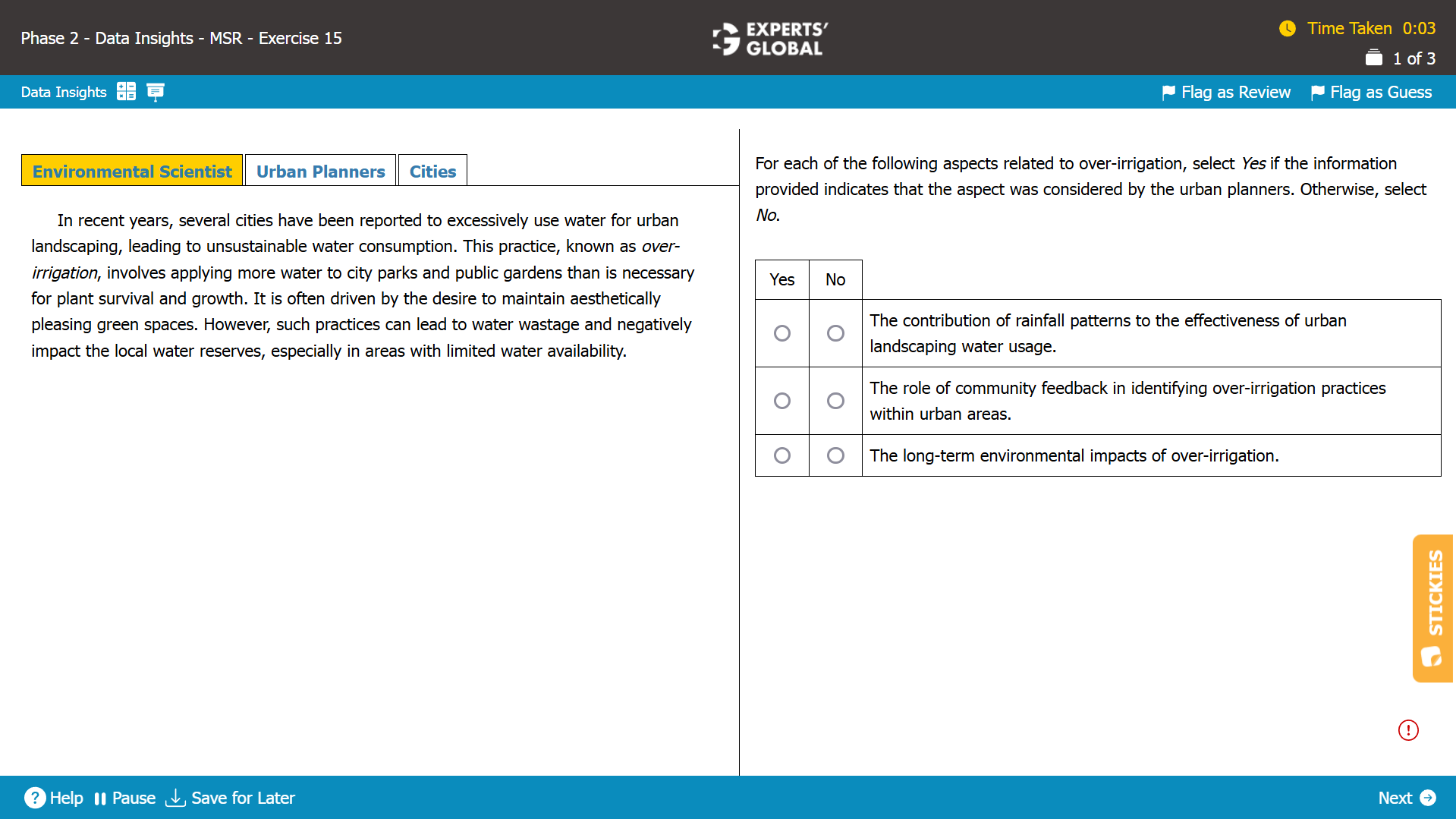
I.Rainfall patterns are not mentioned in any of the tabs.Thus, “No” is the correct answer choice.
II.The role of community feedback is not mentioned in any of the tabs.Thus, “No” is the correct answer choice.
III.The “Urban Planners” tab mentions that cities engaging in over-irrigation face detrimental environmental consequences over time, such as diminished groundwater reserves and escalating costs for water treatment.Thus, “Yes” is the correct answer choice.
Hence, No-No-Yes is the correct combination of answer choices.
Show correct answer to Question 2
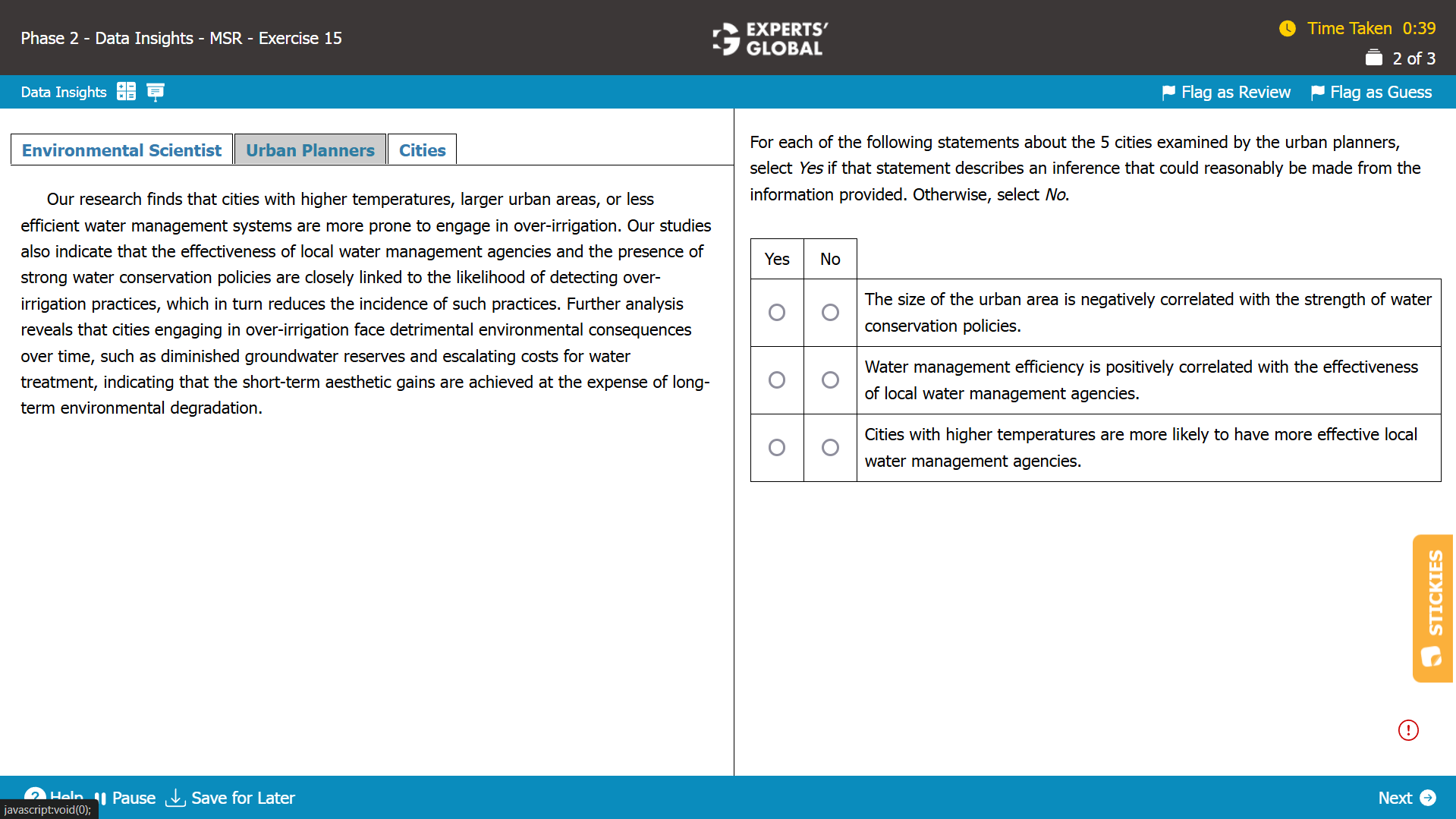
I.The five cities, ranked from the smallest urban area to the largest urban area, are Stonebridge, Belmont, Kingsford, Halcyon, and Cresthill.The five cities, ranked from the weakest to the strongest in terms of water conservation policies, are Halcyon, Kingsford, Cresthill, Stonebridge, and Belmont.Since the two rankings do not follow any noticeable pattern, we cannot infer that the size of the urban area is negatively correlated with the strength of water conservation policies.Thus, “No” is the correct answer choice.
II.The five cities, ranked from the least to the most efficient in terms of water management, are Halcyon, Stonebridge, Kingsford, Cresthill, and Belmont.The five cities, ranked from the least to the most effective in terms of local water management agencies, are Halcyon, Stonebridge, Kingsford, Cresthill, and Belmont.Since the two rankings are the same, we can infer that water management efficiency is positively correlated with the effectiveness of local water management agencies.Thus, “Yes” is the correct answer choice.
III.The five cities, ranked from the lowest temperature to the highest temperature, are Cresthill, Kingsford, Belmont, Stonebridge, and Halcyon.The five cities, ranked from the least to the most effective in terms of local water management agencies, are Halcyon, Stonebridge, Kingsford, Cresthill, and Belmont.Since the two rankings do not follow any noticeable pattern, we cannot infer that cities with higher temperatures are more likely to have more effective local water management agencies.Thus, “No” is the correct answer choice.
Hence, No-Yes-No is the correct combination of answer choices.
Show correct answer to Question 3
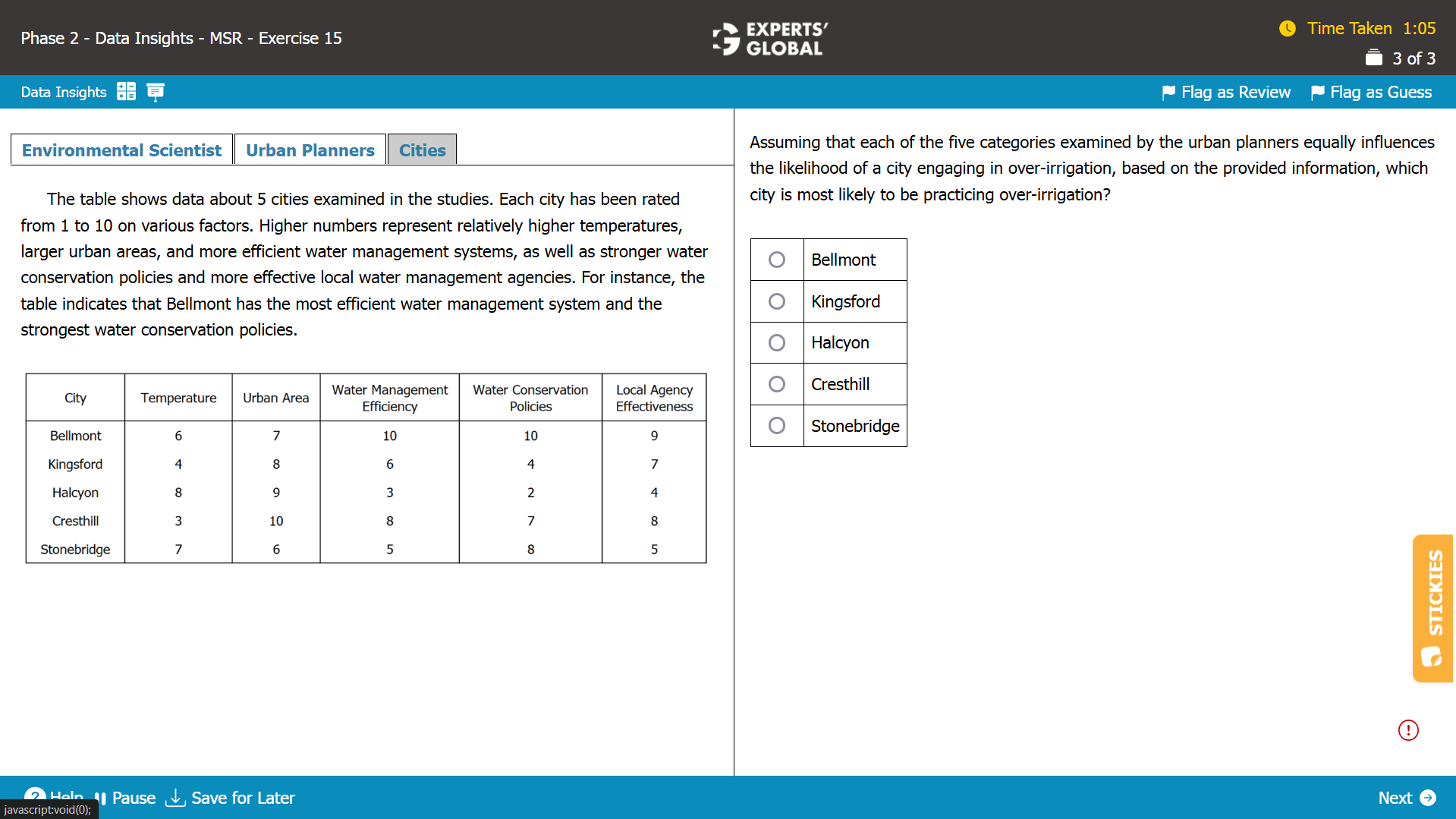
From the “Urban Planners” tab, we know that cities with higher temperatures, larger urban areas, or less efficient water management systems are more prone to engage in over-irrigation.
From the table, we see that Halcyon has the highest temperature, the second-largest urban area, and the least efficient water management system.
From the “Urban Planners” tab, we also know that the effectiveness of local water management agencies and the presence of strong water conservation policies reduces the incidence of over-irrigation.
From the table, we see that Halcyon has the least effective local water management agency and the weakest water conservation policies.
Thus, based on the information provided, Halcyon is most likely to be practicing over-irrigation.
Hence, C is the correct answer choice.
Sample MSR Set 2
Tab 1 + Question 1
Tab 2 + Question 2
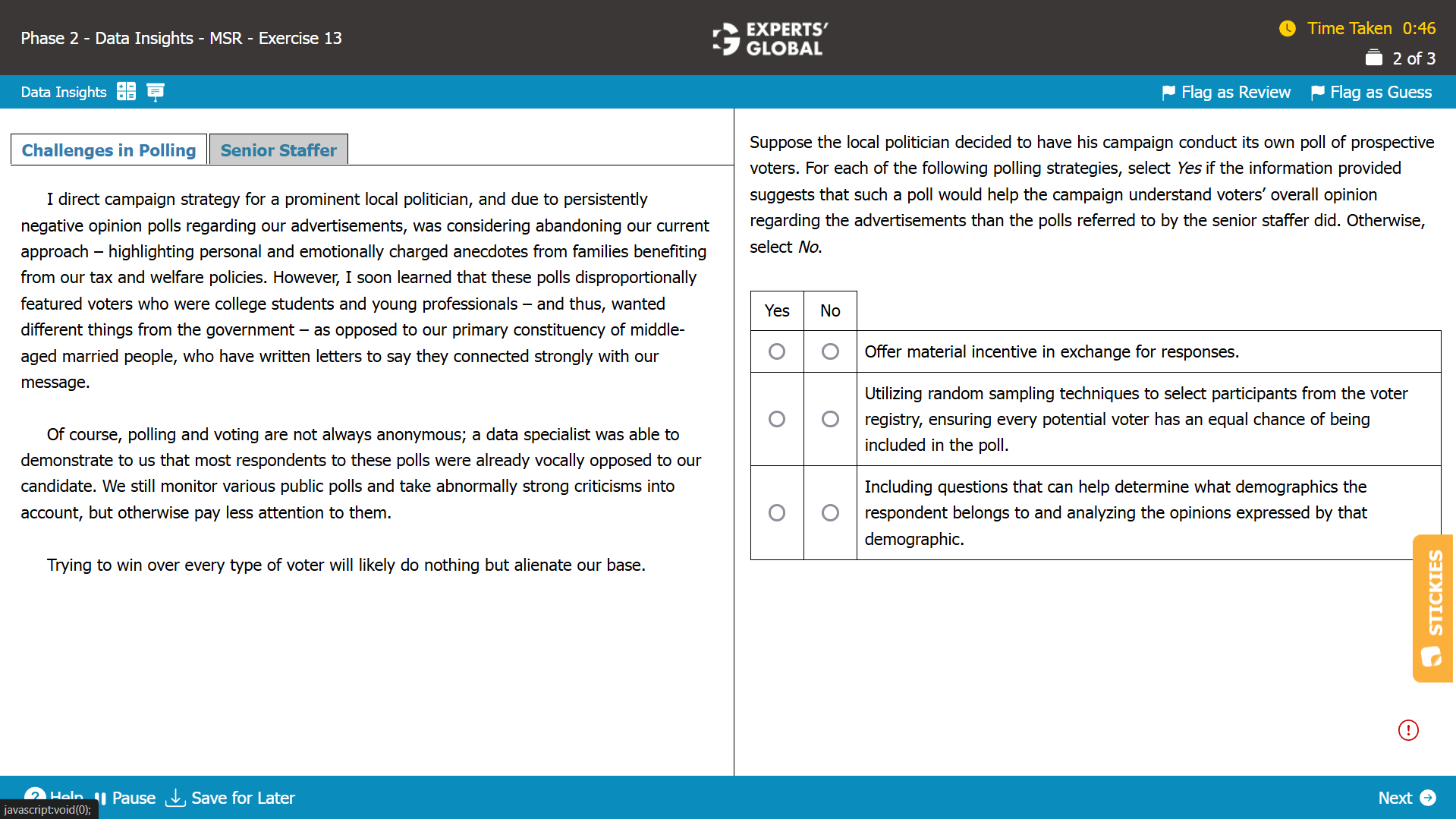
Tab 1 + Question 3
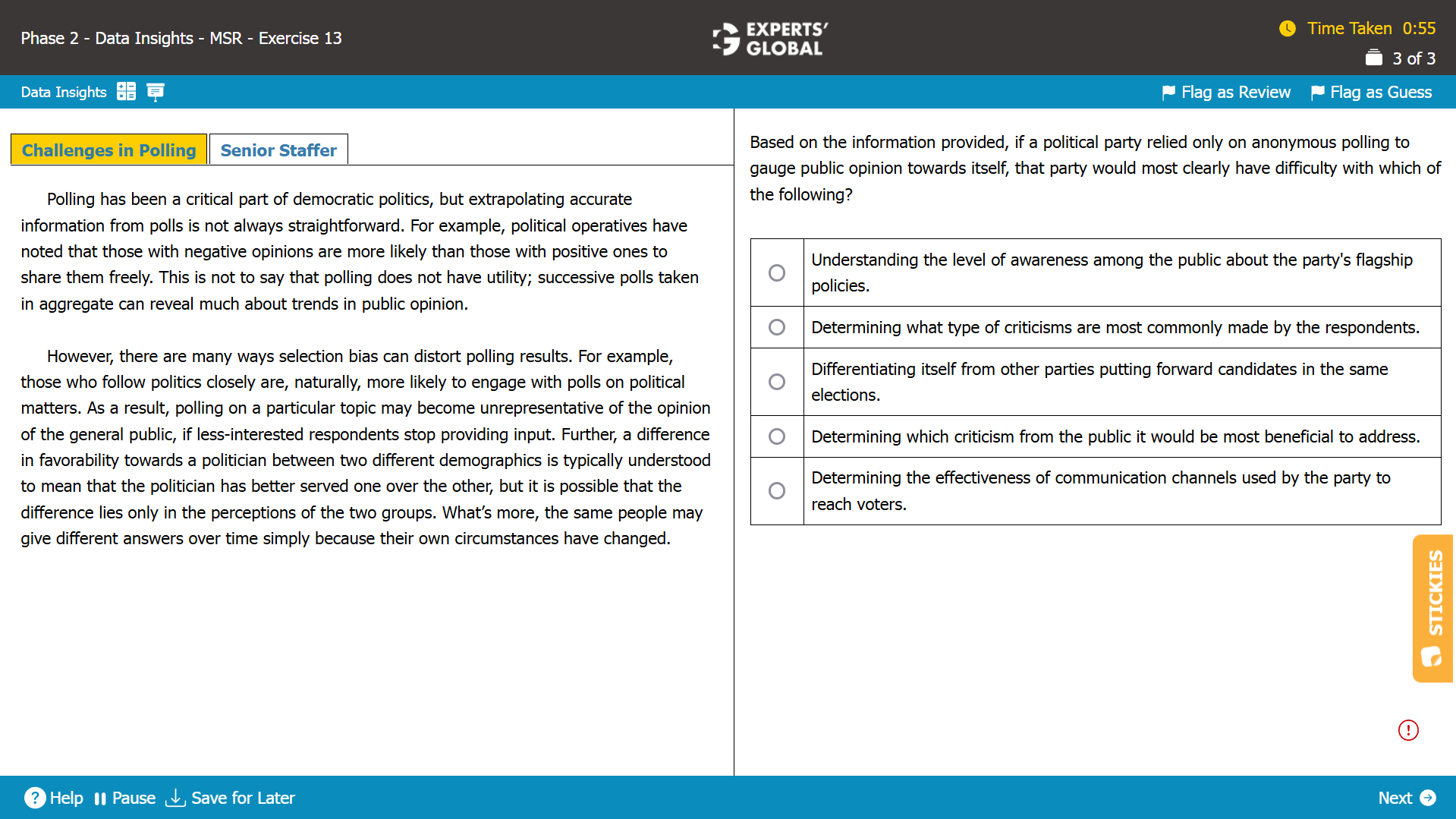
Show correct answer to Question 1
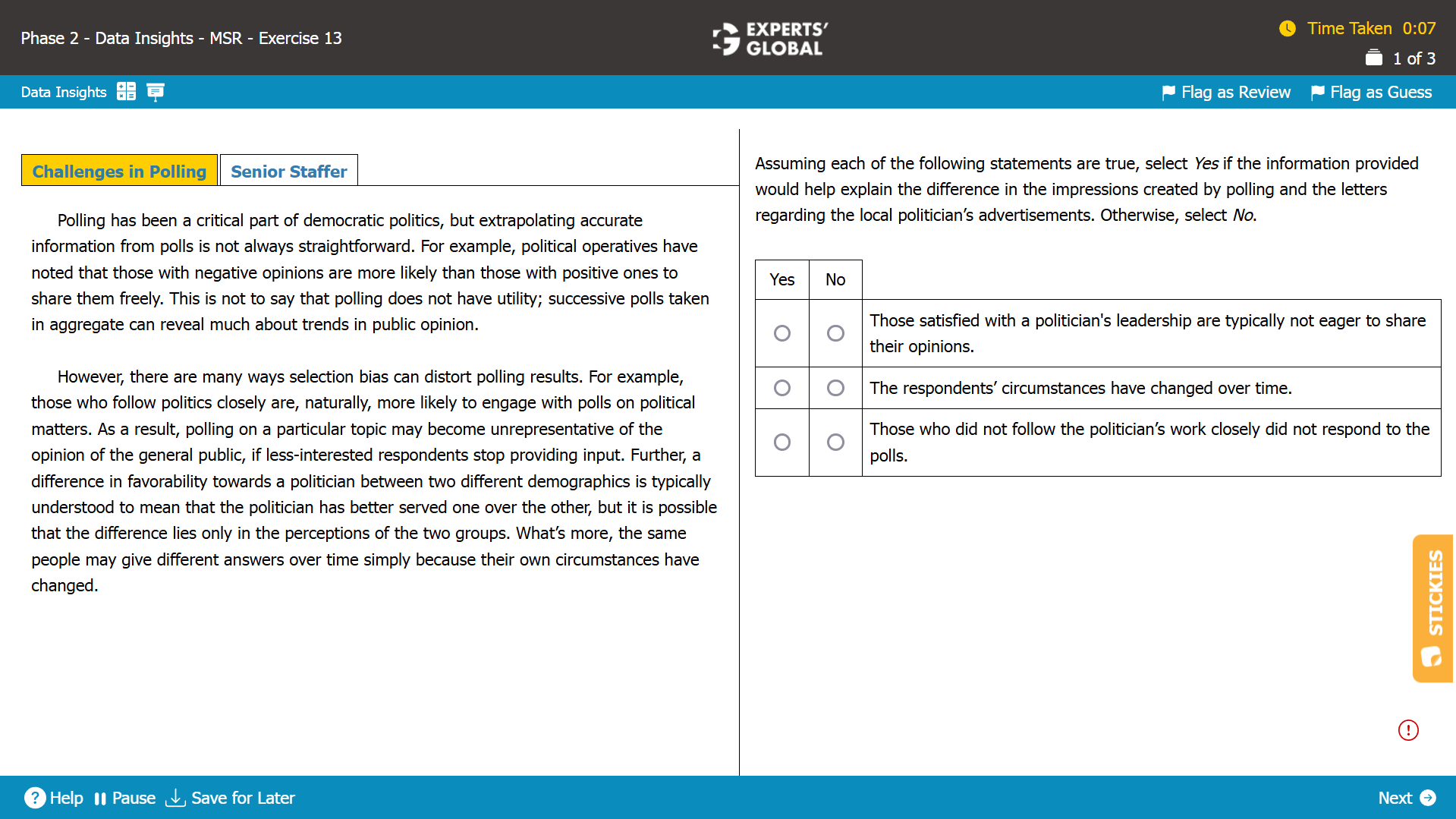
I.The “Challenges in Polling” tab indicates that people with negative opinions are more likely to share them, which suggests that those satisfied with the politician’s leadership (like the middle-aged married people who wrote supportive letters) may be less represented in the polls. This aligns with the senior staffer’s observation that the negative polls disproportionately featured demographics less supportive of the politician, thus explaining the discrepancy between the polls and the letters.Thus, “Yes” is the correct answer choice.
II.While respondents’ circumstances changing over time can affect polling results, in the context of the passage, the key issue lies in the demographic makeup of the poll respondents (college students and young professionals vs. middle-aged married people) rather than changes in individual circumstances.Additionally, there is no reason provided in the tabs to conclude that only the opinions of those responding negatively to the polls have changed over time.Thus, “No” is the correct answer choice.
III.The “Challenges in Polling” tab discusses how selection bias, including the likelihood of politically engaged individuals to respond to polls, can distort results. If those who did not follow the politician’s work closely were less likely to respond, this could contribute to the polling results being unrepresentative of the general public’s opinion.This aligns with the scenario where the primary constituency’s (middle-aged married people) views were underrepresented in the polls compared to college students and young professionals.Thus, “Yes” is the correct answer choice.
Hence, Yes-No-Yes is the correct combination of answer choices.
Show correct answer to Question 2
I.While offering material incentives might increase the overall response rate, it does not directly improve the representativeness of the poll or ensure that it captures the opinions of the campaign’s primary constituency more accurately.Thus, “No” is the correct answer choice.
II.Random sampling from the voter registry addresses the issue of selection bias by giving every voter an equal opportunity to participate, regardless of their demographic characteristics or political engagement levels. By ensuring a more representative sample of the electorate, the campaign can obtain a clearer and more accurate picture of the overall opinion regarding the advertisements.Thus, “Yes” is the correct answer choice.
III.Incorporating demographic questions helps accurately analyze diverse population segments, addressing previous polls’ bias towards certain demographics like college students over middle-aged married people. This strategy ensures the campaign obtains a representative overview of the overall opinion by understanding and adjusting for the demographic composition of respondents.Thus, “Yes” is the correct answer choice.
Hence, No-Yes-Yes is the correct combination of answer choices.
Show correct answer to Question 3
A. Even with anonymous responses, polling can successfully measure public awareness of specific policies by asking respondents directly about their familiarity with these initiatives, without needing to know the respondents’ identities. Thus, this answer choice is incorrect.
B. Even with anonymous polling, the party can aggregate criticisms to identify common themes and issues raised by the respondents, which does not inherently require knowing who the respondents are. Thus, this answer choice is incorrect.
C. Anonymous polling can still capture perceptions of the party in comparison to its competitors by asking respondents their opinions on different parties, which does not necessitate non-anonymous responses. Thus, this answer choice is incorrect.
D. The ‘Senior Staffer’ section highlights that the party’s primary constituency is middle-aged married people and cautions that attempting to appeal to every voter type might alienate this core base. With anonymous polling, the party cannot discern which criticisms originate from this crucial demographic, hindering its ability to focus on the most pertinent feedback. Thus, this answer choice is correct.
E. The party can evaluate which communication channels (social media, email, TV ads, etc.) are most effective in reaching the electorate by asking respondents anonymously about their media consumption habits and recall of political messaging, without linking this information to specific voter identities. Thus, this answer choice is incorrect.
Hence, D is the correct answer choice.
Additional Free GMAT-style Multi-Source Reasoning (MSR) Questions with Explanations:
Please find another set of GMAT-style MSR questions with explanations on: How to Solve GMAT Multi-Source Reasoning Questions
Please find 2 sets of GMAT-style MSR questions with explanations on: Free GMAT Multi-Source Reasoning Prep
Please find another set of GMAT-style MSR questions with explanations on: Free GMAT Data Insights Prep
Please find another set of GMAT-style MSR questions with explanations on: Free GMAT Data Insights Sample Questions
Please find 2 sets of GMAT-style MSR questions with explanations on: Free GMAT Sample Questions
For Further Prep and Practice:
15 full-length GMAT practice tests (includes a free test)
End-to-end GMAT prep course online (includes 7-day free trial)
GMAT 5-weeks crash course
GMAT Prep + Admission Consulting Bundle