The quantitative section on the GMAT is one of the three sections on the exam and therefore contributes to one-third of your overall score. In addition to this direct contribution, the concepts learned during quantitative section preparation also contribute indirectly to roughly half of the questions in the Data Insights section. For this reason, thorough and end to end coverage of all GMAT quantitative concepts is an essential component of any reliable GMAT preparation course. The GMAT quantitative section features only one question format, the problem solving question type, commonly referred to as PS. Each problem solving question presents a problem statement followed by five answer choices, out of which only one option is correct. Your task is to analyze the information provided, work through the required quantitative steps, and identify the correct answer choice.
On this page, we provide a brief introduction to the broad quantitative topics that appear in the GMAT Quant section and present problem solving (PS) sample questions organized by topic. These sample questions provide a firsthand experience of the topics and offer direct exposure to how GMAT quantitative problem solving questions appear across different concepts and test them. Ensure due learning from this rich resource and apply these learnings in subsequent GMAT exercises, GMAT sectional tests, and GMAT full-length practice tests. Happy practicing!
GMAT Quant: Number Properties Sample Questions
Number properties are the backbone of the quantitative section on tests like the GMAT. Nearly half of the questions in this section, either directly or indirectly, rely on number properties. Mastering these concepts will not only boost your performance in the quantitative section but also improve your ability to tackle quant-based problems in the Data Insights section. Becoming comfortable with numbers helps you think and calculate faster and more accurately, making a noticeable difference in your overall GMAT performance. Because of its importance, number properties should be one of the first topics you focus on in your GMAT prep. This topic is both engaging and relatively easy to grasp, laying the groundwork for more advanced concepts as you progress through your study plan.
Important: Before visiting the following sample question(s), if you would like a quick brush up of key Number Properties concepts, you may first visit: Free GMAT Number Properties Prep
Number Properties Sample Question 1
Written Explanation
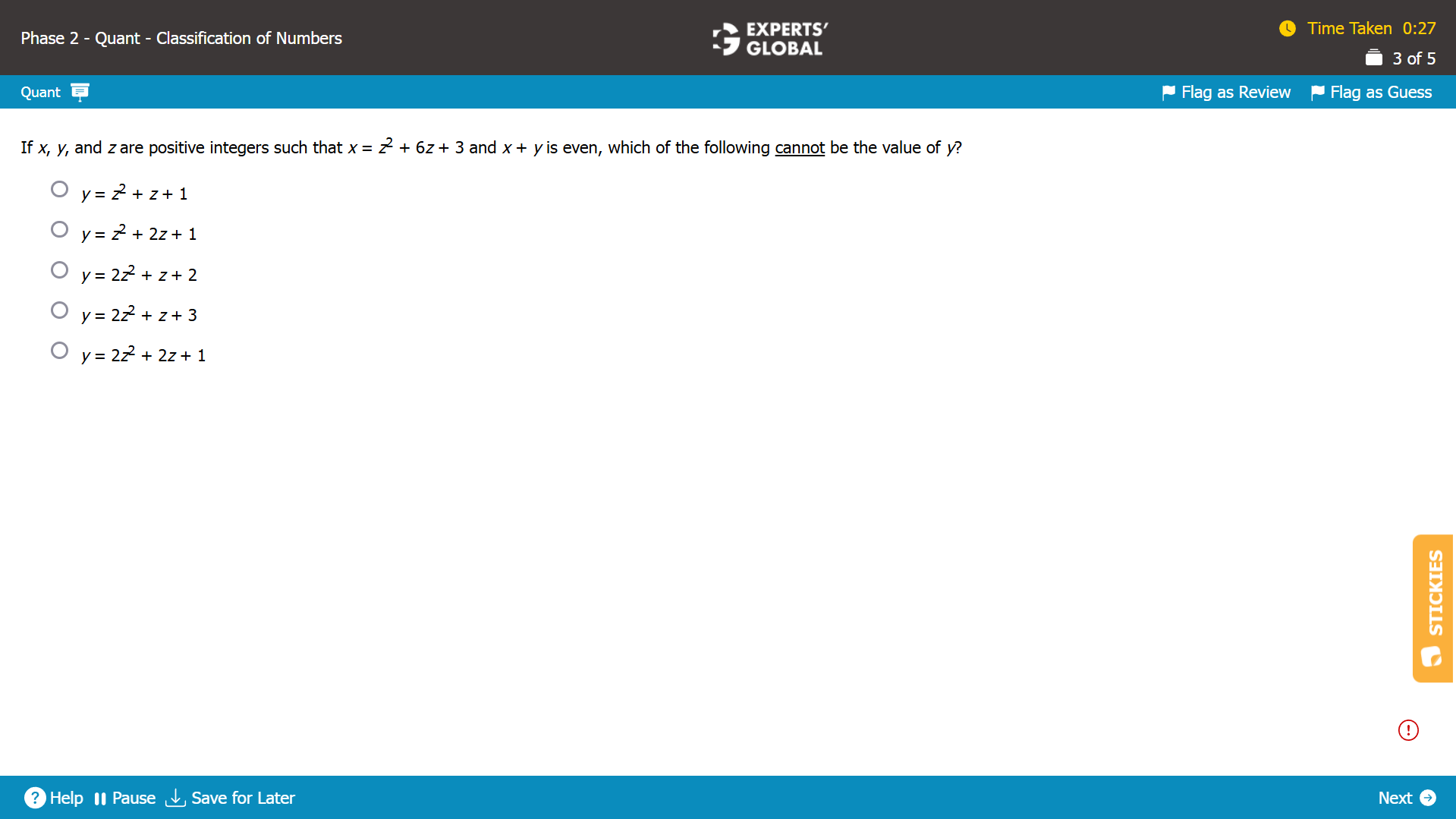
x = z2 + 6z + 3
We need to select the value of y for which (x + y) cannot be even.
A.
x + y = (z2 + 6z + 3) + (z2 + z + 1) = 2z2 + 7z + 4
Since 2z2 and 4 are even, 2z2 + 4 must be even.
However, since 7z can either be even or odd, x + y can either be even or odd.
Thus, this answer choice is incorrect.
B.
x + y = (z2 + 6z + 3) + (z2 + 2z + 1) = 2z2 + 8z + 4
Since 2z2, 8z, and 4 are even, x + y must be even.
Thus, this answer choice is incorrect.
C.
x + y = (z2 + 6z + 3) + (2z2 + z + 2) = 3z2 + 7z + 5
Possibility 1: If z is even, then 3z2 and 7z will be even. This implies that 3z2 + 7z will be even, and x + y will be odd.
Possibility 2: If z is odd, then 3z2 and 7z will be odd. This implies that 3z2 + 7z will be even, and x + y will be odd.
x + y cannot be even.
Thus, this answer choice is correct.
D.
x + y = (z2 + 6z + 3) + (2z2 + z + 3) = 3z2 + 7z + 6
Possibility 1: If z is even, then 3z2 and 7z will be even. This implies that 3z2 + 7z will be even, and x + y will be even.
Possibility 2: If z is odd, then 3z2 and 7z will be odd. This implies that 3z2 + 7z will be even, and x + y will be even.
x + y must be even.
Thus, this answer choice is incorrect.
E.
x + y = (z2 + 6z + 3) + (2z2 + 2z + 1) = 3z2 + 8z + 4
Since 8z and 4 are even, 8z + 4 must be even.
However, since 3z2 can either be even or odd, x + y can either be even or odd.
Thus, this answer choice is incorrect.
C is the correct answer choice.
Number Properties Sample Question 2
Written Explanation
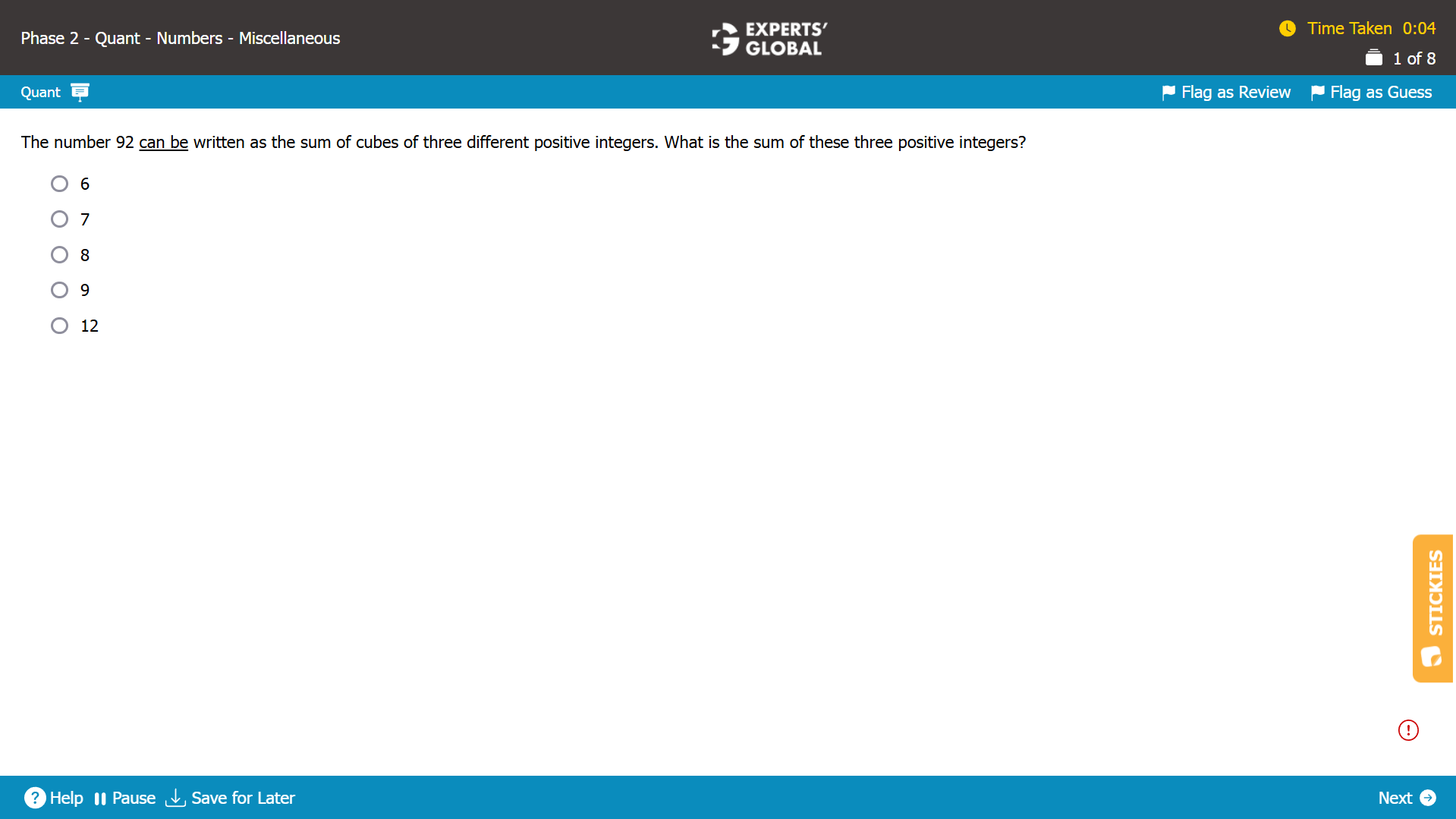
Let’s list the cubes of a few positive integers beginning with 1.
Cube of 1 = 1.
Cube of 2 = 8.
Cube of 3 = 27.
Cube of 4 = 64.
Cube of 5 = 125, greater than 92.
Because the sum of cubes of three different positive integers needs to be 92, the three different numbers will have to be three integers from {1,2,3,4}.
It can be observed that 1 + 27 + 64 = 92.
So, the three positive integers are 1, 3, and 4.
The sum of the three positive integers = 1 + 3 + 4 = 8.
C is the correct answer choice.
Number Properties Sample Question 3
Written Explanation
Let’s list the cubes of a few positive integers beginning with 1.
Cube of 1 = 1.
Cube of 2 = 8.
Cube of 3 = 27.
Cube of 4 = 64.
Cube of 5 = 125, greater than 92.
Because the sum of cubes of three different positive integers needs to be 92, the three different numbers will have to be three integers from {1,2,3,4}.
It can be observed that 1 + 27 + 64 = 92.
So, the three positive integers are 1, 3, and 4.
The sum of the three positive integers = 1 + 3 + 4 = 8.
C is the correct answer choice.
Number Properties Sample Question 4
Written Explanation
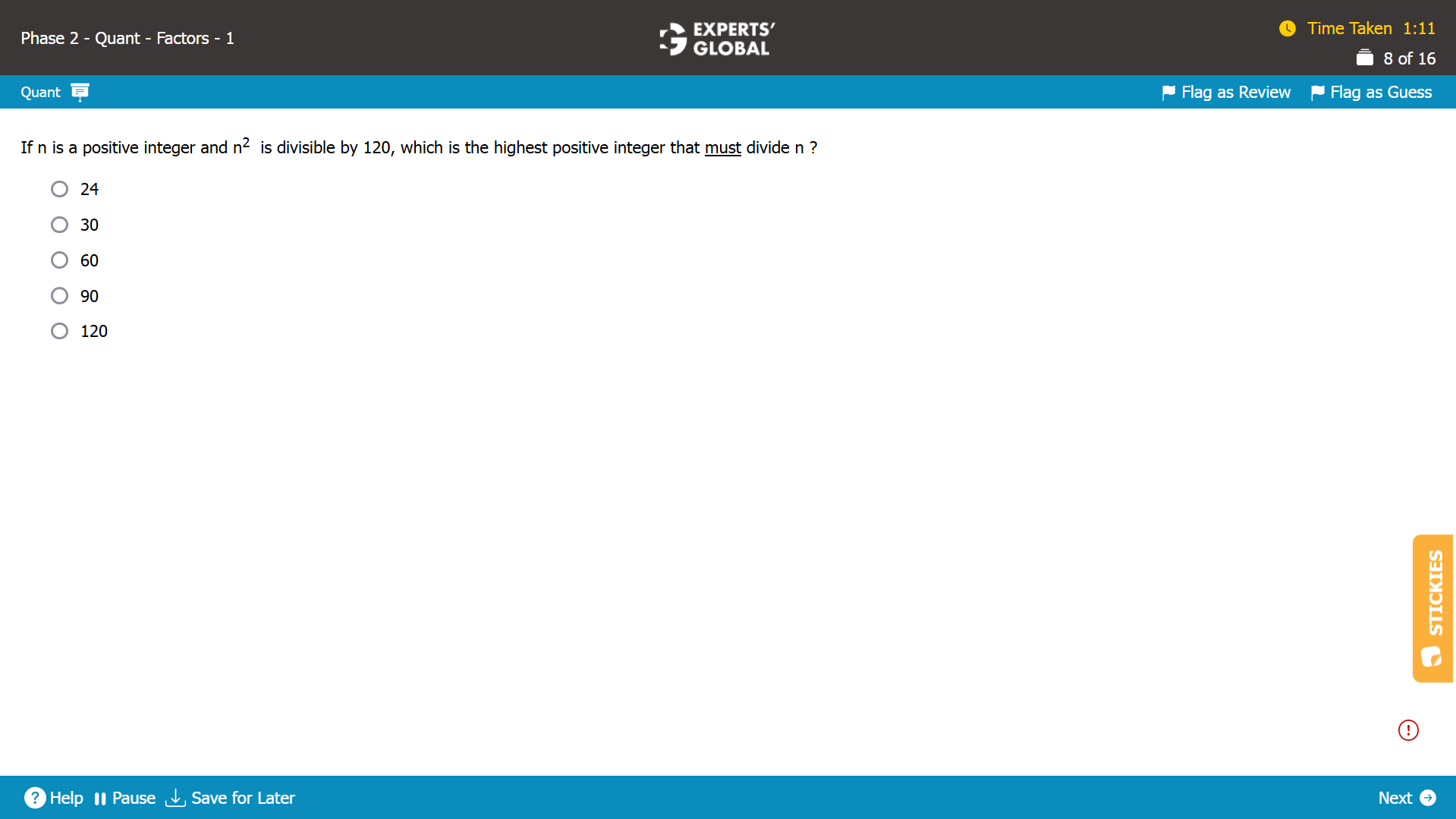
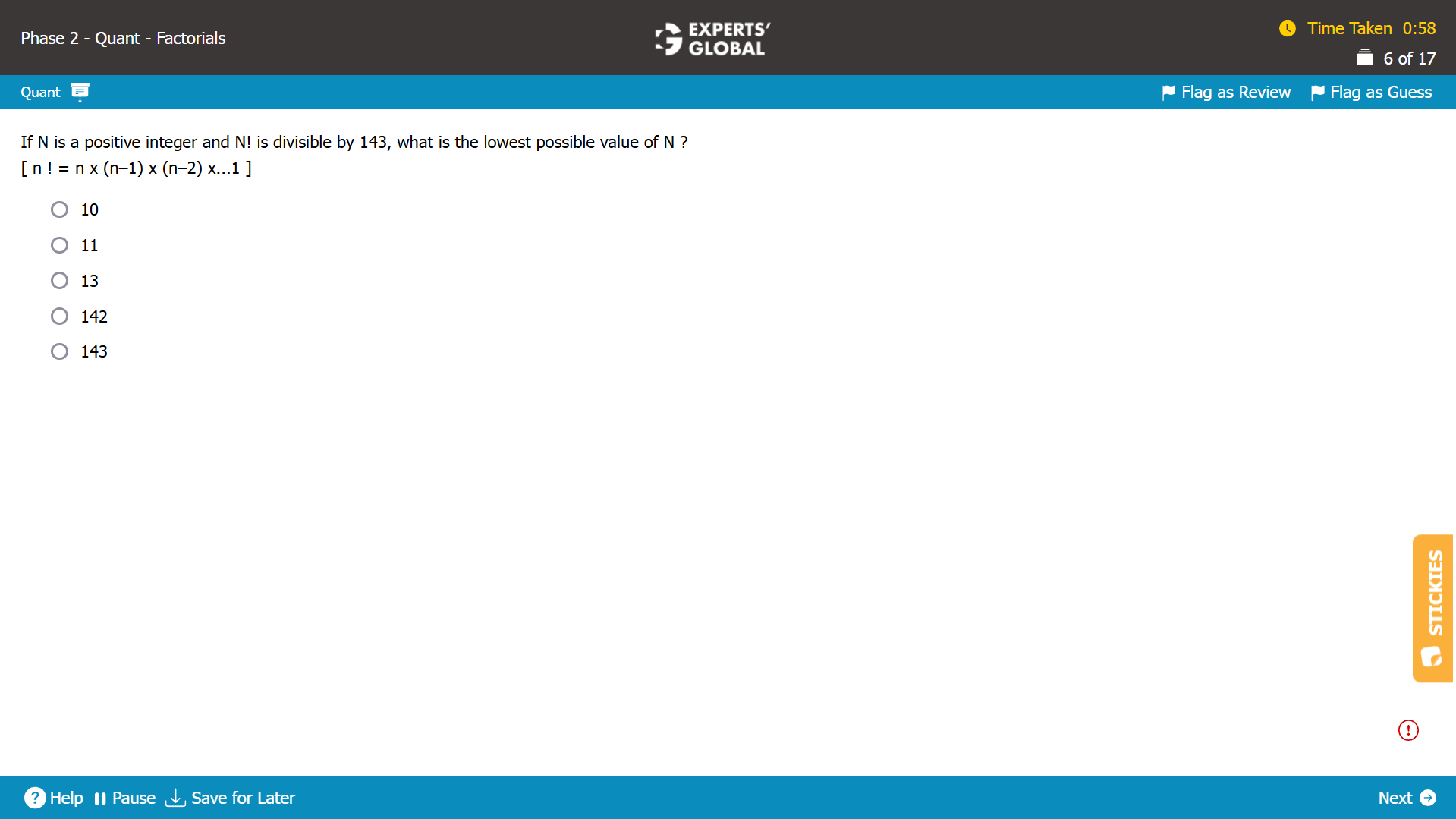
143 = 11 X 13
For any number to be divisible by 143, the number must have equal numbers of 11s and 13s.
The lowest possible value of N such that which N! contains equal numbers of 11s and 13s is 13.
In other words, 13! = (1 X 2 X 3 …X 11 X 12 X 13) is the first factorial that is a multiple of 11 X 13 = 143.
The lowest possible value of N is 13.
Please watch the video for an efficient solution to this problem.
C is the correct answer choice.
Number Properties Sample Question 5
Written Explanation
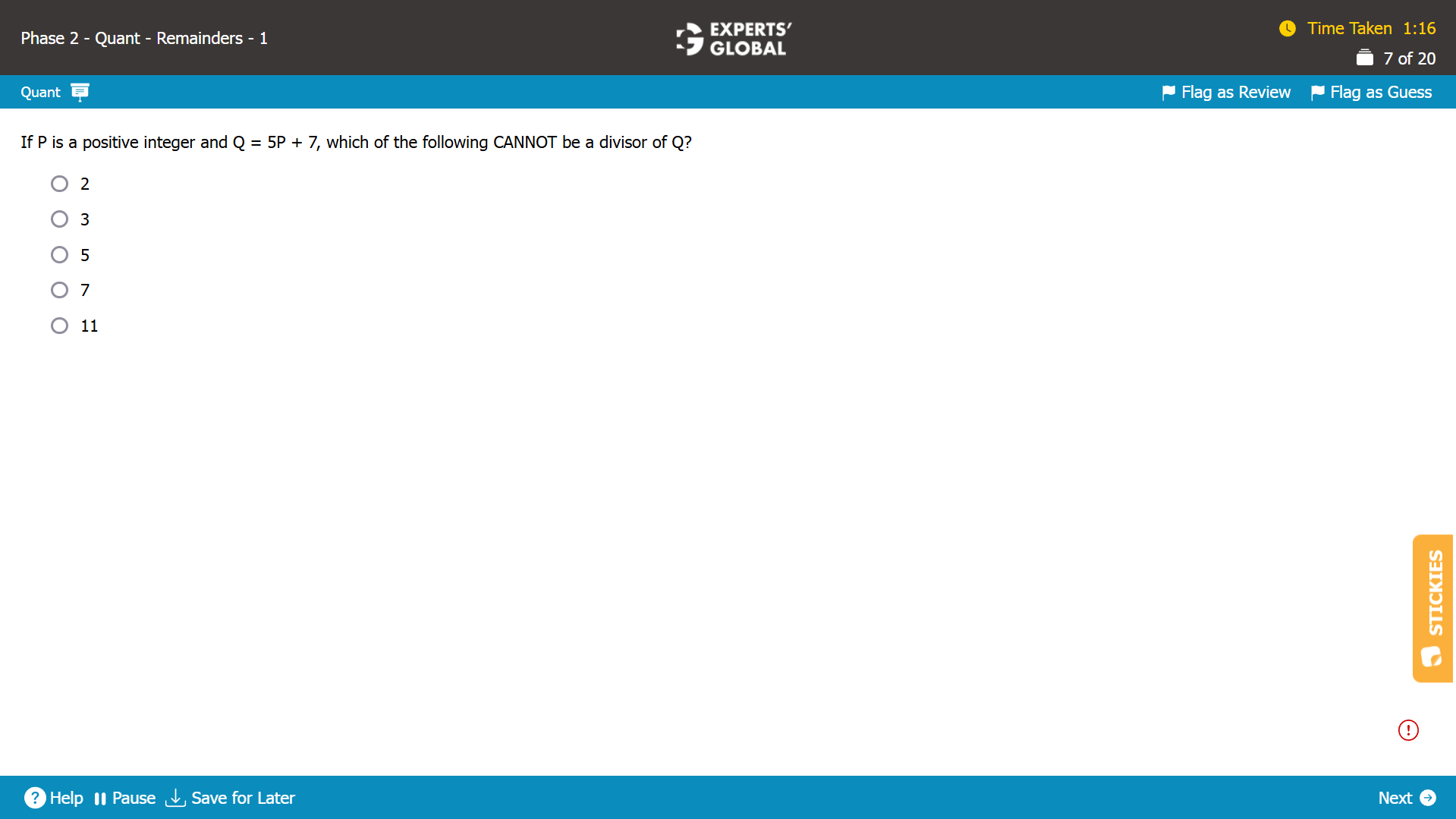
Q = 5P + 7
A.
For Q = 5P + 7 to be a multiple of 2…
5P + 1 needs to be a multiple of 2; in other words, 5P and P need to be odd.
For example, P = 5; Q = 5P + 7 = 25 + 7 = 32, a multiple of 2.
So, 2 can be a divisor of Q. Incorrect.
B.
For Q = 5P + 7 to be a multiple of 3…
5P + 1 needs to be a multiple of 3; in other words, 5P needs to be 1 less than a multiple of 3.
For example, P = 4; Q = 5P + 7 = 20 + 1 = 21, a multiple of 3.
So, 3 can be a divisor of Q. Incorrect.
C.
For Q = 5P + 7 to be a multiple of 5…
5P + 2 needs to be a multiple of 5. However, 5P itself is a multiple of 5. So, 5P + 2 cannot be a multiple of 5.
So, 5 cannot be a divisor of Q. Correct.
D.
For Q = 5P + 7 to be a multiple of 7…
5P needs to be a multiple of 7.
For example, P = 7; Q = 5P + 7 = 35 + 7 = 42, a multiple of 7.
So, 7 can be a divisor of Q. Incorrect.
E.
For Q = 5P + 7 to be a multiple of 11…
5P – 4 needs to be a multiple of 11; in other words, 5P needs to be 4 more than a multiple of 11.
For example, P = 3; Q = 5P + 7 = 15 + 7 = 22, a multiple of 11.
So, 11 can be a divisor of Q. Incorrect.
C is the correct answer choice.
Number Properties Sample Question 6
Written Explanation
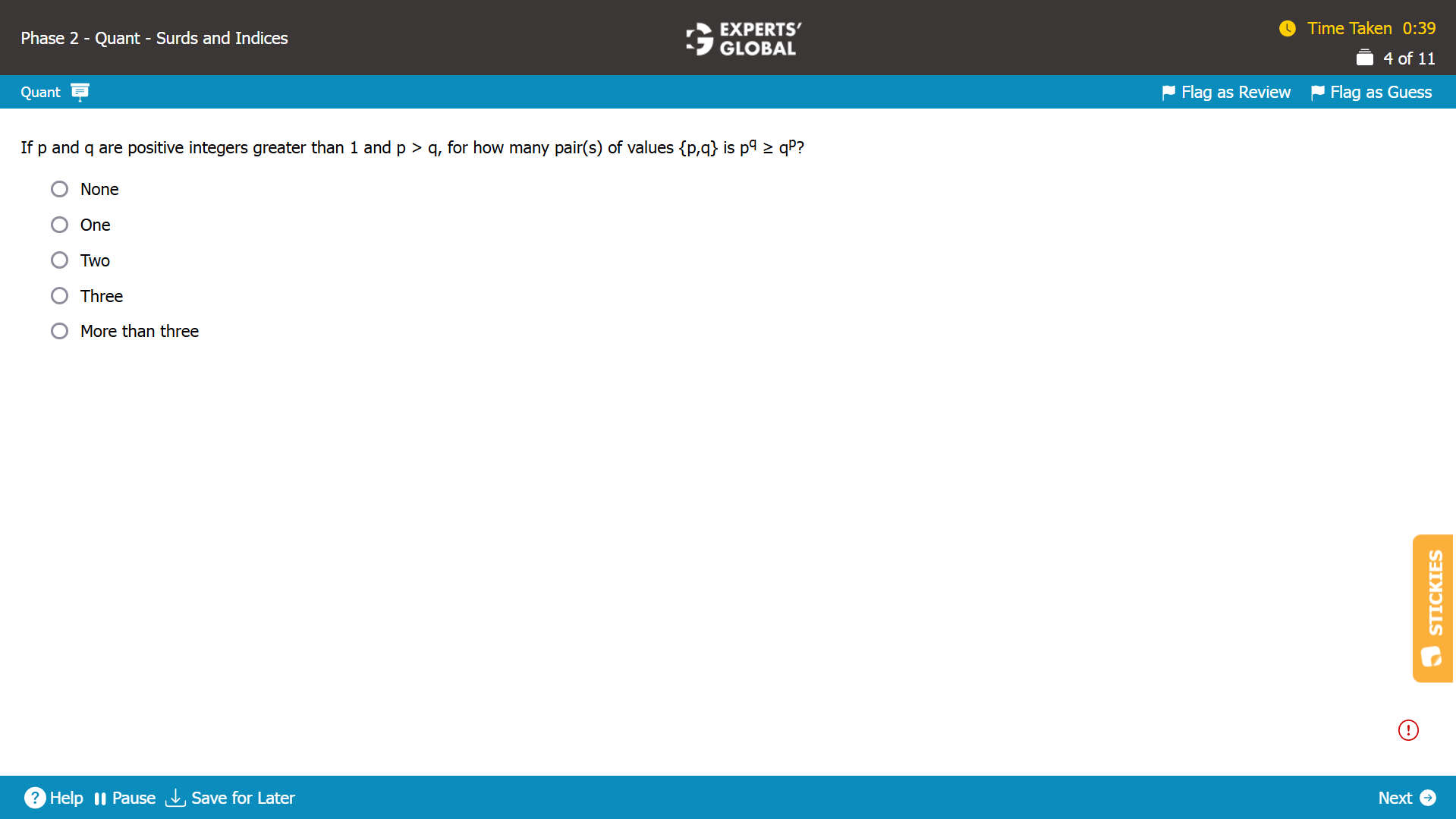
pq ≥ qp can happen only for small positive numbers. With trial and errors, we learn that {3,2} and {4,2} are the only two possible pairs.
Hence, C is the correct answer choice.
Number Properties Sample Question 7
Written Explanation
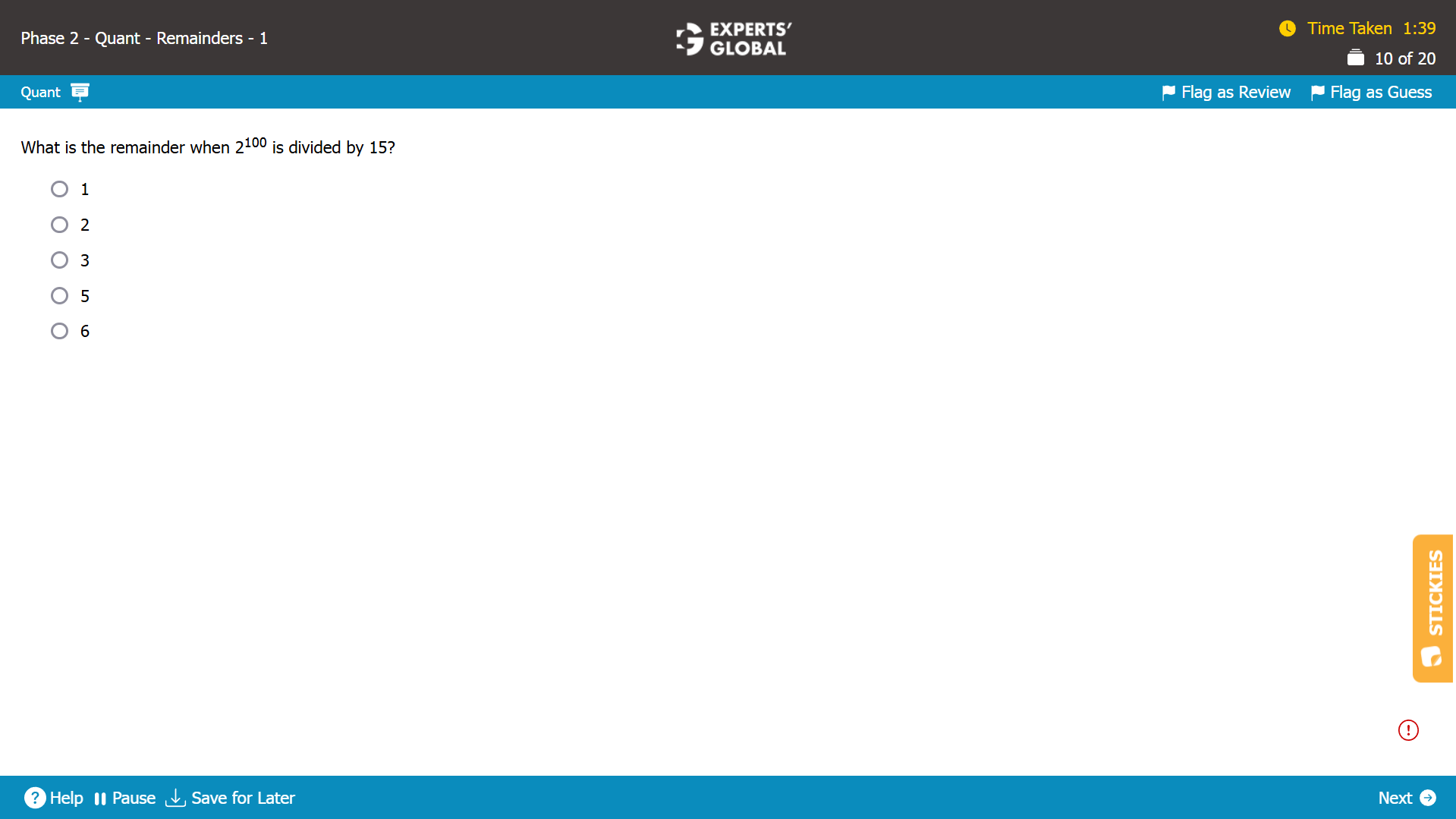
2100 = (24)25 = 1625
Remainder when 2100 is divided by 15 = Remainder when 1625 is divided by 15
= Remainder when (16 X 16 X 16 …25 times) is divided by 15
= (Remainder when 16 is divided by 15)25
The remainder when 16 is divided by 15 = 1
(Remainder when 16 is divided by 15)25 = 125 = 1
So, remainder when 2100 is divided by 15 = 1.
A is the correct answer choice.
Number Properties Sample Question 8
Written Explanation
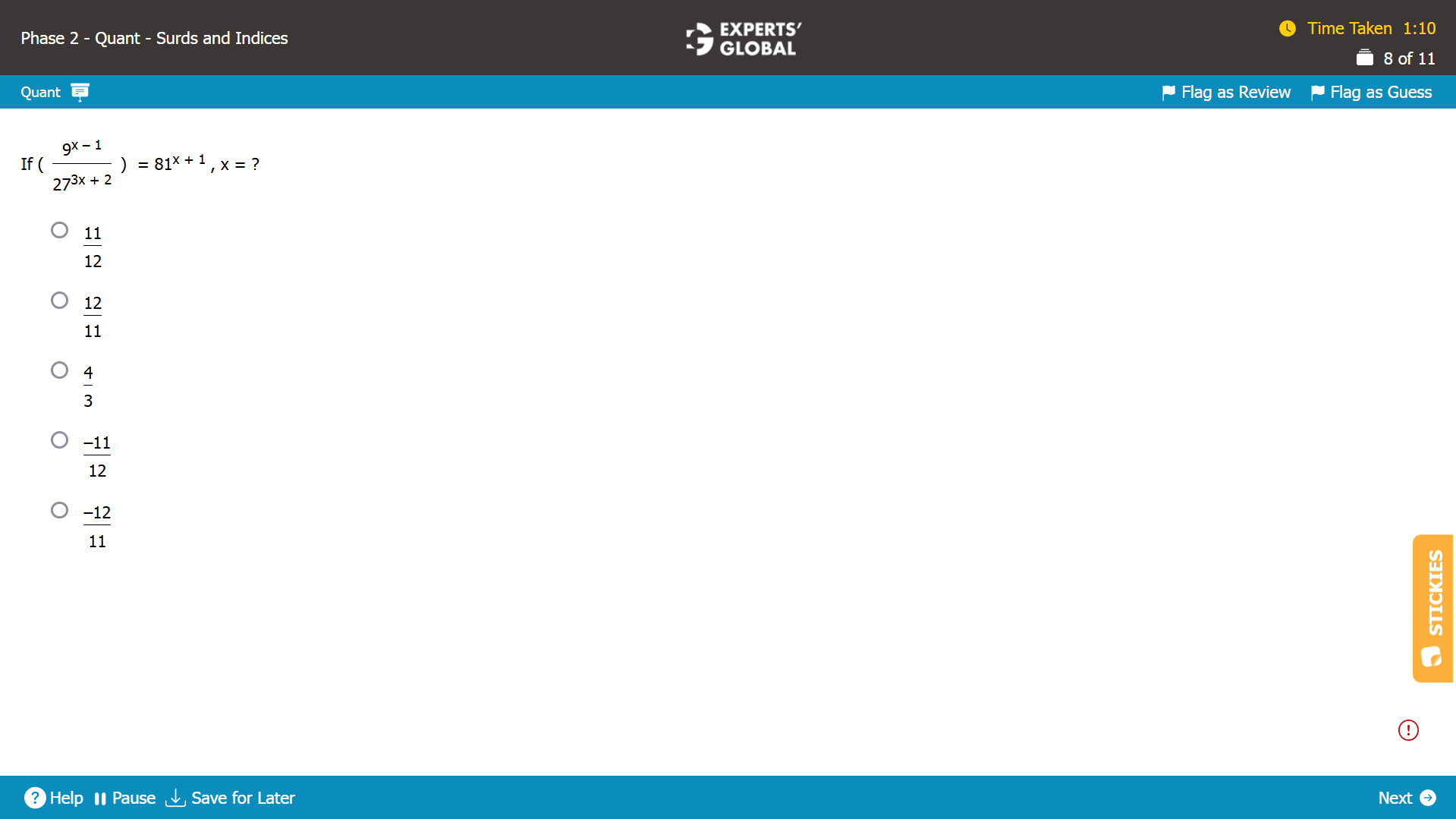
(9x – 1 / 273x + 2) = 81x + 1 … (Equation I)
Expressing every number in the power of 3…
9x – 1 = (32)x – 1 = 3(2x – 2)
273x + 2 = (33)3x + 2 = 3(9x + 6)
81x + 1 = (34)x + 1 = 3(4x + 4)
Substituting all the values in Equation I…
(3(2x – 2) / 3(9x + 6)) = 3(4x + 4)
3((2x – 2) – (9x + 6)) = 3(4x + 4)
Since the bases are the same, powers can be directly compared.
(2x – 2) – (9x + 6) = (4x + 4)
–7x – 8 = 4x + 4
11 x = –12
x = –12/11
E is the correct answer choice.
Number Properties Sample Question 9
Written Explanation
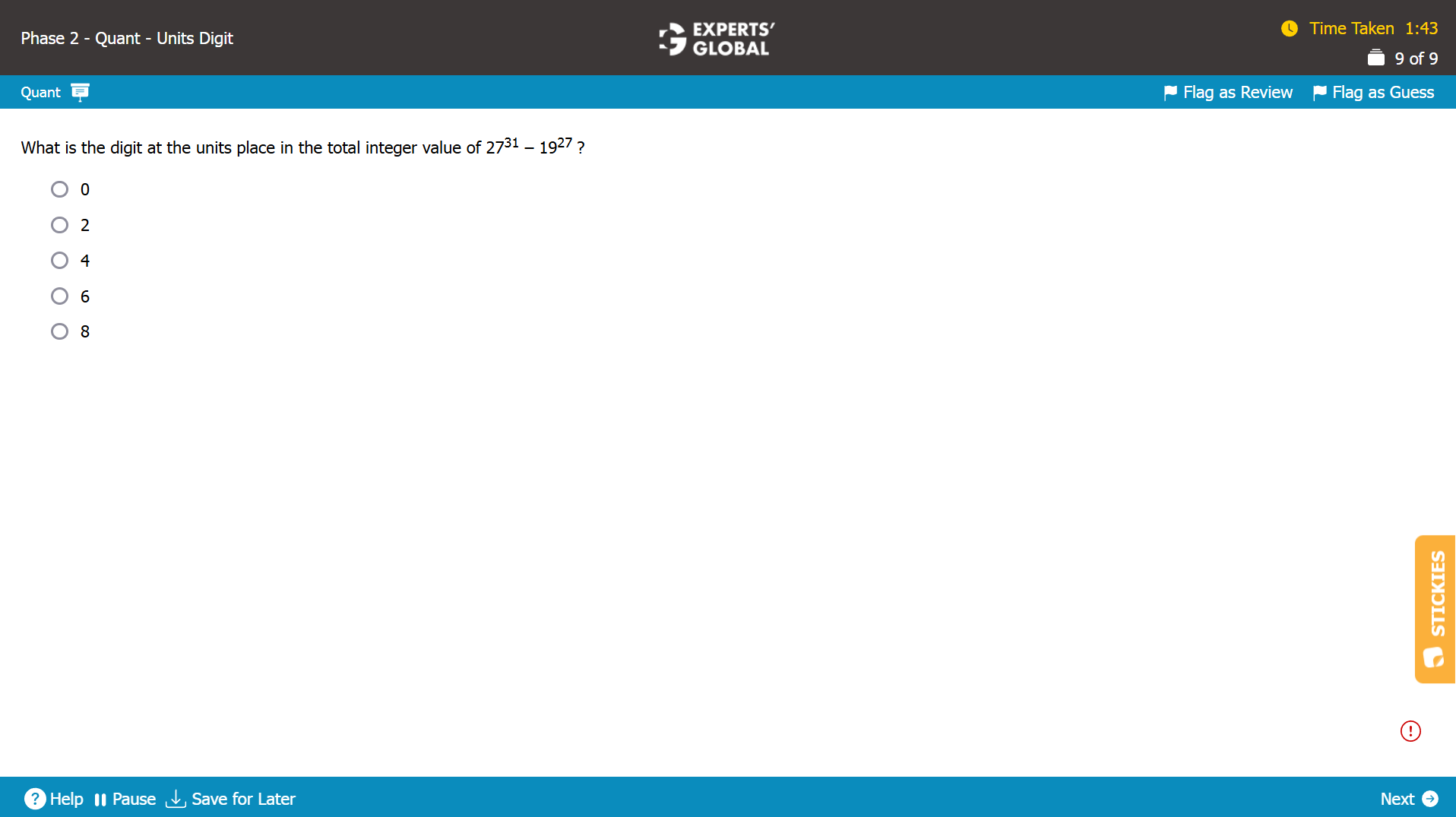
2731 has a greater base and a greater power than 1927.
So, 2731 > 1927.
Hence, units digit in the total integer value of 2731 – 1927 = units digit in 2731 – units digit in 1927.
Units digit in 2731 = units digit in 731.
71 = 7 has last digit 7.
72 will have last digit of 7 X 7 = last digit of 49 = 9.
73 will have last digit of 9 X 7 = last digit of 63 = 3.
74 will have last digit of 3 X 7 = last digit of 21 = 1.
75 will have last digit of 1 X 7 = last digit of 7 = 7.
From the 5th power onwards, the last digits will repeat in the {7, 9, 3, 1} cycle with 4 terms.
31 = 4 X 7 + 3; so, 31 leaves the remainder of 3 in the cycle of 4.
So, the 31 – 3 = 28th power will complete 7 cycles of {7, 9, 3, 1}, and the 31st power will have the units digit of 3, the third term in the cycle.
So, units digit in 2731 = 3.
Units digit in 1927 = units digit in 927.
91 = 9 has last digit 9.
92 will have last digit of 9 X 9 = last digit of 81 = 1.
93 will have last digit of 1 X 9 = last digit of 9 = 9.
From the 3rd power onwards, the last digits will repeat in the {9, 1} cycle with 2 terms.
27 = 2 X 13 + 1; so, 27 leaves the remainder of 1 in the cycle of 2.
So, the 27 – 1 = 26th power will complete 13 cycles of {9, 1}, and the 27th power will have the units digit of 9, the first term in the cycle.
So, units digit in 1927 = 9.
Overall.
Units digit in the total integer value of 2731 – 1927 = units digit in 2931 – units digit in 1927 = 3 – 9
Please note that because 9 is greater than 3 and because the last digit cannot be negative, there will be a carry that needs to be borrowed in this subtraction. In other words, the units digit will be the units digit of (13 – 9), rather than (3 – 9).
So, units digit in the total integer value of 2731 – 1927 = 13 – 9 = 4.
Units digit in the total integer value of 2731 – 1927 will be 4.
C is the correct answer choice.
Number Properties Sample Question 10
Written Explanation
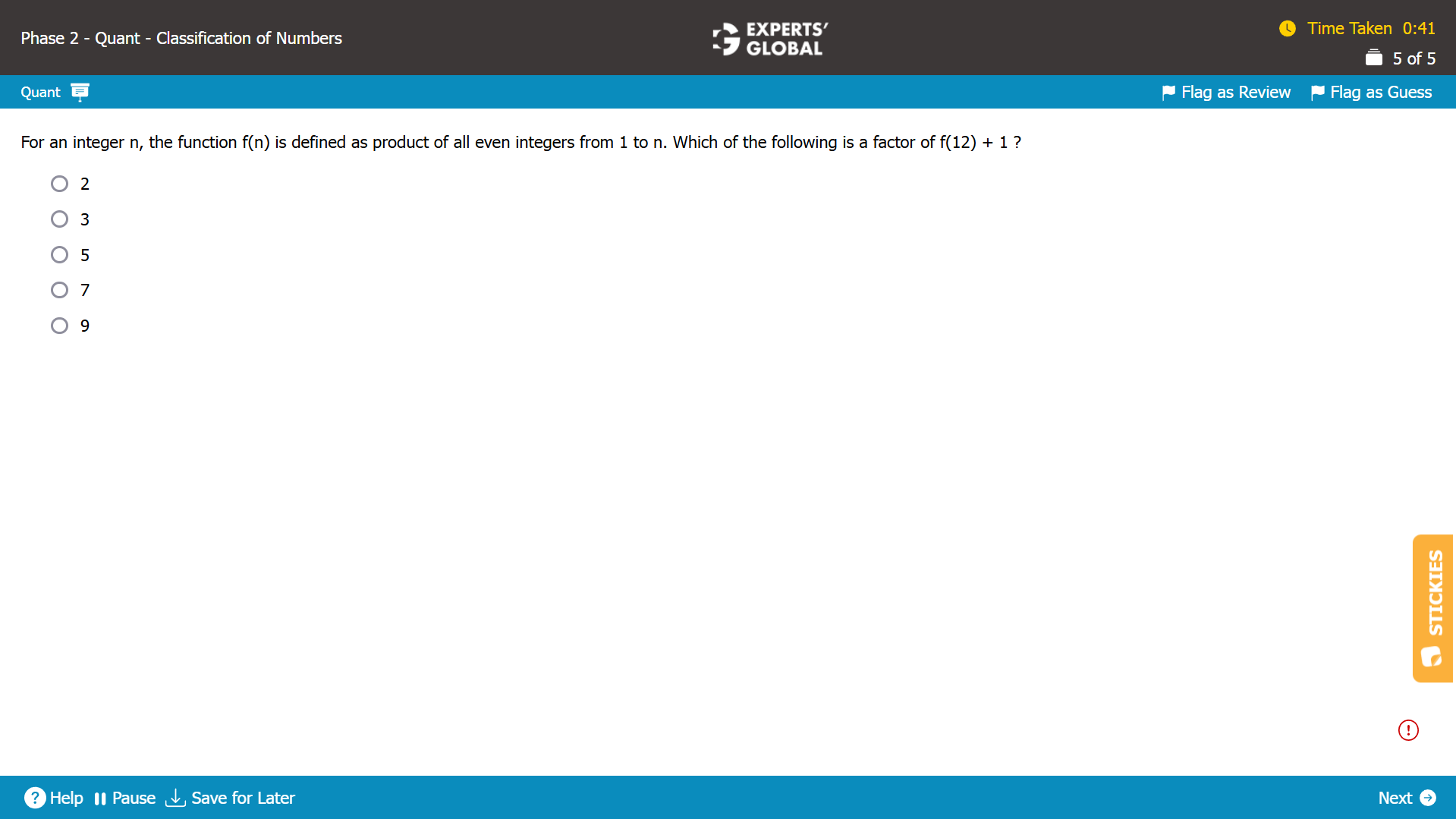
f(12) = 2 X 4 X 6 X 8 X 10 X 12 = 46080
f(12) + 1 = 46081
46081 is odd; so, 2 cannot be a factor.
The digits of 46081 add up to 4 + 6 + 0 + 8 + 1 = 19. 19 is not a multiple of 3. So, 3 cannot be a factor.
Additionally, 3 cannot be a factor of 46081. So, 9 cannot be a factor.
The last digit of 46081 is neither 0 nor 5. So, 5 cannot be a factor.
The only possible factor from the given answer choice is 7.
It can be verified that 46081 / 7 = 6583
7 is a factor of f(12) + 1.
[Alternatively….
f(12) = 2 X 4 X 6 X 8 X 10 X 12
f(12) +1 = (2 X 4 X 6 X 8 X 10 X 12) + 1
2 is a factor of f(12). So, 2 cannot be a factor of f(12) + 1.
3 is a factor of f(12). So, 3 cannot be a factor of f(12) + 1.
Additionally, 9 cannot be a factor of f(12) + 1.
10 is a factor of f(12). So, 10 cannot be a factor of f(12) + 1. As a result, 5 cannot be a factor of f(12) + 1.
The only possible factor from the given answer choice is 7.
It can be verified that 46081 / 7 = 6583
7 is a factor of f(12) + 1.]
D is the correct answer choice.
GMAT Quant: Overlapping Sets Sample Question
Overlapping sets problems describe situations where the same people or objects fit into two or more groups at once. Your job is to see exactly where the groups overlap, how they connect, and what that means for the totals. These questions reward clear organization and careful counting, so you stay in control and avoid small, costly mix ups.
Important: Before visiting the following sample question(s), if you would like a quick brush up of key Overlapping Sets concepts, you may first visit: Free GMAT Overlapping Sets Prep
Practice Question 1
Written Explanation
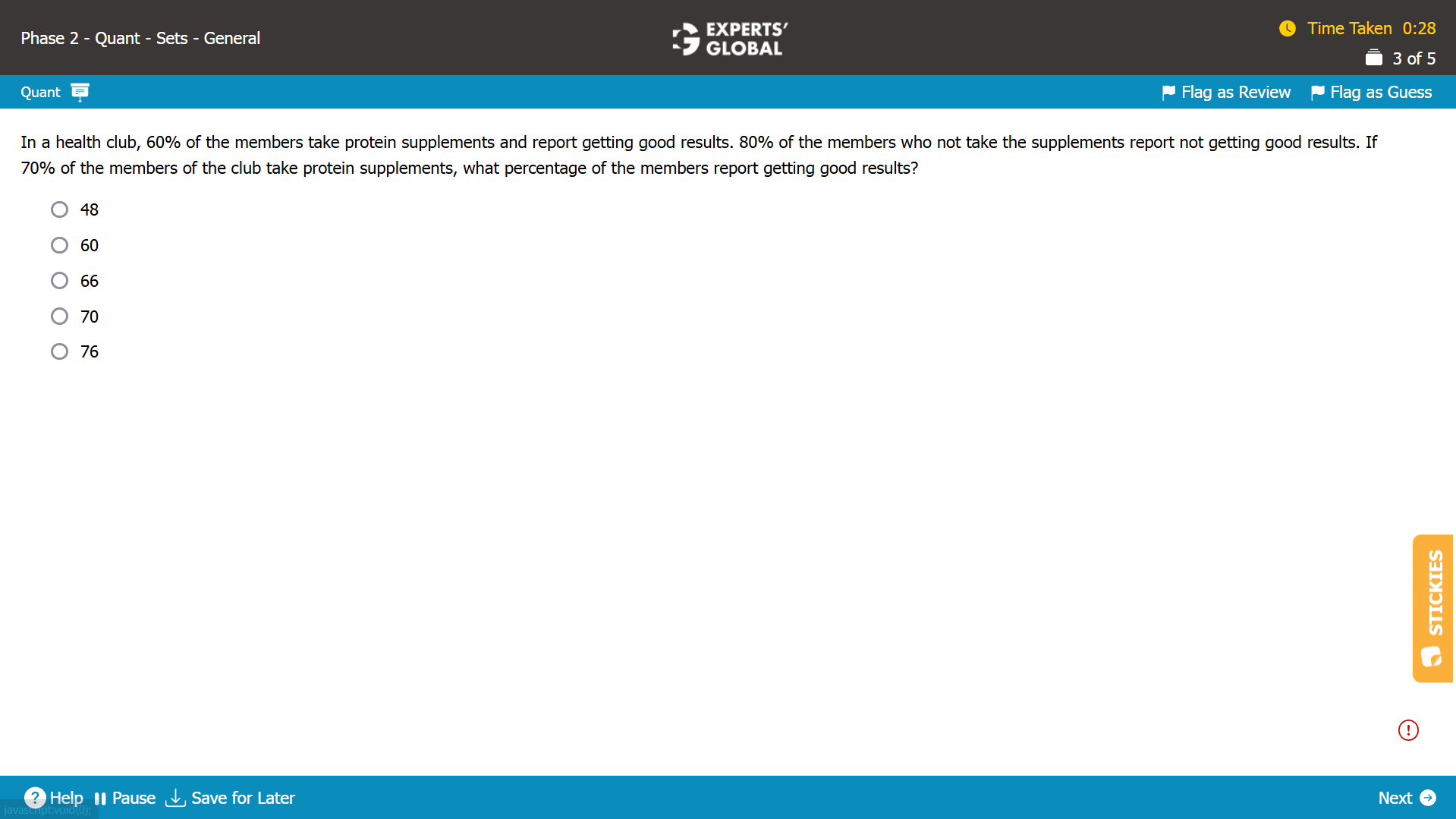
Members who take protein supplements and report getting good results = B = 60%.
Members who do not take protein supplements = C + D
80% of these members report not getting good results.
So, D = (80 / 100) X (C + D)
5D = 4C + 4D
D = 4C
Members who take protein supplements = A + B = 70%
(A + B) + C + D = 100%
(70) + C + 4C = 100
5C = 30
C = 6%.
D = 4 X 6 = 24%.
Members getting good results = B+ C= 60 + 6 = 66%.
66% members report getting good results.
C is the correct answer choice.
Practice Question 2
Written Explanation
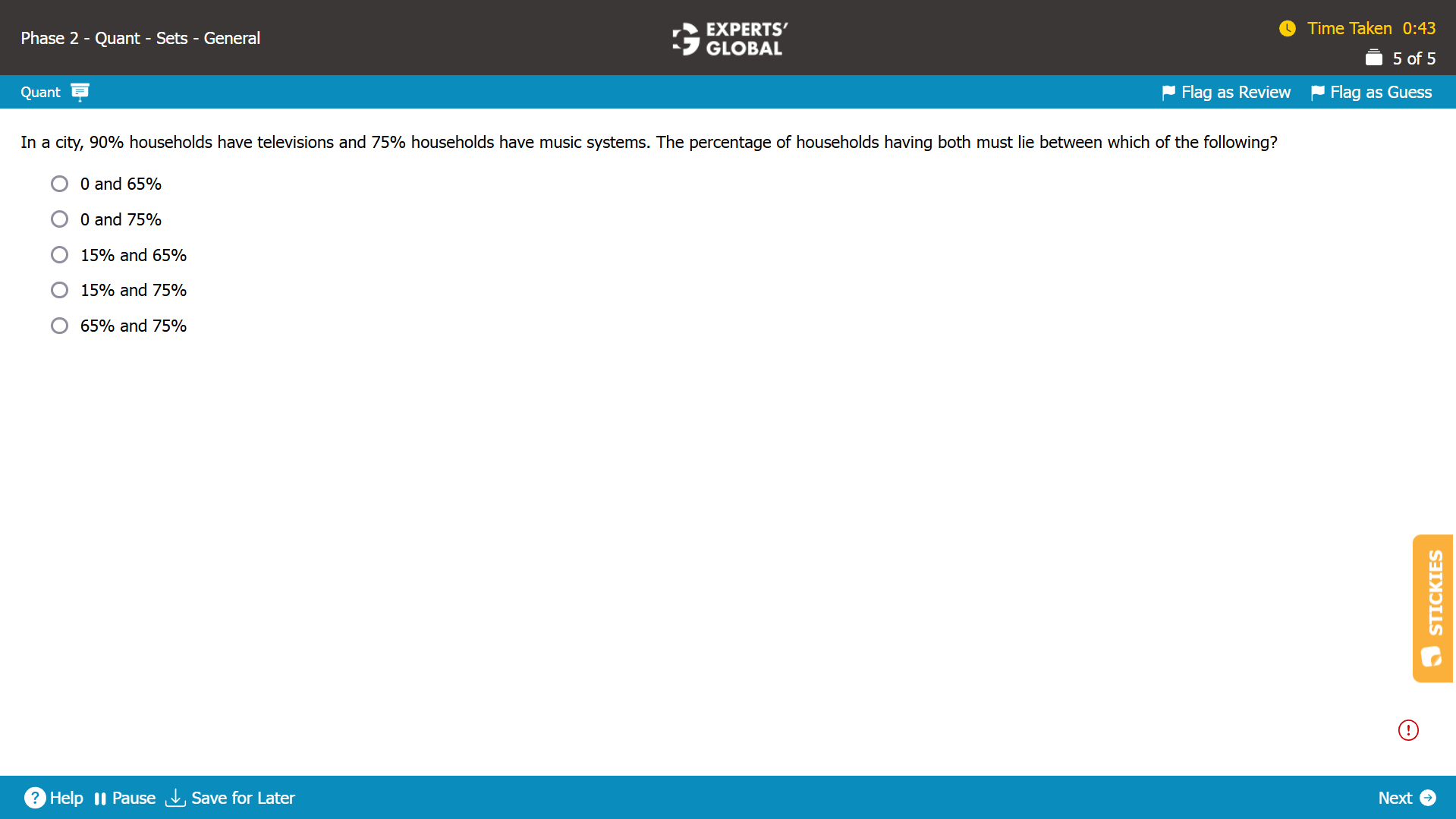
A + B = 90%.
B + C = 75%.
To determine the range of the percentage of households having both appliances, the maximum and minimum limits need to be determined.
Let’s say there is NO overlap between the two sets. So, there would have to be 90% + 75% = 165% households. However, there can only be 100% households. So, 165% – 100% = 65% is the minimum overlap. In other words, the minimum percentage of households having both appliances is 65%.
Let’s say there is COMPLETE overlap between the two sets. So, all of the 75% of households with music systems also have televisions. However, all of the 90% households with the television cannot have music systems because music system is available only in 75% of households. In other words, the maximum percentage of households having both appliances is 75%.
So, the range of the percentage of households having both the appliances is from 65% to 75%.
E is the correct answer choice.
Practice Question 3
Written Explanation
When three sets intersect…
(Set 1 population + Set 2 population + Set 3 population) – (the population common in two sets) + (the population common in all the three sets) + (the population in no set) = Total population
This can be verified from the above diagram as follows.
((A + E + G + D) + (B + E + F + D) + (C + G + F + D)) – (E + D + F + D + G + D) + D + H = A + B + C + E + F + G +D + H
So,
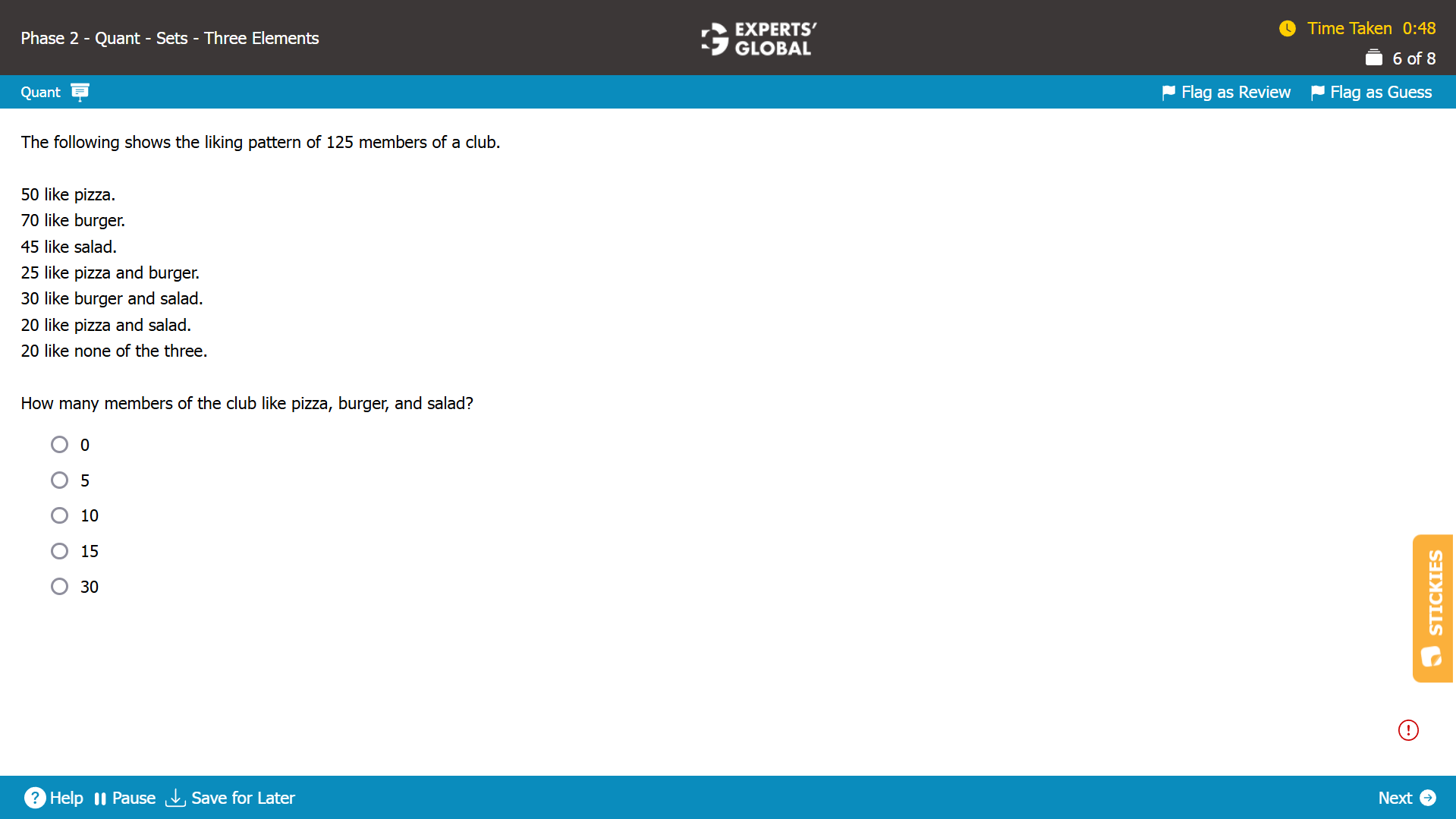
(Pizza members + burger members + salad members) – (members who like two of these items) + (members who like all three items) + (members who like none of the three items) = Total number of members
Pizza members = 50
Burger members = 75
Salad members = 45
So, Pizza members + burger members + salad members = 50 + 70 + 45 = 165.
Pizza and burger members = 25
Burger and salad members = 30
Pizza and salad members = 20
Members who like two of these items = 25 + 30 + 20 = 75.
Members who like none of the three items = 20.
Total number of members = 125.
Overall,
(Pizza members + burger members + salad members) – (members who like two of these items) + (members who like all three items) + (members who like none of the three items) = Total number of members
(165) – (75) + (members who like all three items) + (20) = 125.
Members who like all three items = 15.
15 members like all three items.
D is the correct answer choice.
Practice Question 4
Written Explanation
When three sets intersect…
(The population in exactly one set) + (the population in exactly two sets) + (the population in exactly three sets) + (the population in no set) = Total population
This can be verified from the above diagram as follows.
(A + B + C) + (E + F + G) + D + H = A + B + C + D + E + F + G + H
So,
(Students enrolled in exactly one activity) + (students enrolled in exactly two activities) + (students enrolled in exactly three activities) + (students enrolled in no activity) = Total student population
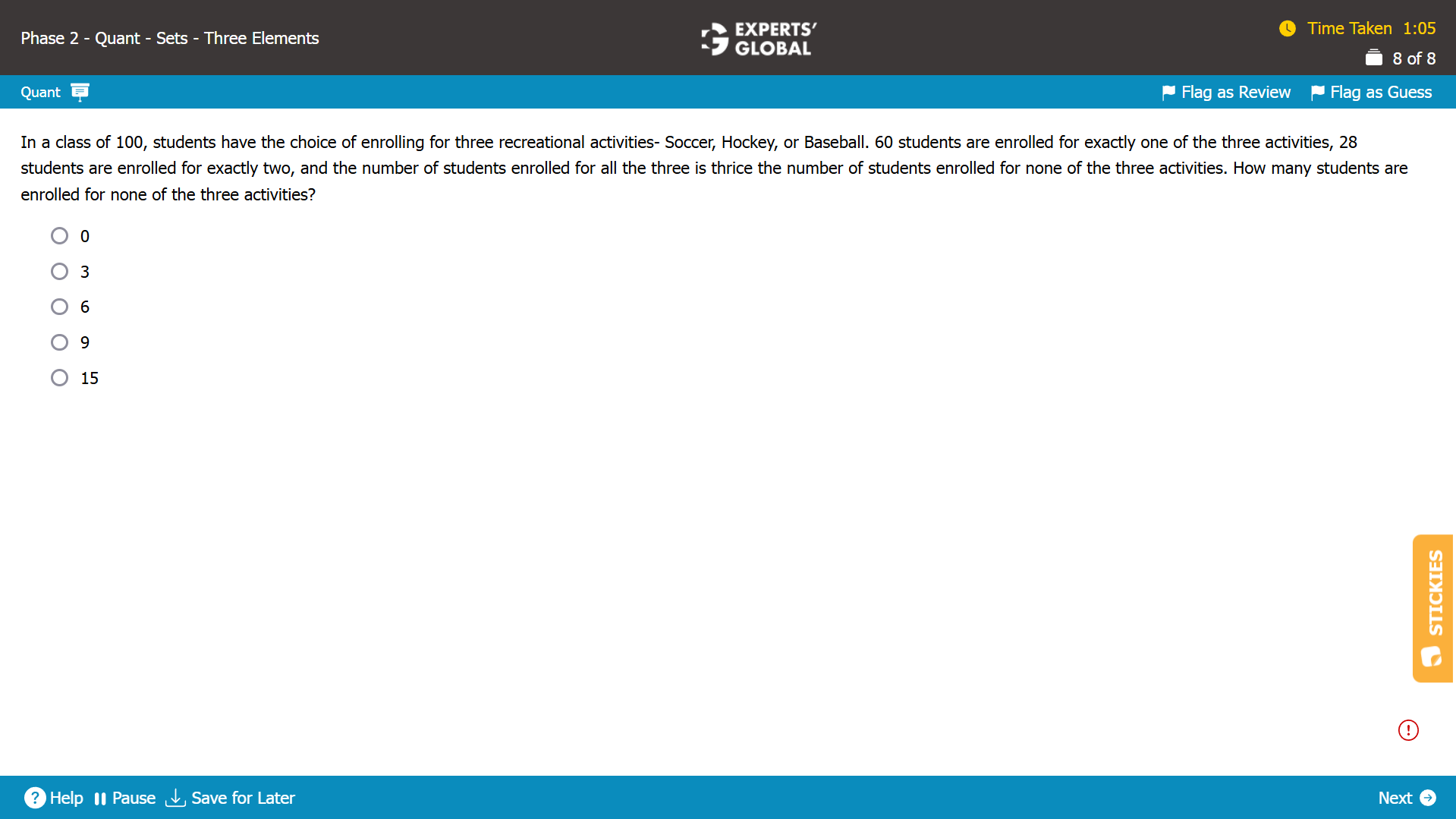
Students enrolled in exactly one activity = 60
Students enrolled in exactly two activities = 28
Let’s say that students enrolled in no activity = x.
So, students enrolled in exactly three activities = 3x.
Total student population = 100.
Overall,
(Students enrolled in exactly one activity) + (students enrolled in exactly two activities) + (students enrolled in exactly three activities) + (students enrolled in no activity) = Total student population
60 + 28 + 3x + x = 100
4x = 12
x = 3.
3 students are enrolled for none of the three activities.
B is the correct answer choice.
Practice Question 5
Written Explanation
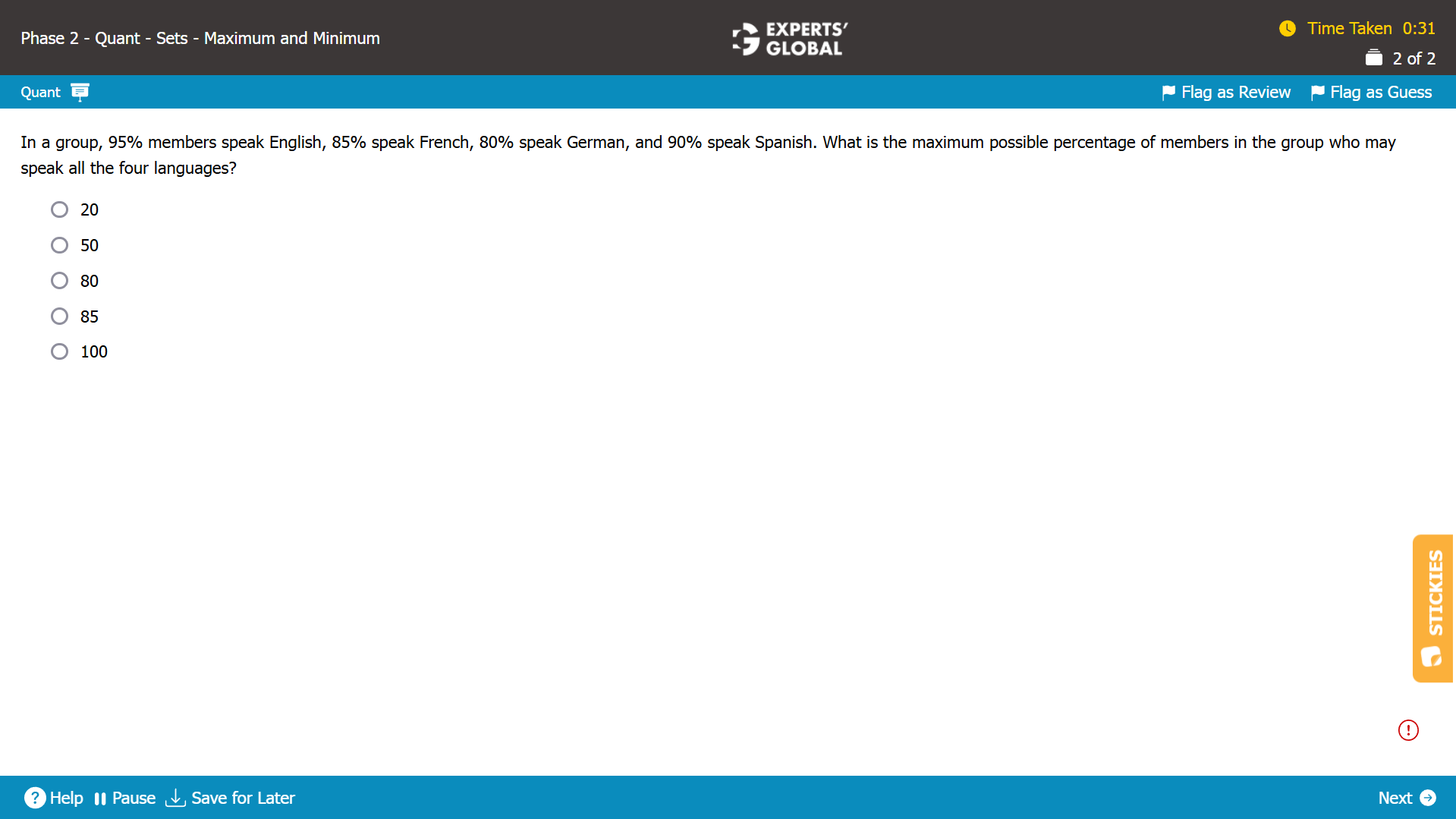
To find the maximum possible percentage who speak all four languages, let’s say that EVERYONE wants to speak all the four languages.
However, only 95% can speak English. So, the maximum possible percentage of all four languages cannot exceed 95%.
Similarly, only 90% can speak Spanish. So, the maximum possible percentage of all four languages cannot exceed 90%.
Similarly, only 85% can speak French. So, the maximum possible percentage of all four languages cannot exceed 85%.
Similarly, only 80% can speak German. So, the maximum possible percentage of all four languages cannot exceed 80%.
Overall, it can be inferred that maximum 80% can speak all the fourth languages.
C is the correct answer choice.
GMAT Quant: Percentages-Mixtures-Alligation Sample Question
Percentages, mixtures, and alligation sit together as one powerful idea set on the GMAT. Percentages tell you how much of the whole you have, measured out of 100. Mixtures focus on what you get when you blend two or more parts into one combined result. Alligation gives you a fast, clever shortcut for many weighted average situations that show up inside mixtures and percentage setups.
Important: Before visiting the following sample question(s), if you would like a quick brush up of key Percentages-Mixtures-Alligation concepts, you may first visit: Free GMAT Percentages-Mixtures-Alligation Prep
Practice Question 1
Written Explanation
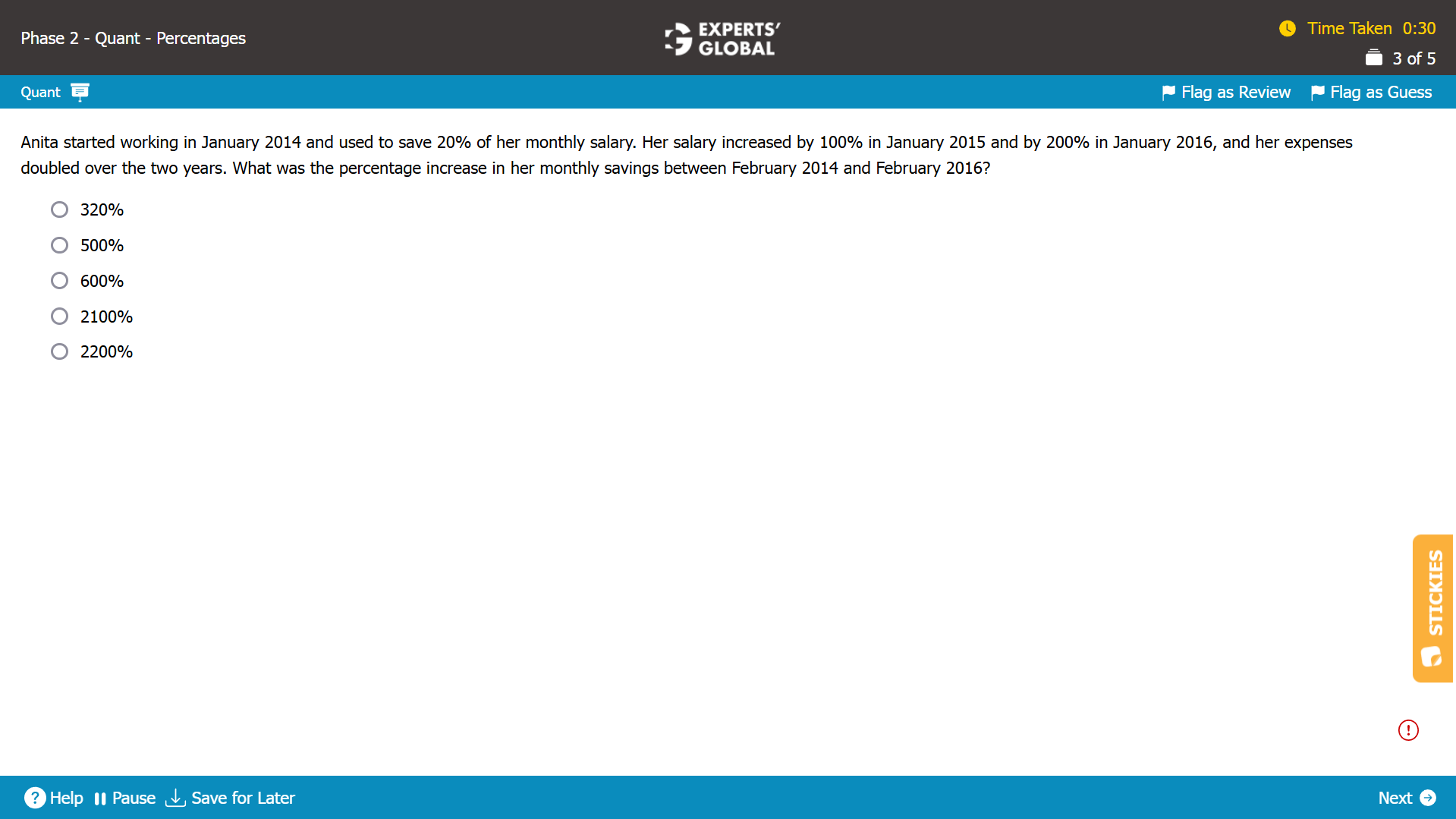
In January 2014…
Let’s say Anita’s salary was 100x.
Anita’s savings = 20% of salary = 20x.
Anita’s expenses = salary – savings = 100x – 20x = 80x.
In January 2015…
Anita’s salary increased by 100%.
Anita’s 2015 salary = 2014 salary X (1 + (100/100)) = 2014 salary X 2 = 200x.
In January 2016…
Anita’s salary increased by 200%.
Anita’s 2016 salary = 2015 salary X (1 + (200/100)) = 2015 salary X 3 = 600x.
Anita’s expenses in 2016 = 2 X Anita’s expenses in 2014 = 2 X 80x = 160x.
Anita’s savings in 2016 = salary – expenses = 600x – 160x = 440x.
Anita’s savings in February 2014 = 20x
Anita’s savings in February 2016 = 440x
Percentage increase in Anita’s savings = ((440x – 20x) / 20x) X 100 = 2100%.
D is the correct answer choice.
Practice Question 2
Written Explanation
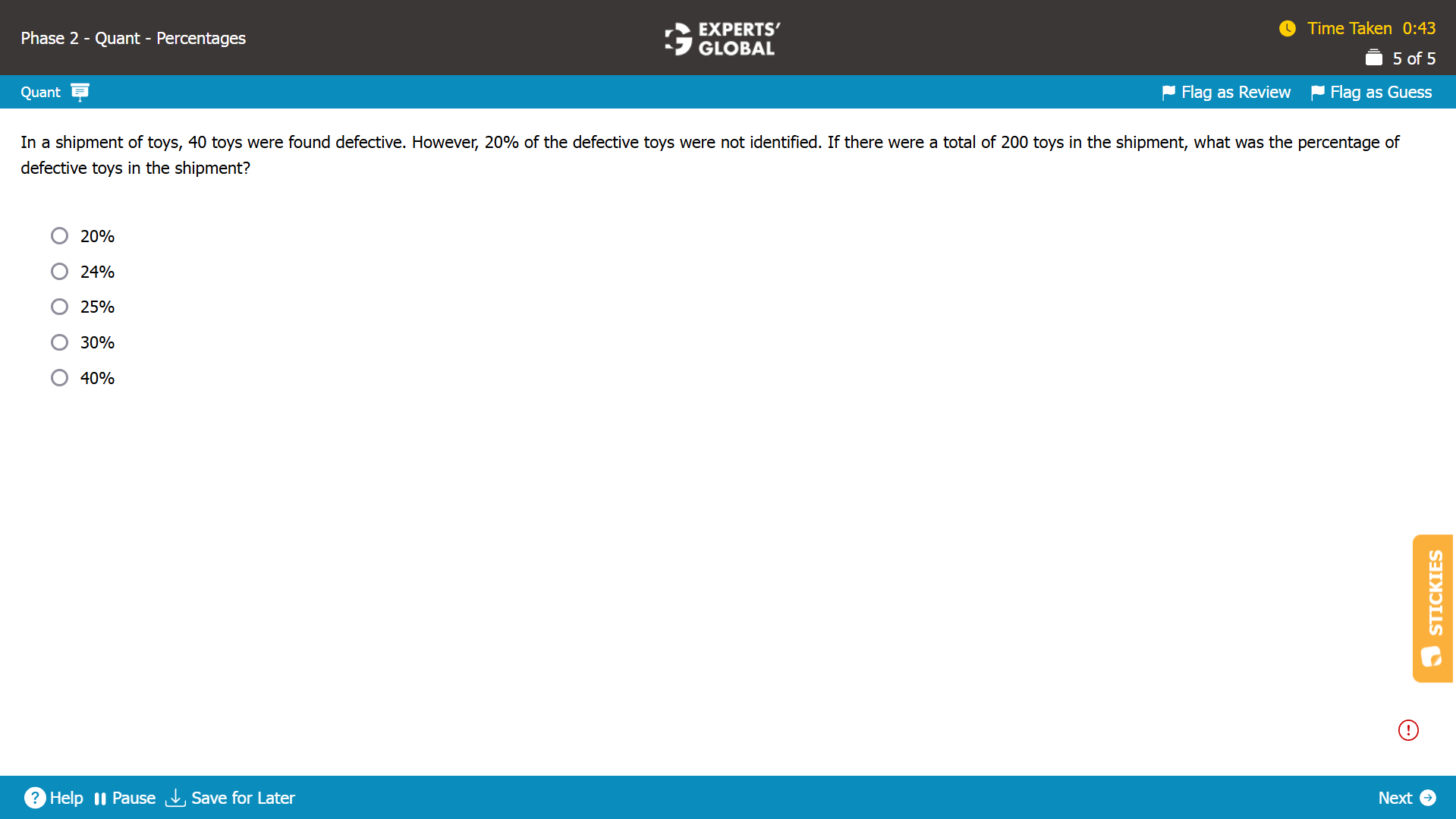
Total number of toys = 200.
Let’s say that there were x defective toys.
x = total number of defective toys = defective toys identified + defective toys unidentified.
Defective toys identified = 40.
Defective toys unidentified = 20% of all defective toys = (0.2) x.
So, x = 40 + (0.2) x.
0.8x = 40.
x = 50.
Percentage of defective toys = total number of defective toys / total number of all toys = 50 / 200 = 25%.
C is the correct answer choice.
Practice Question 3
Written Explanation
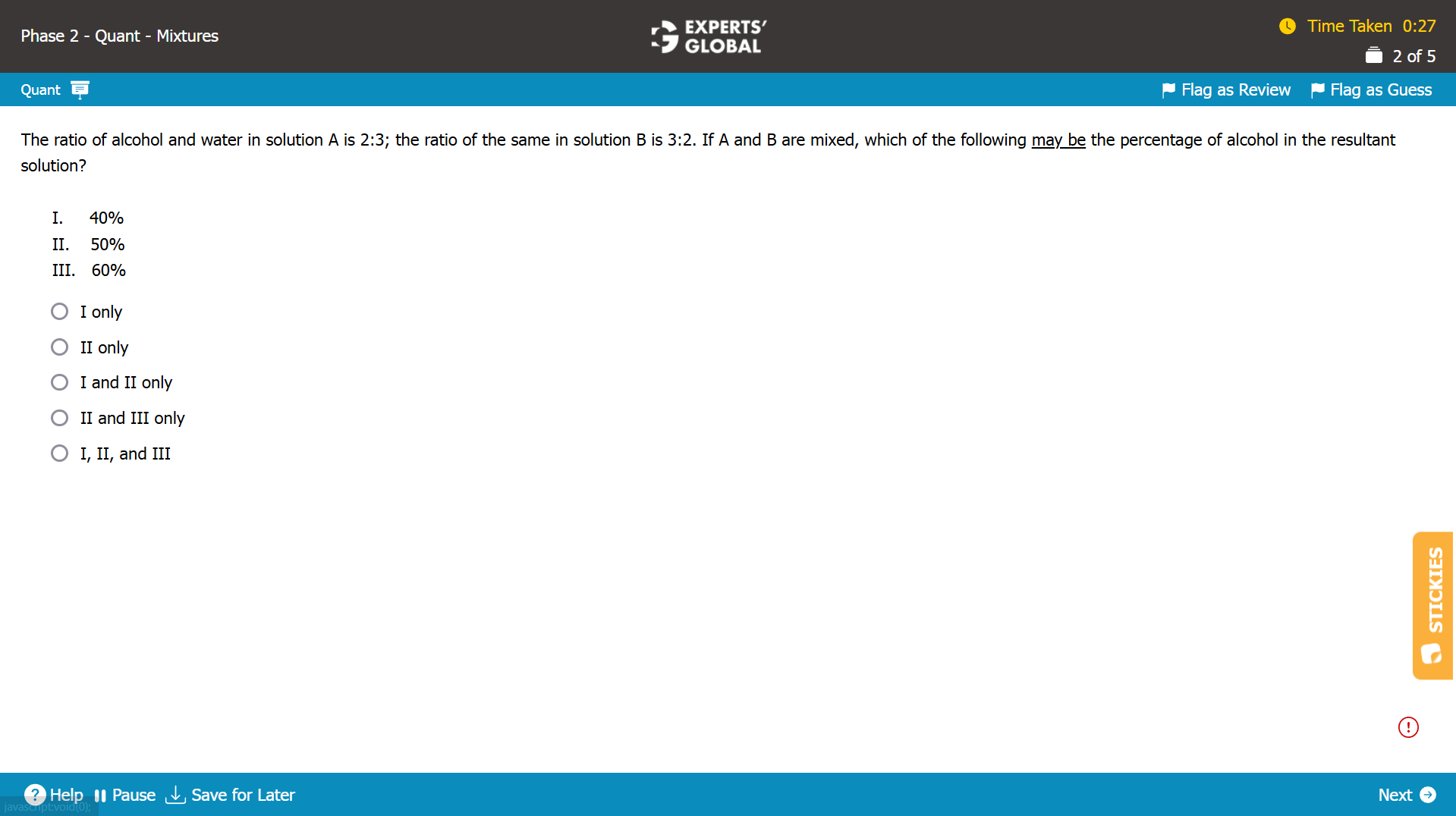
Let’s say 5x liters of solution A is mixed with 5y liters of solution A.
Quantity of solution A = 5x liters.
Ratio of alcohol and water in solution A = 2 : 3
Quantity of alcohol in solution A = 2 / (2 + 3) X 5x = 2x liters.
Quantity of water in solution A = 3 / (2 + 3) X 5x = 3x liters.
Quantity of solution B = 5y liters.
Ratio of alcohol and water in solution A = 3 : 2
Quantity of alcohol in solution B = 3 / (2 + 3) X 5y = 3y liters.
Quantity of water in solution B = 2 / (2 + 3) X 5y = 2y liters.
Quantity of resultant solution = 5x + 5y liters.
Quantity of alcohol in resultant solution = 2x + 3y liters.
Quantity of water in resultant solution = 3x + 2y liters.
Percentage of alcohol in resultant solution = (2x + 3y) / (5x + 5y)
For the percentage of alcohol in resultant solution to be 40%…
(2x + 3y) / (5x + 5y) = 40%
100 (2x + 3y) = 40 (5x + 5y)
200x + 300y = 200x + 200y
y = 0
This equation will hold only when y = 0, or when there is no solution B. This possibility cannot exist. So, it is NOT possible to have 40% alcohol in the resultant solution.
For the percentage of alcohol in resultant solution to be 50%…
(2x + 3y) / (5x + 5y) = 50%
100 (2x + 3y) = 50 (5x + 5y)
200x + 300y = 250x + 250y
50x = 50y
This equation will hold when x = y. So, it is possible to have 50% alcohol in the resultant solution.
For the percentage of alcohol in resultant solution to be 60%…
(2x + 3y) / (5x + 5y) = 60%
100 (2x + 3y) = 60 (5x + 5y)
200x + 300y = 300x + 300y
x = 0
This equation will hold only when x = 0, or when there is no solution A. This possibility cannot exist. So, it is NOT possible to have 60% alcohol in the resultant solution.
Overall, 50% is the only value that can represent the percentage of alcohol in the resultant solution.
[Alternatively….
Percentage of alcohol in Solution A = 2 / (2 + 3) = 40%
Percentage of alcohol in Solution B = 3 / (3 + 2) = 60%
When these two solutions are mixed, the resultant solution will have a percentage of alcohol greater than 40% and less than 60%. Note that 40% and 60% alcohol in the resultant solution is not possible because it will represent cases in which zero quantity of one of the solutions was mixed; such a possibility is invalid. From the answer choices, 50% is the only value that is possible.]
B is the correct answer choice.
Practice Question 4
Written Explanation
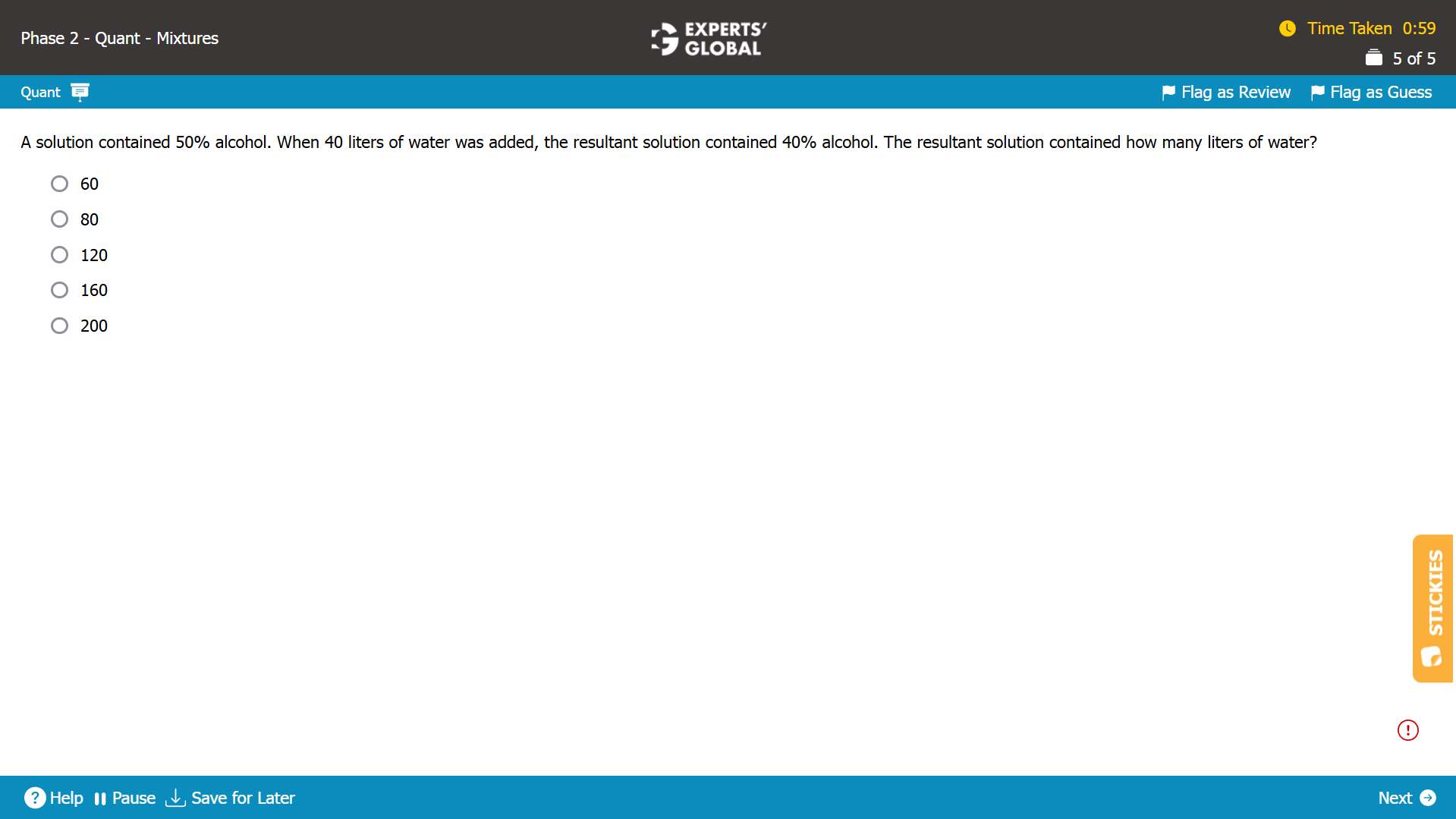
Let’s say that the quantity of the original solution was 2X liters.
The solution contained 50% alcohol.
So, the quantity of alcohol in the original solution = X liters, and
The quantity of water in the original solution = X liters.
After 40 liters of water was added…
Quantity of the resultant solution = 2X + 40 liters
Alcohol in the resultant solution = X liters.
Concentration of alcohol in the resultant solution = X / (2X + 40) = 40%
100X = 80X + 1600
20X = 1600
X = 80 liters.
Quantity of the resultant solution = 2X + 40 liters = 160 + 40 = 200 liters.
Quantity of water in the resultant solution = 40% of 200 liters = 80 liters.
Quantity of water in the original solution = 200 liters – 80 liters = 120 liters.
C is the correct answer choice.
Practice Question 5
Written Explanation
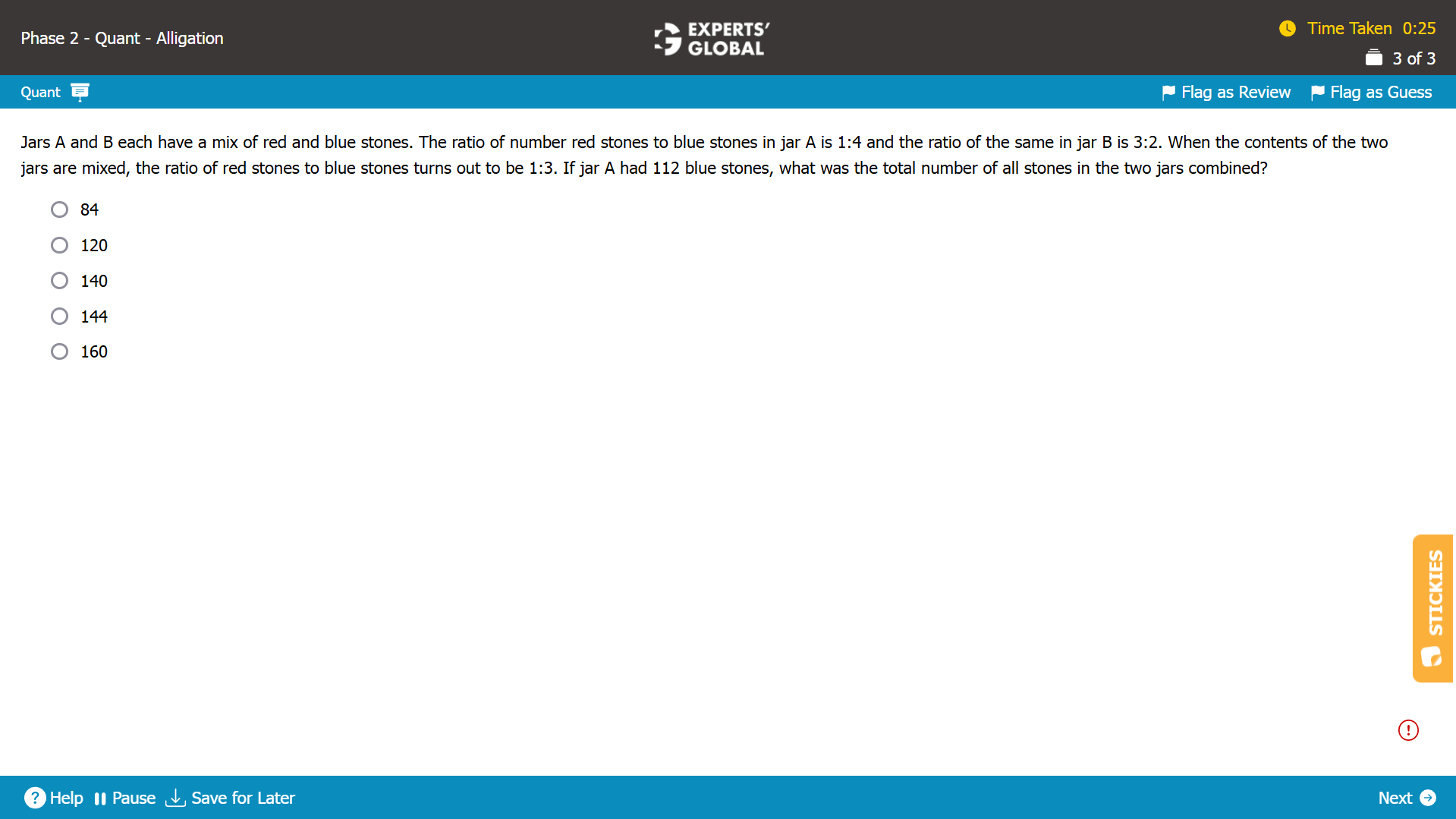
Ratio of red and blue stones in jar A = 1:4
So, let’s say that jar A has x red stones and 4x blue stones.
Jar A has 112 blue stones.
So, 4x = 112; x = 28.
So, in jar A, there are 28 red stones and 112 blue stones.
Total number stones in jar A = 28 + 112 = 140.
Ratio of red and blue stones in jar B = 3:2
So, let’s say that jar B has 3y red stones and 2y blue stones.
Total number stones in jar B = 5y.
When the two jars are mixed…
Total number of stones in the two jars = 140 + 5y
Total number of red stones the two jars = 28 + 3y
Total number of blue stones the two jars = 112 + 2y
The ratio of red and blue stones is 1:3 in the mixed jars.
So, (28 + 3y) : (112 + 2y) = 1:3
3 X (28 + 3y) = 112 + 2y
84 + 9y = 112 + 2y
7y = 28
y = 4
Total number of all stones in the two jars combined = 140 + 5y = 140 + (5 X 4) = 160.
There are 160 stones in the two jars combined.
Please watch the video for an alternate method to solve.
E is the correct answer choice.
GMAT Quant: Ratio-Proportion-Variation Sample Question
Ratios help you compare two quantities side by side. A proportion tells you that two ratios are equal, or it shows how a part connects to the whole. Variation explains how one quantity changes when another quantity changes, so you can spot the pattern and stay in control.
Important: Before visiting the following sample question(s), if you would like a quick brush up of key Ratio-Proportion-Variation concepts, you may first visit: Free GMAT Ratio-Proportion-Variation Prep
Practice Question 1
Written Explanation
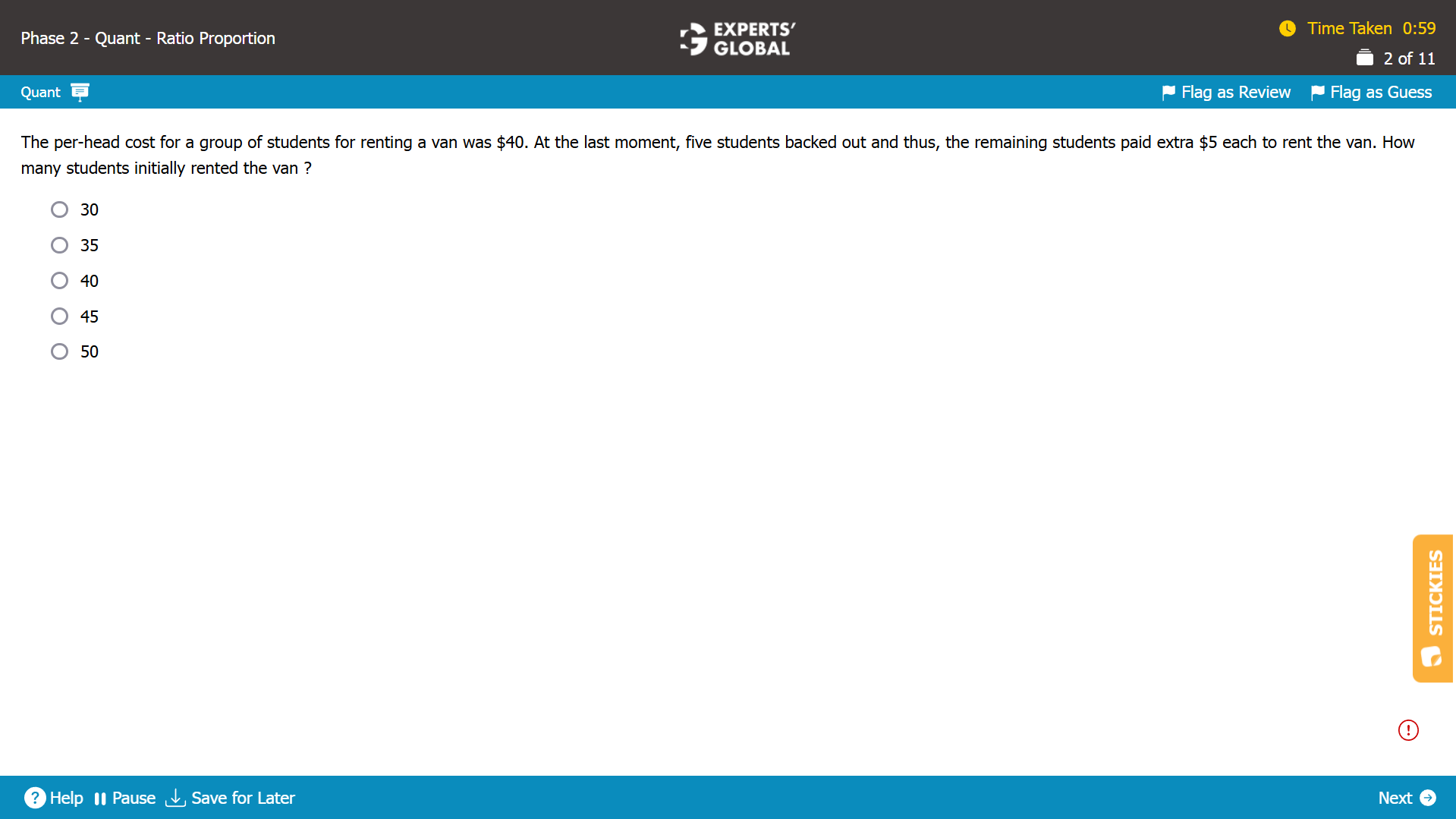
Let’s say that x students initially rented the van.
Earlier…
Number of students = x.
Renting cost per head = $40.
Total renting cost = 40x … (Equation I)
After 5 students back out…
Number of students = x – 5.
Renting cost per head = earlier cost per head + $5 extra = $45
Total renting cost = (x – 5) X 45 … (Equation II)
Equating Equation I and Equation II…
40x = (x – 5) X 45
40x = 45x – 225
5x = 225
x = 45 students
45 students initially rented the van.
D is the correct answer choice.
Practice Question 2
Written Explanation
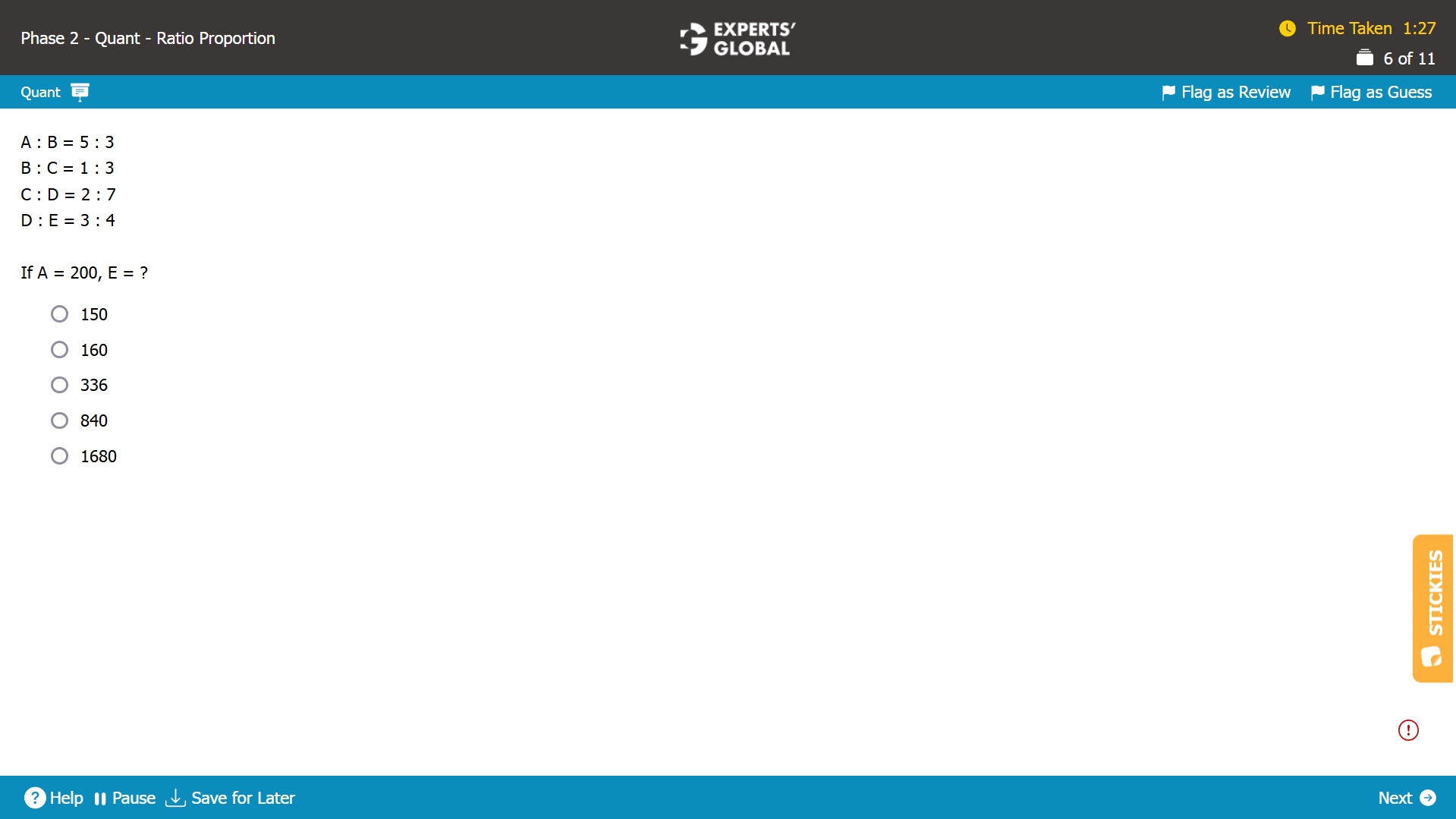
If A = 200…
A / B = 5 / 3
B = 3 X A / 5
So, B = 3 X 200 / 5 = 120.
B / C = 1 / 3
C = 3 X B / 1
So, C = 3 X 120 = 360.
C / D = 2 / 7
D = 7 X C / 2
So, D = 7 X 360 / 2 = 1260.
D / E = 3 / 4
E = 4 X D / 3
So, E = 4 X 1260 / 3 = 1680.
[Alternatively….
A / E = (A / B) X (B / C) X (C / D) X (D / E) = (5 / 3) X (1 / 3) X (2 / 7) X (3 / 4) = 5 / 42.
So, E = 42 X A / 5 = 42 X 200 / 5 = 1680]
E is the correct answer choice.
Practice Question 3
Written Explanation
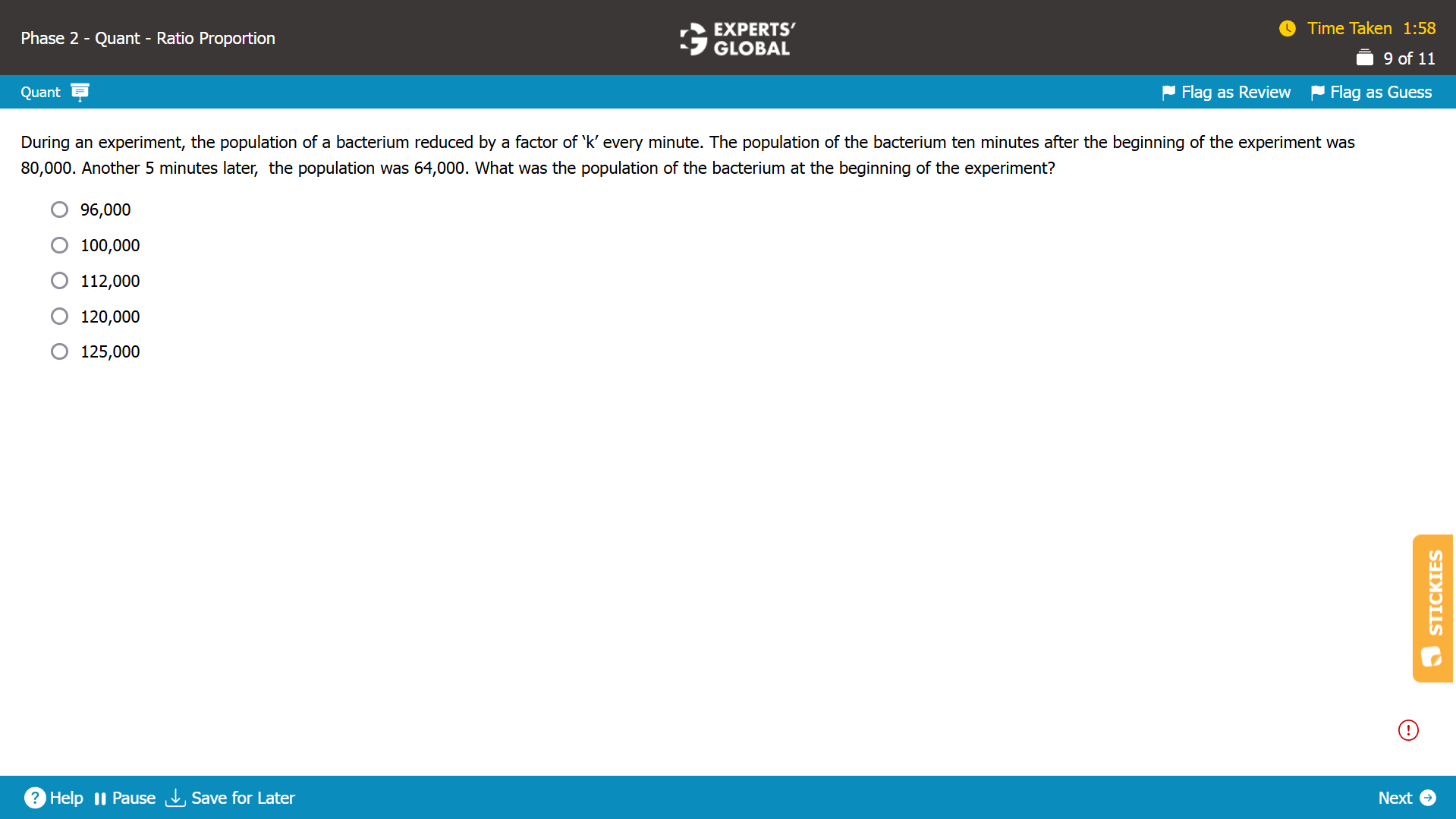
Let’s say that the population of the bacterium at the beginning of the experiment was x.
The population after one minute = x/k.
The population after ten minutes = x/(k10) = 80000 … (Equation I)
The population after fifteen minutes = x/(k15) = 64000 … (Equation II)
Dividing Equation I by Equation II..
(x/(k10)) / (x/(k15)) = 80000/64000.
k5 = 5 / 4
1/k5 = 4 / 5
The population reduces by 4 / 5 after every five minutes.
So, the population after five minutes = population after ten minutes / (4 / 5) = (5 / 4) X 80000 = 100000.
And, the population in the beginning = population after five minutes / (4 / 5) = (5 / 4) X 100000 = 125000.
E is the correct answer choice.
Practice Question 4
Written Explanation
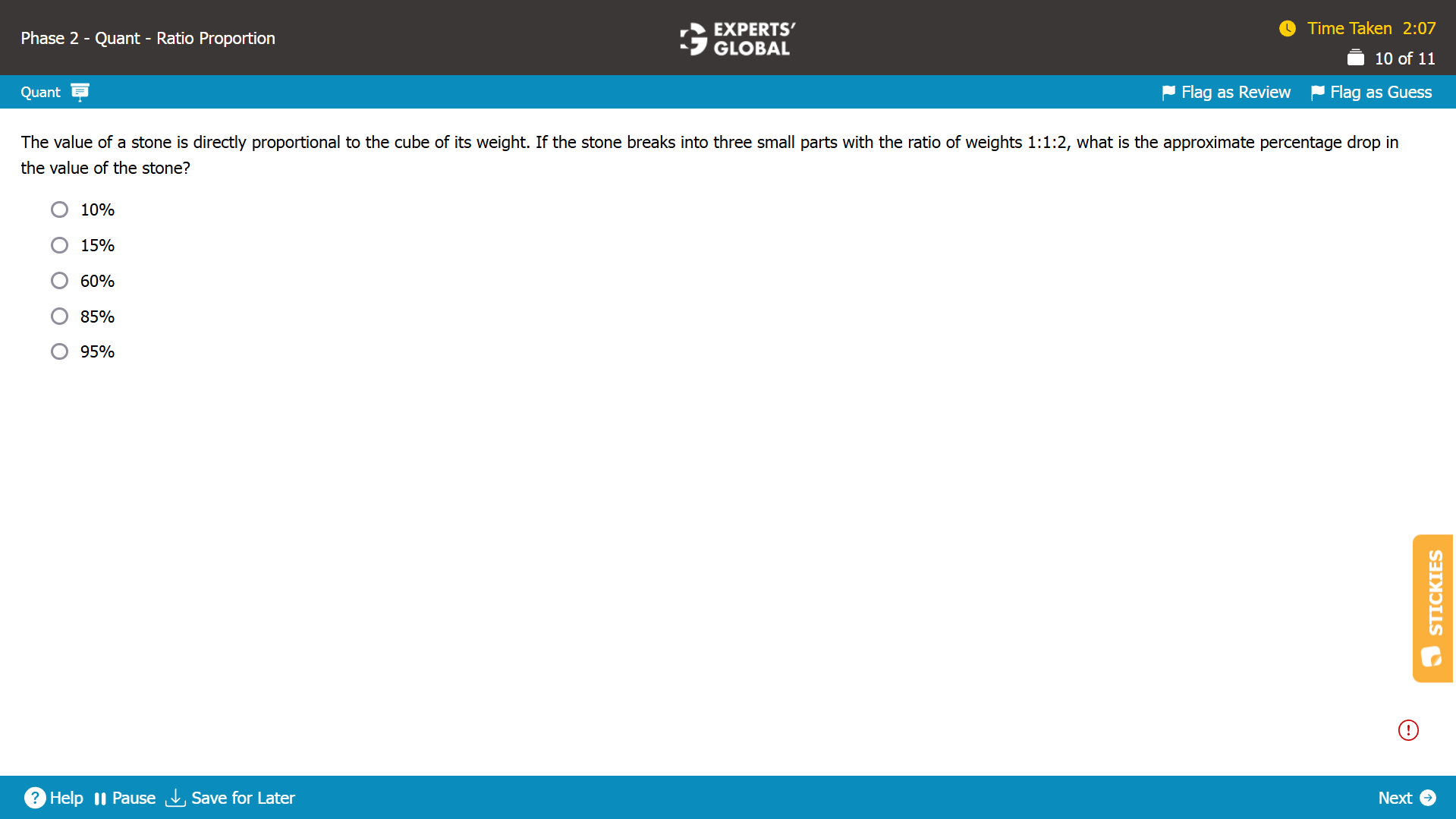
Let’s say that the value of the stone is V and the weight of the stone is W. So, V = kW3.
Let’s say that the stone broke into three pieces of weights W1, W2 and W3, in the ratio 1 : 1 : 2.
So, let’s say that W1 = x, W2 = x, and W3 = 2x.
Weight of the original stone = W1 + W2 + W3 = x + x + 2x = 4x.
Value of the original stone = kW3 = k X (4x)3 = 64k X (x)3.
The value of the first piece = V1 = k(W1)3 = k X (x)3
The value of the second piece = V2 = k(W2)3 = k X (x)3
The value of the third piece = V3 = k(W3)3= k X (2x)3= 8k X (x)3
Total value of all three stones = k X (x)3+ k X (x)3 + 8k X (x)3 = 10k X (x)3
Overall, the value dropped from 64k X (x)3 to 10k X (x)3 or dropped by (64 – 10) / 64 X 100 = 84.37%.
The approximate percentage drop in the value of the stone was 85%.
D is the correct answer choice.
GMAT Quant: Profit-Loss and Interest Sample Question
Profit and loss focuses on how a deal shifts from cost price to selling price, showing whether you gain money or give some up. Interest explains the extra amount you earn or pay when money gets invested or borrowed across time. Together, these two ideas sit at the heart of commercial arithmetic, and you see them again and again in quantitative reasoning.
Important: Before visiting the following sample question(s), if you would like a quick brush up of key Profit & Loss and Interest concepts, you may first visit: Free GMAT Profit & Loss and Interest Prep
Practice Question 1
Written Explanation
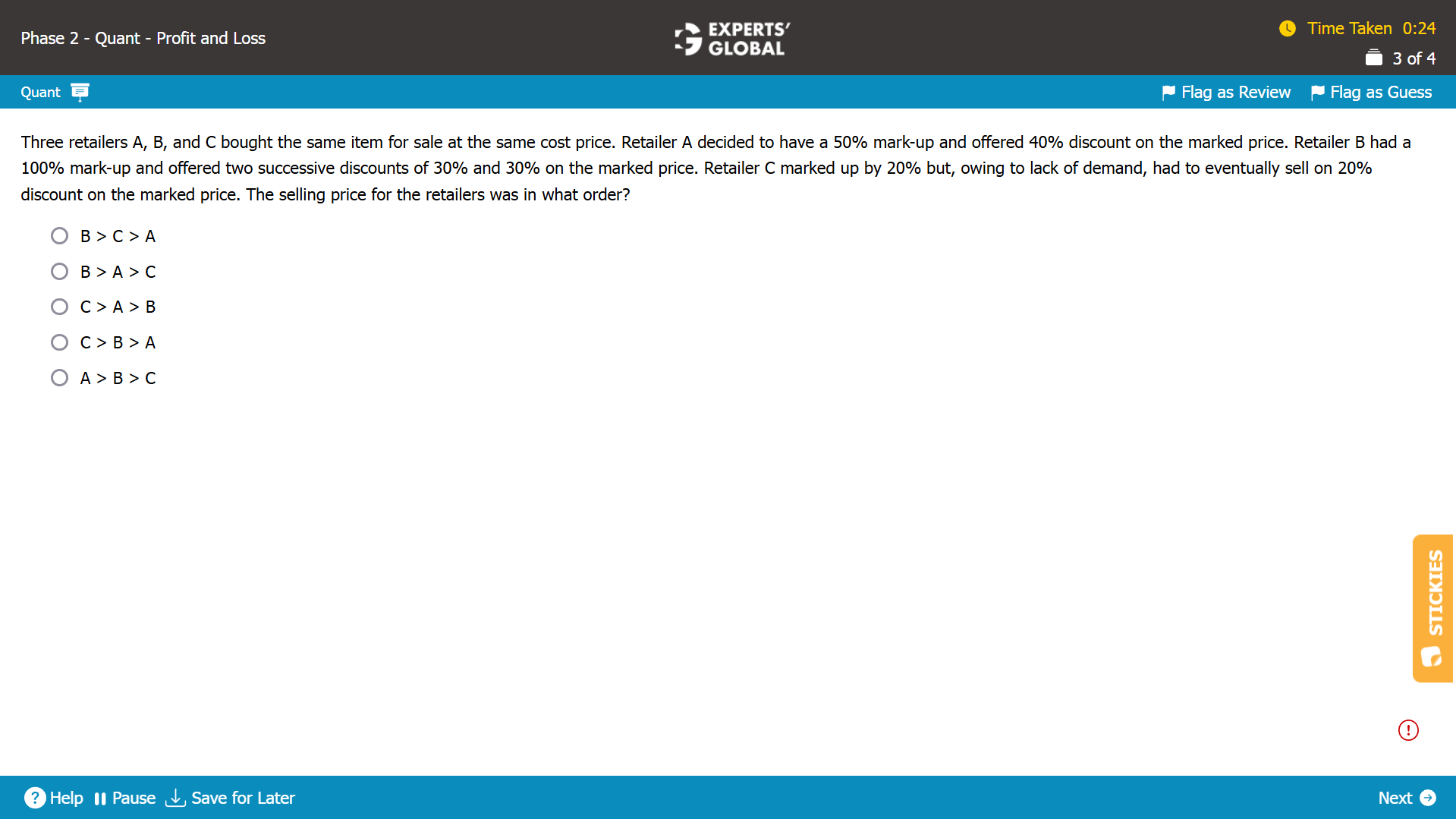
Let’s say the cost price for every retailer was 100x.
Retailer A…
Selling price before discount = 50% mark up on cost price = 1.5 X 100x = 150x
Selling price after discount = 40% discount on selling price before discount = 60% of selling price before discount = 0.6 X 150x = 90x.
Retailer B…
Selling price before any discount = 100% mark up on cost price = 2 X 100x = 200x
Selling price after the first discount = 30% discount on selling price before any discount = 70% of selling price before any discount = 0.7 X 200x = 140x.
Selling price after the second discount = 30% discount on selling price before the second discount = 70% of selling price before the second discount = 0.7 X 140x = 98x.
Retailer C…
Selling price before discount = 20% mark up on cost price = 1.2 X 100x = 120x
Selling price after discount = 20% discount on selling price before discount = 80% of selling price before discount = 0.8 X 120x = 96x.
So, in the decreasing order of final selling prices of all retailers, B > C > A.
A is the correct answer choice.
Practice Question 2
Written Explanation
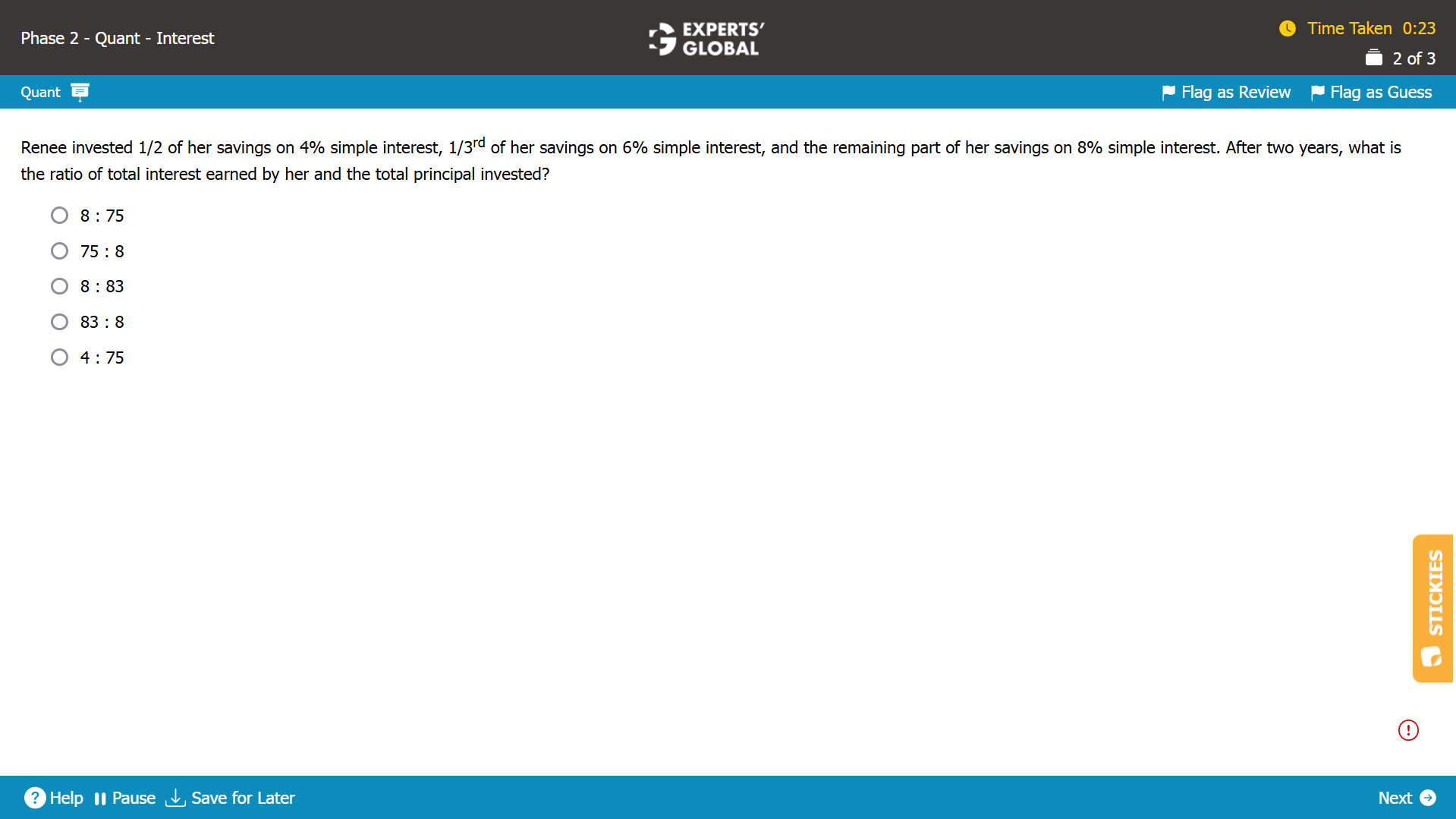
Let’s say that the total savings was 300x.
Investment 1…
Principal = 1 / 2 of total savings = 300x / 2 = 150x
Interest rate = 4%
Period = 2 years
Simple interest earned = (P x r x n)/100 = (150x X 4 X 2) / 100 = 12x.
Investment 2…
Principal = 1 / 3rd of total savings = 300 / 3 = 100x
Interest rate = 6%
Period = 2 years
Simple interest earned = (P x r x n)/100 = (100x X 6 X 2) / 100 = 12x.
Investment 3…
Principal = Savings remaining after Investment 1 and Investment 2 = 300x – 150 x – 100x = 50x
Interest rate = 8%
Period = 2 years
Simple interest earned = (P x r x n)/100 = (50x X 8 X 2) / 100 = 8x.
Total interest earned = 12x + 12x + 8x = 32x
Total principal invested = 300x
Ratio of total interest earned and the total principal invested = 32x / 300x = 8/75.
A is the correct answer choice.
GMAT Quant: Statistics Sample Question
Mean, or average, gives you the central value of a number set. Median points to the middle number after you arrange the values in order. Mode spotlights the value that shows up most often. Range tells you how wide the data spreads by comparing the highest and lowest values. Variance shows how far the numbers sit from the average. Standard deviation translates that spread into a form that feels easier to read and use.
Important: Before visiting the following sample question(s), if you would like a quick brush up of key Statistics concepts, you may first visit: Free GMAT Statistics Prep
Practice Question 1
Written Explanation
Earlier…
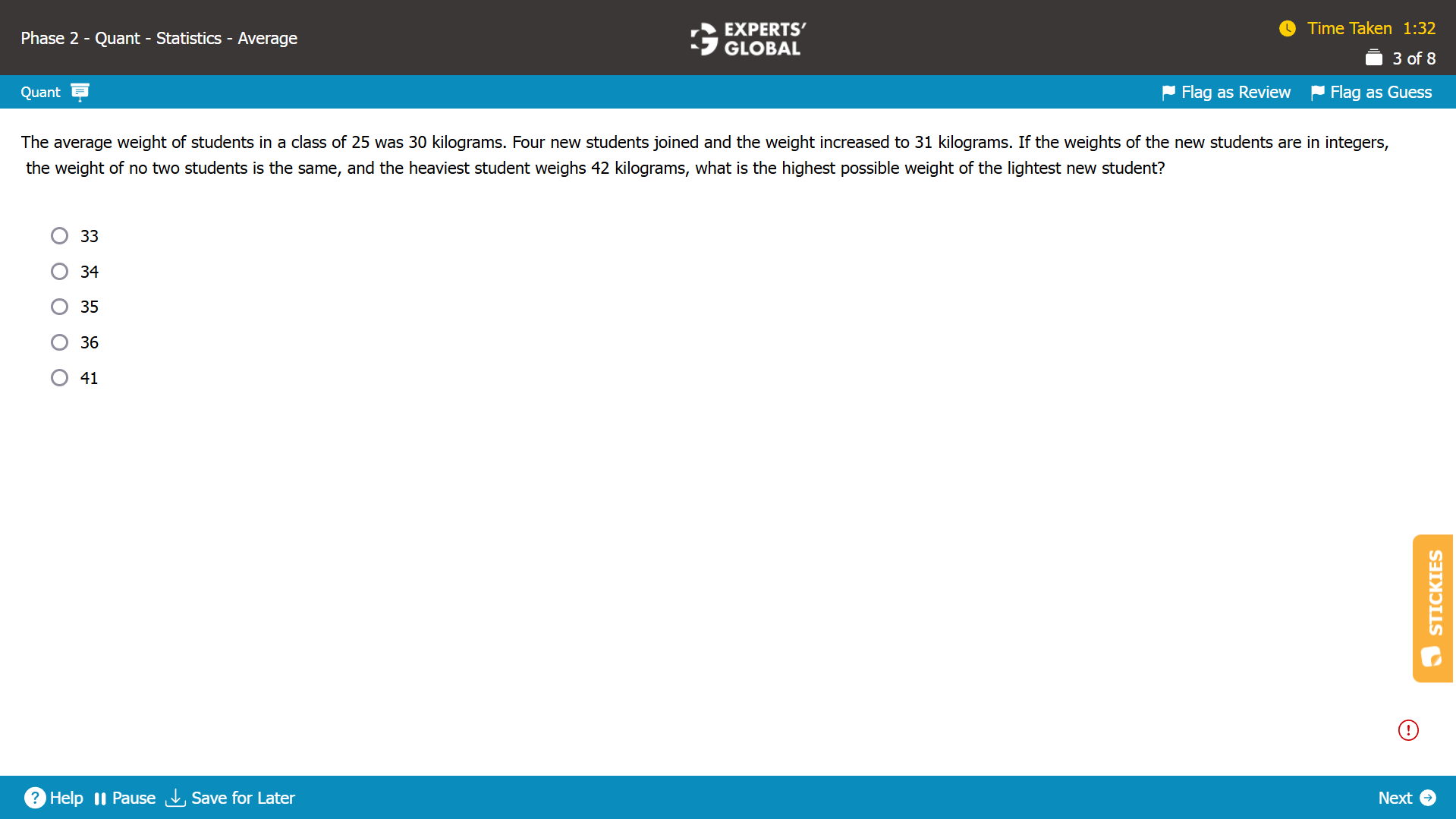
Total number of students = 25
Average weight of 25 students = 30 kilograms
So, total weight of 25 students in the class = 30 X 25 = 750 kilograms
After the addition of 4 new students…
Total number of students = 25 + 4 = 29
Average weight of 29 students = 31 kilograms
So, total weight of 29 students in the class = 31 X 29 = 899 kilograms
So, the total weight of the 4 new students = 899 – 750 = 149 kilograms
Weight of the heaviest new student = 42 kilograms. Let the weight of the lightest new student be x. The weights of the new students, when arranged in ascending order, will be as follows.
{x, W1, W2, 42}
To maximize the weight of the lightest new student, other weights need to be minimized. The weights cannot be repeated. So, the weights of the new students, when arranged in ascending order, will be as follows.
{x, x + 1, x + 2, 42}
Total weight of the 4 new students = x + (x + 1) + (x + 2) + 42 = 149 kilograms
3x + 45 = 149
3x = 104
x = 34.67
Please note that 34.67 is the highest possible value of the weight of the lightest new student; the weight needs to be an integer; so, the highest possible weight would have to be an integer less than 34.67. So, the highest possible value of the weight of the lightest new student is 34.
B is the correct answer choice.
Practice Question 2
Written Explanation
In 2005…
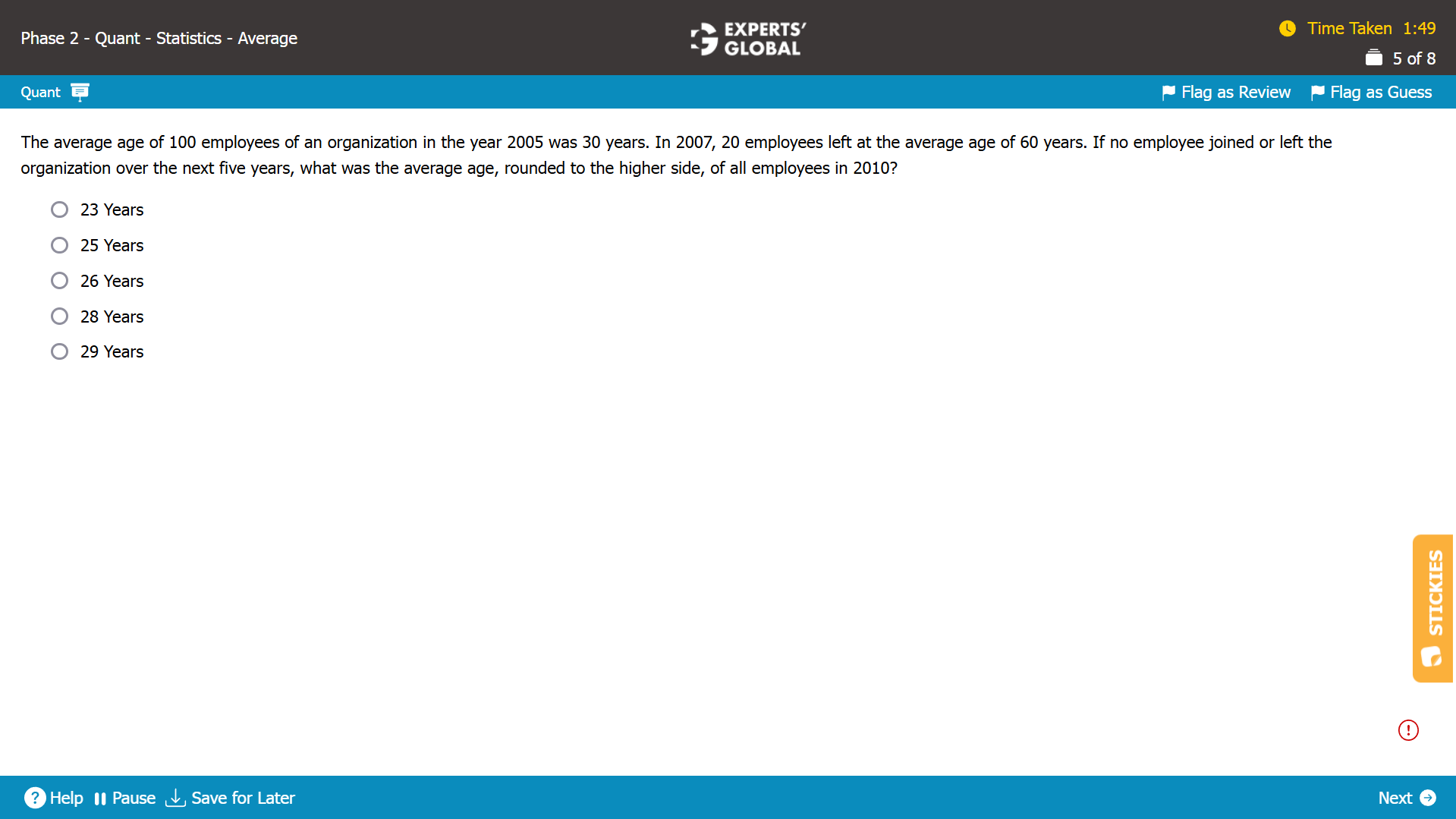
Number of employees = 100
Average age of 100 employees = 30
Total age of all employees = 30 X 100 = 3000
In 2006…
Every employee is one year older than in the previous year. So, the average of all the employees is one more than the average in the previous year.
Average age of 100 employees = 30 + 1 = 31
In 2007…
Every employee is one year older than in the previous year. So, the average of all the employees is one more than the average in the previous year.
Average age of 100 employees = 31 + 1 = 32
Total age of 100 employees = 32 X 100 = 3200
Average age of 20 employees who left = 60
Total age of 20 employees who left = 20 X 60 = 1200
So, after 20 employees leave…
Number of employees = 100 – 80 = 20
Total age of 80 employees = Total age of 100 employees – Total age of 20 employees who left = 3200 – 1200 = 2000
Average age of 80 employees remaining = 2000 / 80 = 25
In 2008…
Every employee is one year older than in the previous year. So, the average of all the employees is one more than the average in the previous year.
Average age of 80 employees = 25 + 1 = 26
In 2009…
Every employee is one year older than in the previous year. So, the average of all the employees is one more than the average in the previous year.
Average age of 80 employees = 26 + 1 = 27
In 2010…
Every employee is one year older than in the previous year. So, the average of all the employees is one more than the average in the previous year.
Average age of 80 employees = 27 + 1 = 28
D is the correct answer choice.
Practice Question 3
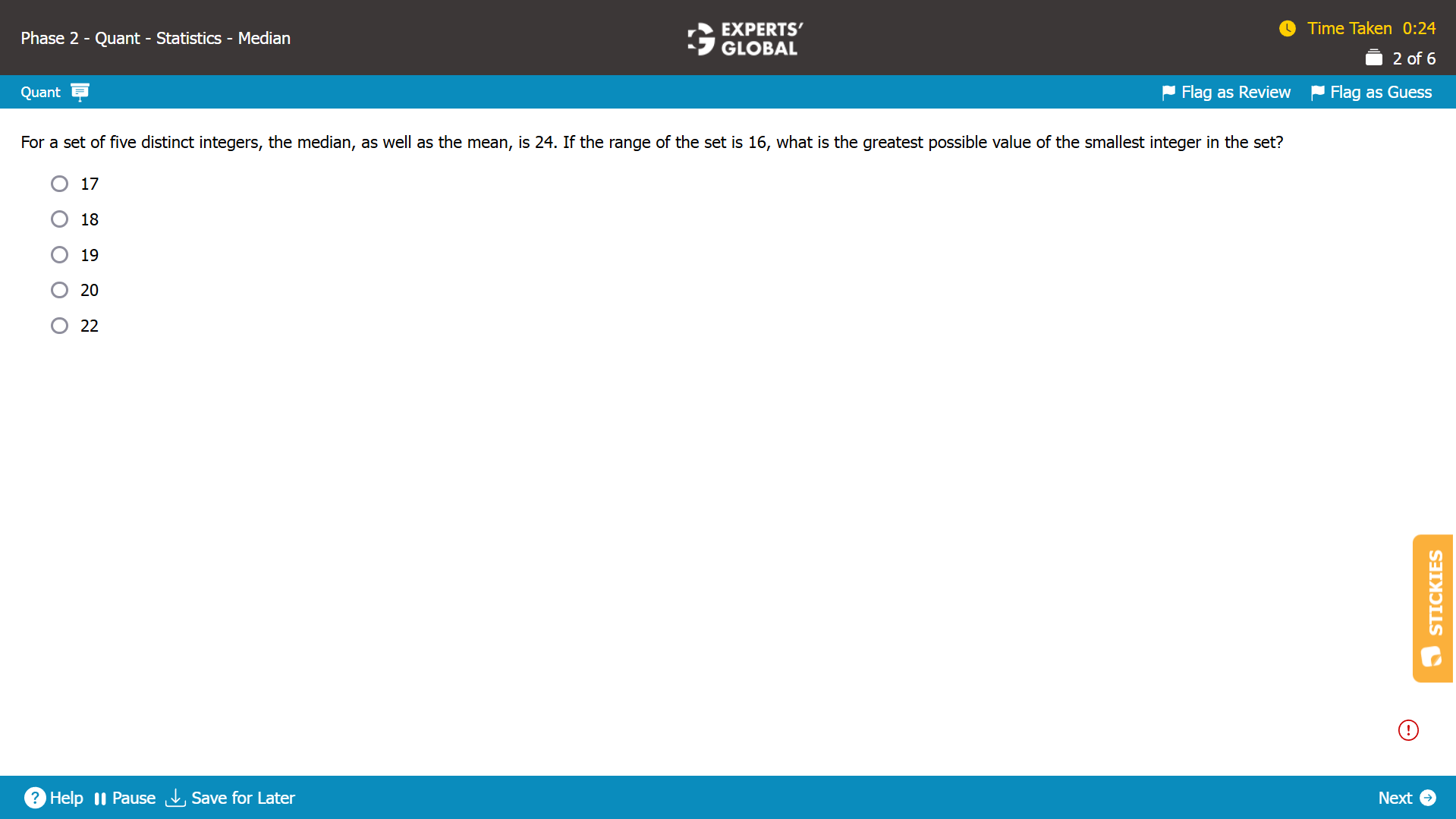
Written Explanation
Let’s consider the set of 5 distinct integers.
The mean is 24. The median would be the 3rd integer, when the set is arranged in ascending order as follows.
{Value 1, Value 2, 24, Value 3, Value 4}
The range of the set is 16; so, when put in ascending order, the lowest and the higher values would differ by 16. The set would look as follows, when put in ascending order.
{x, Value 2, 24, Value 3, x + 16}
To maximize the value of the smallest integer, other values need to be minimized. So, the set would look as follows, when put in ascending order.
{x, x+1, 24, 25, x + 16}
The mean of the set is 24; so, all the values in the set add up to 24 X 5 = 120.
So, x + (x + 1) + 24 + 25 + (x + 16) = 120.
3x + 66 = 120
3x = 54
x = 18
The greatest possible value of the smallest integer in the set is 18.
B is the correct answer choice.
Practice Question 4
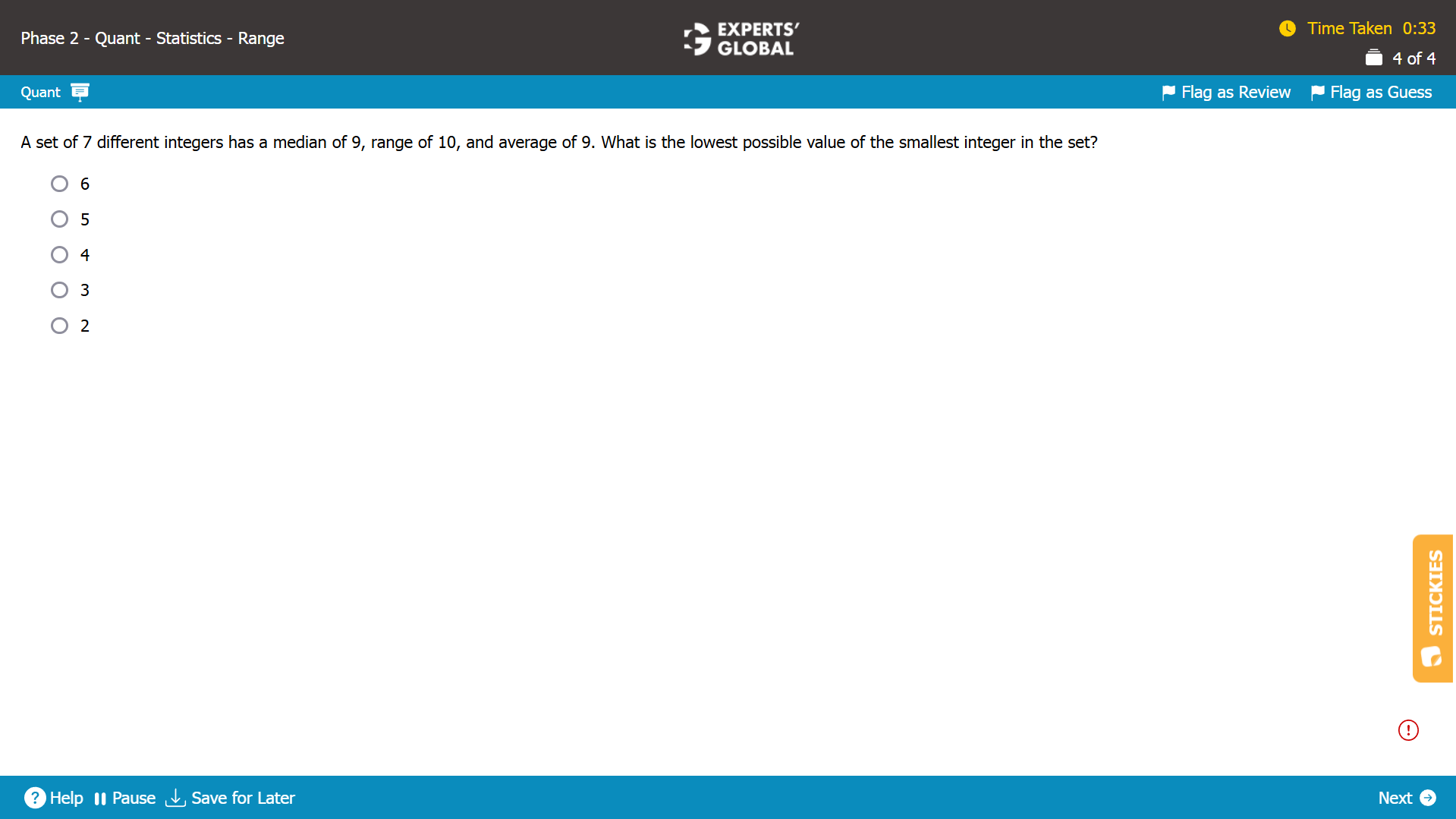
Written Explanation
Let’s consider the set of 7 different integers.
The median of the set is 9; so, the 4th element would be 9. The set would look as follows, when put in ascending order.
{Value 1, Value 2, Value 3, 9, Value 4, Value 5, Value 6}
The range of the set is 10; so, when put in ascending order, the lowest and the higher values would differ by 10. The set would look as follows, when put in ascending order.
{x, Value 2, Value 3, 9, Value 4, Value 5, x + 10}
To minimize the value of the smallest integer, other values need to be maximized. So, the set would look as follows, when put in ascending order.
{x, 7, 8, 9, x + 8, x +9, x + 10}
The average of the set is 9; so, all the values in the set add up to 9 X 7 = 63.
So, x + 7 + 8 + 9 + (x + 8) + (x +9) + (x + 10) = 63
4x + 51 = 63
4x = 12
x = 3
The lowest possible value of the smallest element is 3.
D is the correct answer choice.
Practice Question 5
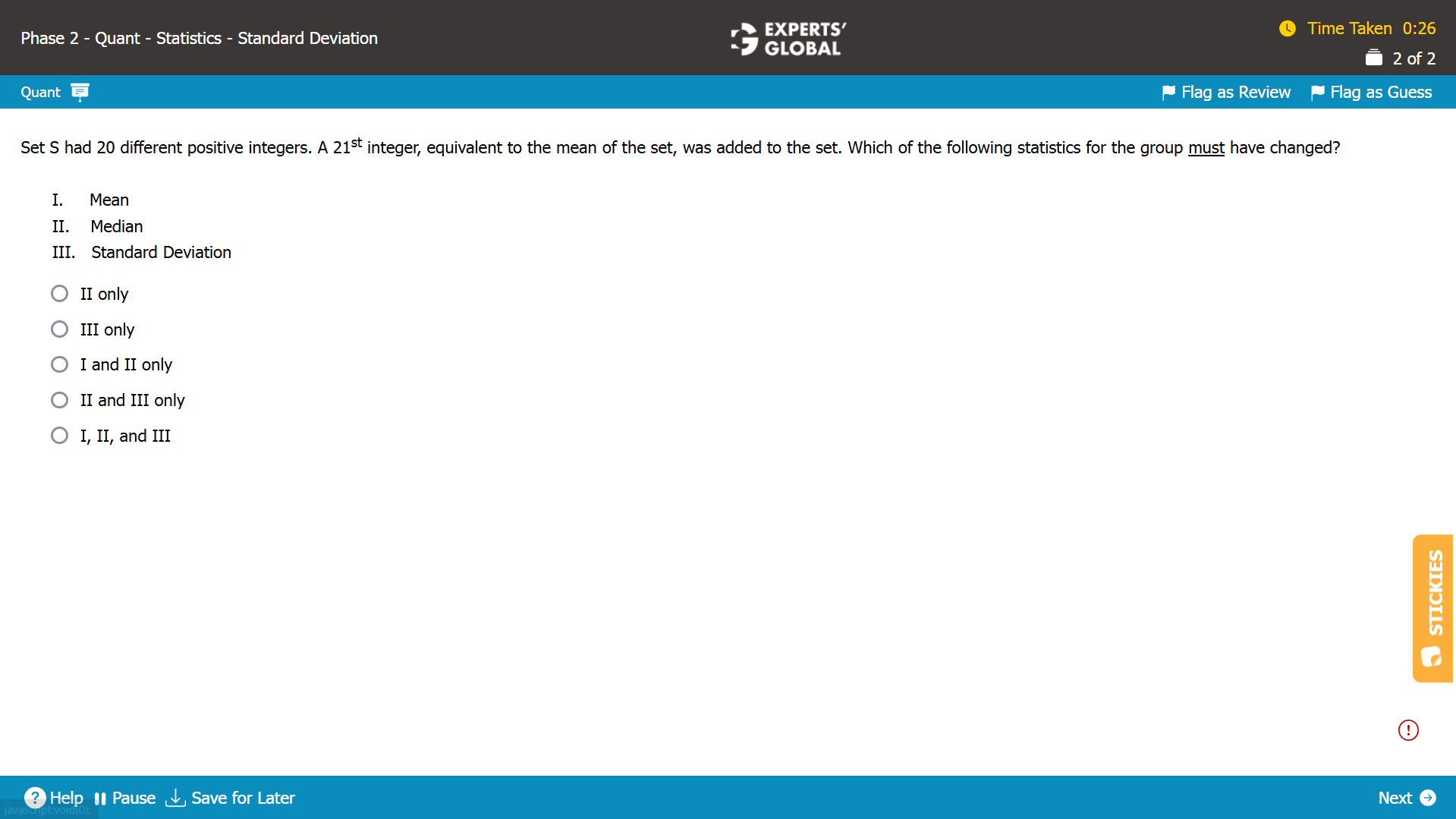
Written Explanation
Addition of a new element will not change the mean if the new element is equal to the mean. So, mean must not have changed.
If the median of the set is equal to the mean of the set, the addition of the new element may not affect the median.
If the median of the set is NOT equal to the mean of the set, the addition of the new element may affect the median.
So, no definite suggestion regarding the change in median can be obtained.
Let’s say the set had a variance, or average difference from the mean, of V before the addition of the new element. The new element is equal to the mean; so, the addition of the new element does not change the variance. However, the variance now accounts for 21 elements, rather than 20 elements. So, the variance and standard deviation of the set have reduced. The standard deviation would not have changed if the set had zero standard deviation in the beginning or when all the elements are equal; however, this set has 20 difference positive integers and so, does not have a standard deviation of zero.
Overall, the standard deviation of the set must have changed.
Among the mean, median, and standard deviation, only standard deviation must have changed.
B is the correct answer choice.
GMAT Quant: Linear and Quadratic Equations Sample Question
Linear equations, often called simple equations, model relationships where variables move at a steady, constant rate. Quadratic equations capture relationships where the change follows a squared pattern, creating a curve instead of a straight line. Together, they sit at the core of algebra and power many problem solving situations on the test.
Important: Before visiting the following sample question(s), if you would like a quick brush up of key Linear and Quadratic Equations concepts, you may first visit: Free GMAT Linear and Quadratic Equations Prep
Practice Question 1
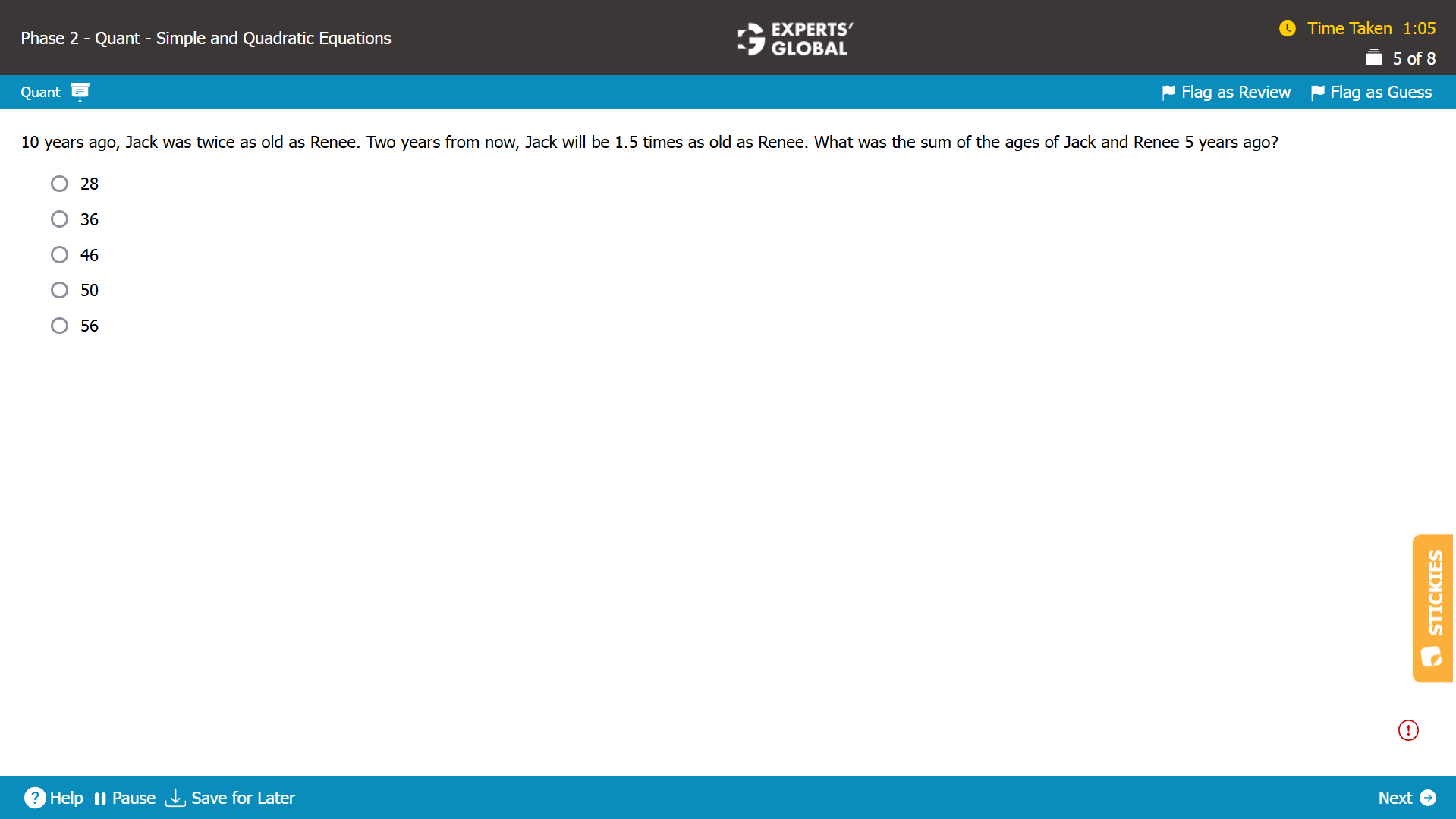
Written Explanation
Let’s say Jack and Renee are J and R years old today, respectively. The quest stem indicates that
(J – 10) = 2(R – 10) … (Equation I)
and
(J + 2) = 1.5(R + 2) … (Equation II)
Let’s simplify the equations to get both equations in the form of J. [Alternately, one may also decide to get both equations in the form of R.]
Equation I:
(J – 10) = 2(R – 10)
J – 10 = 2R – 20
J = 2R – 10
Equation II:
(J + 2) = 1.5(R + 2)
J + 2 = 1.5R + 3
J = 1.5R + 1
Equating the two, we get that
J = 2R – 10 = 1.5R +1
0.5R = 11
R = 22
Putting this value of R in Equation I…
J = 2R – 10
J = 44 – 10
J = 34
[Alternately, one may also put the value of R in Equation II…
J = 1.5R + 1
J = 1.5 X 22 +1
J = 34]
Therefore, today, Jack is 34 years old and Renee is 22 years old.
Five years ago, Jack was 29 years old and Renee was 17 years old.
The sum of the ages of Jack and Renee five years ago was, 29 + 17 = 46 years, as suggested in answer choice C.
C is the correct answer choice.
Practice Question 2
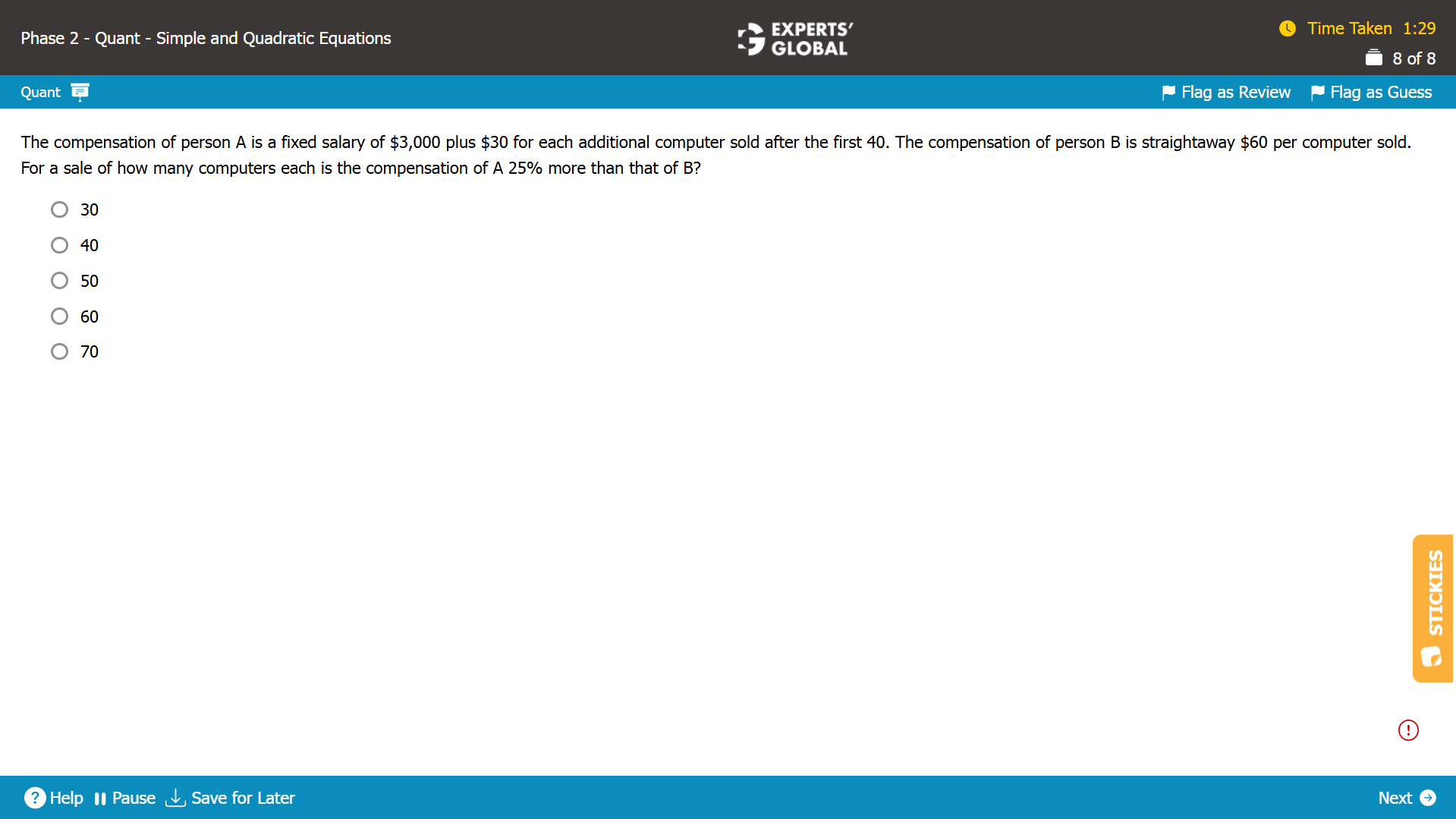
Written Explanation
Let’s say there are x computers sold by each person.
Compensation for person A = 3000 + 30 X (x – 40) … (Equation I)
Compensation for person B = 60x.
Compensation for person A = 25% more than the compensation for person B = 1.25 X 60x = 75x … (Equation II)
Equating Equation I and Equation II…
3000 + 30 X (x – 40) = 75x
3000 + 30x – 1200 = 75x
1800 = 45x
x = 1800 / 45 = 40 computers.
B is the correct answer choice.
Practice Question 3
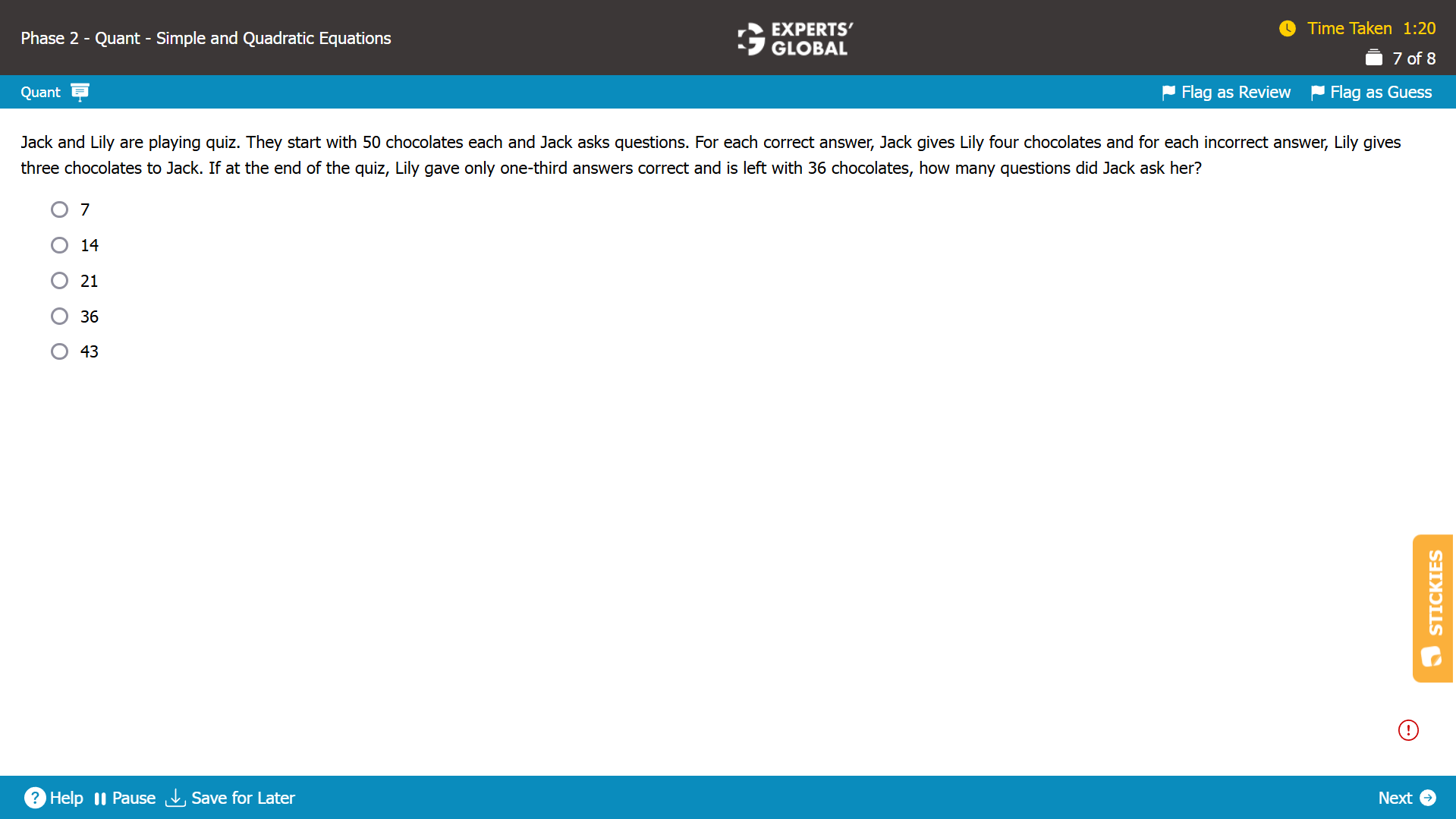
Written Explanation
Let’s say Jack asked Lily 3x questions; out of all the questions, Lily gave x correct answers and 2x incorrect answers.
For every correct answer, Jack gives 4 chocolates to Lily.
So, for x correct answers, Jack gives 4x chocolates to Lily.
For every incorrect answer, Jack receives 3 chocolates from Lily.
So, for 2x incorrect answers, Jack receives 6x chocolate from Lily.
Total chocolates received by Jack during the quiz = 6x – 4x = 2x …. (Equation I)
Total chocolates with Lily in the beginning = 50.
Total chocolates with Lily in the end = 36.
So, Lily gave 50 – 36 = 14 chocolates to Jack during the quiz.
So, total chocolates received by Jack during the quiz = 14 …. (Equation II)
Equating Equation I and Equation II…
2x = 14; so, x = 7 questions.
Total number of questions = 3x = 3 X 7 = 21 questions.
C is the correct answer choice.
GMAT Quant: Inequalities Sample Question
Inequalities show comparisons where one quantity is larger than, smaller than, at least, or at most another. Instead of locking you into one final number, they push you to think in ranges of possible values. They matter a lot in GMAT algebra, and you see them again and again on the exam.
Important: Before visiting the following sample question(s), if you would like a quick brush up of key Inequalities concepts, you may first visit: Free GMAT Inequalities Prep
Practice Question 1
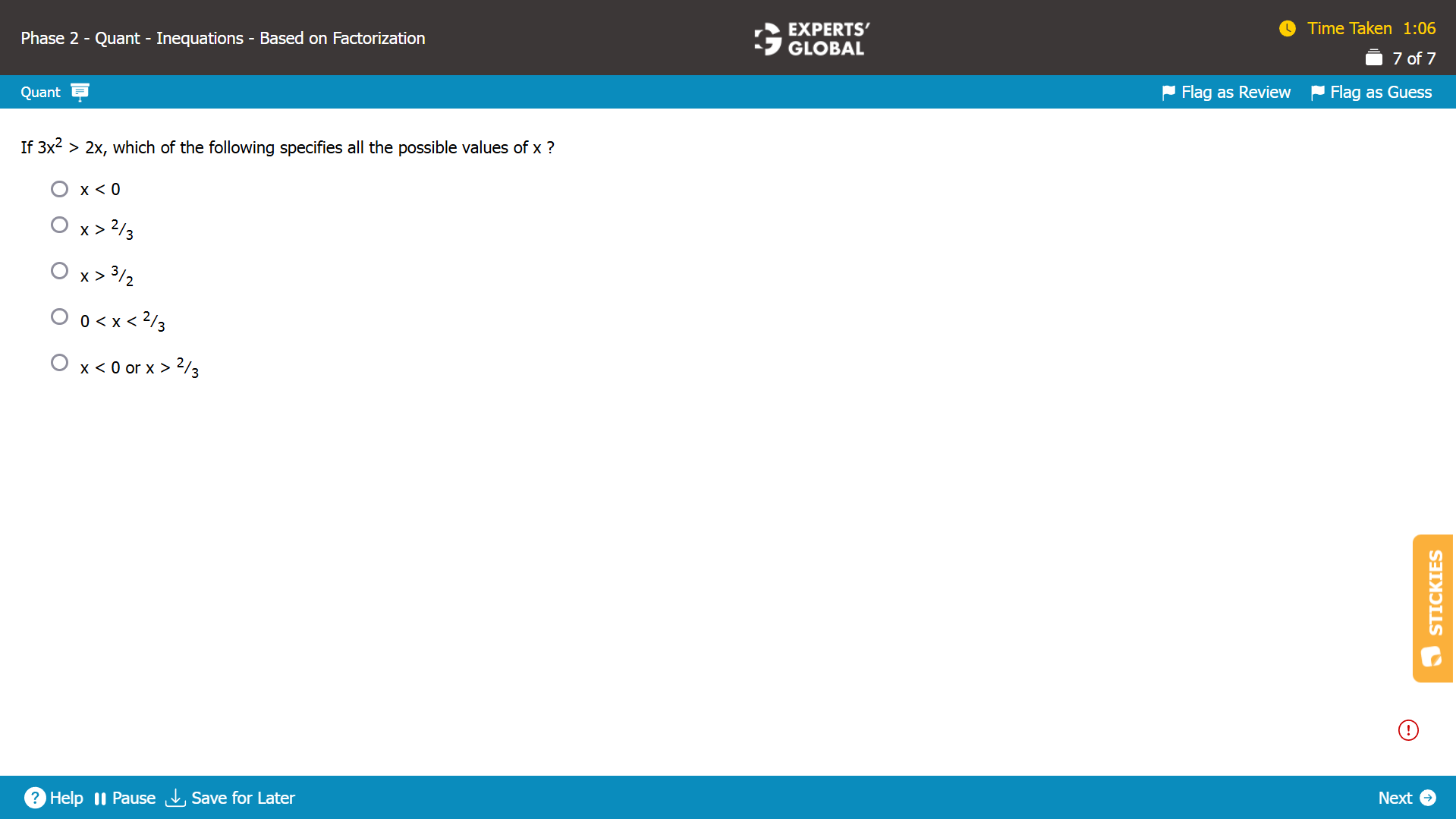
Written Explanation
3x2 > 2x
So, 3x2 – 2x > 0
x (3x – 2) > 0
There are two terms in the function x (3x – 2). So, there will be two nodes of the function.
At each of the five nodes, the value of the function would be zero, or undefined if there is division by zero.
The nodes will be x = 0 and (3x – 2) = 0.
The nodes are x = 0 and x = 2 / 3.
On the number line, the nodes are 0 and 2 / 3, in that order.
For a large value such as x = 10, the function is 10 X (3 X 10 – 2) = 10 X (28) = 280 = Positive.
So, the value is positive for x > 2 / 3.
The value is zero at the second node x = 2 / 3.
Between x = 0 and x = 2 / 3, the function has negative values.
The value is zero at the first node x = 0.
The value is positive for x < 0.
For 3x2 > 2x, or for x (3x – 2) > 0, the values are possible when…
x > 2 / 3
or
x < 0
The required range is x < 0 or x > 2 / 3.
E is the correct answer choice.
Practice Question 2
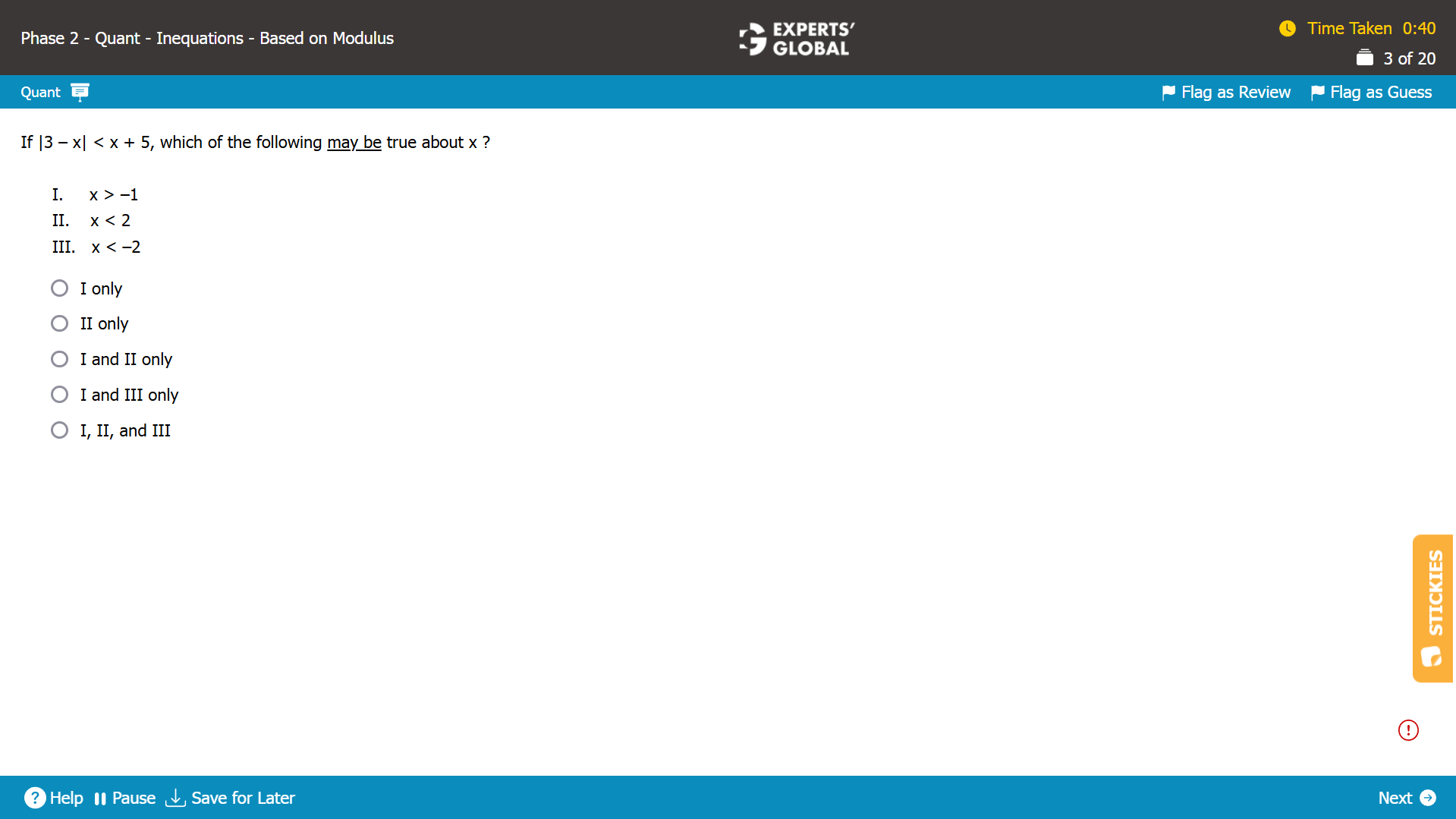
Written Explanation
Removing the modulus sign leads to two possibilities.
So, for the inequality |3 – x| < x + 5…
Possibility 1: (3 – x) is positive.
(3 – x) < x + 5
–2 < 2x
x > –1
x can be any number greater than –1.
Possibility 2: (3 – x) is negative.
(3 – x) > (–1) X (x + 5)
3 – x > –x – 5
3 > –5
No suggestion about the value of x can be obtained in this possibility.
Combining all the possibilities, the range of x is x > –1.
Because x > –1….
x > –1 is always true.
x < 2 may be true for some values of x.
x < –2 will not be true for any values of x.
Only I and II may be true about x.
C is the correct answer choice.
Practice Question 3
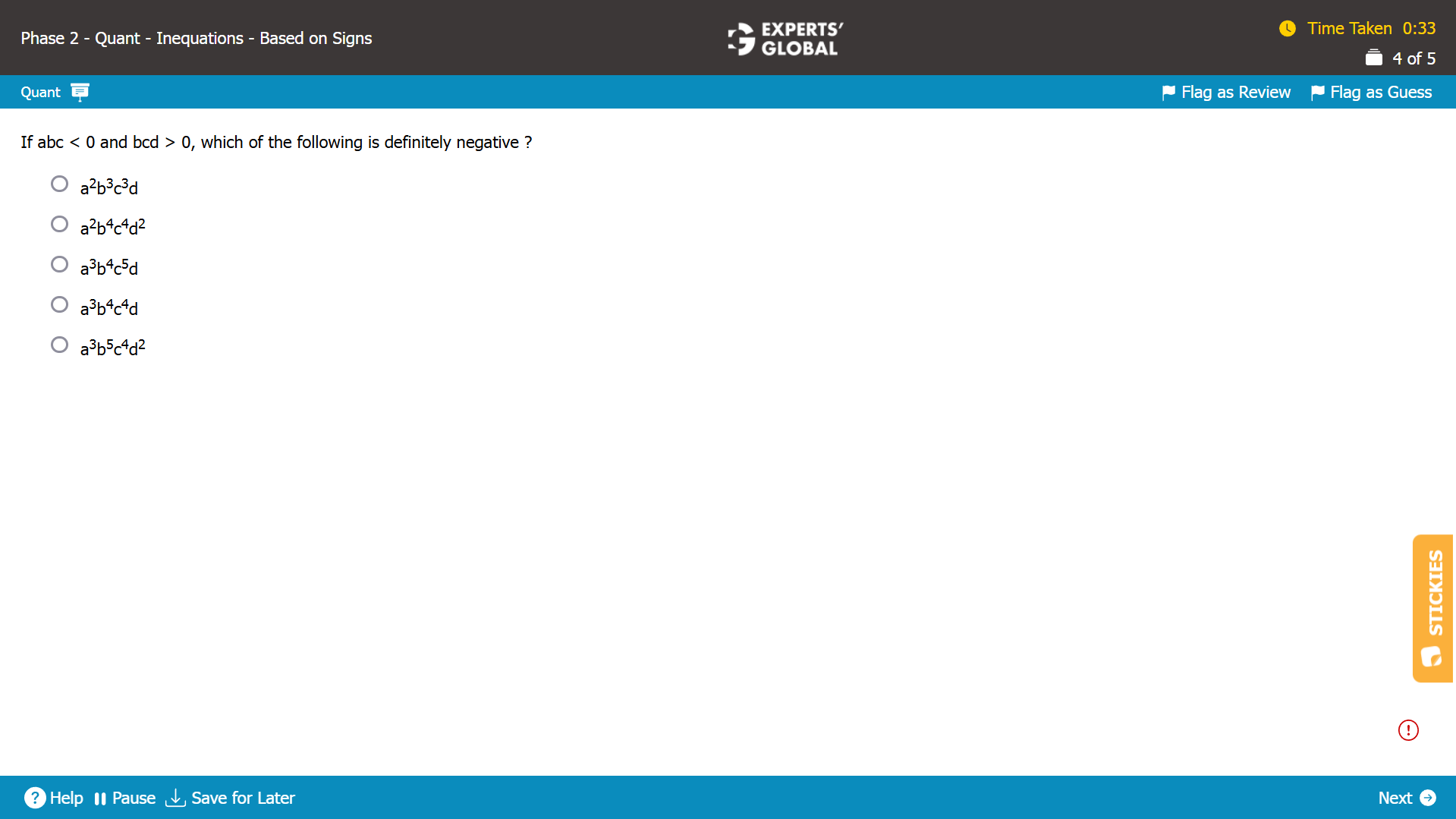
Written Explanation
Even powers are always positive. So, let’s eliminate all even powers from each answer choice and evaluate further.
a2b3c3d
Even powers are a2, b2, and c2, all of which are positive.
So, the sign of a2b3c3d depends on the sign of bcd.
bcd > 0.
a2b3c3d is definitely positive.
a2b4c4d2
All of a2, b4, c4, and d2 are even powers, which are positive.
a2b4c4d2 is definitely positive.
a3b4c5d
Even powers are a2, b4, and c4, all of which are positive.
So, the sign of a3b4c5d depends on the sign of acd.
Nothing can be said about the sign of acd from the given information that abc < 0 and bcd > 0.
The sign of a3b4c5d cannot be determined with certainty.
a3b4c4d
Even powers are a2, b4, and c4, all of which are positive.
So, the sign of a3b4c4d depends on the sign of ad.
Let’s determine the sign of ad from the given information that abc < 0 and bcd > 0.
Possibility 1: a is positive.
abc < 0; so, bc is negative.
bcd > 0; so, d is negative.
Overall, ad is negative.
Possibility 2: a is negative.
abc < 0; so, bc is positive.
bcd > 0; so, d is positive.
Overall, ad is negative.
In both the possibilities, ad is negative.
So, a3b4c4d is definitely negative.
a3b5c4d2
Even powers are a2, b4, c4, and d2 all of which are positive.
So, the sign of a3b5c4d2 depends on the sign of ab.
Nothing can be said about the sign of ab from the given information that abc < 0 and bcd > 0.
The sign of a3b5c4d2 cannot be determined with certainty.
[Alternatively,
bcd > 0
Any power of bcd will be greater than 0.
So, let’s try to reduce each expression by a certain power of bcd.
a2b3c3d = (bcd) X (a2b2c2) = (bcd) X (abc)2
So, the sign of a2b3c3d depends on the sign of (abc)2.
abc < 0 and (abc)2 > 0
a2b3c3d is definitely positive.
a2b4c4d2 = (bcd)2 X a2b2c2 = (abc)2
So, the sign of a2b4c4d2 depends on the sign of (abc)2
abc < 0 and (abc)2 > 0
a2b4c4d2 is definitely positive.
a3b4c5d = (bcd) X (a3b3c4)
So, the sign of a3b4c5d depends on the sign of a3b3c4.
Nothing can be said about the sign of a3b3c4 from the given information that abc < 0 and acd > 0.
The sign of a3b4c5d cannot be determined with certainty.
a3b4c4d = (bcd) X a3b3c3 = (bcd) X (abc)3
So, the sign of a3b4c4d depends on the sign of (abc)3.
abc < 0; so, (abc)3 < 0.
So, a3b4c4d is definitely negative.
a3b5c4d2 = (bcd)2 X (a3b3c2)
So, the sign of a3b5c4d2 depends on the sign of a3b3c2.
Nothing can be said about the sign of a3b3c2 from the given information that abc < 0 and acd > 0.
The sign of a3b5c4d2 cannot be determined with certainty.]
D is the correct answer choice.
Practice Question 4
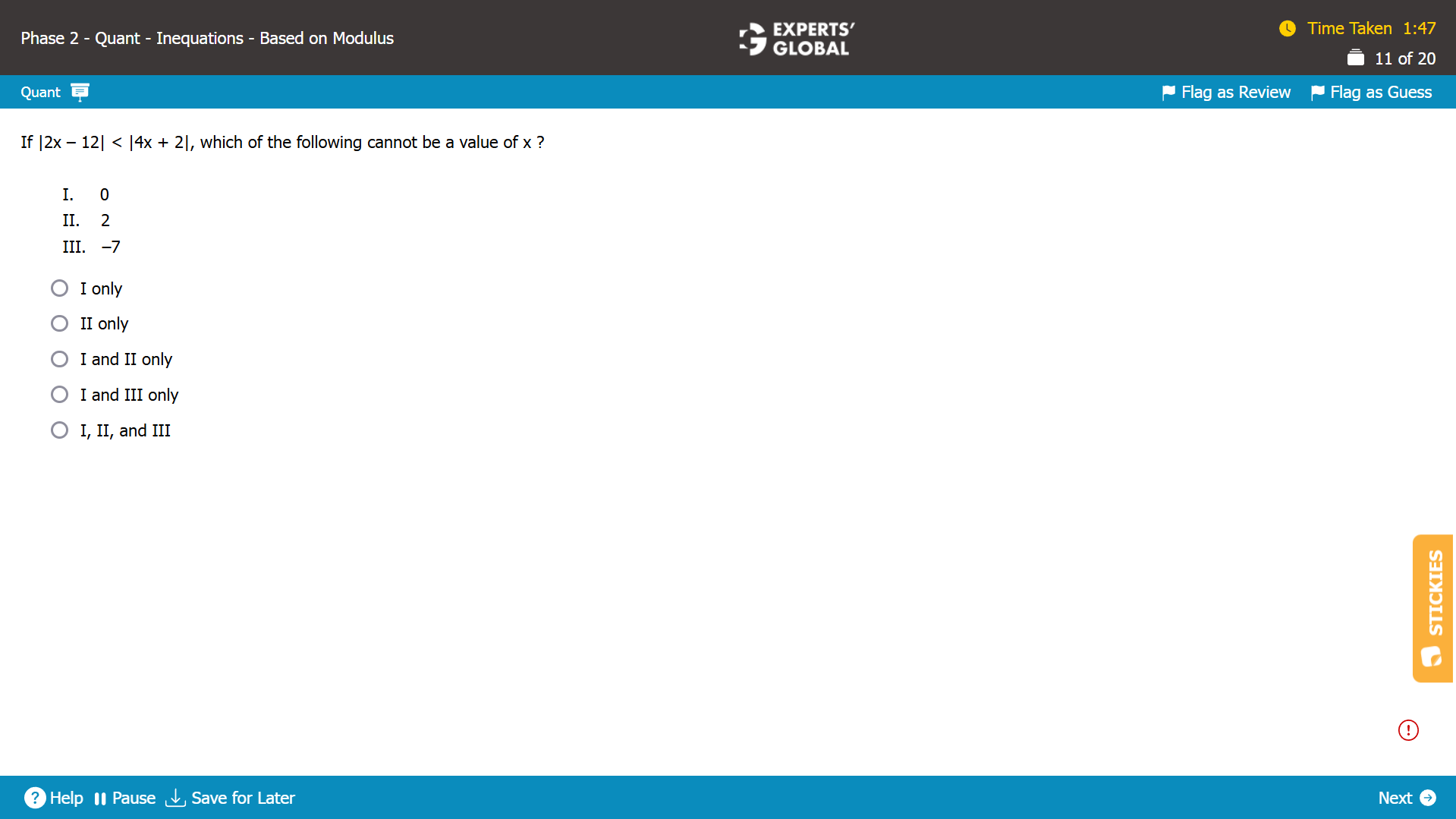
Written Explanation
|2x – 12| < |4x + 2|
Let’s check whether x can be any of the given values.
If x = 0…
|2x – 12| = |0 – 12| = 12
|4x + 2| = |0 + 2| = 2
|2x – 12| < |4x + 2| does not hold for x = 0.
If x = 2…
|2x – 12| = |4 – 12| = 8
|4x + 2| = |8 + 2| = 10
|2x – 12| < |4x + 2| holds for x = –14.
If x = –7…
|2x – 12| = |–14 – 12| = 26
|4x + 2| = |–28 + 2| = 26
|2x – 10| < x + 1 does not hold for x = –7.
Values in I and III cannot be true for x.
D is the correct answer choice.
Practice Question 5
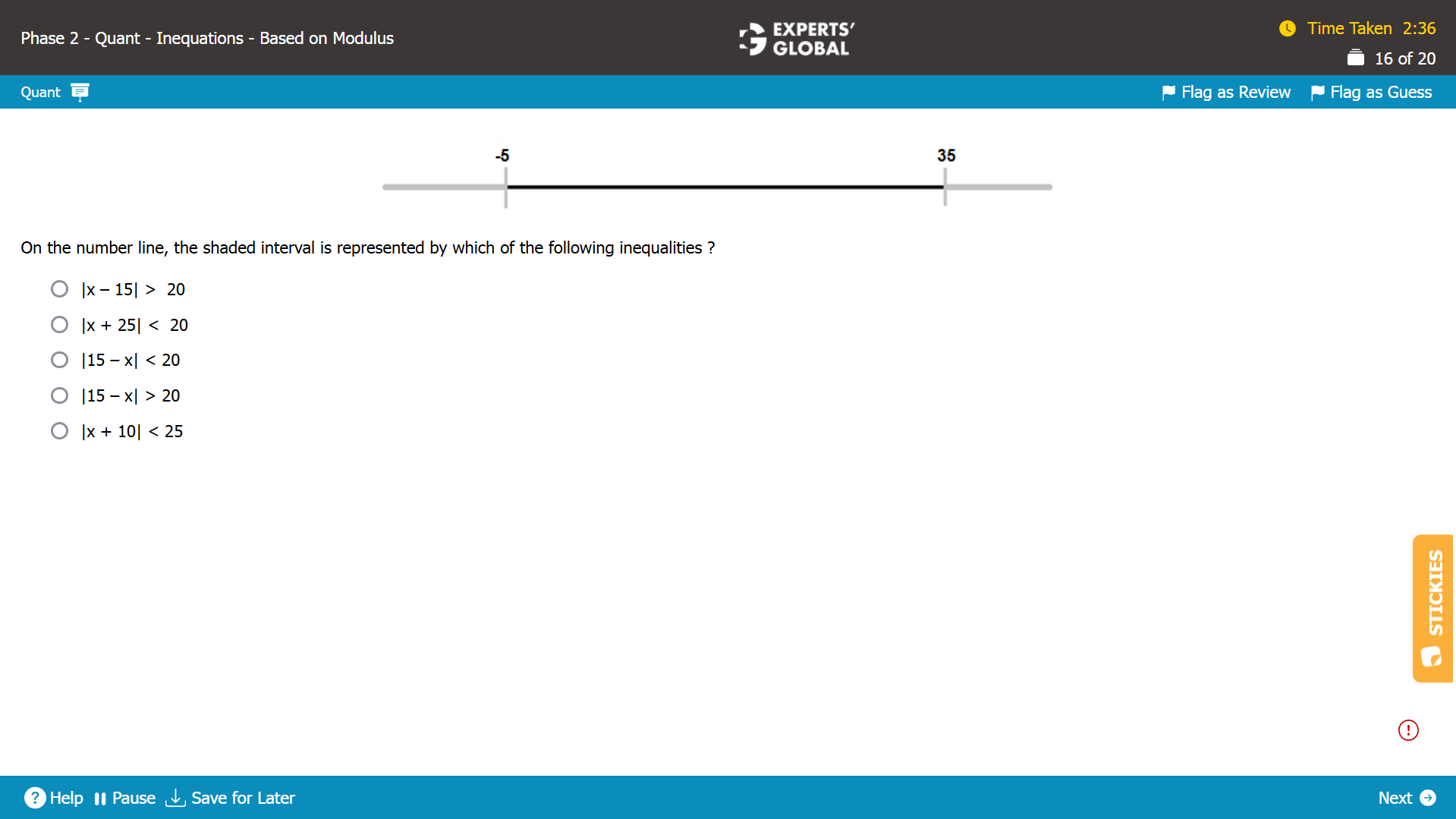
Written Explanation
The shaded interval is –5 < x < 35.
Let’s evaluate each answer choice.
|x – 15| > 20.
So, (x – 15) > 20 or (x – 15) < –20
x > 35 or x < –5.
|x – 15| > 20 does not represent the range –5 < x < 35.
|x + 25| < 20.
So, (x + 25) < 20 or (x + 25) > –20
x < –5 or x > –45.
|x + 25| < 20 does not represent the range –5 < x < 35.
|15 – x| < 20.
So, (15 – x) < 20 or (15 – x) > –20
–x < 5 or –x > –35
x > –5 or x < 35
|15 – x| < 20 represents the range –5 < x < 35.
|15 – x| > 20.
So, (15 – x) > 20 or (15 – x) < –20
–x > 5 or –x < –35
x < –5 or x > 35
|15 – x| > 20 does not represent the range –5 < x < 35.
|x + 10| < 25
So, (x + 10) < 25 or (x + 10) > –25
x < 15 or x > –35
|x + 10| < 25 does not represent the range –5 < x < 35.
The shaded interval is represented by |15 – x| < 20.
C is the correct answer choice.
Practice Question 6
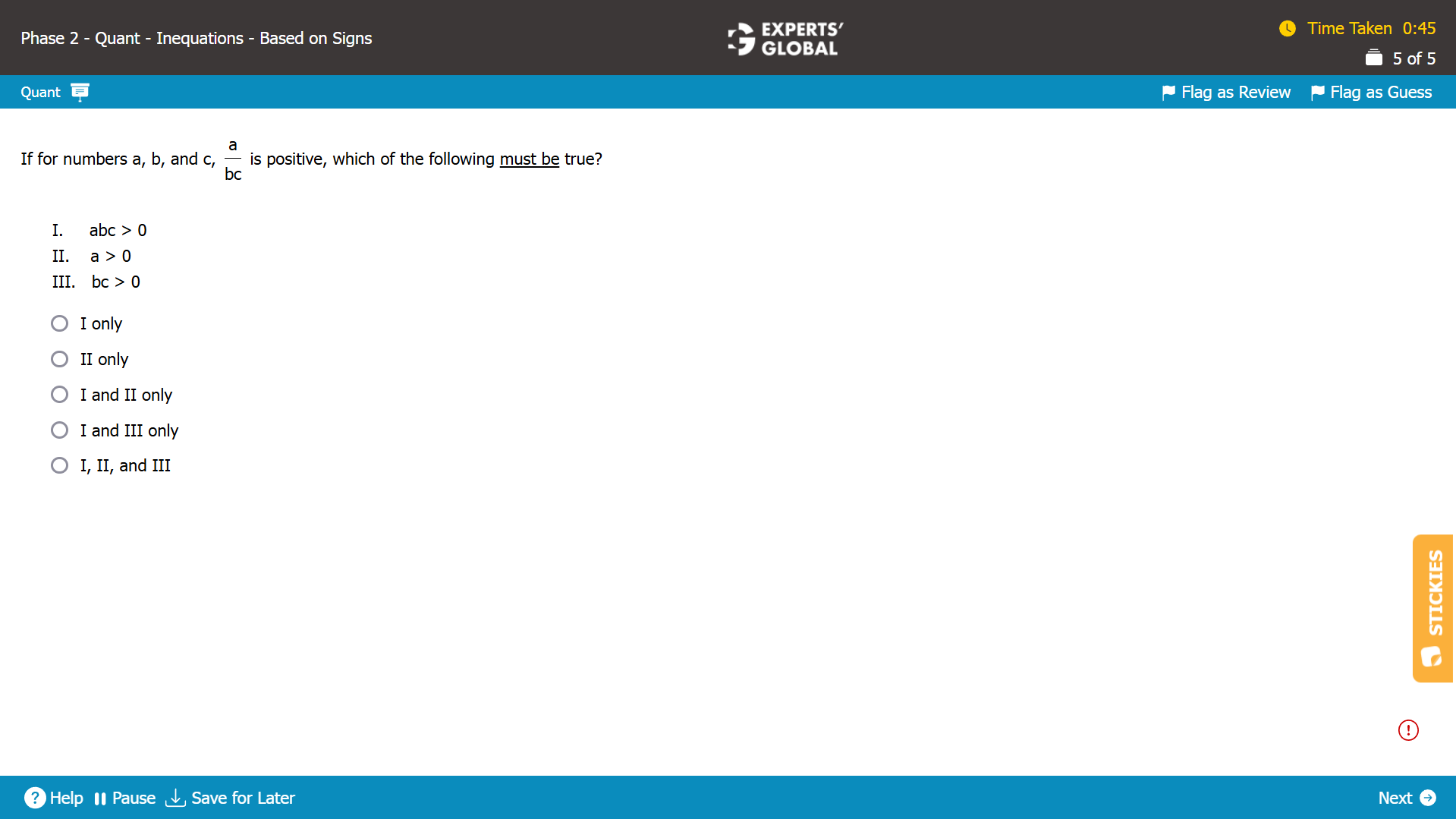
Written Explanation
a / bc is positive.
Possibility 1: Both a and bc are negative.
Possibility 1A: a is negative, b is negative, and c is positive.
Possibility 1B: a is negative, b is positive, and c is negative.
Possibility 2: Both a and bc are positive.
Possibility 2A: a is positive, b is positive, and c is positive.
Possibility 2B: a is positive, b is negative, and c is negative.
Let’s evaluate each statement for each possibility.
Statement I: abc > 0
Possibility 1A : a is negative, b is negative, and c is positive.
abc will be positive. abc > 0 holds.
Possibility 1B: a is negative, b is positive, and c is negative.
abc will be positive. abc > 0 holds.
Possibility 2A: a is positive, b is positive, and c is positive.
abc will be positive. abc > 0 holds.
Possibility 2B: a is positive, b is negative, and c is negative.
abc will be positive. abc > 0 holds.
So, abc > 0 always holds.
Statement II: a > 0
Possibility 1A : a is negative, b is negative, and c is positive.
a > 0 does not hold.
Possibility 1B: a is negative, b is positive, and c is negative.
a > 0 does not hold.
Possibility 2A: a is positive, b is positive, and c is positive.
a > 0 holds.
Possibility 2B: a is positive, b is negative, and c is negative.
a > 0 holds.
abc will be positive. abc > 0 holds.
So, a > 0 does not always hold.
Statement III: bc > 0
Possibility 1A : a is negative, b is negative, and c is positive.
bc will be negative. bc > 0 does not hold.
Possibility 1B: a is negative, b is positive, and c is negative.
bc will be negative. bc > 0 does not hold.
Possibility 2: a is positive, b is positive, and c is positive.
bc will be positive. bc > 0 holds.
Possibility 2B: a is positive, b is negative, and c is negative.
bc will be positive. bc > 0 holds.
So, bc > 0 does not always hold.
Overall, only Statement I must be true.
A is the correct answer choice.
Practice Question 7
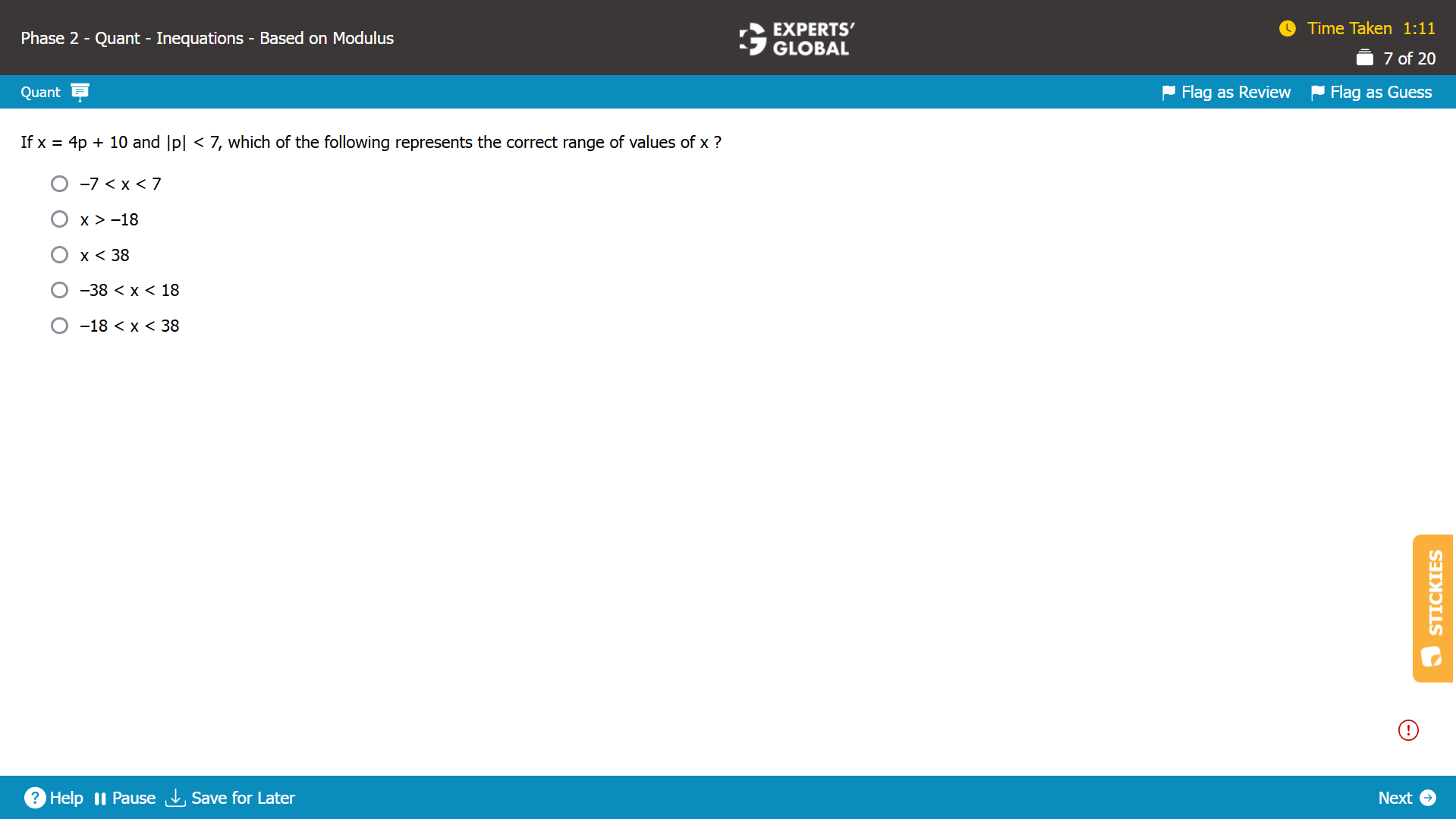
Written Explanation
|p| < 7.
So, p can range from –7 to 7, excluding both values.
Let’s find the extreme points of x = 4p + 10.
When p = –7…
x = 4p + 10 = 4 X (–7) + 10 = –28 + 10 = –18
When p = 7…
x = 4p + 10 = 4 X 7 + 10 = 38
So, x can range from –18 to 38, excluding both values.
The range of x is –18 < x < 38.
E is the correct answer choice.
Practice Question 8
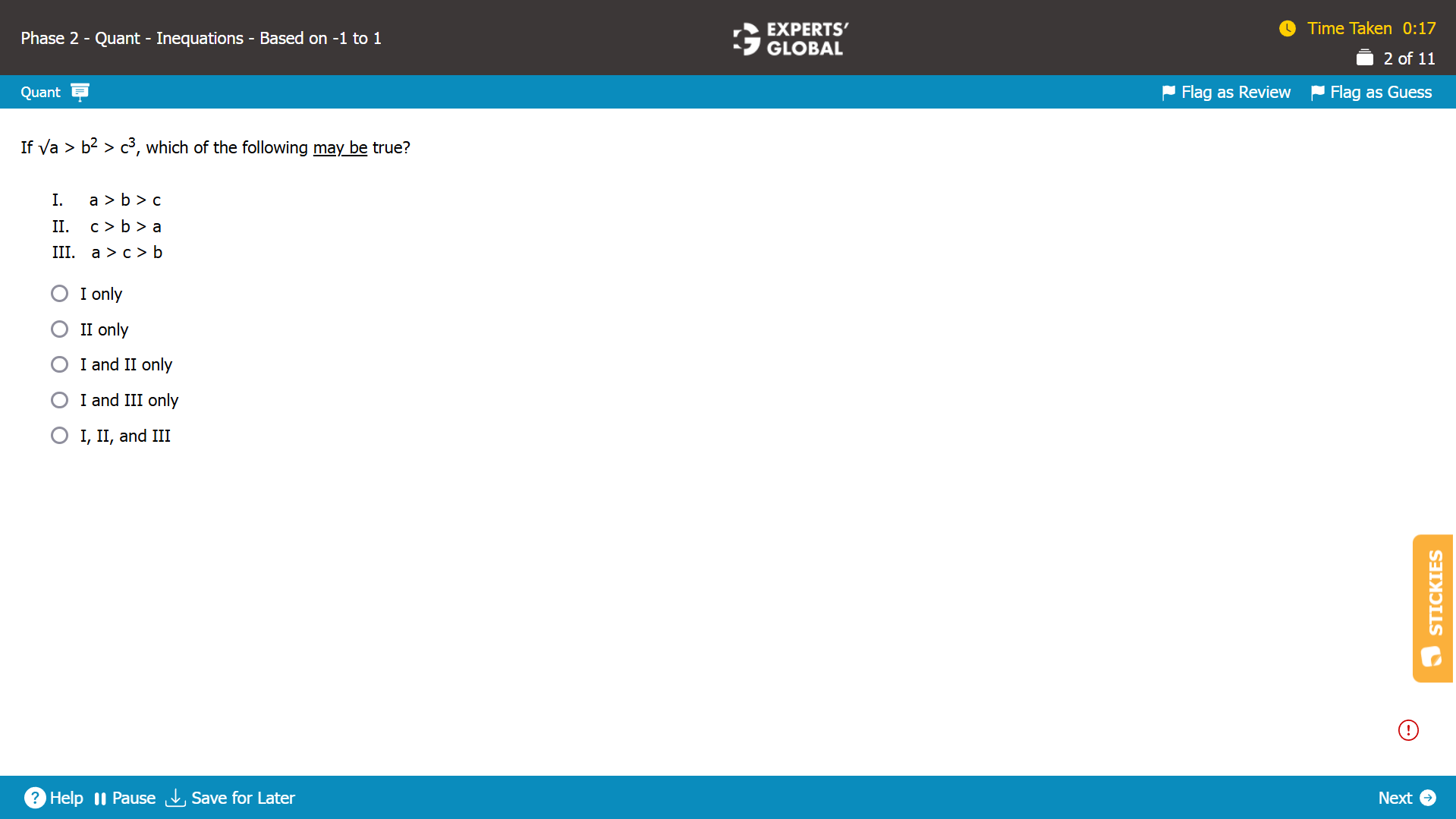
Written Explanation
Let’s evaluate each statement.
a > b > c.
Comparing a, b, and c, a > b > c but √a > b2 > c3.
This may be true for large positive values such as a = 9, b = 2, and c = 1.
√a = 3, b2 = 4, and c3 = 1
√a > b2 > c3 and a > b > c.
Statement I may be true for some values.
c > b > a.
Comparing a and c, c > a but √a > c3.
Comparing b and c, c > b but b2 > c3.
This may be true for small positive values such as a = 0.49, b = 0.65, and c = 0.7.
√a = 0.7, b2 = 0.42, and c3 = 0.373
√a > b2 > c3 and c > b > a.
Statement II may be true for some values.
a > c > b.
Comparing a and b, a > b and √a > b2.
Comparing b and c, c > b but b2 > c3.
This may be true for large positive values of a and small positive values of b and c, such as a = 9, b = 0.5, and c = 0.6.
√a = 3, b2 = 0.25, and c3 = 0.216
√a > b2 > c3 and a > c > b.
Statement III may be true for some values.
All the statements may be true.
E is the correct answer choice.
Practice Question 9
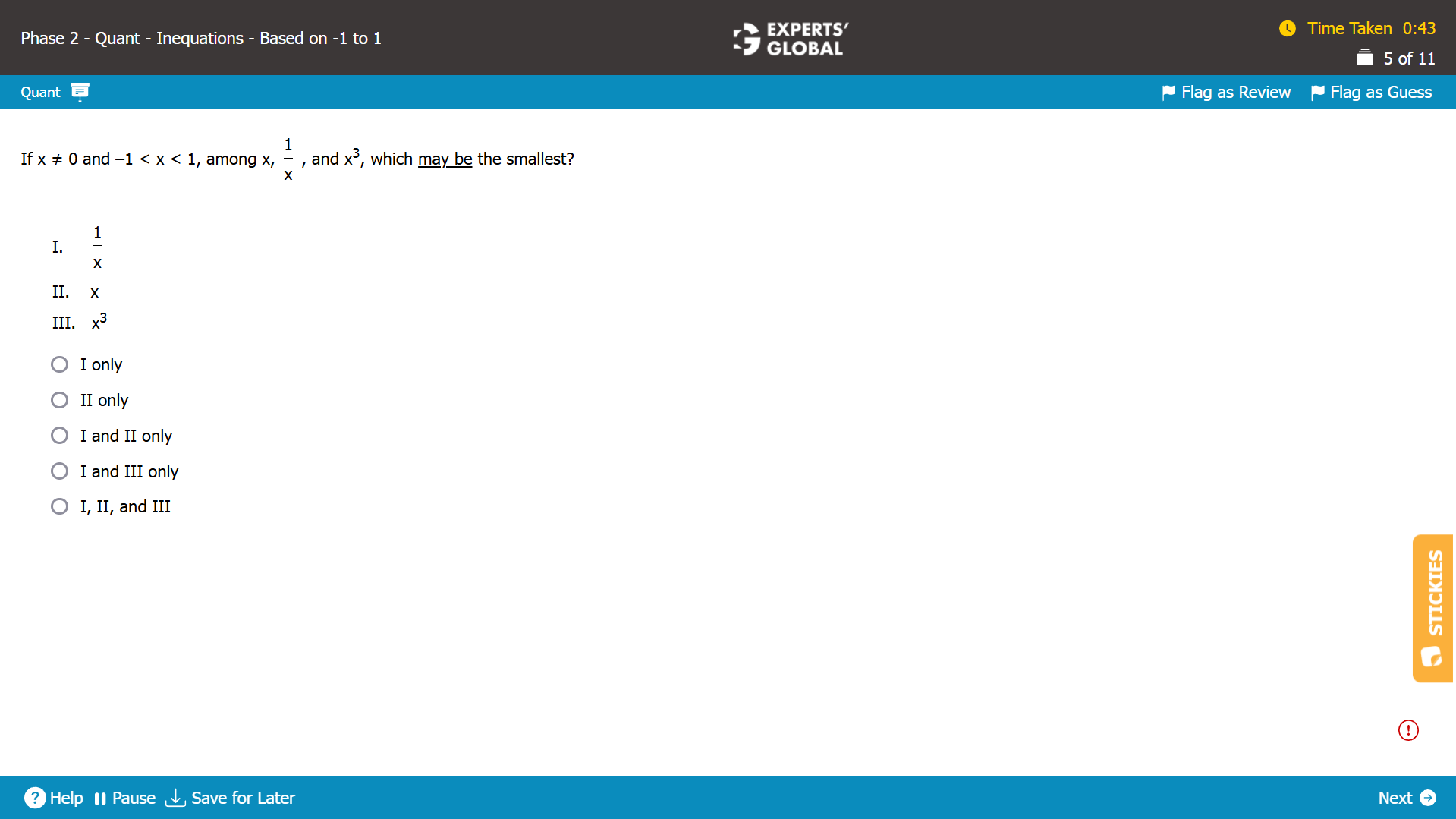
Written Explanation
Let’s evaluate each possibility.
Possibility 1: –1 < x < 0.
Let’s say that x = –1/2 = –0.5.
1 / x = –2.
x3 = (–0.5)3 = –0.125
1 / x is the smallest.
Possibility 2: 0 < x < 1.
Let’s say that x = 1/2 = 0.5.
1 / x = 2.
x3 = (0.5)3 = 0.125
x3 is the smallest.
Overall, 1 / x and x3 may be the smallest among x, 1 / x, and x3.
D is the correct answer choice.
Practice Question 10
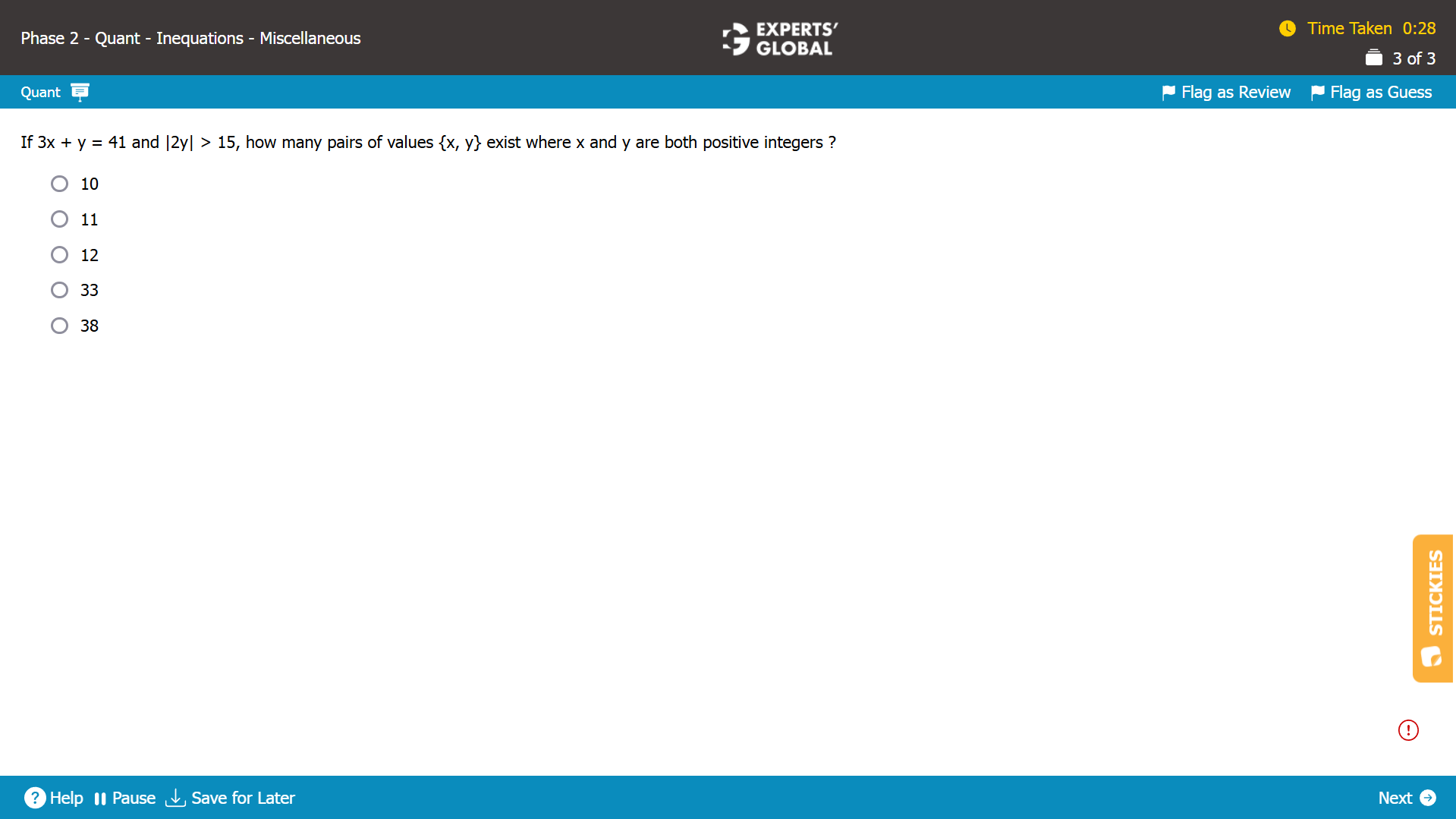
Written Explanation
|2y| > 15
|y| > 7.5
Positive integer values of y can be {8, 9, 10,…}
3x + y = 41
3x = 41 – y
x = (41 – y)/3
When y = 8, x = (41 – 8)/3 = 33 / 3 = 11. x is a positive integer.
When y = 9, x = (41 – 9)/3 = 32 / 3. x is NOT a positive integer.
When y = 10, x = (41 – 10)/3 = 31 / 3. x is NOT a positive integer.
When y = 11, x = (41 – 11)/3 = 30 / 3 = 10. x is a positive integer.
It can be inferred that for every third value of y, x will be a positive integer.
So, the next values of x as a positive integer will be 9, 8, 7, 6, 5, 4, 3, 2, 1.
The only positive integer values of x and y pair are…
x = 11 and y = 8
x = 10 and y = 11
….
x = 1 and y = 38
11 pairs of values {x, y} exist such that x and y are both positive integers.
B is the correct answer choice.
GMAT Quant: Algebraic Functions Sample Question
Functions show how one quantity depends on another by matching every input with one clear, well defined output. This structure helps you spot patterns, understand relationships, and track change with confidence. Functions also connect algebraic thinking to real world situations in a clean, practical way.
Important: Before visiting the following sample question(s), if you would like a quick brush up of key Algebraic Functions concepts, you may first visit: Free GMAT Algebraic Functions Prep
Practice Question 1
Written Explanation
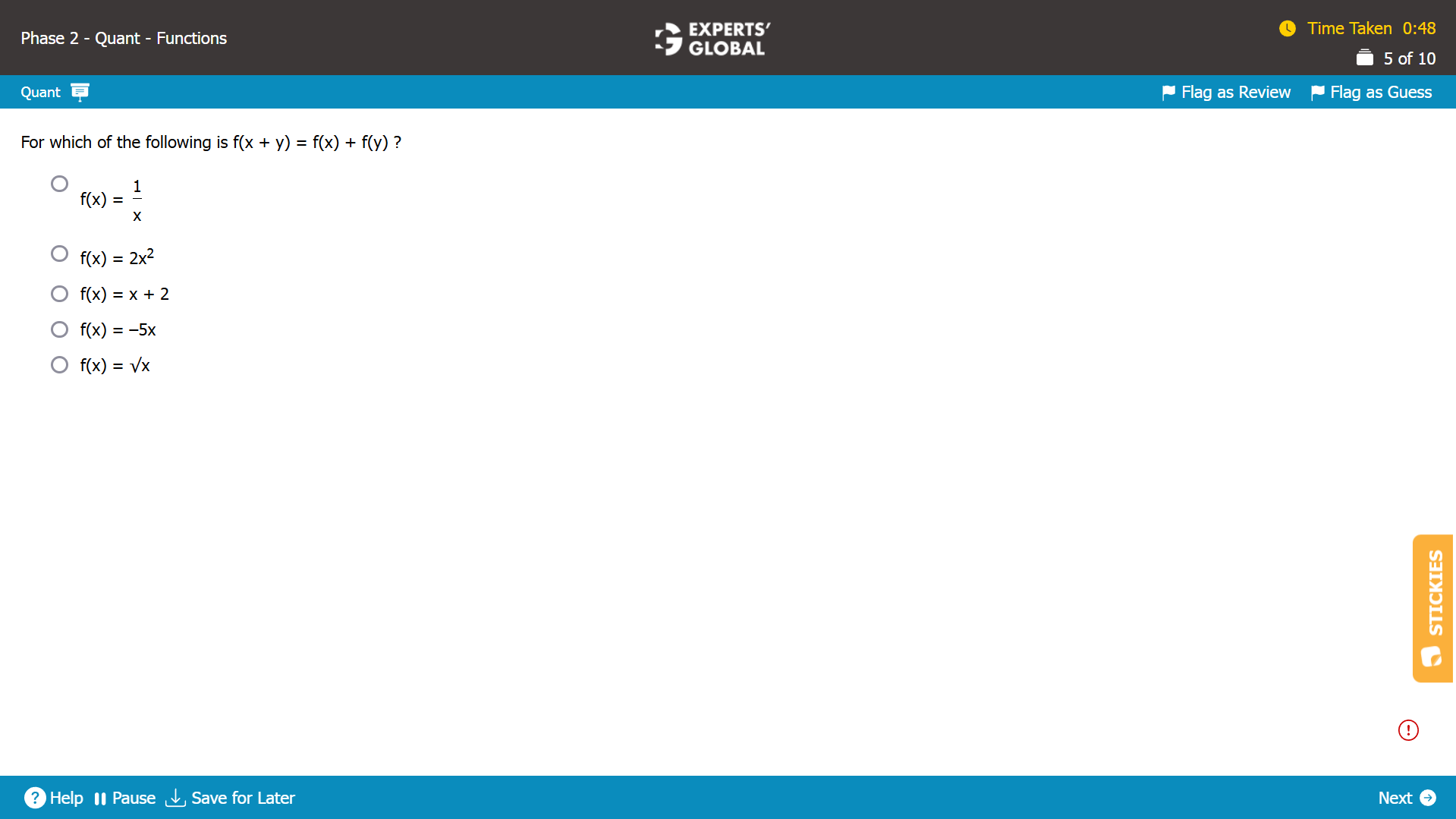
If f(x) = 1 / x…
f(y) = 1 / y
f(x + y) = 1 / (x + y)
f(x) + f(y) = (1 / x) + (1 / y) = (x + y)/ (xy)
The values of f(x + y) and f(x) + f(y) are not equal for all values of x and y. So, f(x) = 1 / x cannot be the required function.
If f(x) = 2x2…
f(y) = 2y2
f(x + y) = 2 (x + y)2 = 2x2 + 2y2 + 4xy
f(x) + f(y) = 2x2 + 2y2
The values of f(x + y) and f(x) + f(y) are not equal for all values of x and y. So, f(x) = 2x2 cannot be the required function.
If f(x) = x + 2 …
f(y) = y + 2
f(x + y) = x + y + 2
f(x) + f(y) = (x + 2) + (y + 2) = x + y + 4
The values of f(x + y) and f(x) + f(y) are not equal for any values of x and y. So, f(x) = x + 2 cannot be the required function.
If f(x) = –5x…
f(y) = –5y
f(x + y) = –5 X (x + y) = –5x – 5y
f(x) + f(y) = –5x – 5y
The values of f(x + y) and f(x) + f(y) are equal for all values of x and y. So, f(x) = –5x can be the required function.
If f(x) = √x…
f(y) = √y
f(x + y) = √(x + y)
f(x) + f(y) = √x + √y
The values of f(x + y) and f(x) + f(y) are not equal for all values of x and y. So, f(x) = √x cannot be the required function.
f(x + y) = f(x) + f(y) is true only for f(x) = –5x from the given answer choices.
D is the correct answer choice.
Practice Question 2
Written Explanation
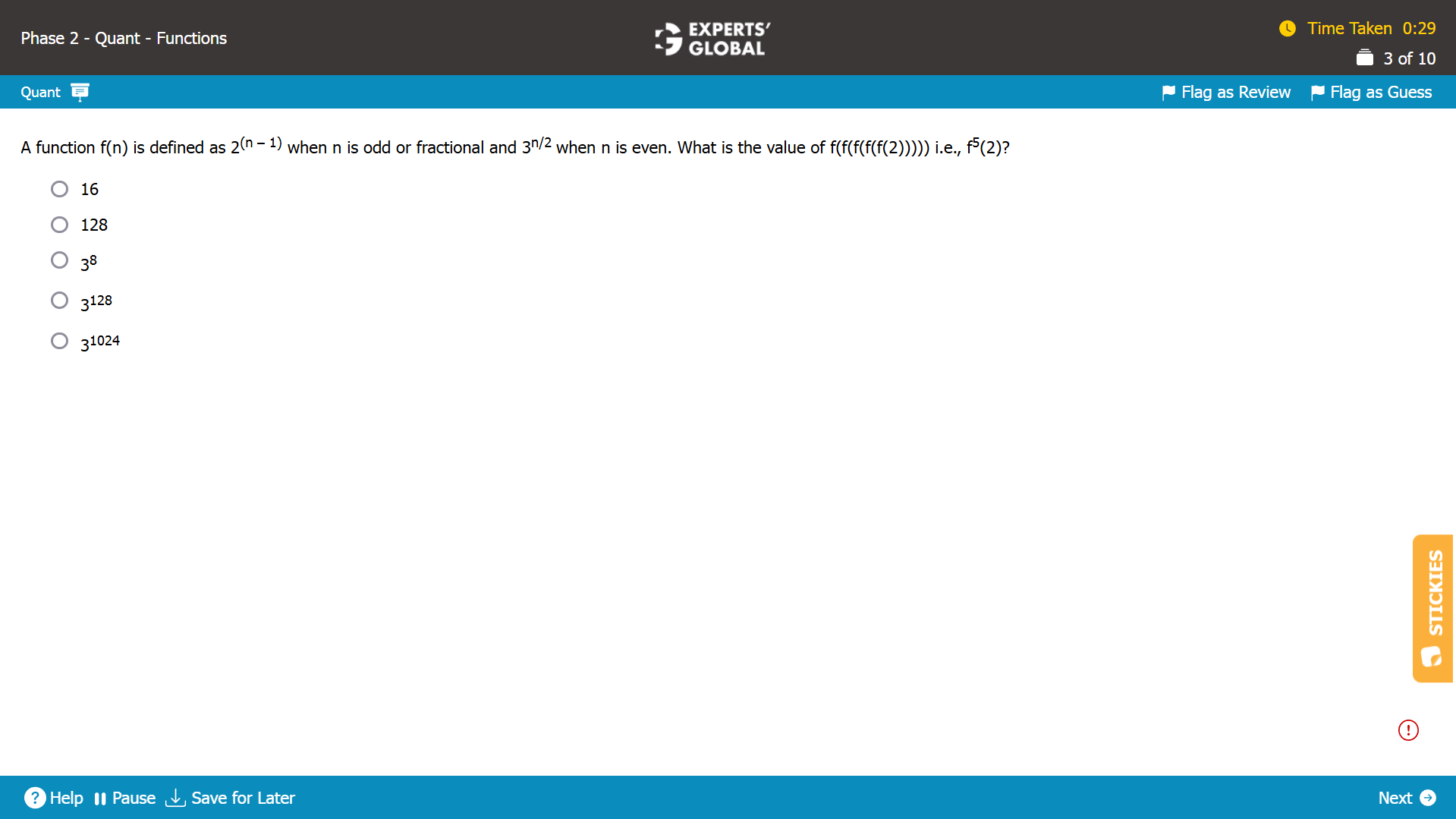
2 is even.
So, f(2) = 3(2/2) = 31 = 3.
f(2) = 3 is odd.
So, f2(2) = 2(3 – 1) = 22 = 4.
f2(2) = 4 is even.
So, f3(2) = 3(4/2) = 32 = 9.
f3(2) = 9 is odd.
So, f4(2) = 2(9 – 1) = 28 = 256.
f4(2) = 256 is even.
So, f5(2) = 3(256/2) = 3128.
Overall, f5(2) = 3128.
D is the correct answer choice.
Practice Question 3
Written Explanation
A.
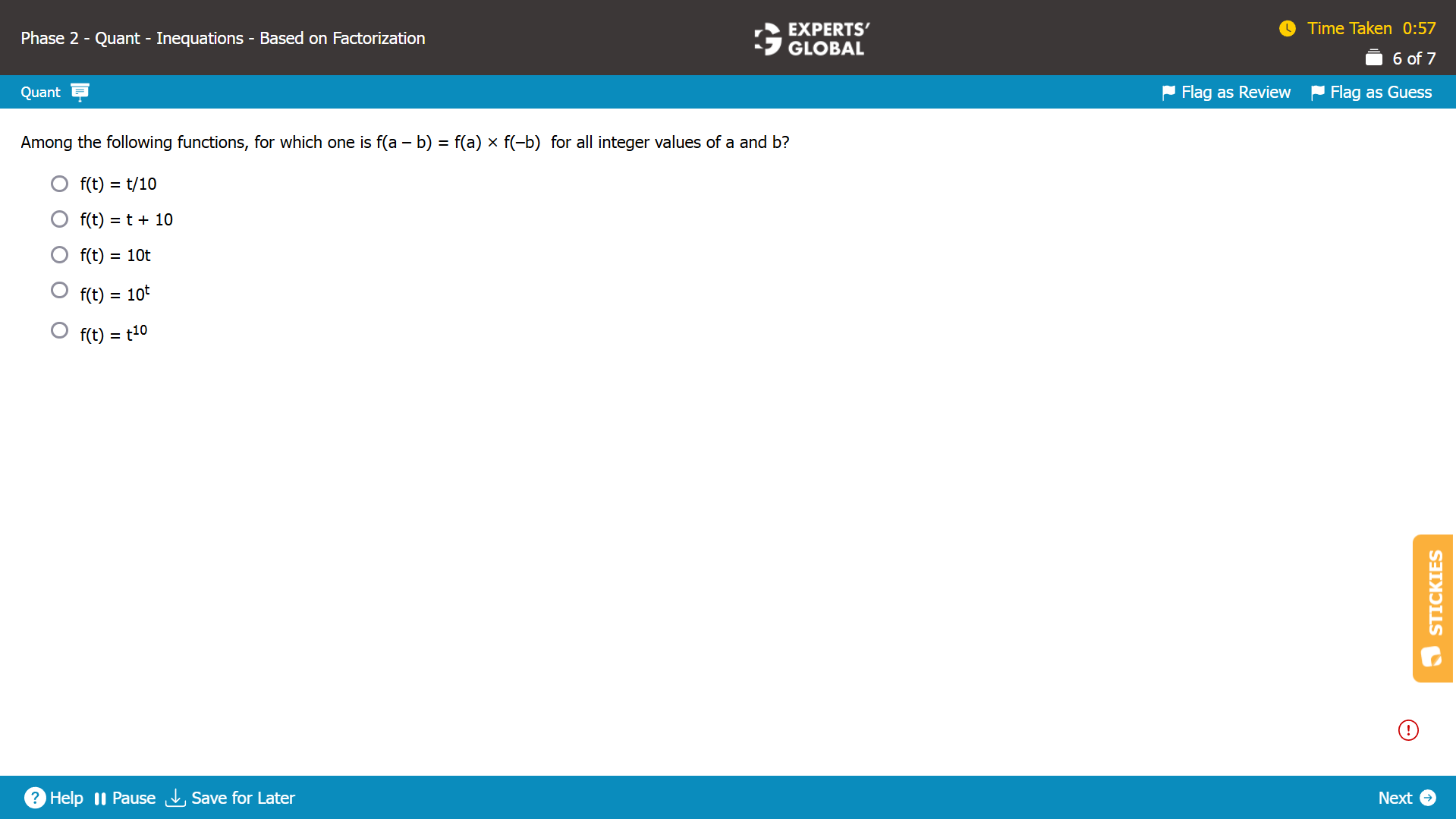
f(t) = t / 10
f(a – b) = (a – b) / 10
f(a) × f(–b) = ( a / 10 ) × ( –b / 10 ) = –ab / 100
In this case, f(a – b) ≠ f(a) × f(–b)
B.
f(t) = t + 10
f(a – b) = a – b + 10
f(a) × f(–b) = (a + 10) × (–b + 10)
In this case, f(a – b) ≠ f(a) × f(–b)
C.
f(t) = 10t
f(a – b) = 10(a – b)
f(a) × f(–b) = 10a × 10(–b) = –100ab
In this case, f(a – b) ≠ f(a) × f(–b)
D.
f(t) = 10t
f(a – b) = 10a – b
f(a) × f(–b) = 10a × 10–b = 10a – b
In this case, f(a – b) = f(a) × f(–b)
E.
f(t) = t10
f(a – b) = (a – b)10
f(a) x f(–b) = a10 × –b10 = (–ab)10
In this case, f(a – b) ≠ f(a) × f(–b)
D is the correct answer choice.
Practice Question 4
Written Explanation
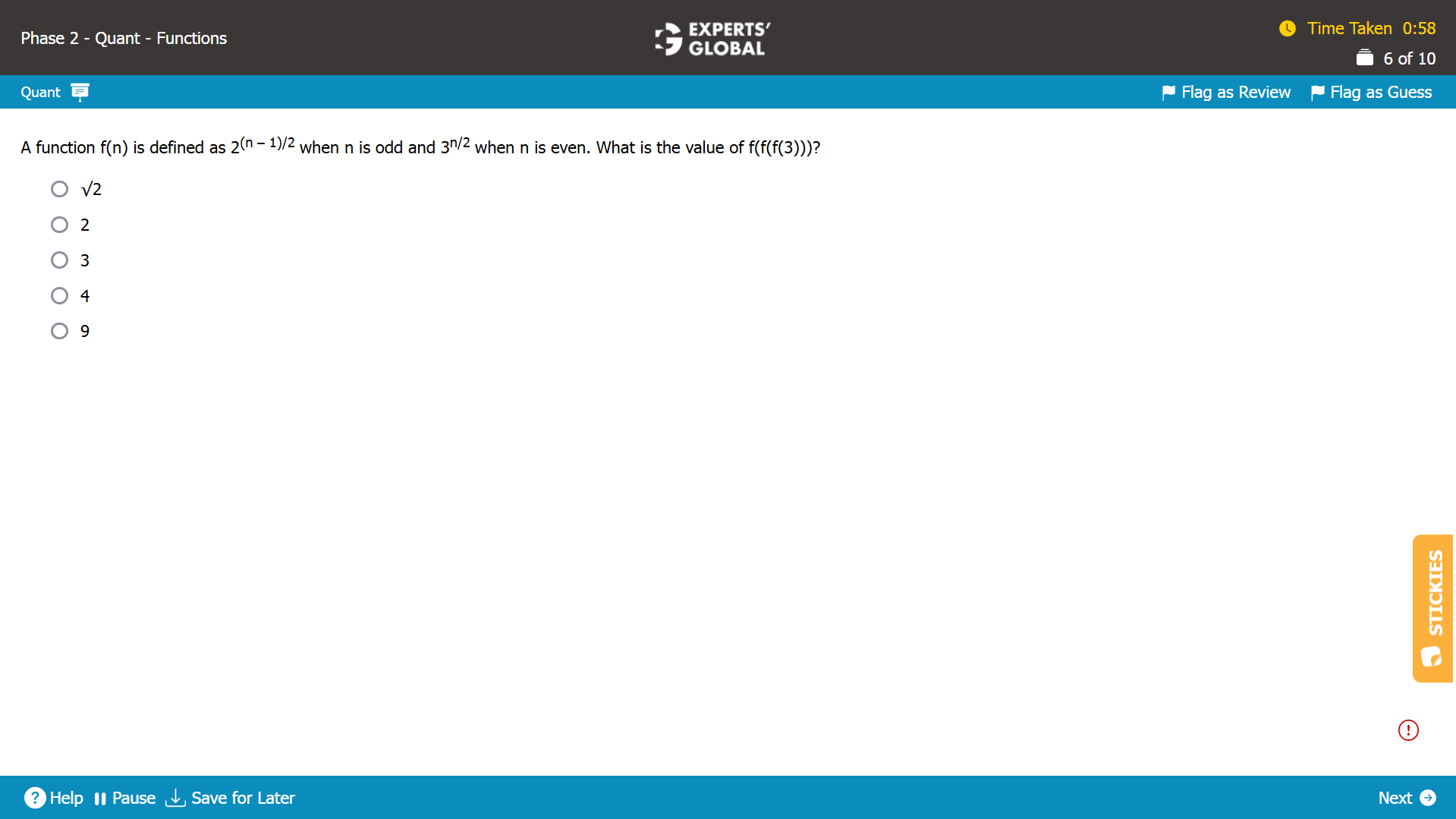
3 is odd.
So, f(3) = 2(3 – 1)/2 = 21 = 2.
f(3) = 2 is even.
So, f(f(3)) = 3(2/2) = 31 = 3.
f(f(3)) = 3 is odd.
So, f(f(f(3))) = 2(3 – 1)/2 = 21 = 2.
Overall, (f(f(3))) = 2.
B is the correct answer choice.
Practice Question 5
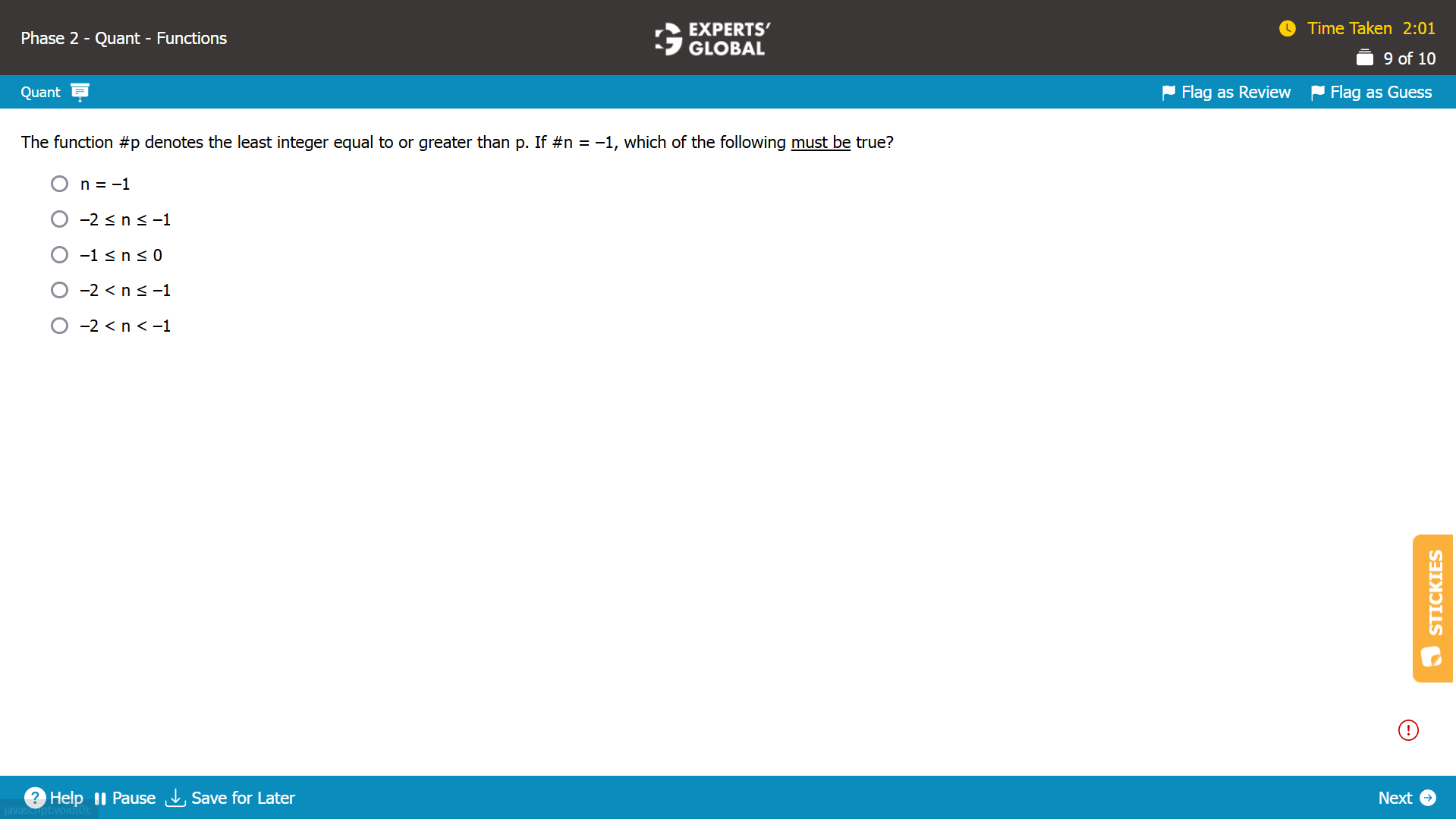
Written Explanation
#n = least integer equal to or greater than n = –1.
Possibility 1: n = –1.
Least integer greater than or equal to –1 is –1. So, #n = –1 holds. n can be –1.
Possibility 2: n > –1.
Least integer greater than or equal to n would be 0 or greater, and not –1. So, #n = –1 will not hold. n cannot be greater than –1.
Possibility 3: –2 < n < –1.
Least integer greater than or equal to n would be –1. So, #n = –1 holds. n can be between –2 and –1.
Possibility 4: n = –2
Least integer greater than or equal to –2 is –2. So, #n = –1 will not hold. n cannot be –2.
Possibility 5: n < –2
Least integer greater than or equal to n would be –2 or lower, and not –1. So, #n = –1 will not hold. n cannot be smaller than –2.
Overall, the possible range for n is –2 < n ≤ –1.
D is the correct answer choice.
GMAT Quant: Work-Rate Sample Question
Work rate problems focus on how fast a job gets done when one person, or several people, work on it. You connect total work to time and to the speed of each contributor. Once you see that link clearly, combined effort starts to feel simple and predictable, like a clean team math move.
Important: Before visiting the following sample question(s), if you would like a quick brush up of key Work-Rate concepts, you may first visit: Free GMAT Work-Rate Prep
Practice Question 1
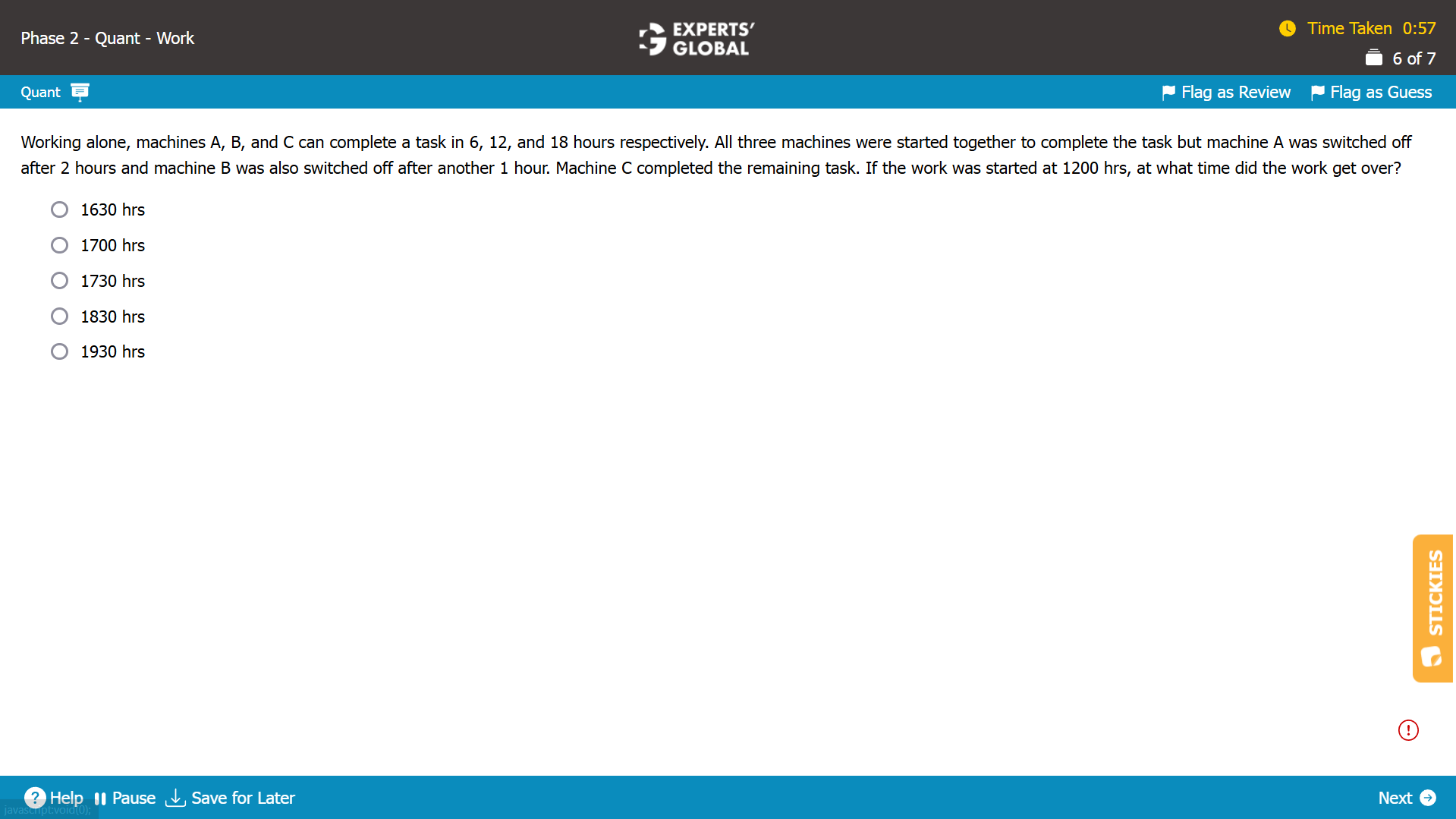
Written Explanation
Let’s say the total work is 36 units of work.
Machine A completes these 36 units in 6 hours; so, Machine A completes 36 / 6 = 6 units per hour.
Machine B completes these 36 units in 12 hours; so, Machine B completes 36 / 12 = 3 units per hour.
Machine C completes these 36 units in 18 hours; so, Machine C completes 36 / 18 = 2 units per hour.
For the first two hours, all the three machines are working.
So, the output per hour was 6 + 3 + 2 = 11 units per hour.
At the end of the two hours, 11 X 2 = 22 units of work was completed and 36 – 22 = 14 units of work was pending.
For the next one hour, only Machine B and Machine C were working.
So, the output per hour was 3 + 2 = 5 units per hour.
At the end of the next one hour, 5 units of work was completed and 14 – 5 = 9 units of work was pending.
Now, only Machine C is working.
So, the output per hour was 2 units per hour.
Work pending was 9 units.
Time taken to complete the work = 9 / 2 = 4 hours 30 mins.
Total time taken to complete = 2 hour of all machines working + 1 hour two machines working + 4 hours 30 minutes of one machine working = 7 hours 30 minutes.
The work was stated as 1200 hours; so, the work will be completed at 1200 hours + 7 hours 30 minutes = 1930 hours.
E is the correct answer choice.
Practice Question 2
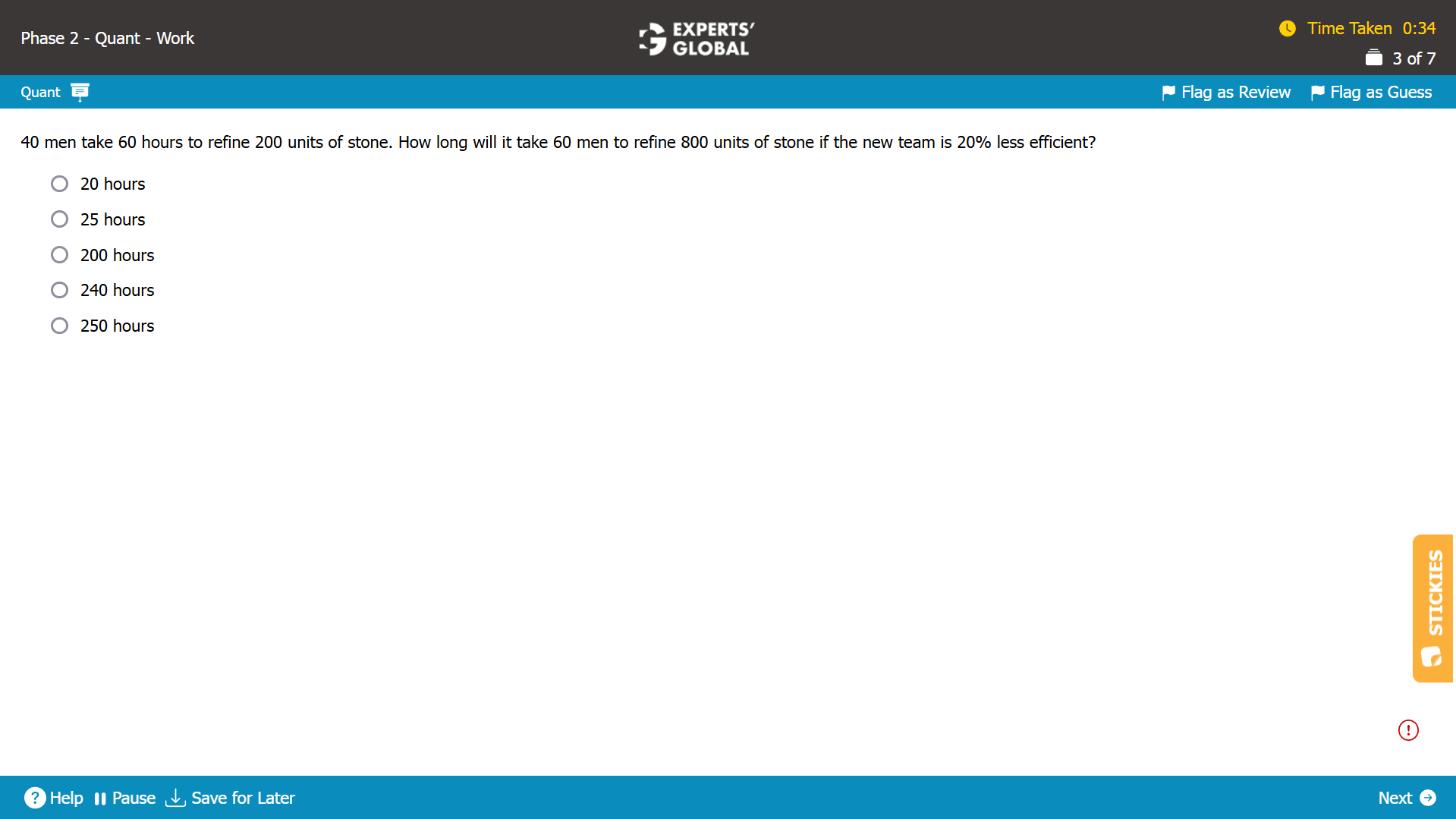
Written Explanation
Let’s say Team 1 has 40 men and refines 200 units of stone in 60 hours.
Team 1 refines 200 / 60 = 10 / 3 units of stone per hour.
Each person on Team 1 refines (10 / 3) / 40 = 1 / 12 units of stone per hour.
Team 2 is 20% less efficient.
So, each person on Team 2 refines (1 / 12) * (8 / 10) = 1 / 15 units of stone per hour.
Team 2 has 60 men.
So, Team 2 refines (1 / 15) * 60 = 4 units of stone per hour.
Team 2 has to refine 800 units of stone.
So, Team 2 takes 800 / 4 = 200 hours.
C is the correct answer choice.
Practice Question 3
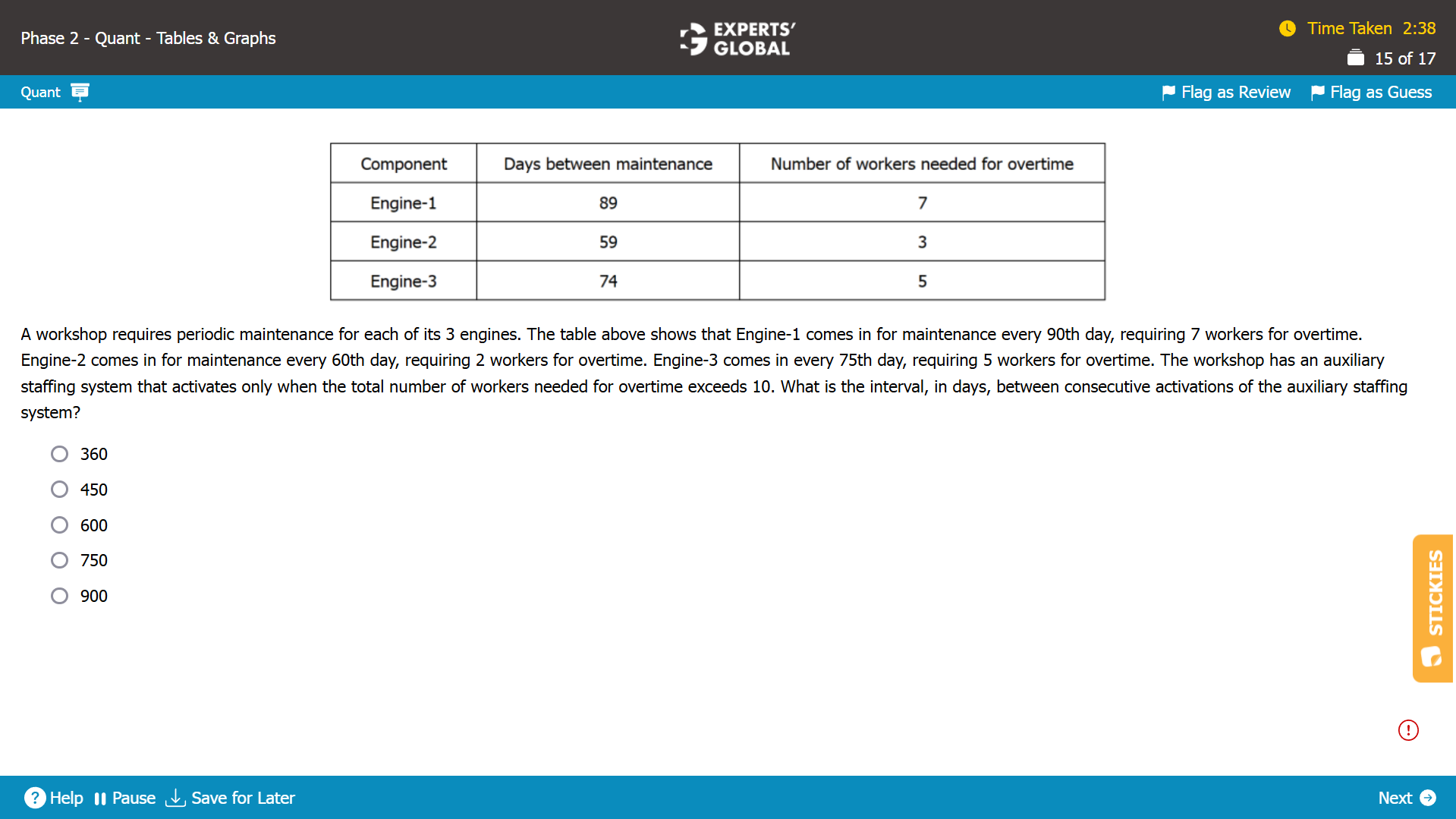
Written Explanation
We need to determine the interval between consecutive activations of the auxiliary staffing system.
The auxiliary staffing system activates only when the total number of workers needed for overtime exceeds 10.
From the “number of workers needed for overtime” column, we see that the auxiliary staffing system can activate only when Engine-1 and Engine-3 arrive for maintenance together.
Since Engine-1 arrives every 90th day and Engine-3 arrives every 75th day, the number of days after which both Engine-1 and Engine-3 arrive at the workshop is given by the LCM of 90 and 75.
Since 90 = 21× 32 × 51 and 75 = 31 × 52, LCM (90, 75) = 21 × 32 × 52 = 450
Hence, the interval between consecutive activations of the auxiliary staffing system is 450 days.
B is the correct answer choice.
GMAT Quant: Time-Speed-Distance Sample Question
Time, speed, and distance connect three simple ideas: how far something goes, how fast it moves, and how long it takes. Relative speed adds an extra layer by showing how one moving object looks from the point of view of another, whether they travel in the same direction or in opposite directions. Once you learn this trio, motion and rate scenarios start to feel clean, clear, and completely manageable.
Important: Before visiting the following sample question(s), if you would like a quick brush up of key Time-Speed-Distance concepts, you may first visit: Free GMAT Time-Speed-Distance Prep
Practice Question
Written Explanation
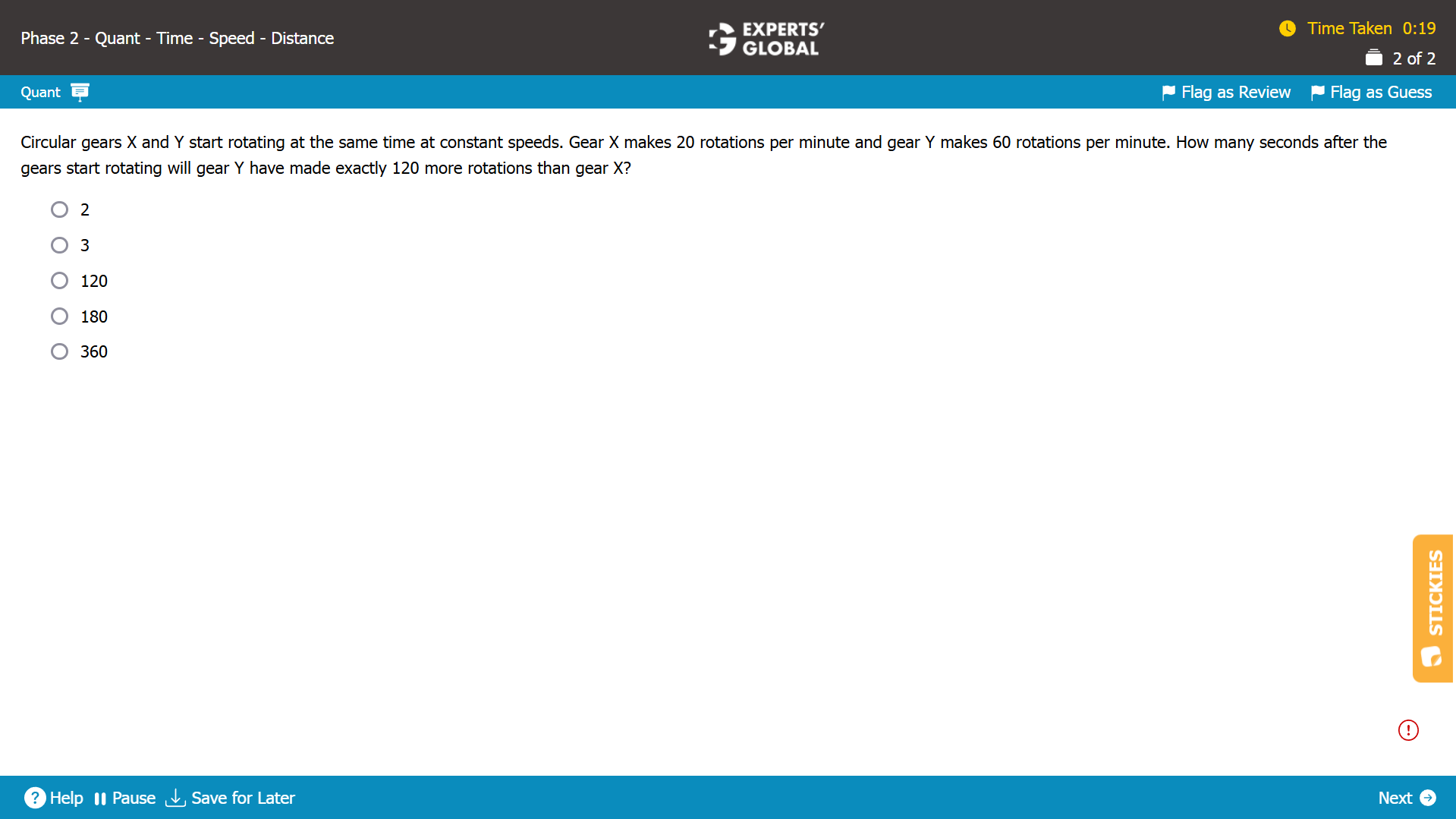
Let’s say that after x seconds, gear Y makes exactly 120 more rotations than gear X.
So, rotations of gear Y = 120 + rotations of gear X … (Equation I)
Gear X makes 20 rotations per minute or per 60 seconds.
So, gear X makes 20 / 60 = 1 / 3 rotations per second.
Gear Y makes 60 rotations per minute or per 60 seconds.
So, gear Y makes 60 / 60 = 1 rotation per second.
In x seconds,
Gear X makes x X (1 / 3) = (x / 3) rotations.
Gear Y makes x X 1 = x rotations.
Substituting these numbers in Equation I…
x = 120 + (x / 3)
(2x / 3) = 120
x = 120 X (3 / 2) = 180 seconds.
D is the correct answer choice.
GMAT Quant: Coordinate Geometry Sample Question
Coordinate geometry shows you how to place points, lines, and shapes on a flat plane using ordered pairs of numbers. With that setup, you can explore location, distance, and clean geometric patterns using algebra. It is a fun bridge between what you see and what you calculate, and it makes visual reasoning feel wonderfully organized.
Important: Before visiting the following sample question(s), if you would like a quick brush up of key Coordinate Geometry concepts, you may first visit: Free GMAT Coordinate Geometry Prep
Practice Question 1
Written Explanation
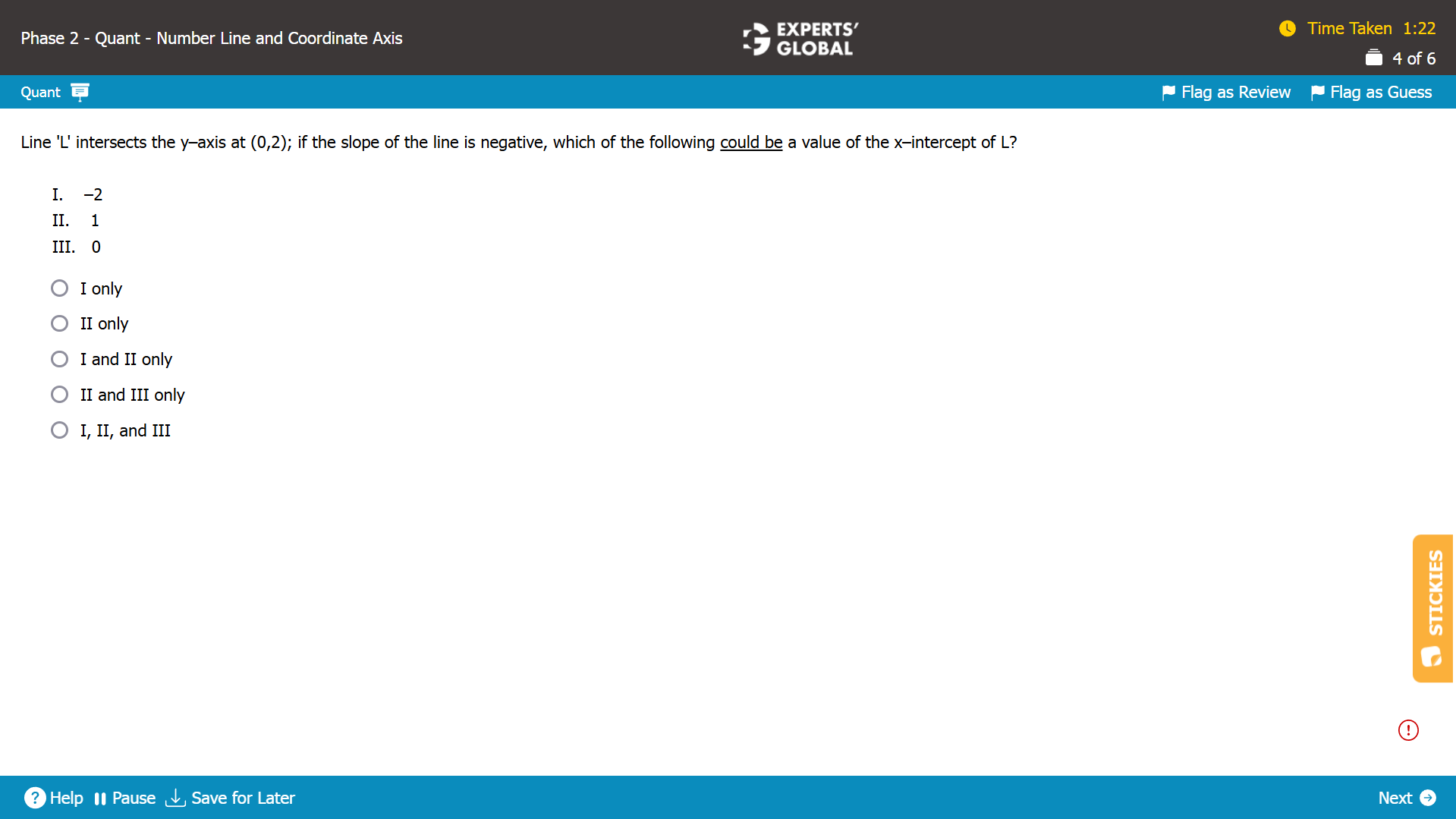
L intersects the y–axis at (0,2).
So, the line passes through (0, 2) and the Y-intercept of L is 2.
The slope of the line is negative. So, the Y-coordinates decrease as the X-coordinates increase.
For such a line, if the Y-intercept is 2, the X-intercept must be positive.
From the given answer choices, only II is a possible value of the X-intercept.
B is the correct answer choice.
Practice Question 2
Written Explanation
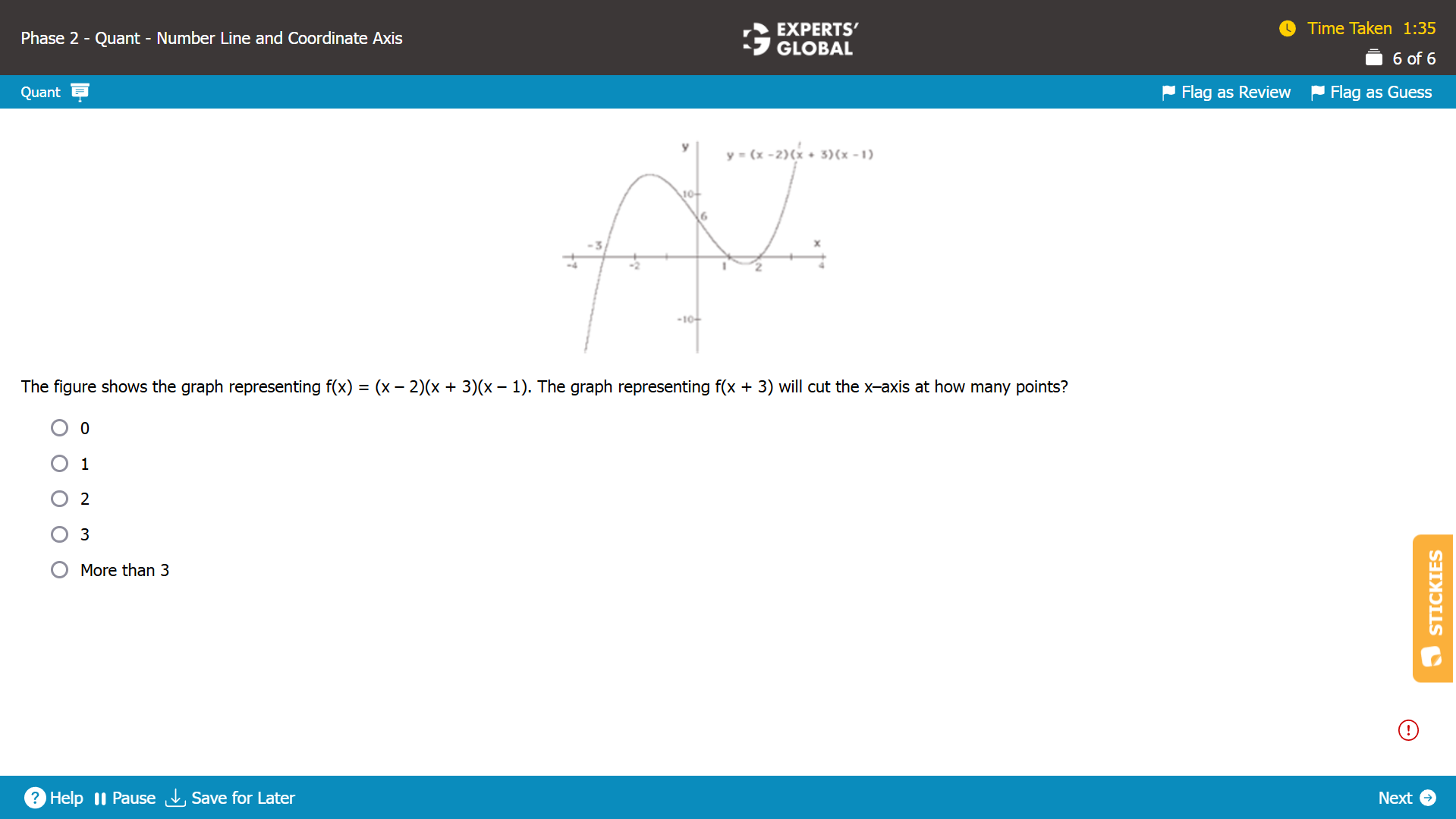
The function represents the graph for f(x).
The graph of f(x + 3) will be the graph for f(x) shifted to the right by 3 points.
Because the graph is shifting only in the direction of the X-axis, its points of interaction with X-axis will change in the X-coordinates. However, the number of intersections between the graph and the X-axis will remain the same.
The function f(x) cuts the X-axis at 3 points. So, the new function will cut the X-axis at 3 points.
D is the correct answer choice.
GMAT Quant: Permutations and Combinations Sample Question
Permutations count how many different arrangements you can make when the order of items matters. Combinations count how many different groups you can choose when the order does not matter. Together, they turn counting into a clean, structured game you can play with confidence and clarity.
Important: Before visiting the following sample question(s), if you would like a quick brush up of key Permutations and Combinations concepts, you may first visit: Free GMAT Permutations and Combinations Prep
Practice Question 1
Written Explanation
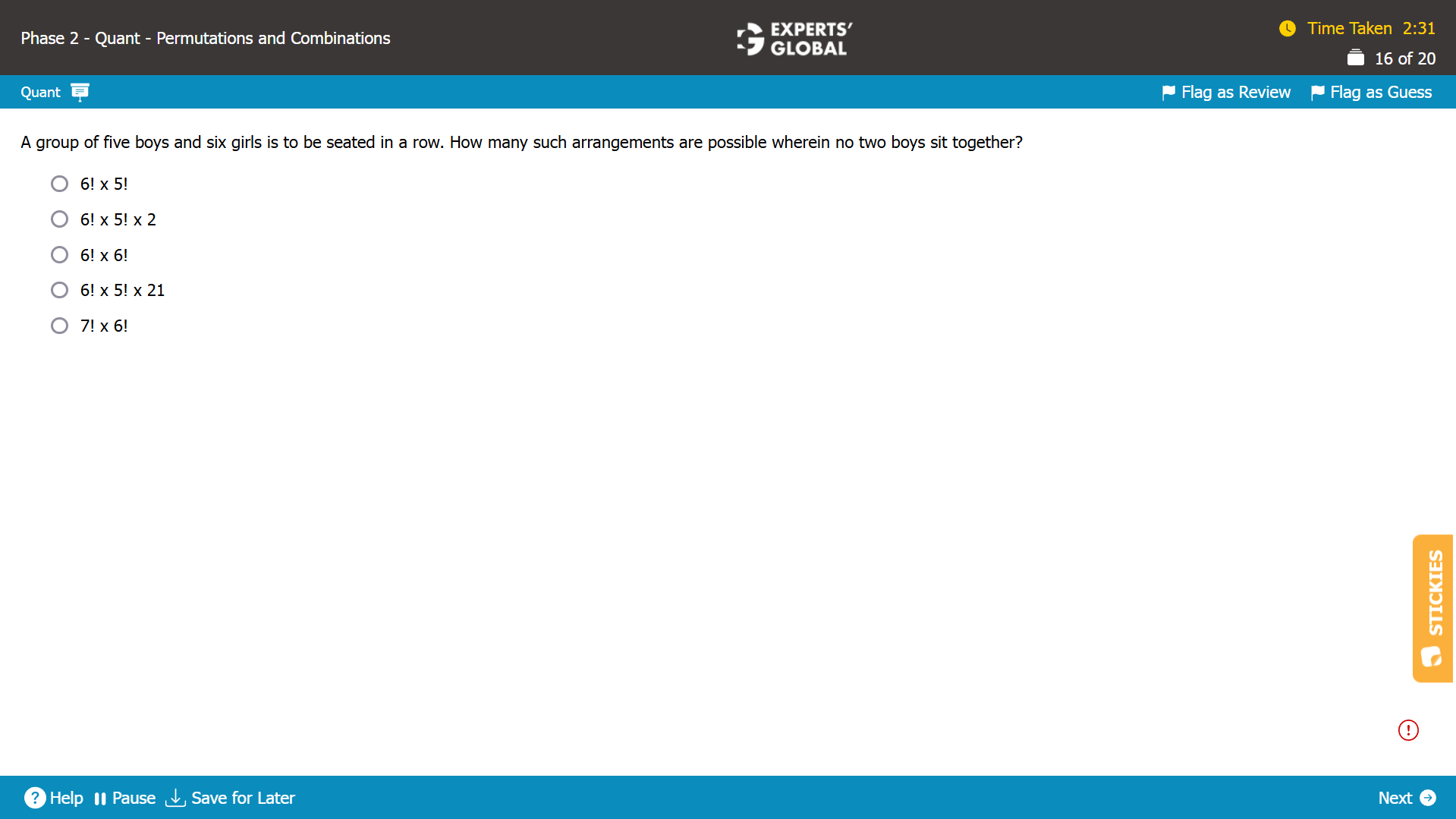
There are restrictions on boys. So, let’s start by arranging the girls, who can be freely seated.
Let’s first sit the six girls such that they leave one seat between any two of them. The arrangement will look as follows.
Girl Girl Girl Girl Girl Girl
There are seven empty seats in the arrangement and five boys can sit in these seven seats. There will not be any two boys sitting together. So, the above arrangement takes care of the restriction.
The arrangement of girls is independent of the arrangement of boys; so, the number of ways of arrangements needs to be multiplied.
Total number of ways = number of ways in which 6 girls can sit X number of ways in which 5 boys can sit
Number of ways in which 6 girls can sit in the 6 seats in the above arrangement = 6!
Number of ways in which 5 boys can sit in the 7 empty seats in the above arrangement = 7P5 = 7! / (7 – 5)! = 7! / 2! = (7 X 6 X 5!) / 2 = 5! X 21.
Overall, total number of ways = 6! X 5! 21.
D is the correct answer choice.
Practice Question 2
Written Explanation
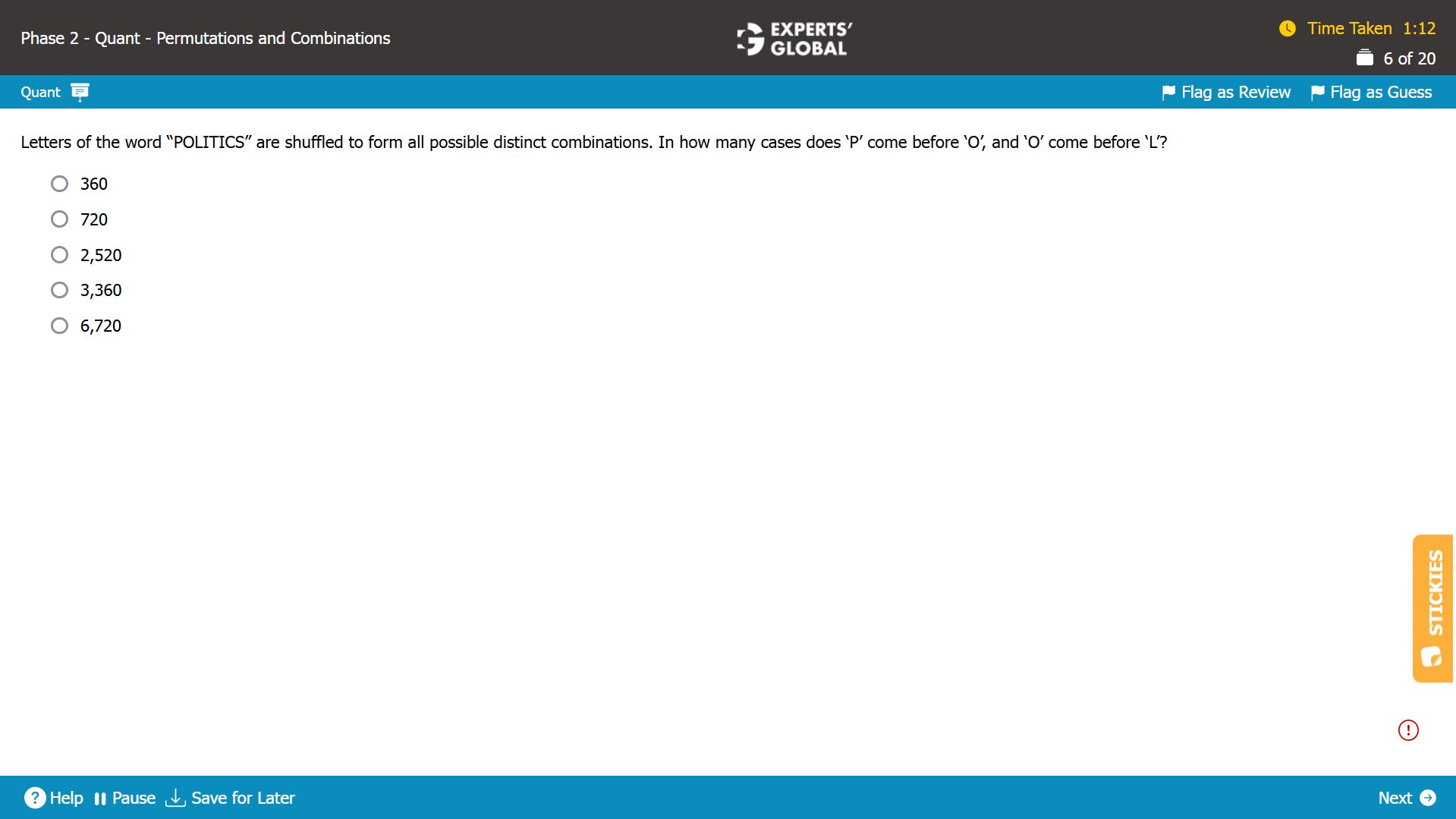
There are two I’s in the word POLITICS. Hence, the letters of the word can be arranged in 8!/(2!) = 20160 ways.
P, O, L , can be arranged in 3! = 6 ways. Out of those, there is only one way in which P comes before O and O before L. That means, out of all the combinations, only 1/6th of the combinations will be suitable for our requirement.
So, the required number is 20160/6 = 3360.
Hence, D is the correct answer choice.
Practice Question 3
Written Explanation
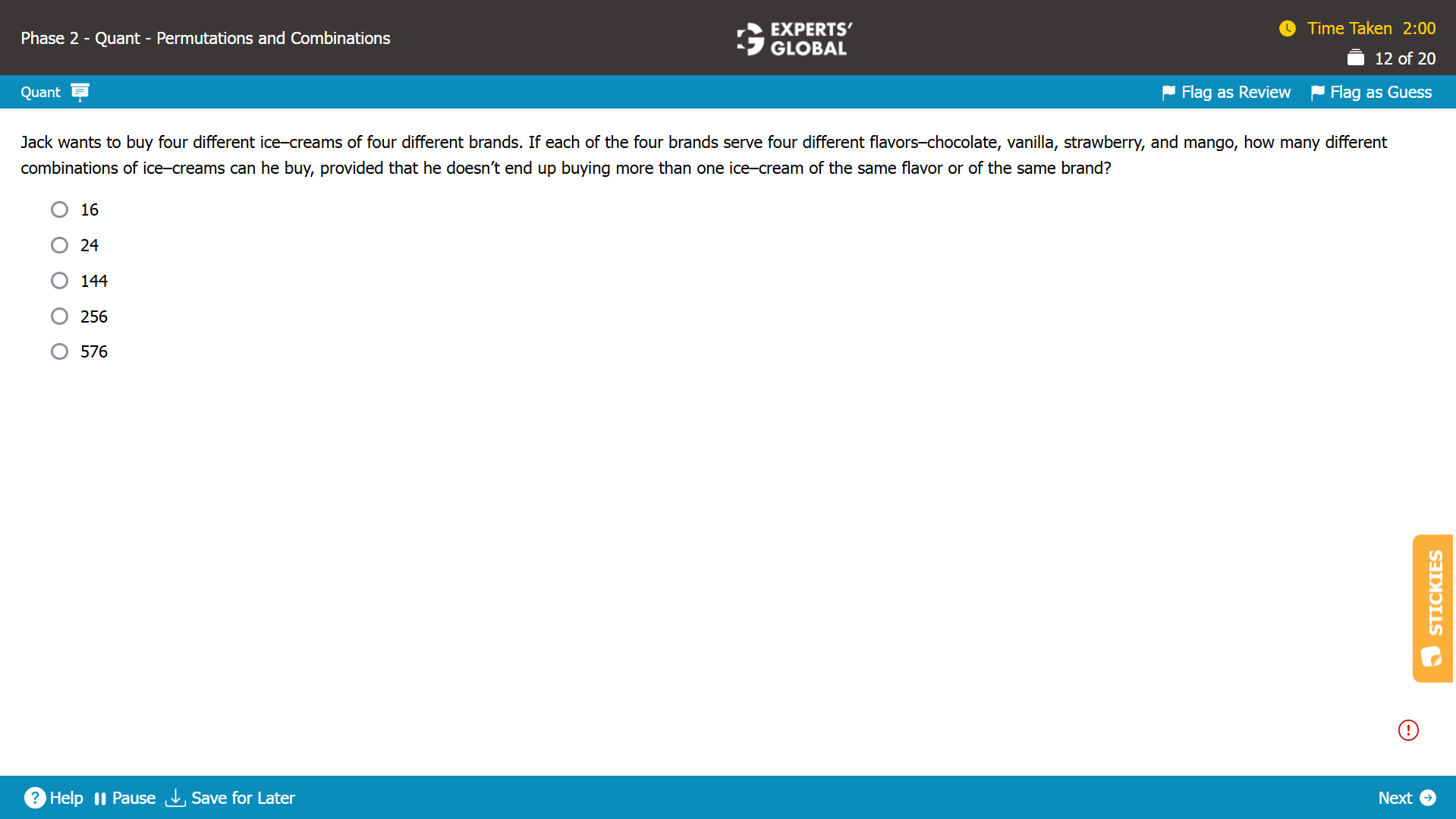
Because there are four flavors and four ice-creams to be chosen, all the flavors will get picked up.
The order of the flavors, or which ice-cream has which flavor, does not matter.
So, let’s assume that the Jack picks up the ice-creams in the following order of flavors.
Ice-cream 1: Flavor = Chocolate.
Ice-cream 2: Flavor = Vanilla.
Ice-cream 3: Flavor = Strawberry.
Ice-cream 4: Flavor = Mango.
After this order is fixed, all Jack has to do is to pick up the brands.
When Jack decides the first ice-cream, he has 4 brands to choose from.
When Jack decides the second ice-cream, he has 3 brands to choose from.
When Jack decides the third ice-cream, he has 2 brands to choose from.
When Jack decides the fourth ice-cream, he has 1 brand to choose from.
Total number of ways in which the four ice-creams can be chosen = 4 X 3 X 2 X 1 = 24.
Please note that the same number of ways = 24 would appear for any order chosen for the flavors.
Also, note that the same number of ways = 24 would appear, even if Jack first fixed the number of brands and then selected favors.
Overall, no matter how Jack picks up the ice-creams, he can do so in 24 ways.
Jack can buy 24 different combinations of ice–creams.
B is the correct answer choice.
Practice Question 4
Written Explanation
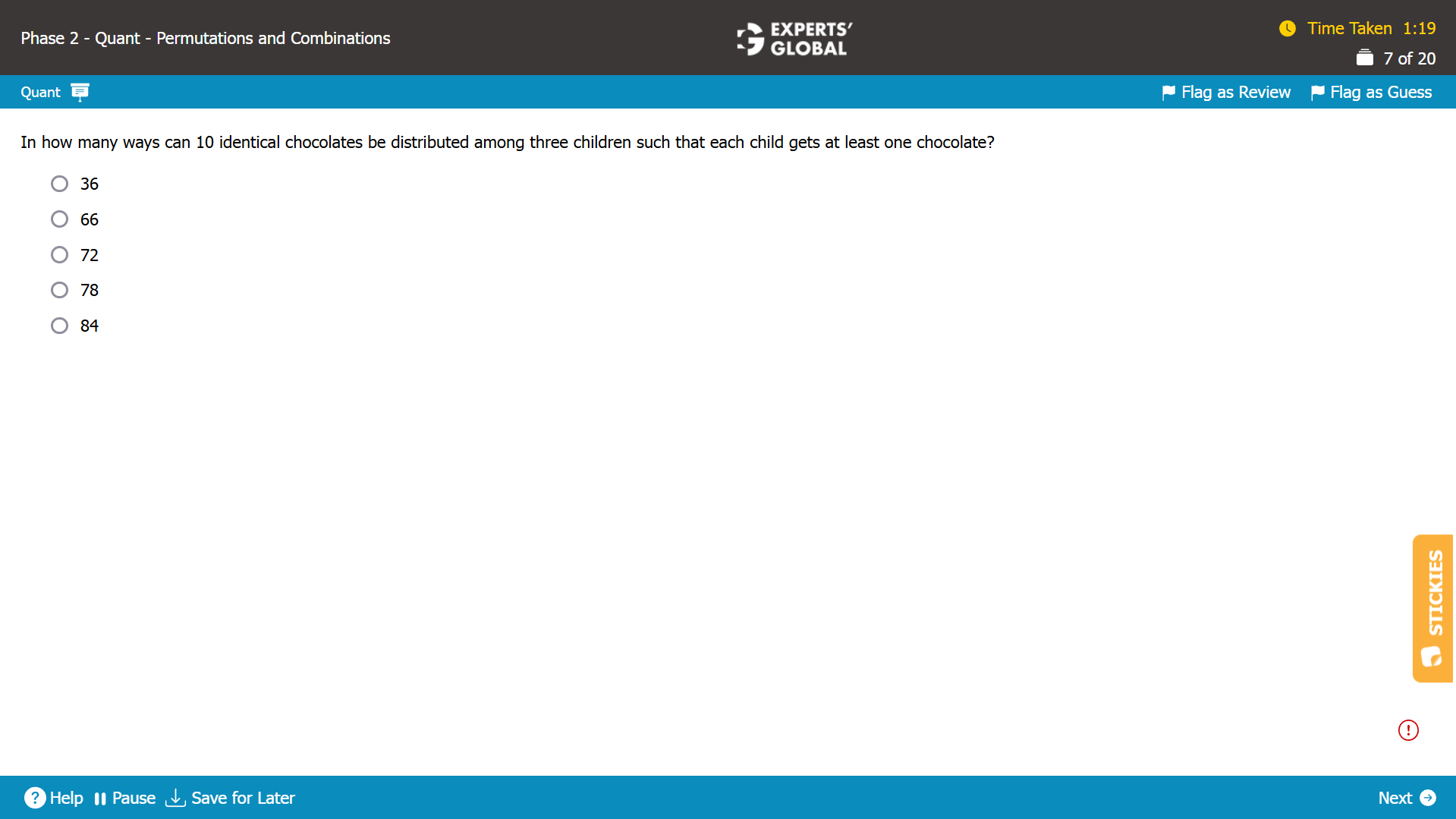
For each child to get at least one chocolate, let’s first distribute one chocolate to each child.
The chocolates are identical and which chocolate goes to which child is not important; in other words, the order of chocolates is not important.
So, number of ways in which 3 chocolates can be distributed to 3 children = 1.
Number of remaining chocolates = 10 – 3 = 7. These chocolates can be distributed randomly.
To distribute 7 chocolates in 3 children, let’s assume that there are 2 X’s that are mixed in the chocolates. There will be 7 + 2 = 9 items to be arranged. Let’s consider one such arrangement as below.
C X C C C C X C C
In this arrangement, each X represents a “cut” in the arrangement to separate the chocolates of one child with those of another child. In other words, the above arrangement represents the arrangement in which the first child gets 1 chocolate, the second child gets 4 chocolates, and the third child gets 2 chocolates.
So, the arrangements of 9 items (7 chocolates and 2 Xs) can indicate the number of ways in 7 chocolates can be distributed among 3 children.
Number of ways in which 9 items can be arranged = 9!
The chocolates are identical and their order is not important; so, the 7! ways in the 7 chocolates are arranged need to be considered as one way.
The X’s are identical and their order is not important; so, the 2! ways in the 2 X’s are arranged need to be considered as one way.
So, number of ways in which 9 items can be arranged regardless of the order = 9! / (7! X 2!)
Overall, the number of required ways = 1 X 9! / (7! X 2!) = 36.
The required distribution can be done in 36 ways.
A is the correct answer choice.
Practice Question 5
Written Explanation
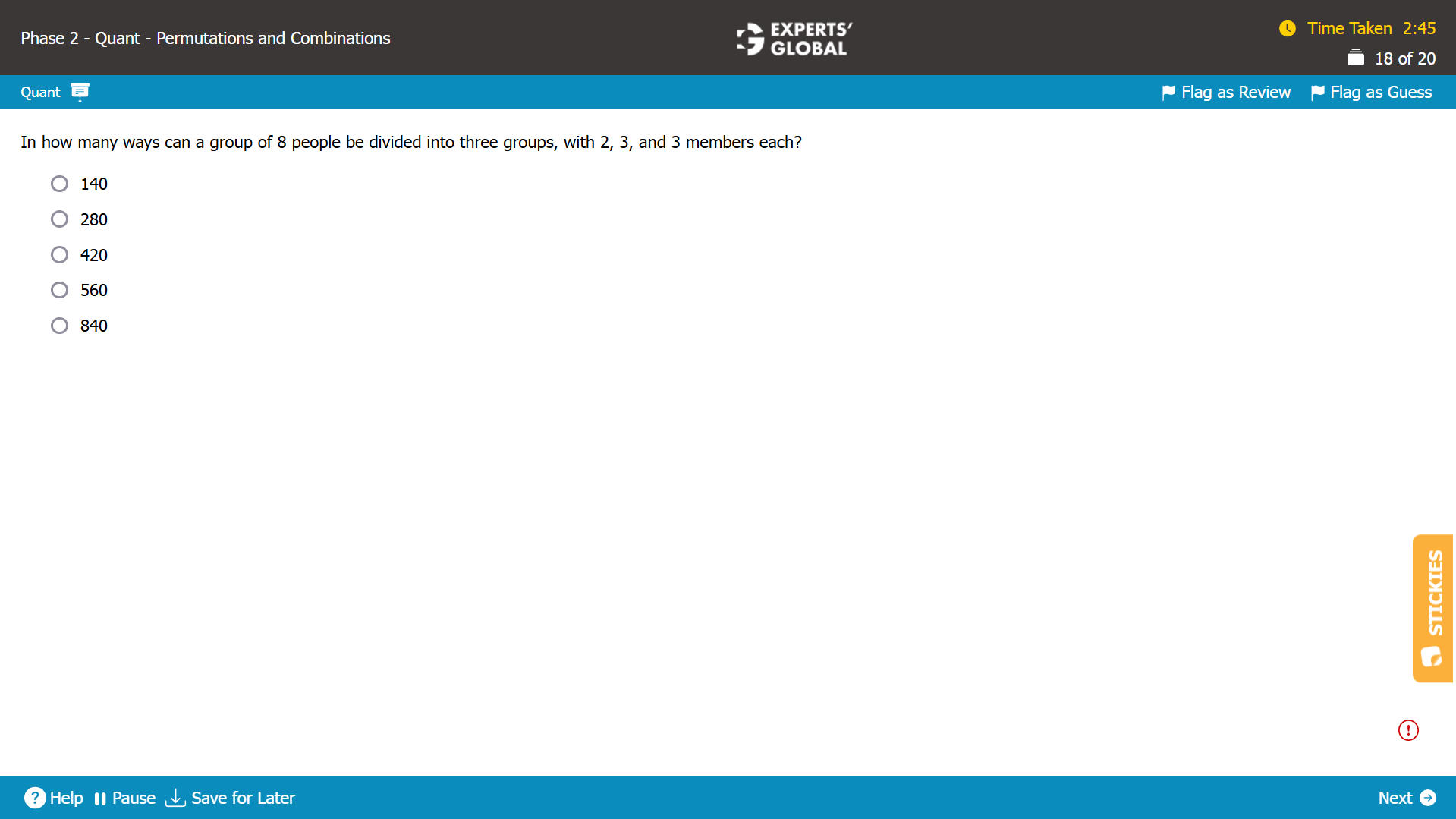
A group of 2 can be selected from 8 people in 8C2 ways.
A group of 3 can be selected from remaining 6 people in 6C3 ways.
A group of 3 can be selected from remaining 3 people in 3C3 ways.
Number of ways in which 3 teams can be formed = 8C2 x 6C3 x 3C3.
In these number of ways, there will be two ways of picking up such that ….
… in the first way of picking up, individuals X, Y, and Z were picked up as part of the second group of 3 members, whereas
… in the second way of picking up, individuals X, Y, and Z were picked up as part of the third group of 3 members.
These two ways of picking the two groups of 3 members should be counted as only one way.
Overall, the repetitions need to be accounted for by dividing the total number of ways by the number of ways in which the two groups of 3 members could have been ordered.
The two groups can be ordered in 2! ways.
Number of ways in which 3 teams can be formed, without repetition = (8C2 x 6C3 x 3C3) / (2!) = (28 X 20 X 1) / 2 = 280.
The required arrangement can be done in 280 ways.
B is the correct answer choice.
GMAT Quant: Probability Sample Question
Probability tells you how likely an event is to happen, so you can put a clear number on uncertainty. It turns chance into something you can measure, compare, and understand. With probability, you line up the possible outcomes and see which ones truly have the best shot.
Important: Before visiting the following sample question(s), if you would like a quick brush up of key Probability concepts, you may first visit: Free GMAT Probability Prep
Practice Question 1
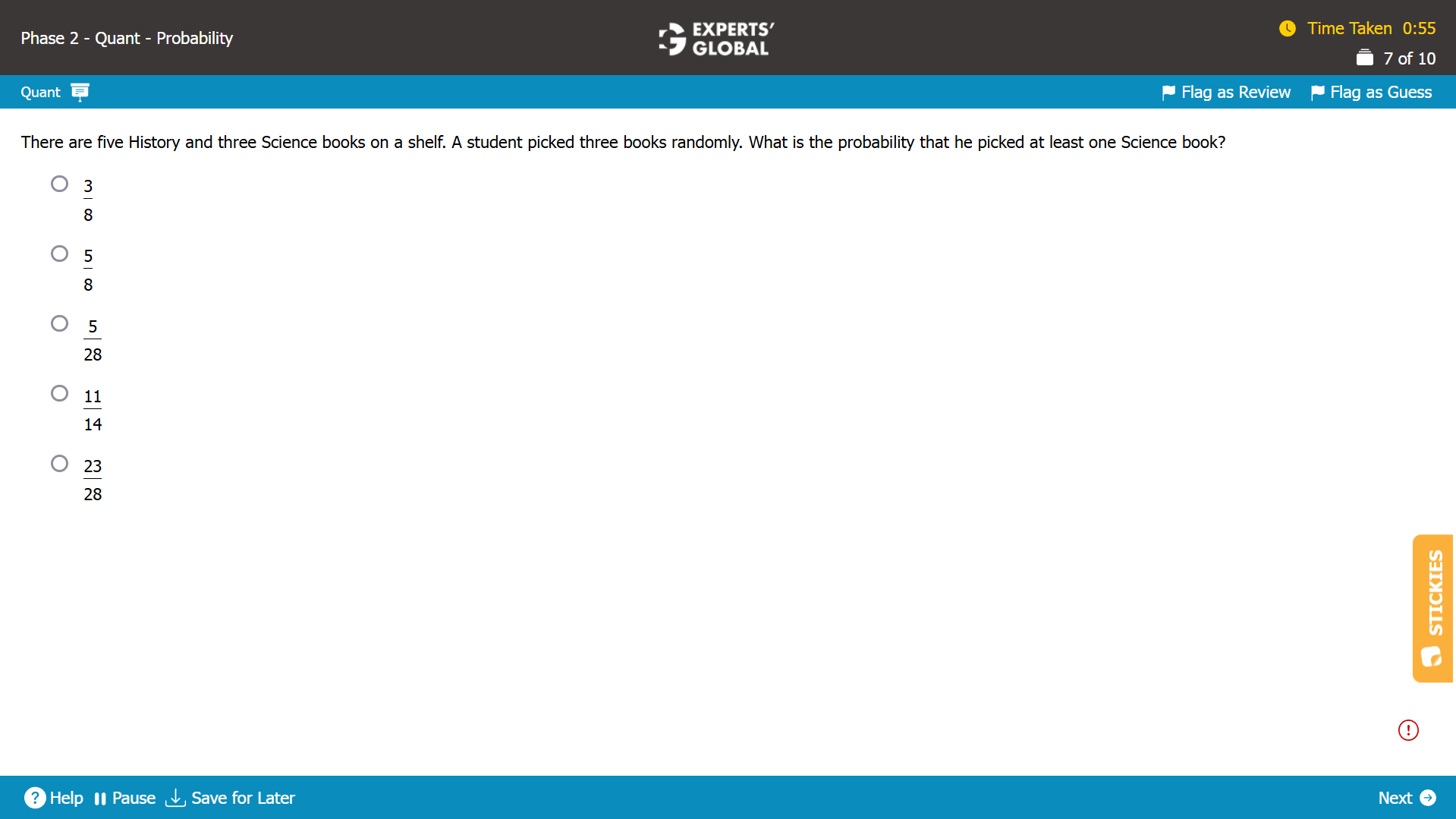
Written Explanation
Number of books = 5 History books + 3 Science books = 8 books
Number of ways in which 3 History books can be picked = 5C3 = 10
Number of ways in which 3 books can be picked from 8 books = 8C3 = 56
So, (all 3 History books were picked) = 10 / 56 = 5 / 28.
Probability (at least one Science book was picked) = 1 – probability (no Science book was picked) = 1 – probability (all 3 History books were picked) = 1 – 5 / 28 = 23 / 28.
The probability that the student picked at least one Science book is 23 / 28.
E is the correct answer choice.
Practice Question 2
Written Explanation
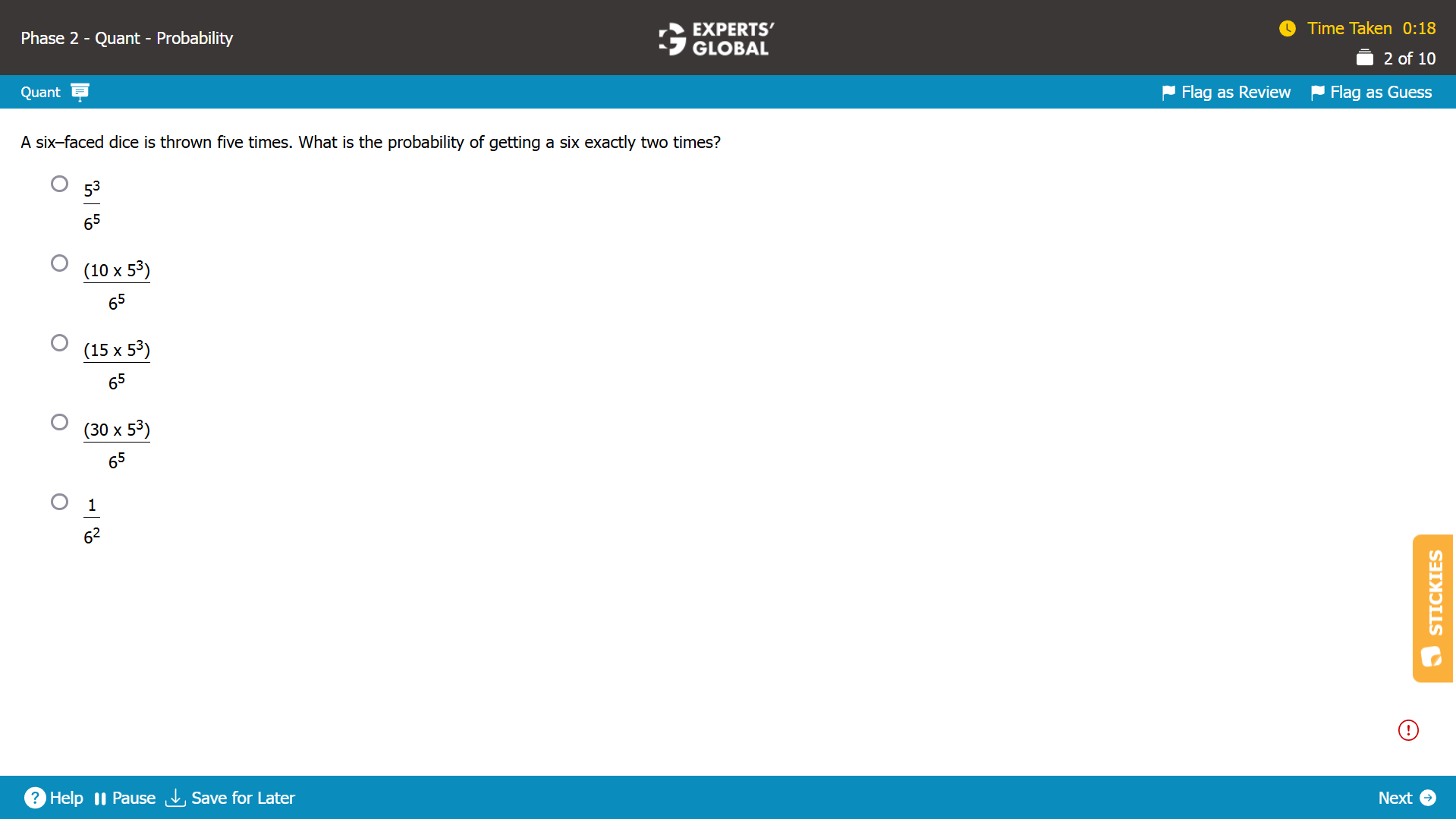
Two out of the five times, the number 6 appears. These two times can occur anywhere in the set of five throws.
Number of ways in which a 6 appears twice = 5C2 = 10 ways
The probability of getting a 6 = 1 / 6.
This event occurs twice.
So, the probability of getting a 6 twice = (1 / 62)
The probability of NOT getting a 6 = 5/ 6.
This event occurs three times.
So, the probability of NOT getting a 6 three times = (53 / 63)
Overall, the probability of getting a six exactly two times = 10 X (1 / 62) X (53 / 63) = (10 X 53) / 65.
B is the correct answer choice.
Practice Question 3
Written Explanation
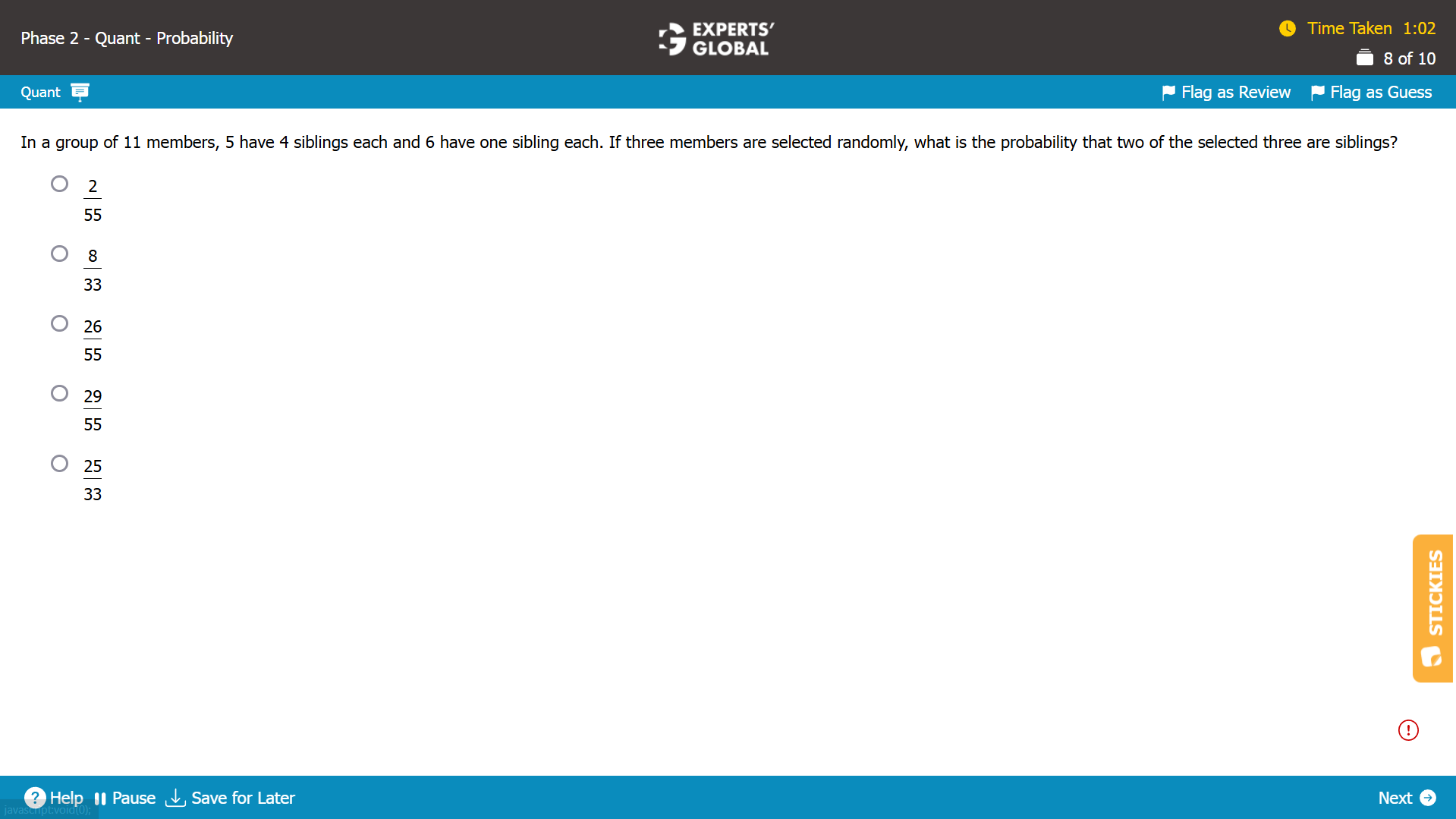
5 members have 4 siblings each.
So, the set of 5 members are all siblings of one another.
6 members have 1 sibling each.
So, there are 3 sets of 2 siblings.
Let’s say that the group is as follows.
{A, B, C, D, E} represents the set of 5 siblings.
{F, G} represents the first set of 2 siblings.
{H, I} represents the second set of 2 siblings.
{J, K} represents the third set of 2 siblings.
For 2 of the selected 3 members to be siblings, the following possibilities exist.
Possibility 1: 2 members from {A, B, C, D, E} were selected and one member from {F, G, H, I, J, K} was selected.
Number of ways to select 2 members from {A, B, C, D, E} = 5C2 = 10.
Number of ways to select 1 member from {F, G, H, I, J, K} = 6C1 = 6.
Number of ways of Possibility 1 = 10 X 6 = 60.
Possibility 2: 2 members from {F, G} were selected and one member from {A, B, C, D, E, H, I, J, K} was selected.
Number of ways to select 2 members from {F, G} = 2C2 = 1.
Number of ways to select 1 member from {A, B, C, D, E, H, I, J, K} = 9C1 = 9.
Number of ways of Possibility 2 = 1 X 9 = 9.
Possibility 3: 2 members from {H, I} were selected and one member from {A, B, C, D, E, F, G, J, K} was selected.
Number of ways to select 2 members from {H, I} = 2C2 = 1.
Number of ways to select 1 member from {A, B, C, D, E, F, G, J, K} = 9C1 = 9.
Number of ways of Possibility 3 = 1 X 9 = 9.
Possibility 4: 2 members from {J, K} were selected and one member from {A, B, C, D, E, F, G, H, I} was selected.
Number of ways to select 2 members from {J, K} = 2C2 = 1.
Number of ways to select 1 member from {A, B, C, D, E, F, G, H, I} = 9C1 = 9.
Number of ways of Possibility 4 = 1 X 9 = 9.
All the possibilities are mutually exclusive; so, the number of possibilities need to be added.
Total number of possibilities = 60 + 9 + 9 + 9 = 87.
Total number of ways in which 3 members can be picked up from 11 members = 11C3 = 165.
Overall, the probability of two of the selected three being siblings = 87 / 165 = 29 / 55.
The probability that two of the selected three are siblings is 29 / 55.
D is the correct answer choice.
GMAT Quant: Sequences and Series Sample Question
Sequences are ordered number lists where each term follows a clear rule or pattern. A series takes those terms and adds them up to form a single total. Together, these ideas help you spot structure, repetition, and growth in a way that feels natural and almost automatic.
Important: Before visiting the following sample question(s), if you would like a quick brush up of key Sequences and Series concepts, you may first visit: Free GMAT Sequences and Series Prep
Practice Question 1
Written Explanation
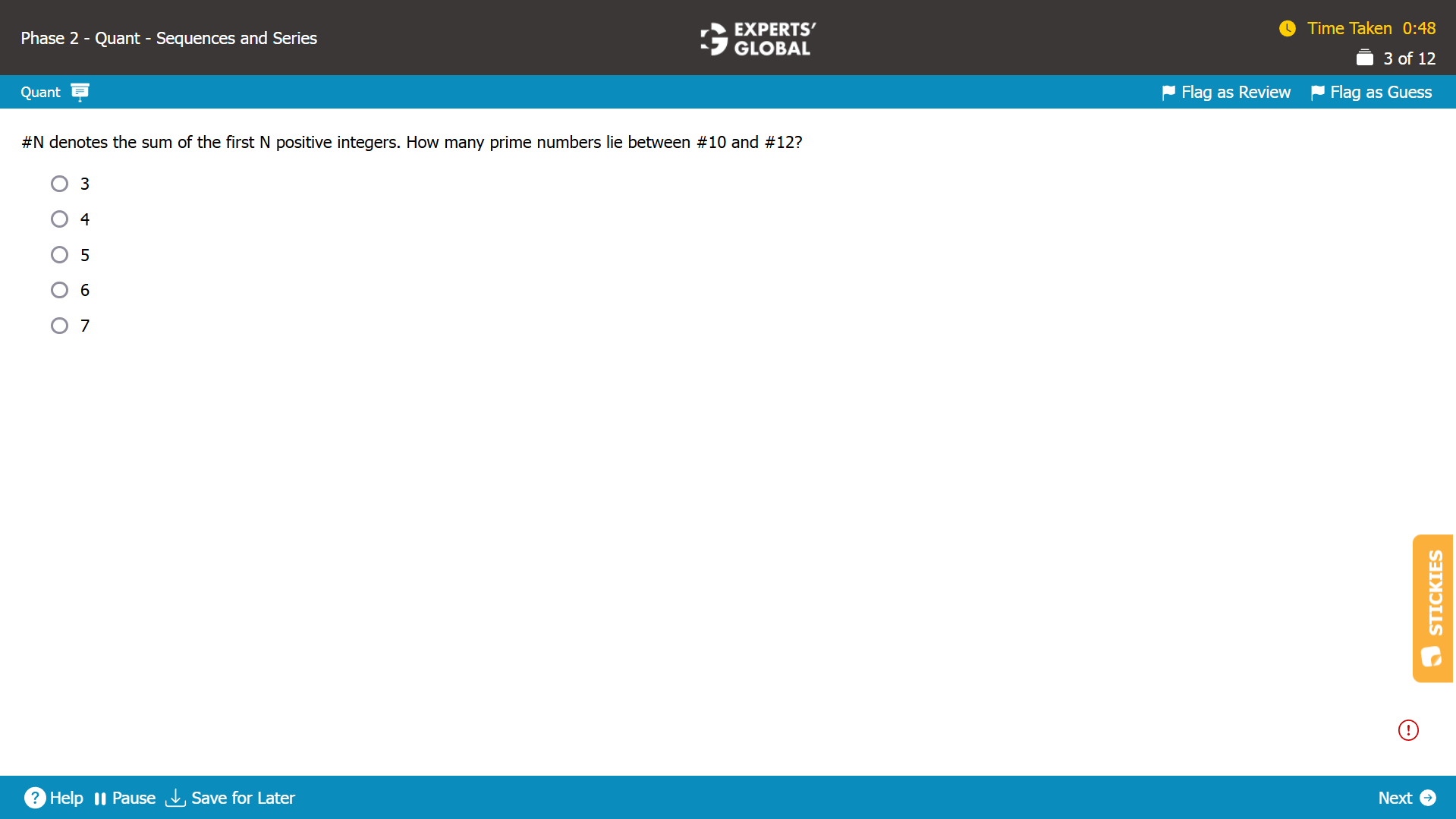
#10 = 1 + 2 + 3 + 4 + 5 + 6 + 7 + 8 + 9 + 10 = 55
#12 = 1 + 2 + 3 + 4 + 5 + 6 + 7 + 8 + 9 + 10 + 11 + 12 = 78
The prime numbers between 55 and 78 are 59, 61, 67, 71, 73. There are 5 prime numbers between 55 and 78.
C is the correct answer choice.
Practice Question 2
Written Explanation
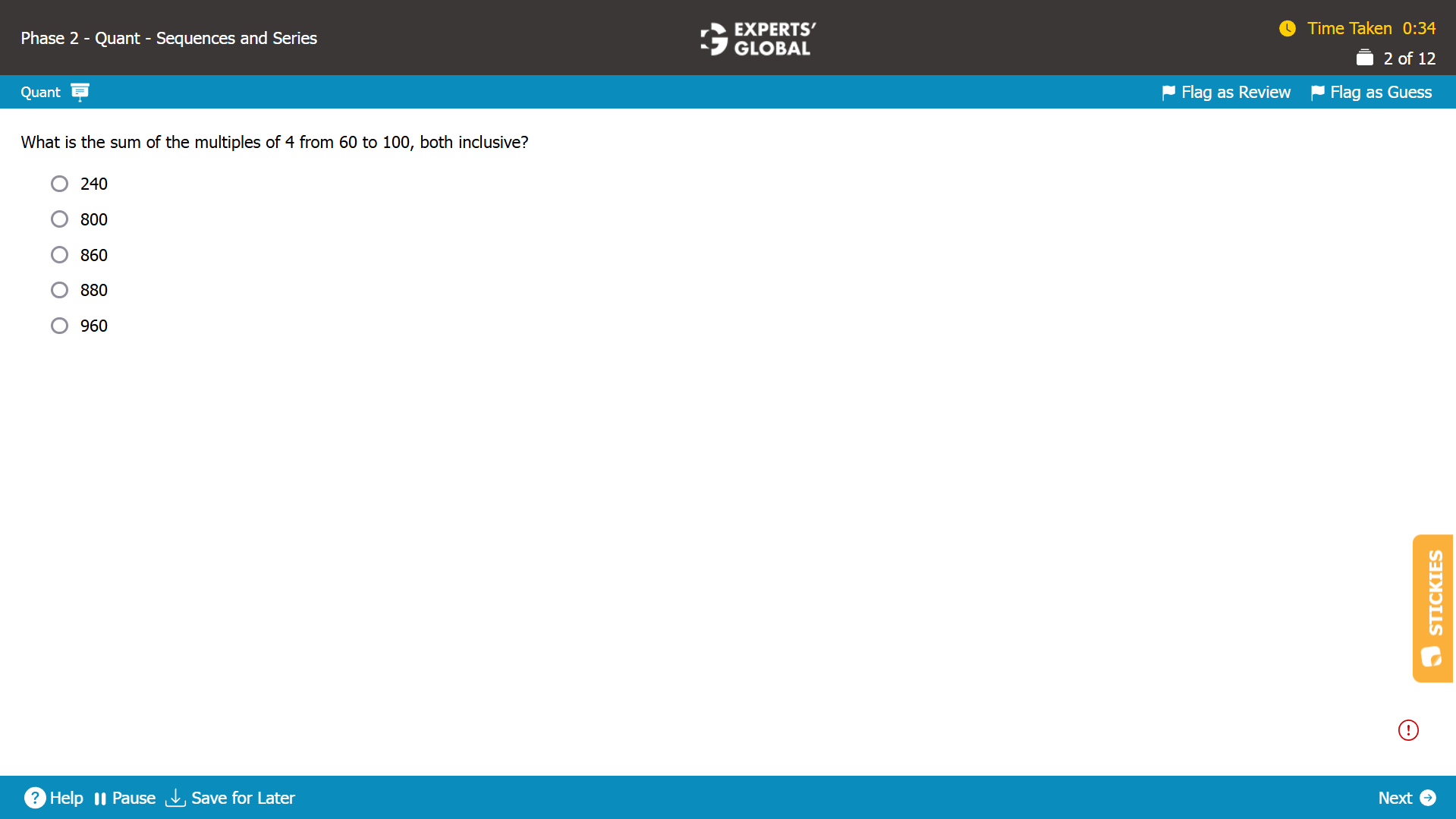
The first multiple of 4 = 60 = 4 X 15
The second multiple of 4 = 64 = 4 X 16
The third multiple of 4 = 68 = 4 X 17
…
Similarly, the last multiple of 4 = 100 = 4 X 25
Sum of the multiples of 4 from 60 to 100, both inclusive = 4 X (15 + 16 + 17 + … 24 + 25) = 4 X (220) = 880.
[Alternatively…
The set of multiples of 4 is going to have 4 as the difference between any two consecutive terms; so, the set is an arithmetic progression.
When the first and the last terms of an arithmetic profession are given,
Sum of all the terms between the first and the last terms, both inclusive = (number of terms / 2) X (first term + last term)
Number of multiples of 4 from 60 to 100, both inclusive = 1 + (100 – 60) / 4 = 11
Sum of the multiples of 4 from 60 to 100, both inclusive = (11 / 2) X (60 + 100) = 880.]
D is the correct answer choice.
Practice Question 3
Written Explanation
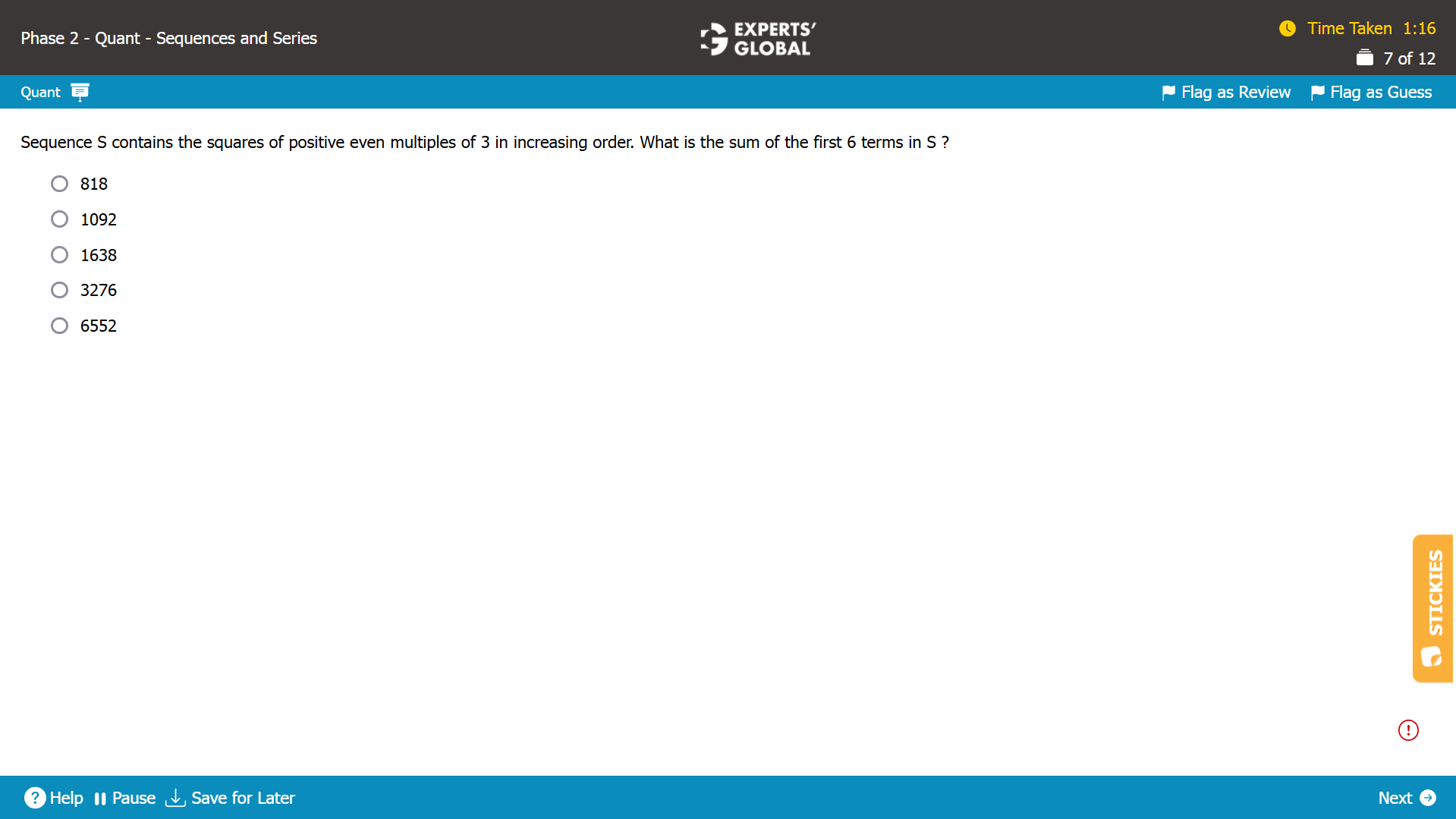
S = {squares of positive even multiples of 3}
S = {squares of 2 X 3, 4 X 3, 6 X 3….}
S = {squares of 6, 12, 18, 24, 30, 36….}
S = {36, 144, 324, 576, 900, 1296….}
The sum of the first 6 terms of S is 36 + 144 + 324 + 576 + 900 + 1296 = 3276.
D is the correct answer choice.
Practice Question 4
Written Explanation
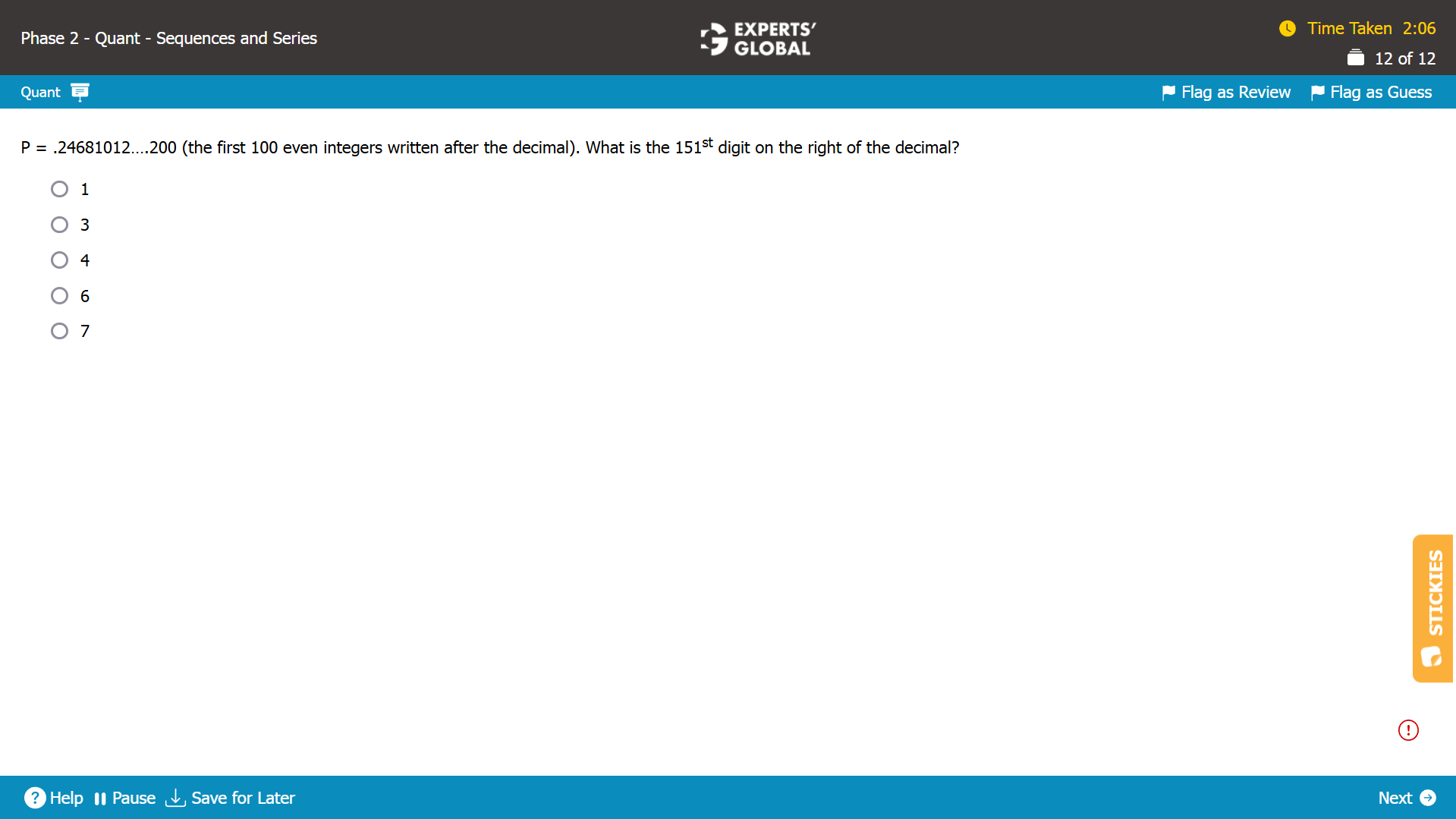
Let’s look at all even integers.
2-8 = 4 numbers each occupying 1 place = 1-4 places after decimal.
10-98 = 45 numbers each occupying 2 places = 5-94 places after decimal.
100 onwards, each number will occupy 3 places. After 94th, we have 151-94 = 57 places to go. These can be occupied in 57/3 = 19 numbers. The number will be the 19th even number after 98. That will be 98+(19*2) = 136. The last digit of this number will land on the 151st place after the decimal. i.e. the 151st digit after the decimal is 6.
Hence, D is the correct answer choice.
For Further Prep and Practice:
15 full-length GMAT practice tests (includes a free test)
End-to-end GMAT prep course online (includes 7-day free trial)
GMAT 5-weeks crash course
GMAT Prep + Admission Consulting Bundle