
Invest 30 seconds...
...for what may lead to a life altering association!
Help Line
- +91.8800.2828.00 (IND)
- 1030-1830 Hrs IST, Mon-Sat
- support@expertsglobal.com
33% off ends soon:GMAT/GRE prep + applications bundle. Profile building, longer mentoring, better results. Inquire

GRE reading comprehension questions ask you to read a passage and answer questions that assess how effectively you process information from the text. Passages come from varied disciplines and generally include multiple layered shifts in meaning that require close attention across the passage, the question stem, and the answer choices. Reading comprehension carries the highest weight in the GRE verbal section, with four full passage sets contributing about ten questions, along with around three short passages that carry one question each. This means roughly 13 of the 27 verbal questions are reading comprehension based, making thorough coverage of reading comprehension an important part of your GRE preparation course. This page takes you through a structured path for GRE reading comprehension, starting with basics and moving into focused video lessons that address different passage types and question formats. You also practice with GRE style questions that show how reading strategies apply directly to real test situations across varied RC question types and patterns.
If you prefer long, comprehensive video lessons that bring all concepts together, watch the Masterclass and then move directly to the practice questions.
If you prefer short, bite sized video lessons that focus on one concept at a time, work through the concept wise modules below and then attempt the practice questions.
The following video walks you through how the RC questions appear on the GRE, what skills they examine, why they matter, and how pacing usually plays out, helping you gain sound clarity before we move ahead into deeper RC concepts and patterns.
Reading Comprehension holds a major share of the GRE Verbal measure, with roughly thirteen of the twenty seven questions built around passages and short texts. This question type sets the rhythm of the verbal measure, since accuracy and reading efficiency directly influence how many questions you answer well and how smoothly your pacing flows. Strong reading comprehension strengthens performance not only on passage based questions but also on other verbal question types that depend on precise interpretation. The following video explains how reading comprehension drives your GRE score, how efficient reading supports overall verbal performance, and why focused work on this skill plays a decisive role in lifting your results across the exam.
Since 2008, tens of thousands of students across the world have benefited from the Mind Map Approach developed by Experts’ Global. The video below introduces this approach and walks you through it step by step using GRE style reading comprehension examples. You learn how to organize ideas, follow relationships, and stay oriented while working through complex passages. Spend focused time understanding how this method works and apply it consistently during reading comprehension practice, GRE drills, and GRE mock tests.
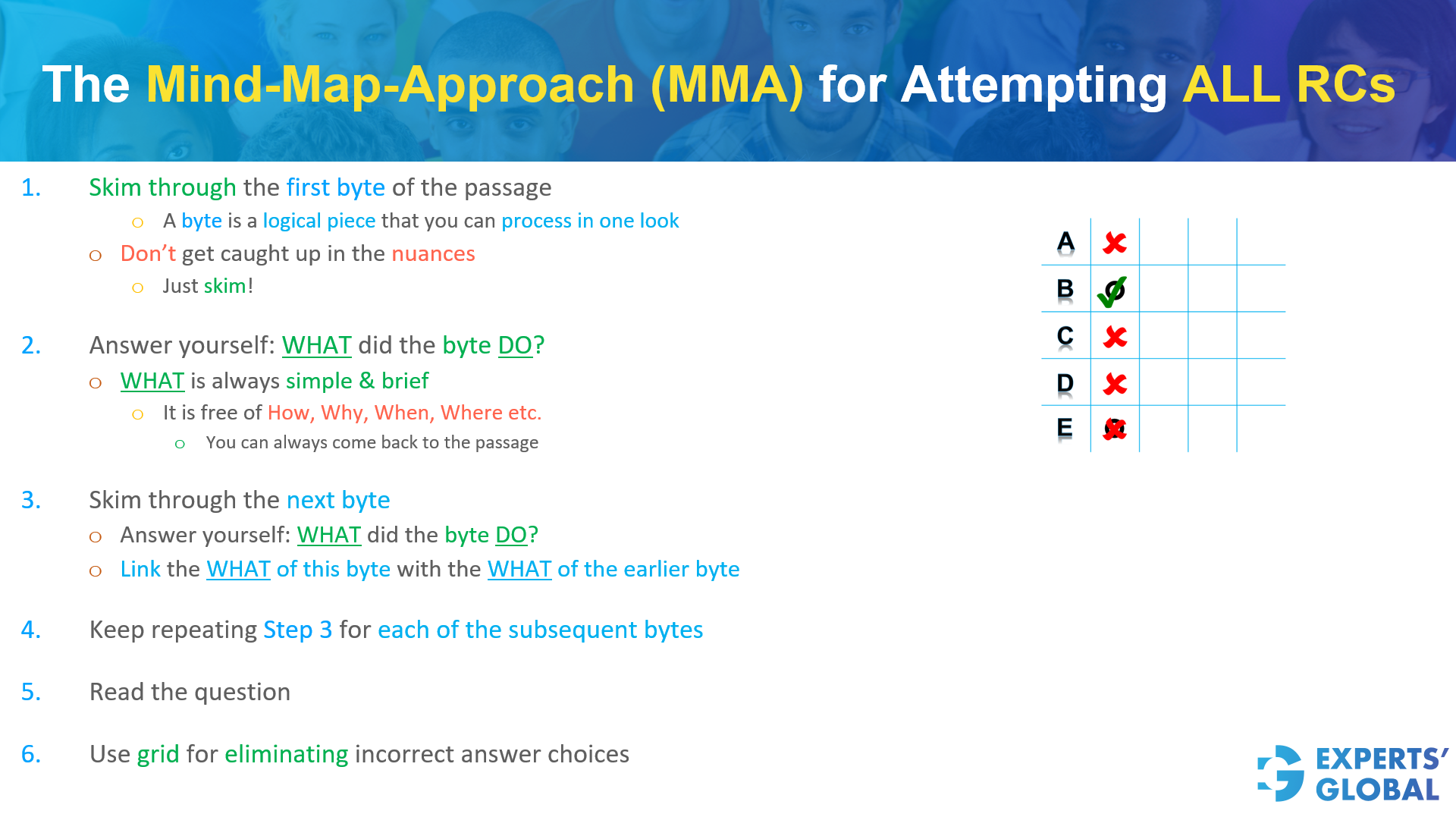
At Experts’ Global, this learning path follows a simple and structured pedagogy built around three clear phases: Understand, Practice, and Master. This framework reflects how reading comprehension skills develop steadily and reliably over time.
Begin by learning the Mind Map Approach and applying it with care to each passage. Focus on recognizing why every paragraph exists and how ideas connect and progress across the text. Work through questions at a steady pace and aim to reach an accuracy level of at least 80 percent. Once this understanding settles in, keep speed aside until the method feels stable and dependable.
After your accuracy stays consistently above 80 percent, start working under timed conditions while duly utilizing the Mind Map Approach for solving RCs. Aim for a balance of speed and accuracy and duly analyze your mistakes; most learning comes from duly realizing what made you select the incorrect choice and eliminate the correct choice.
In the final phase, apply the Mind Map Approach in conditions that closely reflect the GRE. Practice with time limits and longer study sessions so steadiness builds step by step. Review errors thoughtfully and extract clear lessons. When you consistently solve reading comprehension questions in under two minutes per question while maintaining accuracy above 80 percent, you reach expert level command of the Mind Map Approach.
Reading comprehension questions appear in many formats and patterns, yet every question fits clearly into three broad categories: structure based, fact based, and inference based. Structure based questions focus on the overall organization of the passage, including the flow of ideas and the roles played by different parts of the text. Fact based questions focus on information that the passage states directly. Inference based questions focus on ideas that the passage does not state explicitly but that you can deduce with certainty, without any assumption, extrapolation, or exaggeration. The Mind Map Approach (MMA) by Experts’ Global applies seamlessly to all three categories. In the upcoming part of this article, you explore how to apply the Mind Map Approach to each of these three reading comprehension question types with clarity and purpose.
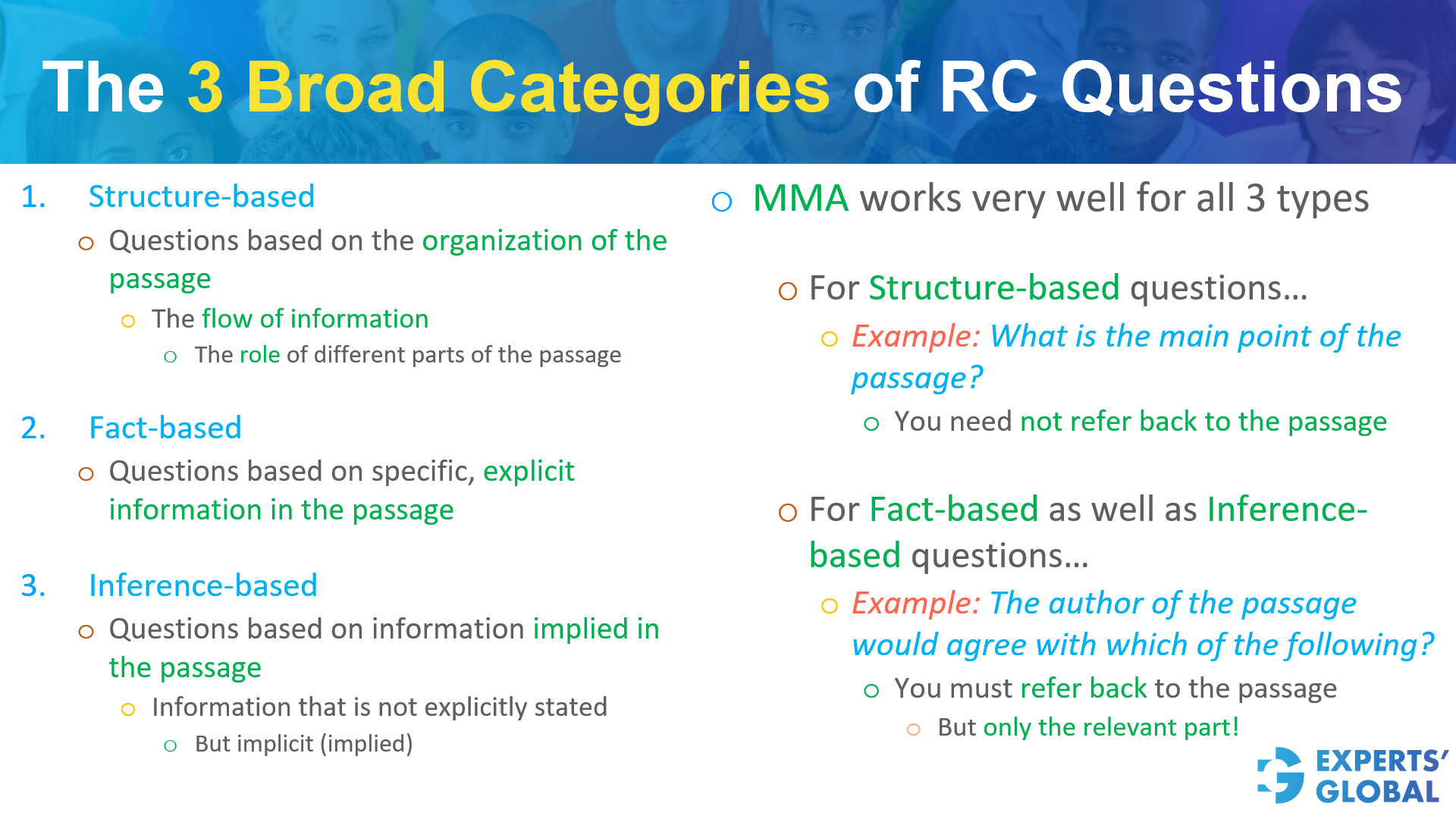
This lesson builds on the Mind Map Approach and shows how to apply it directly to structure-based GRE Reading Comprehension questions. Structure based questions focus on organization and flow, so the mind map generally guides you to the answer without repeated returns to the text. The following video offers a sharp recap of the method, explains its fit for structure-based questions, and walks through GRE style examples with realistic answer choices so you practice the approach in real time and carry it into your prep.
This lesson extends the Mind Map Approach and shows how to apply it with precision to fact-based GRE Reading Comprehension questions. Fact based questions reward accurate tracking of information, and the mind map helps you remember where each detail sits so your reading stays efficient and your answers stay sharp. The following video recaps the approach with clarity, explains how it fits fact-based questions so well, and walks through GRE style examples with realistic answer choices so you practice the method actively and carry it forward.
This lesson builds on the Mind Map Approach and shows how to use it effectively for inference-based GRE Reading Comprehension questions. Inference based questions ask you to draw conclusions that follow directly from the passage, and the mind map helps you track relationships, return to the exact supporting lines, and stay grounded in what the text supports while you remove answer choices. The following video revisits the approach with clarity and energy, then applies it to GRE style questions with realistic answer choices so you practice actively and carry the method into your further RC prep and practice.
This lesson brings together a set of clear and practical guidelines that strengthen how you approach Reading Comprehension questions across all formats. You learn to think from the author point of view, rely fully on what the passage states, stay alert with extreme or emotionally loaded choices, and value balanced options that the text clearly supports. A strong focus stays on solving through elimination, since removing incorrect choices leads to accuracy more consistently than chasing a perfect sounding option, which makes using a grid highly effective. The following video explains these guidelines simply and clearly.
In the previous section, we explored the three broad categories of reading comprehension questions: structure based, fact based, and inference based, and we learned how the Mind Map Approach works across all three. In the upcoming section, the focus shifts to the most commonly asked GRE RC question types. For each question type, you will find a detailed video that explains the nature of the question, shows how to apply the Mind Map Approach step by step on it, and walks through GRE style questions so you can see the approach in action. Use this rich set of resources to build familiarity with each GRE RC question type and develop a clear, consistent way of solving them.
This lesson builds on the Mind Map Approach and shows how to use it smoothly for purpose of the passage questions in GRE Reading Comprehension. Purpose questions focus on what the passage aims to achieve as a whole, and the mind map helps you recognize the role of each unit and the author’s overall direction so you identify the purpose quickly and stay connected to the full passage. The following video refreshes the approach with clarity, then applies it to GRE style questions with representative answer choices for this question type.
This lesson builds on the Mind Map Approach and shows how to use it effectively for purpose of a sentence questions in GRE Reading Comprehension. In these questions, one sentence in the passage is highlighted and your task is to select the option that best explains the role that sentence plays in the passage. The approach guides you to return to the relevant lines, study the surrounding context closely, set a broad expectation for the answer, and remove choices using a simple grid. The following video explains the method with clarity, explains why it fits this question type so well, and applies it to GRE style examples.
This lesson builds on the Mind Map Approach and shows how to apply it to purpose of a term questions in GRE Reading Comprehension. In this question type, a term appears highlighted in the passage, and your task is to identify the answer choice that best explains the purpose or role of that term in the context of the passage. The Mind Map Approach approach guides you to return to the relevant lines, examine the nearby context with care, set a broad expectation for the answer, and remove choices using a simple grid. The following video revisits the method with clarity, explains how it aligns with this question type, and applies it to GRE style examples with representative answer choices.
In this lesson, we apply the Mind Map Approach to solve highlighted content questions. In these questions, a small portion of the passage, usually a word, a few words, or a short phrase, is highlighted, and our task is to identify the role that the highlighted content plays within the passage. Through mind map, we track the flow of ideas, see the immediate context, and understand the broader direction of the author’s thinking, which explains why the highlighted content appears at that point and how it supports the overall message. We solve these questions by returning to the relevant lines, tracking surrounding ideas, forming a clear expectation, and eliminating choices that do not align. The following video recaps the Mind Map Approach, shows its application to GRE highlighted content questions, and walks through GRE style questions with realistic answer choices.
This lesson builds on the Mind Map Approach and shows how to use it effectively for meaning in context questions in GRE Reading Comprehension. In this question type, one word in the passage stands highlighted and your task is to select a replacement that fits the exact context and keeps the sentence meaning intact. These questions rely on how the word functions within the sentence, since the best choice may differ from a dictionary meaning while still expressing the same idea in that moment. The Mind Map Approach leads you back to the relevant line, uses the mind map to anchor the surrounding context, helps you set a broad expectation for the replacement, guides elimination to find the best fit, and confirms accuracy by mentally placing the choice back into the sentence. The following video explains the method with clarity and applies it to GRE style examples with representative answer choices.
In this distinctive question type, the question stem defines a specific role played by one sentence in the passage, and your task is to identify the sentence that fulfills that role. The passage itself acts as the answer set: as you move your cursor across the text, each sentence highlights, and selecting one sentence records your response. So, if a passage has seven sentences, those seven serve as the answer choices. To solve these questions, you read the role in the question stem carefully, use your Mind Map to locate where that role most likely appears, and then evaluate the nearby sentences until one fits the role exactly, followed by a final cross check to confirm alignment within the passage context. The following video and supporting explanation recap the Mind Map Approach, show how to apply it to GRE select in passage questions, and demonstrate the method through GRE style RC questions.
In agreement with passage questions, the question stem checks whether the author, or a person or group discussed in the passage, would support or oppose a given idea in the question stem. You begin by reading the question stem with precision so the expected answer stays clear, then examine each answer choice and return to the passage to verify whether the idea matches what the author or speaker actually supports. Some options eliminate immediately, while others require a careful check guided by the Mind Map, which points you to the correct location in the passage. After four choices fail, the remaining one stands as the answer, followed by a final cross check to confirm full alignment with the question stem and passage context. The video and supporting explanation recap the Mind Map Approach and demonstrate its use on GRE agreement (and disagreement) with passage questions through GRE style examples with representative answer choices.
In EXCEPT questions, the question stem sets a condition that four answer choices satisfy, and your task is to identify the one choice that does not. These questions work with a reversed expectation, so your focus is on finding what fails the condition instead of what fits it. You start by clearly recognizing the stem as an EXCEPT task and locking in that reverse goal. You then evaluate each answer choice and return to the passage to confirm whether it meets or violates the condition, knowing that some options eliminate quickly while others need closer checking. The Mind Map Approach guides you to the exact passage location for each check, and once four choices satisfy the condition, the remaining one becomes the answer. A final cross check ensures that the selected option truly violates the condition stated in the question stem. The video below recaps the Mind Map Approach, shows how to apply it to GRE EXCEPT questions, and demonstrates the method on GRE style questions.
Select one or more Reading Comprehension questions use a response format where more than one answer choice can be correct. Each such question presents a stem with three answer choices, and credit is earned only when all correct choices are selected. You solve these questions by reading the question stem carefully to fix the expectation, then evaluating each answer choice independently by returning to the relevant lines in the passage and deciding whether it truly belongs or should be eliminated. The Mind Map Approach guides you to the exact passage location needed for each check, helping you assess all three options. The following video lesson recaps the Mind Map Approach, shows how to apply it to GRE select one or more Reading Comprehension questions, and demonstrates the method through GRE style questions.
Weakening, strengthening, and assumption questions on the GRE appear as a short passage followed by a single question and operate as critical reasoning tasks in practice. Each question presents a compact argument with a conclusion and a clear gap between the evidence and the claim. At Experts’ Global, we treat all single question passages as critical reasoning and cover them in depth within the critical reasoning segment of the GRE prep course and website. To ensure complete exposure, we also introduce these three formats briefly within the Reading Comprehension coverage. For deeper and more detailed learning, you should refer to our GRE critical reasoning subsection. The video below offers a concise overview of these question types and applies the ideas to GRE style problems for direct familiarity.
Please find another set of GRE style RC questions with explanations on: Free GRE Reading Comprehension Sample Questions
Please find another set of GRE style RC questions with explanations on: Free GRE Verbal Sample Questions
Please find another set of GRE style RC questions with explanations on: Free GRE Sample Questions
GRE preparation course with 7-day trial
Set of 15 Full length GRE practice tests
Free full length diagnostic test for GRE
Structured 5-week GRE crash course
GRE prep combined with admission consulting
