
Invest 30 seconds...
...for what may lead to a life altering association!
Help Line
- +91.8800.2828.00 (IND)
- 1030-1830 Hrs IST, Mon-Sat
- support@expertsglobal.com
33% off ends soon:GMAT/GRE prep + applications bundle. Profile building, longer mentoring, better results. Inquire

Critical reasoning questions on the GRE verbal section appear as a compact paragraph followed by one focused question. ETS, the GRE maker, places these under the broad reading comprehension label and does not formally separate them from RC sets. Even so, these single question passages differ sharply in structure, intent, and thinking style, and they demand a different, clearly defined approach. For this reason, the Experts’ Global GRE prep course treats short single question passages as critical reasoning questions. This page delivers end to end GRE CR prep, enabling you to apply the concepts and methods across GRE quizzes, GRE sectional mocks, and GRE full length mocks.
If you prefer long, comprehensive video lessons that bring all ideas together, watch the CR Masterclass and then move directly to the practice questions.
If you prefer short, bite sized video lessons that focus on one concept at a time, work through the concept wise modules below and then attempt the practice questions.
Across the two verbal sections with 27 questions in total, you usually encounter about three critical reasoning questions. Critical reasoning questions in the GRE verbal section present a short, tightly written paragraph that leads into one precise question. This compact format pushes you to focus on logic, intent, and structure right away, making every sentence count and sharpening how you read and think from the very first glance. This video delivers a sharp and complete introduction to critical reasoning by showing how these questions are presented, what you need to do as a test taker, how they stand apart from standard reading comprehension questions, their overall presence within the verbal section, and the ideal time per question. It also presents the key skills involved in a clear and organized way, helping you build strong familiarity with this focused and intellectually engaging question type.
GRE critical reasoning questions reflect a rich mix of ideas and formats that reward focused preparation. These questions cover eleven distinct types: Assumption, Strengthening, Weakening, Paragraph Completion, Inference, Main Point or Conclusion, Resolve the Paradox, Dialogue, Highlighted Text, Select in Passage, and Contradiction. This video walks you through each concept in a clear and structured way by showing how these question types appear, the common question stems linked to them, and the exact task you perform in every critical reasoning question on the GRE.
Since 2008, tens of thousands of students worldwide have used the “Missing Link Approach” developed by Experts’ Global to solve critical reasoning questions. This approach gives you a clear and organized way to handle most CR questions by building a simple mind map that connects the key information in the argument and leads directly to the conclusion. Critical reasoning paragraphs generally contain an explicit or implicit conclusion, and a gap usually exists between the facts presented and the conclusion drawn. Experts’ Global calls this gap the missing link, and identifying it sits at the center of solving CR questions. Strengthened argument, assumption, and resolve the paradox questions aim to fill this gap, while weakened argument questions aim to attack it. This video explains the Missing Link Approach step by step and applies it to conceptual examples so you gain direct experience using it.
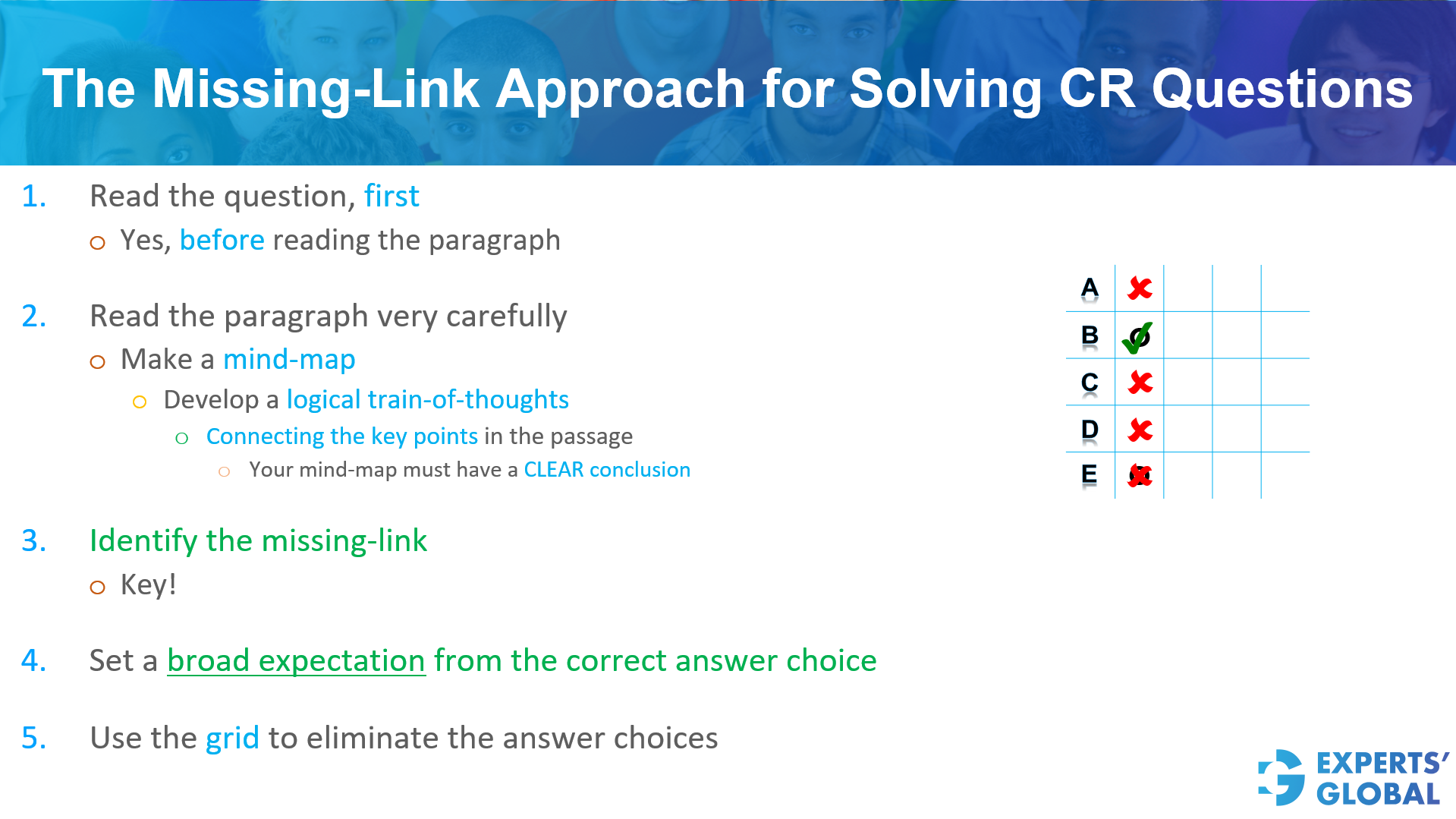
Incorrect answer choices in GRE critical reasoning questions often follow clear and repeatable patterns. These options may bring in ideas that do not connect to the argument, reach conclusions without support, directly oppose what the passage states, or simply repeat information already given. Learning to spot these patterns sharpens your elimination skills and keeps your attention strong and purposeful while solving each question. The video breaks down these incorrect answer styles in a clear and structured way and shows how they commonly appear in GRE critical reasoning questions.
Assumption questions in GRE critical reasoning require you to select the answer choice that represents an assumption made by the argument in reaching its conclusion. These questions generally present an argument with stated facts, a conclusion, and a clear gap between them, that we at Experts’ Global call the “missing-link”. The correct assumption bridges this gap and must hold true for the conclusion to stand, because removing or denying it causes the argument to collapse. Identifying the right assumption involves checking how the idea supports the conclusion and confirming that the argument depends on it. The video lesson explains this logic step by step, shows how assumption questions appear in GRE style formats, and demonstrates how to identify and apply the correct assumption with an efficient and effective process during practice and test attempts.
Strengthen the argument questions on the GRE CR ask you to choose the option that best supports the argument made in the paragraph. These passages present given information, a clear or implied conclusion, and a gap between the two. Experts’ Global calls this gap the missing link. The correct strengthen answer adds information that tightens this gap and makes the conclusion more persuasive. Finding the right option means judging how strongly it boosts the connection between the evidence and the conclusion and pushes the logic forward with purpose. The video explains this approach in a clear and structured way, shows how strengthen questions appear on GRE, and demonstrates how to apply this thinking efficiently.
Paragraph completion questions in GRE critical reasoning present an incomplete argument with the concluding line missing, and your task is to choose the option that completes the paragraph in a logical and coherent way. Start by building an efficient mind map that connects the key information points, then set a broad expectation for what the missing conclusion must accomplish across the full chain of thought, not just the final sentence. Use elimination to remove choices that do not complete the argument as a whole, and cross check at the end that the selected option truly completes the paragraph in meaning and flow. The video explains this question type and the step by step method for solving it, then applies the method to GRE style questions with representative answer choices so you gain direct experience using the approach.
Inference questions in GRE critical reasoning present a dense paragraph, and your task is to choose the single option that logically follows from the information given. The correct inference does not appear word for word, yet it emerges clearly when you connect the key points accurately and rely only on what the text supports, without assumptions, exaggerations, or outside knowledge. Begin by building a clear mind map of the paragraph so you track the key ideas and their relationships, then test each answer choice by checking whether it can be deduced from the passage. Remove choices that add new ideas, stretch beyond what the paragraph supports, or depend on extra assumptions. This video explains the GRE CR inference question type in a structured and engaging way and demonstrates the method on GRE style examples so you gain direct experience using it.
Main point or conclusion questions in GRE critical reasoning ask you to identify the central takeaway of an argument, meaning the conclusion the author wants you to reach and the purpose driving the paragraph. The correct answer is not simply a statement that follows from the text, because it must capture the single idea that unifies the entire argument. The right choice meets two clear standards: it follows directly from the paragraph without assumptions, exaggerations, or extensions, and it reflects the main point the argument is built to support. Build a clear mind map that links the key ideas and leads naturally to the conclusion, set a broad expectation for what the central message must be, then use elimination to remove options that fail to meet either standard, including choices that sound reasonable but miss the true takeaway. The video explains this question type in a clear and structured way and demonstrates the method on GRE style examples so you apply it with clarity and consistency.
Resolve the paradox questions in GRE Critical Reasoning guide you to an answer that shows how two seemingly opposing facts fit together smoothly. The paradox works as the connecting insight, so you begin by recognizing the question type and mapping the key ideas to locate the exact point of tension. You then form a clear expectation for the kind of information that can bridge the gap and filter out options that do not address the core conflict. The video lesson walks through this process with clarity and precision, using GRE style examples to help you build a repeatable approach that feels sharp, focused, and rewarding in practice.
Dialogue-based questions in GRE Critical Reasoning present an argument as a short conversation between two individual. Your goal stays aligned with core Critical Reasoning tasks such as assumption, strengthened argument questions, weakened argument questions, inference, main point, or resolve the paradox, but you gather the evidence through two voices, not one block of text. To solve, lock onto the objective in the question stem, read the full dialogue as a single argument, and build a clean mind map that links the key points across both speakers. Next, set a clear expectation for what the correct answer must do in that conversation, remove choices that miss the goal, and confirm that your final pick matches the stem with precision. The video lesson teaches this format step by step and shows how to convert dialogue into a logical map, then apply smart elimination on GRE style examples.
Highlighted text questions in GRE Critical Reasoning present a rich argument with one or two marked parts, and your task is to identify the exact role each marked part plays in the reasoning. Begin by reading the entire argument and forming a clear mind map that leads to a firm conclusion. Then connect each highlighted portion to that conclusion, which makes its role stand out naturally in context. After that, set a clear expectation for what the correct answer must express before reviewing the choices, remove options that drift away from this expectation, and confirm that your final selection captures the highlighted role with precision across the full argument. This video lesson walks you through the approach with clarity, through worked examples and GRE style examples.
Select In Passage questions require you to choose one exact sentence that fulfills a role stated in the question stem, with each sentence in the passage acting as a clickable option. As you read, every sentence becomes a possible match, so success comes from precise role matching within the full context. Begin by understanding the role described in the stem, then build a clear mind map to predict where that role should appear. Review each candidate sentence with focus, compare its function to your expectation, and confirm that your final choice fits the role perfectly inside the passage. The video presents this format with clarity and structure, showing how to apply the method smoothly through GRE style questions.
Contradiction questions in GRE Critical Reasoning ask you to pick the option that clashes directly with a fact stated or implied in the argument. This task centers on fact checking, so you begin by reading the question stem carefully and confirming that contradiction is your exact objective. Next, build a clear mind map of the argument so the key facts stand out with full context. Then test each choice against those stated or implied facts, remove options that do not create a direct conflict, and verify that your final pick contradicts a specific fact in a clear, undeniable way. The video lesson teaches this question type in clean steps and demonstrates the method on GRE style contradiction examples, so you can apply the same process quickly in practice.
Please find a set of GRE-style CR questions with explanations on: Free GRE Critical Reasoning Practice Questions with Solutions
Please find a set of assorted GRE-style Verbal questions (all types) with explanations on: Free GRE Verbal Practice Questions with Solutions
Please find a set of assorted GRE-style questions (all types) with explanations on: Free GRE Practice Questions with Solutions
End-to-end GRE prep course online (includes 7-day free trial)
15 full-length GRE practice tests
60 sectional GRE practice tests
Free full-length GRE diagnostic test
GRE Prep + Admission Consulting Bundle
