Verbal Reasoning questions on the GRE include sentence equivalence questions, text completion one blank, two blank, and three blank questions, reading comprehension questions, and critical reasoning questions. On this page, we provide GRE verbal practice questions for each format, presented in a well-ordered manner with explanations. Solve the questions with care, use explanations to review incorrect or slow attempts, and carry these learnings into further GRE preparation and practice across GRE drills, GRE sectional tests, and GRE full-length tests.
Important: If you need to undergo thorough Verbal preparation, please visit Free GRE Verbal Reasoning prep
GRE Sentence Equivalence Practice Questions
Each Sentence Equivalence item on the GRE shows a single sentence with two blanks. Your task is to choose two answer options that complete the sentence in a way that preserves the same meaning within the given context. Credit is awarded only if both selected responses are correct. There is no partial scoring for these questions. This question type contributes to approximately 25 percent of the GRE Verbal Reasoning measure. Although vocabulary knowledge plays a role, the real assessment centers on contextual reasoning and the relationship between words. Below is a GRE style practice set for Sentence Equivalence, followed by clear explanations.
Important: If you need to undergo thorough SE prep, please visit Free GRE Sentence Equivalence prep
Practice Question 1 | SE
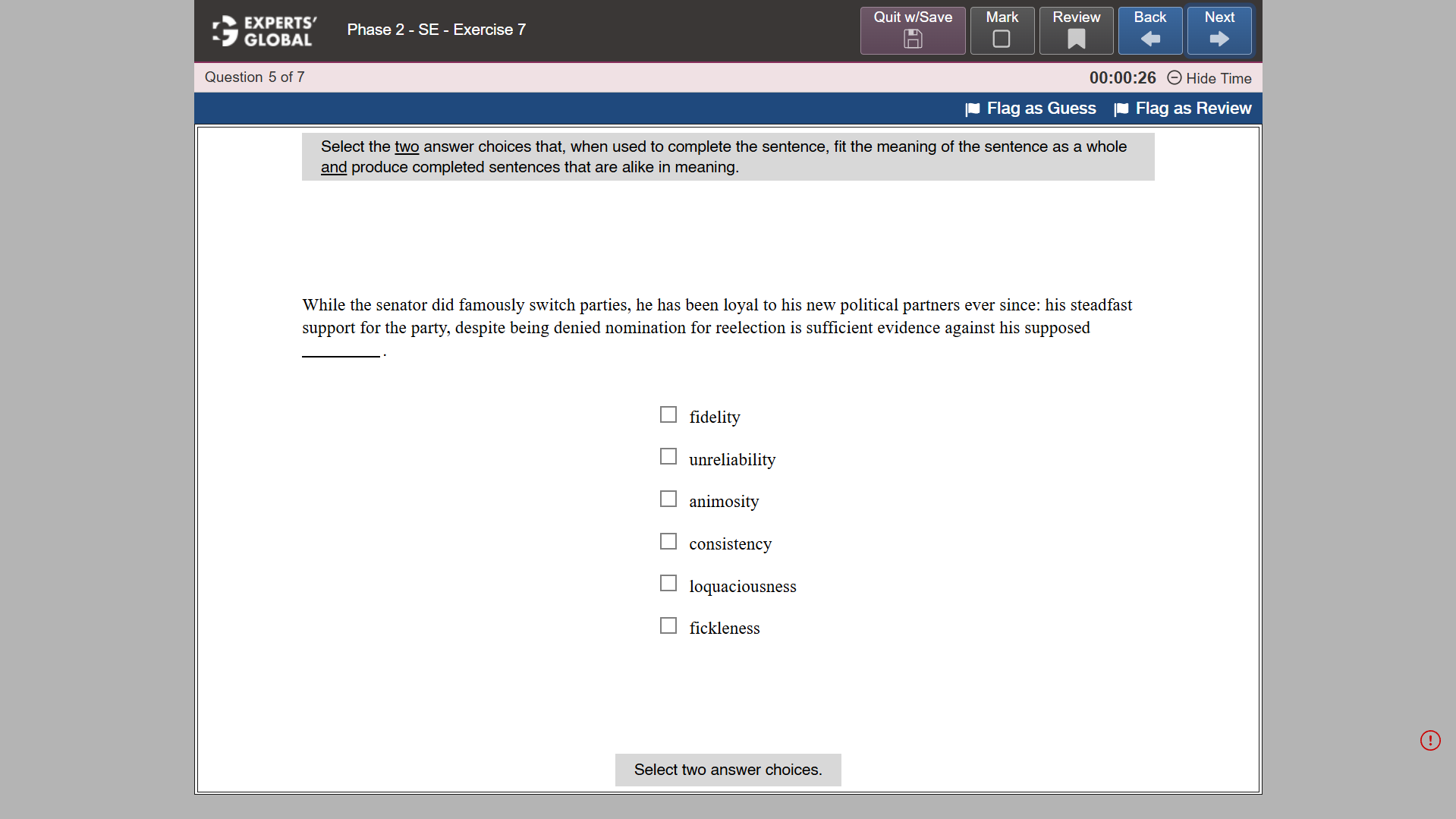
While the senator did famously switch parties, he has been loyal to his new political partners ever since: his steadfast support for the party, despite being denied nomination for reelection is sufficient evidence against his supposed _____.
A. fidelity
B. unreliability
C. animosity
D. consistency
E. loquaciousness
F. fickleness
Written Explanation
The intended core meaning of the sentence: That even though he was denied nomination for re-election, the senator’s firm support for the party is sufficient evidence against his supposed inconsistency.
Reasoning around the blank space: The catch for filling the blank in this sentence lies in identifying the contrast in the usage “WHILE the senator…SWITCH parties…been LOYAL to his new political partners…his STEADFAST support…DESPITE being DENIED nomination…EVIDENCE against his supposed _____”, which implies a difference between the past and the present actions of an individual; this contrast suggests that the sentence intends to convey that while the senator did famously switch parties, he has been loyal to his new political partners ever since as even though he was denied nomination for re-election, he firmly supported his new party, which is sufficient evidence against his supposed inconsistency. Hence, for the blank, we need a word that conveys the idea of sufficient evidence against his supposed “inconsistency”.
Broad expectation from the correct answer choices: A pair of words conveying the idea of being “inconsistent” or “doubtful”.
A. This answer choice, “fidelity”, meaning “the quality of being faithful”, is opposite to our broad expectation from the correct answer choice, which is to convey the idea of being “inconsistent” or “doubtful”. Hence, this answer choice is incorrect.
B. Correct. This answer choice, “unreliability”, meaning “the trait of not being dependable”, matches our broad expectation from the correct answer choice, which is to convey the idea of being “inconsistent” or “doubtful”. Hence, this answer choice is correct.
C. This answer choice, “animosity”, meaning “a strong feeling of dislike or hatred”, does not match our broad expectation from the correct answer choice, which is to convey the idea of being “inconsistent” or “doubtful”. Hence, this answer choice is incorrect.
D. This answer choice, “consistency”, meaning “the quality of always behaving similarly”, is opposite to our broad expectation from the correct answer choice, which is to convey the idea of being “inconsistent” or “doubtful”. Hence, this answer choice is incorrect.
E. This answer choice, “loquaciousness”, meaning “the quality of being talkative”, does not match our broad expectation from the correct answer choice, which is to convey the idea of being “inconsistent” or “doubtful”. Hence, this answer choice is incorrect.
F. Correct. This answer choice, “fickleness”, meaning “unreliable” of “unfaithful”, matches our broad expectation from the correct answer choice, which is to convey the idea of being “inconsistent” or “doubtful”. Hence, this answer choice is correct.
Thus, B and F are the correct answer choices.
Practice Question 2 | SE
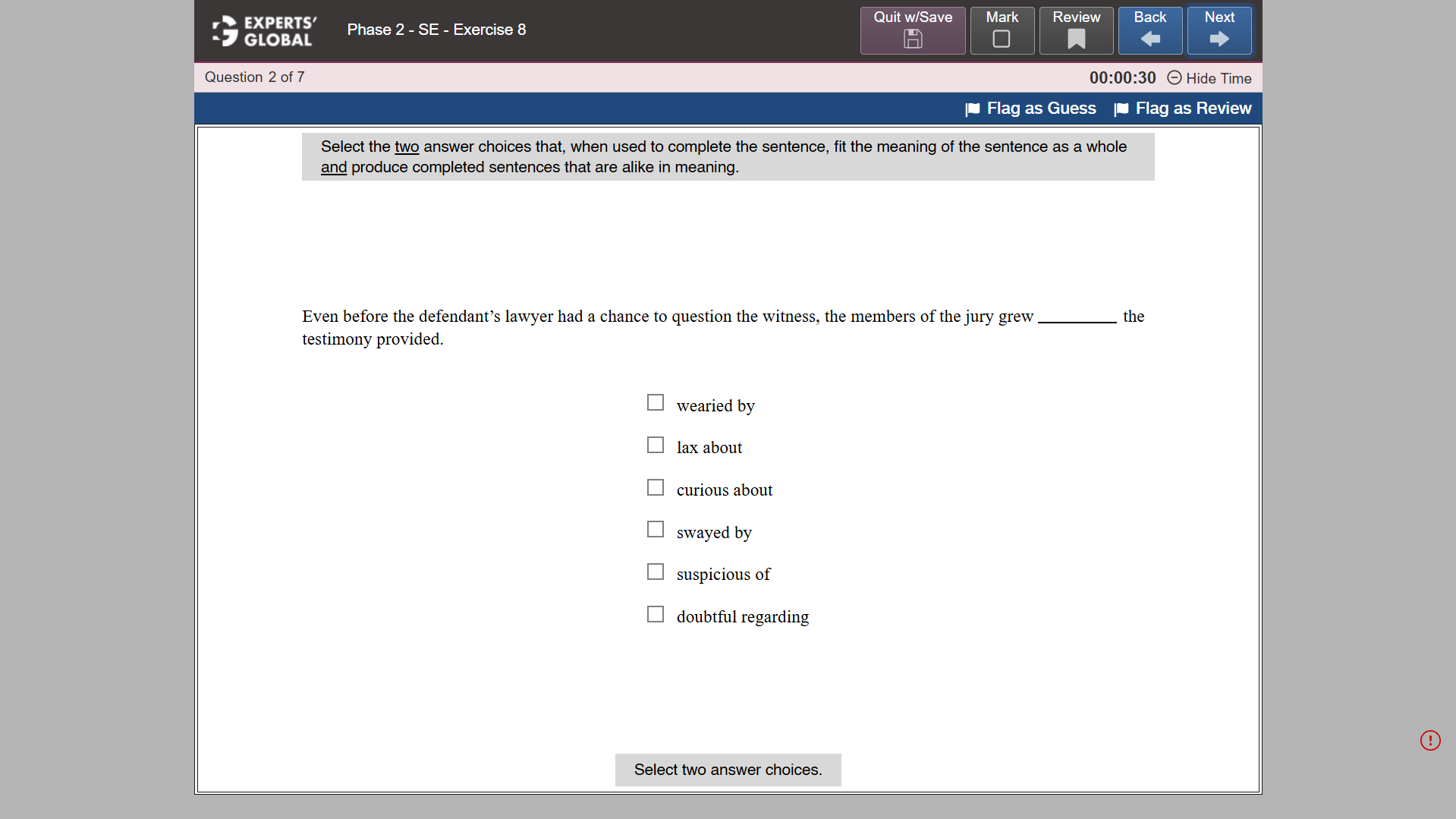
Even before the defendant’s lawyer had a chance to question the witness, the members of the jury grew _____ the testimony provided.
A. wearied by
B. lax about
C. curious about
D. swayed by
E. suspicious of
F. doubtful regarding
Written Explanation
The intended core meaning of the sentence: That even before the defendant’s lawyer could question the witness, the jury was quite distrustful of the testimony provided.
Reasoning around the blank space: The catch for filling the blank in this sentence lies in identifying the continuation of thought in the usage “EVEN BEFORE the DEFENDANT’s lawyer…QUESTION the witness…jury GREW _____ the testimony provided”, which elaborates on the jury’s impression of the testimony provided; this continuation of thought suggests that the sentence intends to convey that even before the defendant’s lawyer could question the witness, the members of the jury grew distrustful of the testimony provided. Hence, for the blank, we need a word that conveys the idea of the members of the jury being quite “distrustful of” the testimony provided.
Broad expectation from the correct answer choices: A pair of words conveying the idea of being “distrustful of” or “unconvinced by”.
A. This answer choice, “wearied by”, meaning “feeling weary or fatigued due to continuous exposure”, does not match our broad expectation from the correct answer choice, which is to convey the idea of being “distrustful of” or “unconvinced by”. Hence, this answer choice is incorrect.
B. This answer choice, “lax about”, meaning “be careless or negligent about something”, does not match our broad expectation from the correct answer choice, which is to convey the idea of being “distrustful of” or “unconvinced by”. Hence, this answer choice is incorrect.
C. This answer choice, “curious about”, meaning “eager to learn more about something”, does not match our broad expectation from the correct answer choice, which is to convey the idea of being “distrustful of” or “unconvinced by”. Hence, this answer choice is incorrect.
D. Trap. Although this answer choice, “swayed by”, meaning “influenced or persuaded to change one’s opinion”, leads to a logical completion of the sentence, this cannot be the correct answer choice because none of the other five answer choices leads to a similar meaning of the sentence. Hence, this answer choice is incorrect.
E. Correct. This answer choice, “suspicious of”, meaning “feeling distrust or doubt toward something”, matches our broad expectation from the correct answer choice, which is to convey the idea of being “distrustful of” or “unconvinced by”. Hence, this answer choice is correct.
F. Correct. This answer choice, “doubtful regarding”, meaning “feeling uncertain or hesitant about something”, matches our broad expectation from the correct answer choice, which is to convey the idea of being “distrustful of” or “unconvinced by”. Hence, this answer choice is correct.
Thus, E and F are the correct answer choices.
Practice Question 3 | SE
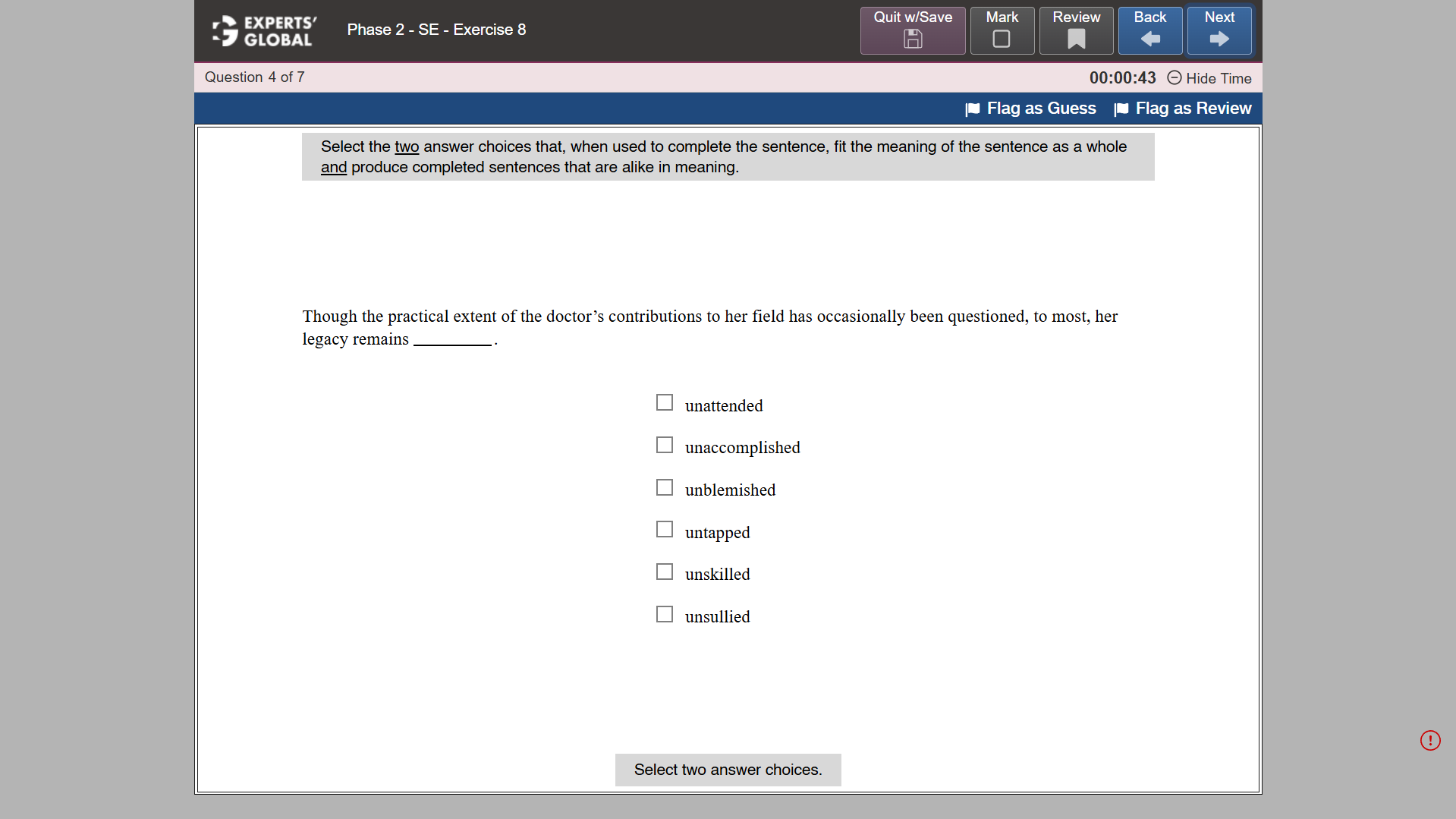
Though the practical extent of the doctor’s contributions to her field has occasionally been questioned, to most, her legacy remains _____.
A. unattended
B. unaccomplished
C. unblemished
D. untapped
E. unskilled
F. unsullied
Written Explanation
The intended core meaning of the sentence: That even though the practical extent of the doctor’s contributions to her field has occasionally been questioned, her legacy is still flawless.
Reasoning around the blank space: The catch for filling the blank in this sentence lies in identifying the contrast in the usage “THOUGH the practical extent of the doctor’s contributions…been QUESTIONED, to most, her legacy REMAINS ___”, which highlights the differing perspectives on the doctor’s contributions; this contrast suggests that the sentence intends to convey that even though the practical extent of the doctor’s contributions to her field has occasionally been questioned, her legacy is still flawless. Hence, for the blank, we need a word that conveys the idea of the doctor’s legacy being “flawless”.
Broad expectation from the correct answer choices: A pair of words conveying the idea of being “flawless” or “without imperfections”.
A. This answer choice, “unattended”, meaning “not watched” or “lacking a caretaker”, does not match our broad expectation from the correct answer choice, which is to convey the idea of being “flawless” or “without imperfections”. Hence, this answer choice is incorrect.
B. This answer choice, “unaccomplished”, meaning “showing little skill” or “unfinished”, does not match our broad expectation from the correct answer choice, which is to convey the idea of being “flawless” or “without imperfections”. Hence, this answer choice is incorrect.
C. Correct. This answer choice, “unblemished”, meaning “not damaged in any way”, matches our broad expectation from the correct answer choice, which is to convey the idea of being “flawless” or “without imperfections”. Hence, this answer choice is correct.
D. This answer choice, “untapped”, meaning “not yet exploited or used”, does not match our broad expectation from the correct answer choice, which is to convey the idea of being “flawless” or “without imperfections”. Hence, this answer choice is incorrect.
E. This answer choice, “unskilled”, meaning “not having professional training or expertise”, does not match our broad expectation from the correct answer choice, which is to convey the idea of being “flawless” or “without imperfections”. Hence, this answer choice is incorrect.
F. Correct. This answer choice, “unsullied”, meaning “not spoiled or made impure”, matches our broad expectation from the correct answer choice, which is to convey the idea of being “flawless” or “without imperfections”. Hence, this answer choice is correct.
Thus, C and F are the correct answer choices.
Additional GRE-style Sentence Equivalence Questions with Explanations
Please find a set of GRE-style SE questions with explanations on: Free GRE Sentence Equivalence Practice Questions with Solutions
Please find a set of assorted GRE-style questions (all section and types) with explanations on: Free GRE Practice Questions with Solutions
GRE Text Completion – One-Blank Practice Questions
Each one blank Text Completion item on the GRE displays a sentence with one word removed. Your role is to pick the option that restores the intended meaning of the sentence as a whole. You earn credit only when the chosen word fits the complete context of the statement. While vocabulary knowledge plays a role, the core skill under evaluation is your ability to track context and maintain logical coherence. This question format represents close to 10 percent of the GRE Verbal Reasoning measure. Below is a GRE style practice set for one blank Text Completion questions, along with detailed solutions.
Important: If you need to undergo thorough TC prep, please visit Free GRE Text Completion prep
Practice Question 1 | TC 1-Blank
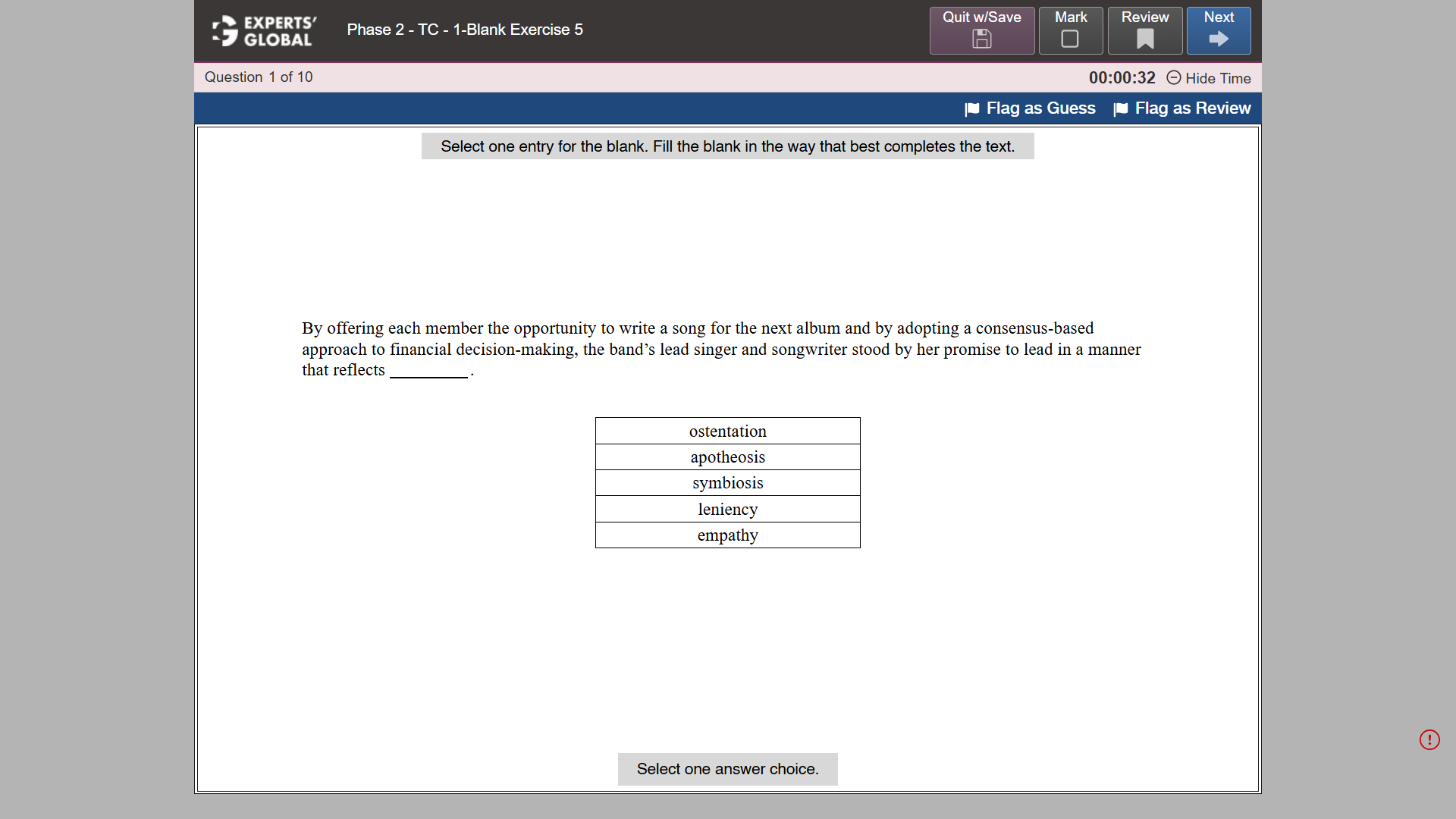
By offering each member the opportunity to write a song for the next album and by adopting a consensus-based approach to financial decision-making, the band’s lead singer and songwriter stood by her promise to lead in a manner that reflects _____.
A. ostentation
B. apotheosis
C. symbiosis
D. leniency
E. empathy
Written Explanation
The intended core meaning of the sentence: That by offering each member opportunity and influence in decision-making, the singer fulfilled her promise to lead cooperatively.
Reasoning around the blank space: The catch for filling the blank in this sentence lies in identifying the continuation of thought in the usage “…by adopting CONSENSUS-BASED APPROACH to…DECISION MAKING…lead singer…stood by her promise to lead in a manner that reflects _____ “, which elaborates on the nature of the singer’s leadership; this continuation of thought suggests that the sentence intends to convey that by offering each member the opportunity to write a song for the next album and by adopting a collective approach to financial decision-making, the band’s lead singer and songwriter stood by her promise to lead in a manner that reflects cooperation. Hence, for the blank, we need a word that conveys the idea of the band’s lead singer standing by her promise to lead in a manner that reflects “cooperation”.
Broad expectation from the correct answer choice: A word conveying a sense of “cooperation” or “fairness”.
A. This answer choice, “ostentation”, meaning “pretentious, showy, or vulgar display”, does not match our broad expectation from the correct answer choice, which is to convey a sense of “cooperation” or “fairness”. Hence, this answer choice is incorrect.
B. Trap. This answer choice, “apotheosis”, meaning “model of excellence” or “the elevation of a person”, does not match our broad expectation from the correct answer choice, which is to convey a sense of “cooperation” or “fairness”. Hence, this answer choice is incorrect.
C. Correct. This answer choice, “symbiosis”, meaning “a mutually beneficial relationship among different people”, matches our broad expectation from the correct answer choice, which is to convey a sense of “cooperation” or “fairness”. Hence, this answer choice is correct.
D. This answer choice, “leniency”, meaning “mercifulness” or “indulgence”, does not match our broad expectation from the correct answer choice, which is to convey a sense of “cooperation” or “fairness”. Hence, this answer choice is incorrect.
E. Trap. This answer choice, “empathy”, meaning “understanding another’s feelings”, does not match our broad expectation from the correct answer choice, which is to convey a sense of “cooperation” or “fairness”. Hence, this answer choice is incorrect.
Thus, C is the correct answer choice.
Practice Question 2 | TC 1-Blank
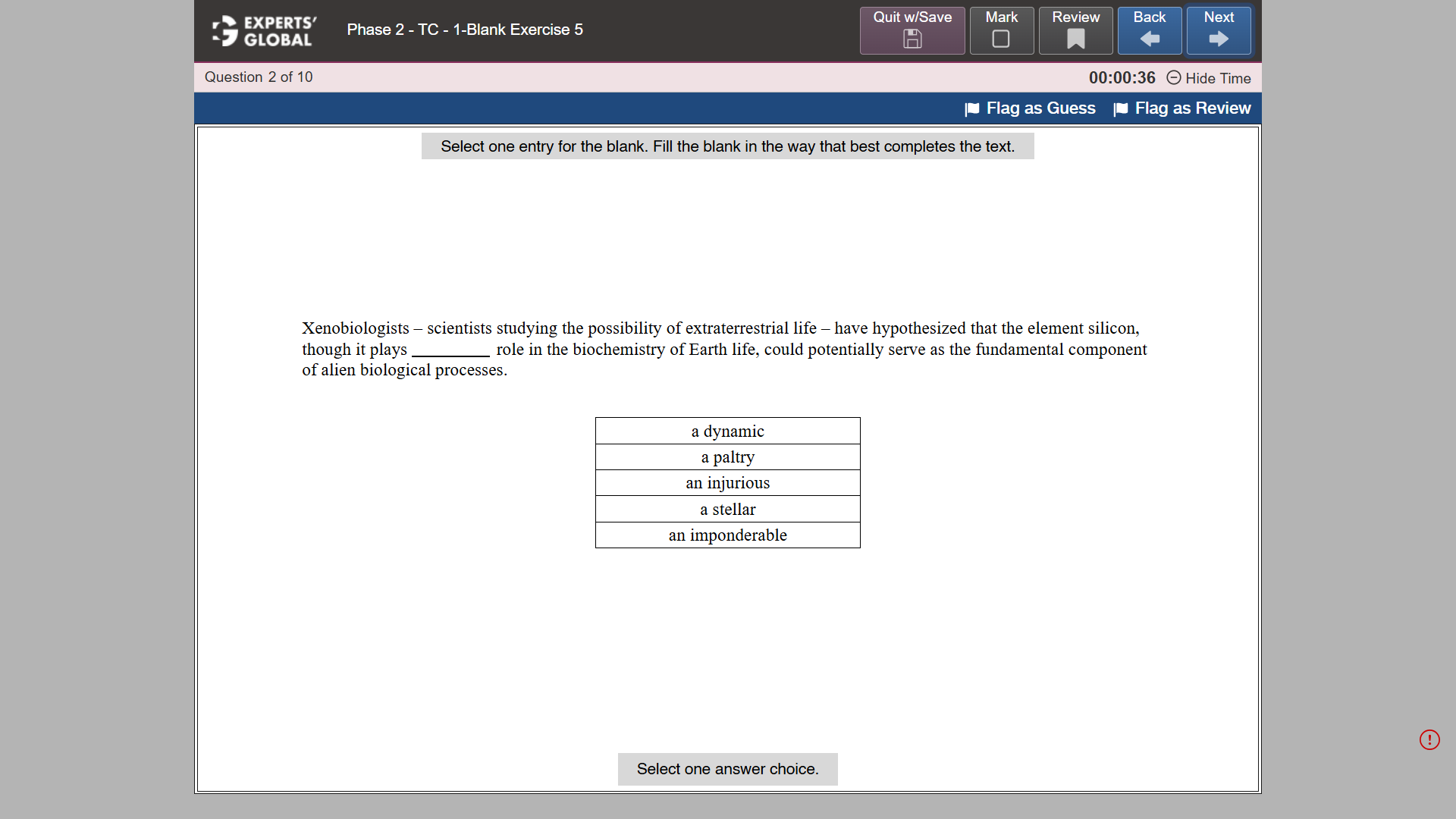
Xenobiologists – scientists studying the possibility of extraterrestrial life – have hypothesized that the element silicon, though it plays _____ role in the biochemistry of Earth life, could potentially serve as the fundamental component of alien biological processes.
A. a dynamic
B. a paltry
C. an injurious
D. a stellar
E. an imponderable
Written Explanation
The intended core meaning of the sentence: That scientists have theorized that while silicon plays a minor role in Earth life, it might be essential for alien life.
Reasoning around the blank space: The catch for filling the blank in this sentence lies in identifying the contrast in the usage “Xenobiologists…hypothesized that…silicon, THOUGH it plays _____ ROLE in…EARTH life…serve as…FUNDAMENTAL COMPONENT of ALIEN biological processes”, which highlights the element’s varying levels of importance; this contrast suggests that the sentence intends to convey that xenobiologists, who are scientists studying the possibility of interplanetary life, have theorized that the element silicon, though it plays a minor role in the biochemistry of Earth life, could potentially serve as the basic component of alien life. Hence, for the blank, we need a word that conveys the idea of silicon playing “a minor” role in the biochemistry of Earth life.
Broad expectation from the correct answer choice: A word conveying the idea of “a minor” or “an unimportant”.
A. This answer choice, “a dynamic”, meaning “characterized by constant change or progress”, does not match our broad expectation from the correct answer choice, which is to convey the idea of “a minor” or “an unimportant”. Hence, this answer choice is incorrect.
B. Correct. This answer choice, “a paltry”, meaning “unimportant” or “scanty”, matches our broad expectation from the correct answer choice, which is to convey the idea of “a minor” or “an unimportant”. Hence, this answer choice is correct.
C. This answer choice, “an injurious”, meaning “causing harm” or “hurtful”, does not match our broad expectation from the correct answer choice, which is to convey the idea of “a minor” or “an unimportant”. Hence, this answer choice is incorrect.
D. This answer choice, “a stellar”, meaning “most important” or “relating to the stars”, is opposite to our broad expectation from the correct answer choice, which is to convey the idea of “a minor” or “an unimportant”. Hence, this answer choice is incorrect.
E. This answer choice, “an imponderable”, meaning “something impossible to assess or measure”, does not match our broad expectation from the correct answer choice, which is to convey the idea of “a minor” or “an unimportant”. Hence, this answer choice is incorrect.
Thus, B is the correct answer choice.
Practice Question 3 | TC 1-Blank
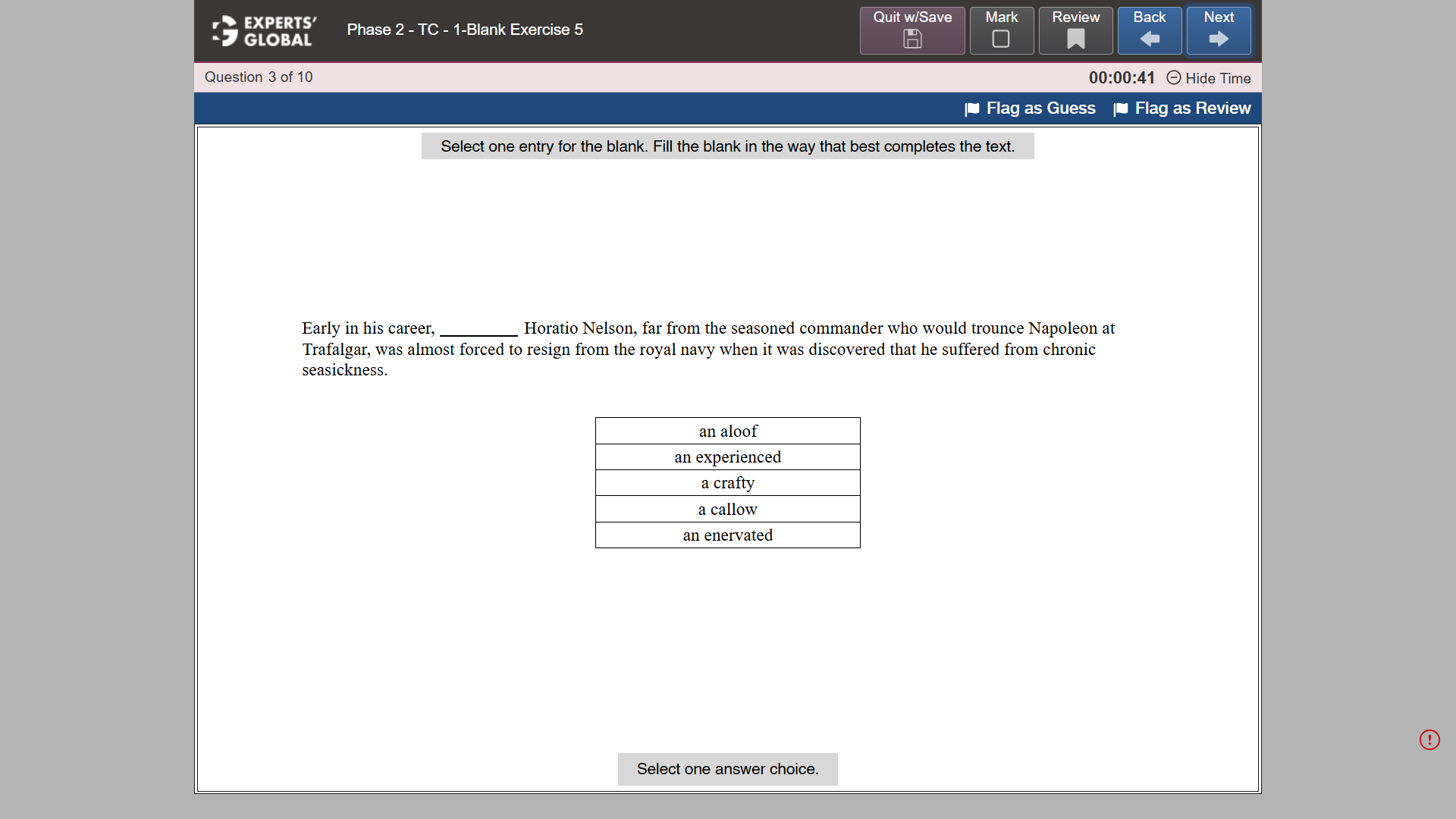
Early in his career, _____ Horatio Nelson, far from the seasoned commander who would trounce Napoleon at Trafalgar, was almost forced to resign from the royal navy when it was discovered that he suffered from chronic seasickness.
A. an aloof
B. an experienced
C. a crafty
D. a callow
E. an enervated
Written Explanation
The intended core meaning of the sentence: That a young Nelson, different from the experienced commander who defeated Napolean, was almost forced to resign from the Navy due to his chronic seasickness.
Reasoning around the blank space: The catch for filling the blank in this sentence lies in identifying the contrast in the usage “EARLY in his career, _____ Horatio Nelson, FAR FROM the SEASONED COMMANDER who would TROUNCE Napoleon…forced to RESIGN…”, which implies a difference between the two stages of Horatio Nelson’s career; this contrast suggests that the sentence intends to convey that early in his career, a young Horatio Nelson, far from the experienced commander who would later defeat Napoleon at Trafalgar, was almost forced to resign from the Royal Navy when it was discovered that he suffered from chronic seasickness. Hence, for the blank, we need a word that conveys the idea of “a young” Horatio Nelson.
Broad expectation from the correct answer choice: A word conveying the idea of being “young” or “inexperienced”.
A. This answer choice, “an aloof”, meaning “reserved and distant”, does not match our broad expectation from the correct answer choice, which is to convey the idea of being “young” or “inexperienced”. Hence, this answer choice is incorrect.
B. Trap. This answer choice, “an experienced”, meaning “having knowledge or skill from participation”, is opposite to our broad expectation from the correct answer choice, which is to convey the idea of being “young” or “inexperienced”. Hence, this answer choice is incorrect.
C. This answer choice, “a crafty”, meaning “marked by skill in deception”, does not match our broad expectation from the correct answer choice, which is to convey the idea of being “young” or “inexperienced”. Hence, this answer choice is incorrect.
D. Correct. This answer choice, “a callow”, meaning “inexperienced” or “immature”, matches our broad expectation from the correct answer choice, which is to convey the idea of being “young” or “inexperienced”. Hence, this answer choice is correct.
E. This answer choice, “an enervated”, meaning “physically or mentally exhausted”, does not match our broad expectation from the correct answer choice, which is to convey the idea of being “young” or “inexperienced”. Hence, this answer choice is incorrect.
Thus, D is the correct answer choice.
GRE Text Completion – Two-Blank Practice Questions
Each two blank Text Completion item on the GRE shows a short passage with two words removed. Your task is to select the pair of options that completes the passage in a way that preserves a coherent meaning. You earn credit only when both selected choices are correct. There is no partial scoring. Although vocabulary knowledge plays a role, the primary skill under assessment is reasoning based on context and logical structure. This question type makes up roughly 10 percent of the GRE Verbal Reasoning measure. Below is a GRE style practice set for two blank Text Completion questions, followed by clear explanations.
Important: If you need to undergo thorough TC 2-blank prep, please visit Free GRE Text Completion 2-blank prep
Practice Question 1 | TC 2-Blank
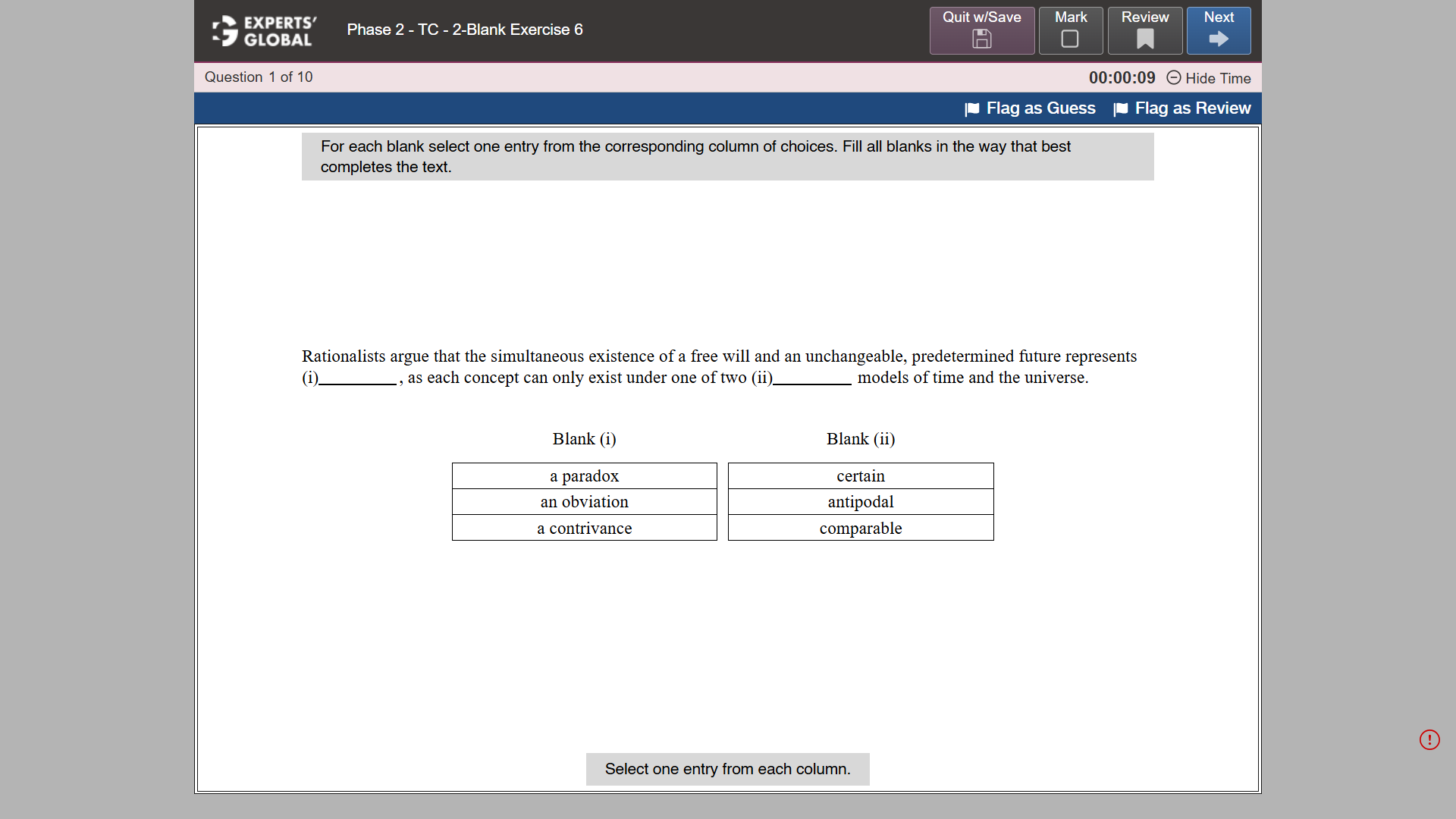
Rationalists argue that the simultaneous existence of a free will and an unchangeable, predetermined future represents (i)_____, as each concept can only exist under one of two (ii)_____ models of time and the universe.
Blank (i)
A. a paradox
B. an obviation
C. a contrivance
Blank (ii)
D. certain
E. antipodal
F. comparable
Written Explanation
Reasoning:
The usage of the phrase “simultaneous existence of a free will and an unchangeable, predetermined future” suggests that “free will” and an “unchangeable, predetermined future” cannot both be real: logically, if all actions are predetermined, one cannot be said to have the ability to meaningfully impact the outcome of events. Hence, the first blank must refer to something along the lines of a contradiction. Therefore, the most logical answer choice for blank (i) is A – “a paradox”.
The usage of the phrase “as each concept can only exist under one of two…models” implies that “free will” is only possible under a model that does not allow for “an unchangeable, predetermined future” and vice versa; further, we have established that “free will” and “an unchangeable, predetermined future” cannot exist simultaneously; hence, in this context, the two models are most likely to be characterized by contrast. Therefore, the most fitting answer choice for blank (ii) is E – “antipodal”.
Correct combination of answer choices:
A. “a paradox”, meaning “a statement that seems impossible but might actually make sense”.
E. “antipodal”, meaning “situated at opposite sides of the earth”.
The aforesaid combination of answer choices leads to a logical and coherent completion of the paragraph.
Incorrect answer choices:
B. This answer choice “an obviation”, meaning “the act of preventing something”, cannot form a logical combination of answer choices for a coherent completion of the paragraph. Hence, this answer choice is incorrect.
C. This answer choice “a contrivance”, meaning “a device that is very useful for a job”, cannot form a logical combination of answer choices for a coherent completion of the paragraph. Hence, this answer choice is incorrect.
D. This answer choice “certain”, meaning “established beyond doubt”, cannot form a logical combination of answer choices for a coherent completion of the paragraph. Hence, this answer choice is incorrect.
F. This answer choice “comparable”, meaning “able to be likened to another”, cannot form a logical combination of answer choices for a coherent completion of the paragraph. Hence, this answer choice is incorrect.
Thus, A and E are the correct combination of answer choices.
Practice Question 2 | TC 2-Blank
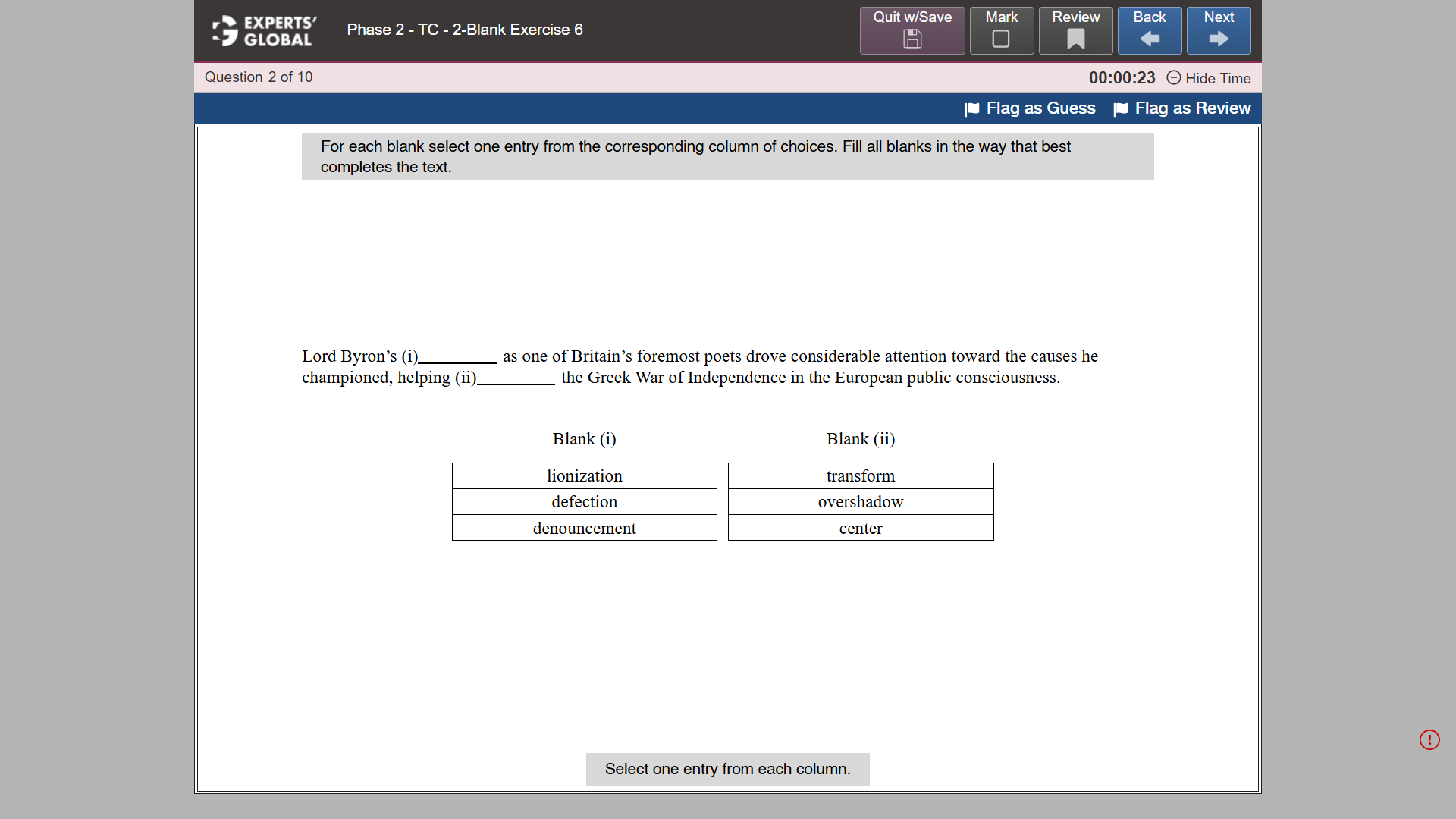
Lord Byron’s (i)_____ as one of Britain’s foremost poets drove considerable attention toward the causes he championed, helping (ii)_____ the Greek War of Independence in the European public consciousness.
Blank (i)
A. lionization
B. defection
C. denouncement
Blank (ii)
D. transform
E. overshadow
F. center
Written Explanation
Reasoning:
The usage of the phrase “as one of Britain’s foremost poets” indicates that a positive or neutral term is needed to refer to how Lord Byron was characterized. Therefore, the only logical answer choice for blank (i) is A – “lionization”.
The usage of the phrase “drove considerable attention toward the causes he championed” in conjunction with “helping…. the Greek War of Independence in the European public consciousness” indicates that the Lionization of Byron increased the salience of the Greek War of Independence among the European public. Therefore, the only logical answer choice for the second blank is F – “center”.
Correct combination of answer choices:
A. “lionization”, meaning “treating someone as a celebrity”.
F. “center”, meaning “focus on”.
The aforesaid combination of answer choices leads to a logical and coherent completion of the paragraph.
Incorrect answer choices:
B. This answer choice “defection”, meaning “abandoning a group for another”, cannot form a logical combination of answer choices for a coherent completion of the paragraph. Hence, this answer choice is incorrect.
C. This answer choice “denouncement”, meaning “criticizing someone publicly”, cannot form a logical combination of answer choices for a coherent completion of the paragraph. Hence, this answer choice is incorrect.
D. This answer choice “transform”, meaning “change completely”, cannot form a logical combination of answer choices for a coherent completion of the paragraph. Hence, this answer choice is incorrect.
E. This answer choice “overshadow”, meaning “make something appear small by comparison”, cannot form a logical combination of answer choices for a coherent completion of the paragraph. Hence, this answer choice is incorrect.
Thus, A and F are the correct combination of answer choices.
Practice Question 3 | TC 2-Blank
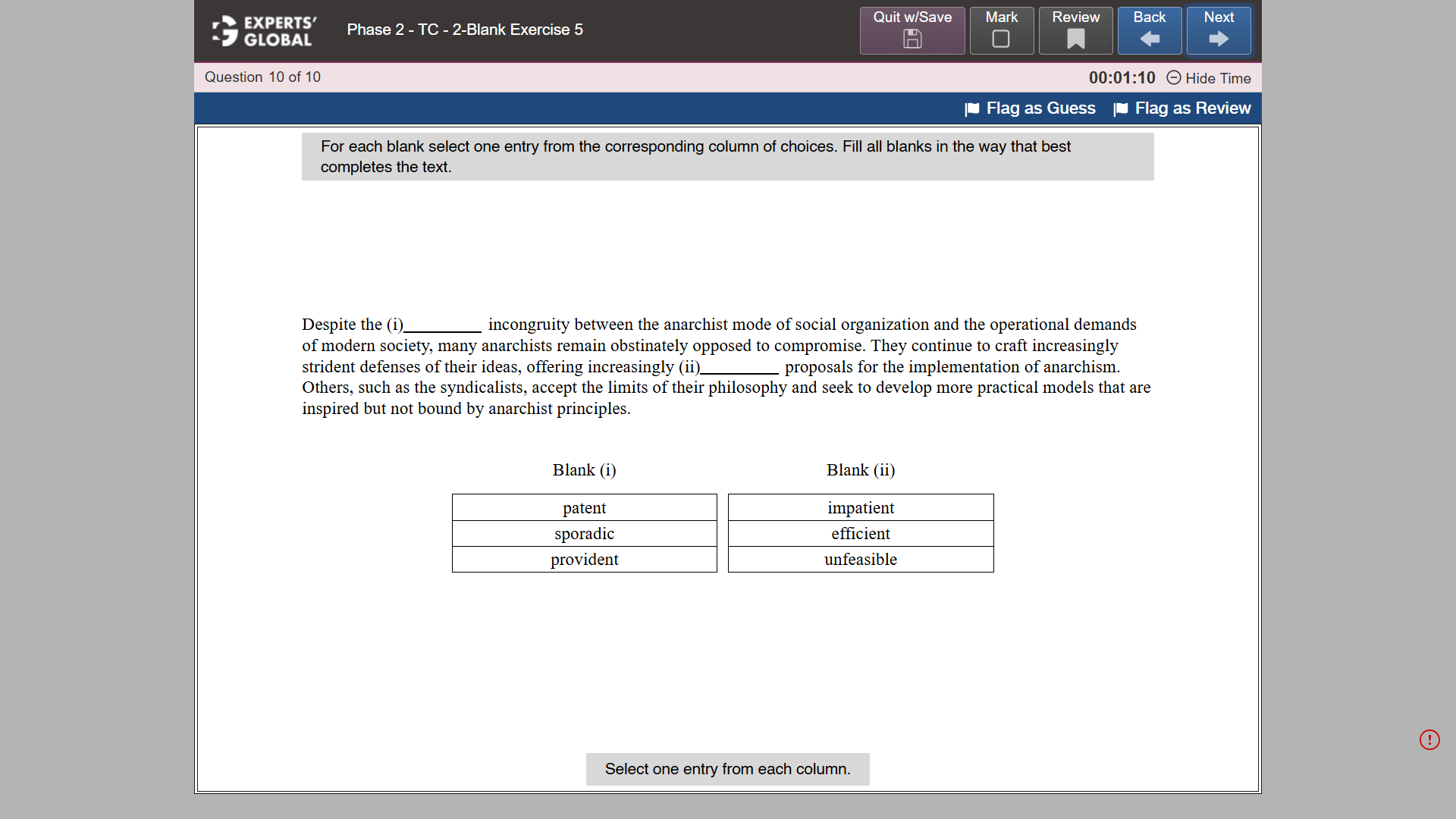
Despite the (i)_____ incongruity between the anarchist mode of social organization and the operational demands of modern society, many anarchists remain obstinately opposed to compromise. They continue to craft increasingly strident defenses of their ideas, offering increasingly (ii)_____ proposals for the implementation of anarchism. Others, such as the syndicalists, accept the limits of their philosophy and seek to develop more practical models that are inspired but not bound by anarchist principles.
Blank (i)
A. patent
B. sporadic
C. provident
Blank (ii)
D. impatient
E. efficient
F. unfeasible
Written Explanation
Reasoning:
The usage of the clause “many anarchists remain obstinately opposed to compromise” and the contrasting phrase “Despite the…incongruity between the anarchist mode of social organization and the operational demands of modern society” indicates that “the anarchist mode of social organization” is impractical and anarchists refuse to deviate from this mode of production; from this, we can conclude that the first blank is a characterization of the “incongruity” that heightens the contrast between the deficiency of the anarchist mode of organization and the anarchists’ opposition to compromise. Therefore, the most logical answer choice for blank (i) is A – “patent”.
The clause “They continue to craft increasingly strident defenses of their ideas” in conjunction with “, offering…proposals for the implementation of anarchism” indicates that anarchists, in refusing to compromise, grew increasingly forceful in defending their ideals; from this, we can surmise that the second blank represents a similar escalation of their behavior that can refer to the “proposals” they put forward. Therefore, the most fitting answer choice for blank (ii) is F – “unfeasible”.
Correct combination of answer choices:
A. “patent”, meaning “obvious” or “a document granting a right”.
F. “unfeasible”, meaning “not practical”.
The aforesaid combination of answer choices leads to a logical and coherent completion of the paragraph.
Incorrect answer choices:
B. This answer choice “sporadic”, meaning “occurring irregularly”, cannot form a logical combination of answer choices for a coherent completion of the paragraph. Hence, this answer choice is incorrect.
C. This answer choice “provident”, meaning “providing carefully for the future”, cannot form a logical combination of answer choices for a coherent completion of the paragraph. Hence, this answer choice is incorrect.
D. This answer choice “impatient”, meaning “eager for something to happen quickly”, cannot form a logical combination of answer choices for a coherent completion of the paragraph. Hence, this answer choice is incorrect.
E. This answer choice “efficient”, meaning “able to achieve a purpose”, cannot form a logical combination of answer choices for a coherent completion of the paragraph. Hence, this answer choice is incorrect.
Thus, A and F are the correct combination of answer choices.
GRE Text Completion – Three-Blank Practice Questions
In three blank Text Completion items on the GRE, a brief passage includes three missing words, and you select one option for each blank to rebuild the intended meaning of the text. Your response earns credit only when all three choices are correct. There is no partial scoring for these questions. Vocabulary appears in the options, but the main skill under assessment involves following the logic of the passage and preserving overall meaning. This question type accounts for roughly 10 percent of the GRE Verbal Reasoning measure. Below is a GRE style practice set for three blank Text Completion questions, accompanied by explanations.
Important: If you need to undergo thorough TC 3-blank prep, please visit Free GRE Text Completion 3-blank prep
Practice Question 1 | TC 3-Blank
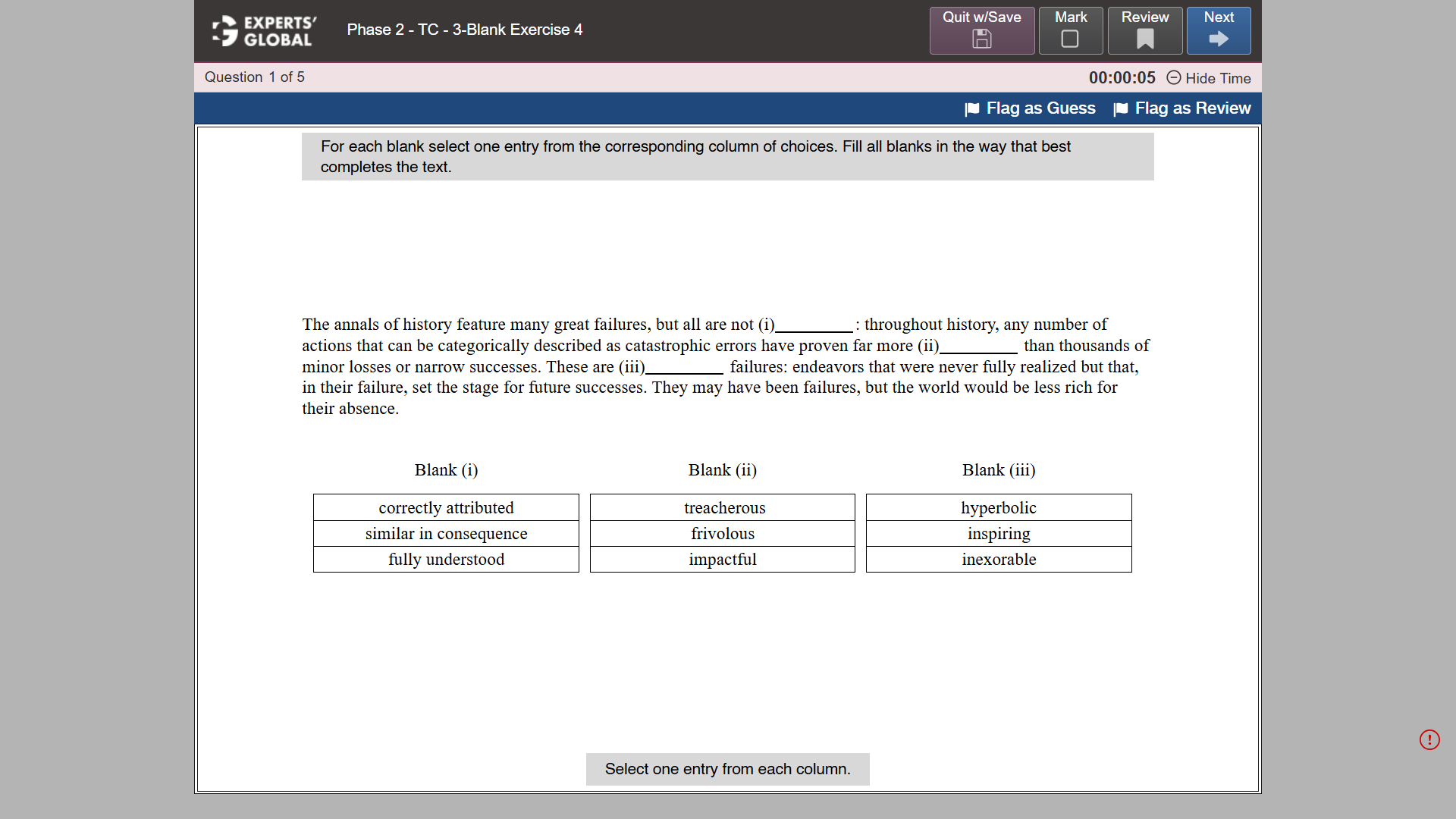
The annals of history feature many great failures, but all are not (i)_____: throughout history, any number of actions that can be categorically described as catastrophic errors have proven far more (ii)_____ than thousands of minor losses or narrow successes. These are (iii)_____ failures: endeavors that were never fully realized but that, in their failure, set the stage for future successes. They may have been failures, but the world would be less rich for their absence.
Blank (i)
A. correctly attributed
B. similar in consequence
C. fully understood
Blank (ii)
D. treacherous
E. frivolous
F. impactful
Blank (iii)
G. hyperbolic
H. inspiring
I. inexorable
Written Explanation
Reasoning
The usage of the clause “These are the…failures” in conjunction with the phrase “endeavors that were never fully realized but that, in their failure, set the stage for future successes” indicates that the third blank characterizes a certain type of “failures” and these failures led to future successes and that “the world would be less rich for their absence”; hence, the third blank must be a positive characterization. Thus, the only fitting answer choice for blank (iii) is H – “inspiring”.
The usage of the clause formed by the third blank “These are the inspiring failures” in conjunction with the clause “any number of actions that can be categorically described as catastrophic errors have proven far more…than thousands of minor losses or narrow successes” indicates that “These are the inspiring failures” refers to the “actions that can be categorically described as catastrophic errors” mentioned in the clause; hence, both the second and third blanks refer to the same “failures”, meaning the second blank must also be a positive characterization. Thus, the only fitting answer choice for blank (iii) is F – “impactful”.
The usage of a colon to link the clause “all are not…” with the clause formed by the second answer choice – “any number of actions that can be categorically described as catastrophic errors have proven far more impactful“ – indicates that the latter explains the former, meaning both must convey a similar meaning; hence, the usage of the phrase “far more impactful” implies that the clause formed by the first blank must refer to a dissimilarity in impact. Therefore, as this clause already includes the negating word “not”, the only fitting answer choice for blank (i) is B – “similar in consequence”.
Correct combination of answer choices:
B. “similar in consequence”, meaning “having the same result”.
F. “impactful”, meaning “having a powerful effect”.
H. “inspiring”, meaning “encouraging”.
The aforesaid combination of answer choices leads to a logical and coherent completion of the paragraph.
Incorrect answer choices:
A. This answer choice “correctly attributed”, meaning “selected the right cause of something”, cannot form a logical combination of answer choices for a coherent completion of the paragraph. Hence, this answer choice is incorrect.
C. This answer choice “fully understood”, meaning “completely grasped”, cannot form a logical combination of answer choices for a coherent completion of the paragraph. Hence, this answer choice is incorrect.
D. This answer choice “treacherous”, meaning “dangerously unstable”, cannot form a logical combination of answer choices for a coherent completion of the paragraph. Hence, this answer choice is incorrect.
E. This answer choice “frivolous”, meaning “not having any serious value”, cannot form a logical combination of answer choices for a coherent completion of the paragraph. Hence, this answer choice is incorrect.
G. This answer choice “hyperbolic”, meaning “exaggerated”, cannot form a logical combination of answer choices for a coherent completion of the paragraph. Hence, this answer choice is incorrect.
I. This answer choice “inexorable”, meaning “unavoidable”, cannot form a logical combination of answer choices for a coherent completion of the paragraph. Hence, this answer choice is incorrect.
Thus, B, F, and H are the correct combination of answer choices.
Practice Question 2 | TC 3-Blank
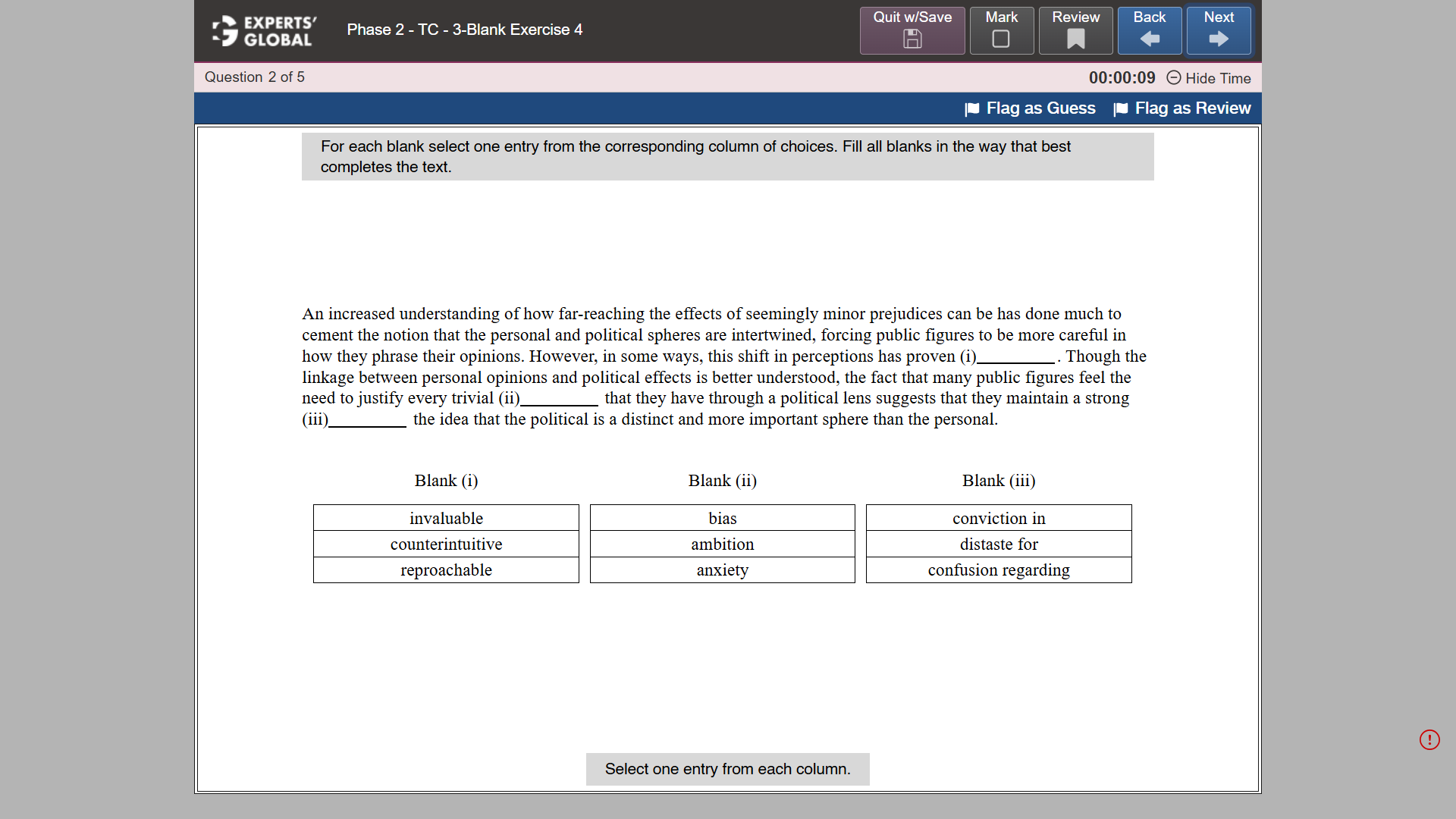
An increased understanding of how far-reaching the effects of seemingly minor prejudices can be has done much to cement the notion that the personal and political spheres are intertwined, forcing public figures to be more careful in how they phrase their opinions. However, in some ways, this shift in perceptions has proven (i)_____. Though the linkage between personal opinions and political effects is better understood, the fact that many public figures feel the need to justify every trivial (ii)_____ that they have through a political lens suggests that they maintain a strong (iii)_____ the idea that the political is a distinct and more important sphere than the personal.
Blank (i)
A. invaluable
B. counterintuitive
C. reproachable
Blank (ii)
D. bias
E. ambition
F. anxiety
Blank (iii)
G. conviction in
H. distaste for
I. confusion regarding
Written Explanation
Reasoning:
The first sentence of this passage states that a certain idea regarding prejudices has been successful in establishing a link between personal and political matters. Thus, the usage of the contrasting phrase “However, in some ways” indicates that the following clause “this shift in perceptions has proven…”, formed with the first blank, is meant to convey that this idea has, in some ways, been unsuccessful. Therefore, the only logical answer choice for blank (i) is B – “counterproductive”.
The passage is broadly concerned with the idea of “prejudices” in relation to politics, hence the phrase formed by the second blank – “feel the need to justify every trivial…that they have though a political lens” – is, likely, also related to prejudices in some way; further, both “ambition” and “anxiety” are too far removed from the context to be correct. Therefore, the only fitting answer choice for blank (ii) is D – “bias”.
The usage of the clause “they maintain a strong…the idea that the political is a distinct and more important sphere than the personal” indicates that the third blank defines the relation between “they” – “public figures” – and the idea that political matters are separate from personal ones; further, the usage of this clause in conjunction with the contrasting phrase “Though the linkage between personal opinions and political effects is better understood” indicates that the public figures, in some way, disagree with the idea that personal opinions and political matters are connected; hence, the third blank must convey that they believe in the idea that the personal and political are separate. Therefore, the only fitting answer choice for blank (iii) is G – “conviction in”.
Correct combination of answer choices:
B. “counterintuitive”, meaning “seemingly opposite to common sense”.
D. “bias”, meaning “partiality that prevents fair consideration”.
G. “conviction in”, meaning “unshakable belief in”.
The aforesaid combination of answer choices leads to a logical and coherent completion of the paragraph.
Incorrect answer choices:
A. This answer choice “invaluable”, meaning “extremely useful”, cannot form a logical combination of answer choices for a coherent completion of the paragraph. Hence, this answer choice is incorrect.
C. This answer choice “reproachable”, meaning “deserving of blame”, cannot form a logical combination of answer choices for a coherent completion of the paragraph. Hence, this answer choice is incorrect.
E. This answer choice “ambition”, meaning “strong desire to achieve something”, cannot form a logical combination of answer choices for a coherent completion of the paragraph. Hence, this answer choice is incorrect.
F. This answer choice “anxiety”, meaning “feeling of worry”, cannot form a logical combination of answer choices for a coherent completion of the paragraph. Hence, this answer choice is incorrect.
H. This answer choice “distaste for”, meaning “strong dislike for”, cannot form a logical combination of answer choices for a coherent completion of the paragraph. Hence, this answer choice is incorrect.
I. This answer choice “confusion regarding”, meaning “lack of clarity about something”, cannot form a logical combination of answer choices for a coherent completion of the paragraph. Hence, this answer choice is incorrect.
Thus, B, D, and G are the correct combination of answer choices.
Practice Question 3 | TC 3-Blank
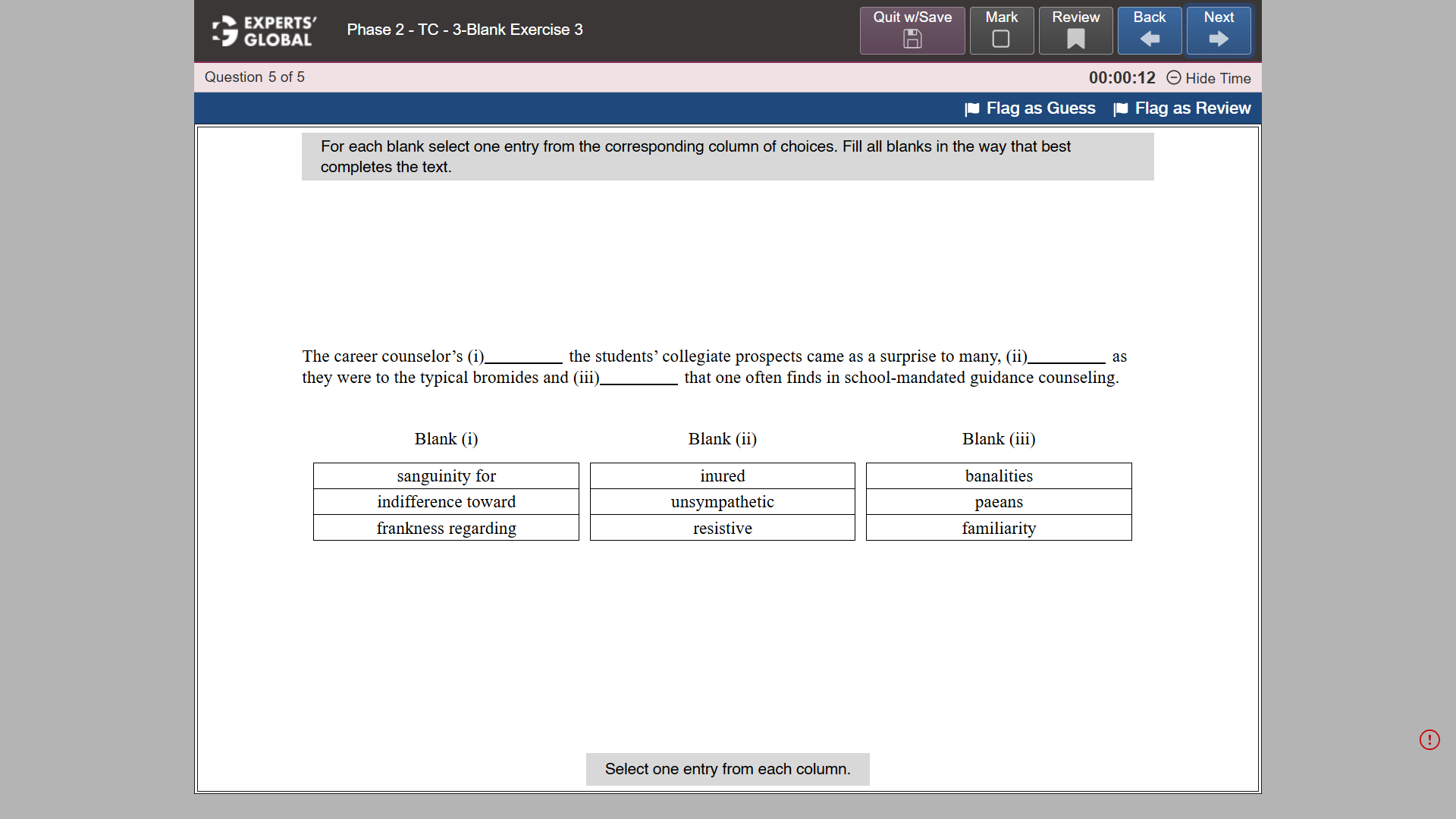
The career counselor’s (i)_____ the students’ collegiate prospects came as a surprise to many, (ii)_____ as they were to the typical bromides and (iii)_____ that one often finds in school-mandated guidance counseling.
Blank (i)
A. sanguinity for
B. indifference toward
C. frankness regarding
Blank (ii)
D. inured
E. unsympathetic
F. resistive
Blank (iii)
G. banalities
H. paeans
I. familiarity
Written Explanation
Reasoning:
The usage of the phrase “bromides and… that one often finds in school-mandated guidance counseling” indicates that the third blank refers to something similar or related to “bromides” that can typically be found in “school-mandated guidance counseling”. Therefore, the most fitting answer choice for blank (iii) is G – “banalities”.
The usage of the phrase “came as a surprise to many” in conjunction with “…as they were to the typical bromides” indicates a cause-and-effect relation between the “surprise” experienced and the relation between the “many” and “the typical bromides”; hence, the second blank must convey that “many” were expecting “the typical bromides”. Therefore, the only fitting answer choice for blank (ii) is D – “inured”.
The usage of the clause “The career counselor’s…the students’ collegiate prospects came as a surprise to many” in conjunction with the phrase formed by the second and third blanks – “inured as they were to the typical bromides and banalities” – indicates that the first blank refers to an attribute of the “career counselor” that contrasts with “bromides and banalities”; hence, the first blank must form a contrast against the idea of boring or forced positivity. Therefore, the most fitting answer choice for blank (i) is C – “frankness regarding”.
Correct combination of answer choices:
C. “frankness regarding”, meaning “honesty about”.
D. “inured”, meaning “caused to become used to something”.
G. “banalities”, meaning “comments that lack originality”.
The aforesaid combination of answer choices leads to a logical and coherent completion of the paragraph.
Incorrect answer choices:
A. This answer choice “sanguinity for”, meaning “hopefulness about”, cannot form a logical combination of answer choices for a coherent completion of the paragraph. Hence, this answer choice is incorrect.
B. This answer choice “indifference toward”, meaning “lack of concern for”, cannot form a logical combination of answer choices for a coherent completion of the paragraph. Hence, this answer choice is incorrect.
E. This answer choice “unsympathetic”, meaning “not favorable toward something”, cannot form a logical combination of answer choices for a coherent completion of the paragraph. Hence, this answer choice is incorrect.
F. This answer choice “resistive”, meaning “not affected by something”, cannot form a logical combination of answer choices for a coherent completion of the paragraph. Hence, this answer choice is incorrect.
H. This answer choice “paeans”, meaning “formal expressions of praise”, cannot form a logical combination of answer choices for a coherent completion of the paragraph. Hence, this answer choice is incorrect.
I. This answer choice “familiarity”, meaning “close information about something”, cannot form a logical combination of answer choices for a coherent completion of the paragraph. Hence, this answer choice is incorrect.
Thus, C, D, and G are the correct combination of answer choices.
GRE Reading Comprehension Practice Questions
Each GRE Reading Comprehension set features a single passage followed by two or three questions that you answer on the basis of what the passage states or logically implies. Most questions appear in the multiple choice select one format with five options. Some appear in the multiple choice select one or more format with three options, where you receive credit only when every correct option is selected, with no partial credit. Certain questions ask you to select a specific sentence from the passage itself. You typically encounter four Reading Comprehension sets that together account for roughly 40 percent of the GRE Verbal Reasoning measure, along with three single passage questions that our course treats as Critical Reasoning. Below is a GRE style set of Reading Comprehension practice questions with explanations.
Important: If you need to undergo thorough RC prep, please visit Free GRE Reading Comprehension prep
Practice Question 1 | RC
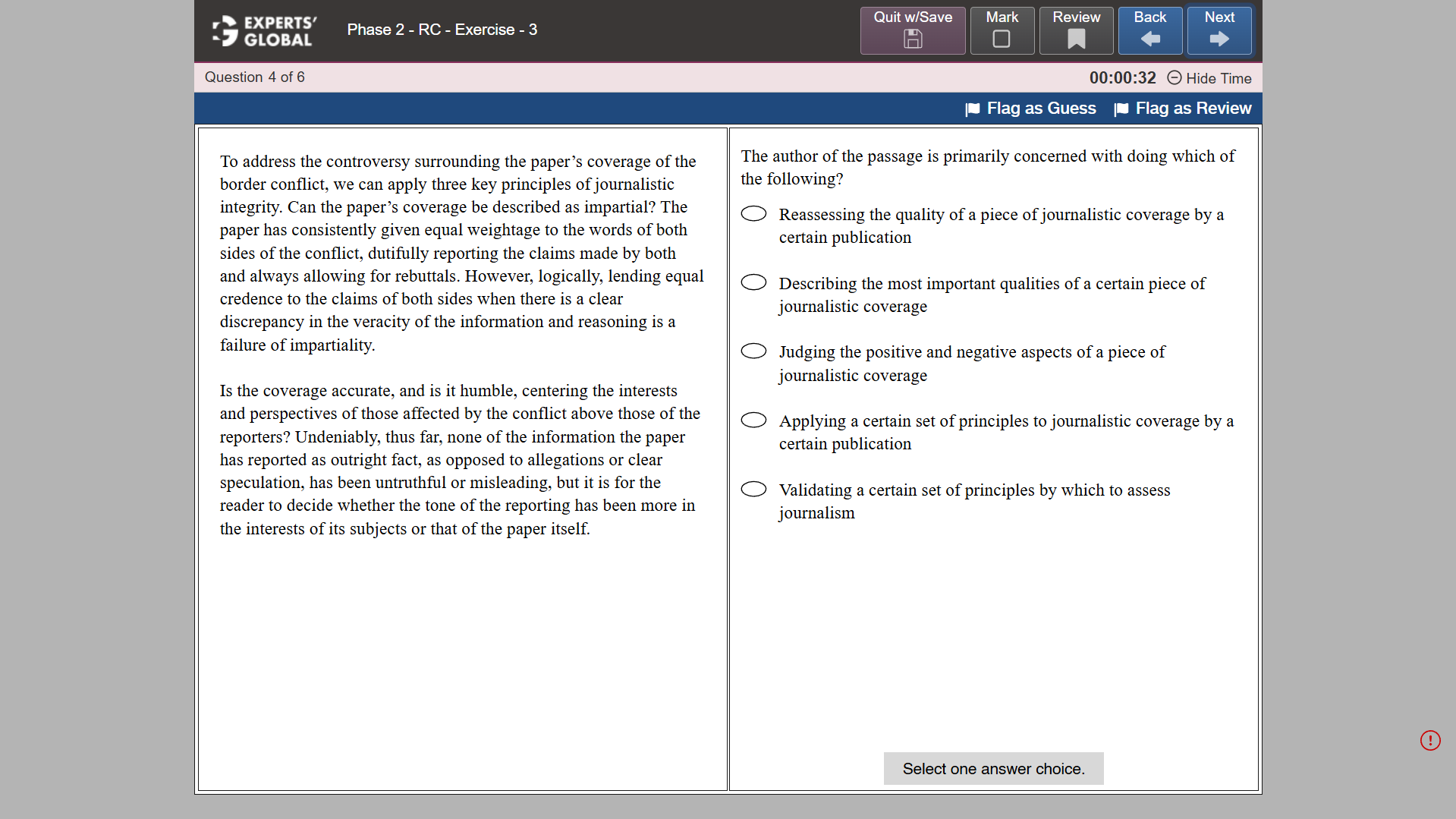
The author of the passage is primarily concerned with doing which of the following?
A. Reassessing the quality of a piece of journalistic coverage by a certain publication
B. Describing the most important qualities of a certain piece of journalistic coverage
C. Judging the positive and negative aspects of a piece of journalistic coverage
D. Applying a certain set of principles to journalistic coverage by a certain publication
E. Validating a certain set of principles by which to assess journalism
Written Explanation
Mind-map
The idea of applying a certain set of principles to a certain paper’s coverage of an issue is suggested (Lines 1 – 2)
The first principle is explained, and it is asserted that coverage is not in line with it (Lines 3 – 9)
The second and third principles are explained (Lines 10 – 12)
That the coverage is in line with the second principle and may be in line with the third is asserted (Line 13 – end)
A. Trap. Referring to the paper’s actions, the passage states that “…lending equal credence to the claims of both sides, when there is a clear discrepancy in the veracity of the information and reasoning is a failure of impartiality…”; although this statement can be said to describe a reassessment of one aspect of the paper’s coverage, it does so only to assert that the coverage is not in line with the first principle; hence, the mention of this reassessment is a passing reference and cannot be considered the main point of the passage. Incorrect.
B. Trap. Although the passage references “…three key principles of journalistic integrity…”, it does not reference the importance of these principles relative to other aspects of journalistic coverage. Moreover, although the passage describes the three key principles of journalistic integrity, it is primarily concerned with applying these principles to a certain piece of journalism. Incorrect.
C. Trap. The passage discusses the paper’s coverage of the border conflict only in the context of determining whether it is in line with three principles of journalistic integrity; hence, any mention of this coverage’s positive and negative aspects is a passing reference and cannot be considered the main point of the passage. Incorrect.
D. Correct. As the mind-map indicates, the passage suggests applying three key principles of journalistic integrity to the paper’s coverage of the conflict, then explains and applies each, concluding that the coverage is not in line with the first, it is with the second, and may or may not be in line with the third; hence, it can be inferred that the passage is primarily concerned with applying a certain set of principles to a particular piece of journalistic coverage.
E. Trap. The passage does not evaluate the validity of the three key principles of journalistic integrity, in the context of journalism in general; rather, the passage evaluates whether the coverage of a certain event by a certain publication is in line with these principles. Incorrect.
Thus, D is the correct answer choice.
Practice Question 2 | RC
The author of the passage is primarily concerned with doing which of the following?
A. Reassessing the quality of a piece of journalistic coverage by a certain publication
B. Describing the most important qualities of a certain piece of journalistic coverage
C. Judging the positive and negative aspects of a piece of journalistic coverage
D. Applying a certain set of principles to journalistic coverage by a certain publication
E. Validating a certain set of principles by which to assess journalism
Written Explanation
Mind-map
The idea of applying a certain set of principles to a certain paper’s coverage of an issue is suggested (Lines 1 – 2)
The first principle is explained, and it is asserted that coverage is not in line with it (Lines 3 – 9)
The second and third principles are explained (Lines 10 – 12)
That the coverage is in line with the second principle and may be in line with the third is asserted (Line 13 – end)
A. Trap. Referring to the paper’s actions, the passage states that “…lending equal credence to the claims of both sides, when there is a clear discrepancy in the veracity of the information and reasoning is a failure of impartiality…”; although this statement can be said to describe a reassessment of one aspect of the paper’s coverage, it does so only to assert that the coverage is not in line with the first principle; hence, the mention of this reassessment is a passing reference and cannot be considered the main point of the passage. Incorrect.
B. Trap. Although the passage references “…three key principles of journalistic integrity…”, it does not reference the importance of these principles relative to other aspects of journalistic coverage. Moreover, although the passage describes the three key principles of journalistic integrity, it is primarily concerned with applying these principles to a certain piece of journalism. Incorrect.
C. Trap. The passage discusses the paper’s coverage of the border conflict only in the context of determining whether it is in line with three principles of journalistic integrity; hence, any mention of this coverage’s positive and negative aspects is a passing reference and cannot be considered the main point of the passage. Incorrect.
D. Correct. As the mind-map indicates, the passage suggests applying three key principles of journalistic integrity to the paper’s coverage of the conflict, then explains and applies each, concluding that the coverage is not in line with the first, it is with the second, and may or may not be in line with the third; hence, it can be inferred that the passage is primarily concerned with applying a certain set of principles to a particular piece of journalistic coverage.
E. Trap. The passage does not evaluate the validity of the three key principles of journalistic integrity, in the context of journalism in general; rather, the passage evaluates whether the coverage of a certain event by a certain publication is in line with these principles. Incorrect.
Thus, D is the correct answer choice.
Practice Question 3 | RC
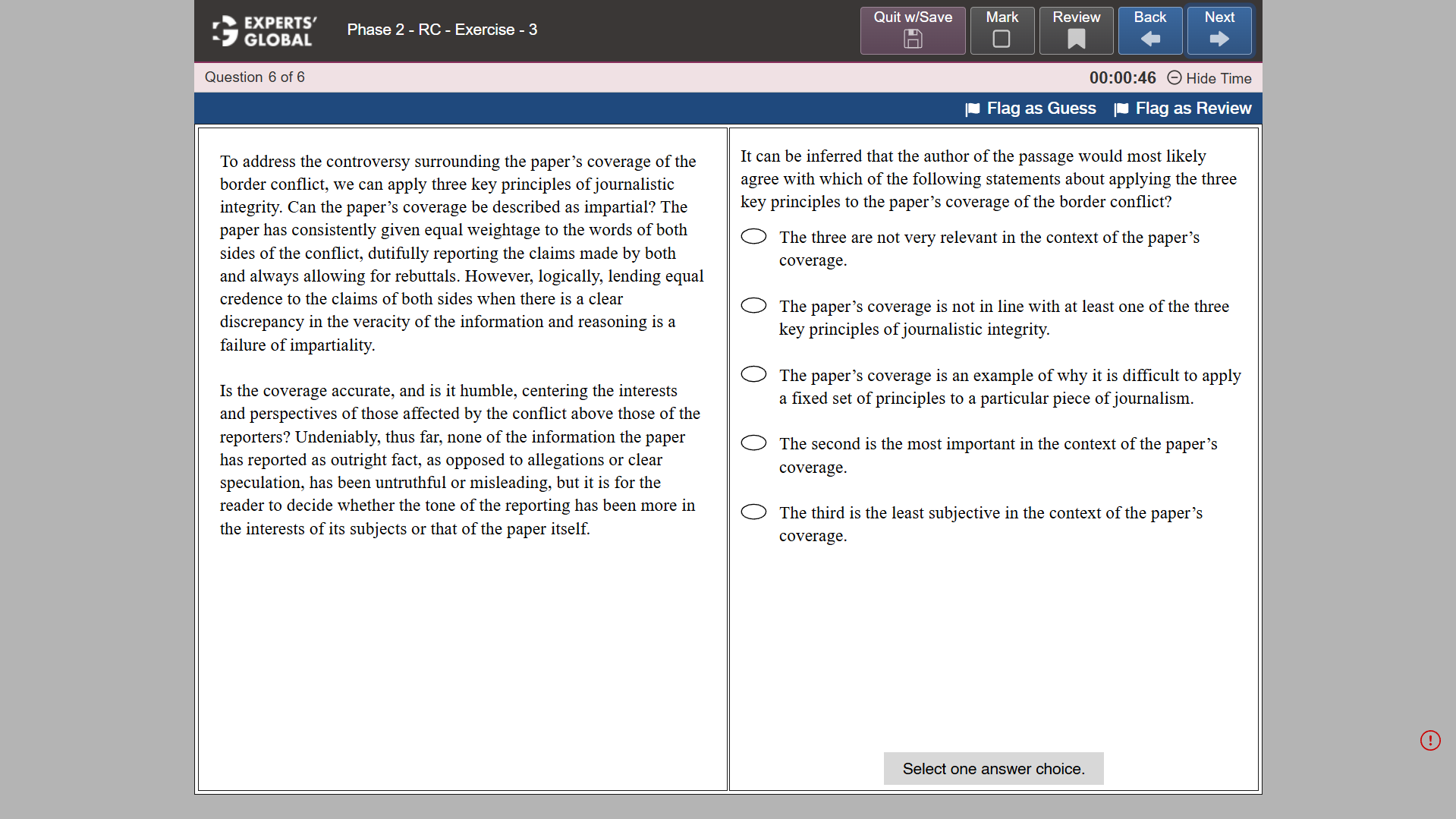
It can be inferred that the author of the passage would most likely agree with which of the following statements about applying the three key principles to the paper’s coverage of the border conflict?
A. The three are not very relevant in the context of the paper’s coverage.
B. The paper’s coverage is not in line with at least one of the three key principles of journalistic integrity.
C. The paper’s coverage is an example of why it is difficult to apply a fixed set of principles to a particular piece of journalism.
D. The second is the most important in the context of the paper’s coverage.
E. The third is the least subjective in the context of the paper’s coverage.
Written Explanation
Mind-map
The idea of applying a certain set of principles to a certain paper’s coverage of an issue is suggested (Lines 1 – 2)
The first principle is explained, and it is asserted that coverage is not in line with it (Lines 3 – 9)
The second and third principles are explained (Lines 10 – 12)
That the coverage is in line with the second principle and may be in line with the third is asserted (Line 13 – end)
A. The passage states, “To address the controversy surrounding the paper’s coverage of the border conflict, we can apply three key principles of journalistic integrity.”, implying that applying these principles has utility in the case of the paper’s coverage. Incorrect.
B. Correct. The passage defines the first principle as “Can the paper’s coverage be described as impartial?” and states that “The paper has consistently given equal weightage to the words of both sides of the conflict…” and that in this case, “…lending equal credence to the claims of both sides…is a failure of impartiality…”; in other words, the paper has failed to be truly impartial; hence, it can be inferred that the paper’s coverage is not in line with at least one of the three key principles of journalistic integrity.
C. Trap. In the context of the third principle, the passage states, “…it is for the reader to decide whether the…reporting has been more in the interests of its subjects or that of the paper itself…”; although this statement implies a difficulty in applying the third principle, this difficulty is relevant to the application of the third principle, in general; hence, the paper’s coverage is not an example of why it is difficult to apply a fixed set of principles to a particular piece of journalism. Incorrect.
D. The passage does not reference the importance of these principles relative to one another. Incorrect.
E. Referring to the third principle – whether the coverage has been more in the interests of the subjects than the paper, the passage states that “…it is for the reader to decide whether the tone of the reporting has been more in the interests of its subjects or that of the paper itself…”, implying that there is a degree of subjectivity in the application of the third principle; conversely, in the context of the second principle, the passage states, “Undeniably…none of the information the paper has reported…has been untruthful or misleading”; hence, the passage implies greater subjectivity in the application of the third criterion than it does in the application of the second. Incorrect.
Thus, B is the correct answer choice.
Additional GRE Reading Comprehension Practice Questions
Please find a set of GRE-style RC questions with explanations on: Free GRE Reading Comprehension Practice Questions with Solutions
Please find a set of assorted GRE-style questions (all sections and types) with explanations on: Free GRE Practice Questions with Solutions
GRE Critical Reasoning Practice Questions
GRE Critical Reasoning questions present a short and information dense passage that contains clear logical turns, followed by a single question based on that passage. ETS does not list Critical Reasoning as a separate category and includes these items under Reading Comprehension. However, these one-question passages differ in structure and in the skill they test when compared with standard multi question Reading Comprehension sets, and focused preparation for this format adds clear value. On the GRE, you typically face three such questions. They appear in the multiple choice select one format with five answer choices and one correct response. Below is a set of GRE style Critical Reasoning practice questions with detailed explanations.
Important: If you need to undergo thorough CR prep, please visit Free GRE Critical Reasoning prep
Practice Question 1 | CR
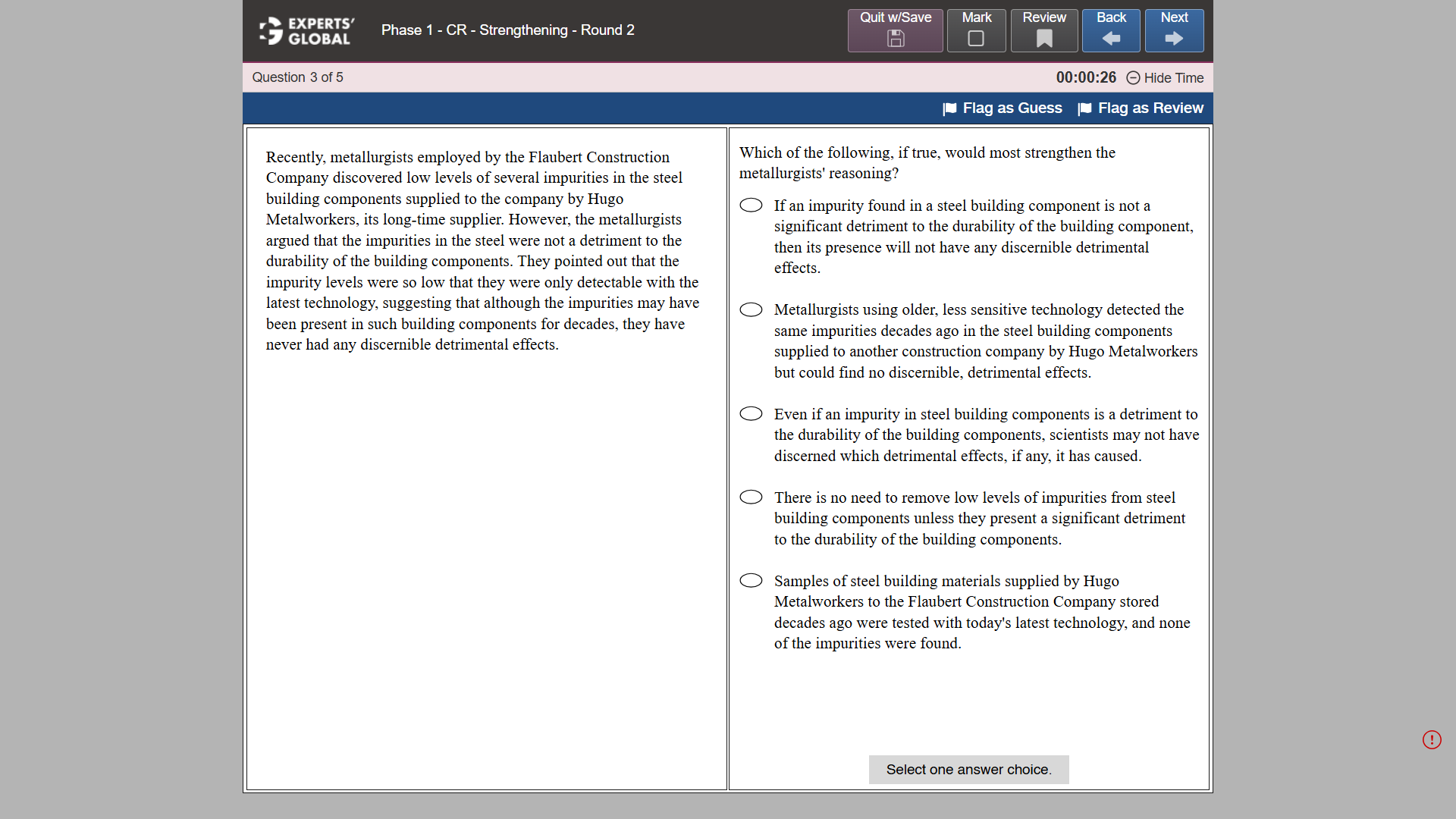
Which of the following, if true, would most strengthen the metallurgists’ reasoning?
A. If an impurity found in a steel building component is not a significant detriment to the durability of the building component, then its presence will not have any discernible detrimental effects.
B. Metallurgists using older, less sensitive technology detected the same impurities decades ago in the steel building components supplied to another construction company by Hugo Metalworkers but could find no discernible, detrimental effects.
C. Even if an impurity in steel building components is a detriment to the durability of the building components, scientists may not have discerned which detrimental effects, if any, it has caused.
D. There is no need to remove low levels of impurities from steel building components unless they present a significant detriment to the durability of the building components.
E. Samples of steel building materials supplied by Hugo Metalworkers to the Flaubert Construction Company stored decades ago were tested with today’s latest technology, and none of the impurities were found.
Written Explanation
Mind-map: Low level of impurities in steel supplied by H → impurities could only be detected with the latest technology → impurities may have been present earlier but had no discernible detrimental effect → impurities are not a detriment to the durability of buildings (conclusion)
Missing-link: Between the possibility that impurities had been present earlier but had no discernible detrimental effect and the conclusion that impurities are not a detriment to the durability of buildings
Expectation from the correct answer choice: To strengthen the conclusion that impurities are not a detriment to the durability of buildings
A. Trap. This answer choice commits the classic GRE error of confusing “effect” with “cause”; the argument’s reasoning is that because there is no discernible detrimental effect in the past usage of steel with possible impurities, using steel with impurities is not a detriment to the durability of buildings; in other words, the argument treats “discernible detrimental effect” as a cause and “detriment to the durability of buildings” as an effect; this answer choice does the reverse and treats “detriment to the durability of buildings” as a cause and “discernible detrimental effect” as an effect; so, this answer choice does not strengthen the conclusion. Because this answer choice does not strengthen the conclusion, this answer choice is incorrect.
B. Correct. This answer choice, by offering independent evidence that the same impurities detected decades ago have not caused any discernible, detrimental effects, strengthens the conclusion that impurities are not a detriment to the durability of buildings. Because this answer choice strengthens the conclusion, this answer choice is correct.
C. The argument is concerned with whether the impurities are a detriment to the durability of buildings; this answer choice, suggesting lack of clarity over specific detrimental effects caused, indicates the possibility that the impurities are a detriment and their specific effects have not been discerned or recognized; such a possibility, if anything, weakens, rather than strengthens, the conclusion. Because this answer choice does not strengthen the conclusion, this answer choice is incorrect.
D. Trap. The argument is concerned with whether the impurities are a detriment to the durability of buildings; this answer choice, suggesting removal of impurities if they are found to be detrimental, is just an opinion statement and has no bearing on the argument. Because this answer choice does not strengthen the conclusion, this answer choice is incorrect.
E. This answer choice, suggesting that the impurities were absent in steel used decades ago, indicates that the impurities began appearing in recent years; the recent presence of impurities indicates the possibility that the impurities are a detriment but their detrimental effect may not be discernable because the impurities have had less time to generate effects; such a possibility casts doubt on the conclusion that the impurities are not a detriment to the durability of buildings; so, this answer choice, if anything, weakens, rather than strengthens, the conclusion. Because this answer choice does not strengthen the conclusion, this answer choice is incorrect.
An interesting discussion:
A student once wrote to us stating that answer choice B is flawed because it discusses the effects of impurities in the material supplied by another company whereas the argument is concerned with the impurities in the material supplied by Hugo Metalworkers. Can you correctly identify the weakness in this reasoning? Although answer choice B compares the impurities in the material supplied by Hugo Metalworkers with those in the material supplied by another company, the answer choice mentions that the “same” impurities were detected and their effects compared; please note that the similarity in the impurities establishes an apt analogy between the two companies and hence, the effect of one company’s material with that of another company’s material can be compared.
B is the correct answer choice.
Practice Question 2 | CR
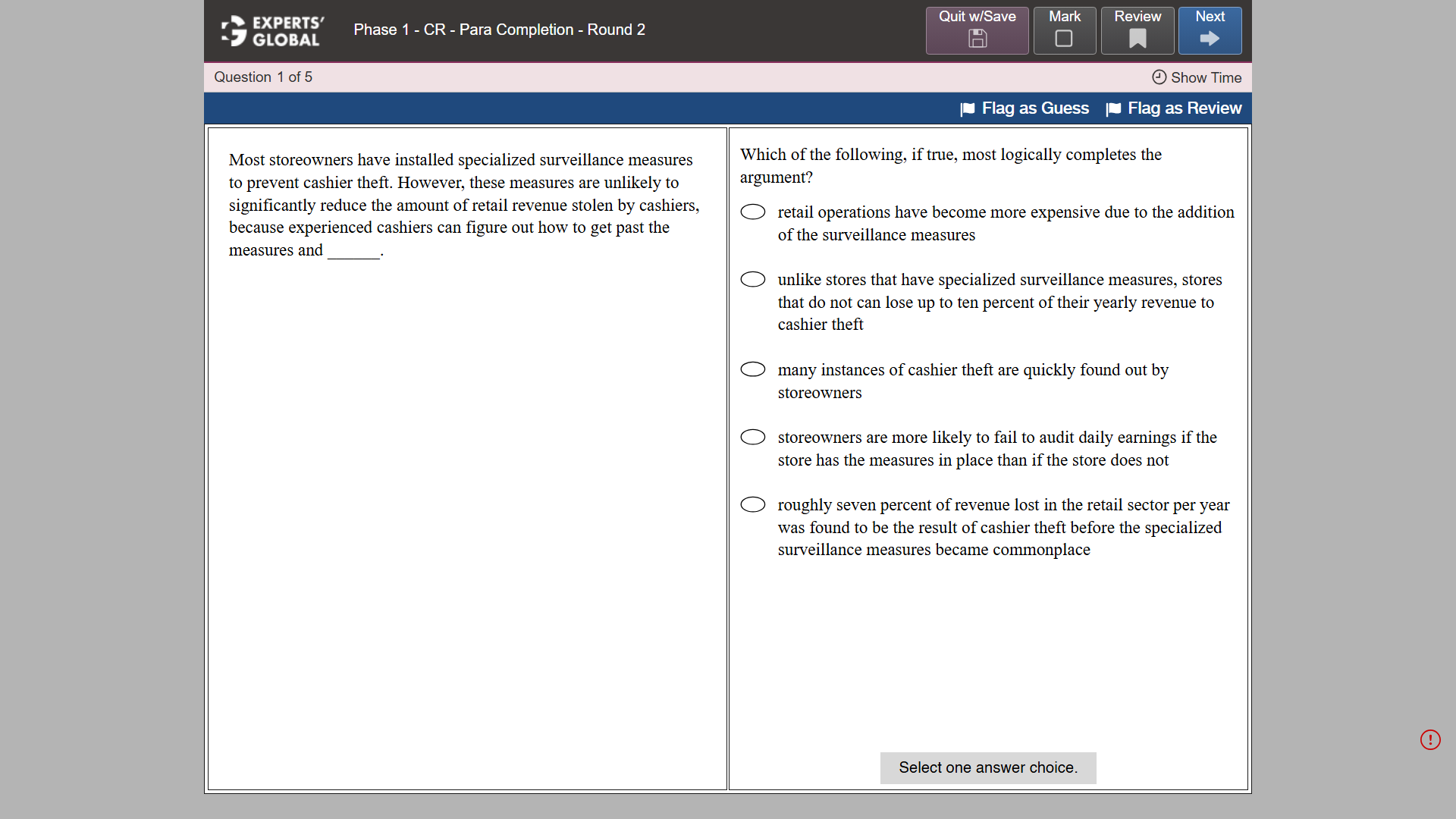
Which of the following, if true, most logically completes the argument?
A. retail operations have become more expensive due to the addition of the surveillance measures
B. unlike stores that have specialized surveillance measures, stores that do not can lose up to ten percent of their yearly revenue to cashier theft
C. many instances of cashier theft are quickly found out by storeowners
D. storeowners are more likely to fail to audit daily earnings if the store has the measures in place than if the store does not
E. roughly seven percent of revenue lost in the retail sector per year was found to be the result of cashier theft before the specialized surveillance measures became commonplace
Written Explanation
Mind-map: Surveillance measures installed to prevent cashier theft → not likely to reduce amount of retail revenue stolen → cashiers can learn to get past the measures and _____
Missing-link: Between surveillance measures being installed to prevent cashier theft but not reducing amount of retail revenue stolen
Expectation from the correct answer choice: Something on the lines of showing why there is no significant reduction in the amount of retail revenue stolen despite surveillance measures
A. The argument is concerned with cashiers stealing retail revenue from stores; this answer choice, suggesting increased expenses because of the surveillance measures, is just additional information and makes no suggestion regarding why there is no significant reduction in the amount of retail revenue stolen despite surveillance measures. Because this answer choice does not effectively complete the chain of thoughts developed in the passage, this answer choice is incorrect.
B. This answer choice, suggesting that stores with no surveillance measures lose up to ten percent of revenue in theft, makes no mention of the percentage of revenue stolen at stores with surveillance measures, thus offering no suggestion regarding whether there was any reduction in the amount of retail revenue stolen after surveillance measures and, if there was no such reduction, the reason for the same. Because this answer choice does not effectively complete the chain of thoughts developed in the passage, this answer choice is incorrect.
C. This answer choice, suggesting that many instances of cashier theft are quickly found out, makes no mention of surveillance measures, thus failing to explain why there is no reduction in the amount of retail revenue stolen despite surveillance measures. Further, “many” is subjective and refers to only a part of all the thefts and is thus limited in scope. Besides, if cashier thefts are quickly found out, it suggests that surveillance measures are likely to make the detection even quicker, thus, if anything, casting doubt on, rather than explaining, why there is no significant reduction in the amount of retail revenue stolen despite surveillance measures. Because this answer choice does not effectively complete the chain of thoughts developed in the passage, this answer choice is incorrect.
D. Correct. If storeowners are less likely to audit daily earnings after putting surveillance measures in place, it indicates that, if the cashiers figure out how to get past the measures, the cashiers can continue to steal retail revenue as they did before the surveillance measures were in place, thus likely preventing any significant reduction in the amount of retail revenue stolen; so, this answer choice effectively completes the chain of thoughts developed in the passage. Because this answer choice duly completes the passage, this answer choice is correct.
E. This answer choice, suggesting that the retail sector lost roughly seven percent of revenue to cashier theft before surveillance measures were in place, makes no mention of the percentage of revenue lost to cashier theft after the measures were in place, thus offering no suggestion regarding whether there was any reduction in the amount of retail revenue stolen after surveillance measures and, if there was no such reduction, the reason for the same. Because this answer choice does not effectively complete the chain of thoughts developed in the passage, this answer choice is incorrect.
D is the correct answer choice.
Practice Question 3 | CR
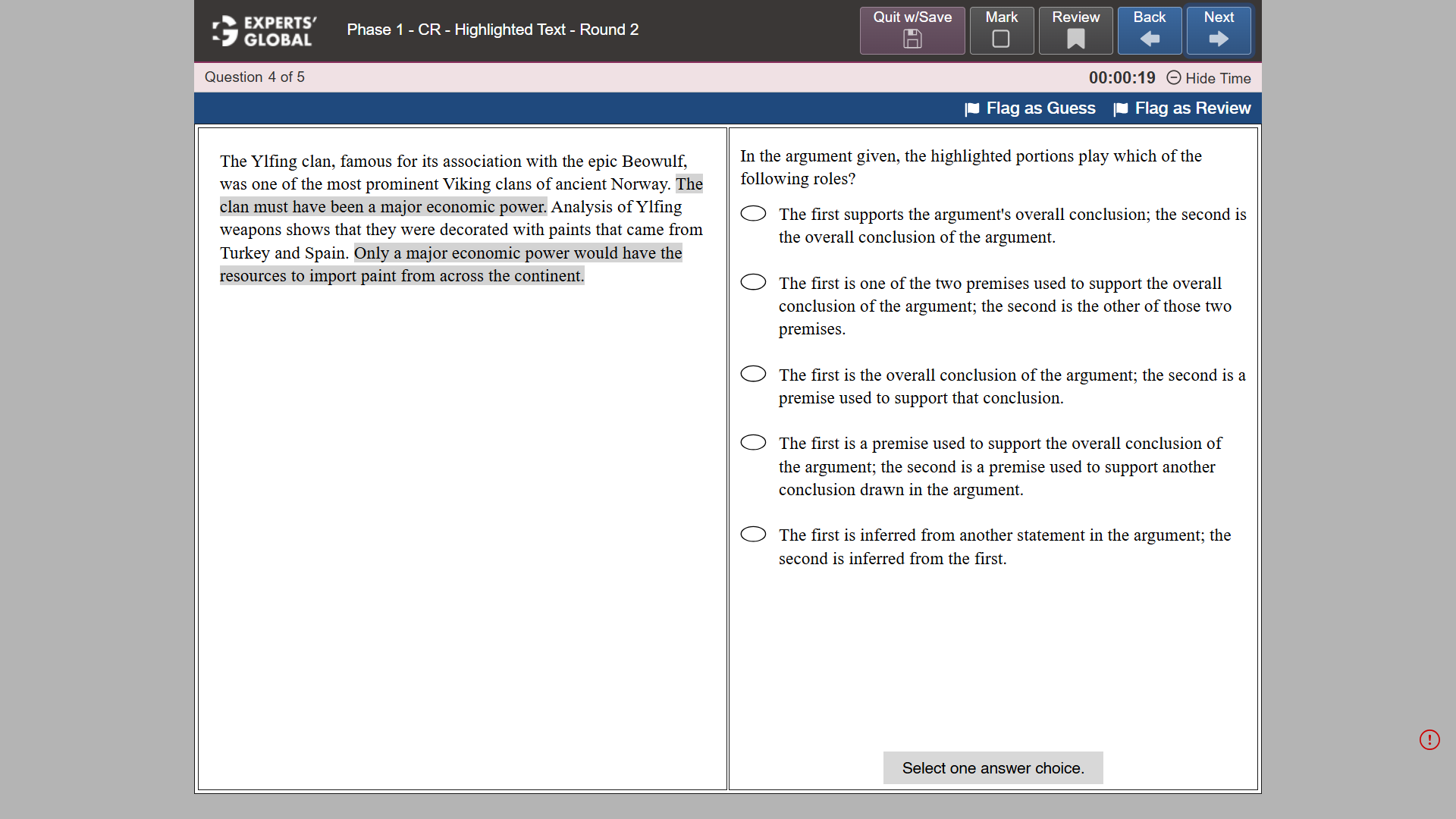
In the argument given, the highlighted portions play which of the following roles?
A. The first supports the argument’s overall conclusion; the second is the overall conclusion of the argument.
B. The first is one of the two premises used to support the overall conclusion of the argument; the second is the other of those two premises.
C. The first is the overall conclusion of the argument; the second is a premise used to support that conclusion.
D. The first is a premise used to support the overall conclusion of the argument; the second is a premise used to support another conclusion drawn in the argument.
E. The first is inferred from another statement in the argument; the second is inferred from the first.
Written Explanation
Strategy: Determining the overall conclusion of the argument and finding the relation of the highlighted portions with this conclusion
Logic: The argument is concerned with a particular clan. The argument mentions that the clan had weapons that were decorated with paint from faraway places and, as the second highlighted portion states, only a major economic power could have afforded to import paint from across the continent. The argument concludes in the first highlighted portion that the clan must have been a major economic power. In the context of the overall conclusion – the first highlighted portion is the overall conclusion of the argument; the second highlighted portion is the judgment based on which the argument establishes its conclusion.
Overall conclusion: The clan must have been a major economic power.
Broad expectation from the correct answer choice:
The first highlighted portion is the overall conclusion of the argument.
The second highlighted portion is the judgment based on which the argument establishes its conclusion.
A. Incorrect.
– The first highlighted portion itself is the overall conclusion of the argument; therefore, it is incorrect to state that the first highlighted portion “supports the argument’s overall conclusion”.
– The argument uses the second highlighted portion to establish the overall conclusion and the second highlighted portion itself is not the overall conclusion; therefore, it is incorrect to state that the second highlighted portion is the “overall conclusion of the argument”.
B. Incorrect.
– The first highlighted portion is the overall conclusion of the argument and has not been used to establish an intermediate conclusion; therefore, it is incorrect to state that the first highlighted portion is a “premise” or “one of the two premises”.
– The first highlighted portion itself is the overall conclusion of the argument; therefore, it is incorrect to state that the first highlighted portion “supports the overall conclusion of the argument”.
– The first highlighted portion is an intermediate conclusion and not a premise; the second highlighted portion is a premise; therefore, it is incorrect to state that the second highlighted portion is the “other premise” in the two premises – the first highlighted portion and the second highlighted portion.
C. Correct.
– The first highlighted portion is the main point that the argument establishes; therefore, it is correct to state that the first highlighted portion is the “overall conclusion of the argument”.
– The argument uses the second highlighted portion to establish the overall conclusion; therefore, it is correct to state that the second highlighted portion is a “premise”.
The second highlighted portion is a judgment based on which the argument establishes its conclusion; therefore, it is correct to state that the second highlighted portion “supports the argument’s overall conclusion”.
D. Incorrect.
– The first highlighted portion is the overall conclusion of the argument and is not used to establish an intermediate conclusion; therefore, it is incorrect to state that the first highlighted portion is a “premise”.
– The first highlighted portion itself is the overall conclusion of the argument; therefore, it is incorrect to state that the first highlighted portion “supports the overall conclusion of the argument”.
– The second highlighted portion supports the overall conclusion of the argument; the argument establishes only one conclusion; therefore, it is incorrect to state that the second highlighted portion “supports an intermediate conclusion other than the overall conclusion in the argument”.
E. Trap. Incorrect.
– The second highlighted portion is the judgment based on which the argument establishes the first highlighted portion as the overall conclusion; in other words, the first highlighted portion is inferred from the second highlighted portion and not the other way round; therefore, it is incorrect to state that the second highlighted portion is “inferred from the first highlighted portion”.
C is the correct answer choice.
Additional GRE Critical Reasoning Practice Questions
Please find a set of GRE-style CR questions with explanations on: Free GRE Critical Reasoning Practice Questions with Solutions
For Further GRE Prep and Practice…
GRE prep course with 7-day free trial
15 full length GRE practice tests
60 sectional GRE practice tests
Free full length GRE diagnostic test
GRE 5-week crash course
GRE prep with admission consulting bundle