
Invest 30 seconds...
...for what may lead to a life altering association!
Help Line
- +91.8800.2828.00 (IND)
- 1030-1830 Hrs IST, Mon-Sat
- support@expertsglobal.com
33% off ends soon:GMAT/GRE prep + applications bundle. Profile building, longer mentoring, better results. Inquire

Text Completion questions on the GRE Verbal section ask you to restore missing words in a short passage by tracking meaning, logic, and tone so the completed text reads as a single coherent thought. A one blank Text Completion question requires you to choose one word that completes the idea accurately. A two blank Text Completion question requires you to select two words that work together and preserve meaning. A three blank Text Completion question requires you to fill three blanks, with each choice reinforcing the overall message of the passage. Collectively, Text Completion questions form almost 25% of the GRE Verbal section and offer a strong opportunity to lift accuracy and save time, which makes due coverage of this topic essential in a well-designed GRE preparation course.
On this page, you learn all the concepts and methodologies needed for excelling at Text Completion one blank, two blank, and three blank questions. Take your due time to absorb these concepts and duly adopt them in your GRE preparation and practice across GRE quizzes, GRE sectional tests, and GRE full-length practice tests.
If you prefer long, comprehensive video lessons that bring all concepts together, watch the Masterclass and then move directly to the practice questions.
If you prefer short, bite sized video lessons that focus on one concept at a time, work through the concept wise modules below and then attempt the practice questions.
Text Completion questions account for roughly one quarter of GRE Verbal, and they give you a strong scoring opening when you use a clear method and aim for high accuracy. The following video walks you through all three Text Completion formats, how each one appears on the GRE, what you do in each format, and how much these questions contribute to the Verbal section, so you build a solid base and step into practice with sharper direction.
The following video presents a clear and practical approach for solving GRE Text Completion one blank questions by focusing on sentence structure, the core idea, and selecting the word that completes meaning precisely, explained step by step with GRE style questions and answer choices so you build clarity, apply the method effectively in practice.
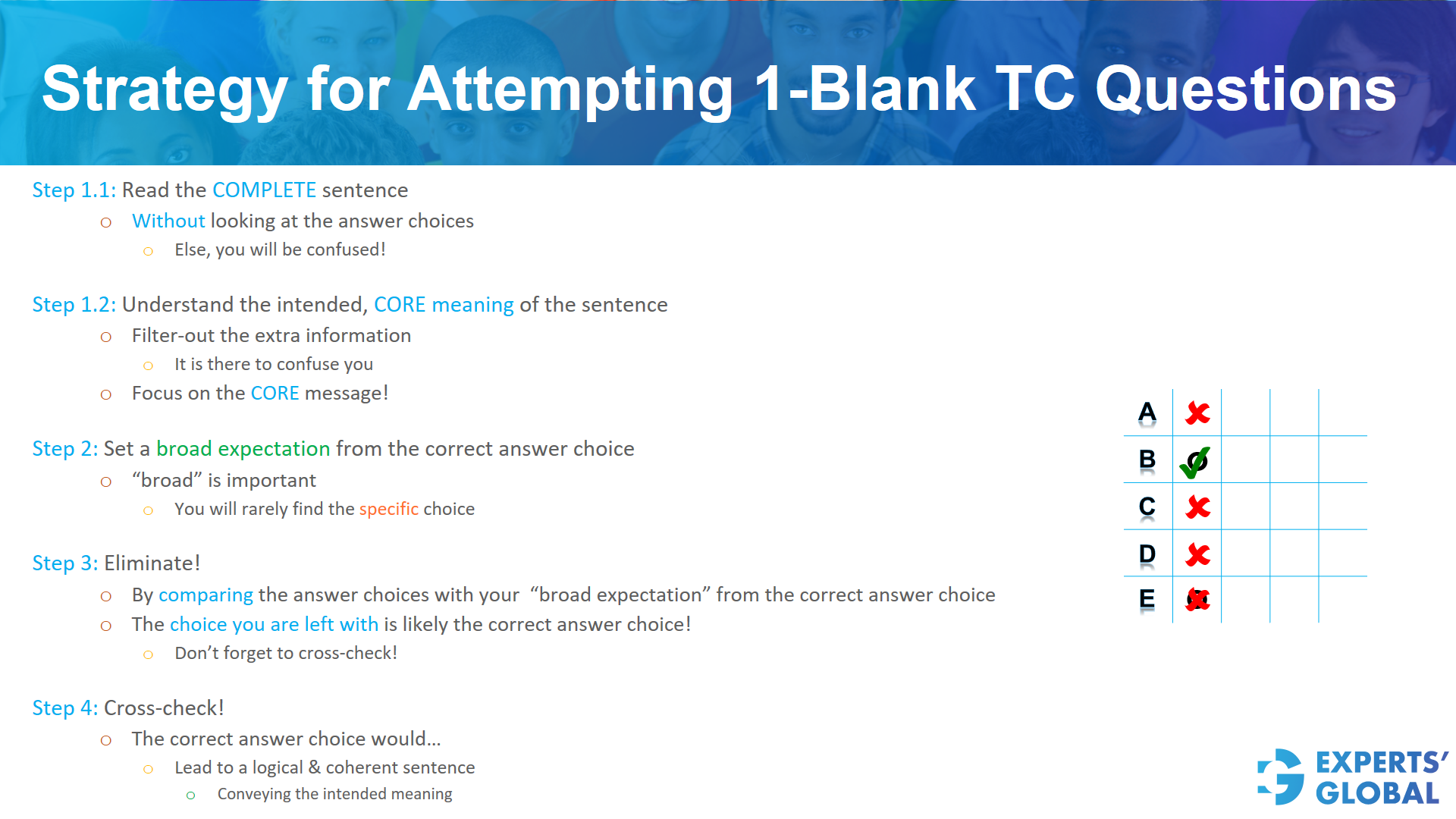
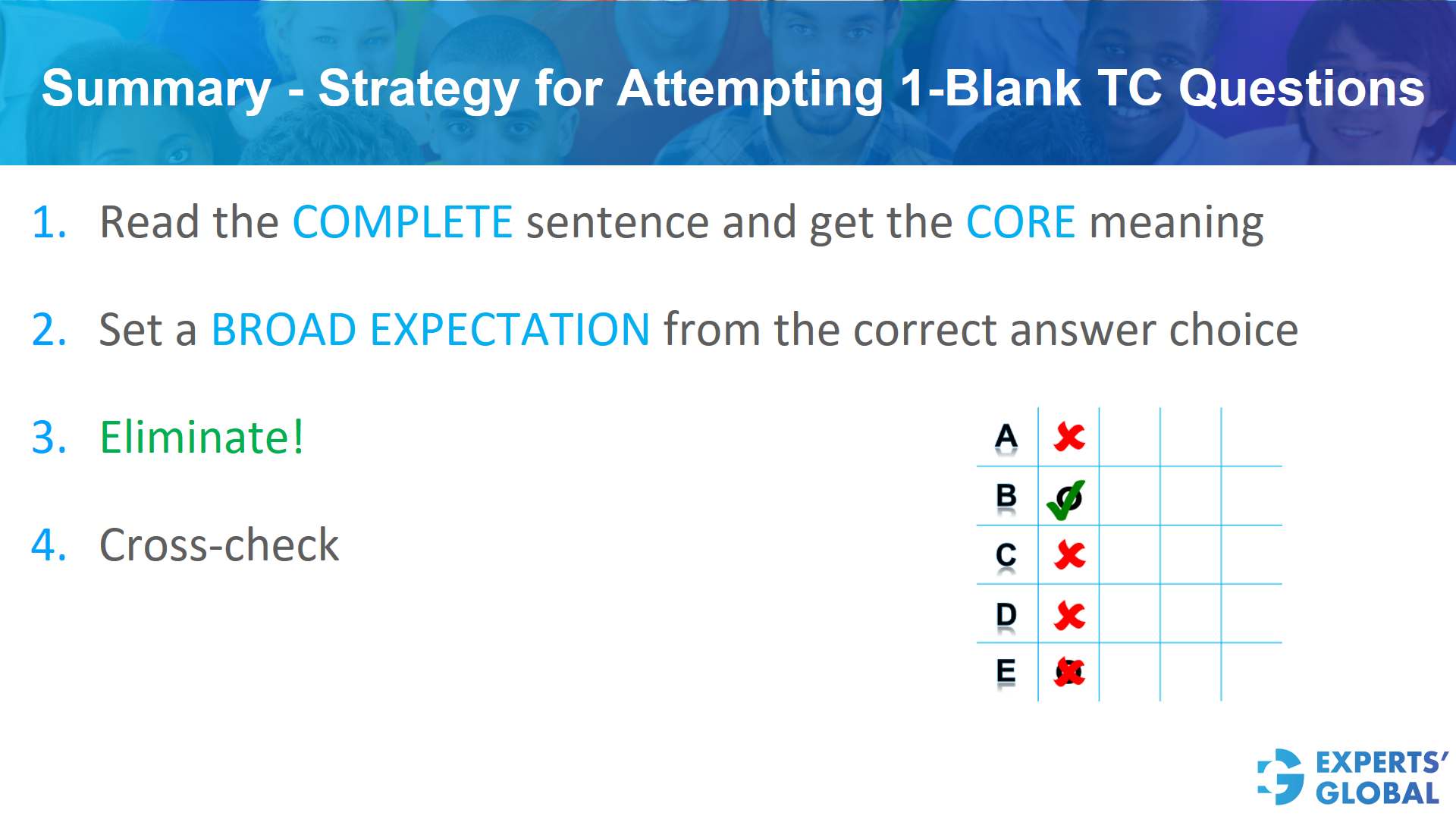
Efficient handling of TC questions helps you build speed and accuracy while freeing up time for Reading Comprehension plus two blank and three blank Text Completion questions that need deeper processing. The following video shares practical time saving techniques in a clear, step by step way and demonstrates how to use them on GRE style examples, so you shape a smoother pacing plan and carry the same habits into your further GRE prep.
Following are common Text Completion mistakes GRE candidates make, explained clearly with GRE style examples that show how the exam prompts these errors and how you handle each trap with awareness, precision, and clean execution. Absorb these concepts and adopt them across your ongoing GRE preparation.
Many beginners drop answer choices into the blank at the start. It seems fast, but it often creates confusion and avoidable errors because the choices are designed as distractions, and option testing steals focus from the sentence logic. A stronger approach starts with purposeful reading and a clear expectation before you scan the options. The short video below spotlights this habit, explains why early plugging misleads you, and demonstrates a more systematic method that keeps your thinking clear and your solving efficient as you practice.
A common beginner slip in Text Completion comes from skipping elimination and trying to spot the correct answer immediately. Strong results come from actively removing choices that fail the sentence on meaning, tone, or logic, not from selecting a word that simply feels right. When you check every option through elimination, subtle cues surface sooner and the sentence locks into place with higher precision. The short video below explains why skipping elimination hurts accuracy and timing, and demonstrates an elimination driven method on GRE style examples so you build a structured, efficient decision process.
A frequent beginner mistake in Text Completion involves selecting options based on how words sound or feel familiar, instead of what they truly mean. Some choices feel pleasant or recognizable, yet their meanings do not fit the sentence, and sound based selection lets traps slip in quietly. A stronger approach puts meaning first and uses elimination to remove choices that fail the sentence on sense, tone, or intent. The short video below explains why sound based judgments cause errors and demonstrates a meaning driven, elimination focused method on GRE style examples that test you on this trap.
A frequent slip in Text Completion comes from missing a shift or contrast hidden inside the sentence. Many sentences begin in one direction and then turn, and the correct answer matches this new direction, not the opening idea. When you notice contrast triggers early, you track how the meaning flows, avoid setting a wrong expectation for the blank, and strengthen accuracy naturally. The conceptual video below highlights how overlooked contrasts lead to confusion and demonstrates a simple way to identify shift triggers like but, however, though, yet, despite, in spite of, and other signs of paradox or unexpected turns, through GRE style Text Completion examples.
A common mistake in Text Completion comes from reading the sentence too casually and missing details that guide meaning. Accurate solving begins with careful end to end reading that captures the full idea the sentence communicates. When attention drifts, small yet powerful clues fade, contrasts slip past, and the blank gets filled from an incomplete understanding. The conceptual video below explains how loose reading creates unclear expectations for the blank and demonstrates a clear, repeatable way to read with precision, applying it to GRE style Text Completion examples that test you to read closely.
New or unfamiliar words appear naturally in GRE Text Completion, and you often face one or more terms you have never seen before. Even with consistent vocabulary growth, no test taker knows every word on the exam, so an unfamiliar word never decides the outcome. Text Completion rewards meaning, structure, and direction, even when some words feel new, and a clear approach keeps your reasoning on track. The following video shows a practical method for handling unfamiliar words so you think clearly and move forward with accuracy and purpose.
he video below introduces a clear and structured method known as the Context Root Connotation technique for handling unfamiliar words in GRE Text Completion. It shows how you rely on sentence context, word roots, and connotation to judge answer choices with precision. The method then comes alive through GRE style examples, helping you build a steady and dependable habit for unknown word moments during practice.
Unfamiliar words appear regularly in GRE Text Completion, and accepting this early keeps your thinking steady and purposeful. When new words pull attention away from sentence logic, accuracy drops, but when you stay focused on structure, direction, and intent, you stay fully in control. Text Completion does not demand complete vocabulary coverage and rewards your ability to reason through context and meaning. The video below shows a practical way to respond when a word feels unfamiliar, so you remain analytical, move forward smoothly, and treat vocabulary rich sentences as clean chances to apply logic.
GRE Text Completion becomes interesting when the correct answer does not align with the first impression. A tempting option may grab attention, while the correct choice feels quieter or unexpectedly different. This often appears with words whose true meanings differ from surface impressions, words with wide usage, confusing connotations, homonyms, and similar vocabulary patterns that invite quick but inaccurate picks. The videos on this page break down each subtle pattern, share a clear and repeatable approach for handling it, and demonstrate the method on GRE style Text Completion questions with realistic trap like choices, so your decision making grows sharper and more reliable.
Some words feel familiar because of how they sound, yet their true meanings move in a very different direction. In GRE Text Completion, this gap between sound and meaning can quietly shape your expectation and pull you away from sentence logic, not because the words are rare, but because they trigger assumptions the sentence does not support. The video below focuses on this exact pattern, explains a clear way to spot such counterintuitive words, and shows how to test their fit using context, with GRE style examples and carefully designed answer choices that reveal how meaning guides you to the correct completion.
Some words carry tonal shades that are easy to misread when you focus only on basic meaning. In GRE Text Completion, these words check whether you notice both what a word indicates and the attitude it brings into the sentence, and your key task is to judge whether that tone fits the sentence direction and intent. The video that follows explains how confusing connotation appears in Text Completion, teaches a clear method for evaluating tone fit, and demonstrates the approach on GRE style examples with answer choices designed to reflect this exact challenge, so your decisions grow more precise and consistent with practice.
Some words work across many situations, so they can appear to fit almost any sentence. In GRE Text Completion, these words test precision rather than familiarity, and your real task is to judge whether a broadly usable word matches the exact meaning, direction, and intent of the sentence, not whether it simply sounds acceptable. The video below explains how wide range words appear in Text Completion, shows a practical way to test true fit, and demonstrates the method on GRE style examples with answer choices designed around this challenge, so you learn to favor exact meaning over general fit through steady practice.
Some words share the same spelling or sound yet carry different meanings, and this overlap can create real ambiguity in GRE Text Completion. The challenge is not the word itself, but identifying which meaning the sentence supports, so you choose the word that matches the intended message and direction. The video below explains how homonyms appear in Text Completion, shows a clear method for locking onto the correct meaning using context, and demonstrates it on GRE style examples with answer choices designed to mirror this exact trap, so you practice selecting meaning, not sound or familiarity.
This GRE style Text Completion example brings the key ideas from this page together, so you practice spotting counterintuitive traps with clarity. Read carefully, track the sentence direction, and notice when an option feels appealing for the wrong reason. Watch for choices driven by surface impressions, misleading connotation, or meanings that do not match what the sentence supports. Use the following video to see the method applied step by step on a GRE style question, while focusing on application and accuracy without worrying about pacing.
GRE Text Completion often builds meaning through a turn in logic, a shift in expectation, or a change in direction, so contrast guides how the sentence moves from its opening idea to its final message. Sometimes the turn appears once, and sometimes it unfolds through linked shifts across the sentence. When you spot where direction changes and compare meaning on both sides of the turn, blank filling becomes precise and natural. The video set below breaks contrast driven patterns into focused lessons, shows how to identify contrast signals, track how direction evolves, and choose words that match the final meaning, then demonstrates the same approach on GRE style Text Completion questions with realistic answer choices.
GRE Text Completion often builds meaning along a timeline, where the sentence shifts from one moment to another and the blank must match that progression. In contrast over time, the sentence highlights what holds true earlier versus what appears later, or how a situation moves from past to present, and careful attention to time cues makes the direction clear. The video set below focuses on these time based contrast patterns, shows how to spot time signals, follow how meaning develops across the sentence, and select words that fit the final outcome, then applies the same approach to GRE style questions with realistic answer choices that test you on this concept.
GRE Text Completion often builds meaning through a change in how something is perceived, where the sentence moves from one impression to a different evaluation or emotional stance, such as appreciation to hesitation, approval to reservation, or optimism to measured judgment. When you stay alert to this shift in viewpoint, you see what the sentence ultimately supports or questions and choose words that match the settled perspective. The video set below focuses on contrast in perception or attitude in Text Completion, shows how to spot the turning point, follow how tone develops, and select words that reflect the final stance, then demonstrates the same approach on GRE style examples with trappy answer choices.
GRE Text Completion often builds meaning by stepping away from what normally happens and highlighting an outcome that feels unexpected within the sentence. In contrast from usual patterns, the sentence first sets up a familiar belief, habit, or routine, then clearly signals that this case moves in a different direction, and the blank must reflect that shift with precision. The video set below focuses on this pattern, shows how to identify what the sentence treats as typical, recognize the cue that marks the deviation, and select words that express the new direction, then applies the same approach to GRE style examples.
GRE Text Completion sometimes places the main shift in meaning directly inside the blank. In this pattern, the missing word creates the contrast even when the sentence shows no obvious signal elsewhere. The sentence builds one idea, pauses at the blank, and then completes a different or opposing idea, which makes the blank the true turning point. The video set below focuses on these cases, shows how to read meaning on both sides of the blank, recognize when the missing word drives the shift, and choose a word that creates the exact contrast the sentence demands, then applies the same approach to GRE style examples with realistic answer choices that test you on this concept.
GRE Text Completion sometimes uses words that look like a shift in direction even though the meaning stays consistent from start to finish, a pattern known as false contrast. A familiar pivot word may appear to signal opposition, yet the core idea continues on the same path, so the key skill is to follow sentence meaning instead of reacting to surface cues. The video below shows how to spot false contrast by looking beyond misleading signal words, staying anchored to the sentence message, and choosing a word that reinforces the idea already in place, then demonstrates the same method on GRE style examples with answer choices designed to test this subtle pattern.
GRE Text Completion often builds meaning through a shift, and some sentences use more than one shift before the message becomes fully clear, a pattern known as multiple contrasts. Instead of one clean turn, the sentence moves through a sequence of pivots, where each contrast trigger redirects the idea and adds a new layer to the final takeaway, so you follow each change in order and confirm what the sentence means after every pivot. The video below teaches a simple, structured way to locate each pivot, track how meaning updates at every step, and lock the final direction before choosing an answer, then demonstrates the same method on GRE style examples with realistic answer choices designed to test this variation.
GRE Text Completion rewards careful meaning tracking, and double negatives build that skill quickly. In these sentences, the writer uses more than one negative idea, and each negative reshapes what the sentence points to, so you reach the correct meaning when you process every negative one at a time, in order. The video below teaches a practical workflow for unpacking each negative, tracking how meaning updates across the sentence, and selecting words that match the final interpretation with precision, then demonstrates the same workflow on GRE style examples with answer choices designed to test this exact pattern.
In the last few lessons, you learned the concept of contrast in Text Completion questions and the key ways it appears on the GRE. Before you move ahead, take time to firmly cement this concept, since contrast lies at the core of more than half of the Text Completion and Sentence Equivalence questions on the exam. Next, you will see 3 contrast drills arranged in increasing order of complexity from low to medium to high. Pause each video, solve every question on your own, then review the explanation. Use these drills to strengthen your grasp of contrast and become adept at handling shifts in meaning in your GRE preparation and practice.
Text Completion drives a large share of GRE Verbal performance, and contrast often reveals the real meaning in these sentences. When you spot contrast signals, identify pivot words, and track how the idea shifts, you read with stronger direction and the blank becomes more predictable because you know what the sentence moves away from and what it moves toward. This low complexity contrast drill gives you a clean, structured way to practice that skill through questions with clear, visible contrast, and the following video shows you how to approach each item, track the shift, and use the explanations to understand exactly why the correct choice fits.
This stage moves you into Text Completion sentences where contrast blends more deeply into phrasing and sentence design. Shifts in meaning still drive the sentence, but they appear with greater subtlety and require closer attention to how ideas connect across the full line, so your goal stays on controlled interpretation and a final choice that matches the complete direction the sentence establishes. The medium complexity drill below gives you room to pause, read with intention, and apply contrast skills more deliberately. The following video shows how to trace meaning as the contrast unfolds, confirm the final outcome, and learn from each explanation, so you build consistent accuracy that carries into advanced drills and further GRE practice.
This level introduces Text Completion sentences where contrast works with real depth inside tightly written structures, with shifts in meaning woven across multiple parts of the sentence and each element shaping the final message. This high complexity contrast drill brings together the skills you built earlier and rewards sustained attention, steady meaning tracking, and careful end to end reading from the opening words to the final blank. The following video guides you through each question with a disciplined workflow, shows how to pause, read slowly, trace every contrast cue, and use the explanation to confirm the final direction, so you prioritize accurate interpretation and carry advanced contrast handling into your GRE prep and practice.
GRE Text Completion often moves forward in a smooth, consistent direction, where the blank carries the idea ahead instead of introducing a turn. In similarity based questions, the correct word supports and deepens the sentence direction, and you identify it through continuation cues, reinforcing language, or parallel tone, sometimes clear and sometimes subtly embedded in the phrasing. The video set below highlights these similarity patterns, shows how to spot continuation signals, confirm the sentence direction, and select words that blend naturally into the meaning already forming, then demonstrates the same approach on GRE style questions with realistic answer choices designed to test this pattern..
GRE Text Completion often uses balanced structure to build meaning across ideas, phrases, or clauses, and the blank must match that structure to keep the logic strong. Your focus stays on noticing how the sentence repeats its form and how each element connects, since that pattern clearly signals the kind of word that fits the blank. Once the structure becomes visible, the answer starts to feel predictable because the sentence leads you there. The video below presents a clear approach for recognizing parallel structure and demonstrates it on GRE style examples so you learn to read structure smoothly and choose with clarity.
In GRE Text Completion, appositives appear when a sentence briefly stops to define, rename, or clarify a noun using a descriptive phrase placed right beside it, often marked by commas. This phrase acts as an embedded explanation that reveals meaning, tone, and direction for the blank. Your role is to read the appositive closely, understand what it tells you about the noun, and let that clarity guide your choice. The video below presents a simple and learner friendly approach to spotting appositives and applies it to GRE style examples so you build this skill smoothly and accurately.
GRE Text Completion often builds meaning through a clear connection between an action and what follows from it, or between a cause and its effect. In cause effect questions, the sentence points to what sparks a situation, how it unfolds, or why a specific outcome appears, and your role is to track that flow and select a word that completes the logic with accuracy. The video set below explores cause effect patterns through crisp and focused lessons, shows how to pinpoint the cause, confirm the result, and decide what the blank must convey, then applies the same approach to GRE style Text Completion examples so the logic feels smooth, purposeful, and easy to use in practice.
In GRE Text Completion questions, a present participle often directs the logic of the sentence by explaining why something happens or what outcome follows. A phrase ending with “ing” usually functions as a meaning cue, guiding you toward the cause or the result within the sentence. When you read this phrase with intent, it becomes easier to anticipate what belongs in the blank and evaluate answer choices with clarity. The video below presents a clear and learner friendly method for identifying this pattern, understanding its role in sentence meaning, and applying it effectively to GRE style Text Completion questions using carefully constructed examples to test this concept.
GRE Text Completion often invites you to continue the writer’s idea in a way that feels complete and natural. In continuation based questions, the sentence keeps the same direction without introducing contrast, so the blank must extend meaning with aligned logic and tone as the thought progresses. The videos below unpack continuation patterns through crisp and example driven lessons, show how to spot steady flow signals, preserve direction, and select answers that finish the sentence with precision, using GRE style Text Completion questions with thoughtfully designed choices to test you on this pattern.
GRE Text Completion sometimes presents a word or idea and then guides you to its meaning through nearby clues. In these questions, the sentence acts like a subtle definition, where surrounding language explains, refines, or sharpens what the term stands for. Your focus stays on reading the full context, capturing the exact sense being built, and anticipating what the blank must convey. The video below shares a clear and beginner friendly approach to this pattern and applies it to GRE style examples with carefully crafted choices, so the correct answer feels natural and complete.
GRE Text Completion rewards steady meaning building from the first word to the last because strong sentences move through a clear chain of ideas. Some questions fit contrast, similarity, cause effect, or continuation, while others blend signals or use fewer pattern cues, so you rely on the chain of thought itself by tracking how each phrase adds detail, sharpens the point, or moves the message forward, and by deciding what the blank must add to keep that progression intact. The videos below focus on these pattern light questions, teach a structured step by step reading method, and demonstrate it on GRE style examples.
Two blank Text Completion questions ask you to complete a sentence using a pair of words that function as one connected idea. You read the sentence as a single flow because each blank influences the other, and the correct pair must align in logic, tone, and direction. Across the two GRE Verbal sections, you typically see about three two blank Text Completion questions within the set of 27 Verbal questions, which makes this format important to understand early. The video below offers a clear overview of how two blank questions appear on the test, how the blanks interact with each other, and where this format fits within GRE Verbal, helping you build a strong base before moving into patterns and guided practice.
Two blank Text Completion questions play a meaningful role in GRE Verbal and offer strong scoring potential when you use a clear structure. They test how well you track meaning across the sentence and how effectively you connect two blanks into one unified idea, so they reward careful reading and disciplined choices. On GRE Verbal, about three of the 27 questions are two blank Text Completion, so solid coverage supports both pacing and accuracy. The following video presents a practical step by step method that treats the sentence as one connected whole, shows how meaning develops across the line, and demonstrates how to choose a word pair that aligns in logic, tone, and direction through GRE style examples you can apply in practice.
One blank Text Completion questions focus on choosing a single word that perfectly completes the sentence meaning, while two blank and three blank questions build the same skill into a connected task where all blanks work together to express one clear idea. As the number of blanks increases, the sentence carries more layers, and every choice must fit both the sentence logic and the relationship among the blanks. This shift changes how you read, evaluate clues, and make decisions. The following video explains how these formats differ, how your reading approach evolves across them, and what to track so your accuracy and efficiency remain strong as you progress to deeper lessons and practice.
Two blank Text Completion questions reward focused reading and strong logical alignment, yet many errors arise from small thinking slips rather than word knowledge. Issues often appear when you handle each blank in isolation, rush through the sentence, overlook a turn in meaning, lock onto early assumptions, or forget that both blanks must join to express one clear idea. This leads to answer pairs that sound attractive but lack unity. The following video breaks down the most frequent TC2 mistake patterns, shows exactly where choices go off track, and explains how to avoid these mistakes to lift consistency.
Two blank Text Completion questions reward an active and thoughtful use of answer choices, where every option helps shape the sentence meaning. Strong progress comes from viewing choices as pairs that build one shared direction, not as separate picks. The moment you consider one word, it guides what fits naturally in the other blank, which helps you test tone, intent, and logic with speed and clarity. The following video shows a smart way to use answer choices as a guide, explains how to confirm meaning, remove pairs that drift off track, and keep the sentence aligned from start to finish.
Three blank Text Completion questions build on the logic you apply in one blank and two blank formats while adding greater depth to the sentence. The meaning unfolds step by step across three blanks, with each choice contributing a unique piece to one unified idea. All selections must align in tone, logic, and intent, which rewards steady attention and complete reading. The following video presents a clear and structured introduction to TC3 questions, explains how each blank shapes the developing meaning, and shows where this format sits within the Verbal section.
Three blank Text Completion questions bring the richest sentence structure in the GRE Verbal section and reward steady meaning tracking across multiple connected details. Each blank plays a distinct role, and clarity rises when all three choices match in logic, tone, and intent. The following video teaches a structured method for solving TC3, shows how meaning develops across the sentence, explains how earlier blanks guide later ones, and trains you to choose words that stay consistent with the full idea through GRE style examples.
Three blank Text Completion questions call for steady focus as meaning unfolds across a longer sentence with closely connected ideas. Accuracy improves when you track the sentence as a whole and let meaning develop naturally. Slips often appear when early blanks receive fixed decisions too quickly, later clues do not reshape earlier thinking, meaning shifts pass unnoticed, or the three blanks do not work together as one unit. The following video brings these patterns into clear view, explains how they influence the full sentence, and shows why avoiding them lifts accuracy.
Three blank Text Completion questions invite you to evaluate how answer choices work together across the entire sentence. Each set of choices forms a connected system, and selecting one word immediately shapes what fits in the remaining blanks. A thoughtful approach to answer choices helps you track meaning, check logical harmony, and narrow options with efficiency. The following video shares a clear and practical method for using answer choices with purpose, shows how to confirm direction, remove mismatches, and preserve consistency as meaning develops, helping you apply the approach in practice.
Reading carefully sits at the core of solving GRE Text Completion questions with accuracy. By this point, you complete nearly all lessons needed to handle every Text Completion variation on the GRE, and together these concepts build the essential skill of careful reading. The next part focuses deeper on effective reading practices and common pitfalls to watch for, so you stay fully in control of the flow, twists, and turns of GRE sentences and paragraphs while solving each question.
GRE Text Completion becomes powerful when you take in meaning across the entire sentence, which makes reading beyond the blank a key habit, especially in multi blank questions. Words and clues that appear later often guide direction, refine tone, and define what the missing word or words must deliver. By reading ahead, you keep your thinking open and select options that fit the full message rather than an early snapshot. The following video shares a clear and repeatable approach to scan forward for meaning cues, confirm the complete sentence idea, and choose words that align precisely with it, demonstrated through GRE style Text Completion examples with realistic answer choices designed to test you on reading beyond the blank.
GRE Text Completion questions often guide you through a change in meaning that points directly to the right word, which makes this skill extremely powerful. Many sentences introduce a shift through contrast signals, pivot words, or subtle transitions that reshape tone, logic, or implication. When you catch these changes early, you clearly see what the sentence sets up before the shift and how the idea moves forward after it. The following video shows how to recognize contrast signals, follow changes in direction, and choose words that fit the intended meaning, helping you apply this approach with precision.
Please find a set of GRE-style TC questions with explanations on: Free GRE Text Completion Practice Questions with Solutions
Please find a set of GRE-style TC 1-blank questions with explanations on: Free GRE Text Completion One-Blank Practice Questions with Solutions
Please find a set of GRE-style TC 2-blank questions with explanations on: Free GRE Text Completion Two-Blank Practice Questions with Solutions
Please find a set of GRE-style TC 3-blank questions with explanations on: Free GRE Text Completion Three-Blank Practice Questions with Solutions
Please find a set of assorted GRE-style Verbal questions (all types) with explanations on: Free GRE Verbal Practice Questions with Solutions
Please find a set of assorted GRE-style questions (all sections and types) with explanations on: Free GRE Practice Questions with Solutions
GRE preparation course with 7-day trial
Set of 15 Full length GRE practice tests
Free full length diagnostic test for GRE
