Two-Part Analysis, often abbreviated as TPA, is one of the most distinctive question types on the GMAT. In a typical TPA question, you are presented with a short situation, set of facts, or problem, followed by two related columns. Each column has the same set of answer choices, usually six options, and your task is to select one correct option for each column so that both parts of the question are answered correctly. The two selections work together, and the question is marked correct only when both choices are right. Through this format, the GMAT evaluates how clearly and logically you handle linked decisions and how well you connect information across two related requirements. Within the 20 questions that make up the Data Insights section of the GMAT, about 4 to 5 questions are Two-Part Analysis, making solid coverage of TPA an essential part of a dependable GMAT prep course.
On this page, we present a collection of sample Two-Part Analysis questions designed to give you direct exposure to how different concepts are tested through the TPA question type on the GMAT. As you work through these questions, without worrying about speed, use this opportunity to become comfortable with the Two-Part Analysis format, flow, user interface, and the way logic connects the two parts of each question. Keep your focus on carefully engaging with the questions and the reasoning required to arrive at correct answers. Use this resource thoughtfully to build broad exposure to the GMAT Two-Part Analysis question type in a short span, and carry these learnings forward into subsequent GMAT quizzes, GMAT sectional tests, and GMAT full-length practice tests. Happy practicing!
Important: Before visiting the Two-Part Analysis sample questions, if you would like a quick brush up of key TPA concepts, you may first visit: Free GMAT Two-Part Analysis Prep
Two-Part Analysis Sample Question 1
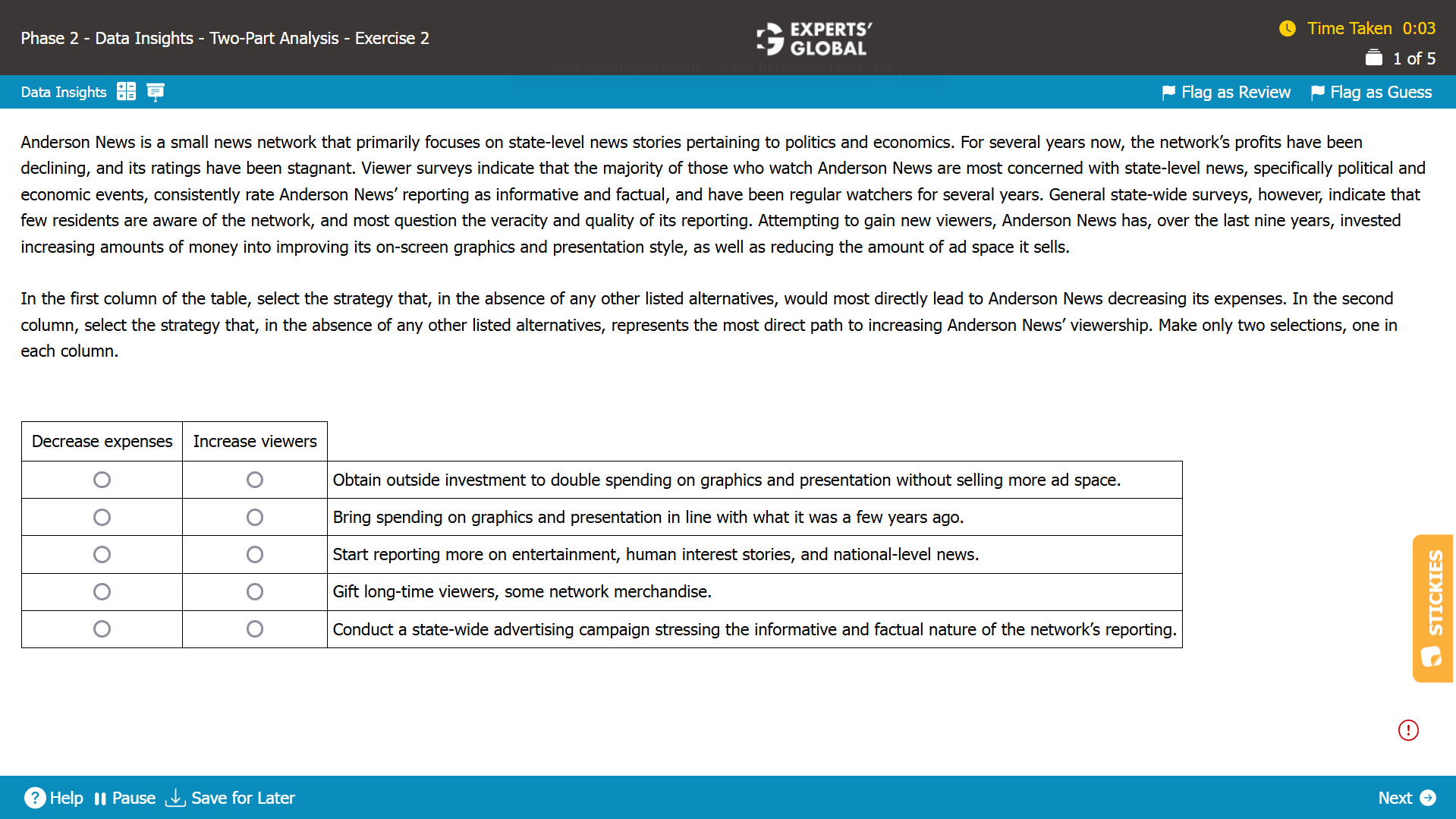
We need to select a strategy that would most directly lead to Anderson News decreasing its expenses, and a strategy that represents the most direct path to increasing Anderson News’ viewership.
A.
If the spending on graphics and presentation is doubled then that would increase the expenses. Hence, this is not the correct answer choice for the decrease expenses column.
The passage states that Anderson News has invested increasing amounts of money in improving graphics and presentation over the last 9 years, however, the network’s profits have been declining and its ratings have been stagnant. There is no information provided in the passage that would lead one to conclude that spending more money on graphics and presentation would increase Anderson News’ viewership. Hence, this is not the correct answer choice for the increase viewers column.
B.
The passage states that Anderson News has invested increasing amounts of money in improving graphics and presentation over the last 9 years. So, if the spending on graphics and presentation is brought in line with what it was a few years ago, then it follows that the expenses of Anderson News will decrease.
Hence, “Bring spending on graphics and presentation in line with what is was a few years ago” is the correct answer choice for the Decrease expenses column.
The passage states that Anderson News has invested increasing amounts of money in improving graphics and presentation over the last 9 years, however, the network’s profits have been declining and its ratings have been stagnant. There is no information provided in the passage that would lead one to conclude that if the spending on graphics and presentation were brought in line with what it was a few years ago, it would increase Anderson News’ viewership. Hence, this is not the correct answer choice for the Increase viewers column.
C.
There is no information provided in the passage that would lead one to conclude that reporting more on entertainment, human interest stories, and national-level news would affect the expense of Anderson News. Hence, this is not the correct answer choice for the decrease expenses column.
Viewer surveys indicate that the majority of those who watch Anderson News are most concerned with state-level political and economic events. There is no information provided in the passage that would lead one to conclude that reporting more on entertainment, human interest stories, and national-level news would increase Anderson News’ viewership. Hence, this is not the correct answer choice for the increase viewers column.
D.
If network merchandise is gifted to long-term viewers then that would increase the expenses. Hence, this is not the correct answer choice for the Decrease expenses column.
There is no information provided in the passage that would lead one to conclude that gifting network merchandise to long-term viewers would increase Anderson News’ viewership. Hence, this is not the correct answer choice for the increase viewers column.
E.
If a state-wide advertising campaign is conducted, then that would increase the expenses. Hence, this is not the correct answer choice for the Decrease expenses column.
The passage states that general state-wide surveys indicate that most residents question the veracity and quality of Anderson News’ reporting. So, if a state-wide advertising campaign is conducted stressing the informative and factual nature of the network’s reporting, then it is reasonable to think that this might lead to an increase in Anderson News’ viewership.
Hence, “Conduct a state-wide advertising campaign stressing the informative and factual nature of the network’s reporting” is the correct answer choice for the Increase viewers column.
Hence, B is the correct answer choice for the “Decrease expenses” column, and E is the correct answer choice for the “Increase viewers” column.
Two-Part Analysis Sample Question 2
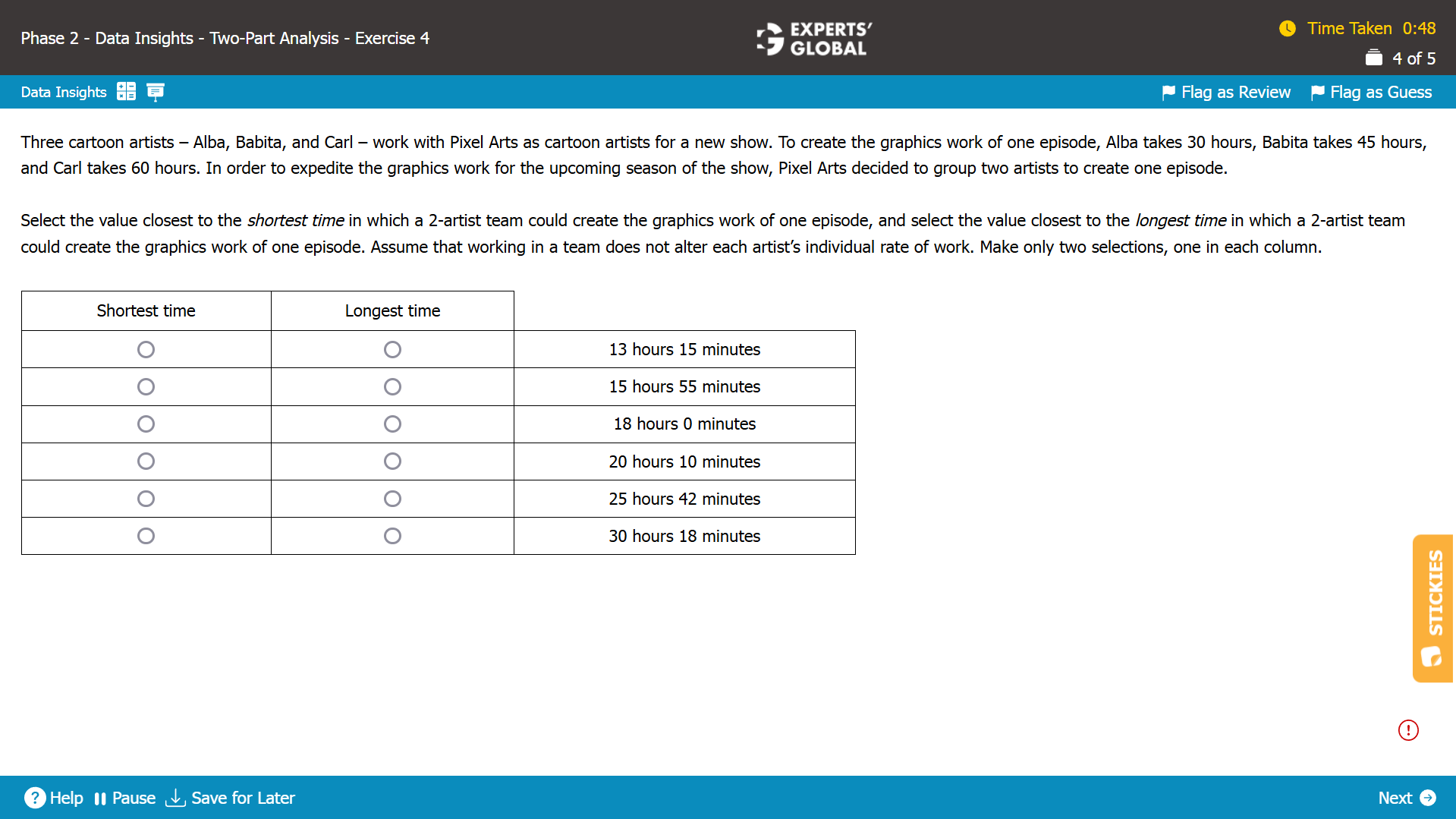
The number of hours taken by Alba to create the graphics work of one episode = 30 hours.
The number of hours taken by Babita to create the graphics work of one episode = 45 hours.
The number of hours taken by Carl to create the graphics work of one episode = 60 hours.
Shortest time:
Since Alba and Babita take less time than Carl, the shortest time will be attained when Alba and Babita work together.
Since Alba takes 30 hours to create the graphics work of one episode, it follows that in 1 hour Alba creates 1 / 30 of the graphics work of one episode.
Since Babita takes 45 hours to create the graphics work of one episode, it follows that in 1 hour Babita creates 1 / 45 of the graphics work of one episode.
The amount of work done by Alba and Babita together in 1 hour = ( 1 / 30 + 1 / 45 ) = ( 3 / 90 + 2 / 45 ) = 5 / 90 of the graphics work of one episode.
If 5 / 90 of the graphics work of one episode is created in 1 hour, then it follows that the time required to create graphics work of one episode = 90 / 5 = 18 hours.
Longest time:
Since Babita and Carl take more time than Alba, the longest time will be attained when Babita and Carl work together.
Since Babita takes 45 hours to create the graphics work of one episode, it follows that in 1 hour Babita creates 1 / 45 of the graphics work of one episode.
Since Carl takes 60 hours to create the graphics work of one episode, it follows that in 1 hour Carl creates 1 / 60 of the graphics work of one episode.
The amount of work done by Babita and Carl together in 1 hour = ( 1 / 45 + 1 / 60 ) = ( 4 / 180 + 3 / 180 ) = 7 / 180 of the graphics work of one episode.
If 7 / 180 of the graphics work of one episode is created in 1 hour, then it follows that the time required to create graphics work of one episode = 180 / 7 ~ 25.7 hours
Hence, for “Shortest time” column, “18 hours 0 minutes”, and for “Longest time” column, “25 hours 42 minutes” is the correct combination of the answer choices.
Two-Part Analysis Sample Question 3
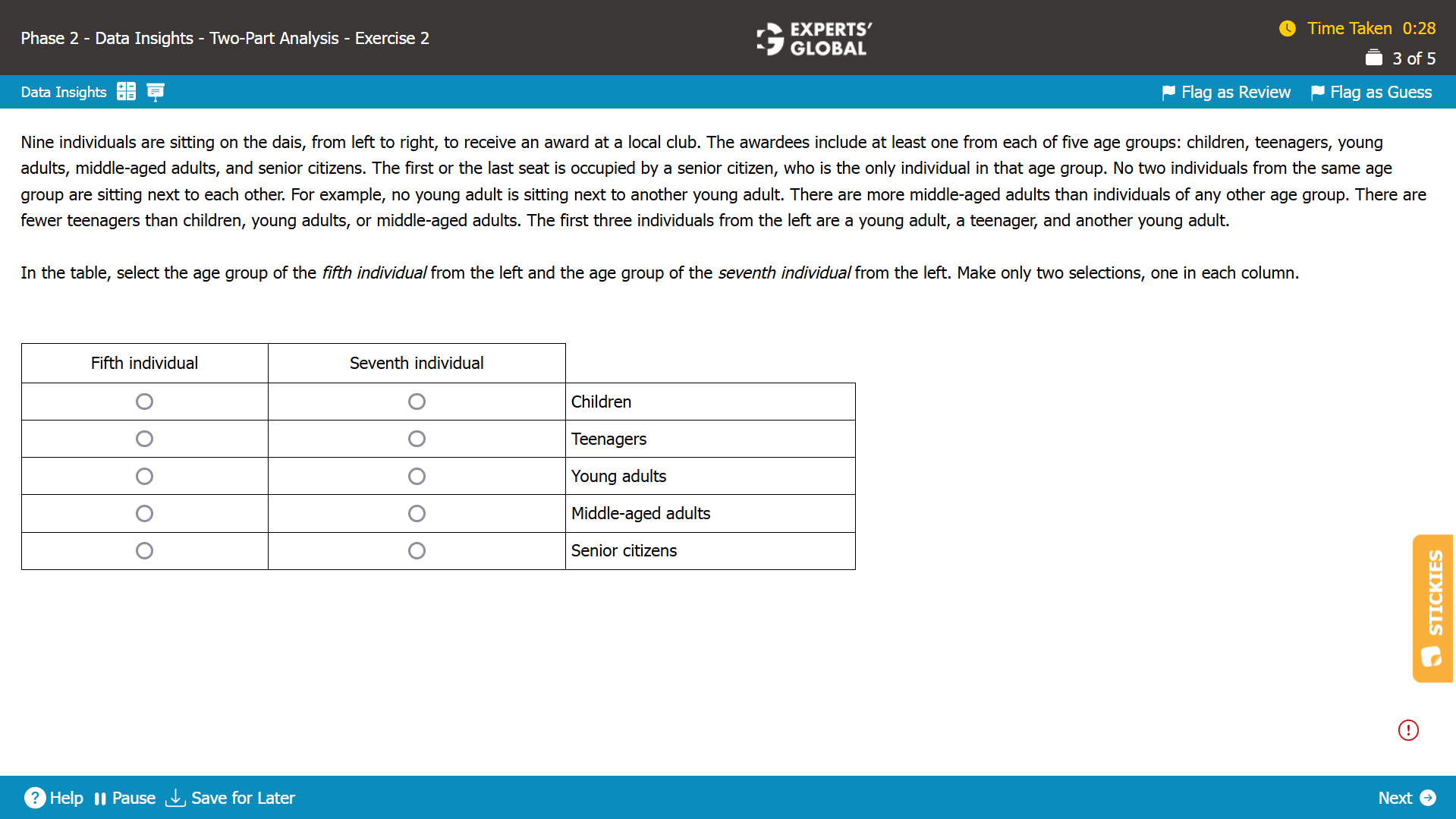
The first three individuals from the left are a young adult, a teenager, and another young adult. We also know that the first or the last seat is occupied by a senior citizen, who is the only individual in that age group. Since the first seat is already occupied by a young adult it follows that the last seat must be occupied by a senior citizen.
With the above conditions, we get the following arrangement:
(young adult, teenager, young adult, ____, ____, ____, ____, ____, senior citizen)
Since there are more middle-aged adults than individuals of any other age group and we already have 2 young adults, it follows that there must be at least 3 middle-aged adults. Furthermore, since no two individuals from the same age group are sitting next to each other, it follows that there must be only 3 middle-aged men seated in the fourth, sixth, and eighth seats.
With the above conditions, we get the following arrangement:
(young adult, teenager, young adult, middle-aged adult, ____, middle-aged adult, ____, middle-aged adult, senior citizen)
And since there are fewer teenagers than children, it implies that there must be at least 2 children in the group. Also, since there are only 2 positions left in the arrangement, it follows that the children must be seated in fifth and seventh place.
Hence, for “Fifth individual” column, “Children”, and for “Seventh individual” column, “Children” is the correct combination of the answer choices.
Two-Part Analysis Sample Question 4
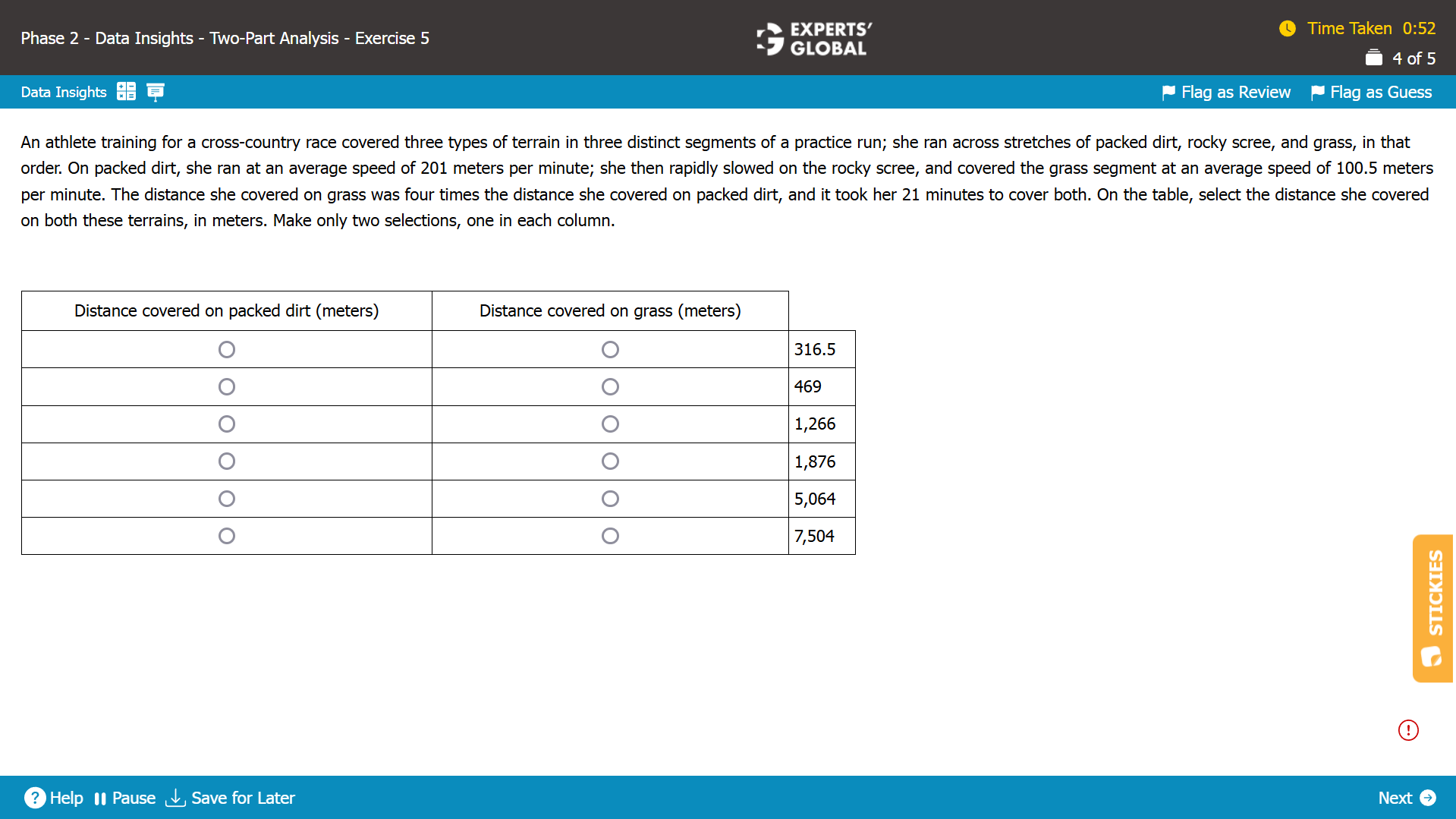
Let the speed of the athlete in the packed dirt and the grass be SP and SG, respectively.
Let the distance covered on packed dirt and the grass be DP and DG, respectively.
Let the time taken to cover packed dirt and the grass be TP and TG, respectively.
SP = 210 meters per minute
SG = 100.5 meters per minute
Since the distance covered on grass was four times the distance covered on packed dirt: DG = 4DP.
Since it took 21 minutes for the athlete to cover both the packed dirt and the grass: TP + TG = 21 minutes.
TP + TG = ( DP / SP ) + ( DG / SG )
21 = ( DP / 201 ) + ( DG / 100.5 )
21 = ( DP / 201 ) + ( 2DG / 201 )
21 = (DP + 2DG) / 201
21 = (DP + 2 × 4DP) / 201
21 = (DP + 8DP) / 201
21 = (9DP) / 201
DP = 469 meters
DG = 4DP = 4 × 469 = 1,876 meters.
Hence, for “Distance covered on packed dirt (meters)” column, “469”, and for “Distance covered on grass (meters)” column, “1,876” is the correct combination of the answer choices.
Two-Part Analysis Sample Question 5
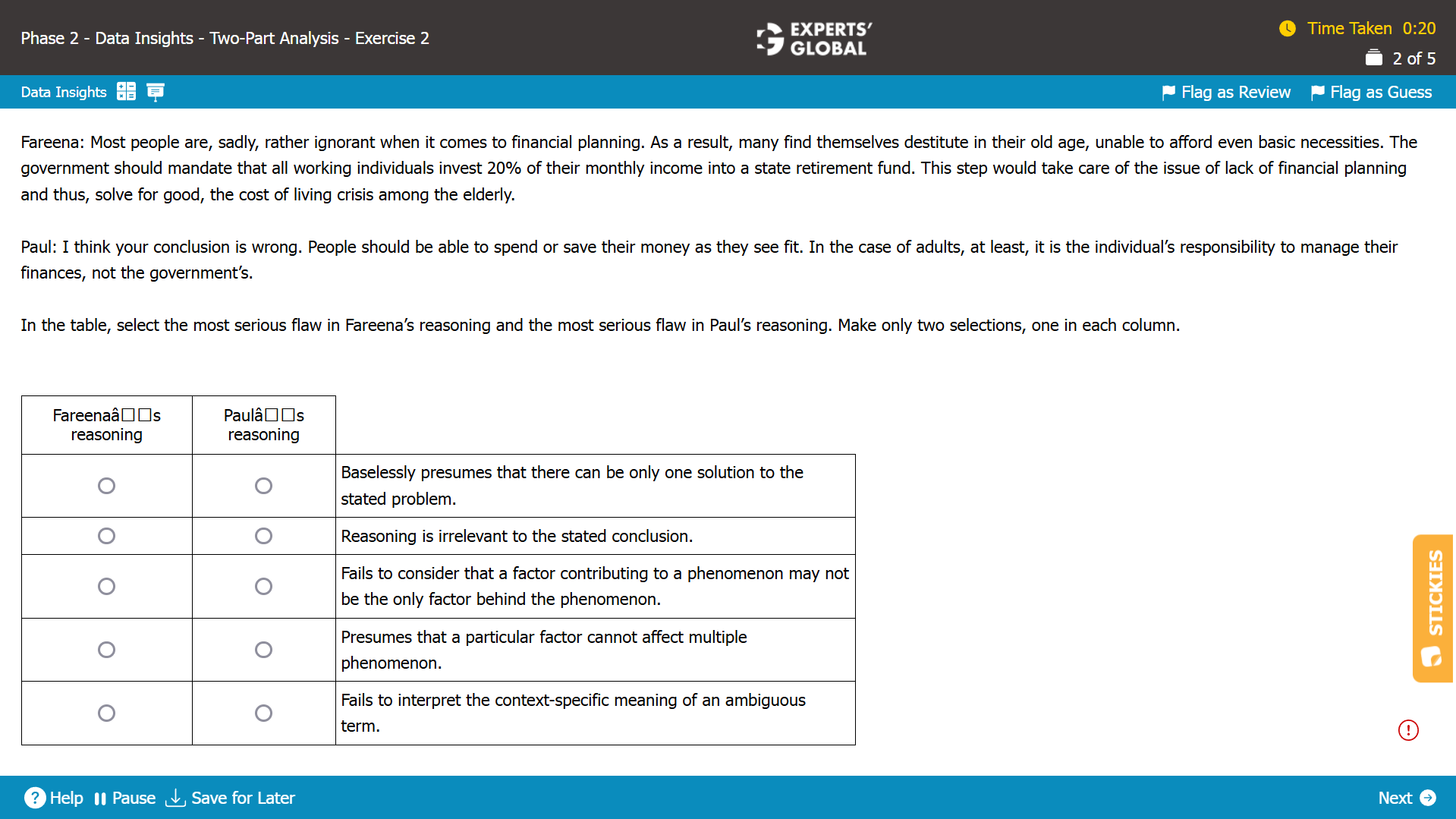
A.
Fareena claims that her stated solution would solve the problem of the cost of living crisis among the elderly, but she does not claim that it is the only way to solve the crisis. Thus, baselessly presuming that there is only one solution to the stated problem cannot reasonably be described as a flaw in Fareena’s reasoning.
Paul offers no solutions to the cost of living crisis among the elderly, rather he merely provides his reasoning for disagreeing with Fareena. Thus, baselessly presuming that there is only one solution to the stated problem cannot reasonably be described as a flaw in Paul’s reasoning.
B.
Fareena’s reasoning is that many people become destitute in their old age because of poor financial planning, and her conclusion is that the cost of living crisis among the elderly can be permanently solved by solving the issue of lack of financial planning by making all working individuals invest 20% of their monthly income into a state retirement fund. Thus, reasoning irrelevant to the conclusion cannot reasonably be described as a flaw in Fareena’s reasoning.
Paul’s reasoning is that people should be able to handle their own financial matters, as they see fit, and that the government has no responsibility to ensure good financial management; his conclusion is that Fareena’s conclusion is wrong – making all working individuals invest 20% of their monthly income into a retirement fund managed by the state is not a permanent solution to the cost of living crisis among the elderly. Thus, we can reasonably say that Paul’s reasoning is irrelevant to the conclusion stated.
Hence, B is the correct answer choice for the column “Paul’s reasoning”.
C.
Fareena’s argument is that due to poor financial planning on their part, many people become destitute in their old age, and so the cost of living crisis among the elderly can be permanently resolved by solving the issue of lack of financial planning by making all working individuals invest 20% of their monthly income into a state retirement fund. Fareena assumes that solving the issue of poor financial planning is enough to permanently resolve destitution among the elderly, and in doing so she fails to consider that there may be other causes for the crisis. Thus, we can reasonably say that Fareena fails to consider that one factor causing a phenomenon may not be the only factor.
Paul’s argument makes no mention of the factors causing destitution among the elderly. Thus, failing to consider that one factor causing a phenomenon may not be the only factor cannot reasonably be described as a flaw in Paul’s reasoning.
Hence, C is the correct answer choice for the column “Fareena’s reasoning”.
D.
Fareena’s argument is concerned only with justifying one solution for a given phenomenon – the cost of living crisis among the elderly – as a viable, permanent solution, meaning that the effect of any particular factor on multiple phenomena is irrelevant. Thus, presuming that a particular factor cannot affect multiple phenomena cannot reasonably be described as a flaw in Fareena’s reasoning.
Paul’s argument makes no mention of the cause-effect relationship between any factor or phenomenon. Thus, presuming that a particular factor cannot affect multiple phenomenon cannot reasonably be described as a flaw in Fareena’s reasoning.
E.
Fareena’s argument includes no context-specific or ambiguous terms. Thus, failing to interpret the context-specific meaning of an ambiguous term cannot reasonably be described as a flaw in Fareena’s reasoning.
Paul’s argument includes no context-specific or ambiguous terms. Thus, failing to interpret the context-specific meaning of an ambiguous term cannot reasonably be described as a flaw in Paul’s reasoning.
Hence, C is the correct answer choice for the column “Fareena’s reasoning”, and B is the correct answer choice for the column “Paul’s reasoning”.
Additional TPA Sample Questions:
Free GMAT TPA prep (includes training videos and additional TPA questions with explanations)
For Further Prep and Practice:
15 full-length GMAT practice tests (includes a free test)
End-to-end GMAT prep course online (includes 7-day free trial)
GMAT 5-weeks crash course
GMAT Prep + Admission Consulting Bundle