Two-Part Analysis (TPA) questions ask you to work with a short scenario, relationship, or set of conditions, and then answer two linked questions using a shared set of answer choices. On the GMAT, you will see four or five TPA questions as part of the 20 questions in the Data Insights section. These questions generally require you to select two responses, and you receive credit only if all chosen responses are correct, with no partial credit. They help you practise holding multiple conditions in mind, testing combinations, and arriving at pairs of answers that fit the given logic. Proper familiarity with this question type is an essential part of any GMAT preparation course. This page provides you an organized subtopic wise playlist, along with a few worked examples, for efficient preparation of this concept.
Approach for GMAT Two-Part Analysis Questions
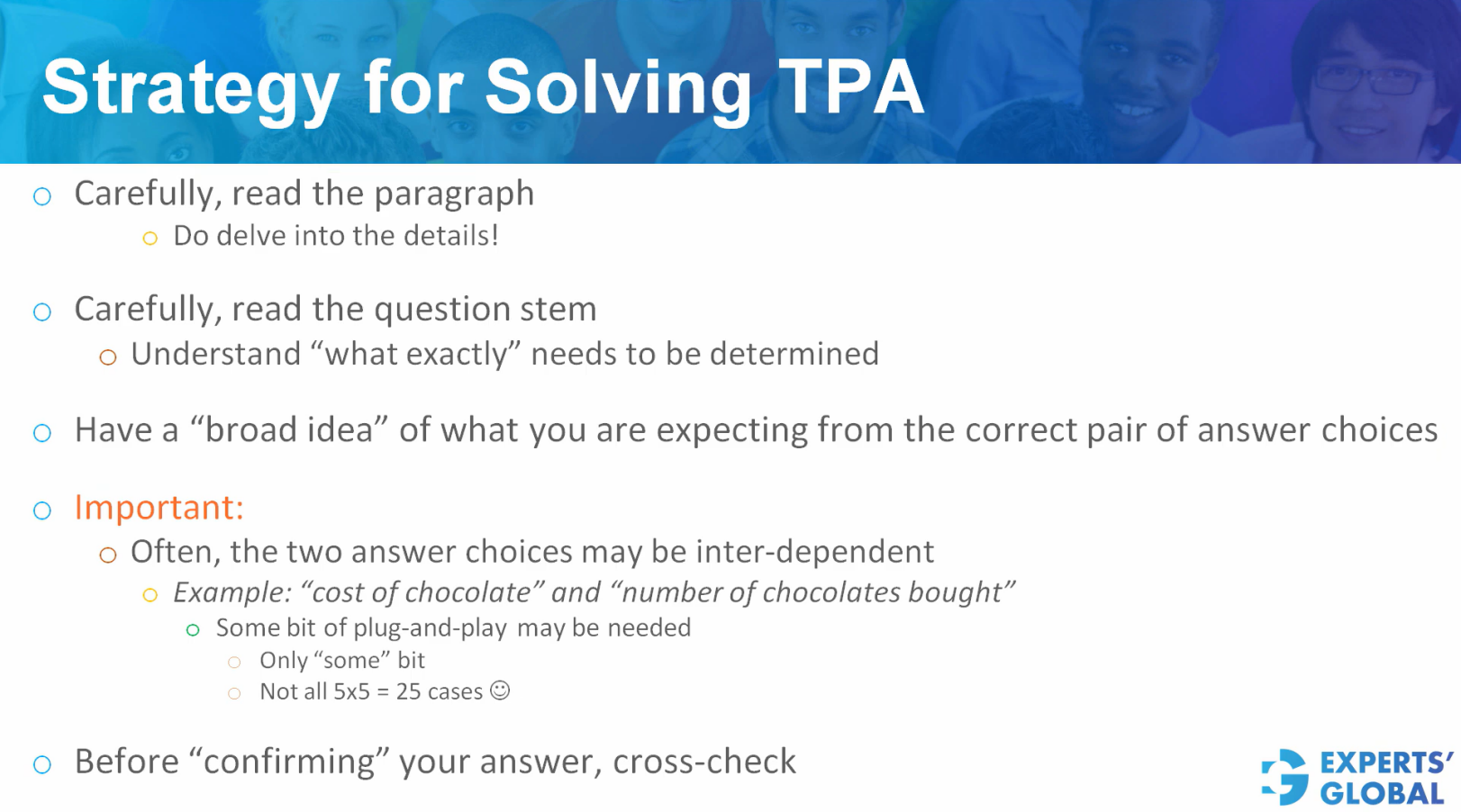
This short video guides you through a clear, structured approach for solving Two-Part Analysis questions on the GMAT. It shows how to follow each step steadily and calmly, even under real exam conditions and strict time limits.

Approach for GMAT Two-Part Analysis Questions
GMAT-style Two-Part Analysis Questions with Explanations
This practice set brings together GMAT-style Two-Part Analysis questions, each supported by a carefully written, stepwise explanation. Work through every item at a calm, deliberate pace and apply the problem solving framework and ideas you have just studied on this page for handling Two-Part Analysis questions on the GMAT. At this stage, give priority to using the structured method accurately rather than simply aiming for a correct response. Once you have completed a question, open the explanation panel to verify the answers to both parts and to review the full descriptive solution.
Question 1
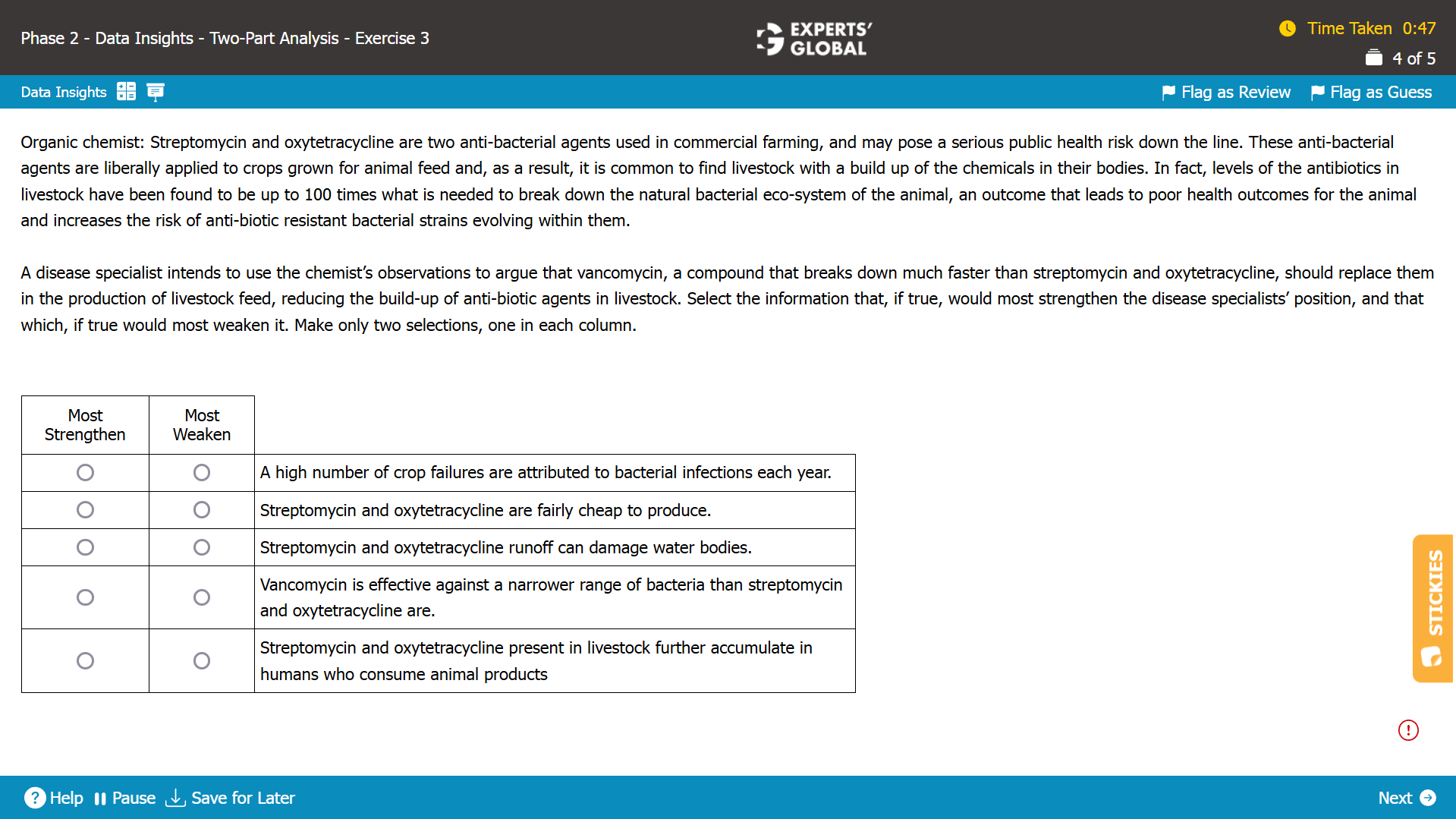
We need to select the information that, if true, would most strengthen the disease specialists’ position, and that which, if true would most weaken it.
A.
Even if it is true that a high number of crop failures are attributed to bacterial infections each year, no information is provided in the passage that suggests whether vancomycin is more or less effective than streptomycin and oxytetracycline in preventing crop failures. Hence, this information neither strengthens nor weakens the disease specialists’ position.
B.
Even if it is true that streptomycin and oxytetracycline are fairly cheap to produce, no information is provided regarding the cost of vancomycin. Since it is not possible to determine whether vancomycin is cheaper than streptomycin and oxytetracycline, this information neither strengthens nor weakens the disease specialists’ position.
C.
Even if it is true that streptomycin and oxytetracycline runoff can damage water bodies, no information is provided that suggests whether vancomycin causes comparatively more or less damage to the water bodies. Hence, this information neither strengthens nor weakens the disease specialists’ position.
D.
Since streptomycin and oxytetracycline are primarily used as antibacterial agents in commercial farming, if vancomycin is effective against a narrower range of bacteria than streptomycin and oxytetracycline, then this would imply that vancomycin cannot effectively replace them as antibacterial agents in livestock feed production. This would weaken the disease specialist’s position advocating for vancomycin as a replacement for streptomycin and oxytetracycline.
Hence, “Vancomycin is effective against a narrower range of bacteria than streptomycin and oxytetracycline are” is the correct answer choice for the Most Weaken column.
E.
If it is true that streptomycin and oxytetracycline present in livestock accumulate in humans who consume animal products, then this would be another concern related to streptomycin and oxytetracycline. However, the passage mentions that vancomycin breaks down much faster than streptomycin and oxytetracycline, reducing the build-up of antibiotic agents in livestock. This suggests that the adverse health effects on humans due to vancomycin will likely be less significant than those caused by streptomycin and oxytetracycline. Consequently, this strengthens the disease specialist’s position in favor of using vancomycin as a replacement for streptomycin and oxytetracycline.
Hence, “Streptomycin and oxytetracycline present in livestock further accumulate in humans who consume animal products” is the correct answer choice for the Most Strengthen column.
Hence, E is the correct answer choice for the “Most Strengthen” column, and D is the correct answer choice for the “Most Weaken” column.
Question 2
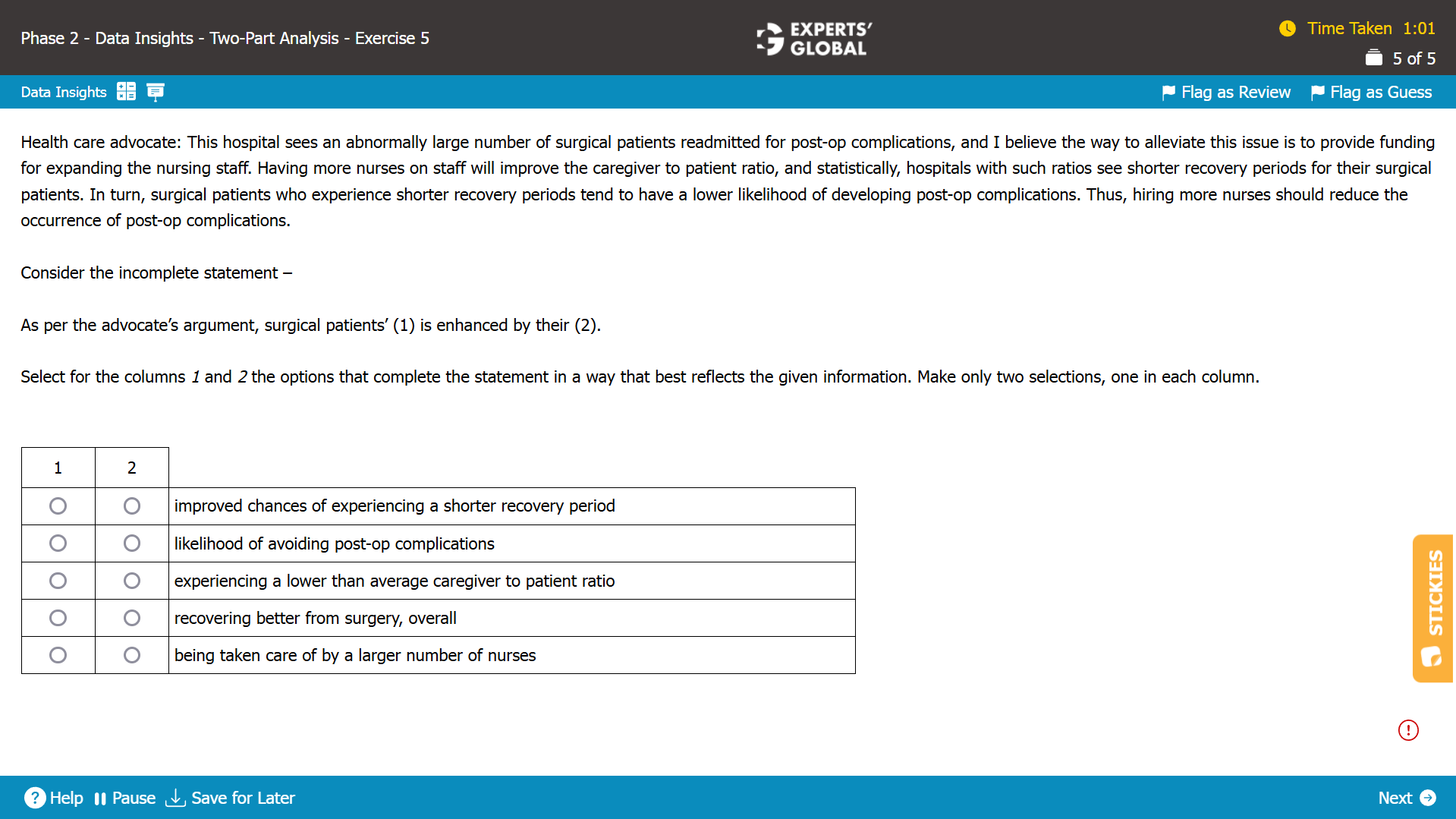
We need to select two answer choices that complete the statement “surgical patients’ (1) is enhanced by their (2)” in a way that best reflects the given information.
The passage provides the following cause-and-effect relation:
Increased funding for expanding the nursing staff ? Improved caregiver to patient ratio ? Shorter recovery periods for surgical patients ? Lower likelihood of developing post-op complications.
A. improved chances of experiencing a shorter recovery period
According to the passage, improved chances of experiencing a shorter recovery period can result in lower likelihood of developing post-op complications. Hence, this could be a potential answer for the (2) column.
B. likelihood of avoiding post-op complications
According to the passage, likelihood of avoiding post-op complications can be enhanced by shorter recovery periods for surgical patients, improved caregiver to patient ratio, or increased funding for expanding the nursing staff. Hence, this could be a potential answer for the (1) column.
C. experiencing a lower than average caregiver to patient ratio
According to the passage, a lower than average caregiver to patient ratio can cause longer recovery periods for surgical patients and a higher likelihood of developing post-op complications, and a lower than average caregiver to patient ratio can be caused by decreased funding for expanding the nursing staff. Since no such relevant answer choices are provided this is not a suitable answer choice for either column.
D. recovering better from surgery, overall
The passage only talks about a reduction in the recovery period for surgical patients, and not about recovering better from surgery, Hence, this is not a potential answer choice for either column.
E. being taken care of by a larger number of nurses
The passage refers to having more nurses on staff, but only as a potential method of reducing the recovery period, which in turn can reduce the likelihood of developing post-op complications. Hence, this is not a potential answer choice for either column.
Hence, B is the correct answer choice for the “1” column, and A is the correct answer choice for the “2” column.
Question 3
I.
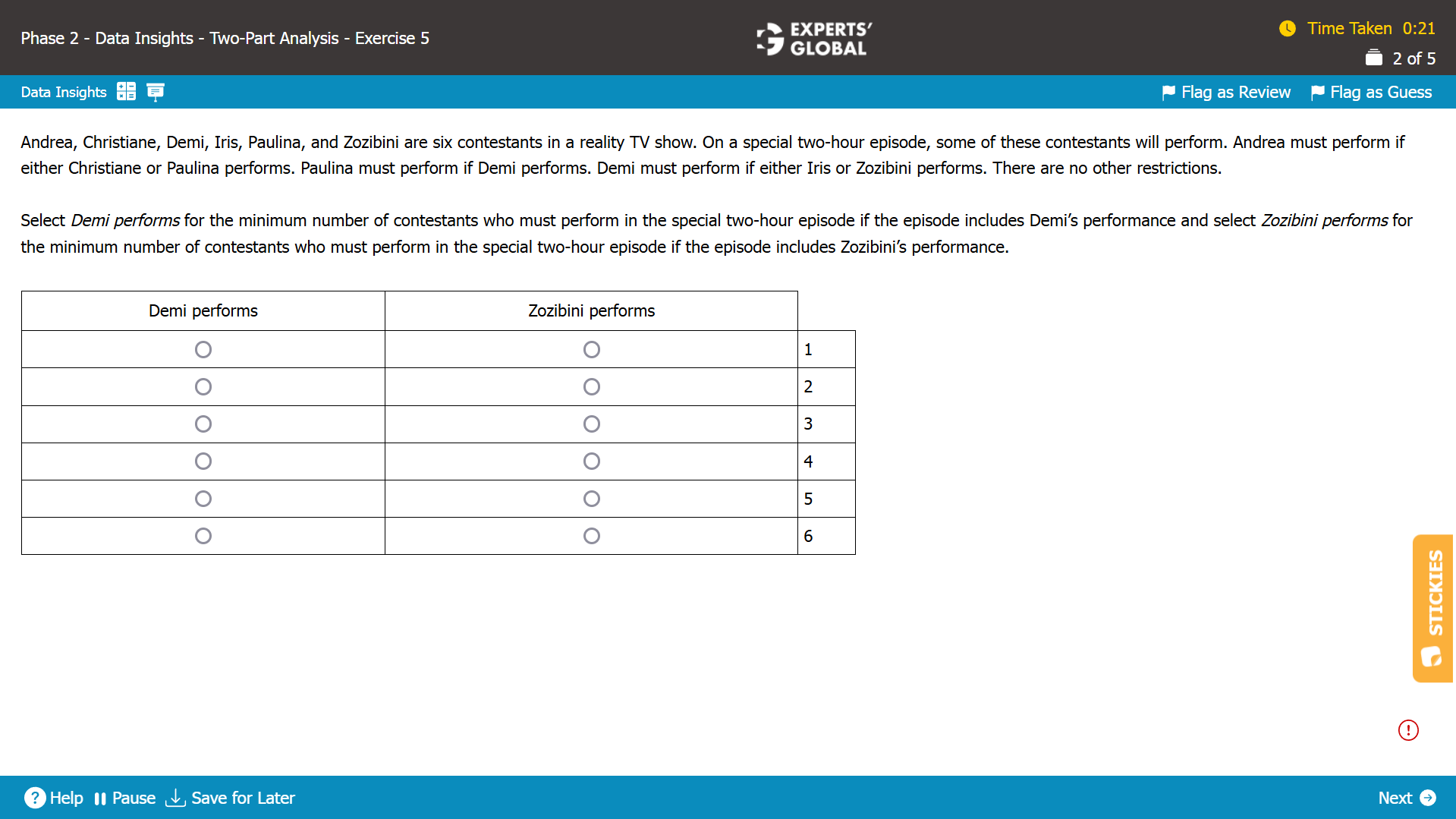
Paulina must perform if Demi performs.
Andrea must perform if Paulina performs.
There are no other conditions specified that necessarily require any other contestant to perform.
Thus, the minimum number of contestants who must perform in the special two-hour episode if the episode includes Demi’s performance is 3 (Demi, Paulina, and Andrea).
II.
Demi must perform if Zozibini performs.
Paulina must perform if Demi performs.
Andrea must perform if Paulina performs.
There are no other conditions specified that necessarily require any other contestant to perform.
Thus, the minimum number of contestants who must perform in the special two-hour episode if the episode includes Zozibini’s performance is 4 (Zozibini, Demi, Paulina, and Andrea).
Hence, for “Demi performs” column, “3”, and for “Zozibini performs” column, “4” is the correct combination of the answer choices.
How and Where to Practice GMAT Two-Part Analysis Questions
Real practice for Two-Part Analysis problems begins when you solve them on a software simulation that closely matches the official GMAT interface. You need a platform that presents the prompt, the paired questions, and the answer choices in a GMAT like layout, lets you work with the information and response grid naturally, and provides all the on screen tools and functionalities that you will see on the actual exam. Without this kind of experience, it is difficult to feel fully prepared for test day. High quality Two-Part Analysis questions are not available in large numbers. Among the limited, genuinely strong sources are the official practice materials released by GMAC and the Experts’ Global GMAT course.
Within the Experts’ Global GMAT online preparation course, every Two-Part Analysis problem appears on an exact GMAT like user interface that includes all the real exam tools and features. You work through more than 50 Two-Part Analysis questions in quizzes and also take 15 full-length GMAT mock tests that include several Two-Part Analysis questions in roughly the same spread and proportion in which they appear on the actual GMAT.
All the best!