Text completion one-blank questions form one of the three variations of GRE text completion, alongside TC two-blank and three-blank questions. Each question presents a dense sentence with one important word missing and five answer choices; your task is to select the one answer choice that completes the sentence coherently. On this page, we present a set of text completion one-blank practice questions for GRE. Use these sample questions carefully and refer to the explanations judiciously to review incorrect attempts and slower attempts, then carry these learnings into further GRE preparation and practice.
Important: If you need to undergo thorough Text Completion preparation, please visit Free GRE Text Completion prep
Practice Question 1 | GRE Text Completion 1-Blank
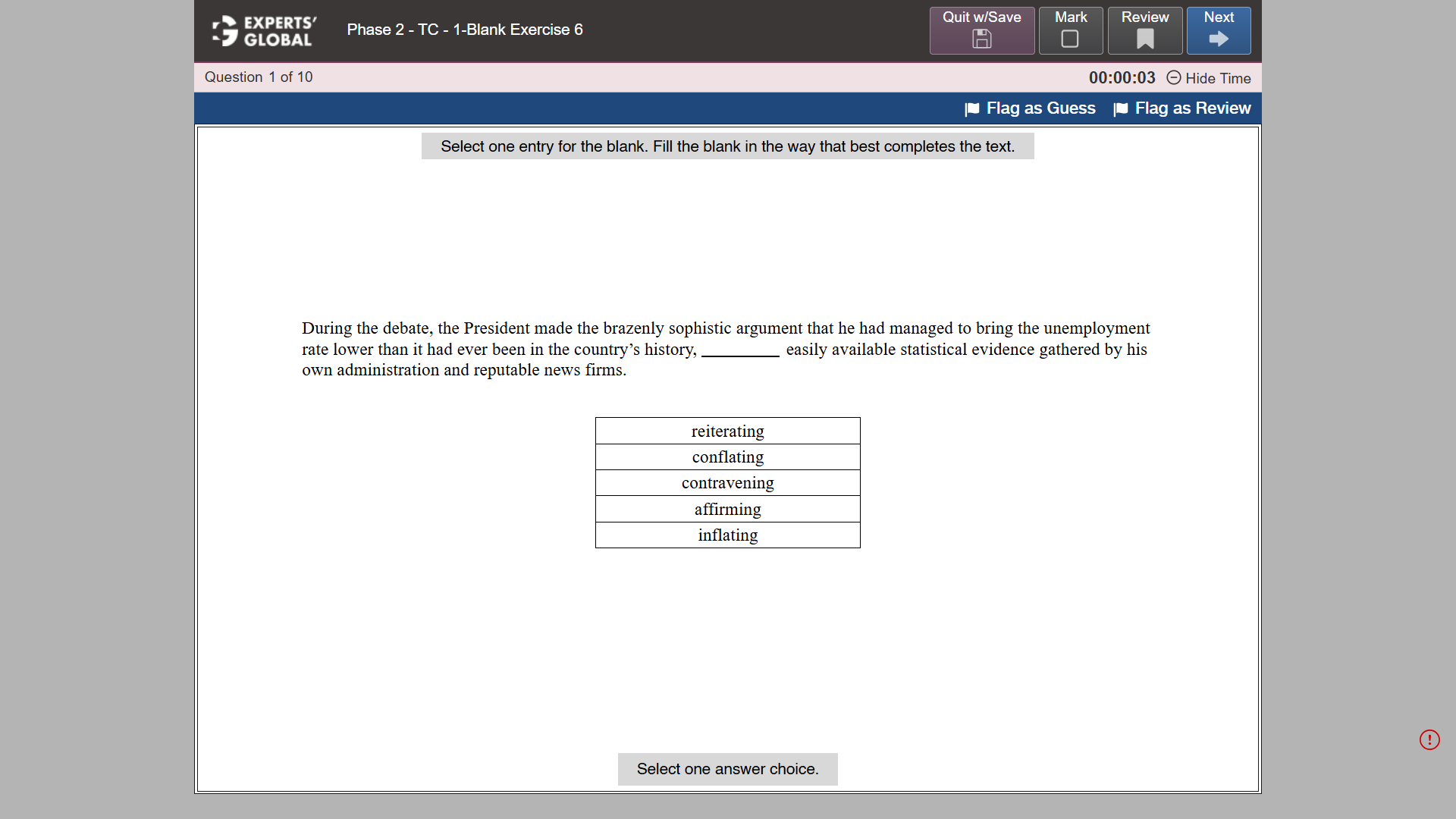
During the debate, the President made the brazenly sophistic argument that he had managed to bring the unemployment rate lower than it had ever been in the country’s history, _____ easily available statistical evidence gathered by his own administration and reputable news firms.
A. reiterating
B. conflating
C. contravening
D. affirming
E. inflating
Written Explanation
The intended core meaning of the sentence: That the President made a boldly misleading argument about lowering the unemployment rate, contradicting obvious evidence.
Reasoning around the blank space: The catch for filling the blank in this sentence lies in identifying the contrast in the usage “…President made…BRAZENLY SOPHISTIC argument…he had…BRING the UNEMPLOYMENT RATE LOWER than it had ever been in…HISTORY, _____ easily available…EVIDENCE gathered by…REPUTABLE news firms”, which implies a difference between the President’s assertion and the reality; this contrast suggests that the sentence intends to convey that during the debate, the President made the boldly misleading argument that he had managed to bring the unemployment rate lower than it had ever been in the country’s history, contradicting easily available statistical evidence gathered by his own administration and reputable news firms. Hence, for the blank, we need a word that conveys the idea of “contradicting” easily available statistical evidence.
Broad expectation from the correct answer choice: A word conveying the idea of contradicting.
A. This answer choice, “reiterating”, meaning “emphasizing or restating a point”, does not match our broad expectation from the correct answer choice, which is to convey the idea of contradicting. Hence, this answer choice is incorrect.
B. This answer choice, “conflating”, meaning “merging two or more different ideas”, does not match our broad expectation from the correct answer choice, which is to convey the idea of contradicting. Hence, this answer choice is incorrect.
C. Correct. This answer choice, “contravening”, meaning “violating or contradicting something”, matches our broad expectation from the correct answer choice, which is to convey the idea of contradicting. Hence, this answer choice is correct.
D. This answer choice, “affirming”, meaning “expressing agreement with a statement”, is opposite to our broad expectation from the correct answer choice, which is to convey the idea of contradicting. Hence, this answer choice is incorrect.
E. This answer choice, “inflating”, meaning “exaggerating” or “magnifying the value of something”, does not match our broad expectation from the correct answer choice, which is to convey the idea of contradicting. Hence, this answer choice is incorrect.
Thus, C is the correct answer choice.
Practice Question 2 | GRE Text Completion 1-Blank
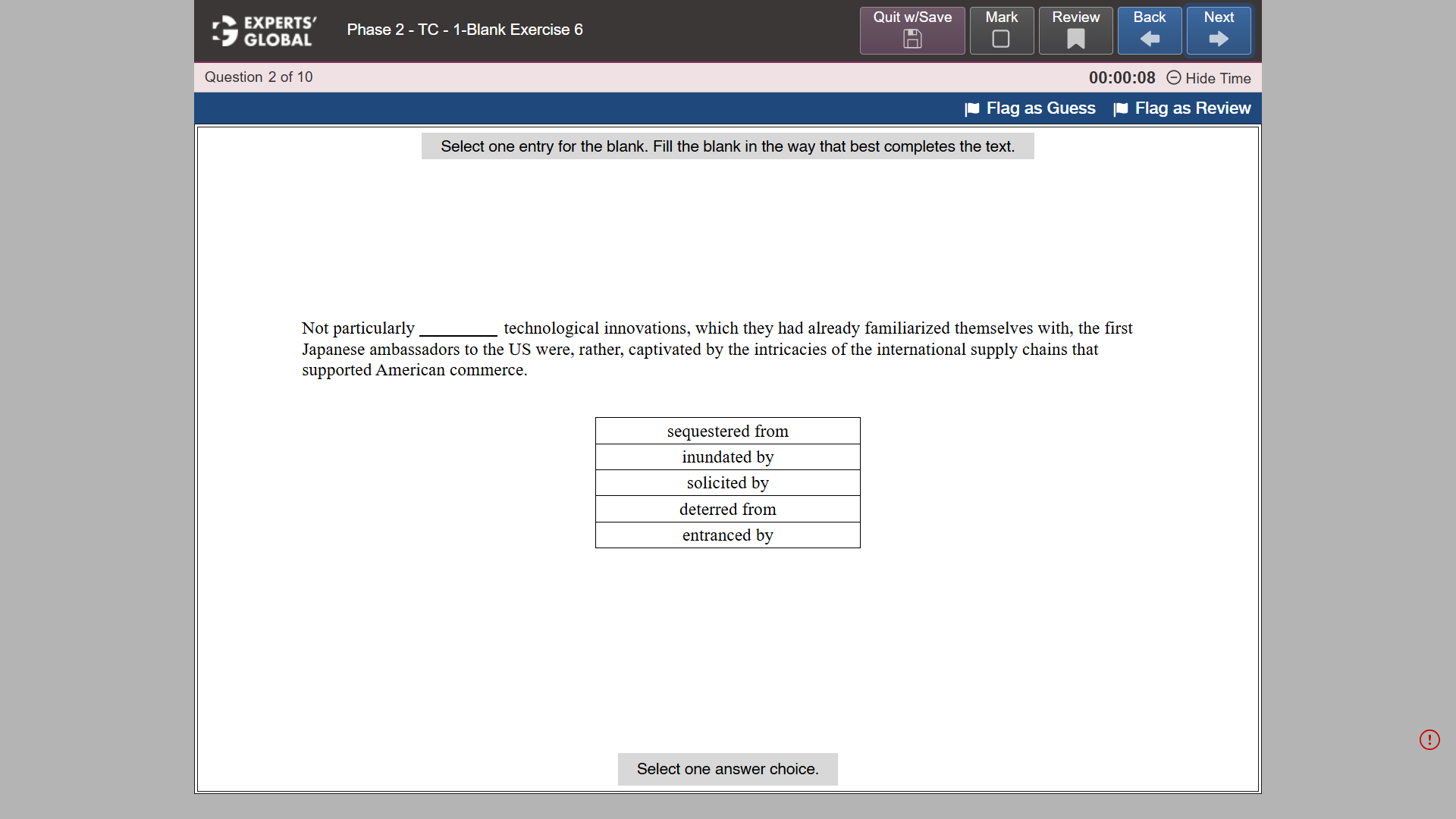
Not particularly _____ technological innovations, which they had already familiarized themselves with, the first Japanese ambassadors to the US were, rather, captivated by the intricacies of the international supply chains that supported American commerce.
A. sequestered from
B. inundated by
C. solicited by
D. deterred from
E. entranced by
Written Explanation
The intended core meaning of the sentence: That the ambassadors were not very fascinated by technological innovations, but by the American international supply chains.
Reasoning around the blank space: The catch for filling the blank in this sentence lies in identifying the contrast in the usage “Not particularly _____ technological innovations…had ALREADY FAMILIARIZED themselves…first Japanese ambassadors to the US…RATHER CAPTIVATED by…international supply chains…”, which highlights the differing interests of the ambassadors; this contrast suggests that the sentence intends to convey that the first Japanese ambassadors to the US were not particularly fascinated by technological innovations, which they had already familiarized themselves with, but they were rather captivated by the complexities of the international supply chains that supported American commerce. Hence, for the blank, we need a word that conveys the idea of the first Japanese ambassadors to the US not being particularly “fascinated by” technological innovations.
Broad expectation from the correct answer choice: A word conveying the idea of being “fascinated by”.
A. This answer choice, “sequestered from”, meaning “kept apart from something”, does not match our broad expectation from the correct answer choice, which is to convey the idea of being “fascinated by”. Hence, this answer choice is incorrect.
B. This answer choice, “inundated by”, meaning “overwhelmed by something” or “receive something in a large amount”, does not match our broad expectation from the correct answer choice, which is to convey the idea of being “fascinated by”. Hence, this answer choice is incorrect.
C. This answer choice, “solicited by”, meaning “asked for or requested something”, does not match our broad expectation from the correct answer choice, which is to convey the idea of being “fascinated by”. Hence, this answer choice is incorrect.
D. This answer choice, “deterred from”, meaning “discouraged from doing something”, does not match our broad expectation from the correct answer choice, which is to convey the idea of being “fascinated by”. Hence, this answer choice is incorrect.
E. Correct. This answer choice, “entranced by”, meaning “fascinated or charmed by something”, matches our broad expectation from the correct answer choice, which is to convey the idea of being “fascinated by”. Hence, this answer choice is correct.
Thus, E is the correct answer choice.
Practice Question 3 | GRE Text Completion 1-Blank
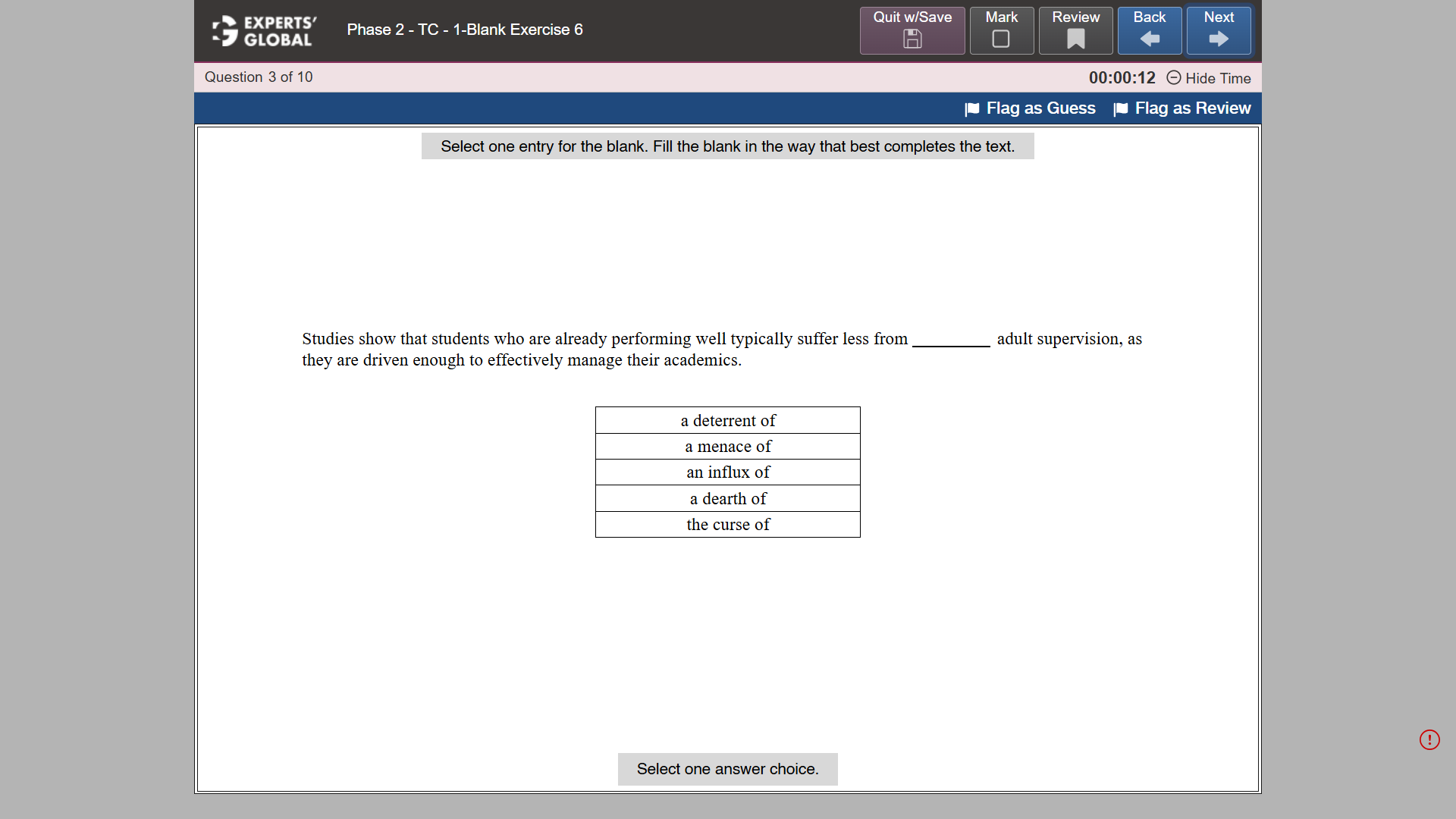
Studies show that students who are already performing well typically suffer less from _____ adult supervision, as they are driven enough to effectively manage their academics.
A. a deterrent of
B. a menace of
C. an influx of
D. a dearth of
E. the curse of
Written Explanation
The intended core meaning of the sentence: That high-performing students suffer less from a lack of adult supervision, as they are innately motivated.
Reasoning around the blank space: The catch for filling the blank in this sentence lies in identifying the cause-effect relationship expressed in the usage “…students…PERFORMING WELL…TYPICALLY SUFFER LESS from _____ adult SUPERVISION, AS they are DRIVEN ENOUGH to…MANAGE their academics”, which implies a certain factor leading to a positive consequence for high-performing students; this causal connection suggests that the sentence intends to convey that studies show that students who are already performing well typically suffer less from a lack of adult supervision, as they are motivated enough to effectively manage their academics on their own. Hence, for the blank, we need a word that conveys the idea of students suffering less from “a lack of” adult supervision.
Broad expectation from the correct answer choice: A word conveying the idea of “a lack of” or “unavailability of”.
A. This answer choice, “a deterrent of”, meaning “something that discourages an action”, does not match our broad expectation from the correct answer choice, which is to convey the idea of “a lack of” or “unavailability of”. Hence, this answer choice is incorrect.
B. Trap. This answer choice, “a menace of”, meaning “something that causes harm or trouble”, does not match our broad expectation from the correct answer choice, which is to convey the idea of “a lack of” or “unavailability of”. Hence, this answer choice is incorrect.
C. This answer choice, “an influx of”, meaning “large arrival or increase of something”, is opposite to our broad expectation from the correct answer choice, which is to convey the idea of “a lack of” or “unavailability of”. Hence, this answer choice is incorrect.
D. Correct. This answer choice, “a dearth of”, meaning “scarcity or lack of something”, matches our broad expectation from the correct answer choice, which is to convey the idea of “a lack of” or “unavailability of”. Hence, this answer choice is correct.
E. This answer choice, “the curse of”, meaning “wishing harm upon”, does not match our broad expectation from the correct answer choice, which is to convey the idea of “a lack of” or “unavailability of”. Hence, this answer choice is incorrect.
Thus, D is the correct answer choice.
Practice Question 4 | GRE Text Completion 1-Blank
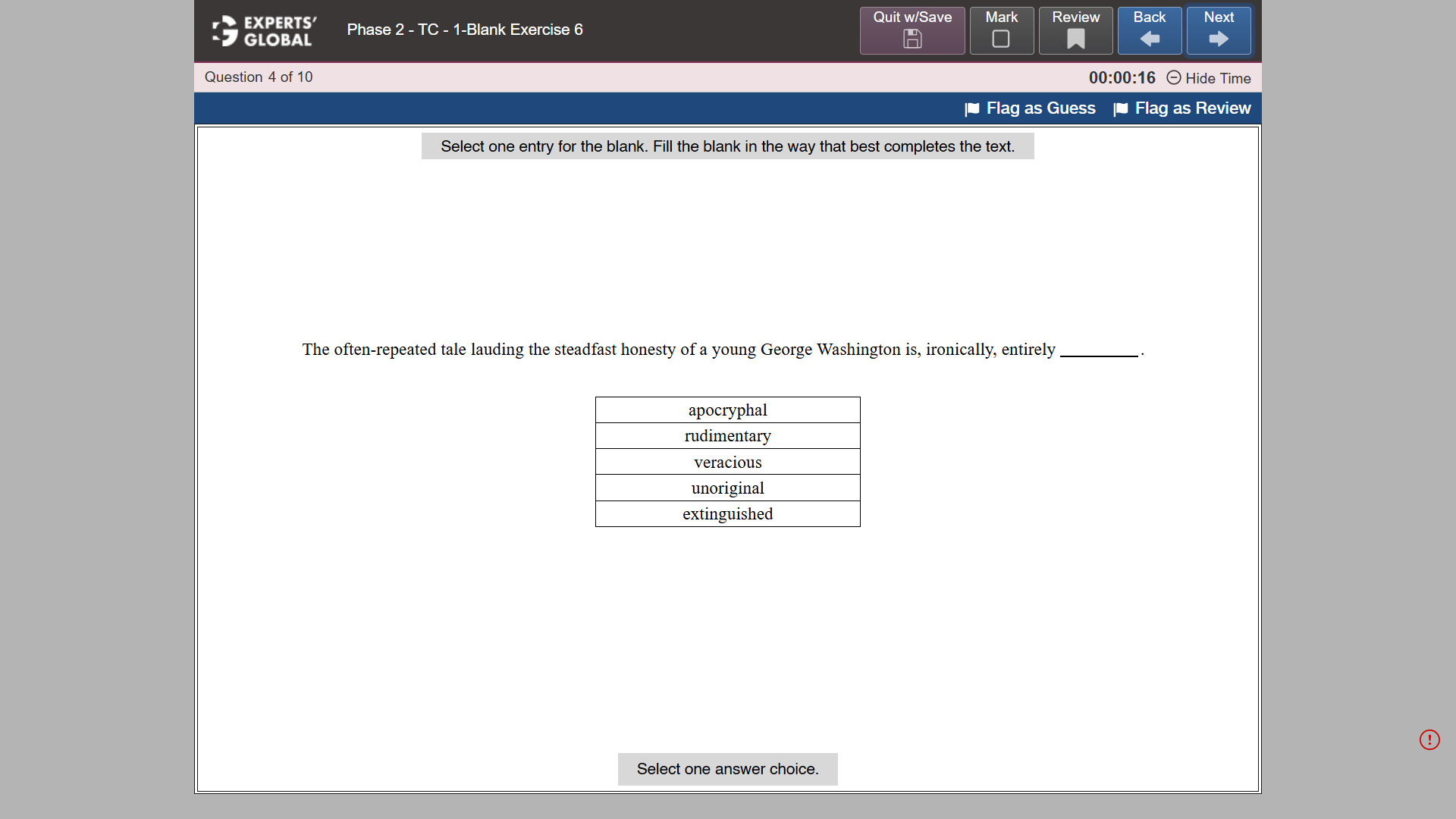
The often-repeated tale lauding the steadfast honesty of a young George Washington is, ironically, entirely _____.
A. apocryphal
B. rudimentary
C. veracious
D. unoriginal
E. extinguished
Written Explanation
The intended core meaning of the sentence: That the story about the honesty of young George Washington is, surprisingly, completely false.
Reasoning around the blank space: The catch for filling the blank in this sentence lies in identifying the contrast in the usage “The often-repeated tale LAUDING…HONESTY of…George Washington is, IRONICALLY…”, which implies a difference between myth and reality; this contrast suggests that the sentence intends to convey that the frequently heard story praising the unwavering honesty of a young George Washington is, surprisingly, completely false. Hence, for the blank, we need a word that conveys the idea of the often-repeated tale being entirely “false”.
Broad expectation from the correct answer choice: A word conveying the idea of being “false” or “fictional”.
A. Correct. This answer choice, “apocryphal”, meaning “not true” or “of doubtful authorship”,matches our broad expectation from the correct answer choice, which is to convey the idea of being “false” or “fictional”. Hence, this answer choice is correct.
B. This answer choice, “rudimentary”, meaning “being in an undeveloped stage” or “basic”, does not match our broad expectation from the correct answer choice, which is to convey the idea of being “false” or “fictional”. Hence, this answer choice is incorrect.
C. This answer choice, “veracious”, meaning “truthful” or “accurate”, is opposite to our broad expectation from the correct answer choice, which is to convey the idea of being “false” or “fictional”. Hence, this answer choice is incorrect.
D. This answer choice, “unoriginal”, meaning “not creative” or “derivative”, does not match our broad expectation from the correct answer choice, which is to convey the idea of being “false” or “fictional”. Hence, this answer choice is incorrect.
E. Trap. This answer choice, “extinguished”, meaning “no longer existing”, does not match our broad expectation from the correct answer choice, which is to convey the idea of being “false” or “fictional”. Hence, this answer choice is incorrect.
Thus, A is the correct answer choice.
Practice Question 5 | GRE Text Completion 1-Blank
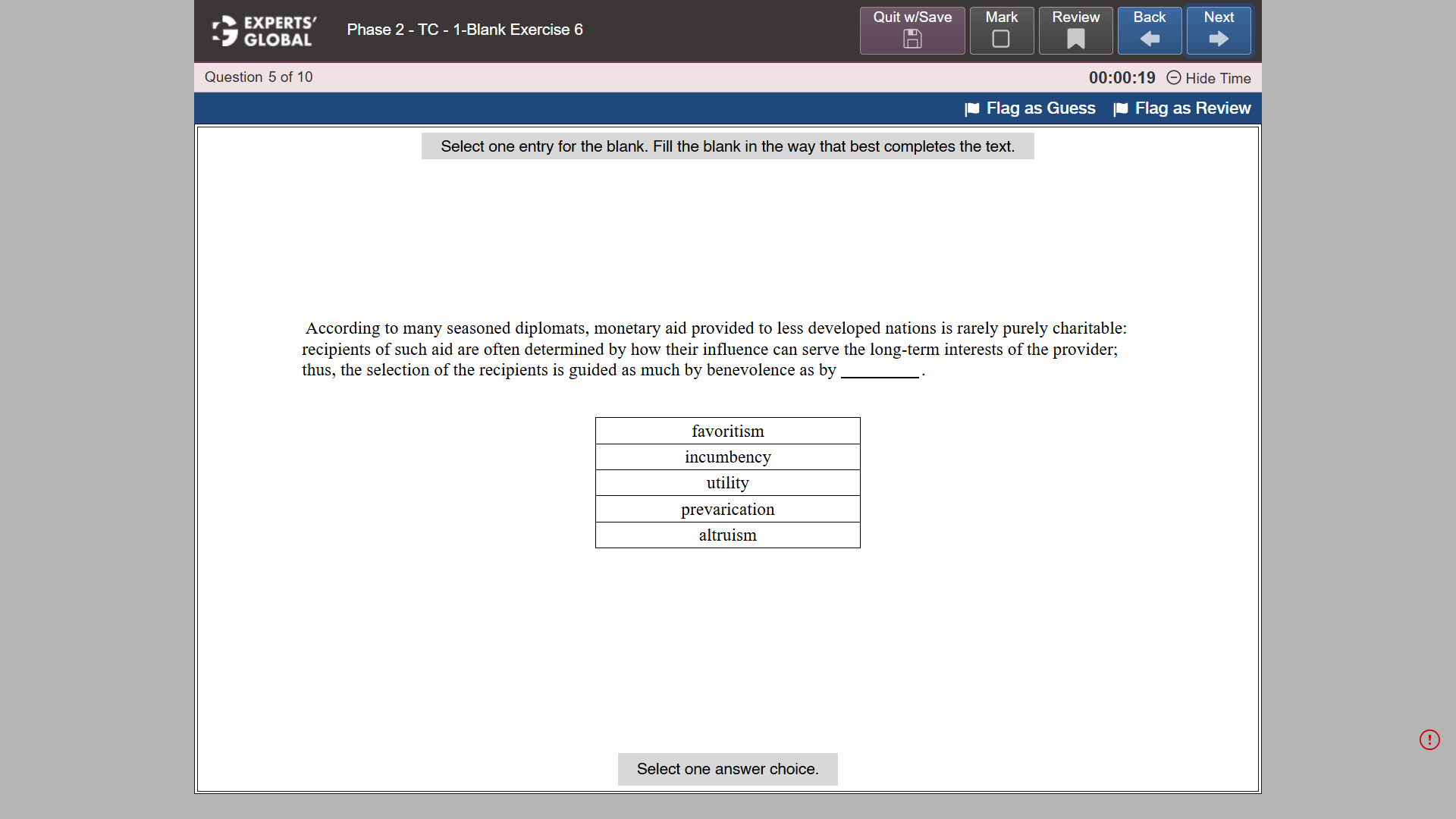
According to many seasoned diplomats, monetary aid provided to less developed nations is rarely purely charitable: recipients of such aid are often determined by how their influence can serve the long-term interests of the provider; thus, the selection of the recipients is guided as much by benevolence as by _____.
A. favoritism
B. incumbency
C. utility
D. prevarication
E. altruism
Written Explanation
The intended core meaning of the sentence: That the selection of aid recipients is guided as much by kindness as by practicality.
Reasoning around the blank space: The catch for filling the blank in this sentence lies in identifying the continuation of thought in the usage “…monetary AID…to less developed nations…is RARELY PURELY CHARITABLE: recipients…determined by how…serve LONG-TERM INTERESTS of the provider; thus…guided as much by benevolence as by _____”, which elaborates on the selection criteria for aid recipients; this continuation of thought suggests that the sentence intends to convey that experienced diplomats believe that aid given to less developed countries is not just about being generous, as aid recipients are often chosen based on how they can benefit the provider’s long-term interests; thus the selection of aid recipients is influenced by both kindness and practicality. Hence, for the blank, we need a word that conveys the idea of the selection of aid recipients being guided as much by benevolence as by “practicality”.
Broad expectation from the correct answer choice: A word conveying a sense of “practicality” or “advantage”.
A. Trap. This answer choice, “favoritism”, meaning “showing unfair preference or bias toward someone”, does not match our broad expectation from the correct answer choice, which is to convey a sense of “practicality” or “advantage”. Hence, this answer choice is incorrect.
B. This answer choice, “incumbency”, meaning “the holding of an office” or “a responsibility”, does not match our broad expectation from the correct answer choice, which is to convey a sense of “practicality” or “advantage”. Hence, this answer choice is incorrect.
C. Correct. This answer choice, “utility”, meaning “the quality of being practical and beneficial”, matches our broad expectation from the correct answer choice, which is to convey a sense of “practicality” or “advantage”. Hence, this answer choice is correct.
D. This answer choice, “prevarication”, meaning “the act of deliberately avoiding the truth”, does not match our broad expectation from the correct answer choice, which is to convey a sense of “practicality” or “advantage”. Hence, this answer choice is incorrect.
E. Trap. This answer choice, “altruism”, meaning “unselfish concern for the welfare of others”, is opposite to our broad expectation from the correct answer choice, which is to convey a sense of “practicality” or “advantage”. Hence, this answer choice is incorrect.
Thus, C is the correct answer choice.
Practice Question 6 | GRE Text Completion 1-Blank
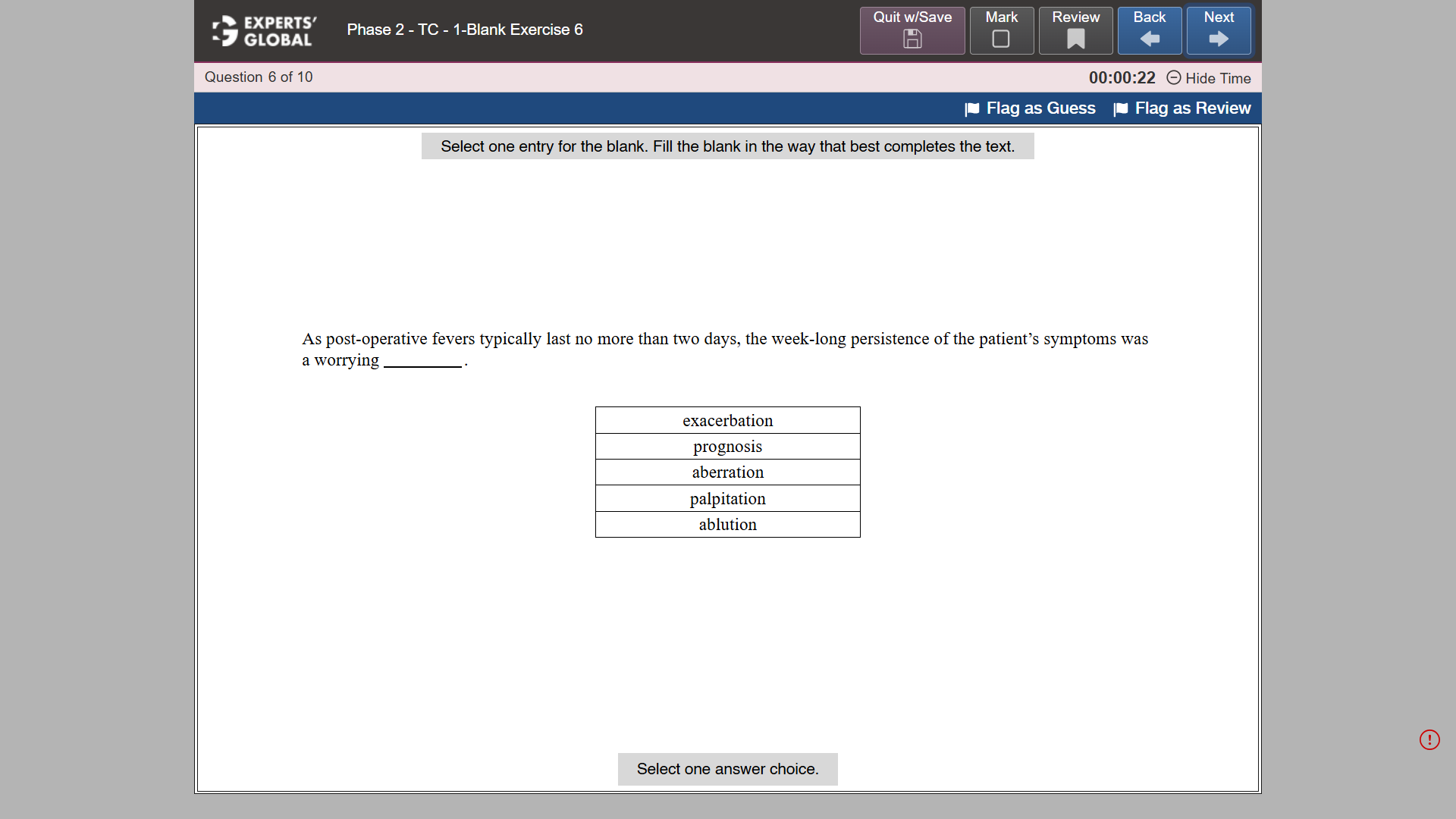
As post-operative fevers typically last no more than two days, the week-long persistence of the patient’s symptoms was a worrying _____.
A. exacerbation
B. prognosis
C. aberration
D. palpitation
E. ablution
Written Explanation
The intended core meaning of the sentence: That the patient’s symptoms lasted a week, instead of the usual two days, was a worrying exception.
Reasoning around the blank space: The catch for filling the blank in this sentence lies in identifying the contrast in the usage “As…fevers TYPICALLY LAST no more than TWO DAYS, the WEEK-LONG…patient’s symptoms was…”, which implies a difference between the rule and the exception to it; this contrast suggests that the sentence intends to convey that as post-operative fevers typically last no more than two days, the week-long continuance of the patient’s symptoms, was a worrying exception. Hence, for the blank, we need a word that conveys the idea of the patient’s symptoms being a worrying “exception”.
Broad expectation from the correct answer choice: A word conveying a sense of “exception” or “rarity”.
A. Trap. This answer choice, “exacerbation”, meaning “making something that is already bad even worse”, does not match our broad expectation from the correct answer choice, which is to convey a sense of “exception” or “rarity”. Hence, this answer choice is incorrect.
B. This answer choice, “prognosis”, meaning “the likely outcome or course of a disease”, does not match our broad expectation from the correct answer choice, which is to convey a sense of “exception” or “rarity”. Hence, this answer choice is incorrect.
C. Correct. This answer choice, “aberration”, meaning “departure from what is normal or usual”, matches our broad expectation from the correct answer choice, which is to convey a sense of “exception” or “rarity”. Hence, this answer choice is correct.
D. This answer choice, “palpitation”, meaning “abnormally rapid beating of the heart”, does not match our broad expectation from the correct answer choice, which is to convey a sense of “exception” or “rarity”. Hence, this answer choice is incorrect.
E. This answer choice, “ablution”, meaning “the act of washing oneself” or “ritual washing of a priest’s hands or sacred vessels”, does not match our broad expectation from the correct answer choice, which is to convey a sense of “exception” or “rarity”. Hence, this answer choice is incorrect.
Thus, C is the correct answer choice.
Practice Question 7 | GRE Text Completion 1-Blank
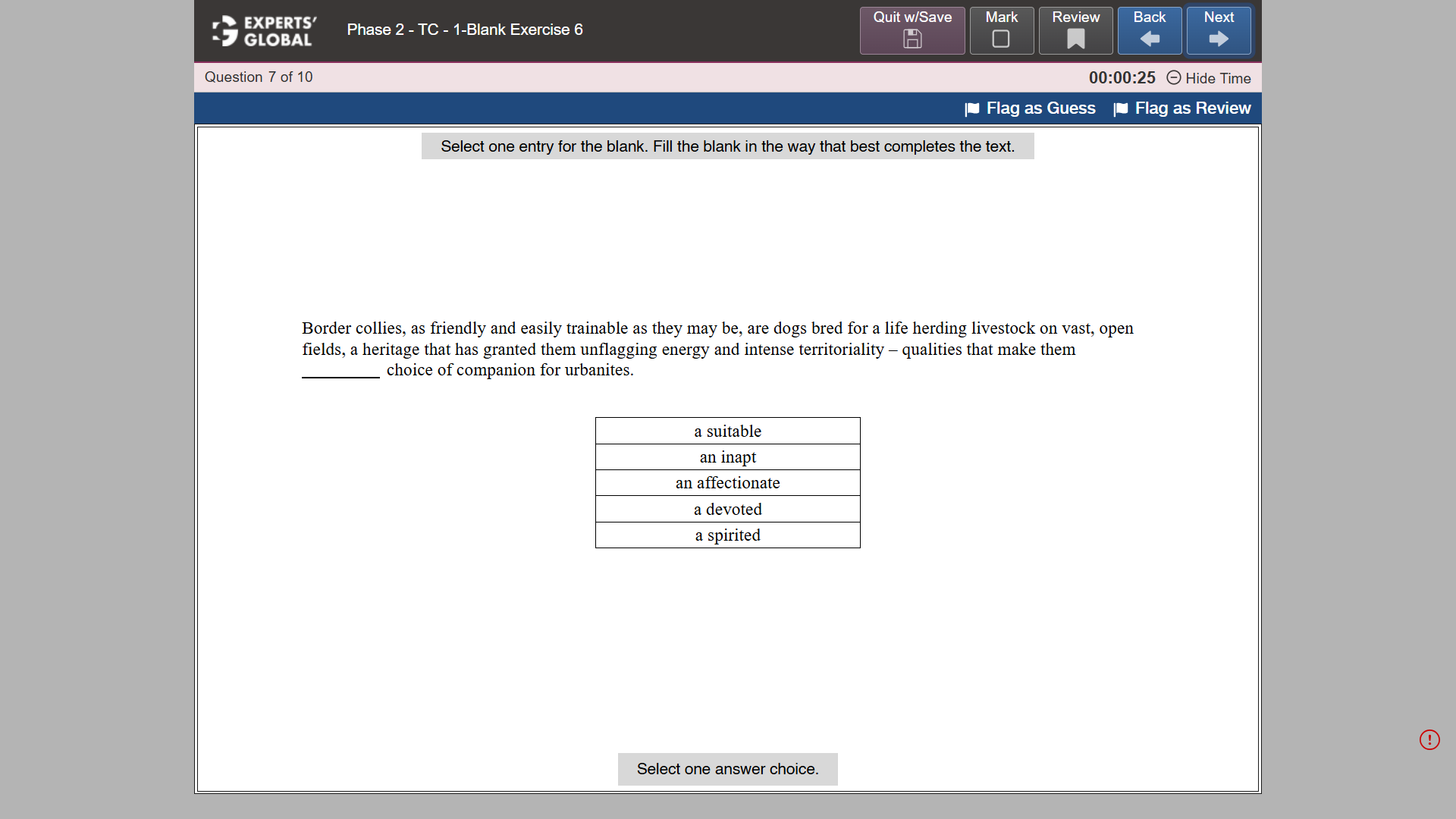
Border collies, as friendly and easily trainable as they may be, are dogs bred for a life herding livestock on vast, open fields, a heritage that has granted them unflagging energy and intense territoriality – qualities that make them _____ choice of companion for urbanites.
A. a suitable
B. an inapt
C. an affectionate
D. a devoted
E. a spirited
Written Explanation
The intended core meaning of the sentence: That despite being friendly, border collies are raised for a life herding cattle in the countryside, making them an unsuitable choice for city dwellers.
Reasoning around the blank space: The catch for filling the blank in this sentence lies in identifying the cause-effect relationship expressed in the usage “Border collies…BRED for a life HERDING LIVESTOCK on…OPEN FIELDS…qualities that MAKE THEM _____ choice of companion for URBANITIES”, which implies certain factors leading to a specific outcome; this causal connection suggests that the sentence intends to convey that border collies, despite being friendly and trainable, are raised for herding cattle in the countryside, a legacy that has granted them high energy and strong protective qualities, which make them an unsuitable choice for city dwellers. Hence, for the blank, we need a word that conveys the idea of qualities that make border collies “an unsuitable” choice of companion for urbanites.
Broad expectation from the correct answer choice: A word conveying the idea of “an unsuitable” or “a wrong”.
A. This answer choice, “a suitable”, meaning “appropriate for a particular purpose”, is opposite to our broad expectation from the correct answer choice, which is to convey the idea of “an unsuitable” or “a wrong”. Hence, this answer choice is incorrect.
B. Correct. This answer choice, “an inapt”, meaning “not suitable for the situation”, matches our broad expectation from the correct answer choice, which is to convey the idea of “an unsuitable” or “a wrong”. Hence, this answer choice is correct.
C. This answer choice, “an affectionate”, meaning “displaying warmth and love”, does not match our broad expectation from the correct answer choice, which is to convey the idea of “an unsuitable” or “a wrong”. Hence, this answer choice is incorrect.
D. This answer choice, “a devoted”, meaning “very loyal and dedicated”, does not match our broad expectation from the correct answer choice, which is to convey the idea of “an unsuitable” or “a wrong”. Hence, this answer choice is incorrect.
E. Trap. This answer choice, “a spirited”, meaning “full of energy” or “lively”, does not match our broad expectation from the correct answer choice, which is to convey the idea of “an unsuitable” or “a wrong”. Hence, this answer choice is incorrect.
Thus, B is the correct answer choice.
Practice Question 8 | GRE Text Completion 1-Blank
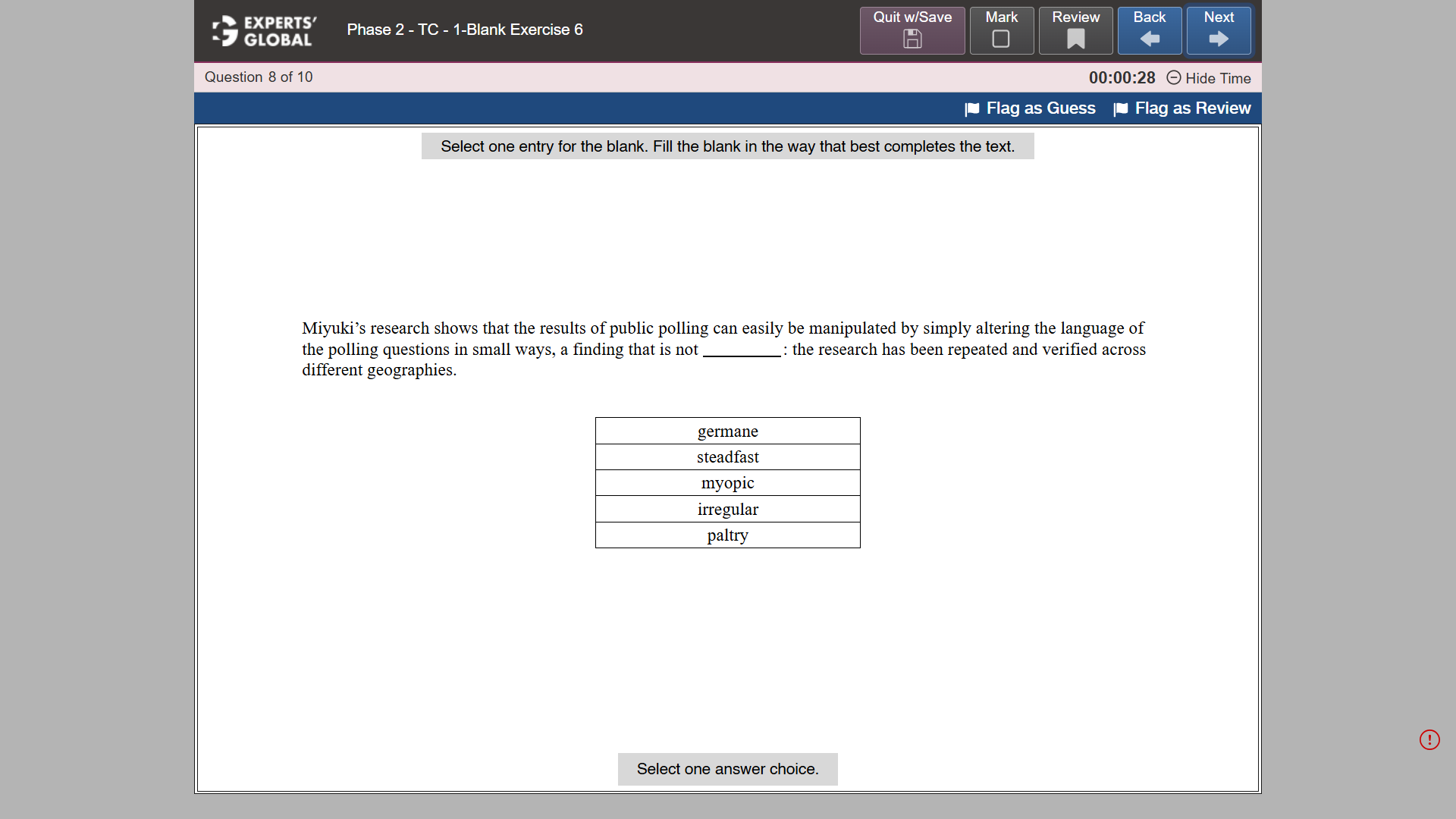
Miyuki’s research shows that the results of public polling can easily be manipulated by simply altering the language of the polling questions in small ways, a finding that is not _____: the research has been repeated and verified across different geographies.
A. germane
B. steadfast
C. myopic
D. irregular
E. paltry
Written Explanation
The intended core meaning of the sentence: That the research’s finding is not incorrect as it has been verified across different geographies.
Reasoning around the blank space: The catch for filling the blank in this sentence lies in identifying the continuation of thought in the usage “…research shows…public polling can…easily…MANIPULATED by…altering language…a FINDING that is NOT _____: the research…been REPEATED and VERIFIED across DIFFERENT GEOGRAPHIES”, which elaborates on the evidence supporting the assertion; this continuation of thought suggests that the sentence intends to convey that Miyuki’s research shows that the results of public polling can easily be influenced by simply changing the language of the polling questions in small ways, a finding that is not incorrect, as the research has been repeated and verified across different geographies. Hence, for the blank, we need a word that conveys the idea of the finding not being “incorrect”.
Broad expectation from the correct answer choice: A word conveying the idea of being “incorrect”.
A. This answer choice, “germane”, meaning “relevant” or “appropriate”, does not match our broad expectation from the correct answer choice, which is to convey the idea of being “incorrect”. Hence, this answer choice is incorrect.
B. This answer choice, “steadfast”, meaning “dependable” or “reliable”, is opposite to our broad expectation from the correct answer choice, which is to convey the idea of being “incorrect”. Hence, this answer choice is incorrect.
C. Trap. This answer choice, “myopic”, meaning “focusing only on immediate concerns” or “nearsighted”, does not match our broad expectation from the correct answer choice, which is to convey the idea of being “incorrect”. Hence, this answer choice is incorrect.
D. Correct. This answer choice, “irregular”, meaning “contrary to accepted order” or “uneven”, matches our broad expectation from the correct answer choice, which is to convey the idea of being “incorrect”. Hence, this answer choice is correct.
E. This answer choice, “paltry”, meaning “very small” or “unimportant”, does not match our broad expectation from the correct answer choice, which is to convey the idea of being “incorrect”. Hence, this answer choice is incorrect.
Thus, D is the correct answer choice.
Practice Question 9 | GRE Text Completion 1-Blank
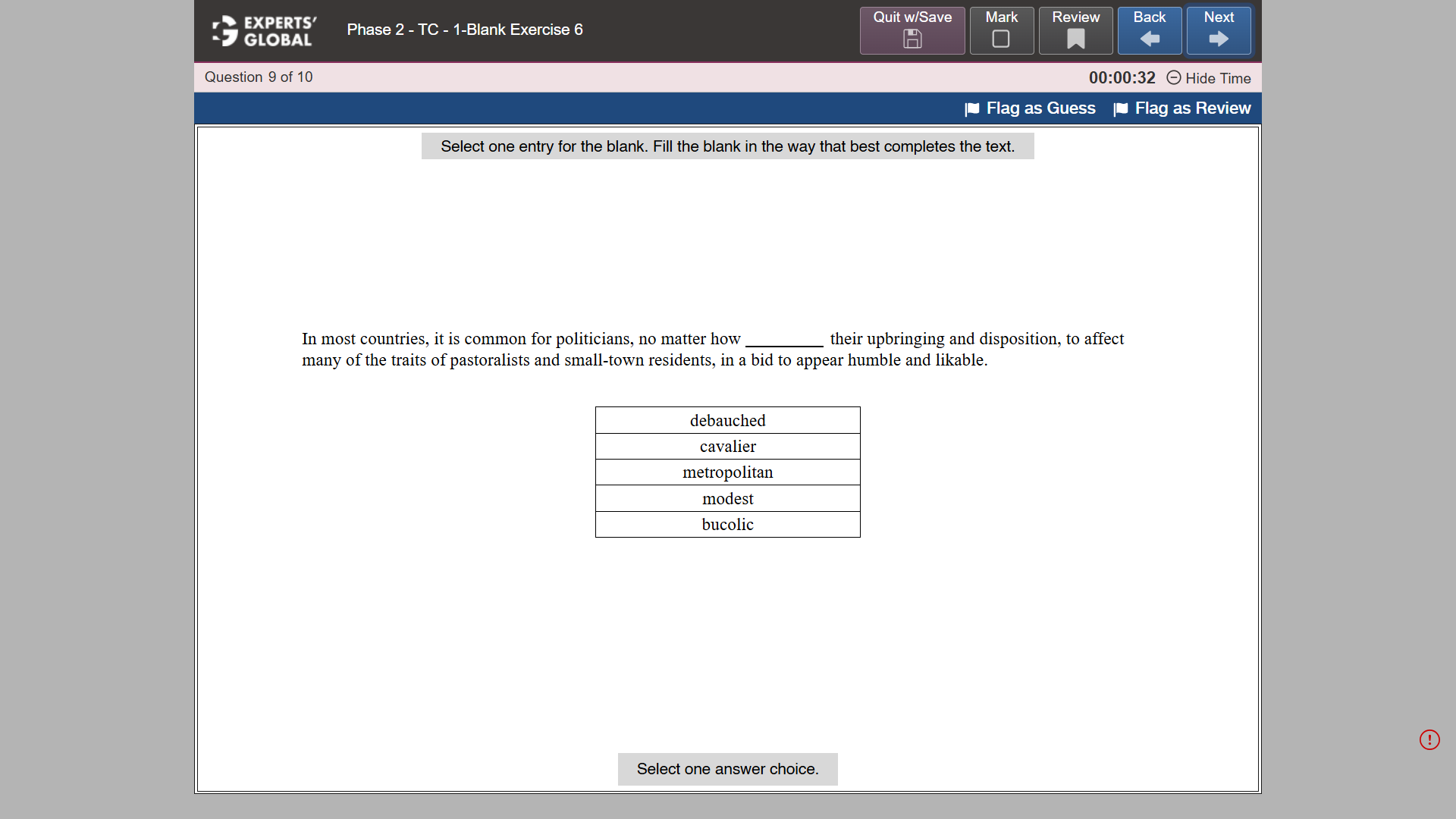
In most countries, it is common for politicians, no matter how _____ their upbringing and disposition, to affect many of the traits of pastoralists and small-town residents, in a bid to appear humble and likable.
A. debauched
B. cavalier
C. metropolitan
D. modest
E. bucolic
Written Explanation
The intended core meaning of the sentence: That in most countries, despite having an urban background, politicians often act like humble villagers to cultivate a mass appeal.
Reasoning around the blank space: The catch for filling the blank in this sentence lies in identifying the contrast in the usage “…it is common for politicians, NO MATTER how _____ their UPBRINGING…AFFECT…traits of PASTORALISTS and…to APPEAR HUMBLE…”, which implies a difference between the politicians’ origins and their seeming persona; this contrast suggests that the sentence intends to convey that in most countries, it is common for politicians, no matter how urban their upbringing and temperament, to act like farmers and small-town residents, in an attempt to appear humble and likable. Hence, for the blank, we need a word that conveys the idea of politicians having an “urban” upbringing and disposition.
Broad expectation from the correct answer choice: A word conveying the idea of being “urban” or “sophisticated”.
A. This answer choice, “debauched”, meaning “morally corrupt” or “unrestrained”, does not match our broad expectation from the correct answer choice, which is to convey the idea of being “urban” or “sophisticated”. Hence, this answer choice is incorrect.
B. This answer choice, “cavalier”, meaning “showing a lack of proper concern or respect”, does not match our broad expectation from the correct answer choice, which is to convey the idea of being “urban” or “sophisticated”. Hence, this answer choice is incorrect.
C. Correct. This answer choice, “metropolitan”, meaning “relating to a major city”, matches our broad expectation from the correct answer choice, which is to convey the idea of being “urban” or “sophisticated”. Hence, this answer choice is correct.
D. This answer choice, “modest”, meaning “humble” or “inferior in station”, is opposite to our broad expectation from the correct answer choice, which is to convey the idea of being “urban” or “sophisticated”. Hence, this answer choice is incorrect.
E. This answer choice, “bucolic”, meaning “relating to the pleasant aspects of the countryside and rural life”, is opposite to our broad expectation from the correct answer choice, which is to convey the idea of being “urban” or “sophisticated”. Hence, this answer choice is incorrect.
Thus, C is the correct answer choice.
Practice Question 10 | GRE Text Completion 1-Blank
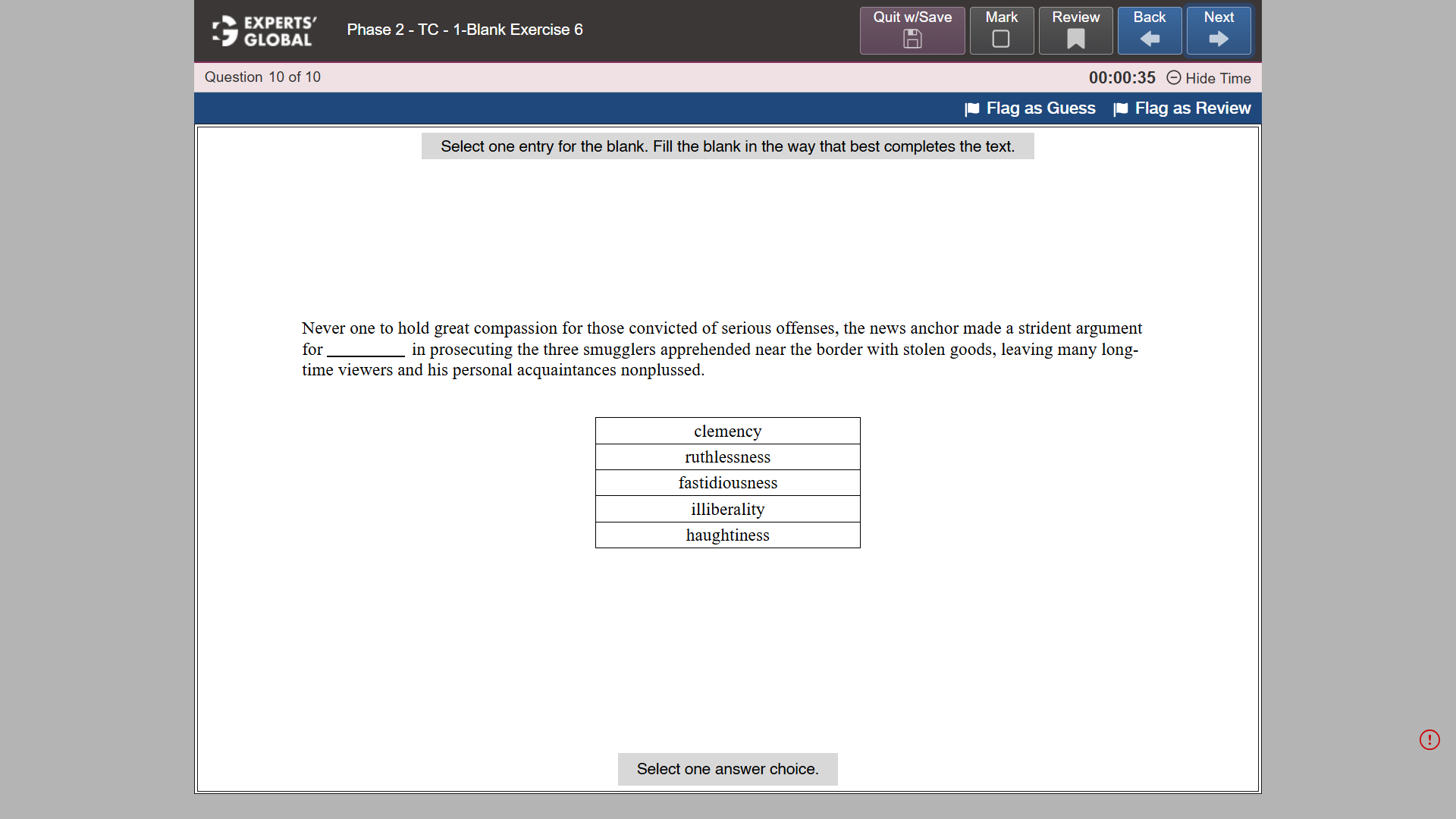
Never one to hold great compassion for those convicted of serious offenses, the news anchor made a strident argument for _____ in prosecuting the three smugglers apprehended near the border with stolen goods, leaving many long-time viewers and his personal acquaintances nonplussed.
A. clemency
B. ruthlessness
C. fastidiousness
D. illiberality
E. haughtiness
Written Explanation
The intended core meaning of the sentence: That though usually tough on offenders, the anchor argued for mercy in prosecuting the three smugglers, leaving audiences puzzled.
Reasoning around the blank space: The catch for filling the blank in this sentence lies in identifying the contrast in the usage “NEVER one to hold…COMPASSION for those CONVICTED of serious offenses…anchor made…STRIDENT ARGUMENT for _____ in prosecuting the THREE SMUGGLERS…leaving many long-time viewers…NONPLUSSED”, which implies a difference between the anchor’s usual attitude and his unexpected argument in the case of the smugglers; this contrast suggests that the sentence intends to convey that though never known to be kind to those sentenced for serious offenses, the news anchor passionately argued for mercy in prosecuting the three smugglers caught with stolen goods near the border, leaving many long-time viewers and his acquaintances puzzled. Hence, for the blank, we need a word that conveys the idea of the news anchor making a strident argument for “mercy” in prosecuting the three smugglers.
Broad expectation from the correct answer choice: A word conveying the idea of “mercy”.
A. Correct. This answer choice, “clemency”, meaning “mercy shown toward someone”, matches our broad expectation from the correct answer choice, which is to convey the idea of “mercy”. Hence, this answer choice is correct.
B. This answer choice, “ruthlessness”, meaning “the quality of being without pity or compassion”, is opposite to our broad expectation from the correct answer choice, which is to convey the idea of “mercy”. Hence, this answer choice is incorrect.
C. This answer choice, “fastidiousness”, meaning “the quality of being very attentive to detail”, does not match our broad expectation from the correct answer choice, which is to convey the idea of “mercy”. Hence, this answer choice is incorrect.
D. This answer choice, “illiberality”, meaning “the tendency to not be generous with money”, does not match our broad expectation from the correct answer choice, which is to convey the idea of “mercy”. Hence, this answer choice is incorrect.
E. This answer choice, “haughtiness”, meaning “an attitude of superiority toward others”, does not match our broad expectation from the correct answer choice, which is to convey the idea of “mercy”. Hence, this answer choice is incorrect.
Thus, A is the correct answer choice.
GRE-style Text Completion 1-Blank Questions with Explanations:
Please find a set of GRE-style TC 1-blank questions with explanations on: Free GRE Text Completion 1-Blank Practice Questions with Solutions
Please find a set of GRE-style TC questions with explanations on: Free GRE Text Completion Practice Questions with Solutions
Please find a set of assorted GRE-style Verbal questions (all types) with explanations on: Free GRE Verbal Practice Questions with Solutions
Please find a set of assorted GRE-style questions (all sections and types) with explanations on: Free GRE Practice Questions with Solutions
For Further GRE Prep and Practice…
End to end online GRE preparation course with free trial
15 GRE full length mocks
60 GRE sectional mocks
Free GRE full length diagnostic mock
GRE prep plus graduate admission consulting