Text completion three-blank questions present a short, dense passage with three words missing, along with three answer choices for each blank. Your task is to select one of the three answer choices for each blank so that the result forms a complete and coherent passage. The three blanks work together in deciding the correct combination of choices, which makes this question type particularly interesting. Generally, out of the 27 questions in the GRE Verbal Reasoning, 2 or 3 are text completion three-blank question types; thus, due coverage of this format, along with its strategy and practice, is essential in an end-to-end GRE preparation course. On this page, we present a rich GRE three-blank practice questions set with detailed explanations. Make good use of this resource and apply the learnings in further GRE sectional practice as well as GRE full-length practice.
Important: If you need to undergo thorough Text Completion Three-Blank preparation, please visit Free GRE Text Completion Three-Blank prep
Practice Question 1 | GRE Text Completion 3-Blank
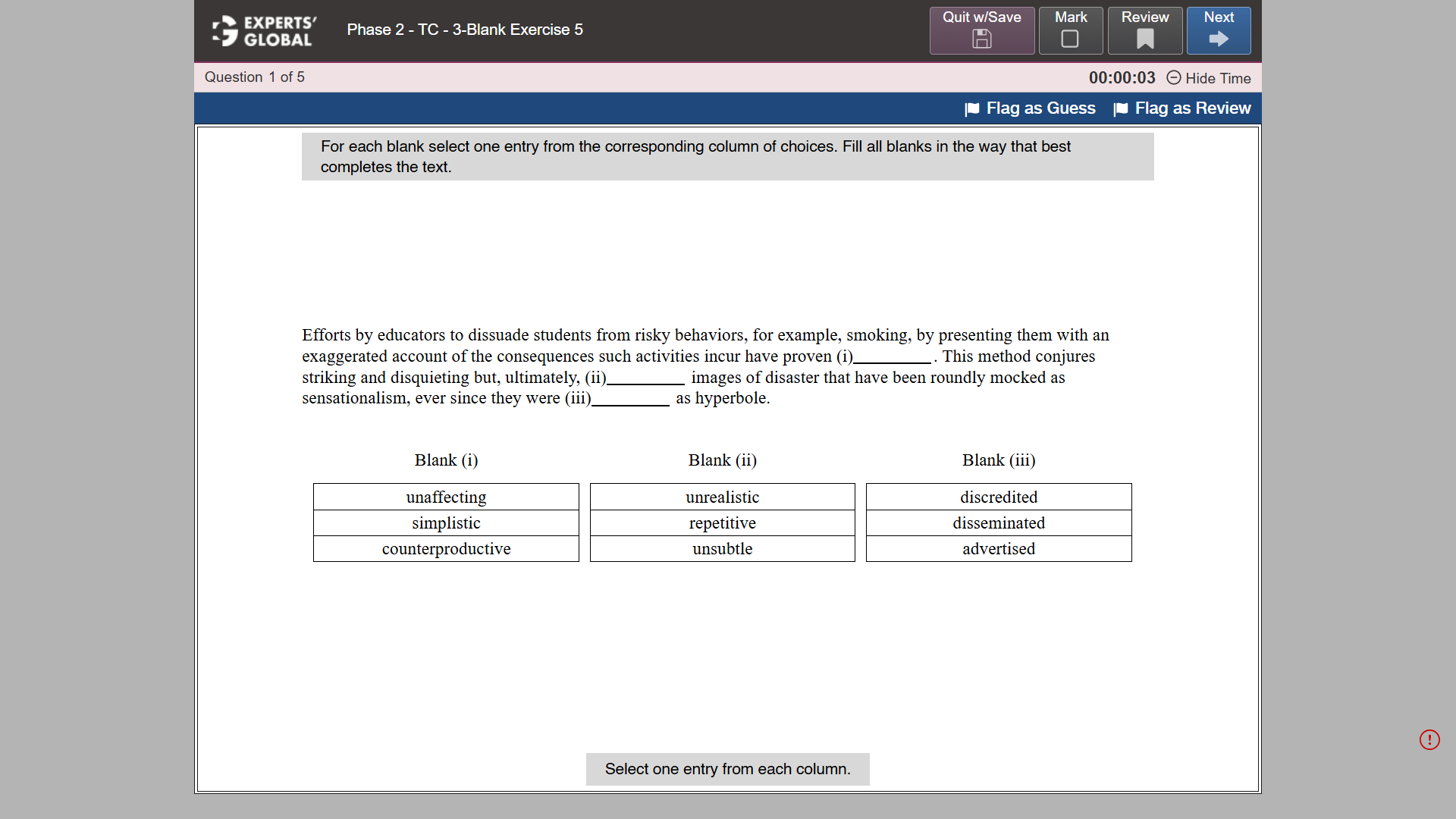
Efforts by educators to dissuade students from risky behaviors, for example, smoking, by presenting them with an exaggerated account of the consequences such activities incur have proven (i)_____. This method conjures striking and disquieting but, ultimately, (ii)_____images of disaster that have been roundly mocked as sensationalism, ever since they were (iii)_____ as hyperbole.
Blank (i)
A. unaffecting
B. simplistic
C. counterproductive
Blank (ii)
D. unrealistic
E. repetitive
F. unsubtle
Blank (iii)
G. discredited
H. disseminated
I. advertised
Written Explanation
Reasoning:
The usage of the phrase “ever since they were…as hyperbole” to refer to “images of disaster” indicates that the third blank refers to an action that could, logically, describe the process of establishing an “image” as “hyperbole”. Therefore, the most fitting answer choice for blank (iii) is G – “discredited”.
The usage of the clause “This method conjures striking and disquieting but, ultimately…images of disaster” in conjunction with the phrase “that have been roundly mocked as sensationalism” indicates that the second blank refers to a characteristic of “images” that can, logically, lead to them being considered “sensationalism”. Therefore, the most fitting answer choice for blank (ii) is D – “unrealistic”; “unsubtle” may seem like a good choice, as a claim made without nuance could also be considered sensationalist, but “sensationalism” implies exaggeration, and “unsubtle” does not necessarily mean “inaccurate”; a claim can be made bluntly while still accurately representing reality.
The usage of the phrase “have proven…” in conjunction with “Efforts by educators to dissuade students from risky behaviors” indicates that the first blank characterizes these “Efforts”, and the usage of the clause formed by the second blank – “This method conjures striking and disquieting but, ultimately, unrealistic images of disaster that have been roundly mocked as sensationalism” implies that these “Efforts” became a target of derision and may have promoted a distorted view of the issue they were meant to address. Therefore, the most fitting answer choice for blank (i) is C – “counterproductive”.
Correct combination of answer choices:
C. “counterproductive”, meaning “having the opposite of the desired effect”.
D. “unrealistic”, meaning “false” or “impractical”.
G. “discredited”, meaning “rejected as false”.
The aforesaid combination of answer choices leads to a logical and coherent completion of the paragraph.
Incorrect answer choices:
A. This answer choice “unaffecting”, meaning “not producing an emotional response”, cannot form a logical combination of answer choices for a coherent completion of the paragraph. Hence, this answer choice is incorrect.
B. This answer choice “simplistic”, meaning “treating severe problems with misleading simplicity”, cannot form a logical combination of answer choices for a coherent completion of the paragraph. Hence, this answer choice is incorrect.
E. This answer choice “repetitive”, meaning “frequently repeated”, cannot form a logical combination of answer choices for a coherent completion of the paragraph. Hence, this answer choice is incorrect.
F. This answer choice “unsubtle”, meaning “clear”, cannot form a logical combination of answer choices for a coherent completion of the paragraph. Hence, this answer choice is incorrect.
H. This answer choice “disseminated”, meaning “spread widely”, cannot form a logical combination of answer choices for a coherent completion of the paragraph. Hence, this answer choice is incorrect.
I. This answer choice “advertised”, meaning “made known publicly”, cannot form a logical combination of answer choices for a coherent completion of the paragraph. Hence, this answer choice is incorrect.
Thus, C, D, and G are the correct combination of answer choices.
Practice Question 2 | GRE Text Completion 3-Blank
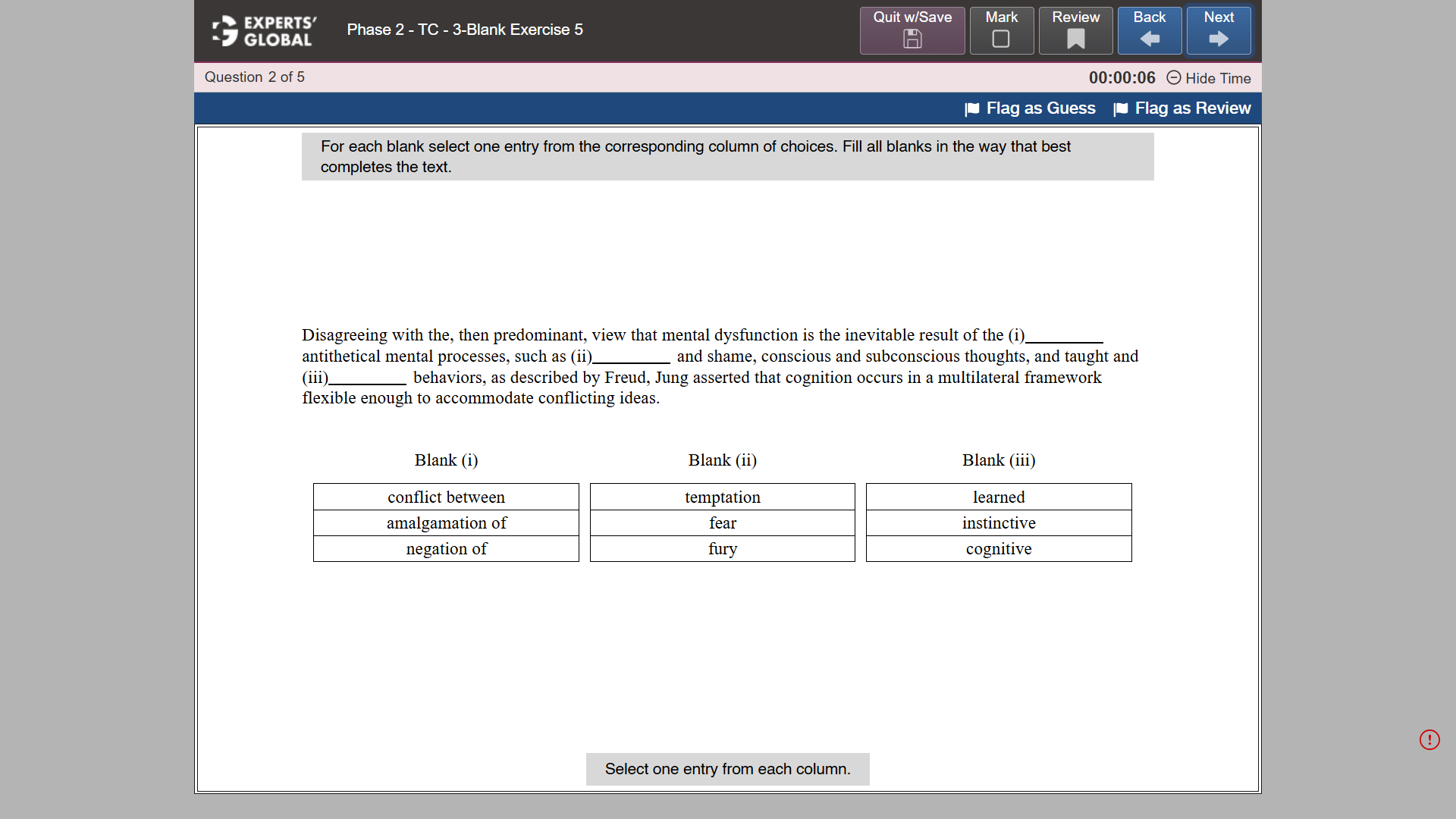
Disagreeing with the, then predominant, view that mental dysfunction is the inevitable result of the (i)_____antithetical mental processes, such as (ii)_____and shame, conscious and subconscious thoughts, and taught and (iii)_____behaviors, as described by Freud, Jung asserted that cognition occurs in a multilateral framework flexible enough to accommodate conflicting ideas.
Blank (i)
A. conflict between
B. amalgamation of
C. negation of
Blank (ii)
D. temptation
E. fear
F. fury
Blank (iii)
G. learned
H. instinctive
I. cognitive
Written Explanation
Reasoning:
The usage of the phrase “antithetical mental processes” in conjunction with “such as”, as well as the usage of the phrase “conscious and subconscious thoughts” indicates that the following list consists of antonymous pairs. Hence, the usage of the phrase “…and shame” indicates that the second blank must be something opposite to “shame”. Therefore, the only fitting answer choice is D – “temptation”.
The usage of the phrase “taught and …behaviors” indicates that the third blank must describe a type of behavior opposite to “taught behaviors”. Therefore, the most fitting answer choice for blank (iii) is H – “instinctive”.
The usage of the clause “Jung asserted that cognition occurs in a multilateral framework flexible enough to accommodate conflicting ideas” conveys that as per Jung, contrasting ideas, or “mental processes”, can exist in one’s mind simultaneously; hence, the usage of the phrase “Disagreeing with the, then predominant, view” to describe Jung’s assertion indicates that this “view” was contrary to Jung’s assertion. Thus, from the usage of the clause “mental dysfunction is the inevitable result of the…antithetical mental processes”, we can conclude that the clause formed by the first blank must convey that contrasting ideas, or “antithetical mental processes”, cannot exist simultaneously, meaning they are in conflict. Therefore, the most fitting answer choice for blank (i) is A – “conflict between”.
Correct combination of answer choices:
A. “conflict between”, meaning “struggle between”.
D. “temptation”, meaning “urge”.
H. “instinctive”, meaning “naturally occurring”.
The aforesaid combination of answer choices leads to a logical and coherent completion of the paragraph.
Incorrect answer choices:
B. This answer choice “amalgamation of”, meaning “combination of”, cannot form a logical combination of answer choices for a coherent completion of the paragraph. Hence, this answer choice is incorrect.
C. This answer choice “negation of”, meaning “rejection of”, cannot form a logical combination of answer choices for a coherent completion of the paragraph. Hence, this answer choice is incorrect.
E. Trap. This answer choice “fear”, meaning “emotion experienced in response to danger”, cannot form a logical combination of answer choices for a coherent completion of the paragraph. Hence, this answer choice is incorrect.
F. This answer choice “fury”, meaning “intense anger”, cannot form a logical combination of answer choices for a coherent completion of the paragraph. Hence, this answer choice is incorrect.
G. This answer choice “learned”, meaning “developed knowledge through education”, cannot form a logical combination of answer choices for a coherent completion of the paragraph. Hence, this answer choice is incorrect.
I. Trap. This answer choice “cognitive”, meaning “related to mental processes”, cannot form a logical combination of answer choices for a coherent completion of the paragraph. Hence, this answer choice is incorrect.
Thus, A, D, and H are the correct combination of answer choices.
Practice Question 3 | GRE Text Completion 3-Blank
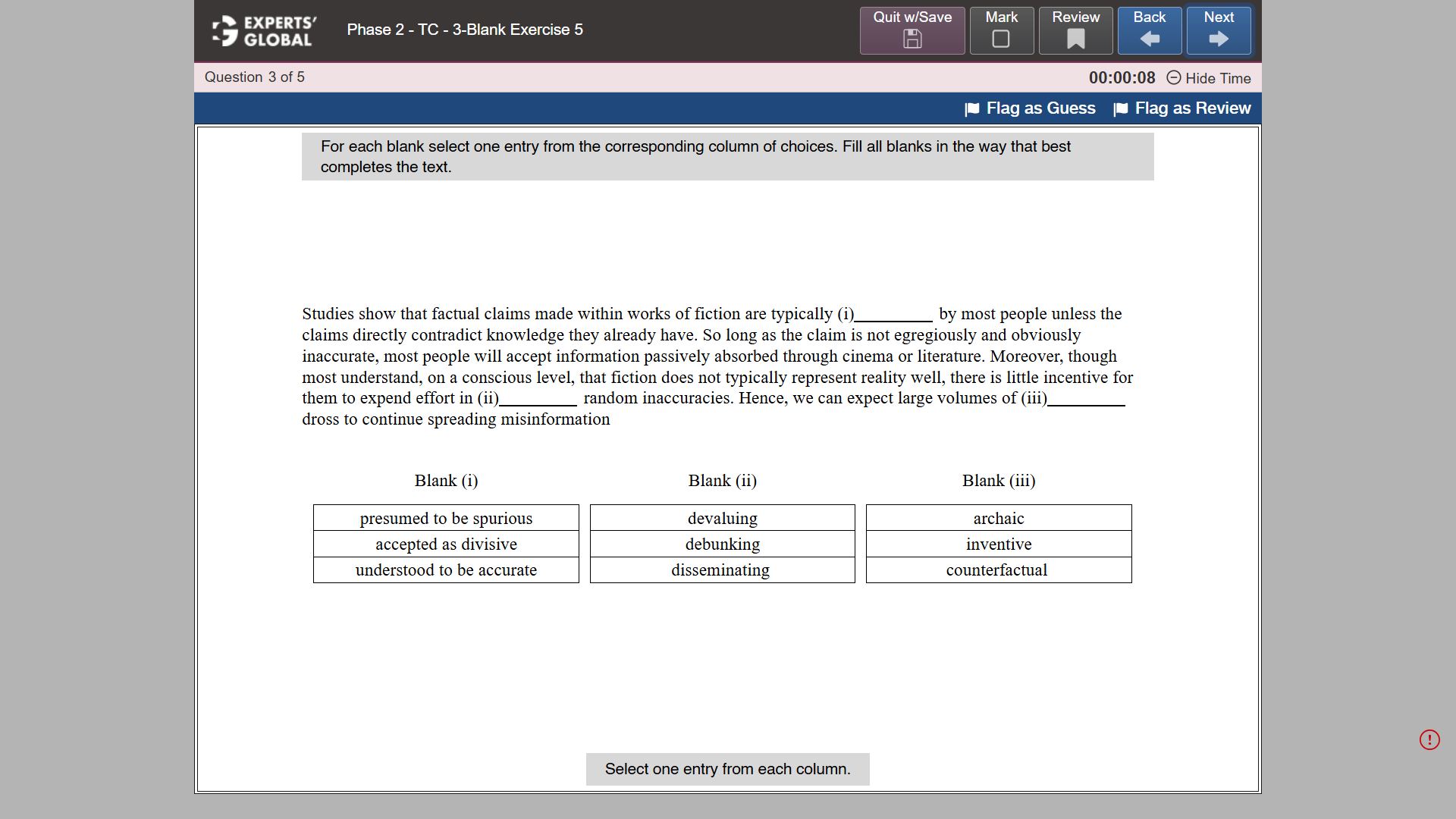
Studies show that factual claims made within works of fiction are typically (i)_____by most people unless the claims directly contradict knowledge they already have. So long as the claim is not egregiously and obviously inaccurate, most people will accept information passively absorbed through cinema or literature. Moreover, though most understand, on a conscious level, that fiction does not typically represent reality well, there is little incentive for them to expend effort in (ii)_____random inaccuracies. Hence, we can expect large volumes of (iii)_____dross to continue spreading misinformation
Blank (i)
A. presumed to be spurious
B. accepted as divisive
C. understood to be accurate
Blank (ii)
D. devaluing
E. debunking
F. disseminating
Blank (iii)
G. archaic
H. inventive
I. counterfactual
Written Explanation
Reasoning:
The usage of the clause “factual claims made within works of fiction are typically…by most people” in conjunction with the contrasting phrase “unless the claims directly contradict knowledge they already have” indicates that the first blank characterizes the typical reaction to a certain type of factual claim, and this reaction is the converse of the typical reaction to a factual claim against which one possesses strong evidence; logically, one would reject a claim that one has clear evidence against, so the first blank must convey acceptance of the claims. Therefore, the only fitting answer choice for blank (i) is C – “understood to be accurate”.
The usage of the contrasting phrase “though most understand” in conjunction with “that fiction does not typically represent reality well” and the clause “there is little incentive for them to expend effort in…random inaccuracies” forms a double negative, meaning that the clause formed by the second blank refers to an action one would be likely to take if one understood that fiction typically contains factual inaccuracies; logically, a natural reaction to encountering “random inaccuracies” under such circumstances is to correct them. Therefore, the only logical answer choice for blank (ii) is E – “debunking”.
The usage of the clause “we can expect large volumes of…dross to continue spreading misinformation” indicates that the third blank refers to a characteristic typical of something that spreads misinformation; on this basis, we can eliminate “inventive”. Of the remaining answer choices, “archaic” can also be eliminated: the usage of “Hence” in conjunction with “we can expect large volumes of…dross to continue spreading misinformation” indicates that this assertion is based on the information provided in the preceding three sentences, and these sentences do not indicate that inaccuracies commonly found in fiction are solely the result of outdated information: they refer to inaccuracies of all kind with no specific cause or source. Therefore, the most fitting answer choice for blank (iii) is I – “counterfactual”.
Correct combination of answer choices:
C. “understood to be accurate”, meaning “believed to be true”.
E. “debunking”, meaning “exposing the falseness of”.
I. “counterfactual”, meaning “opposite to the truth”.
The aforesaid combination of answer choices leads to a logical and coherent completion of the paragraph.
Incorrect answer choices:
A. This answer choice “presumed to be spurious”, meaning “taken to be false”, cannot form a logical combination of answer choices for a coherent completion of the paragraph. Hence, this answer choice is incorrect.
B. This answer choice “accepted as divisive”, meaning “considered to cause disagreement”, cannot form a logical combination of answer choices for a coherent completion of the paragraph. Hence, this answer choice is incorrect.
D. This answer choice “devaluing”, meaning “reducing the value of”, cannot form a logical combination of answer choices for a coherent completion of the paragraph. Hence, this answer choice is incorrect.
F. This answer choice “disseminating”, meaning “distributing”, cannot form a logical combination of answer choices for a coherent completion of the paragraph. Hence, this answer choice is incorrect.
G. This answer choice “archaic”, meaning “very old”, cannot form a logical combination of answer choices for a coherent completion of the paragraph. Hence, this answer choice is incorrect.
H. This answer choice “inventive”, meaning “creative”, cannot form a logical combination of answer choices for a coherent completion of the paragraph. Hence, this answer choice is incorrect.
Thus, C, E, and I are the correct combination of answer choices.
Practice Question 4 | GRE Text Completion 3-Blank
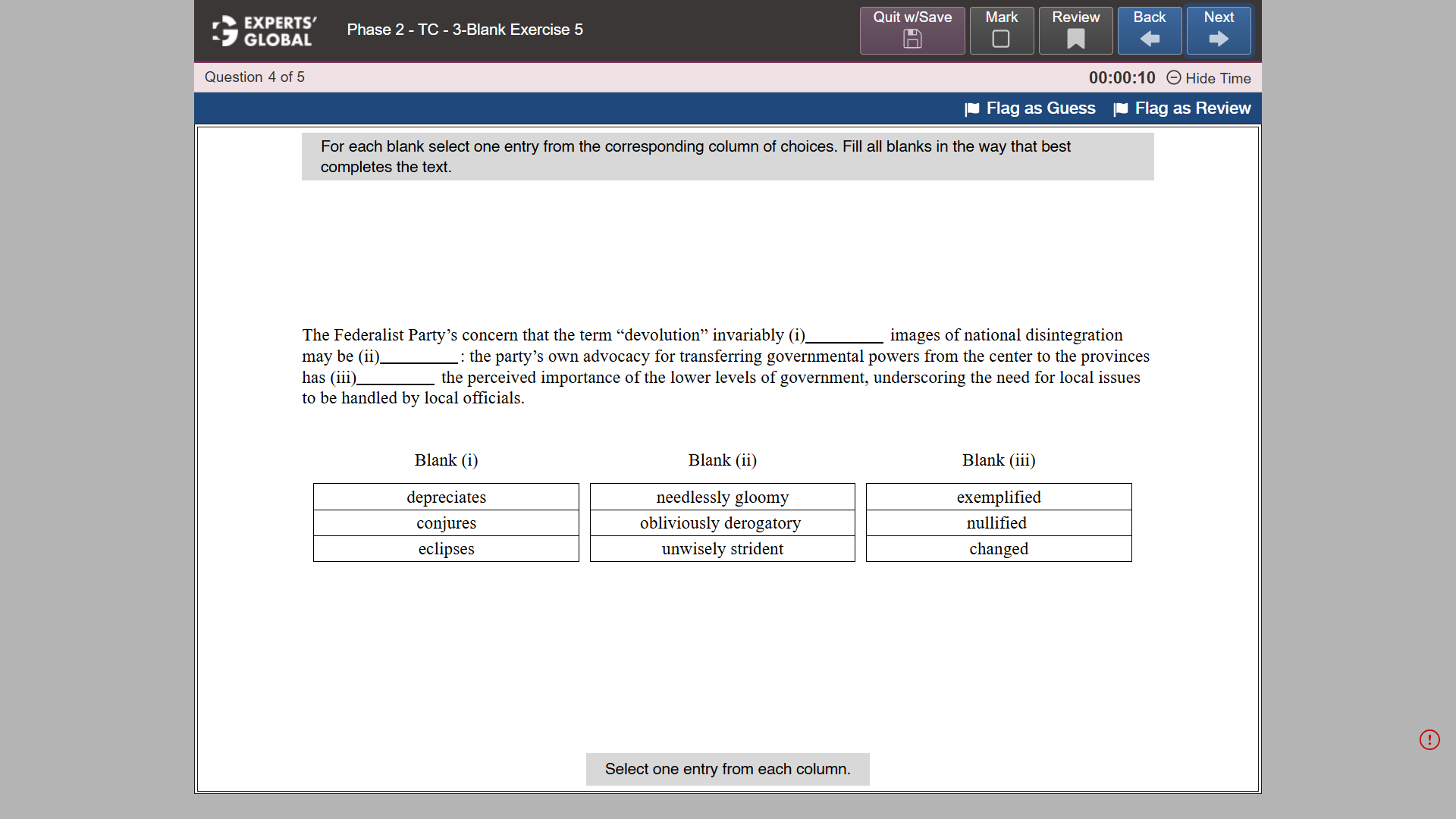
The Federalist Party’s concern that the term “devolution” invariably (i)_____images of national disintegration may be (ii)_____: the party’s own advocacy for transferring governmental powers from the center to the provinces has (iii)_____the perceived importance of the lower levels of government, underscoring the need for local issues to be handled by local officials.
Blank (i)
A. depreciates
B. conjures
C. eclipses
Blank (ii)
D. needlessly gloomy
E. obliviously derogatory
F. unwisely strident
Blank (iii)
G. exemplified
H. nullified
I. changed
Written Explanation
Reasoning:
“depreciates” can be eliminated, as “images” cannot logically be said to “depreciate”. Further, the term “devolution”, in this context, refers to decentralization, the transfer of power away from the national government; hence, the meaning it conveys is very much in line with “images of national disintegration”; as such, it makes little sense to suggest that the term “devolution” could “eclipse” images of national disintegration, as it is more likely to produce such images. Therefore, the only fitting answer choice for blank (i) is B – “conjures”.
The usage of the clause “the party’s own advocacy for transferring governmental powers from the center to the provinces” in conjunction with “has…the perceived importance of the lower levels of government” indicates that the third blank characterizes how “advocacy for transferring governmental powers from the center to the provinces” has affected people’s perception of how important the lower levels of government are. Further, the fact that the Federalist Party is concerned that “the term “devolution” invariably conjures images of national disintegration” implies that transferring power to the lower levels of government is unpopular; in other words, the perceived importance of lower levels of government is low; hence, “exemplified” can be eliminated. Although “nullified” is a better answer choice, it is too strong: it cannot be inferred that the party’s advocacy has eliminated the prior perception of the importance of lower levels of government. Thus, the best answer choice for blank (iii) is I – “changed”.
The clause “The Federalist Party’s concern that the term “devolution” invariably conjures images of national disintegration may be…” indicates that the second blank characterizes a potential evaluation of the party’s concern, and the clause formed by the third blank “the party’s own advocacy for transferring governmental powers from the center to the provinces has changed the perceived importance of the lower levels of government” implies that the party’s concern may be unfounded. Therefore, the best answer choice for blank (ii) is D – “needlessly gloomy”.
Correct combination of answer choices:
B. “conjures”, meaning “brings to mind” or “causes a spirit to appear by magic”.
D. “needlessly gloomy”, meaning “unnecessarily depressing”.
I. “changed”, meaning “made something different”.
The aforesaid combination of answer choices leads to a logical and coherent completion of the paragraph.
Incorrect answer choices:
A. This answer choice “depreciates”, meaning “lowers the value of”, cannot form a logical combination of answer choices for a coherent completion of the paragraph. Hence, this answer choice is incorrect.
C. This answer choice “eclipses”, meaning “outshines”, cannot form a logical combination of answer choices for a coherent completion of the paragraph. Hence, this answer choice is incorrect.
E. This answer choice “obliviously derogatory”, meaning “unknowingly insulting”, cannot form a logical combination of answer choices for a coherent completion of the paragraph. Hence, this answer choice is incorrect.
F. This answer choice “unwisely strident”, meaning “foolishly harsh”, cannot form a logical combination of answer choices for a coherent completion of the paragraph. Hence, this answer choice is incorrect.
G. This answer choice “exemplified”, meaning “shown by example”, cannot form a logical combination of answer choices for a coherent completion of the paragraph. Hence, this answer choice is incorrect.
H. This answer choice “delineated”, meaning “specified”, cannot form a logical combination of answer choices for a coherent completion of the paragraph. Hence, this answer choice is incorrect.
Thus, B, D, and I are the correct combination of answer choices.
Practice Question 5 | GRE Text Completion 3-Blank
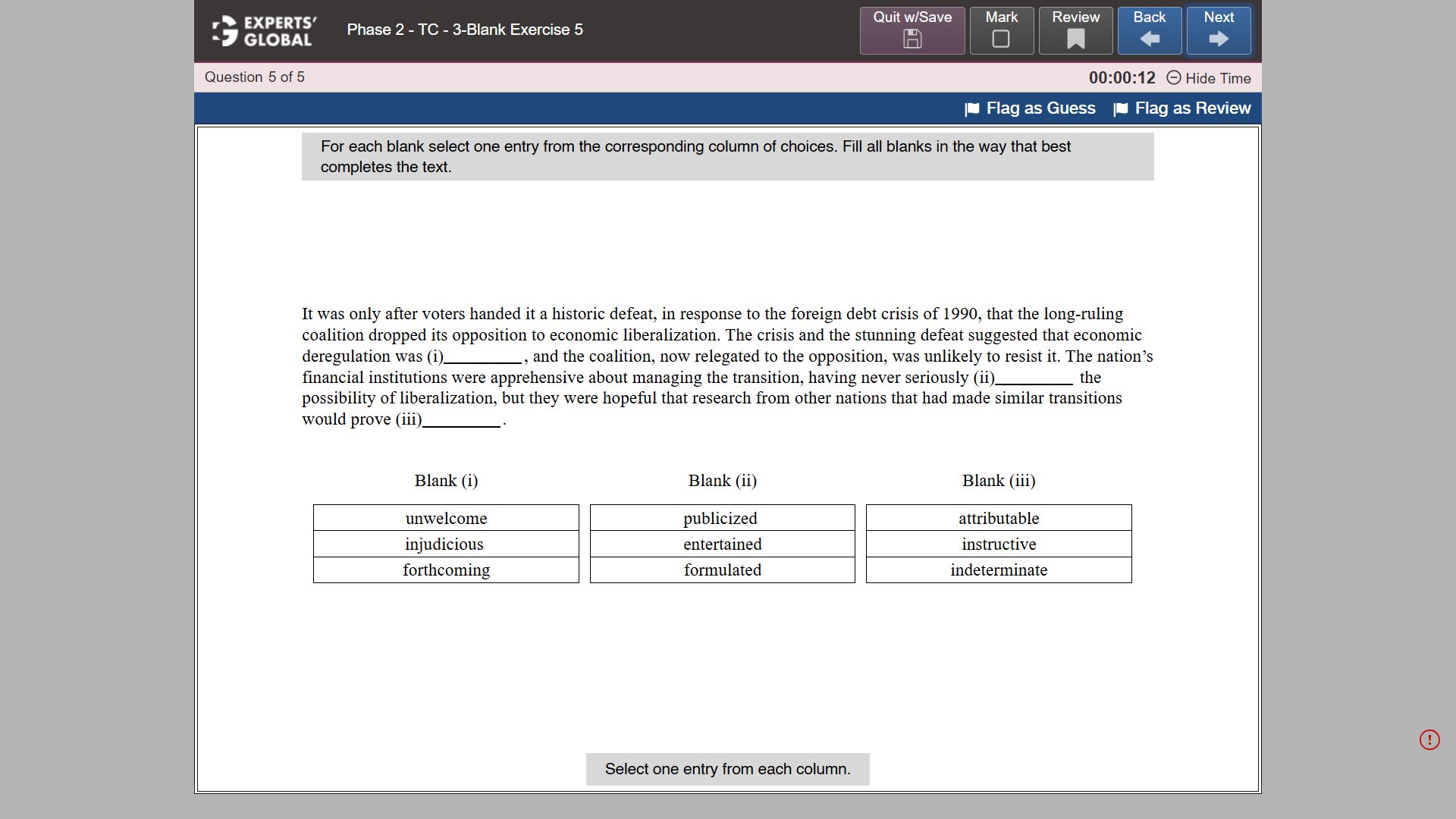
It was only after voters handed it a historic defeat, in response to the foreign debt crisis of 1990, that the long-ruling coalition dropped its opposition to economic liberalization. The crisis and the stunning defeat suggested that economic deregulation was (i)_____, and the coalition, now relegated to the opposition, was unlikely to resist it. The nation’s financial institutions were apprehensive about managing the transition, having never seriously (ii)_____the possibility of liberalization, but they were hopeful that research from other nations that had made similar transitions would prove (iii)_____.
Blank (i)
A. unwelcome
B. injudicious
C. forthcoming
Blank (ii)
D. publicized
E. entertained
F. formulated
Blank (iii)
G. attributable
H. instructive
I. indeterminate
Written Explanation
Reasoning:
The passage states that the “long-ruling coalition” stopped opposing economic liberalization, “only after voters handed it a historic defeat”; from this, we can infer that the coalition changed its stance in response to its defeat. Thus, the usage of the clause “The crisis and the stunning defeat suggested that economic deregulation was…” indicates that the first blank must be a positive characterization of “economic deregulation”: an electoral defeat that led the defeated party to stop opposing economic deregulation suggests that deregulation is popular, and “economic liberalization” and “economic deregulation” can be considered antonyms; hence, we can conclude that “economic deregulation” is popular and likely to succeed. Therefore, the only fitting answer choice for blank (i) is C – “forthcoming”.
The usage of the phrase “having never seriously…the possibility of liberalization” to refer to “the nation’s financial institutions” indicates that the second blank must refer to an action that the country’s financial institutions are unlikely to have taken in the context of “economic deregulation”. Further, the phrase “long-ruling coalition” implies that the coalition, which was opposed to liberalization until its defeat, controlled the government and, by extension, these financial institutions, for a long time; hence, the financial institutions likely never made any efforts toward implementing liberalization. Therefore, the most fitting answer choice for blank (ii) is E – “entertained”.
We have established that the financial institutions had never given serious consideration to the possibility of implementing liberalization, and the usage of the clause “they were hopeful that research from other nations that had made similar transitions would prove…” indicates that the third blank characterizes how “the nation’s financial institutions” would perceive “research from other nations that have made similar transitions”; hence, the third blank must convey that these financial institutions would find such research helpful: information on how liberalization was implemented in other countries would help plug the gaps in the financial institution’s knowledge. Therefore, the most fitting answer choice for blank (iii) is H – “instructive”.
Correct combination of answer choices:
C. “forthcoming”, meaning “about to happen”.
E. “entertained”, meaning “considered” or “provided entertainment for”.
H. “instructive”, meaning “provide useful information”.
The aforesaid combination of answer choices leads to a logical and coherent completion of the paragraph.
Incorrect answer choices:
A. This answer choice “unwelcome”, meaning “unwanted”, cannot form a logical combination of answer choices for a coherent completion of the paragraph. Hence, this answer choice is incorrect.
B. This answer choice “injudicious”, meaning “unwise”, cannot form a logical combination of answer choices for a coherent completion of the paragraph. Hence, this answer choice is incorrect.
D. This answer choice “publicized”, meaning “made known”, cannot form a logical combination of answer choices for a coherent completion of the paragraph. Hence, this answer choice is incorrect.
F. This answer choice “formulated”, meaning “developed according to an orderly plan”, cannot form a logical combination of answer choices for a coherent completion of the paragraph. Hence, this answer choice is incorrect.
G. This answer choice “attributable”, meaning “regarded as being caused by”, cannot form a logical combination of answer choices for a coherent completion of the paragraph. Hence, this answer choice is incorrect.
I. This answer choice “indeterminate”, meaning “not exactly defined”, cannot form a logical combination of answer choices for a coherent completion of the paragraph. Hence, this answer choice is incorrect.
Thus, C, E, and H are the correct combination of answer choices.
GRE-style Text Completion 3-Blank Questions with Explanations:
Please find a set of GRE-style TC 3-blank questions with explanations on: Free GRE Text Completion 3-Blank Practice Questions with Solutions
Please find a set of GRE-style TC questions with explanations on: Free GRE Text Completion Practice Questions with Solutions
Please find a set of assorted GRE-style Verbal questions (all types) with explanations on: Free GRE Verbal Practice Questions with Solutions
Please find a set of assorted GRE-style questions (all sections and types) with explanations on: Free GRE Practice Questions with Solutions
For Further GRE Prep and Practice…
Online GRE prep course with 7-day free access
15 full-length GRE mock tests
60 sectional GRE mock tests
GRE crash course – intense, 5-week prep
GRE prep & admission consulting bundle