GRE critical reasoning questions place you in front of a short, tightly packed passage with twists in logic, followed by one focused question drawn from that passage. ETS, the GRE maker, treats critical reasoning as part of reading comprehension; however, a sincere GRE preparation course must treat these as critical reasoning because these questions differ from conventional reading comprehension in format, question style, and the task you need to perform. On the GRE, you usually see three CR questions, and they generally follow the multiple choice select one format with five answer choices and one correct response. Following is a diverse set of GRE critical reasoning practice questions with detailed explanations. Work through this exercise carefully, study the explanations, and carry these learnings into further prep and practice across GRE drills, GRE sectional mocks, and GRE full-length mocks.
Important: If you need to undergo thorough Critical Reasoning prep, please visit Free GRE Critical Reasoning prep
Practice Question 1 | Critical Reasoning
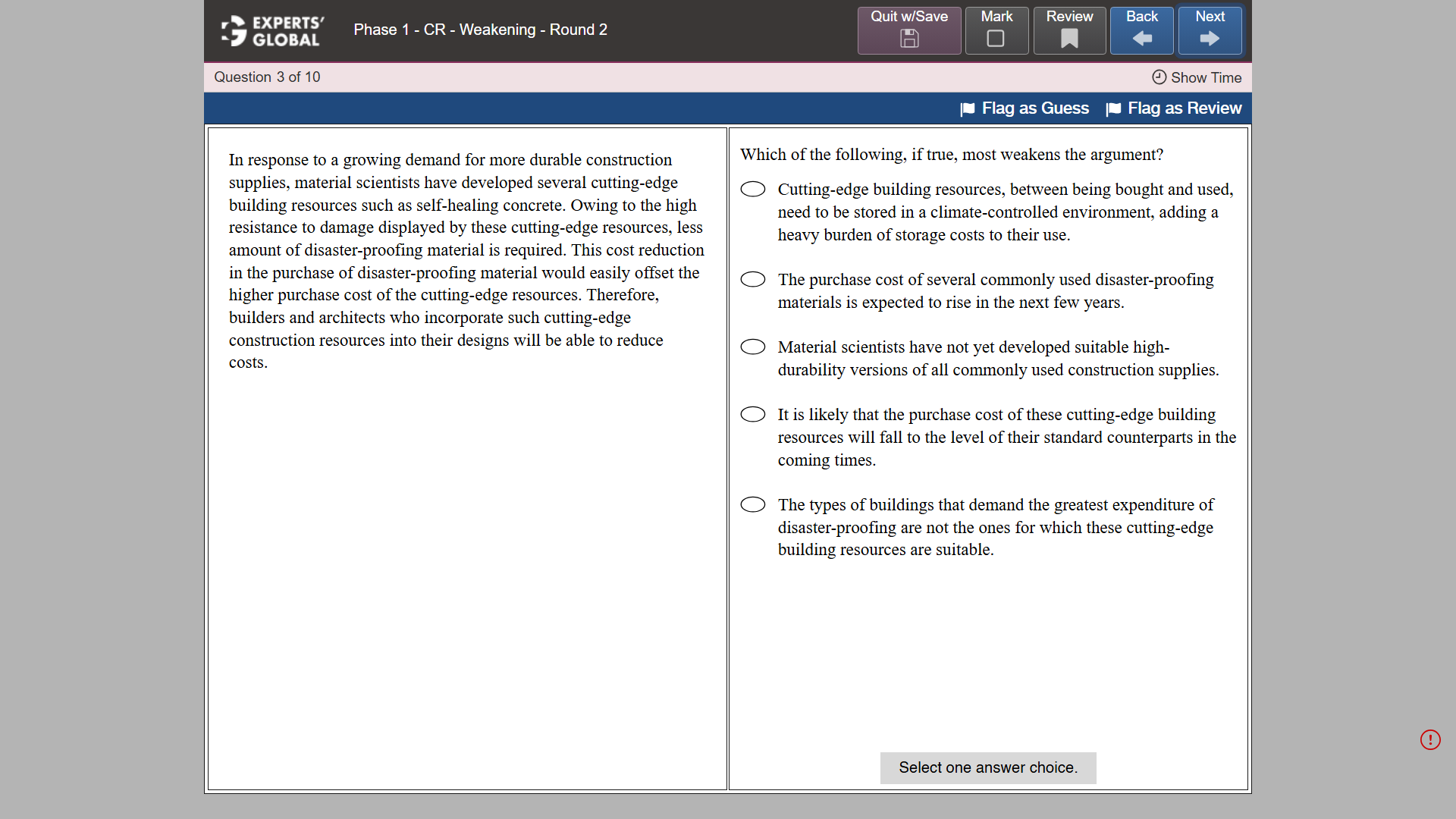
Which of the following, if true, most weakens the argument?
A. Cutting-edge building resources, between being bought and used, need to be stored in a climate-controlled environment, adding a heavy burden of storage costs to their use.
B. The purchase cost of several commonly used disaster-proofing materials is expected to rise in the next few years.
C. Material scientists have not yet developed suitable high-durability versions of all commonly used construction supplies.
D. It is likely that the purchase cost of these cutting-edge building resources will fall to the level of their standard counterparts in the coming times.
E. The types of buildings that demand the greatest expenditure of disaster-proofing are not the ones for which these cutting-edge building resources are suitable.
Written Explanation
Mind-map: Cutting-edge building resources have been developed à new resources offer high resistance to damage à less amount of disaster-proofing material required à cost reduction in purchase of disaster-proofing materials offsets higher purchase cost of cutting-edge resources à builders using cutting-edge building resources will reduce costs (conclusion)
Missing-link: Between the cost reduction in purchase of disaster-proofing materials offsetting higher purchase cost of cutting-edge resources and the conclusion that builders using cutting-edge building resources will reduce costs
Expectation from the correct answer choice: To weaken the conclusion that builders using cutting-edge building resources will reduce costs
A. Correct. By suggesting that cutting-edge resources carry additional expenses of storage costs, this answer choice indicates that, even if the cost reduction in the purchase of disaster-proofing material offsets the higher purchase cost of the cutting-edge resources, using cutting-edge resources may not generate a reduction in total costs; so, this answer choice attacks the missing link and weakens the conclusion. Because this answer choice weakens the conclusion, this answer choice is correct.
B. If the purchase cost of disaster-proofing materials rises in the future, it indicates that builders will realize greater savings by using cutting-edge building resources; so, this answer choice strengthens, rather than weakens, the conclusion that builders using cutting-edge building resources will reduce costs. Because this answer choice does not weaken the conclusion, this answer choice is incorrect.
C. This answer choice, suggesting that high-durability versions of all construction supplies are currently not available, simply indicates that builders can use cutting-edge versions only for a limited number of building resources and realize only some cost reduction; however, “some cost reduction” still indicates that costs would be reduced; so, this answer choice, if anything, marginally strengthens, rather than weakens, the conclusion. Because this answer choice does not weaken the conclusion, this answer choice is incorrect.
D. This answer choice, suggesting that the purchase cost of cutting-edge building resources may fall in the future, indicates that, in the future, builders will realize greater savings by using cutting-edge building resources; so, this answer choice, if anything, strengthens, rather than weakens, the conclusion that builders using cutting-edge building resources will reduce costs. Because this answer choice does not weaken the conclusion, this answer choice is incorrect.
E. Trap. This answer choice, suggesting that the cutting-edge resources are not suitable for buildings demanding the greatest expenditure of disaster-proofing, indicates that the builders of such buildings may not be able to reduce their costs; however, this answer choice is limited to certain buildings and provides no information about cost reduction in buildings in general; so, this answer choice simply adds information, which, although relevant to the broad context of the argument, does not weaken the conclusion. Because this answer choice does not weaken the conclusion, this answer choice is incorrect.
A is the correct answer choice.
Practice Question 2 | Critical Reasoning
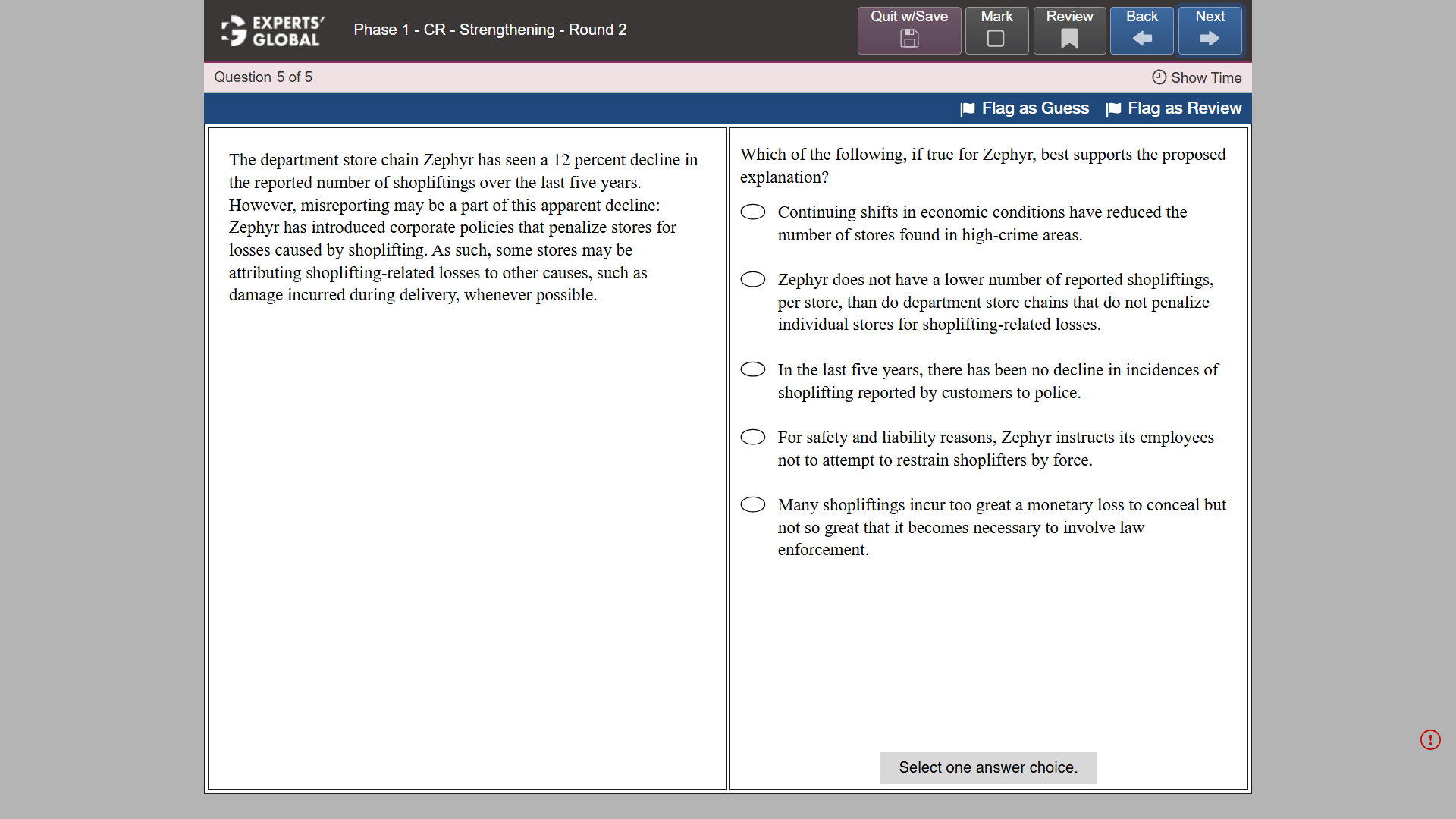
Which of the following, if true for Zephyr, best supports the proposed explanation?
A. Continuing shifts in economic conditions have reduced the number of stores found in high-crime areas.
B. Zephyr does not have a lower number of reported shopliftings, per store, than do department store chains that do not penalize individual stores for shoplifting-related losses.
C. In the last five years, there has been no decline in incidences of shoplifting reported by customers to police.
D. For safety and liability reasons, Zephyr instructs its employees not to attempt to restrain shoplifters by force.
E. Many shopliftings incur too great a monetary loss to conceal but not so great that it becomes necessary to involve law enforcement.
C is the correct answer choice.
Practice Question 3 | Critical Reasoning
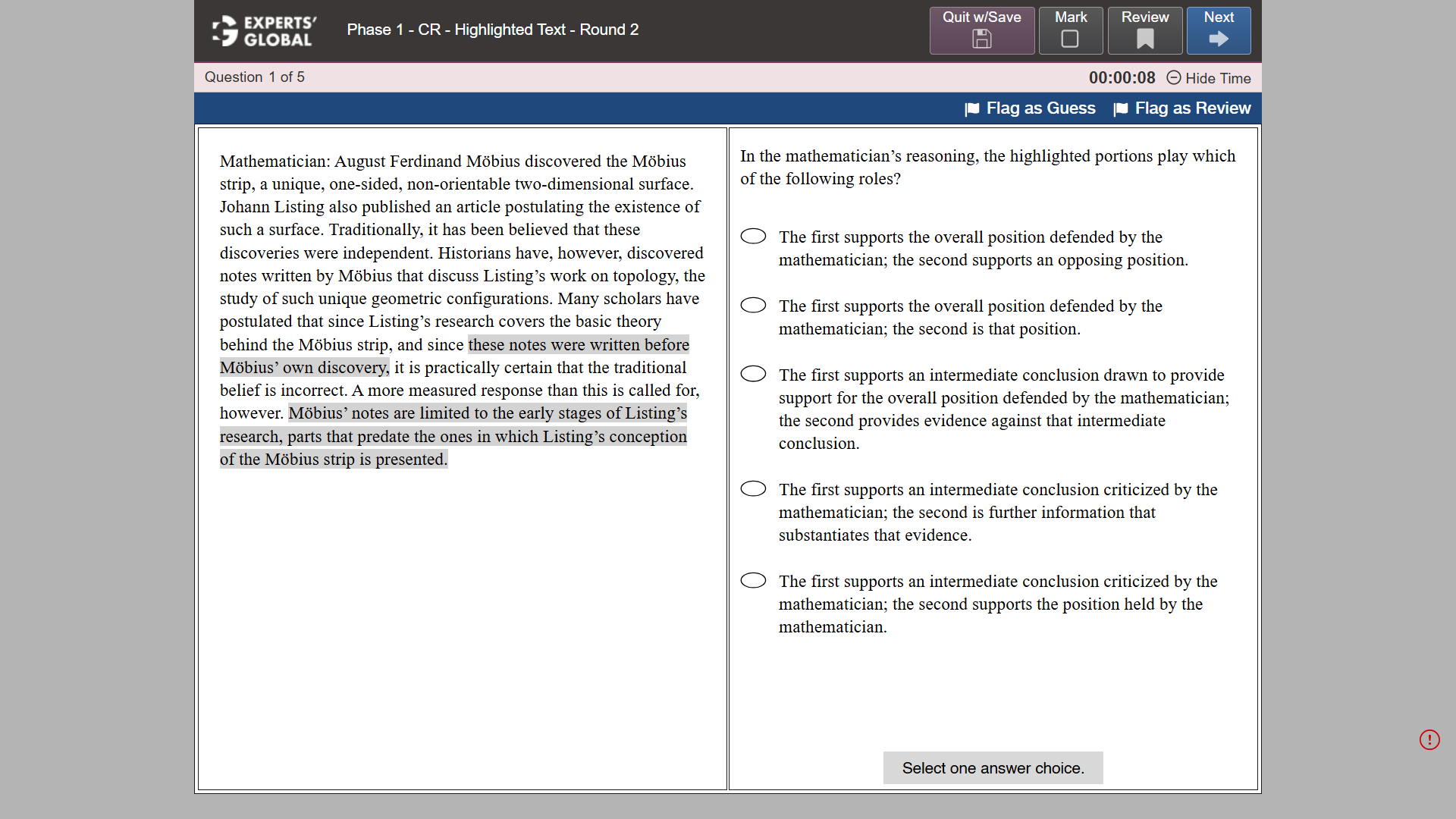
In the mathematician’s reasoning, the highlighted portions play which of the following roles?
A. The first supports the overall position defended by the mathematician; the second supports an opposing position.
B. The first supports the overall position defended by the mathematician; the second is that position.
C. The first supports an intermediate conclusion drawn to provide support for the overall position defended by the mathematician; the second provides evidence against that intermediate conclusion.
D. The first supports an intermediate conclusion criticized by the mathematician; the second is further information that substantiates that evidence.
E. The first supports an intermediate conclusion criticized by the mathematician; the second supports the position held by the mathematician.
Written Explanation
Strategy: Determining the overall conclusion of the argument and finding the relation of the highlighted portions with this conclusion
Logic: The argument presents a mathematician’s thoughts on whether Möbius and Listing independently discovered the Möbius strip. The argument mentions that the traditional belief is that the two scientists made their discoveries independently and that a finding suggests that, as the first highlighted portion states, Möbius referred to Listing’s work before Möbius made his discovery, thus drawing an intermediate conclusion that the traditional belief is false. The argument goes on to conclude that a more measured response is needed because, as the second highlighted portion states, Listing’s work referred by Möbius predates references to Möbius strip. In the context of the overall conclusion – the first highlighted portion is a fact that is used to establish an intermediate conclusion that the argument disapproves; the second highlighted portion is a fact that the argument uses to explain the disapproval of the intermediate conclusion.
Intermediate conclusion: The traditional belief is false.
Overall conclusion: A more measured response than inferring that traditional belief is false is needed.
Broad expectation from the correct answer choice:
The first highlighted portion is a fact that is used to establish an intermediate conclusion that the argument disapproves.
The second highlighted portion is a fact that the argument uses to explain the disapproval of the intermediate conclusion.
A. Incorrect.
– The first highlighted portion is used to cast doubt on the traditional belief; however, the mathematician goes on to conclude that a more measured response is needed; so, the mathematician criticizes the position supported by the first highlighted portion; therefore, it is incorrect to state that the first highlighted portion “supports the overall position defended by the mathematician”.
– The mathematician uses the second highlighted portion to disapprove the intermediate conclusion; so, the second highlighted portion defends the mathematician’s position; therefore, it is incorrect to state that the second highlighted portion “supports a position opposite to the overall position defended by the mathematician”.
B. Incorrect.
– The first highlighted portion is used to cast doubt on the traditional belief; however, the mathematician goes on to conclude that a more measured response is needed; so, the mathematician criticizes the position supported by the first highlighted portion; therefore, it is incorrect to state that the first highlighted portion “supports the overall position defended by the mathematician”.
– The second highlighted portion supports the mathematician’s position but itself is not the position; therefore, it is incorrect to state that the second highlighted portion is the “overall position defended by the mathematician”.
C. Incorrect.
– The first highlighted portion leads to the conclusion that the traditional belief is false; so, the first highlighted portion “supports an intermediate conclusion”; however, the mathematician’s position opposes the intermediate conclusion; therefore, it is incorrect to state that the first highlighted portion “supports an intermediate conclusion drawn to provide support for the overall position defended by the mathematician”.
– The mathematician uses the second highlighted portion to disapprove the conclusion that the traditional belief is false; therefore, it is incorrect to state that the second highlighted portion goes against an intermediate conclusion “drawn to provide support for the overall position defended by the mathematician”.
D. Trap. Incorrect.
– The second highlighted portion states that Listing’s work referred by Möbius predates references to Möbius strip; the first highlighted portion states that Möbius referred to Listing’s work before making the discovery; so, the second highlighted portion does not provide additional information about the first highlighted portion; therefore, it is incorrect to state that the second highlighted portion “substantiates the first highlighted portion’s evidence that has been used in support of an intermediate conclusion criticized by the mathematician”.
E. Correct.
– The first highlighted portion is used to cast doubt on the traditional belief that the two discoveries were independent; so, the first highlighted portion supports an intermediate conclusion; however, the mathematician’s position criticizes the intermediate conclusion; therefore, it is correct to state that the first highlighted portion is “used in support of an intermediate conclusion criticized by the mathematician”.
– The mathematician uses the second highlighted portion to establish his position that a more measured response than casting doubt on the traditional belief is needed; therefore, it is correct to state that the second highlighted portion “offers support to the position held by the mathematician”.
E is the correct answer choice.
Practice Question 4 | Critical Reasoning
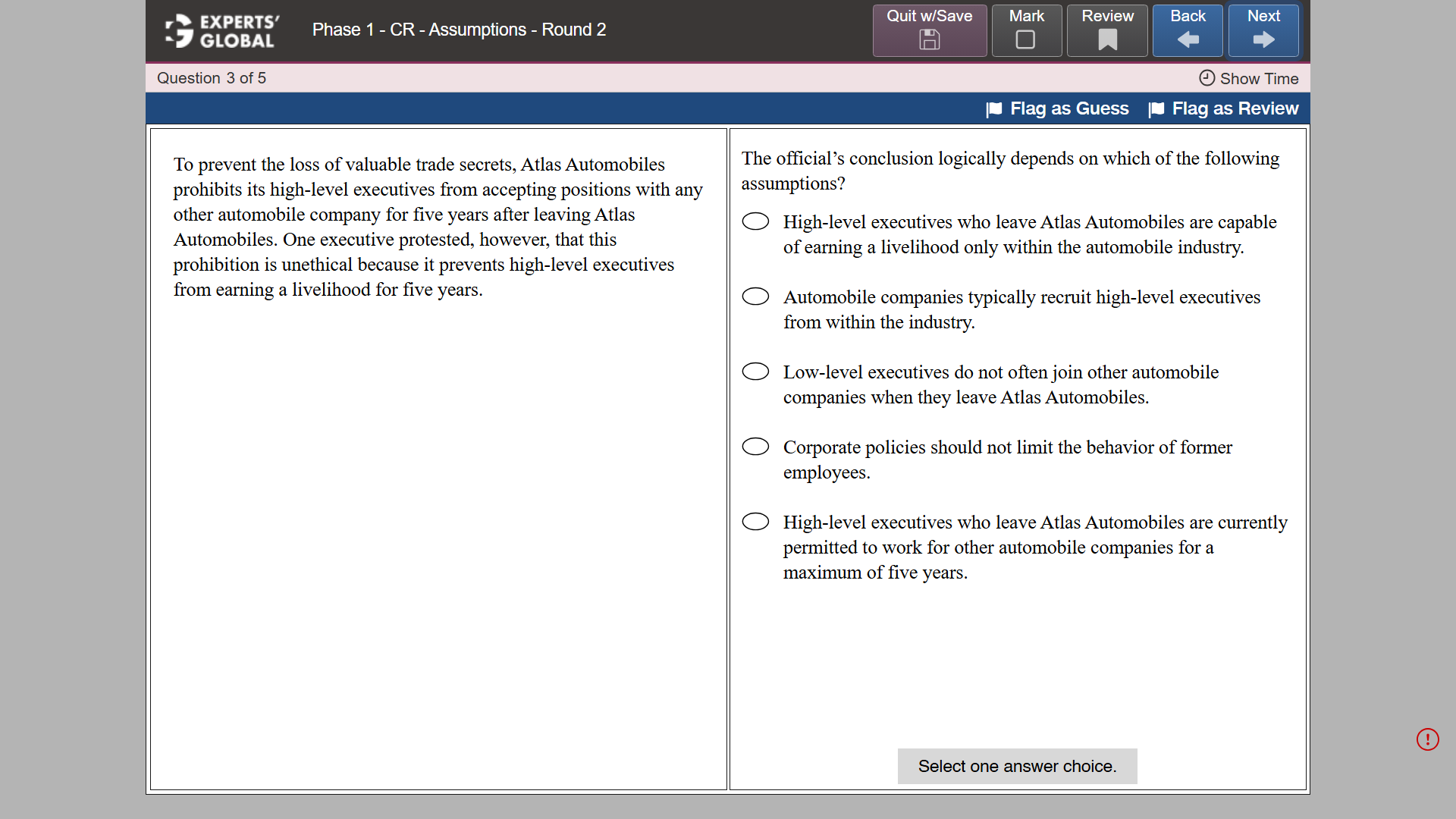
The official’s conclusion logically depends on which of the following assumptions?
A. High-level executives who leave Atlas Automobiles are capable of earning a livelihood only within the automobile industry.
B. Automobile companies typically recruit high-level executives from within the industry.
C. Low-level executives do not often join other automobile companies when they leave Atlas Automobiles.
D. Corporate policies should not limit the behavior of former employees.
E. High-level executives who leave Atlas Automobiles are currently permitted to work for other automobile companies for a maximum of five years.
Written Explanation
Mind-map: Atlas prohibits high-level executives from joining other automobile company for five years → objection that executives cannot earn livelihood for five years (conclusion)
Missing-link: Between not joining another automobile company for five years and the conclusion that executives cannot earn livelihood for five years
Expectation from the correct answer choice: To strengthen the conclusion that executives cannot earn livelihood for five years, through a valid assumption
A. Correct. This answer choice, by suggesting that “high-level executives who leave Atlas Automobiles are capable of earning a livelihood only within the automobile industry” fills the missing link by aptly connecting “joining other automobile company” with “earning livelihood” and thereby strengthening the conclusion that high-level executives cannot earn a livelihood for five years if they don’t work at another automobile company. Additionally, this statement does have to be true for the conclusion to hold; negating this statement would mean that “high-level executives who leave Atlas Automobiles are capable of earning a livelihood even outside the automobile industry” and thus, negate the conclusion that high-level executives cannot earn a livelihood for five years if they don’t work at another automobile company. Because this answer choice strengthens the conclusion through a valid assumption, this answer choice is correct.
B. If automobile companies “typically” recruit high-level executives, it doesn’t suggest that high-level executives can only work in automobile companies; in other words, it doesn’t suggest that high-level executives are dependent on automobile companies; so, this answer choice simply adds information, which, although relevant to the broader context of the argument, does not strengthen the reasoning or its conclusion. Besides, this condition is not necessary for the argument to hold and thus, is not a valid assumption. Because this answer choice does not strengthen the conclusion through a valid assumption, this answer choice is incorrect.
C. The argument is about “high-level executives” and not concerned with “low-level executives”; so, the behavior of low-level executives after leaving Atlas Automobiles is irrelevant to the argument and its conclusion. Besides, this condition is not necessary for the argument to hold and thus, is not a valid assumption. Because this answer choice does not strengthen the conclusion through a valid assumption, this answer choice is incorrect.
D. Even if this is generally true, this statement does not support the conclusion. Additionally, “should not limit” indicates a suggesting/recommending/patronizing tone; one needs to be cautious of such answer choices as they are generally incorrect on the GRE. Besides, this condition is not necessary for the argument to hold and thus, is not a valid assumption. Because this answer choice does not strengthen the conclusion through a valid assumption, this answer choice is incorrect.
E. The restriction on the duration of a former high-level executive’s tenure at another automobile company is out of the scope of the argument and its conclusion. Besides, this condition is not necessary for the argument to hold and thus, is not a valid assumption. Because this answer choice does not strengthen the conclusion through a valid assumption, this answer choice is incorrect.
A is the best choice.
Practice Question 5 | Critical Reasoning
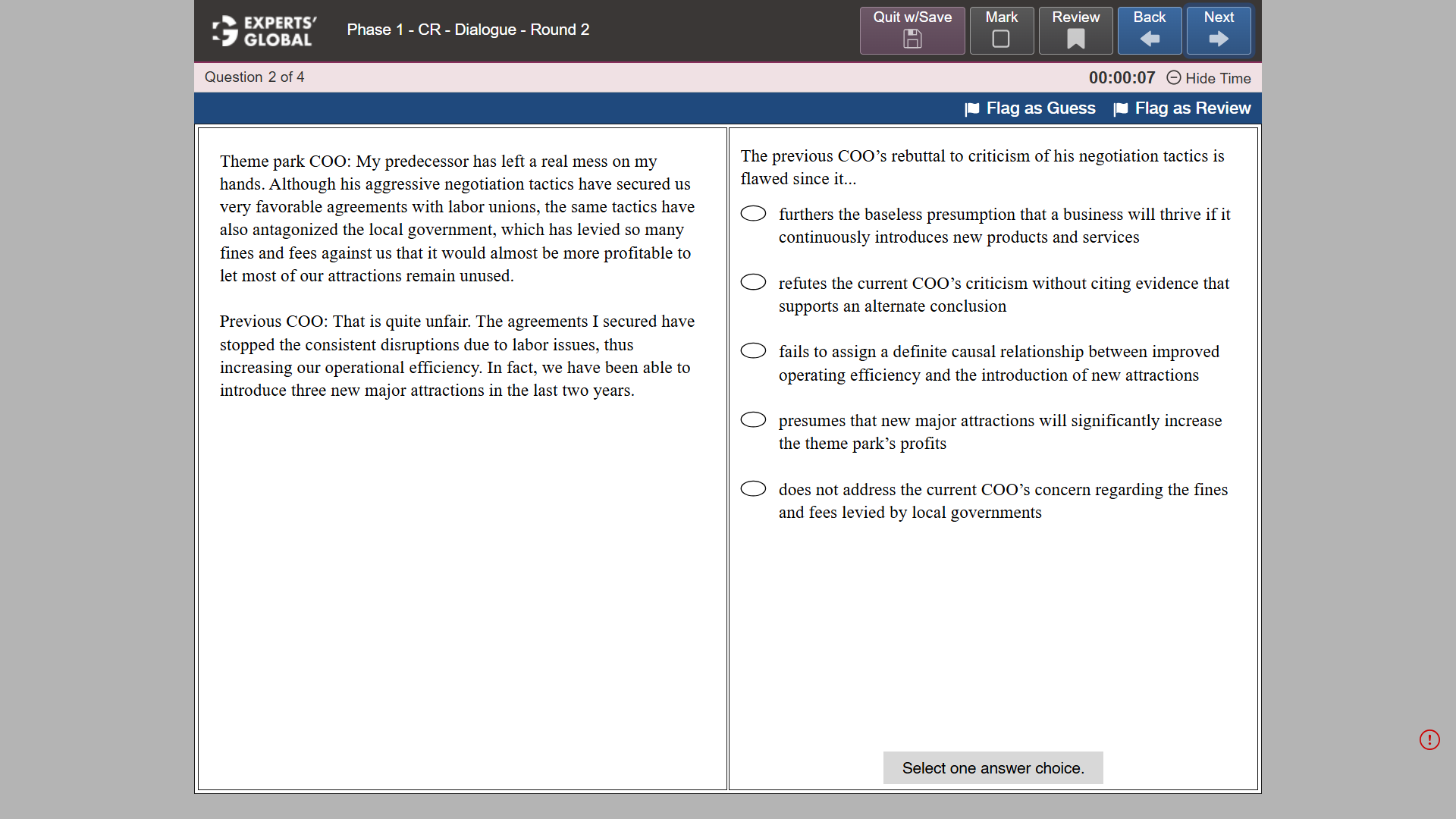
The previous COO’s rebuttal to criticism of his negotiation tactics is flawed since it…
A. furthers the baseless presumption that a business will thrive if it continuously introduces new products and services
B. refutes the current COO’s criticism without citing evidence that supports an alternate conclusion
C. fails to assign a definite causal relationship between improved operating efficiency and the introduction of new attractions
D. presumes that new major attractions will significantly increase the theme park’s profits
E. does not address the current COO’s concern regarding the fines and fees levied by local governments
Written Explanation
Mind-map: Current COO: negotiations tactics of previous COO secured favorable agreements with vendors and labor unions → tactics antagonized local government → local government levied fines and fees → running the theme park is not profitable → previous COO: it is unfair → agreements stopped labor issues and improved efficiency → we introduced three major attractions in last two years
Missing-link: Between the current COO’s dissatisfaction about the local government levying fines that reduced the theme park’s profitability and the previous COO’s response about operational efficiency and introduction of three attractions
Expectation from the correct answer choice: Something on the lines that the previous COO ignoring the current COO’s dissatisfaction about the local government levying fines that reduced the theme park’s profitability
A. The response by the previous COO mentions that improvement in operational efficiency is a benefit caused by the favorable agreements he had secured and cites an example of the introduction of three major attractions; the response makes no suggestion about the theme park’s profits, despite the current COO expressing dissatisfaction about the local government levying fines that reduced the theme park’s profitability; so, the flaw in the previous COO’s response is the failure to respond on the issue of profitability and it is incorrect to state that the flaw is the presumption that a business will thrive if it introduces new products and services, as the answer choice mentions. Additionally, the term “furthers” indicates a previous reference to an idea in the argument; the argument has no reference to the “baseless presumption” stated in this answer choice, invalidating this answer choice. Because this answer choice does not indicate the flaw in the previous COO’s response, this answer choice is incorrect.
B. The response by the previous COO mentions that improvement in operational efficiency is a benefit caused by the favorable agreements he had secured and cites an example of the introduction of three major attractions; the response cites evidence about the introduction of attractions that support an alternate conclusion that the previous COO’s negotiations tactics were beneficial; however, the response fails to address the current COO’s dissatisfaction about the local government levying fines that reduced the theme park’s profitability, making the response incomplete and thus, flawed; overall, it is incorrect to state that refuting the criticism without citing evidence that supports an alternate conclusion is the flaw in the previous COO’s response, as the answer choice mentions. Because this answer choice does not indicate the flaw in the previous COO’s response, this answer choice is incorrect.
C. The response by the previous COO mentions that improvement in operational efficiency is a benefit caused by the favorable agreements he had secured and cites an example of the introduction of three major attractions; although the response does not suggest a definite causal relationship between improved operating efficiency and the introduction of new attractions, the failure to suggest such a relationship is not the flaw in the previous COO’s response; the flaw in the response is that it fails to address the current COO’s dissatisfaction about the local government levying fines that reduced the theme park’s profitability, thus making the response incomplete. Because this answer choice does not indicate the flaw in the previous COO’s response, this answer choice is incorrect.
D. The response by the previous COO mentions that improvement in operational efficiency is a benefit caused by the favorable agreements he had secured and cites an example of the introduction of three major attractions; the response makes no suggestion about the theme park’s profits, despite the current COO expressing dissatisfaction about the local government levying fines that reduced the theme park’s profitability; so, it is incorrect to state that the flaw is the assumption that the new major attractions will increase profits, as the answer choice mentions; the flaw in the response is that it fails to address the current COO’s dissatisfaction about the local government levying fines that reduced the theme park’s profitability, thus making the response incomplete. Because this answer choice does not indicate the flaw in the previous COO’s response, this answer choice is incorrect.
E. Correct. The current COO raises two points – acknowledgment of favorable agreements with vendors and labor unions and dissatisfaction about the local government levying fines that reduced the theme park’s profitability; the response by the previous COO mentions that improvement in operational efficiency is a benefit because of favorable agreements and cites an example of the introduction of three major attractions; the previous COO’s response fails to address the current COO’s dissatisfaction about the local government levying fines that reduced the theme park’s profitability, thus making the response incomplete and thus, flawed. Because this answer choice indicates the flaw in the previous COO’s response, this answer choice is correct.
E is the best choice.
Practice Question 6 | Critical Reasoning
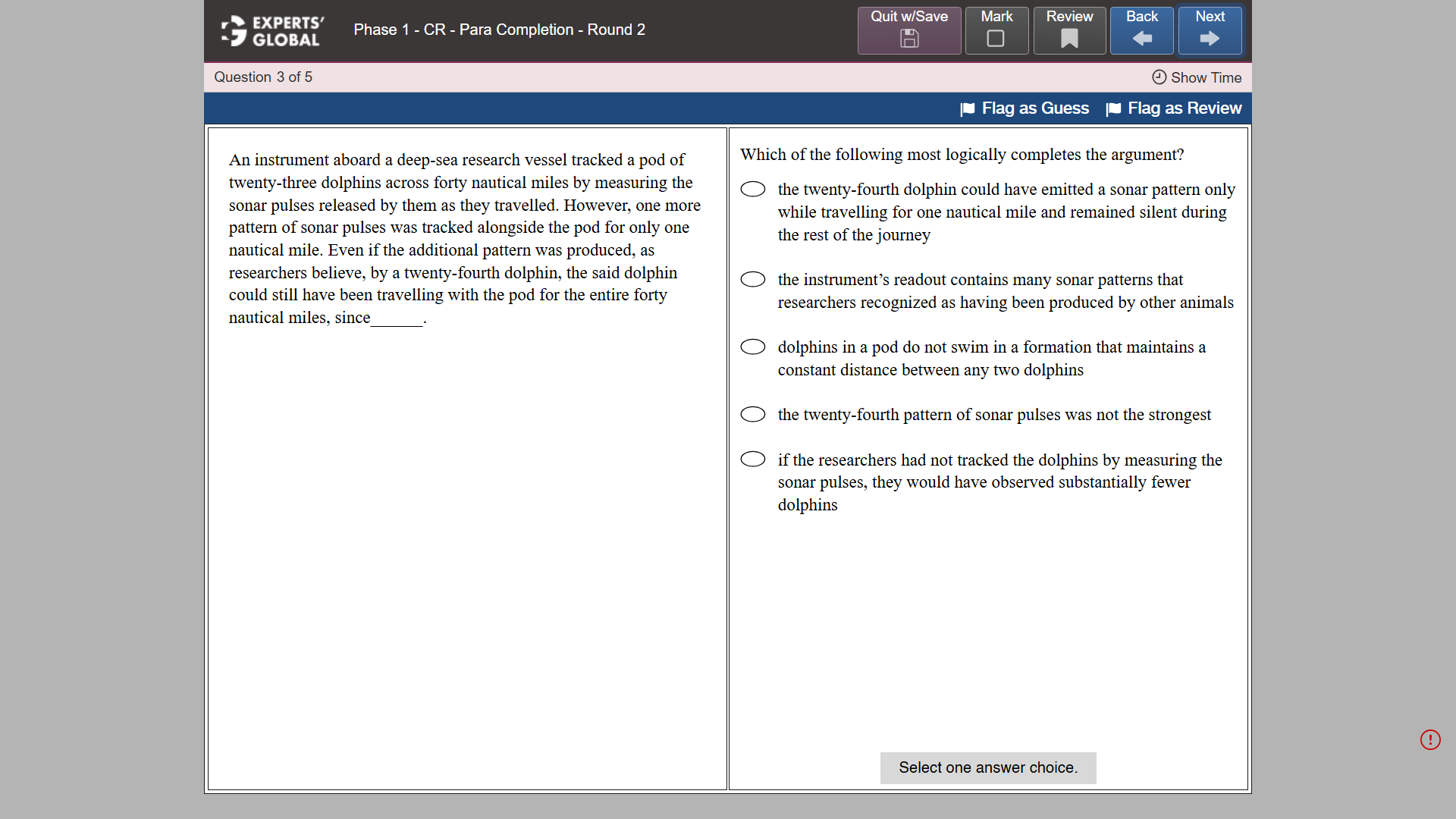
Which of the following most logically completes the argument?
A. the twenty-fourth dolphin could have emitted a sonar pattern only while travelling for one nautical mile and remained silent during the rest of the journey
B. the instrument’s readout contains many sonar patterns that researchers recognized as having been produced by other animals
C. dolphins in a pod do not swim in a formation that maintains a constant distance between any two dolphins
D. the twenty-fourth pattern of sonar pulses was not the strongest
E. if the researchers had not tracked the dolphins by measuring the sonar pulses, they would have observed substantially fewer dolphins
Written Explanation
Mind-map: Instrument tracks a pod of twenty-three dolphins → measures sonar pulses released by the dolphins for forty miles → for one mile, one more pattern of sonar pulses was tracked → even if the additional pattern was produced by a twenty-fourth dolphin → the twenty-fourth dolphin could be travelling all forty miles because _____
Missing-link: Between additional pattern by the twenty-fourth dolphin being tracked only for one mile and the possibility of twenty-fourth dolphin travelling all forty miles
Expectation from the correct answer choice: Something on the lines of an explanation for why the pattern by the twenty-fourth dolphin was tracked only for one mile if the dolphin could have travelled all forty miles
A. Correct. By suggesting that the twenty-fourth dolphin could have released a sonar pattern only for one mile and remained silent elsewhere, this answer choice indicates a possibility in which, owing to the dolphin releasing sonar pulses only for one mile, the twenty-fourth pattern was tracked only for a mile even if the twenty-fourth dolphin could have travelled for all forty miles. Because this answer choice effectively completes the chain of thoughts developed in the passage, this answer choice is correct.
B. The argument is concerned with the explanation for the pattern by the twenty-fourth dolphin and not with the patterns by other animals; so, this answer choice is out of scope and fails to effectively complete the chain of thoughts developed in the passage. Because this answer choice does not duly complete the passage, this answer choice is incorrect.
C. Trap. This answer choice, suggesting that the distance between two dolphins in a pod may be changing through their journey, makes no suggestion regarding the pattern by the twenty-fourth dolphin, thus failing to explain why the twenty-fourth pattern was tracked only for a mile if the twenty-fourth dolphin could have travelled for all forty miles. Because this answer choice does not effectively complete the chain of thoughts developed in the passage, this answer choice is incorrect.
D. This answer choice, suggesting that the twenty-fourth pattern was not the strongest, makes no suggestion regarding why the pattern was tracked only for a mile if the dolphin could have travelled for all forty miles, thus failing to effectively complete the chain of thoughts developed in the passage. Because this answer choice does not duly complete the passage, this answer choice is incorrect.
E. The argument is concerned with the explanation for the sonar pattern by the twenty-fourth dolphin; so, this answer choice, suggesting that fewer dolphins would have been observed if sonar pulses were not used to track the dolphins, is just additional information and fails to effectively complete the chain of thoughts developed in the passage. Because this answer choice does not duly complete the passage, this answer choice is incorrect.
A is the best choice.
Practice Question 7 | Critical Reasoning
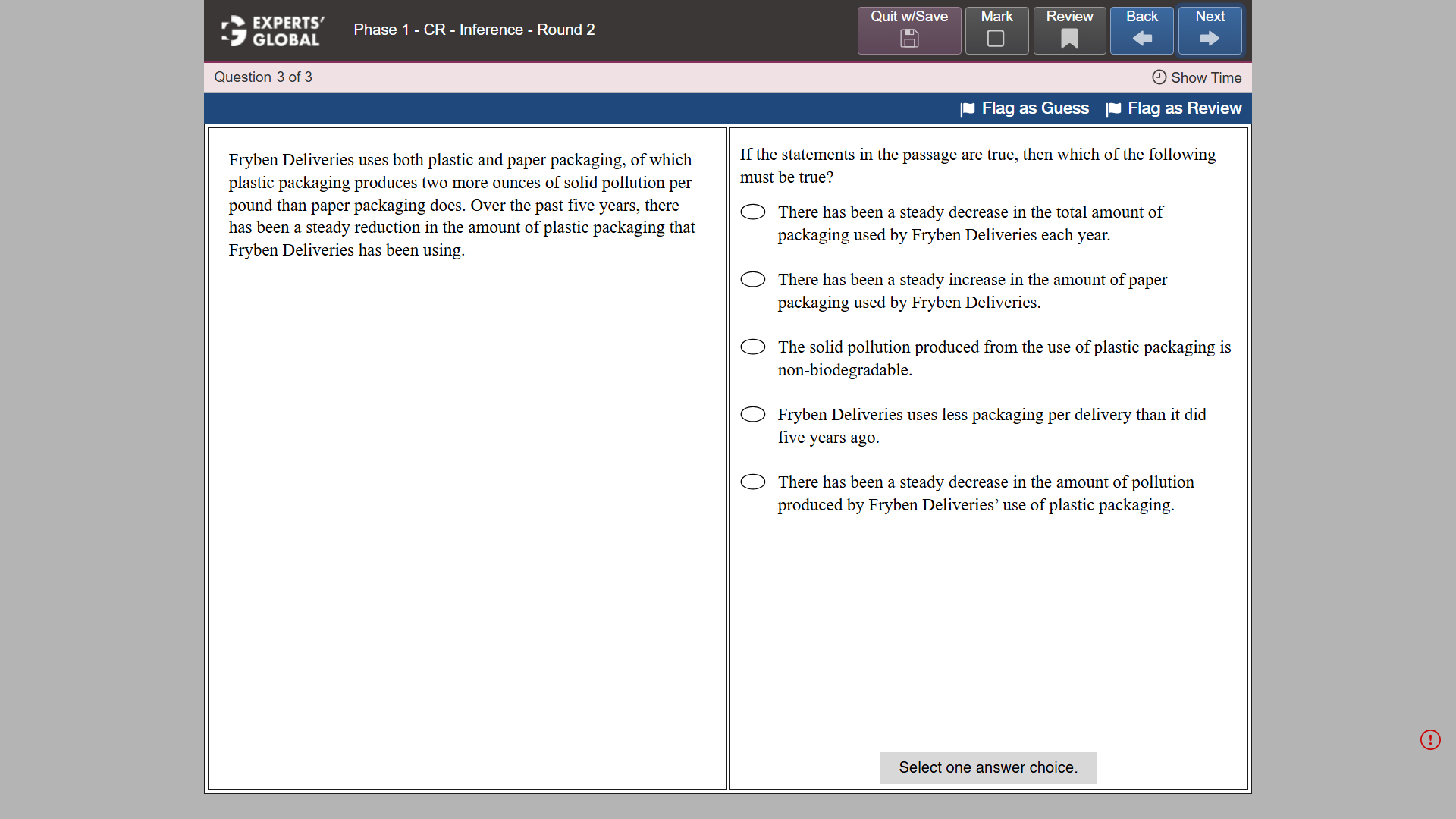
If the statements in the passage are true, then which of the following must be true?
A. There has been a steady decrease in the total amount of packaging used by Fryben Deliveries each year.
B. There has been a steady increase in the amount of paper packaging used by Fryben Deliveries.
C. The solid pollution produced from the use of plastic packaging is non-biodegradable.
D. Fryben Deliveries uses less packaging per delivery than it did five years ago.
E. There has been a steady decrease in the amount of pollution produced by Fryben Deliveries’ use of plastic packaging.
E is the correct answer choice.
Practice Question 8 | Critical Reasoning
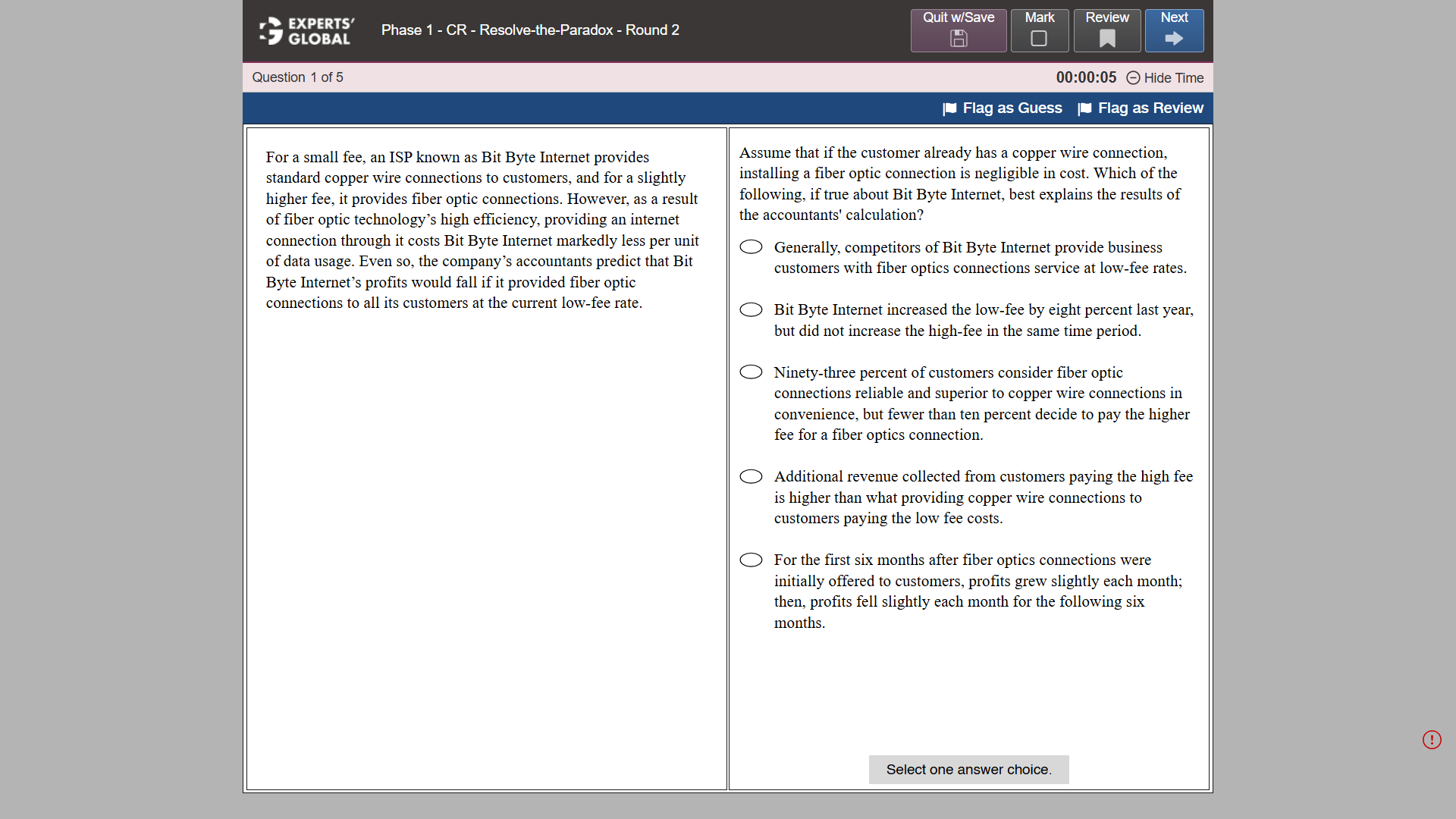
Assume that if the customer already has a copper wire connection, installing a fiber optic connection is negligible in cost. Which of the following, if true about Bit Byte Internet, best explains the results of the accountants’ calculation?
A. Generally, competitors of Bit Byte Internet provide business customers with fiber optics connections service at low-fee rates.
B. Bit Byte Internet increased the low-fee by eight percent last year, but did not increase the high-fee in the same time period.
C. Ninety-three percent of customers consider fiber optic connections reliable and superior to copper wire connections in convenience, but fewer than ten percent decide to pay the higher fee for a fiber optics connection.
D. Additional revenue collected from customers paying the high fee is higher than what providing copper wire connections to customers paying the low fee costs.
E. For the first six months after fiber optics connections were initially offered to customers, profits grew slightly each month; then, profits fell slightly each month for the following six months.
Written Explanation
Mind-map: Bit Byte sells copper wire connections for low fee and fiber optic connections for higher fee → to Bit Byte, fiber optic connections cost less per unit of data usage than copper wire connections → providing fiber optic connections to all customers at current low-fee rate will decrease profits
Missing-link: Between fiber optic connections costing less per unit of data usage than copper wire connections and providing fiber optic connections to all customers at current low-fee rate decreasing profits
Expectation from the correct answer choice: To explain why providing fiber optic connections to all customers at current low-fee rate will decrease profits despite fiber optic connections costing less per unit of data usage than copper wire connections
A. The argument is concerned with the effect on “Bit Byte’s profit” if all its connections are moved to fiber optics; so, the “company’s competitors’ plans” are out of scope. Because this answer choice does not explain the discrepancy in the argument, this answer choice is incorrect.
B. The argument mentions that fiber optics connections are offered at a higher fee than copper wire connections “now” and is concerned with the effect on profit if all connections are moved to fiber optics; so, information about the “past” increase in the fee of the two types of connections has already been accounted for and has no bearing on the argument. Because this answer choice does not explain the discrepancy in the argument, this answer choice is incorrect.
C. Trap. This answer choice, suggesting that only a small proportion of all customers pay a higher fee for fiber optics connection, indicates that, if all connections are moved to fiber optics at a low fee, the revenue lost will likely be small but does not explain why the move will decrease profits. Because this answer choice does not explain the discrepancy in the argument, this answer choice is incorrect.
D. Correct. By suggesting that the difference in the revenue of fiber optics connection and copper wire connections is higher than the difference in the costs of providing copper wire connections and fiber optics connections, this answer choice indicates that, if all connections are moved to fiber optics at a low fee, the revenue lost will be higher than the costs saved, thus explaining why the move will decrease profits. Because this answer choice clarifies the exact discrepancy, this answer choice is correct.
E. Trap. The argument is concerned with the effect on profit if all connections are moved to fiber optics “now”; so, information about the impact on profits at the “time of the initial offering of fiber optics connections” has already been accounted for and does not explain the discrepancy in the argument. Because this answer choice does not explain the discrepancy in the argument, this answer choice is incorrect.
D is the correct answer choice.
Practice Question 9 | Critical Reasoning
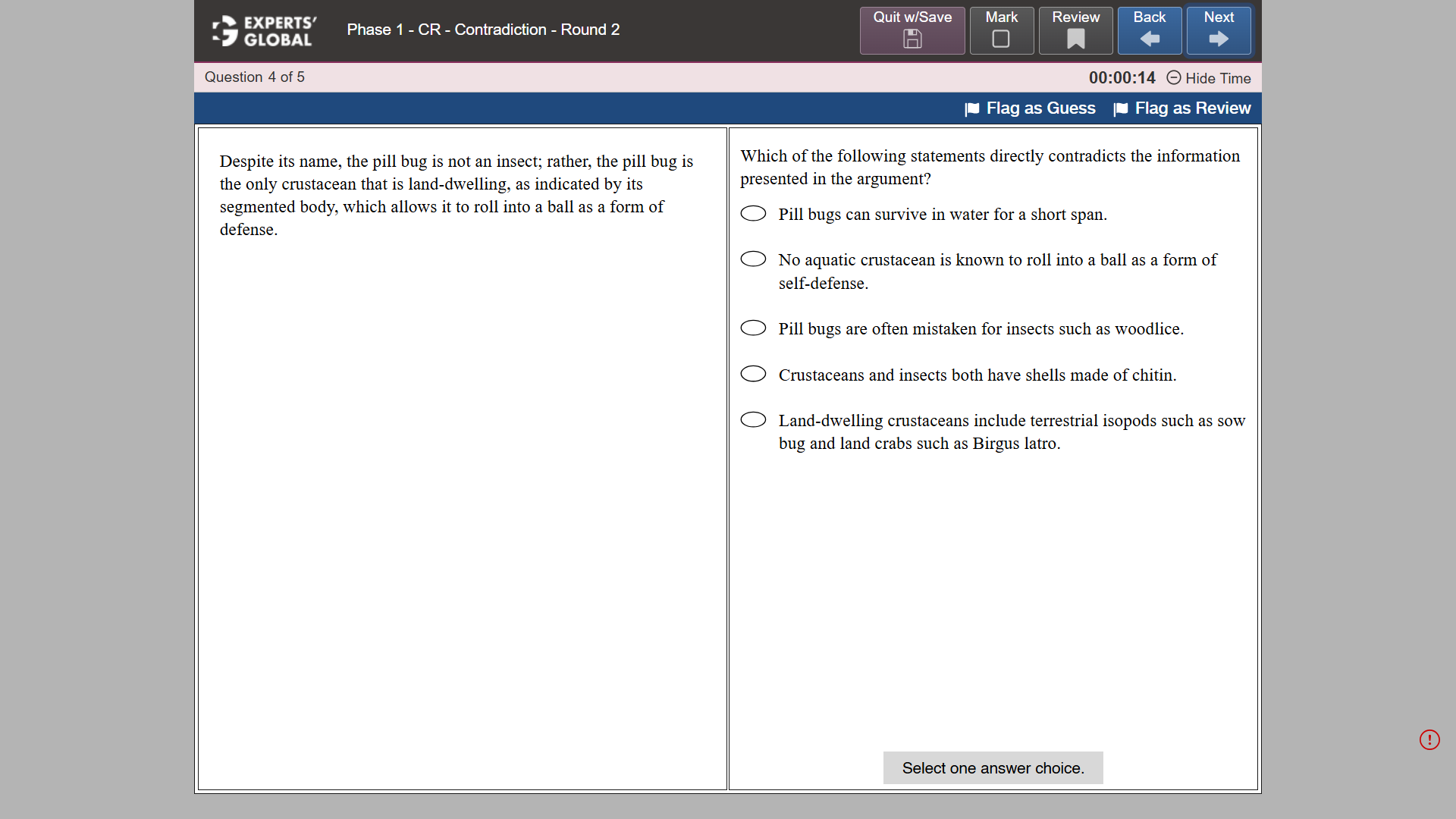
Which of the following statements directly contradicts the information presented in the argument?
A. Pill bugs can survive in water for a short span.
B. No aquatic crustacean is known to roll into a ball as a form of self-defense.
C. Pill bugs are often mistaken for insects such as woodlice.
D. Crustaceans and insects both have shells made of chitin.
E. Land-dwelling crustaceans include terrestrial isopods such as sow bug and land crabs such as Birgus latro.
E is the correct answer choice.
Practice Question 10 | Critical Reasoning
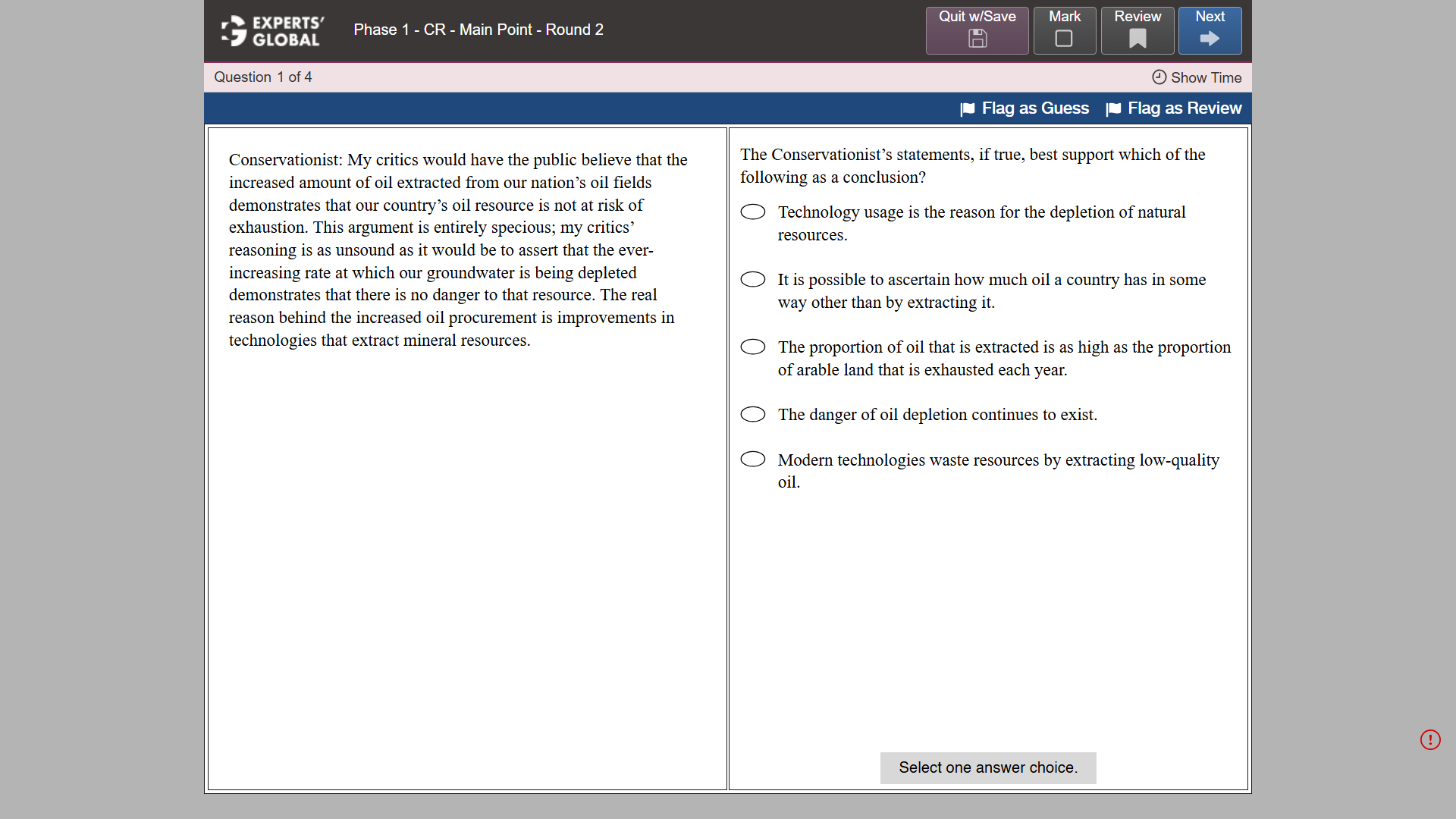
The Conservationist’s statements, if true, best support which of the following as a conclusion?
A. Technology usage is the reason for the depletion of natural resources.
B. It is possible to ascertain how much oil a country has in some way other than by extracting it.
C. The proportion of oil that is extracted is as high as the proportion of arable land that is exhausted each year.
D. The danger of oil depletion continues to exist.
E. Modern technologies waste resources by extracting low-quality oil.
Written Explanation
Mind-map: Conservationist: my critics cite increase in amount of oil extracted as no risk of oil exhaustion → specious argument similar to saying that faster groundwater depletion demonstrates no danger of water depletion → real reason of increase in amount of oil extracted is improvement in extraction technology
Missing-link: Not needed
Expectation from the correct answer choice: Something on the lines of there is risk of oil exhaustion
A. Trap. The argument mentions that the conservationist’s critics argue that there is no risk of oil exhaustion because more oil is getting extracted; the argument also mentions that the conservationist believes that oil is getting depleted and that the depletion is because of improved oil extraction technology; however, the argument makes no suggestion regarding the general cause-effect relationship between the use of technology and depletion of natural resources; so, this answer choice cannot be established. Because this answer choice does not indicate a conclusion of the argument, this answer choice is incorrect.
B. The argument makes no mention of the quantity of oil in a country or any means to measure it; so, this answer choice cannot be established. Because this answer choice does not indicate a conclusion of the argument, this answer choice is incorrect.
C. The argument makes no mention of arable land or any entity that correlates with the proportion of oil extracted; so, this answer choice is out of scope. Because this answer choice does not indicate a conclusion of the argument, this answer choice is incorrect.
D. Correct. The argument mentions that the conservationist’s critics argue that there is no risk of oil exhaustion because more oil is getting extracted and that the conservationist regards the critics’ argument as “specious” and “unsound”, suggesting that the conservationist believes that the danger of oil depletion exists, as the answer choice mentions. Because this answer choice indicates a conclusion of the argument, this answer choice is correct.
E. The argument mentions that the conservationist believes that oil is getting depleted and that the depletion is because of improved oil extraction technology; however, the argument makes no mention of wastage of resources or of low-quality oil; so, this answer choice cannot be established. Because this answer choice does not indicate a conclusion of the argument, this answer choice is incorrect.
D is the best choice.
Additional GRE Critical Reasoning Practice Questions
Please find a set of assorted GRE-style Verbal questions (all types) with explanations on: Free GRE Verbal Practice Questions with Solutions
Please find a set of assorted GRE-style questions (all types) with explanations on: Free GRE Practice Questions with Solutions
For Further GRE Prep and Practice…
GRE preparation course designed for full coverage
15 full length GRE practice exams
60 sectional GRE practice exams
Five week intensive GRE crash course
GRE preparation and admissions consulting bundle