Critical Reasoning Main Point or Conclusion questions ask you to identify the central point that the argument is trying to prove, the one idea that everything else in the passage is meant to support. They help you learn to separate core claims from background details and to see the structure of reasoning with clarity. Steady practice with this question type is an essential part of any comprehensive GMAT preparation course. This page offers you an organized subtopic wise playlist, along with a few worked examples, for efficient preparation of this concept.
Characteristics of a Valid Main Point or Conclusion Statement

Approach for CR Argument’s Main Point Questions
Conclusion is the main idea of an argument – the reason why the argument was written. This overview explains how to recognize a conclusion in GMAT conclusion based Critical Reasoning: it is the main claim that the premises are designed to support. Build a brief mental map separating facts from opinions, ask yourself what the argument is ultimately trying to prove, and favor balanced, accurate wording over extreme language. Keep in mind that the conclusion may appear anywhere in the passage and may not be explicitly signposted. The short video below presents the method, shows it in real use, and prepares you to apply it in GMAT drills, sectional tests, and full-length GMAT mock tests.

GMAT CR: Argument’s Main Point Questions

GMAT-style CR Main Point Questions with Explanations
This section offers a curated set of GMAT-style Critical Reasoning Main Conclusion questions, each supported by a clear, stepwise explanation. Work through every argument at a calm, thoughtful pace and make deliberate use of the method you have just studied on this page for identifying the central conclusion on the GMAT. At this stage, give priority to applying the reasoning process accurately rather than only aiming to select the credited option. After you finalize your answer, use the explanation toggle to view the correct choice and to read the full descriptive reasoning.
Practice Question 1
Written Explanation
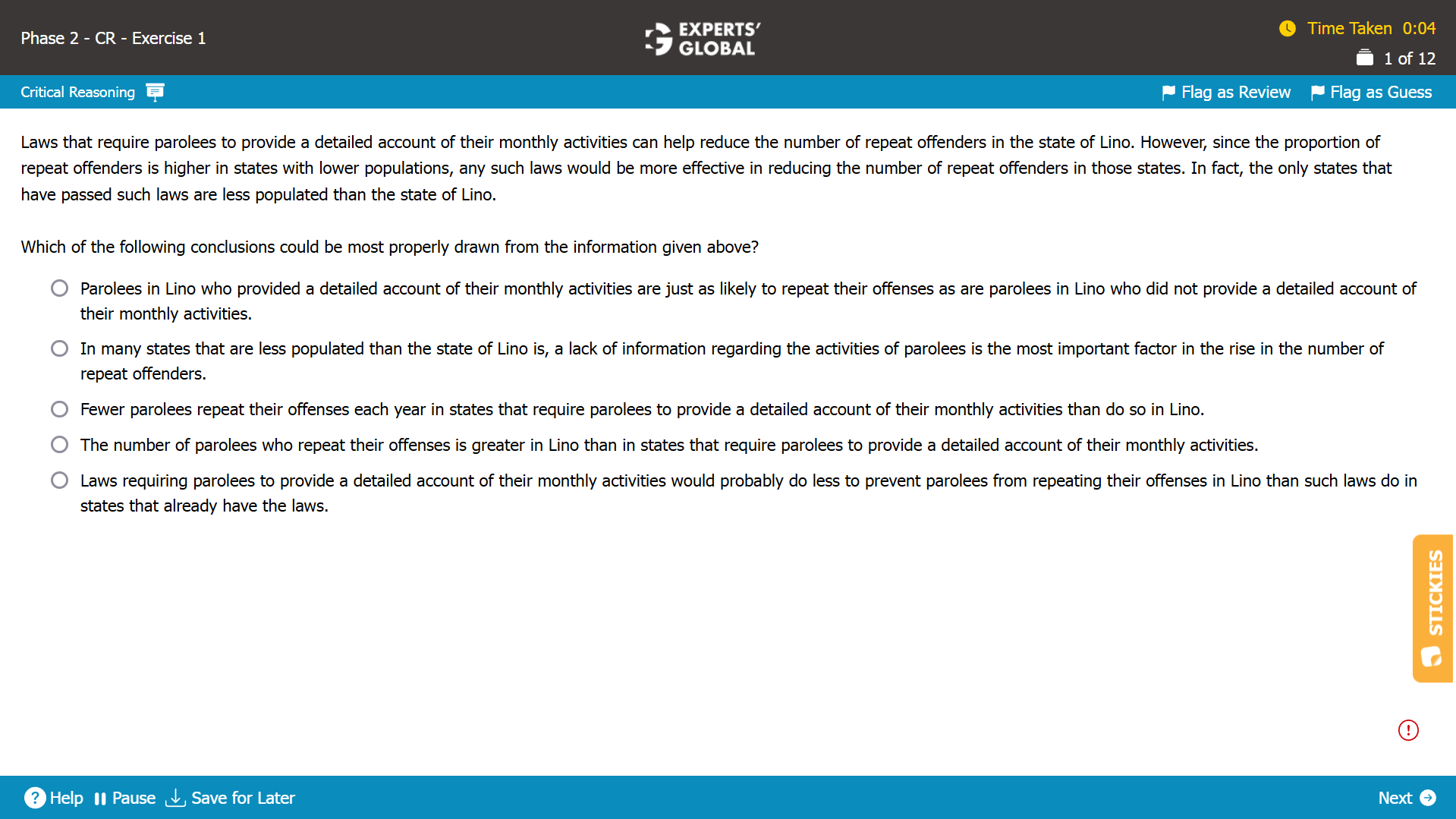
Mind-map: Laws requiring parolees to report activities reduce number of repeat offenders → low population states have higher proportion of repeat offenders → laws would be more effective in such states → states with such laws are less populated than Lino
Missing-link: Not needed
Expectation from the correct answer choice: To be duly deducible from the information in the passage, without any assumption or extrapolation
NOTE: This question tests the classic GMAT error of confusing “proportion” with “absolute numbers”; the argument mentions that the “proportion” of parolees/repeated offenses among all the offenses in a particular state is higher in lower population states than on higher population states; the argument makes no suggestion regarding the “absolute number” of parolees/repeated offenses.
A. Trap. The argument mentions that laws requiring parolees to report monthly activities in detail reduce the number of repeat offenders; so, it can be inferred that parolees in Lino, if forced to report monthly activities in detail, are less likely to repeat offenses than other parolees are, contrary to what the answer choice mentions. Further, the argument mentions that the law will be more effective in lower population states than in Lino; although the argument suggests that the law will be less effective in Lino than in other states, it does not suggest that the law will not be effective in Lino; this answer choice suggests that the, in Lino, the law will be not be effective at all; so, this answer choice cannot be established. Because this answer choice is not deducible from the information in the passage without any assumption or extrapolation, this answer choice is incorrect.
B. Trap. The argument mentions that collecting information regarding activities of parolees causes reduction in the number of repeat offenders but makes no suggestion regarding whether a lack of collecting such information is “the most important factor” that causes repeat offenses; so, this answer choice, making such a suggestion, is just a possibility, which, although relevant to the broad context of the argument, cannot be established. Further, please note, a hint here is in the term “most”, which is extremely strong to be a valid inference; one needs to be cautious of such answer choices. Because this answer choice is not deducible from the information in the passage without any assumption or extrapolation, this answer choice is incorrect.
C. Trap. The argument mentions that certain laws “in a particular state” reduce the number of repeat offenders “in that state” and provides no information about the “absolute number” of parolees/repeated offenses in any state. Besides, the argument compares offenses between two states on the basis of the “proportion” of parolees/repeated offenses among all the offenses in a particular state and not the basis of the absolute “number” of parolees/repeated offenses. Overall, this answer choice, comparing the number of parolees who repeat their offenses “in difference states”, is just a possibility, which, although relevant to the broad context of the argument, cannot be established. Because this answer choice is not deducible from the information in the passage without any assumption or extrapolation, this answer choice is incorrect. Additionally, please note that a hint here is that answer choices C and D provide similar type of information, suggesting that both the answer choices are incorrect.
D. The argument mentions that certain laws “in a particular state” reduce the number of repeat offenders “in that state” and provides no information about the “absolute number” of parolees/repeated offenses in any state. Besides, the argument compares offenses between two states on the basis of the “proportion” of parolees/repeated offenses among all the offenses in a particular state and not the basis of the absolute “number” of parolees/repeated offenses. Overall, this answer choice, comparing the number of parolees who repeat their offenses “in difference states”, is just a possibility, which, although relevant to the broad context of the argument, cannot be established. Because this answer choice is not deducible from the information in the passage without any assumption or extrapolation, this answer choice is incorrect. Additionally, please note that a hint here is that answer choices C and D provide similar type of information, suggesting that both the answer choices are incorrect.
E. Correct. If laws requiring parolees to report monthly activities in detail reduce the number of repeat offenders in a state, and lower population states have a higher proportion of repeat offenders, such laws would likely have a lower impact in Lino than in states with a lower population; in other words, such laws would probably do less to prevent repeat offenses in Lino as they would do in smaller states, as the answer choice mentions. Because this answer choice is deducible from the information in the passage without any assumption or extrapolation, this answer choice is correct.
An interesting discussion:
A student once wrote to us suggesting that the argument is not in favor of implementing the law in Lino and hence, answer choice A, stating that the law will likely not prevent repeat offenses in Lino, must be correct. Can you spot the flaw in this reasoning? Please note that the argument suggests that the law is likely to be “more effective” in lower population states than in Lino and not that the law will be “ineffective” in Lino; so, it cannot be inferred that parolees in Lino, if forced to report monthly activities in detail, are as likely to repeat offenses as other parolees are, as answer choice A mentions.
E is the best choice.
Practice Question 2
Written Explanation
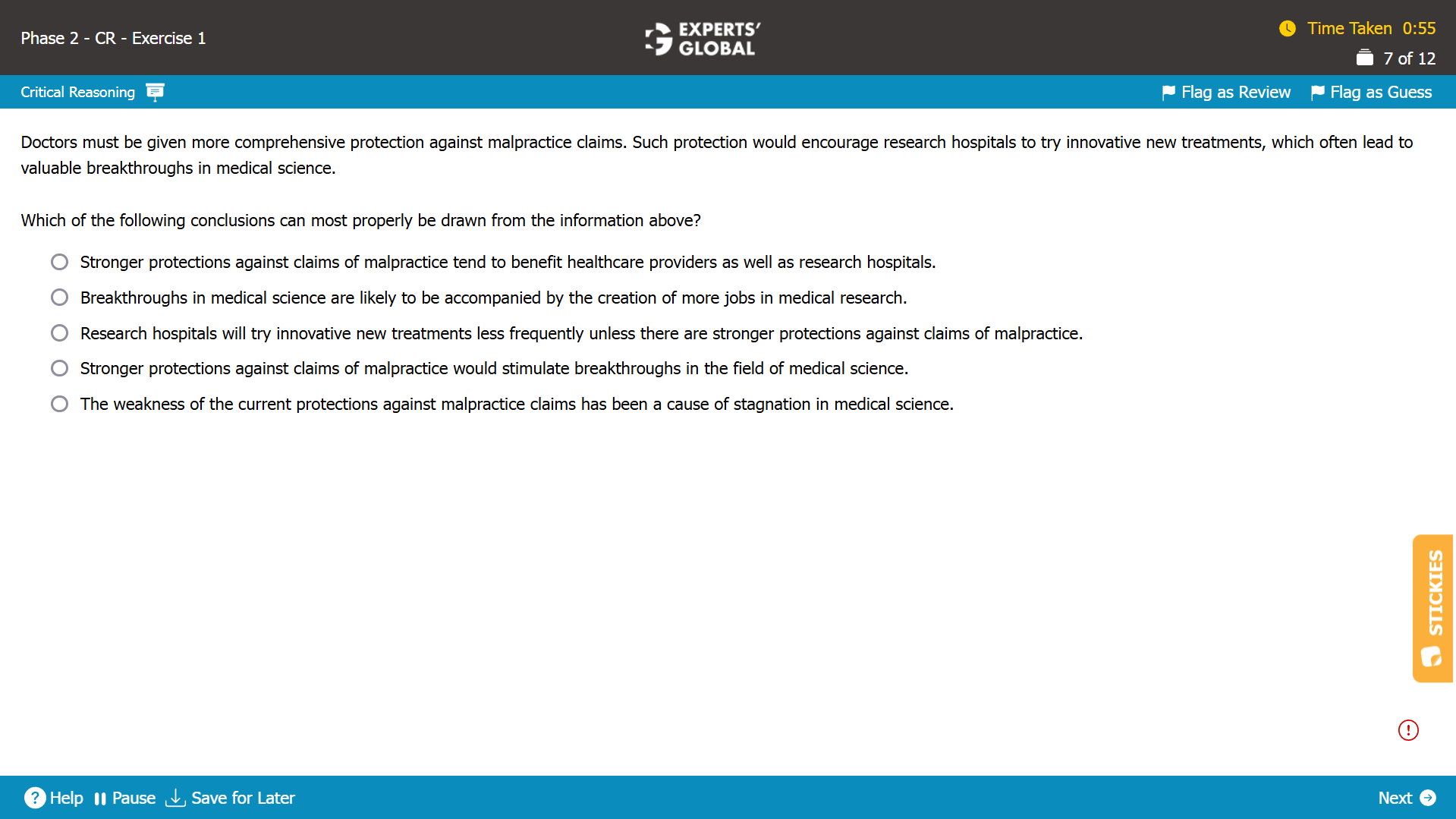
Mind-map: Doctors must receive stronger protection against malpractice claims → research hospitals will try innovative treatments → innovations will often create valuable medical science breakthroughs
Missing-link: Not needed
Expectation from the correct answer choice: To indicate the main point of the argument that stronger protection against malpractice claims facilitates medical science breakthroughs
A. The argument mentions the impact of stronger protection against malpractice claims on research hospitals but makes no suggestion regarding the impact on healthcare providers; so, this answer choice is just a possibility, which, although relevant to the broad context of the argument, is not a conclusion of the argument. Because this answer choice does not indicate the main conclusion of the argument, this answer choice is incorrect.
B. The argument mentions that with stronger protection against malpractice claims, research hospitals would likely create frequent valuable breakthroughs in medical science but provides no information about the impact of the breakthroughs on jobs; so, this answer choice is out of scope and not a conclusion of the argument. Because this answer choice does not indicate the main conclusion of the argument, this answer choice is incorrect.
C. Trap. This answer choice commits the classic GMAT error of confusing “helpfulness” with “necessity”; the argument mentions that with stronger protection against malpractice claims, research hospitals would try innovative new treatments and thus often create valuable breakthroughs; however, the argument does not suggest that stronger protection is a “necessity” and that without stronger protection, research hospitals would try innovative new treatments less often; in other words, it cannot be inferred that research hospitals will try innovative new treatments less often “unless” there is stronger protection against malpractice claims, as the answer choice mentions. Because this answer choice does not indicate the main conclusion of the argument, this answer choice is incorrect.
D. Correct. The argument mentions that with stronger protection against malpractice claims, research hospitals would try innovative new treatments and thus often create valuable breakthroughs, suggesting that stronger protections against claims of malpractice would stimulate breakthroughs in the field of medical science, as the answer choice mentions. Because this answer choice indicates the main conclusion of the argument, this answer choice is correct.
E. The argument makes no suggestion that the current protection against malpractice claims is weak or that medical science is currently stagnated. Further, the argument mentions that with stronger protection against malpractice claims, research hospitals would often create valuable breakthroughs; however, the argument makes no suggestion that “because of” the weak protection currently, medical science is stagnated, as the answer choice mentions. Because this answer choice does not indicate the main conclusion of the argument, this answer choice is incorrect.
D is the best choice.
How and Where to Practice GMAT CR Main Point Questions
High quality CR Main Point questions are not available in large numbers. Among the limited, genuinely strong sources are the official practice materials released by GMAC and the Experts’ Global GMAT course. Within the Experts’ Global GMAT online preparation course, every CR Main Point question appears on an exact GMAT like user interface that includes all the real exam tools and features. You work through more than 30 CR Main Point / Conclusion questions in quizzes and also take 15 full length GMAT mock tests that include several CR Main Point questions in roughly the same spread and proportion in which they appear on the actual GMAT.
Remember…

All the best!