Sincere preparation for the GRE involves focused strategy and practice for reading comprehension. You generally encounter four reading comprehension sets in the GRE verbal section, accounting for almost 40% of the section, and around three single passage questions, which we treat as critical reasoning in our course. On this page, we present three GRE-style reading comprehension practice question sets with detailed explanations. During practice, prioritize accuracy at this stage without worrying about speed. Use the explanations judiciously for incorrect or slow attempts, and carry the learnings into further GRE preparation and practice across GRE practice exercises, GRE sectional practice tests, and GRE full-length practice tests. All the best!
Important: If you need to undergo thorough Reading Comprehension prep, please visit Free GRE Reading Comprehension prep
GRE Reading Comprehension Practice Set 1
Practice Question 1 | Reading Comprehension
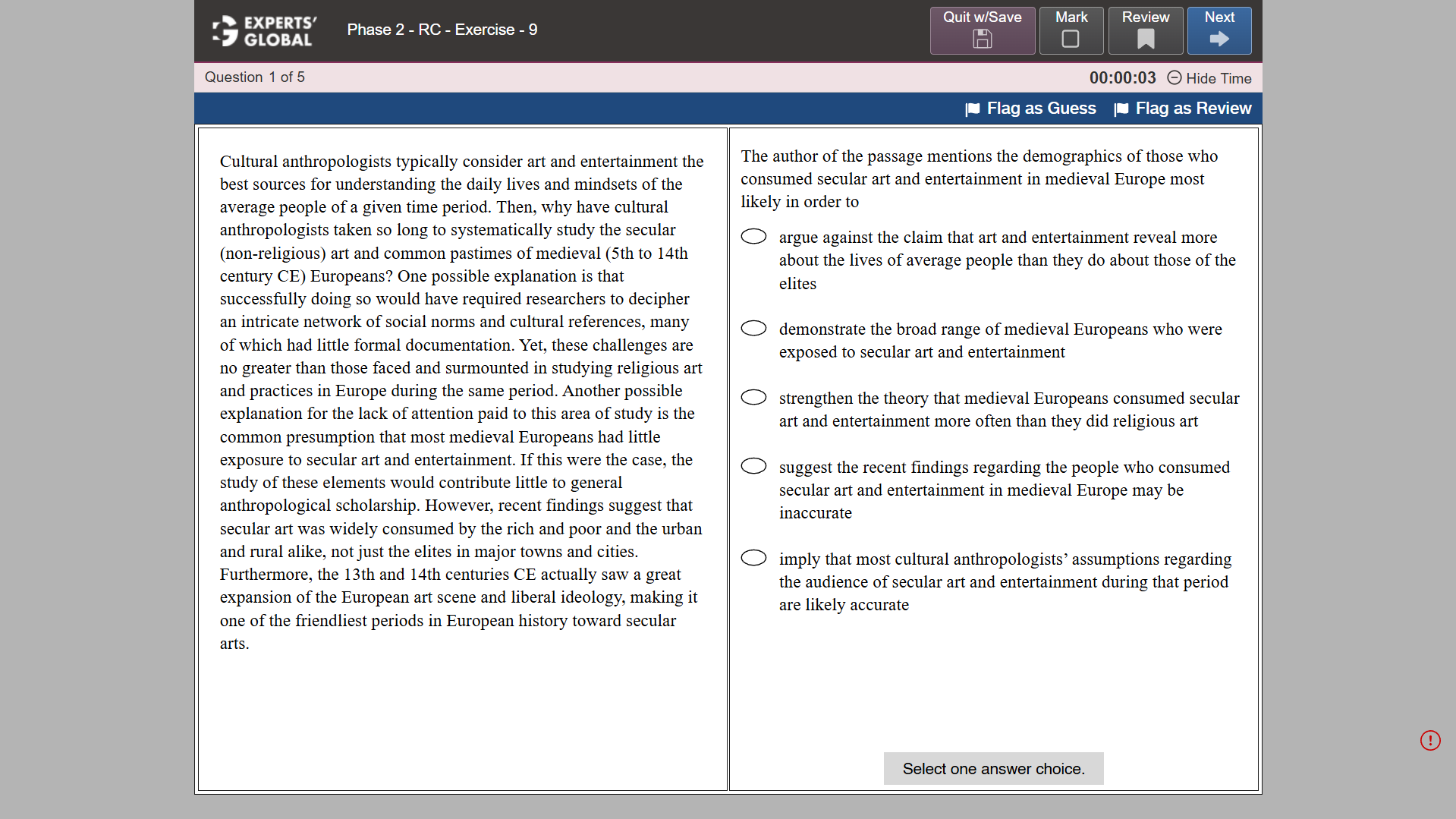
The author of the passage mentions the demographics of those who consumed secular art and entertainment in medieval Europe most likely in order to
A. argue against the claim that art and entertainment reveal more about the lives of average people than they do about those of the elites
B. demonstrate the broad range of medieval Europeans who were exposed to secular art and entertainment
C. strengthen the theory that medieval Europeans consumed secular art and entertainment more often than they did religious art
D. suggest the recent findings regarding the people who consumed secular art and entertainment in medieval Europe may be inaccurate
E. imply that most cultural anthropologists’ assumptions regarding the audience of secular art and entertainment during that period are likely accurate
Written Explanation
Mind-map
The lack of attention paid to a particular subject is questioned (Lines 1 – 5)
A possible justification for this lack of attention is proposed (Lines 6 – 9)
The proposed justification is challenged (Lines 10 – 11)
A second possible justification is proposed (Lines 12 – 16)
The second proposed justification is challenged (Line 17 – end)
A. Trap. The passage does not reference any claim regarding how average people and the elite differed in their reactions to art and entertainment. Incorrect.
B. Correct. The passage states that “…secular art was widely consumed by the rich and poor and the urban and rural alike…”; hence, it can be inferred there was a broad range of medieval Europeans who were exposed to secular art and entertainment.
C. Although the passage asserts that “…secular art was widely consumed by the rich and poor and the urban and rural alike…”, it does not reference how commonly secular art was consumed, relative to religious art. Incorrect.
D. The passage does not reference any potential inaccuracies in the mentioned recent findings. Incorrect.
E. The only assumption the passage refers to is the common presumption that “…most medieval Europeans had little exposure to secular art and entertainment…”, and the passage states that “…secular art was widely consumed by the rich and poor and the urban and rural alike…”, implying that this assumption is not accurate. Incorrect.
Thus, B is the correct answer choice.
Practice Question 2 | Reading Comprehension
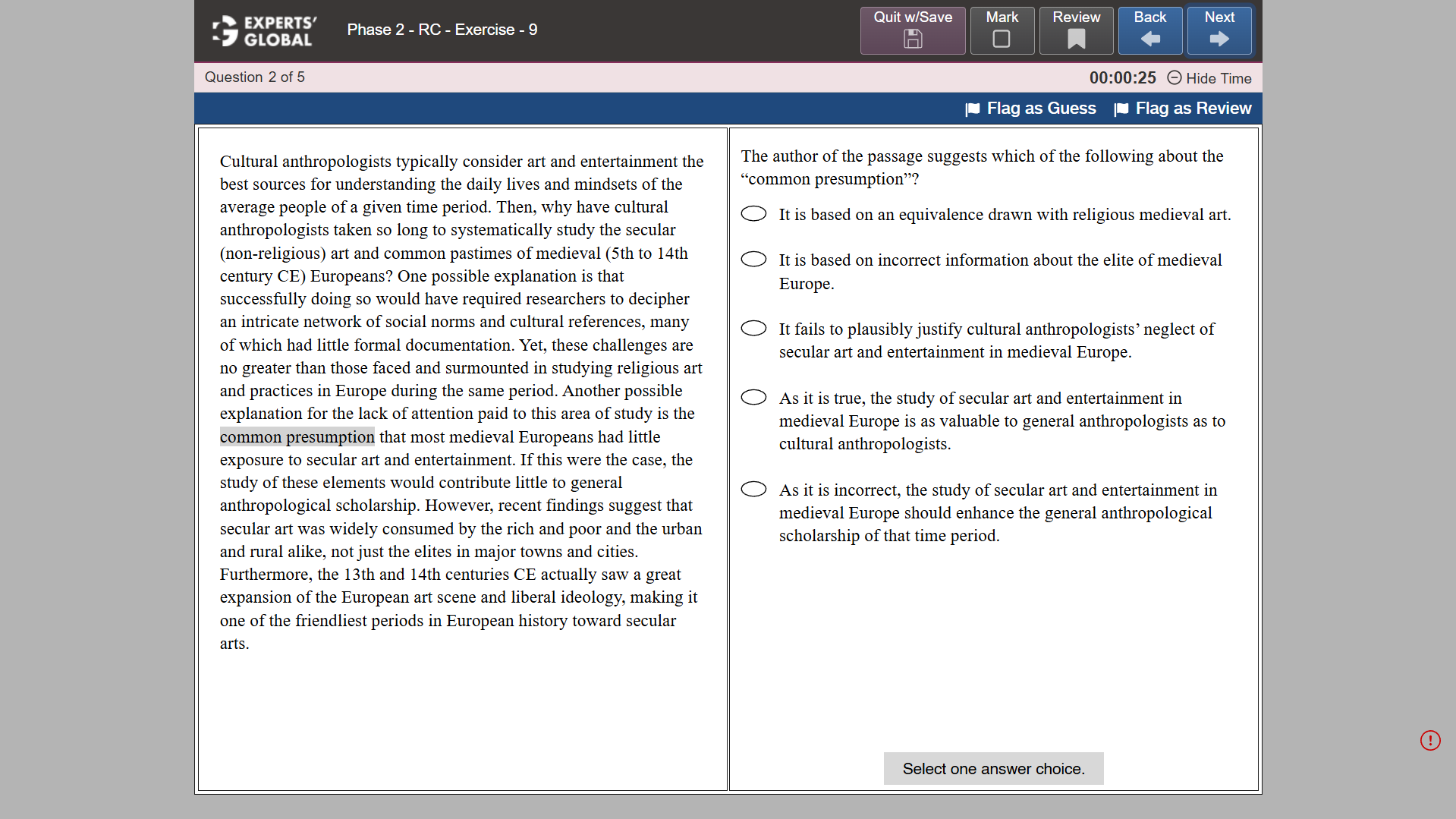
The author of the passage suggests which of the following about the “common presumption”?
A. It is based on an equivalence drawn with religious medieval art.
B. It is based on incorrect information about the elite of medieval Europe.
C. It fails to plausibly justify cultural anthropologists’ neglect of secular art and entertainment in medieval Europe.
D. As it is true, the study of secular art and entertainment in medieval Europe is as valuable to general anthropologists as to cultural anthropologists.
E. As it is incorrect, the study of secular art and entertainment in medieval Europe should enhance the general anthropological scholarship of that time period.
Written Explanation
Mind-map
The lack of attention paid to a particular subject is questioned (Lines 1 – 5)
A possible justification for this lack of attention is proposed (Lines 6 – 9)
The proposed justification is challenged (Lines 10 – 11)
A second possible justification is proposed (Lines 12 – 16)
The second proposed justification is challenged (Line 17 – end)
The “common presumption” referenced here is that “…most medieval Europeans had little exposure to secular art and entertainment…”.
A. The passage does not reference religious medieval art. Incorrect.
B. Trap. The passage states that “…secular art was widely consumed…not just the elites…”; the passage references “…the elites…” only in this statement and does not suggest that this statement is incorrect. Incorrect.
C. Trap. The passage states that “Another possible explanation for the lack of attention paid to this area of study is the common presumption…”; although the passage refutes this presumption, it does so on the basis of factual accuracy – the passage shows that the presumption is incorrect; it does not make the argument that the presumption merely fails to justify the lack of attention paid to secular art. Incorrect.
D. The passage does not reference general anthropologists or general anthropology; rather, it discusses the study of secular art and entertainment in medieval Europe only in the context of “…cultural anthropologists…”. Incorrect.
E. Correct. Referring to the “common presumption”, the passage states, “If this were the case, the study of these elements would contribute little to general anthropological scholarship.”; the passage then asserts that “…secular art was widely consumed by the rich and poor and the urban and rural alike…”; hence, it can be inferred that the “common presumption” is incorrect, and thus the study of secular art and entertainment in medieval Europe should enhance the general anthropological scholarship of that time period.
Thus, E is the correct answer choice.
Practice Question 3 | Reading Comprehension
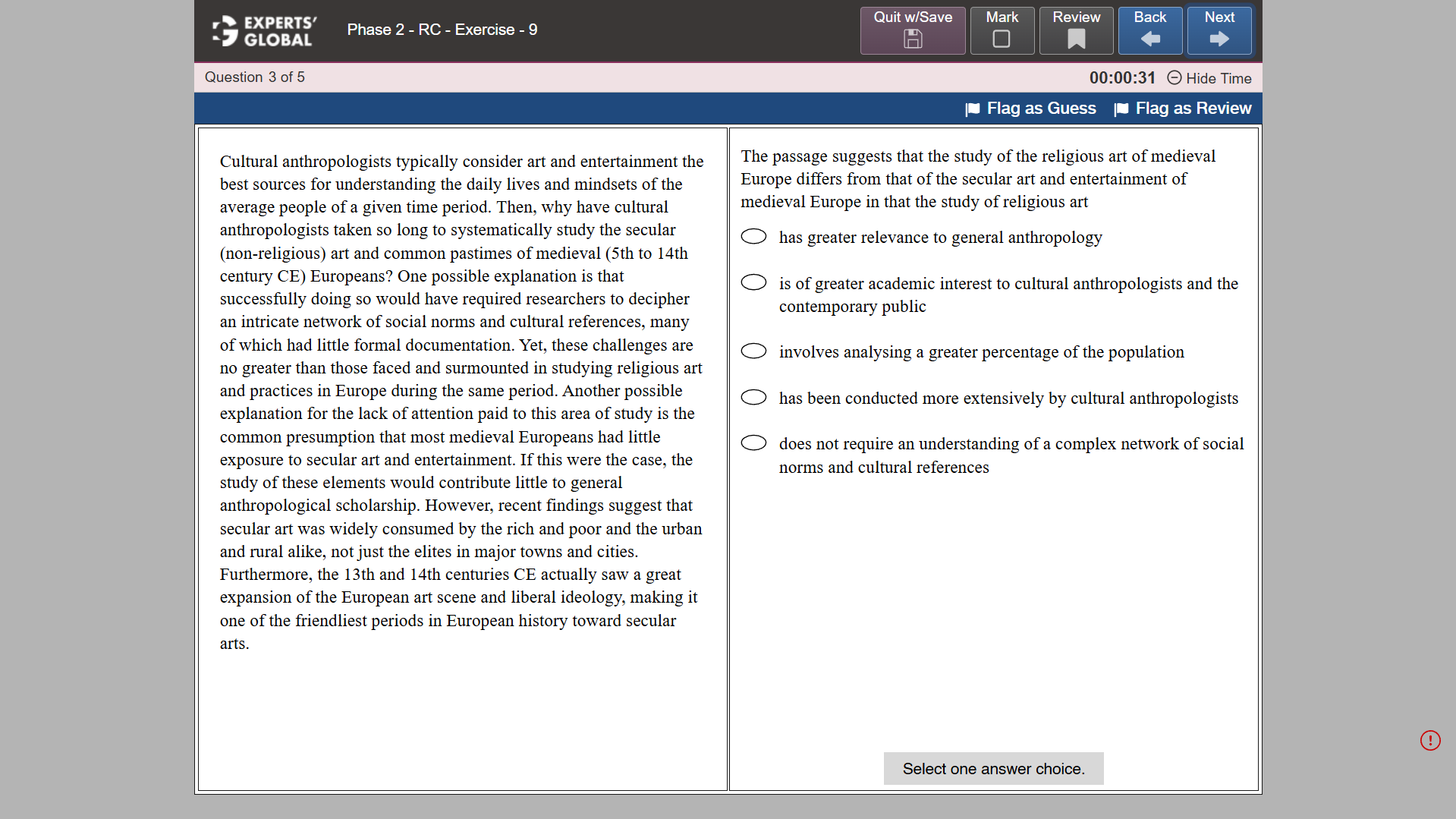
The passage suggests that the study of the religious art of medieval Europe differs from that of the secular art and entertainment of medieval Europe in that the study of religious art
A. has greater relevance to general anthropology
B. is of greater academic interest to cultural anthropologists and the contemporary public
C. involves analysing a greater percentage of the population
D. has been conducted more extensively by cultural anthropologists
E. does not require an understanding of a complex network of social norms and cultural references
Written Explanation
Mind-map
The lack of attention paid to a particular subject is questioned (Lines 1 – 5)
A possible justification for this lack of attention is proposed (Lines 6 – 9)
The proposed justification is challenged (Lines 10 – 11)
A second possible justification is proposed (Lines 12 – 16)
The second proposed justification is challenged (Line 17 – end)
A. The passage does not reference general anthropologists or general anthropology; rather, it discusses the study of secular art and entertainment in medieval Europe only in the context of “…cultural anthropologists…”. Incorrect.
B. The passage does not reference the “contemporary public”. Incorrect.
C. Trap. The passage does not compare what percentage of the population must be analysed in studying medieval European religious art and medieval European secular art and entertainment, respectively. Incorrect.
D. Correct. Referring to the challenges involved in studying the secular art and entertainment of medieval Europe, the passage states that “…these challenges are no greater than those…surmounted…in studying religious art and…”, implying that cultural anthropologists have solved the challenges involved in studying religious art in a way that they have not done for the study of secular art and entertainment; hence, it can be inferred that they have studied religious medieval art to a greater extent than secular art and entertainment.
E. The passage states that studying secular medieval European art requires an understanding of a complex network of social norms and cultural references and, in this context, states that “…these challenges are no greater than those…surmounted…in studying religious art…, implying that studying religious medieval European art also requires an understanding of a complex network of social norms and cultural references. Incorrect.
Thus, D is the correct answer choice.
GRE Reading Comprehension Practice Set 2
Practice Question 4 | Reading Comprehension
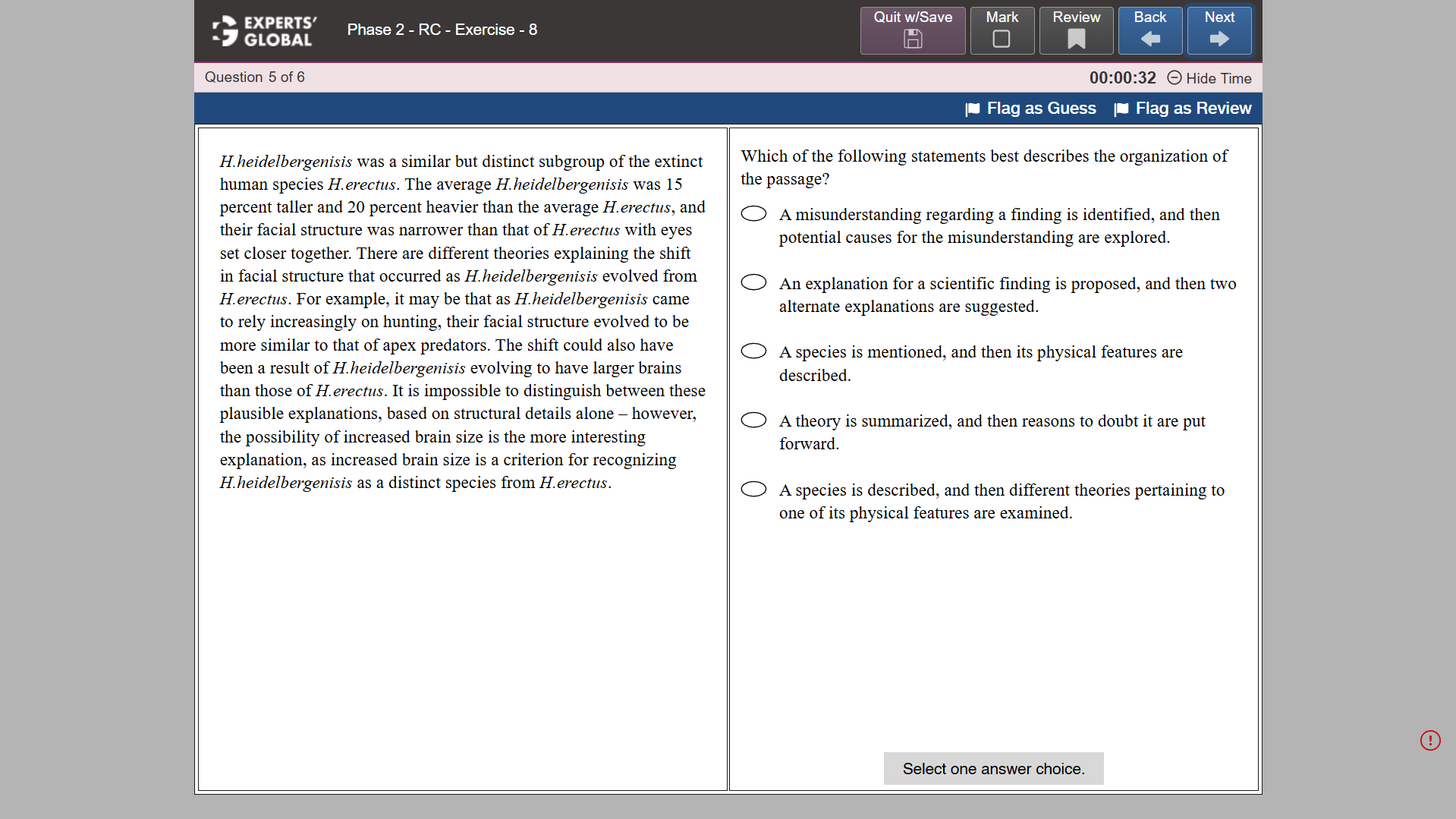
Which of the following statements best describes the organization of the passage?
A. A misunderstanding regarding a finding is identified, and then potential causes for the misunderstanding are explored.
B. An explanation for a scientific finding is proposed, and then two alternate explanations are suggested.
C. A species is mentioned, and then its physical features are described.
D. A theory is summarized, and then reasons to doubt it are put forward.
E. A species is described, and then different theories pertaining to one of its physical features are examined.
Written Explanation
Mind-map
The physical differences between two subspecies are explained (Lines 1 – 4)
Two theories about the origin of these differences are put forward (Lines 5 – 10)
That the second theory is more interesting than the first is asserted (Line 11 – end)
A. The passage does not reference a misunderstanding of any kind. Incorrect.
B. As the mind-map indicates, the passage references only two explanations and does not reference these explanations as alternatives to a third. Incorrect.
C. As the mind-map indicates, the passage not only mentions a species and describes its physical features, but also examines two theories about a particular feature; hence, this answer choice does not do justice to the passage as a whole. Incorrect.
D. As the mind-map indicates, the passage puts forward two theories, not one, and does not reference any reason to doubt either theory; rather, the passage asserts that one theory is more interesting than the other. Incorrect.
E. Correct. As the mind-map indicates, the passage explains how one species physically differs from another, puts forward two theories about these differences, and then asserts that one theory is more interesting than the other; hence, the passage describes one of the species and can be said to examine different theories pertaining to one of its physical features.
Thus, E is the correct answer choice.
Practice Question 5 | Reading Comprehension
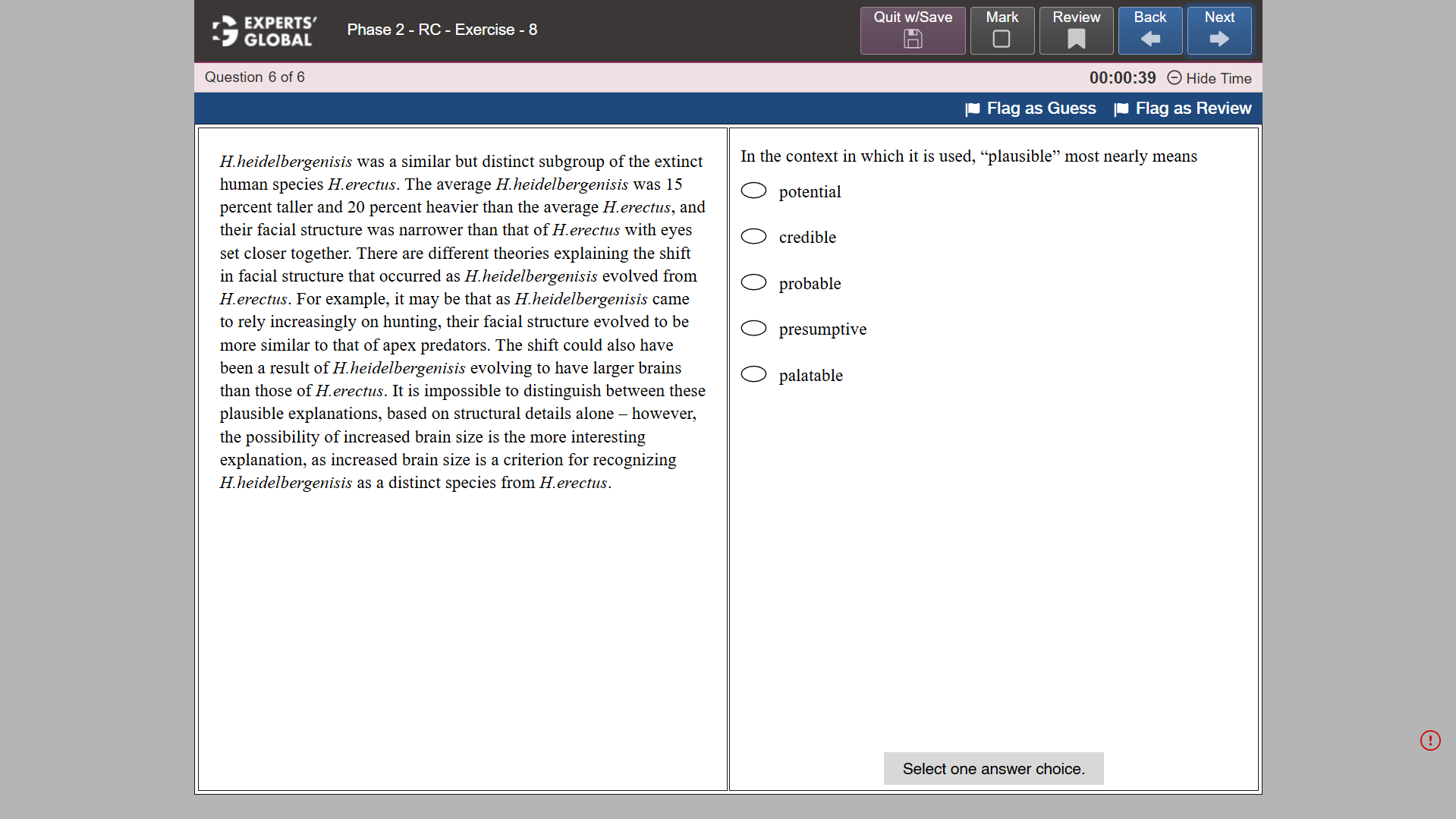
In the context in which it is used, “plausible” most nearly means
A. potential
B. credible
C. probable
D. presumptive
E. palatable
Written Explanation
Mind-map
The physical differences between two subspecies are explained (Lines 1 – 4)
Two theories about the origin of these differences are put forward (Lines 5 – 10)
That the second theory is more interesting than the first is asserted (Line 11 – end)
In the context in which it is used, “plausible” (possible/believable/reasonable) conveys that there is a possibility that certain theories may be true. Our broad expectation from the correct answer choice is to convey a meaning along the lines of “possible”.
A. Correct. “potential” (meaning: possible) can be considered synonymous with “plausible” and conveys a meaning along the lines of “possible”, meeting our broad expectation.
B. Although “credible” (meaning: trustworthy) can be considered synonymous with “plausible”, in the context in which “plausible” is used, the usage of “credible” leads to a change in meaning, as “credible” conveys a meaning along the lines of “reliable”, and not the desired meaning on the lines of “possible”. Incorrect.
C. Although “probable” (meaning: likely/possible) can be considered synonymous with “plausible”, in the context in which “plausible” is used, the usage of “probable” leads to a change in meaning, as “probable” conveys a meaning along the lines of “likely”, and not the desired meaning on the lines of “possible”. Incorrect.
D. There is no meaning of “presumptive” (meaning: assumed) that can be considered synonymous with “plausible”. Incorrect.
E. There is no meaning of “palatable” (meaning: agreeable) that can be considered synonymous with “plausible”. Incorrect.
Thus, A is the correct answer choice.
GRE Reading Comprehension Practice Set 3
Practice Question 6 | Reading Comprehension
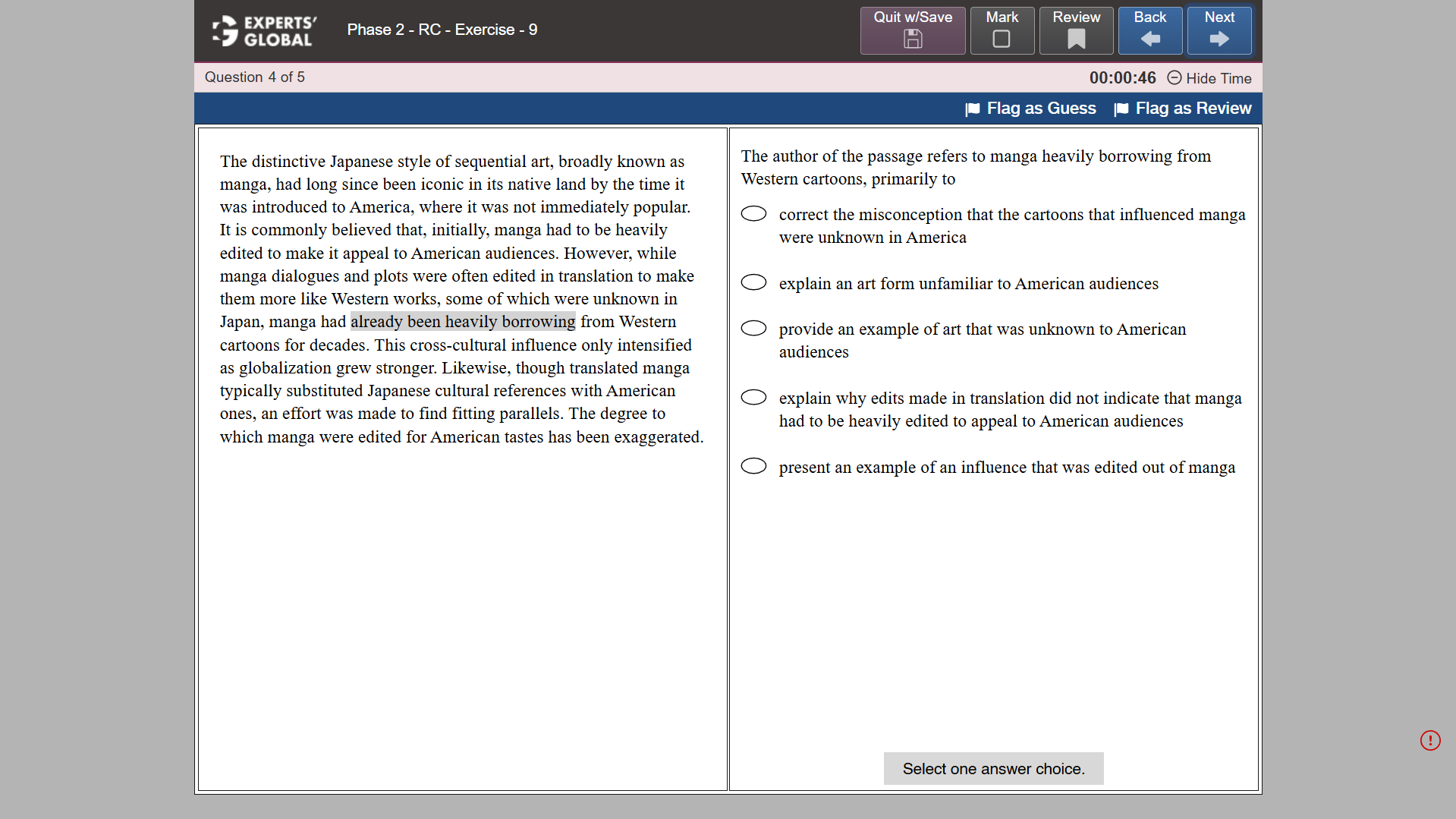
The author of the passage refers to manga heavily borrowing from Western cartoons, primarily to
A. correct the misconception that the cartoons that influenced manga were unknown in America
B. explain an art form unfamiliar to American audiences
C. provide an example of art that was unknown to American audiences
D. explain why edits made in translation did not indicate that manga had to be heavily edited to appeal to American audiences
E. present an example of an influence that was edited out of manga
Written Explanation
Mind-map
The idea that an art form had to be heavily altered to become popular in America is introduced (Lines 1 – 5)
That the alteration of the art form was not as heavy as believed is argued (Lines 6 – 10)
That the nature of this art form was retained despite its alteration is asserted (Lines 11 – end)
A. The passage states, “…manga had already been heavily borrowing from Western cartoons for decades…”; hence, the passage does not reference a misconception that the cartoons that influenced manga were unknown in America; rather, the passage asserts that manga was influenced by Western cartoons. Incorrect.
B. The passage neither explains an art form unfamiliar to Americans nor references manga heavily borrowing from Western cartoons to do so; rather, the passage refers manga heavily borrowing from Western cartoons to argue that manga shared significant similarities with Western works, even before it was edited. Incorrect.
C. In referring to manga heavily borrowing from Western cartoons, the passage does not provide any example of the art form unknown to American audiences (manga). Incorrect.
D. Correct. By mentioning that manga had been borrowing from Western cartoons, the passage suggests that manga already had significant similarities with Western works, meaning manga did not need to be heavily edited to resemble Western works, and thus, did not need to be heavily edited to appeal to American audiences.
E. The passage makes no reference to the influence of Western cartoons being edited out of manga. Incorrect.
Thus, D is the correct answer choice.
Practice Question 7 | Reading Comprehension
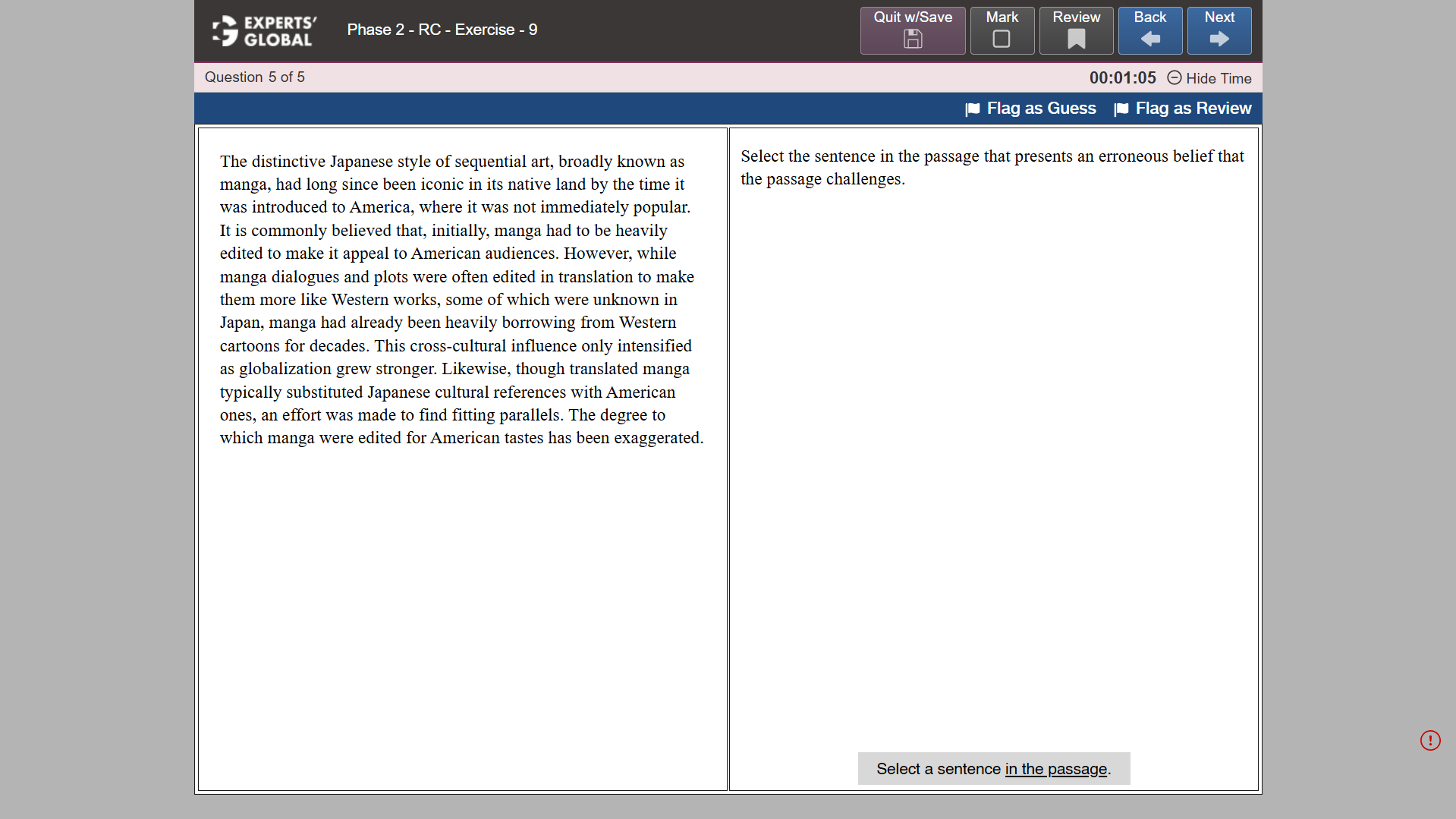
Select the sentence in the passage that presents an erroneous belief that the passage challenges.
Written Explanation
Mind-map
The idea that an art form had to be heavily altered to become popular in America is introduced (Lines 1 – 5)
That the alteration of the art form was not as heavy as believed is argued (Lines 6 – 10)
That the nature of this art form was retained despite its alteration is asserted (Lines 11 – end)
First Sentence (“The distinctive…initially slow.”): Trap. The passage presents no information contrary to the claim that manga was already popular in Japan when it was introduced to America or that manga’s adoption in America was slow. Incorrect.
Second Sentence (“It is…American audiences.”): Correct. As the mind-map indicates, the passage argues against the idea that manga had to be heavily edited to suit Western tastes to become popular in America; hence, the passage can be said to argue against the idea that manga had to be heavily edited for it to appeal to American audiences.
Third Sentence (“However, while…for decades.”): The passage presents no information contrary to the claim that manga plots and dialogues were often heavily edited to make them more like Western works or that Western cartoons had already had a heavy influence on manga. Incorrect.
Fourth Sentence (“This cross-cultural…grew stronger.”): The passage presents no information contrary to the claim that the cross-cultural influence between manga and Western cartoons intensified with globalization. Incorrect.
Fifth Sentence (“Likewise, though…fitting parallels.”): The passage presents no information contrary to the claim that when substituting Japanese cultural references for American ones in translated manga, an effort was made to find fitting parallels. Incorrect.
Sixth Sentence (“The degree…been exaggerated.”): As the mind-map indicates, the passage argues that manga did not need to be heavily edited to become popular in America; hence, the passage is likely to agree that the degree to which manga was edited to suit American tastes has been exaggerated. Incorrect.
Thus, the second sentence is the correct answer choice.
Additional GRE Reading Comprehension Practice Questions
Please find a set of assorted GRE-style Verbal questions (all types) with explanations on: Free GRE Verbal Practice Questions with Solutions
Please find a set of assorted GRE-style questions (all sections and types) with explanations on: Free GRE Practice Questions with Solutions
For Further GRE Prep and Practice…
GRE prep course with 7-day free trial
15 full length GRE practice tests
60 sectional GRE practice tests
GRE 5-week crash course
GRE prep with admission consulting bundle