
Invest 30 seconds...
...for what may lead to a life altering association!
Help Line
- +91.8800.2828.00 (IND)
- 1030-1830 Hrs IST, Mon-Sat
- support@expertsglobal.com

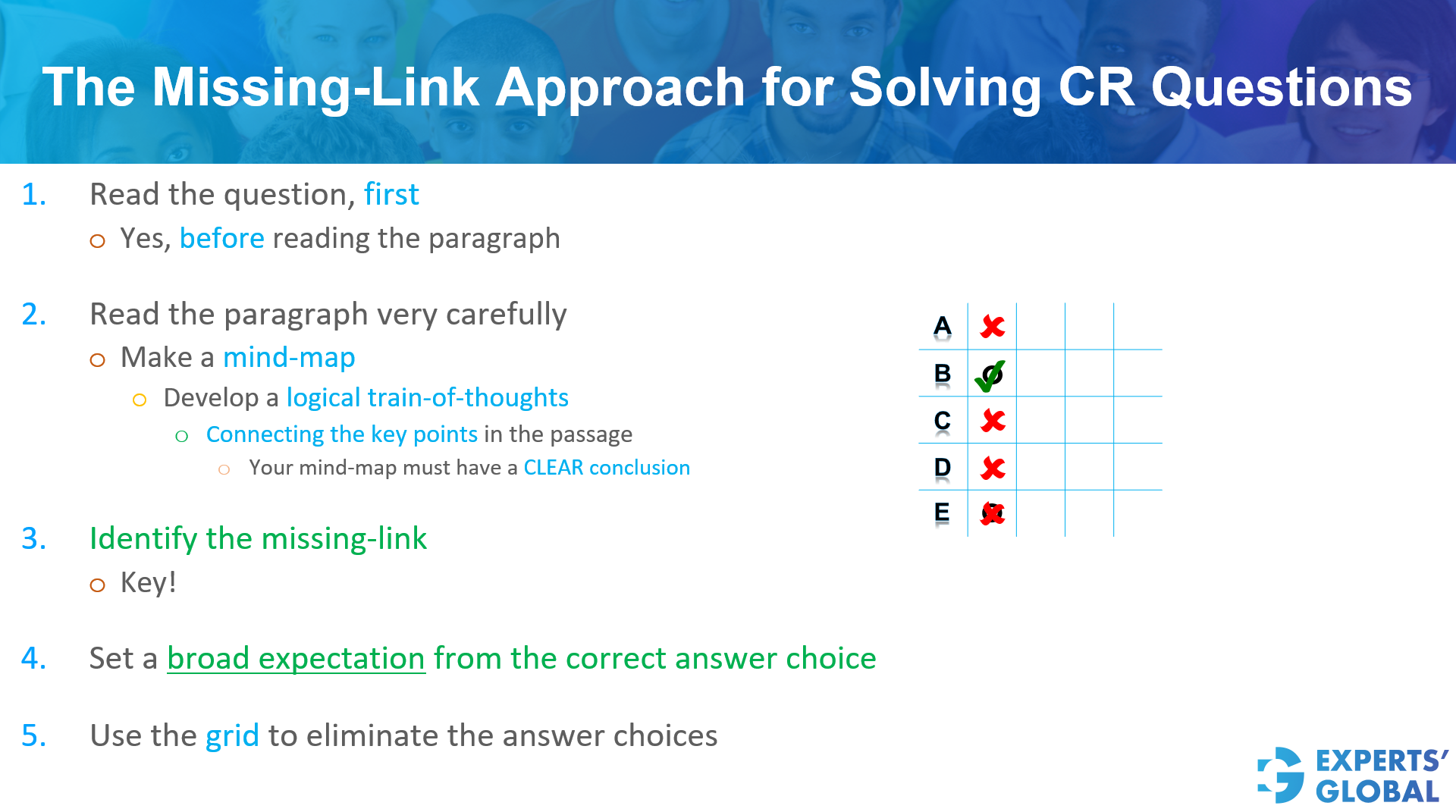
GMAT critical reasoning questions test how clearly you can understand an argument and think through its logic. On the verbal section, critical reasoning and reading comprehension are the only two question types, and you can expect 8 to 10 critical reasoning questions out of a total of 23. That means roughly 40 percent of the verbal section is critical reasoning, which makes it crucial for scoring well on the GMAT. As you prepare, you also build sound critical reasoning skills that support you in other GMAT question types and, very importantly, serve you deeply in business school, in your career in business management, and in daily life. It is helpful to see critical reasoning preparation as an investment in a real-life skill that will benefit you in every sphere of life. Any dependable GMAT preparation course must therefore offer full coverage of GMAT critical reasoning and all its question types. On this page, our aim is to share an efficient approach for solving GMAT critical reasoning questions, an approach that you can apply to virtually all CR question types on the exam. At Experts’ Global, we call this the Missing-Link-Approach.
Critical Reasoning measures how clearly and systematically you can think. This overview introduces the Missing-Link-Approach: first identify the premise, then define the conclusion, and finally mark the gap that lies between them. Through this lens, you will learn how to handle assumption, strengthen, and weaken questions and how to anticipate convincing answers even before you look at the options. The following short video walks step by step through this approach, shows how it handles questions, and equips you to apply it in GMAT drills, sectional tests, and full-length GMAT mock tests.

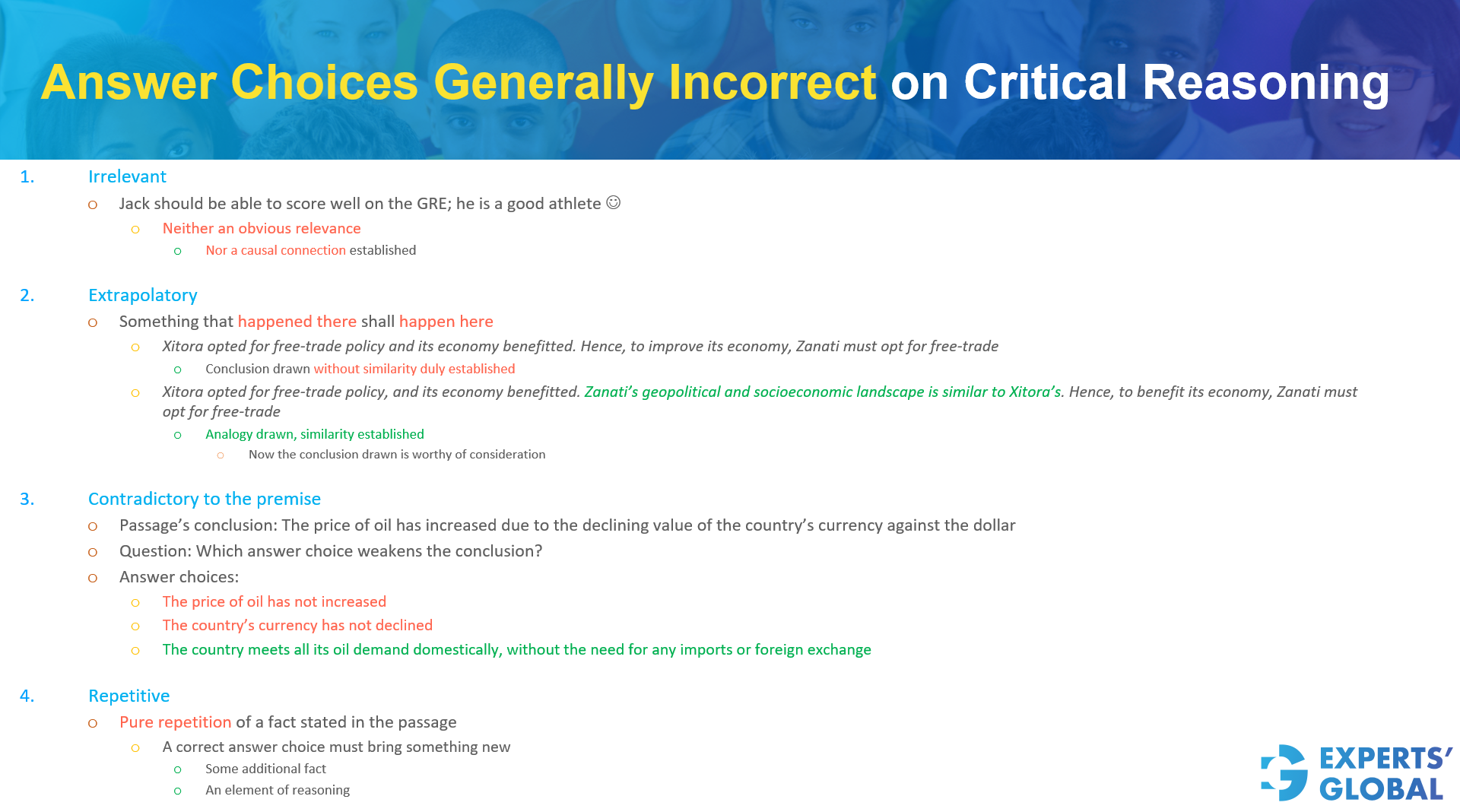
Critical Reasoning rewards calm, disciplined judgment of both claims and supporting evidence. This overview maps out the main wrong answer patterns: choices that are irrelevant, options that stretch “there” to “here” without proper support, statements that conflict with given facts, and responses that simply repeat what is already stated. By learning to spot these patterns, you begin to filter options based on logic rather than polished language. The article then shows how to focus on reasoning links, protect the intended scope of the argument, and eliminate choices quickly and confidently. The short video below walks through this concept in a relaxed way and demonstrates how the GMAT can test it.
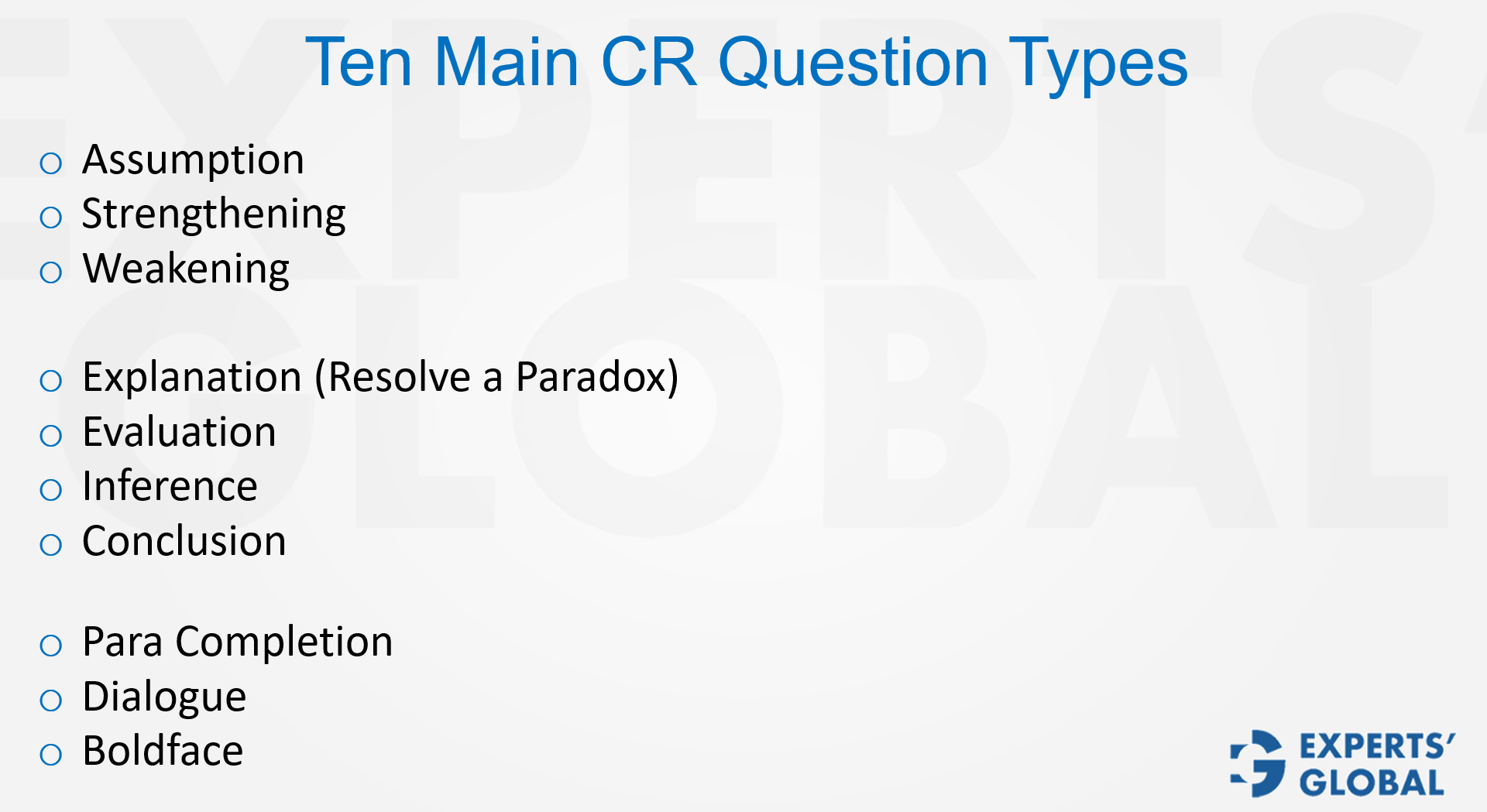
Critical Reasoning on the GMAT becomes much easier when you are clear about the task. This overview presents the ten primary question types and builds the habit of reading the question stem first, then mapping the premise, the conclusion, and the connection between them. You will see how recognizing the question type helps you eliminate options, form a rough prediction, and move toward the answer without adding unnecessary complexity. The following short video clears up this idea and shows how it can be tested on the GMAT.
Real preparation for CR Assumption questions truly begins when you solve them on a software platform that closely mirrors the official GMAT interface. You need a setup that displays the argument, the question stem, and the answer choices in a GMAT like layout, allows you to engage with the reasoning and options in a natural way, and offers all the on screen tools and functions that you will use on the actual exam. Without this kind of realistic environment, it is hard to feel fully ready for test day. High quality CR Assumption questions are not available in very large numbers, and among the limited but genuinely reliable sources are the official practice materials released by GMAC and the Experts’ Global GMAT course.
Within the Experts’ Global GMAT online preparation course, every CR Assumption question is presented on an exact GMAT like user interface that includes all the real exam tools and features. You work through more than 500 CR Assumption questions in quizzes and also take 15 full-length GMAT mock tests that include several CR Assumption questions in roughly the same spread and proportion in which they appear on the actual GMAT.
All the best!
