Invest 30 seconds...
...for what may lead to a life altering association!
Help Line
- +91.8800.2828.00 (IND)
- 1030-1830 Hrs IST, Mon-Sat
- support@expertsglobal.com
33% off ends soon:GMAT/GRE prep + applications bundle. Profile building, longer mentoring, better results. Inquire

Time, speed, and distance describe how far something travels, how fast it moves, and how long the movement takes, and, in the case of relative speed, how one body moves relative to another, both when they are moving in the same direction and when they are moving in opposite directions. These ideas help students understand motion, pacing, and rate based scenarios with clarity. Thorough coverage of this topic is an essential part of any prominent GMAT preparation course. This page offers you an organized subtopic wise playlist, along with a few worked examples, for efficient preparation of this concept.
Speed and average speed questions may appear straightforward, but they call for very careful focus. Average speed is always the total distance divided by the total time taken. When equal distances are covered at two different speeds, you must not use the simple arithmetic mean; you need to consider the complete trip. During your GMAT preparation, train yourself to rewrite every situation as total distance over total time, whether it involves multiple legs, uphill and downhill stretches, or changing speeds. This simple habit cuts down mistakes and makes even advanced word problems feel manageable. In the following short video, this approach is explained step by step, shows how it behaves on questions, and prepares you to use it in GMAT drills, sectional tests, and full-length GMAT mock tests.

Relative speed is one of those concepts that seems easy at first, yet can cause trouble if the understanding is shallow. The heart of the idea is this: when two objects move in opposite directions, their speeds combine, and when they move in the same direction, their speeds are subtracted. This simple rule forms the backbone of many GMAT questions that look complicated on the surface. Consider trains, for instance. When two trains cross each other, the total distance is the sum of their lengths, and the relative speed decides how long the crossing takes. Even when one train is at rest, or when a train passes a pole or a platform, the same principle applies. Once this is clear, long word problems that once seemed confusing begin to feel organized and manageable. The short video below makes this concept easy to grasp and shows how the GMAT can test it.
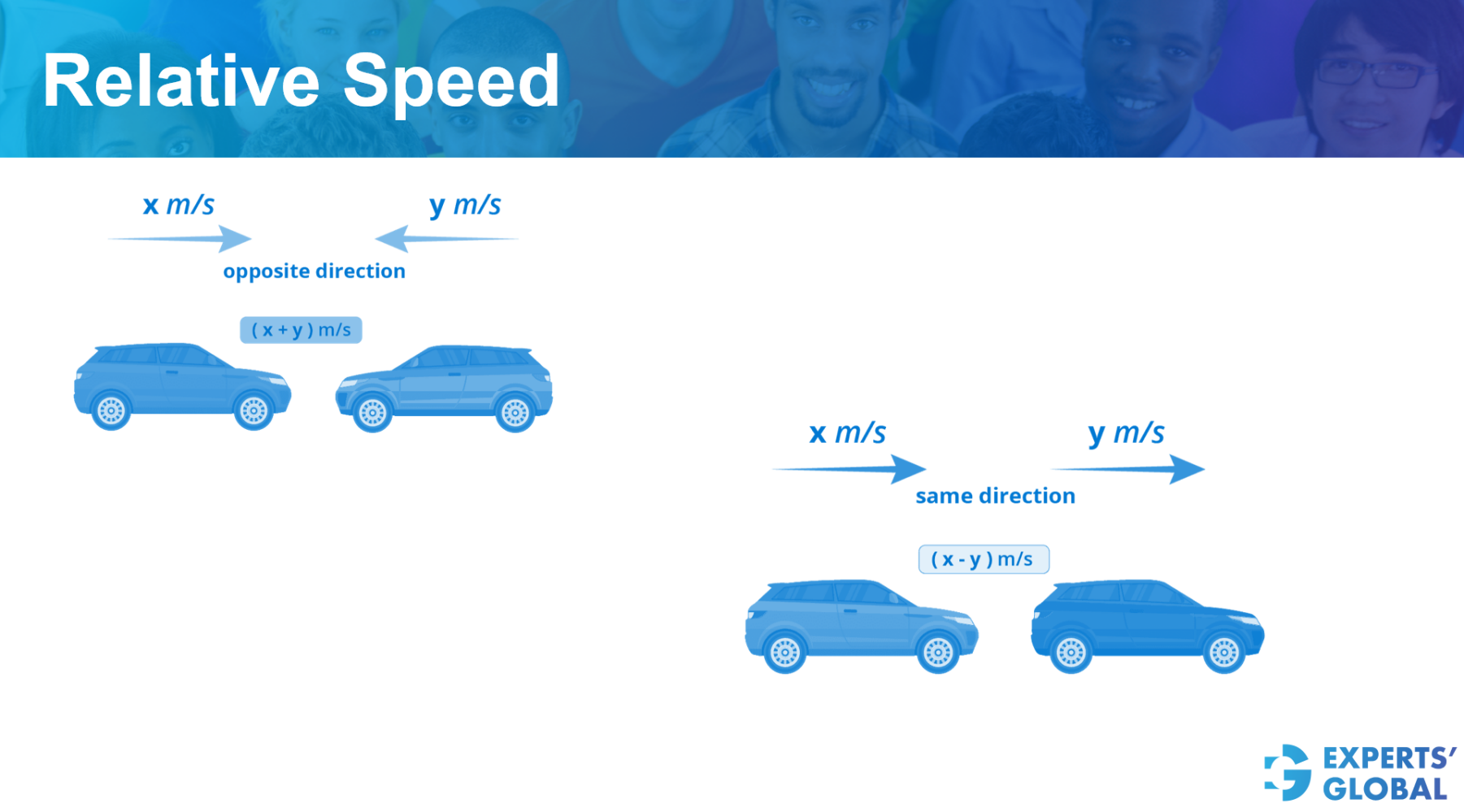
This section offers a carefully chosen set of GMAT-style Time, Speed, and Distance questions, each supported by a clear, stepwise explanation. Work through every problem at a steady pace and consciously apply the methods and ideas you have just studied on this page for handling time–speed–distance situations on the GMAT. At this stage, give priority to using the structured approach correctly rather than only aiming for a correct response. After attempting each question, use the explanation toggle to see the right answer and review the reasoning in detail.
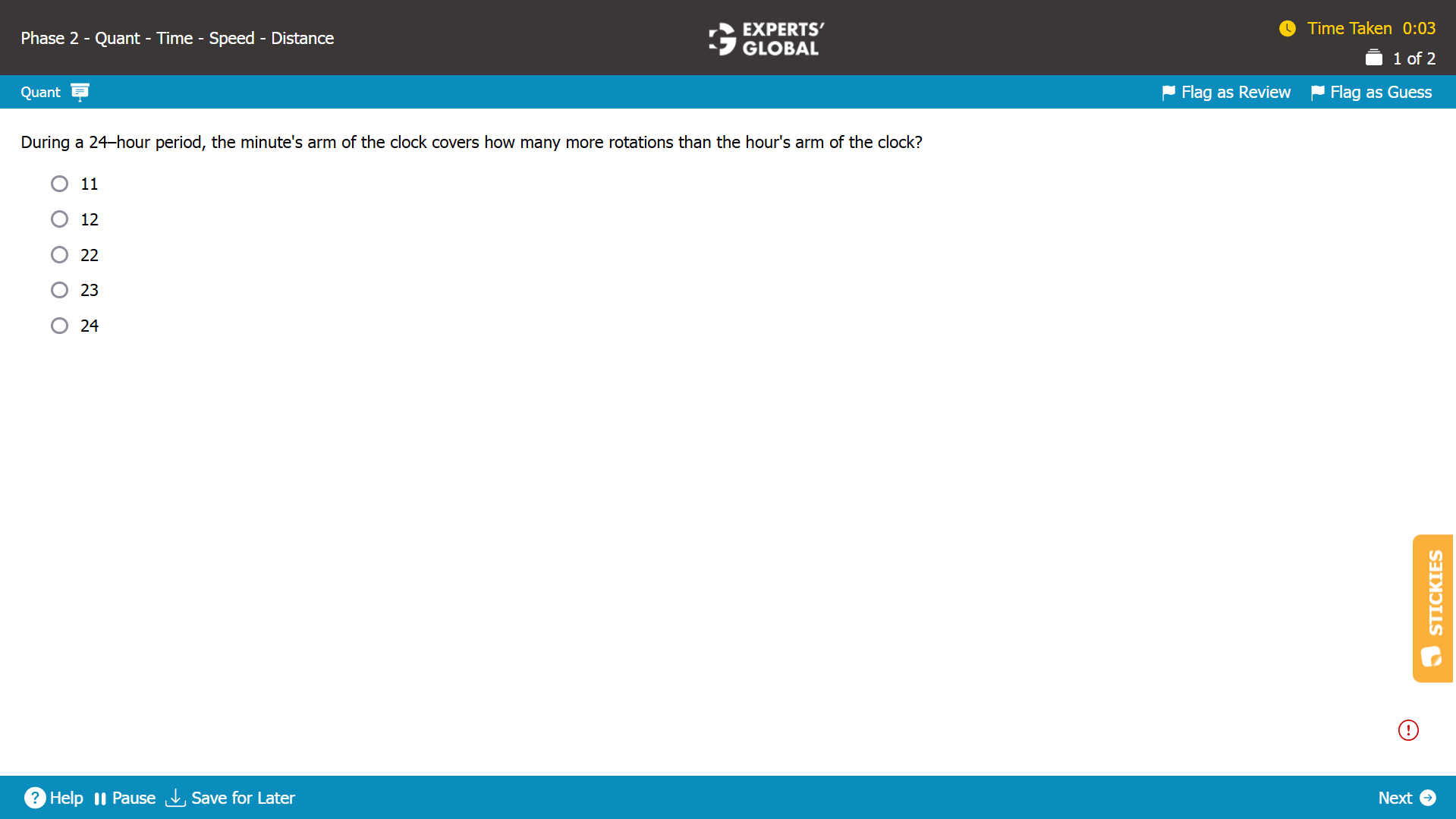
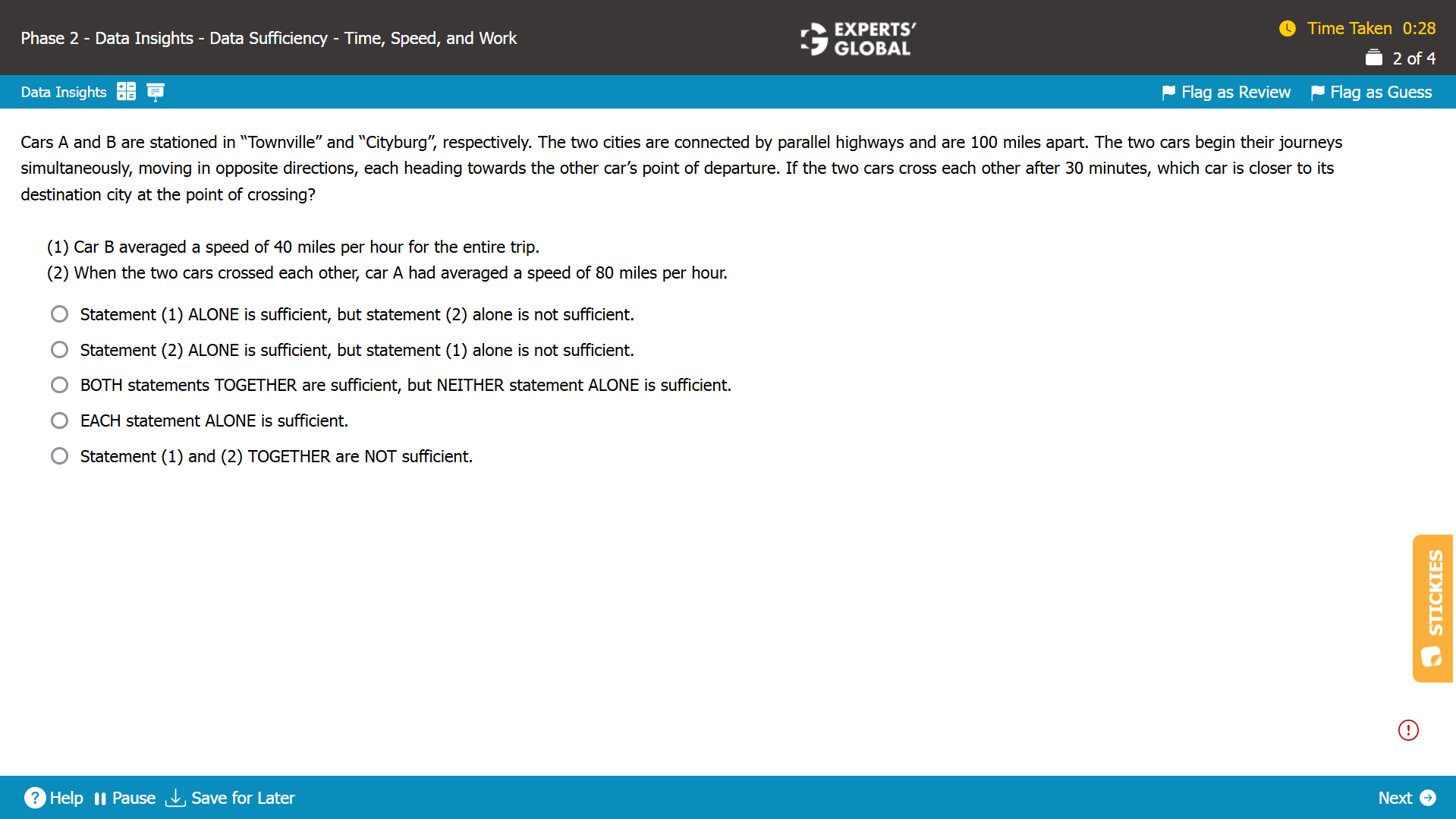
High quality Time-Speed-Distance questions are not available in large numbers. Among the limited, genuinely strong sources are the official practice materials released by GMAC and the Experts’ Global GMAT course. Within the Experts’ Global GMAT online preparation course, every Time-Speed-Distance problem appears on an exact GMAT like user interface that includes all the real exam tools and features. You work through more than 30 Time-Speed-Distance questions in quizzes and also take 15 full-length GMAT mock tests that include several Time-Speed-Distance questions in roughly the same spread and proportion in which they appear on the actual GMAT.
All the best!