Invest 30 seconds...
...for what may lead to a life altering association!
Help Line
- +91.8800.2828.00 (IND)
- 1030-1830 Hrs IST, Mon-Sat
- support@expertsglobal.com
33% off ends soon:GMAT/GRE prep + applications bundle. Profile building, longer mentoring, better results. Inquire

Coordinate geometry describes how points, lines, and shapes can be represented on a plane using pairs of numbers, allowing us to study location, distance, and simple geometric patterns through algebra. It brings together visual reasoning and numerical thinking in a very approachable way. Careful coverage of this topic is an essential part of any thorough GMAT preparation course. This page offers you an organized subtopic wise playlist, along with a few worked examples, for efficient preparation of this concept.
Understanding the coordinate axes, or the xy plane, is one of the most basic ideas in mathematics and sits at the heart of many GMAT questions. The axes divide the plane into four quadrants, each defined by the signs of x and y. The rule is simple yet very powerful: to the right of the y axis, x is positive, and to the left, x is negative. In the same way, above the x axis, y is positive, and below it, y is negative. These sign conventions may appear elementary, but they form the base for reading graphs, interpreting equations, and working with inequalities. On the GMAT, such fundamentals often appear in subtle ways, and overlooking a quadrant or misreading a sign can quietly cost you precious marks. The following short video introduces, explains, and demonstrates this approach, then prepares you to use it across GMAT drills, sectional tests, and full-length GMAT simulations.

In coordinate geometry, a core skill is finding the distance between two points. This distance is not just the change in x or the change in y, but the straight line that joins the two points, often called the Euclidean distance. The formula comes from the Pythagorean theorem and gives a dependable way to measure how far apart any two coordinates lie on the plane. For instance, the distance between (2, 3) and (4, 6) is √13, which is the exact length of the line segment joining them. A firm grip on this idea is vital because such distance questions appear often in the exam. Strengthening accuracy in coordinate geometry not only improves your problem solving but also prepares you for deeper, more advanced applications. The brief video that follows explains this concept clearly and highlights how it may be tested on the GMAT.
Knowing how to write the equation of a line is a central skill in coordinate geometry and supports a wide range of problem solving during GMAT preparation. A line can be expressed in several forms depending on what information you are given, and being at ease with these forms helps you quickly spot patterns in questions. The most familiar is the slope intercept form, y = mx + c, where m is the slope of the line and c is the y intercept. Another valuable version is the intercept form, x/a + y/c = 1, where a represents the x intercept and c represents the y intercept, especially useful when both intercepts are known. Besides, when you know that a line passes through two points (x₁, y₁) and (x₂, y₂), you can write its equation using the two point form: (x – x₁)/(x₂ – x₁) = (y – y₁)/(y₂ – y₁). The short video below illustrates this idea step by step and shows how it can be tested on the GMAT.
The idea of slope lies at the heart of understanding straight lines on the coordinate plane. In essence, slope tells you how quickly a line rises or falls as you move from left to right. It is defined as the ratio of the change in the vertical direction (y) to the change in the horizontal direction (x). A slope of zero corresponds to a perfectly horizontal line, a positive slope shows a line that climbs, and a negative slope marks a line that descends. Slope is more than a simple number; it encodes direction, steepness, and overall orientation, which makes it a crucial tool for reasoning in coordinate geometry. On the GMAT, this concept appears often in questions where your ability to interpret clearly matters more than heavy calculation. The brief video that follows helps you see this idea more clearly and shows how the GMAT may test it.
A straight line is one of the simplest shapes in coordinate geometry, yet it carries immense power. Its basic properties support many of the more advanced questions you will see on the GMAT. Two relationships matter especially: those between parallel lines and perpendicular lines. Parallel lines never meet, no matter how far you extend them, and they always share the same slope. This fact makes it much easier to find or write equations when one line is already known. Perpendicular lines, in contrast, intersect at right angles, and the product of their slopes is -1. These ideas are central to solving geometry based problem solving and data sufficiency questions on the exam. A firm grasp of these fundamentals helps you read graphs correctly, handle equations with confidence, and navigate coordinate geometry word problems accurately. The following short video offers a simple explanation of this idea and demonstrates how it shows up on the GMAT.
One of the most helpful tools in coordinate geometry is the ability to find the distance of a point from a line, as well as the perpendicular distance between two parallel lines. These ideas are simple to understand yet extremely powerful when you tackle advanced GMAT questions. The formula for the length of the perpendicular from a point to a line gives the shortest possible distance, and this often unlocks the logic behind geometry based problems. In the same way, knowing how to compute the perpendicular distance between two parallel lines allows you to interpret spatial relationships with clarity and confidence. Both concepts are precise, systematic, and frequently tested in aptitude exams. A deep grasp of these relationships ensures that you approach such questions calmly, without confusion or hesitation. The following short video puts this concept into perspective and shows how it can be tested on the GMAT.
Grasping the equation of a circle is an important part of coordinate geometry and often serves as the starting point for more advanced questions. The general equation rests on two simple ideas: the center of the circle and its radius. Once these are known, you can write the circle in its standard form and use it to decide whether a point lies inside, outside, or exactly on the circle. This may sound like a basic topic for GMAT preparation, yet it appears regularly in test questions where students make avoidable errors by rushing through the setup. Build a strong hold on this concept and apply it consistently in your GMAT drills and GMAT mocks to develop confidence. The short video below explores this idea and demonstrates how it can be tested in GMAT questions.
This practice set presents GMAT-style Coordinate Geometry questions, each paired with a clear, fully worked explanation. Move through the problems at a steady, unhurried pace and apply the ideas and techniques you have just studied on this page for interpreting points, lines, and graphs in the coordinate plane on the GMAT. At this stage, give more importance to following the recommended approach carefully than to merely obtaining the correct option. After attempting each question, use the explanation button to reveal the right answer and review the reasoning in a detailed, stepwise manner.
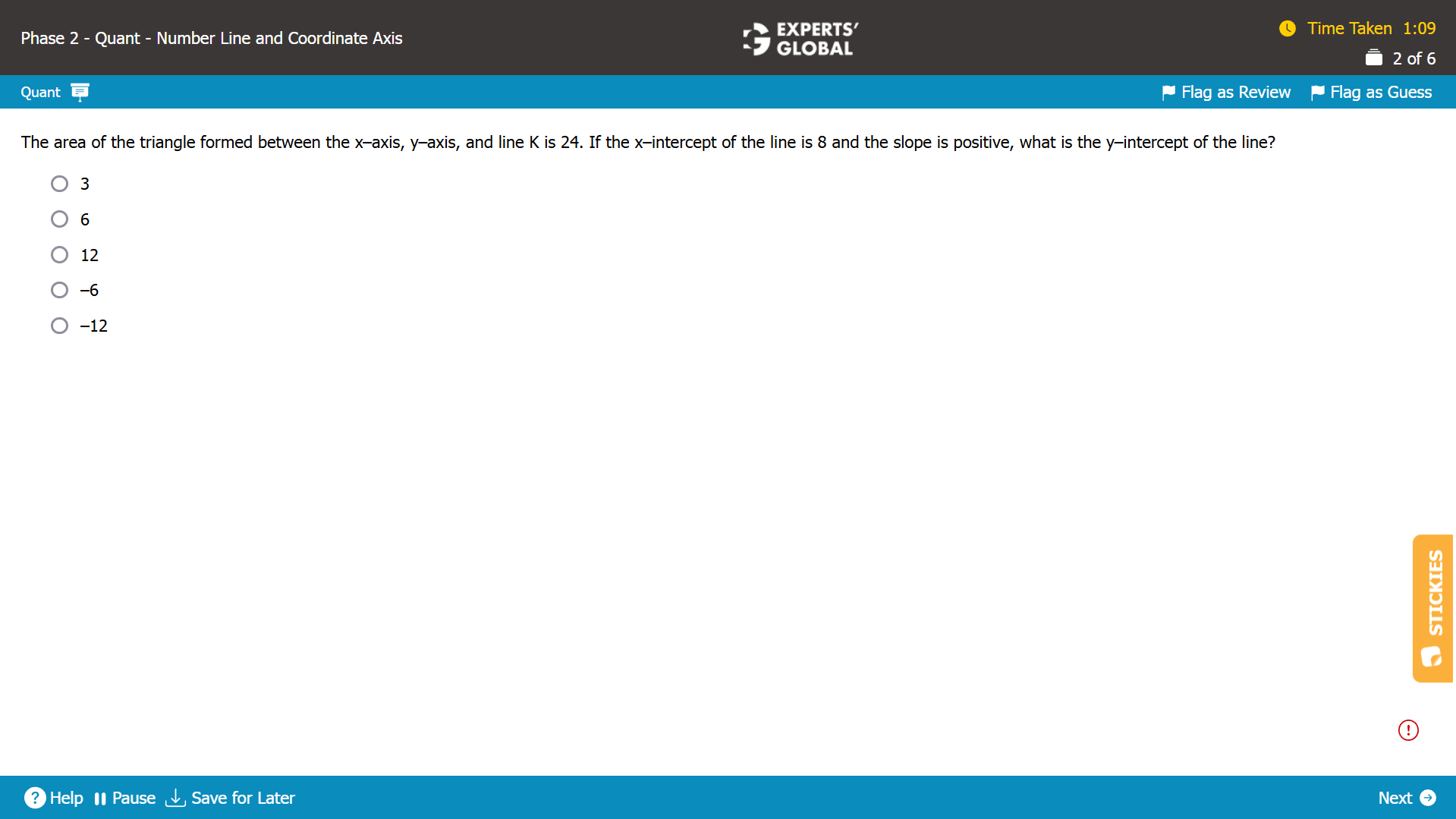
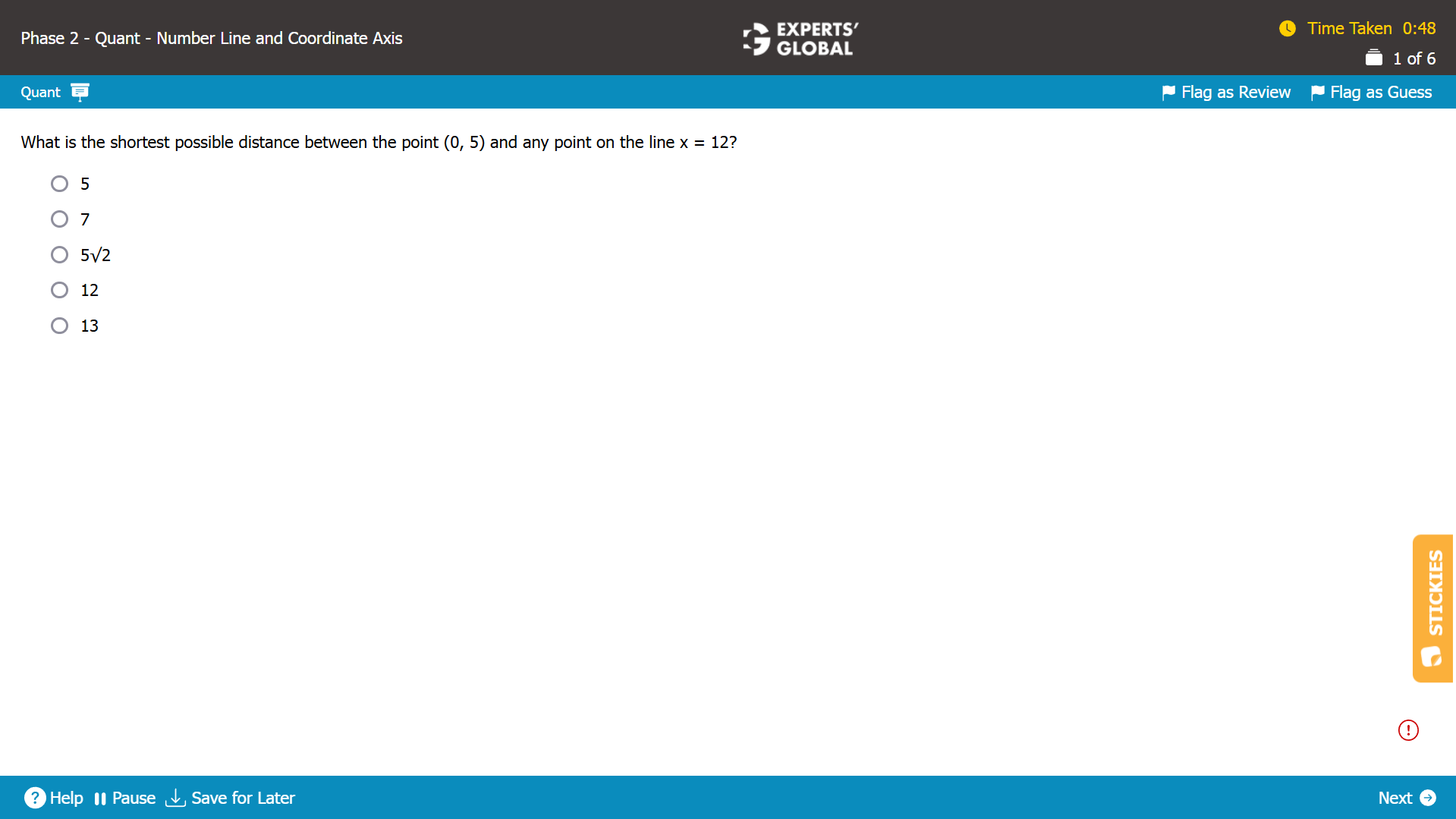
Real practice for Coordinate Geometry problems begins when you work on a software simulation that closely resembles the official GMAT interface. You need a platform that presents the coordinate geometry setup and question in a GMAT like layout, allows you to engage with the information and answer choices smoothly, and offers all the on screen tools and functionalities that you will find on the actual exam. Without this type of environment, it is difficult to feel completely ready for test day. High quality Coordinate Geometry questions are not available in very large numbers. Among the limited, genuinely strong sources are the official practice materials released by GMAC and the Experts’ Global GMAT course.
Within the Experts’ Global GMAT online preparation course, every Coordinate Geometry problem appears on an exact GMAT like user interface that provides all the real exam tools and features. You solve more than 50 Coordinate Geometry questions in quizzes and also take 15 full-length GMAT mock tests that include several Coordinate Geometry questions in roughly the same distribution and proportion as on the actual GMAT.
All the best!