Work rate problems describe how quickly a task is completed when one or more agents contribute, linking the amount of work done to the time and speed of each contributor. They help build a clear understanding of how combined or individual efforts translate into total output. Careful study of this topic is an essential part of any comprehensive GMAT preparation course. This page offers you an organized subtopic wise playlist, along with a few worked examples, for efficient preparation of this concept.
Problems in Which the Total Work is Not Defined: Assume Total Work as ‘1’
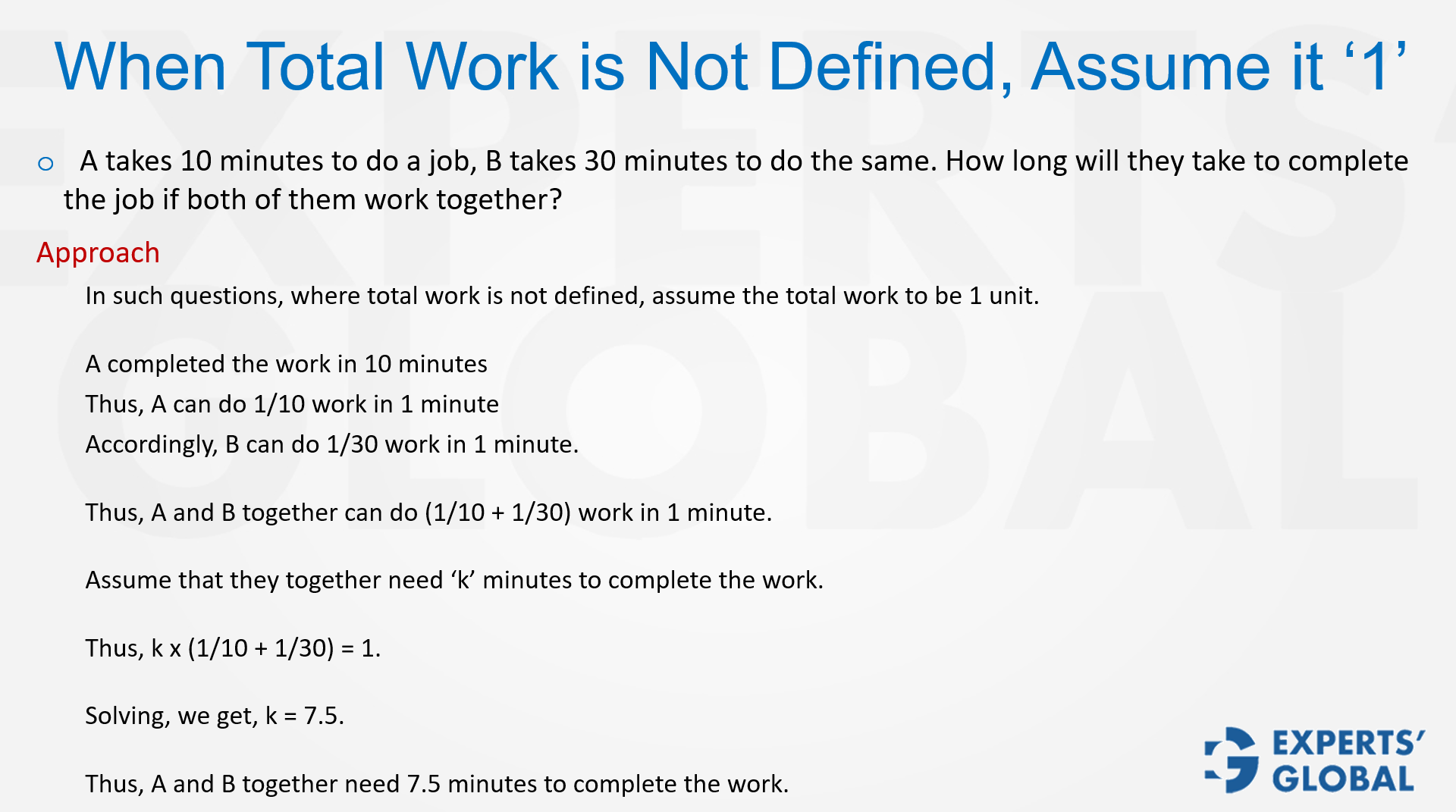
Work and time questions are among the most traditional problem types in aptitude tests, including the GMAT. They are straightforward, but they call for a clear, structured method if you wish to solve them quickly and correctly. One of the most practical approaches during your GMAT prep is to treat the entire task as one complete unit and then determine what fraction of that work each person finishes in a given period. The following short video clarifies and explains this approach, shows it solving problems, and helps you apply it to GMAT drills, sectional tests, and full-length GMAT mock tests.

Work-Rate Problems – When Total Work Can be Assumed as 1
Key Concept Recap
Problems in Which the Total Work is Defined
Work rate questions are among the most practical and intuitive problem types on the GMAT. They check your ability to break a situation into simple pieces and determine how long a task will take when several people or teams are involved. In your GMAT preparation, the central idea is to define the total work in terms of man hours or man days, depending on how the question is framed. This lets you convert the efforts of men, women, or groups with different efficiencies into one common measure. For instance, if 10 men working 12 hours a day can finish a job in 20 days, the total effort can be written as 10 × 20 × 12 man hours. Any new combination of workers must match this same total work. The short video below captures this idea clearly and illustrates how it can show up in GMAT questions.
Work-Rate Problems – When Total Work is Defined
Problems in Which Negative Work is Involved
Many GMAT work problems involve actions that either contribute to progress or cancel it out. Think of forward actions as positive work and reversing actions as negative work, and then combine these signed rates in a single unit, such as jobs per minute or jobs per hour. Developing this habit during your GMAT preparation protects you from algebra that looks correct but carries the wrong sign. The same idea extends well beyond tank problems to situations with workers joining or leaving, rework cutting into production, maintenance pausing output, or tasks that are already partly finished. For partial work, adjust for the remaining fraction and apply the same signed rate approach. Always keep one consistent time base. The following short video outlines this idea in simple language and shows how it can be tested on the GMAT.
Work-Rate Problems – When Negative Work is Involved
GMAT-style Work-Rate Questions with Explanations
This section presents a series of GMAT-style Work-Rate questions, each accompanied by a complete, carefully written explanation. Move through the problems at an unhurried pace and rely on the methods and ideas you have just studied on this page for tackling Work-Rate situations on the GMAT. At this stage, give greater importance to applying the structured approach accurately than to merely arriving at the correct option. Once you finish a question, use the explanation toggle to reveal the right answer and to review the reasoning in a clear, stepwise form.
Practice Question 1
Written Explanation
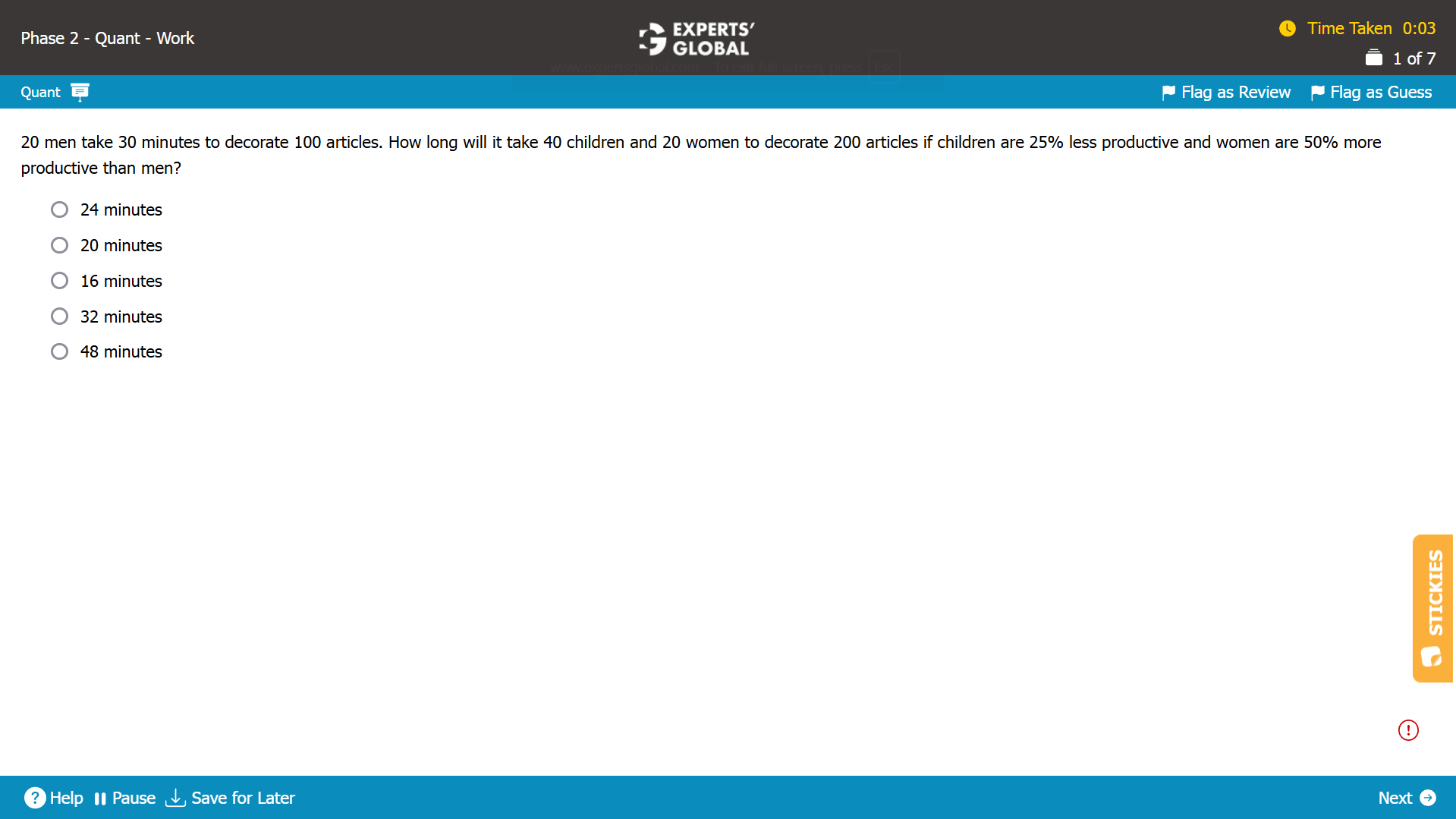
Let’s say the productivity of a man is x articles per minute.
So, 20*x*30 = 100; x = 1/6 articles.
The productivity of a woman is 1.5*x = 1/4 articles and the productivity if a child is 1/8 articles.
So, 40 children and 20 women will produce 40*(1/8) + 20*(1/4) = 10 articles per minute.
To produce 200 articles, they will take 200/10 = 20 minutes will be required.
Hence, B is the correct answer choice.
Practice Question 2

Written Explanation
John takes x minutes to wrap y articles; so, Jack takes (x/y) minutes to wrap one article.
Total articles to be wrapped are given to be m bundles, with 100 articles each; so, there are 100m articles to be wrapped.
Time taken for 100m articles = Time taken for one article * 100m = (x / y) * 100m = 100mx / y minutes.
However, we need to find the time in terms of the number of hours, not the number of minutes.
So, time taken for 100m articles, in minutes = (100mx / y) / 60 = (100/60) X (mx/y) = (5/3) X (mx/y) = 5mx / 3y.
D is the correct answer choice.
Practice Question 3

Written Explanation
Let’s say the team has 40 men, works 8 hours a day, and would complete the project in 60 days.
Total number of man-hours in the project = 40 * 8 * 60 = 19200 man-hours.
The team works for 20 days with all the 40 men.
Work completed in 20 days = 40 * 8 * 20 = 6400 man-hours.
Now, 15 men leave and are replaced by employees only one-third as productive; so, the new 15 employees complete the work of only 15 / 3 = 5 old, fully-efficient employees.
The new team has …
Fully-efficient employees = 40 – 15 = 25 fully-efficient employees.
One-third efficient employees = 15, equivalent of 5 fully-efficient employees.
So, effectively, the team has 25 + 5 = 30 fully-efficient employees.
Work remaining for the new team = 19200 – 6400 = 12800 man-hours.
Number of fully-efficient employees = 30.
Number of days left = 60 days – 20 days = 40 days.
Number of hours to be worked per day = 12800 / (30 X 40) = 10.66 hours = 10 hours 40 minutes.
Extra time to be worked every day = 10 hours 40 minutes – 8 hours = 2 hours 40 minutes.
D is the correct answer choice.
Practice Question 4

We need to determine the least number of minutes required to fill a total of 35 gallons of oil using valve A, 95 gallons of oil using valve B, and 25 gallons of oil using valve C.
Let us first consider the number of minutes required to fill 35 gallons of oil using valve A.
From the table, we see that it takes 6 minutes to fill 5 gallons of oil using valve A.
Then the number of minutes required to fill 35 gallons of oil using valve A = 6 × 35 / 5 = 42 minutes.
Since valves A and C cannot be opened simultaneously, we can only open valve B while using valve A.
From the table, we see that it takes 2 minutes to fill 5 gallons of oil using valve B.
The amount of oil filled using valve B in 42 minutes = 5 × 42 / 2 = 105 gallons > 95 gallons.
This implies that 95 gallons of oil using valve B will be filled by the time 35 gallons of oil is filled using valve A
Now we need to consider the number of minutes required to fill 25 gallons of oil using valve C.
From the table, we see that it takes 4 minutes to fill 5 gallons of oil using valve C.
Then the number of minutes required to fill 25 gallons of oil using valve C = 4 × 25 / 5 = 20 minutes.
Hence, the least amount of time required to fill a total of 35 gallons of oil using valve A, 95 gallons of oil using valve B, and 25 gallons of oil using valve C = 42 + 20 = 62 minutes.
A is the correct answer choice.
Practice Question 5

Let the time taken by pump A to drain the tank be M mins.
Let the time taken by pump B to drain the tank be N mins.
Since (Drain Rate) × (Time taken) = (Total tank volume):
Drain rate of pump A = (1/M) of total tank volume per min.
Drain rate of pump B = (1/N) of total tank volume per min.
Drain rate of pump A and B together = (1/M) + (1/N)
(Drain rate of pump A and B together) × (Time taken together) = Total tank volume
[(1/M) + (1/N)] × (2 hours and 24 minutes) = Total tank volume
[(1/M) + (1/N)] × (144 minutes) = Total tank volume
[(1/M) + (1/N)] = (1/144) of total tank volume per min (Equation I)
We need to find whether the value of “ M ”/60 can be determined.
Statement (1)
M = (2/3)N (Equation II)
From Equation I and II, we have two equations with two unknown variables, which can be solved to determine the exact value of M.
It is possible to determine with certainty the number of hours taken by Pump A to drain the tank alone. Hence, Statement (1) is sufficient.
Statement (2)
M = N – 120 (Equation III)
From Equation I and III, we have two equations with two unknown variables, which can be solved to determine the exact value of M.
It is possible to determine with certainty the number of hours taken by Pump A to drain the tank alone. Hence, Statement (2) is sufficient.
D is the correct answer choice.
How and Where to Practice GMAT Work-Rate Questions
High quality Work-Rate questions are not available in large numbers. Among the limited, genuinely strong sources are the official practice materials released by GMAC and the Experts’ Global GMAT course. Within the Experts’ Global GMAT online preparation course, every Work-Rate problem appears on an exact GMAT like user interface that includes all the real exam tools and features. You work through more than 40 Work-Rate questions in quizzes and also take 15 full-length GMAT mock tests that include several Work-Rate questions in roughly the same spread and proportion in which they appear on the actual GMAT.
All the best!