GMAT critical reasoning questions test how clearly you can understand an argument and think through its logic. On the verbal section, critical reasoning and reading comprehension are the only two question types, and you can expect 8 to 10 critical reasoning questions out of a total of 23. That means roughly 40 percent of the verbal section is critical reasoning, which makes it crucial for scoring well on the GMAT. As you prepare, you also build sound critical reasoning skills that support you in other GMAT question types and, very importantly, serve you deeply in business school, in your career in business management, and in daily life. It is helpful to see critical reasoning preparation as an investment in a real-life skill that will benefit you in every sphere of life. Any dependable GMAT preparation course must therefore offer full coverage of GMAT critical reasoning and all its question types. On this page, our aim is to share an efficient approach for solving GMAT critical reasoning questions, an approach that you can apply to virtually all CR question types on the exam. At Experts’ Global, we call this the Missing-Link-Approach.
Approach for Solving GMAT CR Questions: The Missing-Link-Approach by Experts’ Global
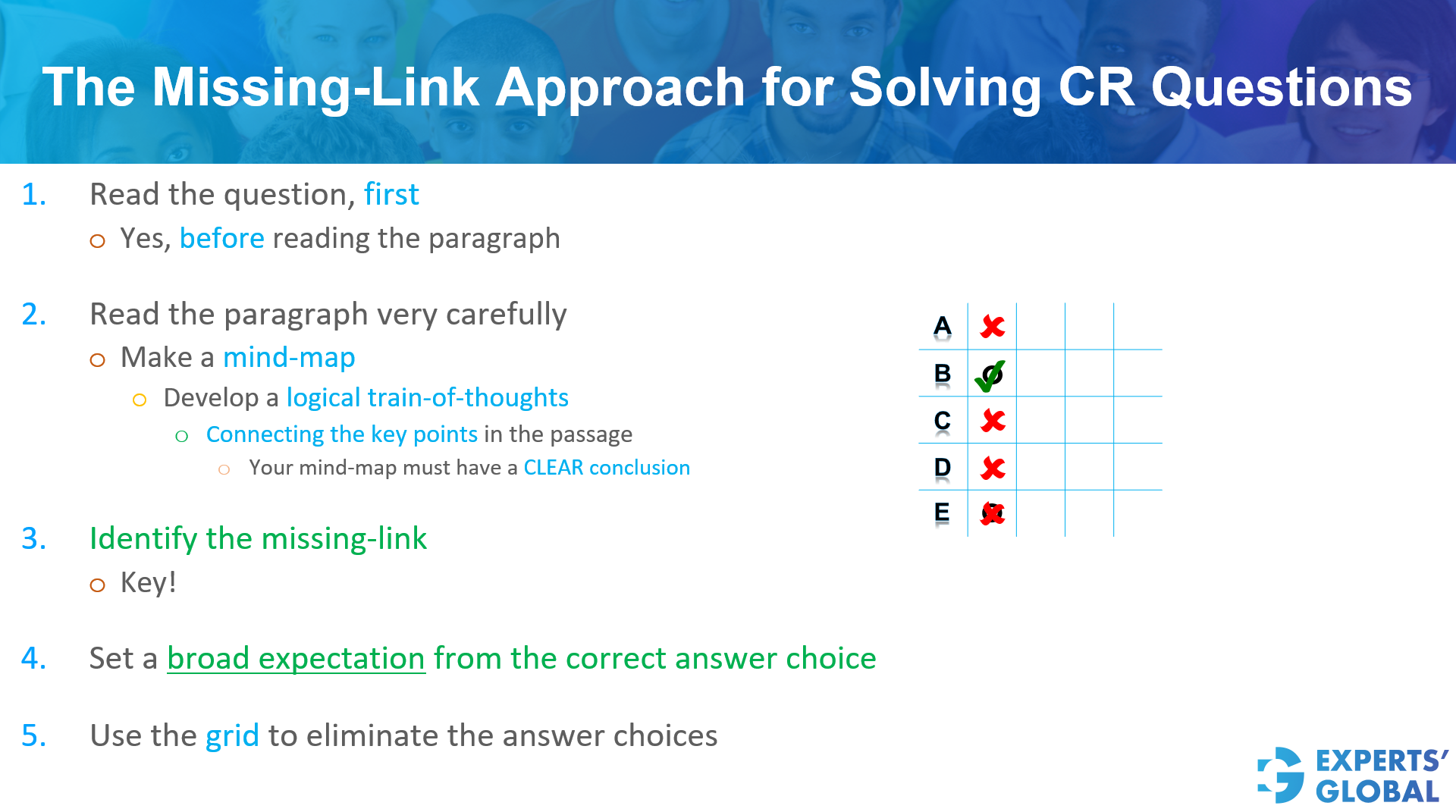
Critical Reasoning measures how clearly and systematically you can think. This overview introduces the Missing-Link-Approach: first identify the premise, then define the conclusion, and finally mark the gap that lies between them. Through this lens, you will learn how to handle assumption, strengthen, and weaken questions and how to anticipate convincing answers even before you look at the options. The following short video walks step by step through this approach, shows how it handles questions, and equips you to apply it in GMAT drills, sectional tests, and full-length GMAT mock tests.

GMAT CR: Approach for Solving CR – The Missing-Link-Approach
Answer Choices Generally Incorrect on GMAT CR
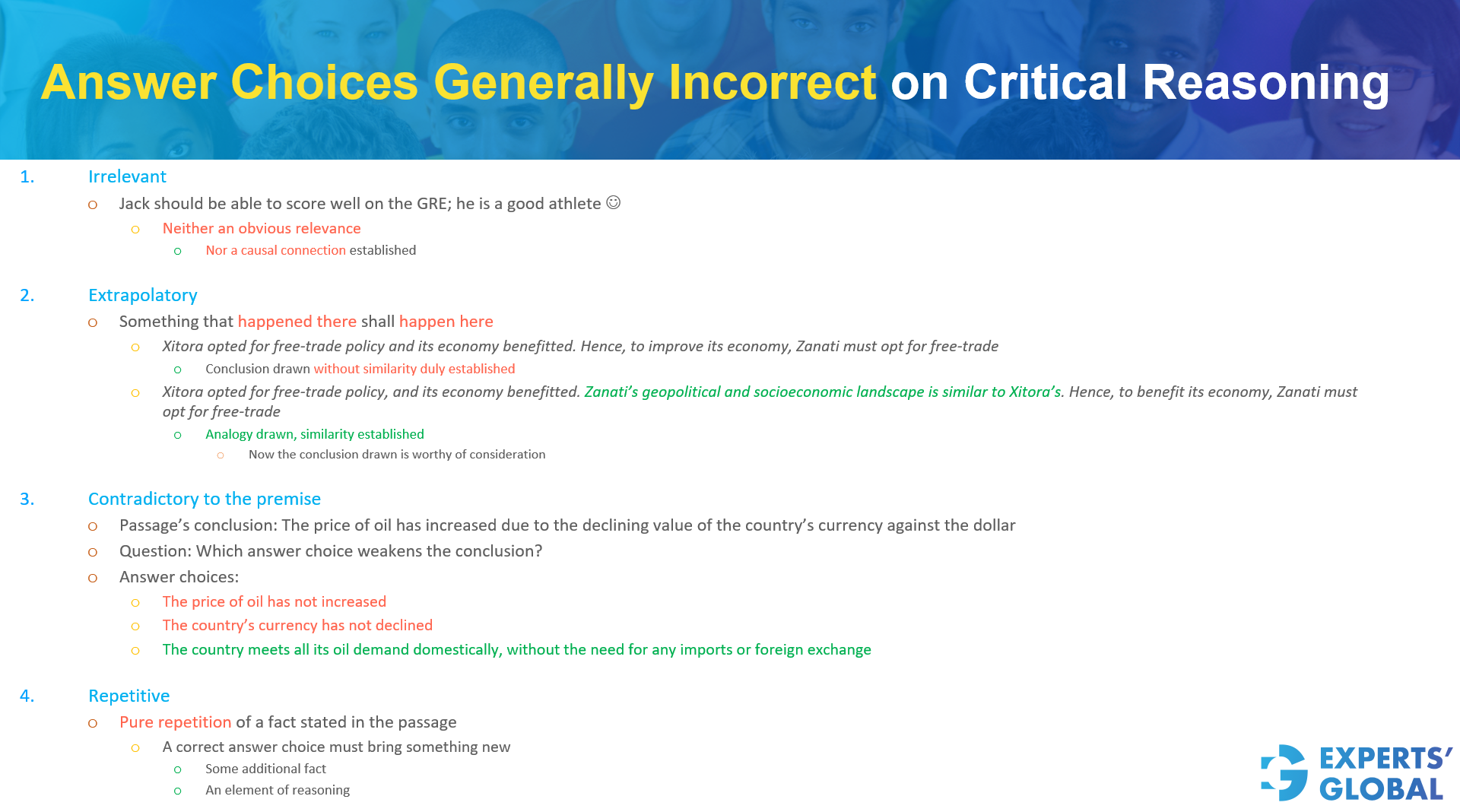
Critical Reasoning rewards calm, disciplined judgment of both claims and supporting evidence. This overview maps out the main wrong answer patterns: choices that are irrelevant, options that stretch “there” to “here” without proper support, statements that conflict with given facts, and responses that simply repeat what is already stated. By learning to spot these patterns, you begin to filter options based on logic rather than polished language. The article then shows how to focus on reasoning links, protect the intended scope of the argument, and eliminate choices quickly and confidently. The short video below walks through this concept in a relaxed way and demonstrates how the GMAT can test it.
GMAT CR: Choices Generally Incorrect
Ten Main CR Question Types
Critical Reasoning on the GMAT becomes much easier when you are clear about the task. This overview presents the ten primary question types and builds the habit of reading the question stem first, then mapping the premise, the conclusion, and the connection between them. You will see how recognizing the question type helps you eliminate options, form a rough prediction, and move toward the answer without adding unnecessary complexity. The following short video clears up this idea and shows how it can be tested on the GMAT.
GMAT CR: Ten Main Question Types

GMAT-style Critical Reasoning Questions with Explanations
This segment offers a set of GMAT-style Critical Reasoning questions specifically chosen to help you internalize the CR Missing-Link-Approach, with each item supported by a clear, stepwise explanation. Work through every question patiently and make a conscious effort to apply the missing-link thinking process that you have just studied on this page for solving Critical Reasoning questions on the GMAT. At this stage, place greater emphasis on using the approach accurately than on simply reaching the correct option. After attempting each question, use the explanation button to reveal the answer and review the full descriptive reasoning.
Practice Question 1
Written Explanation
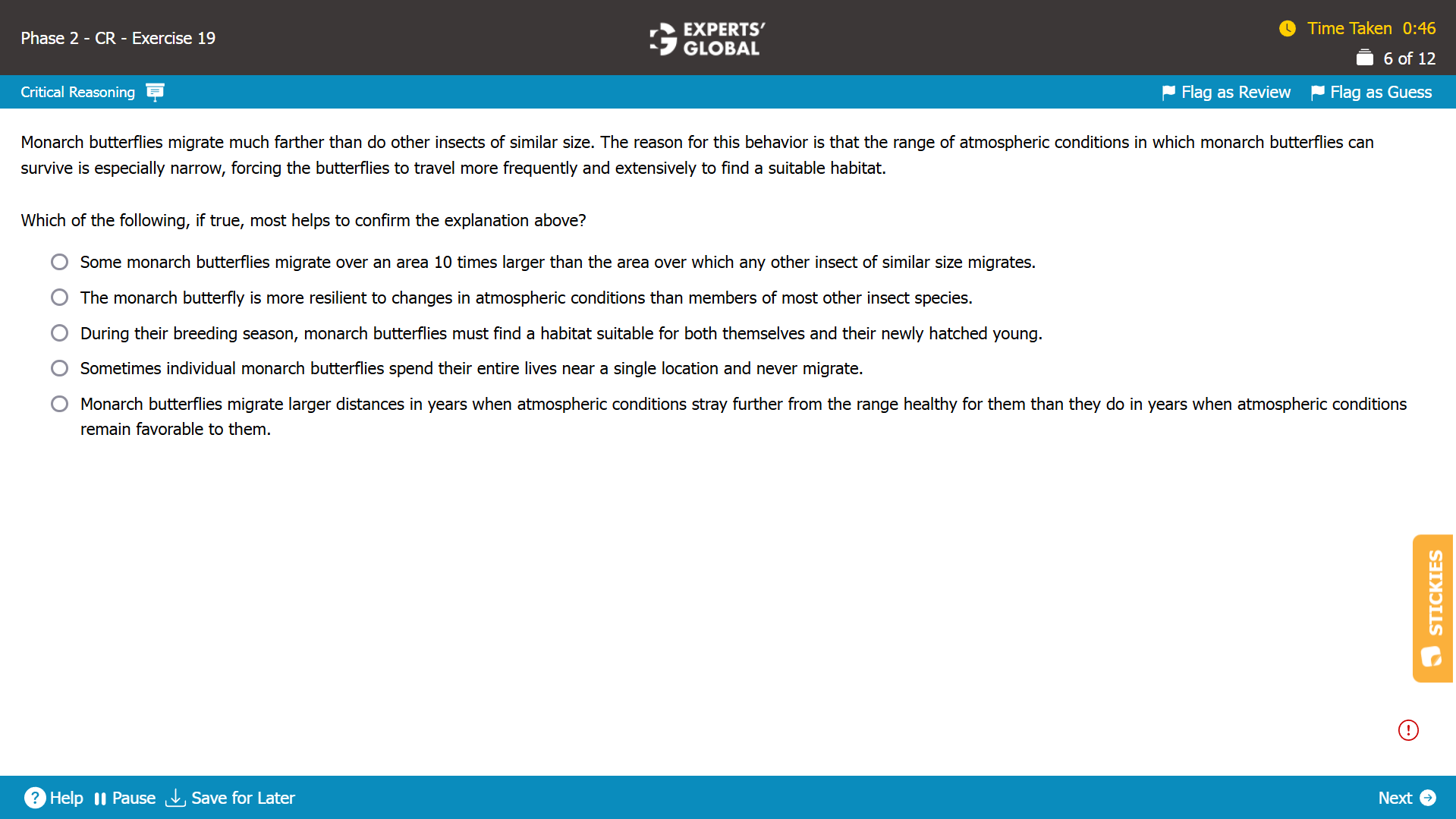
Mind-map: Monarch butterflies migrate farther than other similar species → range of atmospheric conditions suitable for them is narrow → narrow range of atmospheric conditions is the reason monarch butterflies travel more frequently and extensively to find a suitable habitat (conclusion)
Missing-link: Between all the information presented and the conclusion that the narrow range of atmospheric conditions is the reason monarch butterflies travel more frequently and extensively to find a suitable habitat
Expectation from the correct answer choice: To strengthen the conclusion that the narrow range of atmospheric conditions is the reason monarch butterflies travel more frequently and extensively to find a suitable habitat
A. Trap. This answer choice provides additional detail about the fact mentioned in the argument that monarch butterflies migrate farther than other similar species but provides no information about the reason for doing so; thus, this answer choice is just additional detail and does not strengthen the argument. Because this answer choice does not strengthen the conclusion, this answer choice is incorrect.
B. Trap. This answer choice, suggesting that monarch butterflies can withstand atmospheric conditions more strongly than other similar species can, indicates that the butterflies are likely less affected by atmospheric conditions and, if anything, weakens, rather than strengthens, the conclusion. Because this answer choice does not strengthen the conclusion, this answer choice is incorrect.
C. Trap. This answer choice, suggesting a reason for monarch butterflies to find a habitat, provides no information about the reason they travel frequently and extensively to find a habitat; so, this answer choice simply adds information, which, although relevant to the broad context of the argument, does not strengthen the conclusion. Because this answer choice does not strengthen the conclusion, this answer choice is incorrect.
D. This answer choice, suggesting a lack of migration in certain monarch butterflies, highlights an exception to the fact mentioned in the argument that the butterflies migrate farther than other similar species; so, this answer choice, if anything, weakens, rather than strengthens, the conclusion. Further, this answer choice refers to just “individual” butterflies and their behavior “sometimes” and is thus limited in scope and only faintly weakens the argument. Because this answer choice does not strengthen the conclusion, this answer choice is incorrect.
E. Correct. This answer choice, suggesting that unfavorable atmospheric conditions make monarch butterflies travel father than favorable atmospheric conditions do, indicates that monarch butterflies are dependent on specific atmospheric conditions; thus, this answer choice fills the missing link and strengthens the conclusion that the narrow range of atmospheric conditions is the reason monarch butterflies travel more frequently and extensively to find a suitable habitat. Because this answer choice strengthens the conclusion, this answer choice is correct.
E is the best choice.
Practice Question 2

Written Explanation
Mind-map: L sees highest rate of EE immigrants → over last five years, of all the EE immigrants, immigration to L decreased by seven percentage points → local businesses cater to EE immigrants → decline in immigration will likely have a negative impact on local economy (conclusion)
Missing-link: Between local businesses catering to EE immigrants and the conclusion that the decline in immigration will likely have a negative impact on local economy
Expectation from the correct answer choice: To weaken the conclusion that the decline in immigration will likely have a negative impact on local economy
Note: Please be extra careful when you see numbers/percentages/proportions in CR questions; often, the key lies in the numbers.
A. Trap. Even if Lincolnshire attracts more immigrants than other parts, the decline in immigration to Lincolnshire over time is likely to negatively impact the economy; so, this answer choice is just additional information and does not weaken the conclusion. Because this answer choice does not weaken the conclusion, this answer choice is incorrect.
B. This answer choice, suggesting an increase in the immigration to Southampton, simply indicates the possibility that the decline in immigration to Lincolnshire may be because of the increase in the immigration to Southampton but makes no suggestion regarding a negative impact on the local economy of Lincolnshire; so, this answer choice, if anything, faintly strengthens, rather than weakens, the conclusion. Because this answer choice does not weaken the conclusion, this answer choice is incorrect.
C. This answer choice, suggesting that the Eastern European immigrant population was more widely spread across Lincolnshire last year than it was five years ago, makes no suggestion regarding how the local economy of Lincolnshire has been impacted; so, this answer choice is just additional information and does not weaken the conclusion. Because this answer choice does not weaken the conclusion, this answer choice is incorrect.
D. Trap. The argument is concerned with the decline in immigration “to” Lincolnshire rather than “from” Lincolnshire; so, this answer choice is out of scope. Because this answer choice does not weaken the conclusion, this answer choice is incorrect.
E. Correct. This answer choice tests the classic GMAT concept of confusing “percentage” with “absolute numbers”; if the overall number of immigrants to England and Wales has increased, there is the possibility that, even with a decline in the “percentage points of all the immigrants” that immigrate to Lincolnshire, Lincolnshire may be experiencing an increase in the “number” of immigrants; such a possibility indicates that the local economy may be benefitted rather than negatively impacted, thus weakening the conclusion. Because this answer choice weakens the conclusion, this answer choice is correct.
E is the best choice.
Practice Question 3
Written Explanation
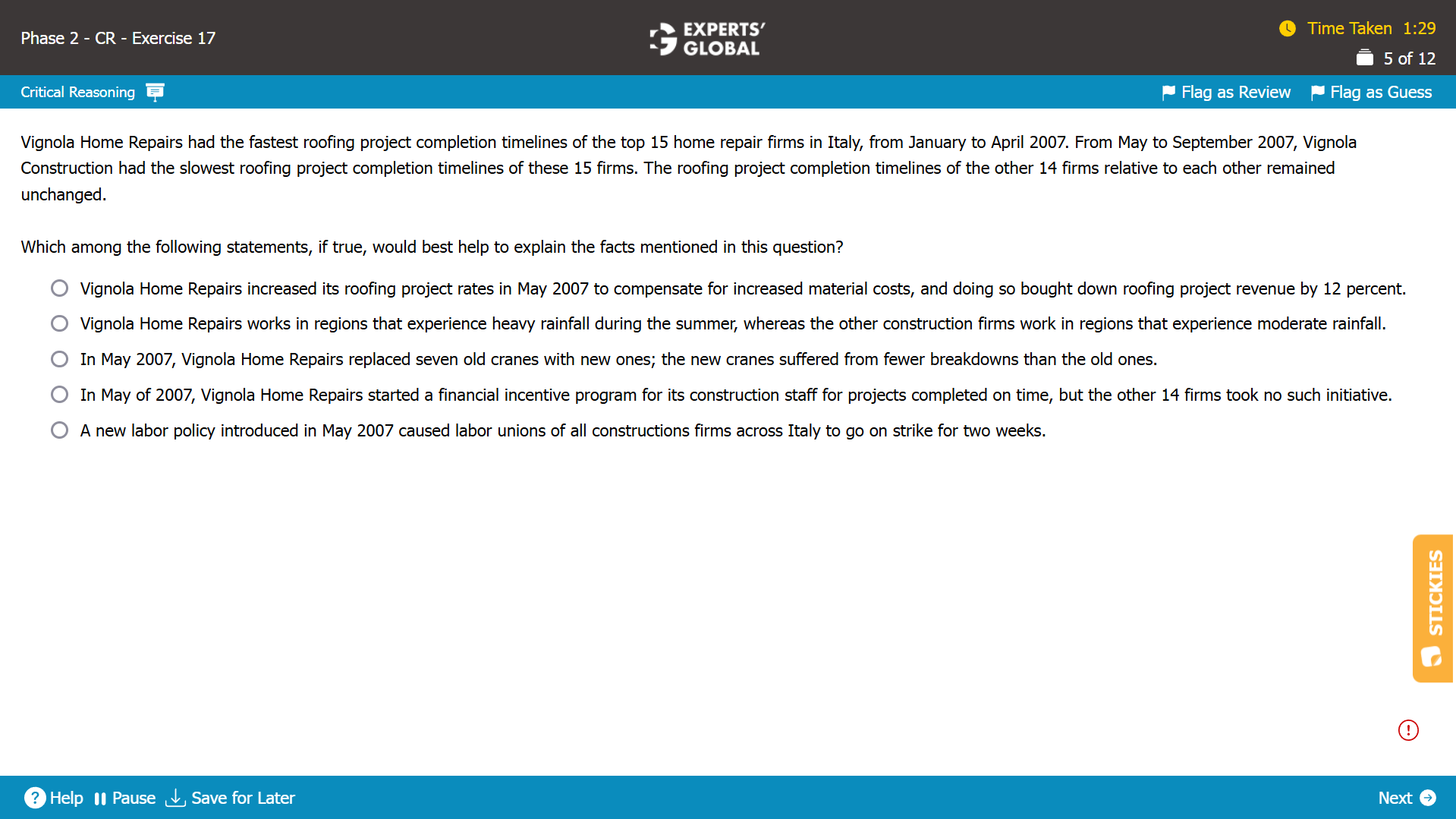
Mind-map: 15 home repair firms undertaking roofing projects → Vignola had the fastest completion time between January-April → Vignola had the slowest completion time between May-September → construction time of all other firms remained same relative to each other
Missing-link: Between Vignola having the fastest completion time between January-April and the slowest completion time between May-September
Expectation from the correct answer choice: To explain why Vignola had the slowest completion time between May-September despite having the fastest completion time between January-April
A. Trap. Increased project rates and reduced project revenue indicate fewer projects; this answer choice, suggesting fewer roofing projects between May-September than in January-April, simply indicates less workload with Vignola and makes no suggestion regarding project completion time; so, this answer choice is just additional information and does not explain the discrepancy in the argument. Because this answer choice does not explain the discrepancy in the argument, this answer choice is incorrect.
B. Correct. By suggesting that Vignola’s construction projects are carried out in regions with heavy rainfall during the summer whereas other firms’ projects are in regions of moderate rainfall, this answer choice introduces the possibility that Vignola’s projects experienced delays because of disturbances due to heavy rainfall whereas other firms’ projects did not, thus explaining why Vignola had the slowest completion time between May-September, the summer months, despite having the fastest completion time between January-April, the non-summer months. Because this answer choice clarifies the exact discrepancy, this answer choice is correct.
C. This answer choice, suggesting that Vignola’s cranes between May-September had fewer breakdowns than those between January-April, indicates the possibility of faster construction between May-September than that in January-April, thus, if anything, raising further concern over, rather than explaining, why the firm had the slowest completion time between May-September despite having the fastest completion time between January-April. Because this answer choice does not explain the discrepancy in the argument, this answer choice is incorrect.
D. This answer choice, suggesting that, since May, Vignola’s workers had financial incentives to complete project milestones on time, indicates greater likelihood of Vignola’s projects being completed on time between May-September, thus, if anything, raising further concern over, rather than explaining, why the firm had the slowest completion time between May-September. Because this answer choice does not explain the discrepancy in the argument, this answer choice is incorrect.
E. This answer choice, suggesting strikes at all firms, indicates that the project completion time of all firms relative to each other should have remained the same; so, this answer choice is just additional information and does not explain the discrepancy in the argument. Because this answer choice does not explain the discrepancy in the argument, this answer choice is incorrect.
B is the best choice.
How and Where to Practice GMAT CR Questions
Real preparation for CR Assumption questions truly begins when you solve them on a software platform that closely mirrors the official GMAT interface. You need a setup that displays the argument, the question stem, and the answer choices in a GMAT like layout, allows you to engage with the reasoning and options in a natural way, and offers all the on screen tools and functions that you will use on the actual exam. Without this kind of realistic environment, it is hard to feel fully ready for test day. High quality CR Assumption questions are not available in very large numbers, and among the limited but genuinely reliable sources are the official practice materials released by GMAC and the Experts’ Global GMAT course.
Within the Experts’ Global GMAT online preparation course, every CR Assumption question is presented on an exact GMAT like user interface that includes all the real exam tools and features. You work through more than 500 CR Assumption questions in quizzes and also take 15 full-length GMAT mock tests that include several CR Assumption questions in roughly the same spread and proportion in which they appear on the actual GMAT.
All the best!