CR Weaken the Argument, or simply weakening, questions ask you to find the statement that makes an argument less convincing by challenging the link between its premise and conclusion. They help you notice gaps, alternative explanations, and overlooked factors that can reduce the strength of a claim. Consistent practice with this question type is an essential part of any comprehensive GMAT preparation course. This page offers you an organized subtopic wise playlist, along with a few worked examples, for efficient preparation of this concept.
Approach for CR Weaken the Argument Question Type
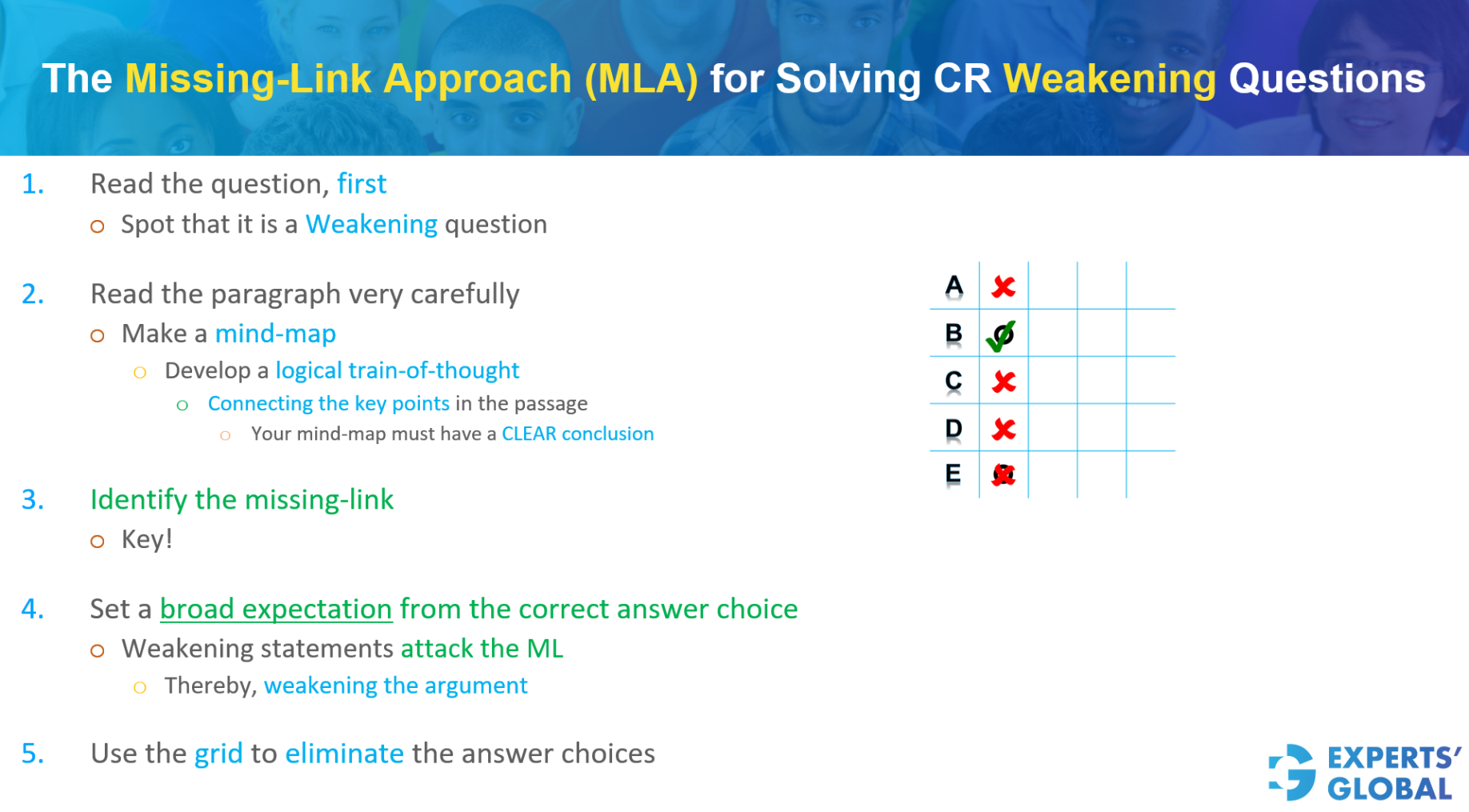
Weakening questions ask you to examine how strong the connection really is between an argument’s premise and its conclusion. This overview explains what a weakening statement does: it lowers the argument’s persuasive power by attacking that link, proposing alternative explanations, questioning the stated cause, introducing conflicting evidence, or shifting the benchmark used for comparison. The video and article present a clear framework for recognizing these moves and applying them with consistency. The short video below covers this approach, shows it at work on GMAT type questions, and prepares you to apply it in drills, sectional tests, and full-length GMAT simulations.

GMAT CR: Weaken the Argument Questions
GMAT-style CR Weaken the Argument Questions with Explanations
This section features a focused set of GMAT-style Critical Reasoning Weaken the Argument questions, each supported by a clear, stepwise explanation. Work through every argument calmly and make a deliberate effort to apply the weakening framework and ideas you have just studied on this page for such questions on the GMAT. At this stage, give more importance to using the method accurately and consistently than to simply arriving at the credited option. After you lock in your answer, use the explanation toggle to view the correct choice and to read the full descriptive reasoning behind it.
Practice Question 1

Written Explanation
Mind-map: Citizen: City has suggestion boxes for citizens to report grievances → most people now have email through which they can report grievances → mayor plans to remove suggestion boxes → poorest parts of the city have most disaffected residents but few internet connections → suggestion boxes are still needed (conclusion)
Missing-link: Between poorest parts of the city having the most disaffected residents but few internet connections and the conclusion that the suggestion boxes are still needed
Expectation from the correct answer choice: To weaken the conclusion that the suggestion boxes are still needed
A. The argument is concerned with whether the suggestions boxes are needed when grievances can be communicated via email; so, the costs associated with the maintenance of the boxes, although suggesting a burden associated with the boxes, is just additional information and does not weaken the argument. Because this answer choice does not weaken the conclusion, this answer choice is incorrect.
B. Trap. This answer choice, suggesting that a large portion of the city’s internet connections are out of order at any given time, casts doubt on the reliable usage of email and indicates the necessity of suggestion boxes in some cases, thus, if anything, marginally strengthening, rather than weakening, the conclusion. Because this answer choice does not weaken the conclusion, this answer choice is incorrect.
C. Trap. This answer choice, although suggesting that city offices benefit more from grievances received through emails than those through suggestion boxes, provides no information regarding whether the boxes are necessary; so, this answer choice simply adds information, which, although relevant to the broad context of the argument, does not weaken the conclusion. Because this answer choice does not weaken the conclusion, this answer choice is incorrect.
D. The argument is concerned with whether the suggestions boxes are needed when grievances can be communicated via email; so, the location of city offices is just additional information and has no bearing on the argument. Because this answer choice does not weaken the conclusion, this answer choice is incorrect.
E. Correct. By suggesting that residents in the poorest parts of the city can directly report their grievances through regularly conducted welfare checks, this answer choice casts doubt on the necessity of suggestion boxes and thus weakens the conclusion. Because this answer choice weakens the conclusion, this answer choice is correct.
E is the best choice.
Practice Question 2
Written Explanation
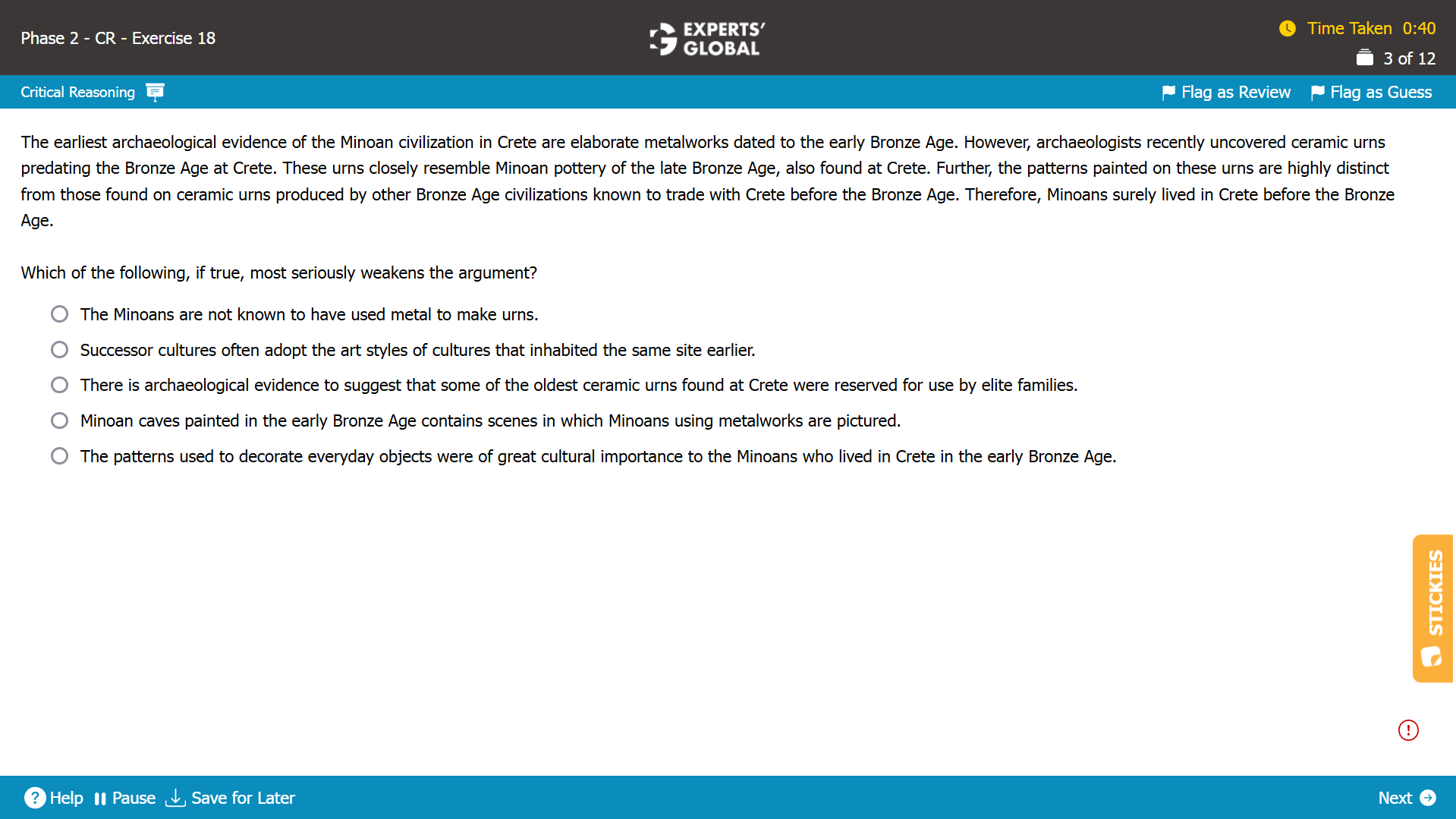
Mind-map: Earliest evidence of Minoans are metalworks from early Bronze Age → recent discovery of ceramic urns predating Bronze Age → urns resemble Minoan pottery known to be from late Bronze Age → urns patterns are unique → Minoans lived in Crete before the Bronze Age (conclusion)
Missing-link: Between all the information presented and the conclusion that the Minoans lived in Crete before the Bronze Age
Expectation from the correct answer choice: To weaken the conclusion that the Minoans lived in Crete before the Bronze Age
A. Trap. The argument mentions that the recently discovered urns are “ceramic” and is concerned with whether the urns were made by the Minoans living in Crete before the Bronze Age; so, information that the Minoans did not likely use “metal” to make urns is just additional information and has no bearing on the argument. Because this answer choice does not weaken the conclusion, this answer choice is incorrect.
B. Correct. By suggesting that later cultures at a site follow art styles of earlier cultures at the site, this answer choice introduces the possibility that the recently discovered ceramic urns were made by another civilization before the Bronze Age and that the Minoans, after they began living in Crete at a later point in time, adopted the urns’ patterns into their pottery; such a possibility weakens the conclusion that the Minoans lived in Crete before the Bronze Age. Because this answer choice weakens the conclusion, this answer choice is correct.
C. The argument is concerned with whether the recently discovered ceramic urns were “made” by the Minoans in Crete before the Bronze Age; so, who “used” these urns is just additional information and has no bearing on the argument. Because this answer choice does not weaken the conclusion, this answer choice is incorrect.
D. This answer choice, suggesting evidence that Minoans in Crete used metalworks in the early Bronze Age, provides no information about whether the Minoans in Crete made “the ceramic urns” before the Bronze Age; thus, this answer choice simply adds information, which, although relevant to the broad context of the argument, does not weaken the conclusion. Because this answer choice does not weaken the conclusion, this answer choice is incorrect.
E. This answer choice, suggesting that the Minoans in early Bronze Age offered high cultural importance to patterns on everyday objects, provides no information about whether the Minoans in Crete made “the ceramic urns” before the Bronze Age; thus, this answer choice simply adds information, which, although relevant to the broad context of the argument, does not weaken the conclusion. Because this answer choice does not weaken the conclusion, this answer choice is incorrect.
B is the best choice.
Practice Question 3

Written Explanation
Mind-map: Newspapers run only a few in-depth and complex stories → such stories represent higher standard of journalism → such stories do not attract subscribers → this year, newspapers published such stories most often → newspapers are assigning more importance to achieving higher standard of journalism than to attracting subscribers (conclusion)
Missing-link: Between all the information presented and the conclusion that the newspapers are assigning more importance to achieving higher standard of journalism than to attracting subscribers
Expectation from the correct answer choice: To weaken the conclusion that the newspapers are assigning more importance to achieving higher standard of journalism than to attracting subscribers
A. This answer choice commits the classic GMAT error of generalization; this answer choice, suggesting the lack of in-depth and complex stories in the bestselling newspaper this year, provides information about only one newspaper whereas the argument mentions the fact that all newspapers, in general, have published such stories most often; so, this answer choice simply adds information, which, although relevant to the broad context of the argument, does not weaken the conclusion. Because this answer choice does not weaken the conclusion, this answer choice is incorrect.
B. The argument is concerned with whether newspapers are assigning more importance to achieving higher standard of journalism than to attracting subscribers; so, whether any newspaper made such an announcement is just additional information and does not weaken the argument. Because this answer choice does not weaken the conclusion, this answer choice is incorrect.
C. Correct. By suggesting that market trends are changing and so in-depth and complex stories attracted the most subscribers this year, this answer choice indicates the possibility that the newspapers may have published such stories to attract subscribers than to achieve a higher standard of journalism, thus weakening the conclusion. Because this answer choice weakens the conclusion, this answer choice is correct.
D. This answer choice, suggesting a general decline in subscribers, provides no information about whether newspapers are preferring achieving higher standard of journalism to attracting subscribers; so, this answer choice is just additional information and does not weaken the argument. Because this answer choice does not weaken the conclusion, this answer choice is incorrect.
E. This answer choice, suggesting that subscription rates are lower this year when newspapers published in-depth and complex stories most often, provides no information about whether newspapers are preferring achieving higher standard of journalism to attracting subscribers; so, this answer choice is just additional information and does not weaken the argument. Because this answer choice does not weaken the conclusion, this answer choice is incorrect.
C is the best choice.
How and Where to Practice GMAT CR Weaken the Argument Questions
High quality CR Weaken the Argument questions are not available in large numbers. Among the limited, genuinely strong sources are the official practice materials released by GMAC and the Experts’ Global GMAT course. Within the Experts’ Global GMAT online preparation course, every CR Weaken the Argument question appears on an exact GMAT like user interface that includes all the real exam tools and features. You work through more than 70 CR Weaken the Argument questions in quizzes and also take 15 full-length GMAT mock tests that include several CR Weaken the Argument questions in roughly the same spread and proportion in which they appear on the actual GMAT.
All the best!