Invest 30 seconds...
...for what may lead to a life altering association!
Help Line
- +91.8800.2828.00 (IND)
- 1030-1830 Hrs IST, Mon-Sat
- support@expertsglobal.com

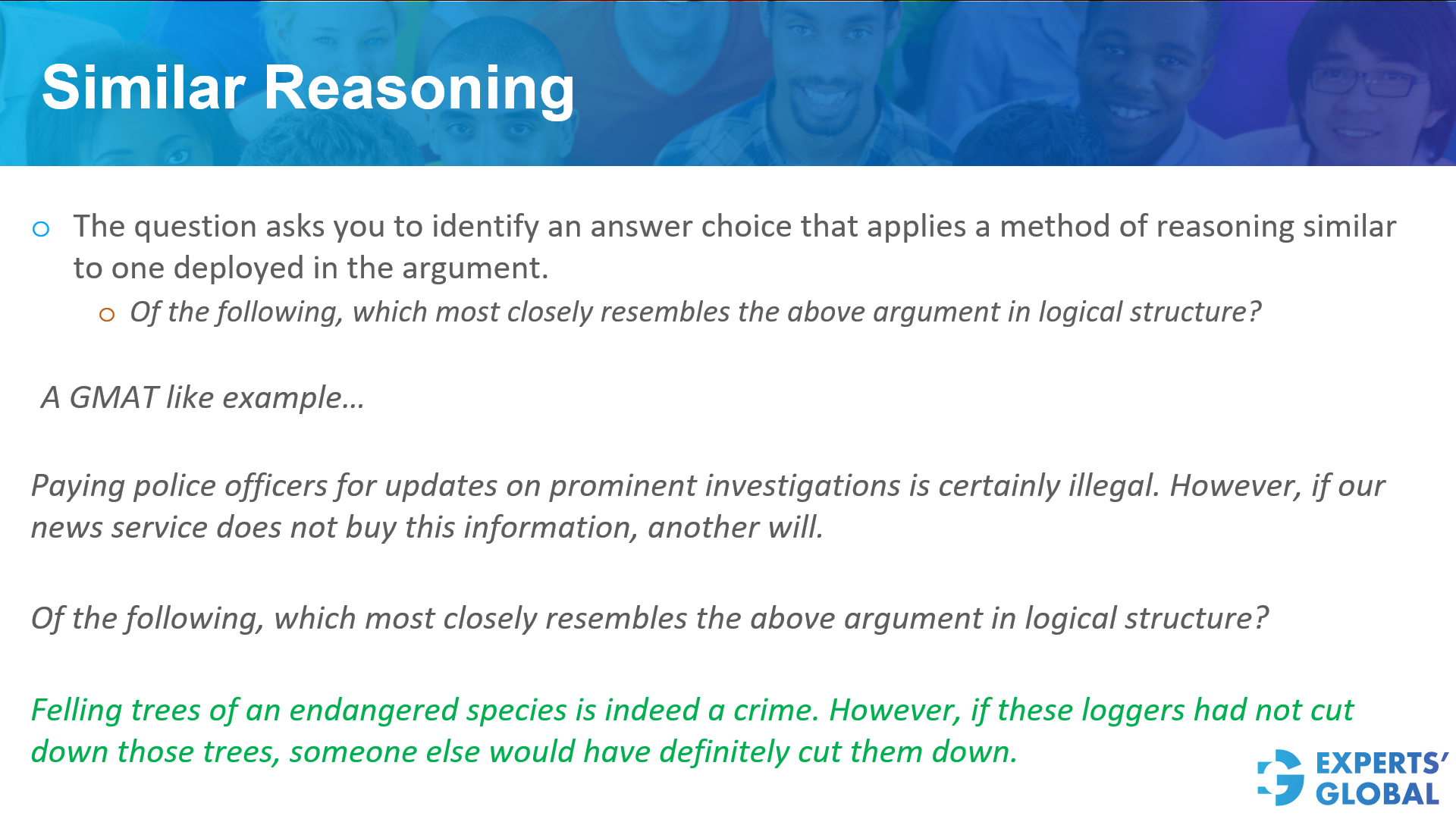
In similar reasoning CR questions, you are given an argument and asked to choose the option that follows the same logical pattern. The typical stem is: “Of the following, which most closely resembles the above argument in logical structure?”
Similar Reasoning questions ask you to match an argument’s structure. Read the question stem first, parse premise, assumption, and conclusion, and express the pattern in a short template before viewing options. Then compare choices for the same skeleton while ignoring surface details. This overview frames a disciplined, transferable habit for analytical reading in GMAT prep and for evaluating analogies in essays and interviews across MBA admissions. The video introduces the workflow; the article elaborates cues and checkpoints.

The similar reasoning CR questions on the GMAT test whether you can identify the logical structure of an argument and match it with another argument that follows the same pattern. The task is not to agree or disagree with the content but to recognize the form of reasoning being used.
The question usually appears in the following format:
“Of the following, which most closely resembles the above argument in logical structure?”
The phrasing makes it clear that your focus should not be on the subject matter but on the framework of reasoning.
The strategy for such questions is rooted in three simple steps:
Before confirming an answer choice, verify once more.
Consider this argument:
Paying police officers for updates on prominent investigations is certainly illegal. However, if our news service does not buy this information, another will.
Question: Of the following, which most closely resembles the above argument in logical structure?
Explanation:
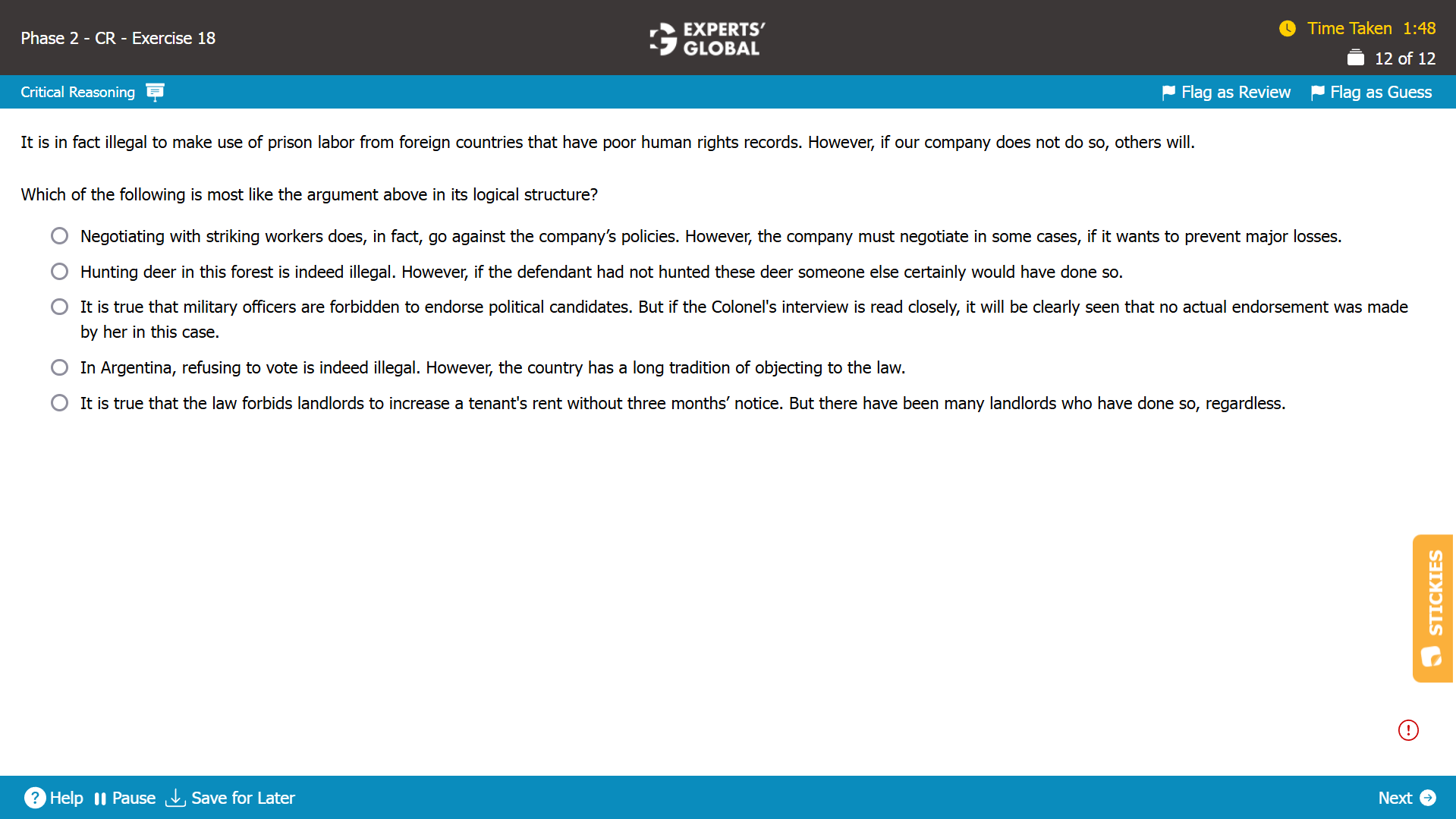
A company defends its involvement in an unethical activity by stating that if it does not carry out this action, another company will.
The structure here is simple:
Now, look at the following answer choice:
Felling trees of an endangered species is indeed a crime. However, if these loggers had not cut down those trees, someone else would have definitely cut them down.
This matches perfectly with the original argument’s structure. Both begin with an unethical activity, followed by a justification framed in the form of inevitability. The reasoning pattern is identical, making this the correct answer choice.
<
Similar Reasoning questions require a different kind of sharpness. They push you beyond content into the structure of logic itself. By practicing these, you strengthen your ability to see arguments as frameworks rather than just stories. This not only prepares you for GMAT Critical Reasoning but also trains your mind for the kind of logical thinking that business school and leadership roles often demand.
Similar Reasoning questions test your ability to identify and match the structure of arguments rather than their subject matter. Success depends on mapping premises, assumptions, and conclusions, then predicting the logical skeleton before reviewing answer choices. By training yourself to recognize parallels in reasoning, you sharpen clarity and avoid being misled by surface details. Regularly practicing with GMAT simulations provides the structured exposure needed to master this skill, ensuring accuracy, speed, and deeper confidence in Critical Reasoning.
The essence of Similar Reasoning questions lies in seeing through words to the underlying framework of thought, a discipline that extends beyond test-taking. In GMAT mock practice, this skill sharpens your ability to filter distractions and focus on structure, a habit that strengthens judgment in both study and decision-making. In MBA application stage , the same clarity helps you construct essays and arguments that are logically sound, while in life, it fosters the wisdom to separate substance from noise, guiding choices with balance, fairness, and intellectual honesty.