Invest 30 seconds...
...for what may lead to a life altering association!
Help Line
- +91.8800.2828.00 (IND)
- 1030-1830 Hrs IST, Mon-Sat
- support@expertsglobal.com

Dialogue-based CR questions on the GMAT test the same concepts as other critical reasoning questions. Just that, instead of a paragraph, they present a dialogue between two people; for example, the question may ask you to identify an assumption made by the second person in responding to the first.
Dialogue-based Critical Reasoning presents arguments as exchanges between speakers, yet the underlying analysis remains the same: map each claim, locate the conclusion, and examine how one statement responds to another. This overview previews how to track interpretations, avoid extrapolations, and identify assumptions or flaws that emerge in conversation. The video and article outline a routine for structured reading applicable to GMAT prep and to analytic communication expected in MBA admissions. Approach dialogues as familiar tasks expressed in a conversational format.

Unlike standard Critical Reasoning questions that present a structured paragraph, dialogue-based questions frame the reasoning through an exchange between two individuals. The underlying logic does not change. Assumptions, strengthening, weakening, explanation, inference, evaluation, and conclusion questions all appear here as well. The difference lies only in presentation.
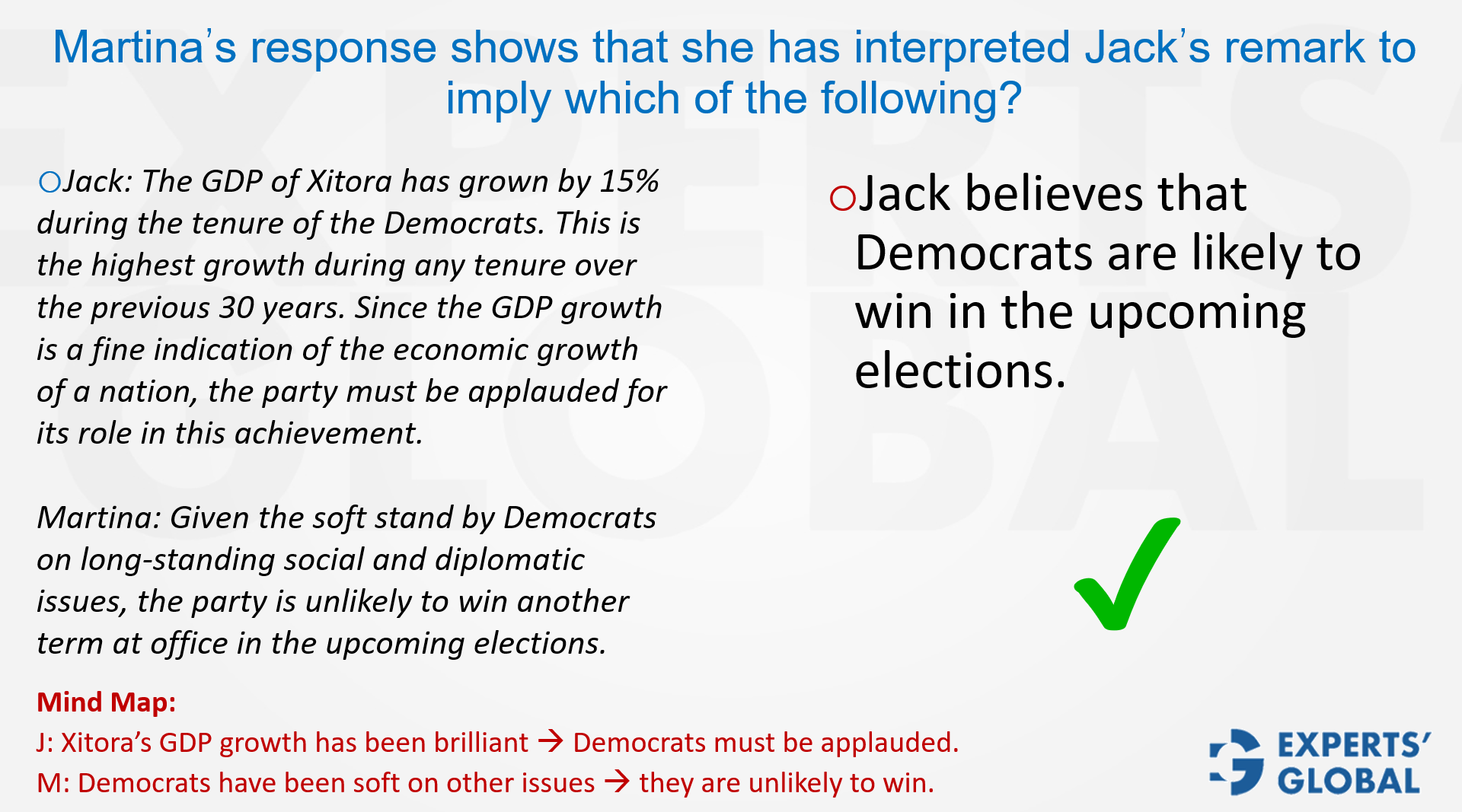
Jack: The GDP of Xitora has grown by 15% during the tenure of the Democrats. This is the highest growth during any tenure over the previous 30 years. Since the GDP growth is a fine indication of the economic growth of a nation, the party must be applauded for its role in this achievement.
Martina: Given the soft stand by Democrats on long-standing social and diplomatic issues, the party is unlikely to win another term at office in the upcoming elections.
Question: Martina’s response shows that she has interpreted Jack’s remark to imply which of the following?
Here, Martina’s statement implies that she understood Jack to mean that Democrats are likely to win. This is why her counter focuses on denying that conclusion.
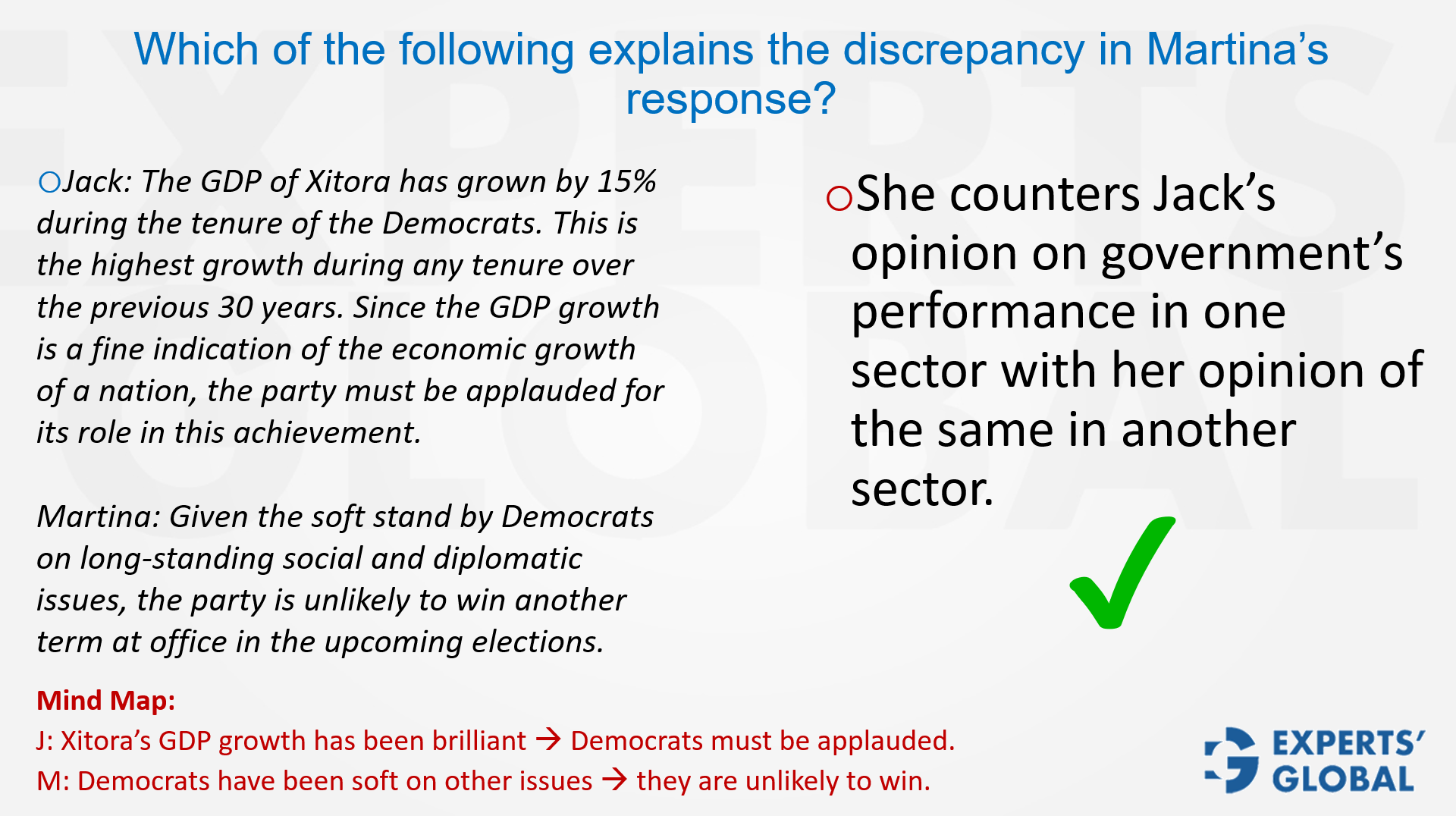
Jack: The GDP of Xitora has grown by 15% during the tenure of the Democrats. This is the highest growth during any tenure over the previous 30 years. Since the GDP growth is a fine indication of the economic growth of a nation, the party must be applauded for its role in this achievement.
Martina: I disagree. You are discounting the soft stand by Democrats on long-standing social and diplomatic issues. Such stand makes the performance of the government far from laudable.
Question: Which of the following explains the discrepancy in Martina’s response?
The correct flaw is that she extrapolates Jack’s specific claim about GDP growth into a claim about overall governance, introducing unrelated issues. A choice that captures this misstep – ignoring the specificity of Jack’s argument – is the right one.
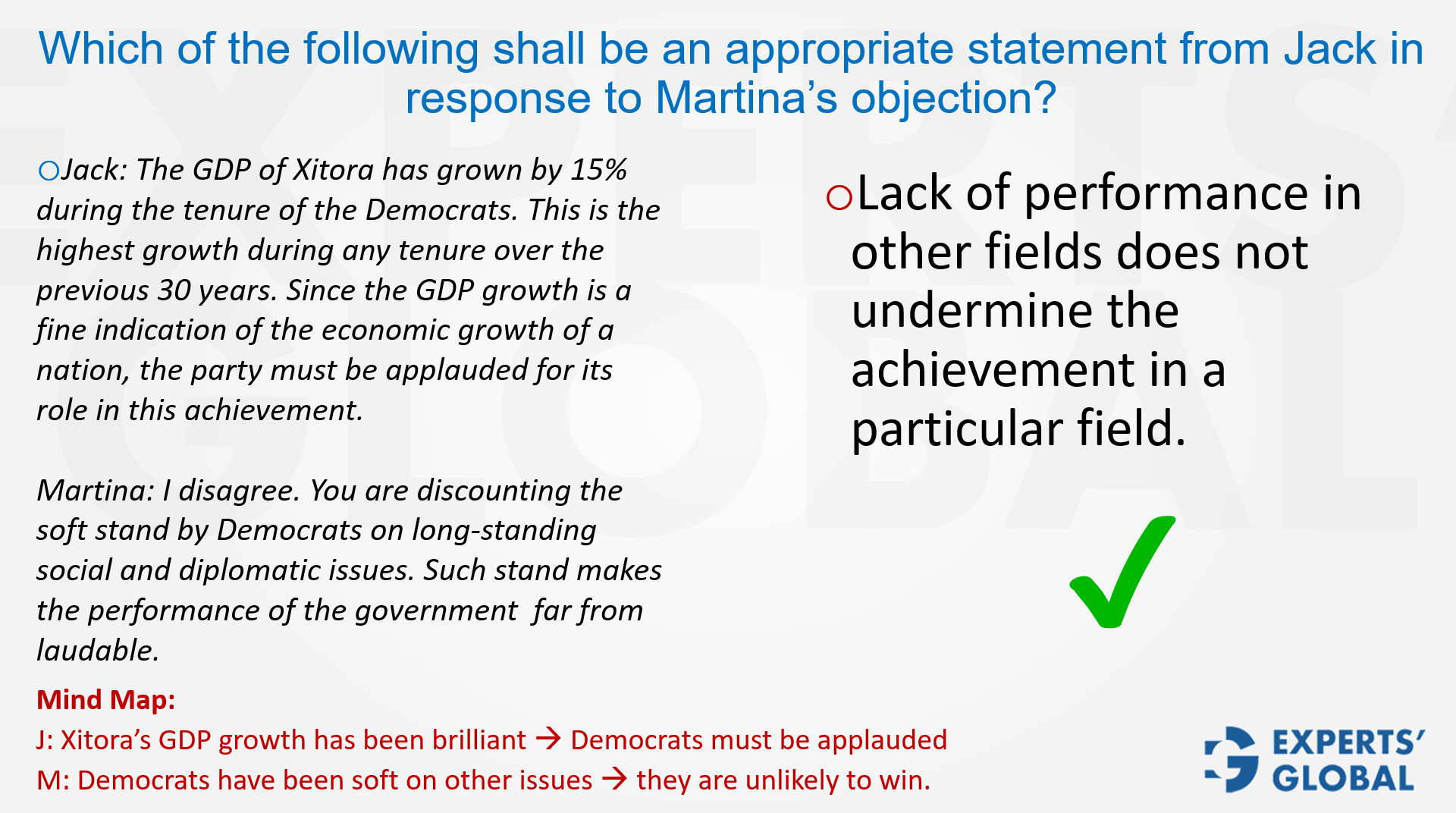
Jack: The GDP of Xitora has grown by 15% during the tenure of the Democrats. This is the highest growth during any tenure over the previous 30 years. Since the GDP growth is a fine indication of the economic growth of a nation, the party must be applauded for its role in this achievement.
Martina: I disagree. You are discounting the soft stand by Democrats on long-standing social and diplomatic issues. Such stand makes the performance of the government far from laudable.
Question: Which of the following shall be an appropriate statement from Jack in response to Martina’s objection?
A fine answer choice: “Lack of performance in other fields does not undermine the achievement in GDP growth.” This directly addresses the flaw in her reasoning and defends his original point.
Dialogue-based CR questions test your ability to separate what was actually said from how it is interpreted or countered. Be careful not to confuse specific claims with general judgments. Always map the argument: what was the first person’s claim, how was it interpreted, and where does the flaw or assumption lie?
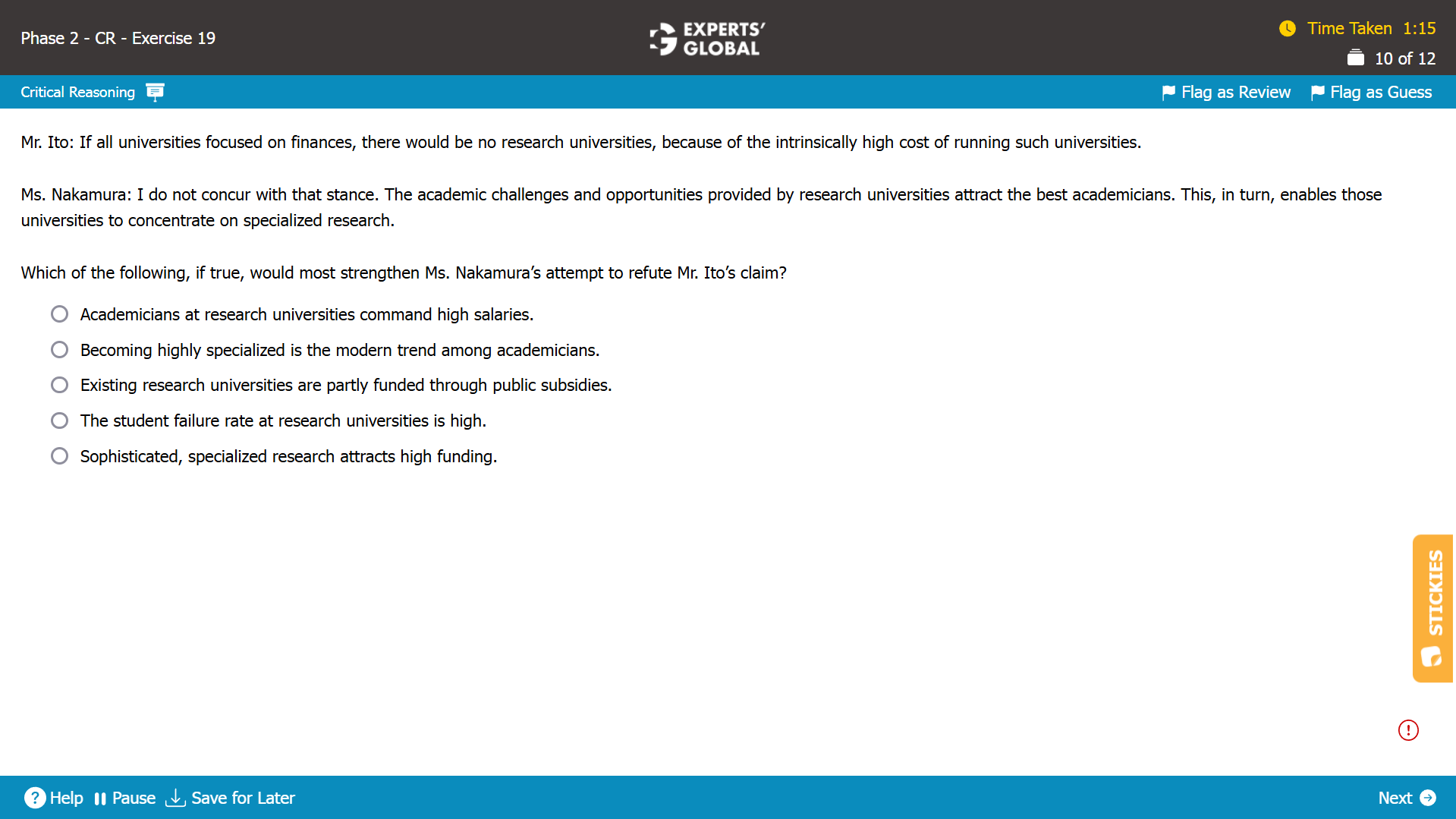
Dialogue-based Critical Reasoning questions test the same logic as paragraph-based ones but in conversational form. Success lies in mapping each speaker’s claim, spotting misinterpretations, and identifying assumptions, flaws, or rebuttals that follow. Always distinguish between specific points and broad judgments, focusing on how statements connect to conclusions. With consistent practice through GMAT simulations, you can sharpen precision, avoid traps, and apply reasoning clarity not only in test settings but also in broader contexts of analytical thinking and structured decision-making.
Dialogue-based questions remind us that meaning is not only in words but in how those words are interpreted, challenged, and defended. This mirrors the essence of preparation, where clarity is built through careful listening and precise reasoning. In MBA applications, too, success comes from understanding perspectives and addressing counterpoints with balance. In life, progress often depends on separating what was truly said from what was assumed. Each GMAT mock becomes a rehearsal in this discipline, shaping sharper thinkers and more thoughtful communicators beyond the exam hall.