Quick Summary
A correct assumption in GMAT Critical Reasoning is the hidden link that must be true for the argument to hold. Unlike strengthening statements, it is indispensable – if denied, the argument collapses. Test by asking: without this link, does the conclusion still stand?
Overview
A correct assumption is the indispensable link that ensures an argument stands, distinct from statements that merely add support. This overview introduces how to recognize assumptions by testing necessity: if denied, the argument collapses. The upcoming video and article illustrate this with clear examples, contrasting assumptions with strengthen choices. Building this distinction sharpens reasoning in GMAT prep and enhances structured evaluation across MBA admissions, where recognizing what is essential versus supplementary often determines the strength of arguments and decisions.

GMAT CR: Assumptions Question Type
Understanding Assumptions in GMAT Critical Reasoning
Assumptions are among the most delicate yet powerful concepts in Critical Reasoning. An assumption is not just any statement that connects the premises to the conclusion. It is the statement that fills the missing link and must necessarily be true for the argument to hold ground. Without it, the argument collapses. A correct assumption always strengthens the argument, and when its truth is denied, the argument loses its validity.
GMAT Critical Reasoning Assumption Questions: What They Look Like
Expect a brief passage with layers of information and a conclusion. Your task is to identify the assumption the author makes in reaching that conclusion.
Typical Question Stems
- Which of the following is an assumption made in the argument?
- Which of the following is an assumption on which the argument depends?
How an Assumptions CR Question Appears on the GMAT
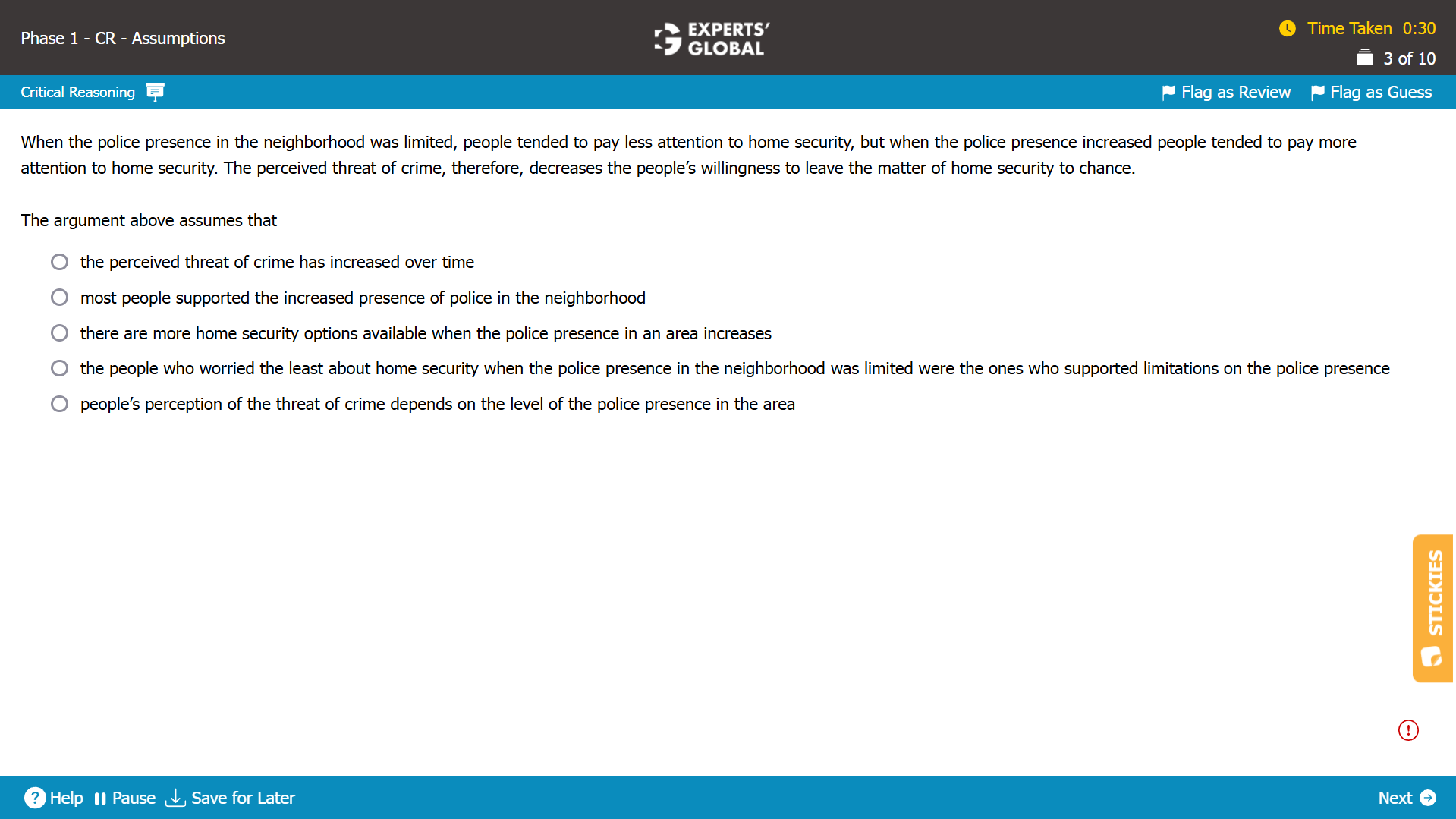
Correct Answer: E
The GDP Growth Example (from the video)
Consider the following:
The GDP of Xitora has grown by 15% during the tenure of the current political party. Hence, the political party has done a good job and deserves another term.
The premise (information) is that the country’s GDP has grown by 15 percent, and the conclusion is that the ruling party has performed well and deserves to remain in power.
The missing-link lies between “GDP growth” and “the performance of the party.”
- A valid assumption must fill the missing-link and be necessarily true for the argument to be valid.
Look at the following statement:
The statement “GDP growth is an important factor in judging the performance of a political party.” Is a valid assumption, because…
- It fills the missing-link, thereby strengthening the argument.
- It is necessarily true for the argument to hold. If GDP growth were not important, the conclusion would not follow.
Common Misunderstandings
-
- “GDP growth is the only factor.” This is not a fine assumption. The argument does not need GDP growth to be the only factor. Even if it is one of the important factors, the conclusion can hold.
- “GDP growth is the most important factor.” Again, not a fine assumption. The argument does not require this extreme condition.
- “No previous government ever achieved more than 10 percent growth.” While this strengthens the argument, it is not an assumption. The argument can hold even if past governments had higher growth.
- “None of the similar economies achieved more than 12 percent growth.” This strengthens but does not qualify as an assumption, since the argument does not depend on this fact.
- “15 percent GDP growth is the highest in 100 years.” Once again, this strengthens, but the conclusion does not require it to be the highest. It only requires 15 percent to be considered good enough.
Assumptions vs. Strengthening Statements in GMAT Critical Reasoning
| Aspect |
Assumptions |
Strengthening Statements |
| Role in the argument |
The hidden foundation. Without it, the argument collapses. |
Additional support. Makes the argument stronger but is not essential. |
| Necessity |
Must be necessarily true for the conclusion to hold. |
Helpful but not required for the conclusion to stand. |
| Effect if denied |
Argument completely falls apart. |
Argument may weaken but can still stand without it. |
| Nature |
Always strengthens the argument when affirmed, destroys it when negated. |
Only increases persuasiveness, not absolute necessity. |
| Example (GDP growth case) |
“GDP growth is an important factor in judging the performance of a political party.” |
“GDP growth of 15 percent is the highest in 100 years.” |
GMAT-style CR Assumptions Question with Explanation
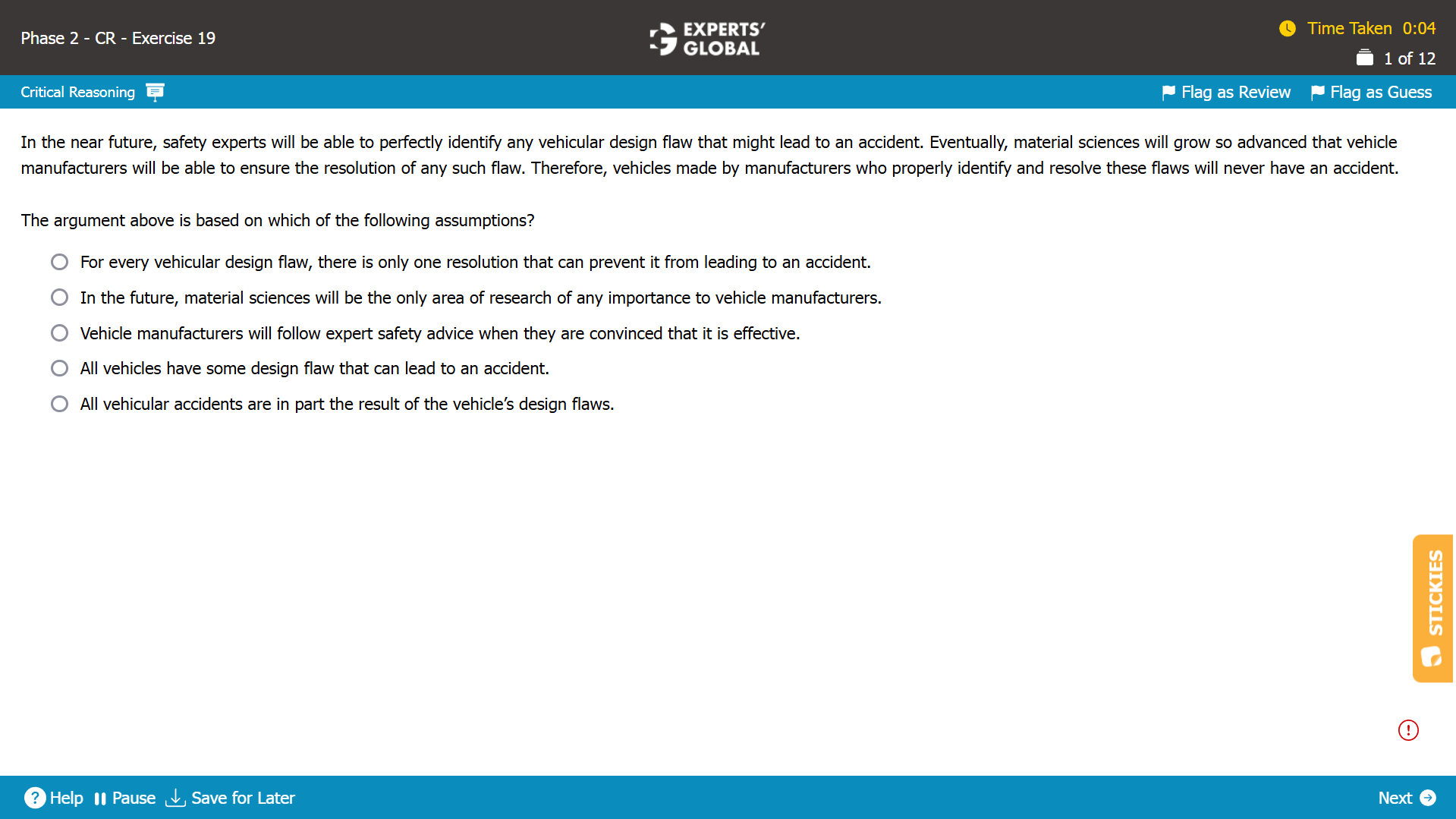
Written Explanation
Mind-map: Safety experts will be able to identify any vehicular design flaw → material sciences will advance and manufacturers can resolve all flaws → vehicles by such manufacturers will never have an accident (conclusion)
Missing-link: Between manufacturers resolving all such flaws and the conclusion that vehicles by such manufacturers will never have an accident
Expectation from the correct answer choice: To strengthen the conclusion that vehicles by manufacturers that resolve flaws will never have an accident, through a valid assumption
A. The conclusion is about “vehicles by manufacturers that resolve all design flaws” and whether “there is only one resolution for every vehicular design flaw” is not relevant to the reasoning, and so doesn’t strengthen the conclusion. Besides, this condition is not necessary for the argument to hold and thus, is not a valid assumption. Because this answer choice does not strengthen the conclusion through a valid assumption, this answer choice is incorrect.
B. The idea that material sciences are the “only” important area of research doesn’t have to be true for the conclusion to hold; it is possible that material sciences are “one of the important areas of research” and the conclusion would still hold; please remember, a valid assumption “must be necessarily true” for the argument to hold. Because this answer choice does not strengthen the conclusion through a valid assumption, this answer choice is incorrect.
C. Trap. The idea that vehicle manufacturers will follow expert safety advice “when they are convinced that it is effective” is simply additional information, which, although relevant to the reasoning, has no bearing on the conclusion; the conclusion is about vehicles by manufacturers that resolve all design flaws and “when” the manufacturers resolve such flaws doesn’t affect the reasoning. By adding a condition about “when” the manufacturers will follow the expert safety advice, this answer choice, if anything, only weakens the argument. Because this answer choice does not strengthen the conclusion through a valid assumption, this answer choice is incorrect.
D. Trap. The idea that “all vehicles have some design flaw that can lead to an accident” contradicts the premise that “vehicle manufacturers will be able to ensure the resolution of any such flaw”, and thus doesn’t strengthen the conclusion; if anything, this answer choice tends to weaken the conclusion. Because this answer choice does not strengthen the conclusion through a valid assumption, this answer choice is incorrect.
E. Correct. If the idea that “all vehicular accidents are in part the result of the vehicle’s design flaws” is connected to the premise that “manufacturers can resolve all flaws”, it suggests that “vehicles by manufacturers that identify and resolve flaws will not have flaws that lead to accidents; this suggestion supports the conclusion of the argument. Additionally, this statement does have to be true for the conclusion to hold; negating this statement would mean that “some vehicular accidents are not the result of the vehicle’s design flaws”, thereby suggesting that vehicles may meet accidents because of reasons unrelated to a design flaw; such a possibility negates the conclusion. Please note that the negation of “all vehicular accidents are in part the result of the vehicle’s design flaws” is that “not all…are…”, and therefore, “some…are…”. Because this answer choice strengthens the conclusion through a valid assumption, this answer choice is correct.
E is the best choice.
Key Takeaways
A correct assumption is not just supportive but necessary—without it, the conclusion fails. Distinguish assumptions from strengthening statements by applying the denial test: if rejecting the statement collapses the argument, it is an assumption. Practice identifying this hidden link to sharpen logical precision. Mapping premises, conclusions, and assumptions consistently builds analytical clarity. Applying these skills through GMAT simulations reinforces timing, accuracy, and confidence, ensuring that assumptions are recognized as the indispensable backbone of sound reasoning.
Parting Thought
The idea of an assumption teaches us to value what is essential over what is merely persuasive. In GMAT preparation, recognizing assumptions sharpens clarity and prevents wasted effort on distractions. In MBA applications, the same discipline guides applicants to uncover the underlying connections that make their story compelling. In life, too, progress depends on identifying the foundations that truly hold an argument, decision, or relationship together. Each GMAT mock becomes a reminder that success rests not on embellishment but on recognizing and protecting what is indispensable.