Invest 30 seconds...
...for what may lead to a life altering association!
Help Line
- +91.8800.2828.00 (IND)
- 1030-1830 Hrs IST, Mon-Sat
- support@expertsglobal.com
33% off ends soon:GMAT/GRE prep + applications bundle. Profile building, longer mentoring, better results. Inquire

On GMAT CR, a weakening statement makes the conclusion less convincing. It attacks the link between premise and conclusion: shows irrelevance, proposes alternative causes, compares with stronger benchmarks, undermines attribution, or adds conflicting evidence. Ask: if true, would this make conclusion look weaker?
Weakening questions invite you to test how robust an argument’s link is between premise and conclusion. This overview introduces what a weakening statement does: it reduces persuasive force by challenging that link, suggesting alternative causes, undermining attribution, adding conflicting information, or reframing benchmarks. The video and article outline a simple lens for spotting such moves and applying them consistently. The analytical discipline supports study in GMAT prep and evaluation of claims in MBA admissions, where separating signal from noise counts.

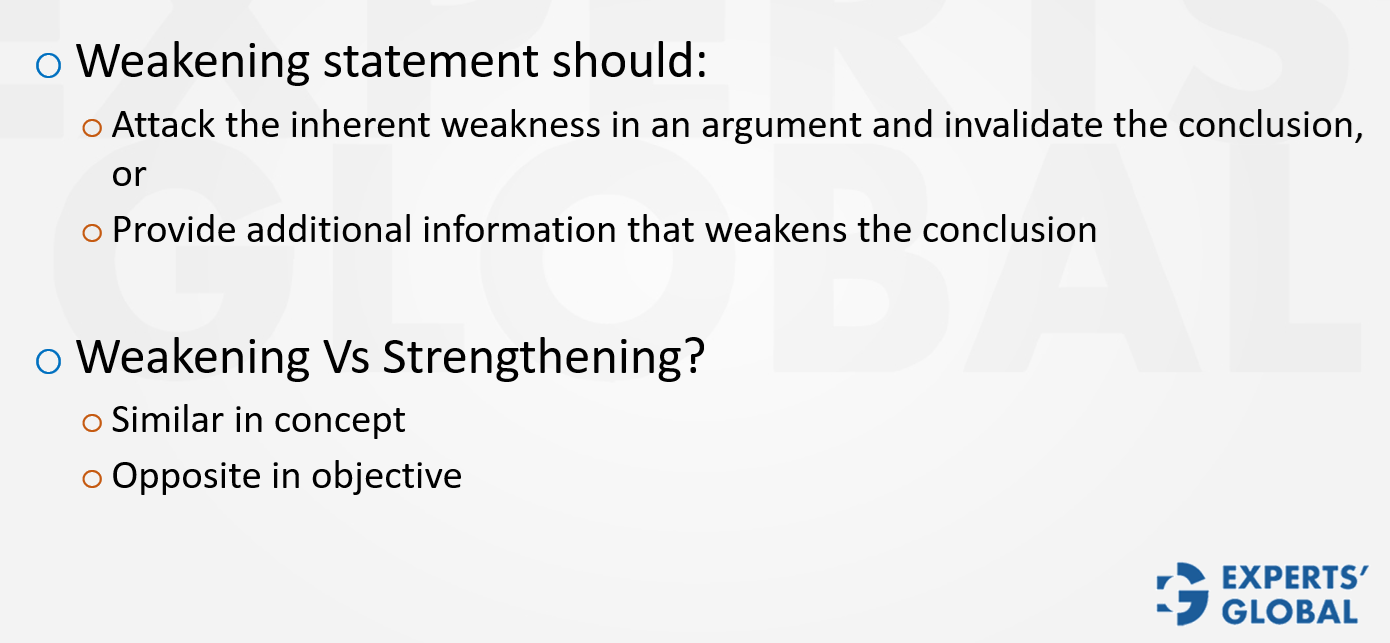
Weakening questions test your ability to challenge the logic of an argument. A correct weakening statement attacks the inherent weakness in the reasoning and reduces the credibility of the conclusion.
Expect a brief passage with layers of information and a conclusion. Your task is to identify the option that most weakens the conclusion reached by the argument.
Which of the following statements, if true, would most significantly weaken the conclusion drawn in the passage?
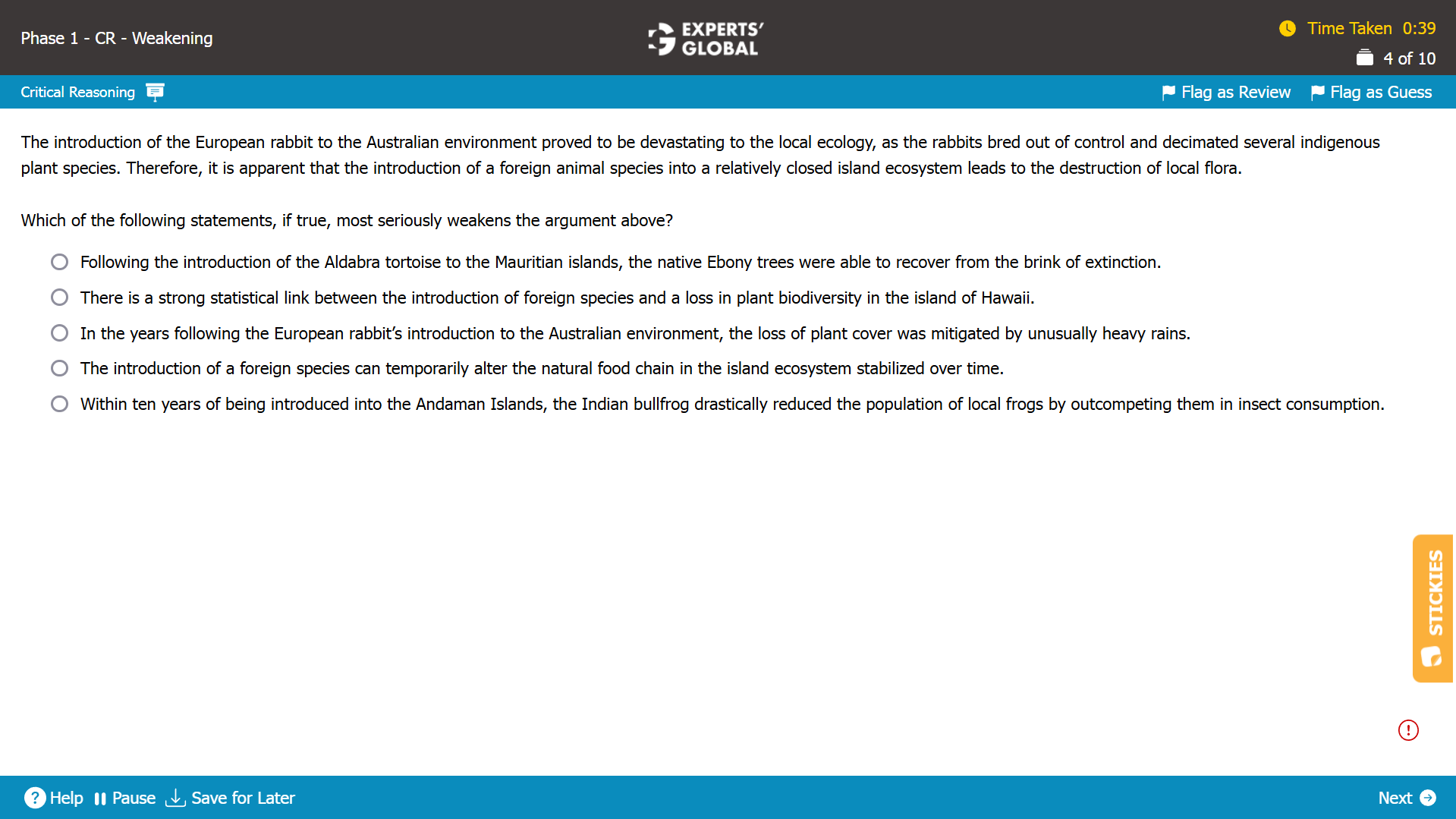
Correct Answer: A
Both types of statements deal with the same missing-link, but they differ in their purpose. Strengthening statements plug that missing-link, while weakening statements attack it. In other words, strengthening makes the argument more convincing, while weakening makes it less so.
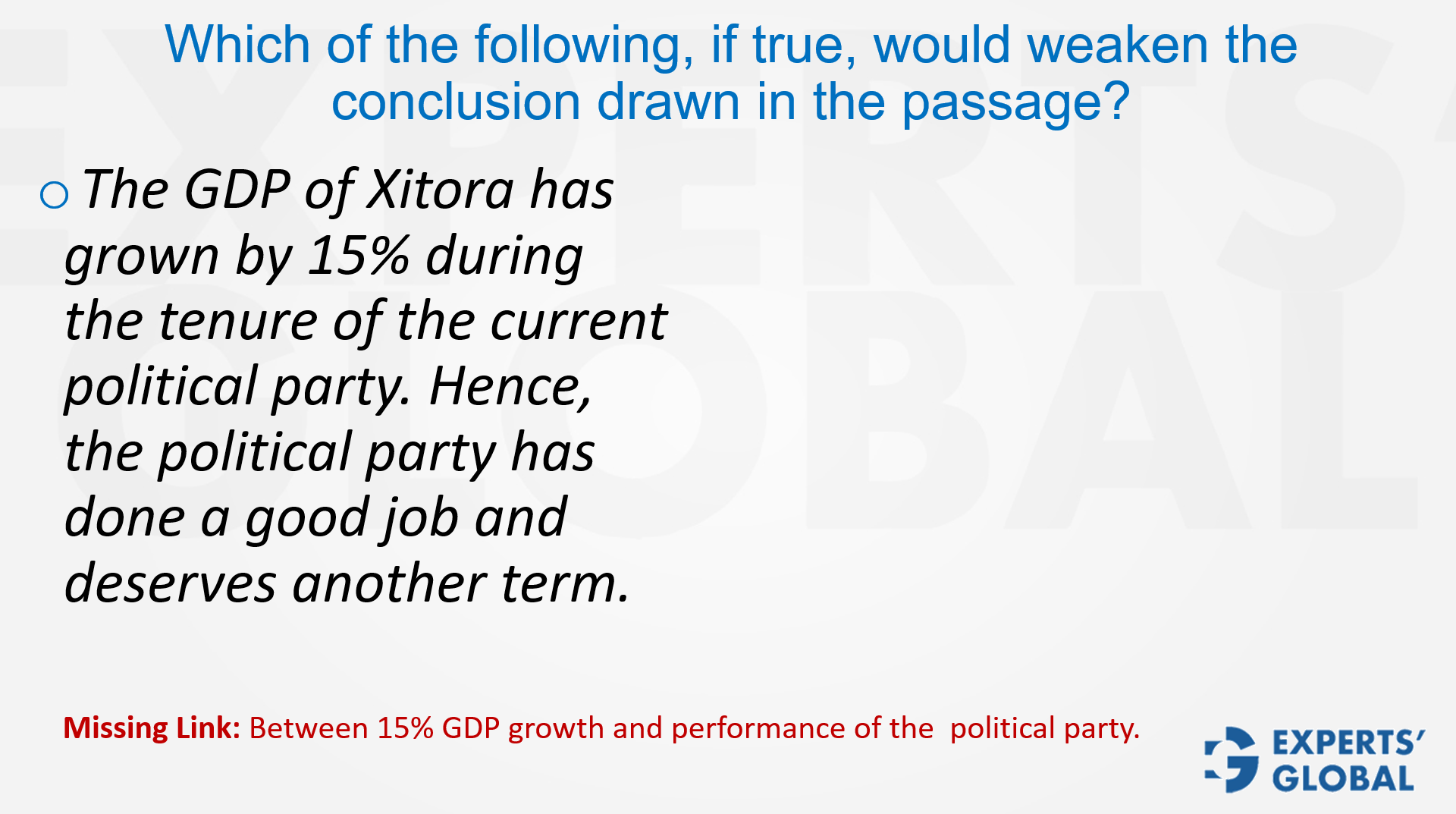
Consider this argument:
The GDP of Xitora has grown by 15 percent during the tenure of the current political party. Hence, the party has done a good job and deserves another term.
The missing-link is between the 15 percent GDP growth and the conclusion that the party has done a good job. Let us see how different statements weaken this argument:
1. “GDP growth is not an important factor in deciding the performance of a political party.”
If GDP growth is irrelevant, the conclusion collapses.
2. “During the tenure of no previous government, the GDP grew by less than 18 percent.”
If earlier governments performed even better, the current government’s achievement looks less impressive.
3. “The government did not play an important role in the GDP growth.”
If the government’s role was minimal, the credit cannot be given to the ruling party.
4. “None of the other similar economies witnessed a growth of less than 20 percent.”
If others grew faster, Xitora’s 15 percent growth looks poor in comparison.
5. “The 15 percent GDP growth is the lowest in 100 years for Xitora.”
What looked impressive in isolation now becomes a sign of decline.
6. “During the same tenure, crime increased by 40 percent, and crime rate is an important factor in deciding whether the government has done a good job.”
A rise in crime provides a new, damaging perspective that weakens the conclusion.
7. “The current President of the party was the main reason behind the performance of the government, and he has declared retirement.”
If the person responsible is leaving, the conclusion about the party’s future performance becomes weaker.
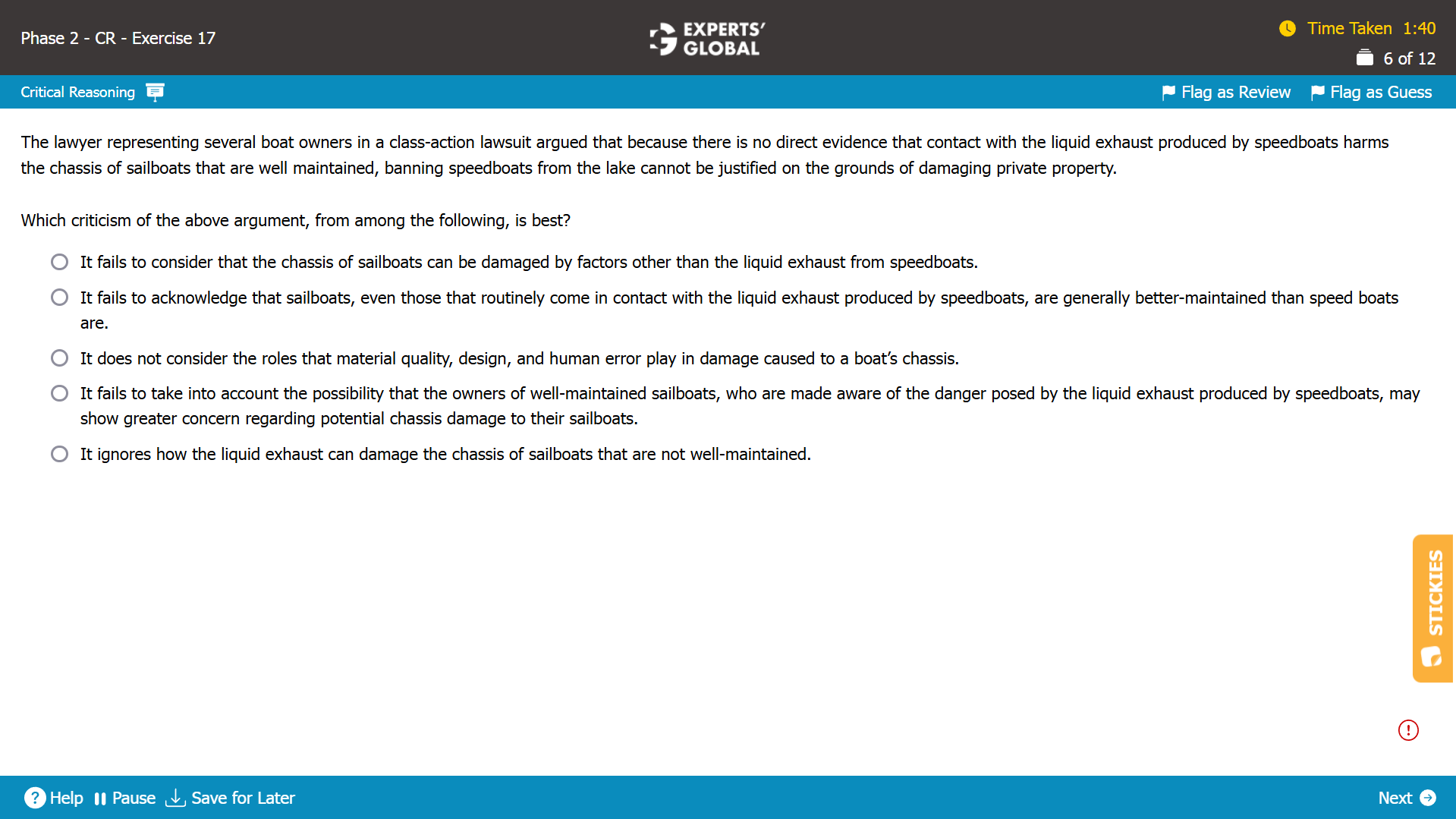
Weakening statements reduce the persuasiveness of an argument without disproving it outright. They work by attacking the link between premise and conclusion through alternative causes, stronger comparisons, conflicting evidence, or undermining attribution. The task is to ask: if true, does the conclusion become less convincing? Mastering this approach refines logical precision and speeds elimination. Consistent practice in GMAT simulations builds the habit of spotting these patterns quickly, ensuring accuracy and confidence in handling Critical Reasoning weakening questions.
| Aspect | Strengthening | Weakening |
|---|---|---|
| Objective | Make the conclusion more convincing by supporting the link between evidence and conclusion. | Make the conclusion less convincing by exposing flaws or providing conflicting information. |
| Approach | Plug the missing link, add credibility to the reasoning. | Attack the missing link, introduce doubt, show alternative explanations. |
| Example Argument | “The GDP of Xitora has grown by 15%. Hence, the ruling party has done a good job.” | Same argument: “The GDP of Xitora has grown by 15%. Hence, the ruling party has done a good job.” |
| Sample Strengthening Statement | “GDP growth is an important factor in deciding the performance of a political party.” | “GDP growth is not an important factor in deciding the performance of a political party.” |
| Another Strengthening Statement | “In the past 100 years, GDP never grew by more than 10% under any government.” | “The 15% GDP growth is the lowest in 100 years for Xitora.” |
| Clarity | Focus is on adding reliability and making the reasoning tighter. | Focus is on adding skepticism and loosening the reasoning. |
| Ease Level | Slightly harder, because it requires precise alignment with the argument. | Often easier, since criticism and counterexamples are more straightforward. |
Weakening statements remind us that progress often depends not only on affirming what seems convincing but also on questioning it. In GMAT preparation, this discipline builds the ability to probe arguments rather than accept them at face value. In MBA applications, the same perspective allows candidates to anticipate concerns and address them honestly, strengthening their case through balance. In life, too, growth comes from examining the assumptions behind our choices. Each GMAT mock becomes a practice ground for testing ideas, refining clarity, and embracing deeper reasoning.