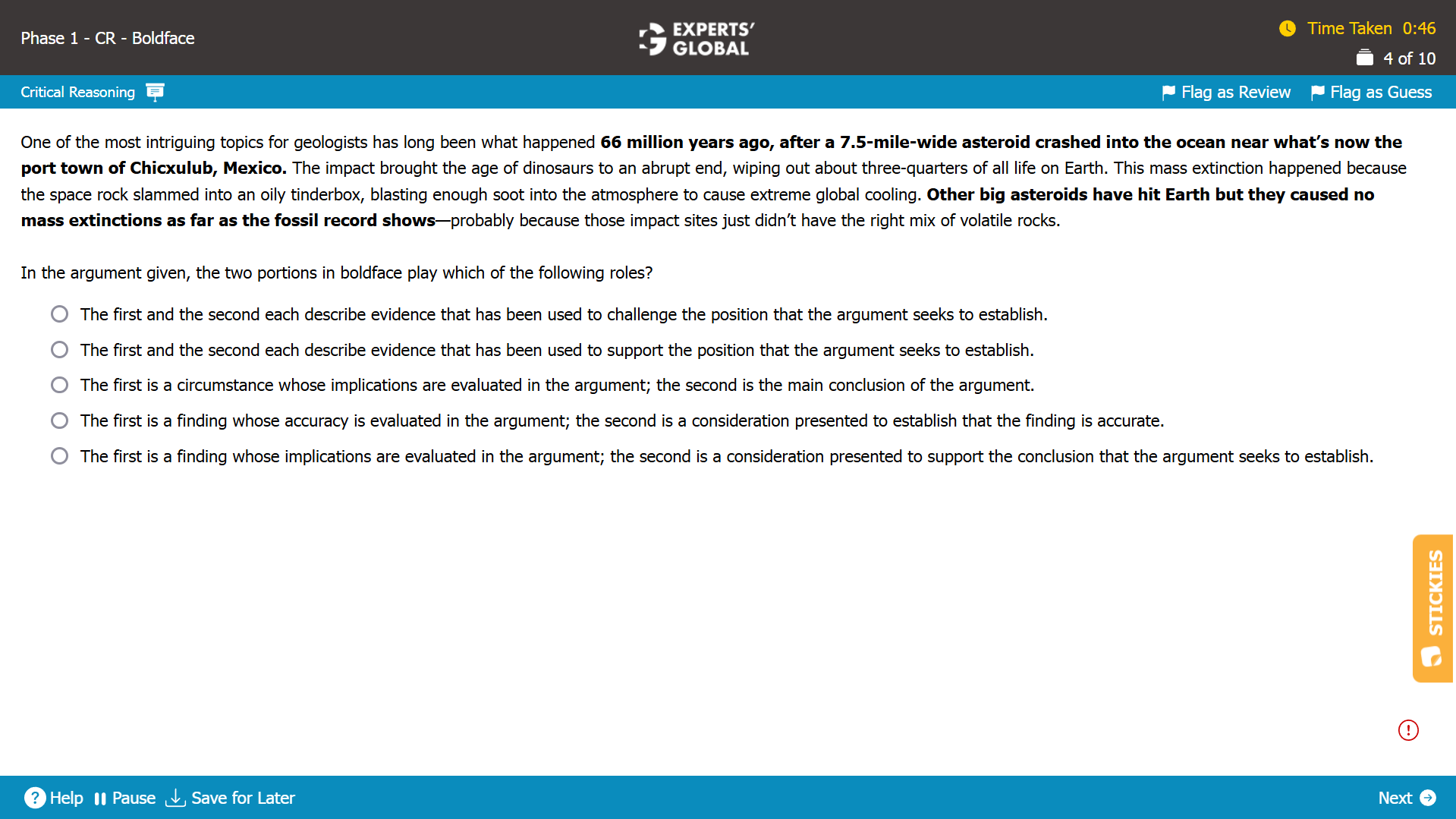
GMAT Critical Reasoning Boldface questions ask you to identify the role that each highlighted statement plays within an argument. On the GMAT, the verbal section contains 23 questions in total; of these, roughly 8 to 10 are Critical Reasoning questions, and typically one of those is a boldface question. Boldface Critical Reasoning questions are among the most engaging question types on the GMAT, yet many candidates struggle with them because they lack a clear, reliable method. Without a sound strategy, the argument structure feels complicated and the nuanced answer choices can appear extremely confusing. Any dependable GMAT prep course should therefore provide a thorough strategy for boldface questions, along with sufficient practice on well designed problems. With a disciplined, stepwise approach, you can realistically aim for 100 percent accuracy on GMAT CR boldface questions within the time limit. On this page, we present that approach in a structured manner and then help you apply it through guided practice and fully worked examples.
The Task on CR Boldface: What CR Boldface Questions Require You to Do
In GMAT Critical Reasoning boldface questions, you are presented with a passage that contains one or more bolded parts. Your task is to identify the role these bolded parts play in the argument.
How a Boldface CR Question Appears on the GMAT
Approach for Solving CR Boldface Questions
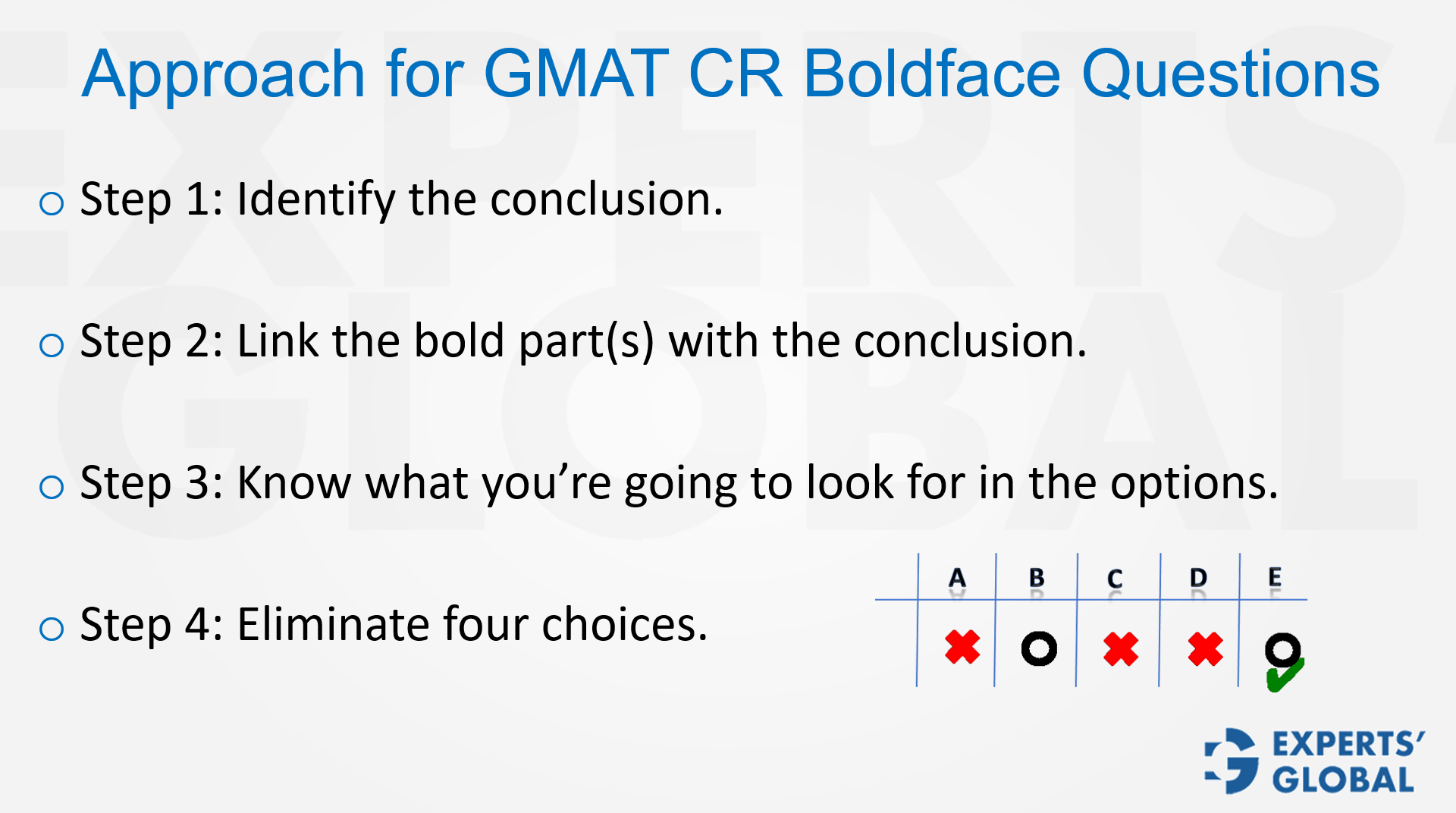
In GMAT boldface questions, a passage contains one or more bolded sections. The task is to identify the role those sections play in the argument. The following is a simple 4-step approach for solving the CR boldface questions:
Step 1: Identify the conclusion of the argument.
Step 2: Link the bold part(s) with the conclusion.
Step 3: Know what you are going to look for in the options.
Step 4: Go by elimination: eliminate four choices. The remaining, fifth, choice is your answer.
As always, before finalizing a choice, verify.
The following conceptual review brings this strategy to life and explains how to apply it to boldface questions on the GMAT, even under real exam conditions and time pressure. This short lesson also includes worked examples to illustrate the steps and the concepts. Pause the video each time to solve the question yourself, focusing on applying the approach and observing how the trainer uses it on live arguments.

GMAT CR: Approach for Solving Boldface Questions
Application of the Discussed Approach on a GMAT-like Boldface Question
Now that you have understood the correct approach for solving GMAT CR Boldface questions, let us apply it to a GMAT-like problem. Watch the following video carefully, pausing it to attempt the question yourself. Focus on applying the strategy rather than just getting the answer right, and observe how the trainer demonstrates the four-step approach effectively and efficiently.

Application of Approach for CR Boldface Questions
Mastering the Frequently Used Vocabulary in Boldface Questions
One of the main challenges in solving GMAT CR Boldface questions is handling the nuanced vocabulary in both the questions and the answer choices. The terms are not difficult in themselves but carry precise meanings. Understanding these meanings helps process the options effectively and makes elimination and final selection easier.
Frequently Used Vocabulary in CR Boldface Questions
Key Nouns Used in CR Boldface Questions
- Conclusion – the claim that the reasoning tries to prove.
- Judgment – a personal view or evaluation of something.
- Prediction – a statement about what is expected to occur later.
- Evidence – information that either backs or disputes an argument.
- Fact – an established truth or verified detail.
- Opinion – a perspective that may or may not be correct.
- Main conclusion – the primary claim of the argument, separate from smaller conclusions.
- Intermediate conclusion (a conclusion) – a secondary claim that may or may not support the main conclusion.
- Circumstance – a condition or context relevant to the argument.
- Assumption – an unstated belief taken as true for the reasoning to hold.
- Consideration – a point or factor taken into account in reasoning.
- Finding – a result discovered through study or effort.
- Explanation – a clarification that makes something understandable.
- Objection – a counterpoint or disagreement.
- Claim – a statement put forward without definite proof.
- Position – a firmly held stance on an issue.
Key Verbs Used in CR Boldface Questions
- To oppose – to counter or weaken.
- To establish – to put forward or set up a viewpoint.
- To evaluate – to judge or assess carefully.
- To imply – to hint at indirectly.
- To introduce – to bring something new into the discussion.
- To support – to back or strengthen an argument.
- To explain – to make an idea clear.
- To undermine – to weaken or reduce strength.
- To challenge – to question or dispute.
- To describe – to present details or an account.
Vocabulary Test 1 for Boldface Questions
Now that you have learned the commonly used vocabulary in GMAT CR Boldface questions, let us apply it to a live argument. In the following video, you will see an argument with a boldfaced portion, followed by 10 terms. Your task is to decide which of the 10 terms fit the boldface. This exercise is Drill #1.
Vocabulary Test 1 for CR Boldface
Vocabulary Test 2 for Boldface Questions
Let us continue practicing with another exercise. In the following video, you will see an argument with a boldfaced portion, followed by 10 frequently used GMAT CR Boldface terms. Your task is to determine which of these terms apply to the boldface. This exercise is Drill #2.
Vocabulary Test 2 for CR Boldface
Vocabulary Test 3 for Boldface Questions
In the following video, you will find an argument with a boldfaced section, along with 10 frequently used GMAT CR Boldface terms. Your task is to work through the list and identify which terms can be linked to the boldface. This exercise is Drill #3.
Vocabulary Test 3 for CR Boldface
Vocabulary Test 4 for Boldface Questions
For the next exercise, watch the video that presents an argument containing a boldfaced section, followed by 10 commonly used GMAT CR Boldface terms. Your task is to analyze and decide which of these terms correctly describe the boldface. This is Drill #4.
Vocabulary Test 4 for CR Boldface
Vocabulary Test 5 for Boldface Questions
The video ahead presents an argument with one part in boldface and then provides 10 common GMAT CR Boldface terms. Review the terms and determine which ones accurately describe the boldface portion. This session is Drill #5.
Vocabulary Test 5 for CR Boldface
Key Recap: Key Points for CR Boldface Questions
So far on this page, you have understood the CR boldface task on the GMAT, learned a clear strategy for these questions, explored frequently tested vocabulary, and practised it through focused vocabulary drills. Congratulations on the solid progress you have made. Before you move on to solving GMAT style CR boldface problems, it is important to briefly revisit the key points of the GMAT CR boldface strategy. The following short video details this approach, shows how it operates on questions, and trains you to use it in GMAT drills, sectional tests, and full-length GMAT practice tests.
GMAT CR: Key Points for Boldface Questions
GMAT-style CR Boldface Questions with Explanations
This section offers a collection of GMAT-style Critical Reasoning Boldface questions, each accompanied by a thorough, stepwise explanation. Work through every argument unhurriedly and use the approach and ideas you have just studied on this page for solving boldface questions on the GMAT. At this stage, place greater emphasis on applying the framework accurately than on simply selecting the option that seems right. After you finish each question, use the explanation control to view the correct answer and to review the reasoning in a clear, descriptive manner.
Practice Question 1
Written Explanation
Strategy: Determining the main conclusion of the argument and finding the relation of the boldfaced portion with this conclusion
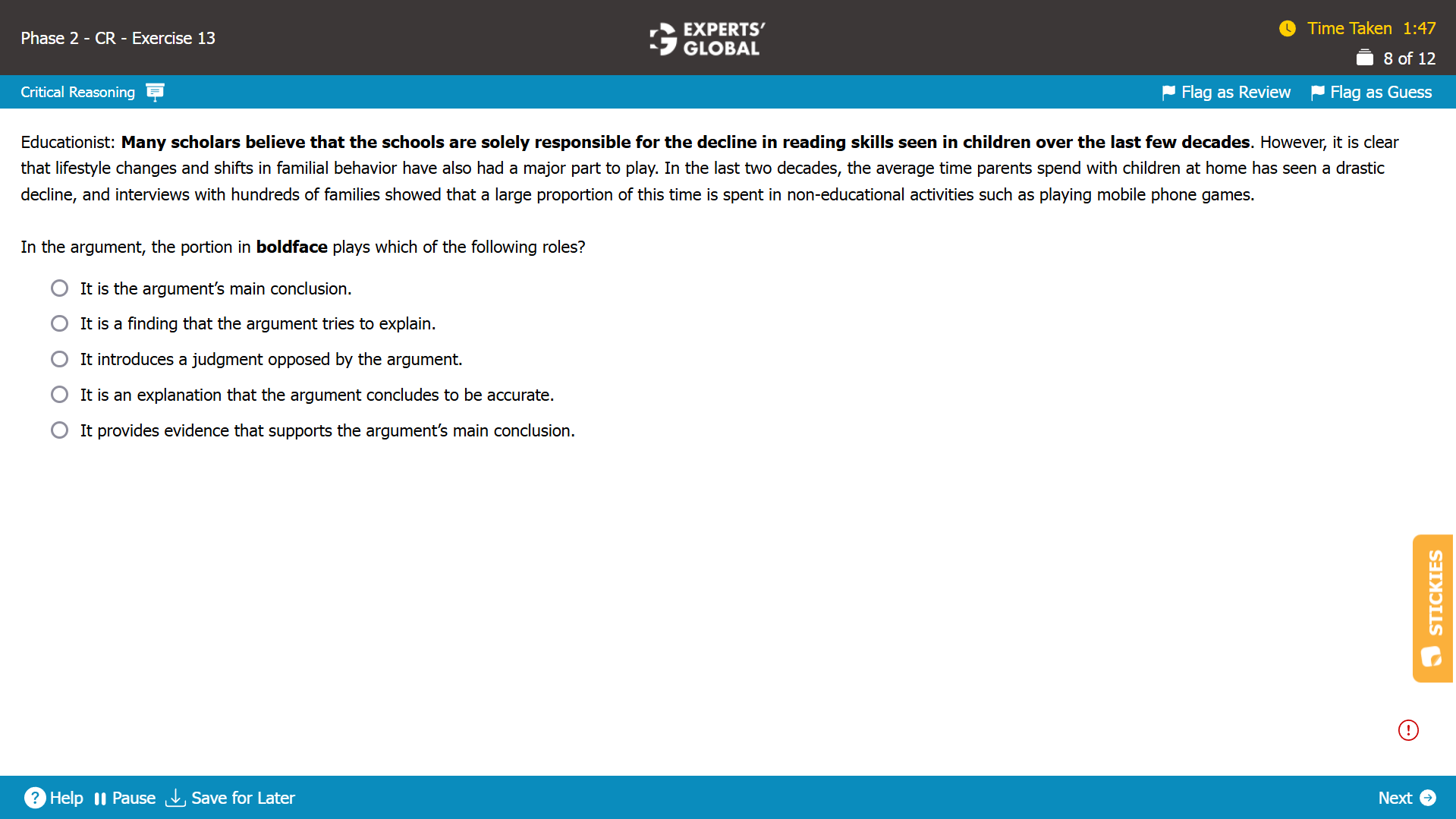
Logic: The argument is an educationist’s view regarding the cause of the decline in reading skills in children. The argument mentions, as the boldface states, that many scholars opine that schools are solely responsible for the decline. The argument states the educationist’s view that factors such as a decline in average parent-children time and increase in non-educational activities have also played an important role in the decline. Overall, the main conclusion is the educationist’s view that other factors not related to schools have also played an important role in the decline. In the context of the main conclusion, the boldface is an opinion that the argument challenges.
Main conclusion: Other factors not related to schools have also played an important role in the decline.
Broad expectation from the correct answer choice:
The boldface is an opinion that the argument challenges.
A.
Merit(s):
None
Demerit(s):
The boldface is many scholars’ opinion that schools alone are responsible for the decline in reading skills in children; the main conclusion is that other factors not related to schools have also played an important role in the decline; therefore, it is incorrect to state that boldface is “the argument’s main conclusion”.
Because this answer choice does not correctly highlight the role played by the portion in boldface, this answer choice is incorrect.
B.
Merit(s):
None
Demerit(s):
The boldface is many scholars’ opinion and not a factual observation; therefore, it is incorrect to state that the boldface is a “finding”.
The boldface offers an explanation for the decline in reading skills in children; the argument challenges the boldface and does not explain the boldface; therefore, it is incorrect to state that the argument “tries to explain the boldface”.
Because this answer choice does not correctly highlight the role played by the portion in boldface, this answer choice is incorrect.
C.
Merit(s):
The boldface is many scholars’ opinion; therefore, it is correct to state that the boldface is a “judgment”.
The boldface is an opinion that the argument challenges; therefore, it is correct to state that the “argument opposes the boldface”.
Demerit(s):
None
Because this answer choice correctly highlights the role played by the portion in boldface, this answer choice is correct.
D.
Merit(s):
The boldface presents a cause of the decline in reading skills in children; therefore, it is correct to state that the boldface is an “explanation”.
Demerit(s):
The boldface is an opinion that the argument challenges; therefore, it is incorrect to state that the “argument concludes that the explanation in boldface is accurate”.
Because this answer choice does not correctly highlight the role played by the portion in boldface, this answer choice is incorrect.
E.
Merit(s):
None
Demerit(s):
The boldface is an opinion and not a concrete fact; therefore, it is incorrect to state that the boldface is an “evidence”.
The boldface is an opinion that the argument challenges in its conclusion; so, the boldface and the main conclusion oppose each other; therefore, it is incorrect to state that the boldface “supports the argument’s main conclusion”.
Because this answer choice does not correctly highlight the role played by the portion in boldface, this answer choice is incorrect.
C is the best answer choice.
Practice Question 2
Strategy: Determining the main conclusion of the argument and finding the relation of the boldfaced portions with this conclusion
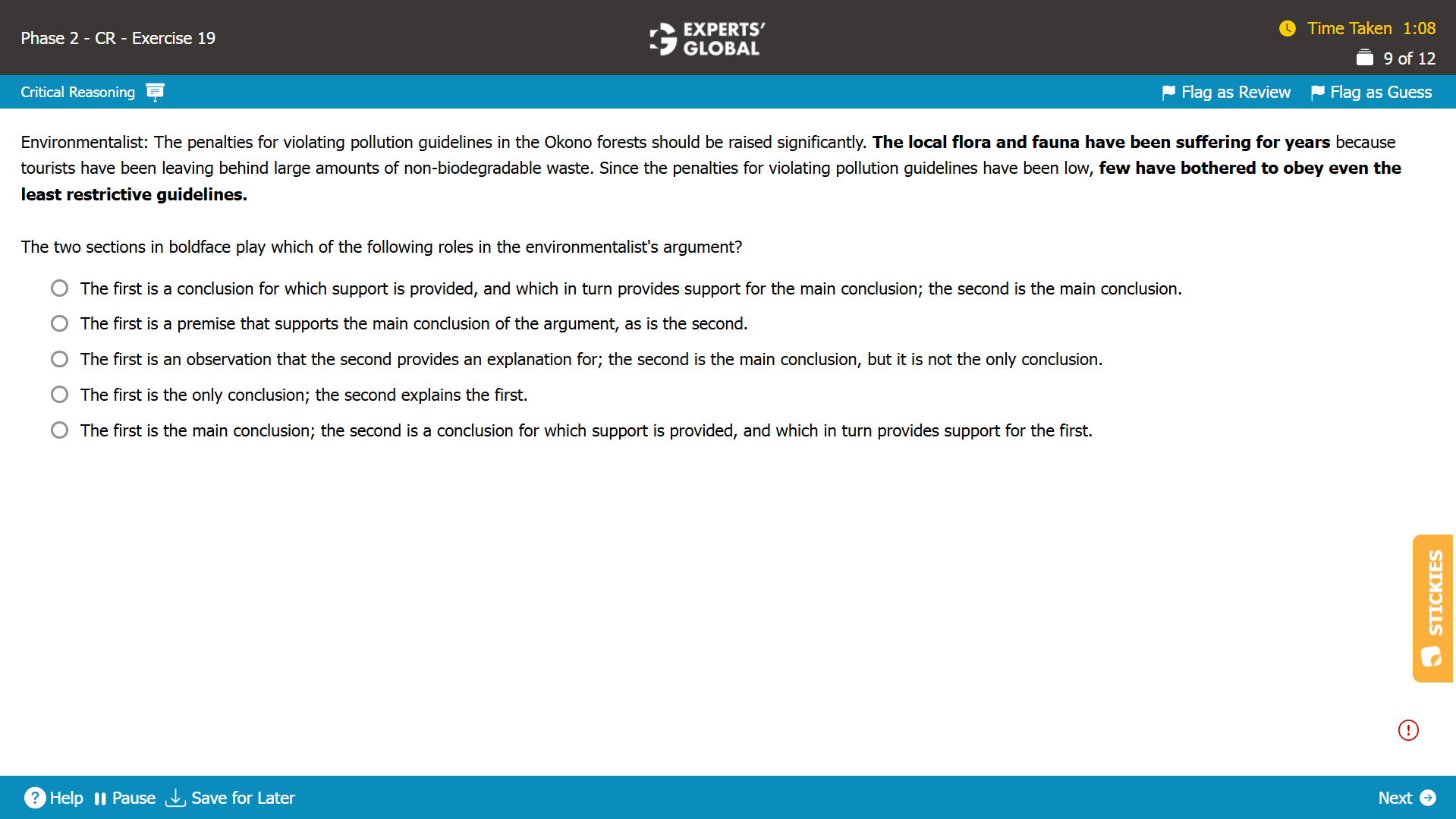
Logic: The argument is concerned with penalties for violating pollution guidelines in a forest. The argument mentions, as the first boldface states, that the local flora and fauna have been suffering for years because of the waste left behind by tourists. The argument also mentions that because the penalties have been low, few tourists have bothered to obey the guidelines, as the second boldface states. Considering these observations, the argument concludes that the penalties should be raised. In the context of the main conclusion – the first boldface is an observation that has been used to establish the main conclusion; the second boldface is another observation that has been used to establish the main conclusion.
Main conclusion: The penalties for violating pollution guidelines should be raised.
Broad expectation from the correct answer choice:
The first boldface is an observation that has been used to establish the main conclusion.
The second boldface is an observation that has been used to establish the main conclusion.
A.
Merit(s):
The argument supports the first boldface by citing the consideration that tourists have been leaving behind waste; therefore, it is correct to state that “support is provided to the first boldface”.
The first boldface is a factual observation that the argument uses to establish the main conclusion; therefore, it is correct to state that the first boldface “provides support for the main conclusion”.
Demerit(s):
The first boldface is a factual observation that the argument uses but does not establish; therefore, it is incorrect to state that the first boldface is a “conclusion”.
The second boldface is an observation that has been used to establish the main conclusion and itself is not the main conclusion; therefore, it is incorrect to state that the second boldface is the “main conclusion”.
Because this answer choice does not correctly highlight the roles played by the two portions in boldface, this answer choice is incorrect.
B.
Merit(s):
The first boldface is a factual observation that the argument uses to establish the main conclusion; therefore, it is correct to state that the first boldface is a “premise”.
The first boldface is a factual observation that the argument uses to establish the main conclusion; therefore, it is correct to state that the first boldface “supports the argument’s main conclusion”.
The second boldface is a factual observation that the argument uses to establish the main conclusion; therefore, it is correct to state that the second boldface is a “premise”.
The second boldface is a factual observation that the argument uses to establish the main conclusion; therefore, it is correct to state that the second boldface “supports the argument’s main conclusion”.
Demerit(s):
None
Because this answer choice correctly highlights the roles played by the two portions in boldface, this answer choice is correct.
C.
Merit(s):
The first boldface is a concrete fact; therefore, it is correct to state that the first boldface is an “observation”.
Demerit(s):
The two boldfaces are independent thoughts; so, neither provides justification for the other; therefore, it is incorrect to state that the second boldface “provides an explanation” for the first boldface.
The second boldface is an observation that has been used to establish the main conclusion and is not the main conclusion or an intermediate/parallel/separate/supporting conclusion; therefore, it is incorrect to state that the second boldface is the “main conclusion” or the “main conclusion but not the only conclusion”.
Because this answer choice does not correctly highlight the roles played by the two portions in boldface, this answer choice is incorrect.
D.
Merit(s):
None
Demerit(s):
The first boldface is a factual observation that the argument uses to establish a conclusion but the argument does not establish the first boldface; therefore, it is incorrect to state that the first boldface is a “conclusion” or that the first boldface is “the only conclusion”.
The second boldface is a factual observation and does not offer justification; therefore, it is incorrect to state that the second boldface is an “explanation”.
The two boldfaces are independent thoughts; so, neither provides justification for the other; therefore, it is incorrect to state that the second boldface “explains” the first boldface.
Because this answer choice does not correctly highlight the roles played by the two portions in boldface, this answer choice is incorrect.
E.
Merit(s):
The argument supports the second boldface by citing the consideration that the penalties for violating pollution guidelines have been low; therefore, it is correct to state that “support is provided to the second boldface”.
Demerit(s):
The first boldface is an observation that has been used to establish the main conclusion and itself is not the main conclusion; therefore, it is incorrect to state that the first boldface is the “main conclusion”.
The second boldface is a factual observation that the argument uses but does not establish; therefore, it is incorrect to state that the second boldface is a “conclusion”.
The two boldfaces are independent thoughts; so, neither provides support to the other; therefore, it is incorrect to state that the second boldface “provides support” to the first boldface.
Because this answer choice does not correctly highlight the roles played by the two portions in boldface, this answer choice is incorrect.
B is the best Answer Choice
How and Where to Practice GMAT CR Boldface Questions
Real practice for CR Boldface questions begins when you solve them on a software simulation that closely matches the official GMAT interface. You need a platform that presents the argument with its boldface portions and the question stem in a GMAT like layout, lets you work with the roles of the bold statements and the answer choices naturally, and provides all the on screen tools and functionalities that you will see on the actual exam. Without this kind of experience, it is difficult to feel fully prepared for test day. High quality CR Boldface questions are not available in large numbers. Among the limited, genuinely strong sources are the official practice materials released by GMAC and the Experts’ Global GMAT course.
Within the Experts’ Global GMAT online preparation course, every CR Boldface question appears on an exact GMAT like user interface that includes all the real exam tools and features. You work through more than 40 CR Boldface questions in quizzes and also take 15 full-length GMAT mock tests that include several CR Boldface questions in roughly the same spread and proportion in which they appear on the actual GMAT.
All the best!