Dialogue-based Critical Reasoning questions present a short conversation between two speakers who react to each other’s claims. Your job is to evaluate the reasoning and answer the question that follows. Focus on roles, logic, and evidence. Consistent practice with this question type is an essential part of any comprehensive GMAT preparation course. This page offers you an organized subtopic wise playlist, along with a few worked examples, for efficient preparation of this concept.
Approach for GMAT CR Dialogue Questions
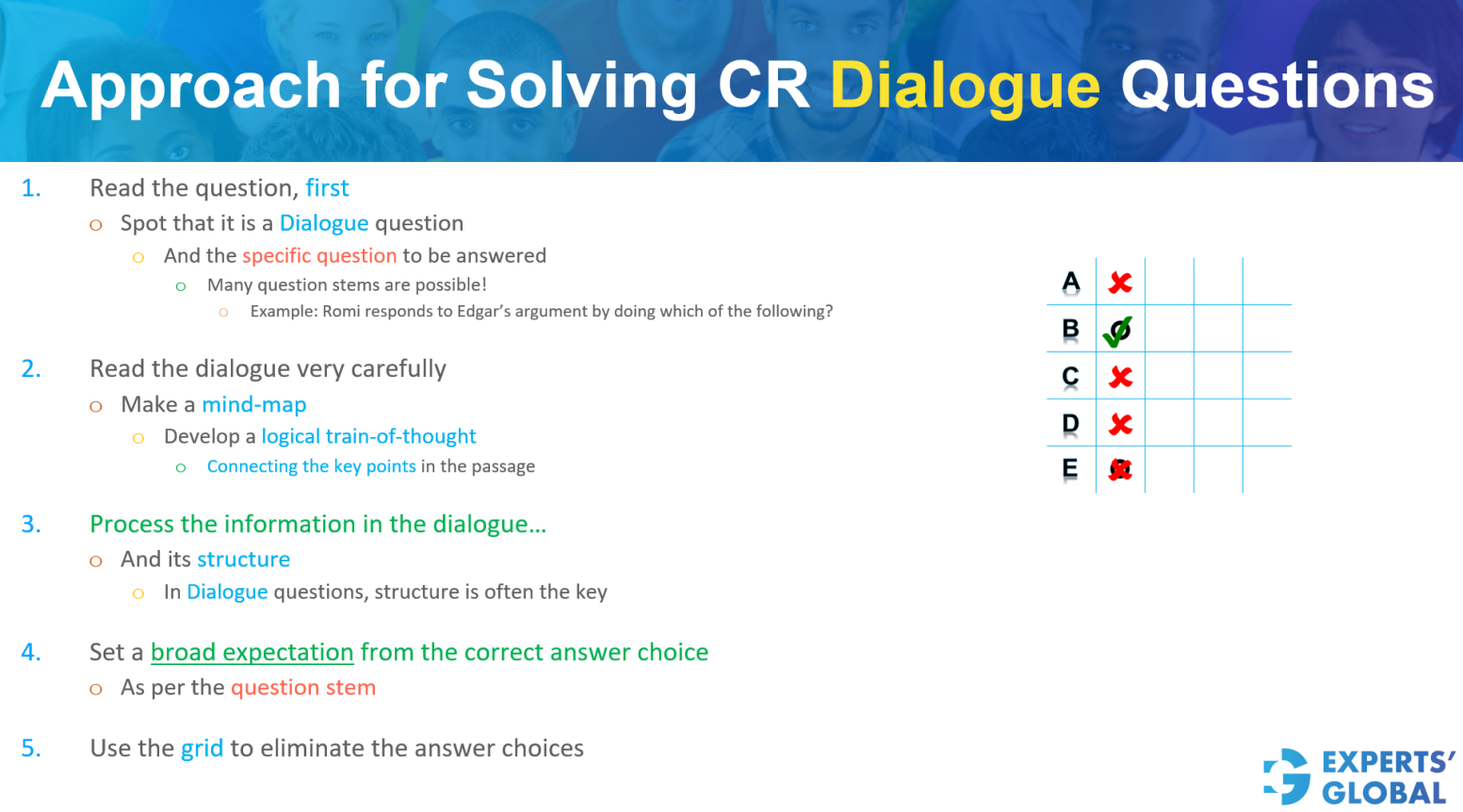
On the GMAT, dialogue-based Critical Reasoning questions examine the same underlying skills as other critical reasoning formats. The difference is that, instead of a single paragraph, the argument appears as an exchange between two speakers. For instance, you may be asked to identify an assumption made by the second speaker while responding to the first. The short video that follows explains this method, demonstrates it on examples, and prepares you to apply it across GMAT drills, sectional tests, and full-length GMAT mock tests.

Approach for CR Dialogue Questions
GMAT-style CR Dialogue Questions with Explanations
This section offers a collection of GMAT-style Critical Reasoning Dialogue questions, each accompanied by a thorough, stepwise explanation. Work through every argument unhurriedly and use the approach and ideas you have just studied on this page for analysing Dialogue structures on the GMAT. At this stage, place greater emphasis on applying the framework accurately than on simply selecting the option that seems right. After you finish each question, use the explanation control to view the correct answer and to review the reasoning in a clear, descriptive manner.
Practice Question 1
Written Explanation
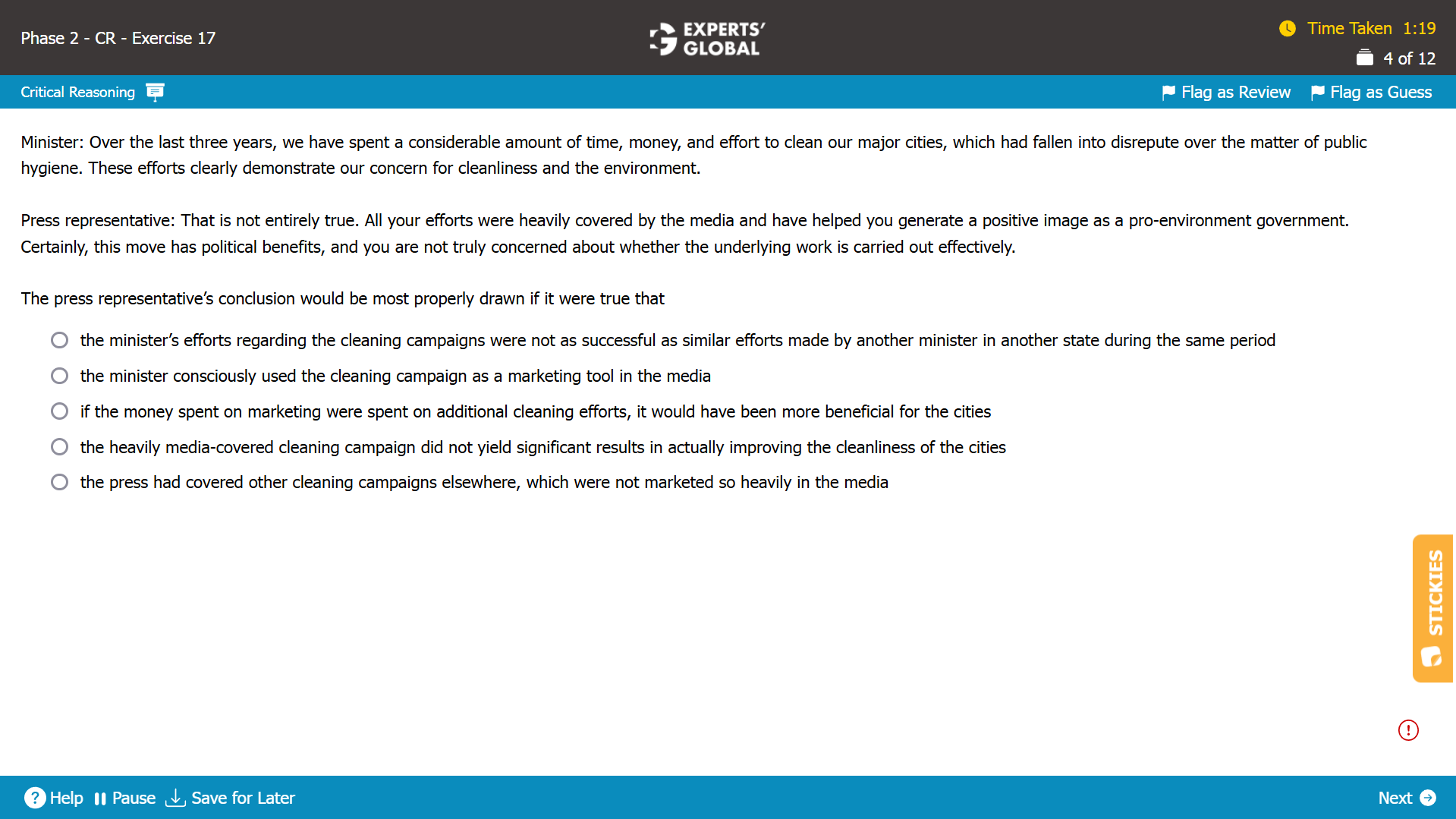
Mind-map: Minister: we worked hard to clean our cities → we are concerned with cleanliness → press representative: that is not true → efforts helped you generate positive image → cleanliness campaign has political benefits and you are not truly concerned about cleanliness (conclusion)
Missing-link: Between all the information presented and the press representative’s conclusion that the cleanliness campaign has political benefits, and that the minister is not truly concerned about cleanliness
Expectation from the correct answer choice: To strengthen the press representative’s conclusion that the cleanliness campaign has political benefits and that the minister is not truly concerned about cleanliness
Note: This question seeks an answer choice that “would most properly” help the conclusion be drawn; such questions often represent a common GMAT dilemma of choosing the “best answer choice” among multiple “good answer choices”; in such a scenario, you need to analyze the options closely and proceed with one that “most” strengthens the argument.
A. Trap. This answer choice, suggesting that the minister’s cleanliness campaign was not as successful as other cleanliness campaigns elsewhere, indicates poor results obtained from the campaign and makes no suggestion regarding whether the cleanliness campaign has political benefits and whether the minister is truly concerned about cleanliness; so, this answer choice is just additional information and does not strengthen the press representative’s conclusion. Because this answer choice does not strengthen the press representative’s conclusion, this answer choice is incorrect.
B. This answer choice, suggesting deliberate efforts by the minister to use the cleanliness campaign as a marketing tool, supports the press representative’s claim that the campaign offered certain political benefits to the minister; however, this answer choice makes no suggestion regarding whether the minister is concerned with cleanliness; it is possible that the minister is truly concerned with cleanliness and also consciously used the campaign as a marketing tool in the media to gain a political advantage; so, this answer choice, at best, only marginally strengthens the conclusion; this answer choice can stay after the first glance but shall eventually make way for a better, stronger answer choice; we have a more convincing answer choice in D.
C. Additional budget is likely to lead to better results in any campaign; this answer choice, suggesting increased cleanliness if the media marketing budget were shifted towards cleanliness campaign, makes no suggestion regarding whether the cleanliness campaign has political benefits and whether the minister is truly concerned about cleanliness; so, this answer choice is just additional information and does not strengthen the press representative’s conclusion. Because this answer choice does not strengthen the press representative’s conclusion, this answer choice is incorrect.
D. Correct. This answer choice, suggesting that the cleanliness campaign was heavily covered in the media but did not significantly improve the cleanliness of the cities, casts doubt on the minister’s claim that he is concerned with cleanliness and reaffirms the press representative’s claim that the media coverage of the cleanliness campaign helped generate a positive image for the minister and offered certain political benefits; so, this answer choice strengthens the press representative’s conclusion. Because this answer choice strengthens the press representative’s conclusion, this answer choice is correct.
E. This answer choice, suggesting that less media coverage was received by “other cleanliness campaigns”, makes no suggestion regarding whether the “minister’s cleanliness campaign” has political benefits and whether the minister is truly concerned about cleanliness; so, this answer choice is just additional information and does not strengthen the press representative’s conclusion. Because this answer choice does not strengthen the press representative’s conclusion, this answer choice is incorrect.
D is the best choice.
Facing difficulty with such problems? Click here
Practice Question 2
Written Explanation
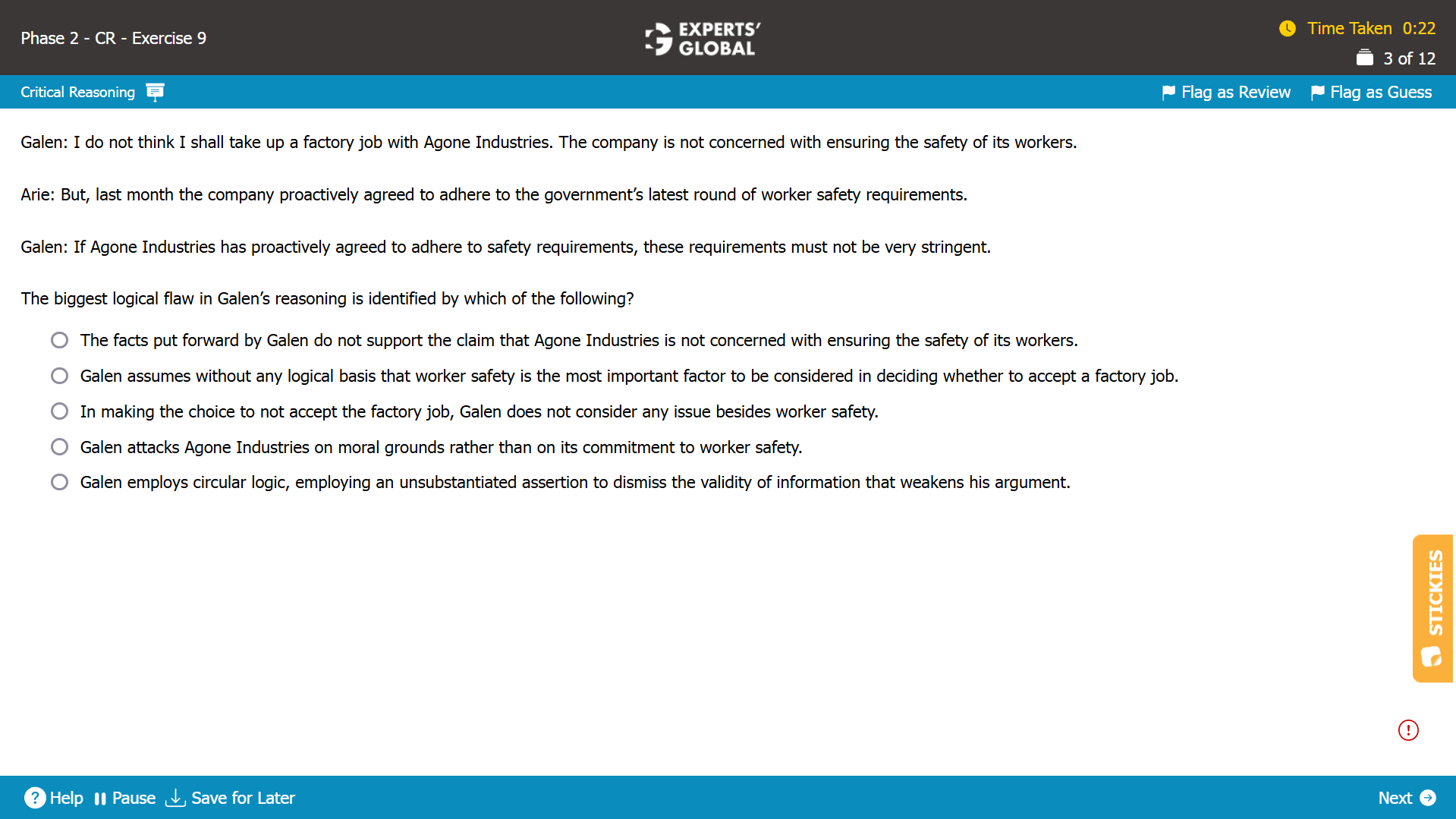
Mind-map: Galen: I will not work at Agone → Agone is not concerned with worker safety → Arie: Agone proactively adhered to new safety requirements → Galen: if so, the requirements must not be stringent (conclusion)
Missing-link: Not needed
Expectation from the correct answer choice: Something on the lines of Galen ignoring Arie’s evidence and doubting the stringency of the new safety requirements simply because Arie’s evidence differs from his judgment
A. Galen does not present any factual information to support his judgment that Agone Industries is not concerned with worker safety or to support his conclusion that the new safety requirements must not be stringent; so, it is incorrect to state that the flaw in Galen’s argument is that the facts put forward by Galen do not support his claim, as the answer choice mentions. Furthermore, the flaw in Galen’s reasoning is that Galen ignores Arie’s evidence and doubts the stringency of the new safety requirements simply because Arie’s evidence differs from his judgment; we need an answer choice on similar lines. Because this answer choice does not identify the biggest logical flaw in Galen’s reasoning, this answer choice is incorrect.
B. Galen’s decision to not work at Agone Industries is entirely based on Galen’s views about worker safety at the company; so, it is likely that Galen believes that worker safety is the most important factor to be considered in deciding whether to accept a factory job; Galen offers no support to his belief; so, the belief can be considered an assumption without any logical basis; however, such an assumption is not the flaw in Galen’s reasoning; the flaw in Galen’s reasoning is that Galen ignores Arie’s evidence and doubts the stringency of the new safety requirements simply because Arie’s evidence differs from his judgment; we need an answer choice on similar lines. Because this answer choice does not identify the biggest logical flaw in Galen’s reasoning, this answer choice is incorrect.
C. Although Galen’s decision to not work at Agone Industries is entirely based on Galen’s views about worker safety at the company, this factor in Galen’s decision is not the flaw in Galen’s reasoning; the flaw in Galen’s reasoning is that Galen ignores Arie’s evidence and doubts the stringency of the new safety requirements simply because Arie’s evidence differs from his judgment; we need an answer choice on similar lines. Because this answer choice does not identify the biggest logical flaw in Galen’s reasoning, this answer choice is incorrect.
D. Galen makes no suggestion about the moral nature of Agone Industries; so, it is incorrect to state that the flaw in Galen’s reasoning is that Galen attacks Agone Industries on moral grounds rather than on its commitment to worker safety, as the answer choice mentions. Furthermore, the flaw in Galen’s reasoning is that Galen ignores Arie’s evidence and doubts the stringency of the new safety requirements simply because Arie’s evidence differs from his judgment; we need an answer choice on similar lines. Because this answer choice does not identify the biggest logical flaw in Galen’s reasoning, this answer choice is incorrect.
E.Correct.Galen questions the worker safety at Agone Industries; upon Arie’s comment that the company proactively adhered to new safety requirements, Galen ignores this evidence and doubts the stringency of the new safety requirements simply because Arie’s evidence differs from his judgment; Galenoffers no support for his judgments about worker safety at Agone Industries or the stringency of the new safety requirements and thus, tries to prove a conclusion by stating/assuming that it is true; in other words, the biggest flaw in Galen’s reasoning is that Galen employs circular logic, employing an unsubstantiated assertion to dismiss the validity of the information that weakens his argument, as the answer choice mentions. Because this answer choice identifies the biggest logical flaw in Galen’s reasoning, this answer choice is correct.
E is the best choice.
How and Where to Practice GMAT CR Dialogue Questions
Real practice for CR Dialogue questions begins when you solve them on a software simulation that closely matches the official GMAT interface. You need a platform that presents the argument with its Dialogue portions and the question stem in a GMAT like layout, lets you work with the roles of the bold statements and the answer choices naturally, and provides all the on screen tools and functionalities that you will see on the actual exam. Without this kind of experience, it is difficult to feel fully prepared for test day. High quality CR Dialogue questions are not available in large numbers. Among the limited, genuinely strong sources are the official practice materials released by GMAC and the Experts’ Global GMAT course.
Within the Experts’ Global GMAT online preparation course, every CR Dialogue question appears on an exact GMAT like user interface that includes all the real exam tools and features. You work through more than 30 CR Dialogue questions in quizzes and also take 15 full-length GMAT mock tests that include several CR Dialogue questions in roughly the same spread and proportion in which they appear on the actual GMAT.
All the best!