CR Assumption questions ask you to identify the unstated idea that must be true for the given argument to work, helping you see the hidden link between the premise and the conclusion. Learning to spot these silent supports builds sharp, confident logical thinking. Careful practice with this question type is an essential part of any thorough GMAT preparation course. This page offers you an organized subtopic wise playlist, along with a few worked examples, for efficient preparation of this concept.
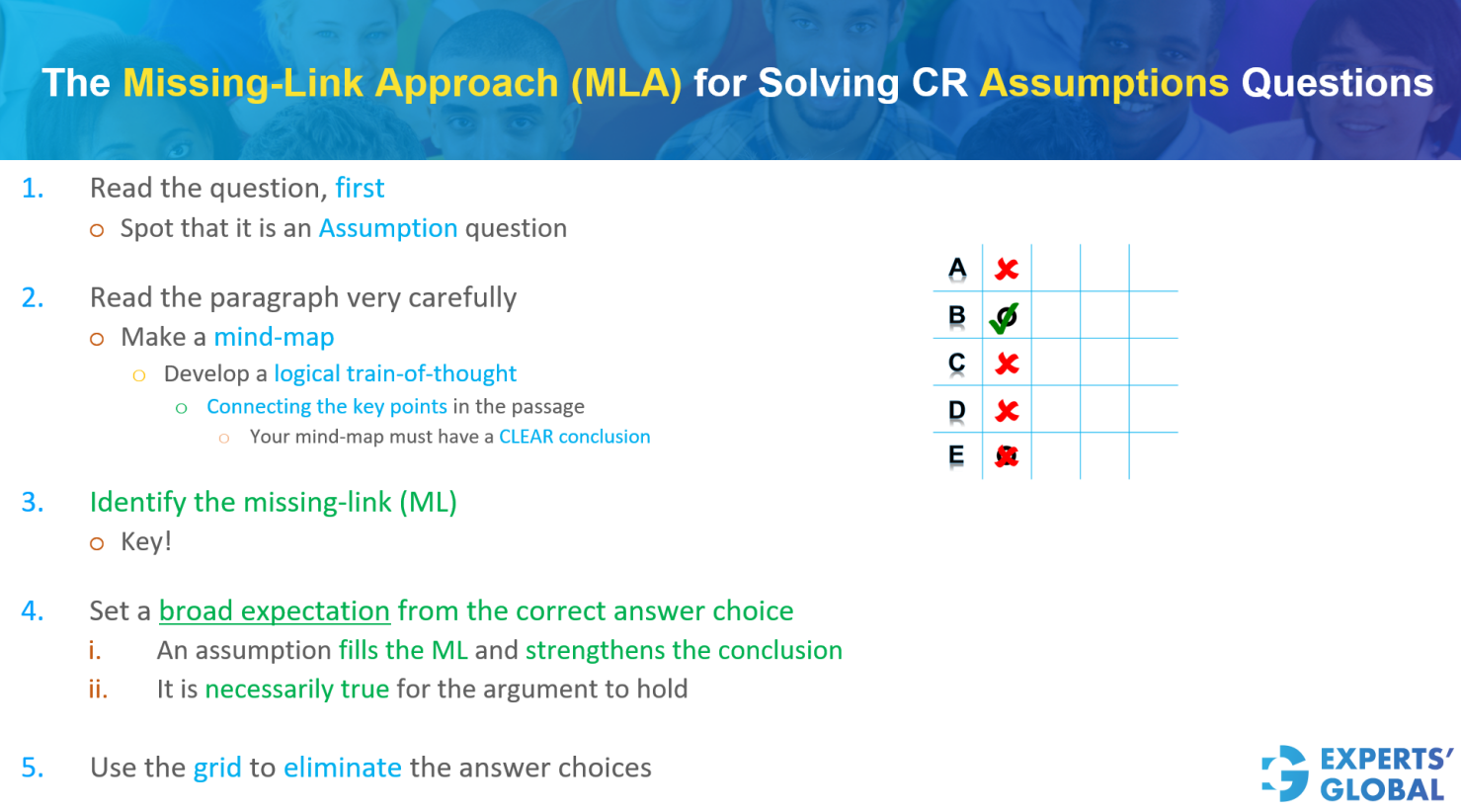
Approach for Assumption Questions in GMAT CR
GMAT critical reasoning assumption questions present a passage with a premise, a conclusion, and a clear gap (the missing-link) between the two. The correct assumption is a statement that fills this missing-link, thereby strengthening the conclusion; besides, a correct assumption statement is one that must be true for the argument to hold. This overview explains how to spot assumption by testing for sufficiency as well as necessity: an assumption statement strengthens the argument but if the statement is denied, the argument falls apart. The short video that follows explains the method, applies it to examples, and prepares you to use it in GMAT drills, sectional tests, and full-length GMAT mock tests.

GMAT CR: Approach for Assumption Questions
Strengthening vs Assumption
Strengthen statements and assumption both serve to link premises with conclusions, but they differ sharply in how essential they are. A strengthening statement increases the persuasive power of the argument, while an assumption is non-negotiable; remove it, and the reasoning falls apart. This overview explains how to tell the two apart, using clear examples that focus on the idea of necessity. Grasping this distinction sharpens accuracy in GMAT preparation and nurtures more refined evaluation skills that carry directly into the business management journey. The short video below offers a focused look at this idea and illustrates how the GMAT may test it.
GMAT CR: Strengthening vs Assumption
Assumption Negation Test
Explore the Assumption Negation Test, a sharp and reliable method for identifying necessary assumption in Critical Reasoning. First, single out a possible assumption, then imagine its opposite, and check whether the conclusion still holds; if the argument collapses, the assumption is essential. The video introduces this technique and explains when to use it as a tiebreaker among close answer choices. Viewing questions through this lens deepens structured analysis during GMAT preparation and nurtures rigorous argument evaluation skills valuable in a career in business management. The following short video makes this concept feel familiar and shows how it can be applied on the GMAT.
GMAT CR: Assumption Negation Test
GMAT-style CR Assumption Questions with Explanations
This section presents a practice set of GMAT-style Critical Reasoning Assumption questions, each accompanied by a careful, stepwise explanation. Work through every argument slowly and apply the approach and concepts you have just studied on this page for identifying and evaluating assumption on the GMAT. At this stage, concentrate more on using the reasoning framework correctly than on simply selecting the option that appears right. Once you have committed to an answer, open the explanation panel to view the correct choice and to read the full descriptive reasoning behind it.
Question 1
Written Explanation
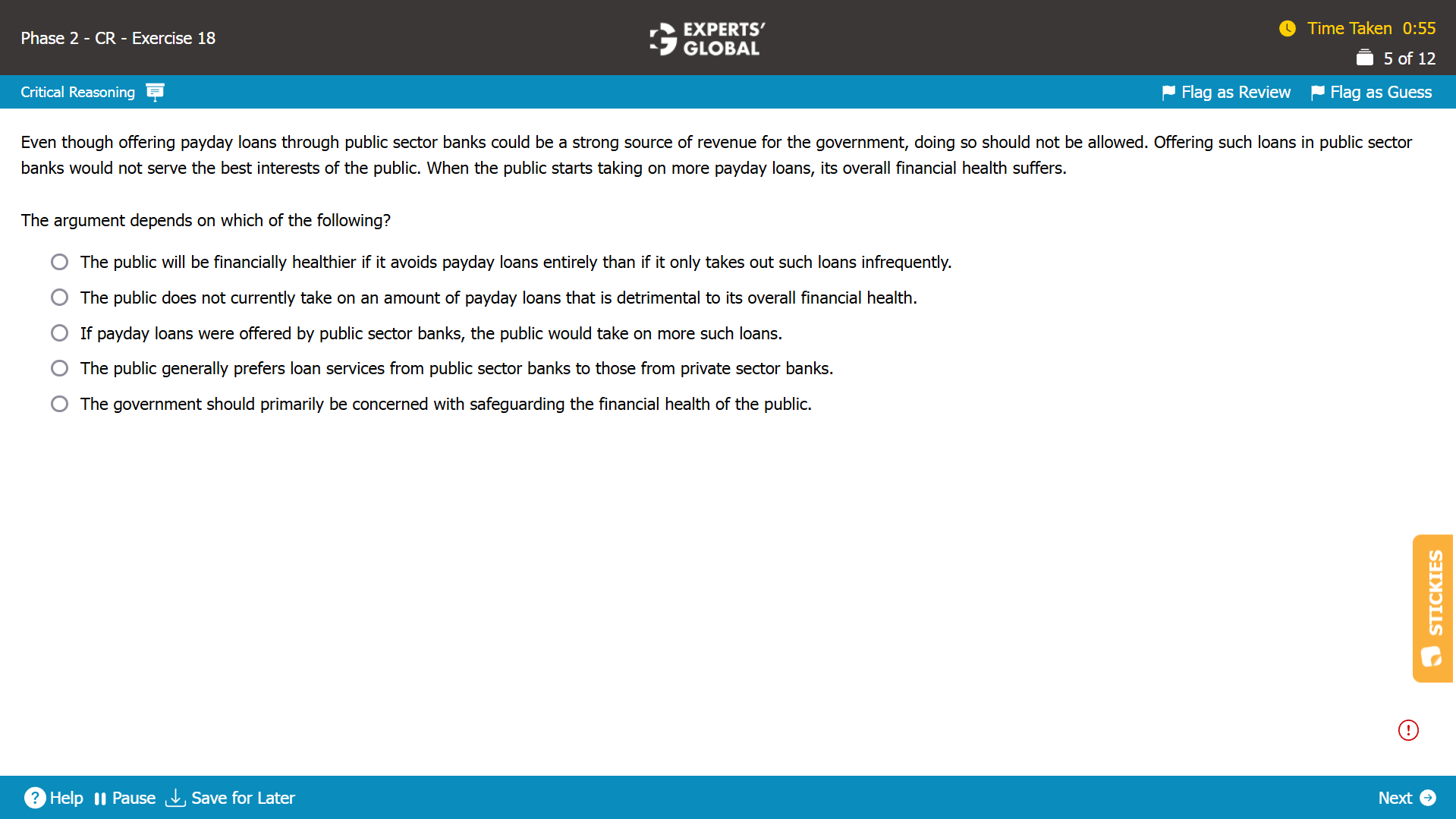
Mind-map: Payday loans through public sector banks bring revenue to government → loans not in public’s interest → when public takes more payday loans, its financial health suffers → payday loans by public sector banks should not be allowed (conclusion)
Missing-link: Between all the information presented and the conclusion that payday loans by public sector banks should not be allowed
Expectation from the correct answer choice: To strengthen the conclusion that payday loans by public sector banks should not be allowed, through a valid assumption
A. This answer choice, suggesting that avoiding payday loans entirely leads to better financial health than taking payday loans occasionally, establishes a relationship between taking payday loans and poor financial health, thus strengthening the conclusion. However, despite being a fine “strengthening statement”, this answer choice doesn’t qualify as a valid “assumption” because it doesn’t have to be true for the conclusion to hold; it is possible that occasional payday loans do not have any impact on the public’s financial health but, beyond a proportion, such loans are detrimental and should not be allowed; please remember, a valid assumption “must be necessarily true” for the argument to hold. Because this answer choice does not strengthen the conclusion through a valid assumption, this answer choice is incorrect.
B. This answer choice, suggesting that currently the amount of payday loans taken by the public is not detrimental to the public’s financial health, indicates that the public’s financial health is currently not likely to suffer; however, this answer choice does not rule out the possibility of the amount increasing in the future and posing a risk to the public’s financial health; overall, this answer choice, if anything, faintly weakens, rather than strengthens, the conclusion that payday loans by public sector banks should not be allowed. Because this answer choice does not strengthen the conclusion through a valid assumption, this answer choice is incorrect.
C. Correct. The argument mentions that when the public takes more payday loans, its financial health suffers; so, by suggesting that the public would take more payday loans if such loans are offered by public sector banks, this answer choice indicates that the public’s financial health is likely to suffer, thus strengthening the conclusion that payday loans by public sector banks should not be allowed. Additionally, this statement does have to be true for the conclusion to hold; negating this statement would mean that “the public would not take more payday loans if such loans are offered by public sector banks”, thus casting doubt on the necessity to not allow such loans by public sector banks and negating the conclusion. Because this answer choice strengthens the conclusion through a valid assumption, this answer choice is correct.
D. Trap. This answer choice, suggesting that the people looking for payday loans prefer public sector banks to private sector banks, indicates that not allowing payday loans by public sector banks may help to effectively control the number of such loans, thus emphasizing the importance of not allowing payday loans by public sector banks and marginally strengthening the conclusion. However, despite being a mild “strengthening statement”, this answer choice doesn’t qualify as a valid “assumption” because it doesn’t have to be true for the conclusion to hold; it is possible that payday loans offered by public sector banks may lead to poor financial health even if people looking for such loans have no preference towards public sector banks; please remember, a valid assumption “must be necessarily true” for the argument to hold. Because this answer choice does not strengthen the conclusion through a valid assumption, this answer choice is incorrect.
E. This answer choice, suggesting that the public’s financial health is the government’s primary concern, emphasizes the importance of not allowing payday loans by public sector banks, thus strengthening the conclusion. However, despite being a fine “strengthening statement”, this answer choice doesn’t qualify as a valid “assumption” because it doesn’t have to be true for the conclusion to hold; the conclusion that payday loans by public sector banks should not be allowed would still hold even if the government does not have primary but lesser (say, secondary) concern towards the public’s financial health; please remember, a valid assumption “must be necessarily true” for the argument to hold. Besides, please note, a hint here is in the term “primary concern”, which is too strong to be a valid assumption; one needs to be cautious of such answer choices as they are generally incorrect on the GMAT. Because this answer choice does not strengthen the conclusion through a valid assumption, this answer choice is incorrect.
C is the best choice.
Question 2
Written Explanation
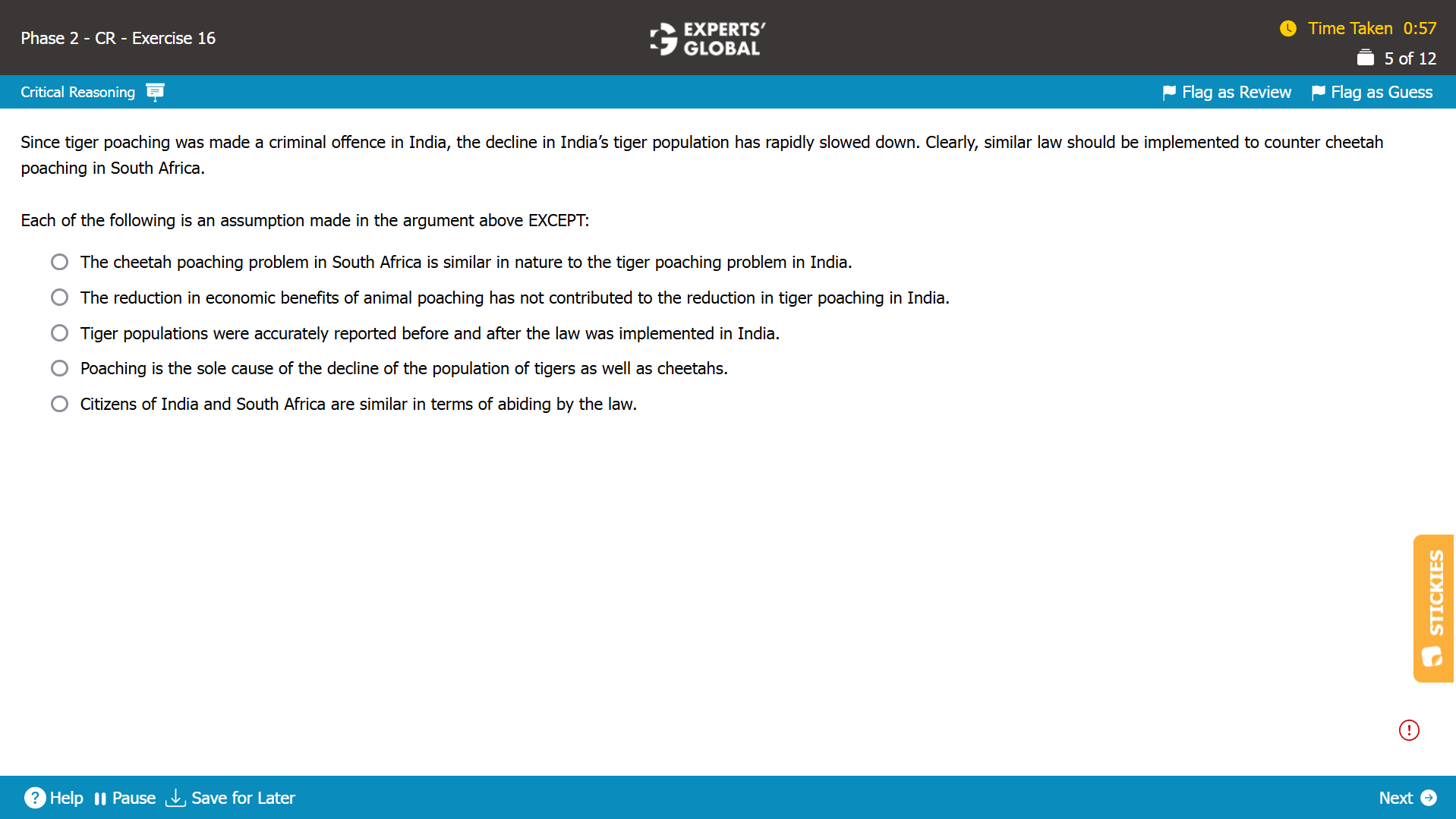
Mind-map: Tiger poaching made a criminal offence in India → decline in tiger population slowed down → cheetah poaching should be made a criminal offence in South Africa (conclusion)
Missing-link: Between decline in tiger population slowing down after tiger poaching was made a criminal offence in India and the conclusion that cheetah poaching should be made a criminal offence in South Africa
Expectation from the correct answer choice: To NOT strengthen the conclusion that cheetah poaching should be made a criminal offence in South Africa, through a valid assumption
Note: This question tests the classic GMAT error of generalization – the idea of reaching a conclusion for a superset on the basis of observations on a subset, or reaching a conclusion based on evidence that is too small. The argument cites the particular case in India in which the decline in tiger population slowed down after tiger poaching was made a criminal offence; on the basis of one particular case, the argument generalizes that poaching is effective. Further, without drawing any analogy between the decline in tiger population in India and the decline in cheetah population in South Africa, the argument concludes that poaching should be made a criminal offence in South Africa in order to combat the decline in cheetah population in the country.
A. This answer choice, suggesting the similarity between the problems of tiger poaching in India and cheetah poaching in South Africa, indicates that an effective solution for one problem may be an effective solution for another, thus strengthening the conclusion. Additionally, this statement does have to be true for the conclusion to hold; negating this statement would mean that “the two problems are not similar in nature”, thus indicating that making cheetah poaching a criminal offence in South Africa may not lead to the decline in cheetah population slowing down; such a suggestion negates the conclusion. Because this answer choice strengthens the conclusion through a valid assumption, this answer choice is incorrect.
B. Trap. This answer choice, suggesting that the reduction in economic benefits was not responsible for the reduction in poaching, eliminates the possibility that the reduction in economic benefits, rather than the law, slowed the decline of the tiger population; so, this answer choice indicates the efficacy of the law and strengthens the conclusion. Additionally, this statement does have to be true for the conclusion to hold; negating this statement would mean that “the reduction in economic benefits was responsible for the reduction in poaching”, thus indicating the possibility that the reduction in economic benefits, rather than the law, slowed the decline of the tiger population; such a possibility casts doubt on the efficacy of the law and the conclusion. Because this answer choice strengthens the conclusion through a valid assumption, this answer choice is incorrect.
C. This answer choice, suggesting accuracy in the reporting of tiger population between and after the law was introduced, adds credibility to the claim that decline in tiger population slowed down; so, this answer choice indicates the efficacy of the law and strengthens the conclusion. Additionally, this statement does have to be true for the conclusion to hold; negating this statement would mean that “tiger populations were not accurately reported”, thus casting doubt on the efficacy of the law and indicating that making cheetah poaching a criminal offence in South Africa may not lead to a decline in cheetah population slowing down; such a suggestion negates the conclusion. Because this answer choice strengthens the conclusion through a valid assumption, this answer choice is incorrect.
D. Correct. This answer choice, suggesting that poaching is the sole cause of the decline of both tigers and cheetahs, indicates that the law that stops poaching likely causes the decline in animal population to slow down, thus strengthening the conclusion that cheetah poaching should be made a criminal offence in South Africa. However, despite being a fine “strengthening statement”, this answer choice doesn’t qualify as a valid “assumption” because it doesn’t have to be true for the conclusion to hold; even if poaching is just a “significant” cause, and not the “sole” cause, of the decline of both tiger and cheetah population, the conclusion will still hold; please remember, a valid assumption “must be necessarily true” for the argument to hold. Because this answer choice does not strengthen the conclusion through a valid assumption, this answer choice is correct.
E. This answer choice, suggesting the similarity in the law-abiding behavior of the citizens of India and South Africa, indicates that the citizens of South Africa are as likely to respond to the law as the citizens of India were, thus increasing the likelihood that the law may be equally effective in South Africa and strengthening the conclusion. Additionally, this statement does have to be true for the conclusion to hold; negating this statement would mean that “the citizens of India and South Africa respond to laws differently”, thus indicating that the law may not be followed in South Africa as it was in India; such a possibility raises concern over whether the law will be effective in South Africa, casting doubt on the conclusion. Because this answer choice strengthens the conclusion through a valid assumption, this answer choice is incorrect.
D is the best choice.
Facing difficulty with such problems? Click here
Question 3
Written Explanation
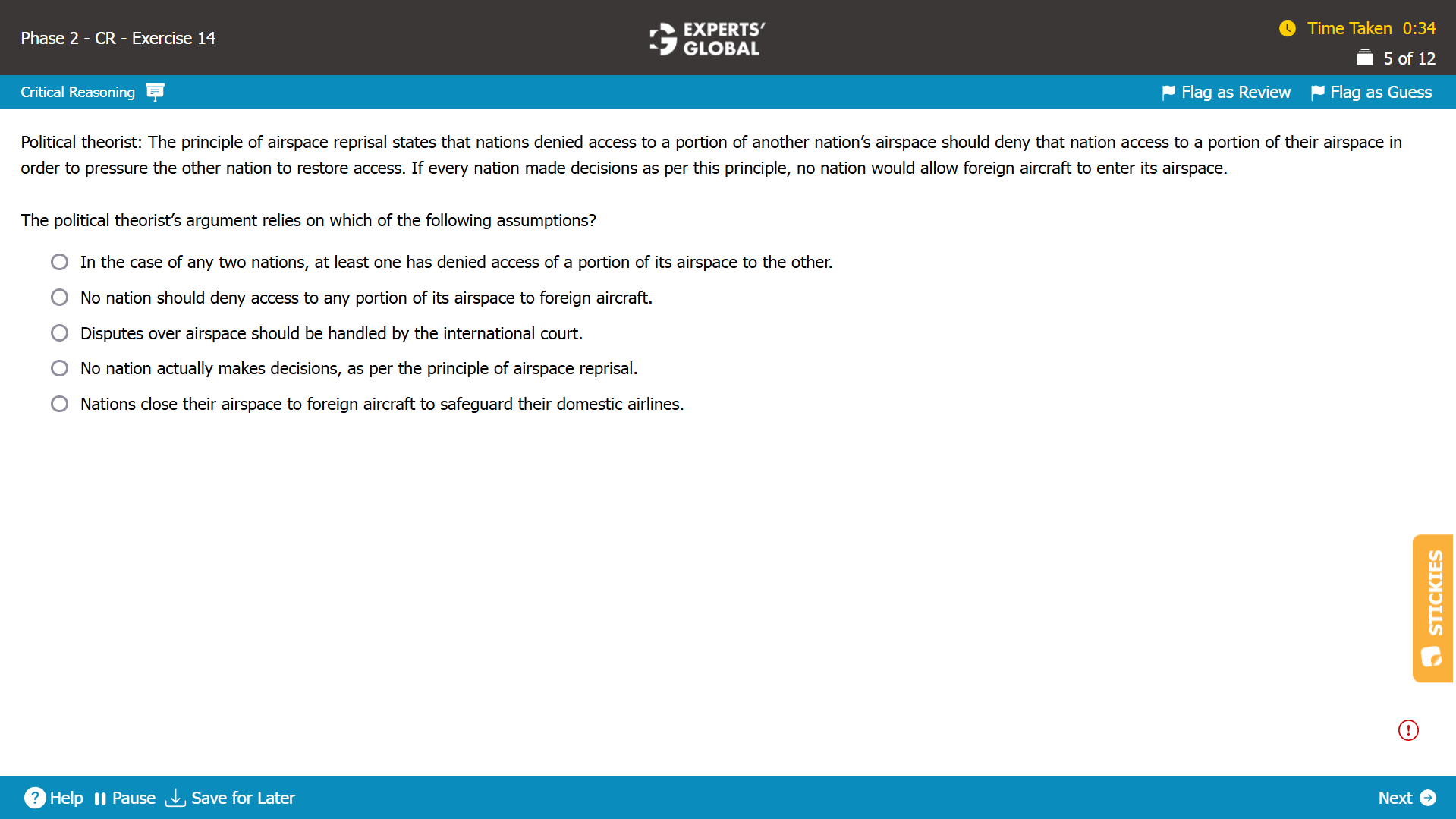
Mind-map: Nation A denies some airspace access to nat → nation B retaliates by same approach → if every nation acts as per the principle of airspace reprisal → no nation would allow foreign aircraft to enter its airspace (conclusion)
Missing-link: Between every nation acting as per the principle of airspace reprisal and the conclusion that no nation would allow foreign aircraft to enter its airspace
Expectation from the correct answer choice: To strengthen the conclusion that no nation would allow foreign aircraft to enter its airspace, through a valid assumption
A. Correct. The idea that “in the case of any two nations, at least one has denied access of a portion of its airspace to the other” is connected to the premise “every nation acts as per the principle of airspace reprisal”, it suggests that there is denial of airspace access and retaliation between every two nations, and strengthens the conclusion that “no nation would allow foreign aircraft to enter its airspace”. Additionally, this statement does have to be true for the conclusion to hold; negating this statement would mean that “at least for some pair of nations, neither nation has denied access of a portion of its airspace to the other”; this suggestion would mean that there is no denial of airspace access between those pairs of nations, and thus, negate the conclusion that no nation would allow foreign aircraft to enter its airspace. Because this answer choice strengthens the conclusion through a valid assumption, this answer choice is correct.
B. This answer choice simply quotes an opinion, which, although relevant to the broad context of the argument, has no bearing on the argument or its conclusion. Additionally, “should” indicates a suggesting/recommending/patronizing tone; one needs to be cautious of such answer choices as they are generally incorrect on the GMAT. Besides, this condition is not necessary for the argument to hold and thus, is not a valid assumption. Because this answer choice does not strengthen the conclusion through a valid assumption, this answer choice is incorrect.
C. The argument is concerned with the effect of the retaliation by nations and not with the settlement of the disputes between nations; thus, this answer choice is out of the scope of the argument and its conclusion. Additionally, “should” indicates a suggesting/recommending/patronizing tone; one needs to be cautious of such answer choices as they are generally incorrect on the GMAT. Besides, this condition is not necessary for the argument to hold and thus, is not a valid assumption. Because this answer choice does not strengthen the conclusion through a valid assumption, this answer choice is incorrect.
D. Trap. The conclusion is valid under the condition that “every nation acts as per the principle of airspace reprisal”; so, the idea that “no nation actually makes decisions, as per the principle of airspace reprisal” is irrelevant to the argument and its conclusion. Besides, this condition is not necessary for the argument to hold and thus, is not a valid assumption. Because this answer choice does not strengthen the conclusion through a valid assumption, this answer choice is incorrect.
E. The argument is concerned with the effect of the denial of airspace by nations and not with the reason for the denial of airspace between nations; thus, this answer choice is out of the scope of the argument and its conclusion. Besides, this condition is not necessary for the argument to hold and thus, is not a valid assumption. Because this answer choice does not strengthen the conclusion through a valid assumption, this answer choice is incorrect.
A is the best choice.
How and Where to Practice GMAT CR Assumption Questions
High quality CR Assumption questions are not available in large numbers. Among the limited, genuinely strong sources are the official practice materials released by GMAC and the Experts’ Global GMAT course. Within the Experts’ Global GMAT online preparation course, every CR Assumption question appears on an exact GMAT like user interface that includes all the real exam tools and features. You work through more than 50 CR Assumption questions in quizzes and also take 15 full-length GMAT mock tests that include several CR Assumption questions in roughly the same spread and proportion in which they appear on the actual GMAT.
All the best!