Multi Source Reasoning questions ask you to work with information drawn from multiple tabs, such as short passages, charts, tables, or statements, and then combine these pieces to answer carefully framed questions. These questions help you practice switching between sources, comparing details, and drawing sound conclusions from blended information. On the GMAT, you may see one or two Multi Source Reasoning sets, with three questions in each set. This means that either three or six of the twenty questions in the GMAT Data Insights section will be multi source reasoning. Most of these questions require multiple answer responses, and your attempt is considered correct only when every selected response is correct. There are no partial credits. Therefore, strong comfort with this question type is an essential part of any comprehensive GMAT preparation course. This page provides you an organized subtopic wise playlist, along with a few worked examples, for efficient preparation of this concept.
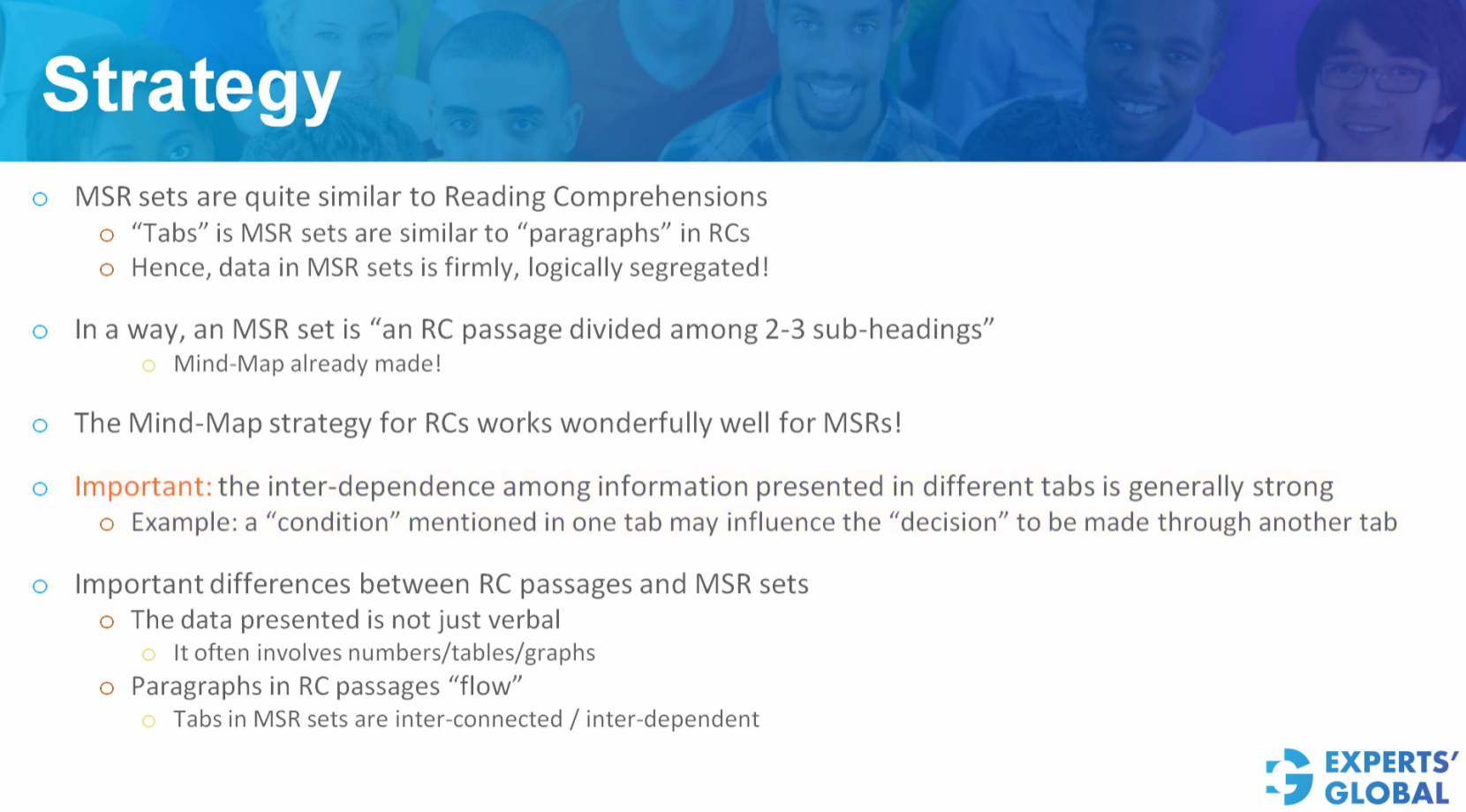
Multi-Source Reasoning challenges your ability to collect, connect, and evaluate information across two or three tabs. Imagine a Reading Comprehension passage, but split up for you. The real test isn’t how long it is, but how the information relies on each other. It’s about seeing the bigger picture. The following short video guides you through a clear, structured approach for solving MSR questions on the GMAT. It shows how to follow each step steadily and calmly, even under real exam conditions and strict time limits.

Approach for GMAT Multi-Source Reasoning Questions
GMAT-style Multi-Source Reasoning Sets with Explanations
Please find below, two truly GMAT-style Multi-Source Reasoning sets. In each set, the three images together present the complete case: in each image, the left half shows one of the three information tabs, and the right half shows the corresponding question that you need to answer using the given information. For these three questions, you may need to synthesize data from across all three tabs, so read every tab carefully before committing to your answers. Take your time and deliberately apply the recently learned strategy from earlier on this page while attempting this MSR set. The goal here is not to work quickly but to practise the method, think calmly, and give each of the three questions your best effort. At this stage, do not worry about timing; focus instead on using the approach correctly and aiming to get all three questions right. Once you have attempted all three questions, toggle the explanation buttons to review the detailed solutions, confirm your reasoning, and consolidate your learning. Make full and thoughtful use of this rich preparation resource. Happy practicing and learning!
MSR Practice Set 1 with Explanations
Tab 1 + Question 1
Tab 2 + Question 2
Tab 1 + Question 3
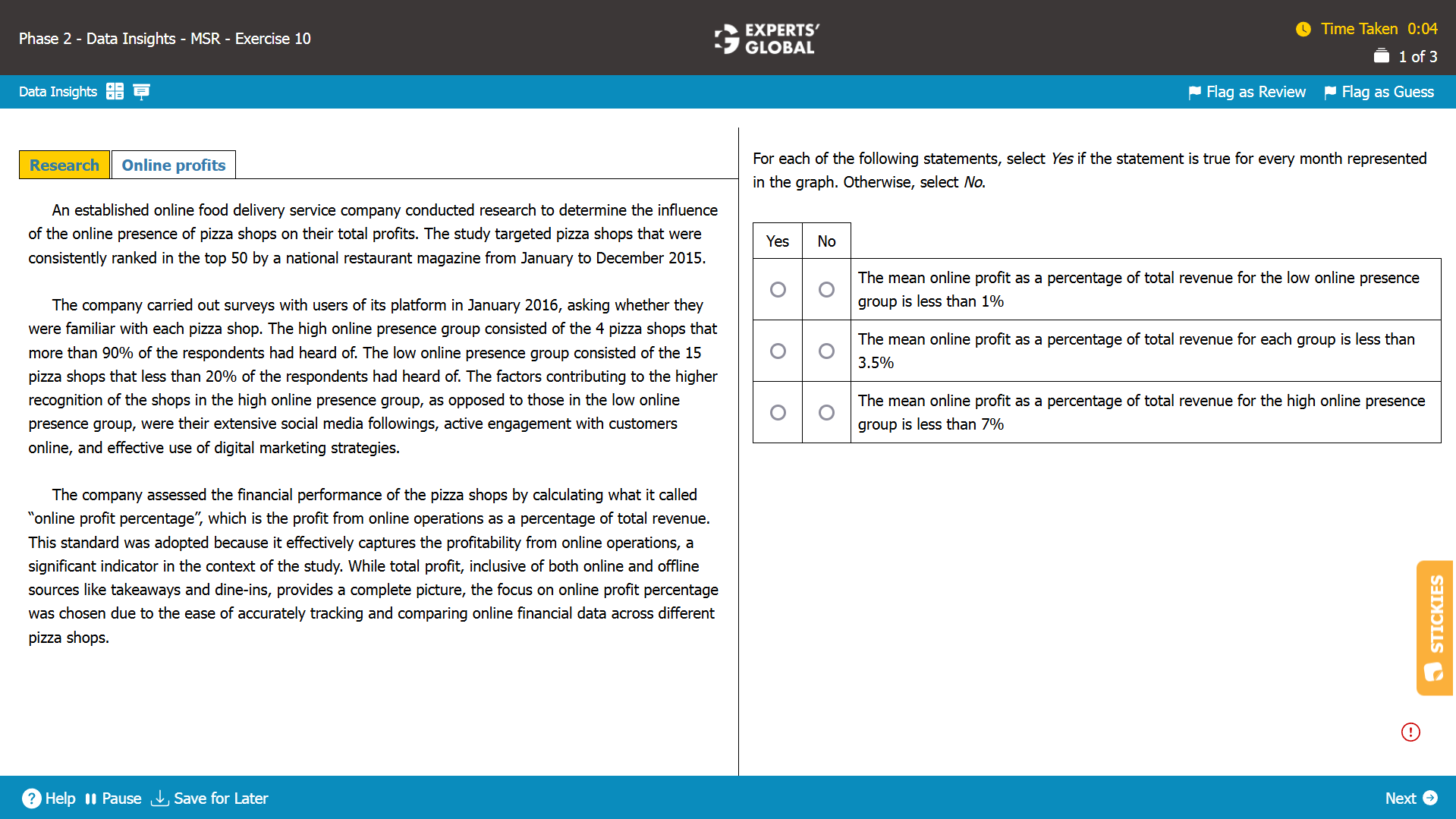
I. From the graph, we see that the mean online profit as a percentage of the total revenue for the low online presence group is between 1% to 3% for every month represented in the graph.Thus, “No” is the correct answer choice.
II. From the graph, we see that the mean online profit as a percentage of the total revenue for the high online presence group is between 4% to 6% for every month represented in the graph. Therefore, this statement is true only for the low online presence group. Thus, “No” is the correct answer choice.
III. From the graph, we see that the mean online profit as a percentage of the total revenue for the high online presence group is between 4% to 6% for every month represented in the graph. Thus, “Yes” is the correct answer choice.
Hence, No-No-Yes is the correct combination of answer choices.
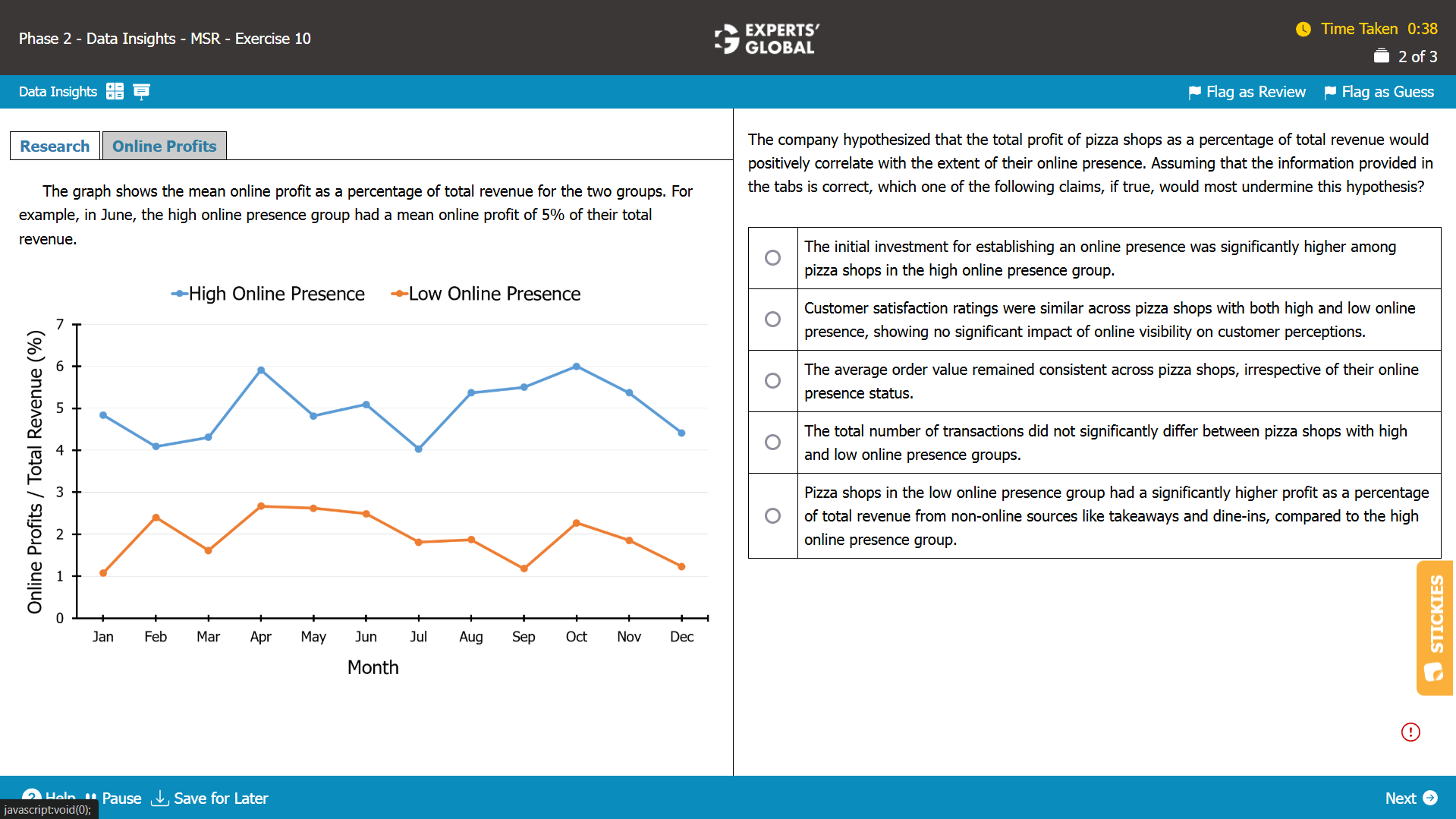
A.
This statement focuses on the initial investment, rather than directly addressing the relationship between online presence and total profit as a percentage of total revenue.
It does not undermine the hypothesis that online presence correlates with total profit margins.
Thus, this answer choice is incorrect.
B.
This statement indicates that online presence does not significantly affect customer satisfaction, which is not directly related to the hypothesis about online presence influencing total profit margins.
It does not provide evidence against the notion that a stronger online presence could correlate with higher profits, as customer satisfaction is not explicitly linked to profitability in the hypothesis.
Thus, this answer choice is incorrect.
C.
The consistency in average order value across different levels of online presence does not directly challenge the hypothesis that a greater online presence would lead to higher total profit percentages.
This statement is more about revenue per order than about the overall profitability or how online presence might influence it.
Thus, this answer choice is incorrect.
D.
This choice suggests that the volume of transactions is not directly related to the online presence, which does not undermine the correlation between online presence and higher online profit percentages.
It’s incorrect because it shifts the focus to transaction volume rather than the profitability or revenue impact highlighted by the graph.
Thus, this answer choice is incorrect.
E.
According to the hypothesis provided in the question stem, the company would expect the high online presence group to have a higher total profit as a percentage of total revenue.
From the “Research tab”, we know that the total profit for pizza shops includes earnings from both online and non-online sources, but the study only considers profits from online sources.
From the graph, we know that the profits from online operations are higher for the high-online presence group, however, the tabs do not provide any information about the profits from non-online sources.
If the low online presence group had significantly higher profits from non-online sources, then this could potentially offset the lower profits from online sources and result in having a higher total profit as a percentage of total revenue.
Therefore, if this statement is true the direct correlation between online presence and total profit (as a percentage of total revenue) becomes less clear or could even be negated.
Thus, this answer choice is correct.
Hence, E is the correct answer choice.
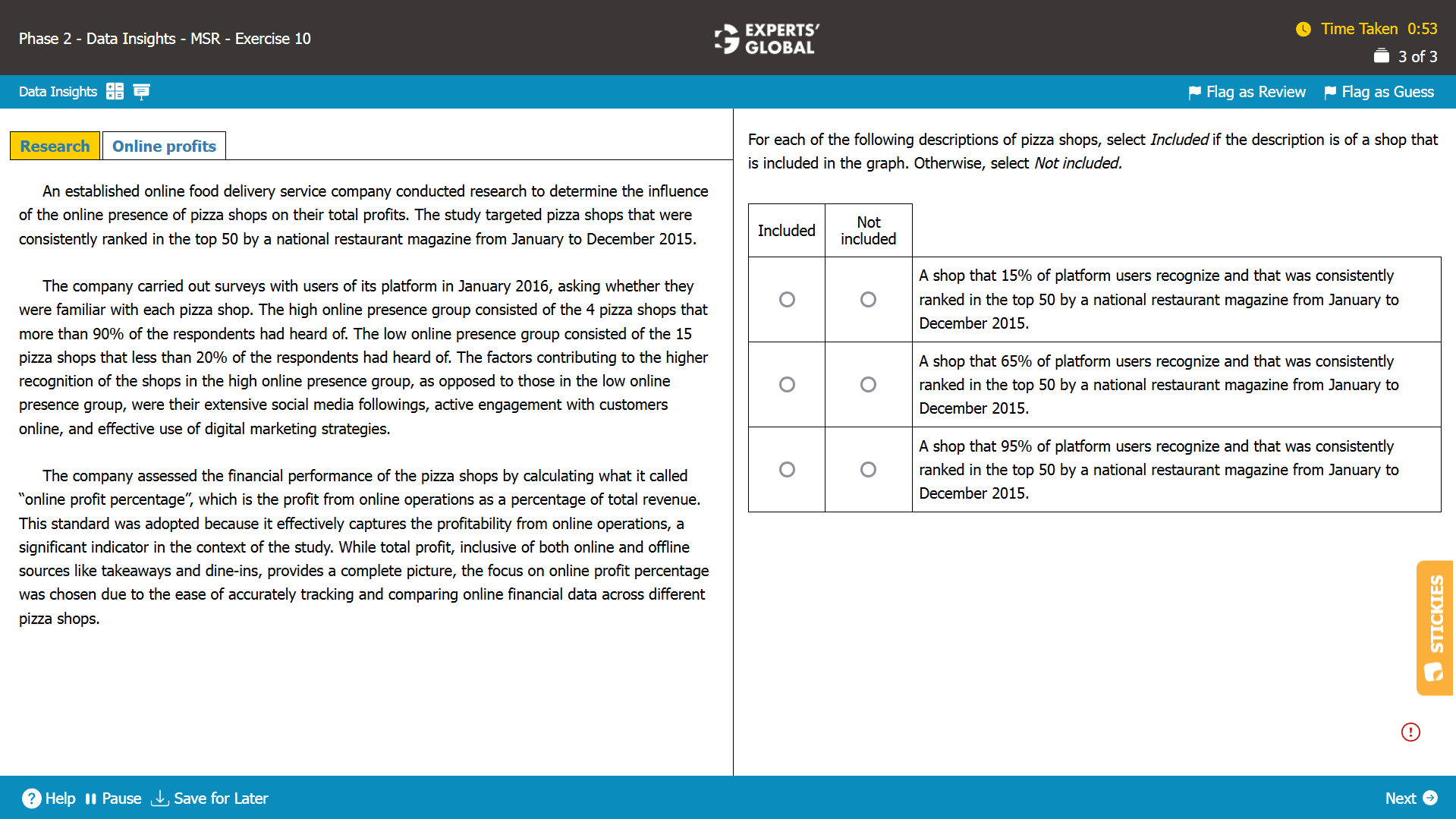
I.
From the “Research” tab, we know that the low online presence group in the graph comprised pizza shops that were recognized by less than 20% of the platform users and were consistently ranked in the top 50 by a national restaurant magazine.
Thus, “Included” is the correct answer choice.
II.
From the “Research” tab, we know that the graph includes only pizza shops recognized by less than 20% of platform users (low online presence group) and by more than 90% of platform users (high online presence group).
Thus, “Not Included” is the correct answer choice.
III.
From the “Research” tab, we know that the high online presence group in the graph comprised pizza shops that were recognized by more than 90% of the platform users and were consistently ranked in the top 50 by a national restaurant magazine.
Thus, “Included” is the correct answer choice.
Hence, Included-Not Included-Included is the correct combination of answer choices.
MSR Practice Set 2 with Explanations
Tab 1 + Question 1
Tab 2 + Question 2
Tab 3 + Question 3
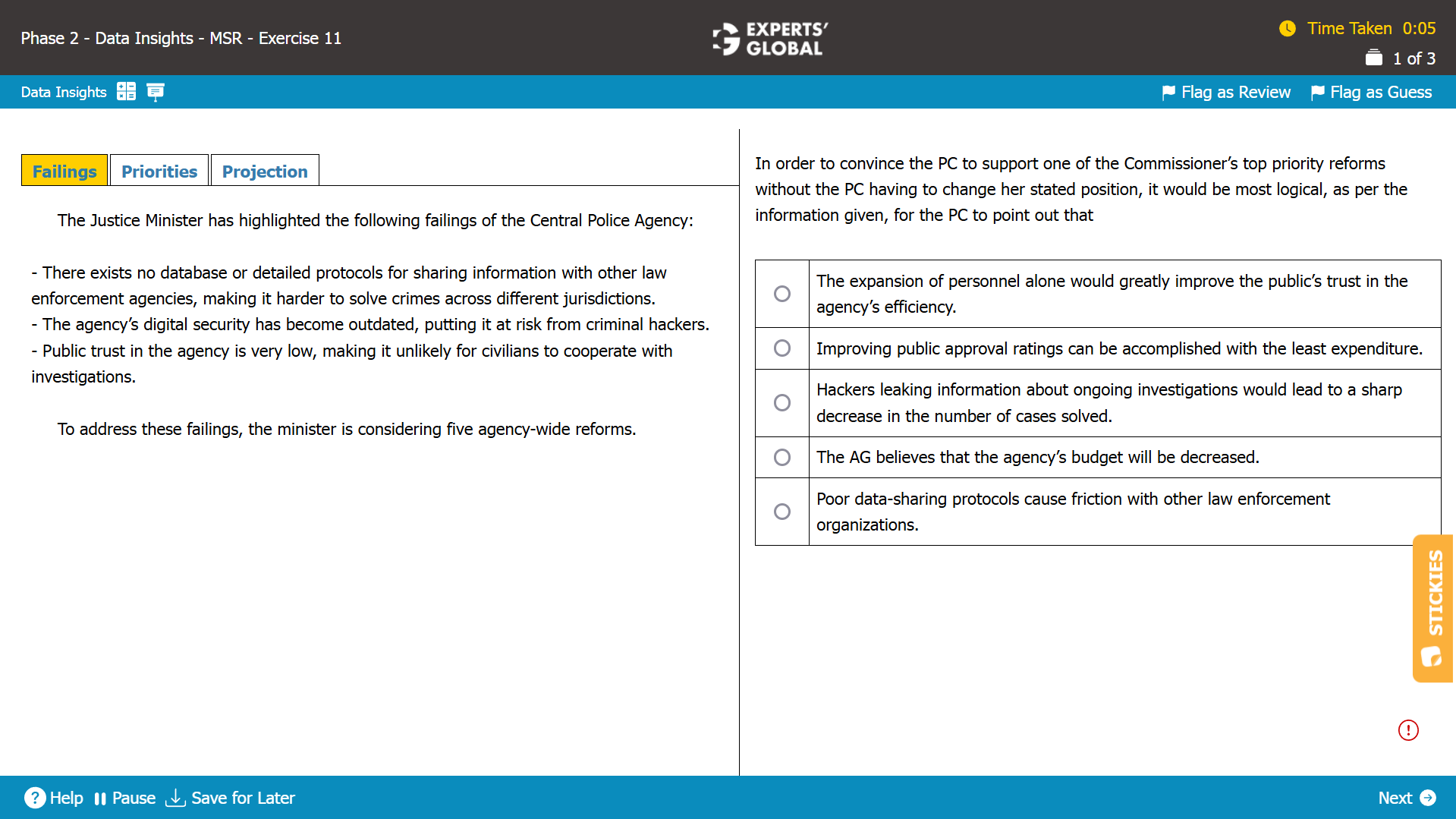
From the “Priorities” tab, we know that the Commissioner prioritizes reforms whose non-implementation would lead to a greater decrease in the number of solved cases.
From the table, we see that improvement in digital security would lead to the greatest decrease in the number of solved cases from non-implementation.
Thus, it follows that the Commissioner prioritizes improvement in digital security.
From the “Priorities” tab, we also know that the Police Chief (PC) prioritizes reforms that will lead to an increase in the percentage of cases closed.
A.
This answer choice focuses on the public’s trust and agency efficiency through personnel expansion, which does not directly relate to digital security improvements or the specific goal of increasing the percentage of cases closed.
Thus, this answer choice is incorrect.
B.
This answer choice emphasizes cost-efficiency in improving public approval ratings, which does not directly relate to digital security improvements or the specific goal of increasing the percentage of cases closed.
Thus, this answer choice is incorrect.
C.
This answer choice directly relates to digital security since hackers leaking information is a digital security issue.
It also connects to the PC’s priority by highlighting that a breach in digital security (through information leaks) would decrease the number of cases solved.
Therefore, improving digital security would logically aim to prevent such leaks, aligning with the PC’s goal of increasing the percentage of cases closed without requiring a change in stance.
Thus, this answer choice is correct.
D.
This answer choice is about budget expectations and does not directly relate to digital security improvements or the specific goal of increasing the percentage of cases closed.
Thus, this answer choice is incorrect.
E.
While this answer choice touches upon an issue that could affect case resolutions, it does not directly support the Commissioner’s top priority of enhancing digital security to prevent a decrease in solved cases, nor does it align with the PC’s focus on increasing the percentage of cases closed.
Thus, this answer choice is incorrect.
Hence, C is the correct answer choice.
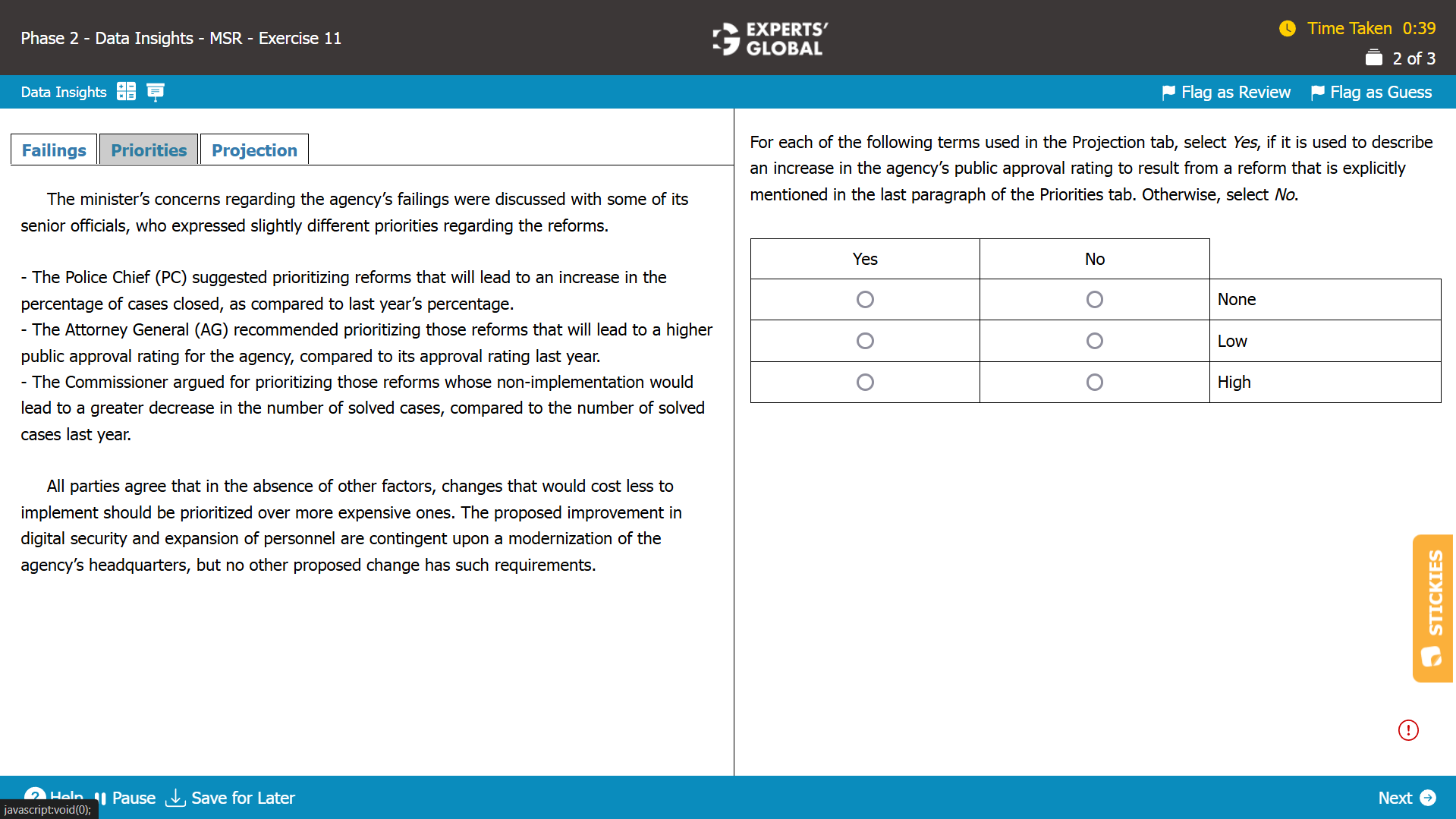
Improvement in digital security, expansion of personnel, and modernization of the agency’s headquarters are the reforms that are explicitly mentioned in the final paragraph of the Priorities tab.
I. From the table, we see that the term “None” is NOT used to describe an increase in the agency’s public approval rating to result from any of the reforms mentioned above. Thus, “No” is the correct answer choice.
II.From the table, we see that the term “Low” is used to describe an increase in the agency’s public approval rating to result from improvement in digital security.Thus, “Yes” is the correct answer choice.
III. From the table, we see that the term “High” is used to describe an increase in the agency’s public approval rating to result from the modernization of the agency’s headquarters .Thus, “Yes” is the correct answer choice.
Hence, No-Yes-Yes is the correct combination of answer choices.
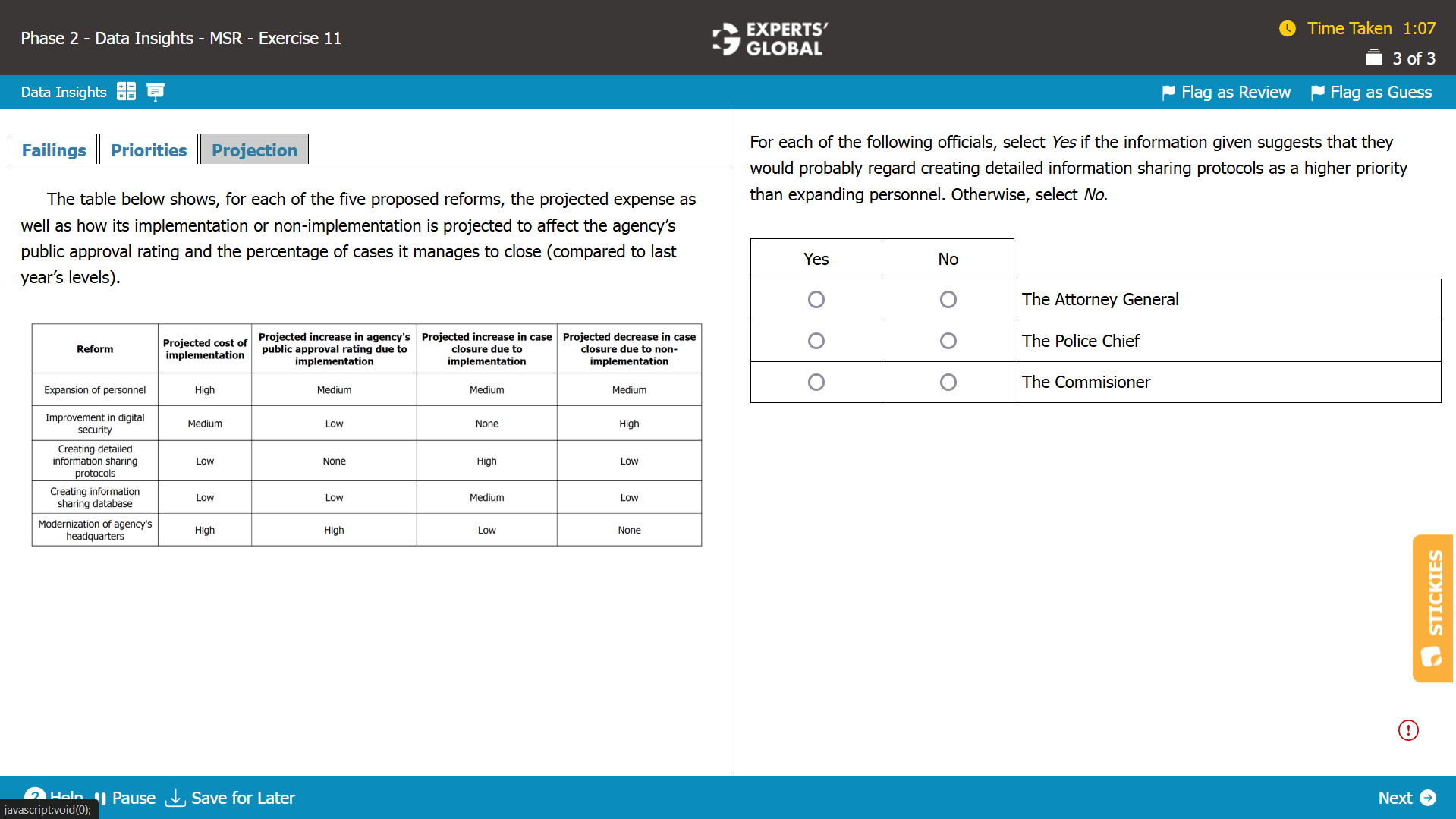
I. From the “Priorities” tab, we know that the Attorney General prioritizes reforms that will lead to a higher public approval rating for the agency. From the table, we see that the projected increase in public approval rating due to creating detailed information sharing protocols is “None”, whereas the projected increase in public approval rating from the expansion of personnel is “Medium”.Therefore, the Attorney General would probably NOT regard creating detailed information sharing protocols as a higher priority than expanding personnel. Thus, “No” is the correct answer choice.
II. From the “Priorities” tab, we know that the Police Chief prioritizes reforms that will lead to an increase in the percentage of cases closed.From the table, we see that the projected increase in case closure due to creating detailed information sharing protocols is “High”, whereas the projected increase in case closure from the expansion of personnel is “Medium”.Therefore, the Police Chief would probably regard creating detailed information sharing protocols as a higher priority than expanding personnel. Thus, “Yes” is the correct answer choice.
III. From the “Priorities” tab, we know that the Commissioner prioritizes reforms whose non-implementation would lead to a greater decrease in the number of solved cases.From the table, we see that the projected decrease in case closure due to non-implementation of creating detailed information sharing protocols is “Low”, whereas the projected decrease in case closure due to non-implementation of expansion of personnel is “Medium”.Therefore, the Police Chief would probably NOT regard creating detailed information sharing protocols as a higher priority than expanding personnel.Thus, “No” is the correct answer choice.
Hence, No-Yes-No is the correct combination of answer choices.
Additional Free GMAT-style Multi-Source Reasoning (MSR) Questions with Explanations:
Please find another set of GMAT-style MSR questions with explanations on: How to Solve GMAT Multi-Source Reasoning Questions
Please find another set of GMAT-style MSR questions with explanations on: Free GMAT Data Insights Prep
Please find 2 sets of GMAT-style MSR questions with explanations on: Free GMAT Multi-Source Reasoning Sample Questions
Please find another set of GMAT-style MSR questions with explanations on: Free GMAT Data Insights Sample Questions
Please find 2 sets of GMAT-style MSR questions with explanations on: Free GMAT Sample Questions
How and Where to Practice GMAT Multi-Source Reasoning Questions
Real practice for Multi-Source Reasoning problems begins when you solve them on a software simulation that closely matches the official GMAT interface. You need a platform that presents the multiple sources or tabs along with the question prompts in a GMAT like layout, lets you work with the information and answer choices naturally, and provides all the on screen tools and functionalities that you will see on the actual exam. Without this kind of experience, it is difficult to feel fully prepared for test day. High quality Multi-Source Reasoning questions are not available in large numbers. Among the limited, genuinely strong sources are the official practice materials released by GMAC and the Experts’ Global GMAT course.
Within the Experts’ Global GMAT online preparation course, every Multi-Source Reasoning problem appears on an exact GMAT like user interface that includes all the real exam tools and features. You work through more than 30 Multi-Source Reasoning sets in quizzes and also take 15 full-length GMAT mock tests that include several Multi-Source Reasoning questions in roughly the same spread and proportion in which they appear on the actual GMAT.
All the best!