On the GMAT, reading comprehension involves a detailed passage, with twists and turns, followed by three or four multiple choice questions, each with exactly one correct answer. You are generally presented with four such passages, so about 13 to 15 out of the 23 verbal questions are reading comprehensions. This alone shows how central RC is to your verbal preparation and your GMAT preparation at large. Even more importantly, becoming strong at reading comprehension sharpens your ability to understand and analyze information quickly, and this skill is crucial across all GMAT sections and question types. In that sense, being good at reading comprehension supports not only the RCs or the verbal section, it practically strengthens your performance throughout the entire GMAT. Therefore, thoughtful strategy and practice of reading comprehension is an essential part of any comprehensive GMAT preparation course. This page offers you an organized subtopic wise playlist, along with a few worked examples, for efficient preparation of this concept.
Overview of Reading Comprehension on GMAT
Reading Comprehension in the GMAT Verbal section checks how well you can understand, analyze, and use ideas drawn from written passages. Each RC set consists of one passage followed by three or four questions, and you typically see four such sets, together making up 14 or 15 of the total 23 Verbal questions. Through this mix, the test quietly measures how deeply you read, how reliably you extract meaning, and how steadily you can judge arguments and ideas in a timed, high stakes exam.
Understanding Reading Comprehension Passages on the GMAT
The passages used for Reading Comprehension are drawn from a wide span of fields, such as business management, economics, natural and social sciences, social theory, the humanities, and scientific exploration. They are usually 200 to 350 words long, written in a formal academic style, and are not limited to business topics. Together, these passages mirror the kind of complex, abstract reading you meet in a graduate level program and in professional settings, where you are expected to work with dense information and subtle shifts in thought.
What Do Reading Comprehension Questions Assess
Reading Comprehension questions invite you to identify the main idea, track supporting points, and understand how the passage is structured. They also ask you to sense the author’s tone or intent, form logical inferences, and predict the effect of hypothetical changes to the information or argument. A thoughtful GMAT prep course that sharpens your approach, speed, and precision on RCs can help you handle these demands. This article walks you through the format, the core skills tested, practical strategies, and frequent mistakes to avoid, so you can grow from early practice to confident, accurate reading under pressure.
Strategy for Solving Any Reading Comprehension Set – The Mind-Map-Approach
Reading comprehension is about sixty percent of the GMAT verbal section and it trains you to process information quickly, helping you across virtually all GMAT question types and sections. Trust us when we say RC is the key to a strong GMAT score; nobody performs well on the GMAT without becoming good at RC. To reach that stage, you need a clear approach for solving RC questions and to practice that approach across many passages until it feels natural. The Mind-Map-Approach by Experts’ Global has helped tens of thousands of GMAT students since 2008 by giving them a simple, organized, efficient way to handle RC that saves time and increases accuracy. In case you would like to ‘read’ the complete strategy, please refer our detailed article: The Mind-Map-Approach for Solving Any Reading Comprehension. In this short video, the method is presented, illustrated on problems, and prepared for direct use in GMAT drills, sectional tests, and full-length GMAT mock tests.

GMAT RC: How to Solve Reading Comprehension Questions
Solving Reading Comprehension- Strategy
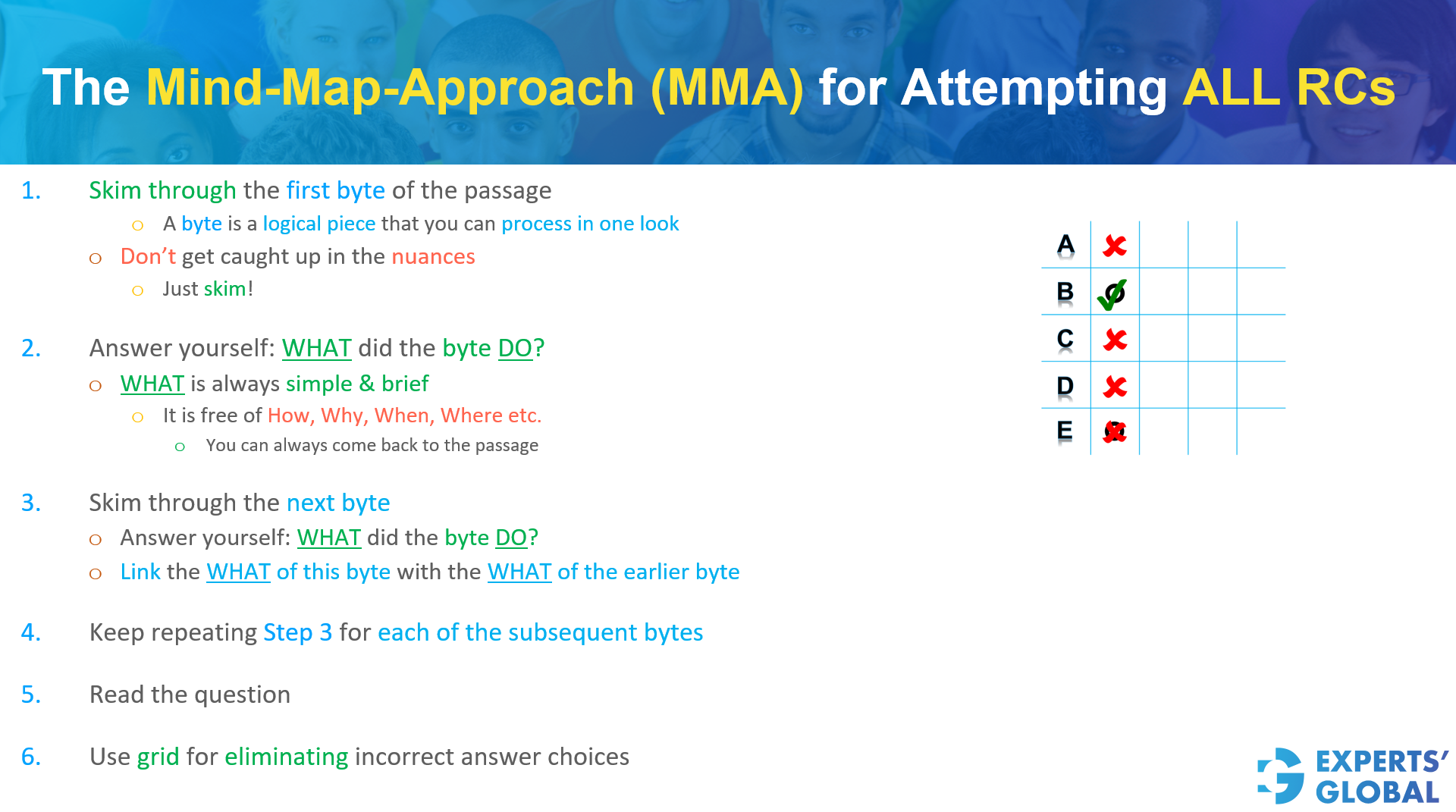
How to Master the Mind-Map-Approach for Solving RCs
As always, Experts’ Global explains this journey in three clear stages: Understand – Practice – Master.
Stage 1: Understand
In the first few days, do not think about speed at all. Give your full attention to understanding the Mind-Map-Approach and using it correctly. Your aim at this point is to build a clear sense of how to recognize the purpose of each paragraph and see how the ideas connect. Work patiently toward reaching an accuracy level of at least 80 percent before you bring in any kind of time pressure.
Stage 2: Practice
Once you are regularly scoring above 80 percent accuracy, begin attempting questions under timed conditions. At this stage, your focus is on learning to apply the Mind-Map-Approach effectively so that you can maintain high accuracy while your speed gradually improves under time constraints. By now, the method should start to feel natural and should support both your accuracy and your confidence when you work under time pressure, in GMAT exercises as well as in GMAT mocks.
Stage 3: Master
In the final stage, refine how you use the Mind-Map-Approach and build complete confidence in it under conditions that resemble the real test. Practice under time pressure and in long sittings so that your endurance and composure grow steadily. Study your mistakes with care and learn from them. When you are consistently solving RC questions in less than 2 minutes with more than 80 percent accuracy, you can say that you have truly mastered the Mind-Map-Approach.
GMAT Reading Comprehension Worked Practice Set with Explanations
This section presents a set of GMAT-style Reading Comprehension passages and questions, each accompanied by a careful, paragraph wise explanation. Work through every passage slowly and apply the reading approach and reasoning habits you have just studied on this page for handling Reading Comprehension questions on the GMAT. At this stage, give priority to following the process for active reading, annotation, and option analysis rather than simply picking the answer that feels right. After you complete each question, use the explanation control to view the correct choice and to study the full, descriptive reasoning behind it.
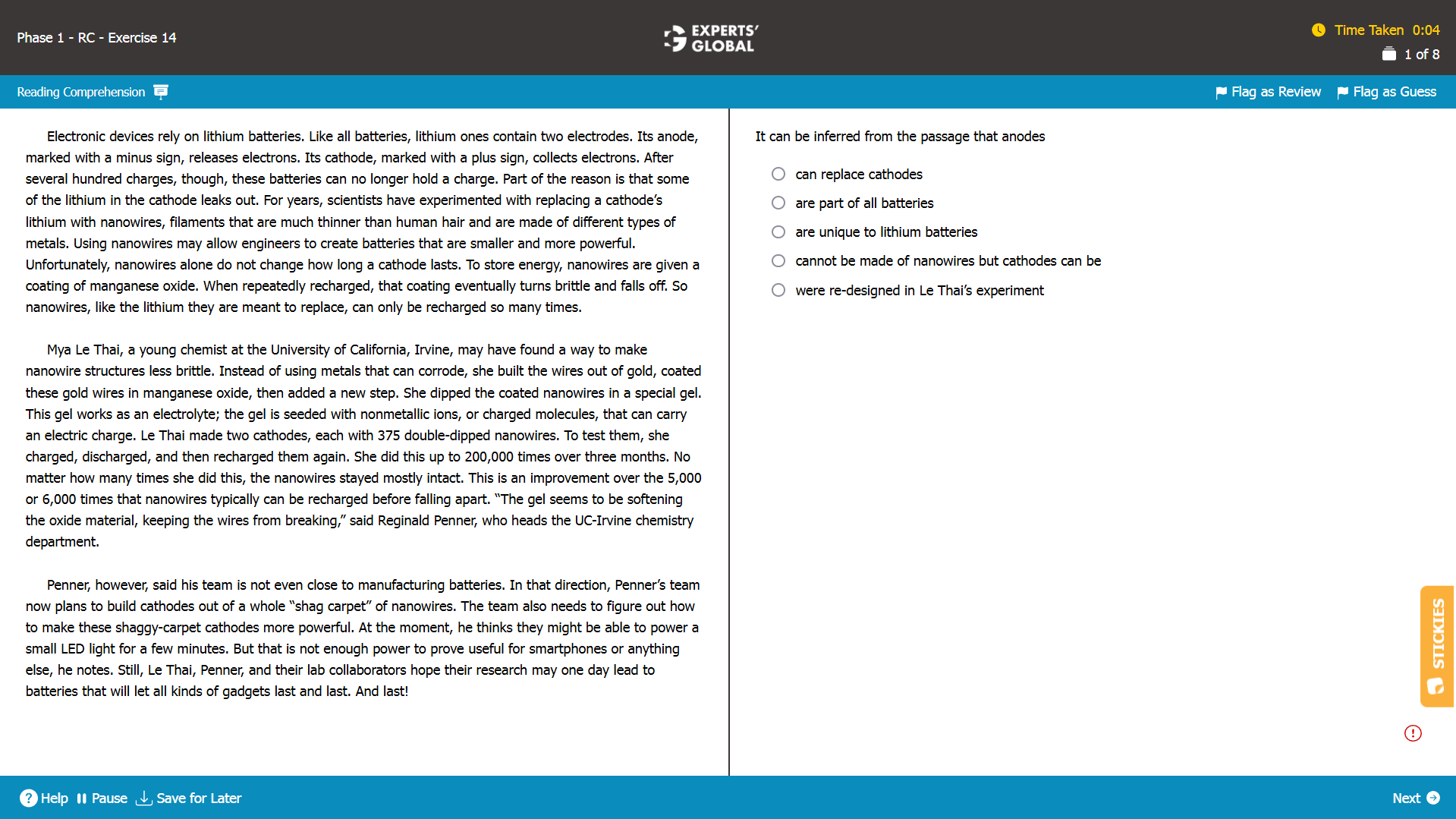
GMAT RC Practice Question 1
Written Explanation
Each answer choice needs to be carefully evaluated in light of the information presented in the passage.
A. The first paragraph simply mentions that all batteries “contain two electrodes” called “anode” and “cathode” and makes no suggestion regarding whether anodes can replace cathodes, as the answer choice mentions. Because this statement about anodes cannot be inferred, this answer choice is incorrect.
B. Correct. The first paragraph mentions that “Like all batteries, lithium ones contain two electrodes” one of which is an “anode”, which is “marked with a minus sign” and “releases electrons”; it can be inferred that anode is a part of all batteries, as the answer choice mentions. Because this statement about anodes can be inferred, this answer choice is correct.
C. The first paragraph mentions that “Like all batteries, lithium ones contain two electrodes”, which are an “anode” and a “cathode”; it can be inferred that anode is a component of all batteries and not unique to lithium batteries, as the answer choice mentions. Because this statement about anodes cannot be inferred, this answer choice is incorrect.
D. The first paragraph mentions that “Like all batteries, lithium ones contain two electrodes”, which are an “anode” and a “cathode”; the paragraph also mentions that “scientists have experimented with replacing a cathode’s lithium with nanowires”; the passage makes no connection between anodes/cathodes and nanowires; so, it cannot be established that anodes cannot be made of nanowires but cathodes can be, as the answer choice mentions.
E. Trap. The second paragraph mentions that “Le Thai made two cathodes” of gold nanowires dipped in a “special gel”; the passage makes no mention of anodes in Le Thai’s experiment; so, it cannot be established that anodes were re-designed in Le Thai’s experiment, as the answer choice mentions. Because this statement about anodes cannot be inferred, this answer choice is incorrect.
B is the best choice.
GMAT RC Practice Question 2

Written Explanation
As the second paragraph mentions, Penner explains that “The gel seems to be softening the oxide material, keeping the wires from breaking”. It can be inferred that the special gel in Le Thai’s experiment made the oxide material flexible and prevented the breaking of nanowires, making the batteries last longer. Each answer choice needs to be carefully evaluated in light of the information presented in this context.
A. The second paragraph mentions that Le Thai “built the wires out of gold”, “coated these gold wires in manganese oxide”, and the “added a new step” of dipping “the coated nanowires in a special gel”; it can be inferred that Le Thai used the special gel on top of the coating of manganese oxide; so, it is incorrect to state that the special gel likely eliminated the need for manganese oxide coating, as the answer choice mentions. Furthermore, our expectation from the correct answer choice is on the lines that the special gel in Le Thai’s experiment made the oxide material flexible and prevented the breaking of nanowires, making the batteries last longer. Incorrect.
B. Although the second paragraph mentions that with the help of the special gel, “nanowires stayed mostly intact” even after “200,000 times”, the passage makes no mention of the speed of charging; so, it cannot be established that the special gel likely caused the batteries to be charged faster, as the answer choice mentions. Furthermore, our expectation from the correct answer choice is on the lines that the special gel in Le Thai’s experiment made the oxide material flexible and prevented the breaking of nanowires, making the batteries last longer. Incorrect.
C. Trap. Although the second paragraph mentions that with the help of the special gel, “nanowires stayed mostly intact” even after “200,000 times over three months”, the passage makes no suggestion that the batteries’ life increased “up to three months”, as the answer choice mentions. Additionally, the idea of “increasing” batteries’ life up to three months suggests that other batteries have a life span of less than three months; the passage makes no such suggestion. Overall, this answer choice cannot be established. Furthermore, our expectation from the correct answer choice is on the lines that the special gel in Le Thai’s experiment made the oxide material flexible and prevented the breaking of nanowires, making the batteries last longer. Incorrect.
D. Correct. The first paragraph mentions that “When repeatedly recharged”, the oxide coating on nanowires will “eventually turn brittle and fall off”; as the second paragraph mentions, Penner explains that “The gel seems to be softening the oxide material, keeping the wires from breaking”; it can be inferred that the special gel likely prevented the nanowires from cracking, as the answer choice mentions.
E. As the second paragraph mentions, Le Thai experimented with nanowire batteries and not lithium batteries; so, it is incorrect to state that the special gel prevented the leakage of lithium, as the answer choice mentions. Furthermore, our expectation from the correct answer choice is on the lines that the special gel in Le Thai’s experiment made the oxide material flexible and prevented the breaking of nanowires, making the batteries last longer. Incorrect.
D is the best choice.
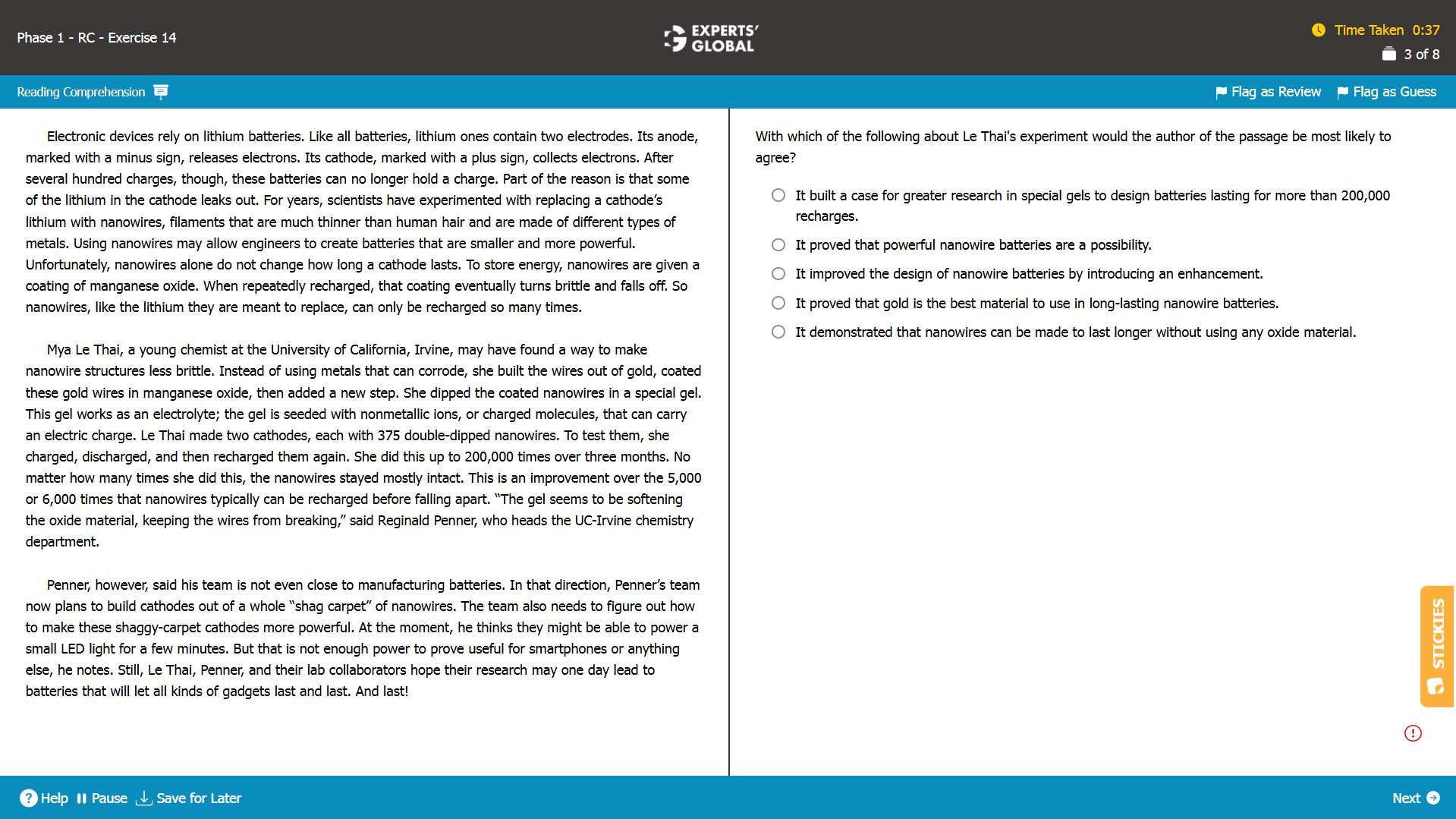
GMAT RC Practice Question 3
Written Explanation
Each answer choice needs to be carefully evaluated in light of the information presented in the passage.
A.Trap. Although the second paragraph mentions that with the help of the special gel, “nanowires stayed mostly intact” even after “200,000 times over three months”, the passage makes no reference to greater research on specialgels or any suggestion that a different special gel would make the battery last even longer; so, it cannot be established that Le Thai’s experiment built a case for greater research in special gels to design batteries l
asting for more than 200,000 recharges, as the answer choice mentions. Because it cannot be established whether the author would likely agree with this statement, this answer choice is incorrect.
B. The third paragraph mentions that batteries produced in Le Thai’s experiment need to be made “more powerful” and that “At the moment”, they “might be able to power a small LED light for a few minutes”; it can be inferred that powerful nanowire batteries are currently not a possibility; hence it is incorrect to state that Le Thai’s experiment“proved”that powerful nanowire batteries are a possibility. Because it cannot be established whether the author would likely agree with this statement, this answer choice is incorrect.
C. Correct. The second paragraph mentions that Le Thai thinks “ may have found a way to make nanowire structures less brittle” and states that she “added a new step” of dipping “the coated nanowires in a special gel” because of which “nanowires stayed mostly intact” even after “200,000 times over three months”; it can be inferred that Le Thai’s experiment improved the design of nanowire batteries by introducing an enhancement, as the answer choice mentions. Because the author would likely agree with this statement, this answer choice is correct.
D. Although the second paragraph mentions that Le Thai “ built the wires out of gold”, the passage does not make any comparison among different materials to use in nanowire batteries; so, it cannot be established that Le Thai’s experiment proved that gold is the best material to use in long – lasting nanowire batteries, as the answer choice mentions. Moreover, the terms “proved” and “best” are extremely strong; one needs to be cautious of such answer choices as they are generally incorrect on the GMAT. Because it cannot be established whether the author would likely agree with this statement, this answer choice is incorrect.
E. The second paragraph mentions that Le Thai “ built the wires out of gold”, “coated these gold wires in manganese oxide”, and then “added a new step” of dipping “the coated nanowires in a special gel”; it can be inferred that Le Thai used the special gel on top of the coating of manganese oxide; so, it is incorrect to state that Le Thai’s experiment demonstrated that nanowires can be made to last longer “without using any oxide material”, as the answer choice mentions. Because the author would not likely agree with this statement, this answer choice is incorrect.
C is the best choice.
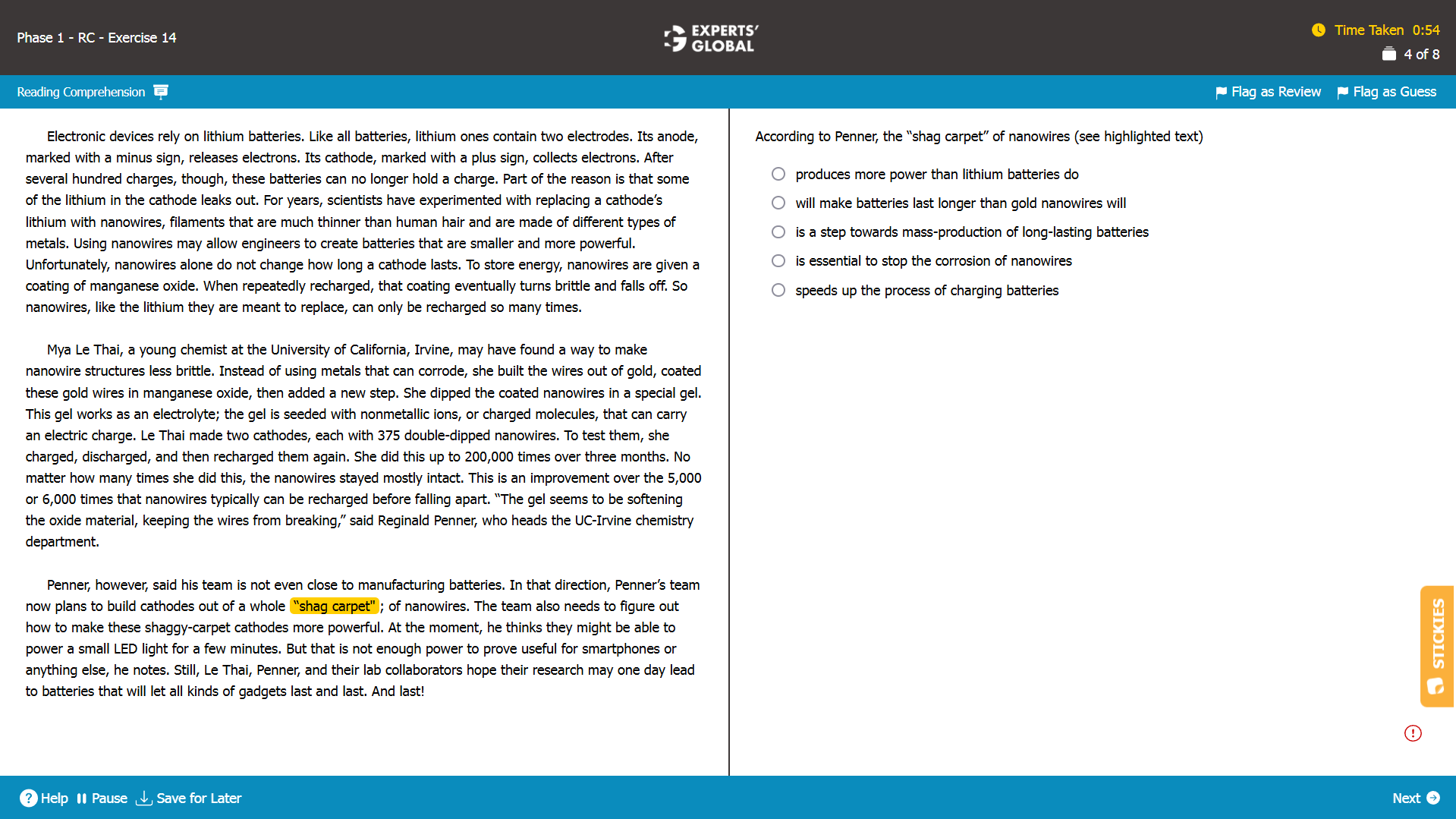
GMAT RC Practice Question 4
Written Explanation
The third paragraph mentions that “Penner, however, says his team is not even close to manufacturing batteries. In that direction, Penner’s team now plans to build cathodes out of a whole shag carpet of nanowires. It can be inferred that Penner believes that building a “shag carpet” of nanowires is an essential step towards the manufacturing of long-lasting batteries. The answer choice that does justice to this thought is the correct answer choice.
A. The passage compares lithium batteries and nanowire batteries on the basis of longevity and not power. Moreover, this comparison is not in the context of the “shag carpet” of nanowires; so, it cannot be established that the “shag carpet” of nanowires produces “more power” than lithium batteries do, as the answer choice mentions. Furthermore, the third paragraph mentions Penner’s belief that building a “shag carpet” of nanowires is an essential step towards the manufacturing of long-lasting batteries; we need an answer choice on similar lines. Incorrect.
B. In the context of the highlighted text, the passage makes no comparison between the “shag carpet” of nanowires and gold nanowires on the basis of how long each lasts; so, it cannot be established that the “shag carpet” of nanowires will make batteries last longer than gold nanowires will, as the answer choice mentions. Furthermore, the third paragraph mentions Penner’s belief that building a “shag carpet” of nanowires is an essential step towards the manufacturing of long-lasting batteries; we need an answer choice on similar lines. Incorrect.
C. Correct. The third paragraph mentions that “Penner, however, says his team is not even close to manufacturing batteries. In that direction, Penner’s team now plans to build cathodes out of a whole “shag carpet” of nanowires. It can be inferred that Penner believes that building a “shag carpet” of nanowires is an essential step towards the manufacturing of long-lasting batteries, or towards mass-production of long-lasting batteries, as the answer choice mentions.
D. Trap. In the context of the highlighted text, the passage makes no mention of the corrosion of nanowires; so, it cannot be established that the “shag carpet” of nanowires is essential to stop the corrosion of nanowires, as the answer choice mentions. Additionally, the second paragraph mentions that “Instead of using metals that can corrode”, Le Thai “built the wires out of gold”, suggesting that nanowires being made of <“gold”, rather than being in the shape of “shag carpet”, is what stops the corrosion of nanowires. Furthermore, the third paragraph mentions Penner’s belief that building a “shag carpet” of nanowires is an essential step towards the manufacturing of long-lasting batteries; we need an answer choice on similar lines. Incorrect.
E. In the context of the highlighted text, the passage makes no mention of the process of charging batteries; so, it cannot be established that the “shag carpet” of nanowires speeds up the process of charging batteries, as the answer choice mentions. Furthermore, the third paragraph mentions Penner’s belief that building a “shag carpet” of nanowires is an essential step towards the manufacturing of long-lasting batteries; we need an answer choice on similar lines. Incorrect.
C is the best choice.
GMAT RC Practice Question 5
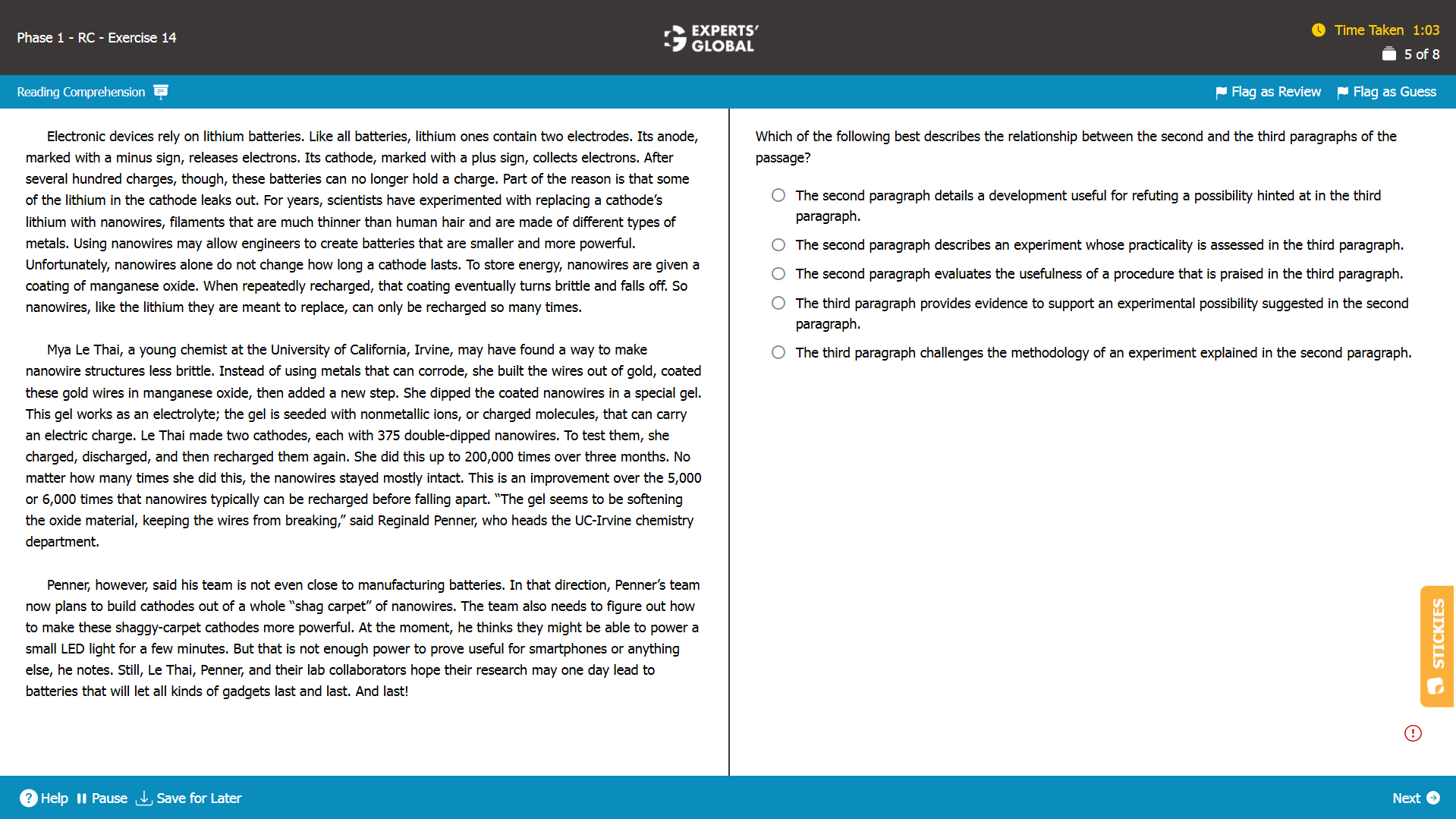
Written Explanation
As the mind-map mentions, the first paragraph states that lithium and nanowire batteries can only be recharged a limited number of times, the second paragraph describes how special-gel nanowire batteries were charged for several times more, and the third paragraph indicates that special-gel nanowire batteries are not currently powerful but the research team is hopeful. Each answer choice needs to be carefully evaluated in light of the information presented in this context.
A. As the mind-map mentions, the second paragraph describes how special-gel nanowire batteries were charged for several times more; it is correct to state that the second paragraph details a development about long-lasting batteries. The third paragraph mentions scientists’ belief that “one day”, batteries will “last and last”, suggesting the possibility of long-lasting batteries. Overall, it can be inferred that the development mentioned in the second paragraph and the possibility hinted at in the third paragraph are in sync; in other words, it is incorrect to state that second paragraph details a development useful for “refuting” a possibility hinted at in the third paragraph, as the answer choice mentions. Incorrect.
B. Correct. As the mind-map mentions, the second paragraph describes how special-gel nanowire batteries were charged for several times more. The third paragraph mentions that “Penner, however, says his team is not even close to manufacturing batteries” and that “At the moment”, nanowire batteries “might be able to power a small LED light for a few minutes” but “that is not enough power to prove useful for smartphones or anything else”; it can be inferred that the third paragraph evaluates the practical aspect of nanowire batteries. Overall, it is correct to state that the second paragraph describes an experiment whose practicality is assessed in the third paragraph, as the answer choice mentions.
C. As the mind-map mentions, the second paragraph describes how special-gel nanowire batteries were charged for several times more; although the second paragraph describes an experiment/procedure, it is incorrect to state that it evaluates the usefulness of the procedure. Moreover, the third paragraph assesses the experiment’s practical use and does not praise it as such. Overall, it cannot be established that the second paragraph evaluates the usefulness of a procedure that is praised in the third paragraph, as the answer choice mentions. Incorrect.
D. As the mind-map mentions, the second paragraph describes how special-gel nanowire batteries were charged for several times more; it is correct to state that the second paragraph suggests the possibility of long-lasting batteries; however, the third paragraph provides no evidence to support such a possibility; rather, the third paragraph weakens the possibility by citing that current nanowire batteries do not have “enough power”; so, it cannot be established that the third paragraph provides evidence to support an experimental possibility suggested in the second paragraph, as the answer choice mentions. Incorrect.
E. Trap. As the mind-map mentions, the second paragraph explains how special-gel nanowire batteries were charged for several times more; the third paragraph assesses the experiment’s “practical” use and does not challenge the “methodology” of the experiment; so, it cannot be established that the third paragraph challenges the methodology of an experiment explained in the second paragraph, as the answer choice mentions. Incorrect.
B is the best choice.
GMAT RC Practice Question 6
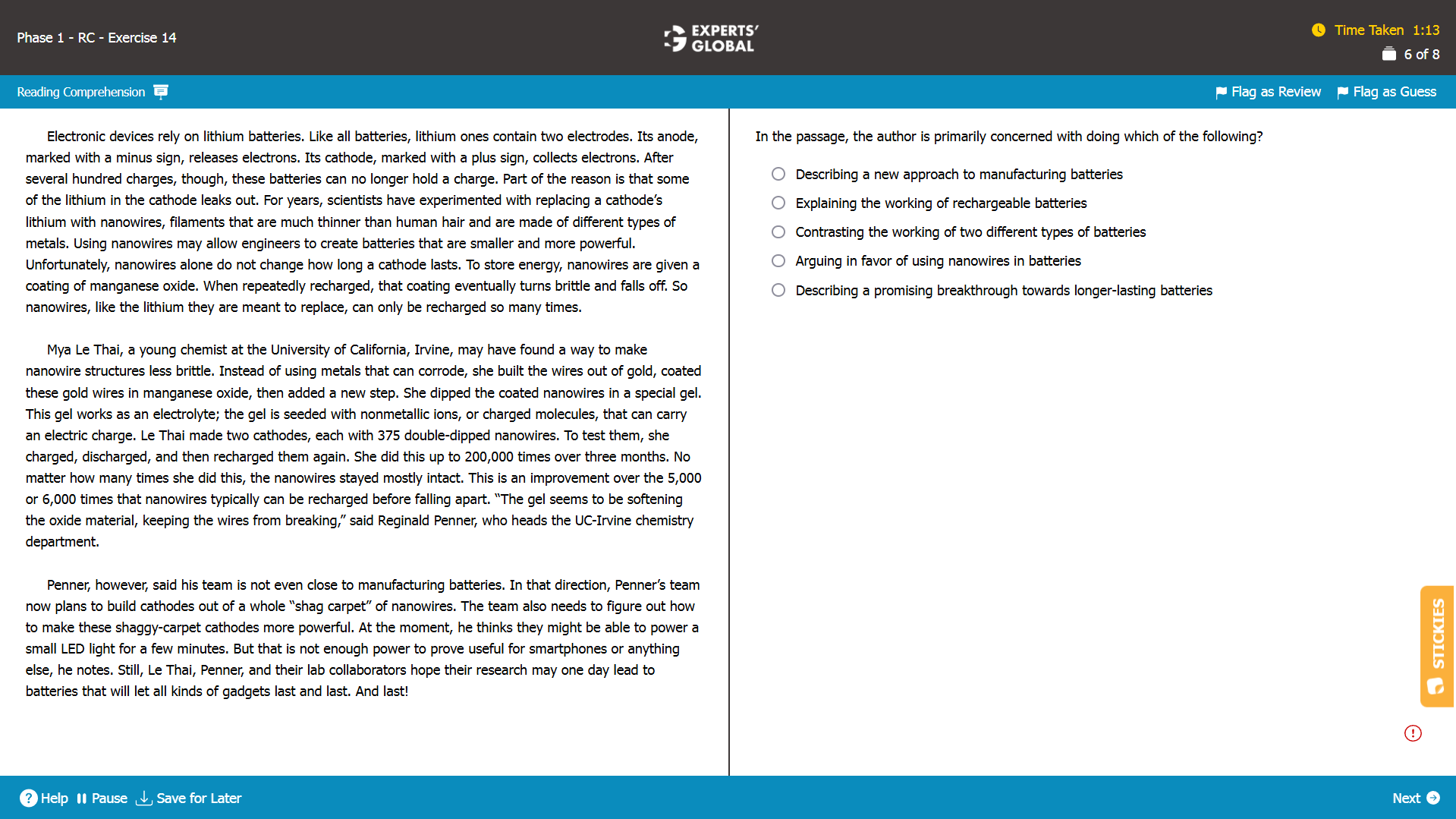
Written Explanation
As the mind-map mentions, the first paragraph states that lithium and nanowire batteries can only be recharged a limited number of times, the second paragraph describes how special-gel nanowire batteries were charged for several times more, and the third paragraph indicates that special-gel nanowire batteries are not currently powerful but the research team is hopeful. As a whole, the passage introduces a limitation of current batteries and cites an experiment to discuss the potential of special-gel nanowire batteries to last much longer than current lithium batteries. The answer choice that does justice to this summary is the correct answer choice.
A. Although the second paragraph describes how special-gel nanowire batteries were charged for several times more, the third paragraph mentions that the research team “is not even close to manufacturing batteries”; so, it is incorrect to state that the author is primarily concerned with describing a new approach to “manufacturing batteries”, as the answer choice mentions. Furthermore, our expectation from the correct answer choice is on the lines that the author is primarily concerned with introducing a limitation of current batteries and citing an experiment to discuss the potential of special-gel nanowire batteries to last much longer than current lithium batteries. Incorrect.
B. Although the first paragraph mentions “anodes” and “cathodes” in batteries and the experiments in “replacing a cathode’s lithium with nanowires”, these references are made to indicate that lithium and nanowire batteries can only be recharged a limited number of times rather than to explain “the working of rechargeable batteries”, as the answer choice mentions; even if it did so, this discussion would be limited in scope to the first paragraph and cannot be considered the primary concern in the passage. Furthermore, our expectation from the correct answer choice is on the lines that the author is primarily concerned with introducing a limitation of current batteries and citing an experiment to discuss the potential of special-gel nanowire batteries to last much longer than current lithium batteries. Incorrect.
C. Although the first paragraph states that lithium and nanowire batteries can only be recharged a limited number of times, and the second paragraph describes how special-gel nanowire batteries were charged for several times more, the passage does not compare the “working” of the two types of batteries; so, it is incorrect to state that the author is primarily concerned with contrasting the working of two different types of batteries, as the answer choice mentions. Furthermore, our expectation from the correct answer choice is on the lines that the author is primarily concerned with introducing a limitation of current batteries and citing an experiment to discuss the potential of special-gel nanowire batteries to last much longer than current lithium batteries. Incorrect.
D. Trap. Although the second paragraph describes how special-gel nanowire batteries were charged for several times more, and the third paragraph indicates that the research team is hopeful of making longer-lasting batteries, the author’s tone is objective and unbiased; so, it is incorrect to state that the author argues in favor of using nanowires in batteries, as the answer choice mentions. Furthermore, our expectation from the correct answer choice is on the lines that the author is primarily concerned with introducing a limitation of current batteries and citing an experiment to discuss the potential of special-gel nanowire batteries to last much longer than current lithium batteries. Incorrect.
E. Correct. As the mind-map mentions, the first paragraph states that lithium and nanowire batteries can only be recharged a limited number of times, the second paragraph describes how special-gel nanowire batteries were charged for several times more, and the third paragraph indicates that special-gel nanowire batteries are not currently powerful but the research team is hopeful; as a whole, the passage introduces a limitation of current batteries and cites an experiment to discuss the potential of special-gel nanowire batteries to last much longer than current lithium batteries; in other words, the author is primarily concerned with describing a promising breakthrough towards longer-lasting batteries, as the answer choice mentions. Further, please note that this answer choice does not explicitly include the contents of the first paragraph, which acts merely as the background for the later paragraphs, and still adequately captures the essence of the entire passage.
E is the best choice.
GMAT RC Practice Question 7
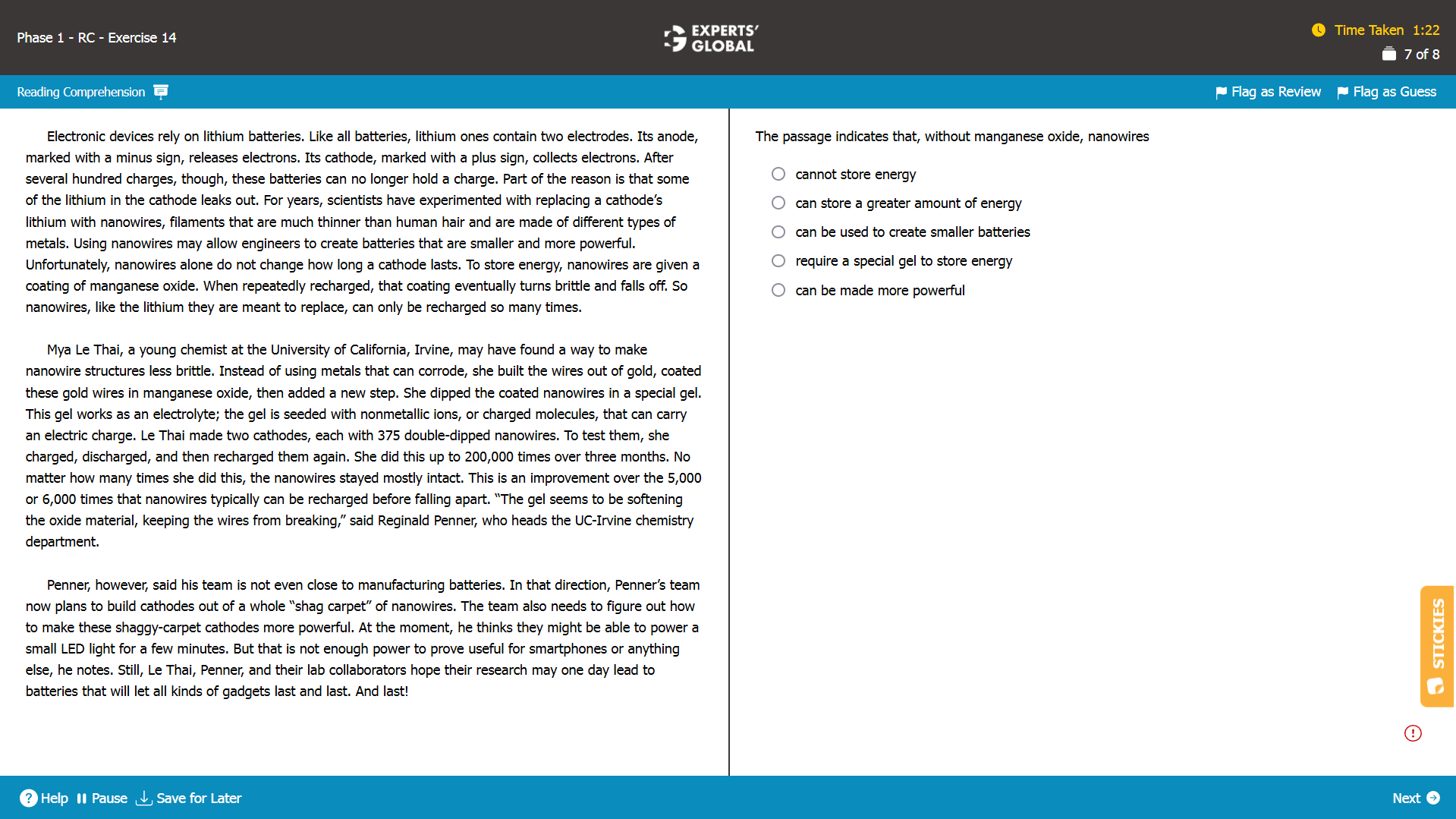
Written Explanation
The first paragraph mentions that “To store energy, nanowires are given a coating of manganese oxide”. Each answer choice needs to be carefully evaluated in light of the information presented in this context.
A. Correct. The first paragraph mentions that “To store energy, nanowires are given a coating of manganese oxide”, suggesting that without manganese oxide, nanowires cannot store energy, as the answer choice mentions.
B. The first paragraph mentions that “To store energy, nanowires are given a coating of manganese oxide”, suggesting that without manganese oxide, nanowires cannot store energy; hence, it is incorrect to state that without manganese oxide, nanowires can store a greater amount of energy, as the answer choice mentions. Incorrect.
C. Trap. The first paragraph mentions that “To store energy, nanowires are given a coating of manganese oxide”, suggesting that without manganese oxide, nanowires cannot store energy and thus cannot create batteries, smaller or larger. Further, although the first paragraph mentions that “Using nanowires may allow engineers to create batteries that are smaller”, the passage makes no mention of manganese oxide in the context of creating smaller batteries using nanowires. Overall, it cannot be established that without manganese oxide, nanowires can be used to create smaller batteries, as the answer choice mentions. Furthermore, our expectation from the correct answer choice is on the lines that without manganese oxide, nanowires cannot store energy. Incorrect.
D. The first paragraph mentions that “To store energy, nanowires are given a coating of manganese oxide”; the passage makes no mention of “special gel” in this context; so, it cannot be established that without manganese oxide, nanowires require a special gel to store energy, as the answer choice mentions. Furthermore, our expectation from the correct answer choice is on the lines that without manganese oxide, nanowires cannot store energy. Incorrect.
E. The passage makes no connection between nanowires being “powerful” and manganese oxide; so, it cannot be established that without manganese oxide, nanowires can be made more powerful, as the answer choice mentions. Furthermore, our expectation from the correct answer choice is on the lines that without manganese oxide, nanowires cannot store energy. Incorrect.
A is the best choice.
GMAT RC Practice Question 8
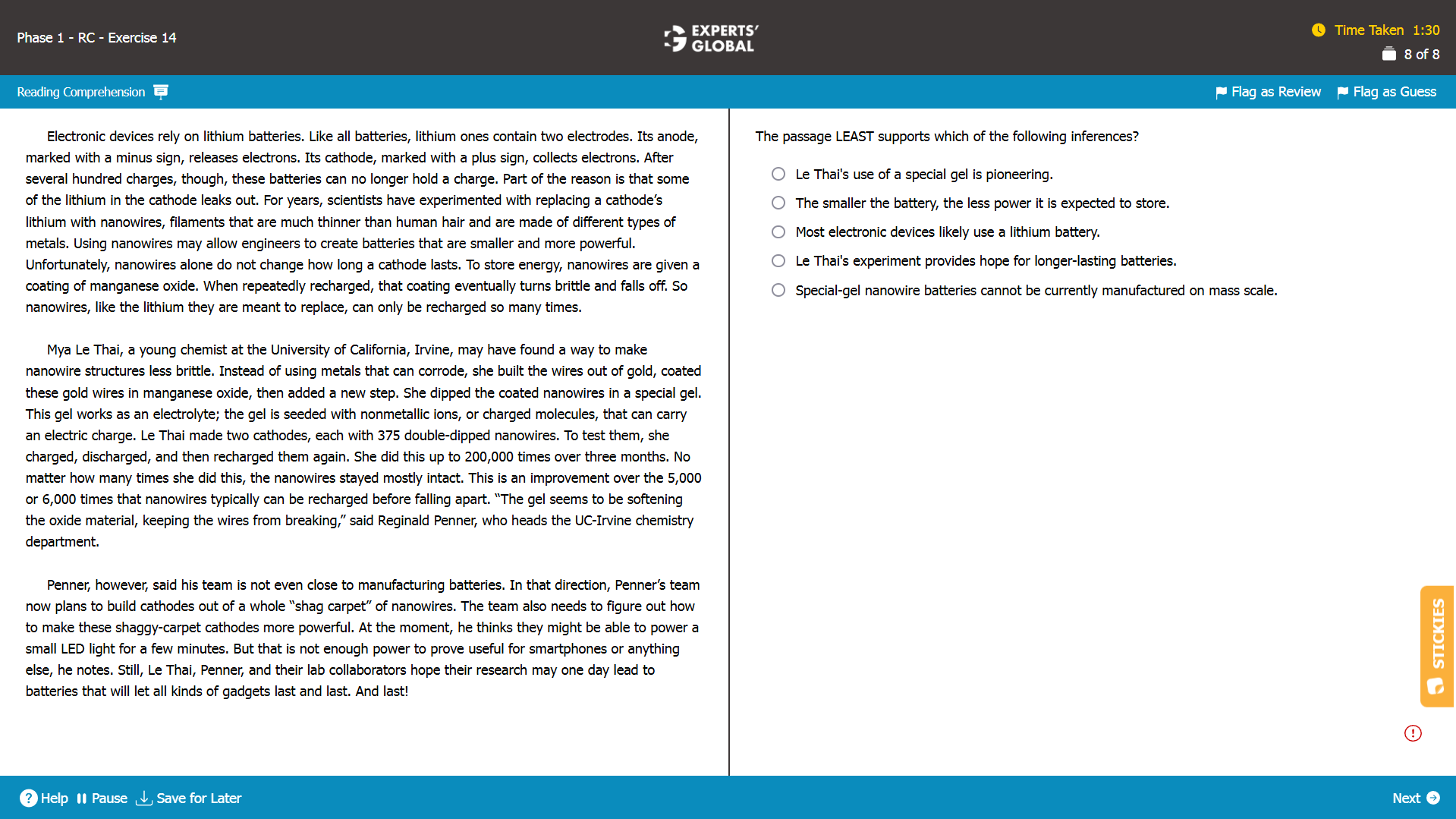
Written Explanation
Each answer choice needs to be carefully evaluated in light of the information presented in the passage.A. The second paragraph mentions that in her experiment, Le Thai added a “new step” of coating nanowires in a special gel, suggesting that Le Thai’s use of a special gel is pioneering, as the answer choice mentions. Because the passage supports this statement, this answer choice incorrect.B. Correct. The first paragraph mentions that “Using nanowires may allow engineers to create batteries that are smaller and more powerful”; it can be inferred that smaller batteries can be more powerful; so, it is incorrect to state that the smaller the battery, the less power it is expected to store, as the answer choice mentions. Because the passage does not support this statement, this answer choice is correct.
C. The first paragraph mentions that “Electronic devices rely on lithium batteries”, suggesting that most electronic devices likely use a lithium battery, as the answer choice mentions. Because the passage supports this statement, this answer choice is incorrect.
D. The second paragraph describes Le Thai’s experiment in which special-gel nanowire batteries were charged for several times more, and the third paragraph mentions that “Le Thai, Penner, and their lab collaborators hope their research may one day lead to batteries that will let all kinds of gadgets last, and last”; it can be inferred that Le Thai’s experiment provides hope for longer-lasting batteries, as the answer choice mentions. Because the passage supports this statement, this answer choice is incorrect.
E. The second paragraph describes Le Thai’s experience in which special-gel nanowire batteries were charged for several times more, and the third paragraph mentions that “Penner, however, says his team is not even close to manufacturing batteries”; it can be inferred that special-gel nanowire batteries cannot be currently manufactured on mass scale, as the answer choice mentions. Because the passage supports this statement, this answer choice is incorrect.
B is the best choice.
Additional 40+ Free GMAT-style Reading Comprehension Questions with Explanations:
Please find another set of GMAT-style RC questions with explanations on: How to Solve GMAT Reading Comprehension Questions
Please find another set of GMAT-style RC questions with explanations on: Free GMAT Reading Comprehension Sample Questions
Please find another set of GMAT-style RC questions with explanations on: Free GMAT Verbal Prep
Please find another set of GMAT-style RC questions with explanations on: Free GMAT Verbal Sample Questions
Please find another set of GMAT-style RC questions with explanations on: Free GMAT Sample Questions
How and Where to Practice GMAT Reading Comprehension Questions
Real practice for Reading Comprehension problems begins when you solve them on a software simulation that closely matches the official GMAT interface. You need a platform that presents the passage and the questions in a GMAT like layout, lets you work with the information and answer choices naturally, and provides all the on screen tools and functionalities that you will see on the actual exam. Without this kind of experience, it is difficult to feel fully prepared for test day. High quality Reading Comprehension questions are not available in large numbers. Among the limited, genuinely strong sources are the official practice materials released by GMAC and the Experts’ Global GMAT course.
Within the Experts’ Global GMAT online preparation course, every Reading Comprehension problem appears on an exact GMAT like user interface that includes all the real exam tools and features. You work through adequate Reading Comprehension questions in quizzes and also take 15 full length GMAT mock tests that include several Reading Comprehension questions in roughly the same spread and proportion in which they appear on the actual GMAT.
All the best!