A strong GRE preparation course rests on wide and careful exposure across every section, question format, topic, concept, and micro concept. This page brings together GRE practice questions that are thoughtfully organized by section and question type. As you work through these practice questions, keep your attention on experiencing the questions themselves, their formats, structures, and patterns, and on reaching accurate answers with care. Speed does not matter at this stage. Use this phase to gain first hand exposure to the full GRE range and to extract meaningful learning from both the questions and their detailed explanations. Spend focused hours with this rich resource to build broad familiarity with the GRE and carry these learnings forward into GRE quizzes, GRE sectional tests, and GRE full-length practice tests. Happy practicing!
GRE Quant Practice Questions
GRE Verbal Practice Questions
Analytical Writing
GRE Quant Practice Questions
Quantitative Reasoning is one of the three GRE sections, along with Verbal Reasoning and Analytical Writing. A complete GRE preparation plan requires thorough Quant preparation. This section offers sample practice questions for each GRE Quantitative Reasoning question type across different GRE Quant concepts. Solve each question carefully and use the explanations to extract clear apt learning from this rich set of GRE Quant practice questions.
Important: Before attempting the GRE Quantitative Reasoning practice questions, if you would like to undergo GRE Quant concepts prep, please visit Free GRE Quant prep
Quantitative Comparison Practice Questions
Quantitative Comparison questions account for roughly one third of the GRE Quantitative Reasoning section and ask you to compare two expressions, Quantity A and Quantity B. Instead of calculating exact values, you focus on understanding how the two quantities relate under the given conditions. With practice, this format becomes a strong scoring opportunity because it rewards clear reasoning and helps you save time across the section. Following is a short exercise of sample GRE quantitative comparison questions.
Important: Before attempting the GRE Quantitative Comparison practice questions, if you would like to learn the strategy for solving QC questions, please visit Strategy for GRE Quantitative Comparison Questions
Practice Question 1 | QC
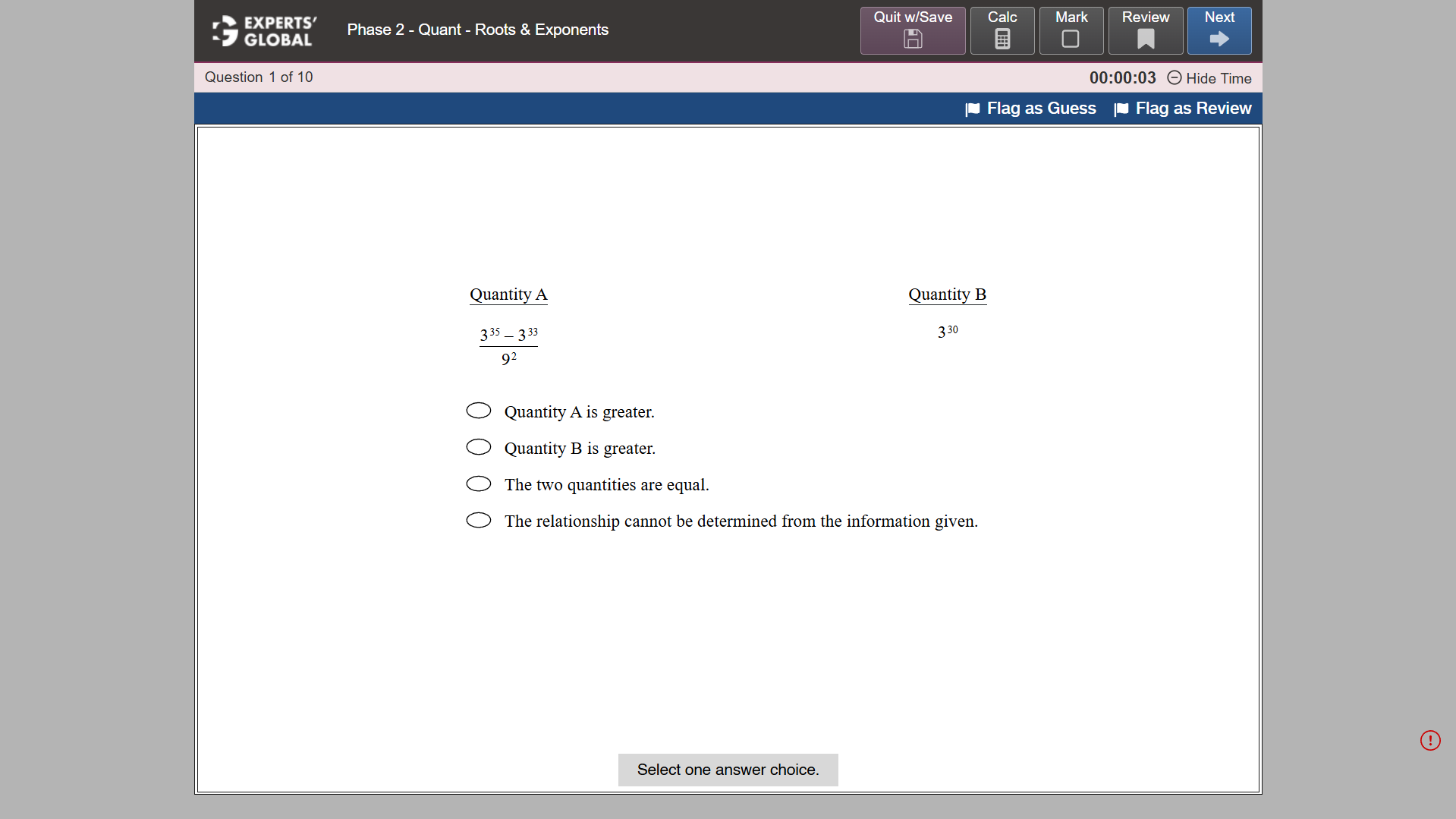
Quantity A: 335 – 333 / 92
Quantity B: 330
A. Quantity A is greater.
B. Quantity B is greater.
C. The two quantities are equal.
D. The relationship cannot be determined from the information given.
Written Explanation
We need to determine the relationship between (335 – 333) / 92 and 310.
Quantity A:
(335 – 333) / 92
= (335 – 333) / 32 × 2
= (335 – 333) / 34
= 331 – 329
= 329(32 – 1)
= 329(9 – 1)
= 329(8)
Quantity B:
330
= 329(3)
Hence, Quantity A is greater.
A is the correct answer.
Practice Question 2 | QC
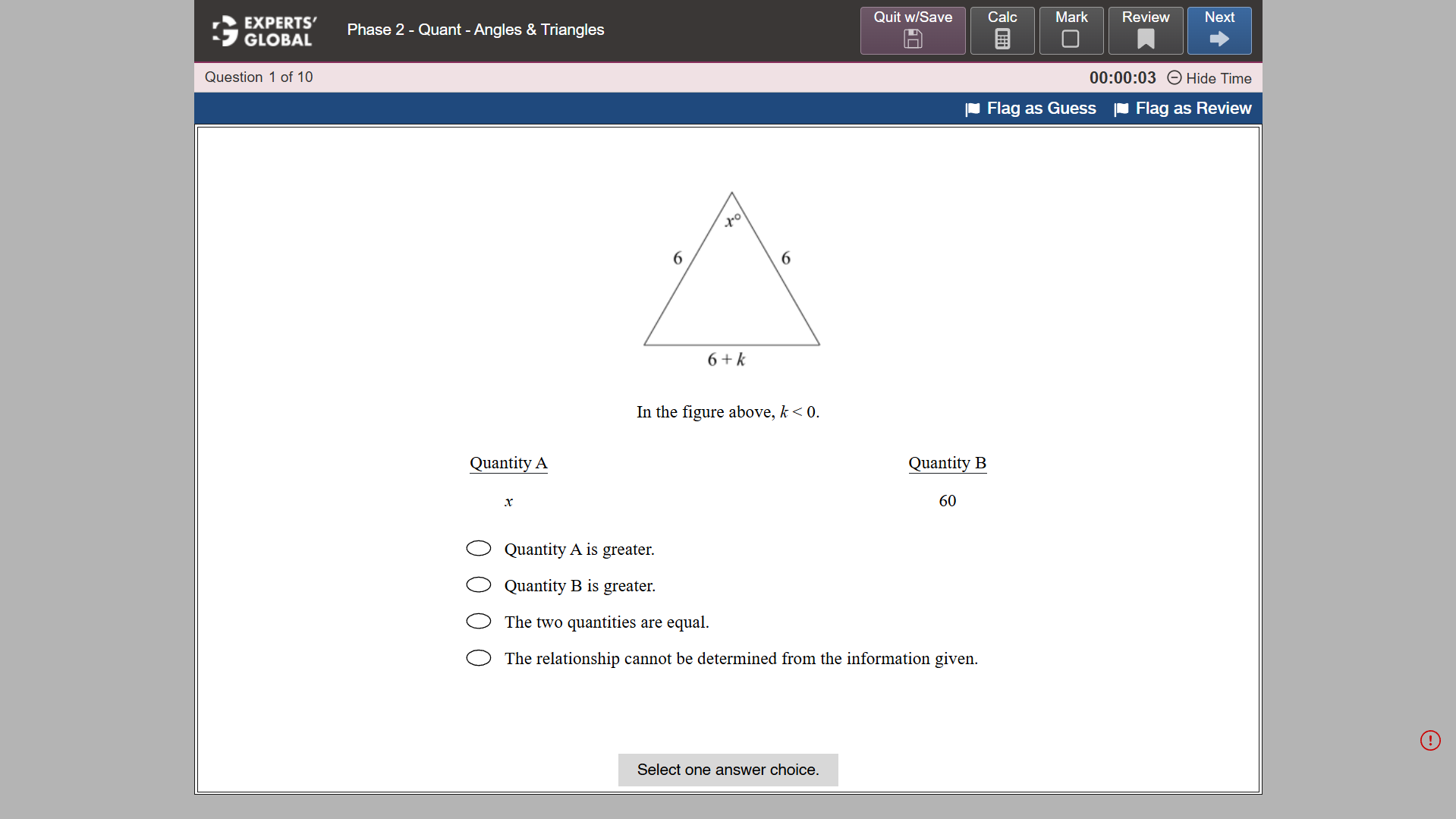
In the figure above, k < 0.
Quantity A: x
Quantity B: 60
A. Quantity A is greater.
B. Quantity B is greater.
C. The two quantities are equal.
D. The relationship cannot be determined from the information given.
Written Explanation
k < 0
We need to determine the relationship between x and 60.
Quantity A:
If k = 0, the triangle would be equilateral, making x = 60.
Since k is a negative number, the side (6 + k) is shorter than 6, making it the shortest side of the triangle.
In any triangle, the smallest interior triangle is opposite the shortest side.
Thus, when k < 0, x must be less than 60.
Quantity B:
60
Hence, Quantity B is greater.
B is the correct answer.
Practice Question 3 | QC
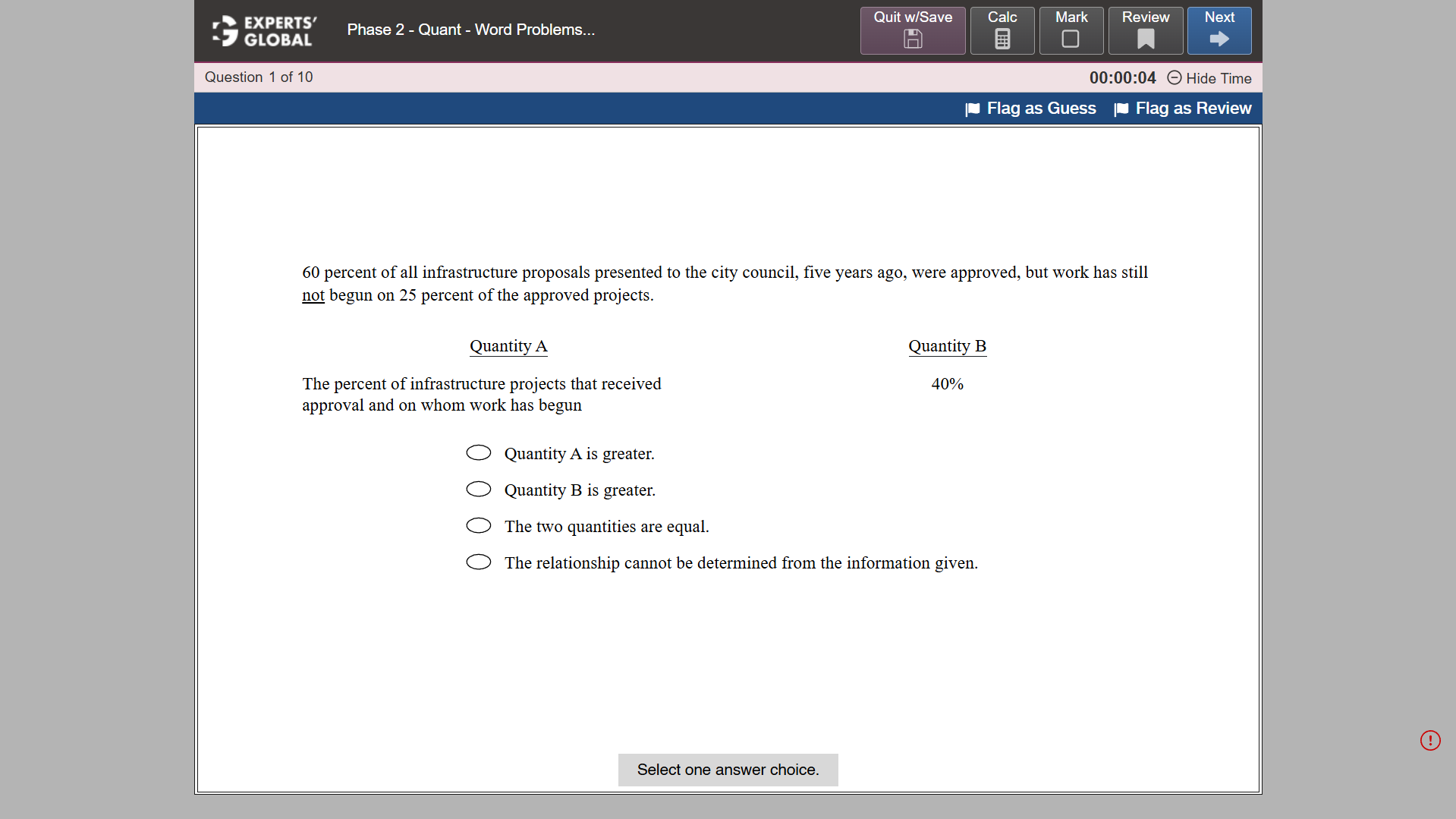
60 percent of all infrastructure proposals presented to the city council, five years ago, were approved, but work has still not begun on 25 percent of the approved projects.
Quantity A: The percent of infrastructure projects that received approval and on whom work has begun
Quantity B: 40%
A. Quantity A is greater.
B. Quantity B is greater.
C. The two quantities are equal.
D. The relationship cannot be determined from the information given.
Written Explanation
Let the total number of infrastructure proposals presented to the city council be x.
We need to determine the relationship between the percentage of proposals that were approved and have begun work and 40%.
Quantity A:
60% of all infrastructure proposals were approved.
Therefore, the number of approved proposals = 0.6x.
25% of the approved proposals have not begun work.
Therefore, the number of approved proposals on which work has begun = (0.75)(0.6x) = 0.45x = 45% of x.
Thus, the percent of infrastructure proposals that were approved and on which work has begun = 45%.
Quantity B:
40%
Hence, Quantity A is greater.
A is the correct answer.
Additional GRE-style Quantitative Comparison Questions with Explanations:
Please find a set of GRE-style QC questions with explanations on: Free GRE Quantitative Comparison Questions with Solutions
Please find another set of GRE-style QC questions with explanations on: Free GRE Quantitative Comparison Questions Prep
Numeric Entry Practice Questions
Numeric Entry questions on GRE Quantitative Reasoning require you to type the answer instead of selecting from choices. This format is peculiar and requires greater precision because there are no answer choices to guide your thinking. Some questions use one answer box for an integer or decimal, while others use two boxes when the answer must be entered as a fraction, with separate fields for numerator and denominator. Following is a short exercise including GRE NE questions…
Practice Question 1 | Numeric Entry
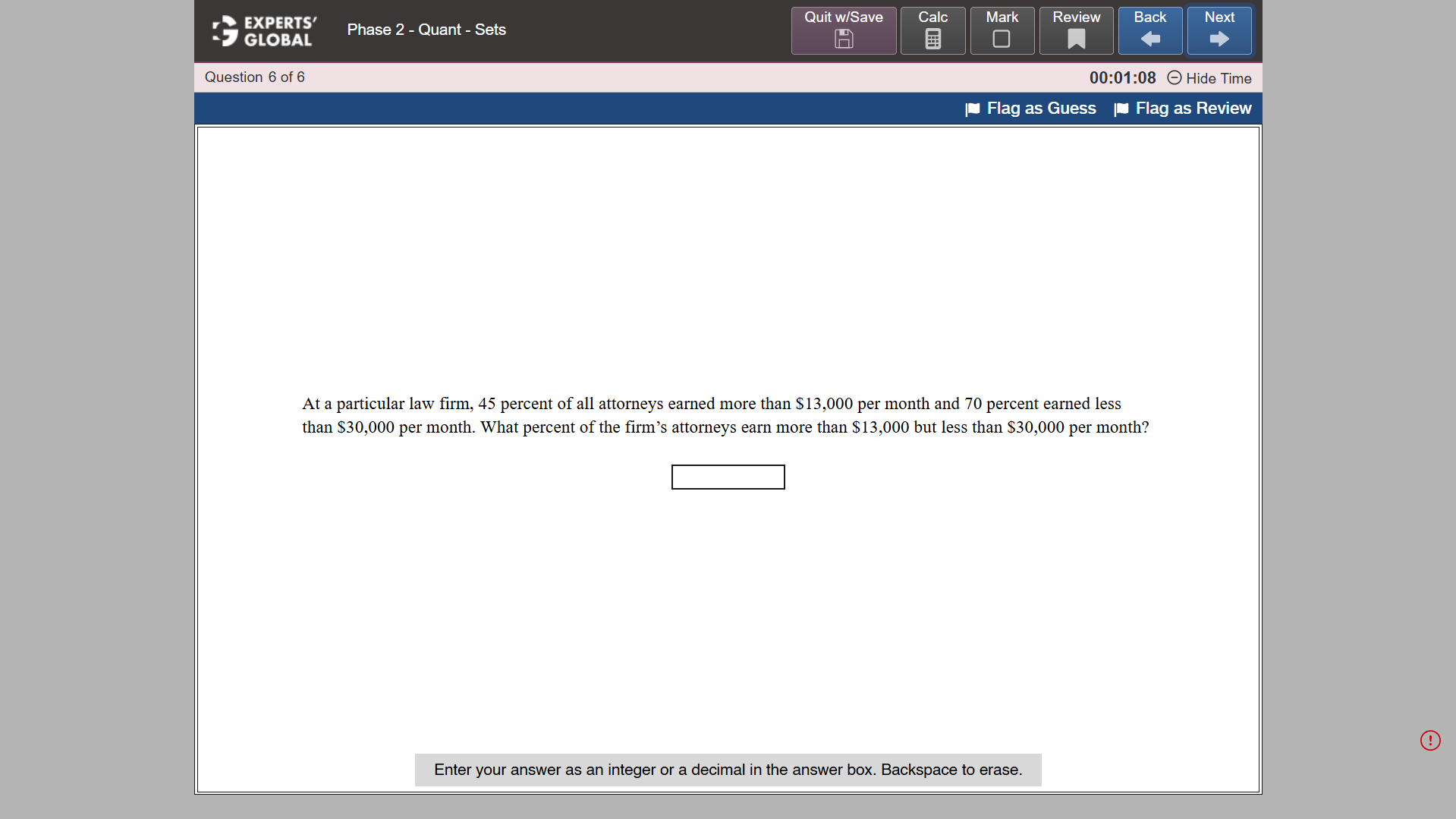
At a particular law firm, 45 percent of all attorneys earned more than $13,000 per month and 70 percent earned less than $30,000 per month. What percent of the firm’s attorneys earn more than $13,000 but less than $30,000 per month?
Written Explanation
We need to determine the percentage of the firm’s attorneys who earn more than $13,000 but less than $30,000 per month.
45 percent of all attorneys earned more than $13,000 per month.
This implies that 100 – 45 = 55 percent of all attorneys earned $13,000 or less.
70 percent of all attorneys earned less than $30,000 per month.
This implies that 100 – 70 = 30 percent of all attorneys earned $30,000 or more.
The percentage of the firm’s attorneys who earn more than $13,000 but less than $30,000 per month
= (Total percent) – (Percent of attorneys who earned $13,000 or less) – (Percent of attorneys who earned $30,000 or more)
= 100 – 55 – 30
= 15
15 is the correct answer.
Practice Question 2 | Numeric Entry
A mother and her 5 children are riding an amusement park ride that consists of 6 single-seat cars on a track. There are 720 different ways in which they can sit together in these cars. In how many of those ways is the mother sitting on one of the end seats?
Written Explanation
We need to determine the number of ways a mother can be seated in one of the end seats in an amusement park ride that consists of 6 single-seat cars with her 5 children.
If we fix the mother in the first seat, we have 5 children left to arrange in 5 remaining seats.
The number of ways to arrange 5 children in 5 seats = 5! = 120.
Therefore, there are 120 ways to seat the mother in the first seat.
Similarly, there are 120 ways to seat the mother in the last seat.
Hence, the total number of arrangements in which the mother is in one of the end seats = 120 + 120 = 240.
240 is the correct answer.
Practice Question 3 | Numeric Entry
In a sequence S, each term, after the first term, is defined by multiplying the previous term by a constant k, where k is an integer other than 1. If the 4th term of the sequence is –9 and the 7th term is 243, what is the sum of the first five terms of the sequence?
Give your answer to the nearest integer.
Written Explanation
Let xn denote the nth term of the sequence.
x4 = –9
x7 = 243
We need to determine the sum of the first five terms of the sequence.
Each term, after the first term, is defined by multiplying the previous term by a constant k.
x2 = kx1
x3 = kx2 = k2x1
x4 = k3x1
Since x4 = –9, it follows that k3x1 = –9. (Equation I)
x5 = k4x1
x6 = k5x1
x7 = k6x1
Since x7 = 243, it follows that k6x1 = 243. (Equation II)
Dividing Equation II by I,
(k6x1) / (k3x1) = 243 / (–9)
k3 = –27
Taking cube roots on both sides,
k = –3
Substituting the value of k in Equation I,
(–27)x1 = –9
x1 = 1 / 3
The sum of the first five terms of the sequence
= x1 + x2 + x3 + x4 + x5
= x1 + kx1 + k2x1 + k3x1 + k4x1
= x1(1 + k + k2 + k3 + k4)
= 1 / 3 [1 + (–3) + (–3)2 + (–3)3 + (–3)4]
= 1 / 3 (1 – 3 + 9 – 27 + 81)
= 61 / 3
≈ 20
20 is the correct answer.
Additional Free GRE-style Numeric Entry Questions with Explanations:
Please find a set of GRE-style NE questions with explanations on: Free GRE Numeric Entry Practice Questions with Solutions
Please find another set of GRE-style NE questions with explanations on: Free GRE Numeric Entry Practice Questions Prep
GRE Multiple Choice – Select One Practice Questions
This format presents one question with five answer choices, where only one option is correct. You read the prompt and select the single best value or statement. Around 40% of GRE quantitative reasoning questions use this format, and these questions can span virtually any topic covered across the GRE quantitative reasoning curriculum. Here is a short exercise on GRE MCQ – Select One Answer problems…
Practice Question 1 | MCQ – Select One
When the positive integer p is divided by 72, the remainder is 36. Which of the following CANNOT be a divisor of p?
A. 8
B. 12
C. 15
D. 18
E. 27
Written Explanation
When the positive integer p is divided by 72, the remainder is 36.
This can be expressed as p = 72k + 36, for any integer k.
Factoring out 36 from this equation, p = 36(2k + 1).
We need to determine which of the given answer choices cannot be a divisor of p.
A. 8
p = 36(2k + 1) = (22 × 32)(2k + 1)
8 = 23
For p to be divisible by 8, (22 × 32)(2k + 1) must be divisible by 23.
This will only be true if (2k + 1) is divisible by 2.
For any integer value k, (2k + 1) will not be divisible by 2.
Thus, 8 cannot be a divisor of p.
Hence, this is the correct answer choice.
B. 12
36 is a multiple of 12.
Thus, 12 is a divisor of p.
Hence, this answer choice is incorrect.
C. 15
If k = 2, then p = 36(2k + 1) = 36[2(2) + 1] = 36 × 5.
(36 × 5) is a multiple of 15.
Thus, 15 can be a divisor of p.
Hence, this answer choice is incorrect.
D. 18
36 is a multiple of 18.
Thus, 18 is a divisor of p.
Hence, this answer choice is incorrect.
E. 27
If k = 1, then p = 36(2k + 1) = 36[2(1) + 1] = 36 × 3.
(36 × 3) is a multiple of 27.
Thus, 27 can be a divisor of p.
Hence, this answer choice is incorrect.
A is the correct answer choice.
Practice Question 2 | MCQ – Select One
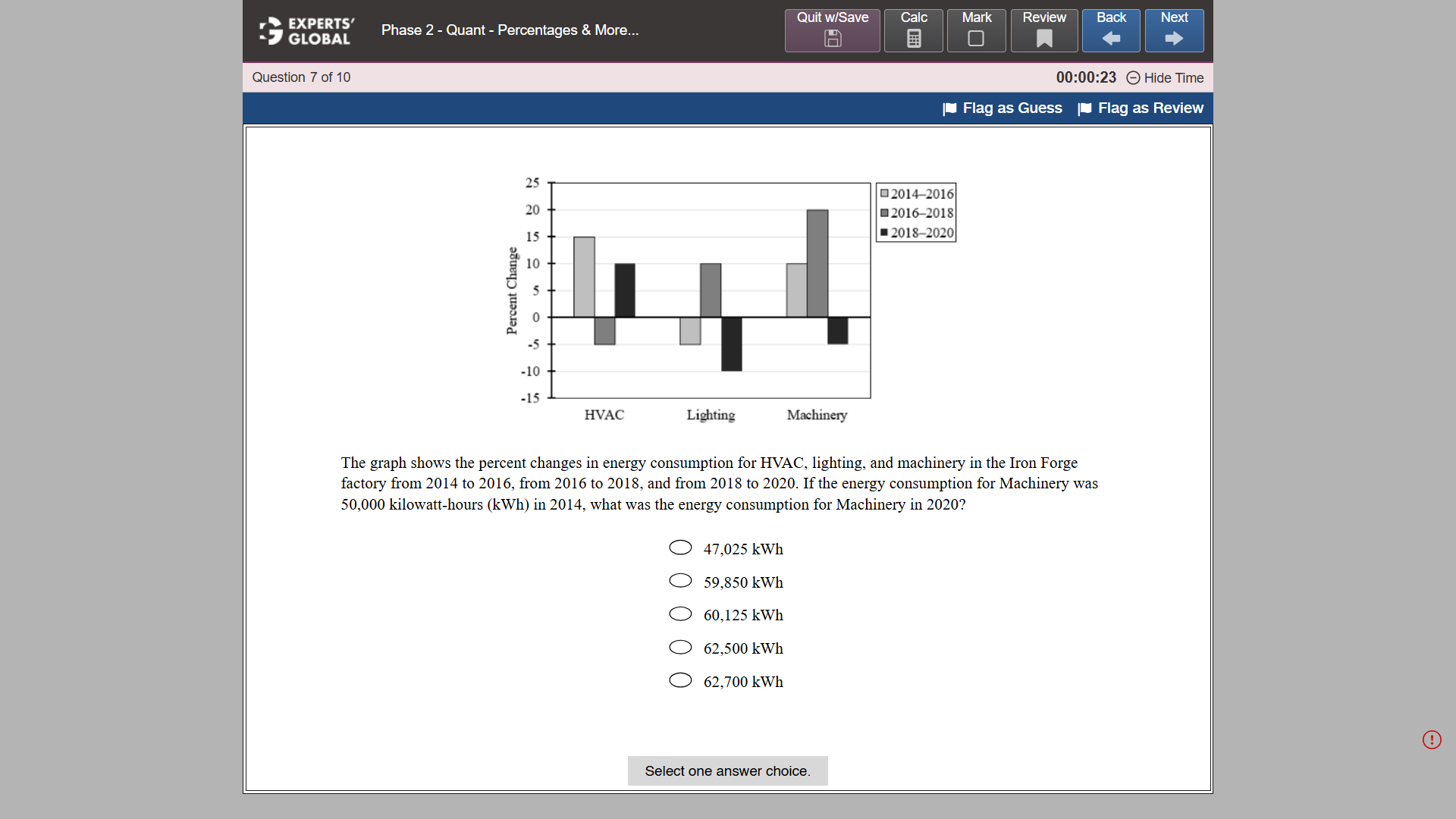
The graph shows the percent changes in energy consumption for HVAC, lighting, and machinery in the Iron Forge factory from 2014 to 2016, from 2016 to 2018, and from 2018 to 2020. If the energy consumption for Machinery was 50,000 kilowatt-hours (kWh) in 2014, what was the energy consumption for Machinery in 2020?
A. 47,025 kWh
B. 59,850 kWh
C. 60,125 kWh
D. 62,500 kWh
E. 62,700 kWh
Written Explanation
The energy consumption for Machinery in 2014 = 50,000 kWh.
We need to determine the energy consumption for Machinery in 2020.
The percentage change in the energy consumption for Machinery from 2014–2016 = 10%.
Therefore, the energy consumption for Machinery in 2016 = 1.1 × (The energy consumption for Machinery in 2014) = 1.1 × 50,000 kWh.
The percentage change in the energy consumption for Machinery from 2016–2018 = 20%.
Therefore, the energy consumption for Machinery in 2018 = 1.2 × (The energy consumption for Machinery in 2016) = 1.2 × 1.1 × 50,000 kWh.
The percentage change in the energy consumption for Machinery from 2018–2020 = –5%.
Therefore, the energy consumption for Machinery in 2020 = 0.95 × (The energy consumption for Machinery in 2018) = 0.95 × 1.2 × 1.1 × 50,000 kWh = 62,700 kWh.
E is the correct answer choice.
Practice Question 3 | MCQ – Select One
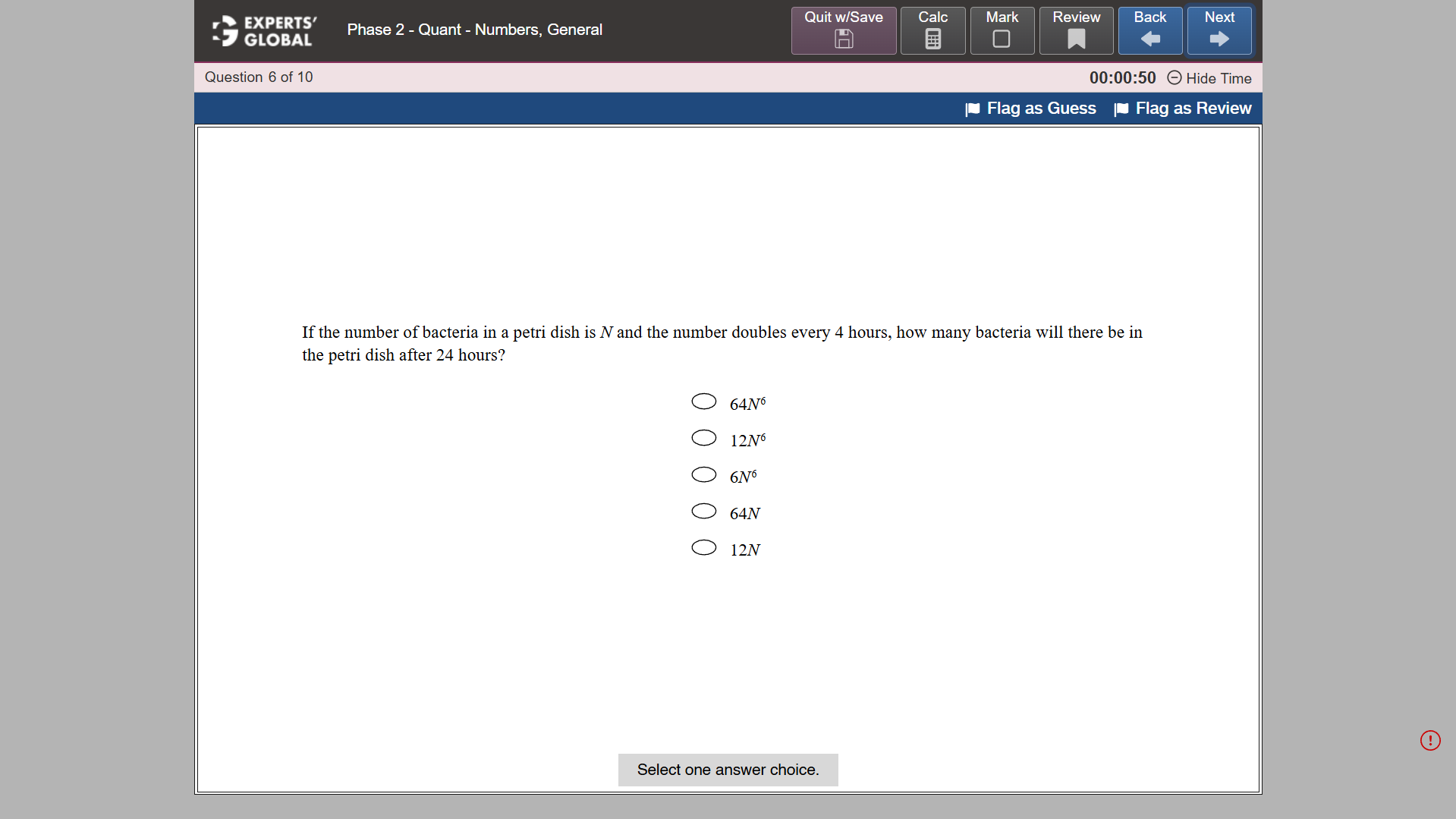
If the number of bacteria in a petri dish is N and the number doubles every 4 hours, how many bacteria will there be in the petri dish after 24 hours?
A. 64N6
B. 12N6
C. 6N6
D. 64N
E. 12N
Written Explanation
The initial number of bacteria in the petri dish is N.
The number of bacteria in the petri dish doubles every 4 hours.
The number of bacteria in the petri dish after 4 hours (1 doubling period) = 2 × N.
The number of bacteria in the petri dish after 8 hours (2 doubling periods) = 2 × 2 × N = 22 × N.
The number of bacteria in the petri dish after 12 hours (3 doubling periods) = 2 × 2 × 2 × N = 23 × N.
Similarly, after 24 hours bacteria in the petri will undergo ( 24 / 4 ) = 6 doubling periods.
Therefore, the number of bacteria in the petri dish after 24 hours = 26 × N = 64N.
D is the correct answer choice.
Additional GRE-style MCQ – Select One Questions with Explanations
Please find a set of GRE-style Quant MCQ – Select One questions with explanations on: Free GRE Quant MCQ – Select One Practice Questions with Solutions
Please find a set of GRE-style Quant questions with explanations on: Free GRE Quant Practice Questions with Solutions
GRE Multiple Choice – Select One or More Practice Questions
This format presents three or more answer choices, of which one or more may be correct. You select all choices that apply, and the response counts as correct only when every selected option matches the complete set of correct answers, with no partial credit. This format contributes to roughly 15% of GRE quantitative reasoning questions.
Practice Question 1 | MCQ – Select One or More
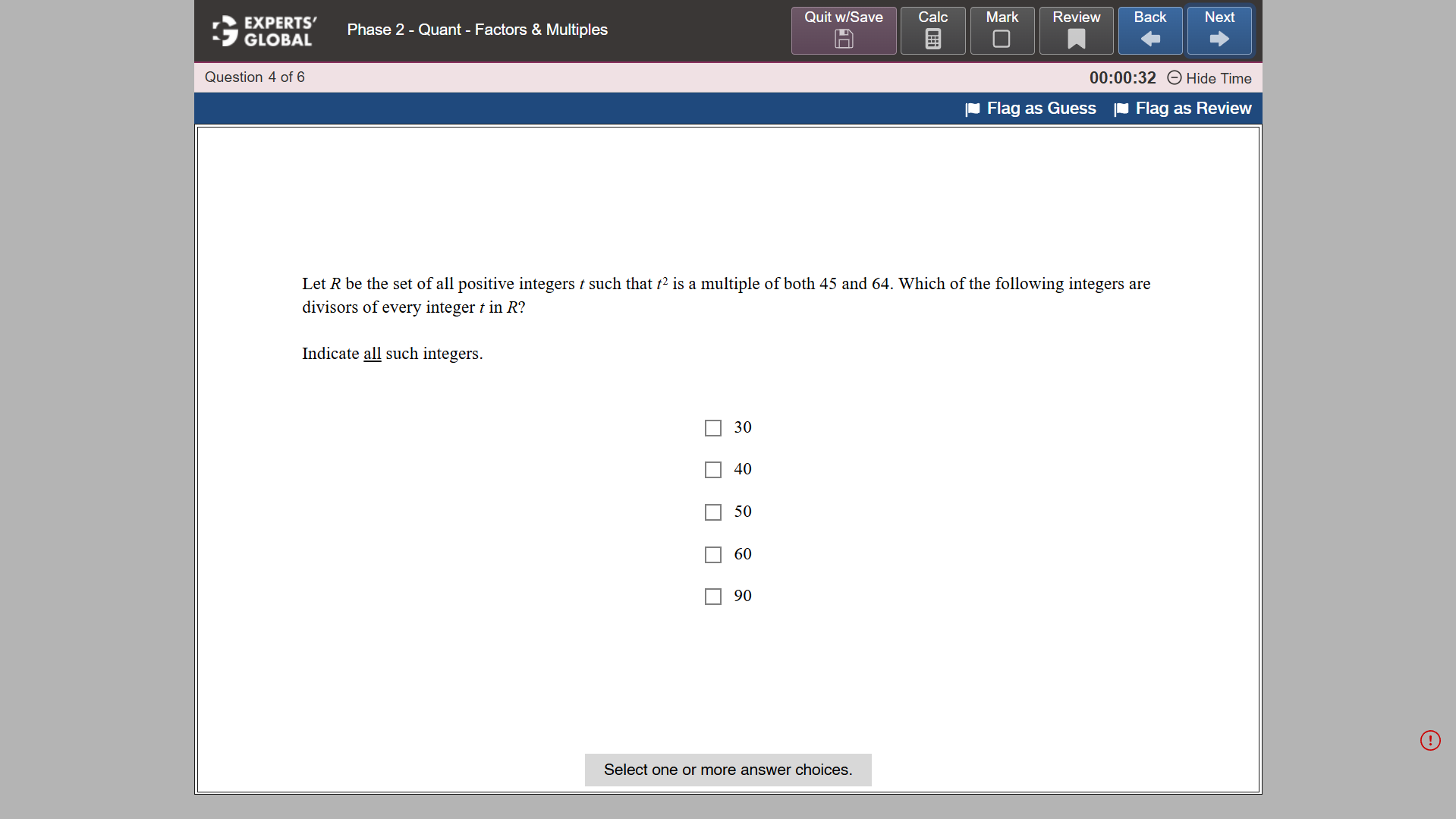
Let R be the set of all positive integers t such that t2 is a multiple of both 45 and 64. Which of the following integers are divisors of every integer t in R?
Indicate all such integers.
A. 30
B. 40
C. 50
D. 60
E. 90
Written Explanation
R is a set of all positive integers t such that t2 is a multiple of both 45 and 64.
We need to determine which of the given integers are divisors of every integer t in R.
Prime factorization of 45 = 32 × 5.
Prime factorization of 64 = 26.
If t2 is a multiple of both 45 and 64, it follows that t2 must also be a multiple of the LCM of 45 and 64.
The LCM of two integers is the product of the highest powers of all primes appearing in their prime factorizations.
LCM(45, 64) = 26 × 32 × 5
Thus, t2 is a multiple of (26 × 32 × 5).
Additionally, since t2 is a square of a positive integer t, the square root of t2 must be an integer.
Therefore, t2 must be of the form k2(26 × 32 × 52), for some positive integer k and the minimum possible value of t2 = 26 × 32 × 52.
Then it follows that, t must be of the form k(23 × 3 × 5), for some positive integer k and the minimum possible value of t = 23 × 3 × 5 = 120.
Thus, set R = {120, 240, 360, 480, …}
The integers that are divisors of every integer t in set R must be divisors of 120.
The divisors of 120 are 1, 2, 3, 4, 5, 6, 8, 10, 12, 15, 20, 24, 30, 40, 60, and 120.
A, B, and D are the correct answer choices.
Practice Question 2 | MCQ – Select One or More
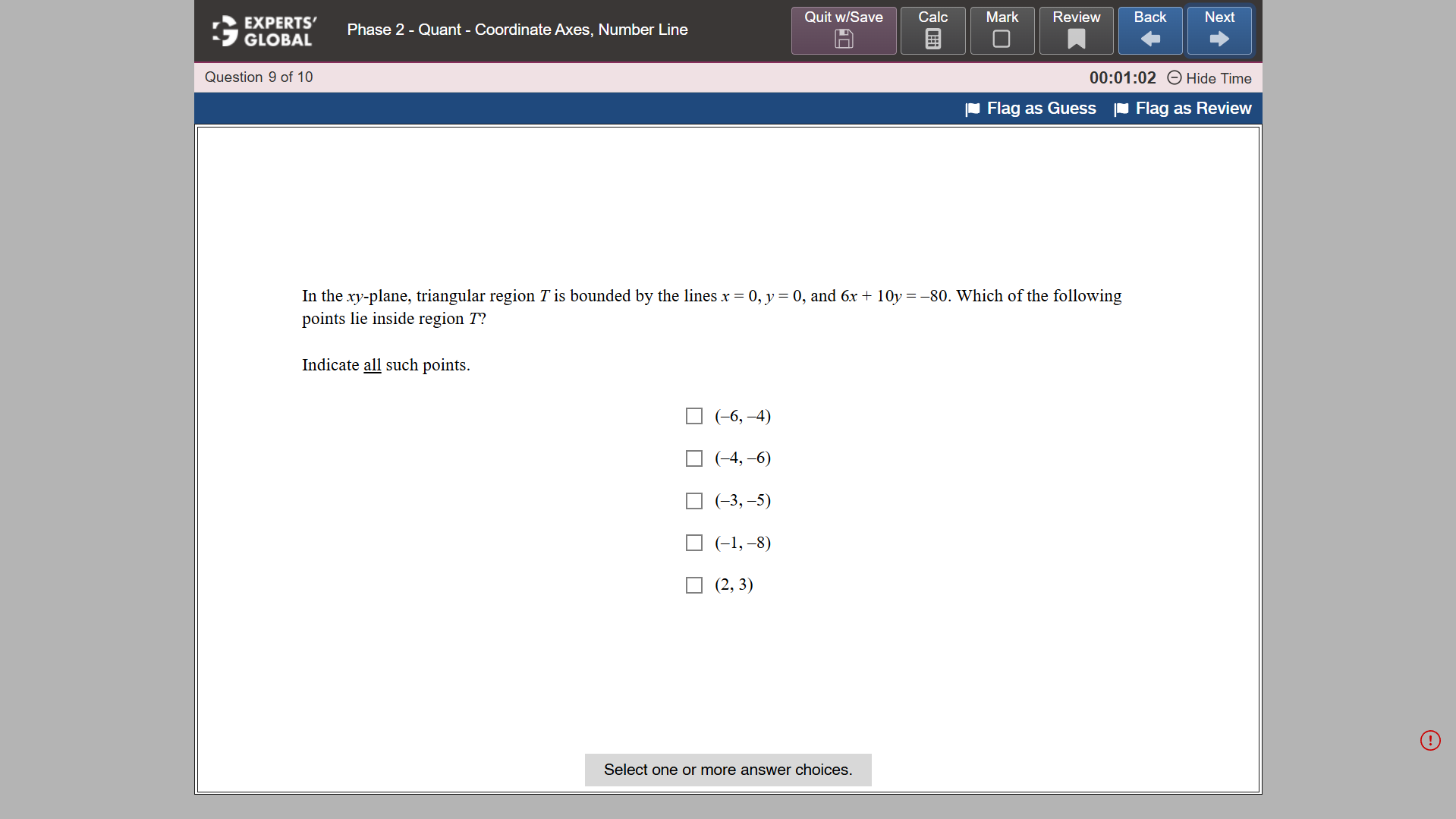
In the xy-plane, triangular region T is bounded by the lines x = 0, y = 0, and 6x + 10y = –80. Which of the following points lie inside region T?
Indicate all such points.
A. (–6, –4)
B. (–4, –6)
C. (–3, –5)
D. (–1, –8)
E. (2, 3)
Written Explanation
The triangular region T is bounded by the lines x = 0, y = 0, and 6x + 10y = –80.
From the explanation diagram above, we see that the points that lie inside region T will satisfy the following conditions x < 0, y < 0, and 6x + 10y > –80.
We need to determine which of the given points lie inside region T.
A. (–6, –4)
x-coordinate (–6) < 0
y-coordinate (–4) < 0
6x + 10y = 6(–6) + 10(–4) = –76 > –80
Hence, this point lies inside region T.
B. (–4, –6)
6x + 10y = 6(–4) + 10(–6) = –84 < –80
Hence, this point lies outside region T.
C. (–3, –5)
x-coordinate (–3) < 0
y-coordinate (–5) < 0
6x + 10y = 6(–3) + 10(–5) = –68 > –80
Hence, this point lies inside region T.
D. (–1, –8)
6x + 10y = 6(–1) + 10(–8) = –86 < –80
Hence, this point lies outside region T.
E. (2, 3)
x-coordinate (2) > 0
Hence, this point lies outside region T.
A and C are the correct answer choices.
Practice Question 3 | MCQ – Select One or More
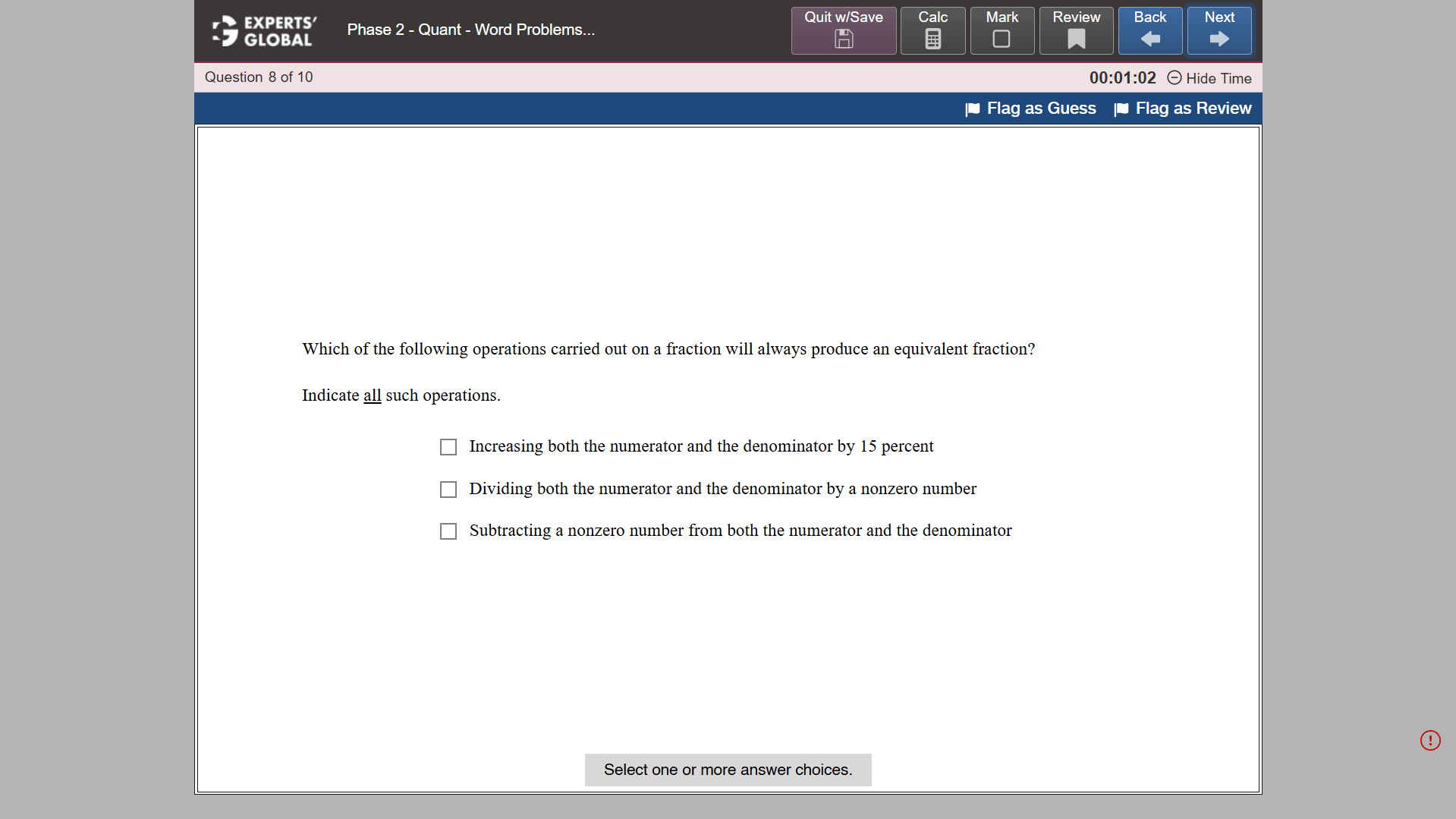
Which of the following operations carried out on a fraction will always produce an equivalent fraction?
Indicate all such operations.
A. Increasing both the numerator and the denominator by 15 percent
B. Dividing both the numerator and the denominator by a nonzero number
C. Subtracting a nonzero number from both the numerator and the denominator
Written Explanation
Let the numerator and the denominator of the fraction be N and D, respectively.
The original fraction = N / D
We need to determine which of the given operations carried out on a fraction will always produce an equivalent fraction.
A. Increasing both the numerator and the denominator by 15 percent
New fraction = 1.15N / 1.15D
Dividing the numerator and the denominator by 1.15, we get;
New fraction = N / D = Original fraction
Hence, this is a correct answer choice.
B. Dividing both the numerator and the denominator by a nonzero number
Let the nonzero number be k.
New fraction = N / k / D / k
Multiplying the numerator and the denominator by k, we get;
New fraction = N / D = Original fraction
Hence, this is a correct answer choice.
C. Subtracting a nonzero number from both the numerator and the denominator
Let the nonzero number be k.
New fraction = N – k / D – k
The new fraction would be equal to the original fraction only when N = D and n ≠ 0.
In all other cases, the new fraction ≠ original fraction.
Hence, this answer choice is incorrect.
A and B are the correct answer choices.
Additional GRE-style MCQ – Select One or More Questions with Explanations
Please find a set of GRE-style Quant MCQ – Select One or More questions with explanations on: Free GRE Quant MCQ – Select One or More Practice Questions with Solutions
Please find a set of GRE-style Quant MCQ – Select One or More questions with explanations on: Free GRE Quant MCQ – Select One or More Practice Questions Prep
GRE Data Interpretation Practice Questions
The GRE includes one data interpretation set in quantitative reasoning, with three questions tied to a shared data source, usually one or two charts. These questions appear in multiple choice, select one, select one or more, or numeric entry formats, while quantitative comparison does not appear in these sets. Data interpretation forms about 10% of the measure and about 25% of the first quantitative section, which shapes the difficulty of the second section and influences the overall score. Following is a sample GRE-style DI set for practice.
Important: Before attempting the GRE Data Interpretation practice questions, if you would like to undergo detailed DI prep, please visit Free GRE Data Interpretation prep
Practice Question 1 | Data Interpretation
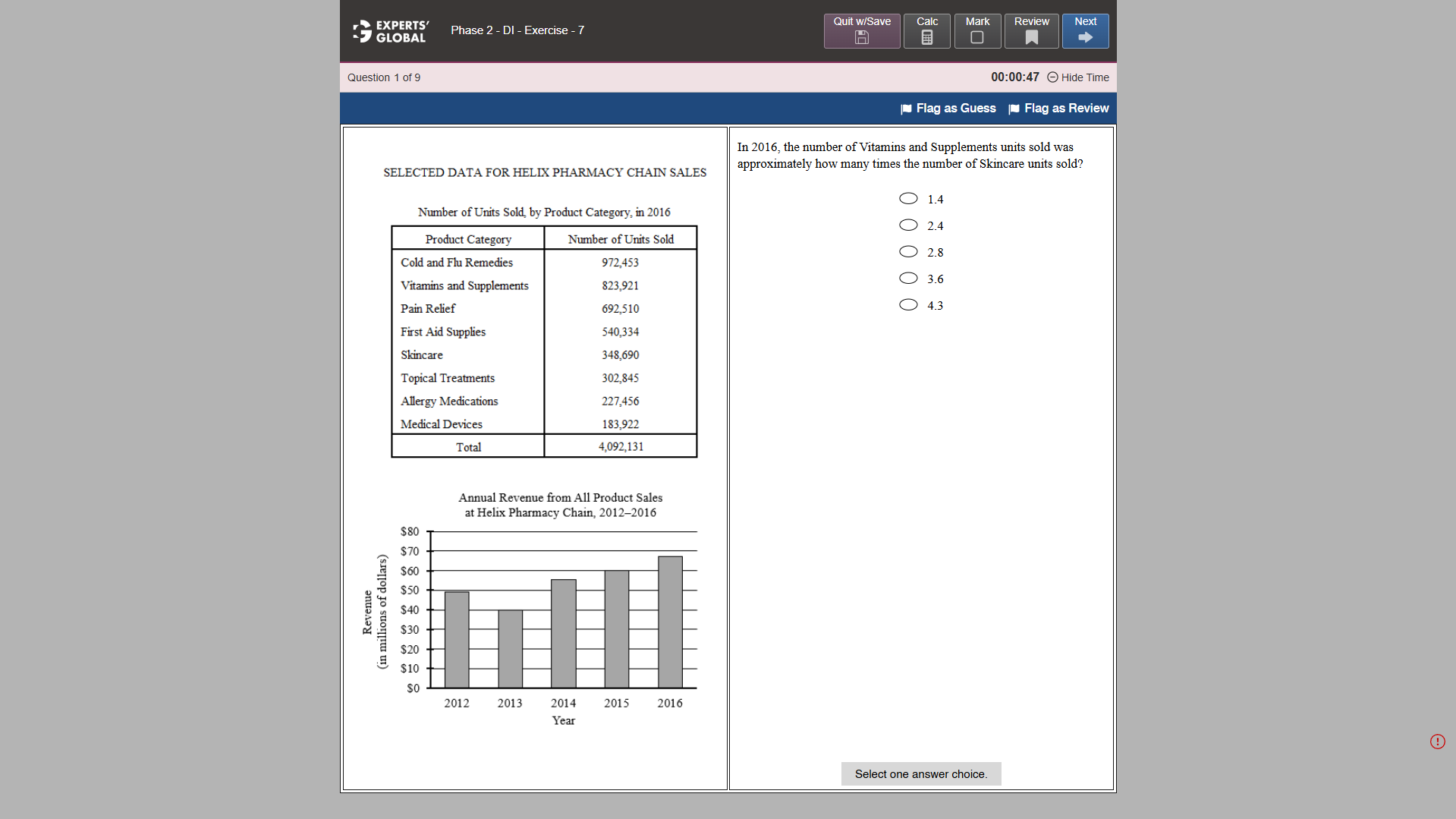
In 2016, the number of Vitamins and Supplements units sold was approximately how many times the number of Skincare units sold?
A. 1.4
B. 2.4
C. 2.8
D. 3.6
E. 4.3
Written Explanation
The table shows the number of units sold in 2016.
The Vitamins and Supplements units sold in 2016 = 823,921.
The Skincare units sold in 2016 = 348,690.
The ratio of the number of Vitamins and Supplements units sold to the number of Skincare units sold = 823,921 / 348,690 ≈ 2.4.
Hence, the number of Vitamins and Supplements units sold was approximately 2.4 times the number of Skincare units sold.
B is the correct answer choice.
Practice Question 2 | Data Interpretation
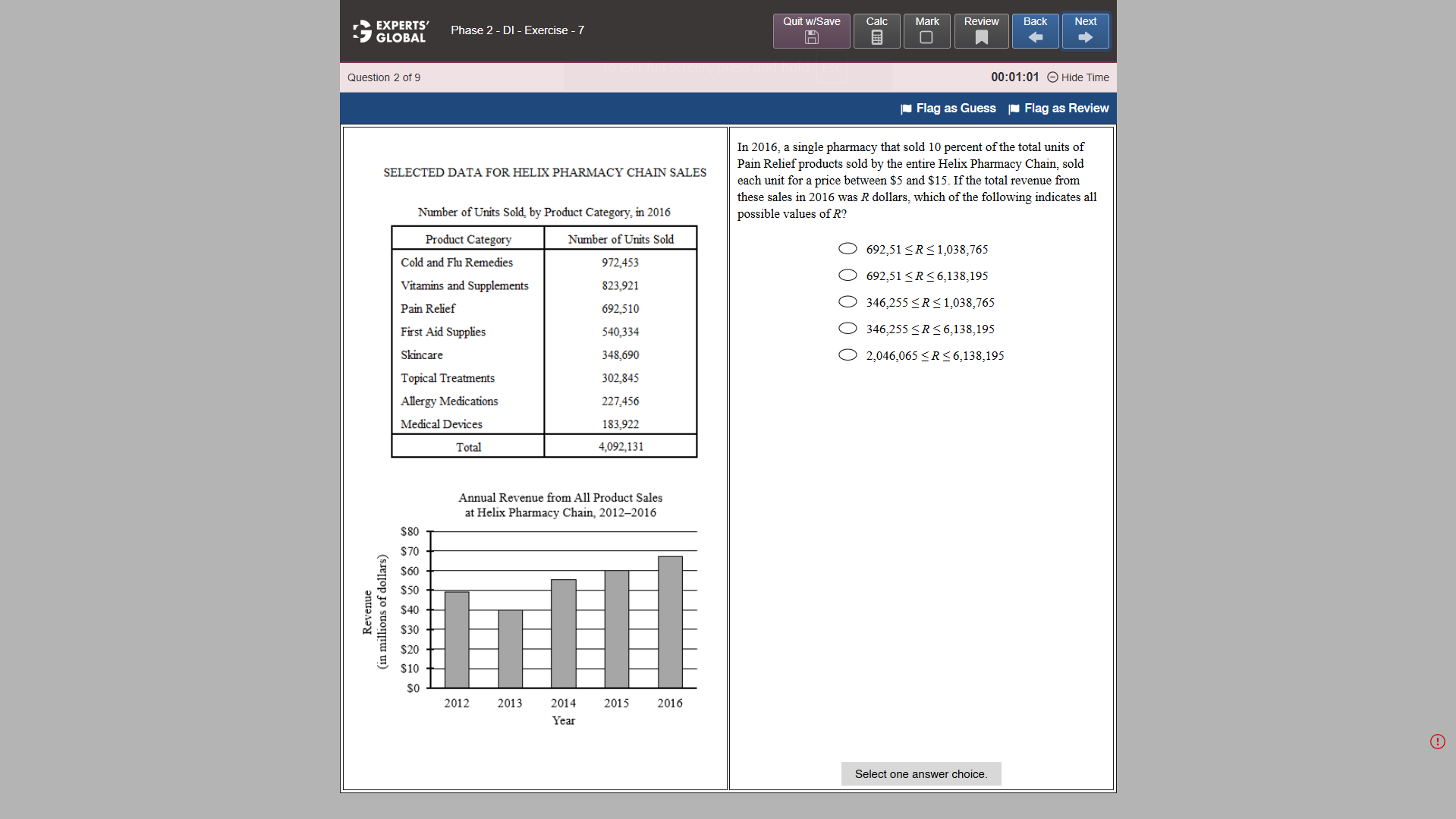
In 2016, a single pharmacy that sold 10 percent of the total units of Pain Relief products sold by the entire Helix Pharmacy Chain, sold each unit for a price between $5 and $15. If the total revenue from these sales in 2016 was R dollars, which of the following indicates all possible values of R?
A. 692,51 ≤ R ≤ 1,038,765
B. 692,51 ≤ R ≤ 6,138,195
C. 346,255 ≤ R ≤ 1,038,765
D. 346,255 ≤ R ≤ 6,138,195
E. 2,046,065 ≤ R ≤ 6,138,195
Written Explanation
The table shows the total number of pain relief products sold in 2016 = 692,510.
The pharmacy sold 10 percent of the total units of Pain Relief products.
This implies that the number of units of Pain Relief products sold by the pharmacy = 10% of 692,510 = 69,251.
Each Pain Relief unit was sold for a price between $5 and $15.
Thus, the minimum possible revenue from these Pain Relief products sold in 2016 = 69,251 × $5 = $346,255.
Similarly, the maximum possible revenue from these Pain Relief products sold in 2016 = 69,251 × $15 = $1,038,765.
Hence, the range 346,255 ≤ R ≤ 1,038,765 indicates all possible values of R.
C is the correct answer choice.
Practice Question 3 | Data Interpretation
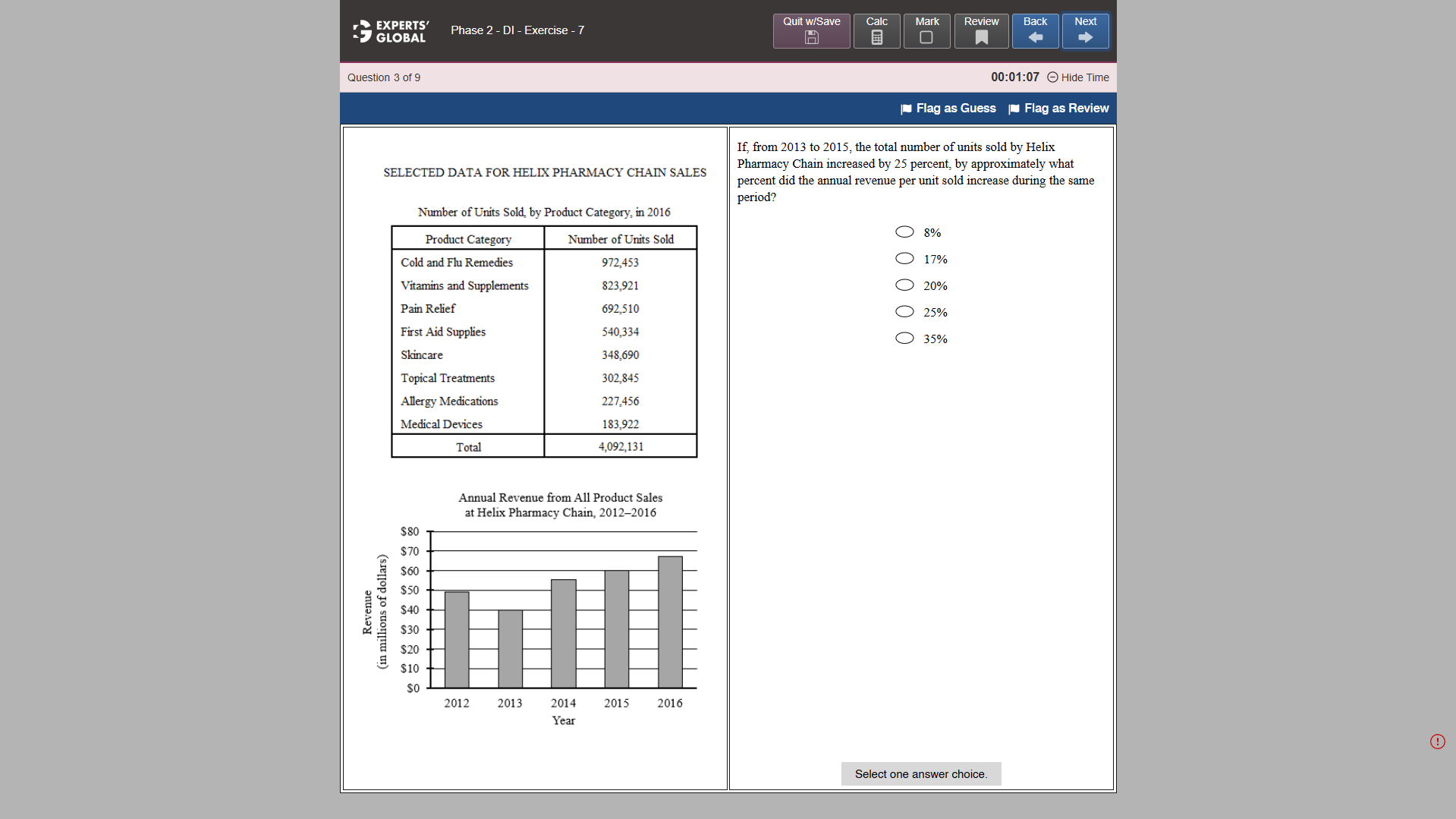
If, from 2013 to 2015, the total number of units sold by Helix Pharmacy Chain increased by 25 percent, by approximately what percent did the annual revenue per unit sold increase during the same period?
A. 8%
B. 17%
C. 20%
D. 25%
E. 35%
Written Explanation
Let the total number of units sold by Helix Pharmacy Chain in 2013 be N.
The bar graph shows that the annual revenue in 2013 = $40 million.
Thus, the annual revenue per unit sold in 2013 = ($40 million) / N.
The total number of units sold by Helix Pharmacy Chain increased by 25 percent from 2013 to 2015.
Thus, the total number of units sold by Helix Pharmacy Chain in 2015 = 1.25N.
The bar graph shows that the annual revenue in 2015 = $60 million.
Thus, the annual revenue per unit sold in 2015 = ($60 million) / 1.25N .
Required percentage change
= [(The annual revenue per unit sold in 2015) – (The annual revenue per unit sold in 2013)] / (The annual revenue per unit sold in 2013)
= [ ($60 million) / 1.25N – ($40 million) / N ] / ($40 million) / N
= [ $48 million / N– $40 million / N ] / $40 million / N
Multiplying the numerator and denominator by N, we get;
= [($48 million) – ($40 million)] / ($40 million)
= ($8 million) / ($40 million)
≈ 20%
Hence, from 2013 to 2015, the annual revenue per unit sold increased by approximately 20%.
C is the correct answer choice.
Additional GRE-style Numeric Entry Questions with Explanations:
Please find a set of GRE-style DI questions with explanations on: Free GRE Data Interpretation Practice Questions with Solutions
Please find a set of 12 GRE-style DI questions with explanations on: Free GRE Data Interpretation 12 Practice Questions with Solutions
GRE Sentence Equivalence Practice Questions
Each GRE Sentence Equivalence question presents one sentence with two blanks and requires you to select two choices that produce the same meaning in context. You receive credit only when both responses are correct, with no partial credit. These questions account for roughly 25% of the GRE Verbal Reasoning measure. Vocabulary is involved, but the task primarily evaluates reasoning through context and word relationships. Following is a GRE-style set of sentence equivalence practice questions with explanation.
Important: Before attempting the GRE Sentence Equivalence practice questions, if you would like to undergo detailed SE prep, please visit Free GRE Sentence Equivalence prep
Practice Question 1 | SE
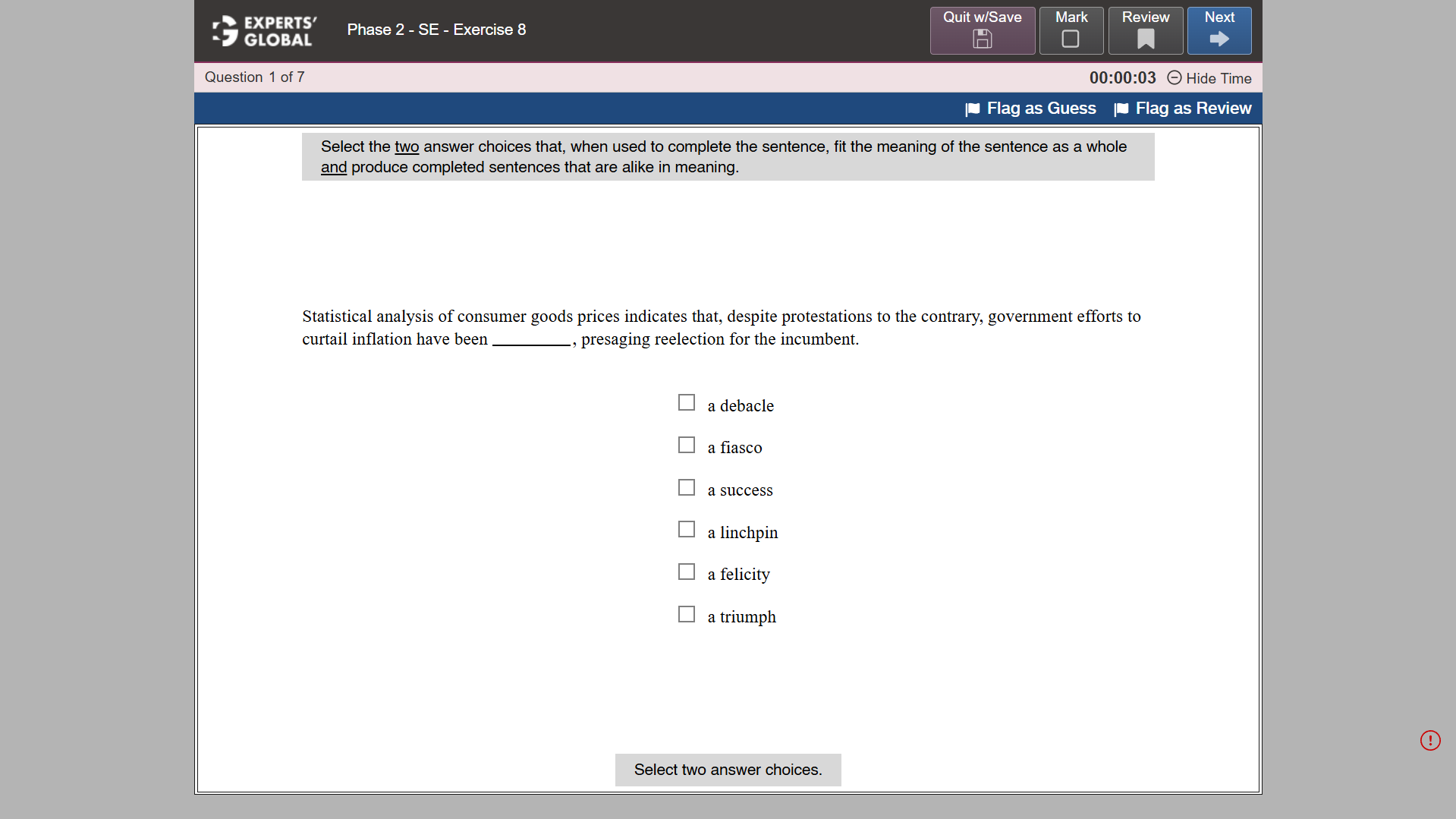
Statistical analysis of consumer goods prices indicates that, despite protestations to the contrary, government efforts to curtail inflation have been _____, presaging reelection for the incumbent.
A. a debacle
B. a fiasco
C. a success
D. a linchpin
E. a felicity
F. a triumph
Written Explanation
The intended core meaning of the sentence: That government efforts to control inflation have been successful, signaling reelection for the office-bearer.
Reasoning around the blank space: The catch for filling the blank in this sentence lies in identifying the cause-effect relationship expressed in the usage “…government EFFORTS to curtail inflation have been _____, PRESAGING REELECTION for…incumbent”, which implies positive efforts resulting in a positive outcome for the government; this causal connection suggests that the sentence intends to convey that statistical analysis of consumer goods prices indicates that government efforts to control inflation have been successful, signaling reelection for the incumbent. Hence, for the blank, we need a word that conveys the idea of the government efforts to curtail inflation being “successful”.
Broad expectation from the correct answer choices: A pair of words conveying the idea of being “successful” or “an achievement”.
A. This answer choice, “a debacle”, meaning “a sudden and complete failure or collapse”, is opposite to our broad expectation from the correct answer choice, which is to convey the idea of being “successful” or “an achievement”. Hence, this answer choice is incorrect.
B. This answer choice, “a fiasco”, meaning “a disaster” or “a catastrophe”, is opposite to our broad expectation from the correct answer choice, which is to convey the idea of being “successful” or “an achievement”. Hence, this answer choice is incorrect.
C. Correct. This answer choice, “a success”, meaning “the attainment of a goal”, matches our broad expectation from the correct answer choice, which is to convey the idea of being “successful” or “an achievement”. Hence, this answer choice is correct.
D. This answer choice, “a linchpin”, meaning “a source of support and stability”, does not match our broad expectation from the correct answer choice, which is to convey the idea of being “successful” or “an achievement”. Hence, this answer choice is incorrect.
E. This answer choice, “a felicity”, meaning “a pleasing and appropriate style”, does not match our broad expectation from the correct answer choice, which is to convey the idea of being “successful” or “an achievement”. Hence, this answer choice is incorrect.
F. Correct. This answer choice, “a triumph”, meaning “a great victory or success”, matches our broad expectation from the correct answer choice, which is to convey the idea of being “successful” or “an achievement”. Hence, this answer choice is correct.
Thus, C and F are the correct answer choices.
Practice Question 2 | SE
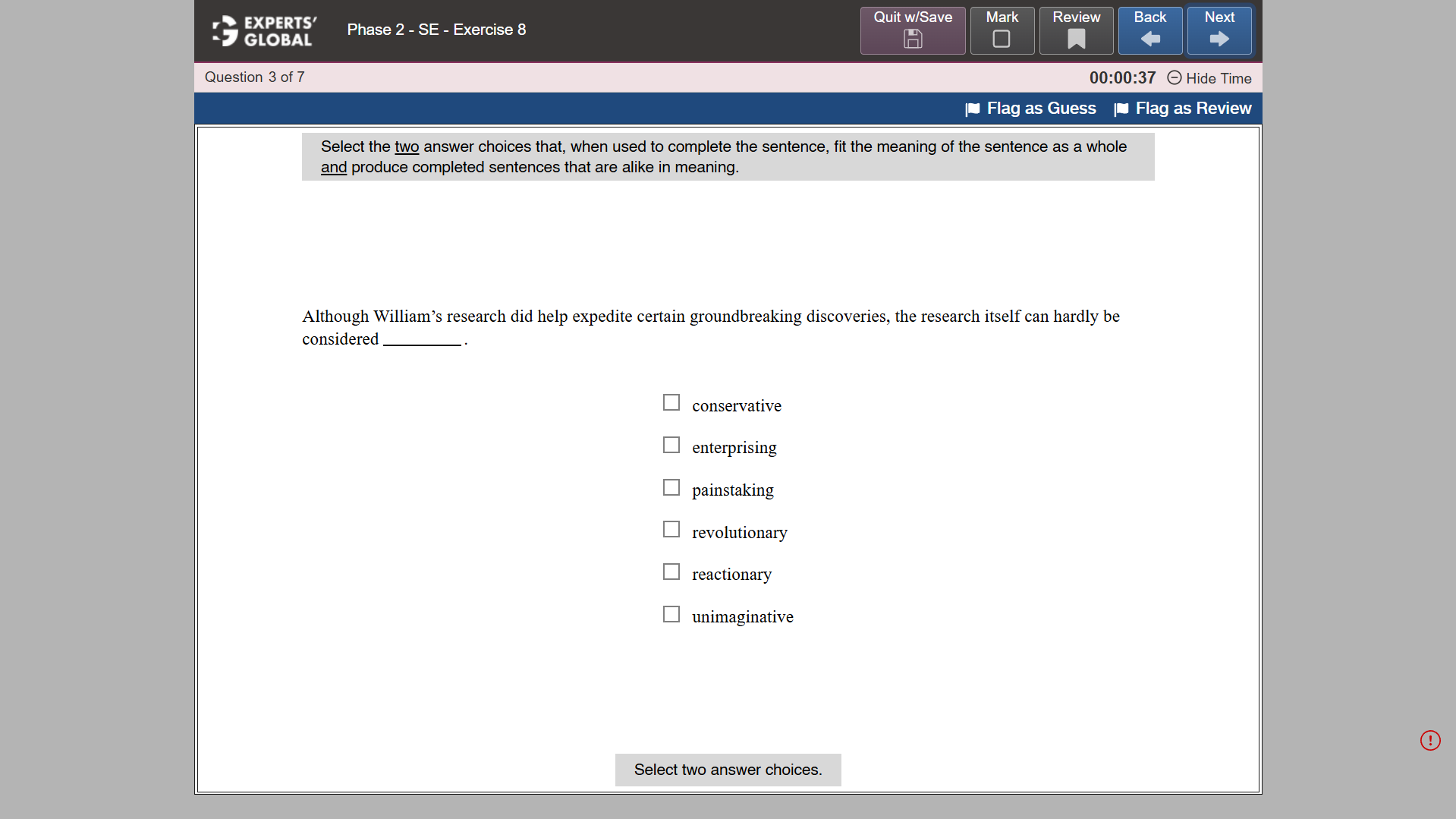
Although William’s research did help expedite certain groundbreaking discoveries, the research itself can hardly be considered _____.
A. conservative
B. enterprising
C. painstaking
D. revolutionary
E. reactionary
F. unimaginative
Written Explanation
The intended core meaning of the sentence: That despite the fact that William’s research did help speed up certain groundbreaking discoveries, the research itself can hardly be considered pathbreaking.
Reasoning around the blank space: The catch for filling the blank in this sentence lies in identifying the contrast in the usage “ALTHOUGH William’s research… EXPEDITE certain GROUNDBREAKING discoveries, the research…can HARDLY be considered _____”, which implies a significant difference between the initial impression and the actual assessment of the research; this contrast suggests that the sentence intends to convey that despite the fact that William’s research did help speed up certain groundbreaking discoveries, the research itself can hardly be considered pathbreaking. Hence, for the blank, we need a word that conveys the idea of the research being hardly considered “pathbreaking”.
Broad expectation from the correct answer choices: A pair of words conveying the idea of being “pathbreaking” or “innovative”.
A. This answer choice, “conservative”, meaning “resistant to change” or “unimaginatively conventional”, is opposite to our broad expectation from the correct answer choice, which is to convey the idea of being “pathbreaking” or “innovative”. Hence, this answer choice is incorrect.
B. Correct. This answer choice, “enterprising”, meaning “marked by initiative to undertake new projects”, matches our broad expectation from the correct answer choice, which is to convey the idea of being “pathbreaking” or “innovative”. Hence, this answer choice is correct.
C. This answer choice, “painstaking”, meaning “characterized by extreme care”, does not match our broad expectation from the correct answer choice, which is to convey the idea of being “pathbreaking” or “innovative”. Hence, this answer choice is incorrect.
D. Correct. This answer choice, “revolutionary”, meaning “markedly new” or “introducing fundamental change”, matches our broad expectation from the correct answer choice, which is to convey the idea of being “pathbreaking” or “innovative”. Hence, this answer choice is correct.
E. Trap. This answer choice, “reactionary”, meaning “opposed to progress or reform”, is opposite to our broad expectation from the correct answer choice, which is to convey the idea of being “pathbreaking” or “innovative”. Hence, this answer choice is incorrect.
F. This answer choice, “unimaginative”, meaning “dull” or “not readily using imagination”, is opposite to our broad expectation from the correct answer choice, which is to convey the idea of being “pathbreaking” or “innovative”. Hence, this answer choice is incorrect.
Thus, B and D are the correct answer choices.
Practice Question 3 | SE
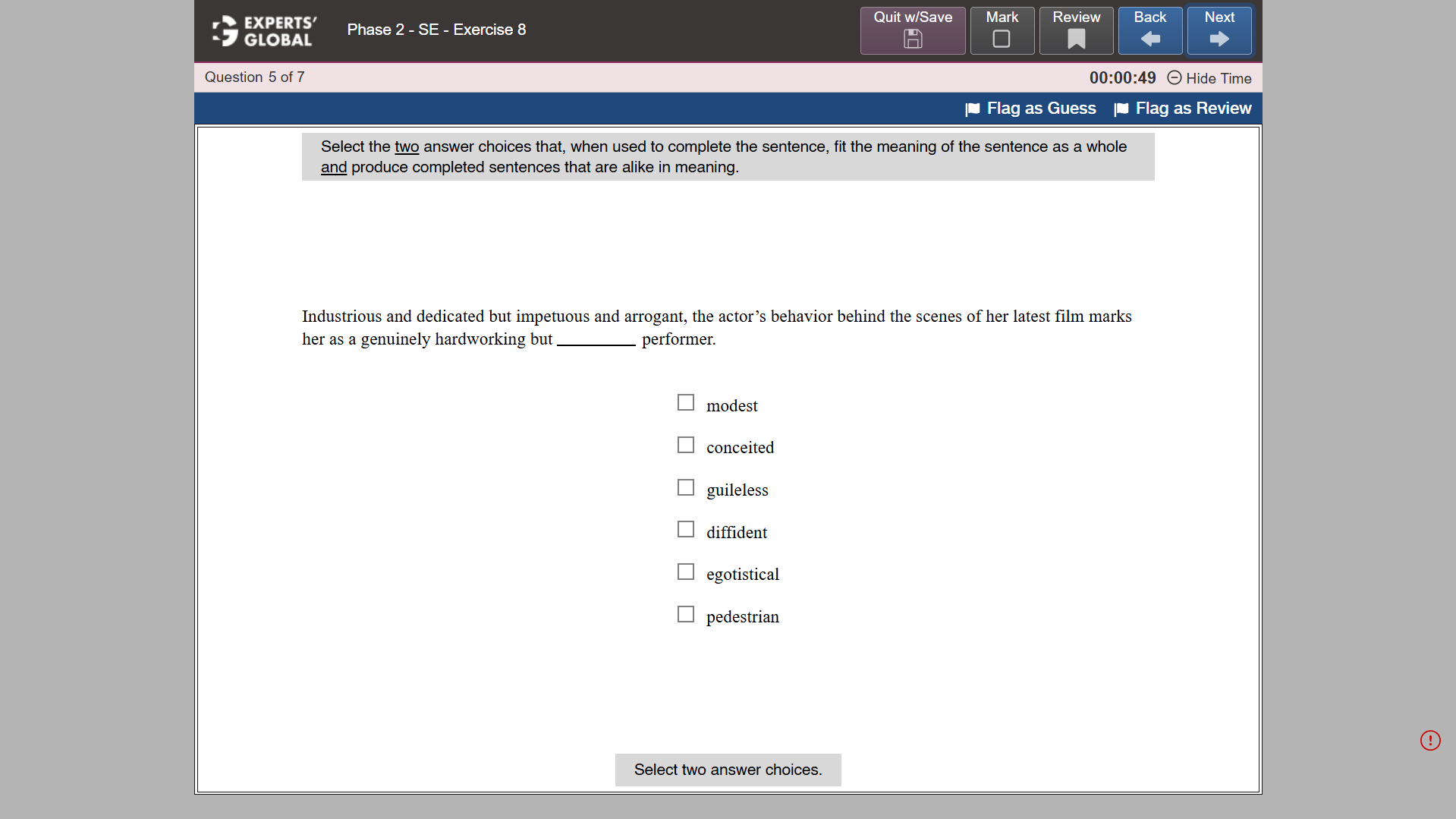
Industrious and dedicated but impetuous and arrogant, the actor’s behavior behind the scenes of her latest film marks her as a genuinely hardworking but _____ performer.
A. modest
B. conceited
C. guileless
D. diffident
E. egotistical
F. pedestrian
Written Explanation
The intended core meaning of the sentence: That the actor’s behavior, behind the scenes of her latest film, marks her as a genuinely hardworking but arrogant performer.
Reasoning around the blank space: The catch for filling the blank in this sentence lies in identifying the continuation of thought in the usage “INDUSTRIOUS and DEDICATED but IMPETUOUS and ARROGANT, the actor’s behavior…genuinely HARDWORKING but ___ performer”, which implies the presence of negative qualities in the actor along with positive ones; this continuation of thought suggests that the sentence intends to convey that although the actor is genuinely hardworking, she is also an arrogant performer. Hence, for the blank, we need a word that conveys the idea of the actor being an “arrogant” performer.
Broad expectation from the correct answer choices: A pair of words conveying the idea of being “arrogant”.
A. This answer choice, “modest”, meaning “humble” or “marked by simplicity”, is opposite to our broad expectation from the correct answer choice, which is to convey the idea of being “arrogant”. Hence, this answer choice is incorrect.
B. Correct. This answer choice, “conceited”, meaning “excessively proud of oneself” or “self-important”, matches our broad expectation from the correct answer choice, which is to convey the idea of being “arrogant”. Hence, this answer choice is correct.
C. This answer choice, “guileless”, meaning “innocent and without deception”, does not match our broad expectation from the correct answer choice, which is to convey the idea of being “arrogant”. Hence, this answer choice is incorrect.
D. This answer choice, “diffident”, meaning “shy” or “lacking self-confidence”, is opposite to our broad expectation from the correct answer choice, which is to convey the idea of being “arrogant”. Hence, this answer choice is incorrect.
E. Correct. This answer choice, “egotistical”, meaning “self-centred” or “self-loving”, matches our broad expectation from the correct answer choice, which is to convey the idea of being “arrogant”. Hence, this answer choice is correct.
F. This answer choice, “pedestrian”, meaning “lacking wit or imagination”, does not match our broad expectation from the correct answer choice, which is to convey the idea of being “arrogant”. Hence, this answer choice is incorrect.
Thus, B and E are the correct answer choices.
Additional GRE-style Sentence Equivalence Questions with Explanations
Please find a set of GRE-style SE questions with explanations on: Free GRE Sentence Equivalence Practice Questions with Solutions
Please find a set of assorted GRE-style Verbal questions (all types) with explanations on: Free GRE Verbal Practice Questions with Solutions
GRE Text Completion – One-Blank Practice Questions
Each GRE Text Completion one blank question presents a sentence with a single missing word and requires you to choose the option that best completes the meaning of the text. You receive credit only when the selected choice fits the full context of the passage. Vocabulary is involved, but the task primarily evaluates reasoning through context and logical flow. These questions contribute roughly 10% of the GRE Verbal Reasoning measure. Following is a GRE-style set of sample SE practice questions with solution.
Important: Before attempting the GRE Text Completion practice questions, if you would like to undergo detailed TC prep, please visit Free GRE Text Completion prep
Practice Question 1 | TC 1-Blank
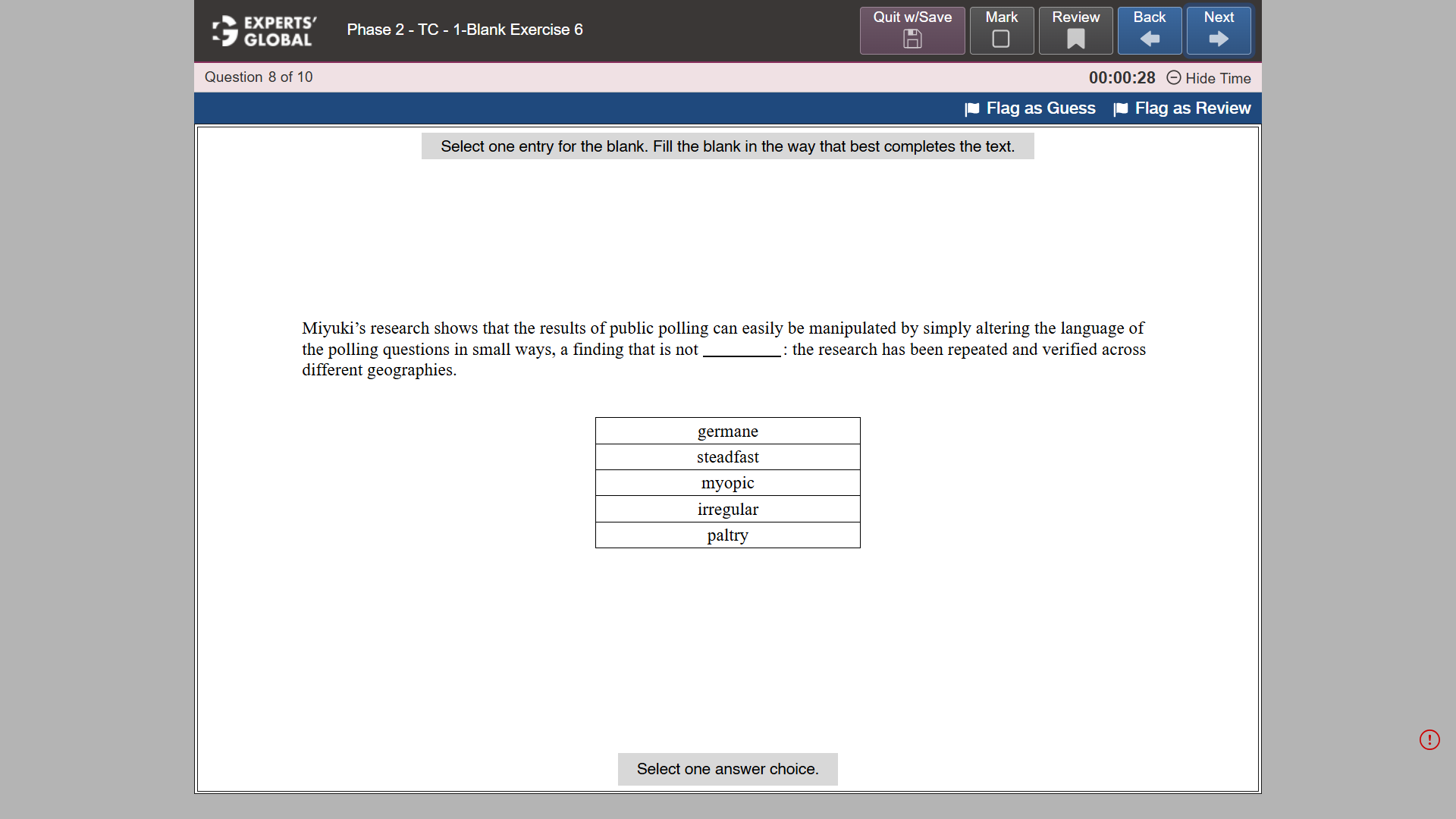
Miyuki’s research shows that the results of public polling can easily be manipulated by simply altering the language of the polling questions in small ways, a finding that is not _____: the research has been repeated and verified across different geographies.
A. germane
B. steadfast
C. myopic
D. irregular
E. paltry
Written Explanation
The intended core meaning of the sentence: That the research’s finding is not incorrect as it has been verified across different geographies.
Reasoning around the blank space: The catch for filling the blank in this sentence lies in identifying the continuation of thought in the usage “…research shows…public polling can…easily…MANIPULATED by…altering language…a FINDING that is NOT _____: the research…been REPEATED and VERIFIED across DIFFERENT GEOGRAPHIES”, which elaborates on the evidence supporting the assertion; this continuation of thought suggests that the sentence intends to convey that Miyuki’s research shows that the results of public polling can easily be influenced by simply changing the language of the polling questions in small ways, a finding that is not incorrect, as the research has been repeated and verified across different geographies. Hence, for the blank, we need a word that conveys the idea of the finding not being “incorrect”.
Broad expectation from the correct answer choice: A word conveying the idea of being “incorrect”.
A. This answer choice, “germane”, meaning “relevant” or “appropriate”, does not match our broad expectation from the correct answer choice, which is to convey the idea of being “incorrect”. Hence, this answer choice is incorrect.
B. This answer choice, “steadfast”, meaning “dependable” or “reliable”, is opposite to our broad expectation from the correct answer choice, which is to convey the idea of being “incorrect”. Hence, this answer choice is incorrect.
C. Trap. This answer choice, “myopic”, meaning “focusing only on immediate concerns” or “nearsighted”, does not match our broad expectation from the correct answer choice, which is to convey the idea of being “incorrect”. Hence, this answer choice is incorrect.
D. Correct. This answer choice, “irregular”, meaning “contrary to accepted order” or “uneven”, matches our broad expectation from the correct answer choice, which is to convey the idea of being “incorrect”. Hence, this answer choice is correct.
E. This answer choice, “paltry”, meaning “very small” or “unimportant”, does not match our broad expectation from the correct answer choice, which is to convey the idea of being “incorrect”. Hence, this answer choice is incorrect.
Thus, D is the correct answer choice.
Practice Question 2 | TC 1-Blank
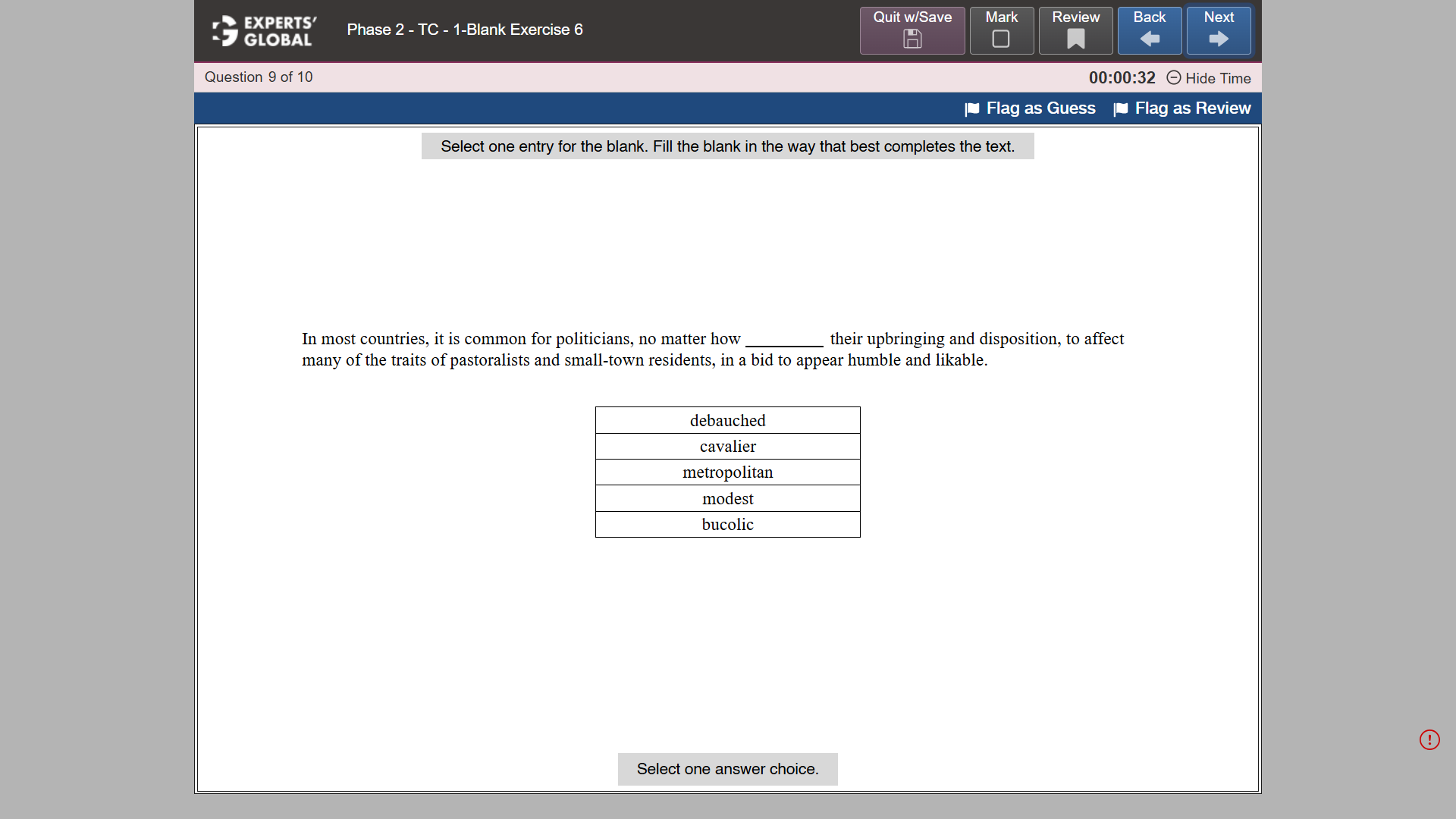
In most countries, it is common for politicians, no matter how _____ their upbringing and disposition, to affect many of the traits of pastoralists and small-town residents, in a bid to appear humble and likable.
A. debauched
B. cavalier
C. metropolitan
D. modest
E. bucolic
Written Explanation
The intended core meaning of the sentence: That in most countries, despite having an urban background, politicians often act like humble villagers to cultivate a mass appeal.
Reasoning around the blank space: The catch for filling the blank in this sentence lies in identifying the contrast in the usage “…it is common for politicians, NO MATTER how _____ their UPBRINGING…AFFECT…traits of PASTORALISTS and…to APPEAR HUMBLE…”, which implies a difference between the politicians’ origins and their seeming persona; this contrast suggests that the sentence intends to convey that in most countries, it is common for politicians, no matter how urban their upbringing and temperament, to act like farmers and small-town residents, in an attempt to appear humble and likable. Hence, for the blank, we need a word that conveys the idea of politicians having an “urban” upbringing and disposition.
Broad expectation from the correct answer choice: A word conveying the idea of being “urban” or “sophisticated”.
A. This answer choice, “debauched”, meaning “morally corrupt” or “unrestrained”, does not match our broad expectation from the correct answer choice, which is to convey the idea of being “urban” or “sophisticated”. Hence, this answer choice is incorrect.
B. This answer choice, “cavalier”, meaning “showing a lack of proper concern or respect”, does not match our broad expectation from the correct answer choice, which is to convey the idea of being “urban” or “sophisticated”. Hence, this answer choice is incorrect.
C. Correct. This answer choice, “metropolitan”, meaning “relating to a major city”, matches our broad expectation from the correct answer choice, which is to convey the idea of being “urban” or “sophisticated”. Hence, this answer choice is correct.
D. This answer choice, “modest”, meaning “humble” or “inferior in station”, is opposite to our broad expectation from the correct answer choice, which is to convey the idea of being “urban” or “sophisticated”. Hence, this answer choice is incorrect.
E. This answer choice, “bucolic”, meaning “relating to the pleasant aspects of the countryside and rural life”, is opposite to our broad expectation from the correct answer choice, which is to convey the idea of being “urban” or “sophisticated”. Hence, this answer choice is incorrect.
Thus, C is the correct answer choice.
Practice Question 3 | TC 1-Blank
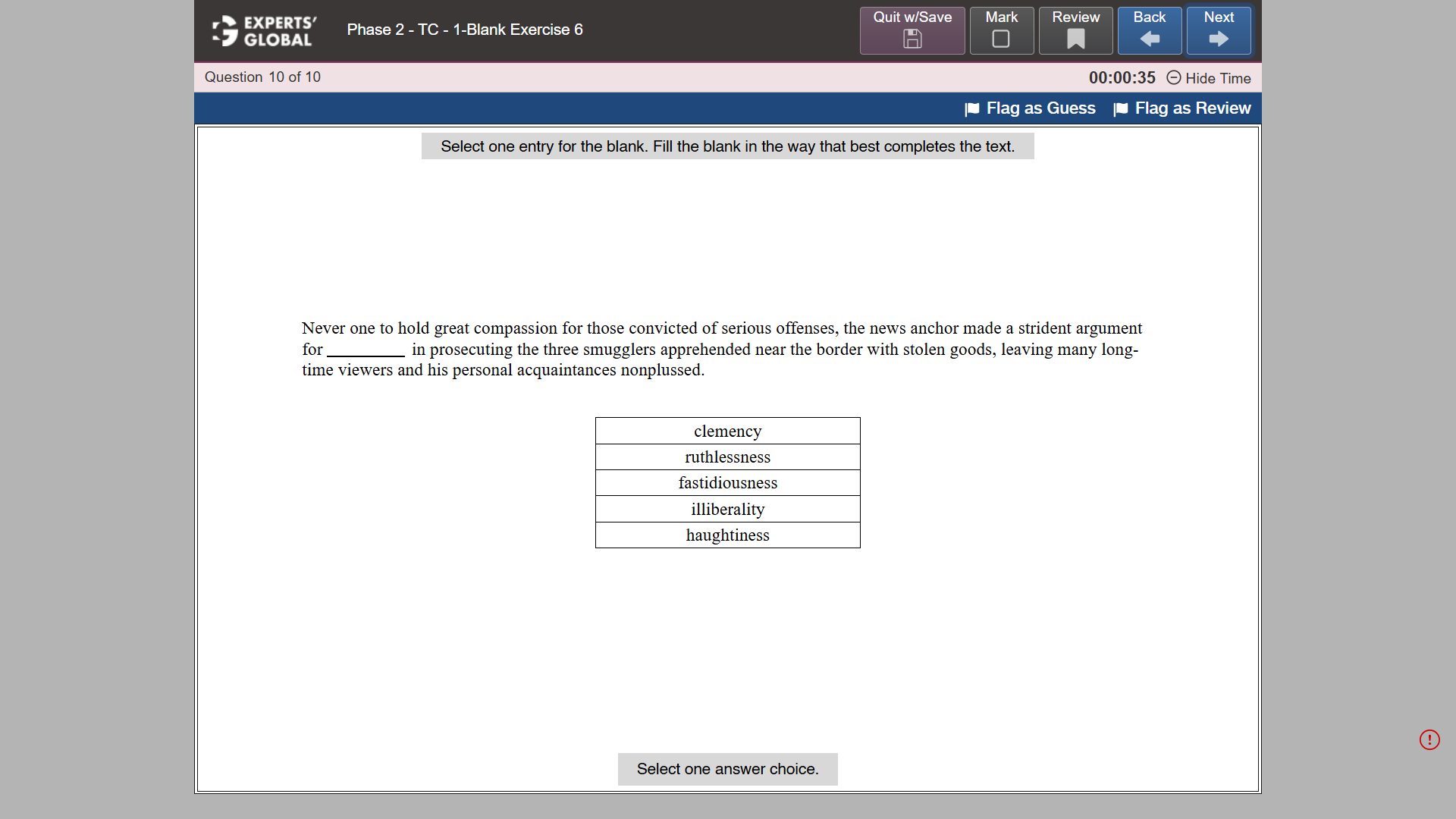
Never one to hold great compassion for those convicted of serious offenses, the news anchor made a strident argument for _____ in prosecuting the three smugglers apprehended near the border with stolen goods, leaving many long-time viewers and his personal acquaintances nonplussed.
A. clemency
B. ruthlessness
C. fastidiousness
D. illiberality
E. haughtiness
Written Explanation
The intended core meaning of the sentence: That though usually tough on offenders, the anchor argued for mercy in prosecuting the three smugglers, leaving audiences puzzled.
Reasoning around the blank space: The catch for filling the blank in this sentence lies in identifying the contrast in the usage “NEVER one to hold…COMPASSION for those CONVICTED of serious offenses…anchor made…STRIDENT ARGUMENT for _____ in prosecuting the THREE SMUGGLERS…leaving many long-time viewers…NONPLUSSED”, which implies a difference between the anchor’s usual attitude and his unexpected argument in the case of the smugglers; this contrast suggests that the sentence intends to convey that though never known to be kind to those sentenced for serious offenses, the news anchor passionately argued for mercy in prosecuting the three smugglers caught with stolen goods near the border, leaving many long-time viewers and his acquaintances puzzled. Hence, for the blank, we need a word that conveys the idea of the news anchor making a strident argument for “mercy” in prosecuting the three smugglers.
Broad expectation from the correct answer choice: A word conveying the idea of “mercy”.
A. Correct. This answer choice, “clemency”, meaning “mercy shown toward someone”, matches our broad expectation from the correct answer choice, which is to convey the idea of “mercy”. Hence, this answer choice is correct.
B. This answer choice, “ruthlessness”, meaning “the quality of being without pity or compassion”, is opposite to our broad expectation from the correct answer choice, which is to convey the idea of “mercy”. Hence, this answer choice is incorrect.
C. This answer choice, “fastidiousness”, meaning “the quality of being very attentive to detail”, does not match our broad expectation from the correct answer choice, which is to convey the idea of “mercy”. Hence, this answer choice is incorrect.
D. This answer choice, “illiberality”, meaning “the tendency to not be generous with money”, does not match our broad expectation from the correct answer choice, which is to convey the idea of “mercy”. Hence, this answer choice is incorrect.
E. This answer choice, “haughtiness”, meaning “an attitude of superiority toward others”, does not match our broad expectation from the correct answer choice, which is to convey the idea of “mercy”. Hence, this answer choice is incorrect.
Thus, A is the correct answer choice.
GRE-style Text Completion One-Blank Questions with Explanations:
Please find a set of GRE-style TC One-blank questions with explanations on: Free GRE Text Completion One-Blank Practice Questions with Solutions
Please find a set of GRE-style TC questions with explanations on: Free GRE Text Completion Practice Questions with Solutions
GRE Text Completion – Two-Blank Practice Questions
Each GRE Text Completion two blank question presents a short passage with two missing words and requires you to choose the pair of options that completes the meaning of the text coherently. You receive credit only when both selected choices are correct, with no partial credit. Vocabulary is involved, but the task primarily evaluates reasoning through context and logical structure. These questions contribute roughly 10% of the GRE Verbal Reasoning measure. Following is a set of GRE-style sample Text Completion two blank practice questions with explanations.
Important: Before attempting the GRE Text Completion 2-blank practice questions, if you would like to undergo detailed prep, please visit Free GRE Text Completion 2-blank prep
Practice Question 1 | TC 2-Blank
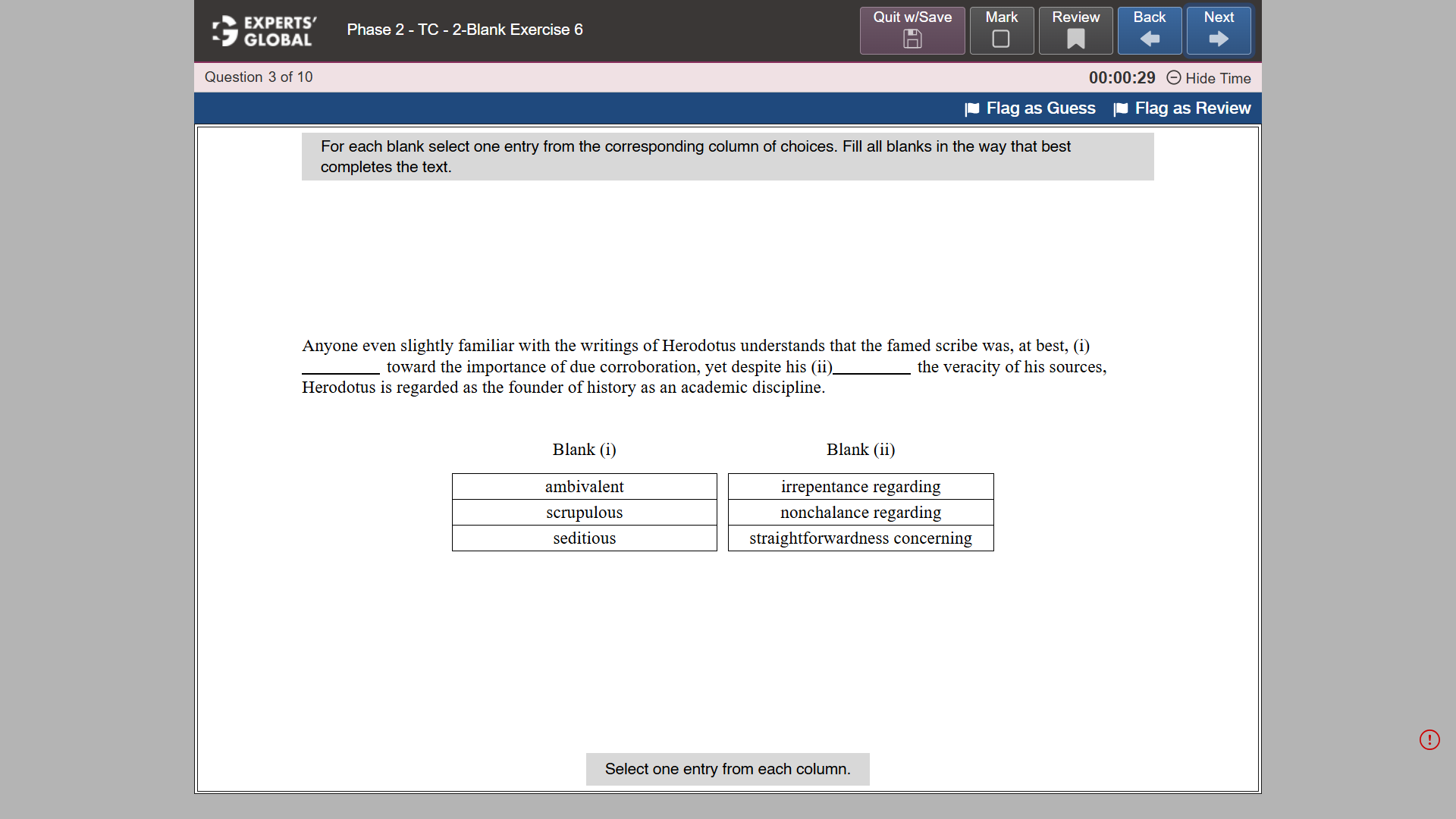
Anyone even slightly familiar with the writings of Herodotus understands that the famed scribe was, at best, (i)_____ toward the importance of due corroboration, yet despite his (ii)_____ the veracity of his sources, Herodotus is regarded as the founder of history as an academic discipline.
Blank (i)
A. ambivalent
B. scrupulous
C. seditious
Blank (ii)
D. irrepentance regarding
E. nonchalance regarding
F. straightforwardness concerning
Written Explanation
Reasoning:
The usage of the clause “Herodotus is regarded as the founder of history as an academic discipline” in conjunction with the contrasting phrase “yet despite his…the veracity of his sources” implies that Herodotus’ attitude toward the “veracity of his sources” should, logically, preclude him from being an esteemed historian; hence, the second blank must refer to a negative quality, likely one that refers to a lack of care or duplicity. Therefore, the most fitting answer choice for blank (ii) is E – “nonchalance regarding”.
The usage of the clause “the famed scribe was, at best,…” in conjunction with the phrase “toward the importance of due corroboration” indicates that the first blank refers to how Herodotus viewed the importance of verifying information. We have established that Herodotus was unconcerned about how reliable his sources of information were; therefore, the only logical answer choice for blank (i) is A – “ambivalent”.
Correct combination of answer choices:
A. “ambivalent”, meaning “doubtful”.
E. “nonchalance regarding”, meaning “lack of concern about something”.
The aforesaid combination of answer choices leads to a logical and coherent completion of the paragraph.
Incorrect answer choices:
B. This answer choice “scrupulous”, meaning “extremely attentive to details”, cannot form a logical combination of answer choices for a coherent completion of the paragraph. Hence, this answer choice is incorrect.
C. This answer choice “seditious”, meaning “causing people to rebel against authority”, cannot form a logical combination of answer choices for a coherent completion of the paragraph. Hence, this answer choice is incorrect.
D. This answer choice “irrepentance regarding”, meaning “not showing regret about something”, cannot form a logical combination of answer choices for a coherent completion of the paragraph. Hence, this answer choice is incorrect.
F. This answer choice “straightforwardness concerning”, meaning “being honest about something”, cannot form a logical combination of answer choices for a coherent completion of the paragraph. Hence, this answer choice is incorrect.
Thus, A and E are the correct combination of answer choices.
Practice Question 2 | TC 2-Blank
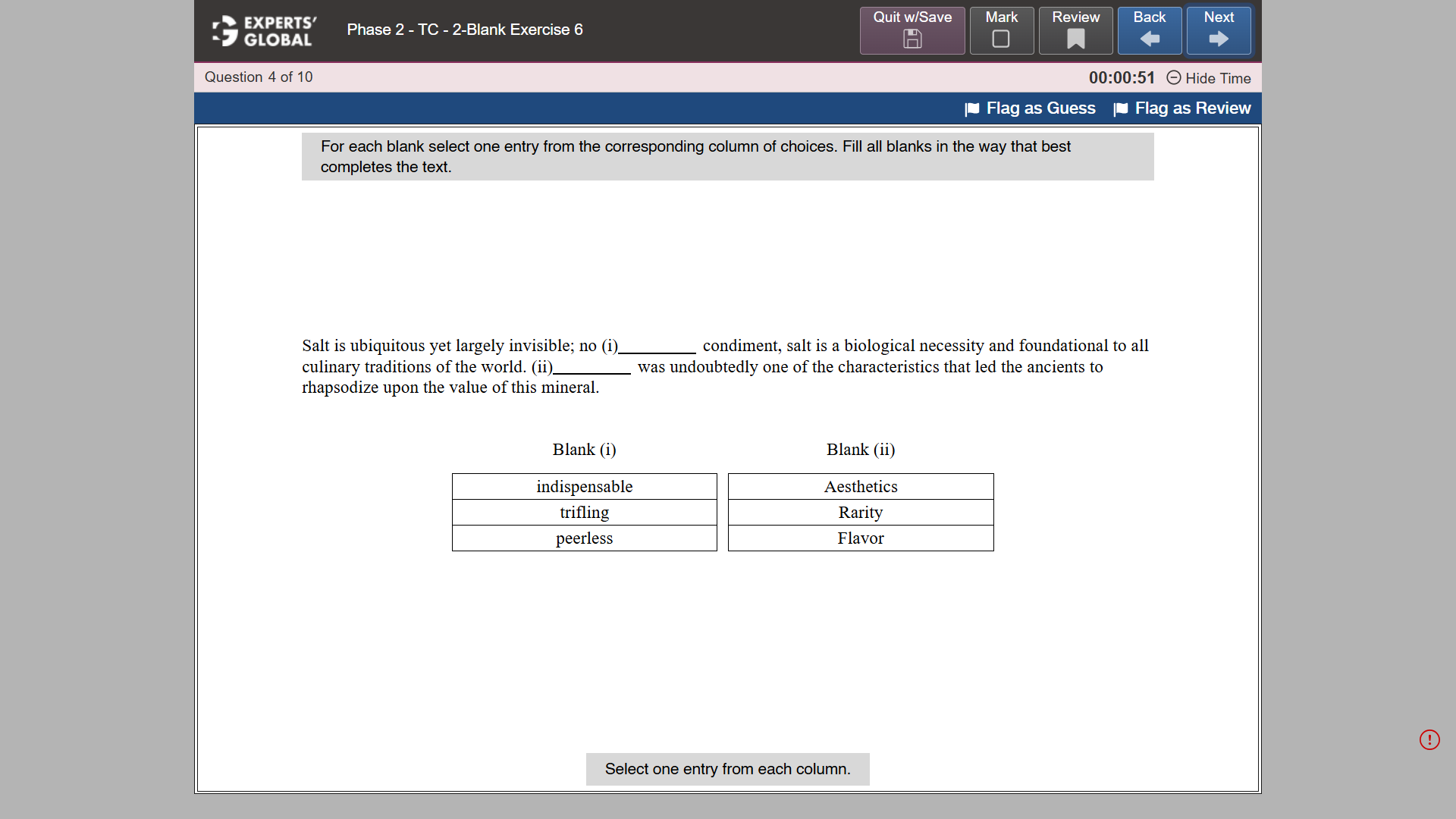
Salt is ubiquitous yet largely invisible; no (i)_____ condiment, salt is a biological necessity and foundational to all culinary traditions of the world. (ii)_____ was undoubtedly one of the characteristics that led the ancients to rhapsodize upon the value of this mineral.
Blank (i)
A. indispensable
B. trifling
C. peerless
Blank (ii)
D. Aesthetics
E. Rarity
F. Flavor
Written Explanation
Reasoning:
The usage of the clause “Salt is ubiquitous yet largely invisible” conveys that salt is widely used; hence, the usage of the contrasting phrase “no…condiment” indicates that the phrase formed by the first blank must convey that “salt” is important; in other words, the first blank must be a negative quality. Therefore, the only fitting answer choice for blank (i) is B – “trifling”.
The usage of the clause “…was undoubtedly one of the characteristics that led the ancients to rhapsodize upon the value of this mineral” indicates that the second blank refers to a characteristic of “salt”, and the usage of the phrase “foundational to all culinary traditions of the world” implies that this characteristic is related to food or cooking. Therefore, the only fitting answer choice for blank (ii) is F – “Flavor”.
Correct combination of answer choices:
B. “trifling”, meaning “of little importance”.
F. “Flavor”, meaning “the taste of food”.
The aforesaid combination of answer choices leads to a logical and coherent completion of the paragraph.
Incorrect answer choices:
A. This answer choice “indispensable”, meaning “absolutely necessary”, cannot form a logical combination of answer choices for a coherent completion of the paragraph. Hence, this answer choice is incorrect.
C. This answer choice “peerless”, meaning “beyond comparison”, cannot form a logical combination of answer choices for a coherent completion of the paragraph. Hence, this answer choice is incorrect.
D. This answer choice “Aesthetics”, meaning “the branch of philosophy dealing with beauty”, cannot form a logical combination of answer choices for a coherent completion of the paragraph. Hence, this answer choice is incorrect.
E. This answer choice “Rarity”, meaning “the state of being uncommon”, cannot form a logical combination of answer choices for a coherent completion of the paragraph. Hence, this answer choice is incorrect.
Thus, B and F are the correct combination of answer choices.
Practice Question 3 | TC 2-Blank
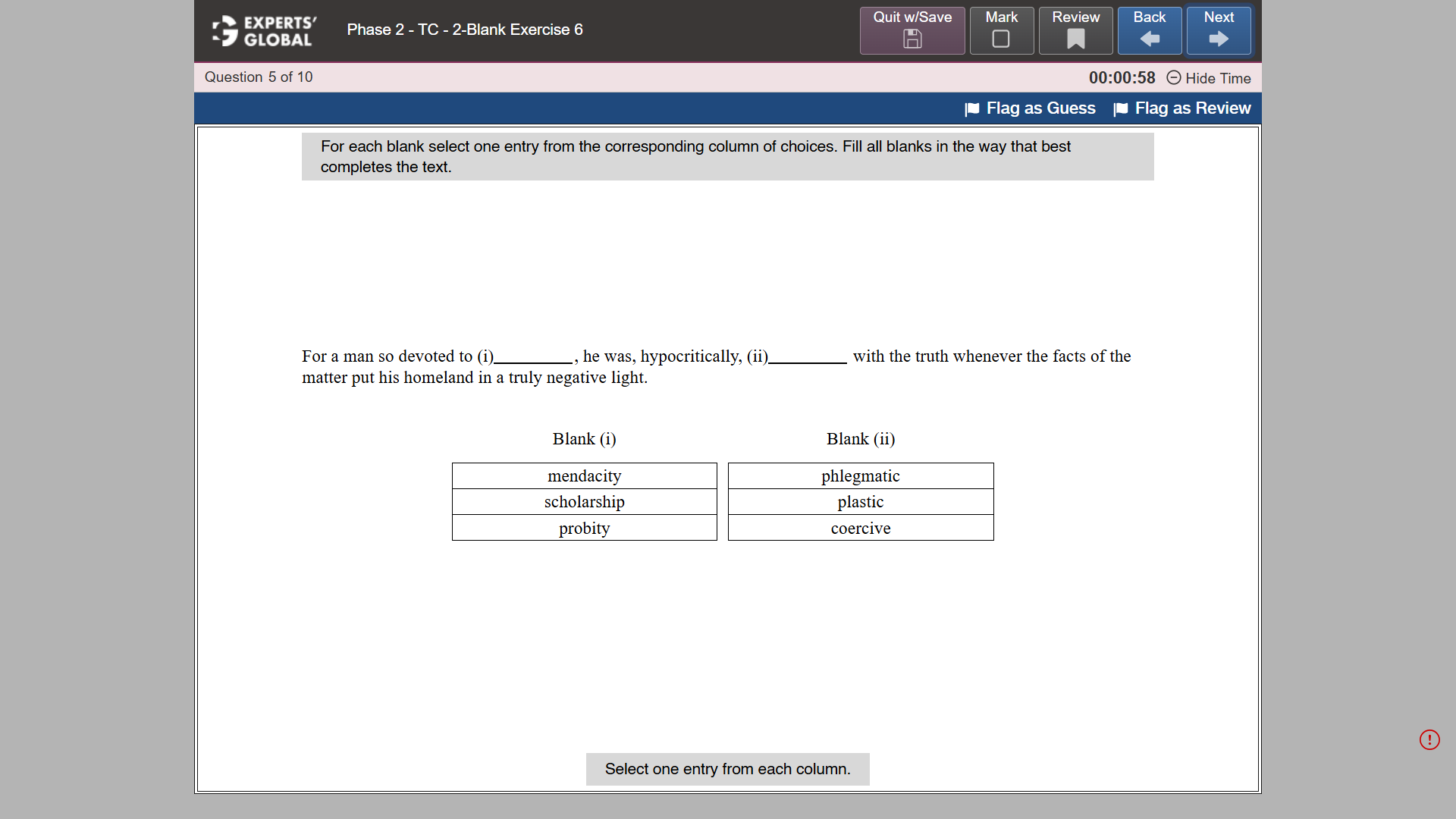
For a man so devoted to (i)_____, he was, hypocritically, (ii)_____ with the truth whenever the facts of the matter put his homeland in a truly negative light.
Blank (i)
A. mendacity
B. scholarship
C. probity
Blank (ii)
D. phlegmatic
E. plastic
F. coercive
Written Explanation
Reasoning:
The usage of the phrase “whenever the facts of the matter put his homeland in a truly negative light” suggests that the “man” referred to in the sentence would not adhere perfectly to “the truth” in the relevant context; logically, should “the facts of the matter” portray something one cares for in a negative way, it is typical to deny or downplay these facts. Therefore, the most fitting answer choice for blank (ii) is E – “plastic”.
The usage of the word “hypocritically” in conjunction with the phrase “For a man so devoted to…” indicates that the man’s behavior, as described in the sentence, is contradictory to how the sentence initially characterizes the man; hence, since we know the sentence describes the man as being “plastic with the truth”, the quality that the man is devoted to must be something conveying devotion to the truth. Therefore, the only logical answer choice for blank (i) is C – “probity”.
Correct combination of answer choices:
C. “probity”, meaning “honesty”.
E. “plastic”, meaning “changeable” or “bendable”.
The aforesaid combination of answer choices leads to a logical and coherent completion of the paragraph.
Incorrect answer choices:
A. This answer choice “mendacity”, meaning “dishonesty”, cannot form a logical combination of answer choices for a coherent completion of the paragraph. Hence, this answer choice is incorrect.
B. This answer choice “scholarship”, meaning “academic learning”, cannot form a logical combination of answer choices for a coherent completion of the paragraph. Hence, this answer choice is incorrect.
D. This answer choice “phlegmatic”, meaning “calm”, cannot form a logical combination of answer choices for a coherent completion of the paragraph. Hence, this answer choice is incorrect.
F. This answer choice “coercive”, meaning “using force”, cannot form a logical combination of answer choices for a coherent completion of the paragraph. Hence, this answer choice is incorrect.
Thus, C and E are the correct combination of answer choices.
GRE-style Text Completion Two-Blank Questions with Explanations:
Please find a set of GRE-style TC Two-blank questions with explanations on: Free GRE Text Completion Two-Blank Practice Questions with Solutions
GRE Text Completion – Three-Blank Practice Questions
In GRE Text Completion three blank questions, a short passage contains three missing words, and you choose one option for each blank to restore the intended meaning of the text. The response counts as correct only when all three selections are accurate, with no partial credit. Vocabulary appears as input, while the task centers on tracing logic across the passage and keeping the overall meaning consistent. These questions form roughly 10% of the GRE Verbal Reasoning measure. Following is a set of GRE-style sample Text Completion three blank practice questions with explanations.
Important: Before attempting the GRE Text Completion 3-blank practice questions, if you would like to undergo detailed prep, please visit Free GRE Text Completion 3-blank prep
Practice Question 1 | TC 3-Blank
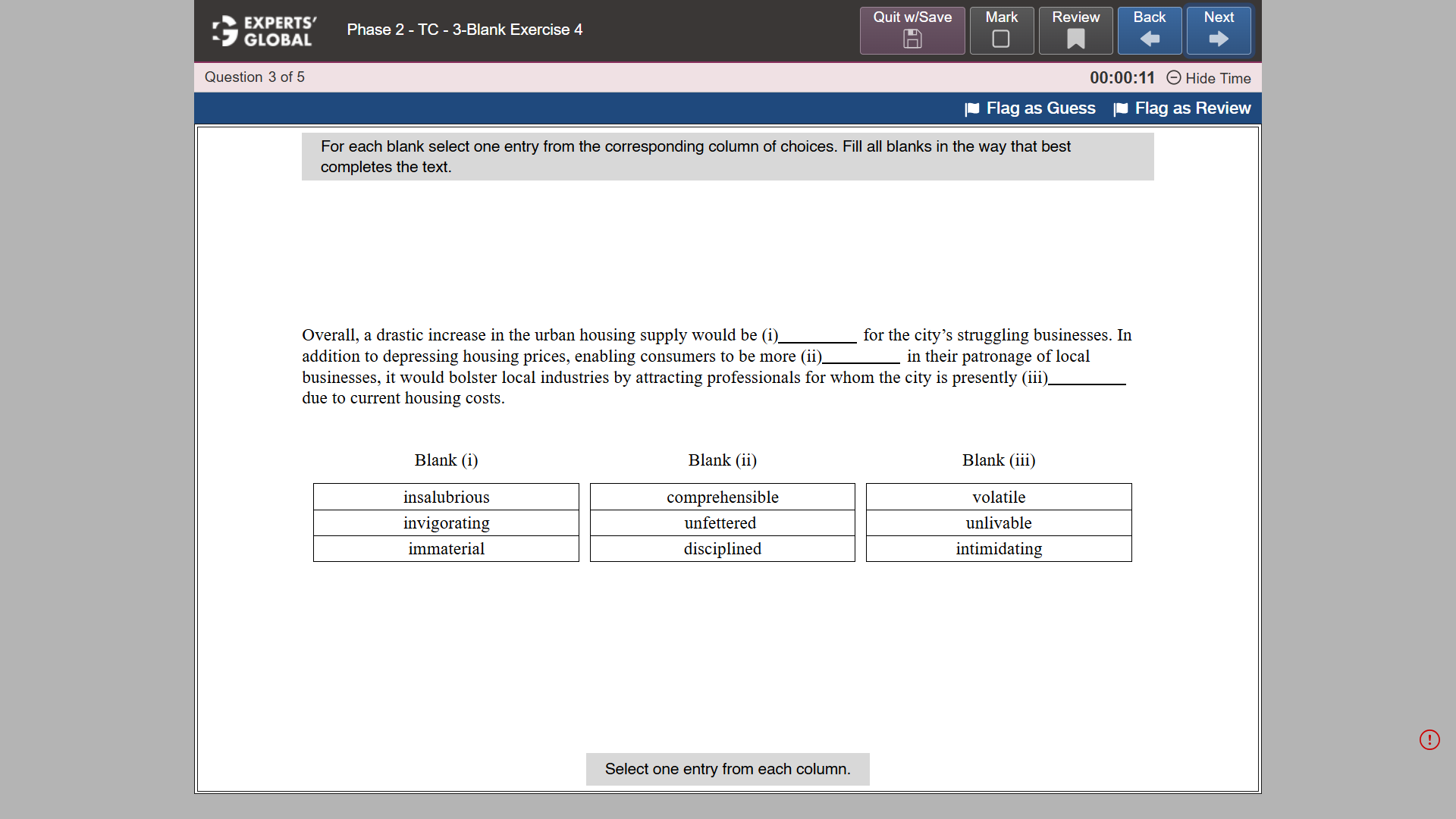
Overall, a drastic increase in the urban housing supply would be (i)_____ for the city’s struggling businesses. In addition to depressing housing prices, enabling consumers to be more (ii)_____ in their patronage of local businesses, it would bolster local industries by attracting professionals for whom the city is presently (iii)_____ due to current housing costs.
Blank (i)
A. insalubrious
B. invigorating
C. immaterial
Blank (ii)
D. comprehensible
E. unfettered
F. disciplined
Blank (iii)
G. volatile
H. unlivable
I. intimidating
Written Explanation
Reasoning:
The usage of the clause “increase in the urban housing supply would be…for the city’s struggling businesses” indicates that the first blank characterizes how “increase in the urban housing” would, according to the passage, affect businesses, and the usage of the clause “it would bolster local industries” implies that this effect would be positive. Therefore, the only fitting answer choice for blank (i) is B – “invigorating”.
The usage of the phrase “In addition to depressing housing prices” in conjunction with “enabling consumers to be more…in their patronage of local businesses” indicates a cause-effect relationship between a decrease in housing prices and the change in spending referred to by the phrase formed by the second blank; in other words, the second blank refers to a quality that would become more pronounced in consumer spending if housing prices were to fall. Therefore, the most fitting answer choice for blank (ii) is E – “unfettered”.
The usage of the phrase “attracting professionals for whom the city is presently…due to current housing costs” indicates that the third blank refers to an attribute applicable to a “city” that can logically be considered the result of “housing costs”. Therefore, the most fitting answer choice for blank (iii) is H – “unlivable”; “intimidating” is also a decent answer choice – a high cost of living can be described as “intimidating” – but difficulty in securing a commodity needed for survival – housing – relates more directly to a sense of difficulty in surviving rather than to fear.
Correct combination of answer choices:
B. “invigorating”, meaning “strengthening” or “refreshing”.
E. “unfettered”, meaning “free”.
H. “unlivable”, meaning “not habitable”.
The aforesaid combination of answer choices leads to a logical and coherent completion of the paragraph.
Incorrect answer choices:
A. This answer choice “insalubrious”, meaning “harmful”, cannot form a logical combination of answer choices for a coherent completion of the paragraph. Hence, this answer choice is incorrect.
C. This answer choice “immaterial”, meaning “unimportant”, cannot form a logical combination of answer choices for a coherent completion of the paragraph. Hence, this answer choice is incorrect.
D. This answer choice “comprehensible”, meaning “clear”, cannot form a logical combination of answer choices for a coherent completion of the paragraph. Hence, this answer choice is incorrect.
F. This answer choice “disciplined”, meaning “controlled”, cannot form a logical combination of answer choices for a coherent completion of the paragraph. Hence, this answer choice is incorrect.
G. This answer choice “volatile”, meaning “unstable”, cannot form a logical combination of answer choices for a coherent completion of the paragraph. Hence, this answer choice is incorrect.
I. This answer choice “intimidating”, meaning “causing a loss of self-confidence”, cannot form a logical combination of answer choices for a coherent completion of the paragraph. Hence, this answer choice is incorrect.
Thus, B, E, and H are the correct combination of answer choices.
Practice Question 2 | TC 3-Blank
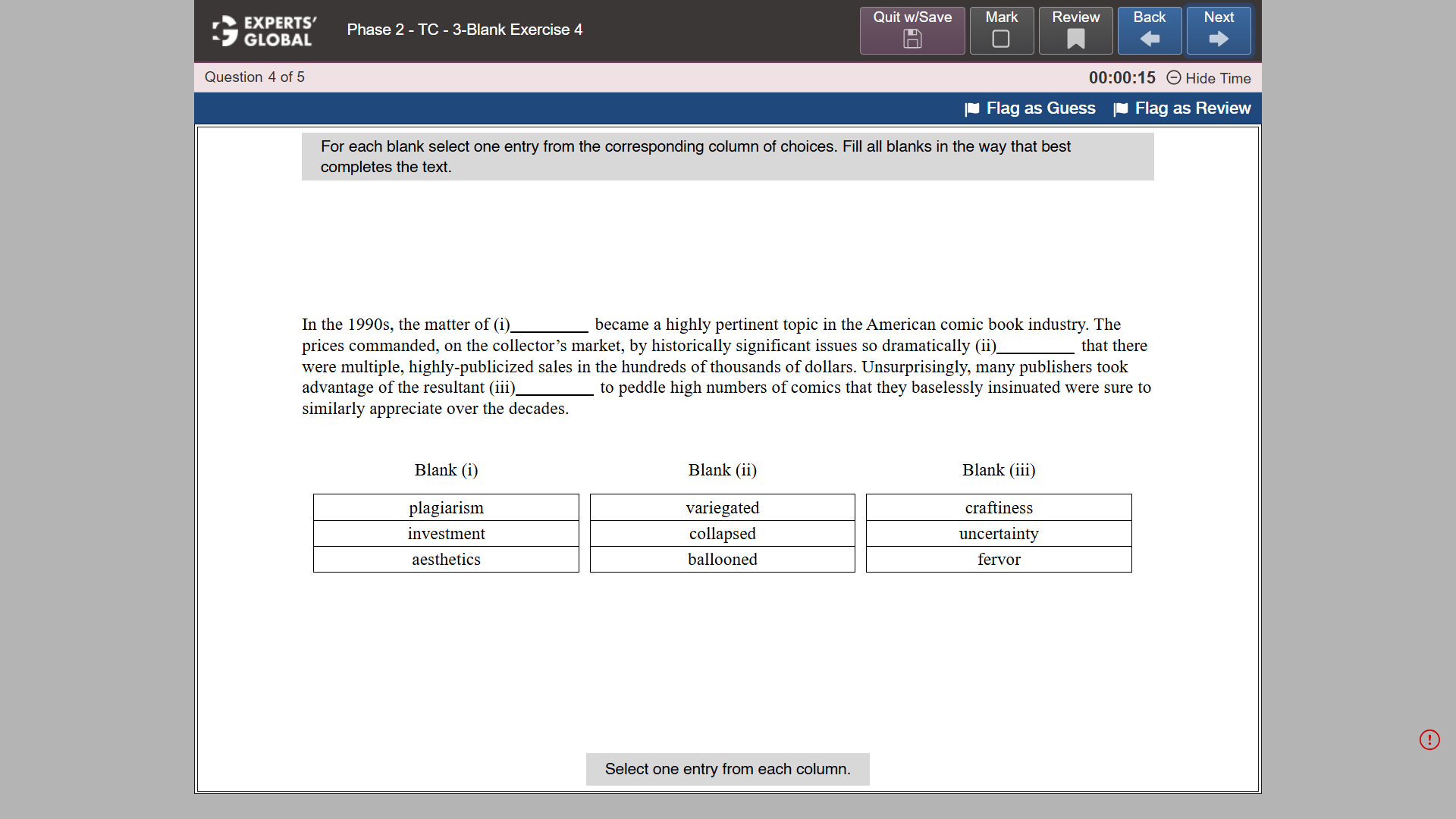
In the 1990s, the matter of (i)_____ became a highly pertinent topic in the American comic book industry. The prices commanded, on the collector’s market, by historically significant issues so dramatically (ii)_____ that there were multiple, highly-publicized sales in the hundreds of thousands of dollars. Unsurprisingly, many publishers took advantage of the resultant (iii)_____ to peddle high numbers of comics that they baselessly insinuated were sure to similarly appreciate over the decades.
Blank (i)
A. plagiarism
B. investment
C. aesthetics
Blank (ii)
D. variegated
E. collapsed
F. ballooned
Blank (iii)
G. craftiness
H. uncertainty
I. fervor
Written Explanation
Reasoning:
The usage of the clause “the matter of…became a highly pertinent topic in the American comic book industry” indicates that the first blank refers to a concept that was of considerable significance in “the American comic book industry”, and the usage of the phrase “to peddle high numbers of comics that they baselessly insinuated were sure to similarly appreciate over the decades” implies that during the relevant period, many comics were sold with the promise that they would grow in value with time and could, presumably, be sold at a profit; hence, the first blank must refer to something related to the sale of assets that have increased in value. Therefore, the only fitting answer choice for blank (i) is B – “investment”.
The usage of the clause “The prices commanded, on the collector’s market, by historically significant issues so dramatically…” in conjunction with “that there were multiple, highly-publicized sales in the hundreds of thousands of dollars” indicates that the second blank is an action that can logically be applied to “prices” in the context of “sales in the hundreds of thousands of dollars”. Therefore, the only logical answer choice is F – “ballooned”.
The usage of the clause “many publishers took advantage of the resultant…” in conjunction with “to peddle high numbers of comics” indicates that the third blank refers to an element that would have aided “publishers” in selling their products; hence, the third blank must be something that can, logically, be said to lead to excitement. Therefore, the most fitting answer choice for blank (iii) is I – “fervor”.
Correct combination of answer choices:
B. “investment”, meaning “putting money into a business to make a profit”.
F. “ballooned”, meaning “increased rapidly” or “swelled”.
I. “fervor”, meaning “passion”.
The aforesaid combination of answer choices leads to a logical and coherent completion of the paragraph.
Incorrect answer choices:
A. This answer choice “plagiarism”, meaning “copying someone else’s ideas without permission”, cannot form a logical combination of answer choices for a coherent completion of the paragraph. Hence, this answer choice is incorrect.
C. This answer choice “aesthetics”, meaning “appreciation of beauty”, cannot form a logical combination of answer choices for a coherent completion of the paragraph. Hence, this answer choice is incorrect.
D. This answer choice “variegated”, meaning “make more varied”, cannot form a logical combination of answer choices for a coherent completion of the paragraph. Hence, this answer choice is incorrect.
E. This answer choice “collapsed”, meaning “fallen”, cannot form a logical combination of answer choices for a coherent completion of the paragraph. Hence, this answer choice is incorrect.
G. This answer choice “craftiness”, meaning “skill in achieving one’s ends through dishonest methods”, cannot form a logical combination of answer choices for a coherent completion of the paragraph. Hence, this answer choice is incorrect.
H. This answer choice “uncertainty”, meaning “state of being unsure of something”, cannot form a logical combination of answer choices for a coherent completion of the paragraph. Hence, this answer choice is incorrect.
Thus, B, F, and I are the correct combination of answer choices.
Practice Question 3 | TC 3-Blank
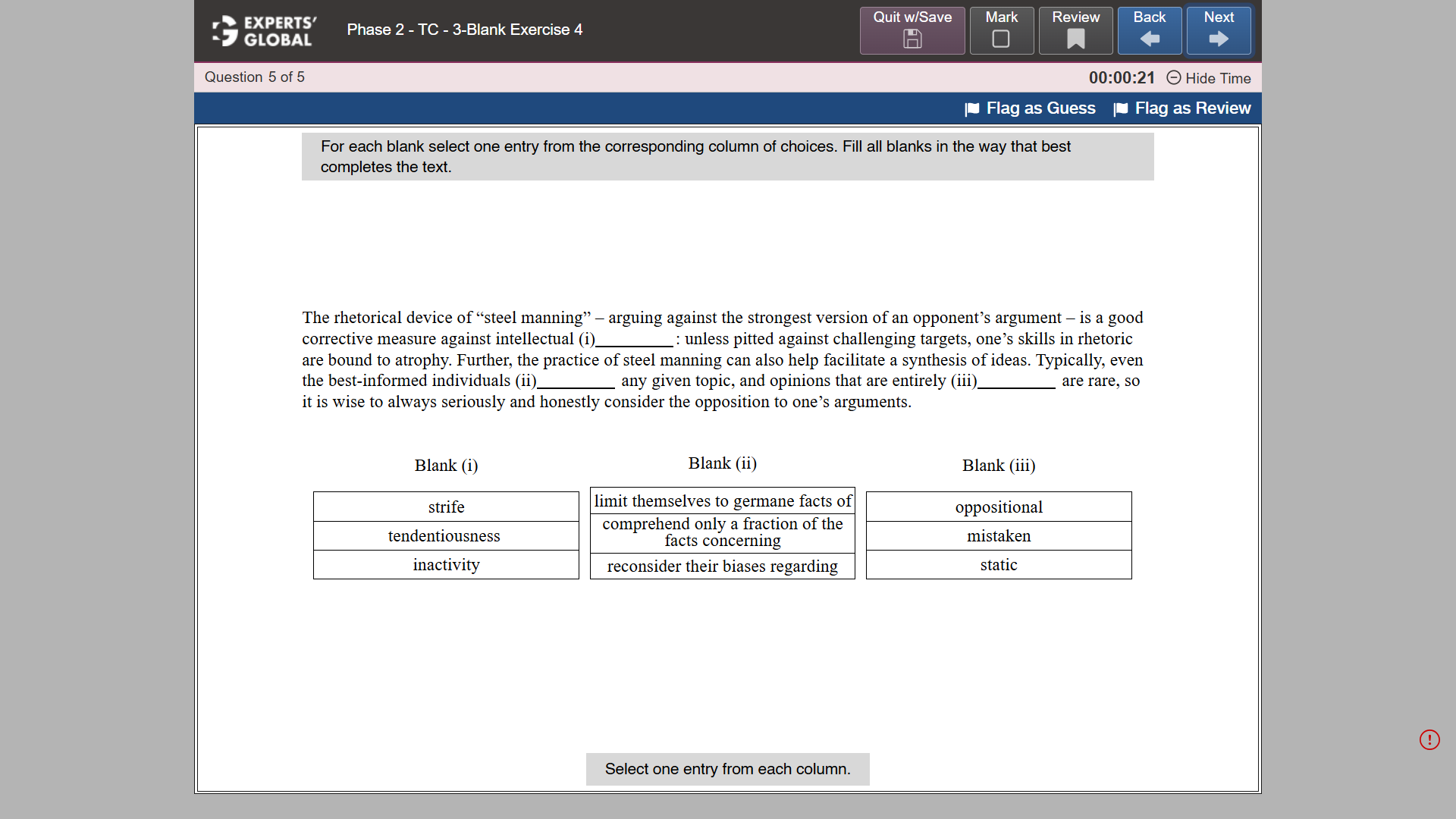
The rhetorical device of “steel manning” – arguing against the strongest version of an opponent’s argument – is a good corrective measure against intellectual (i)_____: unless pitted against challenging targets, one’s skills in rhetoric are bound to atrophy. Further, the practice of steel manning can also help facilitate a synthesis of ideas. Typically, even the best-informed individuals (ii)_____ any given topic, and opinions that are entirely (iii)_____ are rare, so it is wise to always seriously and honestly consider the opposition to one’s arguments.
Blank (i)
A. strife
B. tendentiousness
C. inactivity
Blank (ii)
D. limit themselves to germane facts of
E. comprehend only a fraction of the facts concerning
F. reconsider their biases regarding
Blank (iii)
G. oppositional
H. mistaken
I. static
Written Explanation
Reasoning:
The definition provided for “steel manning” – “arguing against the strongest version of an opponent’s argument” – implies that this practice involves taking on a more challenging task than necessary and thus requires more effort; hence the usage of the phrase “is a good corrective measure against intellectual…” implies that the first blank refers to a lack of effort or exertion. Therefore, the only logical answer choice for blank (i) is C – “inactivity”.
The usage of the clause “the practice of steel manning can also help facilitate a synthesis of ideas” indicates that the relevant context for the second and third blanks is understanding and accepting differing ideas; hence, the clauses formed by these blanks must convey the value of accepting differing points of view. Thus, the usage of the clause “even the best-informed…any given topic” indicates that the second blank refers to an educational or informational shortcoming of “the best-informed”. Therefore, the most fitting answer choice for blank (ii) is E – “comprehend only a fraction of the facts concerning”; one may consider “limit themselves to the germane facts of” a fitting choice, but the usage of “germane” implies that even if the “best-informed” are limited in what they know, the information they possess is entirely sufficient, meaning D does not represent an informational shortcoming.
The usage of the clause “opinions that are entirely…are rare” indicates that the third blank refers to a characteristic applicable to “opinions”, and as we have established that the clause formed by the third blank must convey that there is value in considering opposing ideas, the third blank must refer to a characteristic that, if widespread among “opinions”, would limit the value of considering opposing opinions. Therefore, the most fitting answer choice for blank (iii) is H – “mistaken”.
Correct combination of answer choices:
C. “inactivity”, meaning “lack of action” or “laziness”.
E. “comprehend only a fraction of the facts concerning”, meaning “understand only a small part of the realities of”.
H. “mistaken”, meaning “wrong”.
The aforesaid combination of answer choices leads to a logical and coherent completion of the paragraph.
Incorrect answer choices:
A. This answer choice “strife”, meaning “bitter conflict”, cannot form a logical combination of answer choices for a coherent completion of the paragraph. Hence, this answer choice is incorrect.
B. This answer choice “tendentiousness”, meaning “having a controversial bias”, cannot form a logical combination of answer choices for a coherent completion of the paragraph. Hence, this answer choice is incorrect.
D. This answer choice “limit themselves to germane facts of”, meaning “focus only on suitable realities about”, cannot form a logical combination of answer choices for a coherent completion of the paragraph. Hence, this answer choice is incorrect.
F. This answer choice “reconsider their biases regarding”, meaning “rethink their inflexible ideas about”, cannot form a logical combination of answer choices for a coherent completion of the paragraph. Hence, this answer choice is incorrect.
G. This answer choice “oppositional”, meaning “characterized by disagreement”, cannot form a logical combination of answer choices for a coherent completion of the paragraph. Hence, this answer choice is incorrect.
I. This answer choice “static”, meaning “unchanging”, cannot form a logical combination of answer choices for a coherent completion of the paragraph. Hence, this answer choice is incorrect.
Thus, C, E, and H are the correct combination of answer choices.
GRE-style Text Completion Three-Blank Questions with Explanations:
Please find a set of GRE-style TC Three-blank questions with explanations on: Free GRE Text Completion Three-Blank Practice Questions with Solutions
GRE Reading Comprehension Practice Questions
Each GRE Reading Comprehension set presents one passage followed by a group of questions that you answer based only on what the passage states or logically supports. Most questions use the multiple choice select one format with five answer choices. Some use multiple choice select one or more with three choices, for which you receive credit only when all correct options are selected, with no partial credit. Some questions require selecting a sentence directly from the passage. You generally get four reading comprehension sets that together contribute roughly 40% of the GRE Verbal Reasoning measure, along with three single passage questions that are treated as critical reasoning in our course. Following is a set of GRE-style reading comprehension practice questions with explanations.
Important: Before attempting the GRE Reading Comprehension practice questions, if you would like to undergo detailed RC prep, please visit Free GRE Reading Comprehension prep
Practice Question 1 | RC
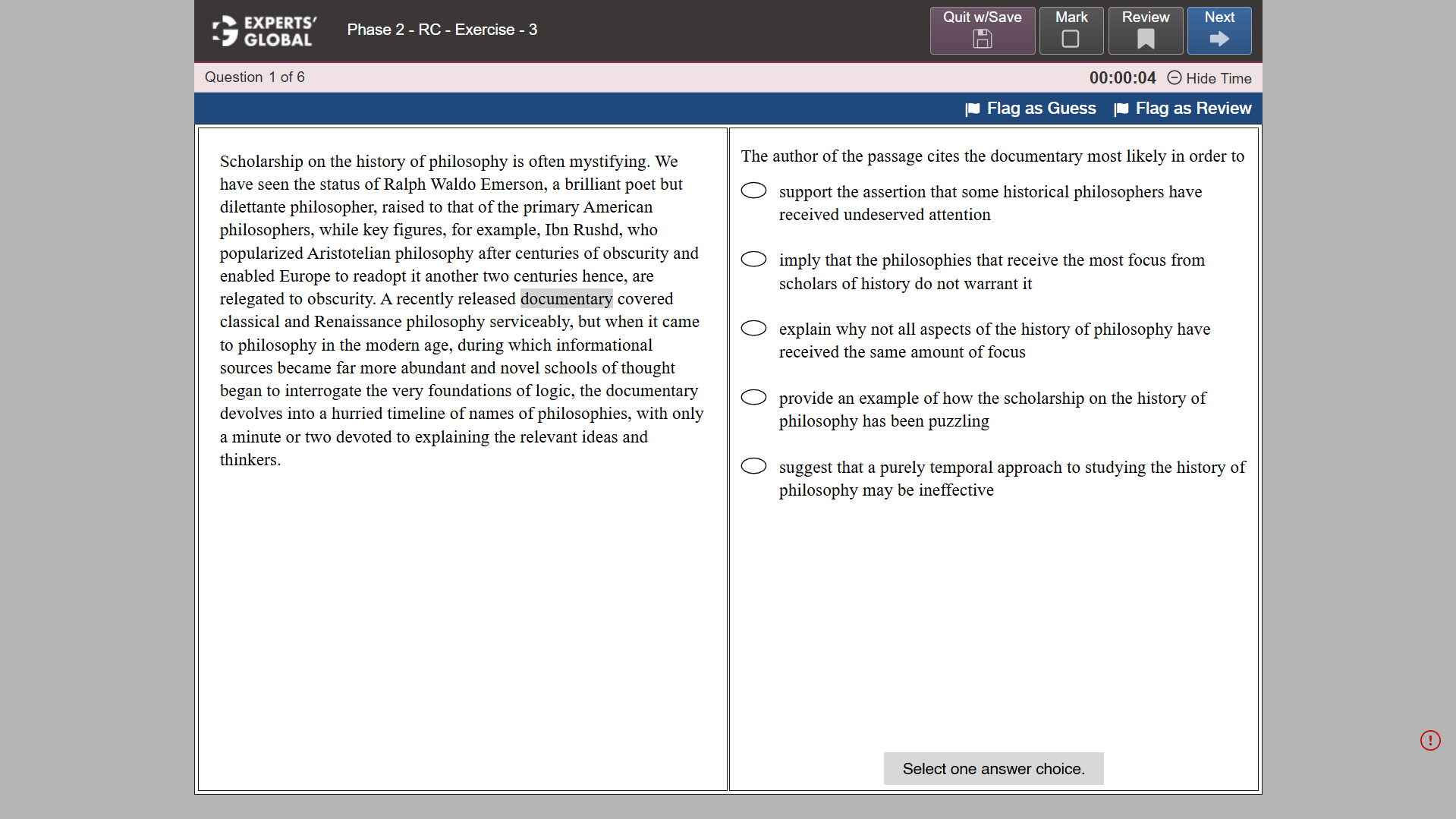
The author of the passage cites the documentary most likely in order to
A. support the assertion that some historical philosophers have received undeserved attention
B. imply that the philosophies that receive the most focus from scholars of history do not warrant it
C. explain why not all aspects of the history of philosophy have received the same amount of focus
D. provide an example of how the scholarship on the history of philosophy has been puzzling
E. suggest that a purely temporal approach to studying the history of philosophy may be ineffective
Written Explanation
Mind-map
That the recording of philosophical history is confusing is asserted (Lines 1 – 2)
An example of how the recording of philosophical history is confusing is provided (Lines 2 – 6)
A more detailed example of how the recording of philosophical history is confusing is provided (Line 7 – end)
A. Trap. Referring to the documentary, the passage states that “…when it came to philosophy in the modern age, during which informational sources became far more abundant…the documentary devolves into a hurried timeline”; although this statement implies that the documentary did not pay enough attention to some philosophers, it cannot be inferred from this alone that the documentary paid undeserved attention to other philosophers. Incorrect.
B. Trap. Referring to the documentary, the passage states that “…when it came to philosophy in the modern age, during which…novel schools of thought began to interrogate the very foundations of logic, the documentary devolves into a hurried timeline…”; although this statement implies that the documentary did not pay enough attention to some philosophies, it cannot be inferred from this alone that those philosophies the documentary did focus on, did not warrant it. Incorrect.
C. As the mind-map suggests, the passage does not explain any of the observations it makes; rather, the passage cites the documentary to help illustrate an observation. Incorrect.
D. Correct. As the mind map indicates, the “…recently released documentary…” serves as a second, more detailed example of how the history of philosophy is confusing.
E. Although the usage of the phrase “…when it came to philosophy in the modern age…the documentary devolves into a hurried timeline…” indicates that the documentary takes a temporal approach to history, the passage does not reference the efficacy of this approach; rather, it criticizes the documentary for devoting comparatively little attention to the more impactful eras in the history of philosophy. Incorrect.
Thus, D is the correct answer choice.
Practice Question 2 | RC
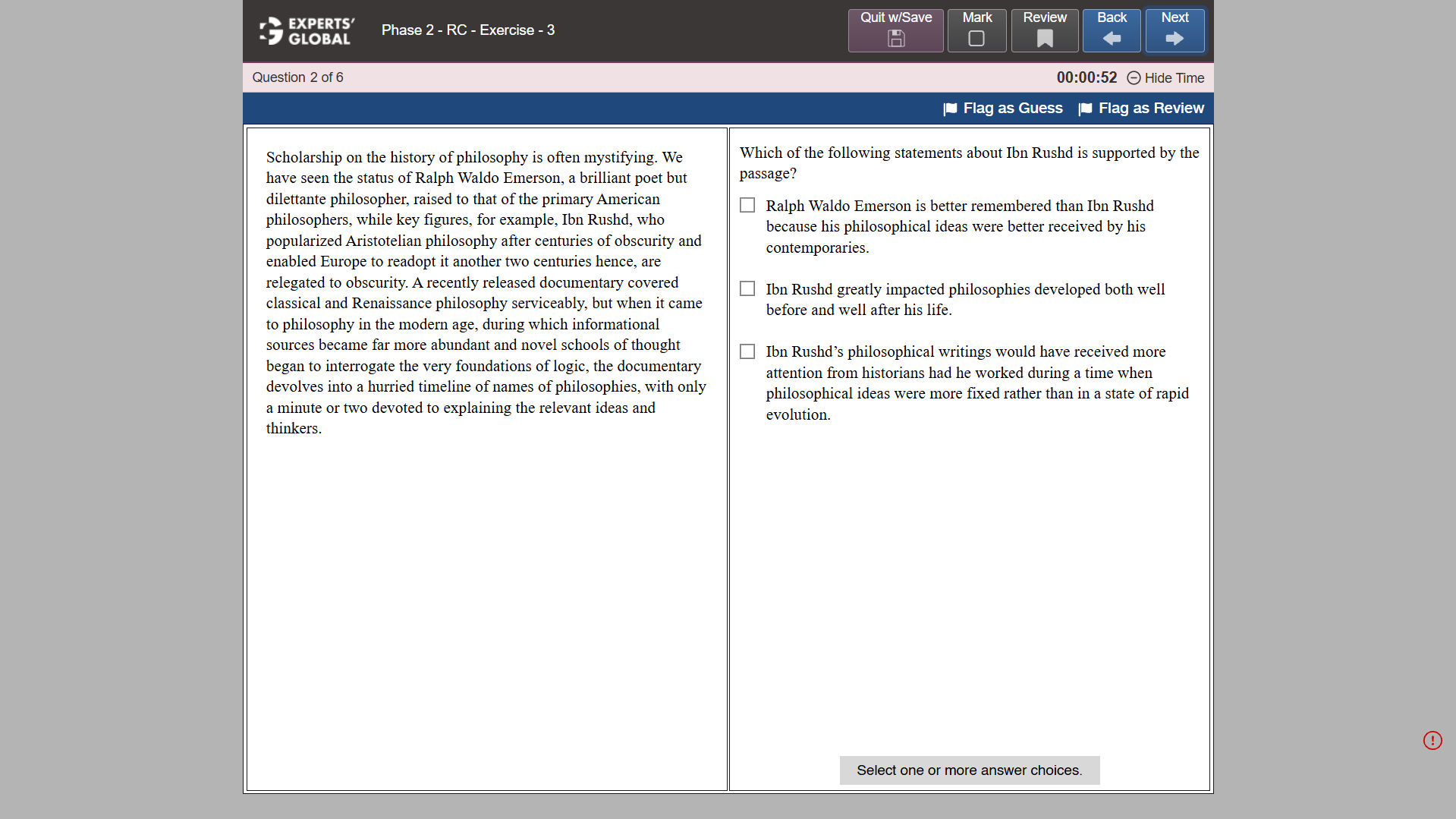
Which of the following statements about Ibn Rushd is supported by the passage?
A. Ralph Waldo Emerson is better remembered than Ibn Rushd because his philosophical ideas were better received by his contemporaries.
B. Ibn Rushd greatly impacted philosophies developed both well before and well after his life.
C. Ibn Rushd’s philosophical writings would have received more attention from historians had he worked during a time when philosophical ideas were more fixed rather than in a state of rapid evolution.
Written Explanation
Mind-map
That the recording of philosophical history is confusing is asserted (Line 1)
An example of how the recording of philosophical history is confusing is provided (Lines 2 – 6)
A more detailed example of how the recording of philosophical history is confusing is provided (Line 7 – end)
A. The passage does not reference the reception of Ralph Waldo Emerson’s or Ibn Rushd’s ideas among their respective contemporaries. Incorrect.
B. Correct. The usage of “…Ibn Rushd…” in conjunction with “…who popularized Aristotelian philosophy after centuries of obscurity and enabled Europe to readopt it another two centuries hence…” conveys that Ibn Rushd brought attention to a philosophy developed centuries before he lived and that by doing so he influenced philosophies developed centuries after he lived.
C. Trap. The passage does not reference the nature of the predominant philosophical ideas during Ibn Rushd’s life or career. Incorrect.
Thus, B is the correct answer choice.
Practice Question 3 | RC
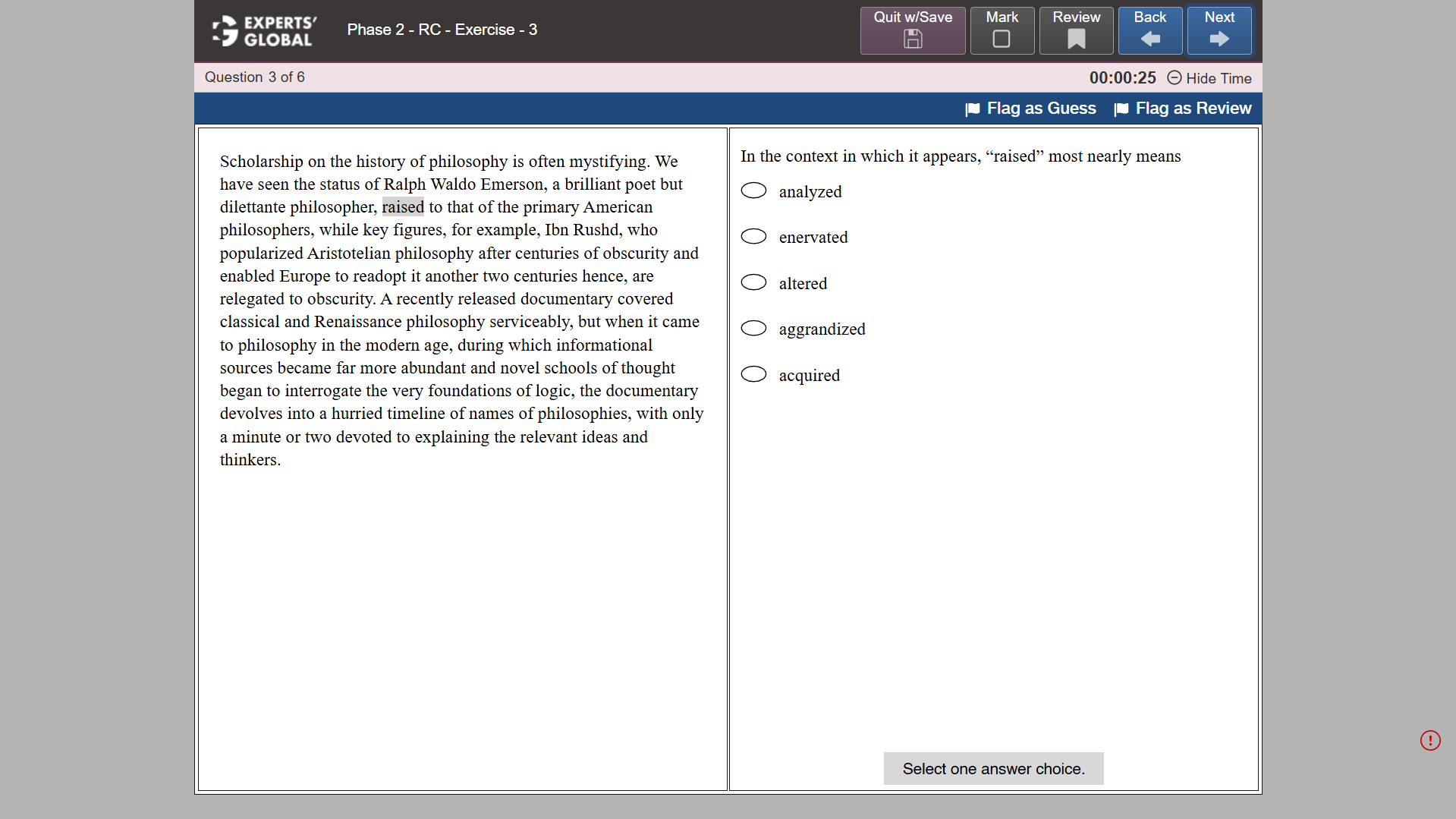
In the context in which it appears, “raised” most nearly means
A. analyzed
B. enervated
C. altered
D. aggrandized
E. acquired
Written Explanation
Mind-map
That the recording of philosophical history is confusing is asserted (Line 1)
An example of how the recording of philosophical history is confusing is provided (Lines 2 – 6)
A more detailed example of how the recording of philosophical history is confusing is provided (Line 7 – end)
Our broad expectation from the correct answer choice is that it must convey something along the lines of “given a higher status”.
A. The word “analyzed” has no meaning that can be considered, even loosely, synonymous with “raised”; hence, in the context in which it appears, “raised” cannot mean “analyzed”. Incorrect.
B. The word “enervated” (meaning: weakened, drained of energy, or exhausted) has no meaning that can be considered, even loosely, synonymous with “raised”; hence, in the context in which it appears, “raised” cannot mean “enervated”. Incorrect.
C. Trap. Although something that is “raised” can be said to have been “altered”, an alteration can imply positive, negative, and neutral change, whereas “aggrandized” refers only to positive change; thus, the answer choice “aggrandized” is closer in meaning to “raised” than the answer choice “altered” is; hence, D is not the answer choice closest in meaning to “raised”. Incorrect.
D. Correct. The passage states, “We have seen the status of Ralph Waldo Emerson…raised to that of primary American philosophers…” and refers to “…Ralph Waldo Emerson…” with the phrase “…dilettante philosopher…”; from this, it can be inferred that Ralph Waldo Emerson’s positive qualities have been exaggerated; hence, in the context in which it appears, “raised” means something along the lines of exaggerated, which is closely synonymous with “aggrandized”.
E. The word “acquired” has no meaning that can be considered, even loosely, synonymous with “raised”; hence, in the context in which it appears, “raised” cannot mean “acquired”. Incorrect.
Thus, D is the correct answer choice.
Additional GRE Reading Comprehension Practice Questions
Please find a set of GRE-style RC questions with explanations on: Free GRE Reading Comprehension Practice Questions with Solutions
Please find a set of assorted GRE-style Verbal questions (all types) with explanations on: Free GRE Verbal Practice Questions with Solutions
GRE Critical Reasoning Practice Questions
GRE critical reasoning questions present a short, dense passage with logical turns, followed by a single question based on that passage. ETS does not separate critical reasoning from reading comprehension and treats these as part of reading comprehension, yet these one-question-passages differ in structure and task from standard multi question reading comprehension sets and you shall benefit from focused preparation for these. Our course treats these questions separately and builds dedicated concepts and practice across lessons, exercises, sectional tests, and full-length tests. On the GRE, you generally get three such questions, and they appear in the multiple choice select one format with five answer choices and one correct response. Following is a set of GRE-style critical reasoning practice questions with detailed explanations.
Important: Before attempting the GRE Critical Reasoning practice questions, if you would like to undergo detailed CR prep, please visit Free GRE Critical Reasoning prep
Practice Question 1 | CR
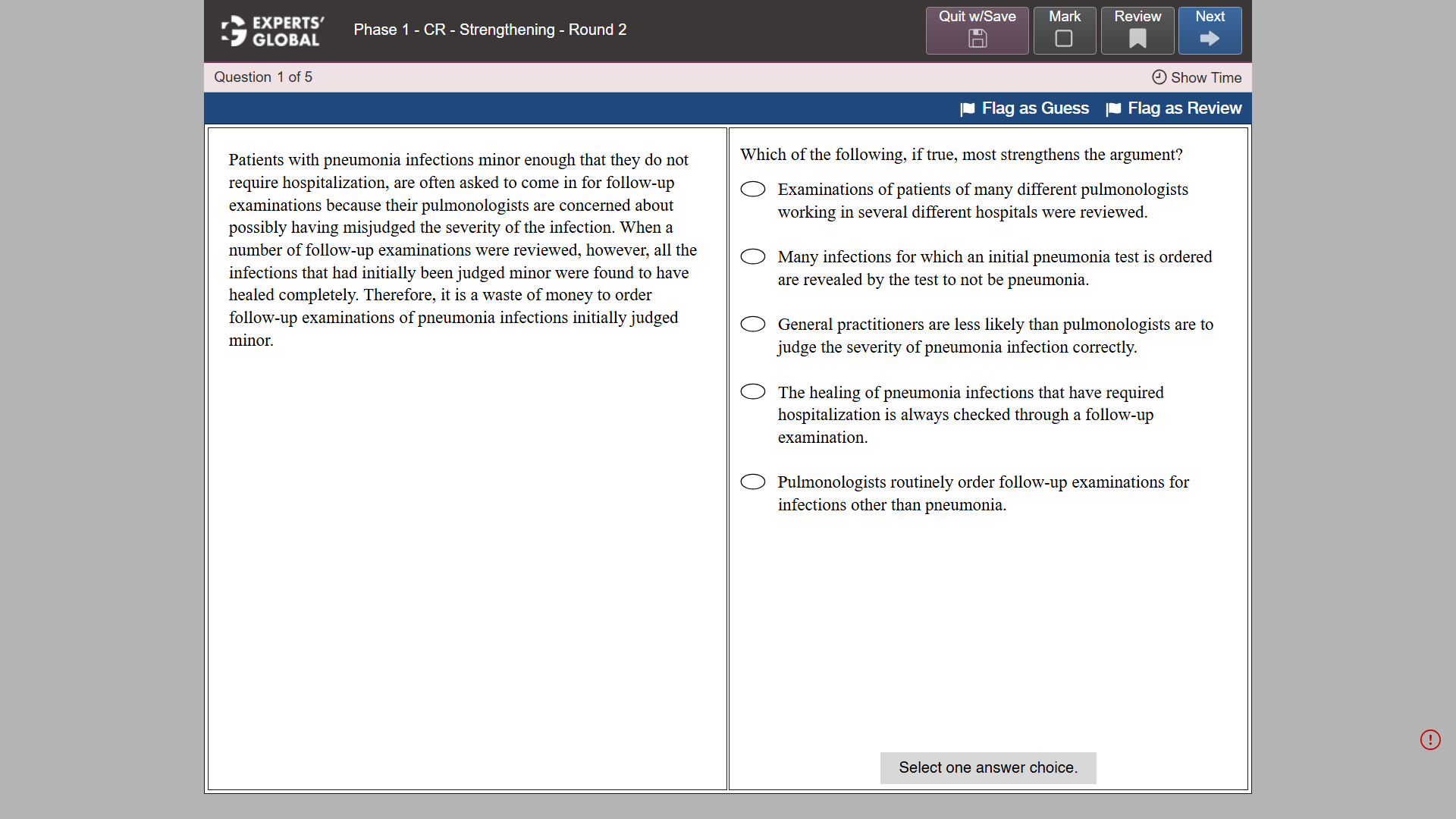
Which of the following, if true, most strengthens the argument?
A. Examinations of patients of many different pulmonologists working in several different hospitals were reviewed.
B. Many infections for which an initial pneumonia test is ordered are revealed by the test to not be pneumonia.
C. General practitioners are less likely than pulmonologists are to judge the severity of pneumonia infection correctly.
D. The healing of pneumonia infections that have required hospitalization is always checked through a follow-up examination.
E. Pulmonologists routinely order follow-up examinations for infections other than pneumonia.
Written Explanation
Mind-map: Pulmonologists judge certain pneumonia cases as minor → such patients are asked for follow-up examinations to confirm judgment on severity → number of follow-up exams were reviewed → all infections judged minor were found to have healed → follow-up exams of pneumonia cases that are judged as minor are a waste of money (conclusion)
Missing-link: Between all infections judged minor being healed and the conclusion that follow-up exams of pneumonia cases that are judged minor are a waste of money
Expectation from the correct answer choice: To strengthen the conclusion that follow-up exams of pneumonia cases that are judged minor are a waste of money
Note: This question represents a common GRE dilemma of choosing the “best answer choice” among all “unconvincing answer choices”; in such a scenario, it becomes all the more important to “go-by-elimination”; an answer choice that you find “least unconvincing” is likely the correct answer choice.
A. Correct. This answer choice, suggesting that the set of follow-up exams reviewed was diverse in nature, removes a possible bias in the results of the review and adds to the general view that follow-up exams may not be necessary; among all the answer choices deemed unconvincing, this choice is the least prone to elimination and can be considered the “best” answer option.
B. Trap. The argument is concerned with pneumonia cases judged minor; if the initial pneumonia tests do not reveal pneumonia, there is no question of pulmonologists judging such cases minor; so, such cases are out of scope. Because this answer choice does not strengthen the conclusion, this answer choice is incorrect.
C. The argument is concerned with whether follow-up exams are necessary when pulmonologists judge pneumonia infections as minor; so, a comparison between the likelihood of pulmonologists correctly judging the severity and that of general practitioners doing so is just a statement of fact and has no bearing on the argument. Because this answer choice does not strengthen the conclusion, this answer choice is incorrect.
D. The argument is concerned with follow-up exams when there is no hospitalization; so, information about cases that have required hospitalization is just a statement of fact and has no bearing on the argument. Because this answer choice does not strengthen the conclusion, this answer choice is incorrect.
E. The argument is concerned with follow-up exams in pneumonia infections; so, follow-up exams in other infections are out of scope. Because this answer choice does not strengthen the conclusion, this answer choice is incorrect.
A is the correct answer choice.
Practice Question 2 | CR
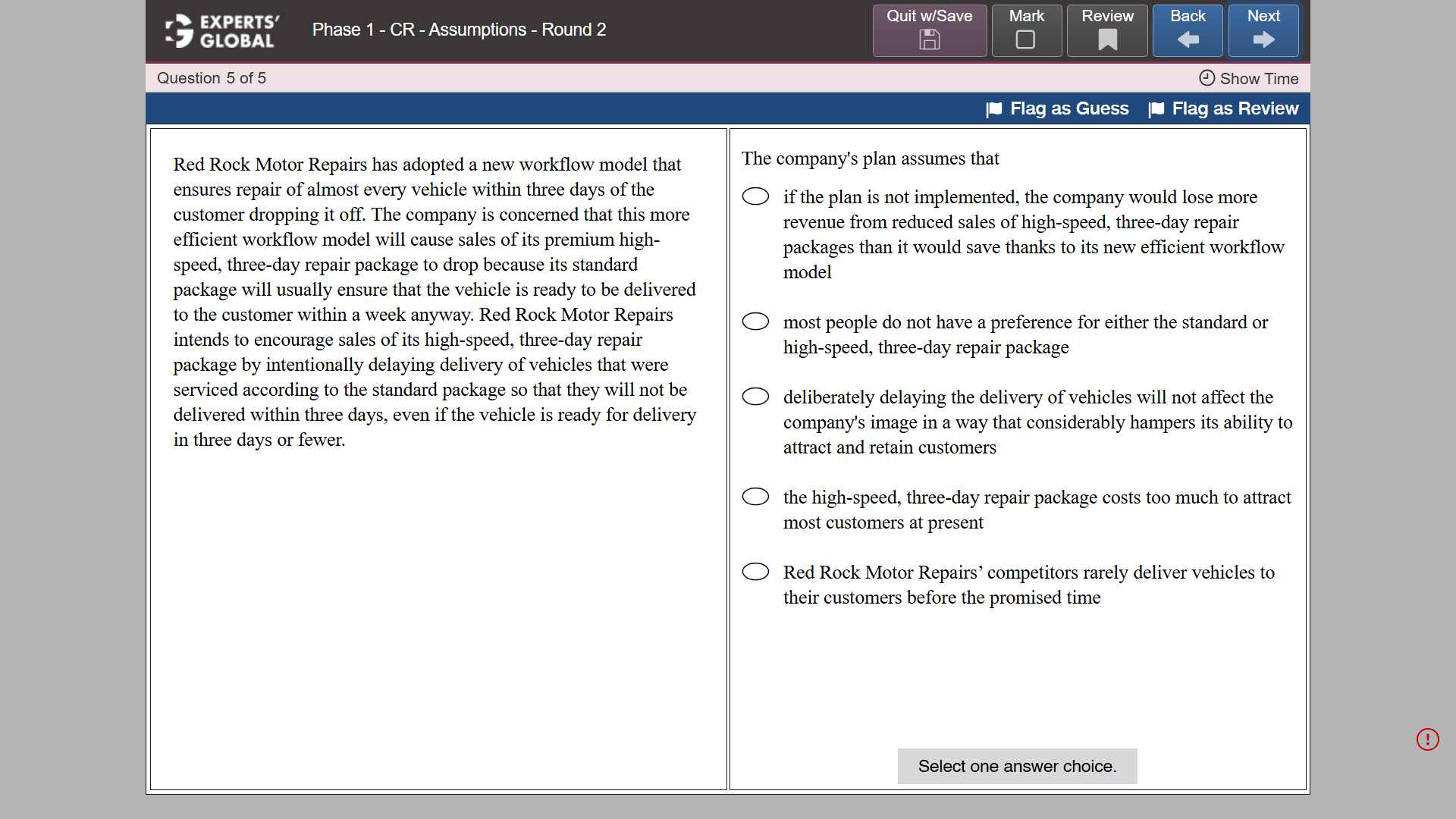
The company’s plan assumes that
A. if the plan is not implemented, the company would lose more revenue from reduced sales of high-speed, three-day repair packages than it would save thanks to its new efficient workflow model
B. most people do not have a preference for either the standard or high-speed, three-day repair package
C. deliberately delaying the delivery of vehicles will not affect the company’s image in a way that considerably hampers its ability to attract and retain customers
D. the high-speed, three-day repair package costs too much to attract most customers at present
E. Red Rock Motor Repairs’ competitors rarely deliver vehicles to their customers before the promised time
Written Explanation
Mind-map: New workflow model ensures repair in three days à may cause lower sales in premium package à company plans to intentionally delay delivery in standard option à the plan will ensure no lower sales in premium package (implicit conclusion)
Missing-link: Between company planning to intentionally delay delivery and the conclusion that the plan will ensure no lower sales in premium package
Expectation from the correct answer choice: To strengthen the conclusion that the plan will ensure no lower sales in premium package, through a valid assumption
A. Trap. This answer choice suggests that the company will have some “bigger lost sales in premium package” without the plan, in comparison to “smaller savings” with the plan; however, it cannot be inferred from this statement that with the plan, the company will have “no lower sales in premium package”; so, this answer choice simply adds information, which, although relevant to the broad context of the argument, does not strengthen the conclusion. Besides, this condition is not necessary for the argument to hold and thus, is not a valid assumption. Because this answer choice does not strengthen the conclusion through a valid assumption, this answer choice is incorrect. Side-note: “What would happen if a plan is not implemented” is not likely an “assumption” in any plan.
B. Trap. By suggesting that “most people do not have a preference for either the standard or high-speed, three-day repair package”, this answer choice casts doubt on the company’s premium high-speed, three-day repair package; so, this answer choice, if anything, only weakens, rather than strengthens, the argument. Because this answer choice does not strengthen the conclusion through a valid assumption, this answer choice is incorrect.
C. Correct. This answer choice addresses a likely negative side-effect of the plan and thus, strengthens the argument. Additionally, this statement does have to be true for the conclusion to hold; negating this statement would mean that “deliberately delaying the delivery of vehicles will affect the company’s image in a way that considerably hampers its ability to attract and retain customers” and thus, negate the conclusion. Because this answer choice strengthens the conclusion through a valid assumption, this answer choice is correct.
D. The argument is concerned with whether the sales of the premium package are lowered, and not with how expensive the premium package is; so, this answer choice is out of scope. Besides, this condition is not necessary for the argument to hold and thus, is not a valid assumption. Because this answer choice does not strengthen the conclusion through a valid assumption, this answer choice is incorrect.
E. The argument is concerned with a particular company’s plan for better delivery, and not with how efficiently the company’s competitors deliver; so, this answer choice is out of scope. Besides, this condition is not necessary for the argument to hold and thus, is not a valid assumption. Because this answer choice does not strengthen the conclusion through a valid assumption, this answer choice is incorrect.
C is the correct answer choice.
Practice Question 3 | CR
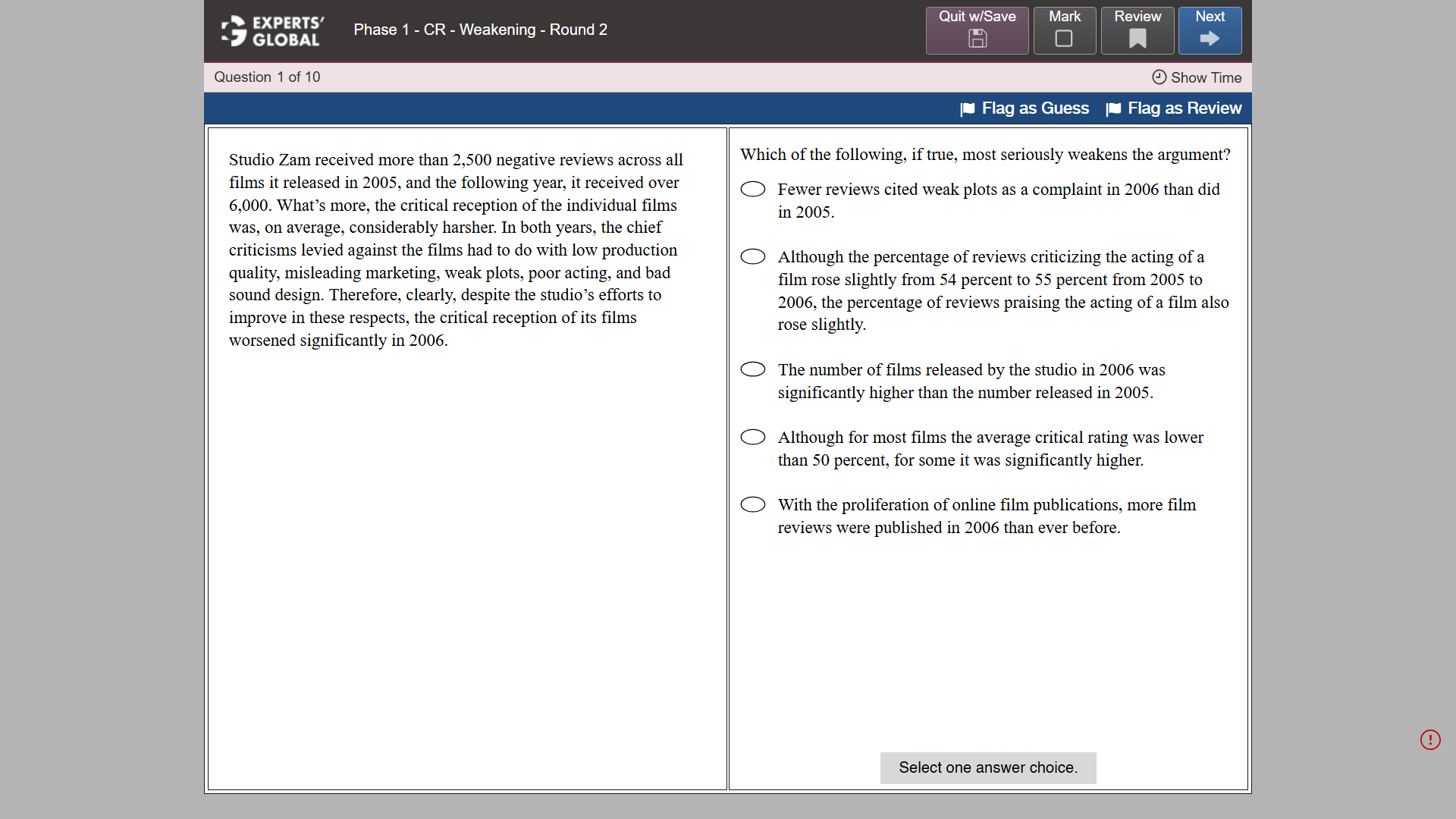
Which of the following, if true, most seriously weakens the argument?
A. Fewer reviews cited weak plots as a complaint in 2006 than did in 2005.
B. Although the percentage of reviews criticizing the acting of a film rose slightly from 54 percent to 55 percent from 2005 to 2006, the percentage of reviews praising the acting of a film also rose slightly.
C. The number of films released by the studio in 2006 was significantly higher than the number released in 2005.
D. Although for most films the average critical rating was lower than 50 percent, for some it was significantly higher.
E. With the proliferation of online film publications, more film reviews were published in 2006 than ever before.
E is the correct answer choice.
Additional GRE Critical Reasoning Practice Questions
Please find a set of GRE-style CR questions with explanations on: Free GRE Critical Reasoning Practice Questions with Solutions
Please find a set of assorted GRE-style Verbal questions (all types) with explanations on: Free GRE Verbal Practice Questions with Solutions
GRE Analytical Writing Practice Questions
The GRE Analytical Writing Assessment (abbreviated as AWA or AW) measure includes one essay task called Analyze an Issue. The task requires you to read a short prompt, take a position, and build a clear, well supported argument within 30 minutes. Scoring focuses on how clearly you think and communicate, including the quality of reasoning, structure, coherence, and control over language. The task does not assess general or specialized knowledge, and it does not judge which stand you take. Responses receive scores from 0 to 6 in half point steps, based on overall writing and argument quality. Following is a set of GRE-style AW practice questions with detailed explanations.
Important: Before attempting the GRE Analytical Writing practice questions, if you would like to undergo detailed AW prep, please visit Free GRE Analytical Writing Assessment prep
Practice Question 1 | AW
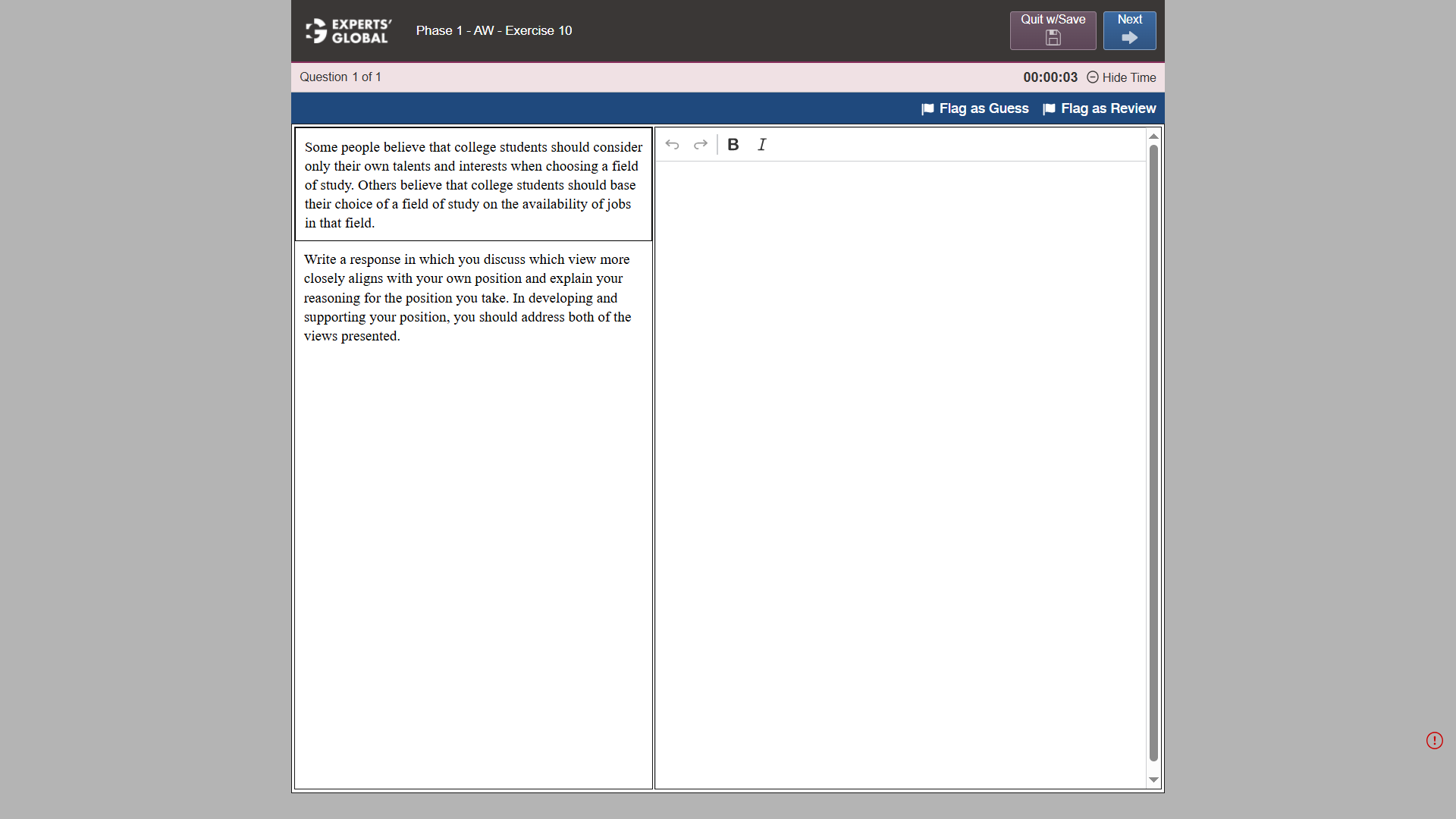
Some people believe that college students should consider only their own talents and interests when choosing a field of study. Others believe that college students should base their choice of a field of study on the availability of jobs in that field.
Write a response in which you discuss which view more closely aligns with your own position and explain your reasoning for the position you take. In developing and supporting your position, you should address both of the views presented.
Written Explanation
Reasons with relevant examples:
For the first view:
Reason: Intrinsic motivation leads to persistence and deeper learning.
Example: A student passionate about a given subject is more likely than one who is not passionate about that subject to engage deeply, take initiative, and go beyond basic course requirements.
Example 2: A student with a genuine interest in engineering will likely take on more ambitious projects than one pursuing an engineering degree only in hopes of a lucrative career.
Reason: People tend to be more successful in fields they enjoy and excel in.
Example: A student who’s naturally gifted in art may thrive as a designer, but struggle to pass a business course.
Reason: Skills developed in pursuing passions often translate across fields.
Example: A literature major learns communication and analysis, skills valuable in fields like marketing or management.
Reason: Working in a misaligned field can lead to burnout.
Example: Many who pursue a field for financial security later report dissatisfaction or leave for more meaningful work in unrelated fields.
Reason: Collegiate education should involve self-discovery.
Example: Students who study what excites them learn more about their identity, values, and intellectual goals, benefiting them long-term.
For the second view:
Reason: Doing so is the more stable option.
Example: Graduates in high-demand fields such as healthcare or engineering typically secure employment and financial independence sooner than others.
Reason: Secure employment enables personal freedom.
Example: A student who chooses a lucrative field may later have the financial freedom to take up passion projects.
Reason: Doing so helps society at large.
Example: Countries benefit when students enter fields where workers are needed, such as nursing or renewable energy.
Reason: Interest in a subject does not necessarily mean that one is capable of studying it formally and carving a career out of it.
Example: Many students have found pursuing subjects such as literature or art as subjects of formal study to be far more challenging than pursuing them as hobbies.
Reason: Students can develop their interest in a subject through mastery.
Elaboration: Many people grow to enjoy what they become good at, skill development sparking interest over time.
Example: In the process of learning how to code, a disinterested student can come to appreciate the intricacy of computer science.
Practice Question 2 | AW
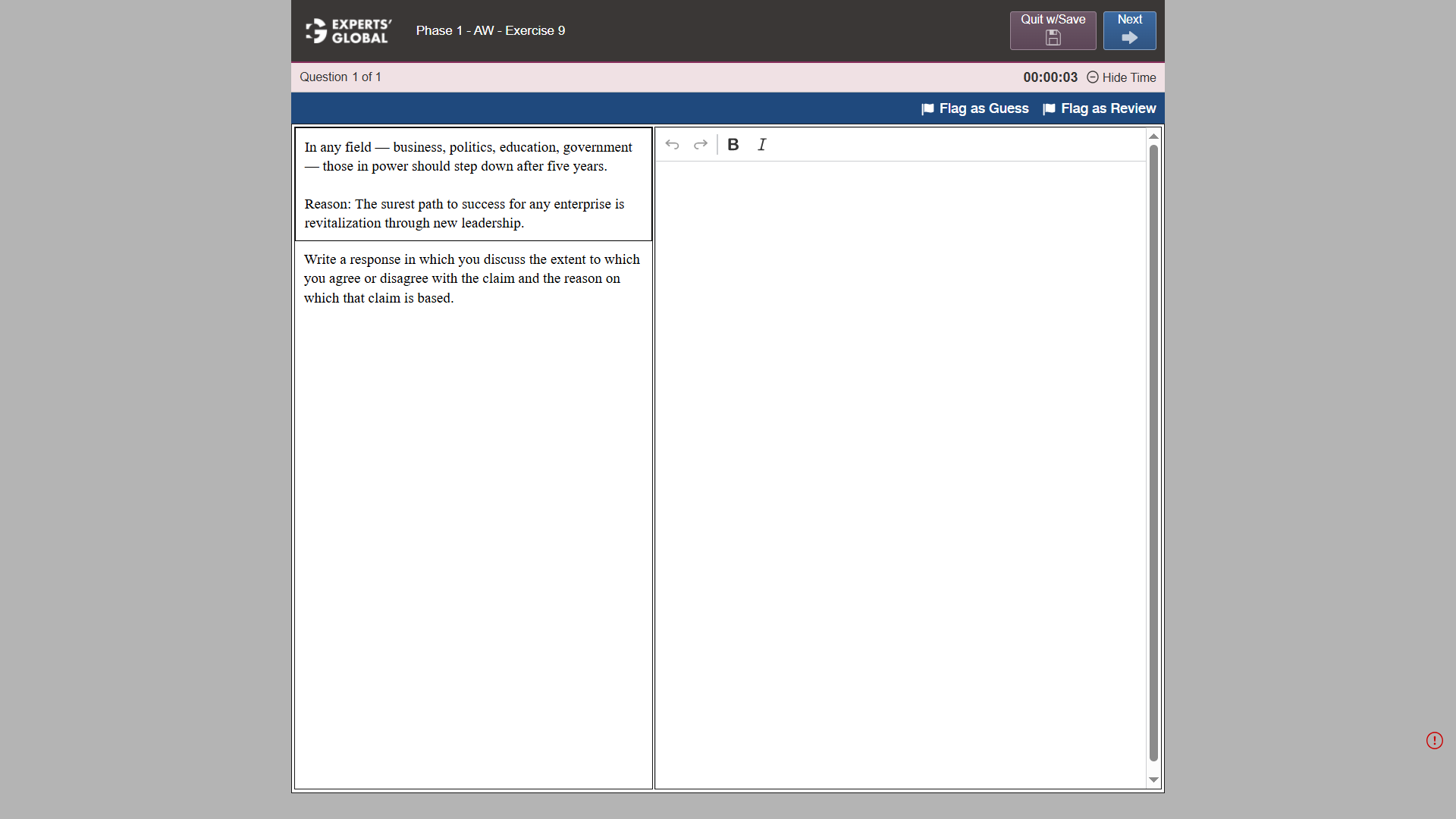
In any field — business, politics, education, government — those in power should step down after five years.
Reason: The surest path to success for any enterprise is revitalization through new leadership.
Write a response in which you discuss the extent to which you agree or disagree with the claim and the reason on which that claim is based.
Written Explanation
Reasons with relevant examples:
For the issue:
Reason: Fresh leadership is needed to ensure adaptability.
Elaboration: New leadership brings new perspectives, helping organizations evolve instead of stagnating or resisting change.
Example: Ensuring that younger executives get a chance to lead can help a company avoid falling out of sync with consumer desires.
Reason: Such a requirement would help prevent the concentration and abuse of power.
Example: In governments and corporations, long-term leaders may accumulate unchecked authority, making systems vulnerable to corruption or favoritism.
Example 2: Countries with strictly enforced political term limits are, on average, far less corrupt than those without such limits
Reason: Such a requirement would stop organizations from growing dependent on one individual
Example: If leadership is regularly rotated, institutions will build stronger teams and systems rather than relying on one person’s expertise.
Example 2: A political party that cultivates a number of leaders is more likely to stay relevant over time than one that relies on a single charismatic leader.
Reason: Such a requirement would help prevent burnout and decision fatigue in leaders themselves.
Elaboration: Leading an institution can be mentally and emotionally taxing; a five-year term allows for full engagement without risking overextension.
Example: The Roman Republic limited the terms of its elected leaders, the consuls, to two years and banned consecutive terms partly due to instances of erratic behavior from long-serving leaders.
Reason: Such a requirement aligns with democratic and meritocratic ideals.
Example: Rotating leadership reflects the belief that no one is indispensable and everyone deserves a fair chance to exercise power.
Against the issue:
Reason: Such a requirement would degrade institutional knowledge.
Example: A five-year limit may force out effective leaders just as they get a firm grasp on complex systems or challenges.
Reason: Such a requirement would likely complicate long-term planning.
Example: In businesses, frequent leadership turnover can stall progress and lead to inconsistent vision or execution.
Reason: Such a requirement would empower unelected bureaucrats or informal power holders.
Example: In politics, if elected leaders are routinely removed, advisors, donors, or lobbyists may come to wield outsized influence.
Reason: Such a requirement may simply be impractical.
Example: In organizations such as political parties, it may not be feasible to maintain a large pool of candidates ready to take up leadership positions.
Reason: Good leadership alone cannot guarantee success.
Example: Material conditions, such as an acute shortage of resources, can undermine the efforts of even the best leaders.
Practice Question 3 | AW
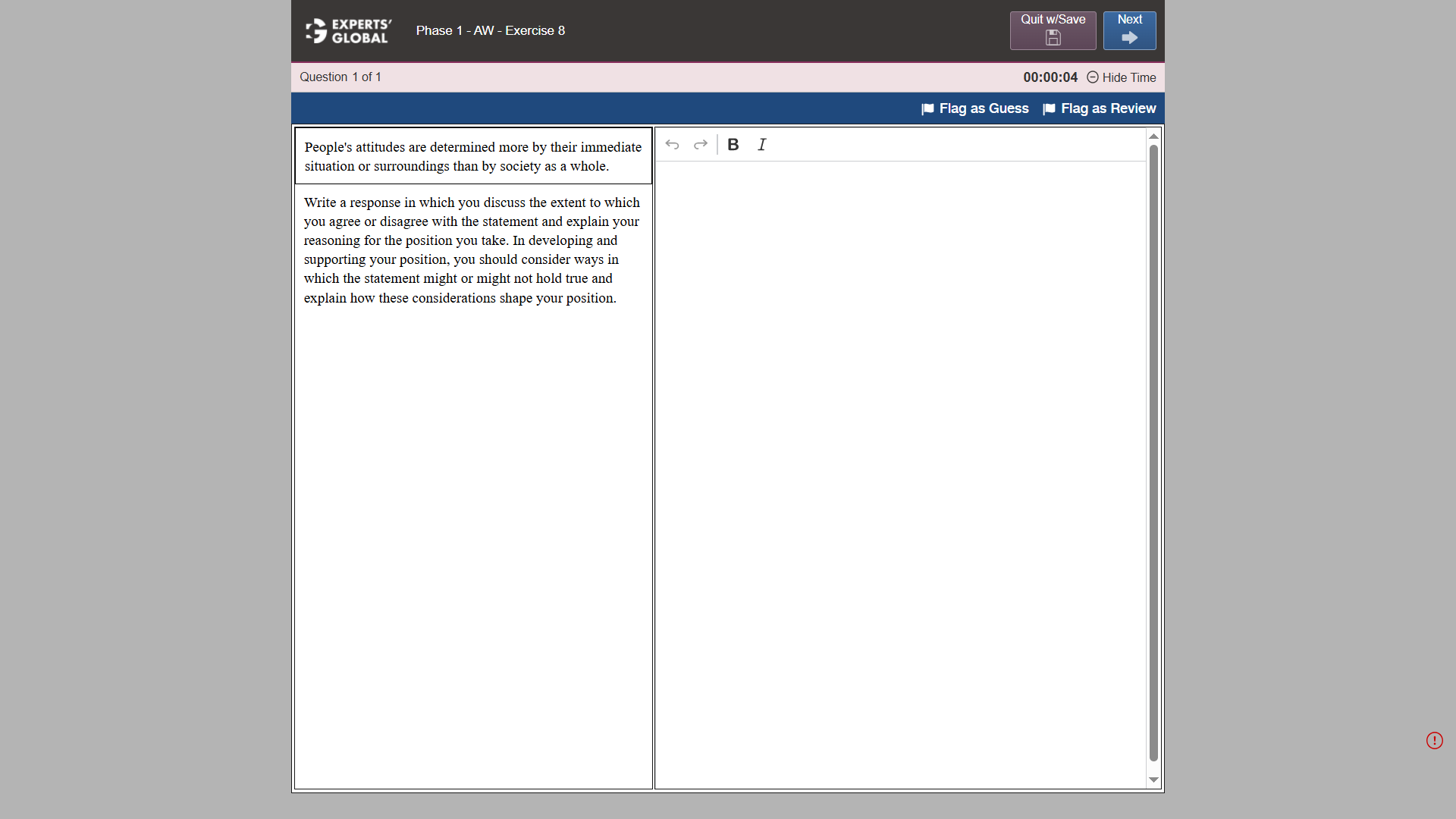
People’s attitudes are determined more by their immediate situation or surroundings than by society as a whole.
Write a response in which you discuss the extent to which you agree or disagree with the statement and explain your reasoning for the position you take. In developing and supporting your position, you should consider ways in which the statement might or might not hold true and explain how these considerations shape your position.
Written Explanation
Reasons with relevant examples:
For the issue:
Reason: Direct environments affect behavior in real-time.
Elaboration: Society’s values may be broad, but immediate situations shape how people think and act daily.
Example: Someone might claim to support immigration policies in theory, but feel threatened or hostile when faced with sudden demographic changes in their neighborhood.
Reason: Family and peer groups serve as intermediaries.
Elaboration: Societal ideals are filtered through close relationships, which exert a stronger influence on the individual’s attitudes than society as a whole does.
Example: Schools may impart societally approved values, but input from their peers and family members determines how adolescents respond to the school’s instruction.
Reason: The desire to fit in is a strong motivating factor.
Elaboration: Social groups regulate membership on the basis of public behavior, encouraging conformity.
Example: In order to avoid being isolated, new employees may quickly adopt the philosophy of a company, even if it contradicts their own beliefs.
Reason: Social roles shape personal identity.
Elaboration: The immediate roles a person plays, such as that of a parent, influence their behavior and priorities more than societal values.
Example: For most people who have young children, their role as a parent is what they identify with most strongly, owing to the amount of time they spend raising their children.
Reason: Survival overrides moral concerns or ideology.
Elaboration: People will readily compromise on previously held beliefs in the face of serious threats.
Example: Although society typically values generosity, hoarding of resources is common during natural disasters.
Against the issue:
Reason: Society broadly defines what is acceptable.
Elaboration: Behavioral or ideological variation among individuals tends to be limited to a narrow set of beliefs considered acceptable within their society.
Example: The public may vigorously debate how to best grow a sector of the economy, but never question whether that sector should be grown.
Reason: Some institutions carry society-wide influence.
Example: One of the key roles that primary and secondary education play in any society is to indoctrinate the population with certain foundational values.
Reason: Societal values, in turn, shape immediate environments.
Elaboration: Local environments are typically, in some way, a product of society-level policies.
Example: Political opinions often determine which friend groups one may be accepted by.
Reason: Mass media homogenize experiences.
Elaboration: The prevalence of mass media in contemporary societies ensures that people are exposed to and heavily influenced by ideas outside their immediate environments.
Example: People’s sense of aesthetics is increasingly shaped by national and international level media.
Reason: Language itself shapes perception.
Example: According to certain linguistic theories, the language one speaks shapes one’s perception of the world; hence, a common language ensures certain conformity across different parts of society.
Additional GRE AW Practice Questions
For practice GRE AW topics with explanations, please visit: GRE Analytical Writing Practice Topics with Explanations
For the complete list of official AW topics, please visit: Official GRE Analytical Writing Topics, Prompts
For Further Prep and Practice:
15 full-length GRE practice tests (includes a free test)
60 sectional GRE practice tests (includes 3 free sectional tests)
End-to-end GRE prep course online (includes 7-day free trial)
GRE 5-weeks crash course
GRE Prep + Admission Consulting Bundle