
Invest 30 seconds...
...for what may lead to a life altering association!
Help Line
- +91.8800.2828.00 (IND)
- 1030-1830 Hrs IST, Mon-Sat
- support@expertsglobal.com
33% off ends soon:GMAT/GRE prep + applications bundle. Profile building, longer mentoring, better results. Inquire

Quantitative Comparison questions on the GRE present two quantities, Quantity A and Quantity B, and ask you to compare their values using one of four fixed answer choices. The setup feels simple, but the real skill sits in how you reason with limited information. These questions stay unique because you do not compute a single final number as the goal. You evaluate relationships, test hidden cases, and notice when the comparison changes under different valid values. They test quantitative reasoning, algebraic sense, number properties, estimation, and disciplined decision-making under time pressure.
A part of our GRE Prep course, the following video shares a sound and efficient approach for solving Quantitative Comparison questions on the GRE. You learn a simple, organized, and methodical way to work through QC questions, see the layers in each prompt, and navigate the commonly tested traps in this engaging question type. The lesson then demonstrates the approach across multiple GRE-style problems with realistic, trappy answer choices that reflect frequently tested traps, so you learn how to apply the approach correctly and handle those traps first-hand. Take your time with this important lesson and carry the methodology and learnings into your GRE practice drills, GRE sectional mocks, and GRE full mocks.
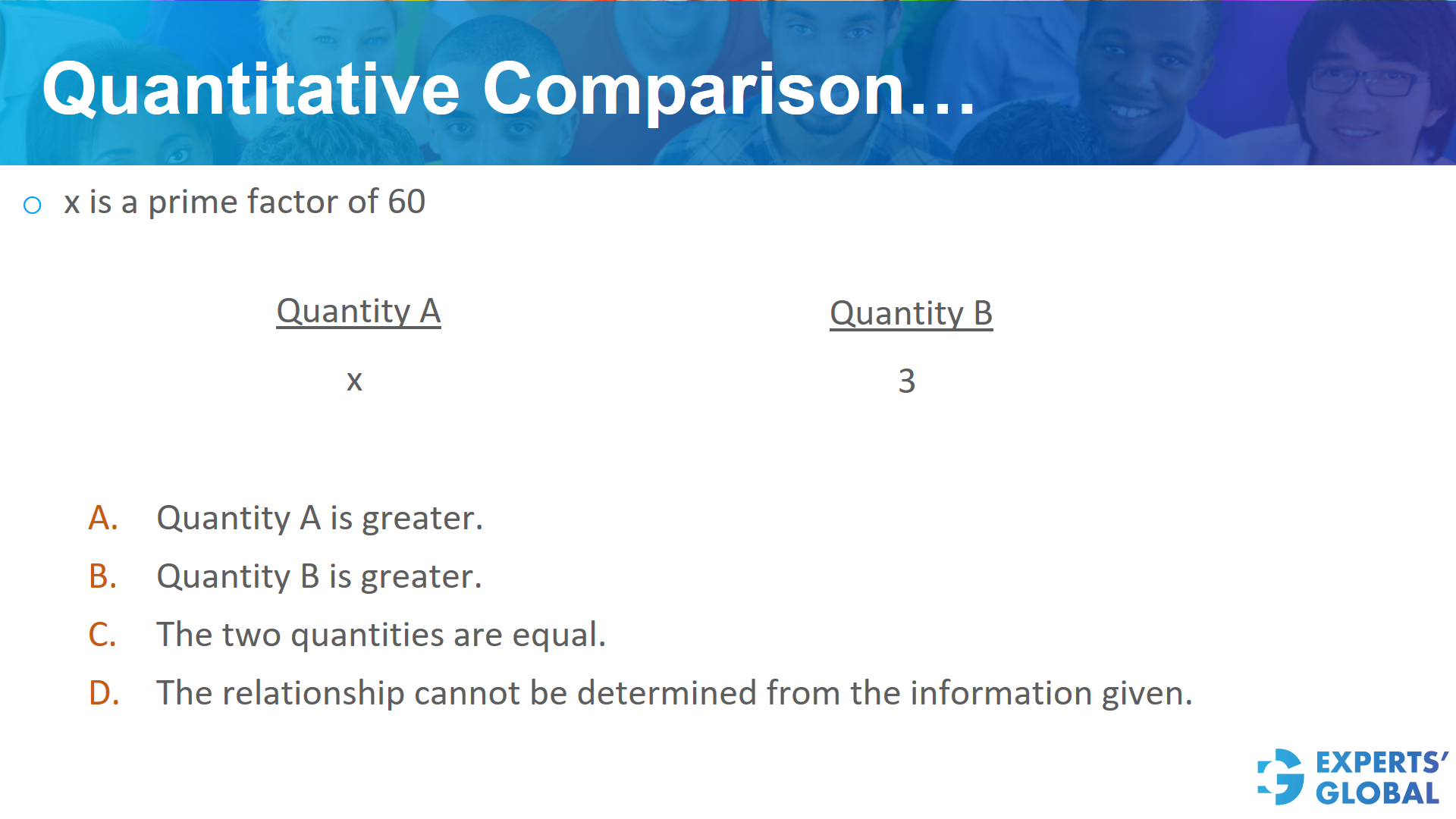
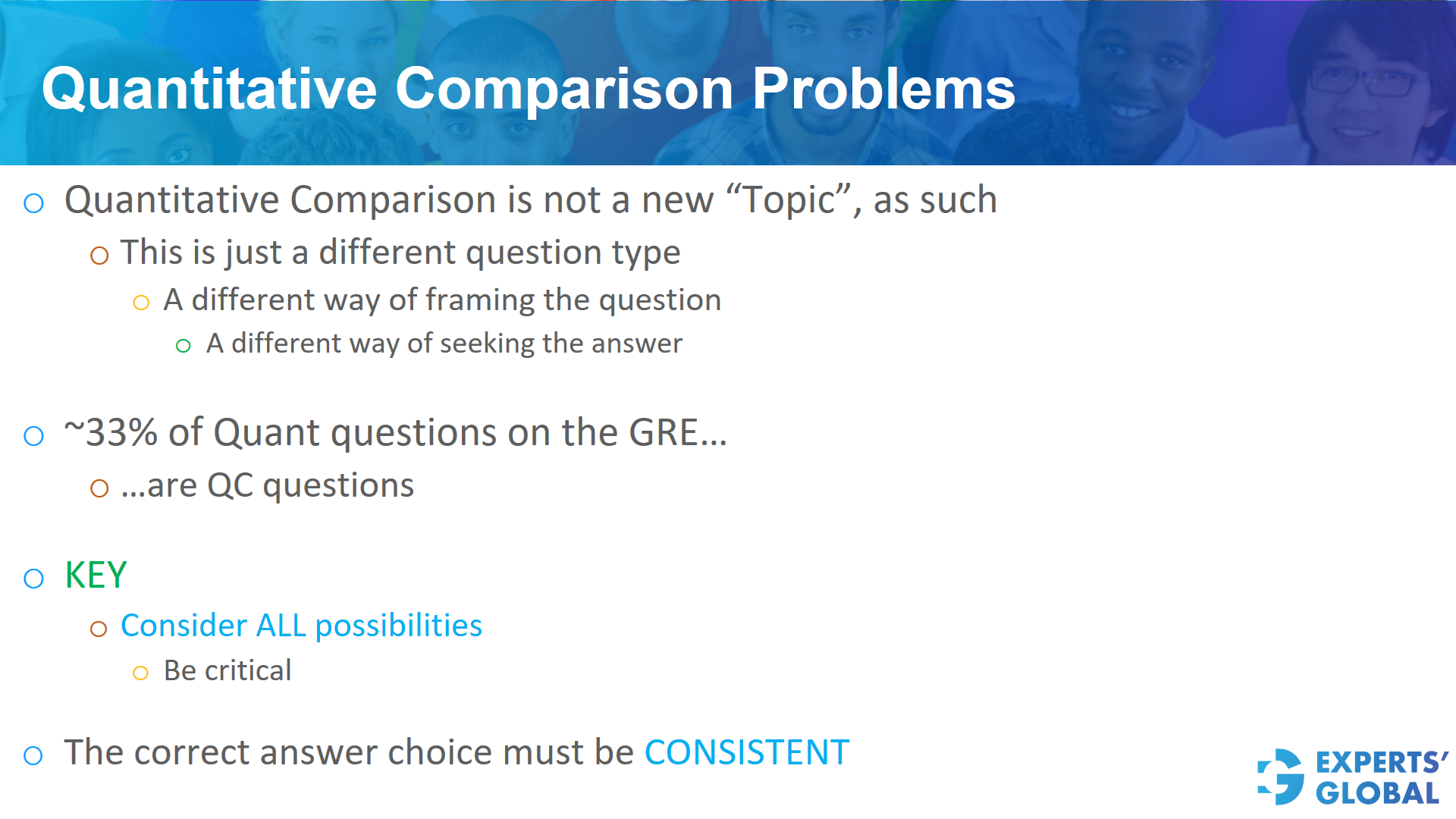
Quantitative Comparison (QC) is a specific question format rather than a unique mathematical subject. It presents a different way of framing problems and seeking answers compared to standard multiple-choice questions.
On the GRE, approximately 33% of the Quantitative Reasoning section consists of QC questions.
The primary key to mastering these problems is to consider all possibilities and maintain a critical mindset.
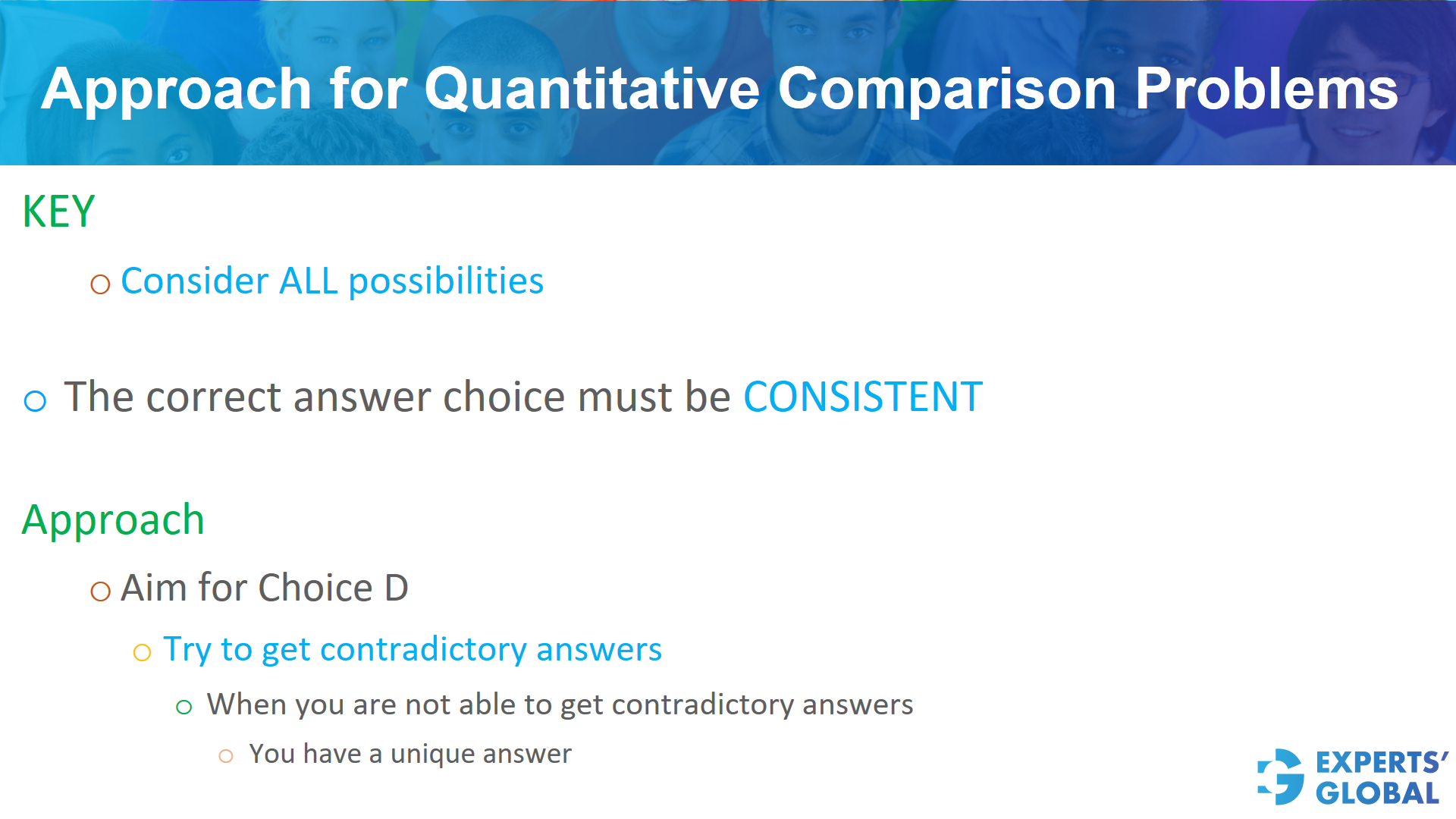
To master Quantitative Comparison (QC) problems, you must adopt a mindset of “proving the problem wrong” before settling on a definitive relationship. Here is the academic breakdown of the methodology:
Correct Answer: D
The relationship cannot be determined from the information given.
For a detailed explanation of this question, please refer to the video presented earlier on this page.
Following is a step-wise written explanation:
For GRE quantitative comparison questions, our approach is to aim for answer choice D by testing for contradictory outcomes. If no contradictions appear, the relationship is unique and the correct answer falls under A, B, or C.
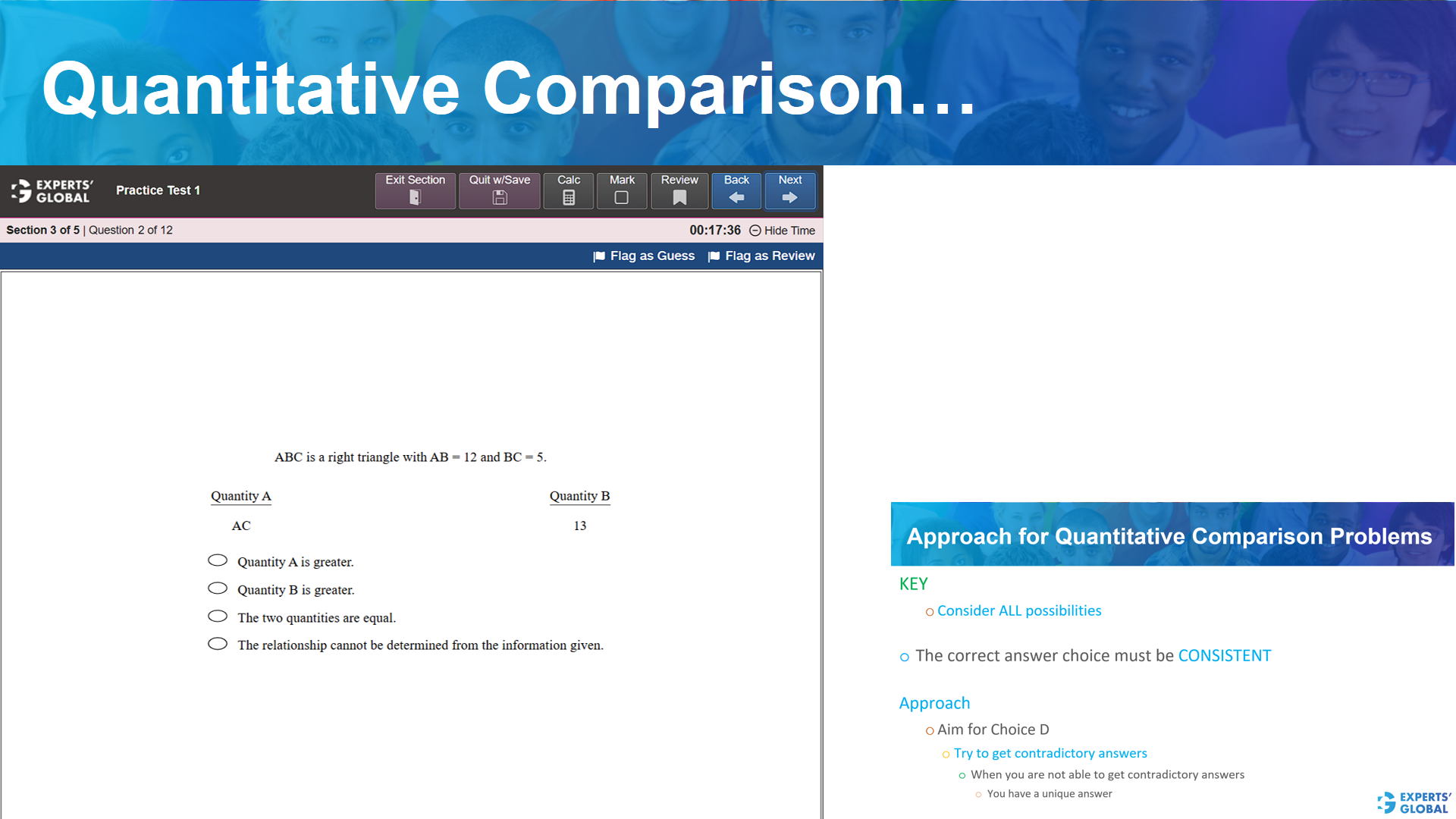
ABC is a right triangle with AB = 12 and BC = 5.
Quantity A Quantity B
AC 13
If AB and BC are the legs, we use the Pythagorean theorem to find the longest side.
(12)² + (5)² = (AC)²
144 + 25 = 169
The square root of 169 is 13.
In this case, AC is 13.
Result: Quantity A is equal to Quantity B.
The problem does not state which side is the hypotenuse. If AB is the hypotenuse, it must be the longest side.
(AC)² + (5)² = (12)²
(AC)² + 25 = 144
(AC)² = 119
The square root of 119 is approximately 10.9.
In this case, AC is less than 13.
Result: Quantity B is greater than Quantity A.
We followed the approach to aim for Choice D by finding contradictory answers.
In Case 1, the quantities are equal.
In Case 2, Quantity B is greater.
Because we succeed in getting contradictory answers, the relationship cannot be determined.
Final Answer: D
The relationship cannot be determined from the information given.
Correct Answer: D
The relationship cannot be determined from the information given.
For a detailed explanation of this question, please refer to the video presented earlier on this page.
Following is a step-wise written explanation:
For GRE quantitative comparison questions, our approach is to aim for answer choice D by testing for contradictory outcomes. If no contradictions appear, the relationship is unique and the correct answer falls under A, B, or C.
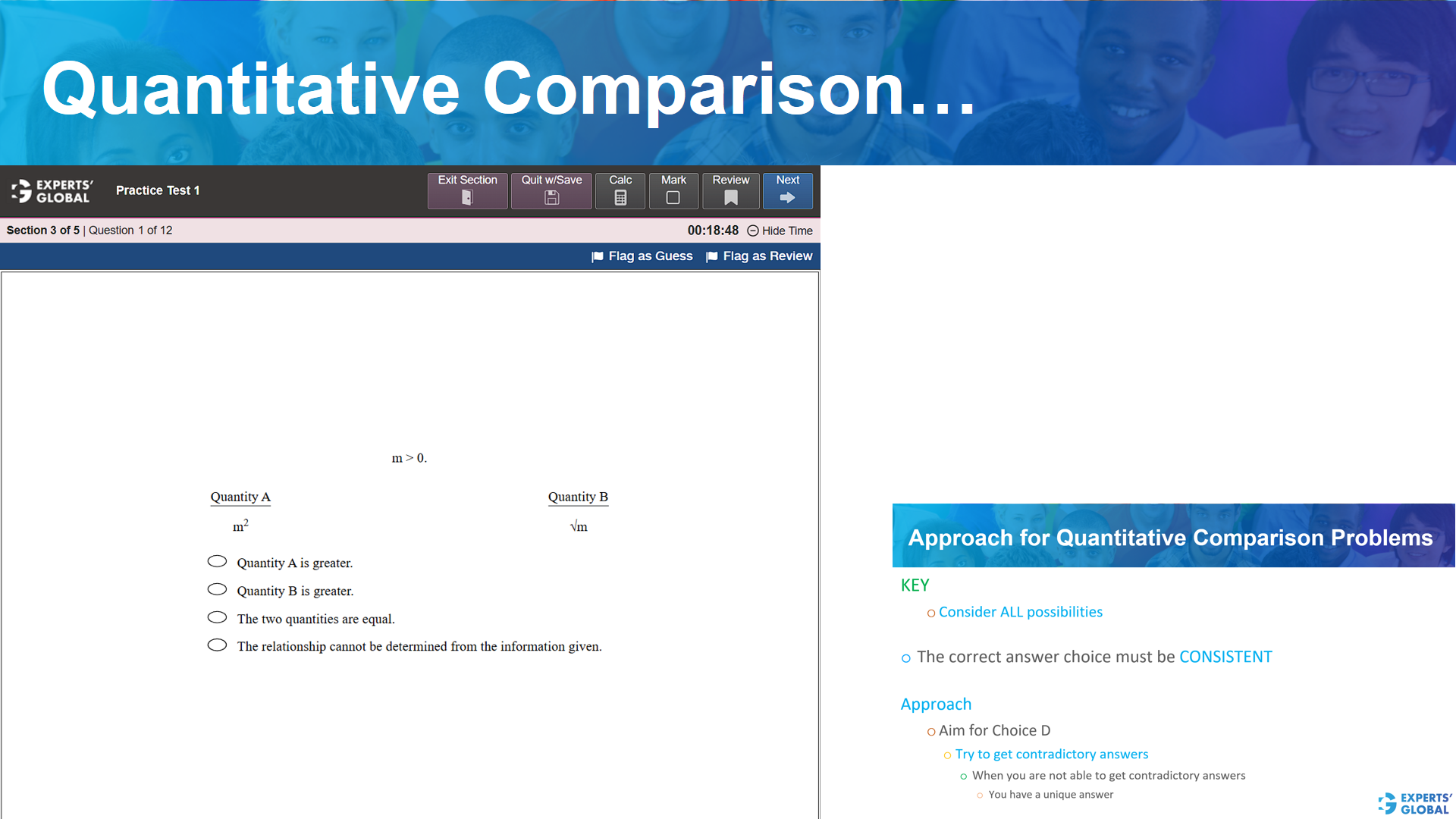
m > 0.
Quantity A Quantity B
m² √m
If m is 4, we calculate both quantities.
Quantity A: (4)² = 16
Quantity B: √4 = 2
In this case, 16 is greater than 2.
Result: Quantity A is greater than Quantity B.
If m is 0.25, we calculate both quantities.
Quantity A: (0.25)² = 0.0625
Quantity B: √0.25 = 0.5
In this case, 0.5 is greater than 0.0625.
Result: Quantity B is greater than Quantity A.
We followed the approach to aim for Choice D by finding contradictory answers.
In Case 1, Quantity A is greater.
In Case 2, Quantity B is greater.
Because we succeed in getting contradictory answers, the relationship cannot be determined.
Final Answer: D
The relationship cannot be determined from the information given.
End-to-end GRE prep course online (includes 7-day free trial)
60 sectional GRE practice tests
15 full-length GRE practice tests
