Invest 30 seconds...
...for what may lead to a life altering association!
Help Line
- +91.8800.2828.00 (IND)
- 1030-1830 Hrs IST, Mon-Sat
- support@expertsglobal.com
33% off ends soon:GMAT/GRE prep + applications bundle. Profile building, longer mentoring, better results. Inquire

A strengthening statement makes the conclusion more convincing by addressing the missing-link between premise and conclusion or adding new, relevant information; it needn’t be essential (unlike an assumption). Useful patterns: causation, relevant benchmarks/comparisons, uniqueness, and ruling out alternatives.
Strengthening statements increase an argument’s persuasiveness by supplying relevant information that connects premise to conclusion without being logically indispensable. This overview clarifies how they differ from assumptions, which must be true for the reasoning to stand. The video and article outline common strengthening patterns, such as causal links, benchmark comparisons, uniqueness claims, and ruling out alternatives. Use this lens to read question stems, focus evaluation, and build a practical checklist for GMAT prep and rigorous argument appraisal across MBA admissions.

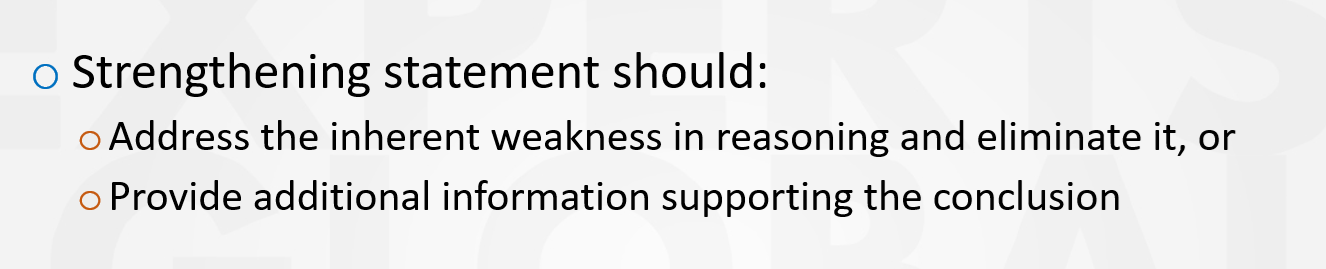
Critical Reasoning questions on the GMAT often test whether you can identify how an argument can be supported. This is where strengthening statements play their role. A strengthening statement is one that either addresses a weakness in the reasoning or provides additional, relevant information that supports the conclusion.
Expect a brief passage with layers of information and a conclusion. Your task is to identify the option that most strengthens the author’s reasoning in reaching that conclusion.
Which of the following statements, if true, would most significantly strengthen the conclusion drawn in the passage?
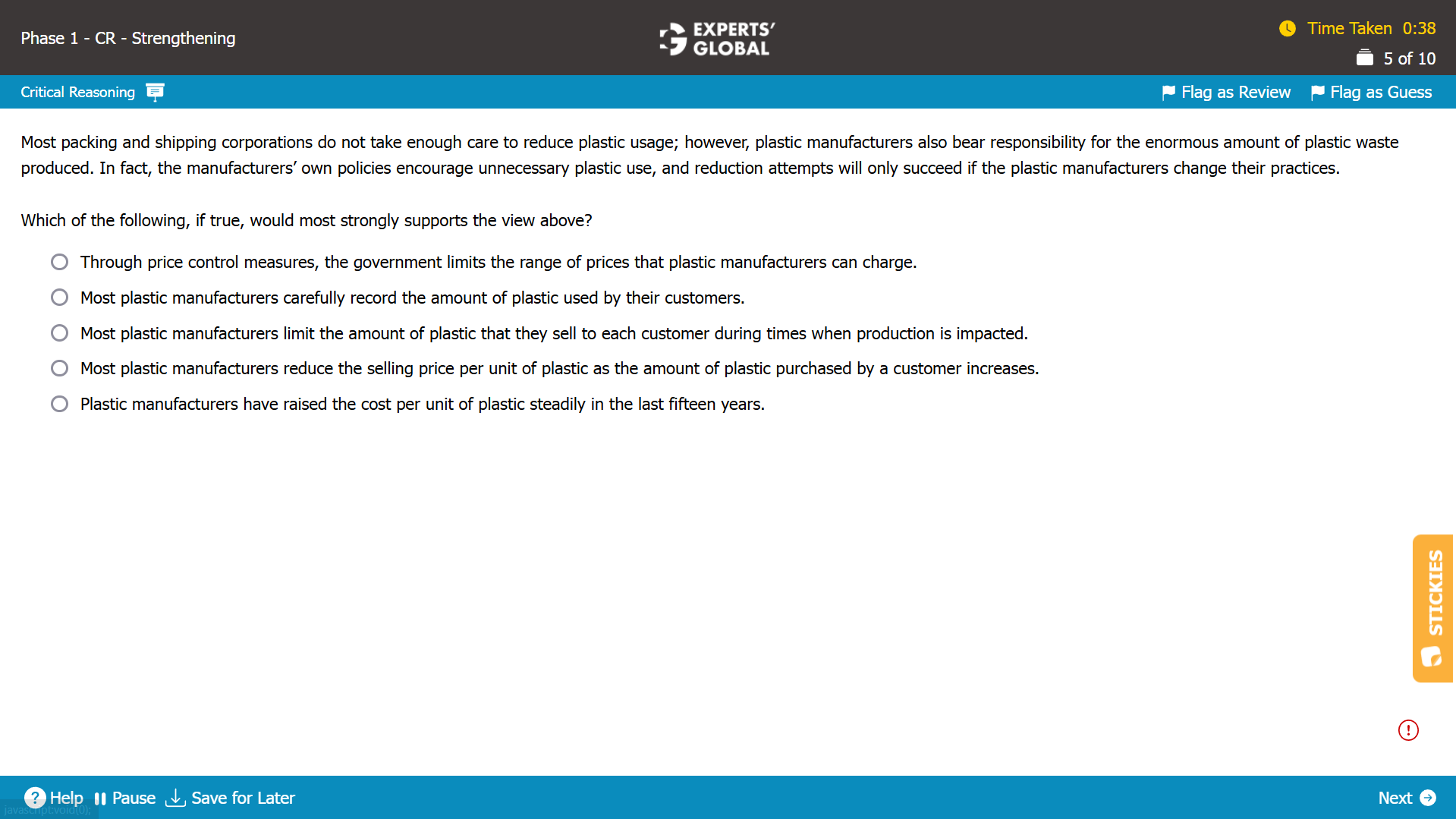
Correct Answer: D
The line separating strengthening statements and assumptions is important. An assumption fills the missing link between the premise and the conclusion and must be true for the argument to hold. A strengthening statement also fills the missing link, but it is not bound by the “must be true” condition. This makes strengthening questions relatively easier than assumption questions, because all you need to check is whether the missing link has been addressed.
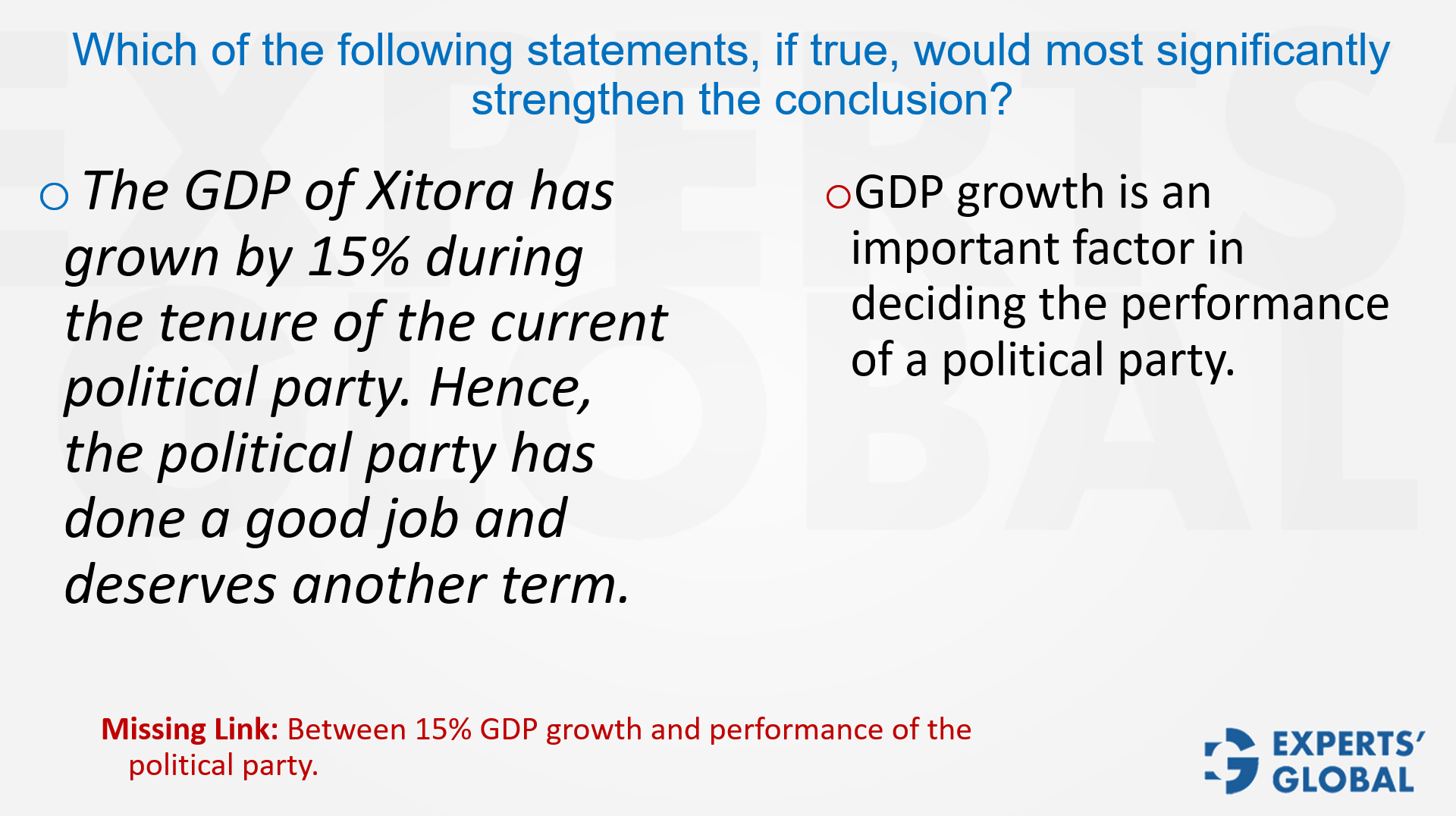
Consider this argument: “The GDP of Xitora has grown by 15 percent during the tenure of the current political party. Hence, the party has done a good job and deserves another term.”
The missing-link is between the GDP growth and the conclusion that the party has done a good job. Let us explore some statements:
1. “GDP growth is an important factor in deciding the performance of a political party.”
This directly fills the gap and strengthens the argument. Since the reasoning is built entirely around GDP growth, calling it an important factor makes the conclusion more convincing.
2. “During the tenure of no previous government, the GDP grew by more than 10 percent.”
This strengthens the conclusion because it positions the 15 percent growth as a unique achievement. However, it does not qualify as an assumption since it is not something that must be true for the conclusion to hold.
3. “The government played an important role in achieving the growth in GDP.”
This creates a cause-effect relationship between the party and the GDP growth, thereby strengthening the conclusion.
4. “None of the other similar economies witnessed a growth of more than 12 percent in GDP during the same tenure.”
Here, the analogy with similar economies makes the party’s performance look even stronger. The conclusion gains support, but again, this is not a must-be-true condition, so it cannot be called an assumption.
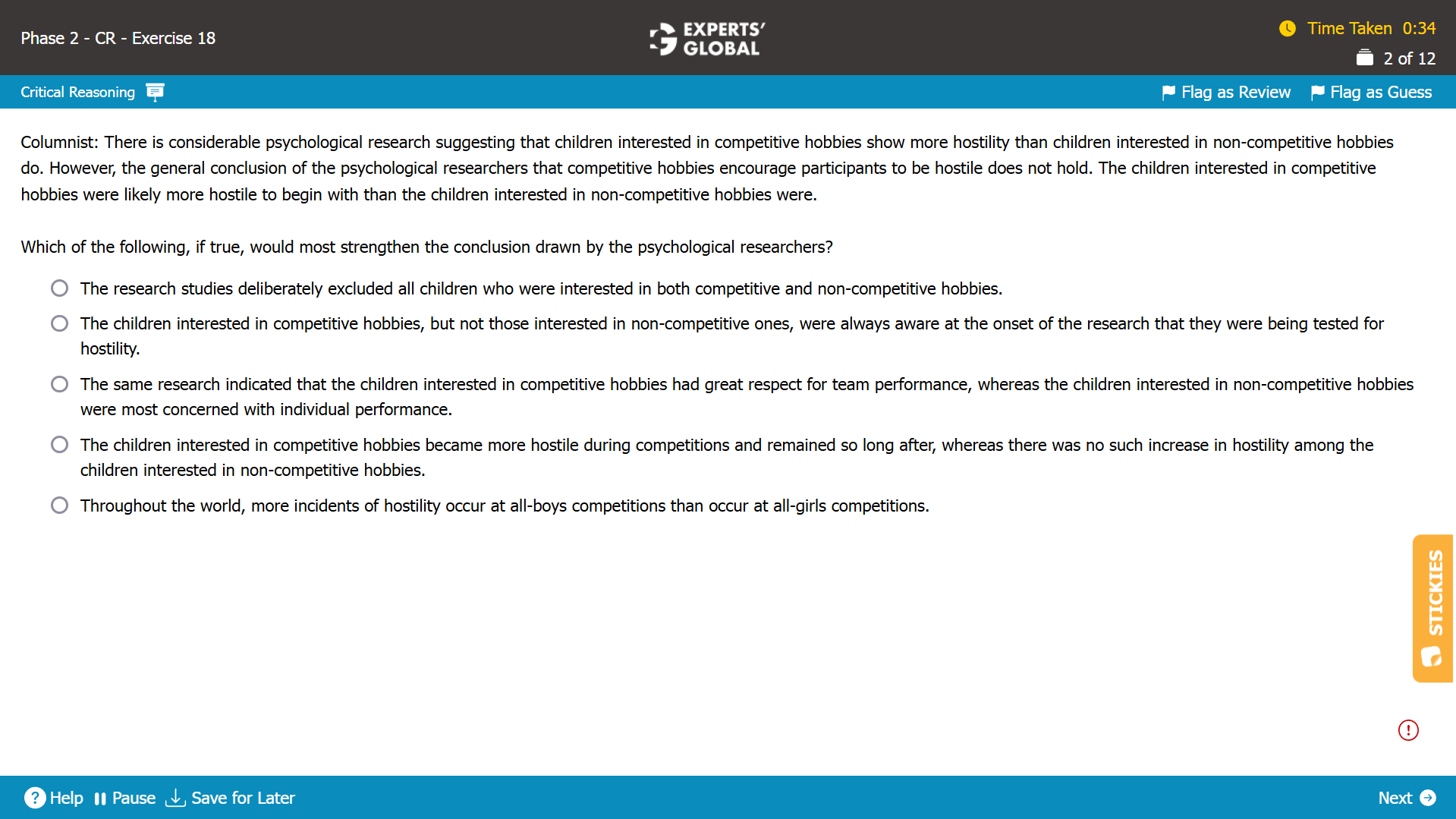
A strengthening statement enhances the persuasiveness of an argument by addressing gaps between premise and conclusion, though it need not be essential. Typical forms include establishing causation, offering benchmarks, highlighting uniqueness, or ruling out alternatives. The key is ensuring the statement adds value without contradicting given facts. Distinguishing strengtheners from assumptions saves time and improves accuracy. Practicing these distinctions in GMAT simulations sharpens recognition, builds systematic reasoning, and prepares you to handle diverse Critical Reasoning questions with confidence.
Strengthening statements remind us that progress often lies not in finding absolute certainty but in adding credible support to what we believe. In GMAT preparation, this mirrors the process of building stronger arguments through practice and reflection. In MBA applications, it echoes the art of presenting experiences with persuasive detail that enhances credibility. In life, too, we constantly strengthen our choices by aligning them with evidence, context, and perspective. Each GMAT mock provides a training ground for this discipline, teaching us how to add structure and weight to our reasoning beyond the exam.