
Invest 30 seconds...
...for what may lead to a life altering association!
Help Line
- +91.8800.2828.00 (IND)
- 1030-1830 Hrs IST, Mon-Sat
- support@expertsglobal.com
33% off ends soon:GMAT/GRE prep + applications bundle. Profile building, longer mentoring, better results. Inquire

An effective GMAT study week balances learning, practice, and testing. Use weekdays for building concepts and practicing steadily, Saturday for consolidating and reviewing mistakes, and Sunday for a full-length mock test with thorough analysis. This weekly rhythm builds discipline, reinforces learning, and ensures steady progress.
A strong GMAT preparation plan is not built in a single day but through consistent and structured effort week after week. The rhythm of your study schedule plays a powerful role in how steadily your skills improve. A balanced week allows you to learn new concepts, reinforce them, and then test your understanding in realistic exam-like conditions. During the weekdays, your focus should be on building clarity and practicing steadily. The weekend, however, should serve a different purpose. Saturday is best used for consolidating your learning, revising what you studied, and revisiting the questions that challenged you most. Sunday must be reserved for a full-length test, simulating exam conditions and followed by thorough analysis. This cycle ensures progress without gaps and prevents important lessons from slipping away. Incorporating this routine into your GMAT preparation plan, and validating it through regular GMAT mock tests, will build both discipline and confidence.

The weekdays should be devoted to self-preparation. Spend this time learning and revising key concepts, practicing questions, and gradually building accuracy. Consistency here matters more than volume; it is better to study for steady hours each day than to overwork on a single day and lose rhythm.
Reserve Saturdays for consolidating the week’s preparation. Revise the concepts you studied during the week and revisit the questions you answered incorrectly. Understanding why you got a question wrong is just as important as solving new ones. This habit ensures that your mistakes become stepping stones to mastery.
Sundays should be dedicated to a full-length GMAT test. Simulating the real exam helps you practice time management, endurance, and pacing. Just as important as taking the test is analysing it thoroughly afterward. Identify your weak areas, understand patterns of error, and note strategies for improvement.
| Day | Focus Area |
|---|---|
| Monday to Friday | Learn concepts and practice related questions. – Focus un real ‘takeaways’ and not just ‘completing’ the study material – Emphasize on ‘accuracy’ over ‘speed’ – Once you have gained accuracy, aim for balance between accuracy and speed – Analyze incorrect attempts; most learning comes from it – Try to study in long sittings; GMAT requires endurance – Keep an eye on analytics ; work harder on weaker areas and ensure fully leveraging your strengths |
| Saturday | Consolidate the week’s work: revise all topics studied and reattempt wrong questions |
| Sunday | Take a full-length GMAT test under exam-like conditions, followed by deep analysis of errors and pacing. |
Repeating this cycle week after week ensures steady growth. You do not just build knowledge but also reinforce it, test it, and refine it. By following this disciplined structure as part of your GMAT preparation course, you will find your confidence rising and your readiness for the actual test steadily taking shape.
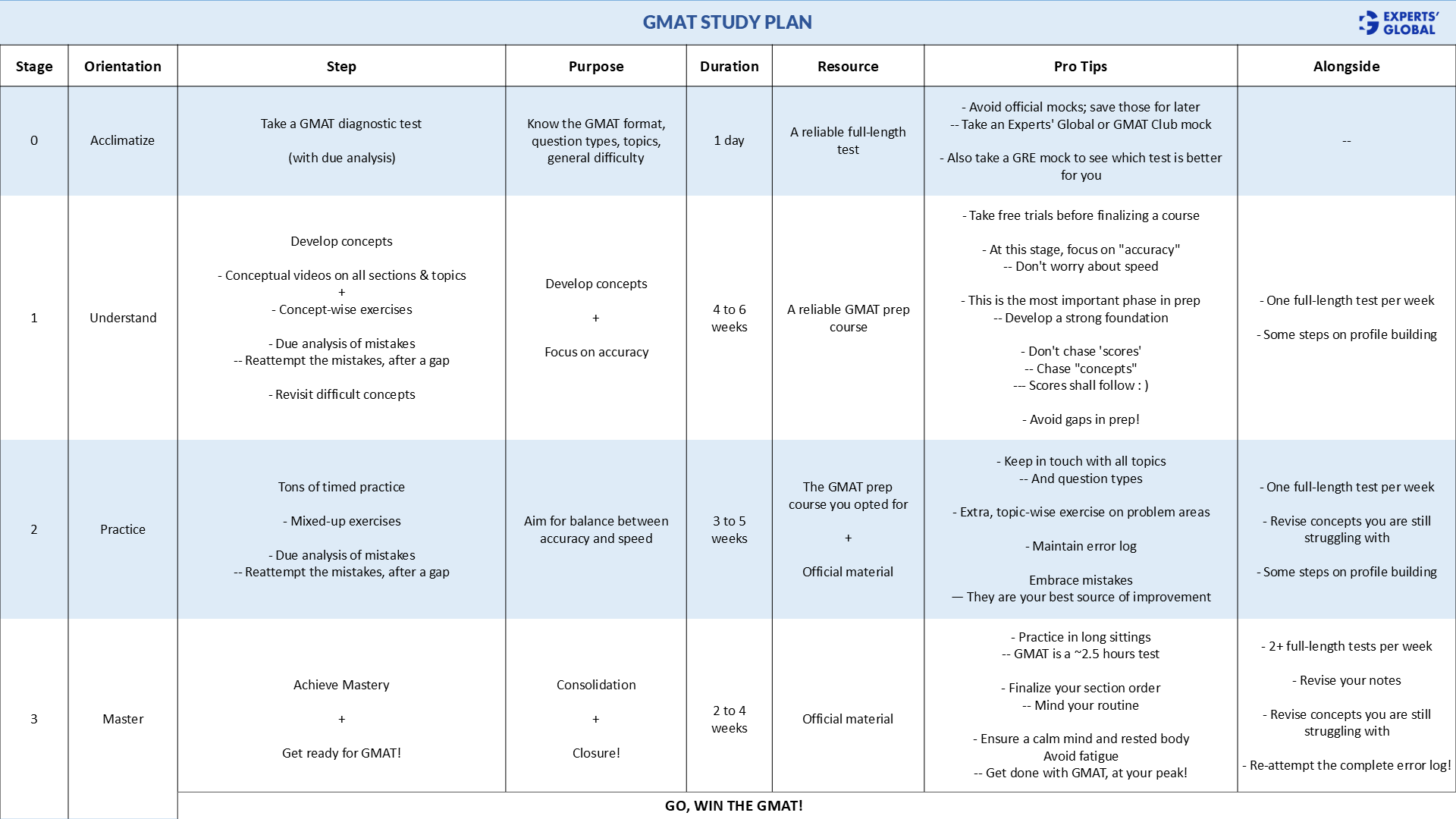
When you repeat this weekly rhythm long enough, something deeper begins to shift. The GMAT stops being only a test and starts becoming a training ground for how you handle effort, time, and uncertainty. You learn to show up on weekdays when it feels ordinary, to reflect on Saturdays when it feels messy, and to perform on Sundays when it really counts. That same cycle appears again in your MBA applications process and, later, in your career. There will be long stretches of quiet work, periods of honest self review, and moments when you must take the stage and perform. If you treat this typical GMAT week with respect, you are not only preparing for a score. You are practicing how to build a meaningful result from many small, conscious choices. That is a habit that stays with you long after the exam is over.
