Invest 30 seconds...
...for what may lead to a life altering association!
Help Line
- +91.8800.2828.00 (IND)
- 1030-1830 Hrs IST, Mon-Sat
- support@expertsglobal.com

Method-of-reasoning CR questions on the GMAT test how an argument is structured. A typical stem reads: “In the passage, the author builds the argument by…”. Your task is to choose the option that best captures the way the argument is developed.
Method-of-reasoning questions ask you to identify how an argument is built. Method-of-reasoning questions in GMAT Critical Reasoning are an important part of GMAT prep because they test both your logical ability and your attentiveness to structure. Unlike strengthen, weaken, or inference questions that focus on proving or questioning a conclusion, these require you to understand how the author or speaker organizes the reasoning. A typical stem appears as: “In the passage, the author develops the argument by…”, and your task is to pick the answer choice that best reflects the structure of the argument.

Method of reasoning questions in GMAT Critical Reasoning test not just your logical ability but also your attentiveness to structure. Unlike strengthening, weakening, or inference questions, these do not revolve around proving or disproving the conclusion. Instead, they require you to identify how the author or speaker has developed the argument.
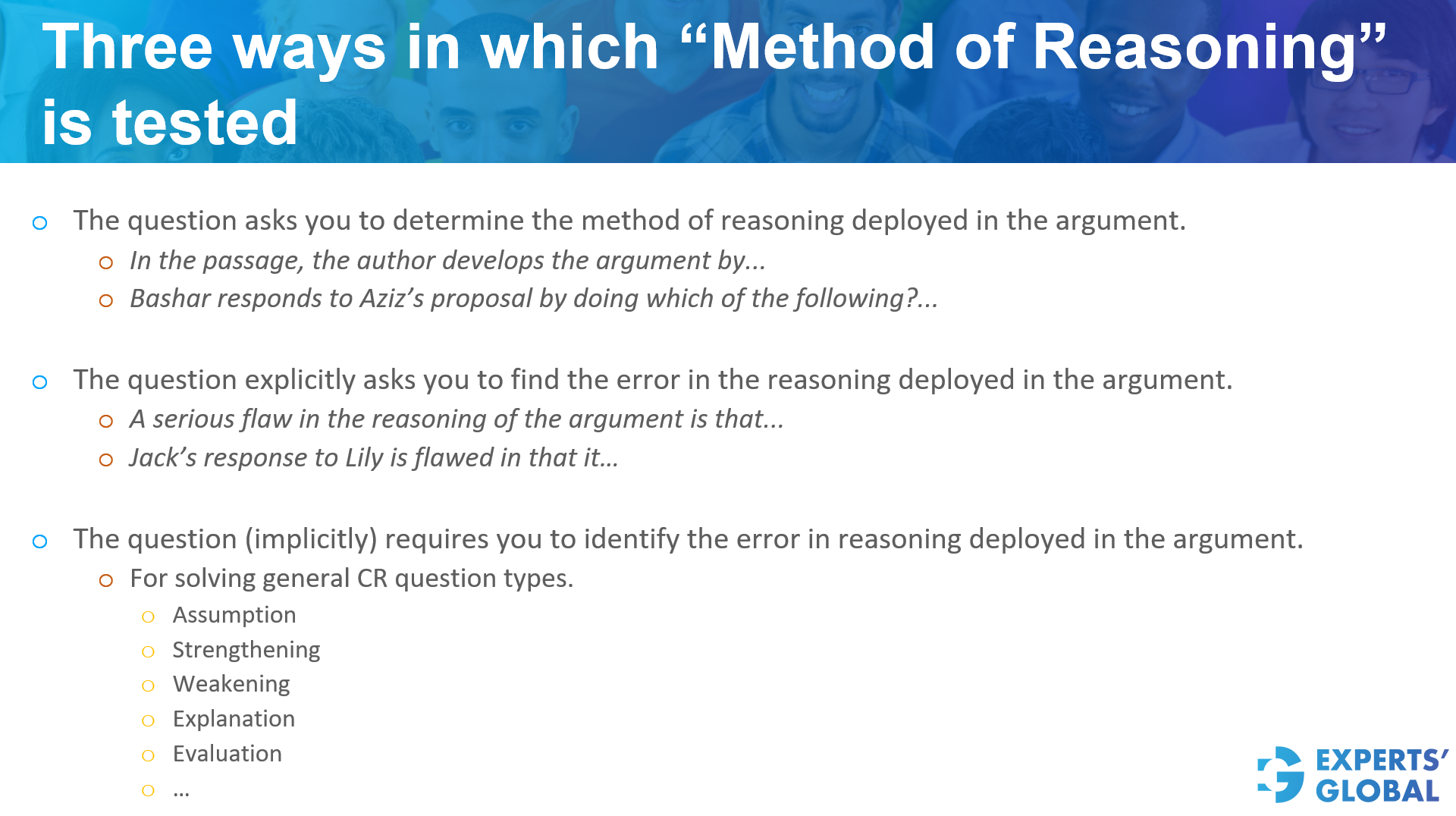
The method to solve these questions follows the following disciplined steps:
Before confirming an answer choice, verify once more.
Consider the following reasoning:
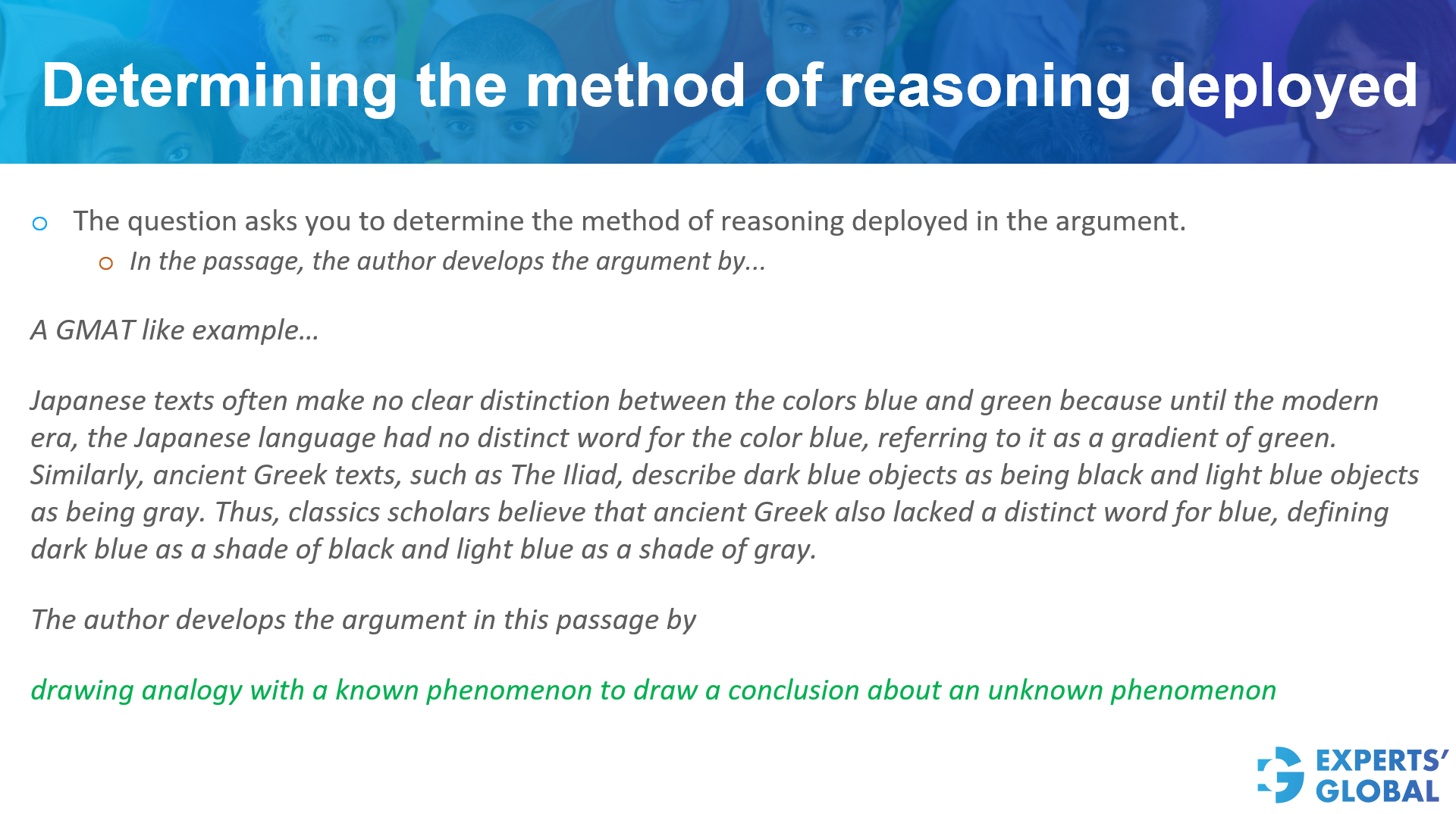
Japanese texts often make no clear distinction between the colors blue and green because until the modern era, the Japanese language had no distinct word for the color blue, referring to it as a gradient of green. Similarly, ancient Greek texts, such as The Iliad, describe dark blue objects as being black and light blue objects as being gray. Thus, classics scholars believe that ancient Greek also lacked a distinct word for blue, defining dark blue as a shade of black and light blue as a shade of gray.
Question: The author develops the argument in this passage by…
Correct answer: drawing analogy with a known phenomenon to draw a conclusion about an unknown phenomenon
Explanation:
The author refers to Japanese texts and then says “similarly” something holds for Greek texts. Finally, the author concludes with thus. The correct interpretation of the method here is “drawing an analogy with a known phenomenon (Japanese texts) to make a claim about an unknown one (Greek texts).” The essence lies in recognizing that the argument has been constructed by analogy.
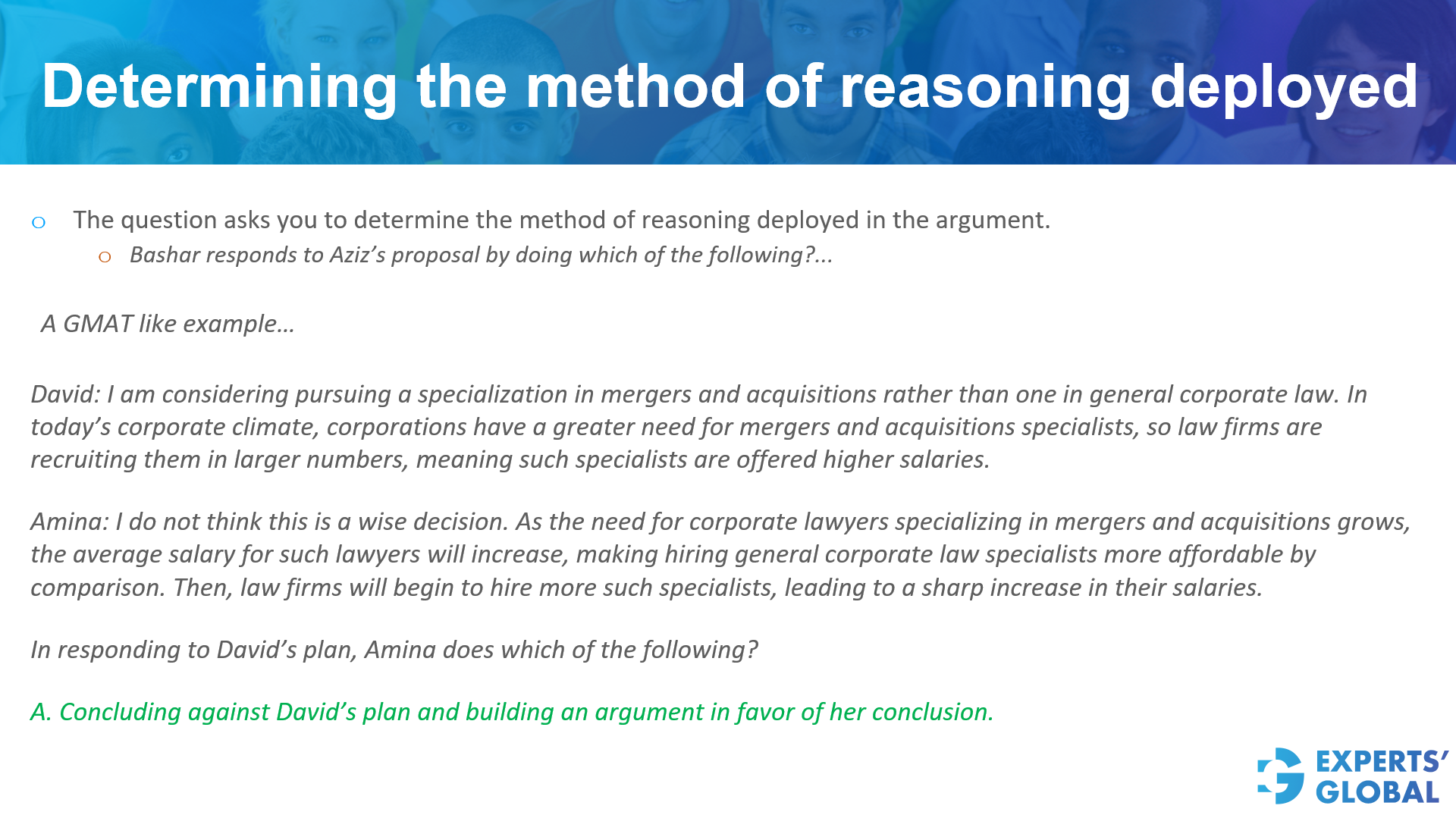
Another variation involves a dialogue format. Consider the following reasoning…
David: I am considering pursuing a specialization in mergers and acquisitions rather than one in general corporate law. In today’s corporate climate, corporations have a greater need for mergers and acquisitions specialists, so law firms are recruiting them in larger numbers, meaning such specialists are offered higher salaries.
Amina: I do not think this is a wise decision. As the need for corporate lawyers specializing in mergers and acquisitions grows, the average salary for such lawyers will increase, making hiring general corporate law specialists more affordable by comparison. Then, law firms will begin to hire more such specialists, leading to a sharp increase in their salaries.
Question: In responding to David’s plan, Amina does which of the following?
Correct Answer: Concluding against David’s plan and building an argument in favor of her conclusion.
Explanation:
The second speaker then disagrees and provides reasons against that plan. The correct answer choice here would capture the method as “concluding against the first speaker’s plan and developing an argument in favor of the opposite conclusion.”
Students often find these questions intimidating because the answer choices use heavy reasoning vocabulary. Phrases like “drawing analogy,” “concluding against,” “supporting with evidence,” or “evaluating implications” may sound complex, but if you already know what you are looking for, the difficulty reduces dramatically.
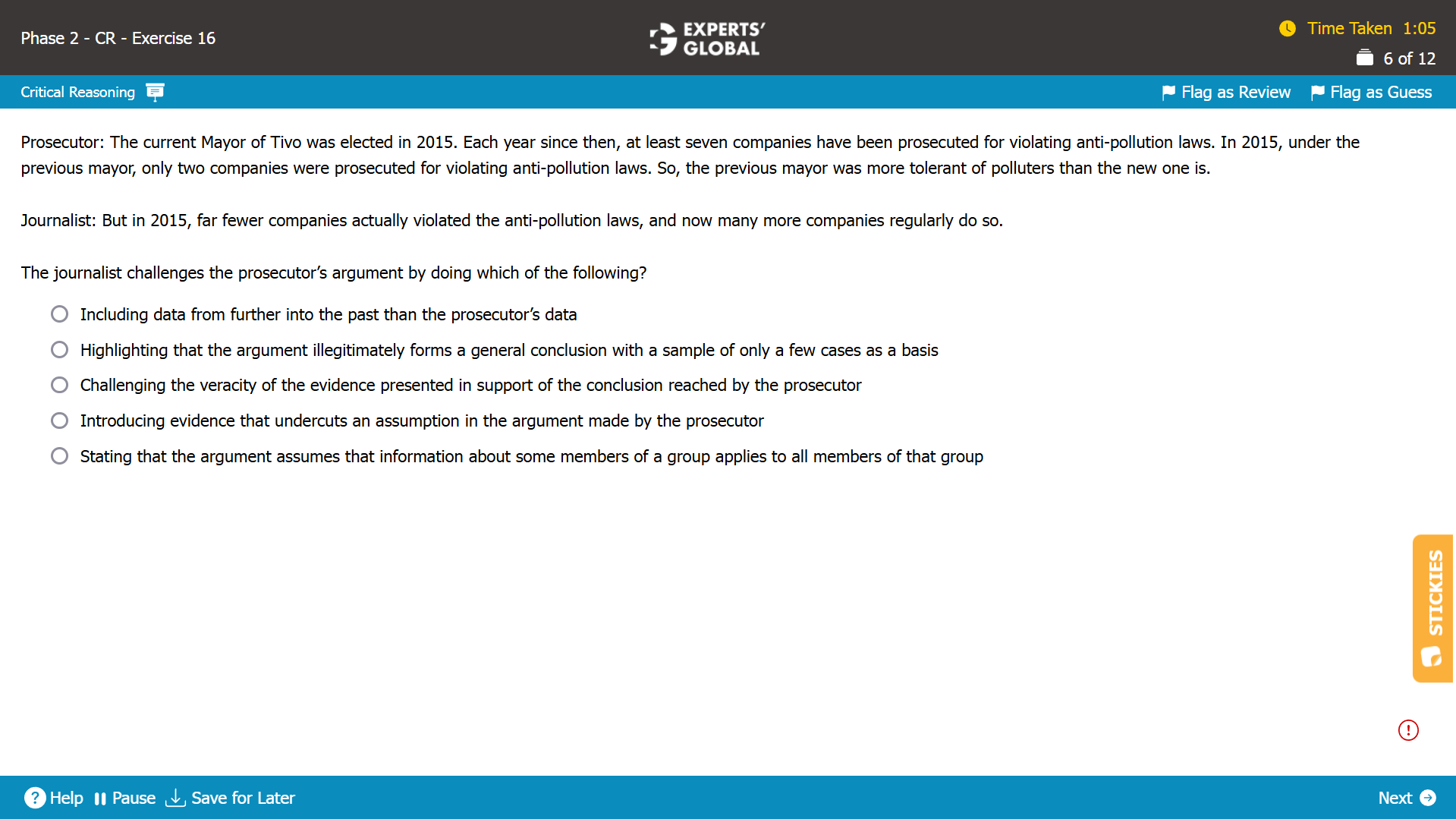
Method-of-reasoning questions highlight that success depends on recognizing how an argument is structured rather than debating its truth. Focus on cues such as “similarly” or “thus,” and classify whether the logic rests on analogy, contrast, or causal linkage. In dialogue formats, track how the second speaker positions their response – agreement, disagreement, reframing etc. Practicing these distinctions through GMAT simulations develops clarity, speed, and confidence, reinforcing reasoning discipline that benefits both exam performance and broader analytical judgment.
Method of reasoning questions reward clarity, not speed. If you discipline yourself to always read the question stem first, connect structural words to reasoning flow, and anticipate the type of method being tested, accuracy becomes achievable. These questions are logical in nature and can be mastered with practice. To refine your skills further, work through GMAT prep course resources that specifically emphasize reasoning strategies, ensuring that you not only recognize the method but also apply it confidently under exam pressure. The skills you develop here shall extend into the MBA application process as well as a career in business mana