
Invest 30 seconds...
...for what may lead to a life altering association!
Help Line
- +91.8800.2828.00 (IND)
- 1030-1830 Hrs IST, Mon-Sat
- support@expertsglobal.com
33% off ends soon:GMAT/GRE prep + applications bundle. Profile building, longer mentoring, better results. Inquire

Begin by reading the complete sentence to grasp its core meaning. Form a broad expectation for the correct answer choices. Eliminate mismatches. Finally, cross-check the remaining options to ensure both choices fit the sentence and convey the similar meaning.
Sentence Equivalence represents a significant portion of the GRE Verbal section, accounting for a solid 25 percent of the total content. This particular question type presents you with a wonderful opportunity to score high, while also saving time for other question types — Reading Comprehensions and Text Completion 2 blank and 3 blank questions, which require more time. This balance matters because strong performance on Sentence Equivalence supports both outcomes that you care about: accuracy and speed! Therefore, thorough Sentence Equivalence preparation should be an important part of your GRE preparation course.
In this article, we present and discuss an efficient approach for solving GRE Sentence Equivalence questions, an approach that helps you solve virtually all the Sentence Equivalence questions on the GRE. We present the approach, discuss it in a structured manner, and illustrate its application using GRE questions and answer choices, so you make good use of this rich resource and apply the learnt strategy in your GRE drills as well as full-length GRE practice tests.
Curious about your current GRE standing? Take a free full-length GRE mock test
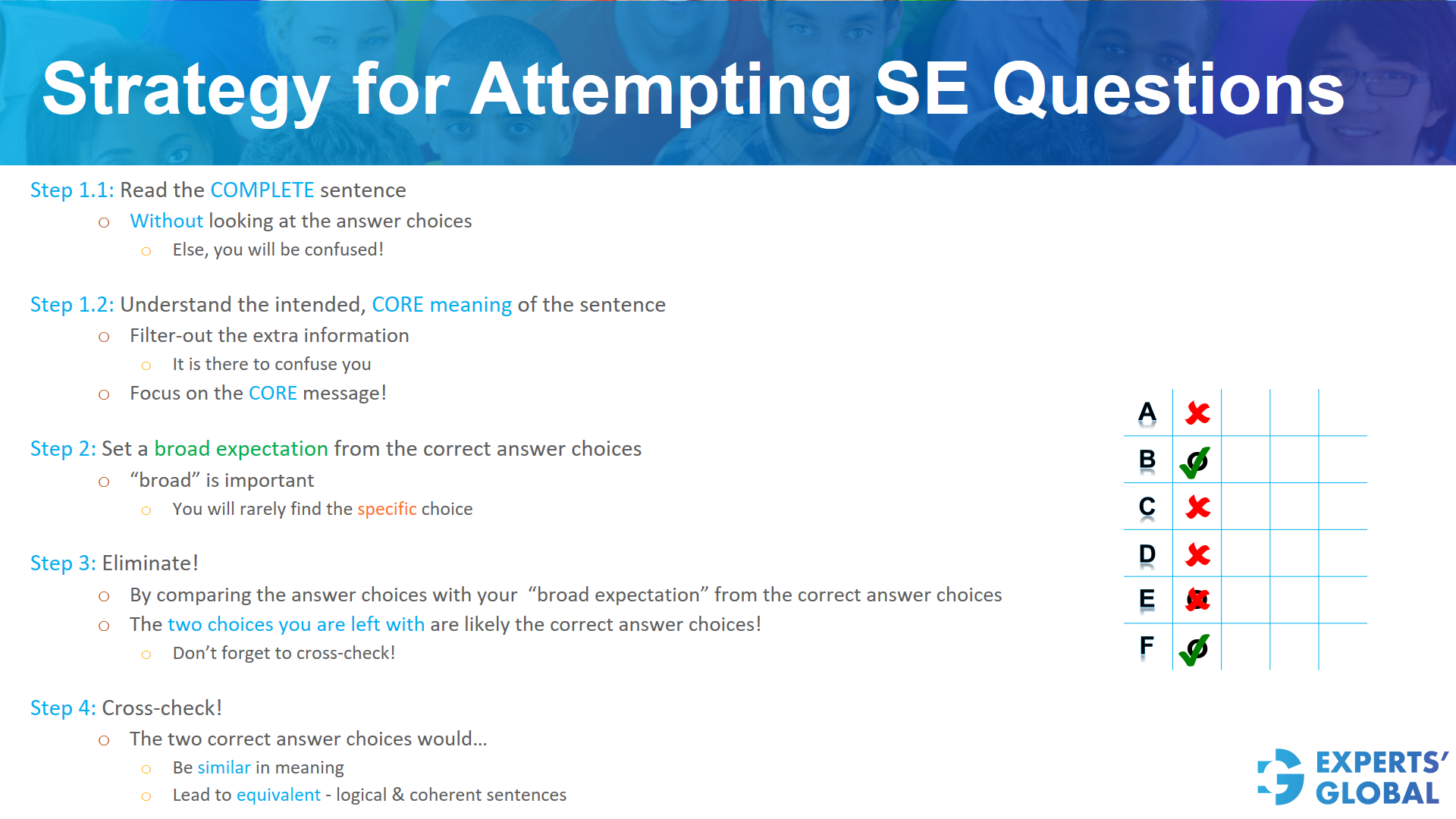
The first step is to read the entire sentence from start to finish. Most importantly, do this without looking at the answer choices first. Looking at the options too early can cause confusion and lead you toward “trap” answers.
Once you’ve read the sentence, filter out the “extra” information. Sentences often include complex phrases intended to distract you. Strip those away and focus entirely on the CORE message the sentence is trying to convey.
Before you look at the choices, decide what kind of word should go in the blank. Keep this expectation broad. You likely won’t guess the exact word the test-maker used, but you can identify the “flavor” or direction (positive, negative, increasing, decreasing, etc.) of the missing word.
Now, look at the answer choices. Compare them to your “broad expectation.”
Finally, make sure your two chosen words work together. The two correct answer choices must:
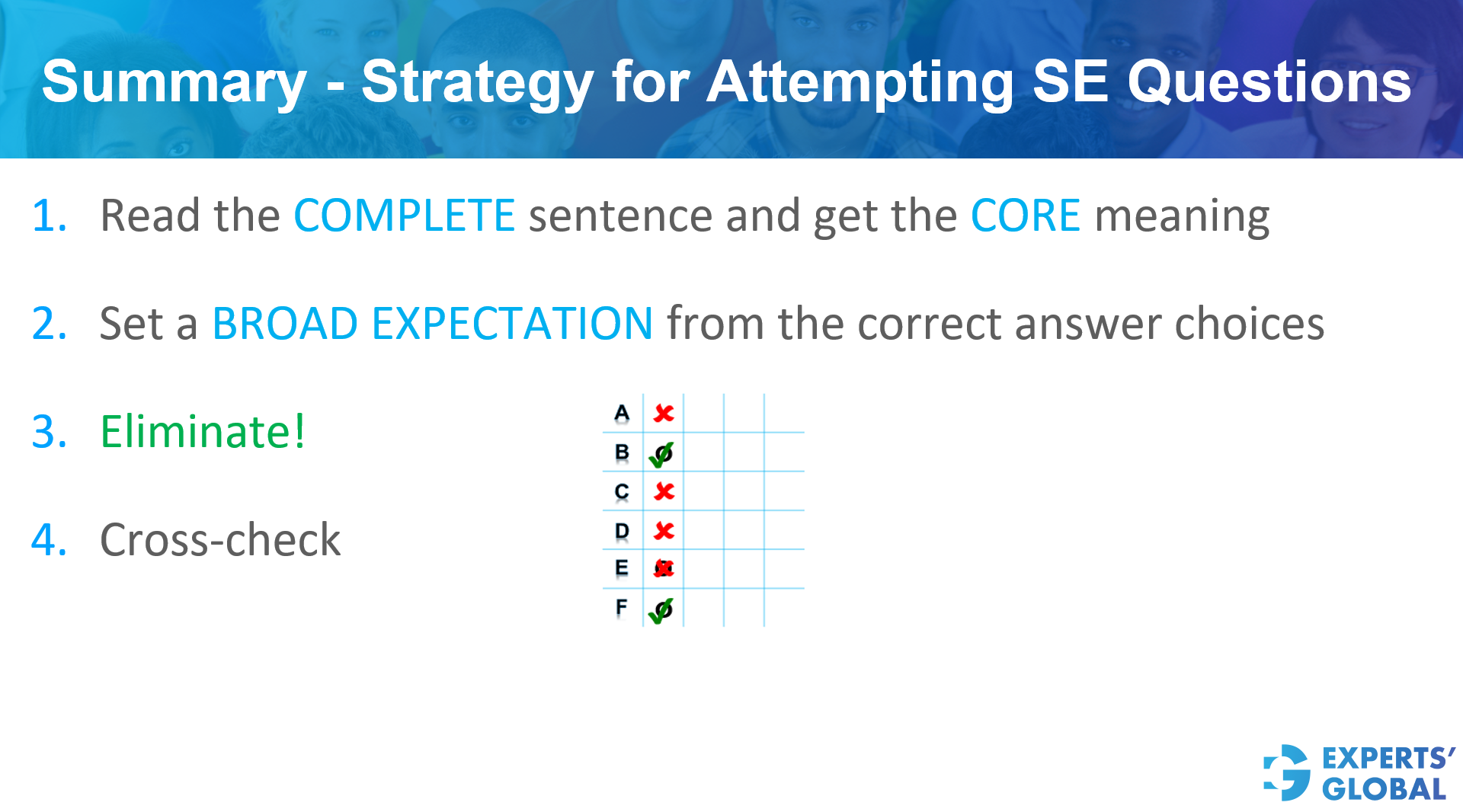
To find the correct answer, you should follow a specific sequence of actions. Here is the step-by-step breakdown:
Before looking at the answer choices, read the entire sentence from start to finish. Don’t stop at the blank. Your goal is to understand the core meaning—the main idea the author is trying to communicate. Look for clues or “signal words” (like although, because, or however) that show how different parts of the sentence relate to each other.
Once you understand the sentence, try to predict what kind of word should go in the blank. You don’t need the exact word yet; just set a broad expectation. For example, decide if the missing word should be positive or negative, or if it should describe a characteristic like “speed” or “intelligence.” Having a “mental filler” helps you stay in control when you look at the options.
Now, look at the answer choices (labeled A through F). Do not look for the “right” word immediately; instead, eliminate the ones that definitely do not fit your broad expectation.
In Sentence Equivalence questions, you are often looking for two words that complete the sentence in the same way. Once you have narrowed down your choices, cross-check them.
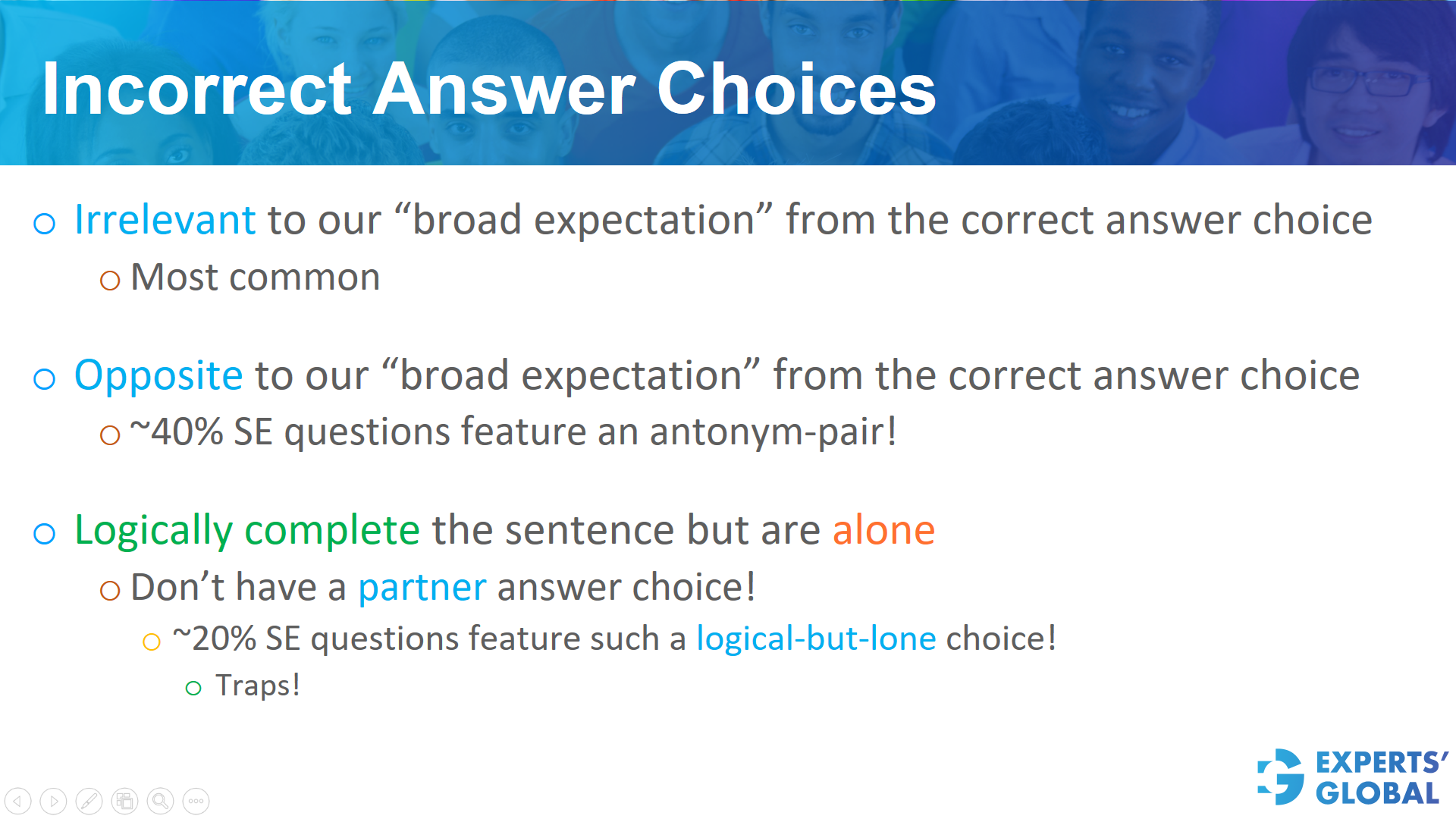
When you are tackling Sentence Equivalence (SE) questions, knowing why an answer is wrong is just as important as knowing why it is right. Test-makers often use specific patterns to create “trap” answers.
By understanding these three main categories of incorrect choices, you can better navigate your exams and avoid common pitfalls.
These are the most common types of incorrect answers you will encounter.
Sometimes, an answer choice will mean the exact opposite of what the sentence requires.
These are perhaps the trickiest traps because they actually make sense in the sentence.
| Type | Description | Key Fact |
|---|---|---|
| Irrelevant | Does not fit the context or expectation. | Most common type. |
| Opposite | Means the reverse of the required word. | Found in ~40% of questions. |
| Logically Complete but Alone | Fits the sentence but has no synonym partner. | Found in ~20% of questions; a major trap! |
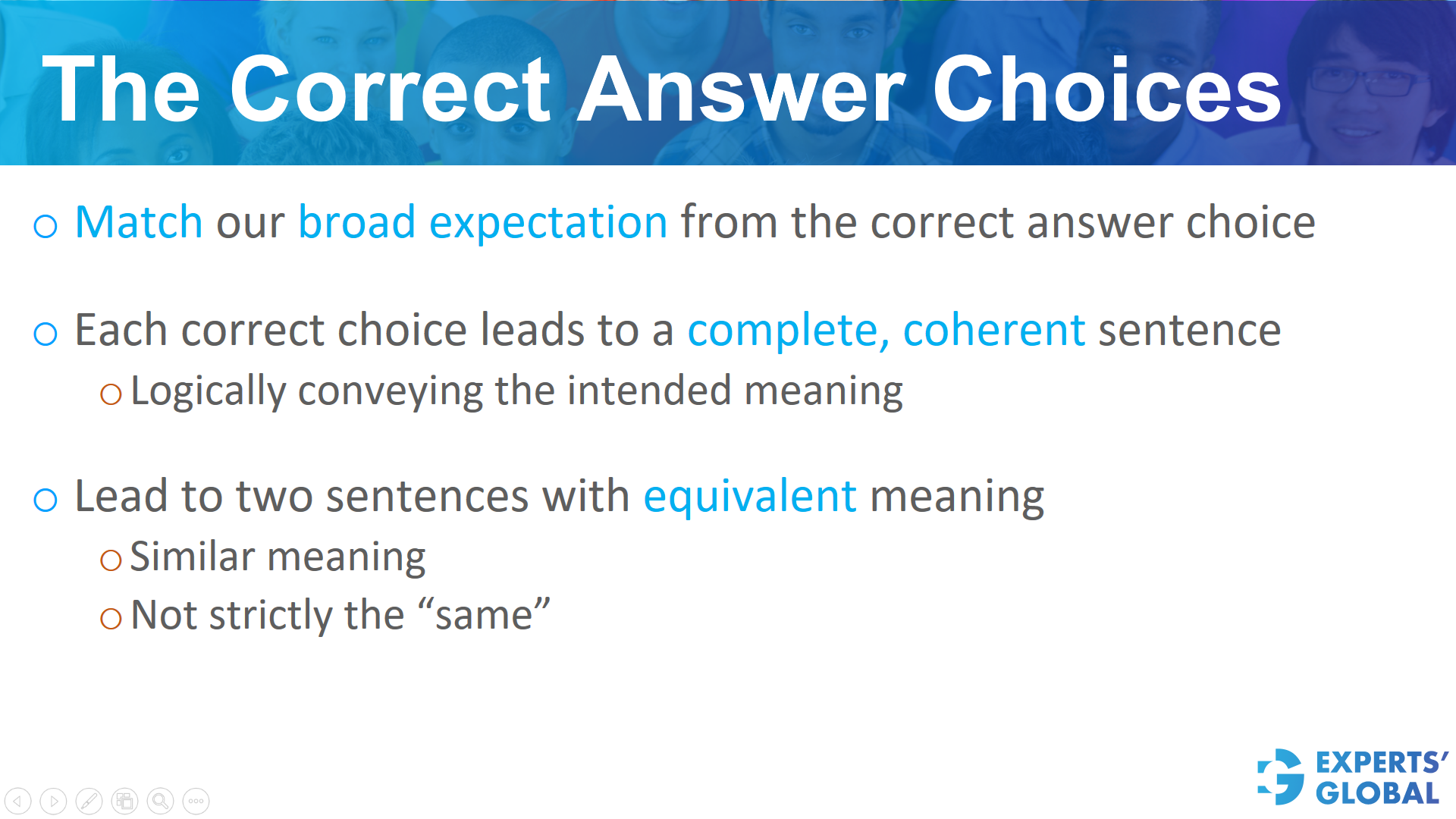
Mastering Sentence Equivalence (SE) questions is all about identifying the right pair of words that fit perfectly into a sentence. Understanding what makes an answer choice “correct” will help you approach these questions with confidence and ease!
When you are looking for the right answers in an SE question, keep these three key criteria in mind
The correct answer choices should…
The correct answer choices should match our broad expectation from the correct answer choice. Before looking at the options, you should have a general idea of what kind of word belongs in the blank. The right answers will align with that mental image.
Each of the correct choices must lead to a complete, coherent sentence. This means that when you plug a word into the blank:
The most important part of SE is that your two chosen words must lead to two sentences with equivalent meaning. To achieve this:
Let’s use our happy, four-step strategy to solve this GRE-style example:
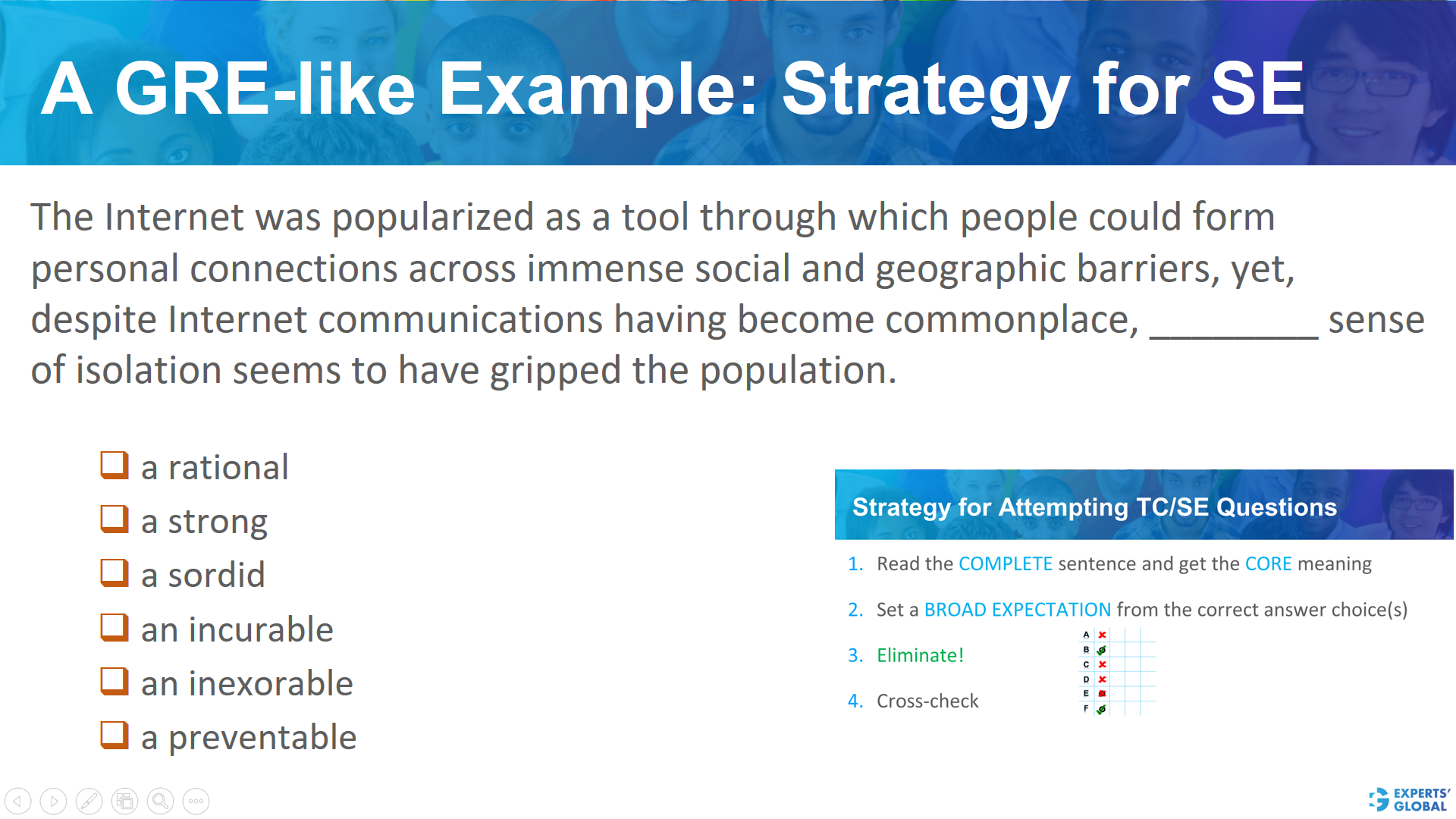
For a detailed explanation of this question, please refer the last ~2 minutes of the video featured earlier on this page. Following is a step-by-step written solution:
The Internet was popularized as a tool through which people could form personal connections across immense social and geographic barriers, yet, despite Internet communications having become commonplace, ___________ sense of isolation seems to have gripped the population.
The sentence says that even though the Internet helps people connect, a feeling of isolation has “gripped” the population anyway. The CORE meaning is that despite more connection, the feeling of being alone is very powerful or hard to stop.
Because the word “gripped” is used, we need a word that means “powerful,” “strong,” or “unstoppable.”
Correct Answers: B and E
GRE prep course with 7-day free trial
15 full length GRE practice tests
60 sectional GRE practice tests
Free full length GRE diagnostic test
GRE prep with admission consulting bundle
Sentence Equivalence rewards a habit that matters far beyond this one question type: you pause, read the whole statement, and decide what it truly says before you react to options. In GRE prep, that habit turns speed into earned speed, because you cut noise, set a broad expectation, and let elimination do the heavy work. In the graduate or MBA admissions stage, the same discipline helps you read prompts with care, define the message you want to convey, and remove details that do not serve it. In life, you face choices that look attractive in isolation, yet only a paired fit creates real meaning. You choose paths that align with your core values, not just one convenient word. Keep practicing the sequence: understand, expect, eliminate, cross-check. Over time, the method becomes an inner filter that protects your energy and keeps your decisions coherent. This structure supports clarity when pressure tries to rush.
