
Invest 30 seconds...
...for what may lead to a life altering association!
Help Line
- +91.8800.2828.00 (IND)
- 1030-1830 Hrs IST, Mon-Sat
- support@expertsglobal.com
33% off ends soon:GMAT/GRE prep + applications bundle. Profile building, longer mentoring, better results. Inquire

LCM based remainder questions involve multiple divisors, and solving these questions centers on finding the LCM of those divisors. The following conceptual video, part of our online GRE prep course, explains this concept in a simple and intuitive manner, outlines how it is commonly tested in GRE Quantitative questions, and then applies it to varied GRE-style problems so you gain first-hand experience using it.
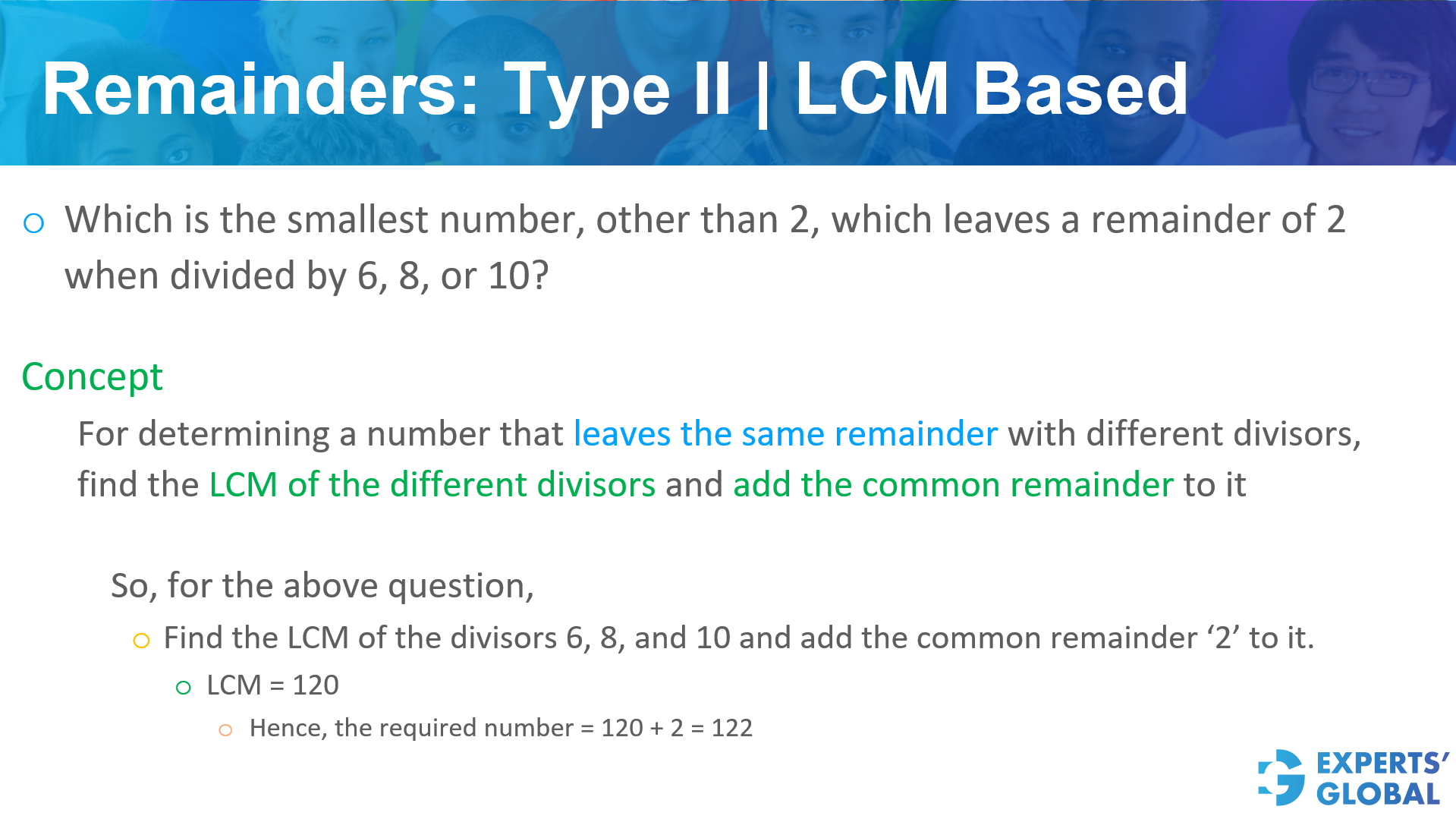
When you need to find the smallest number that leaves the same remainder when divided by multiple different divisors, you follow a specific Least Common Multiple (LCM) approach.
To determine a number that leaves a common remainder across different divisors:
The general formula for such a number can be expressed as: Number = (LCM of divisors * k) + Remainder (where k is an integer 1, 2, 3…)
Problem: Find the smallest number, other than 2, which leaves a remainder of 2 when divided by 6, 8, or 10.
Solution: The required number is 122.
In these types of problems, the remainder itself (in this case, 2) is technically the smallest non-negative integer that satisfies the condition because:
By asking for the smallest number other than 2, the problem directs you to find the first multiple of the LCM plus that remainder.
For a detailed explanation, please refer to the video presented earlier on this page.
Following is a concise, step-wise written explanation…
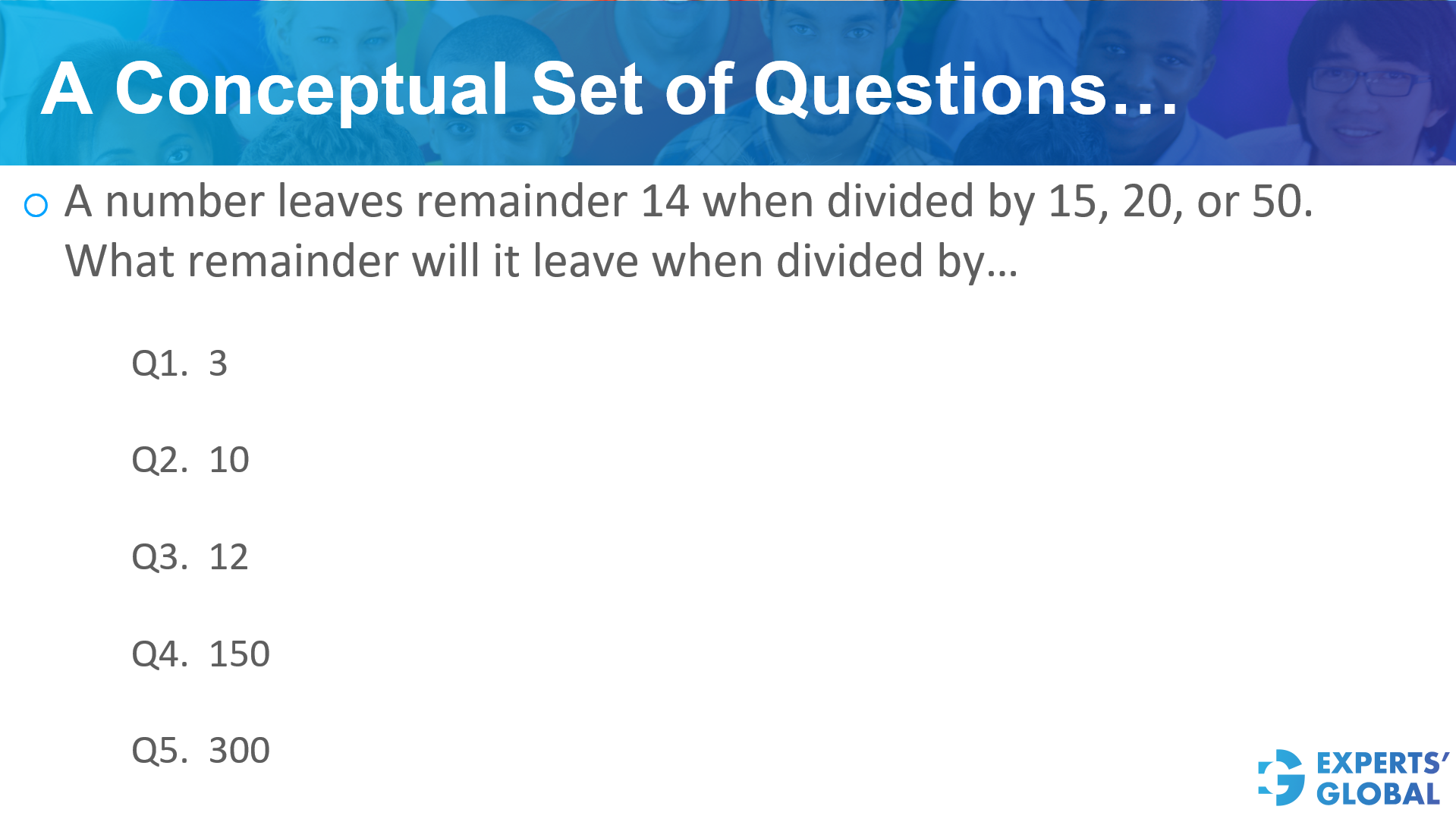
A number leaves remainder 14 when divided by 15, 20, or 50. What remainder will it leave when divided by…
The number can be written as (Common Multiple of 15, 20, and 50) + 14.
The Least Common Multiple (LCM) of 15, 20, and 50 is 300.
So, the number looks like: (300 * k) + 14, where k is a positive integer.
Divide (300 * k + 14) by 3. 300 * k is perfectly divisible by 3.
Now divide 14 by 3.
The remainder is 2.
Correct Answer: 2
Divide (300 * k + 14) by 10.
300 * k is perfectly divisible by 10.
Now divide 14 by 10.
The remainder is 4.
Correct Answer: 4
Divide (300 * k + 14) by 12.
300 * k is perfectly divisible by 12
Now divide 14 by 12.
The remainder is 2.
Correct Answer: 2
Divide (300 * k + 14) by 150.
300 * k is perfectly divisible by 150.
Now divide 14 by 150.
Since 14 is smaller than 150, the remainder is 14.
Correct Answer: 14
Divide (300 * k + 14) by 300.
300 * k is perfectly divisible by 300.
Now divide 14 by 300.
Since 14 is smaller than 300, the remainder is 14.
Correct Answer: 14
Correct Answer: 2
For a detailed explanation, please refer to the video presented earlier on this page.
Following is a concise, step-wise written explanation…
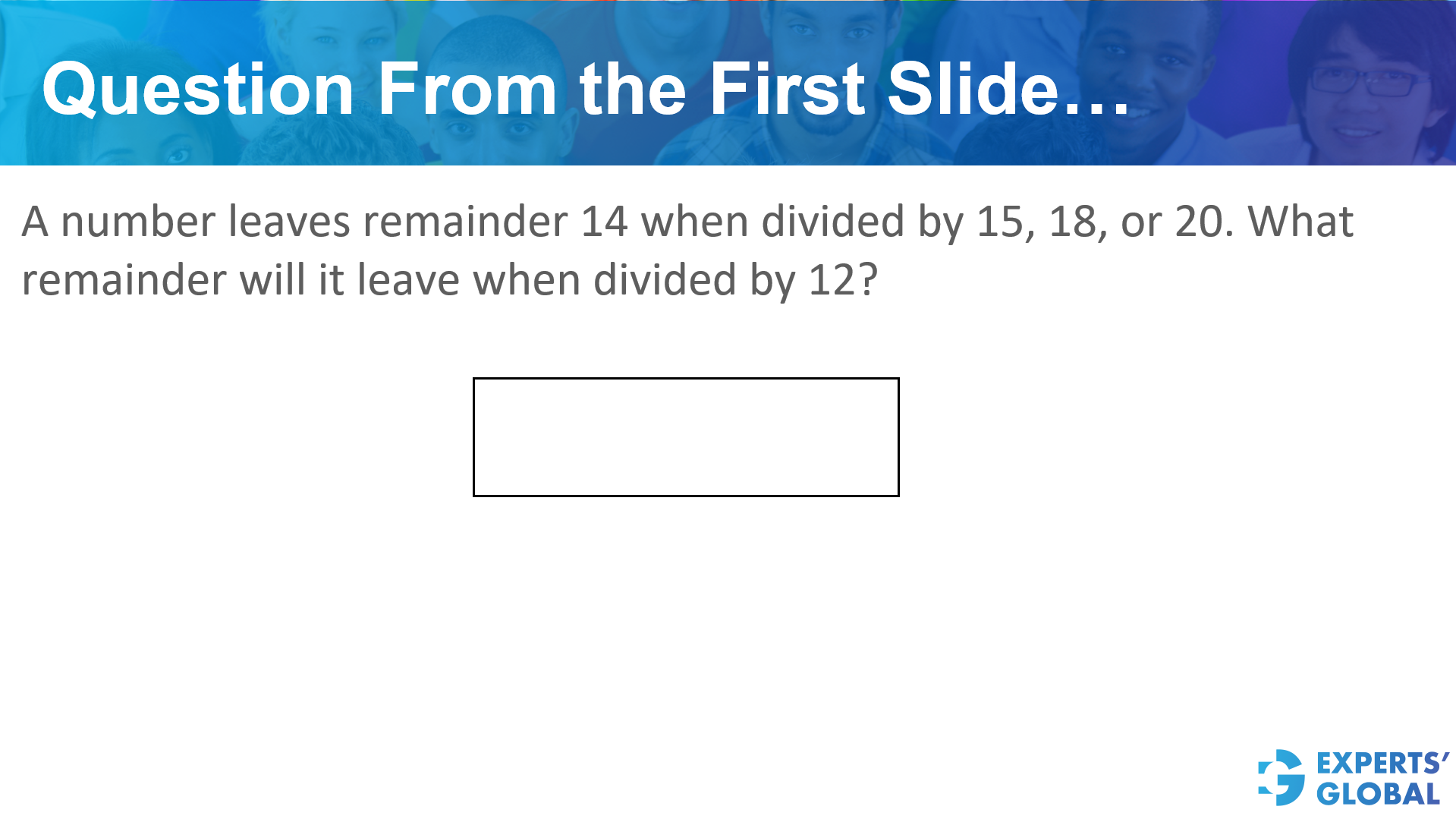
A number leaves remainder 14 when divided by 15, 18, or 20. What remainder will it leave when divided by 12?
Factors of 15: 3 * 5
Factors of 18: 2 * 3 * 3
Factors of 20: 2 * 2 * 5
LCM = 2 * 2 * 3 * 3 * 5 = 180
The number can be written as (LCM * k) + Remainder.
Number = 180k + 14
180k is exactly divisible by 12 because 180 / 12 = 15.
Therefore, the remainder depends only on the constant part: 14.
14 / 12 = 1 with a remainder of 2.
Correct Answer: 2
Correct Answer: 20
For a detailed explanation, please refer to the video presented earlier on this page.
Following is a concise, step-wise written explanation…
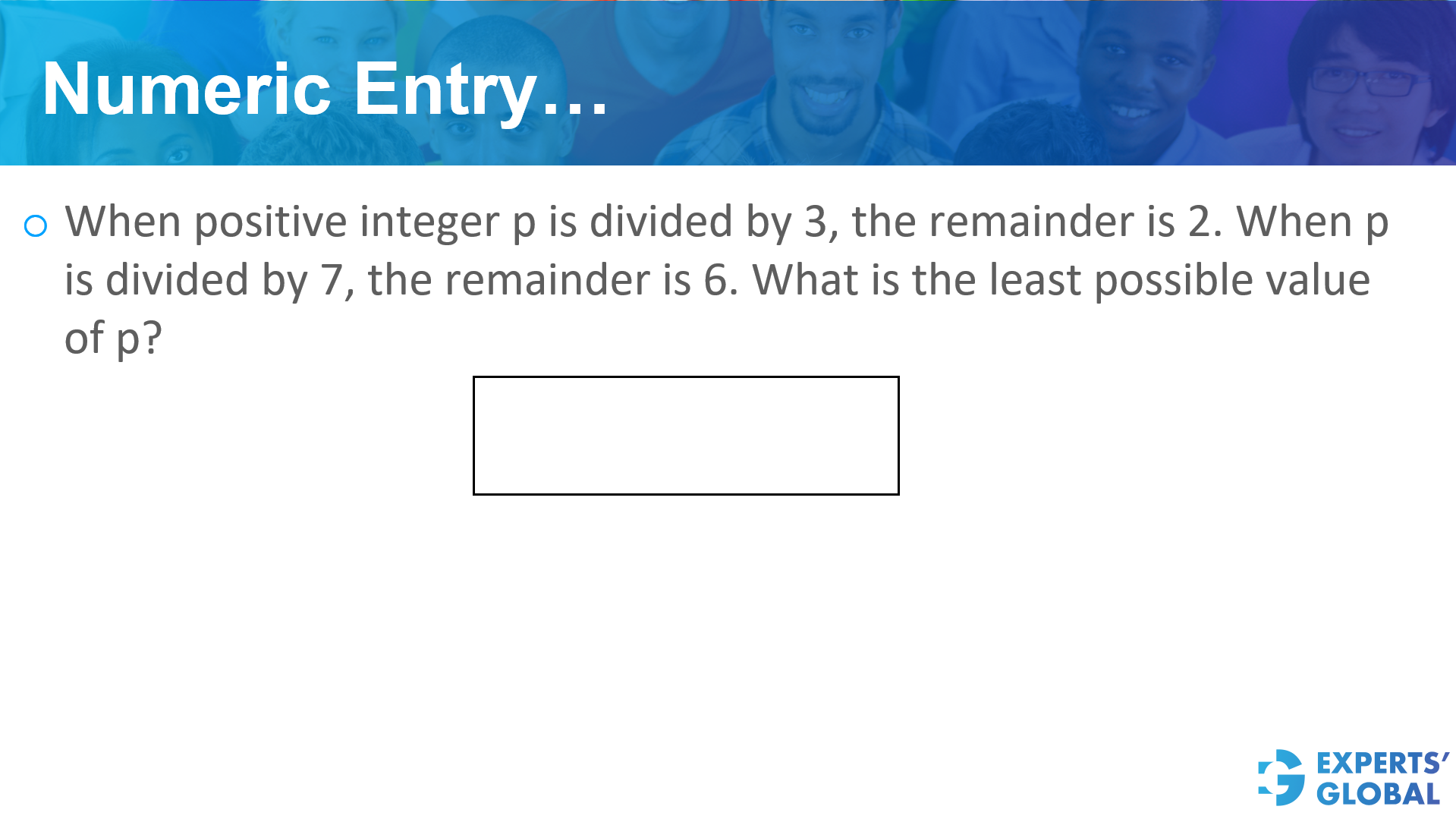
When positive integer p is divided by 3, the remainder is 2. When p is divided by 7, the remainder is 6. What is the least possible value of p?
In both cases, the remainder is exactly 1 less than the divisor.
This means if you add 1 to the number p, the result would be perfectly divisible by both 3 and 7.
The smallest number divisible by both 3 and 7 is 3 * 7 = 21.
Since p + 1 = 21, then p = 20.
Correct Answer: 20
Correct Answer: 12
For a detailed explanation, please refer to the video presented earlier on this page.
Following is a concise, step-wise written explanation…
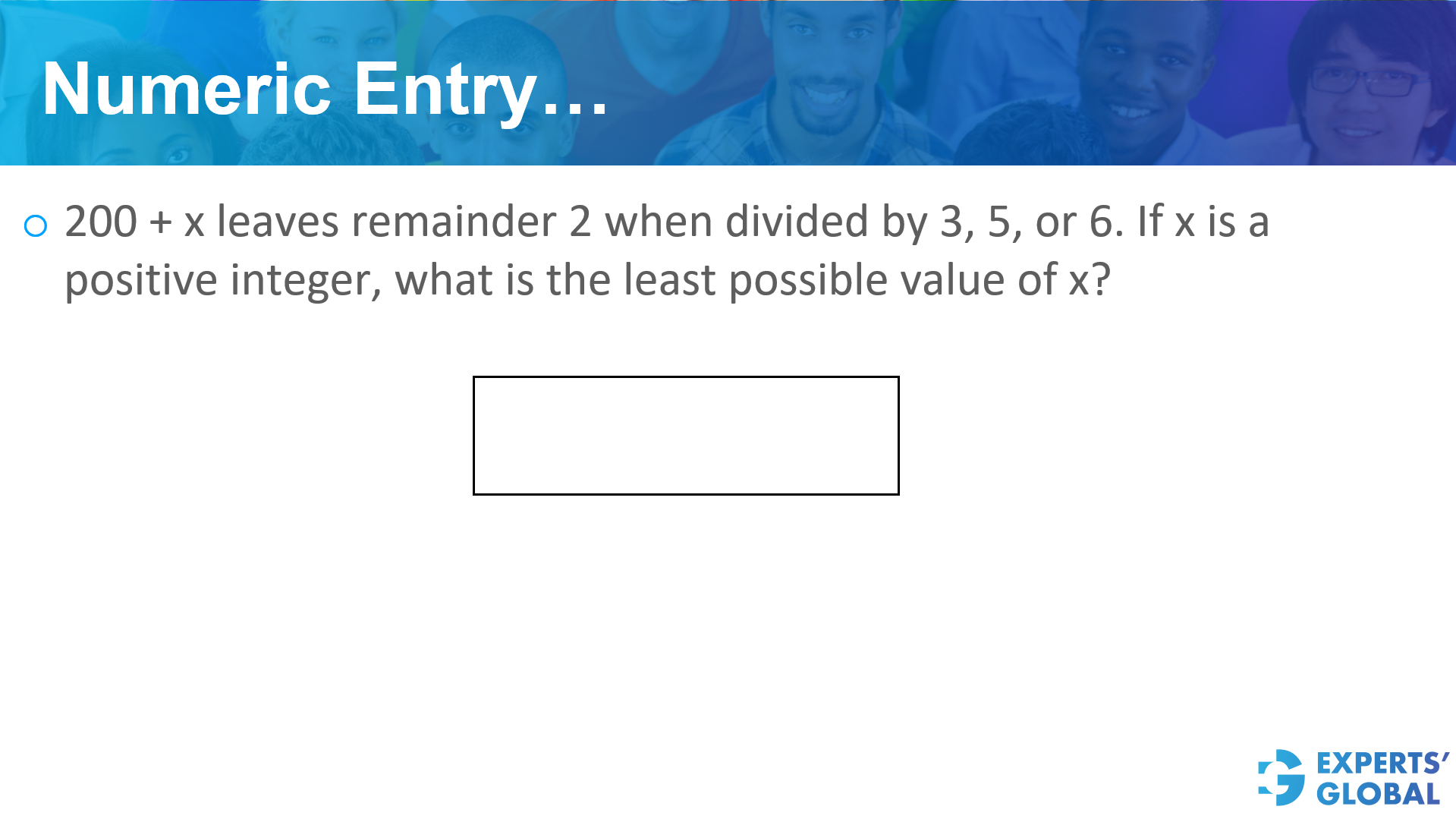
200 + x leaves remainder 2 when divided by 3, 5, or 6. If x is a positive integer, what is the least possible value of x?
The number (200 + x) leaves a remainder of 2 when divided by 3, 5, and 6.
This means if we subtract 2 from the number, the result must be perfectly divisible by 3, 5, and 6.
(200 + x) – 2 = 198 + x
We need the smallest number that is divisible by 3, 5, and 6. The LCM is 30.
The value (198 + x) must be a multiple of 30. We are looking for the smallest positive integer x. We need the first multiple of 30 that is greater than 198.
198 + x = 210
x = 210 – 198
x = 12
Correct Answer: 12
Correct Answer: B
Quantity B is greater.
For a detailed explanation, please refer to the video presented earlier on this page.
Following is a concise, step-wise written explanation…
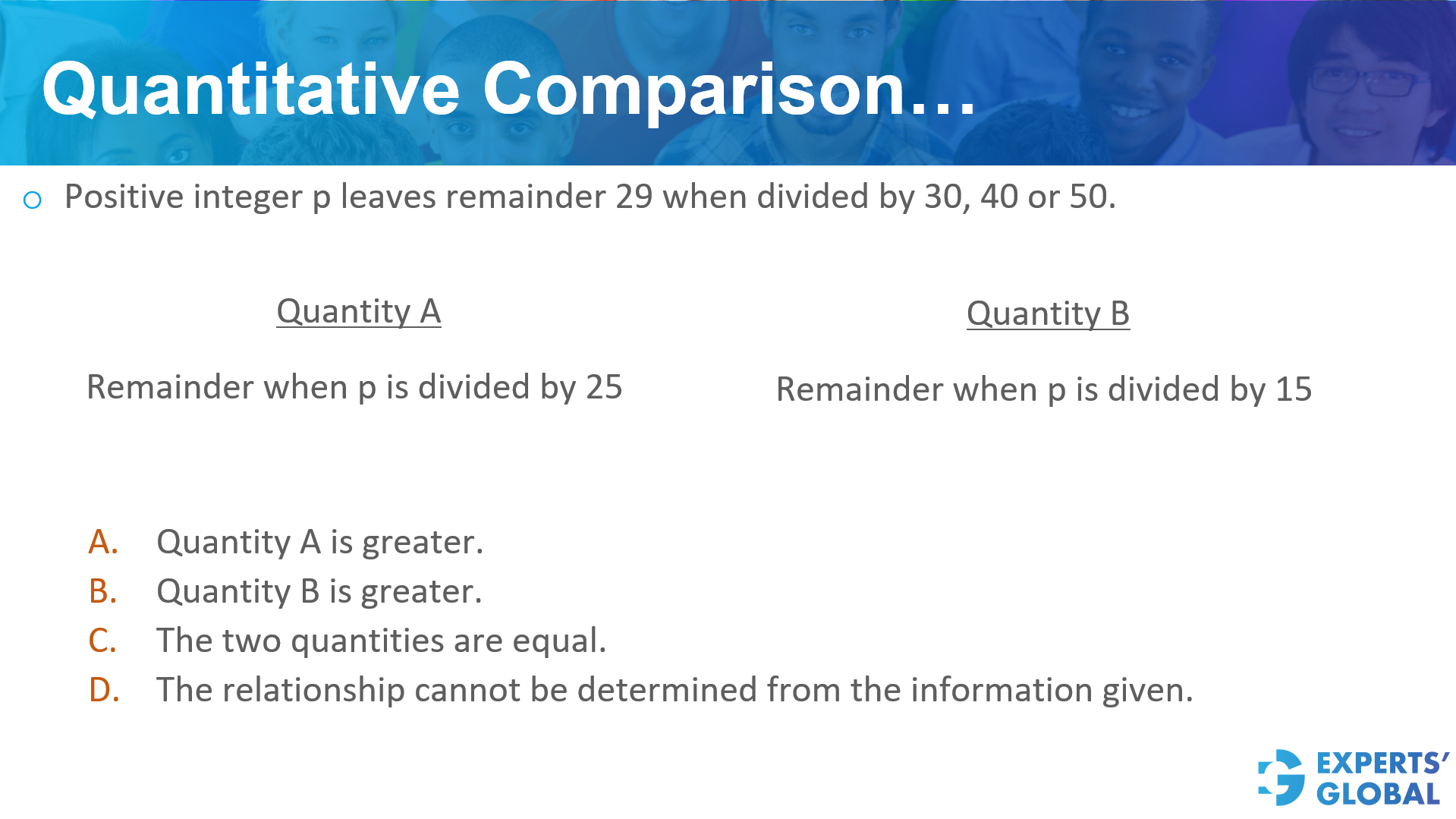
Positive integer p leaves remainder 29 when divided by 30, 40 or 50.
Quantity A
Remainder when p is divided by 25
Quantity B
Remainder when p is divided by 15
The problem states that p leaves a remainder of 29 when divided by 30, 40, and 50.
This means p is 29 more than a common multiple of 30, 40, and 50.
The LCM of 30, 40, and 50 is 600.
Therefore, p can be written as (600 * n) + 29, where n is a non-negative integer.
Divide 600n + 29 by 25.
The remainder is 4.
Divide 600n + 29 by 15.
The remainder is 14.
Quantity A = 4
Quantity B = 14
14 is greater than 4.
Correct Answer: B
Quantity B is greater.
Correct Answer: D
The relationship cannot be determined from the information given.
For a detailed explanation, please refer to the video presented earlier on this page.
Following is a concise, step-wise written explanation…
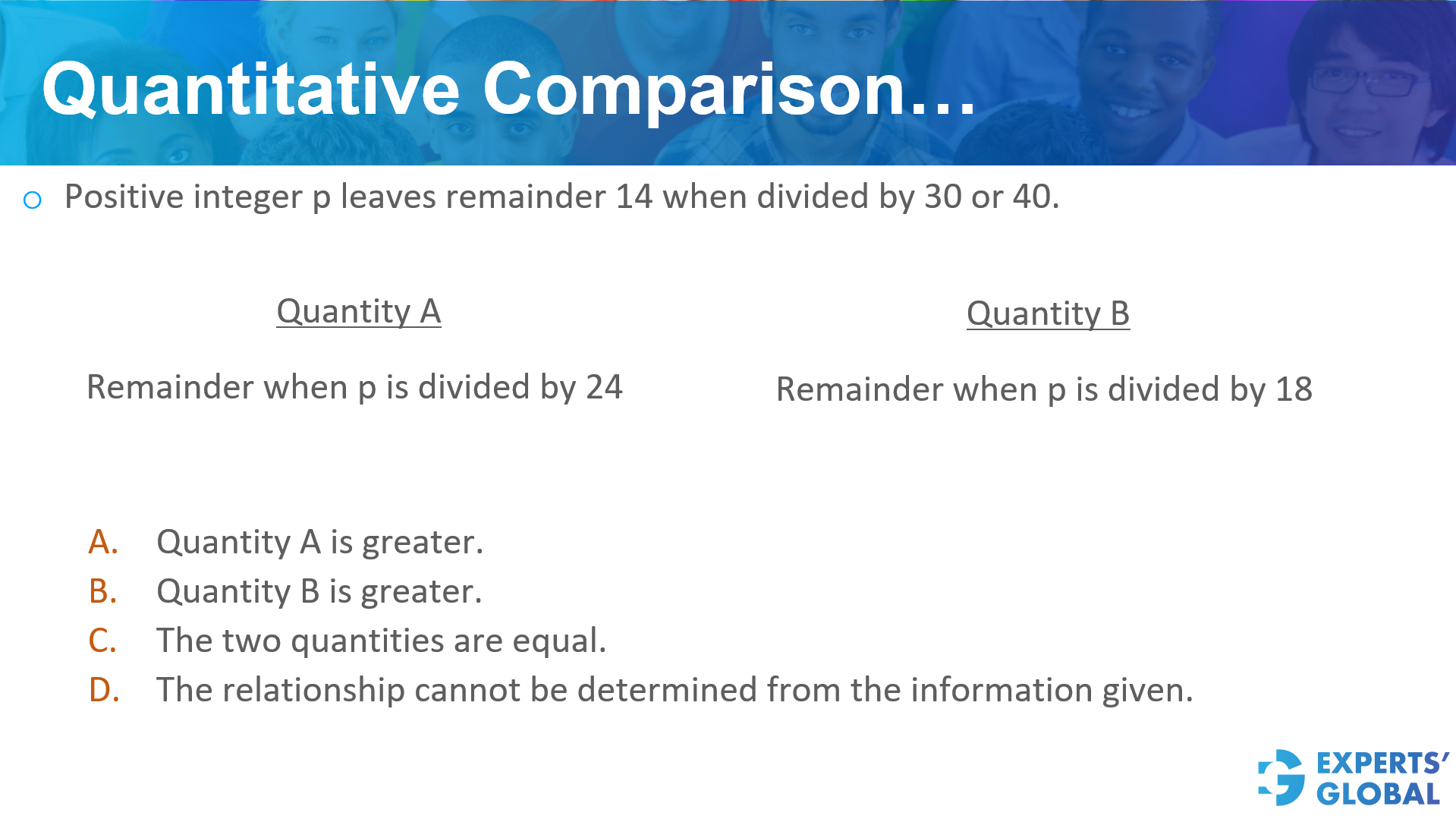
Positive integer p leaves remainder 14 when divided by 30 or 40.
Quantity A
Remainder when p is divided by 24
Quantity B
Remainder when p is divided by 18
If p leaves a remainder of 14 when divided by 30 and 40, p must be a multiple of both 30 and 40, plus 14.
To find the smallest such number, find the Least Common Multiple (LCM) of 30 and 40.
The LCM is 120.
The general relationship for p is: p = 120 * n + 14 (where n is a non-negative integer)
Let n = 0: p = 14
Quantity A (14 divided by 24): Remainder is 14.
Quantity B (14 divided by 18): Remainder is 14.
In this case, A = B.
Let n = 1: p = 120 + 14 = 134
Quantity A (134 divided by 24): Remainder is 14.
Quantity B (134 divided by 18): Remainder is 8.
In this case, A is greater than B.
Since the relationship changes depending on the value of p, the answer cannot be determined.
Correct Answer: D
The relationship cannot be determined from the information given.
Free full length diagnostic test for GRE
Set of 15 Full length GRE practice tests
Set of 60 sectional GRE practice tests
GRE preparation course with 7-day trial
GRE prep combined with admission consulting
