
Invest 30 seconds...
...for what may lead to a life altering association!
Help Line
- +91.8800.2828.00 (IND)
- 1030-1830 Hrs IST, Mon-Sat
- support@expertsglobal.com
33% off ends soon:GMAT/GRE prep + applications bundle. Profile building, longer mentoring, better results. Inquire

Both question types give you one blank in an incomplete sentence, but the task differs. Sentence Equivalence gives 6 choices and you select 2 that create complete, coherent sentences with similar meaning. Text Completion one-blank gives 5 choices and you select 1 best fit.
At a surface level, sentence equivalence and text completion one blank questions can look similar, and they do share certain structural features. Both question types present an incomplete sentence with a single blank, which can initially make them feel alike. However, the task involved in each question type is different, and this difference directly shapes the way you approach and solve them. Understanding the similarity as well as the difference between these two question types is an important part of GRE preparation.
Sentence equivalence questions require you to select two answers from six choices that lead to complete and coherent sentences with equivalent meanings, while text completion one blank questions require you to choose only one correct answer from five options that completes the sentence logically. Although the broad strategy overlaps, sentence equivalence adds an extra layer of ensuring meaning alignment between two answers. The video and the article that follows explore these similarities and differences in detail and apply them to GRE-style questions and answer choices. Take these learnings forward and apply them thoughtfully in your GRE practice drills as well as GRE mock tests.
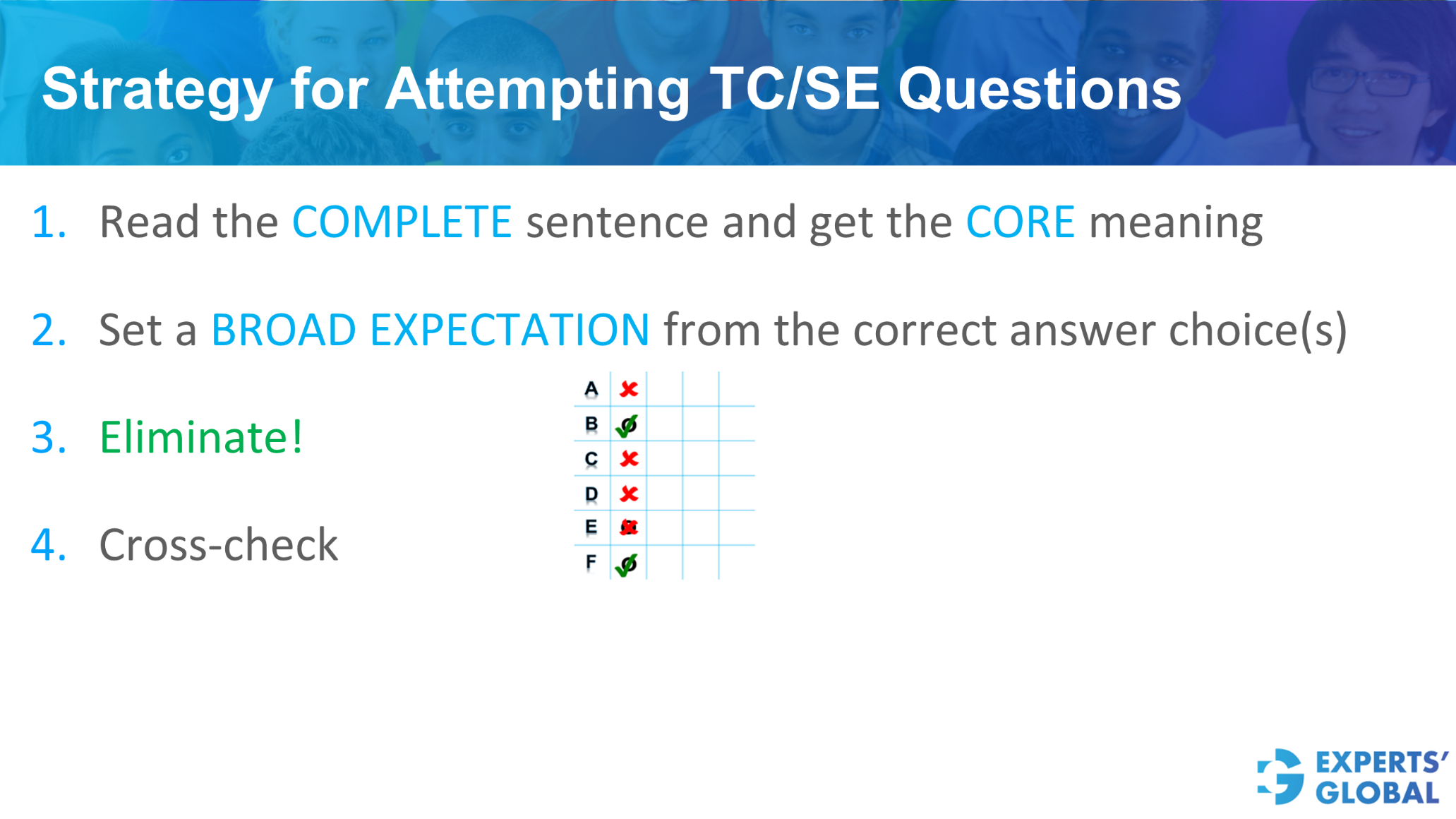
You can approach sentence equivalence and text completion one blank questions using the same four-step method, because the overall sequence of actions stays consistent across both question types. The difference shows up not in the structure of the approach, but in what you expect from the correct answer choice once you start evaluating the options.
In text completion one blank questions, your expectation remains straightforward. You look for one correct answer choice that completes the sentence in a logical and coherent manner. In sentence equivalence questions, however, the reasoning becomes significantly more nuanced. Here, you must select two answers from six choices, and both must do two things at the same time: each word must complete the sentence in a coherent manner, and the two completed sentences must lead to similar meaning. This added requirement changes how you judge answer choices. For instance, a third answer choice may complete the sentence logically and still fail the sentence equivalence task because it does not have a partner answer choice that produces a similar meaning, which means it cannot be part of the correct pair.
Assess your present GRE ability through a free full-length GRE simulation
Text Completion one blank questions can be considered a simpler version of sentence equivalence questions because the broad approach remains the same, but you only select one answer that completes the sentence coherently, without needing a partner choice or ensuring equivalence between two resulting sentences.
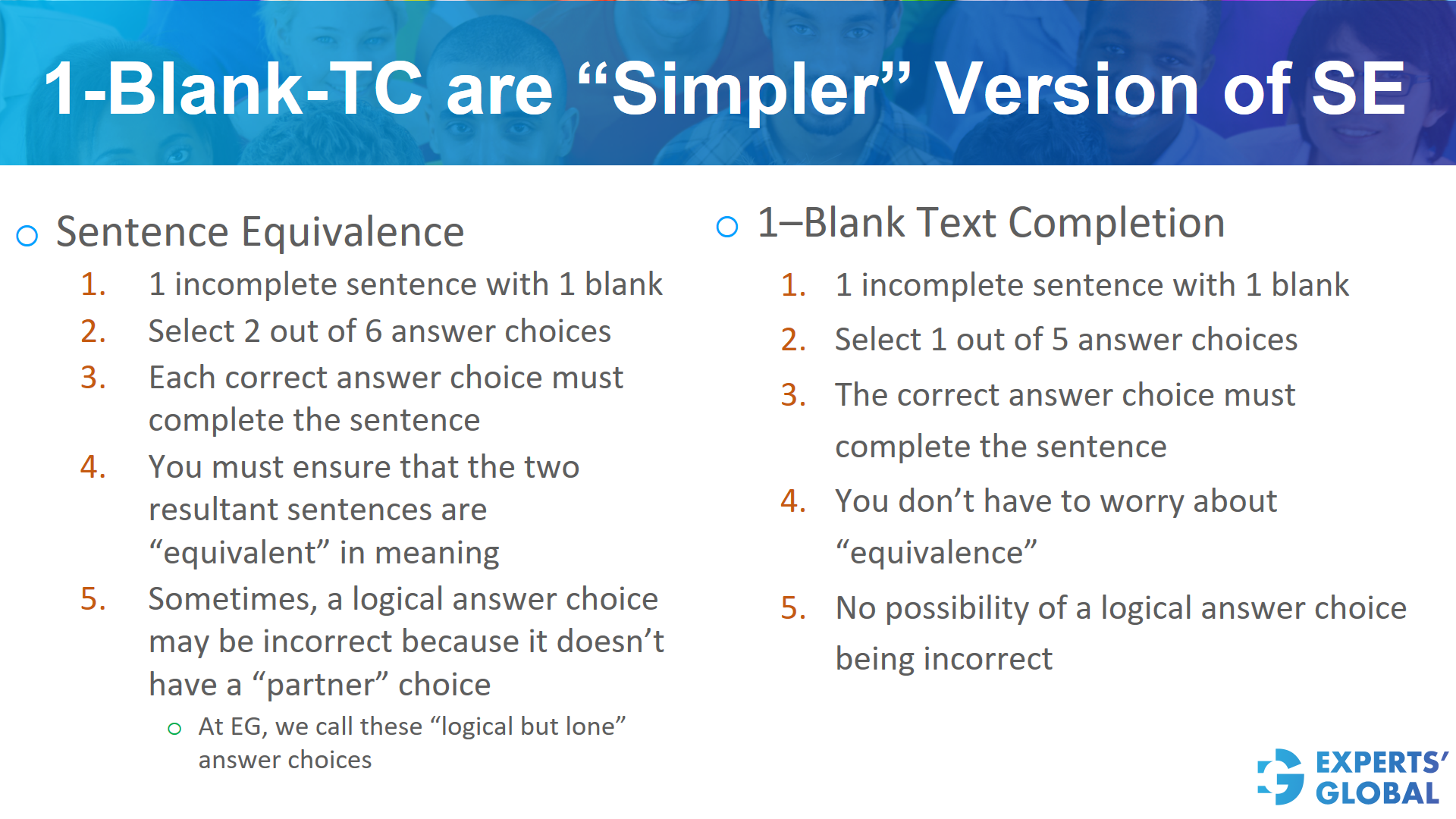
Below is a breakdown of the rules for each type so you can see the similarities and the key differences.
By understanding these structures, you can see that while both require you to fill a single blank, the 1-Blank TC is more straightforward because it removes the need to find a “partner” word or ensure sentence equivalence.
To help you understand this better, let’s look at a practice sentence. This same sentence can be used as either a 1-Blank TC or an SE question.
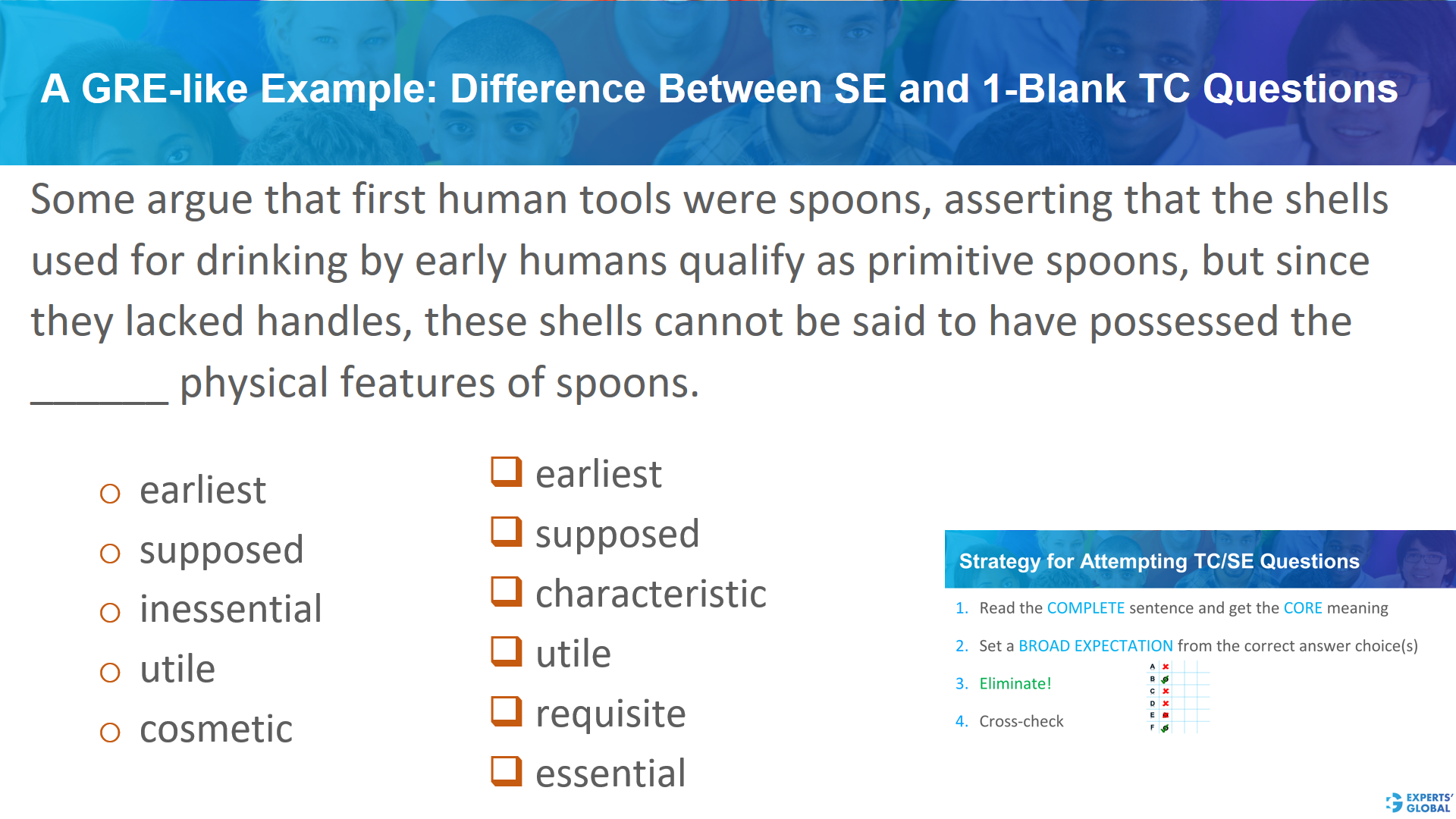
For a detailed explanation of this question, please refer the last ~2 minutes of the video featured earlier on this page. Following is a step-by-step written solution:
Some argue that first human tools were spoons, asserting that the shells used for drinking by early humans qualify as primitive spoons, but since they lacked handles, these shells cannot be said to have possessed the ________ physical features of spoons.
TC answer choices (select 1 of 5):
SE answer choices (select 2 of 6):
We will follow our four steps approach to find the right answer:
Step 1: Read the COMPLETE sentence and get the CORE meaning.
The sentence tells us that while some people think ancient shells were “primitive spoons,” these shells did not have handles. Because they were missing a main part (the handle), they didn’t have the “standard” or “required” traits of a real spoon.
Step 2: Set a BROAD EXPECTATION from the correct answer choice(s).
Since the shells lacked handles, our expectation for the blank is a word that means “useful”, “necessary,” “required,” or “defining.”
Step 3: Eliminate!
Now, let’s look at the choices provided for both question formats:
If this were a 1-Blank TC (Select 1 out of 5):
If this were an SE Question (Select 2 out of 6):
Looking at the list, requisite and essential both mean “necessary” or “required”. They fit our broad expectation perfectly!
Note: “utile” in this case is incorrect because it lacks a ‘partner’ choice.
Step 4: Cross-check.
If we put “requisite” in the blank, the sentence makes sense. If we put “essential” in the blank, the sentence has the exact same meaning. They are a perfect pair!
Final Answer:
When you learn the difference between Sentence Equivalence and Text Completion one blank, you practice a quiet form of maturity: you stop treating similar-looking choices as identical tasks. In GRE prep, that mindset keeps you honest with the question in front of you. Sometimes you search for one best fit, and sometimes you search for a pair that creates the same meaning, even when a tempting option looks logical on its own. The MBA admissions consulting process rewards the same awareness. Prompts can sound familiar, yet each one asks for a slightly different story, a different emphasis, and a different kind of proof. Life works in a similar way. Many opportunities look alike on the surface, but they ask different things from you once you step in. When you train yourself to notice what the task truly is, you make clearer decisions and waste less energy on attractive distractions. Keep practicing with patience and consistency, and let your GRE drills and mock tests become a daily reminder that precision builds progress.
Complete GRE prep course online with free trial
Free GRE diagnostic test (full length)
