
Invest 30 seconds...
...for what may lead to a life altering association!
Help Line
- +91.8800.2828.00 (IND)
- 1030-1830 Hrs IST, Mon-Sat
- support@expertsglobal.com
33% off ends soon:GMAT/GRE prep + applications bundle. Profile building, longer mentoring, better results. Inquire

Divisibility rules and shortcuts support specific moments in GRE Quant problem solving where quick checks on numbers add clarity and efficiency. These ideas stay simple in structure and help you test numerical relationships smoothly, recognize useful signals inside a problem, and move forward with better direction on select Quant questions without unnecessary effort.
The following video, part of our GRE preparation online course, covers divisibility rules for important values such as 2, 3, 4, 5, 9, 11, 20, 25, and 50, along with higher powers of 2, higher powers of 5, and their common combinations. It explains how these rules apply within expressions and conditions and shows how they guide sound numerical decisions. Spend time with this lesson and apply these ideas thoughtfully during your GRE practice questions, GRE sectional tests, and GRE practice tests.

Divisibility rules for various numbers can be determined by examining a specific number of ending digits. The core logic is based on whether the last n digits are divisible by the divisor in question.
To find the remainder when dividing by 2, 5, or 10, look only at the last digit of the number.
To find the remainder for these divisors, look at the last two digits of the number.
This general rule states that for any divisor that is a power of 2 or 5, you must divide the last n digits by that divisor to find the remainder.
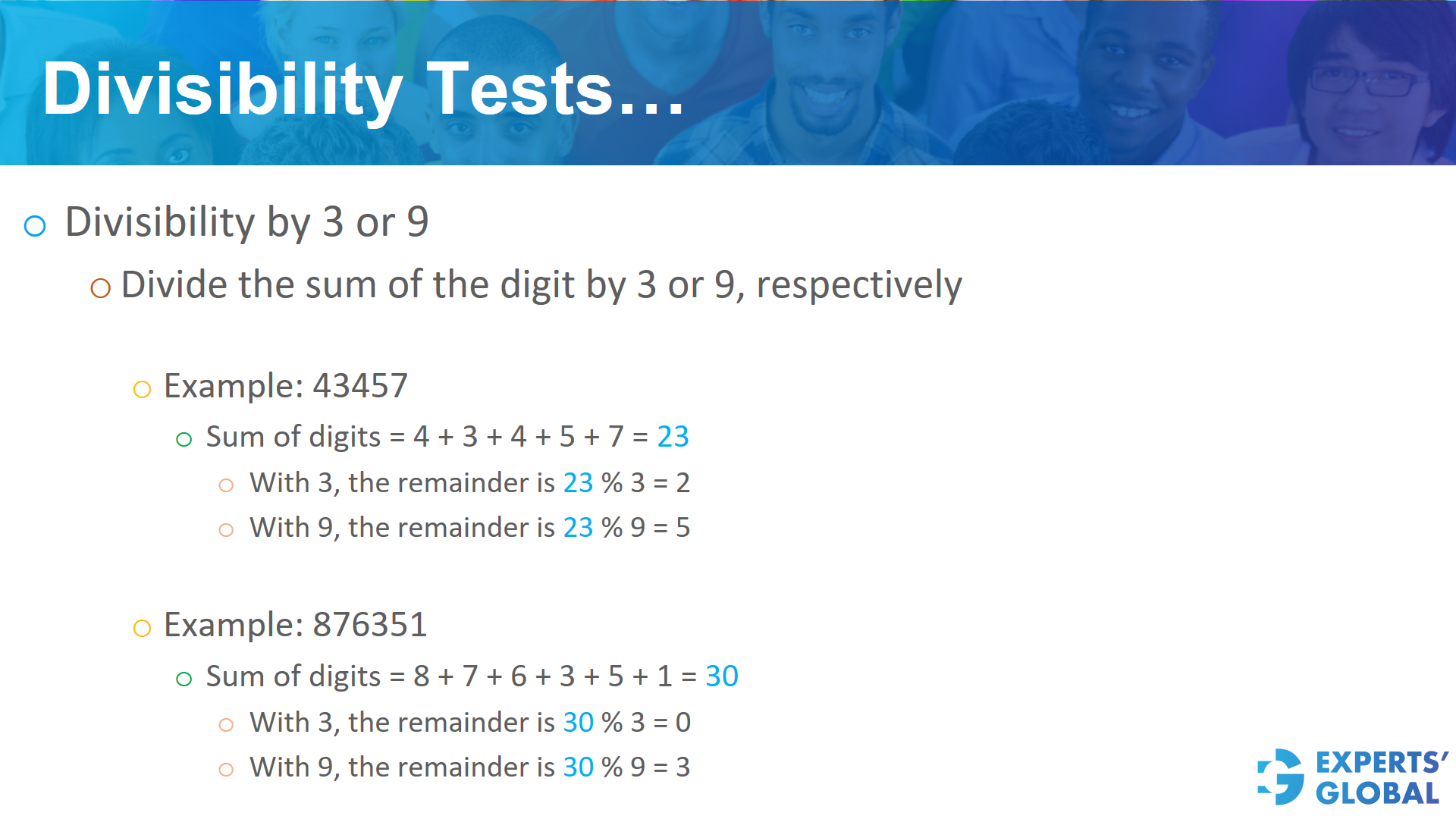
Divisibility tests for 3 and 9 are determined by calculating the sum of the digits of a number and then dividing that sum by 3 or 9. The remainder of this division matches the remainder of the original number.
Add all the digits of the number together. Divide that sum by 3 (for divisibility by 3) or by 9 (for divisibility by 9).
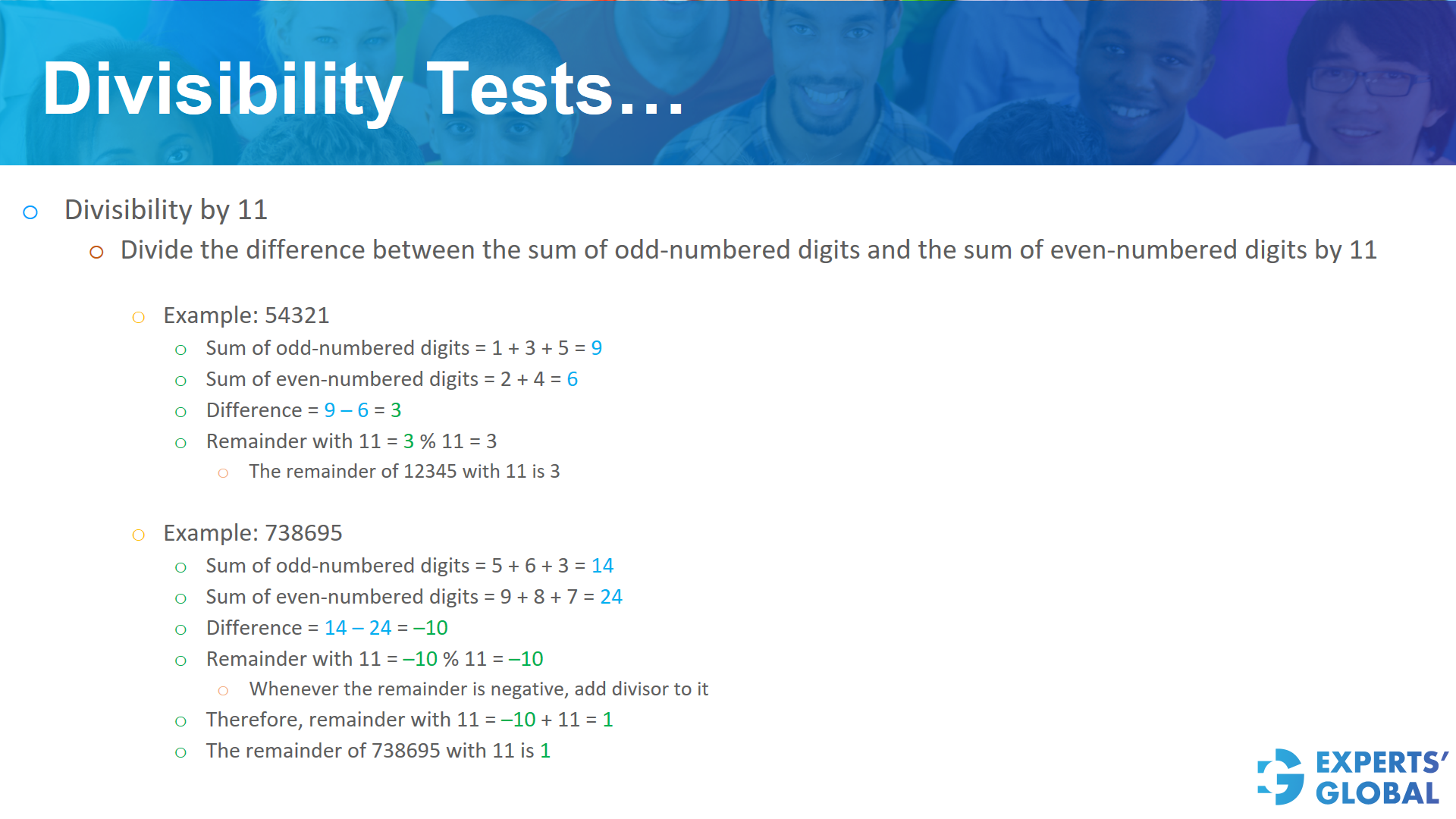
To determine if a number is divisible by 11, or to find its remainder when divided by 11, calculate the difference between the sum of the odd-numbered digits and the sum of the even-numbered digits. If that difference is then divided by 11, the resulting remainder is the same as the remainder of the original number.

A number is divisible by a composite number if it is divisible by its co-prime factors. This allows you to determine divisibility without memorizing a unique rule for every large number.
The number must be divisible by both 2 and 3.
The number must be divisible by both 3 and 4.
The number must be divisible by both 3 and 5.
The number must be divisible by both 2 and 9.
The number must be divisible by both 2 and 11.
Rather than memorizing an exhaustive list of individual rules, focus on the broad concept: if a number satisfies the divisibility requirements of two co-prime factors that multiply to the target number, it is divisible by that target.

Which of the following integers are prime numbers?
Answer: The prime numbers in the list are 37, 43, 59, 67, 79, 83, 87, 93, and 101.
For a detailed explanation, please refer to the video presented earlier on this page.
Free diagnostic full length GRE mock test
GRE crash course – intense, 5-week prep
