
Invest 30 seconds...
...for what may lead to a life altering association!
Help Line
- +91.8800.2828.00 (IND)
- 1030-1830 Hrs IST, Mon-Sat
- support@expertsglobal.com
33% off ends soon:GMAT/GRE prep + applications bundle. Profile building, longer mentoring, better results. Inquire

This article focuses on the common mistakes you need to avoid in GRE sentence equivalence questions to score high and save time on this important question type. SE makes up roughly 25 percent of the GRE Verbal section, which makes strong coverage of this question type a necessary part of any well-designed GRE preparation course. When you understand where students typically lose marks or waste time, you put yourself in a position to convert sentence equivalence into a reliable scoring opportunity rather than a source of uncertainty.
The detailed video lesson below together with the article that follows addresses virtually all the common pitfalls seen in GRE sentence equivalence questions. It explains each mistake clearly at a conceptual level and then reinforces the learning through GRE-style sentence equivalence examples. Take time to understand these patterns carefully and carry the insights forward into your GRE practice exercises as well as full-length GRE mock tests. When you learn to recognize and avoid these pitfalls early, you walk into the actual GRE with clarity, control, and the confidence that comes from thoughtful preparation.
Let’s explore each common mistake discussed in the video lesson…
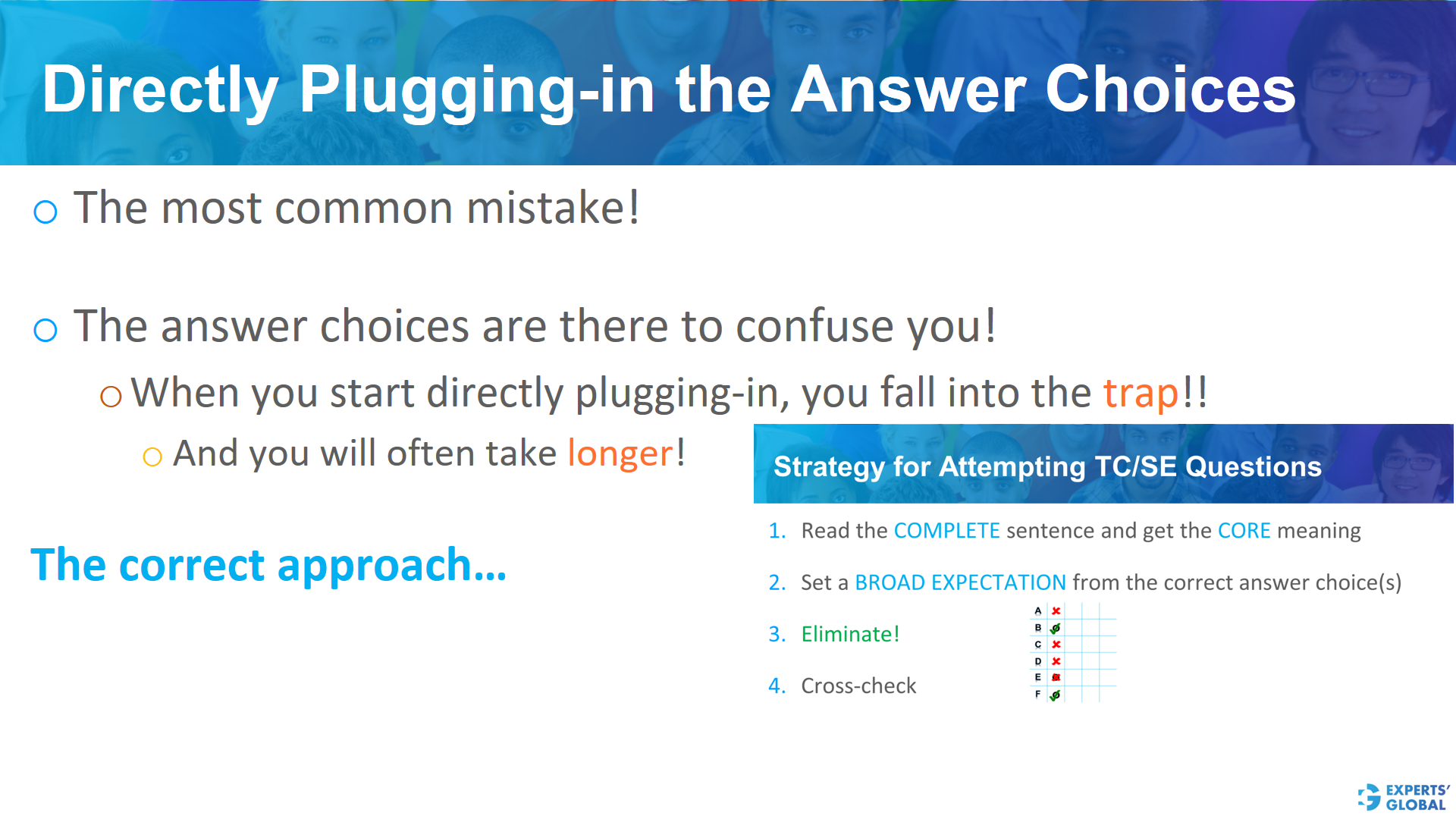
When you are preparing for exams like the GRE, one of the most common mistakes students make is directly plugging in the answer choices. While it might feel like the quickest way to find an answer, it is actually a trap that can lead to errors and waste your valuable time. The answer choices are often designed to confuse you. If you start by plugging them in immediately, you are more likely to fall for these traps.
Want an accurate sense of your GRE level? Take a free GRE practice test
To solve these questions like a pro, always follow this reliable flow:
For efficiency and accuracy, follow the four-step approach. So-called shortcuts usually waste time and lower accuracy.
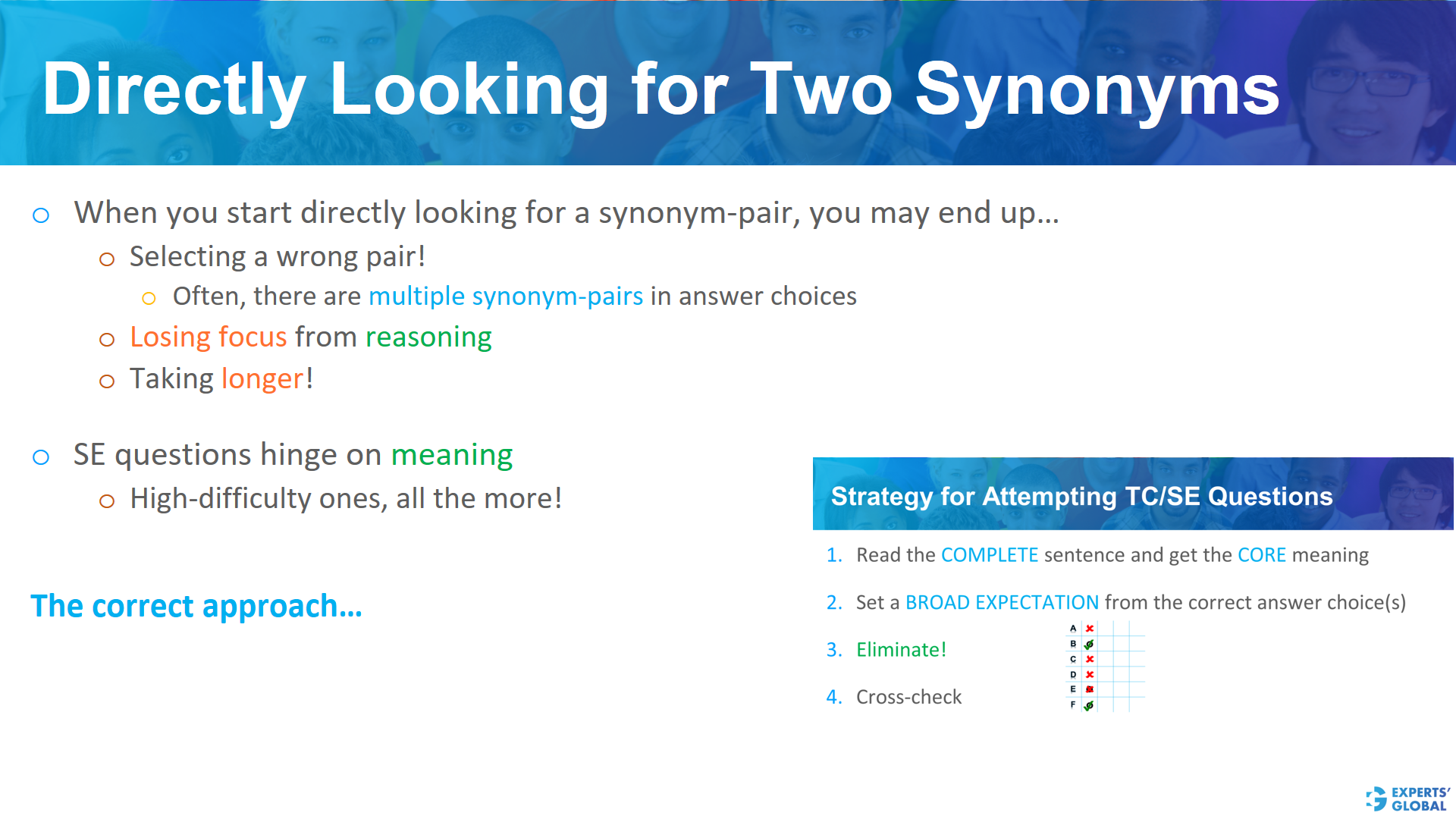
When you are working on Sentence Equivalence (SE) questions, a very common mistake is directly looking for two synonyms among the answer choices.
Looking for quick GRE prep? Check our GRE crash course
While it might seem like a shortcut, this method can lead to several problems:
Remember, SE questions hinge on meaning. This is especially true for high-difficulty questions.
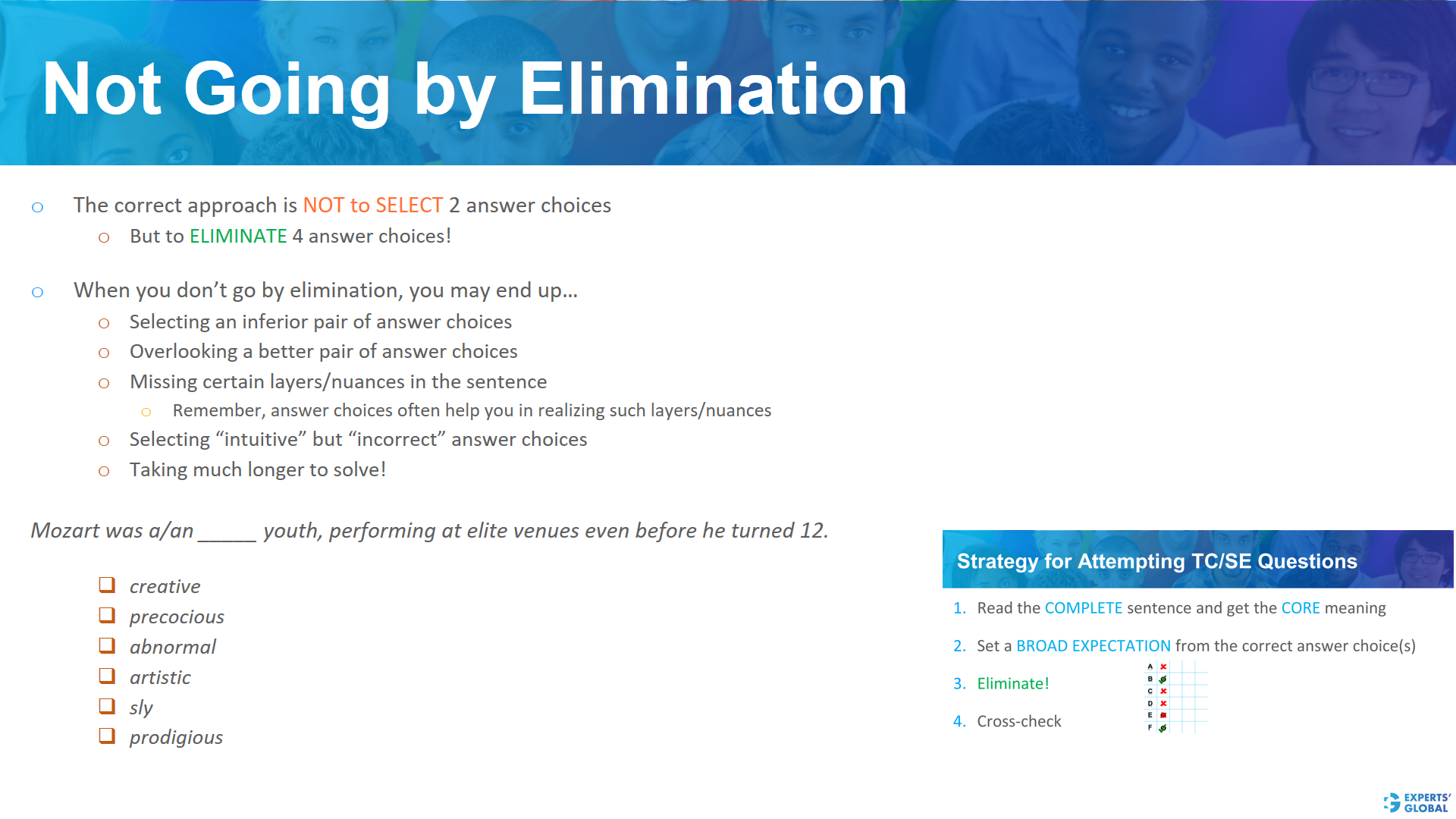
When you are tackling Sentence Equivalence (SE) questions, the secret to success is not just finding the right words — it is about eliminating the wrong ones! Many students try to simply pick two words that look good, but the correct approach is NOT to SELECT 2 answer choices; it is to ELIMINATE 4 answer choices.
If you don’t use elimination, you might run into these common problems: Selecting an inferior pair of answer choices.
For a detailed explanation for example on the slide, please refer to the video featured earlier on this page. Following is step-by-step written explanation.
Mozart was a/an ________ youth, performing at elite venues even before he turned 12.
Step 1: Read the COMPLETE sentence and get the CORE meaning: We read the whole sentence: “Mozart was a/an ________ youth, performing at elite venues even before he turned 12.” The core meaning is that Mozart was performing at a very high level at a very young age.
Step 2: Set a BROAD EXPECTATION from the correct answer choice(s): Based on the fact that he was performing at “elite venues” before age 12, our broad expectation is a word that means “gifted or advanced at a young age”.
Step 3: Eliminate! Now, let’s look at our choices and eliminate 4 that don’t fit our expectation:
By eliminating four choices, we are left with precocious and prodigious.
Step 4: Cross-check: “precocious” and “prodigious” fit the sentence perfectly and create the same core meaning: Mozart was an exceptionally advanced youth.
Without following the four-step approach, we would have fallen into the trap of selecting an inferior synonym pair from the answer choices.
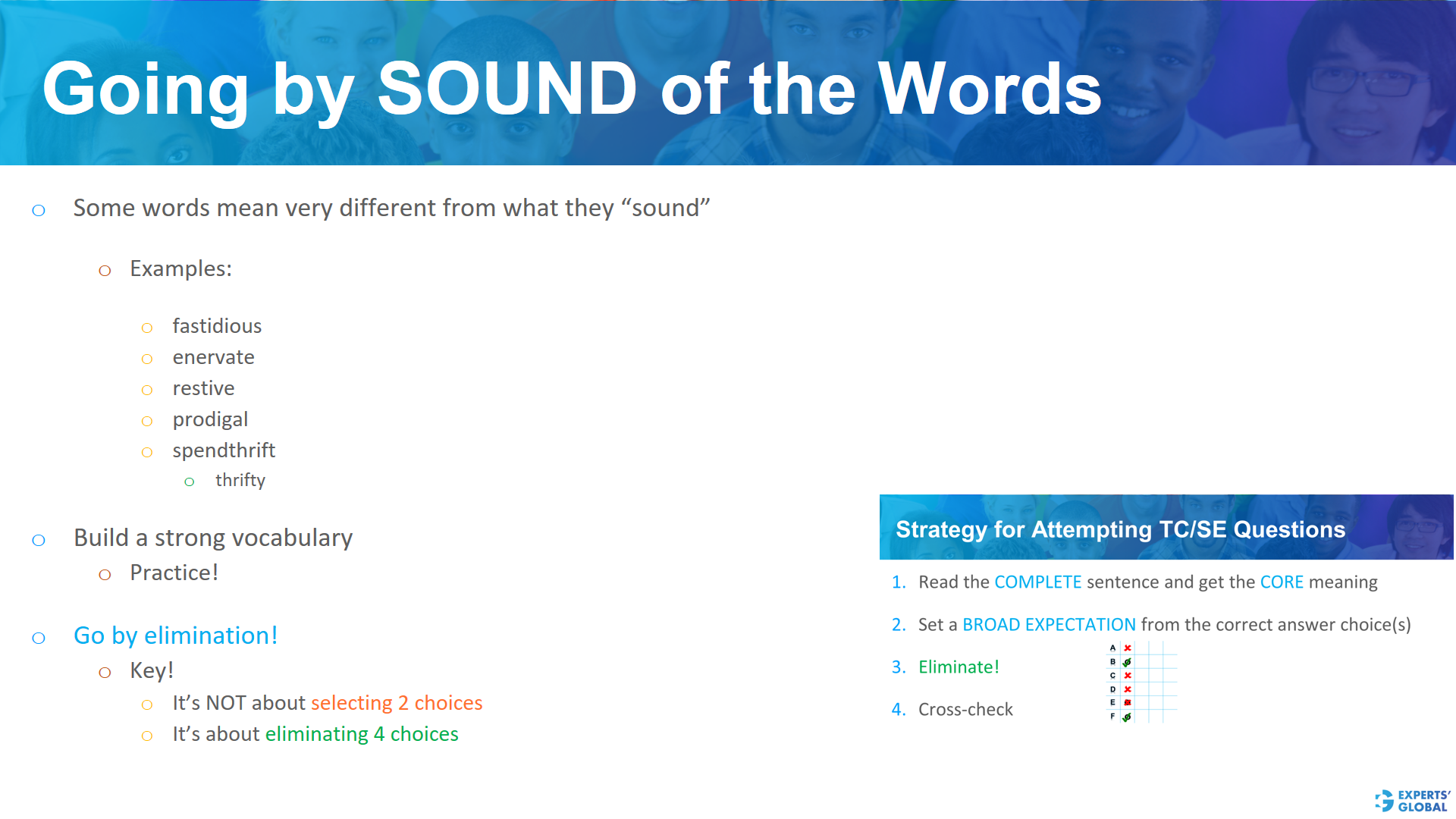
When you are preparing for exams, it is very important to avoid common traps in Text Completion (TC) and Sentence Equivalence (SE) questions. One of the biggest mistakes beginners make is going by the “SOUND” of the words. Some words mean something very different from what they “sound” like. To avoid these traps, you need to build a strong vocabulary through practice and always use a logical strategy. Always Use Elimination: The correct approach is NOT to SELECT 2 answer choices, but to ELIMINATE 4 choices. If you don’t eliminate, you might overlook a better pair or miss subtle nuances in the sentence.
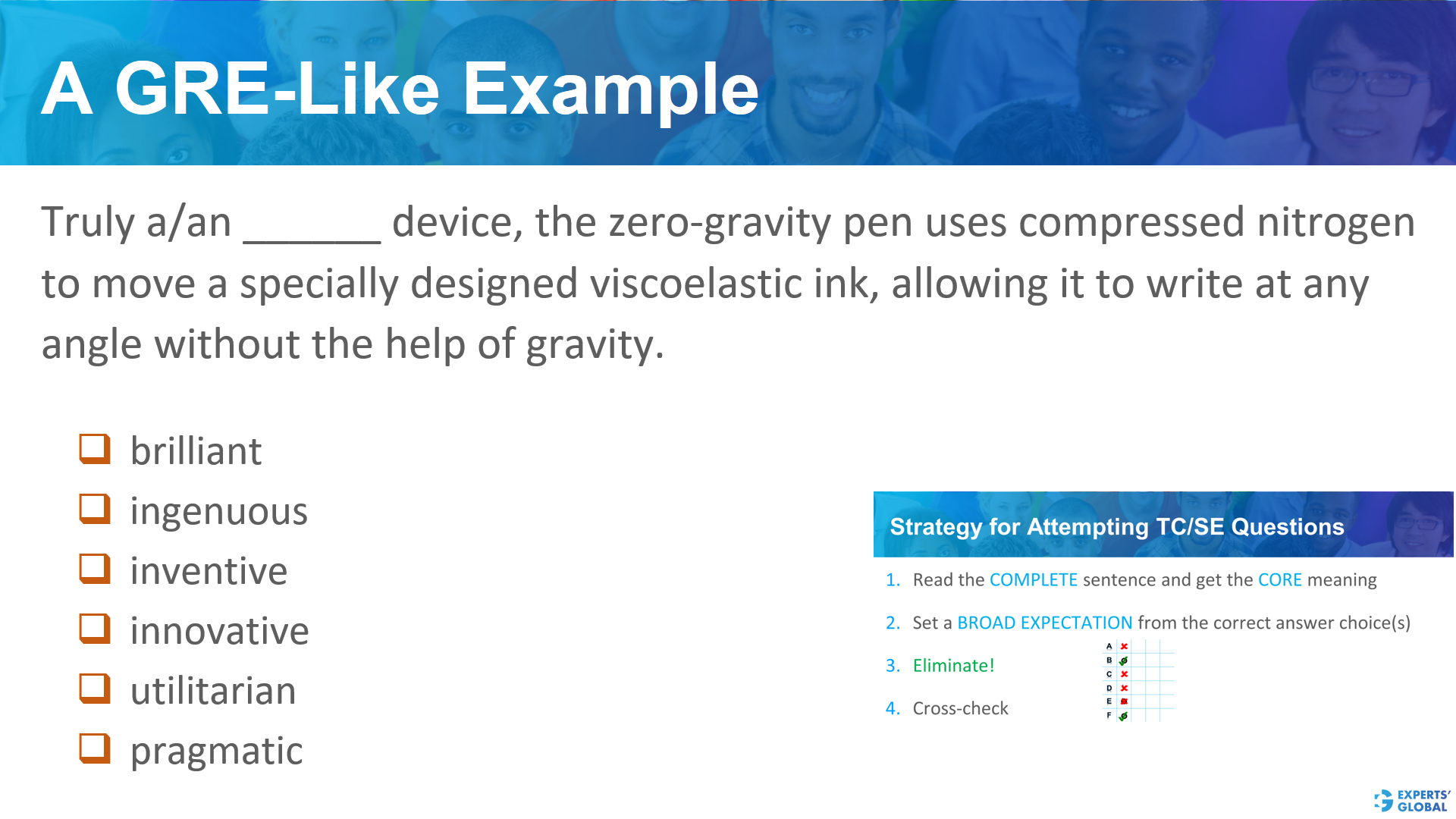
Correct Answer: C and D
Relying on the sound of the words alone would have led to the trap choices.
For detailed explanation, watch the video lesson presented earlier on this page.
Following is a detailed written explanation…
The sentence praises the pen as a cleverly designed device that solves the problem of writing without gravity.
The blank should mean creative, original in design, or newly developed.
Our chosen words are “inventive” and “innovative.”
Correct Answer: C and D
Sentence Equivalence is about getting two sentences with EQUIVALENT meaning, not necessarily the “exactly same” meaning. “Exactly same” is difficult because exact synonyms are rare; each word has its own character. You are looking for two choices that lead to complete, coherent sentences that are equivalent in meaning. Sometimes, words that are NOT “clear synonyms” may still lead to equivalent sentences because context matters!
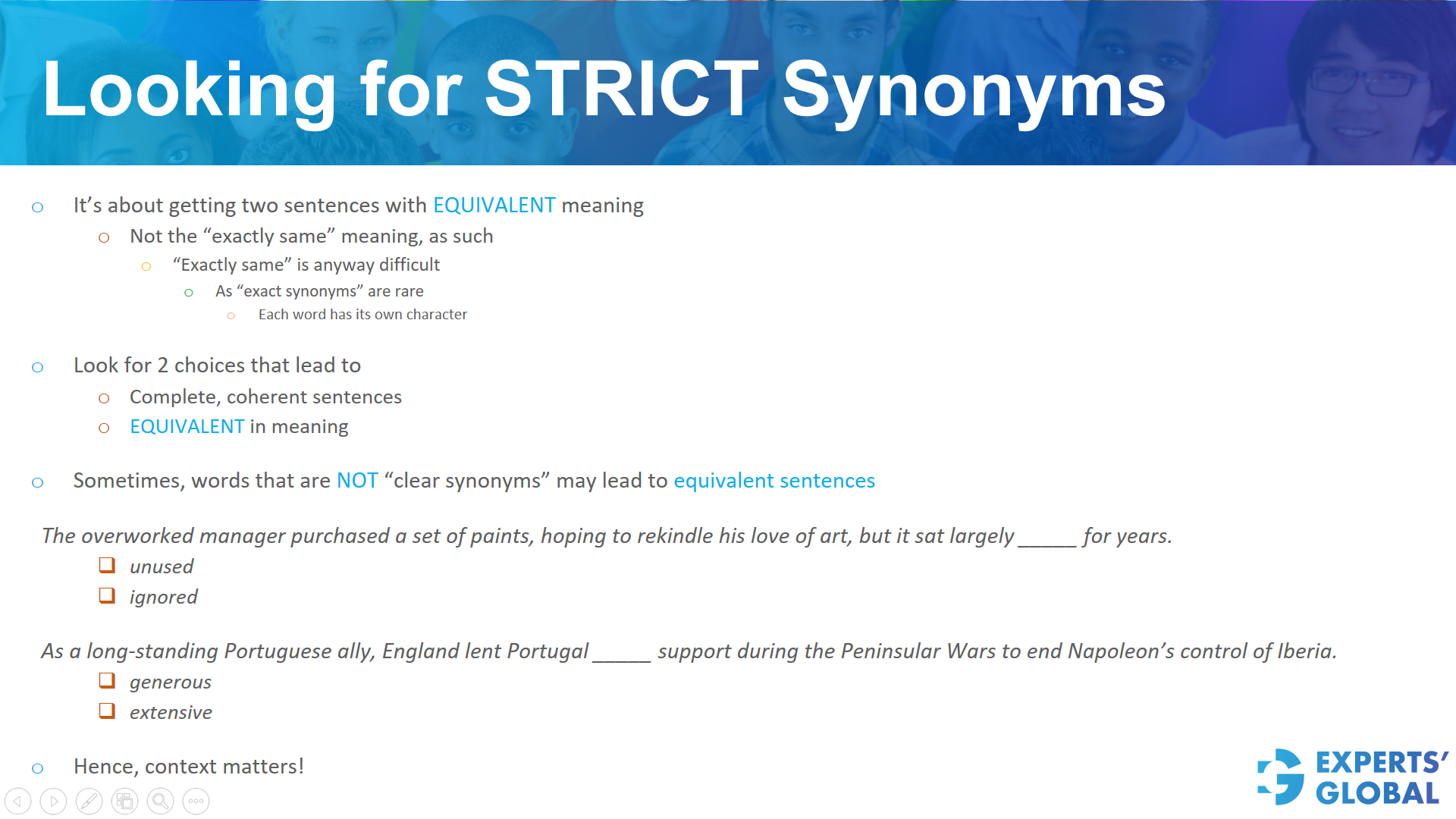
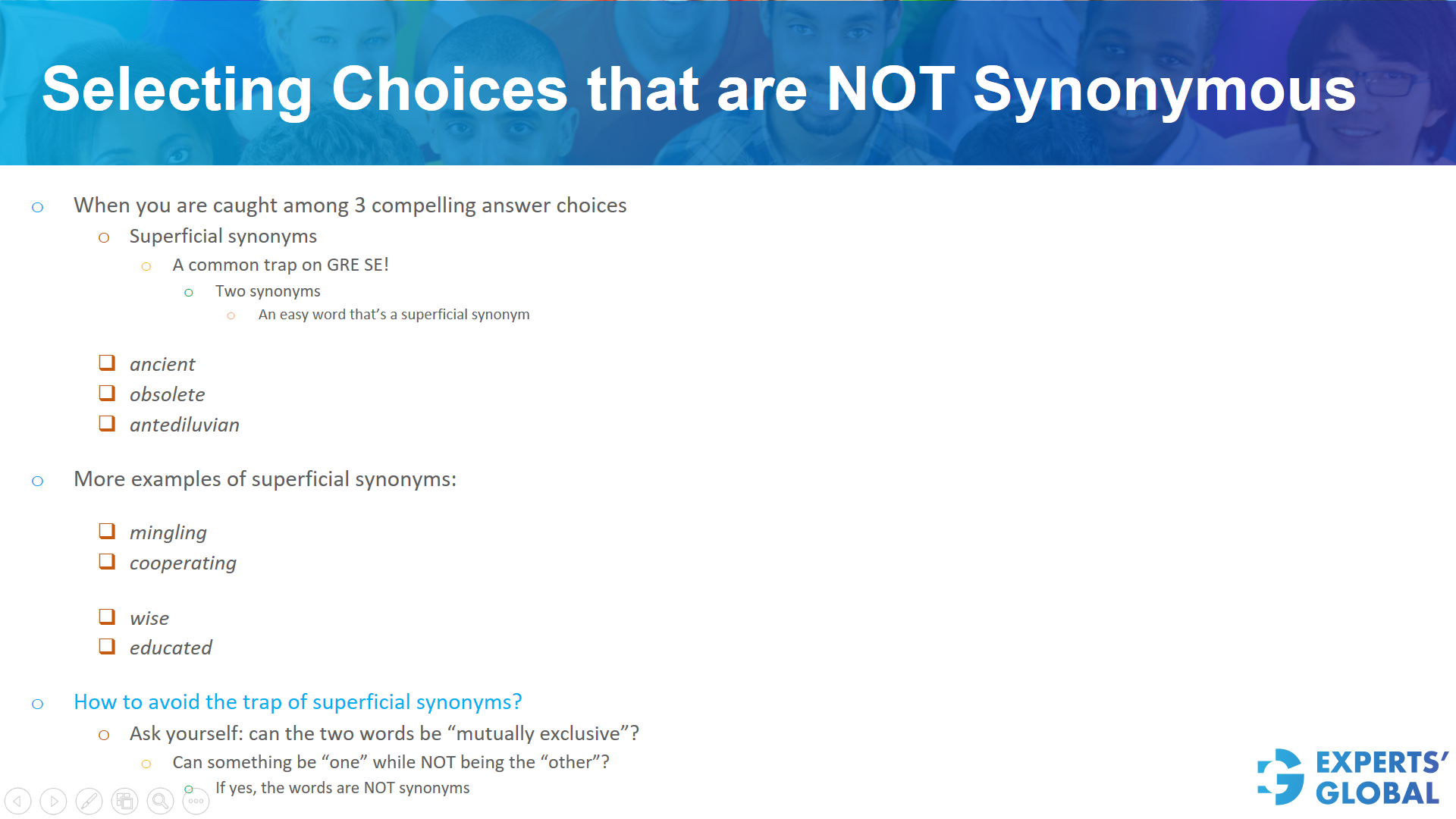
A common trap is a pair of words that seem related but aren’t true synonyms. To avoid this, ask yourself: “Can the two words be mutually exclusive?” If something can be one while NOT being the other, they are NOT synonyms.
Some examples of superficial synonym pairs:
Often, an answer choice that makes a complete, coherent sentence is actually incorrect because it doesn’t have a partner choice that leads to an EQUIVALENT meaning. A very common trap is an “easy” word that runs into the blank but has no partner. At Experts’ Global, we call such coherent answer choices lacking a partner choice “Logical but Lone” choices. Don’t commit to one choice until you find its pair!
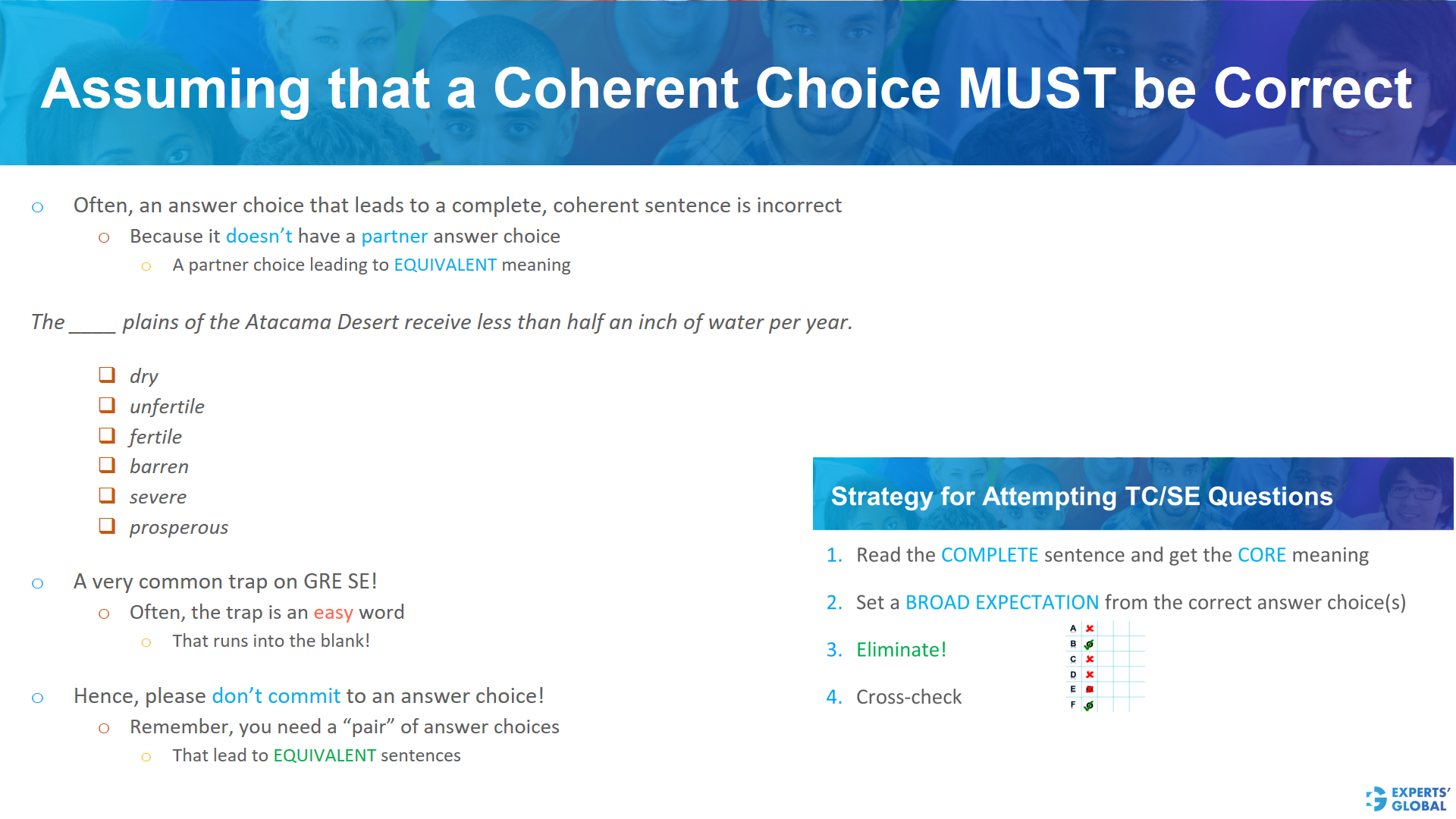
The ________ plains of the Atacama Desert receive less than half an inch of water per year.
In the example above, “dry” is a coherent answer choice that lacks a partner among the other five options. It completes the sentence logically, but choosing it leads to the classic GRE trap of a logical but lone answer choice. The correct pair is unfertile and barren, which together produce coherent sentences with equivalent meaning.
When you are solving sentence completion or text completion questions, one of the most common mistakes is not spotting a contrast or shift in meaning. If you miss a shift, you will likely choose the “opposite” of the correct answer. Spot every shift in meaning, spot every contrast trigger. The good news is that once you learn how to spot these shifts, you will be much more successful!
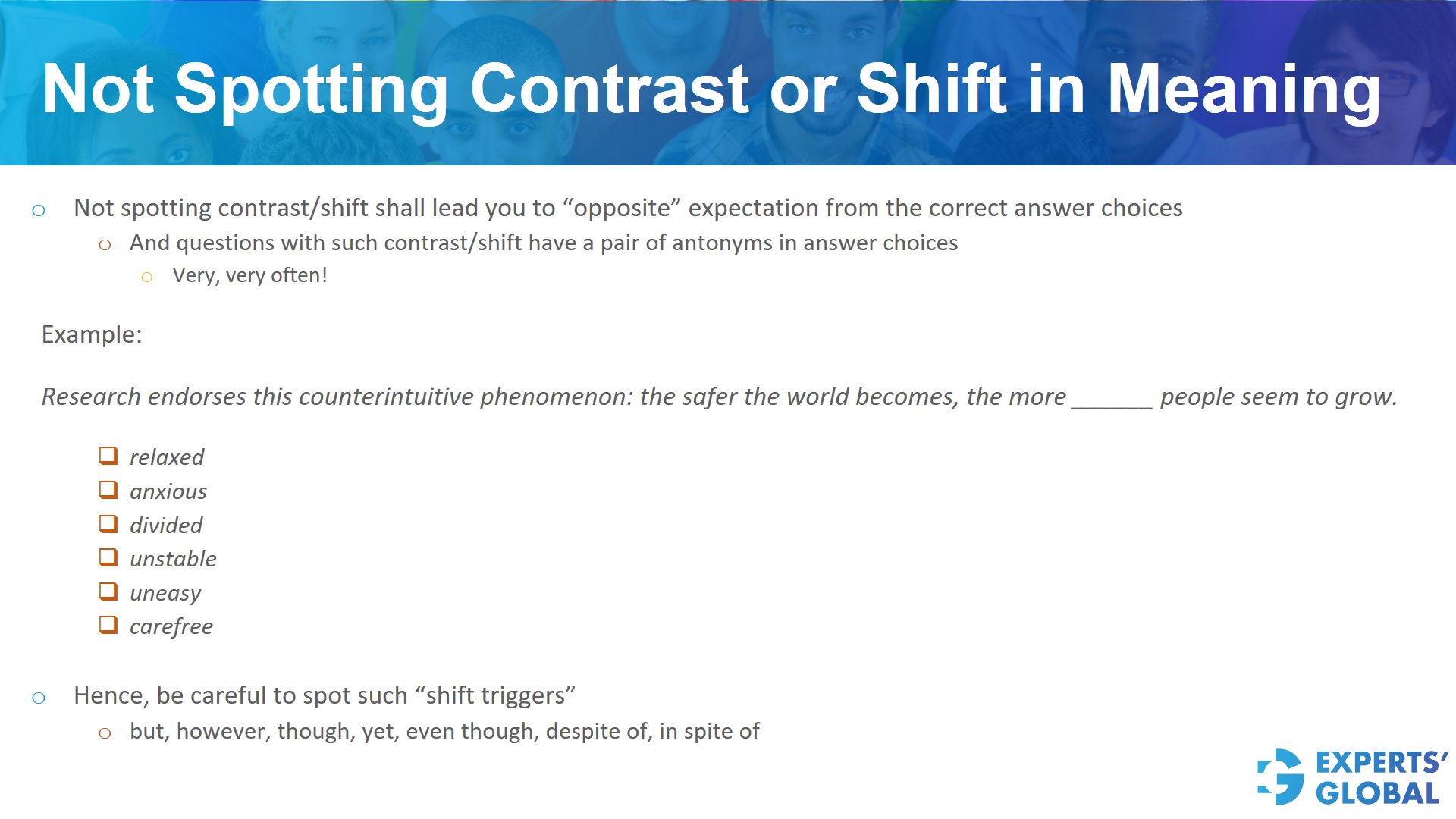
In many GRE questions, the sentence will lead you in one direction and then suddenly switch to the other. If you don’t notice the shift, you will look for a word that matches the first half of the sentence. These questions often include a pair of antonyms in the answer choices to trap you if you missed the shift.
To get these questions right, you must be careful to spot shift triggers. These are specific words that signal a change in direction. Keep an eye out for:
Research endorses this counterintuitive phenomenon: the safer the world becomes, the more __________ people seem to grow.
In the question above, “anxious” and “uneasy” are the correct answer choices. However, if you missed the shift in the sentence, you could easily choose “relaxed” and “carefree” instead.
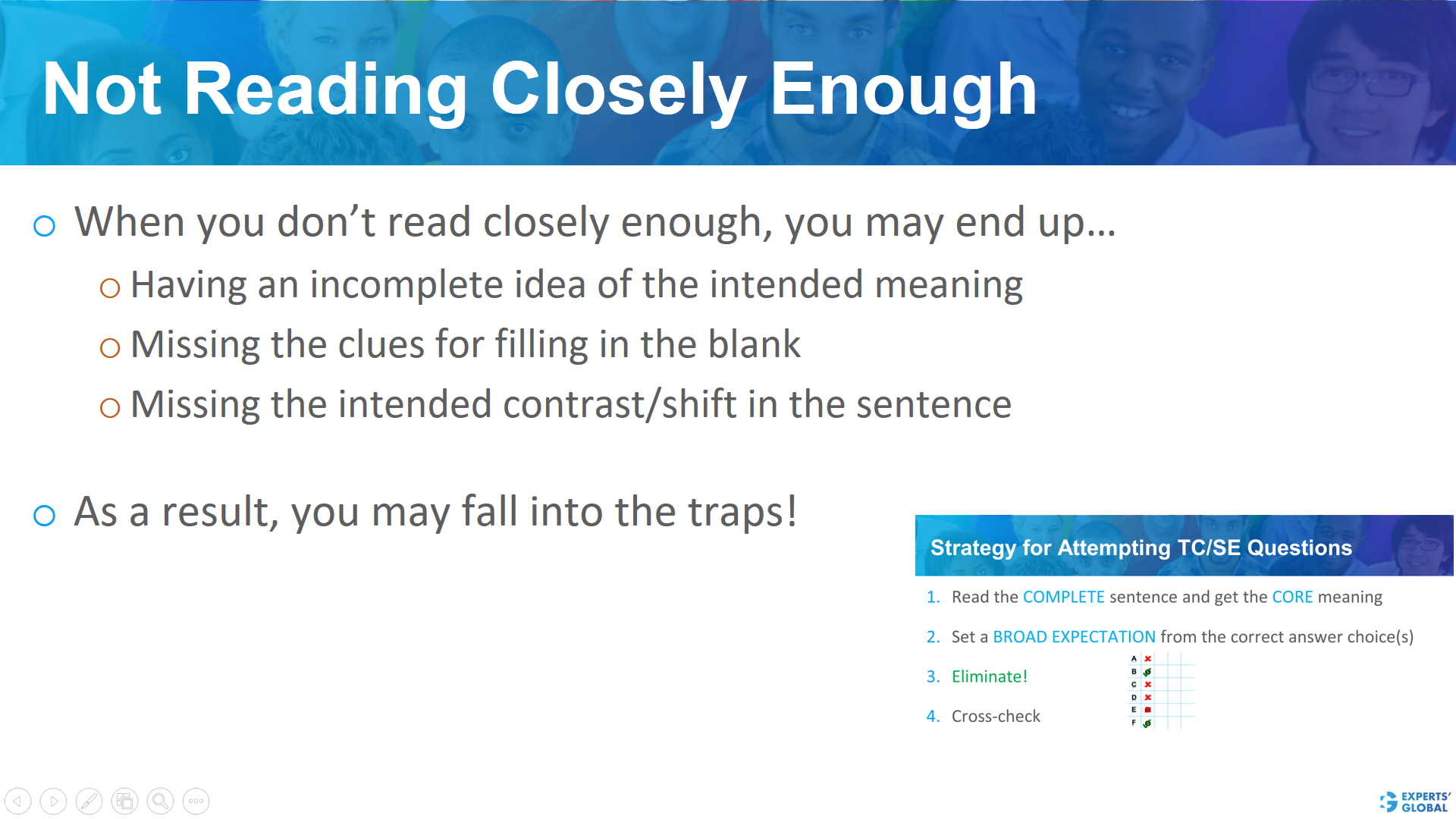
When you are working through sentence completion questions, accuracy starts with your eyes! A very common mistake is not reading closely enough. If you skim the text too quickly, you might face some tricky challenges:
Having an incomplete idea of the intended meaning: You might only understand part of the story the sentence is trying to tell.
Missing the clues for filling in the blank: Sentences are full of little hints that point to the right answer, but you have to see them to use them!
Missing the intended contrast or shift in the sentence: Sentences often change direction (using words like “but” or “however”), and if you miss that shift, you might pick the exact opposite of the correct answer.
As a result of these small oversights, you may fall into the traps!
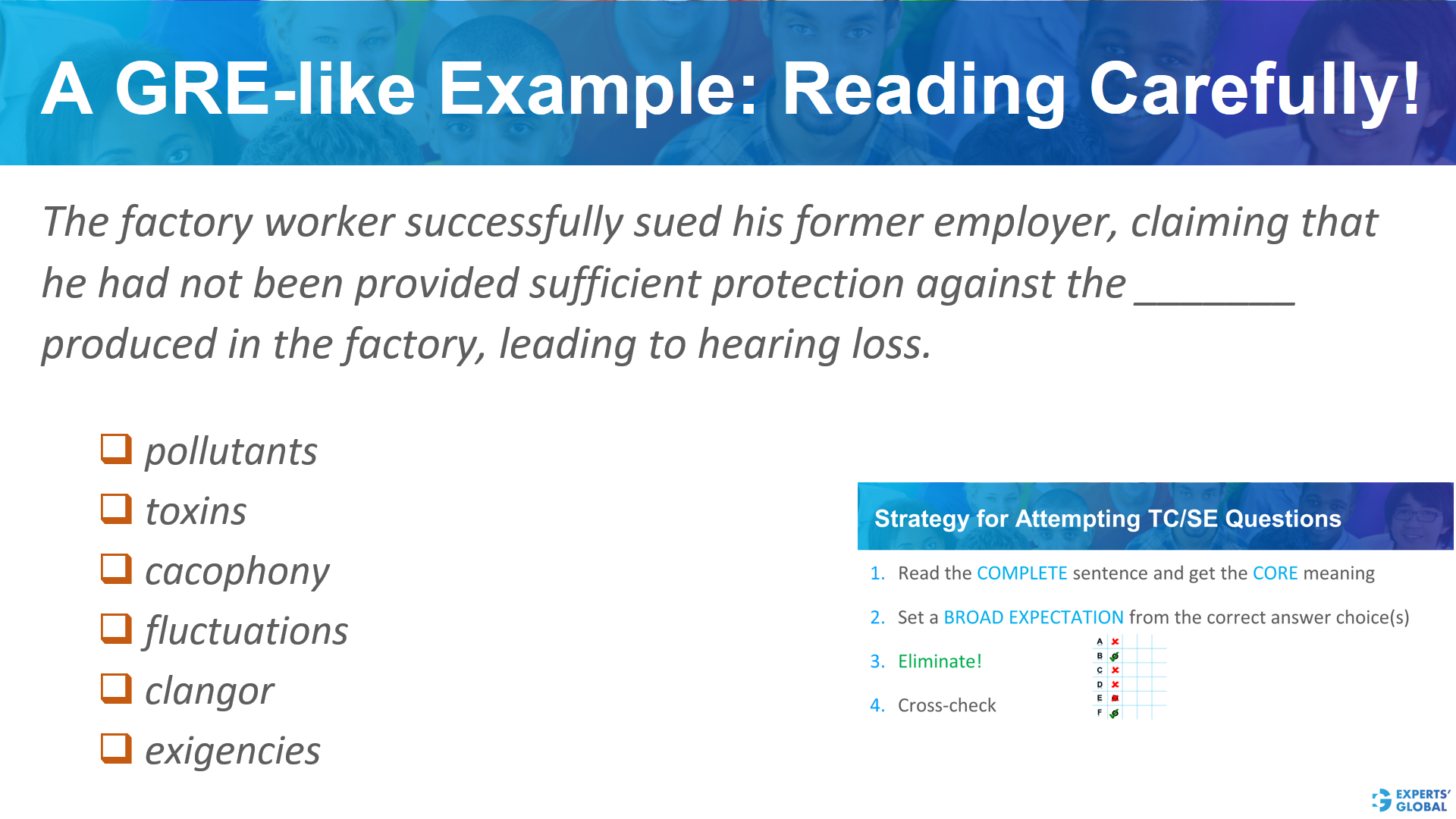
In the question above, if you do not read closely enough to recognize that the sentence is about “hearing loss,” you can miss the correct answer choices, “cacophony” and “clangor”, which fit that context. If you read less carefully, you may choose “pollutants” and “toxins”, which feel more intuitive in the context of factory work.
Therefore, please always carefully read the sentence, end to end, especially beyond the blank, because the key to solving the question often lies there.
Correct answers: C and E. For complete explanation, please watch the video above.
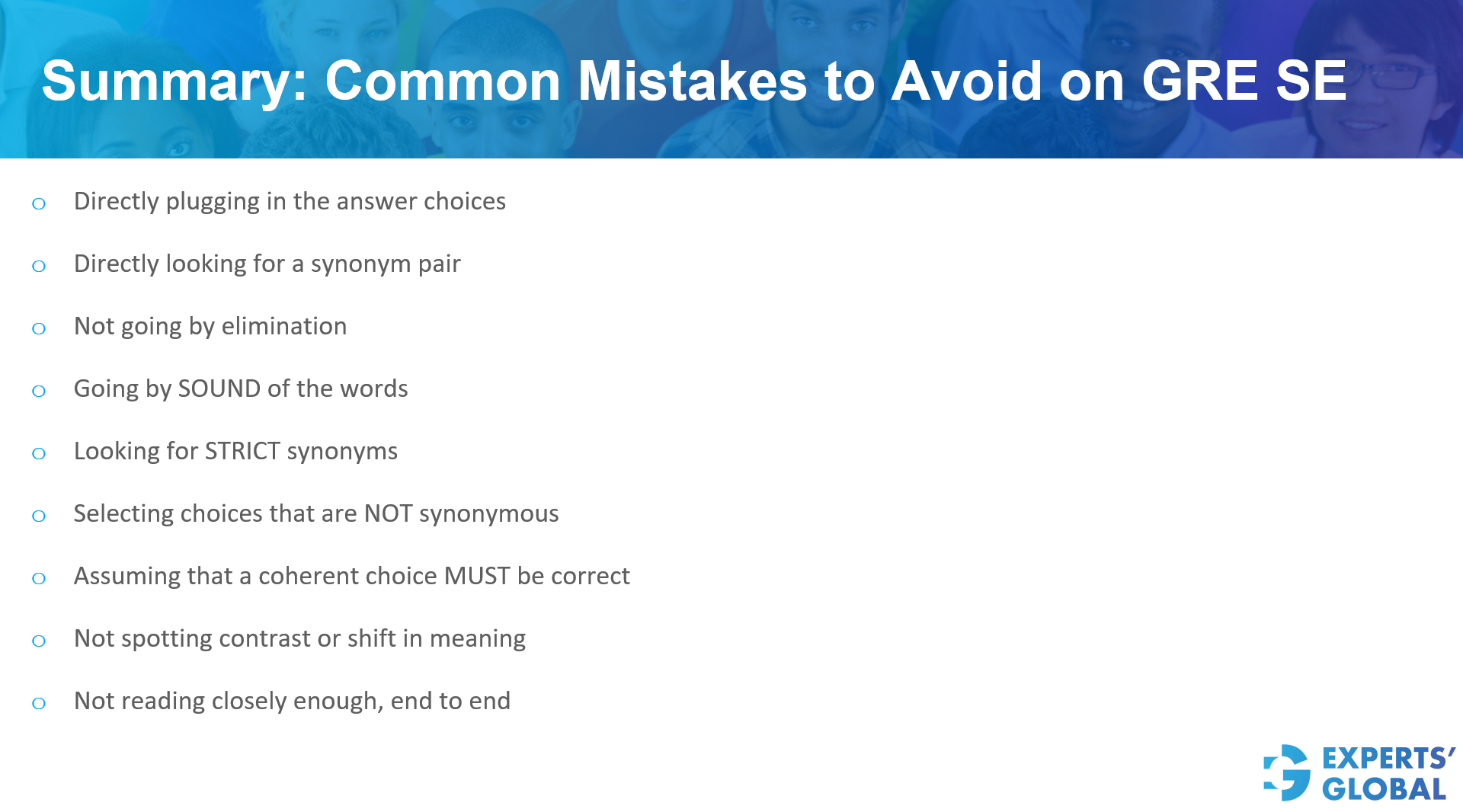
When you study common mistakes in Sentence Equivalence, you do more than fix a test habit. You start building a disciplined way of thinking that protects you from attractive distractions. The GRE rewards that discipline because it quietly asks you to stay loyal to meaning, follow a clear four-step approach, eliminate with patience, and avoid shortcuts that feel fast but pull you away from the sentence’s core message. Graduate and MBA admissions consulting works in a similar way. Applications often contain choices that sound impressive but do not fit your story, your evidence, or your direction. The strongest outcomes come when you resist the urge to force a match and instead choose what aligns cleanly with the prompt and with who you are. Life mirrors this pattern too. Many options look right at first glance, yet the best decisions come from reading the full situation, spotting shifts, and staying steady when something feels intuitive but incomplete. Keep practicing in drills and mock tests, and let careful thinking become your default.
End to end online GRE preparation course with free trial
Free GRE full length diagnostic mock
