
Invest 30 seconds...
...for what may lead to a life altering association!
Help Line
- +91.8800.2828.00 (IND)
- 1030-1830 Hrs IST, Mon-Sat
- support@expertsglobal.com
33% off ends soon:GMAT/GRE prep + applications bundle. Profile building, longer mentoring, better results. Inquire

GRE Sentence Equivalence and Text Completion questions always reward careful meaning-building from start to finish, and every well-written sentence naturally unfolds as a chain of thought. Some Sentence Equivalence questions fit clear patterns such as contrast, similarity, cause and effect, or continuation of thought, but some do not follow any one of these four structures in a clean way. For those questions, you rely on the sentence’s chain of thought as your main guide: you track how each phrase shapes the idea, how the sentence develops step by step, and what meaning the blank must express to complete that progression. When you follow the chain of thought closely, you solve these questions in a methodical and efficient way. For this reason, learning to track the chain of thought belongs in a well-planned GRE prep course.
The set of videos below focuses on Sentence Equivalence questions where none of the four broad patterns applies directly. Each video shows a structured way to follow the chain of thought through the sentence, keep the meaning clear at every step, and select the correct pair based on the exact idea the sentence builds, then applies the same method to GRE-style Sentence Equivalence questions with realistic answer choices designed to test this skill directly. The theory that follows supports the same approach. Absorb the method fully, then apply it consistently in GRE drills and full-length GRE mocks to strengthen your Sentence Equivalence performance.
Some sentences require you to understand the full chain of thought as meaning builds steadily from the beginning to the end. In these sentences, contrast, similarity, continuation, and cause effect cues do not shape meaning in a dominant way, so you determine the blank by processing how ideas connect logically across the entire structure. This sentence type appears frequently in GRE Text Completion and Sentence Equivalence questions and makes up a substantial portion of practice.
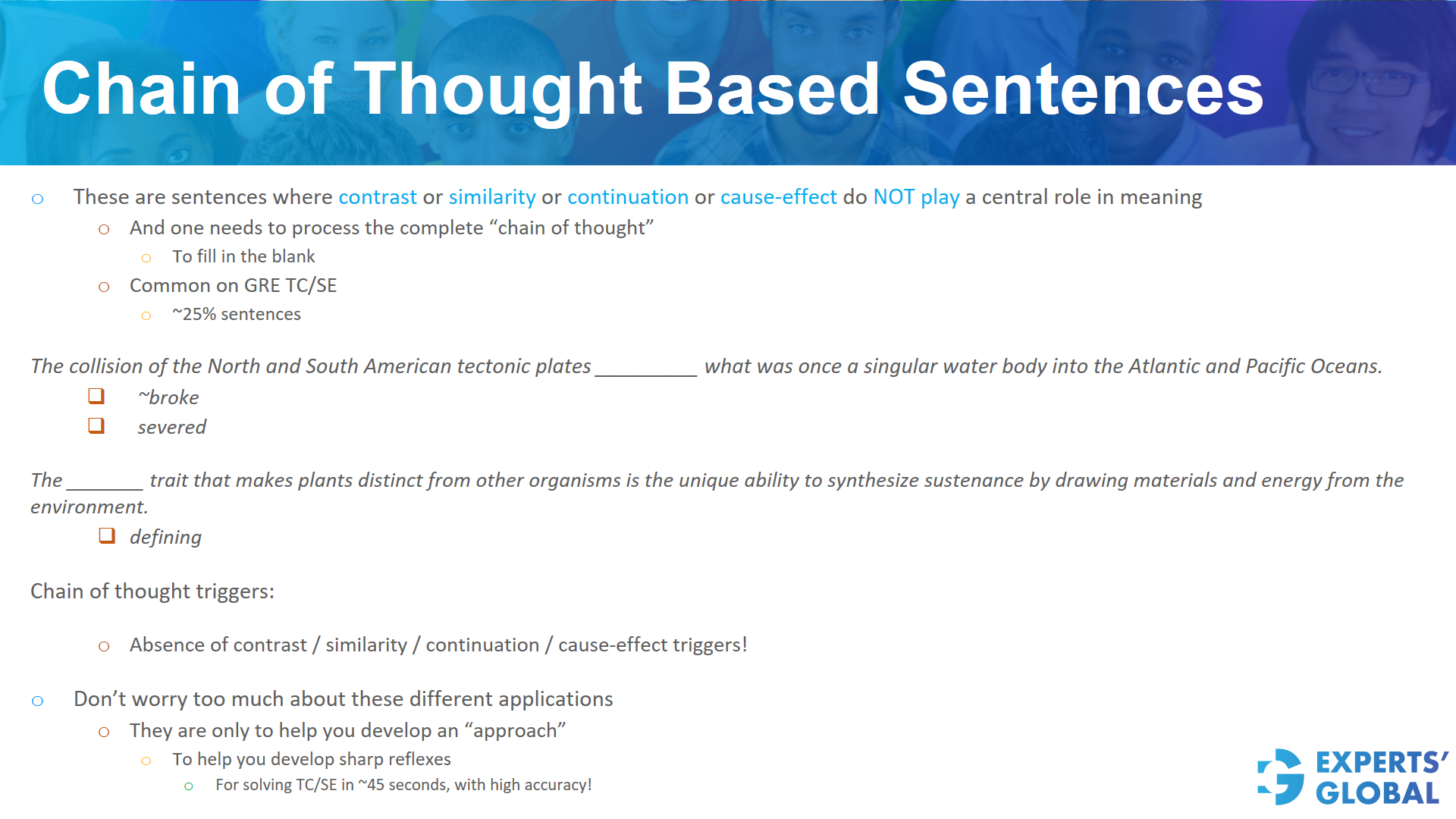
Many GRE sentences give you “clues” or “triggers” like contrast (words like but or however) or similarity (words like and or furthermore). Chain of Thought sentences are unique because:
For a detailed explanation for examples on the slide, please refer to the video featured earlier on this page. Following is step-by-step written explanation.
The collision of the North and South American tectonic plates _________ what was once a singular water body into the Atlantic and Pacific Oceans.
The _________ trait that makes plants distinct from other organisms is the unique ability to synthesize sustenance by drawing materials and energy from the environment.
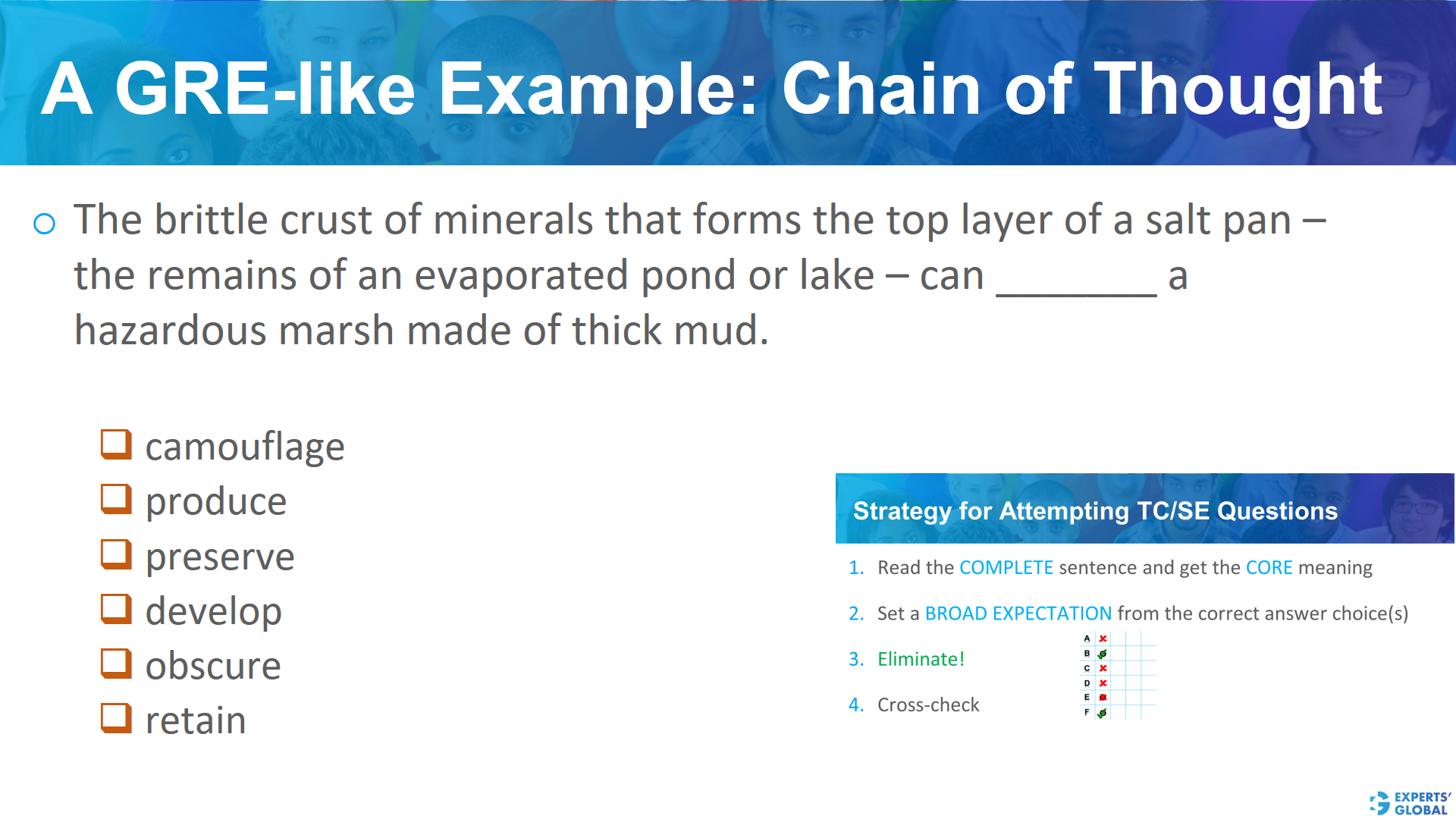
Correct answers: camouflage, obscure
For a detailed explanation of this question, please refer the last ~2 minutes of the video featured earlier on this page. Following is a step-by-step written solution:
The brittle crust of minerals that forms the top layer of a salt pan – the remains of an evaporated pond or lake – can ______ a hazardous marsh made of thick mud.
1. Core Meaning
The sentence describes a “brittle crust of minerals” that forms on top of a salt pan. This crust covers a “hazardous marsh” of mud, suggesting that it hides or conceals the danger beneath it.
2. Broad Expectation
I expect a word meaning to hide, mask, or cover up to describe how the top crust interacts with the marsh.
3. Eliminate
4. Cross-check
Camouflage and obscure are synonyms that accurately describe how a surface layer can prevent someone from seeing a hazard underneath.
Correct answers: camouflage, obscure
All-inclusive GRE prep course online
15 full length GRE practice tests
60 sectional GRE practice tests
