
Invest 30 seconds...
...for what may lead to a life altering association!
Help Line
- +91.8800.2828.00 (IND)
- 1030-1830 Hrs IST, Mon-Sat
- support@expertsglobal.com
33% off ends soon:GMAT/GRE prep + applications bundle. Profile building, longer mentoring, better results. Inquire

The Analytical Writing section on the GRE is one of the three test sections, along with Quantitative Reasoning and Verbal Reasoning. The Analytical Writing section is always the first section to appear on the GRE exam, after which the four Quantitative Reasoning and Verbal Reasoning sections appear alternately in any order. In a 30 minute time window, your task is to analyze an issue presented to you and write an essay that clearly states your position and supports it through well-reasoned arguments. You receive a score on a scale of 0 to 6 in half point increments. While Quantitative Reasoning and Verbal Reasoning scores are available immediately after you complete the exam, the Analytical Writing score appears on your score report after a few.
A part of Experts’ Global’s GRE prep course, the following video explains the Analytical Writing section on the GRE in a comprehensive and clear manner. They explain how the question appears on the exam, the standard instructions used in the Analytical Writing assessment, what you are expected to do in your response, what the test makers assess through this section, how your response is evaluated, how scoring works, what different score levels indicate, the importance of the Analytical Writing score, and what is considered a good score. Use this resource to build a complete and structured understanding of the Analytical Writing section in just a few focused minutes. All the best.
The GRE Analytical Writing task asks you to analyze a given issue and write one essay within 30 minutes. You receive a specific issue with clear instructions, and you respond by shaping your thinking into a focused essay.
You take a definite stand, in favor of or against the issue, and then support it with a strong argument. You build that argument through clear reasons and relevant examples that show your logic step by step. The essay is scored from 0 to 6 in steps of 0.5, so every improvement matters. Your score does not depend on which side you choose. It depends on how clearly, logically, and effectively you develop and communicate your position, so clarity of thought and expression stays at the center of the task.
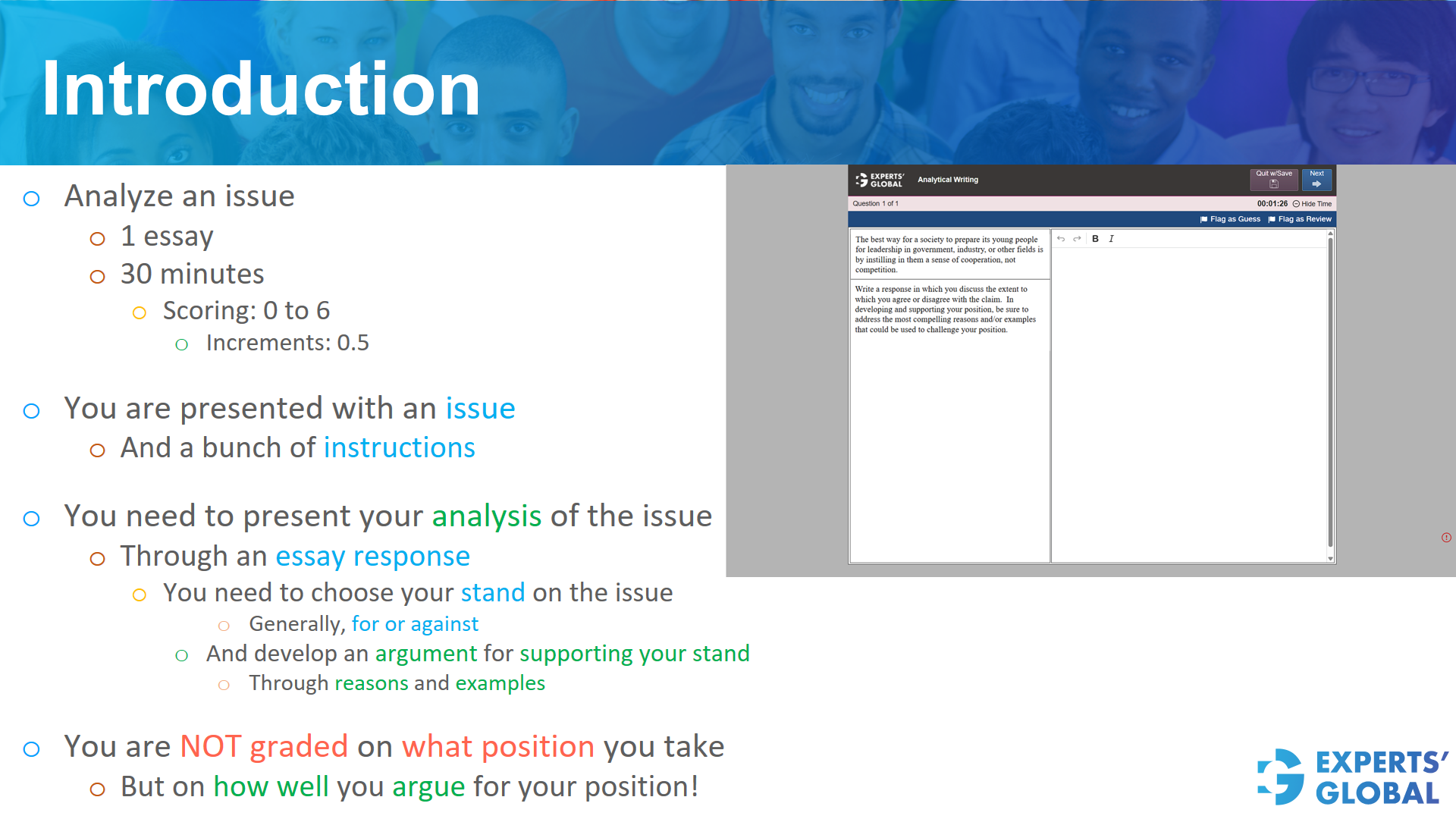
Your essay response is evaluated on how thoughtfully and directly you address the instructions and how clearly you build your position on the issue. You are expected to take a clear stand and develop it with purpose, showing that you can engage with a complex idea rather than avoid it. What matters most is how well you support your position through relevant reasoning and examples that strengthen your argument.
At the same time, the task values clarity of thought and expression. When your ideas flow logically and your language stays precise, your argument becomes more persuasive and easier to follow. Careful use of grammar helps your thoughts move smoothly, and strong semantics ensure your meaning lands exactly as you intend. When clarity and structure work together, your response reflects both depth of thinking and control over expression, which is exactly what the evaluator looks for.
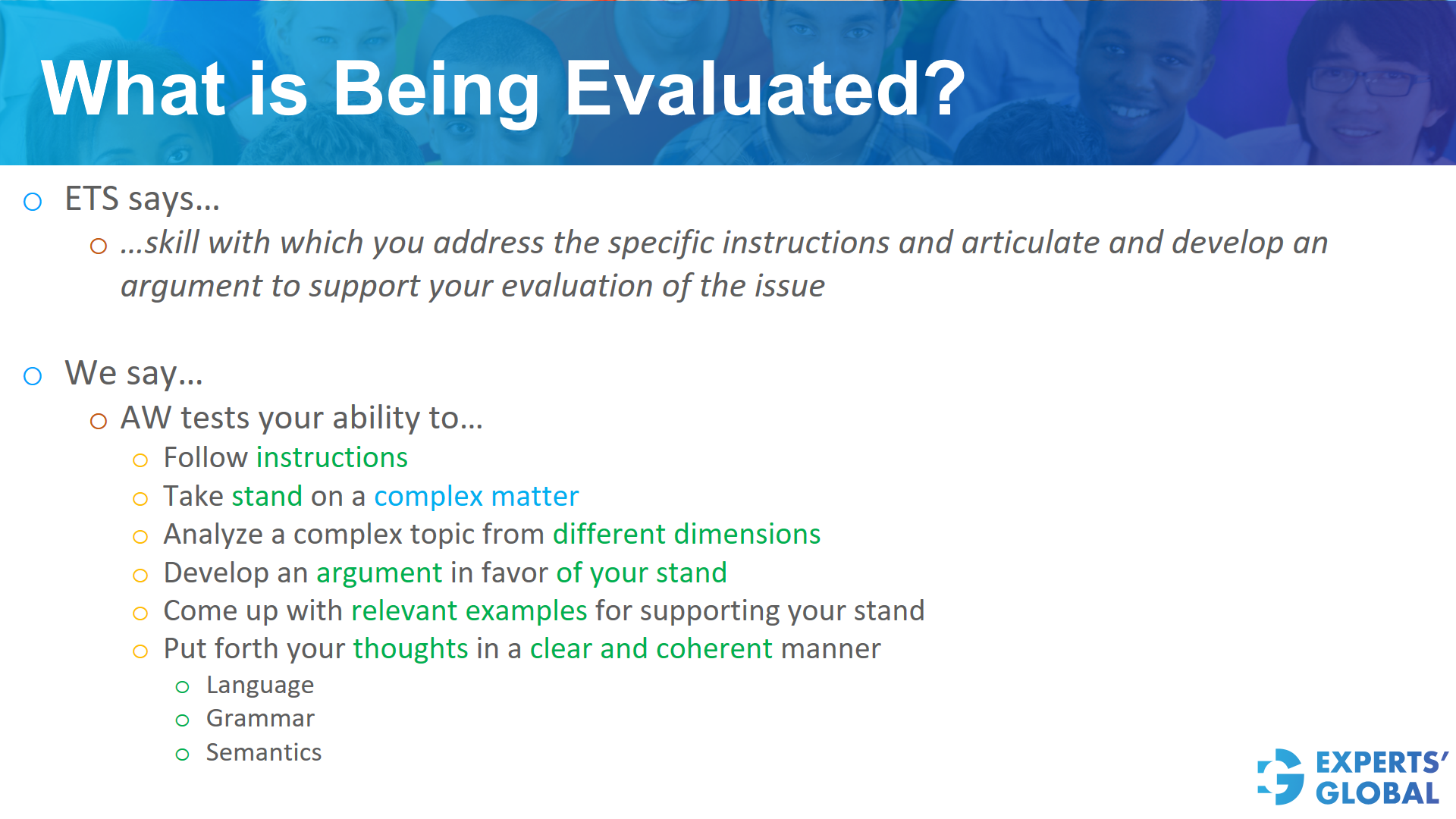
The Analytical Writing section of the GRE asks you to write an essay in response to an analysis of issue prompt. These prompts change slightly in wording, but their underlying purpose stays the same. The following slide highlights the most common prompt types you see on the exam.
You should spend time becoming familiar with these prompts during preparation. This habit helps you save valuable time on test day. When you glance at the prompt, you quickly understand what is being asked, instead of spending extra minutes decoding the language. No matter how the prompt is framed, the task remains consistent. You take a clear stand for or against the issue and build a strong response that supports your position with thoughtful reasoning.
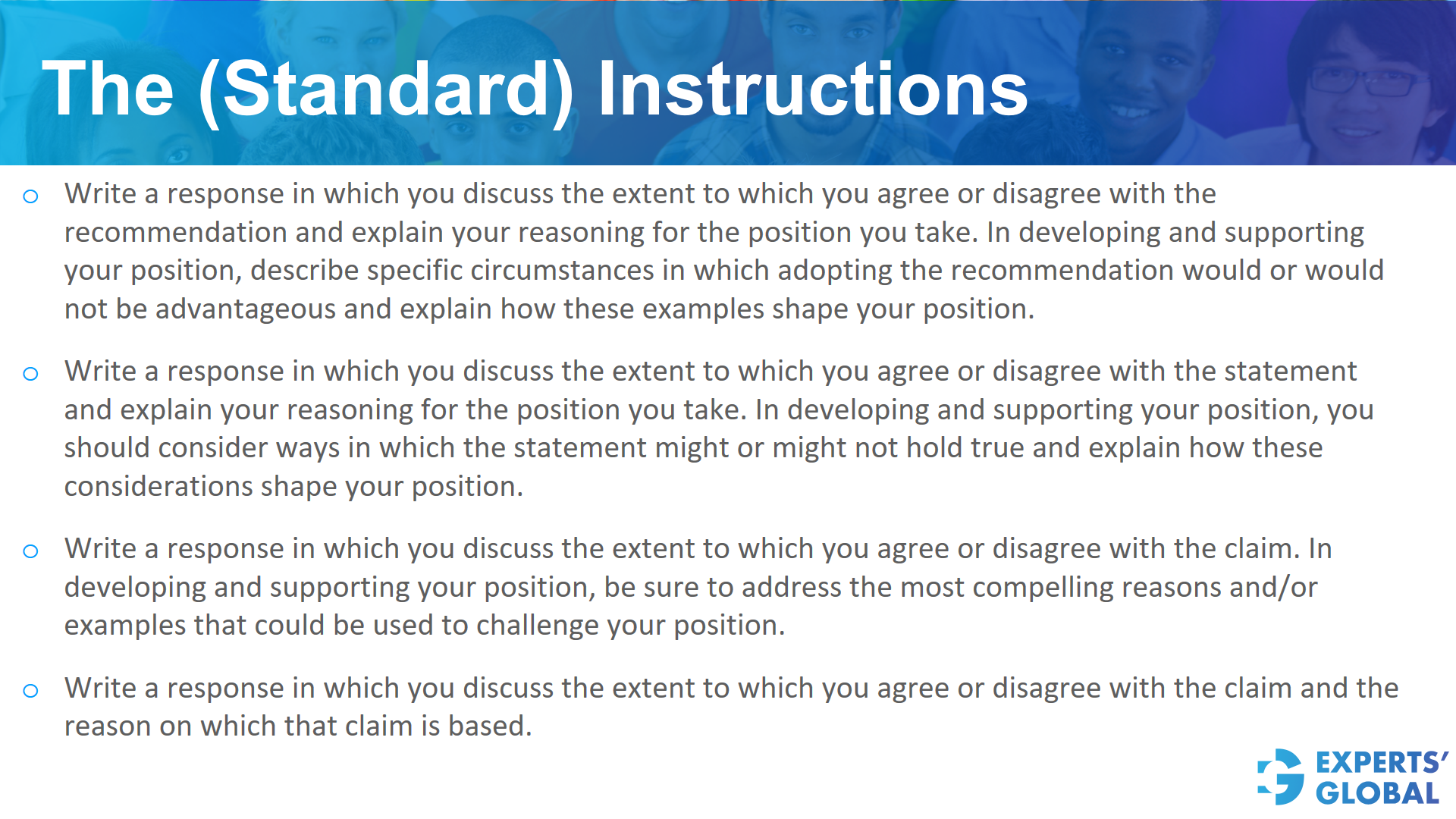
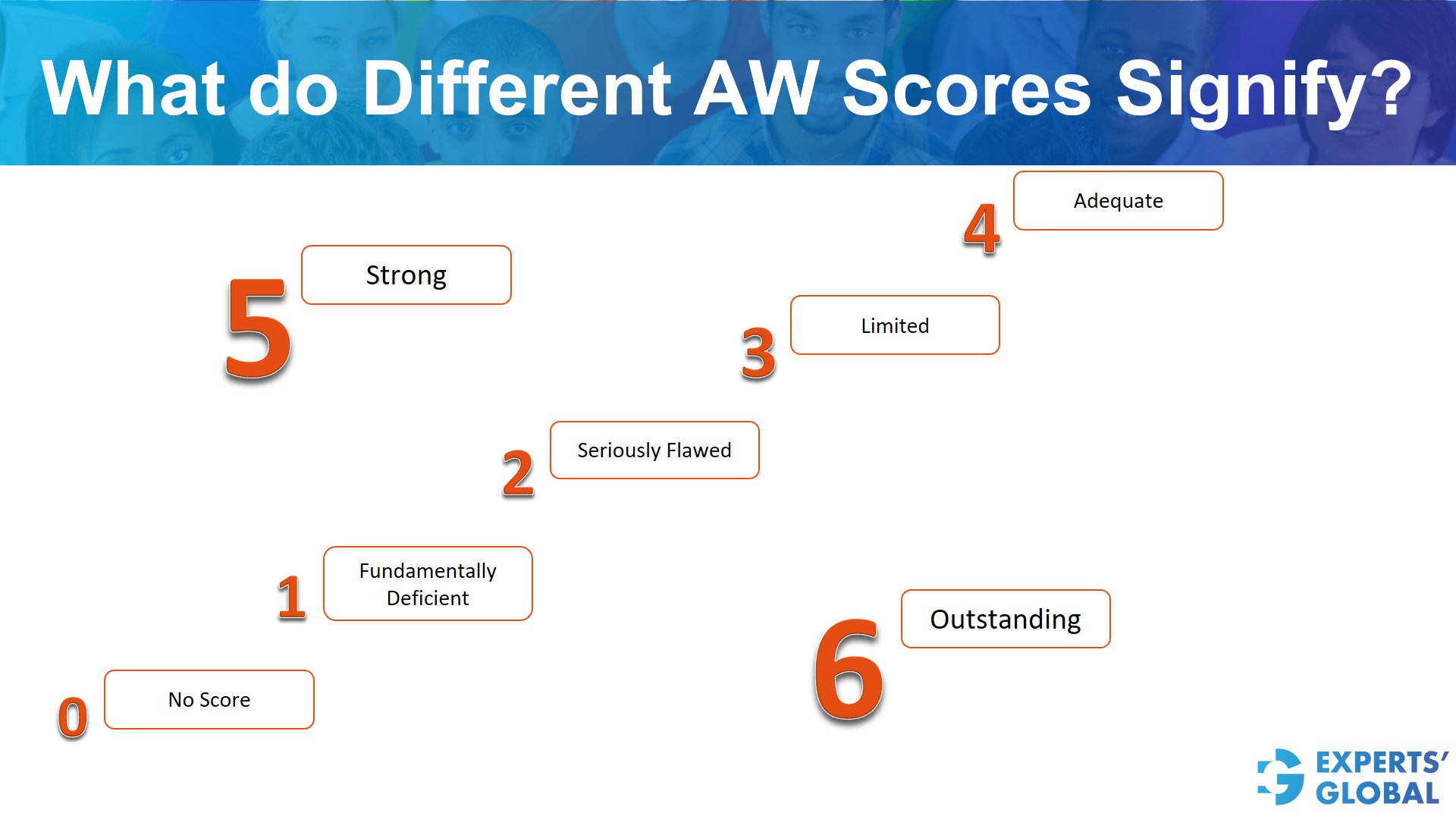

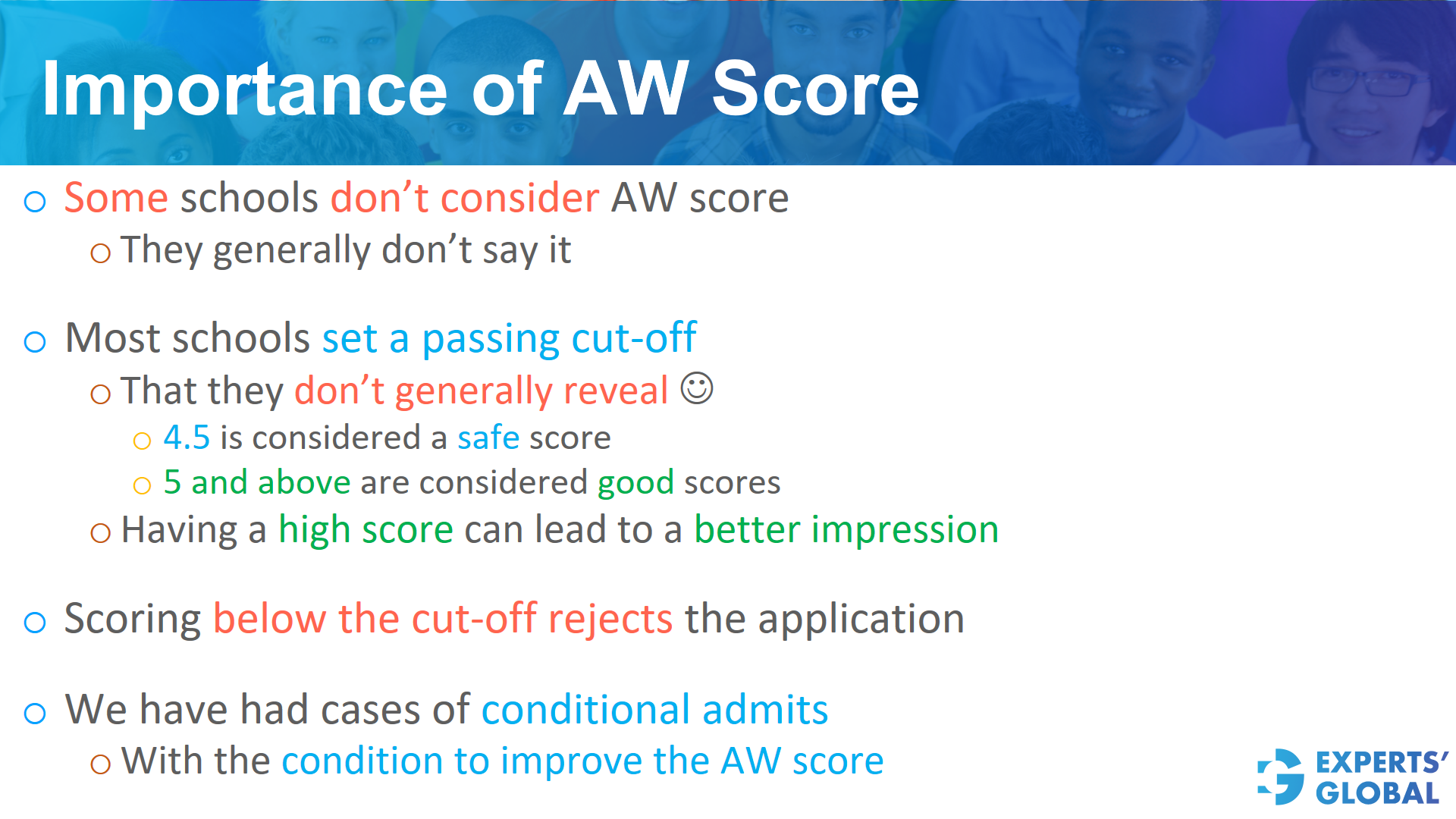
The AW score plays a role in how applications are reviewed by schools, even though some schools do not treat it as a primary factor and usually do not clearly state how they evaluate it. Many schools set a passing cut off for the AW score, but this cut off is typically not shared openly. A score of 4 to 4.5 is widely viewed as a safe score, while scores of 5 and above are seen as good scores that help create a stronger overall impression in the application. Meeting the required cut off keeps the application eligible for review, which makes the score an important checkpoint. There have also been cases where schools offer conditional admits, and in such situations the condition involves improving the AW score after admission, showing that this score carries meaningful weight in the overall process.
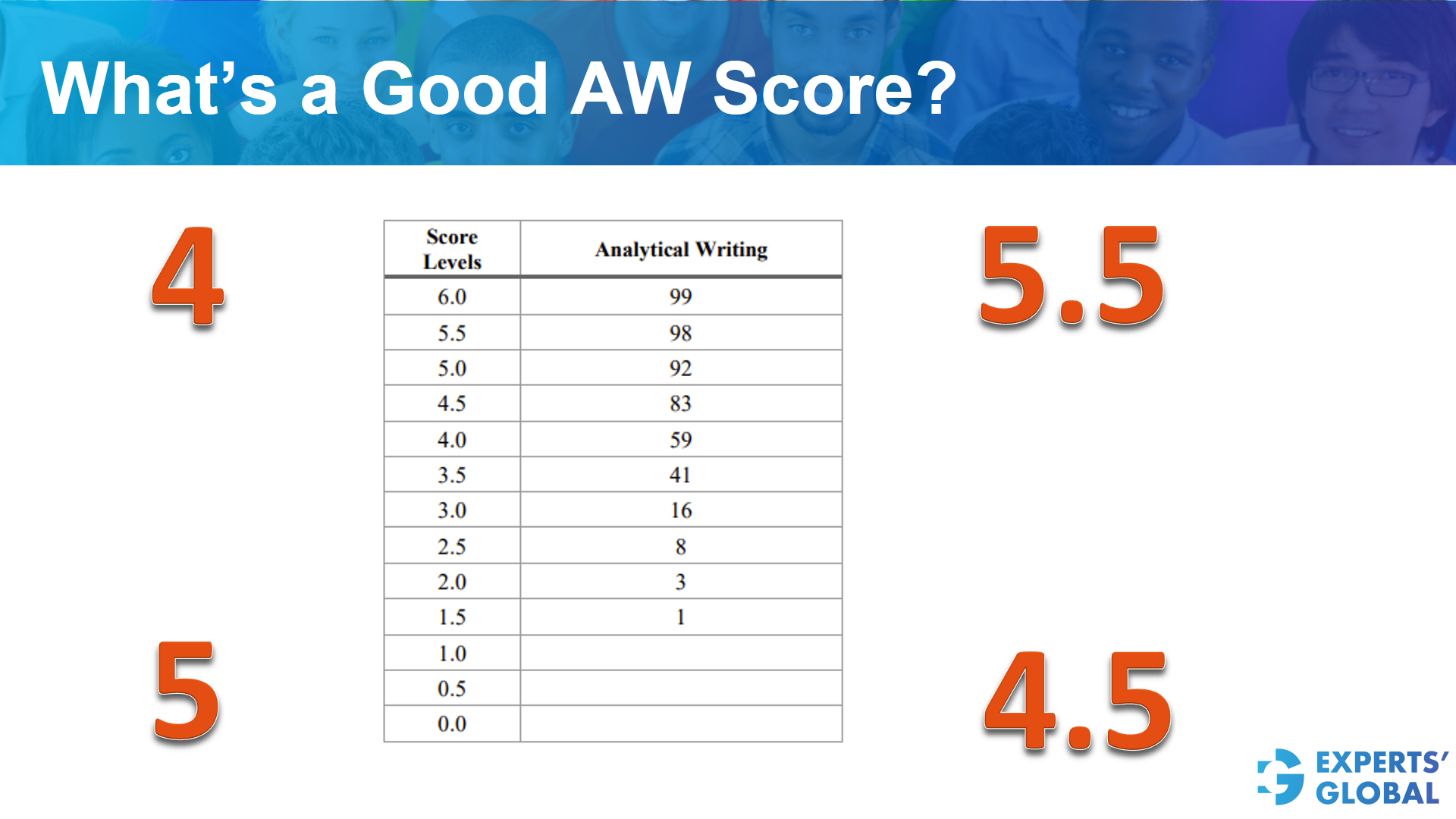
The slide highlights score ranges that commonly define a good level of performance in GRE Analytical Writing and presents scores such as 4.0, 4.5, 5.0, and 5.5 as key reference points. A score of 4.0 represents a decent level of performance, while a score of 4.5 is widely viewed as a strong and safe score. A score of 5.0 reflects a high level of writing quality, and a score of 5.5 reflects an excellent level of performance. The table also shows how different score levels align with percentile standing in Analytical Writing, making it clear that higher scores correspond to stronger percentile positions on the scale and signal stronger overall writing ability.
| Score level | Analytical Writing percentile |
|---|---|
| 6.0 | 99 |
| 5.5 | 98 |
| 5.0 | 92 |
| 4.5 | 83 |
| 4.0 | 59 |
| 3.5 | 41 |
| 3.0 | 16 |
| 2.5 | 8 |
| 2.0 | 3 |
| 1.5 | 1 |
| 1.0 | |
| 0.5 | |
| 0.0 |
GRE prep course with 7-day free trial
15 full length GRE practice tests
60 sectional GRE practice tests
