
Invest 30 seconds...
...for what may lead to a life altering association!
Help Line
- +91.8800.2828.00 (IND)
- 1030-1830 Hrs IST, Mon-Sat
- support@expertsglobal.com
33% off ends soon:GMAT/GRE prep + applications bundle. Profile building, longer mentoring, better results. Inquire

LCM, the least common multiple, is the smallest number divisible by all numbers in a given set, and HCF, the highest common factor, also referred to as GCD or greatest common divisor, is the greatest number that divides each number in the set. For example, for the set 6, 8, 12, and 20, the LCM is 120 and the HCF is 2. These simple ideas lead to a wide variety answer of layered and nuanced GRE questions and word problems.
The following conceptual video, part of our online GRE preparation course, duly covers the concept of LCM and HCF for GRE. It defines the terms, explains how to find LCM and HCF for a set of numbers, outlines how these concepts commonly appear on the GRE Quantitative section, and then applies them to multiple GRE-style problems so you gain first-hand experience using them. Take your time to absorb the ideas and apply them consistently in your further GRE preparation, GRE drills, GRE sectional mock tests, and GRE mock tests.
After you have grasped the basics of least common multiple and highest common factor, it’s time for some deeper practice. Solve the three conceptual questions that follow to apply LCM and HCF in GRE style scenarios. Pause the video at each question, solve it on your own, then use the explanations thoughtfully to extract maximum learning.
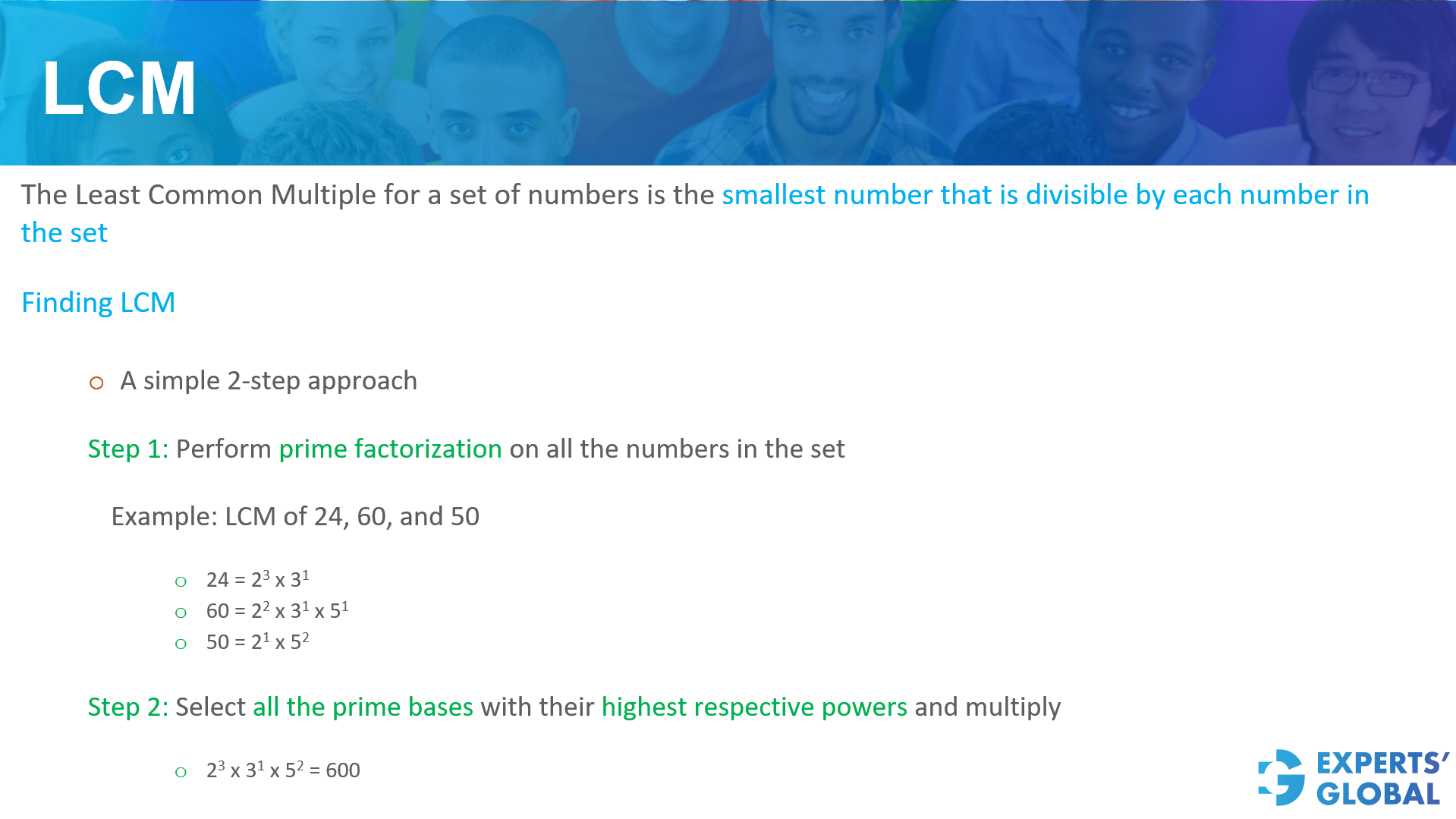
The Least Common Multiple for a set of numbers is the smallest number that is divisible by each number in the set.
A simple 2-step approach can be used to determine the LCM of a group of numbers:
Break down each number into its prime factors expressed with exponents.
Identify every unique prime base present across all factorizations. For each base, take the highest exponent found in any single factorization and multiply them together.
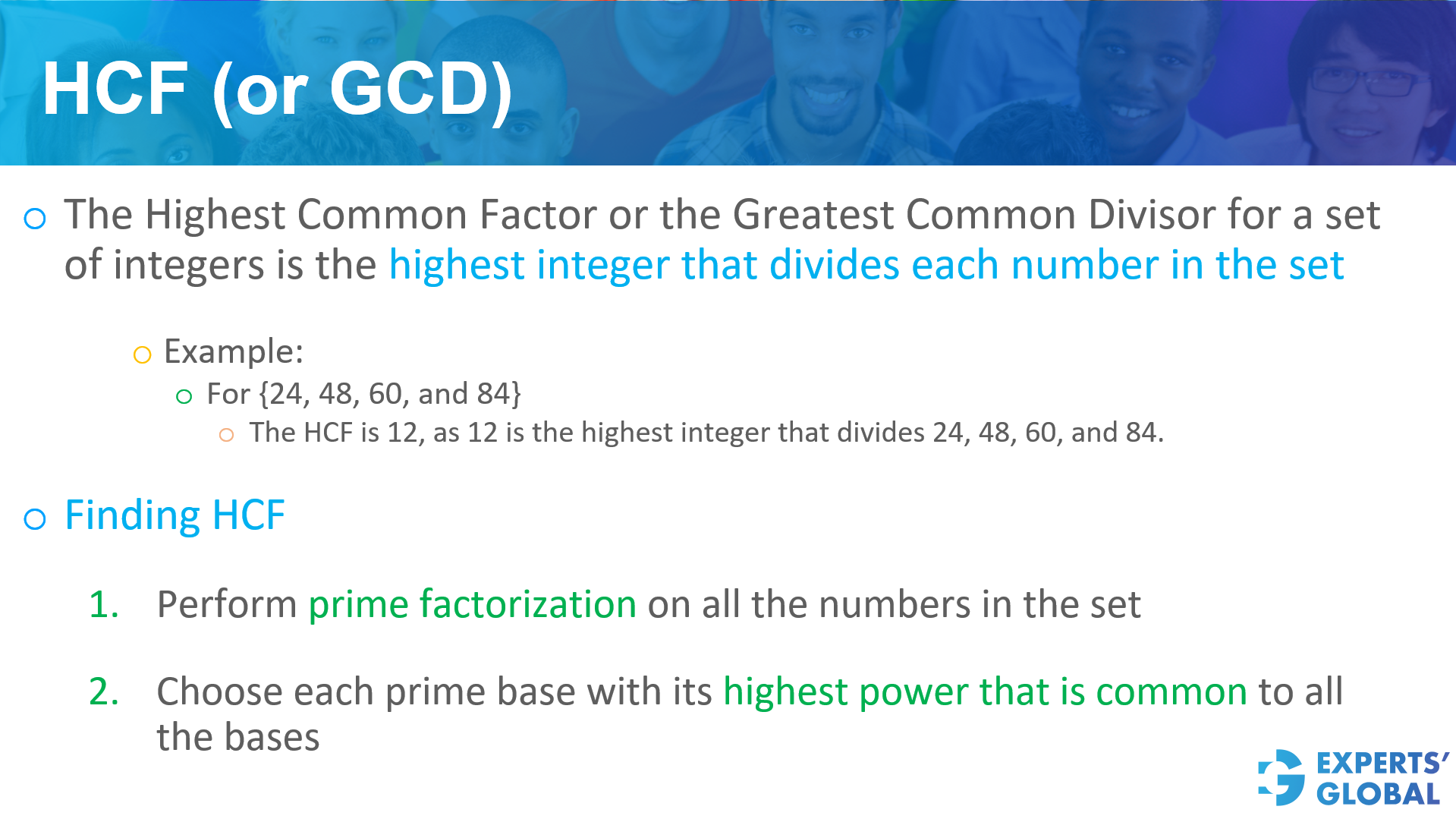
The Highest Common Factor (HCF), also known as the Greatest Common Divisor (GCD), for a set of integers is the highest integer that divides each number in the set.
For example, for the set {24, 48, 60, and 84}, the HCF is 12 because 12 is the highest integer that divides all four numbers.
To find the HCF of a set of numbers, follow these steps:
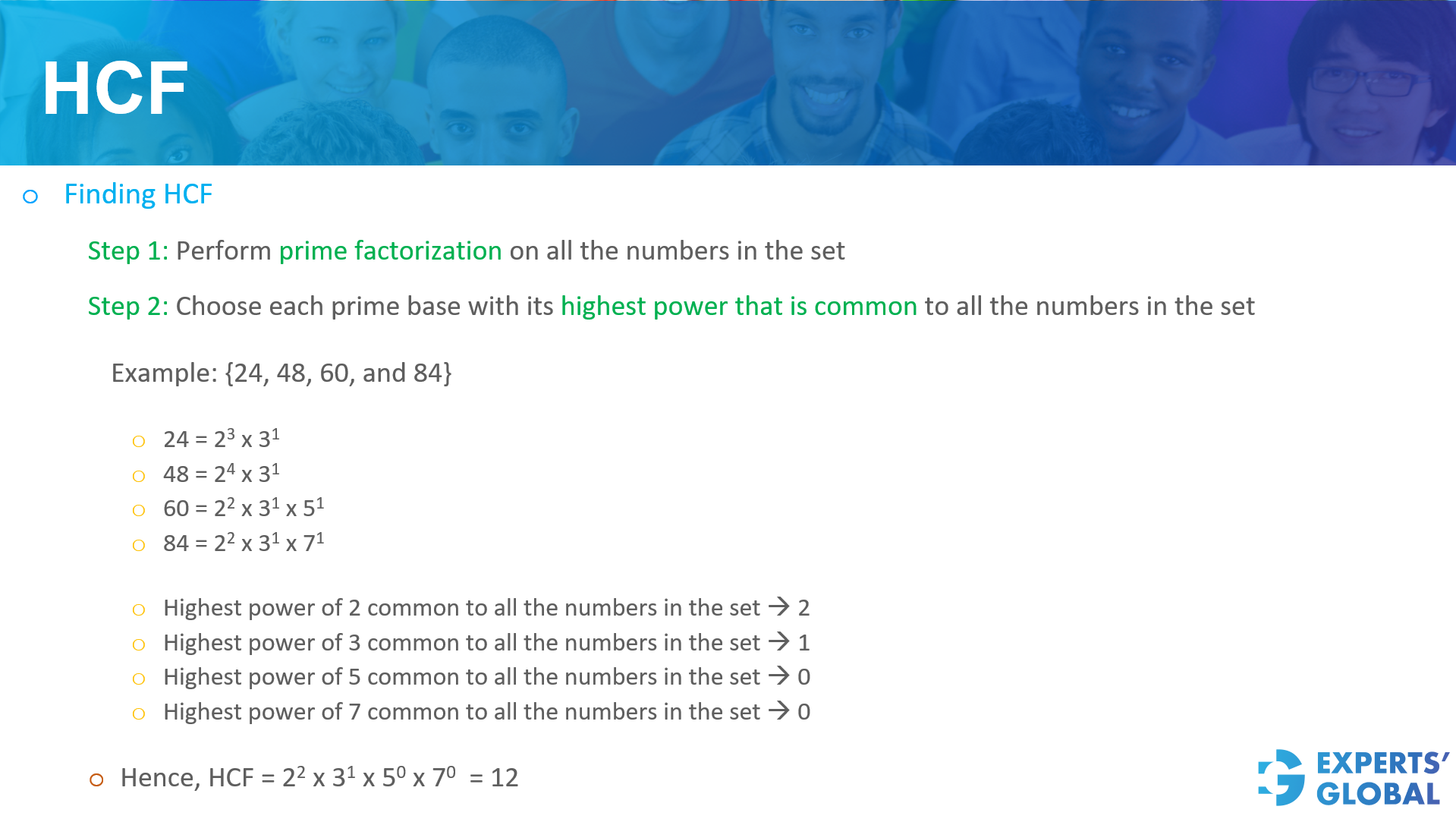
The Highest Common Factor (HCF) of a set of numbers can be determined through prime factorization using a two-step process:
To find the HCF of the set {24, 48, 60, and 84}, the numbers are first broken down into their prime factors:
Next, determine the highest power for each prime base that is present in all four numbers:
The final HCF is calculated by multiplying these common powers together:
HCF = (2)² x (3)¹ x (5)0 x (7)0 = 12
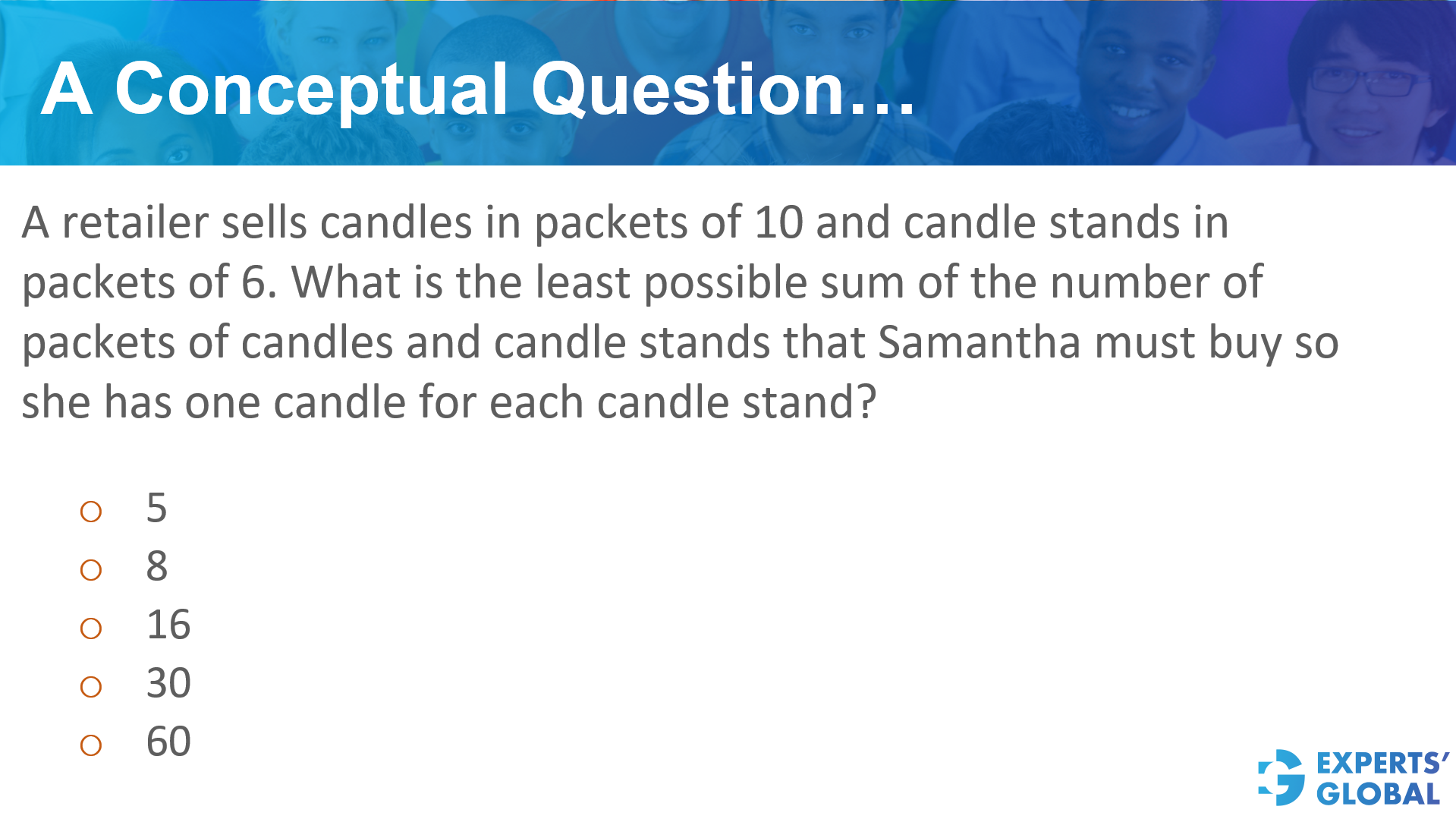
Correct Answer: B
For a detailed explanation, please refer to the video presented earlier on this page.
Following is a concise, step-wise written explanation…
A retailer sells candles in packets of 10 and candle stands in packets of 6. What is the least possible sum of the number of packets of candles and candle stands that Samantha must buy so she has one candle for each candle stand?
To have an equal number of candles and stands, we need to find the Least Common Multiple (LCM) of 10 and 6.
The smallest number they both share is 30. This means she needs 30 of each item.
Correct Answer: B
Correct Answers
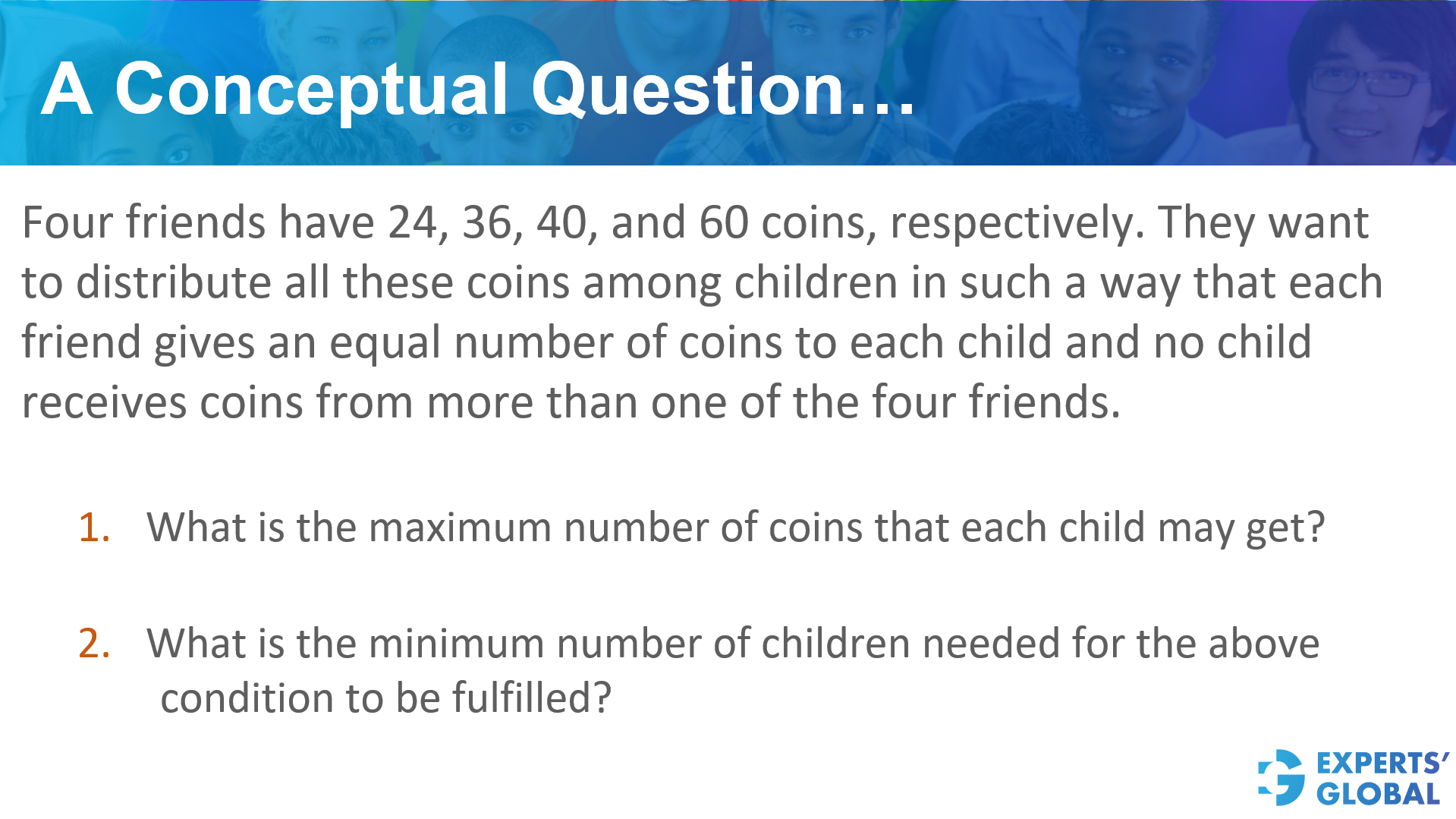
1. 4 coins
2. 40 children
For a detailed explanation, please refer to the video presented earlier on this page.
Following is a concise, step-wise written explanation…
Four friends have 24, 36, 40, and 60 coins, respectively. They want to distribute all these coins among children in such a way that each friend gives an equal number of coins to each child and no child receives coins from more than one of the four friends.
To find the maximum number of coins that can be given equally by each friend, we need to find the Highest Common Factor (HCF) of 24, 36, 40, and 60.
The largest number that appears in all four lists is 4.
To get the minimum number of children, we divide the total number of coins each friend has by the maximum number of coins per child (4).
Total children = 6 + 9 + 10 + 15 = 40
Correct Answers
1. 4 coins
2. 40 children
Correct Answer B
Quantity B is greater.
For a detailed explanation, please refer to the video presented earlier on this page.
Following is a concise, step-wise written explanation…
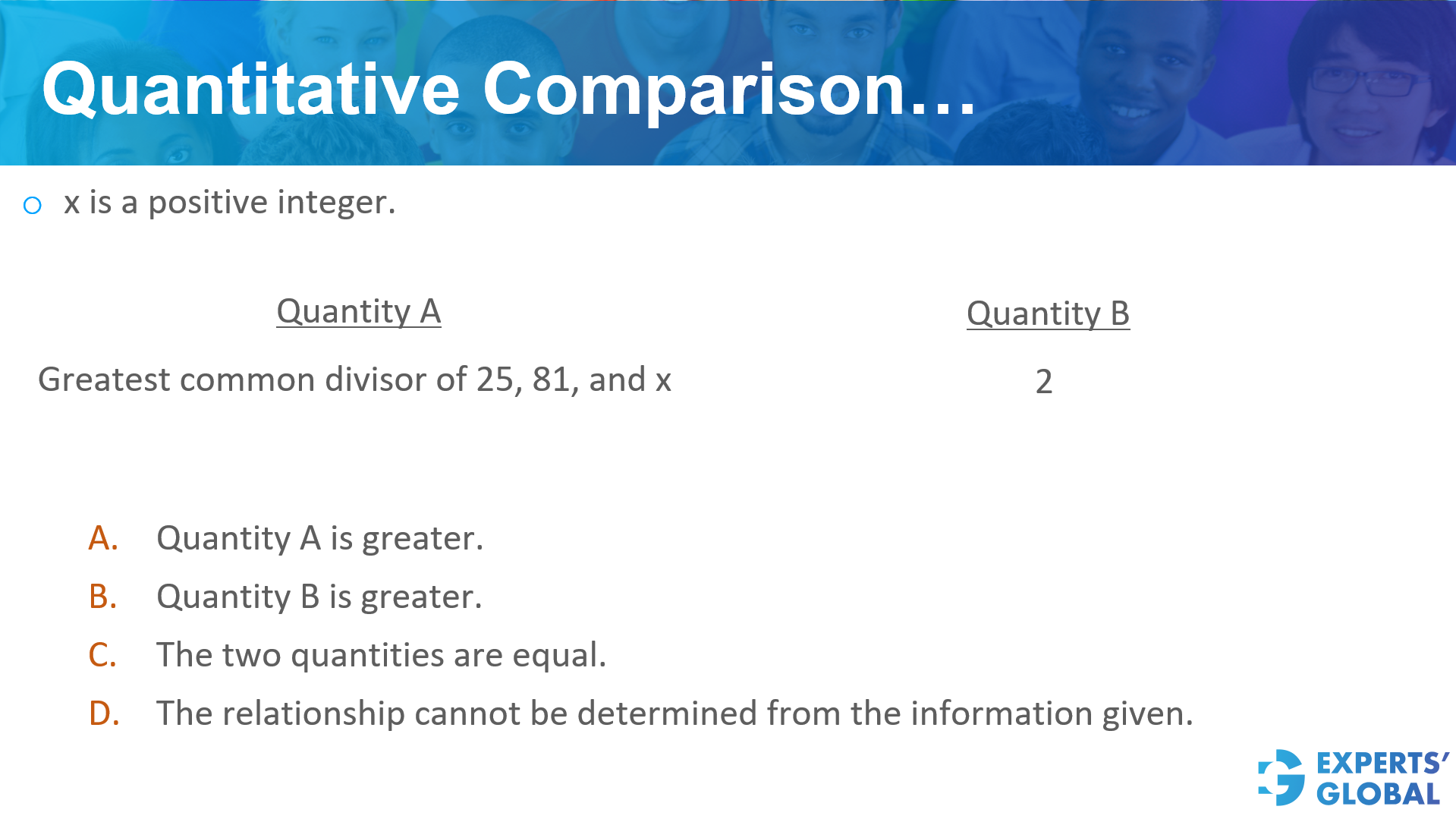
x is a positive integer.
Quantity A
Greatest common divisor of 25, 81, and x
Quantity B
2
The prime factors of 25 are 5 * 5. The prime factors of 81 are 3 * 3 * 3 * 3.
The numbers 25 and 81 do not share any prime factors. Their only common divisor is 1.
The greatest common divisor (GCD) of 25, 81, and any other number x must be a factor of the GCD of 25 and 81. Since the GCD of 25 and 81 is 1, the GCD of 25, 81, and x must be 1, regardless of the value of x. Quantity A is 1.
Quantity A is 1.
Quantity B is 2.
2 is greater than 1.
Correct Answer B
Quantity B is greater.
15 full length GRE practice tests
60 sectional GRE practice tests
Free full length GRE diagnostic test
GRE prep course with 7-day free trial
GRE prep with admission consulting bundle
