
Invest 30 seconds...
...for what may lead to a life altering association!
Help Line
- +91.8800.2828.00 (IND)
- 1030-1830 Hrs IST, Mon-Sat
- support@expertsglobal.com
33% off ends soon:GMAT/GRE prep + applications bundle. Profile building, longer mentoring, better results. Inquire

A percentage means out of 100, and this simple definition helps you compare parts of a whole with ease. By converting values into percentages, you gain a clear view of size, change, and proportion in a consistent format. This idea sits at the core of arithmetic and supports how quantities relate to each other in everyday math. From this basic meaning, a wide range of interesting, layered, and nuanced questions take shape. On the GRE, percentage-based questions appear in varied forms, across multiple question formats, and within word problems that test comparison, change, and proportional reasoning.
The following video, part of our end-to-end GRE preparation course, explains percentages in a simple and structured manner. It shows how to interpret percentage values, work through calculations, handle percentage changes, and manage situations with varying bases. The video then applies the method on GRE-style problems so you experience the application first-hand. Use this learning steadily across your GRE prep, practice exercises, GRE sectional mock tests, and GRE mock tests.
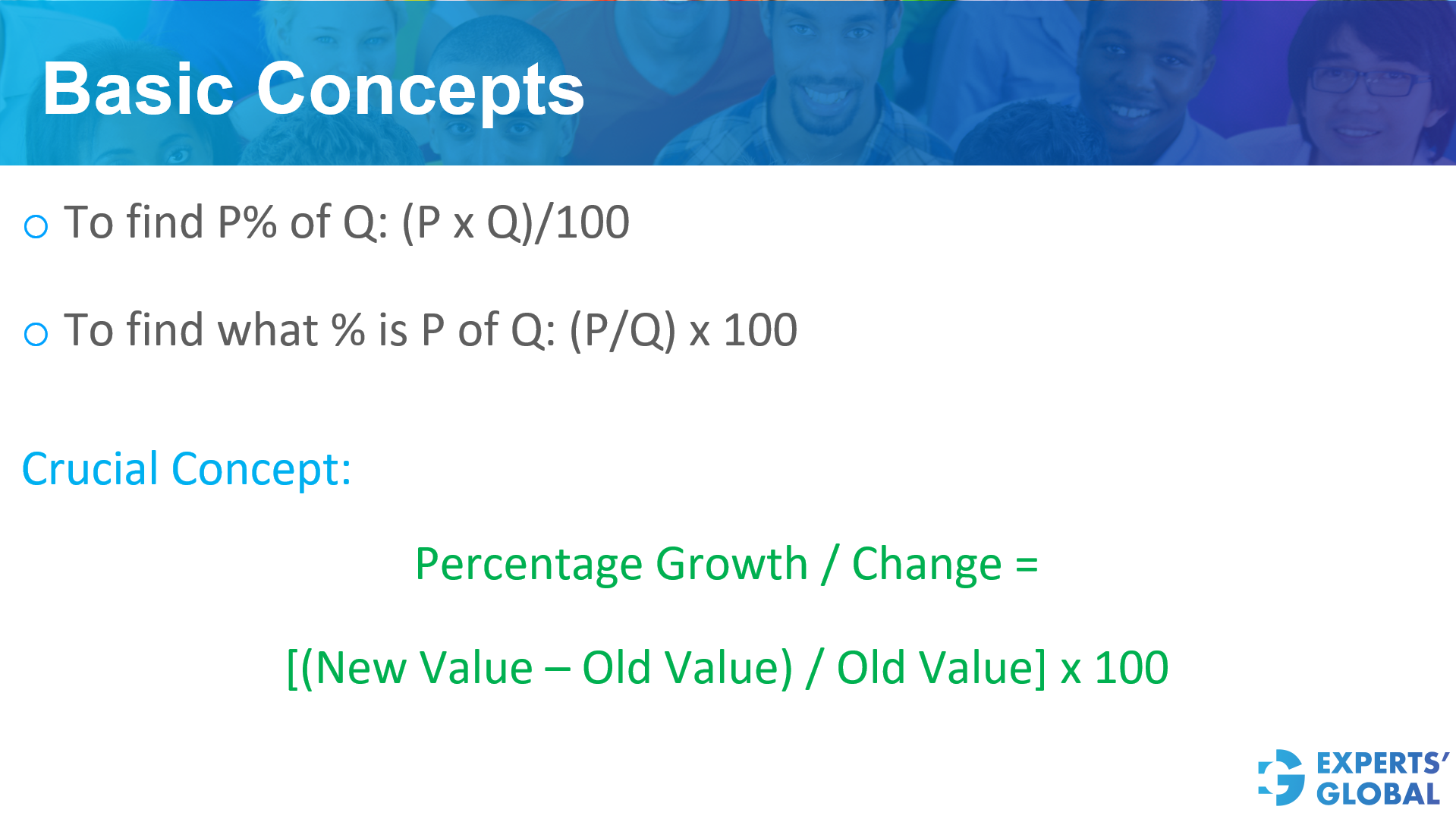
Understanding percentages is essential for basic data analysis and financial calculations. The primary methods for determining values and changes include:
A critical concept for measuring progress or fluctuation over time is percentage growth or change. This is calculated by comparing a new value against an original value using the following formula:
Percentage Growth / Change = [(New Value – Old Value) / Old Value] * 100
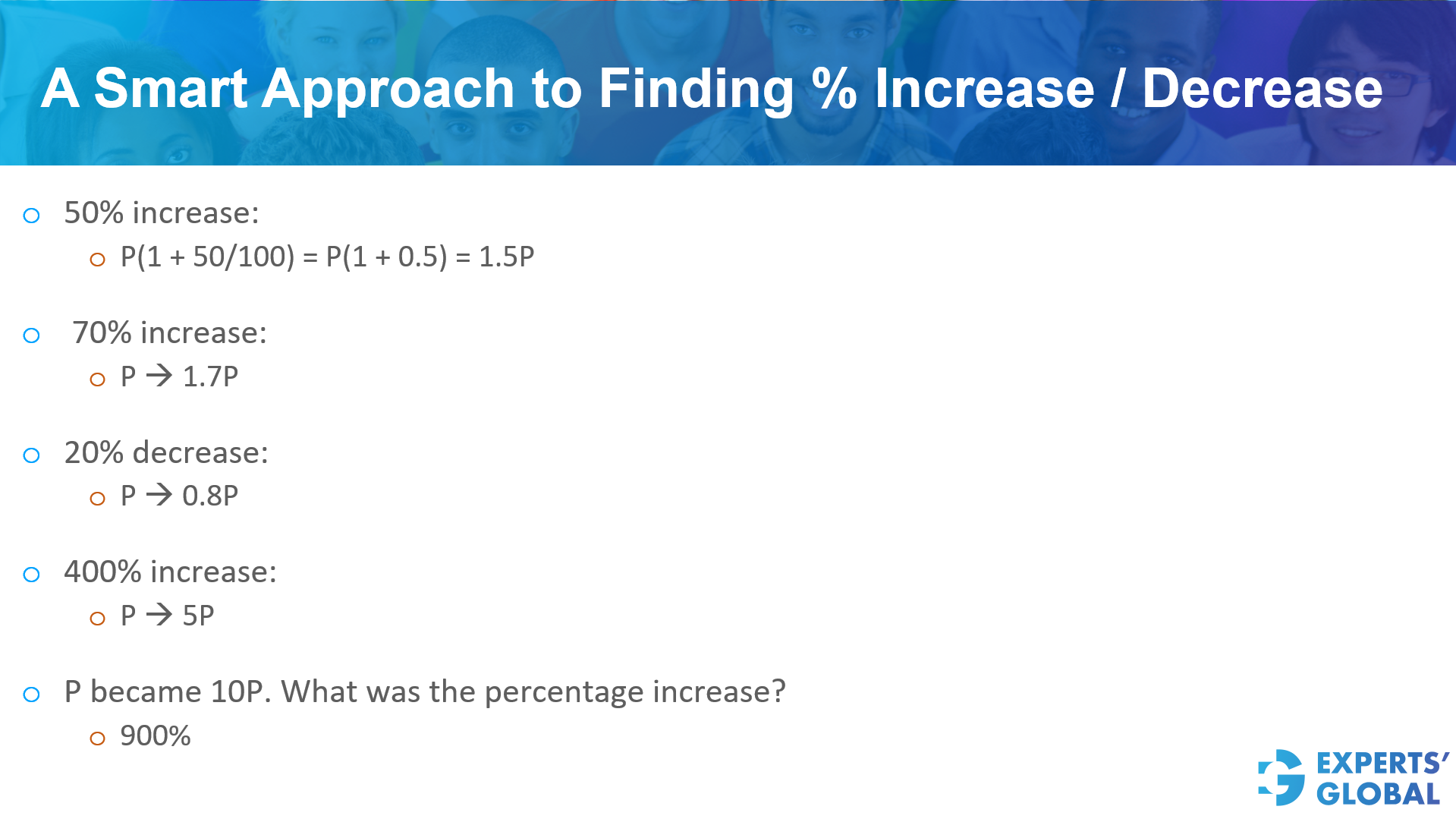
Finding percentage increases and decreases can be simplified by using a multiplier applied to the original value, often represented as P.
To find a new value after a percentage increase, add the decimal equivalent of the percentage to 1 and multiply it by the original value.
To find a new value after a percentage decrease, subtract the decimal equivalent of the percentage from 1 and multiply it by the original value.
If you know the final value relative to the original, you can determine the percentage increase by looking at the difference from the base of 1.
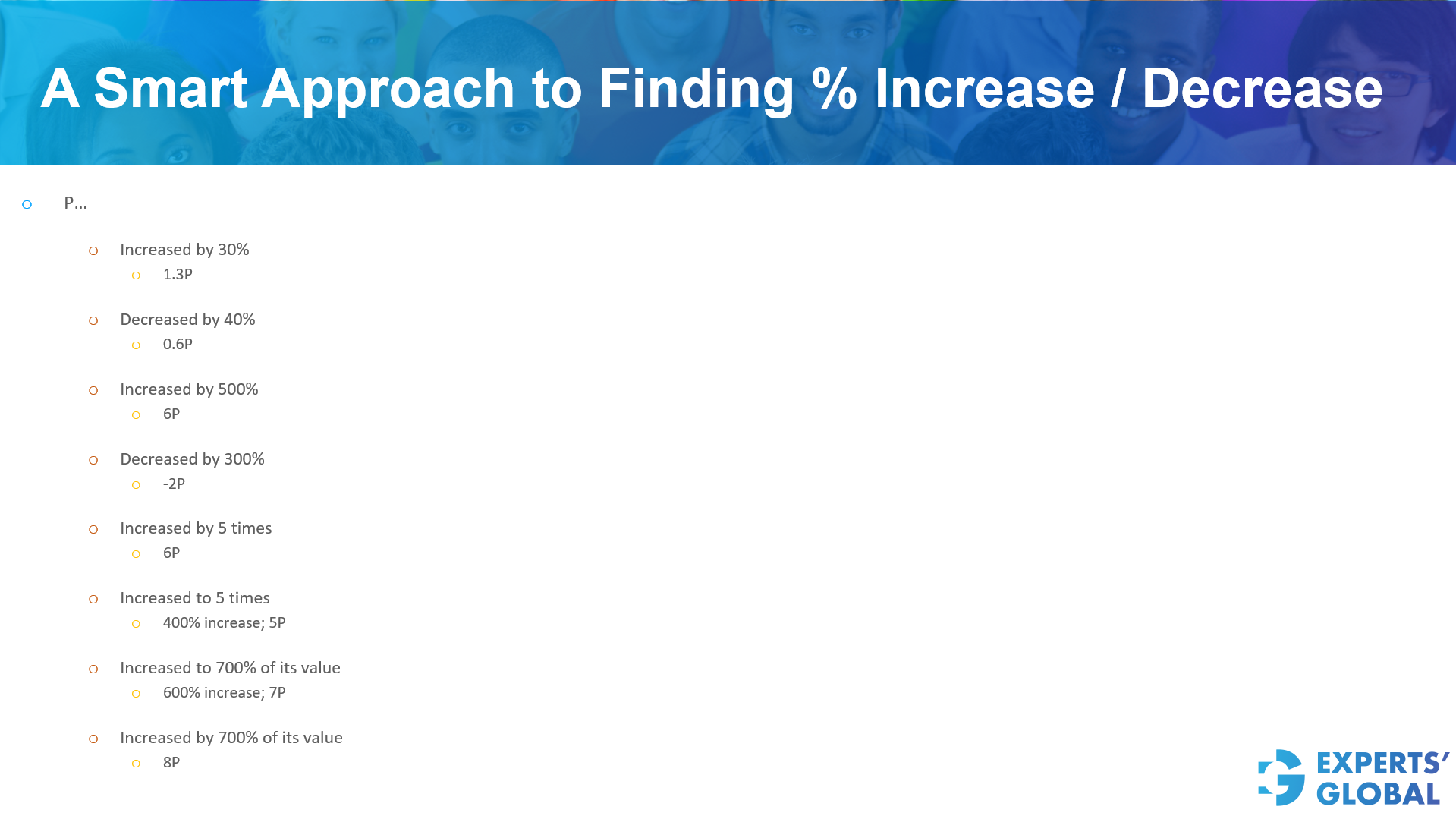
To calculate percentage increases and decreases relative to an initial value P, you can use the following multipliers and logic:
This results in 1.3P.
This results in 0.6P.
This results in 6P.
This results in -2P.
This is equivalent to adding 5 times the original value, resulting in 6P.
This represents a 400% increase, resulting in 5P.
This represents a 600% increase, resulting in 7P.
This results in 8P.
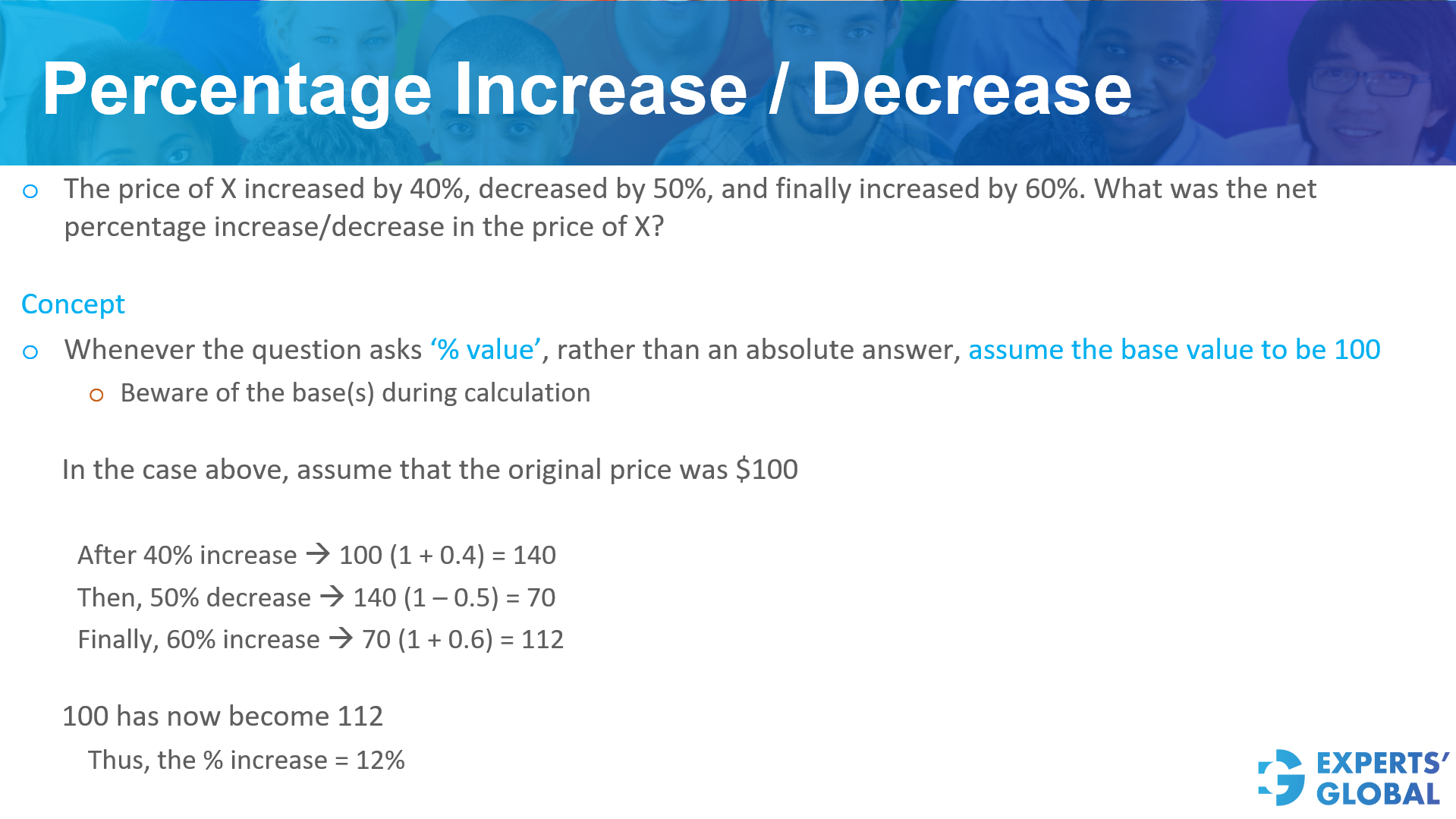
Correct Answer: 12 percent increase.
For a detailed explanation, please refer to the video presented earlier on this page.
Following is a concise, step-wise written explanation…
The price of X increased by 40 percent, decreased by 50 percent, and finally increased by 60 percent. What was the net percentage increase/decrease in the price of X?
Assume the original price of X is 100.
This makes calculating percentages very easy.
40 percent of 100 is 40.
New price = 100 + 40 = 140.
Now take 50 percent of the new price (140).
50 percent of 140 is 70.
New price = 140 – 70 = 70.
Finally, take 60 percent of the current price (70).
Calculation: 70 * 0.60 = 42.
Final price = 70 + 42 = 112.
The price started at 100 and ended at 112.
The difference is 12.
Since it started at 100, a change of 12 is exactly 12 percent.
Correct Answer: 12 percent increase
Correct Answer: 80% increase
For a detailed explanation, please refer to the video presented earlier on this page.
Following is a concise, step-wise written explanation…
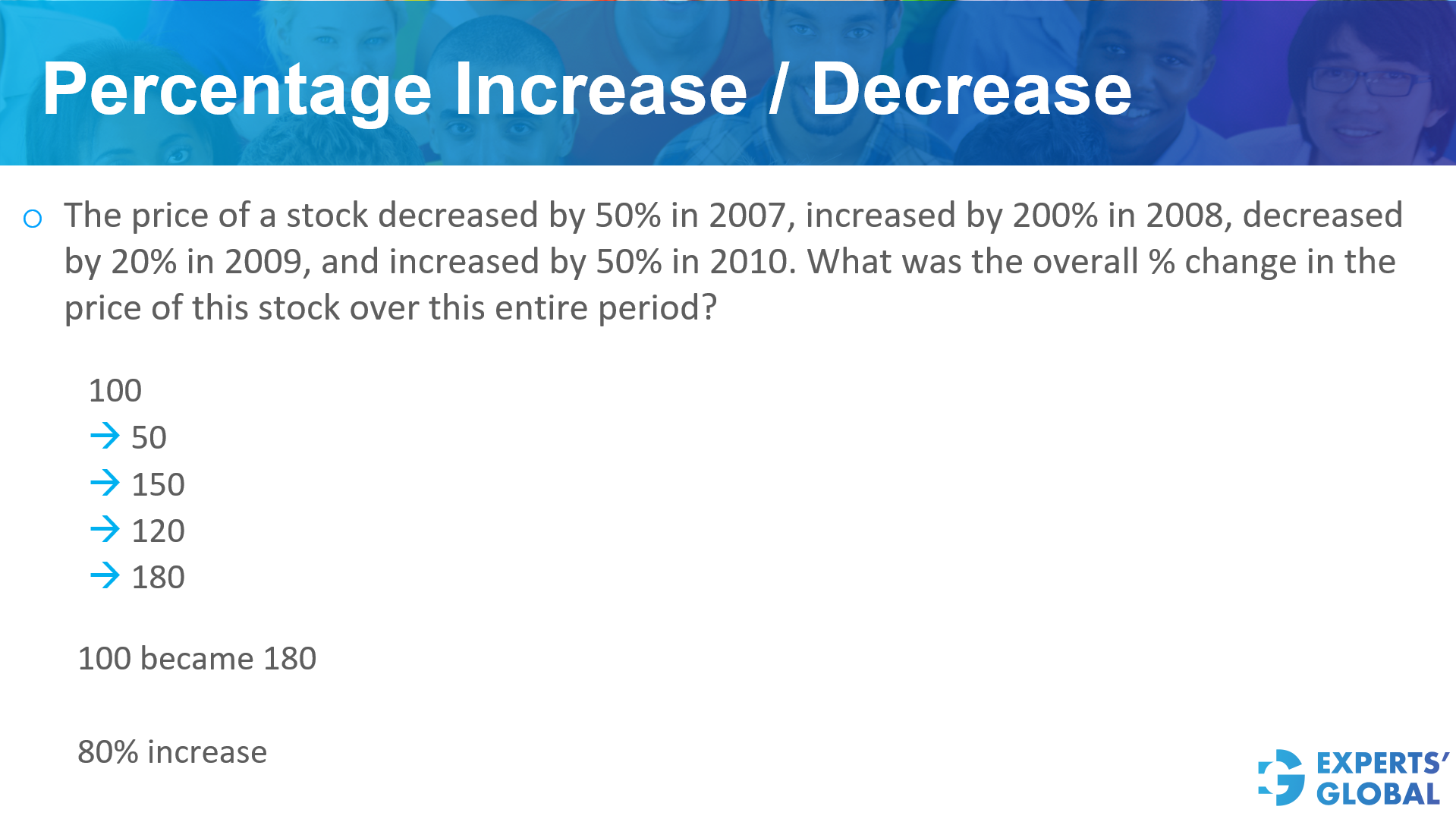
The price of a stock decreased by 50% in 2007, increased by 200% in 2008, decreased by 20% in 2009, and increased by 50% in 2010. What was the overall % change in the price of this stock over this entire period?
Start with a base price of 100 to make calculations easy.
In 2007, the price drops by 50%.
Calculate 50% of 100 which is 50.
New price: 100 – 50 = 50.
In 2008, the price grows by 200%.
Calculate 200% of 50.
Since 100% of 50 is 50, then 200% is 100.
New price: 50 + 100 = 150.
In 2009, the price drops by 20%.
Calculate 20% of 150.
Since 10% is 15, then 20% is 30.
New price: 150 – 30 = 120.
In 2010, the price grows by 50%.
Calculate 50% of 120 which is 60.
New price: 120 + 60 = 180.
Compare the final price to the starting price.
Start: 100. End: 180.
The increase is 80 points.
Because we started at 100, an 80 point increase is exactly 80%.
Correct Answer: 80% increase
Correct Answer: 20%.
For a detailed explanation, please refer to the video presented earlier on this page.
Following is a concise, step-wise written explanation…
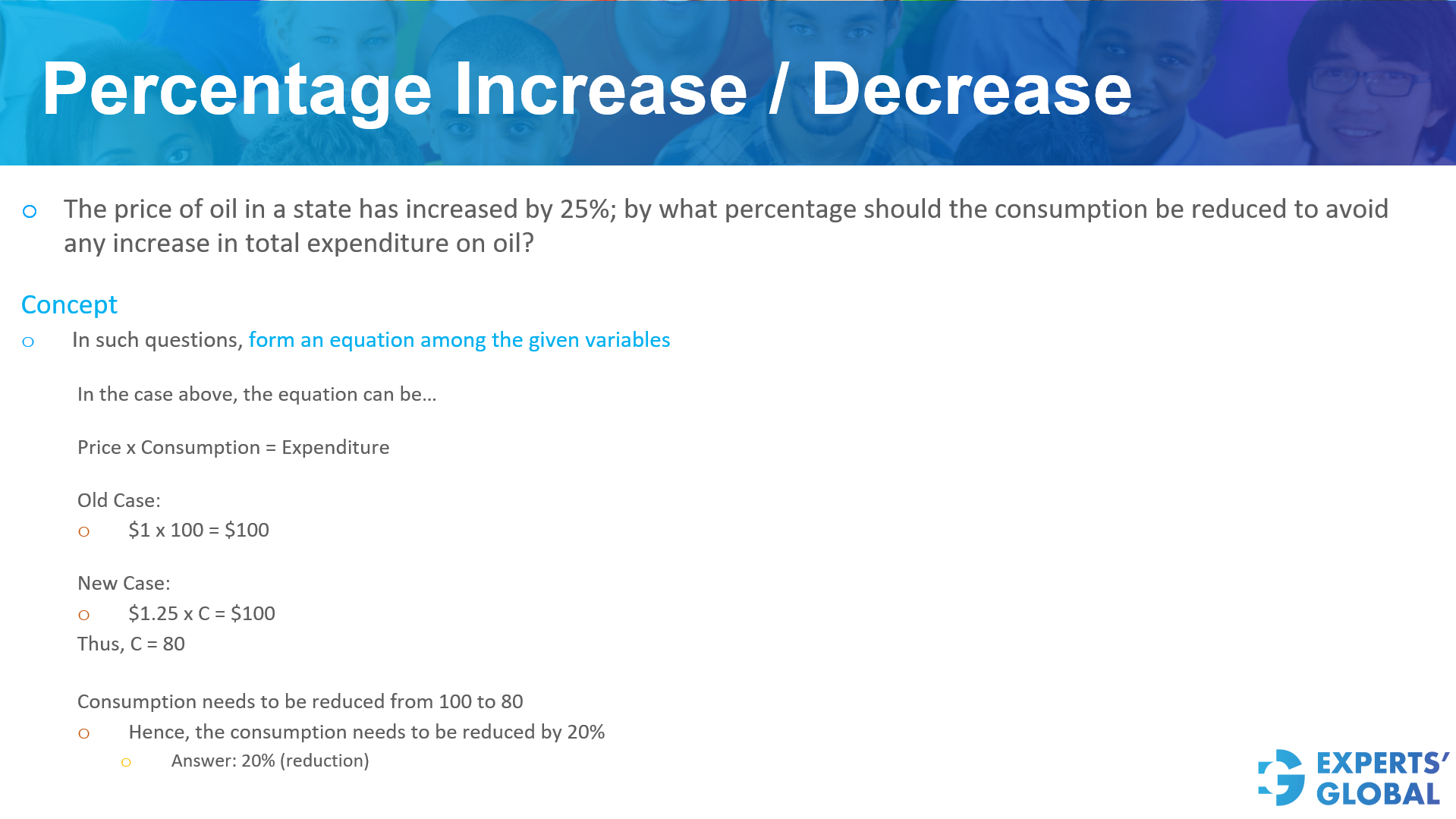
The price of oil in a state has increased by 25%; by what percentage should the consumption be reduced to avoid any increase in total expenditure on oil?
Price * Consumption = Total Expenditure
If the Price goes up, the Consumption must go down to keep the Expenditure the same.
Let the old price be 100 units and old consumption be 100 units.
Old Expenditure = 100 * 100 = 10,000.
The price increased by 25%.
New Price = 100 + 25 = 125.
Expenditure must stay at 10,000.
Let the new consumption be C.
125 * C = 10,000.
C = 10,000 / 125.
C = 80.
The consumption dropped from 100 to 80.
Reduction = 100 – 80 = 20.
Percentage Reduction = (20 / 100) * 100 = 20%.
Correct Answer: 20%
Correct Answer: 20% (increase).
For a detailed explanation, please refer to the video presented earlier on this page.
Following is a concise, step-wise written explanation…
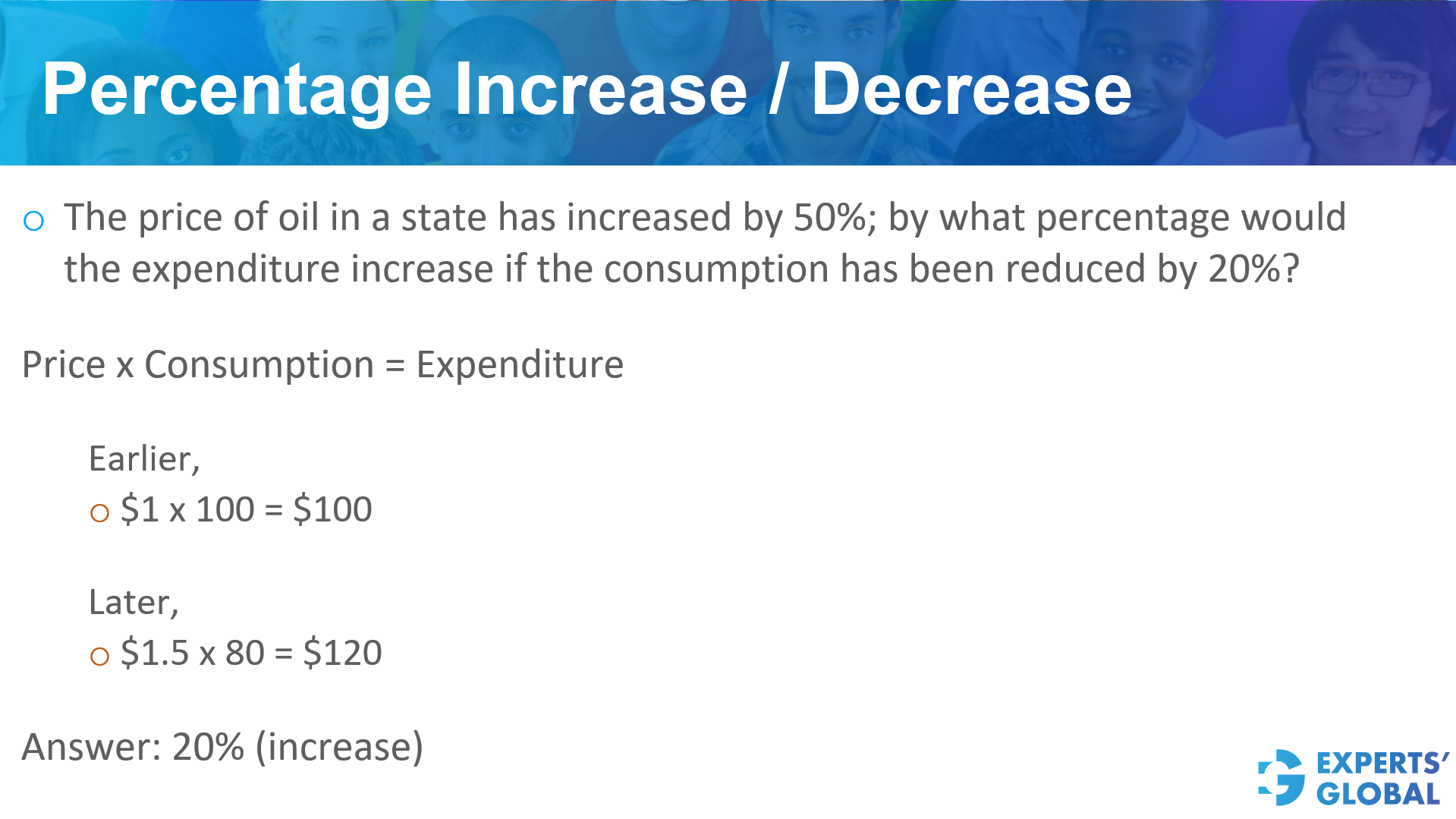
The price of oil in a state has increased by 50%; by what percentage would the expenditure increase if the consumption has been reduced by 20%?
Price x Consumption = Expenditure
Correct Answer: 20% (increase)
Correct Answer: 4% decrease.
For a detailed explanation, please refer to the video presented earlier on this page.
Following is a concise, step-wise written explanation…
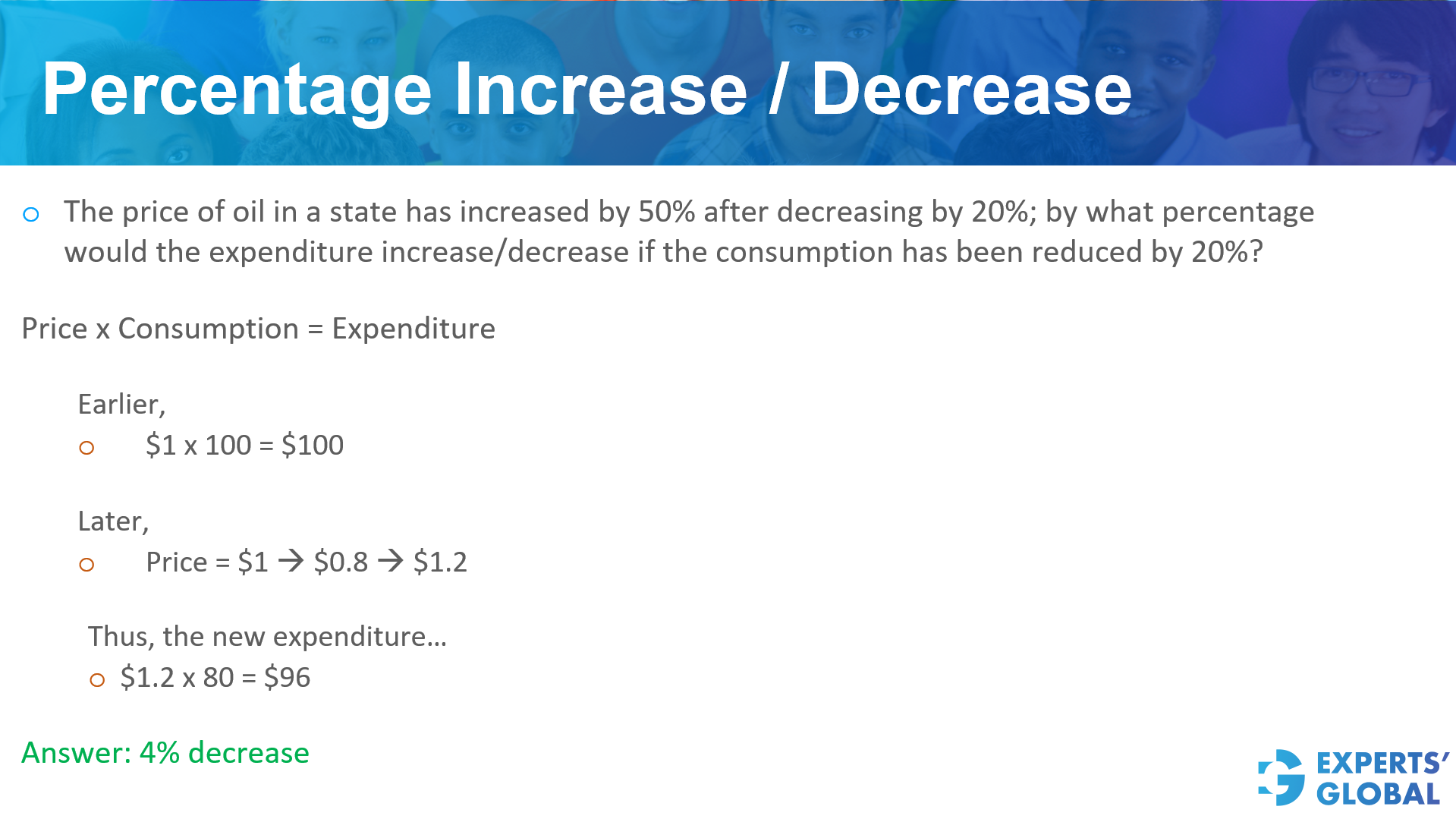
The price of oil in a state has increased by 50% after decreasing by 20%; by what percentage would the expenditure increase/decrease if the consumption has been reduced by 20%?
To keep things simple, let us assume the starting price is 100 and the starting consumption is 100.
Initial Price * Initial Consumption = 100 * 100 = 10,000
First, the price decreased by 20%: 100 – 20 = 80
Next, that price increased by 50%: 80 + (50% of 80) = 80 + 40 = 120
New Price = 120
The consumption was reduced by 20%: 100 – 20 = 80
New Consumption = 80
New Price * New Consumption = New Expenditure 120 * 80 = 9,600
The expenditure went from 10,000 to 9,600. Decrease = 10,000 – 9,600 = 400
Percentage Decrease = (400 / 10,000) * 100 = 4%
Correct Answer: 4% decrease
Comprehensive online GRE prep course
15 GRE practice tests full length
60 GRE practice tests sectional
Free GRE diagnostic test full length
