
Invest 30 seconds...
...for what may lead to a life altering association!
Help Line
- +91.8800.2828.00 (IND)
- 1030-1830 Hrs IST, Mon-Sat
- support@expertsglobal.com
33% off ends soon:GMAT/GRE prep + applications bundle. Profile building, longer mentoring, better results. Inquire

A particularly tricky scenario on GRE Sentence Equivalence questions arises when an answer choice produces a logical and complete sentence on its own but does not have a valid partner choice. These logical but lone options often pull attention away from the correct pair and lead to incorrect attempts despite the sentence reading well. Handling this trap correctly plays a meaningful role in improving accuracy on higher-difficulty Sentence Equivalence questions; thus, due coverage of this trap is essential in a thorough GRE prep course.
The video below explains a sound and practical approach for identifying and eliminating logical but lone answer choices, first clarifying why such options must be rejected and then demonstrating how the correct pair emerges on GRE-style examples with realistic answer choices. The article that follows expands on the same approach in greater detail. Carefully understand the concept, the method, and how they apply, and then carry them forward into GRE practice exercises and full-length GRE mock tests to improve your performance on Sentence Equivalence questions.
Sometimes on GRE sentence equivalence, a word might look perfect in a sentence, but it is actually a trap! It’s a trap because it lacks a partner answer choice.
In Sentence Equivalence, you aren’t just looking for a word that “fits.” Even if a word creates a complete and coherent sentence, it is incorrect if it doesn’t have a partner.
On the GRE, the two correct answers must be synonyms that lead to sentences with EQUIVALENT meanings. If a word makes sense but has no “twin” in the list, it’s a “Lone Answer Choice”—and it’s a trap!
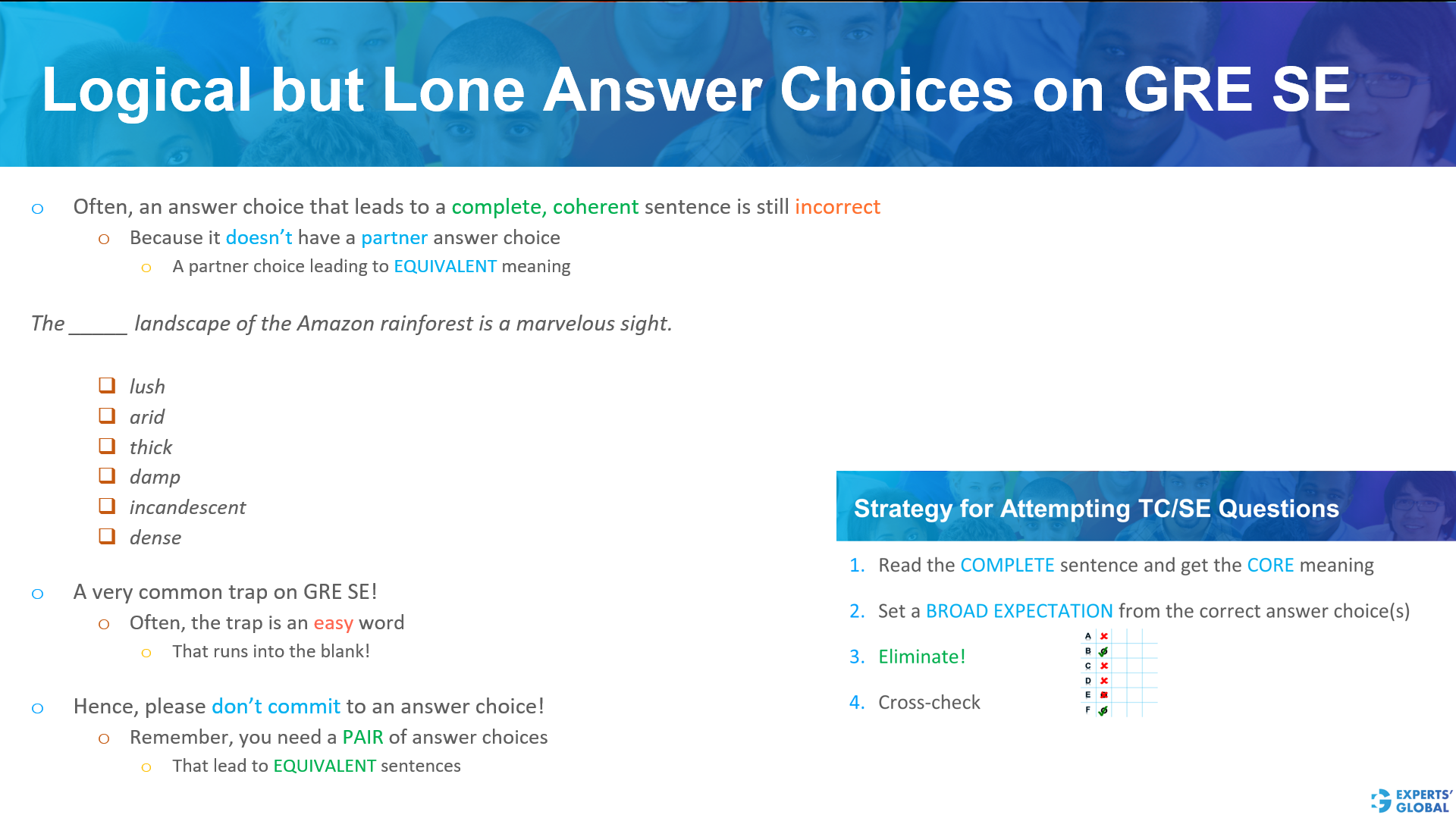
An answer choice may form a complete and coherent sentence and still be incorrect, and this happens when no second option creates an equivalent meaning with it. The sentence here describes the landscape of the Amazon rainforest using a single blank, and six different answer choices fit that blank grammatically, which makes the task more subtle. A single strong sounding word does not meet the requirement by itself because you must identify a pair of choices that produce sentences with the same meaning. This is why you should stay open and attentive as you evaluate each option, continuing the process patiently until a clear matching pair emerges and confirms the correct direction.
For a detailed explanation of the example on the slide, please refer to the video featured earlier on this page.
Don’t commit to an answer choice just because it’s an “easy” word that runs into the blank! Always remember: You need a PAIR.
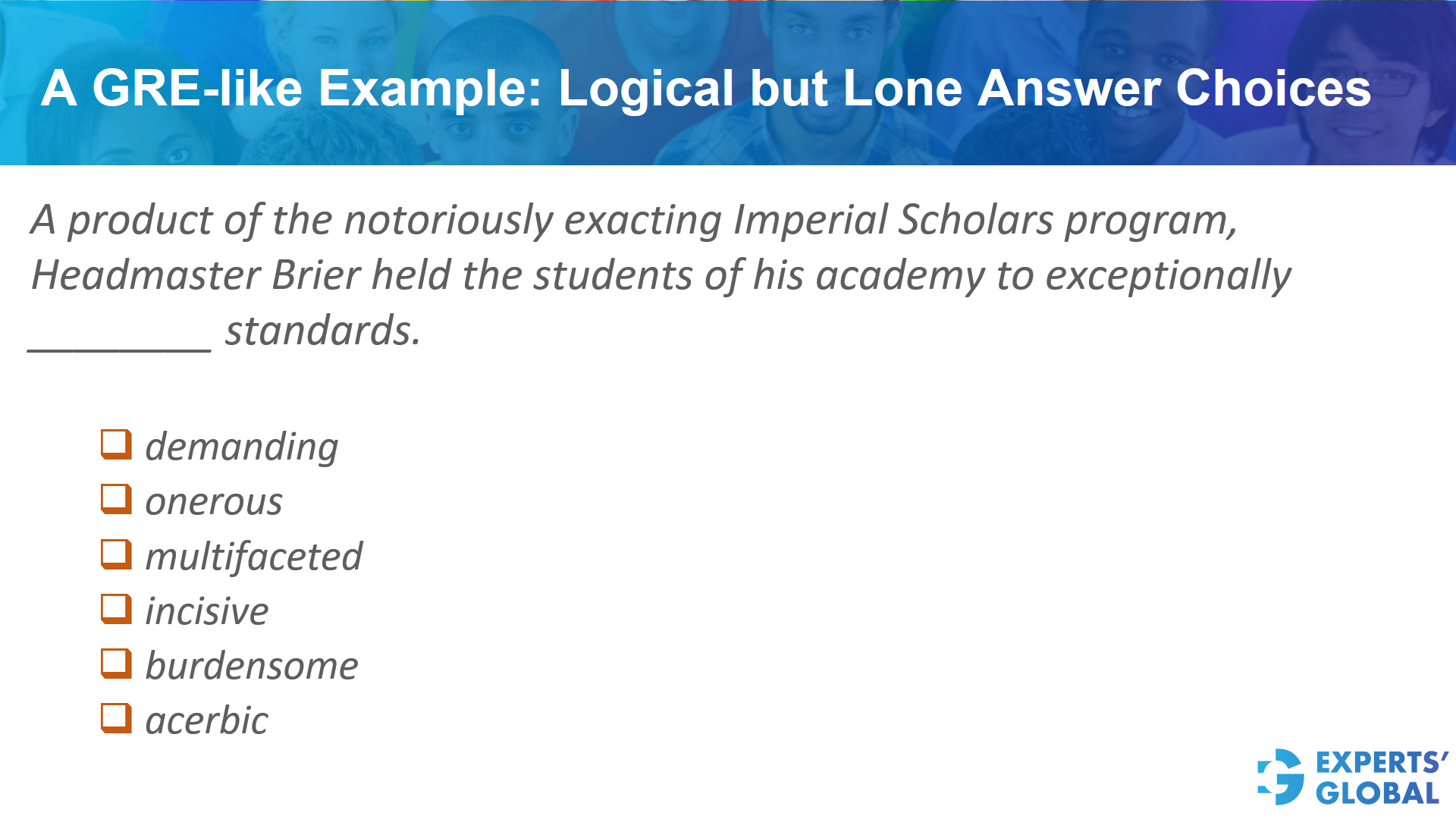
Correct answer: onerous and burdensome.
For a detailed video explanation of this question, please refer to the video featured earlier on this page. Following is a step-by-step written explanation:
A product of the notoriously exacting Imperial Scholars program, Headmaster Brier held the students of his academy to exceptionally _________ standards.
Let’s use our strategy to solve this together exactly as shown on the slide.
Step 1: Read the COMPLETE sentence and get the CORE meaning.
The sentence tells us about Headmaster Brier. He came from a program that was “notoriously exacting,” which means he is used to very high and strict requirements.
Step 2: Set a BROAD EXPECTATION from the correct answer choice(s).
Because he is “exacting,” we expect the blank to be a word that describes standards that are very tough, difficult, or demanding.
Step 3: Eliminate!
Now, let’s look at our choices and use our expectation to filter them:
Step 4: Cross-check.
This is the most important part! We have three words that “logically” fit: demanding, onerous, and burdensome. However, the GRE requires a PAIR of words that create EQUIVALENT meanings.
Final Answer: onerous and burdensome.
GRE preparation course designed for full coverage
15 full length GRE practice exams
Free full length diagnostic GRE exam
